This is Acerola, a super-confident alpha male. He emerged from the long grass

then strolled along the dirt road with a full belly, supremely uninterested in us:

Definitely not a hungry cat.
In the Northern Pantanal, jaguars tend to eat capybara, but in the Southern Pantanal, on these vast cattle ranches, the jaguars most certainly like to eat beef. Ten jaguars on a cattle ranch next door to the one we stayed on were monitored for 2 1/2 years between 2001-2004. The researchers counted their kills, which “were composed of 31.7% cattle (9.8% adults and 21.9% calves), 24.4% caiman (Caiman crocodilus yacare), 21.0% peccaries (mostly Tayassu pecari)”. No other species was above 5% of their diet.
From https://academic.oup.com/jmammal/article/91/3/722/846646
This diet has advantages to the jaguar (lots of juicy cows to eat), but it also poses a threat to their survival. Jaguars are classified by the IUCN as Near Threatened, mainly due to habitat loss and conflicts with cattle ranchers. The Wildlife Conservation Society estimates there are about 5000 left in the Pantanal, and maybe 10,000 in the Amazon.
Some forward-looking landowners are looking for ways to accommodate both cattle and jaguar in a careful balance. We were staying at Caiman, a vast cattle ranch of 131,000 acres, large areas of which are set aside as protected. 76 different jaguars were sighted in 2022, and 200 since 2011. The jaguars coexist with the cattle, and the cattle owners sign contracts agreeing that they must expect up to 3% losses to jaguars, after which they will be compensated. The ranch has a sizable ecotourism program (another revenue source for them), and it also hosts the Onçafari research and rehabilitation project, which studies the animals, and also has the first ever successful program of reintroducing captured animals to the wild. You can read more here..
We followed Acerola one day, and he was behaving oddly. He had his head down in the grass in one spot for a long time, but he did not seem to be eating.
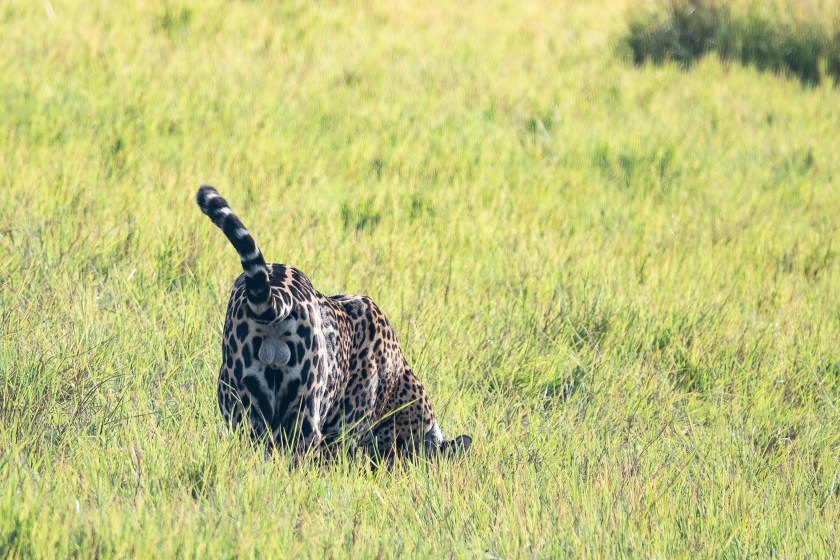
When he eventually raised his head, his expression was very distinctive:
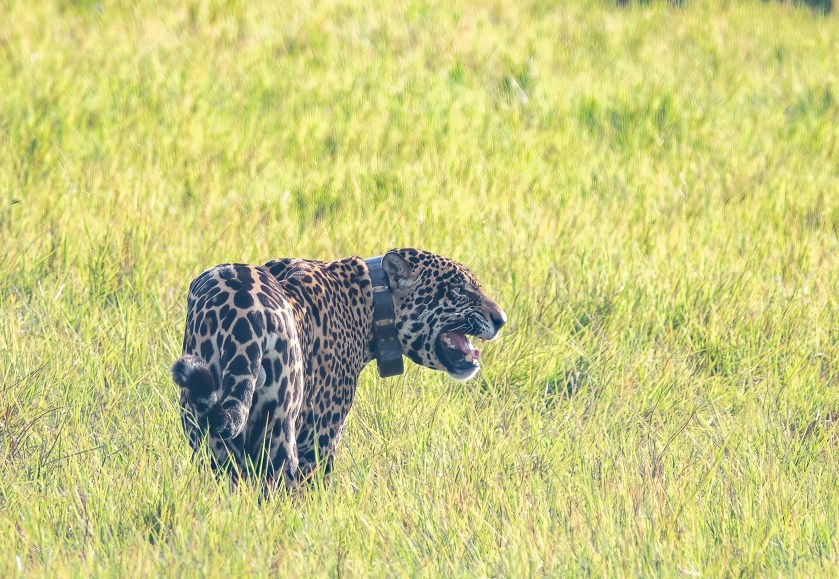
He had been scenting a receptive female, and this expression with his upper lips curled back, mouth open, is called the Flehmen response. It allows her pheromones to reach special receptors on the roof of his mouth just behind his top incisors. This video shows the behavior more clearly; I have cut out most of the very long time that he had his nose down and back to us just sniffing!
It is a privilege to see such magnificent animals in the wild, and coexistence with humans may be their only chance of survival.
 Eyes on the Wild
This explanation of the plan for coexistence gives me hope for the animals of the world. There are too many humans!
LikeLike