The Jabiru Stork, Jabiru mycteria, is a gigantic bird. Its name means “swollen neck” in Guaraní, and at five feet tall, with a nine foot wingspan, it is the largest flying bird in Central and South America.

The bright red skin at the base of the neck changes color with mood; paler when calm:

darker when excited or threatened:

They mate for life, up to 36 years, and nest high in dead trees, returning to the same nest year after year.

The pair below were not even fazed when their tree toppled in a storm: they just nested on top of the truncated stump. The fact that there is a livestock corral right beneath their nest does not disturb them. Not even the cowboys lassoing the bleating lambs:

However, if random people like us come too close, they glower and hood their wings:

Once the eggs (2 to 5 in all) are laid they tend them carefully,

turning them from time to time.

Both parents take turns to tend the nest, so the shift change gives us a chance to see both together.

After a brief overlap, in which one assumes they pass on a report on the condition of the eggs, and advice on when they next need turning, the outgoing shift takes off:
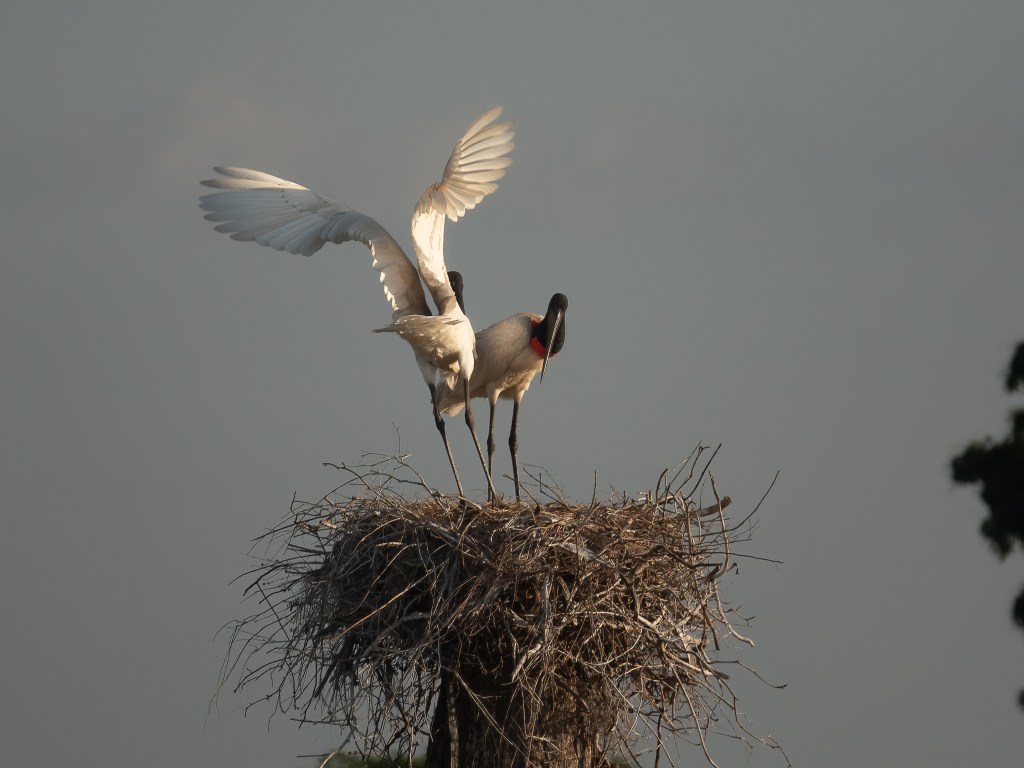
vast wings beating strongly as it heads off to feed.

They eat frogs, fish, insects, and even small rodents. They coexist comfortably with wood storks and various egrets,

as well as rheas, and other large birds. This one nearly landed on a rhea, a large flightless bird up to 1.7m (5′ 7″) tall.

A quiet yoga pose is the image that remains with me.

PS Here is a photo of a pair of the Greater Rheas, Rhea americana, distant relatives of ostrich and emu.

and a close-up.
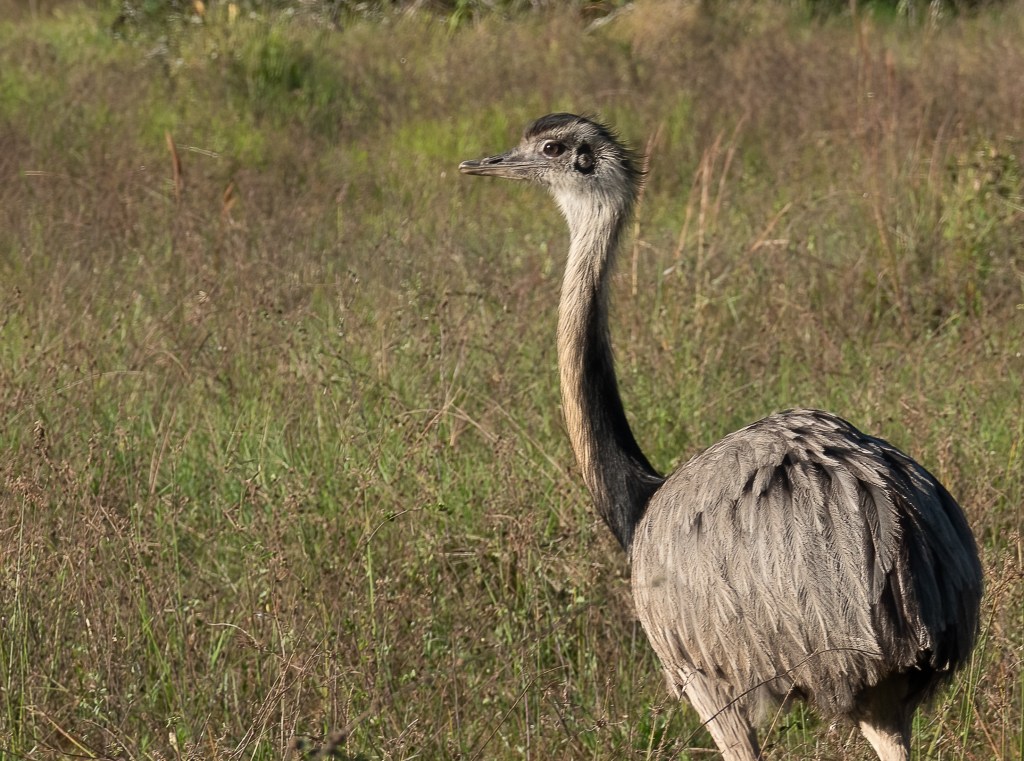
The IUCN classifies it as Near Threatened, with its population in decline.
*My title owes apologies to Lewis Carroll’s Jabberwocky, here translated into Portuguese by August de Campos::
JAGUADARTE
Era briluz. As lesmolisas touvas
roldavam e reviam nos gramilvos.
Estavam mimsicais as pintalouvas,
E os momirratos davam grilvos.
“Foge do Jaguadarte, o que não morre!
Garra que agarra, bocarra que urra!
Foge da ave Fefel, meu filho, e corre
Do frumioso Babassura!”
Ele arrancou sua espada vorpal
e foi atras do inimigo do Homundo.
Na árvore Tamtam ele afinal
Parou, um dia, sonilundo.
E enquanto estava em sussustada sesta,
Chegou o Jaguadarte, olho de fogo,
Sorrelfiflando atraves da floresta,
E borbulia um riso louco!
Um dois! Um, dois! Sua espada mavorta
Vai-vem, vem-vai, para tras, para diante!
Cabeca fere, corta e, fera morta,
Ei-lo que volta galunfante.
“Pois entao tu mataste o Jaguadarte!
Vem aos meus braços, homenino meu!
Oh dia fremular! Bravooh! Bravarte!”
Ele se ria jubileu.
Era briluz.As lesmolisas touvas
Roldavam e relviam nos gramilvos.
Estavam mimsicais as pintalouvas,
E os momirratos davam grilvos.
Just to remind you, here is the original. Perhaps ‘Beware the Jubjub bird’ would have been a better title, but Jabiru and Jabberwock have the same rhythm.
The Jabberwocky, from Through the Looking Glass , 1871, by Lewis Caroll:
‘Twas brillig, and the slithy toves
Did gyre and gimble in the wabe;
All mimsy were the borogoves,
And the mome raths outgrabe.
“Beware the Jabberwock, my son!
The jaws that bite, the claws that catch!
Beware the Jubjub bird, and shun
The frumious Bandersnatch!”
He took his vorpal sword in hand:
Long time the manxome foe he sought—
So rested he by the Tumtum tree,
And stood awhile in thought.
And as in uffish thought he stood,
The Jabberwock, with eyes of flame,
Came whiffling through the tulgey wood,
And burbled as it came!
One, two! One, two! And through and through
The vorpal blade went snicker-snack!
He left it dead, and with its head
He went galumphing back.
“And hast thou slain the Jabberwock?
Come to my arms, my beamish boy!
O frabjous day! Callooh! Callay!”
He chortled in his joy.
‘Twas brillig, and the slithy toves
Did gyre and gimble in the wabe;
All mimsy were the borogoves,
And the mome raths outgrabe.
 Eyes on the Wild
Particularly wonderful blog, in the midst of always marvellous, informative, beautiful and detailed blogs anyway. Thank you as always – (and for the Lewis Carroll in both languages)
LikeLike
What a gigantic bird…w.s. is impressive….must have very strong flight muscles. I really love how your photos and narration are set up…so much to learn.
LikeLike