The Fall Life of Bears: Foraging, fishing, and family 3

3. Family

[My last grizzly post.]

In the fall, one can see this year’s cubs, now around seven months old. At Knights Inlet, from a stand, we watched one mother and this spring’s cub cross the river:

The mother climbed on a log, and the cub rather tentatively followed her:
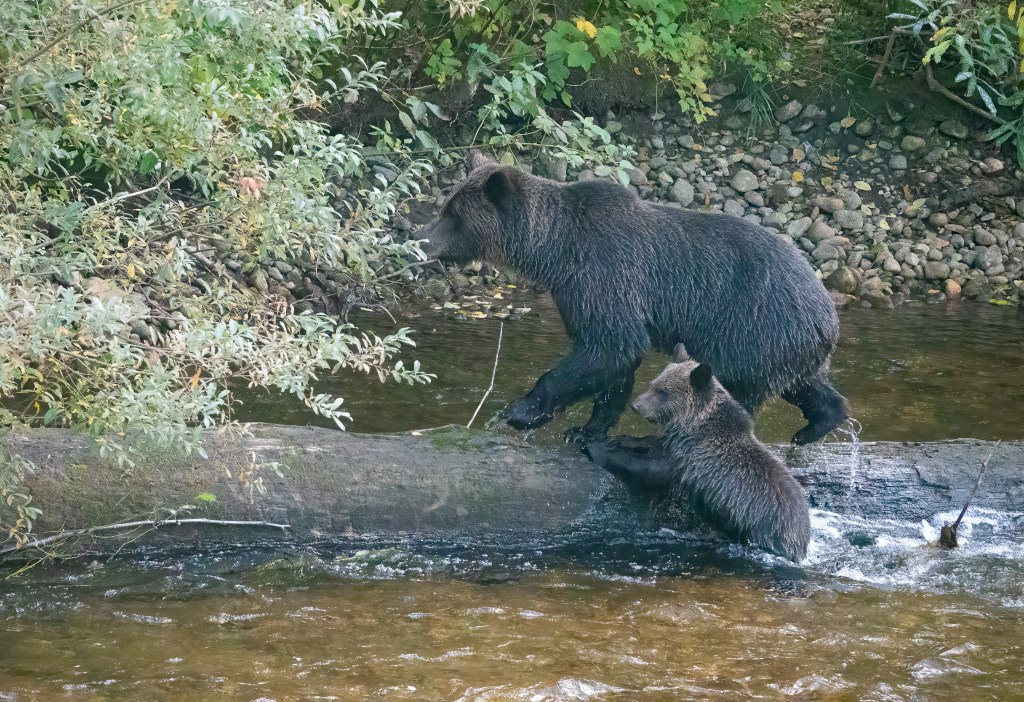
Changing her mind, the mother walked along the log:
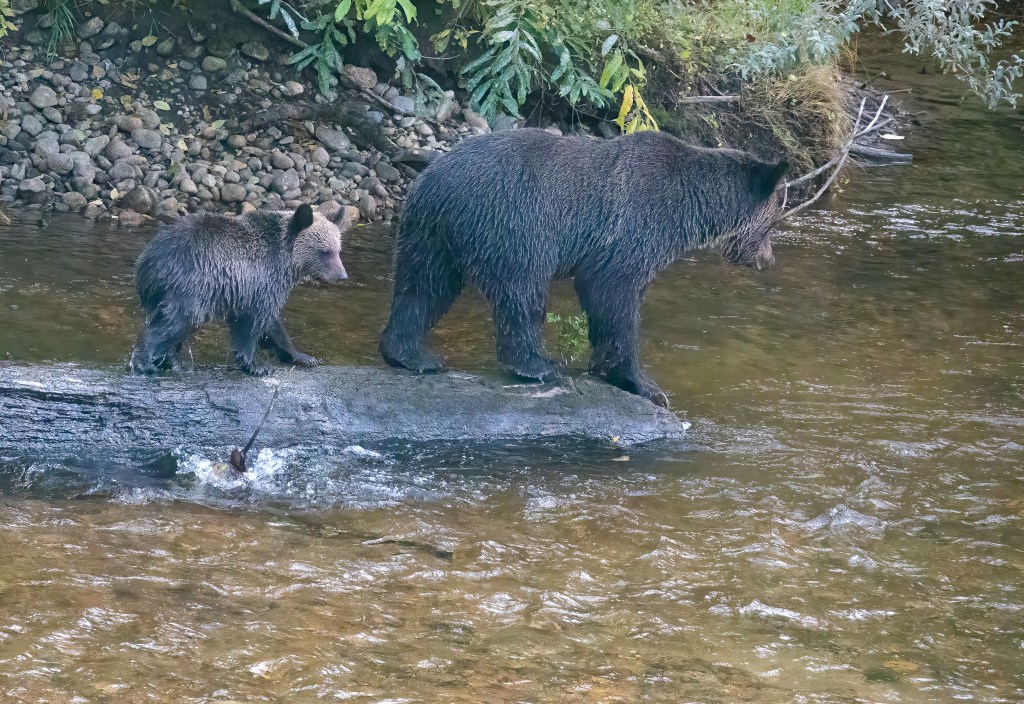
and jumped off:

The cub was not at all sure about this:

but eventually he followed, scrambling to catch her up.
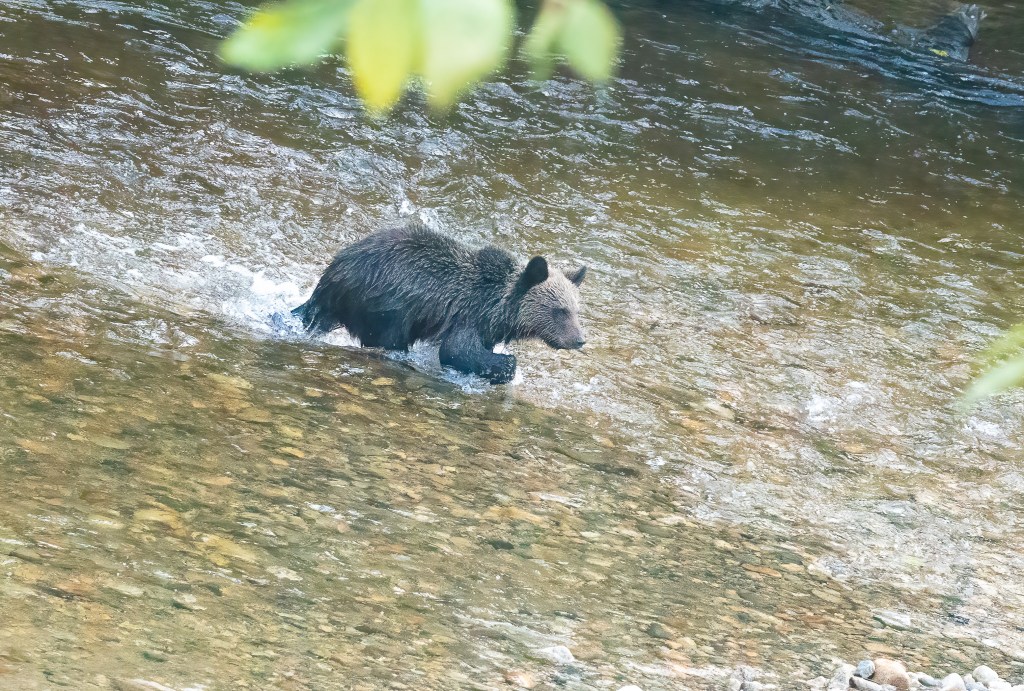
The guides told us that he was smaller than he should be at this time of year, so let’s hope he makes it through the winter.

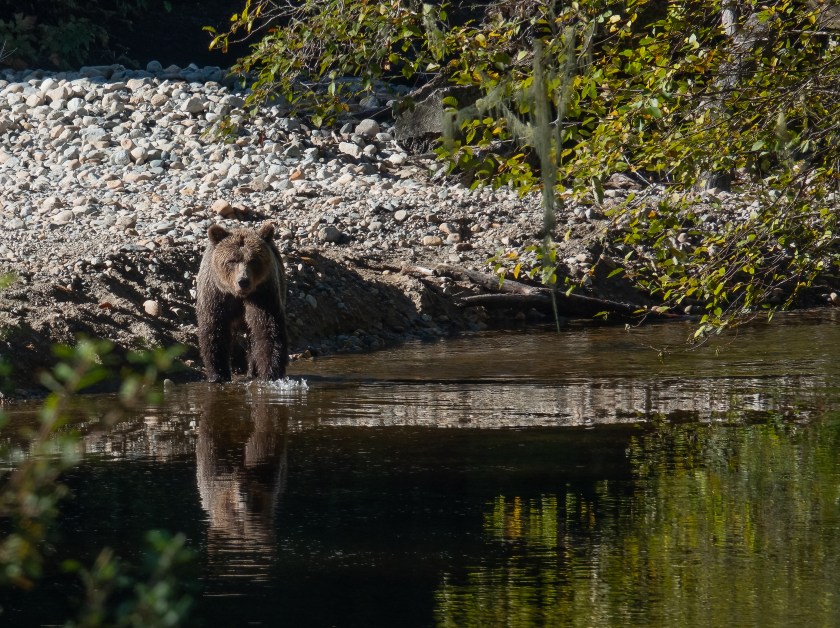
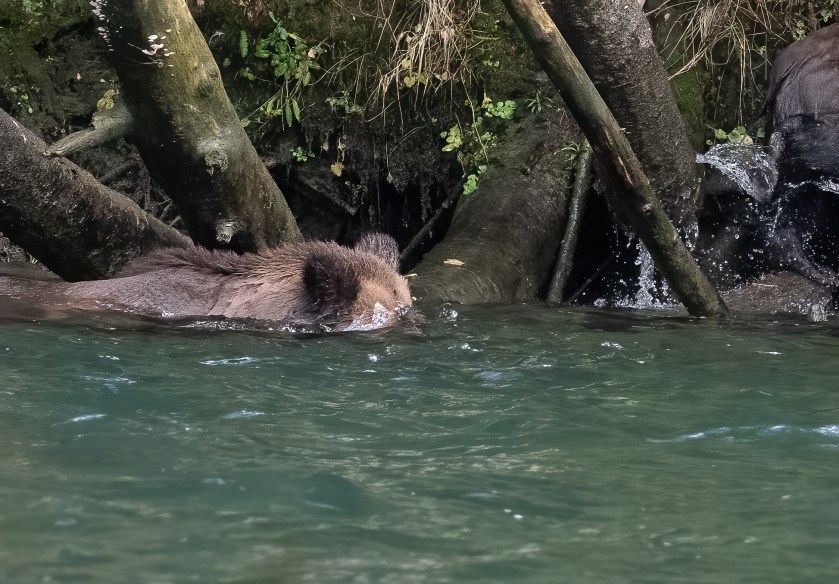
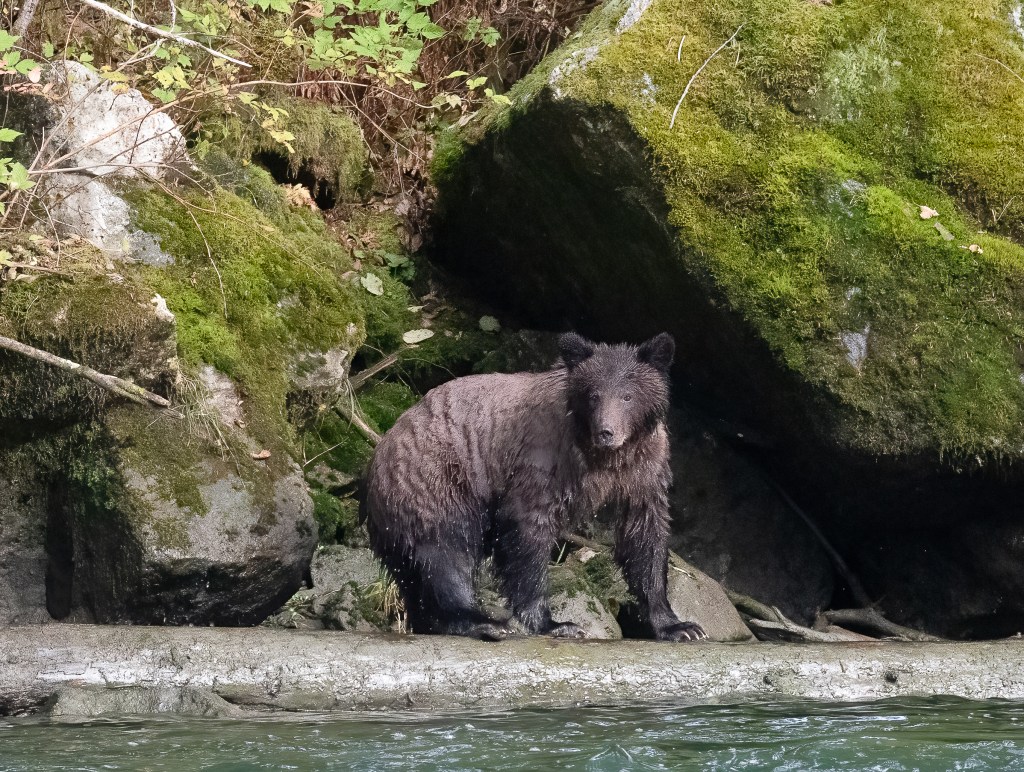
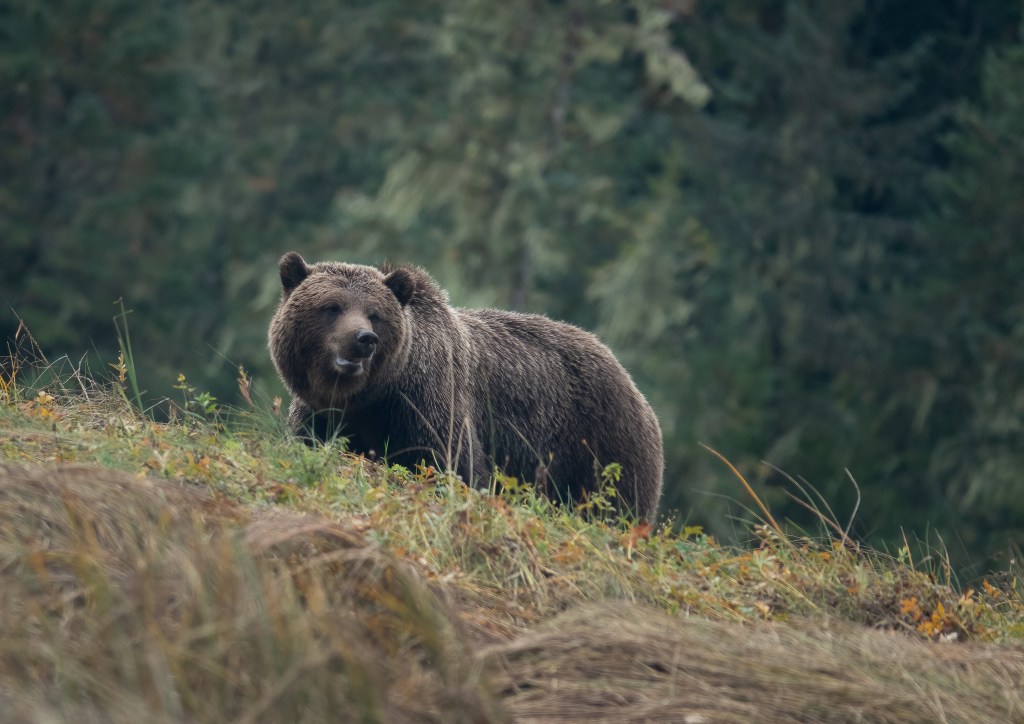
The Spirit Bear Lodge area is also packed with grizzlies, largely on the mainland. If the grizzlies were to cross to the spirit bear islands they would be likely to outcompete them, so this is a case of separation being desirable. There are no viewing stands here, so we took the zodiac up a shallow river, and found this mother grizzly with two of this year’s cubs, moving along the river’s margin. The shore was steep, rocky, and thickly vegetated, so she was swimming (acting as a barrier between us and her cubs), but the cubs were doing a bit of each. The bears let zodiacs get relatively close; people on foot are much more threatening to them.
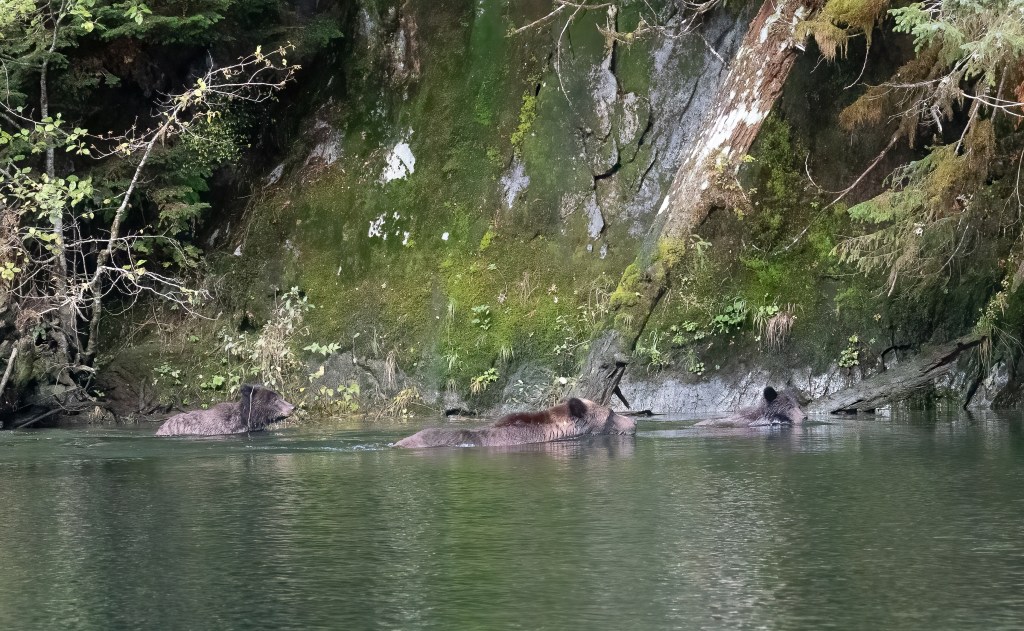
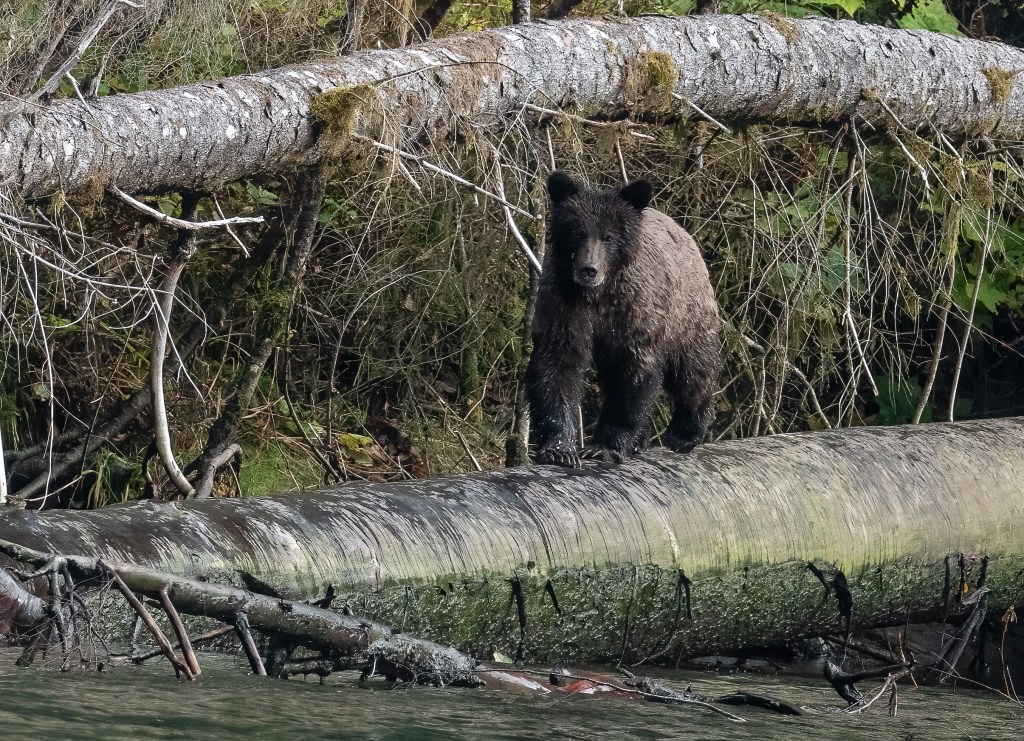
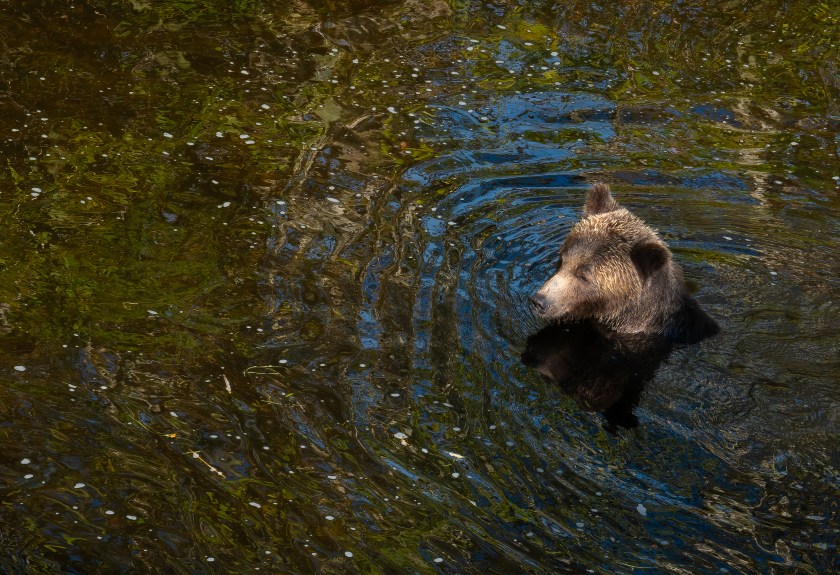
When they are wet they look like drowned rats,

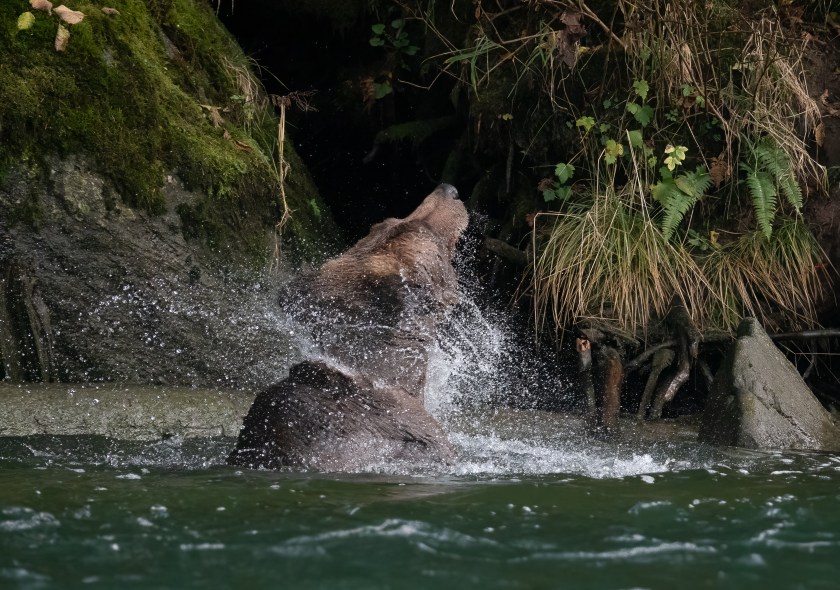
but after a good shake their coiffures improve .

The cubs played on fallen logs:
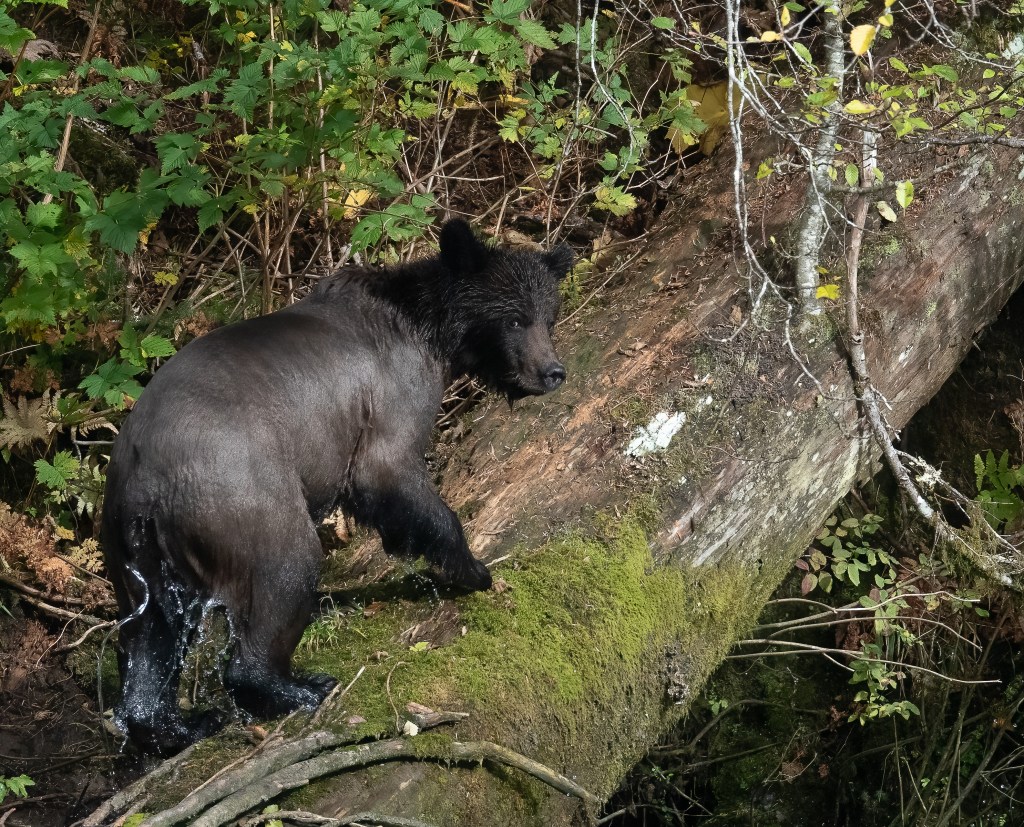
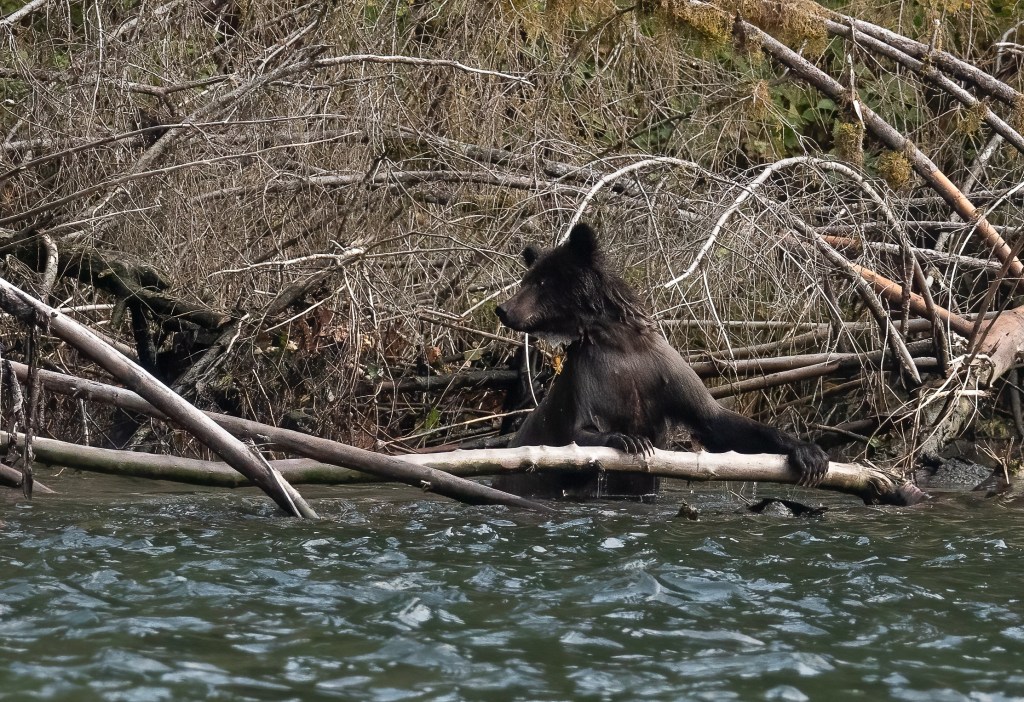
And then they all found a shingle bank where they dug for molluscs:
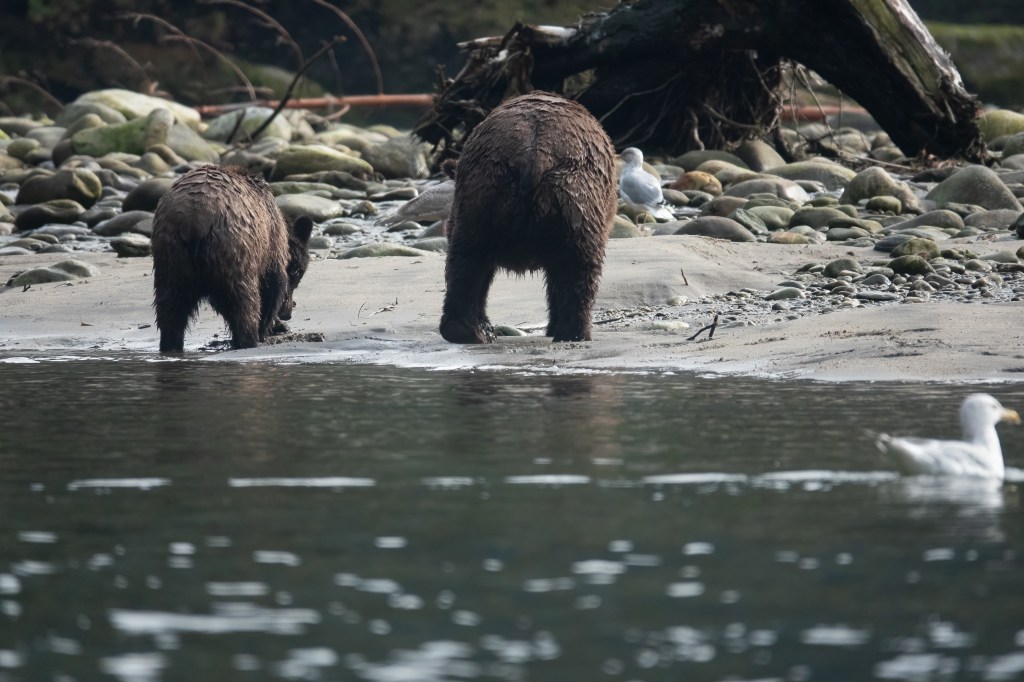
until they strolled off across the strand:

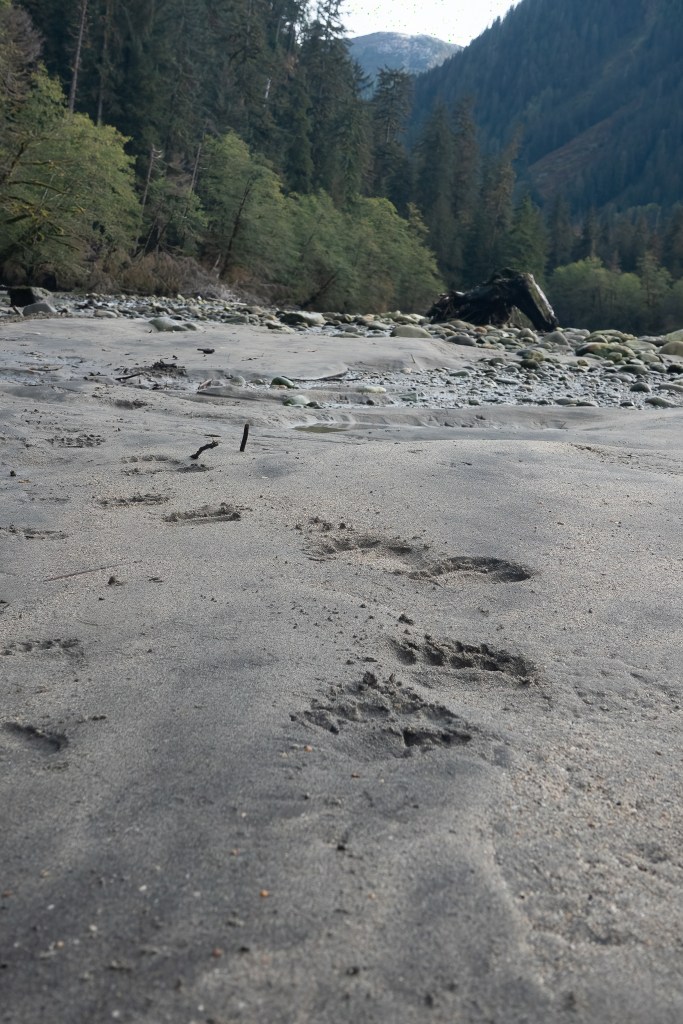
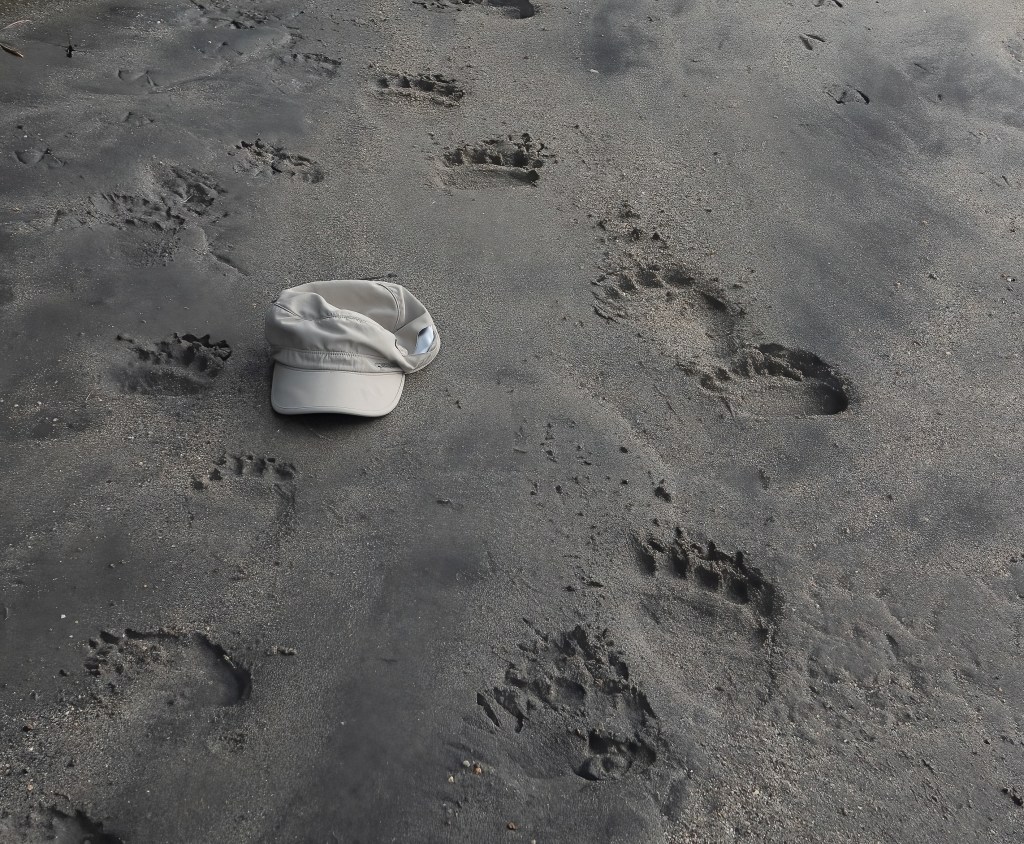
These are the freshest grizzly tracks I have ever seen, or hope to see.

And with my cap, for scale:
Cubs usually leave their mother by the age of three, but no-one told Fauna, below. She apparently did leave around that age, but just like a human boomerang kid, she reappeared at her mother Flora’s side a few months later.
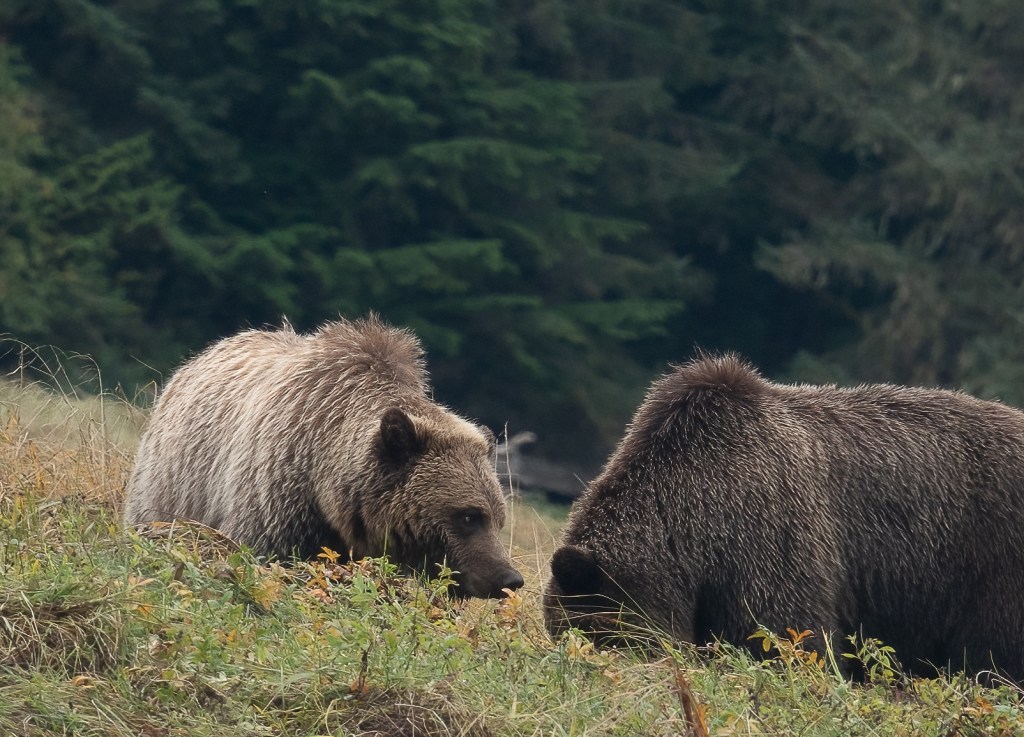
And Flora didn’t have the heart to chase her away. However, once she has another litter she will not tolerate Fauna any longer.

PS I recommend this website specifically about the grizzlies of British Columbia.

The passage below is taken from there:

“…one to four hairless cubs weighing only about 0.5 kg (1 lb.) are born in
the den in January or February. The mother nurses her cubs in the den until they all come out in late April or May.

Grizzly cubs usually stay with their mother and den with her for at least two years. During that time they are fiercely protected and learn where to find food as the seasons change and when, where and how to dig a winter den. Grizzly cubs also play a great deal. The period of dependence on the mother is relatively long compared to other mammals. This prepares the cubs for an independent life. In June of the third year, adult females usually breed again, and they chase the cubs, now quite large, off to become self-sufficient. … Sow Grizzly Bears don’t produce their first litter until they are about five or six years old or even older. Delayed sexual maturity, together with a three-or- more-year interval between litters, results in a low reproductive rate. The maximum life span of Grizzly Bears in the wild is more than 30 years. “

Killer whales take a day off

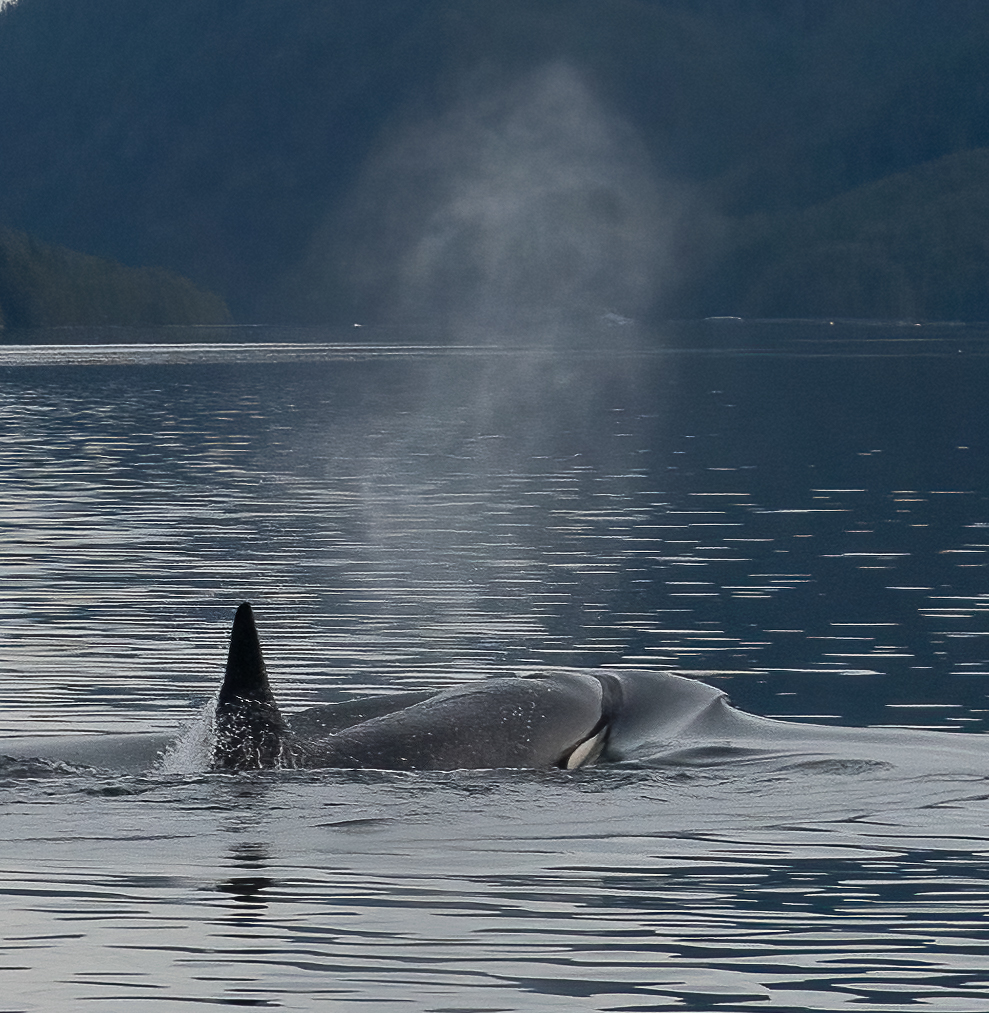
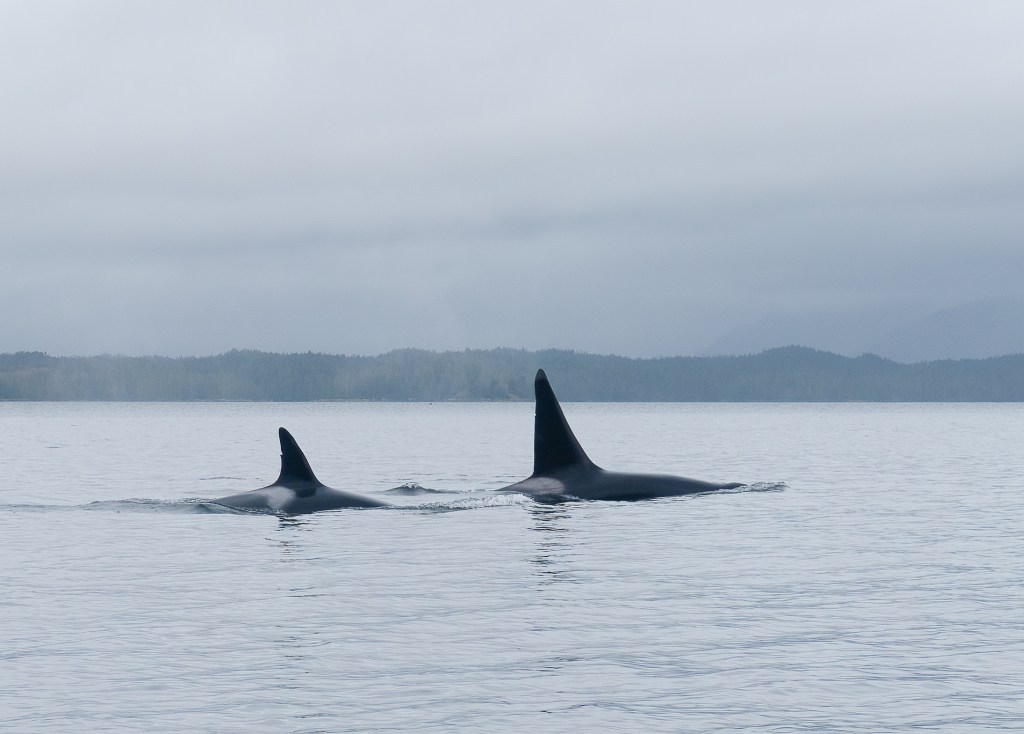
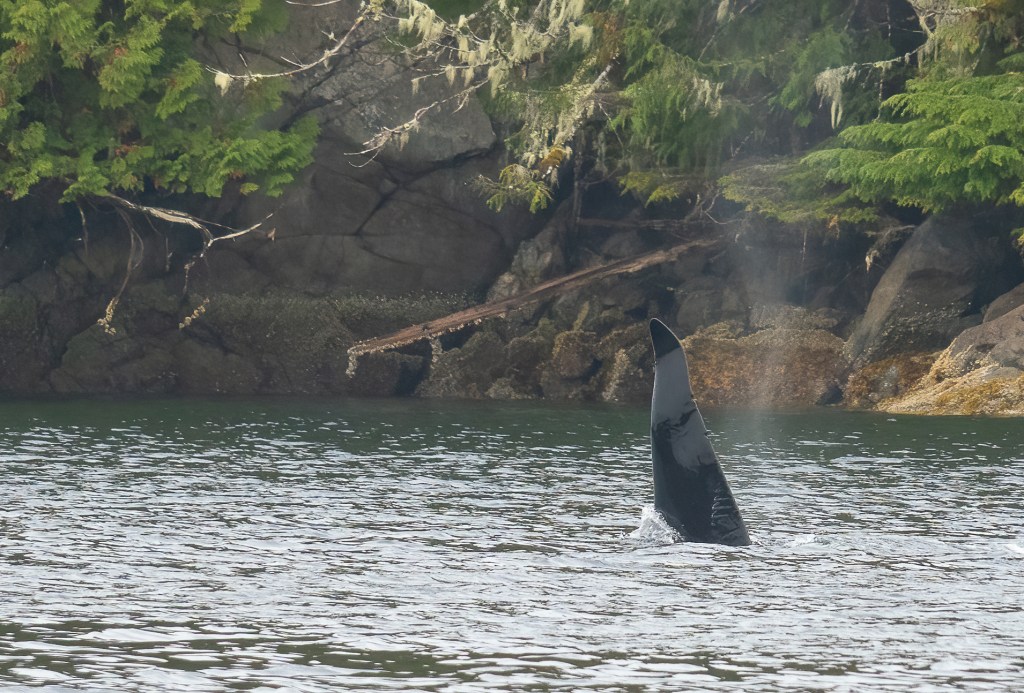
Some of our group had done a three-day pre-trip watching whales and orcas, but we had not. However our guide, Mark Carwardine, is one of the world’s leading marine mammal experts, so you could be sure he would magic up some orcas for us, and he did. In the pair above, the male has the very tall dorsal fin (at six feet, it is the tallest of any cetacean) , and the females and juveniles have shorter ones. Here is a another male:

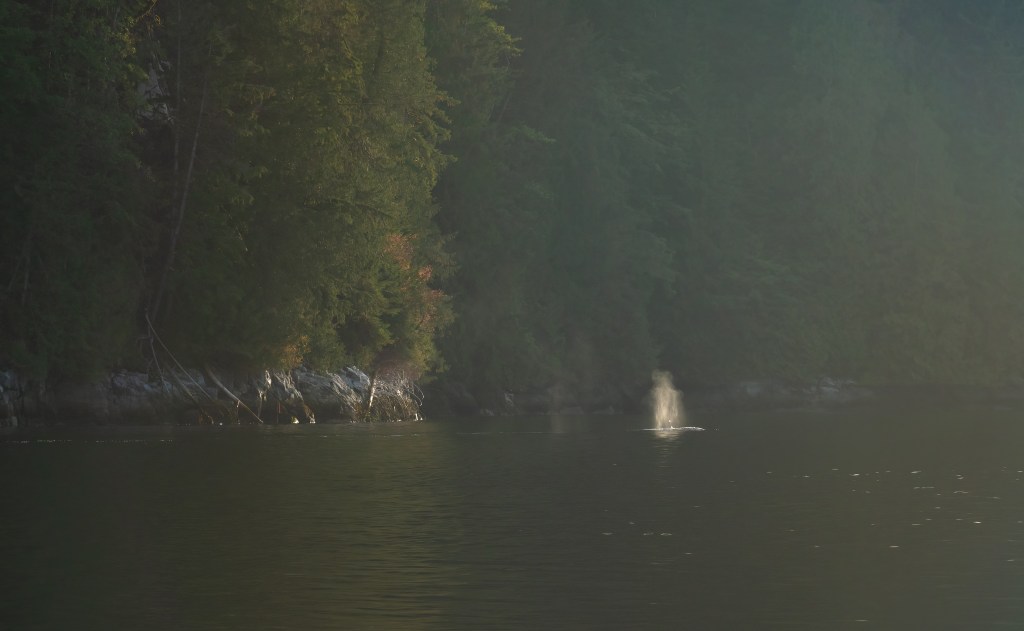
Orcas, Orcinus orca, also called Killer Whales, are actually the largest members of the dolphin family. We mostly saw them either blowing in the distance

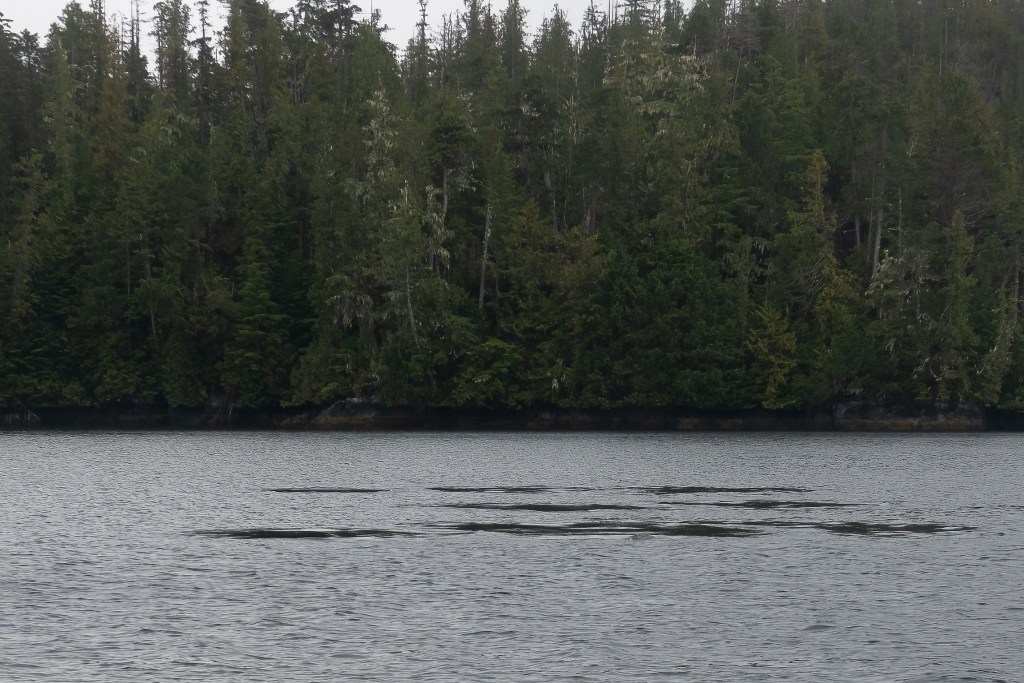
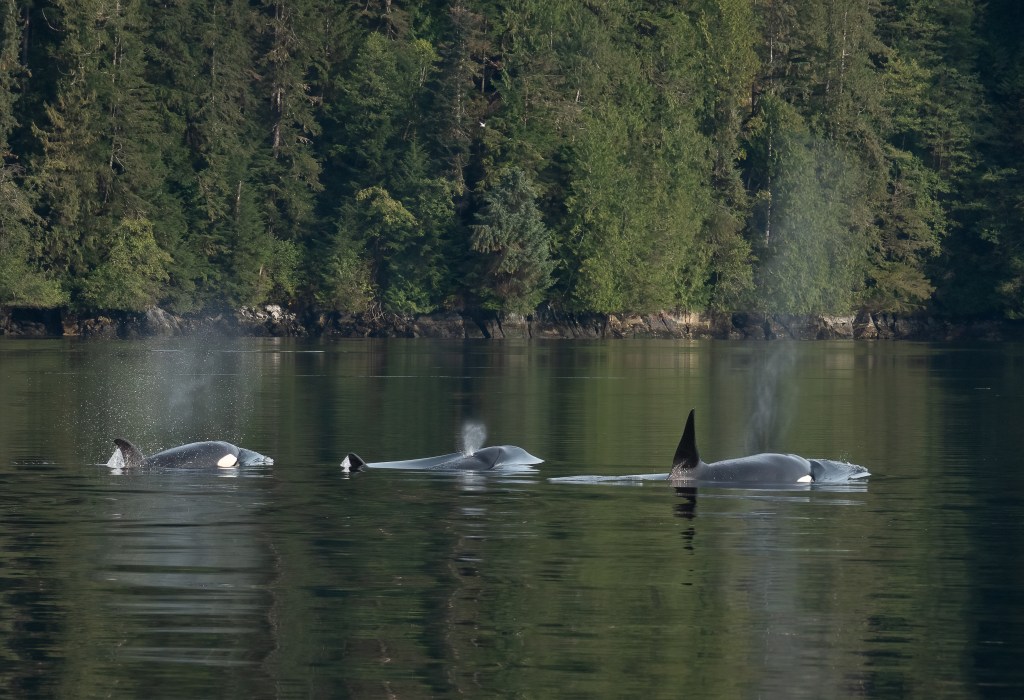
disappearing beneath the surface leaving a ghostly footprint behind, like these three:

or cruising around seemingly lackadaisically:

:

But they are faster than they appear: look at these bow waves:

There are three ecotypes in British Columbia: Residents, Transients, and Offshore Orcas. They eat different foods, use different hunting techniques, have different acoustic dialects, different shaped dorsal fins and saddle patches behind their dorsal fins, (see below), and do not appear to interbreed.

It may be that they are gradually evolving into distinct species. I highly recommend this if you’d like to know more: https://www.scientificamerican.com/article/killer-whales-are-speciating-right-in-front-of-us/

These are all Transient or Bigg’s Killer Whales. The name transient is misleading: it is now recognized that they too often stay in one area, but they move in smallish groups of 3-7 immediate family members, led by a matriarch. Any males in the group are likely to be her sons. A second difference between them and other orcas is that they eat only marine mammals, not fish or sharks.

From time to time these groups, or pods, join forces with others in super-pods, where they socialize and breed, but we saw only small groups.

My second-favorite encounter was with this trio, as they swam through glassy dark water making those sculpted bow waves:

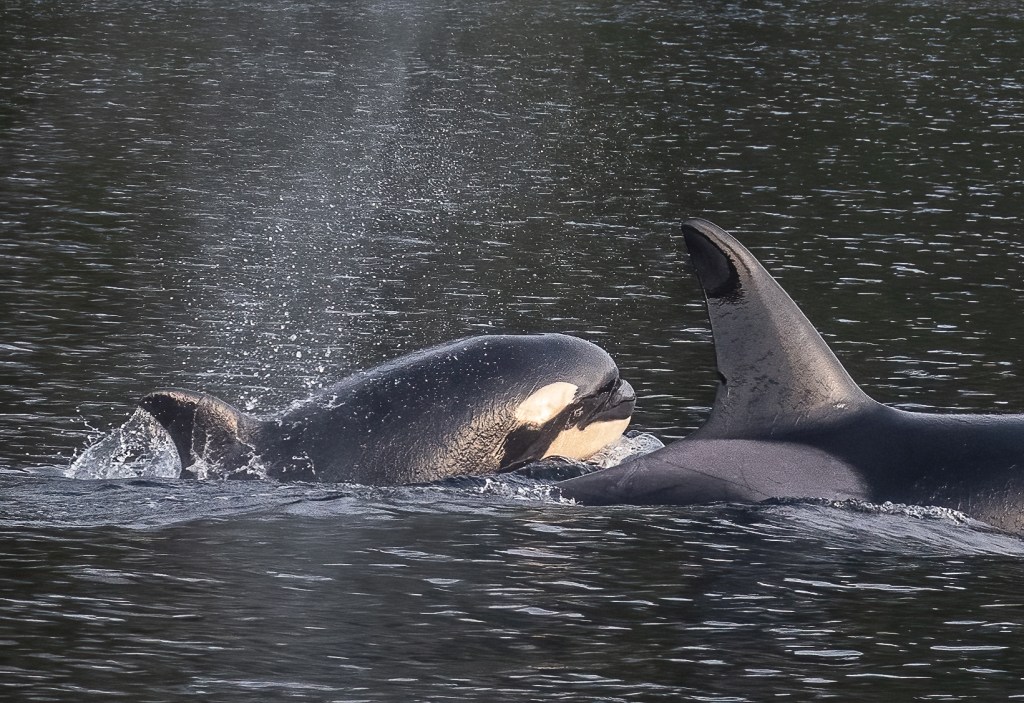
but top marks go to a group earlier that morning which included this delightful baby, making his own miniature bow wave:

PS This is Mark’s latest book:

The Fall Life of Bears: Foraging, fishing, and family 2

2. Fishing

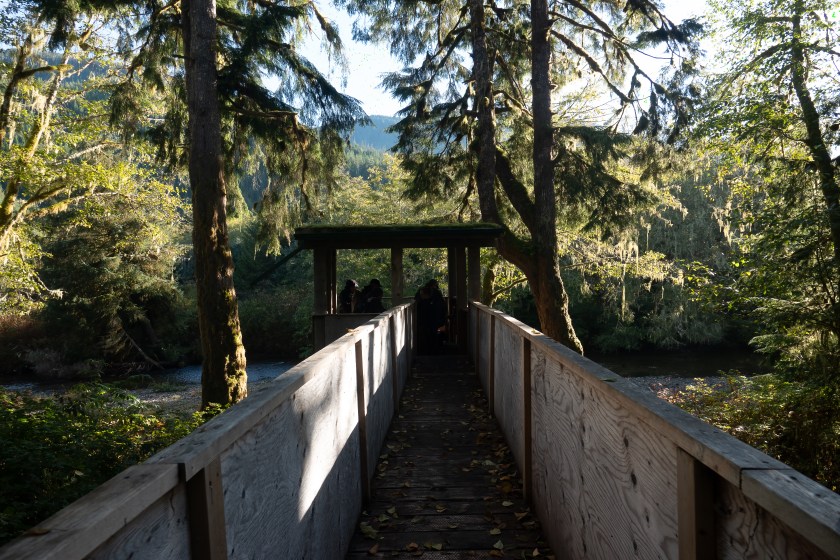
Knight’s Inlet Lodge is located close to a salmon spawning channel, and a river, and they have built viewing stands to which the bears are now accustomed.

For about two months you can see them fishing here, but then the lodge closes because the weather gets too bad to fly in and out. We were the last guests of the season.

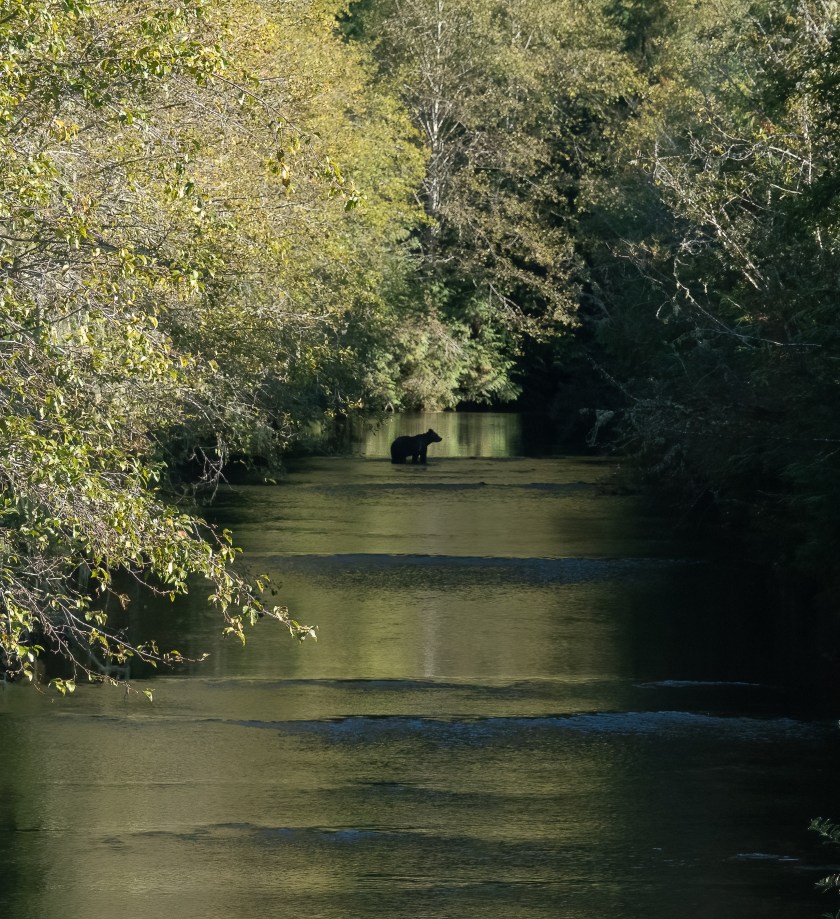
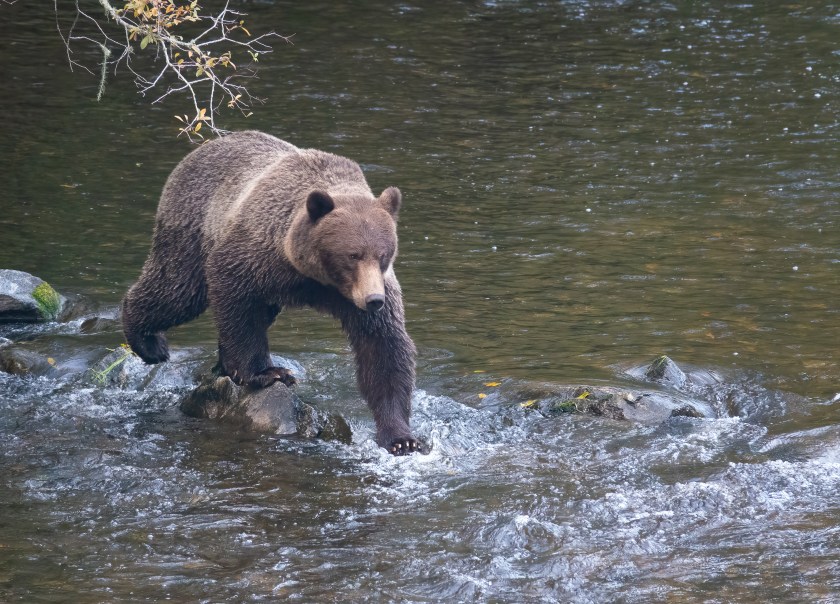
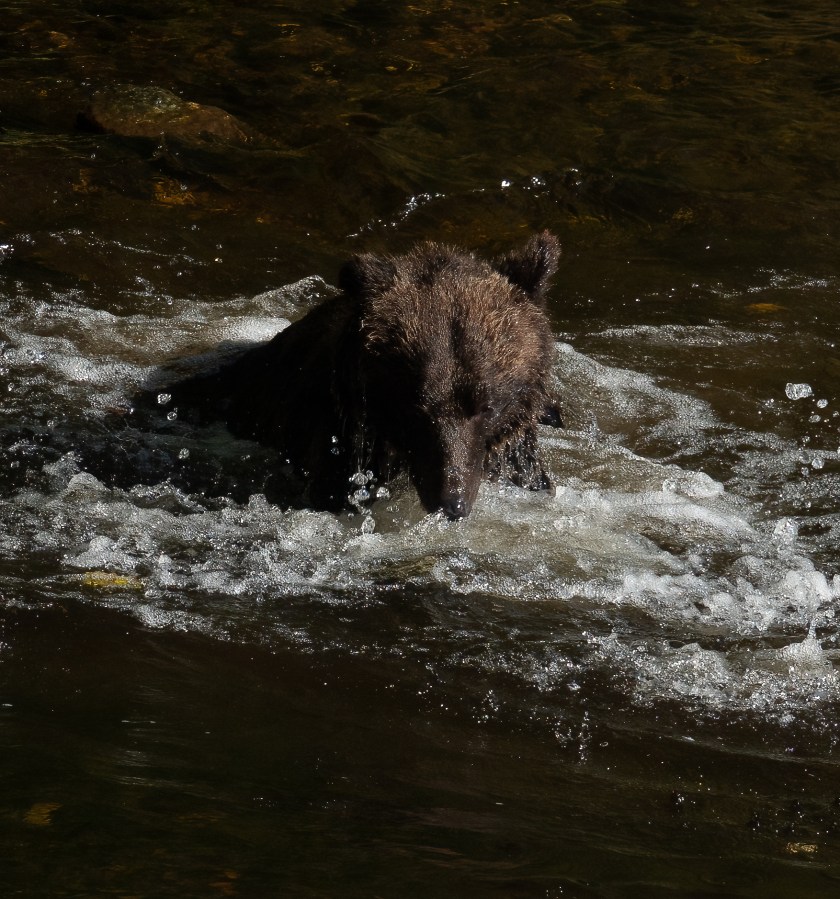
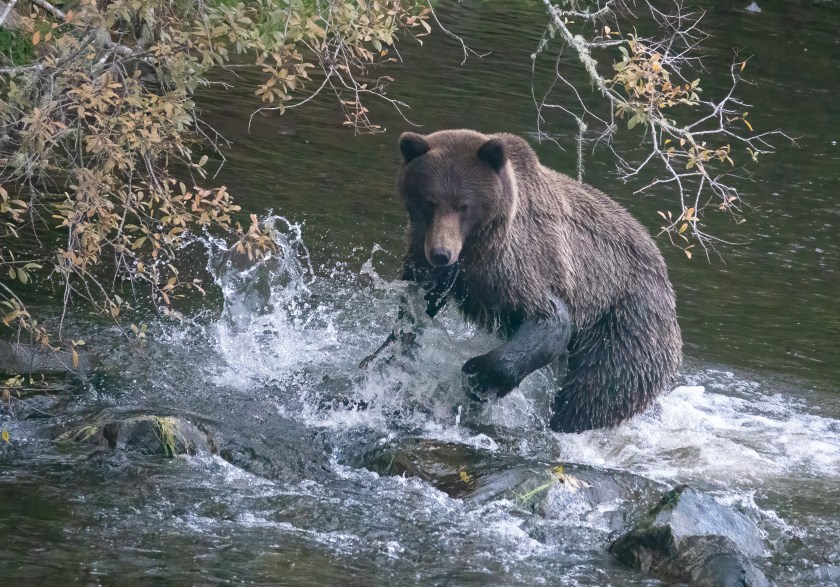
The bears wander down the spawning channel, watching out for fish:

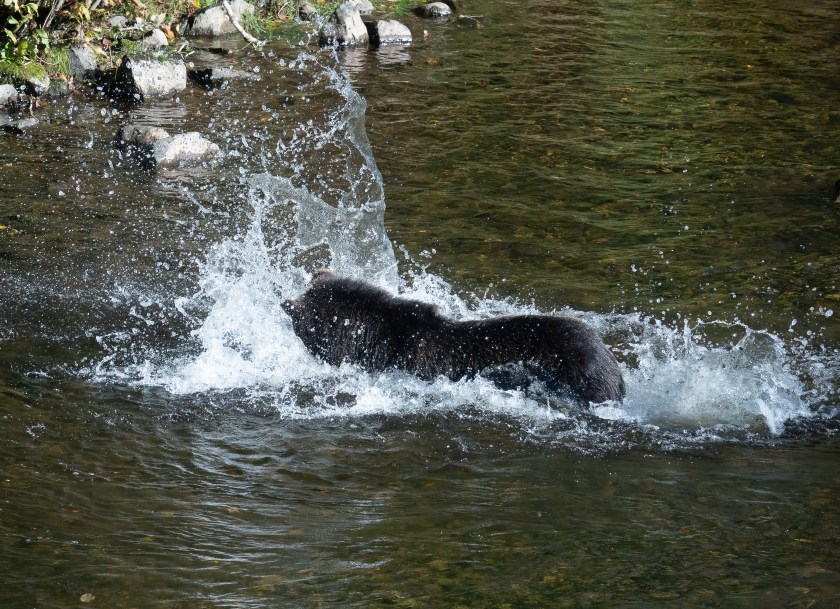
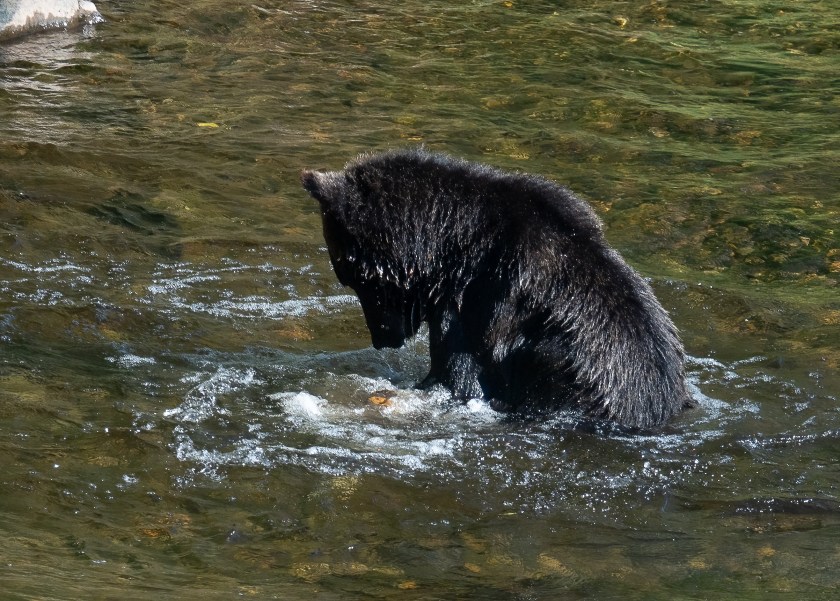
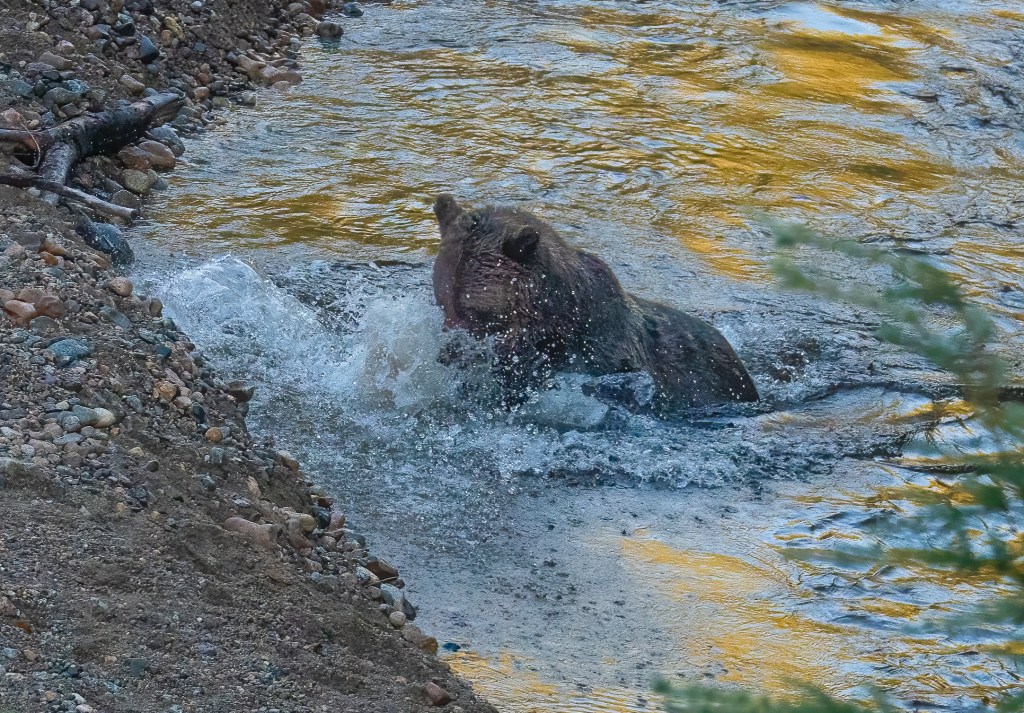
At this time of year the species of salmon is the Pink Salmon, and the fish don’t seem to jump much. Instead, the bears dive in headfirst and fling themselves on top of them.

Missed.

It all looks a bit haphazard, rather than skillful, although I admit two of these three bears are inexperienced yearling cubs, with their mother:

In the deeper parts, they walk slowly on their hind legs scanning for a passing fish.

They will look underwater, too:

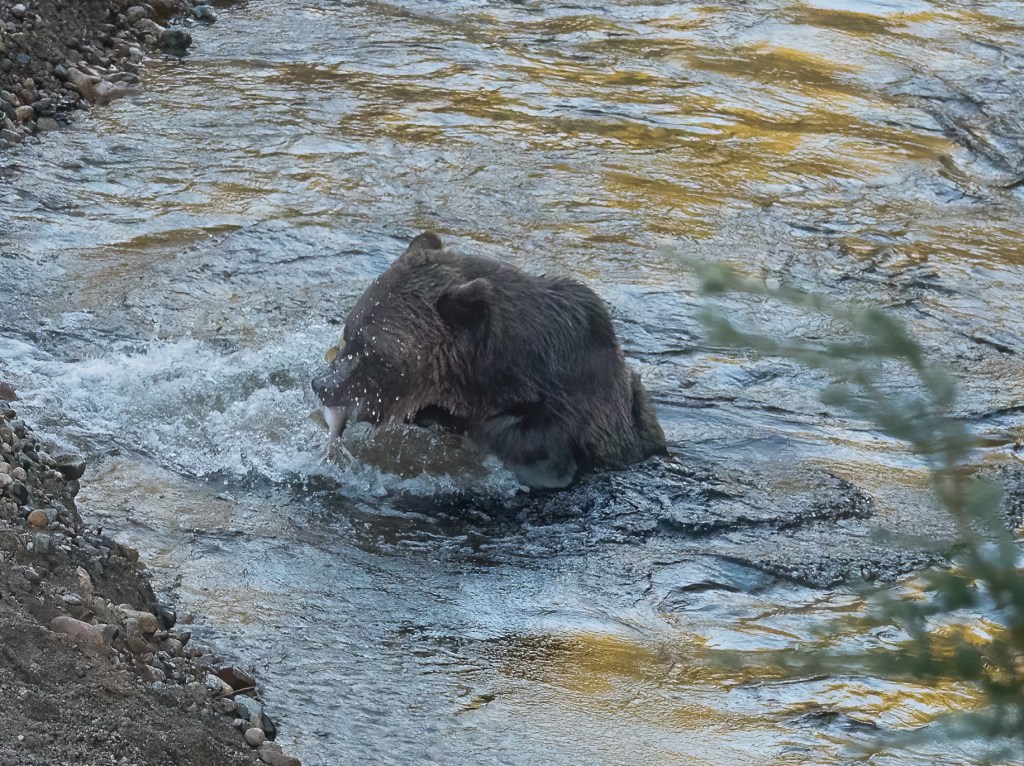
These shots show a bear fishing at dawn,

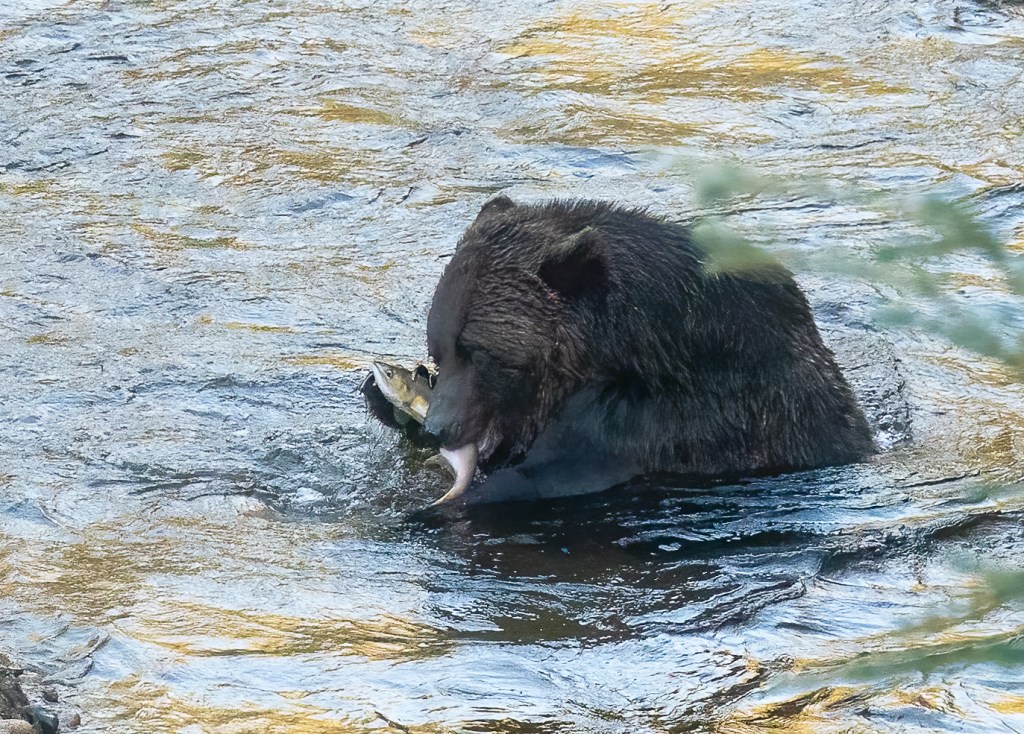
then one second later the moment of catch,

two more seconds to get a good grip,

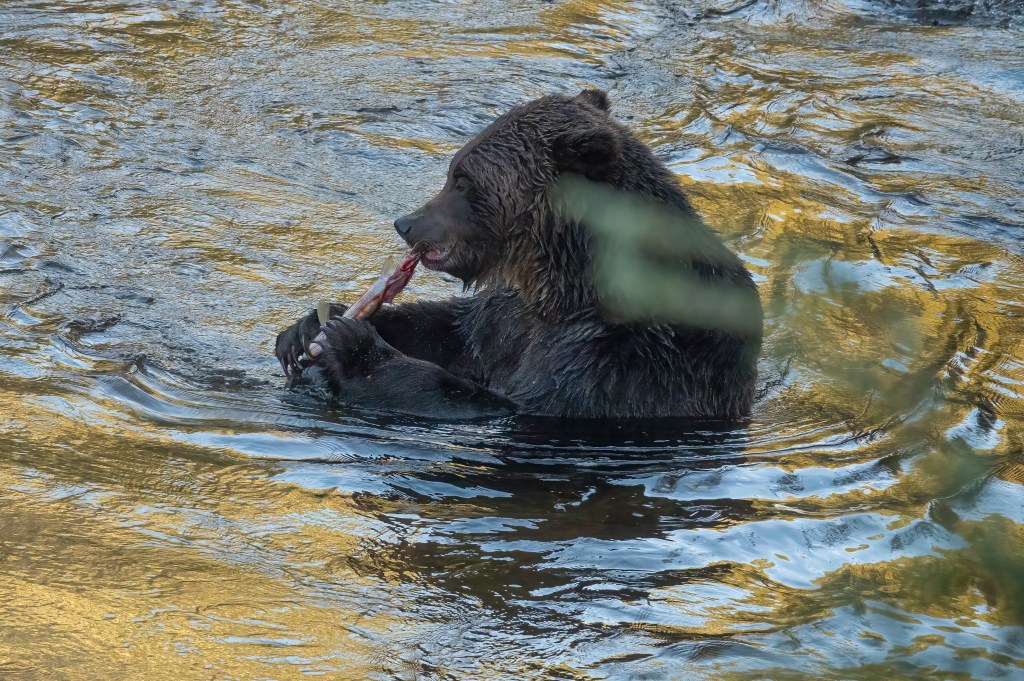
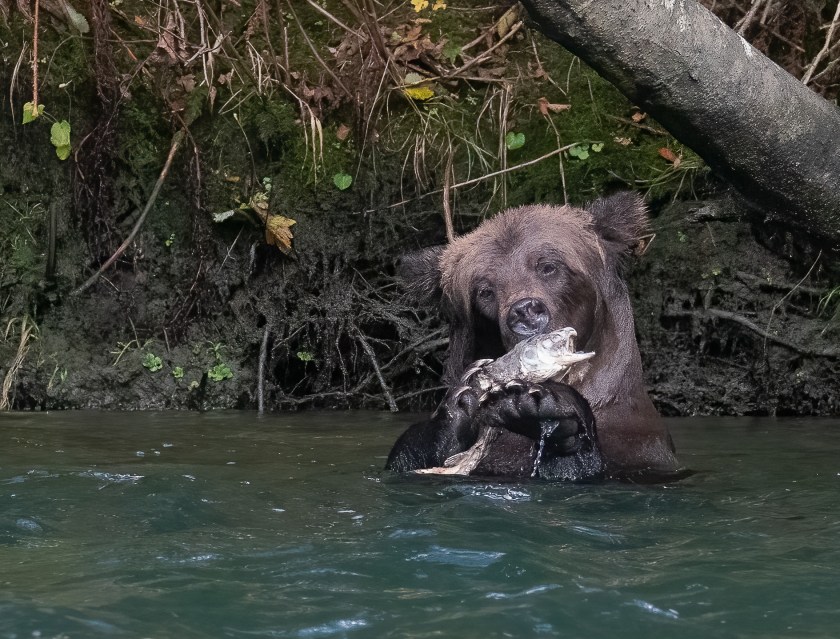
and finally settling down for a meal:

They may eat in full view,

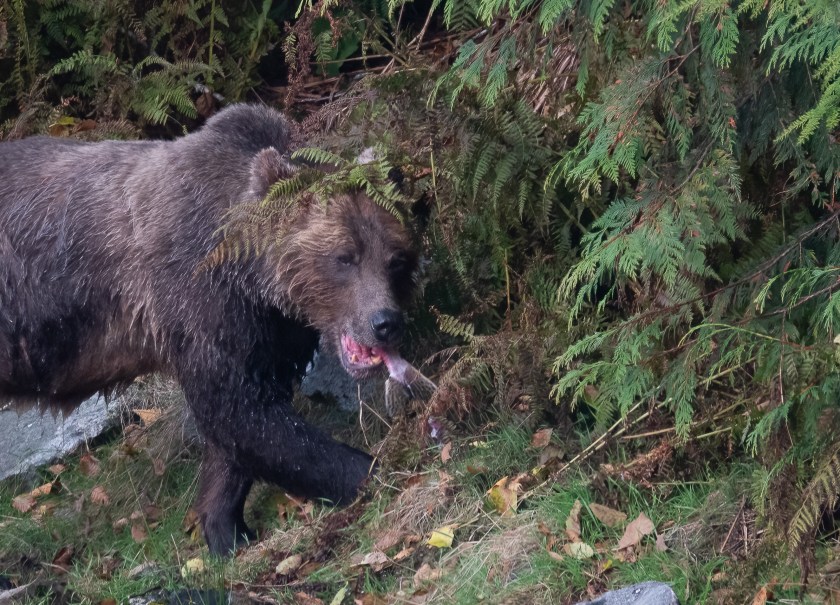
or retreat to the bushes.

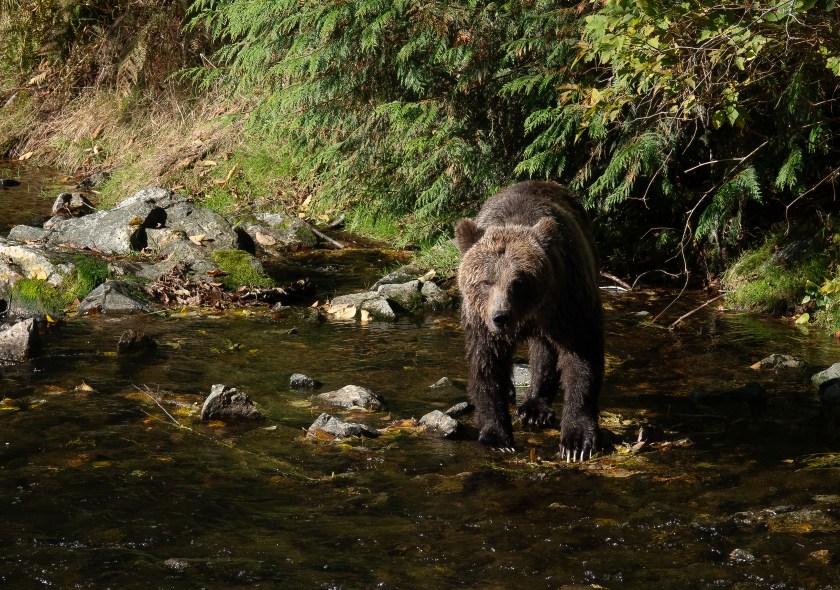
The next shot is a grizzly near Spirit Bear Lodge, eating dead salmon that have already spawned:

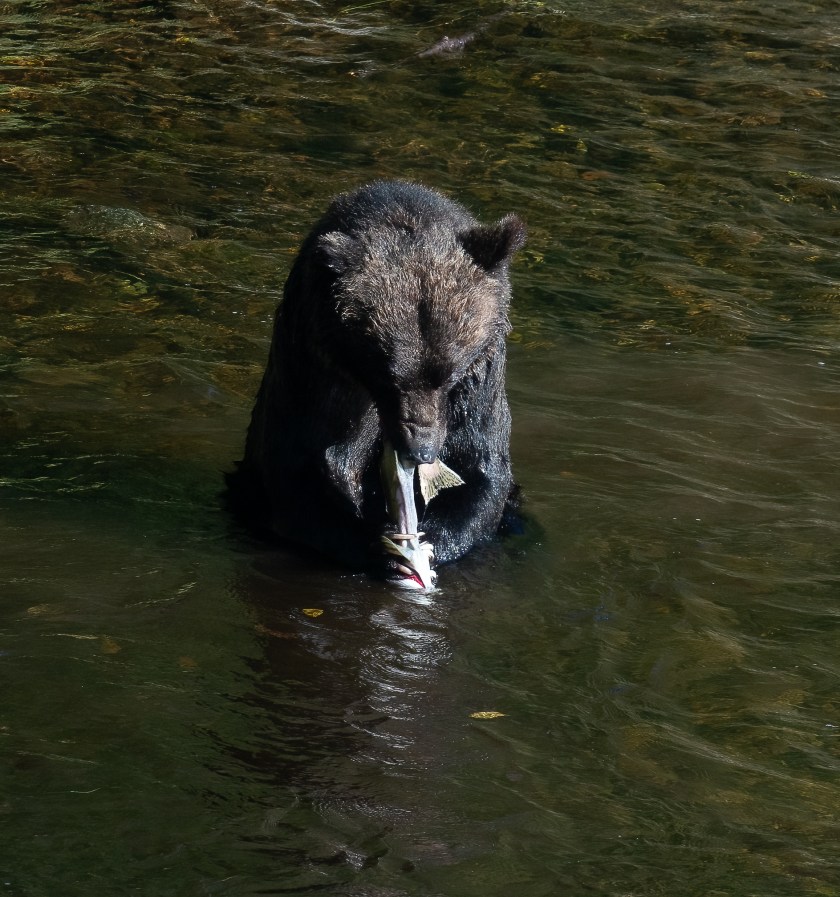
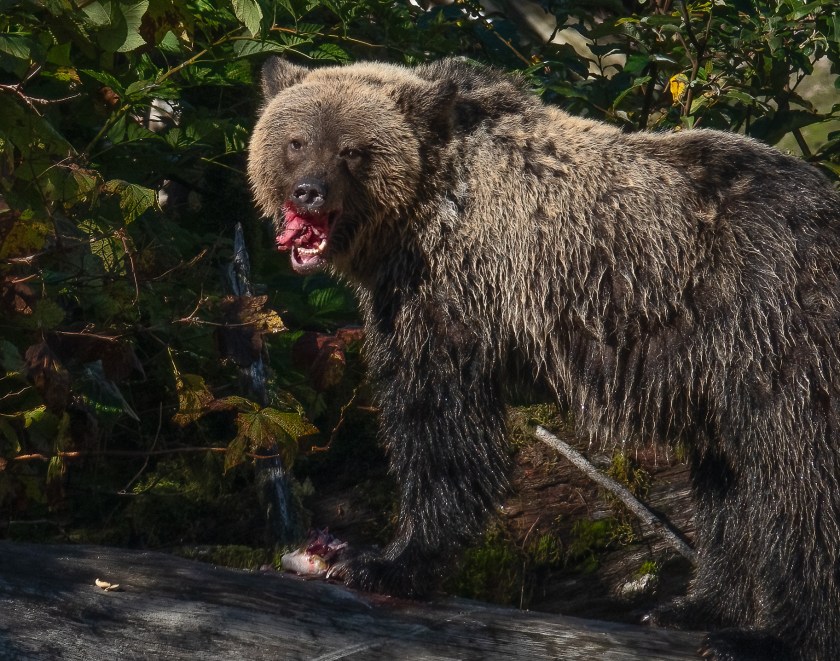
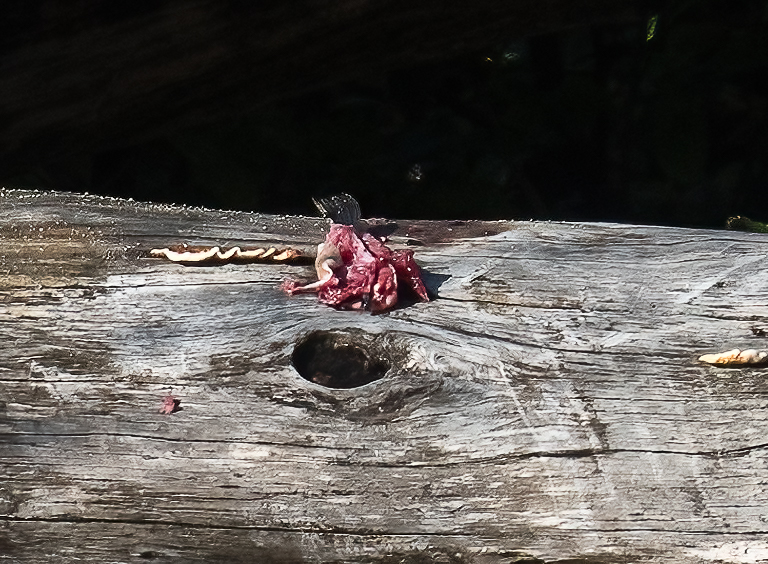
If they are healthy and fat, they are picky eaters. They dissect the salmon, and the parts highest in fats and nutrition: the skin, the brain, and the roe (eggs). They leave most of the flesh, the parts we humans like to eat! Here is one eating, and what he left behind:

They often remind me of dogs, posing nicely for the camera,

or having a good shake

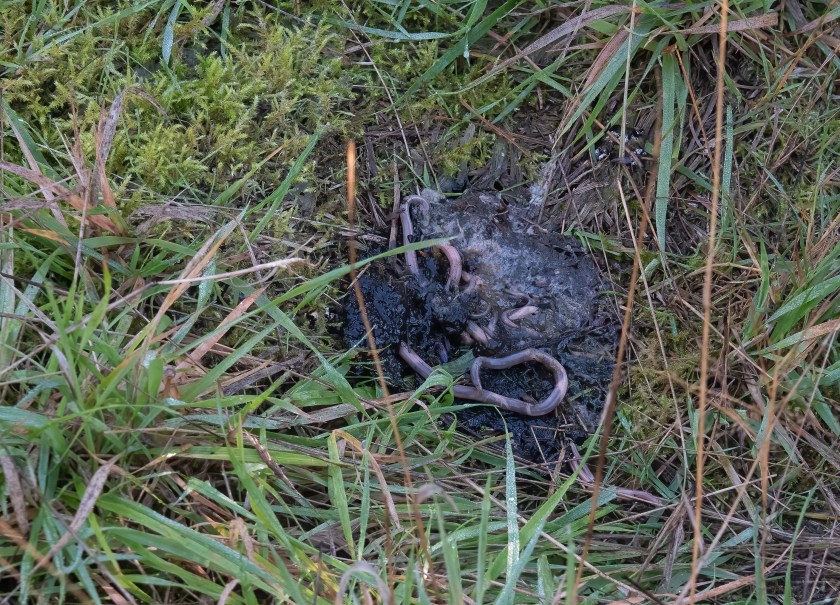
PS There is a side effect of the grizzlies’ taste for the roe, because they may then also inadvertently eat parts of the intestines. Salmon carry tapeworms, and these can get passed to the bears. There’s a photo which I’ve put at the very end so a squeamish reader can easily skip it. The tapeworm Diphyllobothrium latum can also transfer to humans who eat raw freshwater fish, and indeed I once had it (symptom free, and easily treated). Not recommended as a weight loss strategy.

The Fall Life of Bears: Foraging, fishing, and family 1

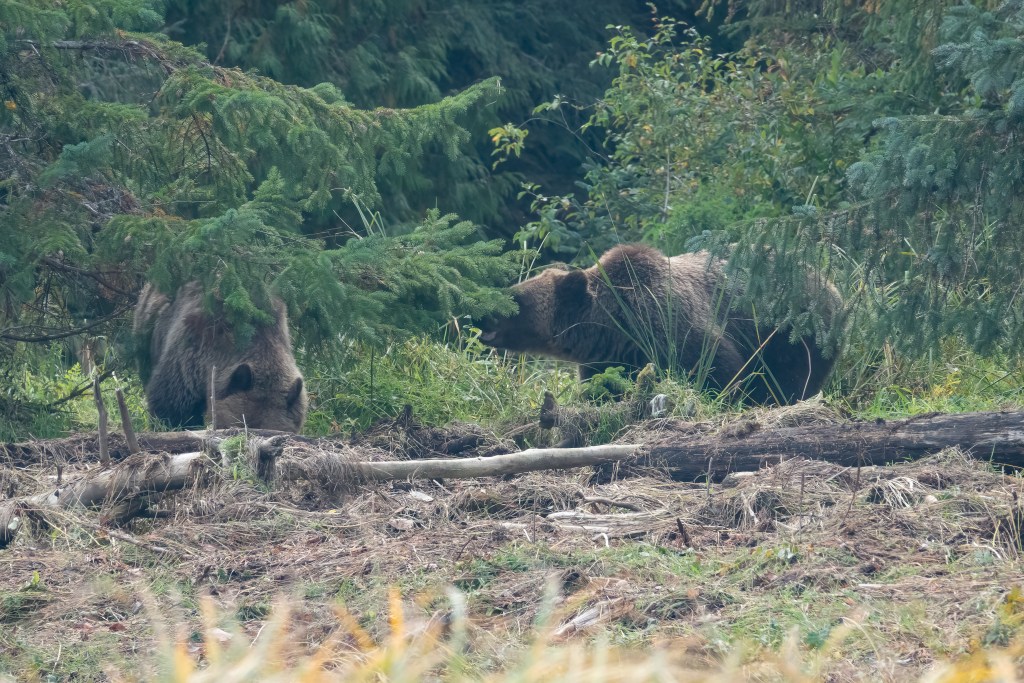
The spirit bears were a one-day wonder. But grizzlies we saw virtually every day, in both locations. And they were busy getting fat for hibernation.

1. Foraging

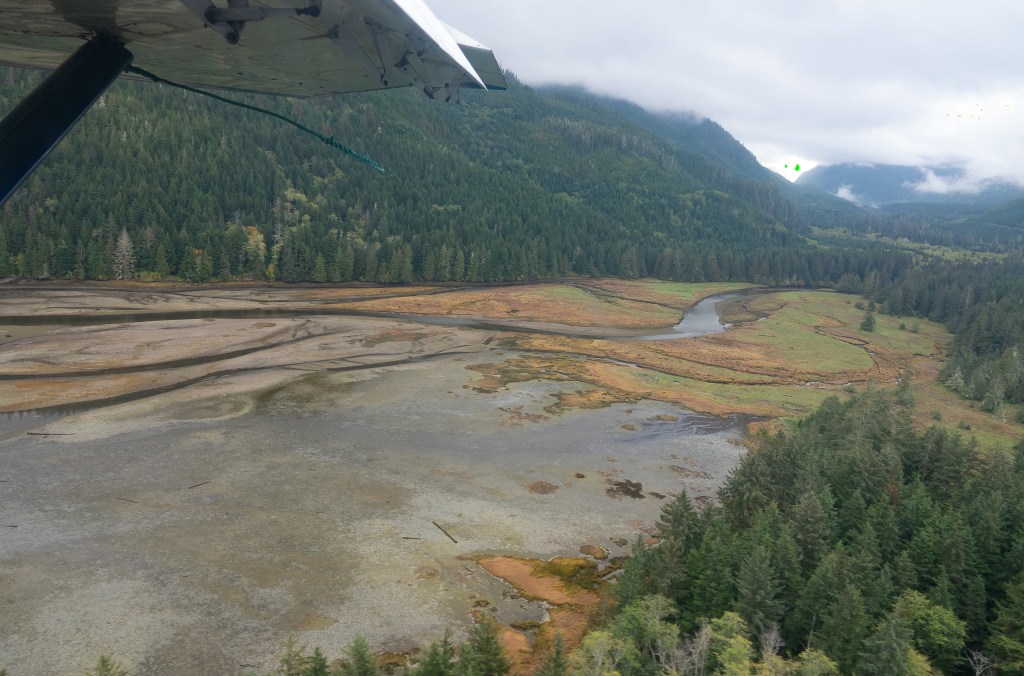
In the fall, grizzlies are committed to eating. They do nothing else. This period, known as hyperphagia, has the goal of building up fat stores for the long hibernation to come. On Knights Inlet, they head for the estuary, seen here from our float plane:

and from our skiff:

This is where the bears come to gorge. From our small tippy open boats (not the ideal platforms for taking photos) they appear to us first as rather nondescript distant brown blobs:

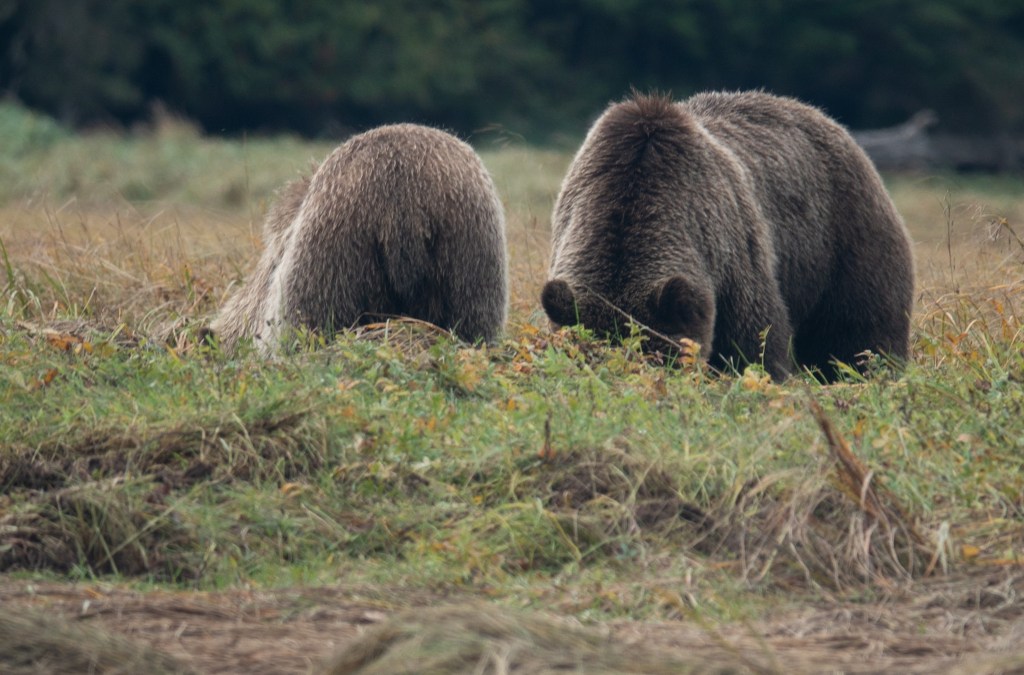
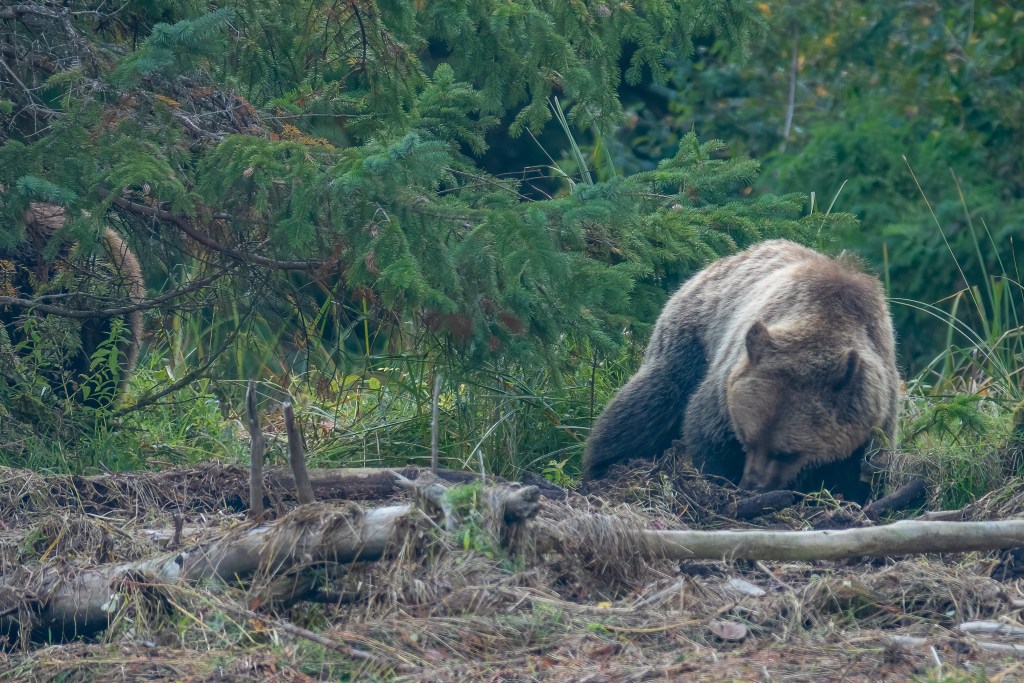
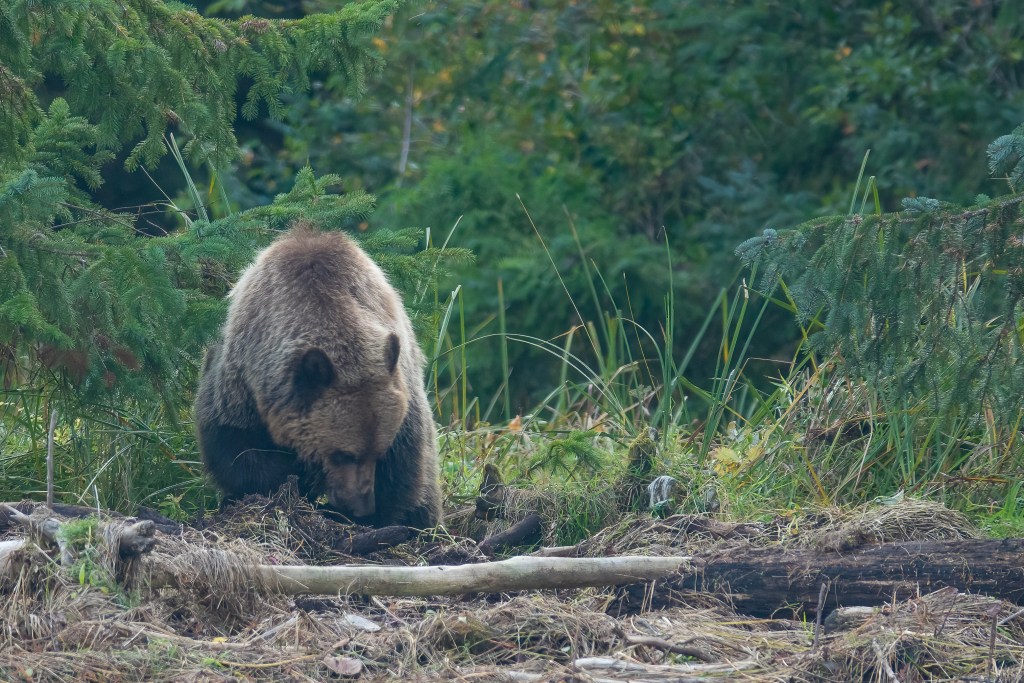
The sedge grasslands are full of succulent roots rich in sugars and starches, so they put their butts in the air, their heads down, dig, and munch. They remind me of cows, or perhaps hippos.

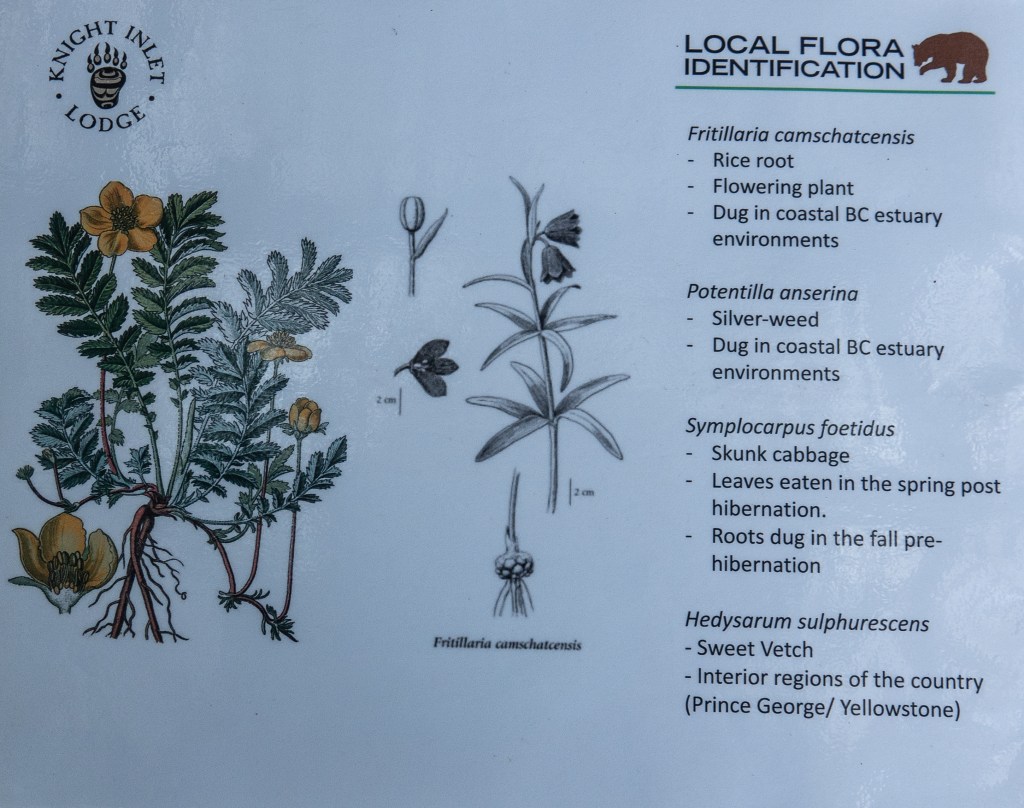
One of their favorites is Rice Root, desired for its tiny white tuber the size of my little finger nail that tastes rather like jicama (I tried it!), though it is actually related to Fritillaria.

God knows how many they eat each day, but judging by their bellies it is quite a lot.

They dig away, rarely raising their heads, and thus thwarting most attempts at photography.

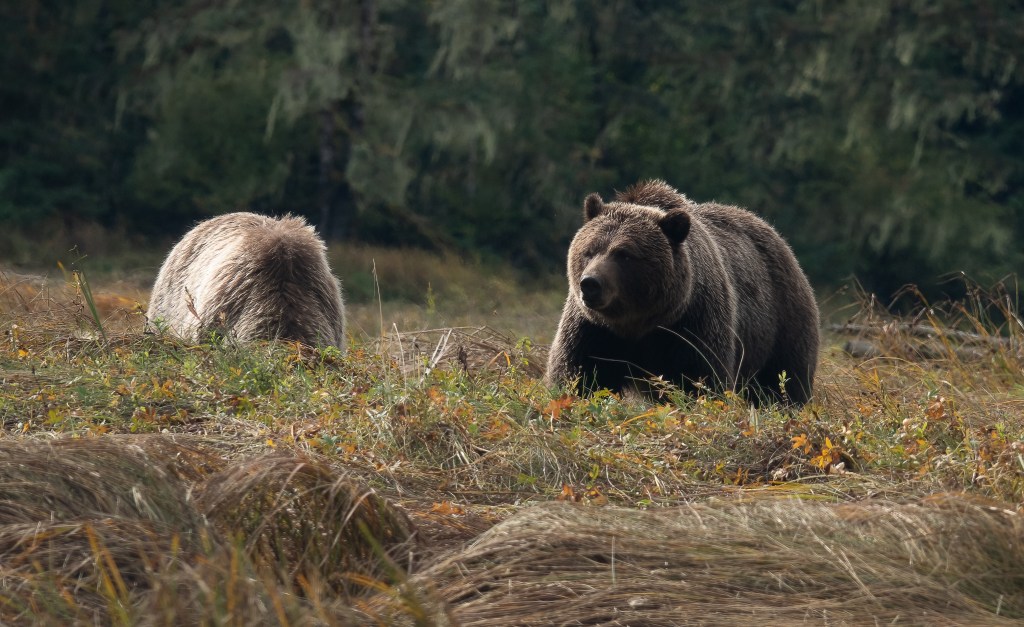
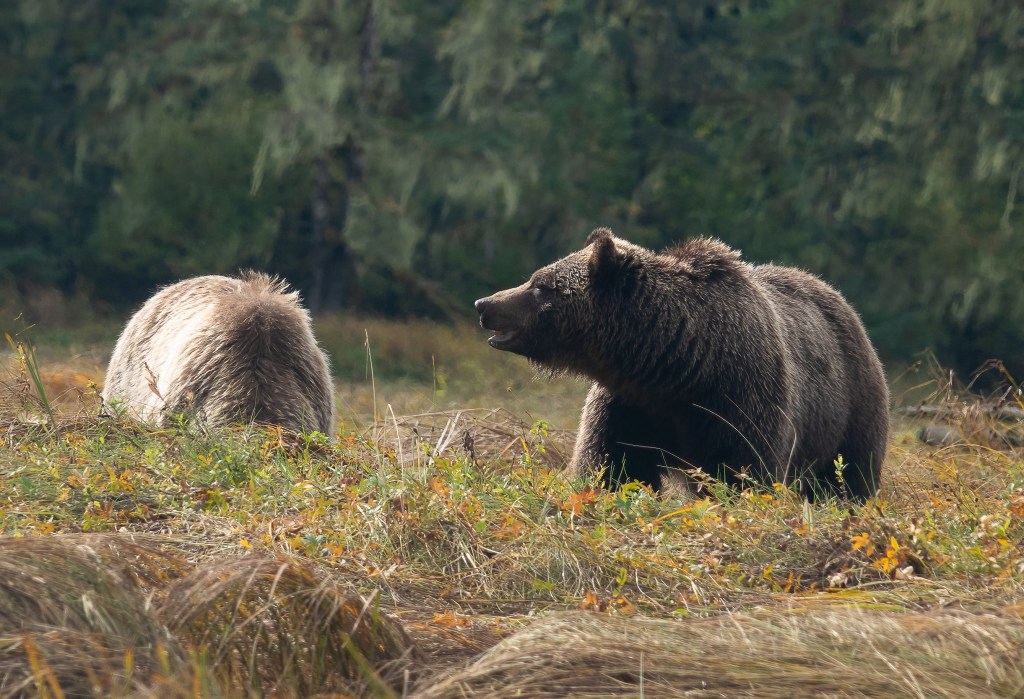
I did discover one technique for getting them to raise their heads. Lower my camera, and sure as God made little green apples, up come their heads. Every now and again, the stars aligned and I got a shot. This is Flora, the mother (right) and Fauna a 3-year old cub, left. More on them another time.

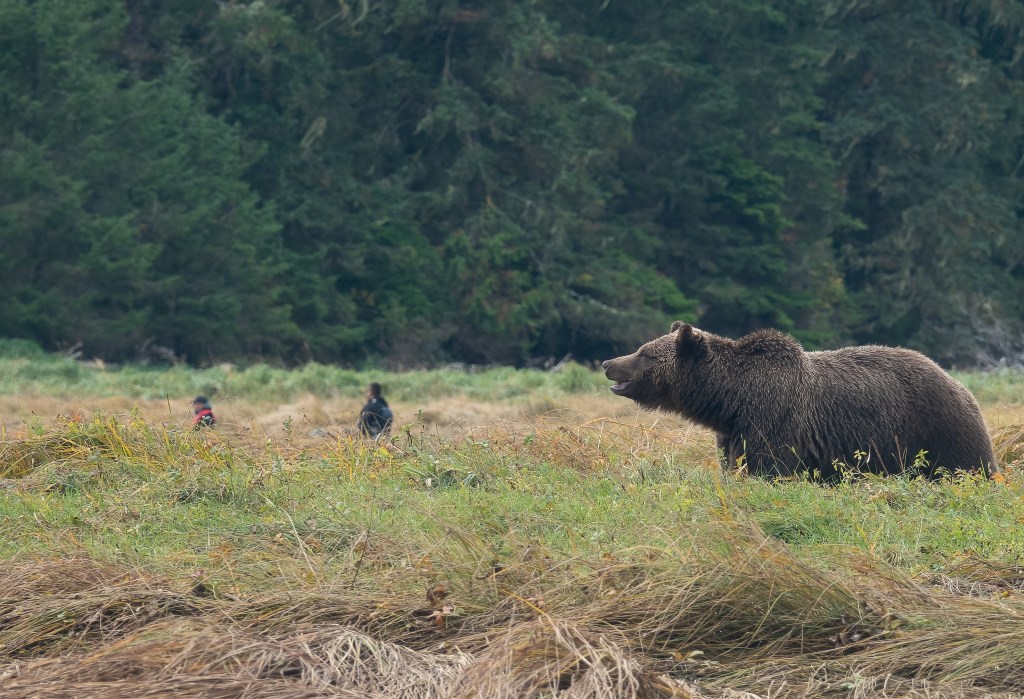
They’re so immersed in digging that they look up only briefly even when another boatload of photographers passes close behind them:

Here is a short video of them hard at work, first the cub then the mother:

There is apparently some mother-daughter friction vying for the best spot:

But the cub digs on, oblivious:

PS: They eat a range of plants. Here are some favorites:

Humpbacks 2: Blowing bubbles

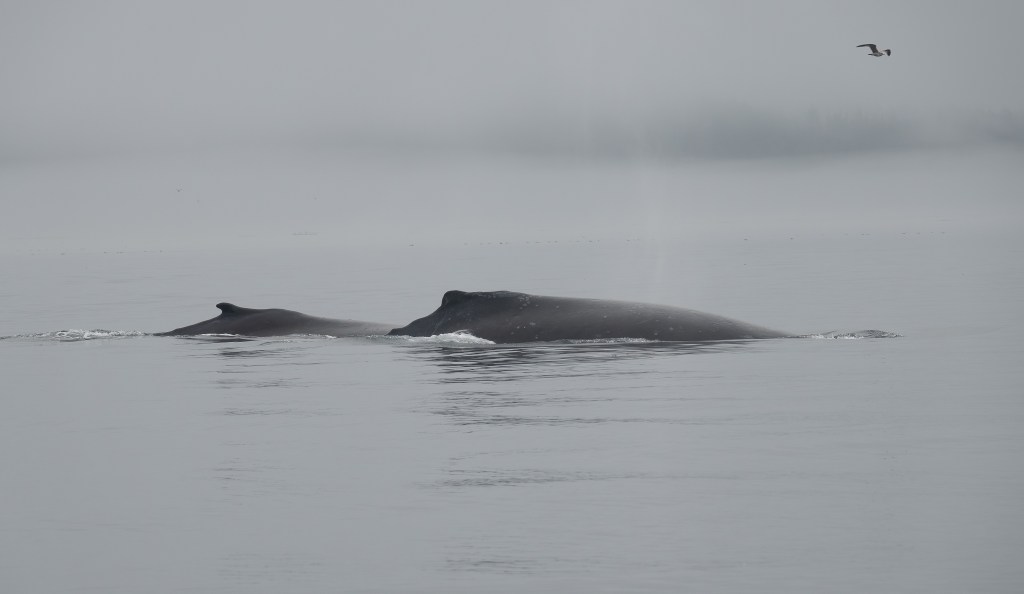
In the mist, humpbacks are calm and peaceful.

But..

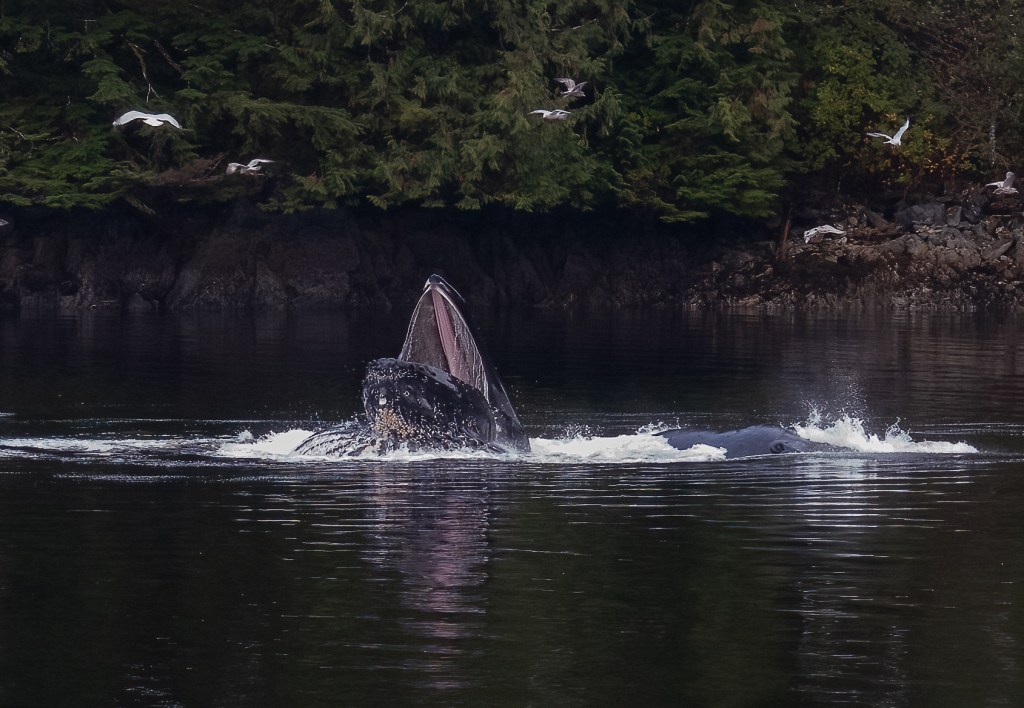
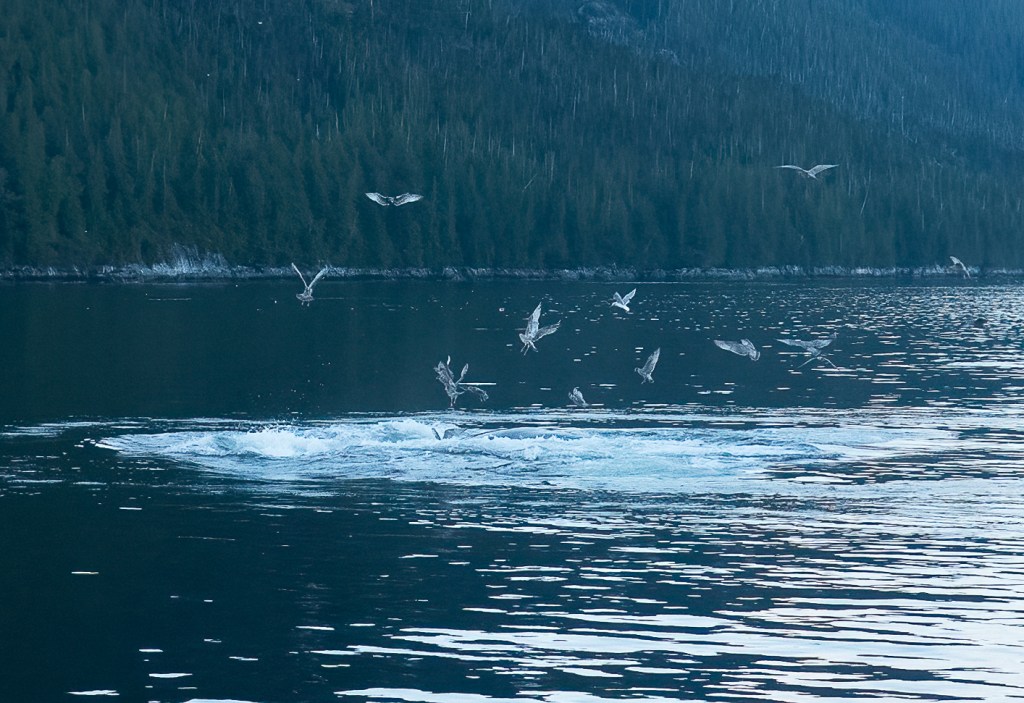
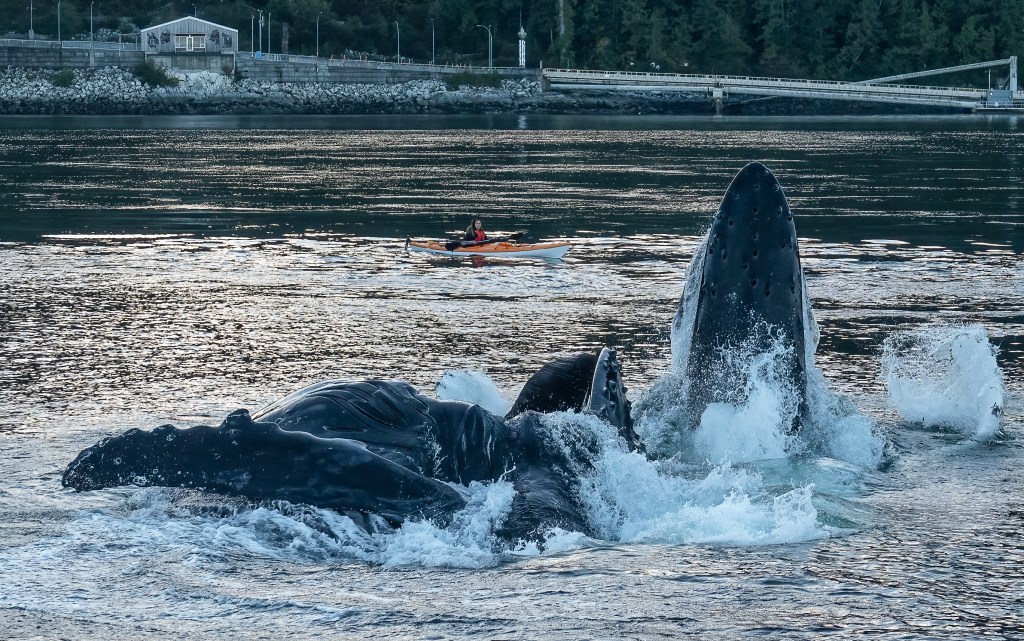
In a few parts of the world, including South-eastern Alaska and ‘our’ part of British Columbia, humpbacks have developed a feeding technique called bubble-net feeding. It is a behavior they learn from each other and pass on within their own community. It can involve up to 20 whales, but we saw small groups of two or three doing this, regularly, right off Spirit Bear Lodge:

Although we are close to shore, the water is about 300 feet deep. The first sign is an easy-to-miss faint ring of bubbles, 3 – 30 meters wide, sometimes also signaled by low-flying expectant gulls. (In the photo below the righthand portion of the circle is out of shot. )

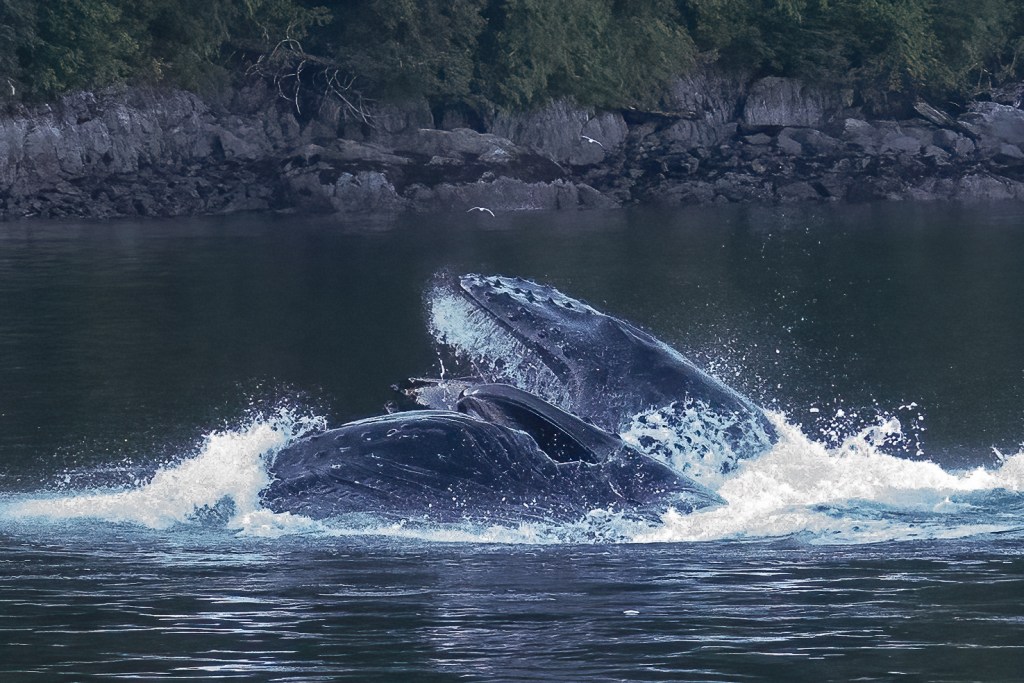
The bubbles are created by the whales well below the surface surrounding the fish, and swimming upward in a spiral blowing bubbles, which apparently creates a barrier net that the herring don’t cross, for reasons that are unclear. Once they have the fish trapped, the whales burst upwards, together, gulping gigantic mouthfuls of fish and seawater.

There are three whales in this photo, all with their mouths wide open. Look carefully. (1) Left, facing left, lower jaw in the water, upper jaw vertical. (2) Centre, upper jaw with pink palate facing us at 45 degrees, lower jaw in water pointing towards us. (3) Right, whale on its side in the water facing left, with underside of lower jaw displaying the ventral folds.

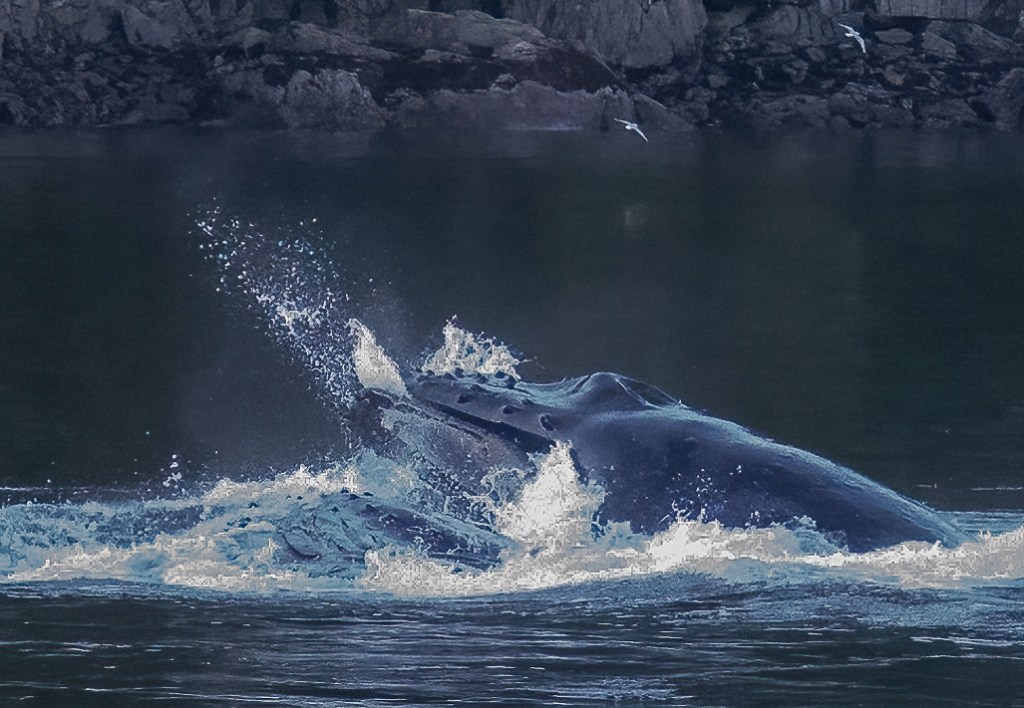
These folds expand to hold a huge volume of water and fish, mostly below the waterline in this next photo.

Once the whale has a mouthful, up to 15,000 gallons worth, it closes its mouth

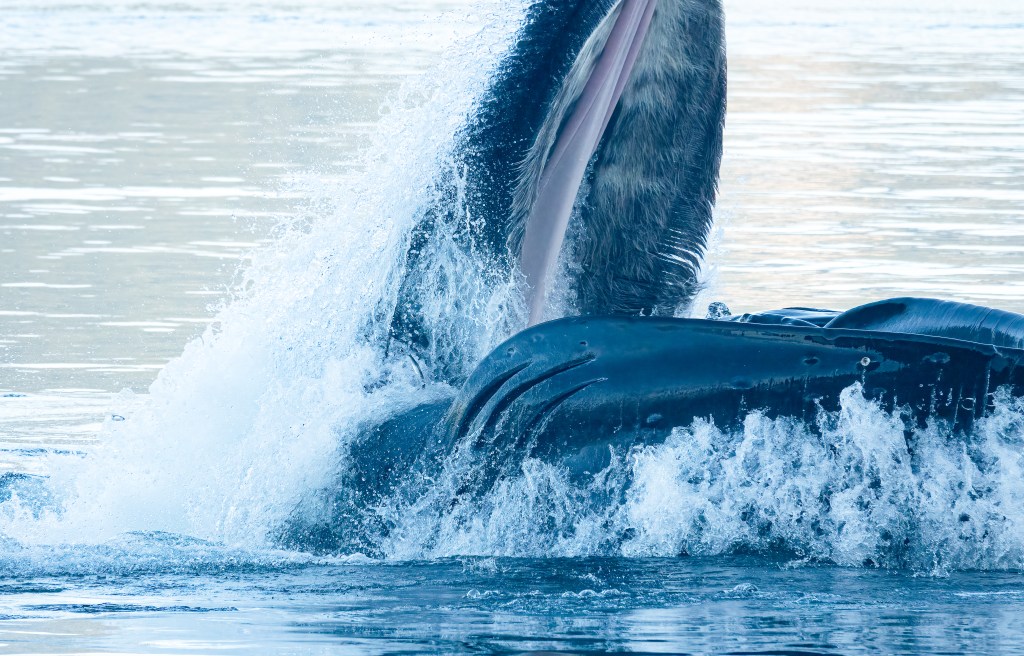
The water then spills out through the baleen plates, leaving the fish inside:

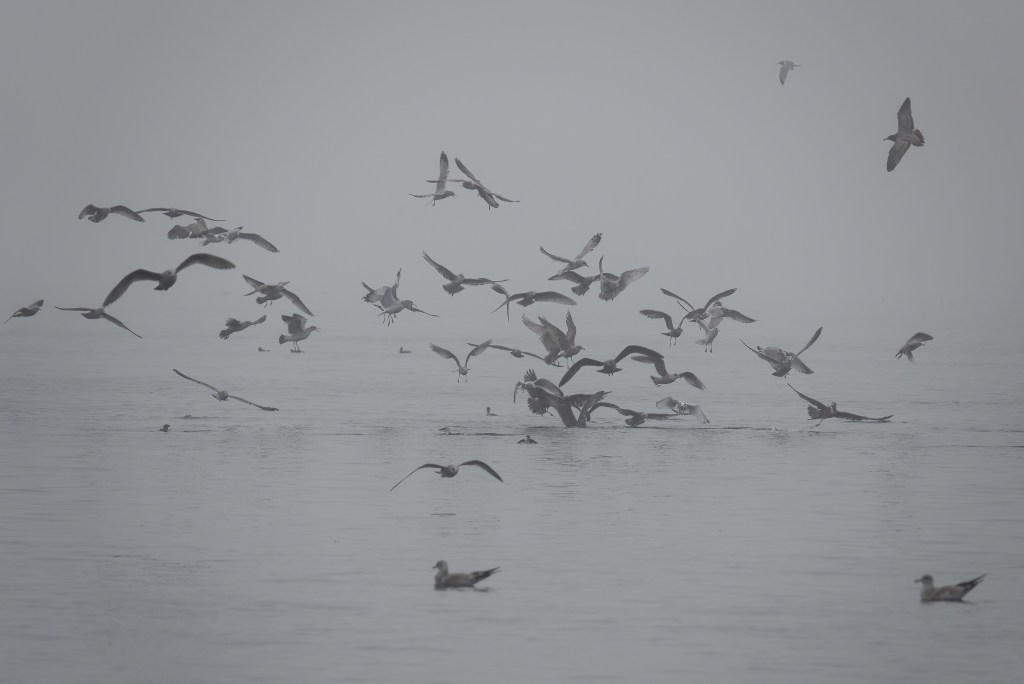
This all happens fast, and usually I was looking the other way when they erupted from the depths. The whole thing was 7 seconds from bubble circle to a calm ocean and scavenging seagulls again:

It can be very dramatic: behind this group is a stunned kayaker:

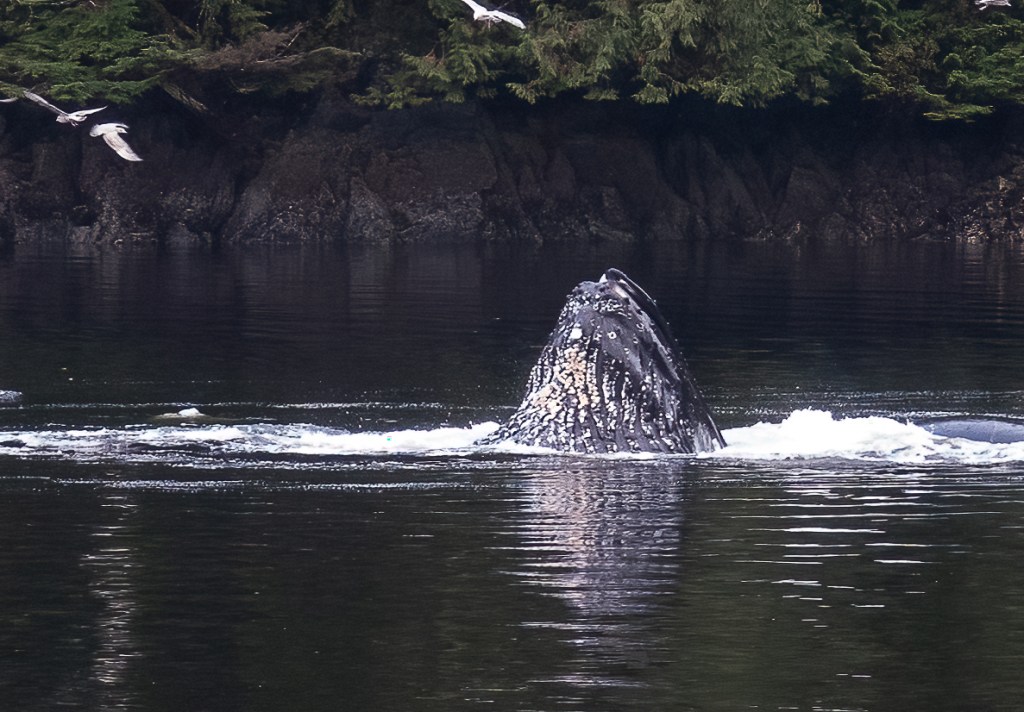
In closeup the baleen fringes surrounding the pink palate are quite visible. They are 2-3 feet long, and made of keratin.

Here you can see how they work as filters:

As the whales sink beneath the surface, the ever-hopeful gulls swoop in:

This feeding behavior goes on only during the summer and fall months when the whales gorge on the rich cold-water fish stocks. They build up body fat for their migration south to their winter breeding grounds in Mexico or Hawaii.