Happy New Year. It is 2024 as I write this from Maine. It is a worrying year. Instead of snow, we have had rain, and lots of it. The ground is muddy and brown rather than hard and white.
But there are still things to discover out in the woods. I came across this tree, recently gnawed.
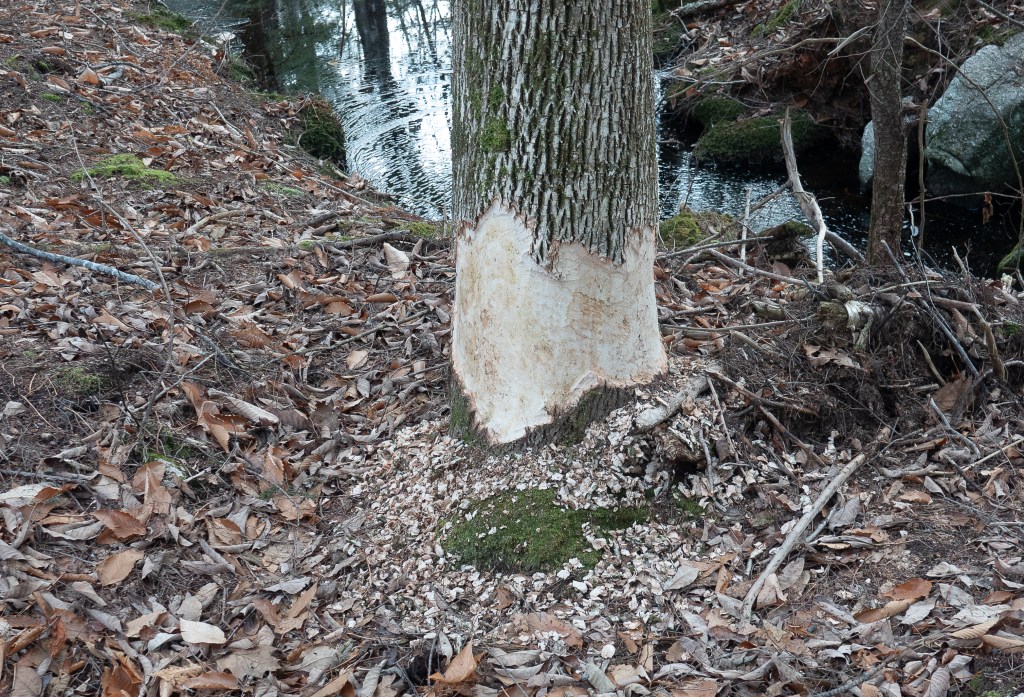
Typical porcupine, just shallow bites to reach the cambium, which you can clearly see contains nutritious sap (the little dots):
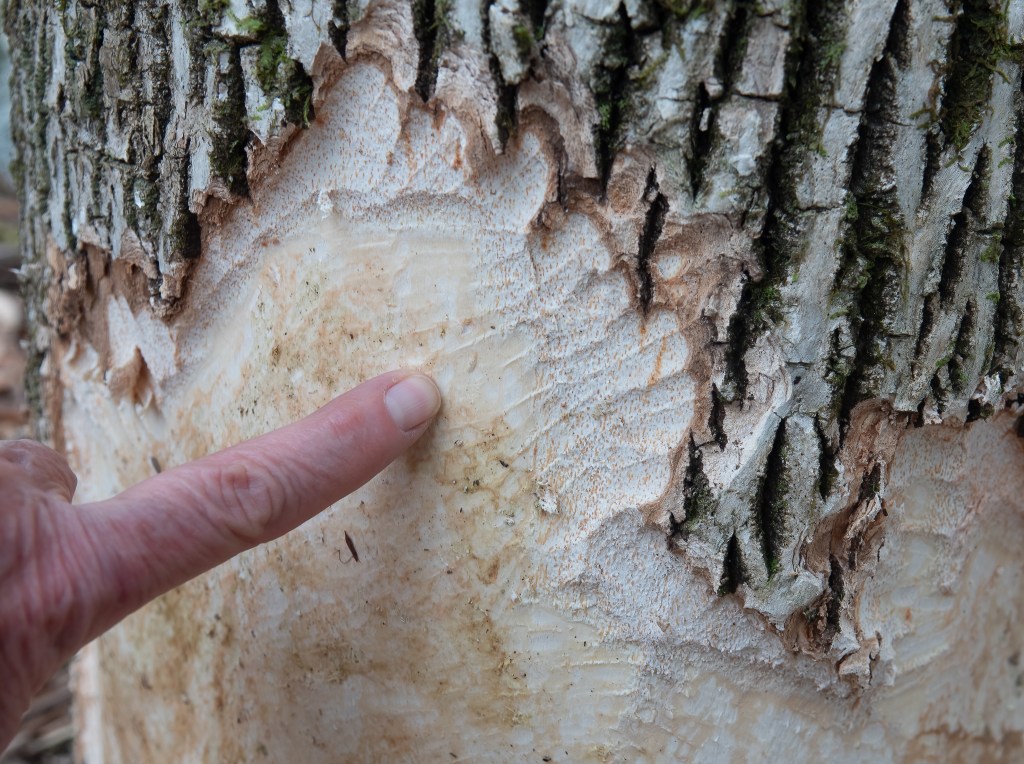
Unlike beavers, they do not chew into the wood proper. (PS A Maine Master Naturalist whom I greatly respect has just told me she thinks I got this wrong, and it is actually beaver after all! It is now under deep snow, so we can’t check, but be skeptical of my claims!)
Porcupines are common round there, and in early November this one spent a lot of time in my field. Sometimes it was asleep, catching the final rays of an Indian summer, relaxed and unaware of my presence, quills down:

I could get very close before it opened its tiny eyes.
One other occasions it was feeding on the last green plants of the year, before the usual snow cover makes foraging harder and they are reduced to chewing trees.
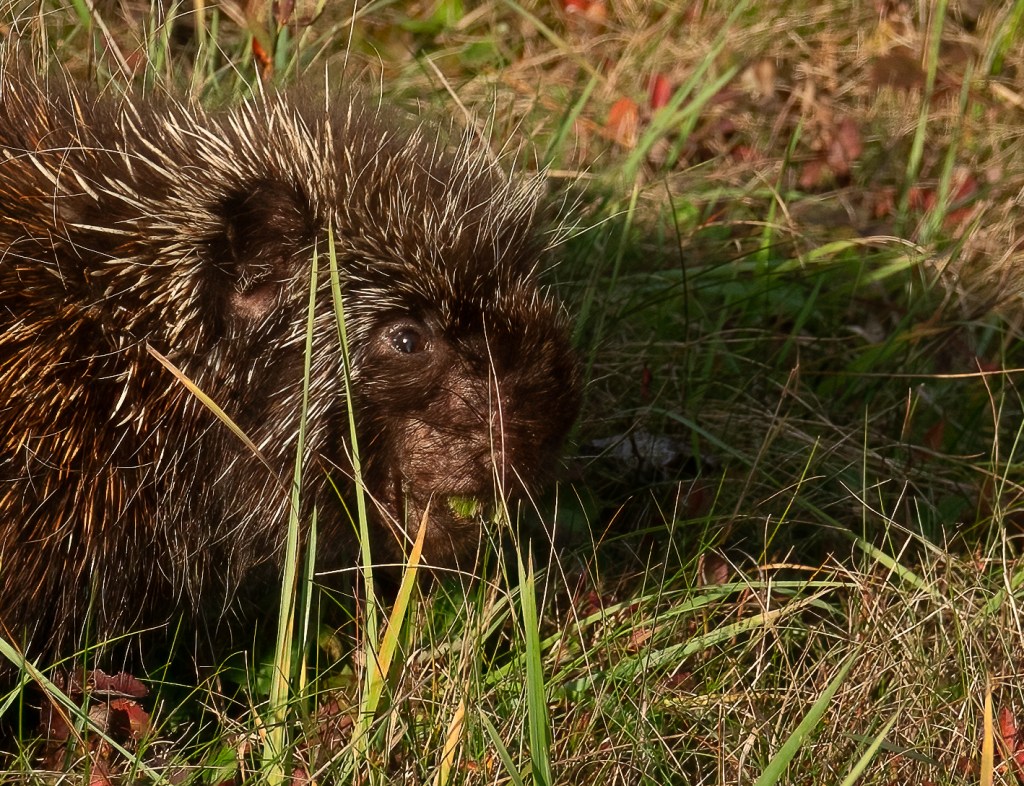
They don’t hibernate, but they do become less active.
Their incisors are a startling orange color:
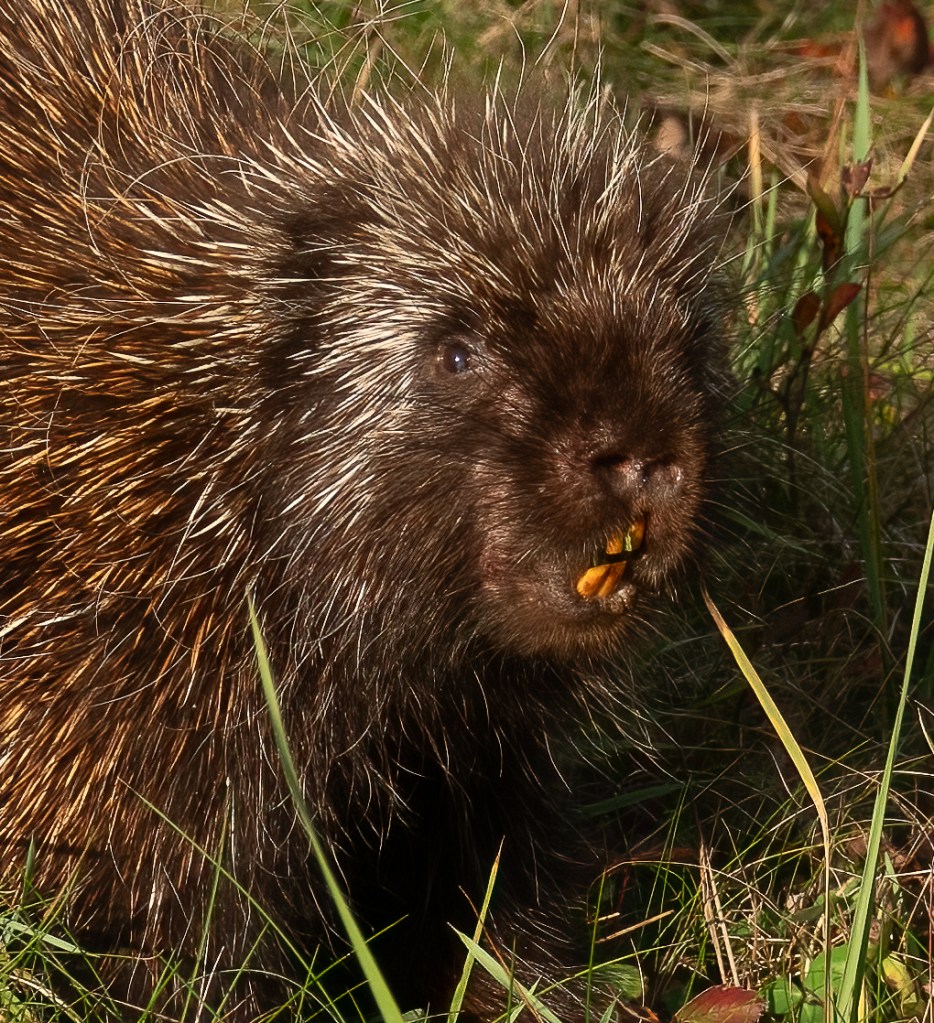
The color is caused by iron oxide, which is incorporated into the teeth as they grow. It is thought to harden the teeth, so they can chew wood. The incisors grow throughout their lives.
When a porcupine is disturbed, it erects its quills. As it retreats, you can clearly see the posterior quills in action:
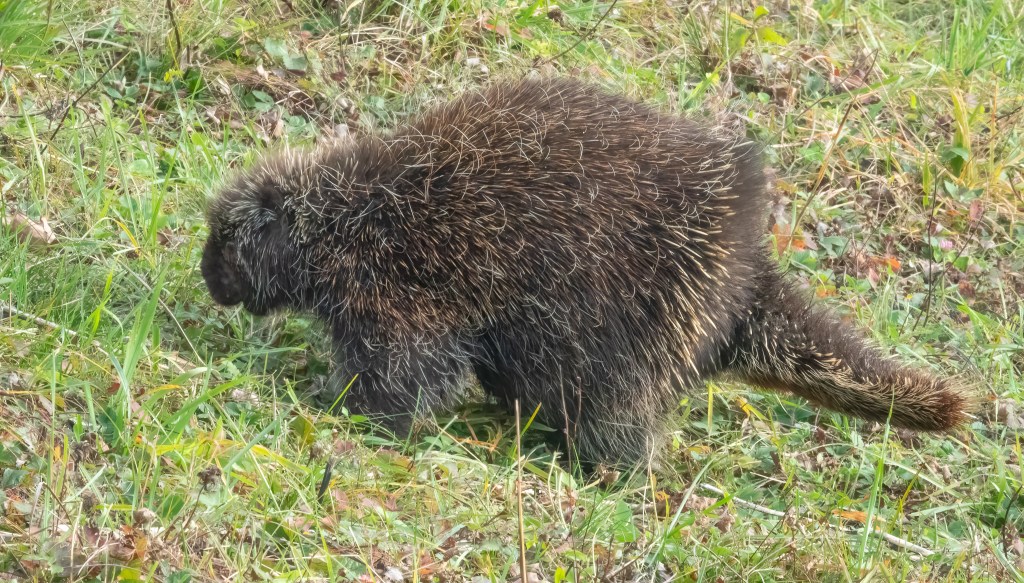
Their other weapon is their claws, visible on lower left:
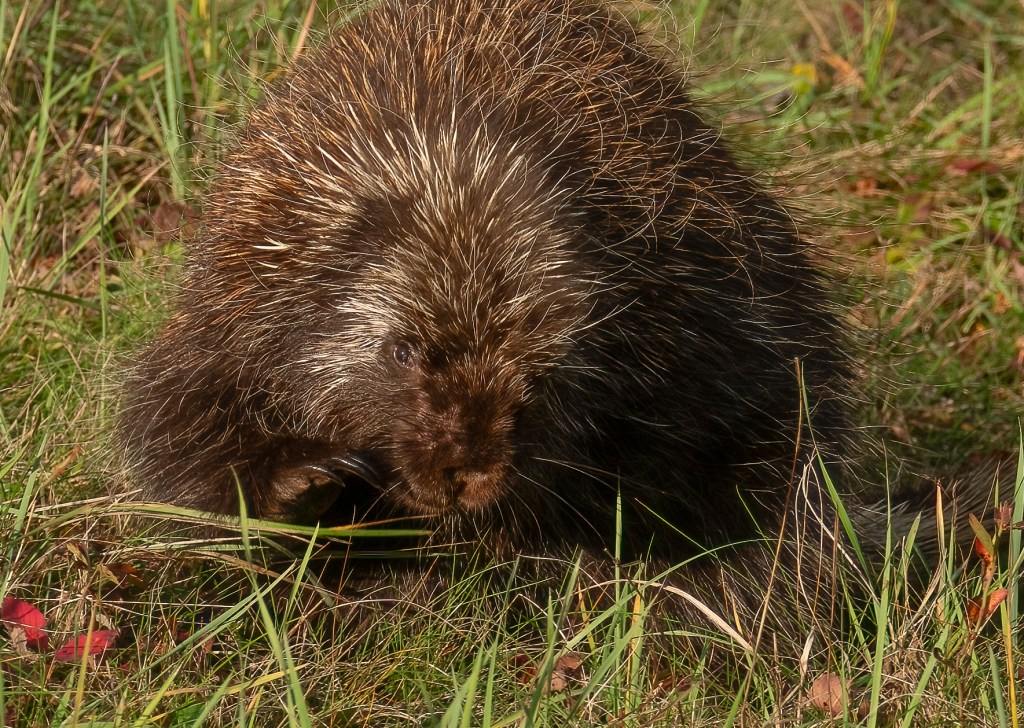
But their defensive behavior is all about those quills. They will sometimes turn their backs and stand their ground, and in the modern world that doesn’t always work. Pickup trucks, for example, are undeterred, hence the high number of roadkills.
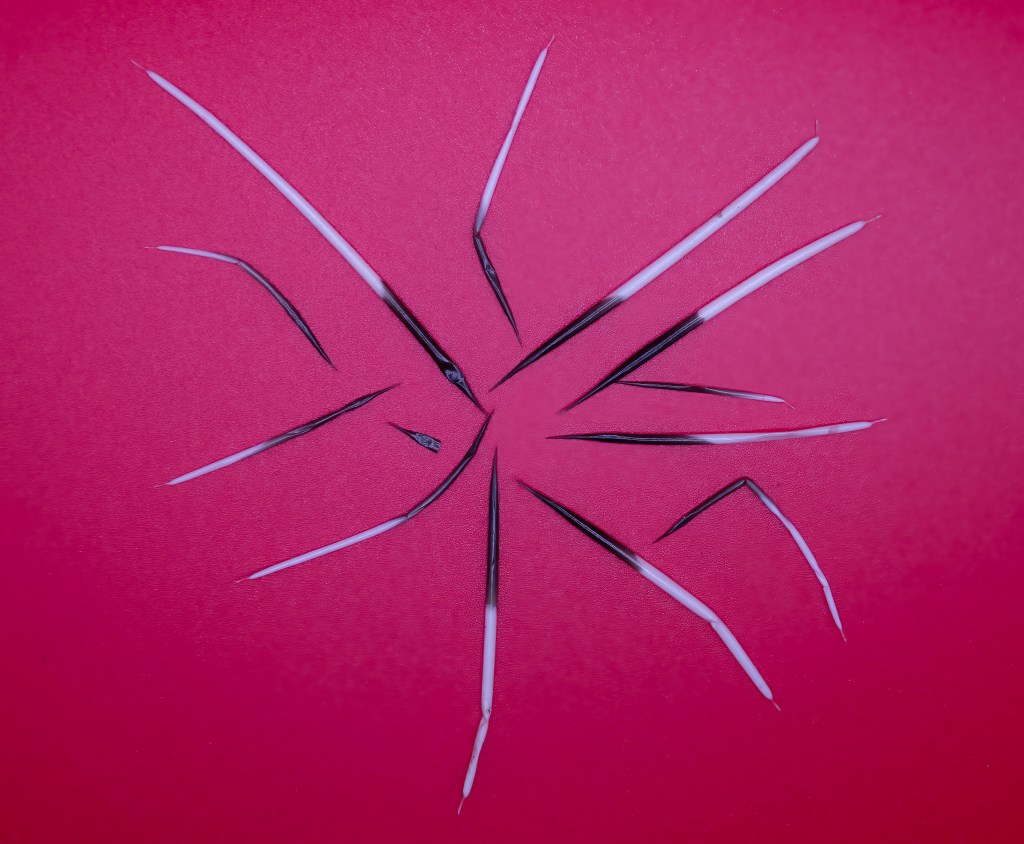
Any animal brave enough or foolish enough to tangle with a porcupine pays a price. Gemma, our beagle, found one in February:

There were quills in her lips, up her nose, and one on her tongue, which she patiently let us extract with tweezers. There were twelve of them, but sometimes dogs get 50 or 60, and a trip to the vet is needed.
I’ll let Ogden Nash have the final word:
The Porcupine, by Ogden Nash (1902-1971)
Any hound a porcupine nudges
Can’t be blamed for harboring grudges.
I know one hound that laughed all winter
At a porcupine that sat on a splinter.
 Eyes on the Wild
Oh, poor, sweet Gemma…that must have hurt. Quill wounds don’t get infected? I’ve not heard of Porcupine sightings, here, south of Boston, MA.
LikeLike
I think they can get infected, like any laceration. We remove them with tweezers, gripping them as close to the skin as possible. She was fine. The one on her tongue was the hardest. One of us held her mouth open while the other extracted the quill.
There are porcupines in Massachusetts too, so watch out! But they are shy, timid, and do not attack unless they have no option. They do not “shoot” their quills, but they may back into a curious dog, who then gets a muzzle-full.
LikeLike
Happy New Year!
Thank you for your wonderful photos.
We have very little snow in Switzerland too, except at very high altitudes.
Wishing you a wonderful and peaceful year ahead.
LikeLike
I love learning about all the different animals on our Earth, their adaptations, their food preferences. Have you seen any of Joel Santore’s awesome books?
LikeLike