
Jack-in-the-Pulpit, Arisaema triphyllum, is a striking, exotic, almost sci-fi looking wildflower. It has a single funnel-shaped stripy “petal” called a spathe, curled around an upright structure called a spadix.
I found myself wondering how on earth it is pollinated. If you look very closely at this photo, you can see pollen grains on the spadix, on the right hand-side:

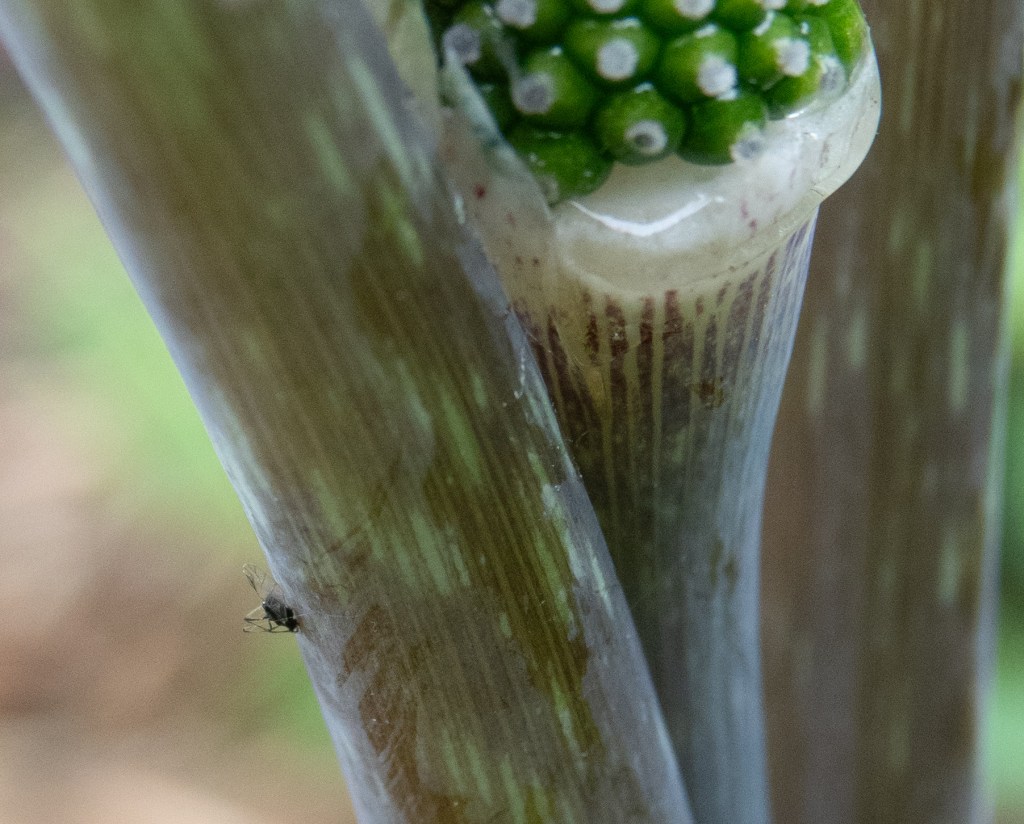
Each plant is either male or female. The male flowers produce pollen, and the females have ovaries, and need the male pollen for fertilization. The female spadix apparently has tiny flowers, but I have never been able to see them. Finally, I found a more precise description. The tiny flowers are deep inside the spathe, at the base of the spadix, and to see them you have to cut away the front of the spathe, so I did:

What you are looking at is the inside of a female flower. These are the bright green ovaries, each topped by a tiny white fuzzy stigma waiting to receive the pollen.

But how does it get there?
Here is the best description I can find, from the New York Botanical Garden:
” Jack-in-the-pulpit is pollinated by fungus gnats, which are attracted into the hooded spathes by a slight fungal odor. The gnats visit to lay their eggs on what they are duped to believe is a fungus. … When the mistake is perceived the gnats are unable to crawl out of the spathe due to its slippery interior, nor can they fly straight up to escape in that way. However, if the plant is a male, they may eventually notice a small opening at the base of the spathe through which they can escape. By this time they are dusted with pollen.
The gnats, being of limited brain capacity, may be duped repeatedly until they eventually enter a female plant where the pollen that they are carrying brushes off on the fuzzy stigmas, thereby effecting pollination. This time there is no escape since the spathes of female plants have no opening in the base of their spathes, and the gnats die within the spathe.”
And here is what I think is a visiting gnat, on the stalk at lower left:
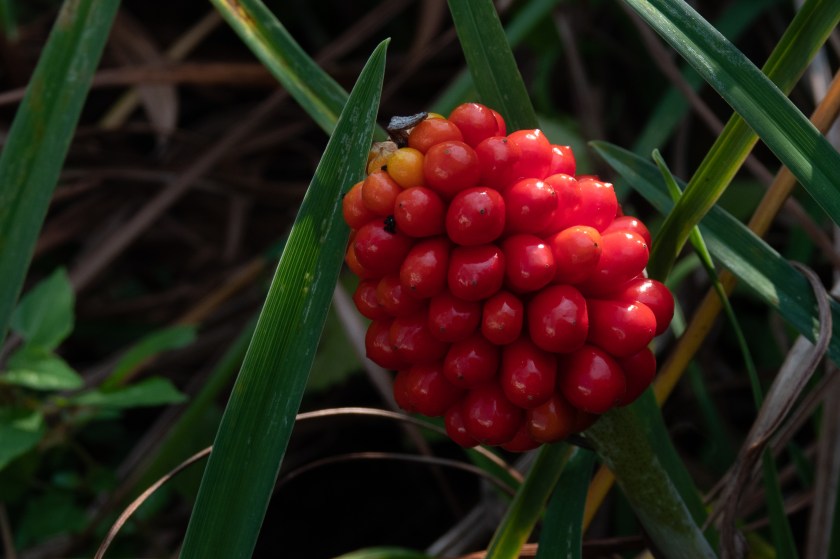
Successfully pollinated plants show brilliant berries in the fall:
PS The suggestive upright “Jack” is in fact a mere sterile appendix, but it does have one function: it produces the aromas that attract the gnats.
PPS There are many different species of Aristaema, Japan has five. It turns out each is mostly visited by a different species of fungus gnat, meaning that pollen is largely transferred amongst flowers of the same species, making hybridization unlikely. Read more here:
https://www.indefenseofplants.com/blog/2021/3/11/how-fungus-gnats-maintain-jack-in-the-pulpits
 Eyes on the Wild
Such interesting info! Great photos. The importance of every creature…even gnats…our wonderful world! I’ve always loved Jack-in-the Pulpits….used to walk a lot in the woods & would be happy to discover them.
LikeLiked by 1 person