I’m going somewhere warm for the next couple of weeks, so while I’m away I’m arranging to send out this hopefully last seriously wintery blog post!].
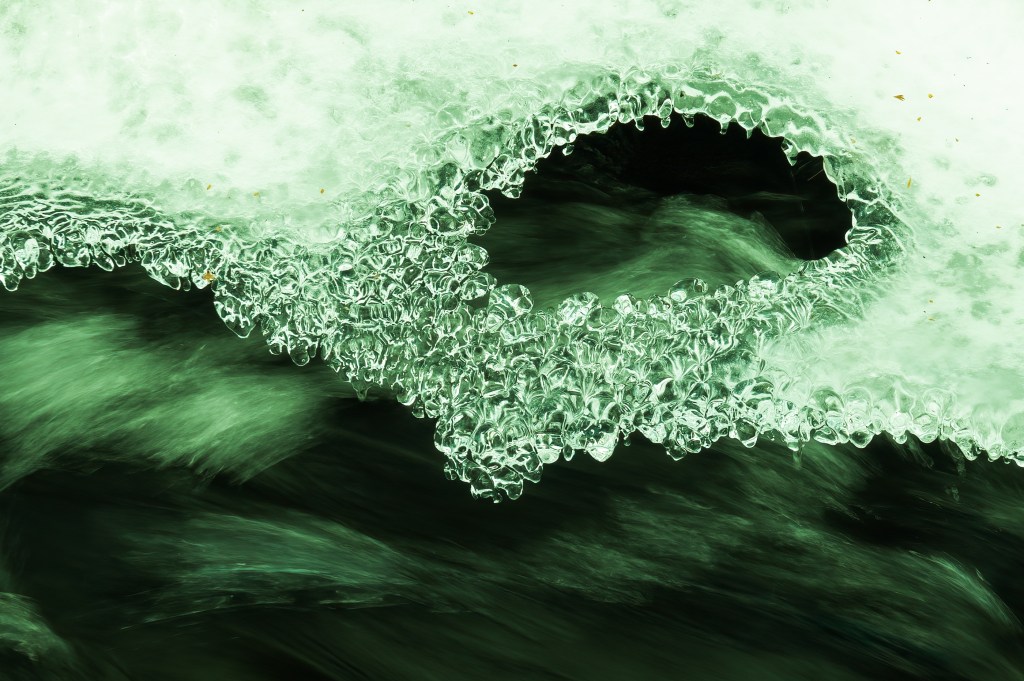
Ice can look like diamonds:
But its beauty can also be subtler: the physics of freezing is a transformative force. Some weeks later, and it had been very cold, -3F (-19C) at night. The stream was mostly frozen, and covered with snow, with only a few fast-flowing stretches still open.
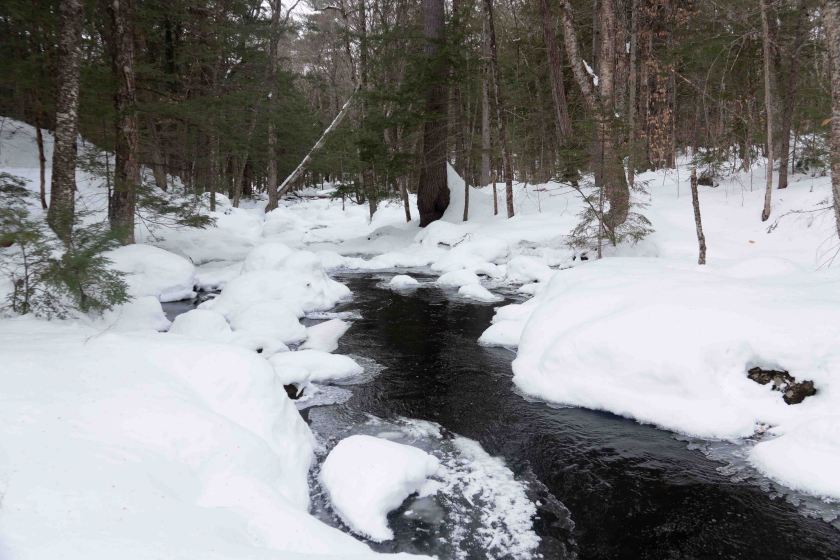
Where the ice meets the water, a new paper-thin layer of ice had formed, and this created the perfect conditions for the formation of frost flowers:
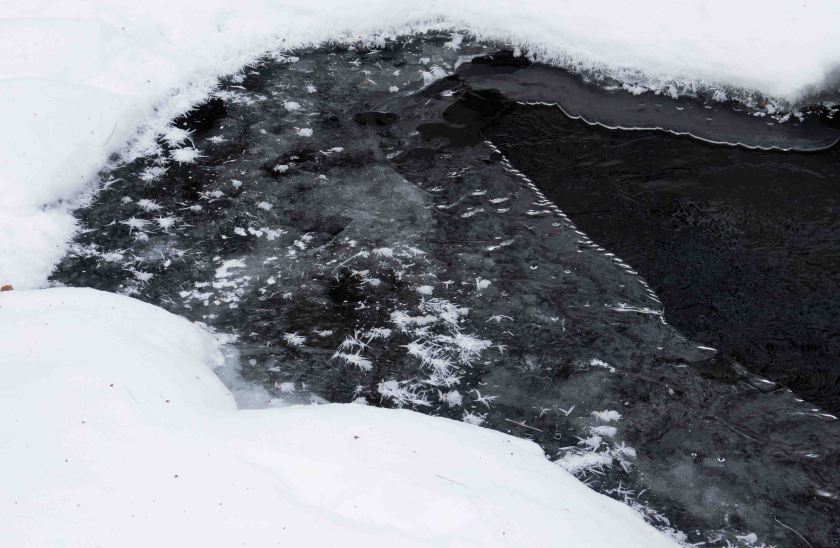
Here is a close-up:
Wikipedia explains how they form:
“Frost flowers form when a layer of relatively warm ice is exposed to still, cold air that is at least 15 °C colder. For example, this would occur when freshly-formed ice at 0 °C underlies cold air at -30 °C. In this situation, water vapor sublimates from the surface of the ‘warm’ ice. As this moist air rises into the colder overlying air, the temperature drops, and the air becomes supersaturated. The final result is a layer of supersaturated air, lying directly above the ice (just like how steam forms above the surface of a hot mug of water on a cold day). Any protrusions from the ice surface stick up into the supersaturated air, and end up being covered in hoar-frost like crystals (i.e. frost flowers) due to condensation. ….
Typically, frost flowers are only found on new ice, when the air temperature is very low. This is because thin, new ice has a temperature close to that of the underlying, warm water. As ice thickens, its surface becomes much colder, and it is harder to get the necessary ice/air temperature difference needed for frost flower growth. Over fresh water, these conditions are only found when the air temperature drops dramatically below zero in a short amount of time, leading to a sudden freezing event. “
The previous day at my house it had reached 30F (-1C), then dropped to -3F (-19C) at night: textbook conditions!
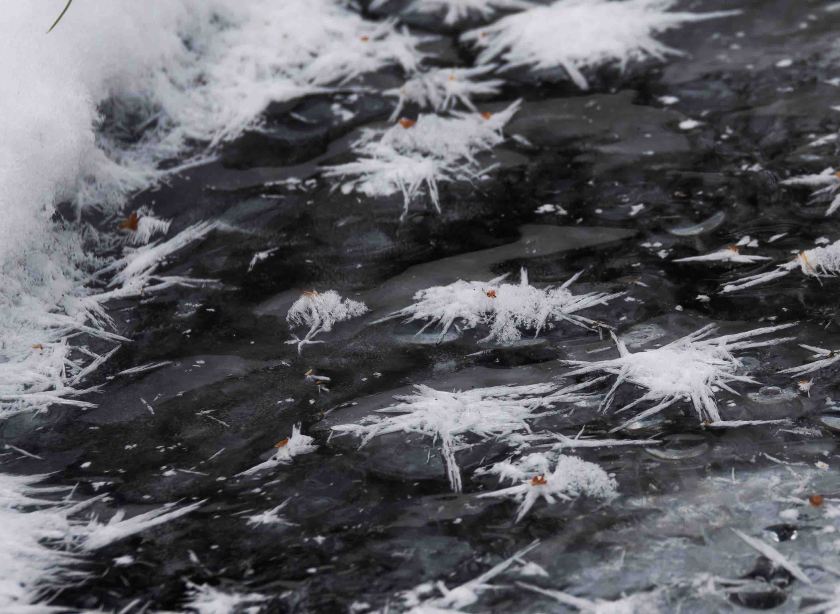
In one spot a small animal, probably a mink, had crossed from the bank onto the ice, spilling a little snow. These provided nuclei for the frost to grow:
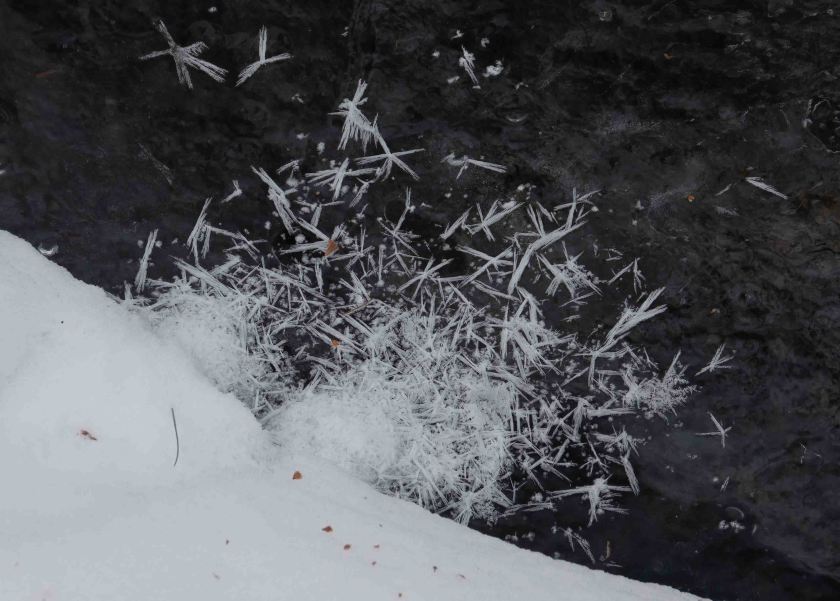
Closer up, they were lovely; I couldn’t get any closer without falling into the stream!
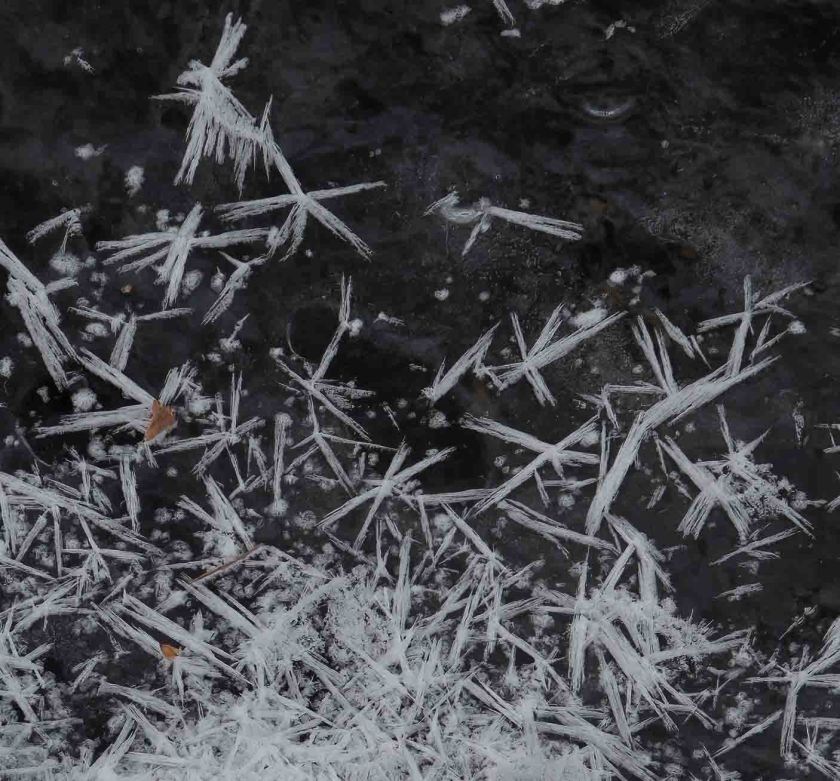
Frost flowers can be much more three-dimensional than these, which were fairly flat to the ice, but they were up to 3cm across, and still beautiful.
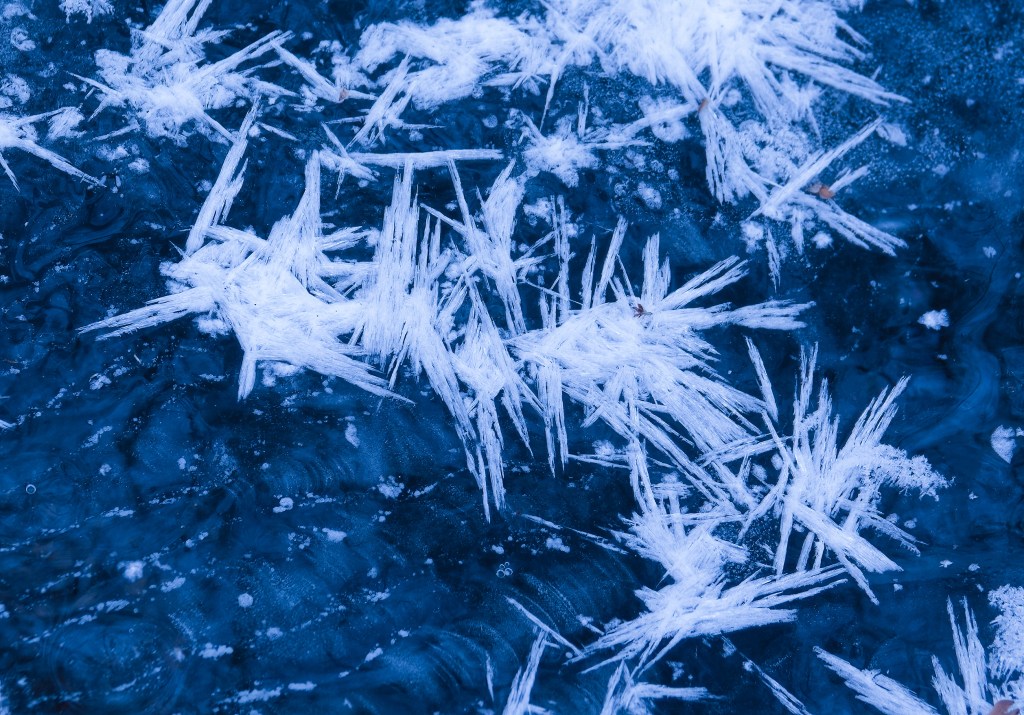
The next day they were gone.
PS In case it isn’t obvious, the colors in the first and last photos have benefited from a soupçon of digital manipulation, in the interests of art, if not science.
 Eyes on the Wild
Lovely, and bon voyage! Anne
>
LikeLike