[I’m just back from Costa Rica. My greatest desire was to see a sloth, which for me and many Brits rhymes with ‘both’, so make sure you pronounce my title accordingly! As usual, the photos are mine, but supplemented here by our guide’s.]
Costa Rica has three species of sloth, one of which is very rare. They live in the lush rainforest and are arboreal, often high up, which makes them hard to see and photograph, but on the other hand they don’t move much! This post focuses on the Three-toed Sloth, more properly called a Three-Fingered Sloth, which has three toes on all four limbs; here it is moving painstakingly about a foot along a branch. (The bottom is to the left, and the head is in the centre!!)
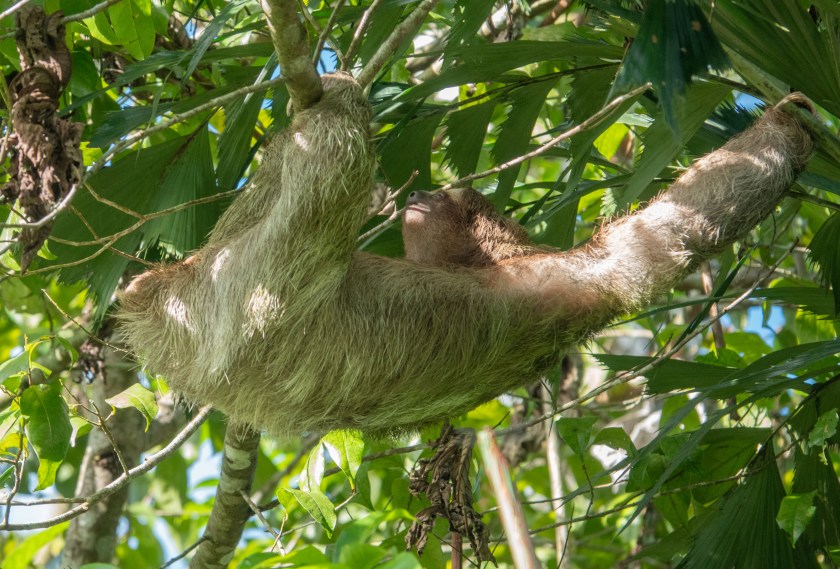
Their faces have a certain placid charm:
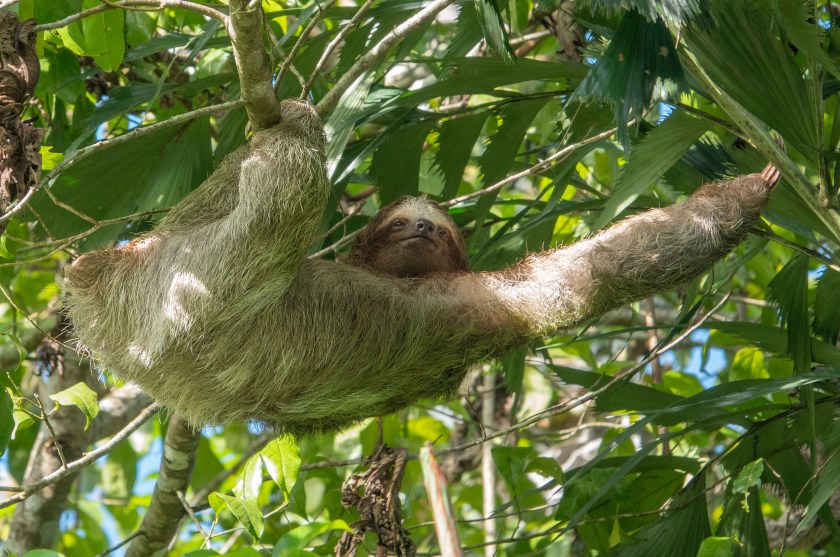
Their fur has a greenish tinge, caused by algae that flourish in the humid conditions:
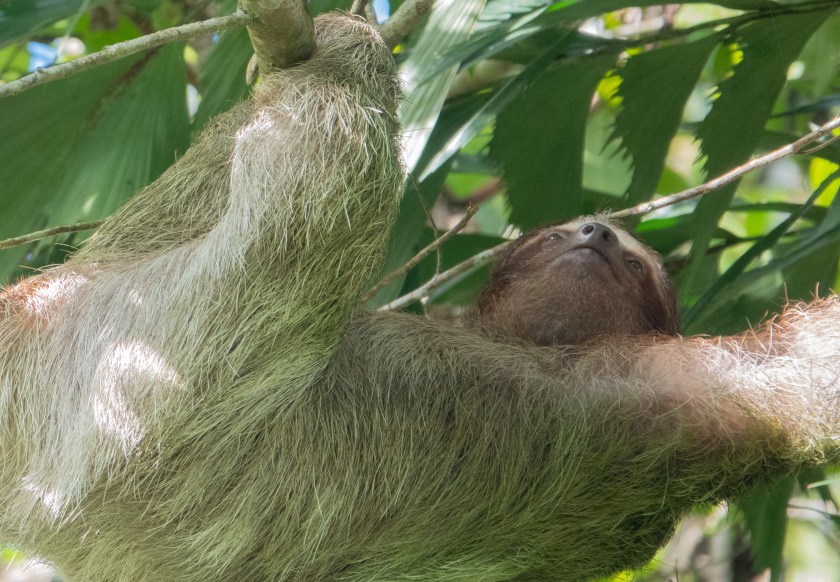
If they are short of food, they lick their fur for nourishment. Insects live in their fur too, eating the algae.
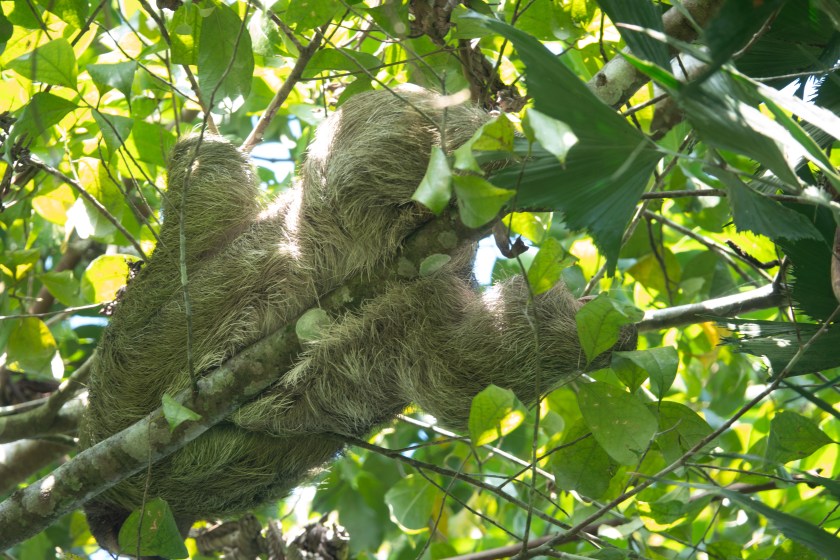
They’re leafeaters, and leaves don’t have a lot of calories, so to conserve energy they move very, very slowly, averaging about 1/2 m.p.h, and sleep a lot. This sloth had moved only a few feet in two days. The photo was taken from directly underneath the sleeping sloth, resting its spine on a branch to take some weight off its arms, and giving the delightful impression of stretching its spine on a foam roller.
Famously, they only defecate once a week, coming down to the water or the ground, and burying their faeces so as not to attract predators.
Those powerful claws and strong limbs mean they can hang by only two legs if necessary:
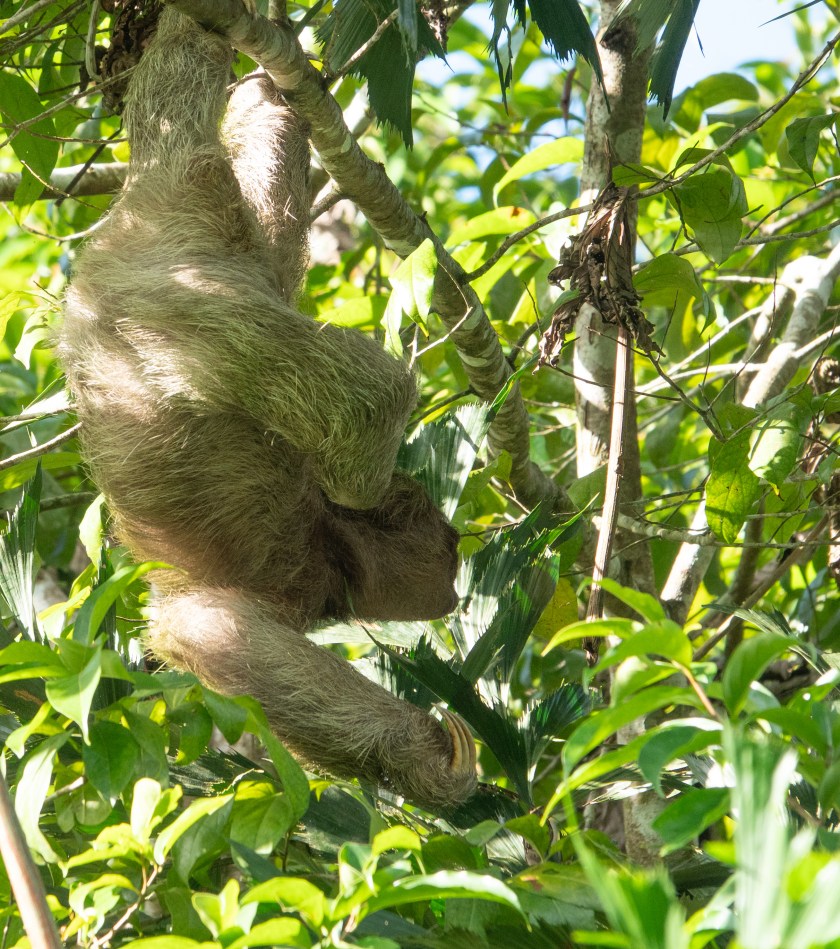
(In the last photo above, you can clearly see the three claws on the front foot.)
Our guide , the nature interpreter Johan Fernandez, used his iPhone through his scope to take photos and videos, like these two:
These videos are not in slow motion!.
I end with a quote from P.J. O’Rourke: “Sloths move at the speed of congressional debate but with greater deliberation and less noise.”
PS This website is chock full of fascinating sloth facts, if you’d like to know more: https://www.slothconservation.org/slothopedia
 Eyes on the Wild