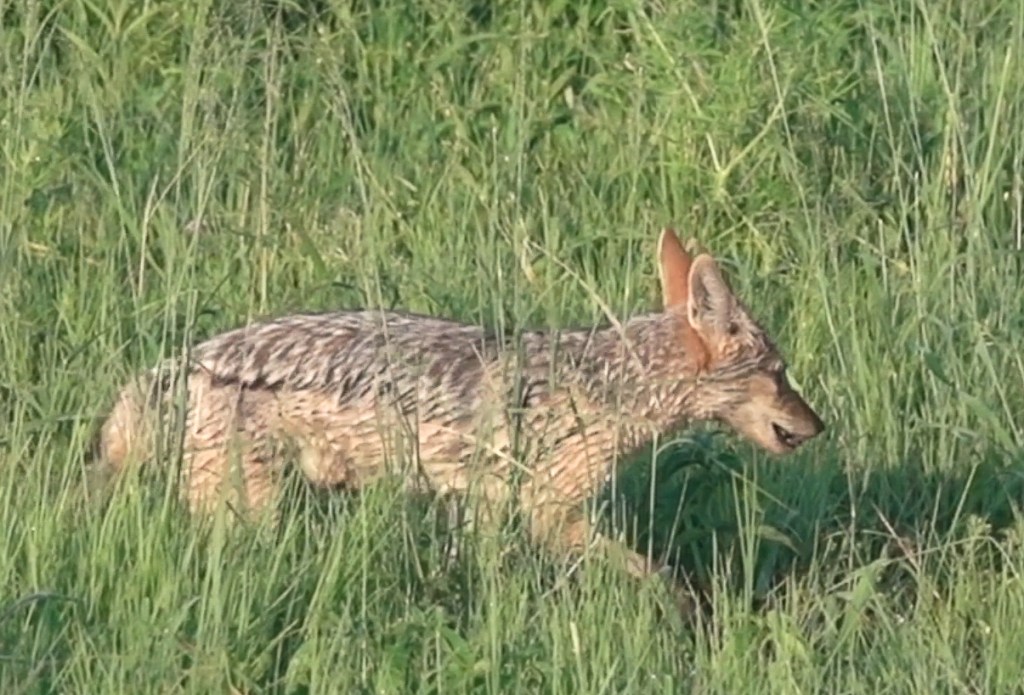
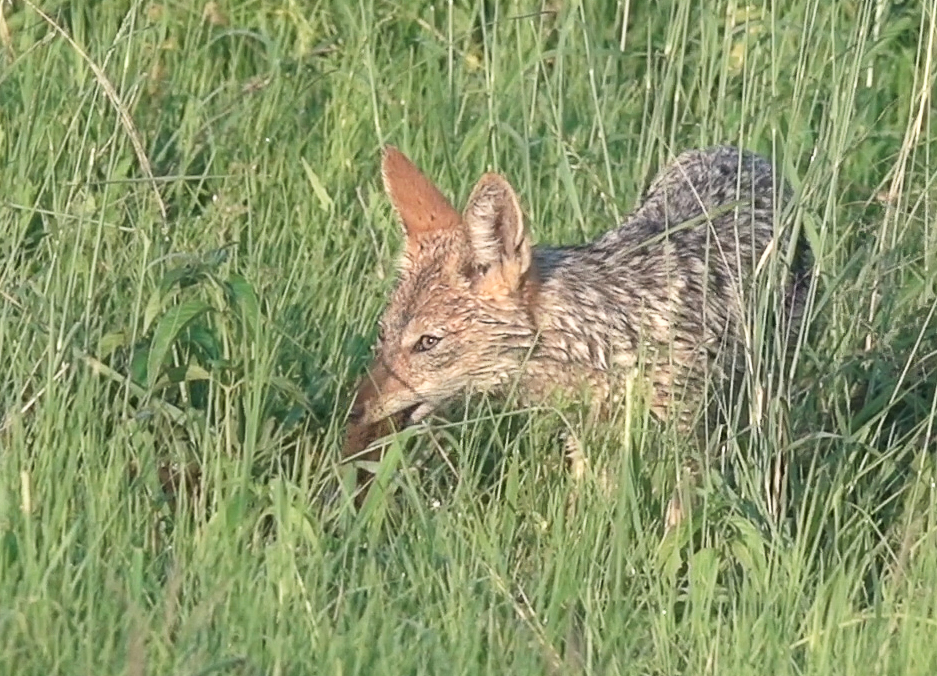
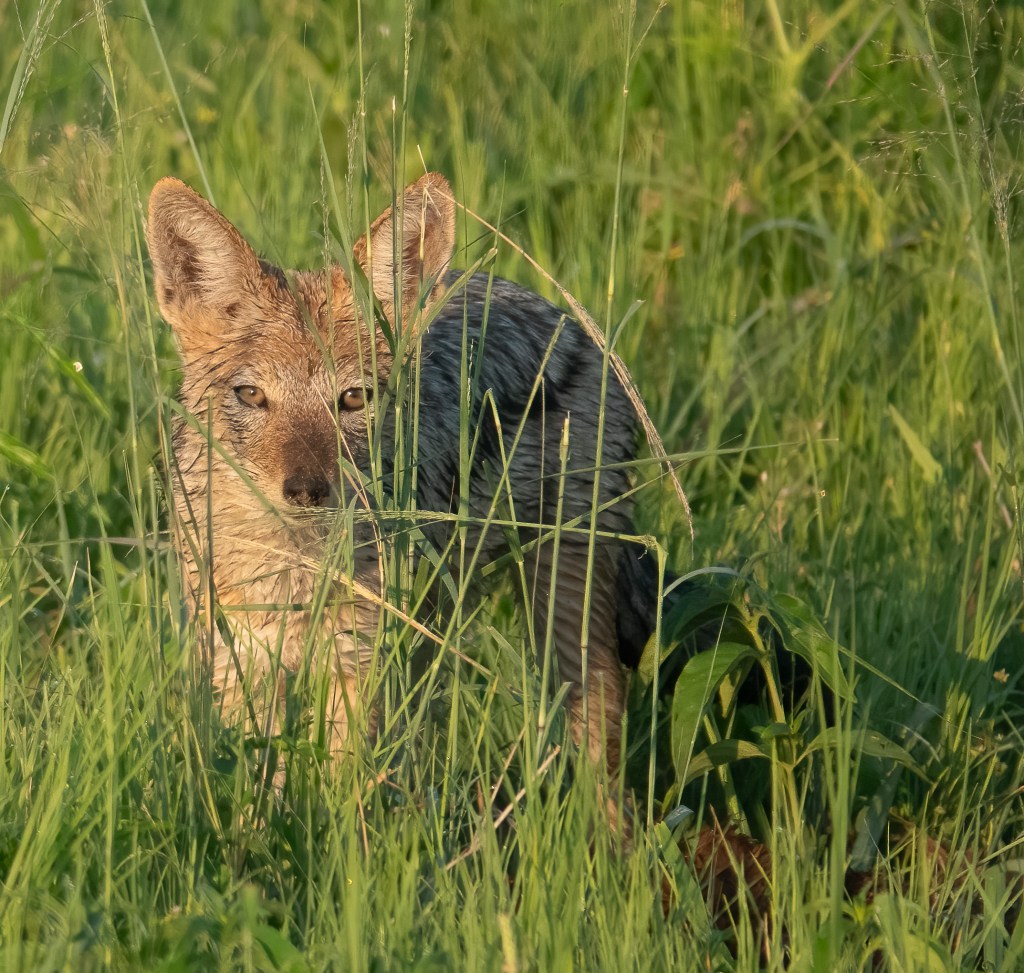
Black-backed Jackals have a varied diet. They’re not just scavengers, especially in an area like the Makgadikgadi where alpha predators are few and far between. This jackal was digging and pouncing on something very tiny in the long grass, early in the morning with its coat tipped with dew:
I made a video of it in action, but it’s almost impossible to see any details, so I captured a couple of stills from the video. At the very start, it catches what I suspect was a beetle, carries it off (here) and then lies down to eat it.
At the end, it catches what looks like something small, dark and furry:
Here’s the video (with long slow sections excised!):
Tiny morsels, but hopefully enough to keep body and soul together.
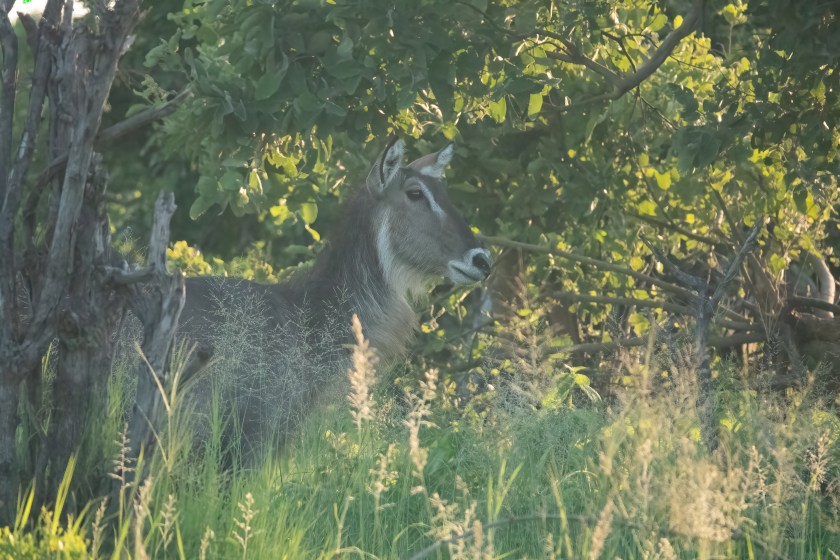
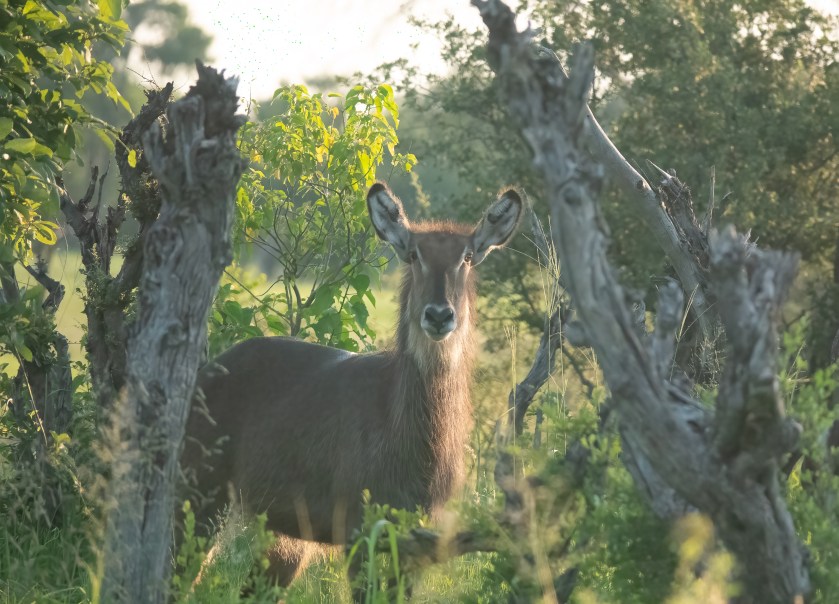
Like the Red Lechwe, Kobus leche, the Waterbuck, Kobus ellipsiprymnus, depend on water. They’re related, although they don’t look much like each other. Here is a female:
I love the fluffiness of their coat:
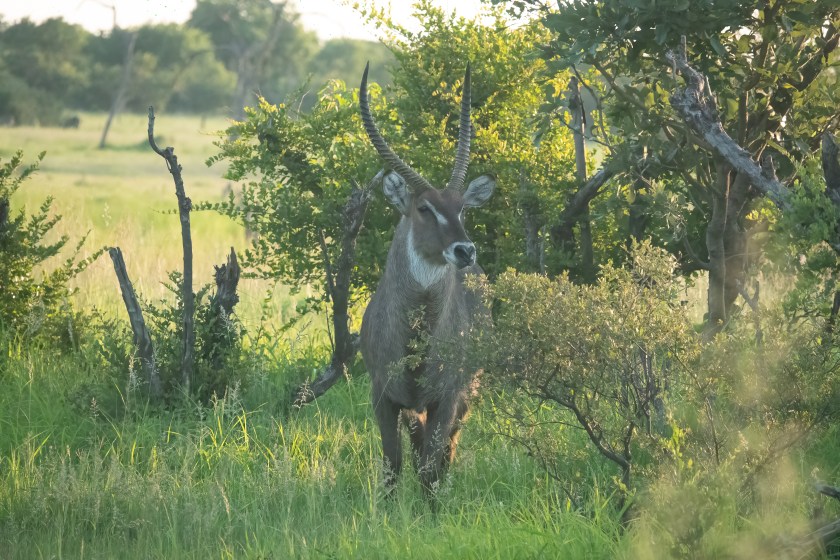
The males are rather fine:
Both males and females have very photogenic bottoms, ringed in white:
Their sweat glands secrete water-repellent oils, giving them a distinctive odor. Apparently the meat of older animals can develop a nasty flavor, but it is not true that lions won’t hunt and eat waterbuck, though they may not be their first choice.
When I was checking details for this posting I learnt something fascinating: once in a blue moon, Waterbucks and Red Lechwe mate and produce a hybrid. Watch this PBS video (I specially liked the very final shot):
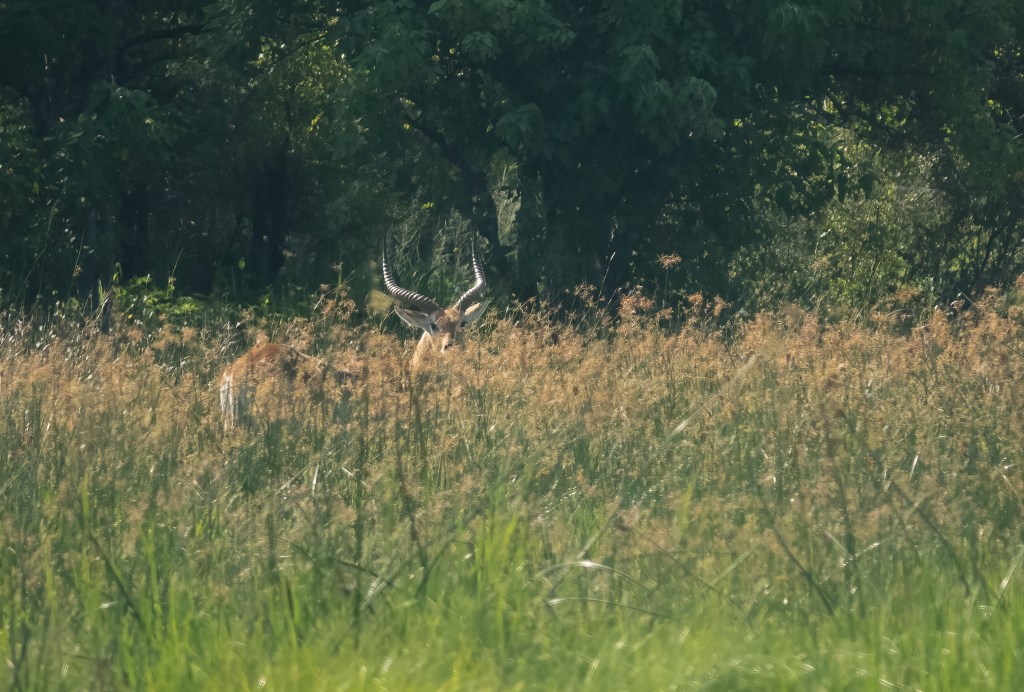
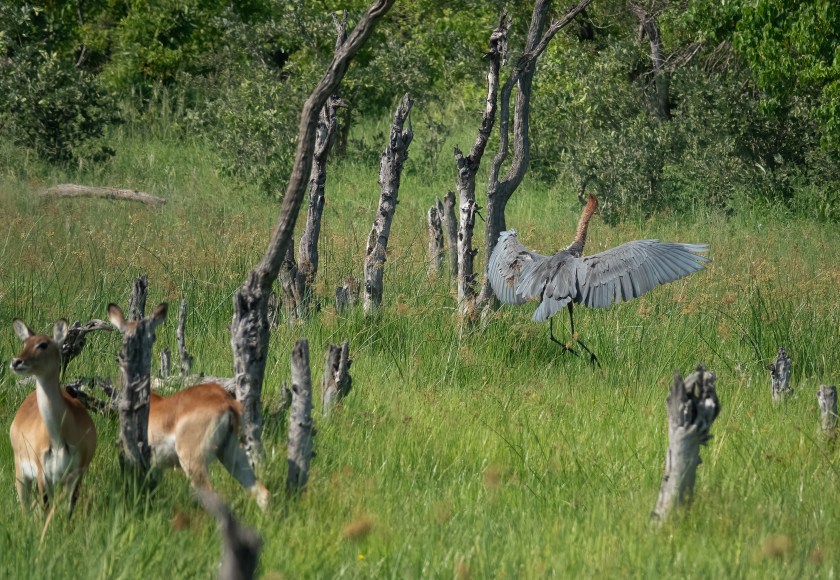
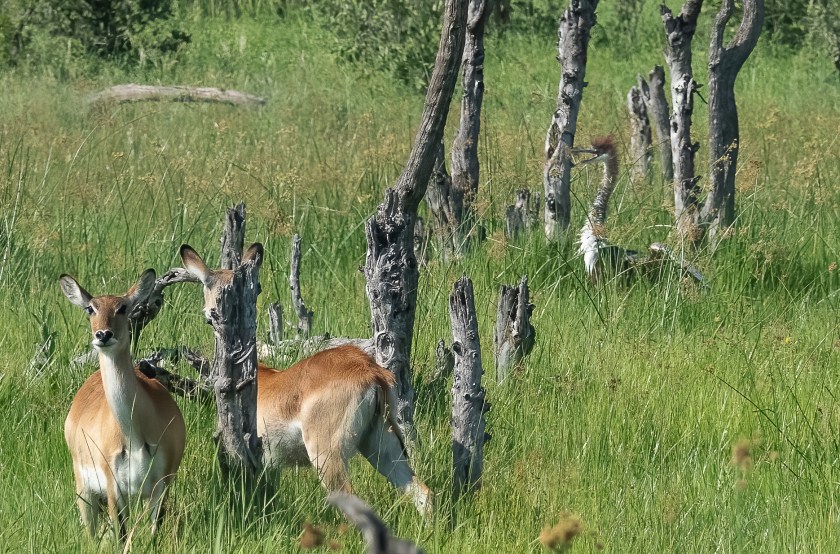
Red Lechwe antelope, Kobus leche, were grazing amongst the water meadows by the Khwai River. One male:
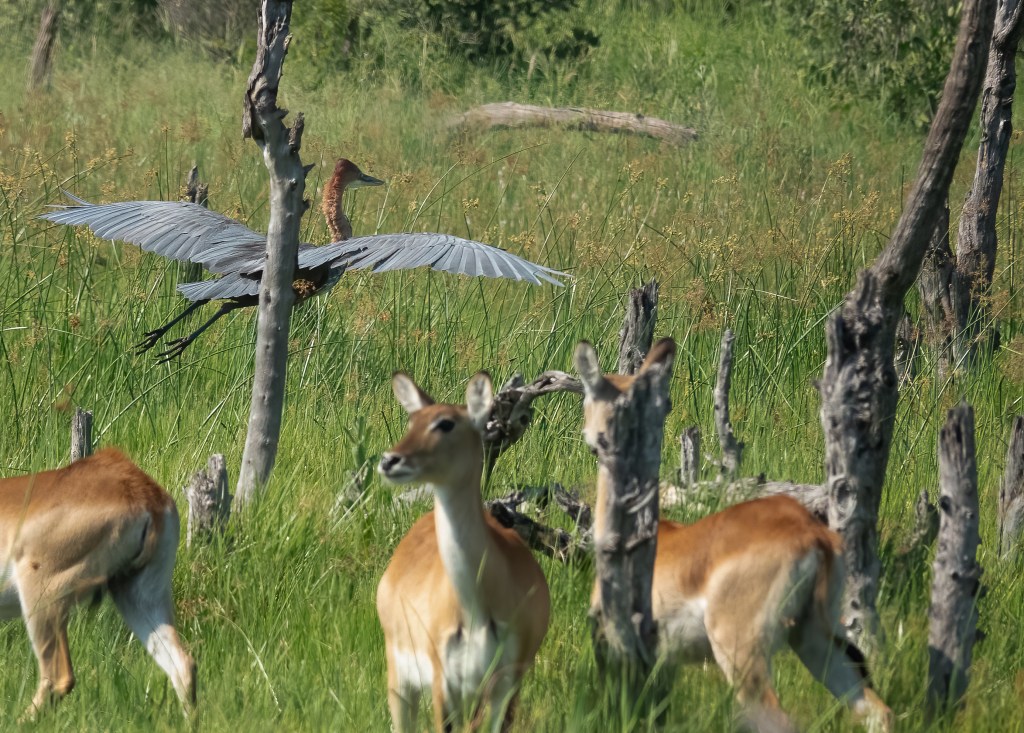
and a group of females:
They’re specialized for marshy wetlands, and their lower legs have water-repellent oils that help them run fast in knee-deep water. As a result, that is their refuge if predators threaten.
Only the males have horns:
As we watched, a goliath heron flew in:
and landed just behind the lechwe.
The lechwe stand about three feet at the shoulder, and the goliath heron (the world’s largest heron) is up to five feet, so they can look each other in the eye.
He was displaying, though we couldn’t see a nearby female:
Off he strutted; hope springs eternal.
PS Red Lechwe are now categorized as Near Threatened by the IUCN. They are found in discontinuous marshy areas in Northern Botswana and its neighboring countries.
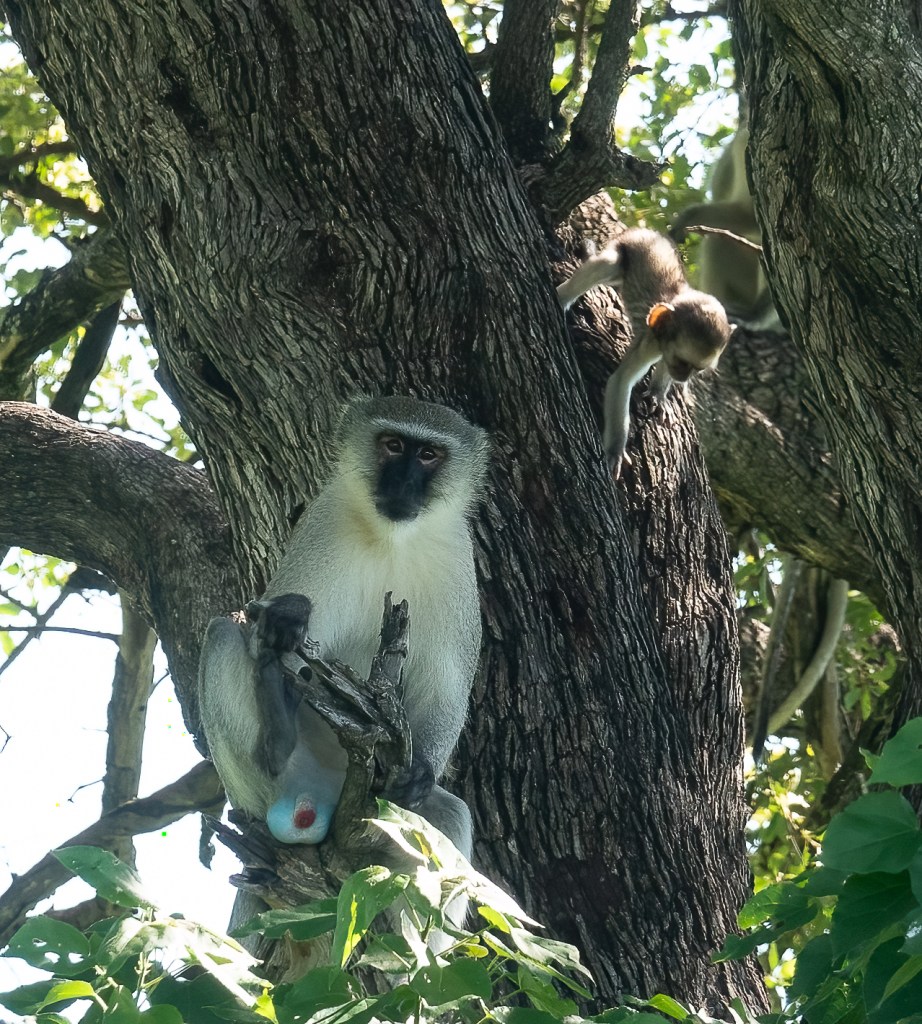
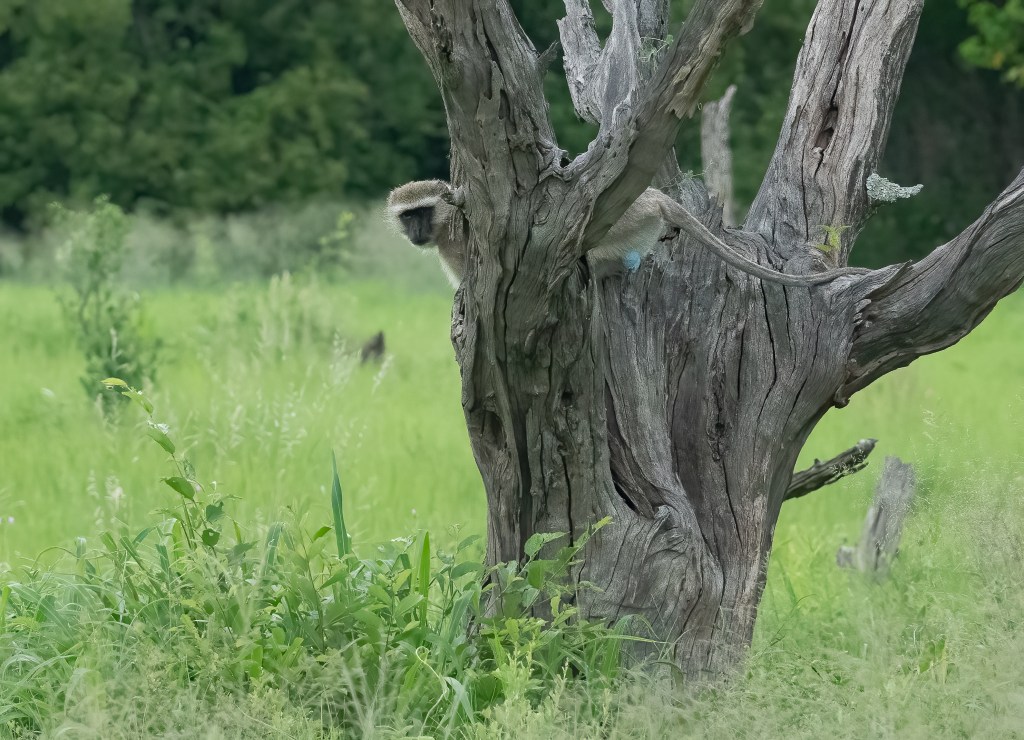
Vervet monkeys, Cercopithecus aethiops, pop up from time to time in my blogs. They’re widely distributed in Africa, and often hang out near lodges where they raid the tables and kitchens. These were nowhere near any lodges, I’m happy to say.
The mature males have famously blue scrotums, and this guy (and his family) were close enough that you can see them rather clearly in the closeups below!
He was hanging out and grooming, while acting as a lookout for the females foraging in the long grass below.
Sleepily, he allowed us a good look at his rather intimidating dentition.
They mostly eat flowers, leaves, and fruit, but as you can probably guess, his diet includes meat. They have been seen killing and eating tree squirrels, and francolins.
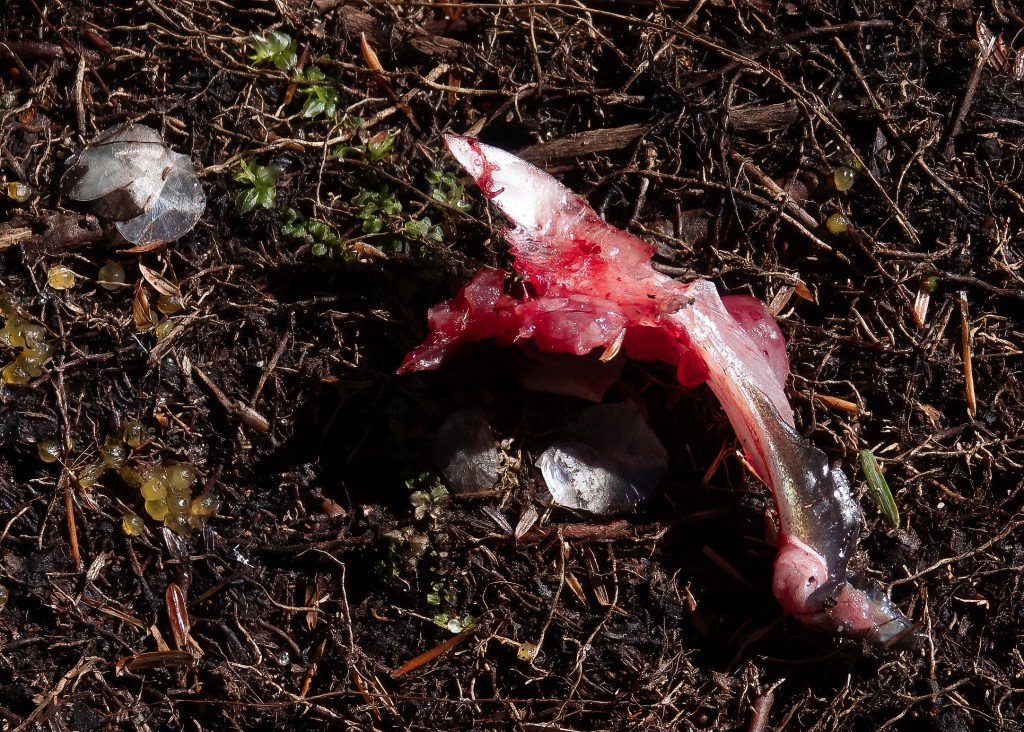
Walking along the brook (in shadow on the right in the photo below), I saw something tiny and bright red by some twigs:
Upon inspection, I realized that I was looking at the remains of an otter repast. The ground was littered with fish scales, and the tiny red thing was a small bone or cartilage, probably from the gills, with remnants of bright red flesh still attached:
Most interesting of all, there were small clusters of bright yellow eggs left behind:
I asked fishing friends if they could ID the fish, and eventually with the help of a State of Maine biologist they converged on a fallfish as the most likely victim . They do spawn at this time of year, and one friend had recently caught one a mile or so downstream from my brook. This last photo was taken a couple of winters ago, and the fish in question (half a mile upstream from the dining debris) is definitely a fallfish (a type of chub native to New England).
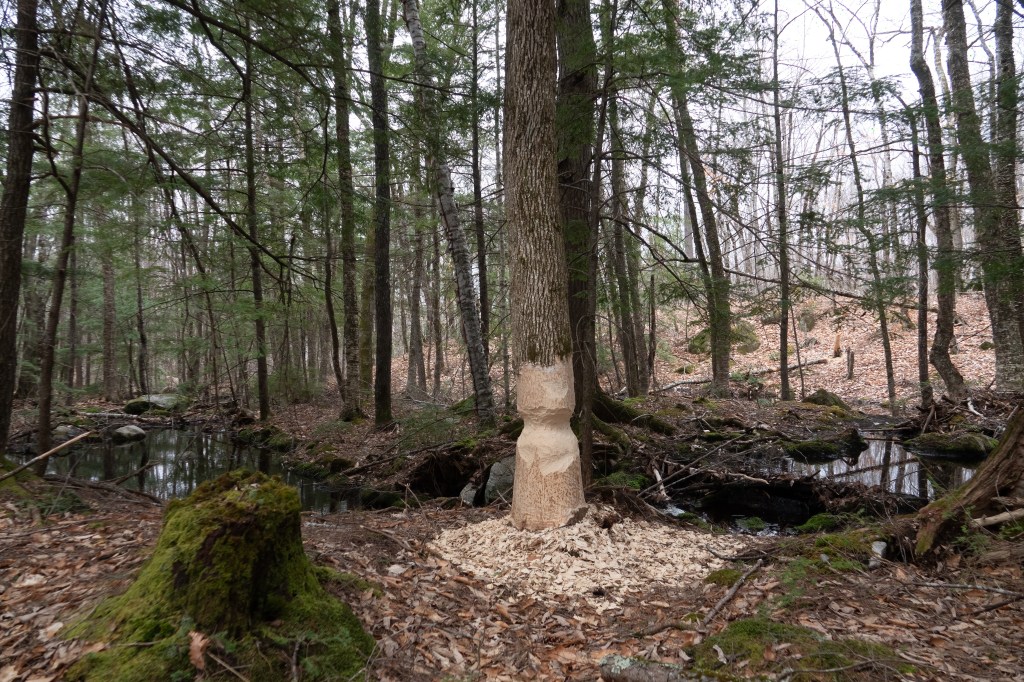
My other favorite aquatic mammal has created a new perfectly symmetrical sculpture:
Beaver cut
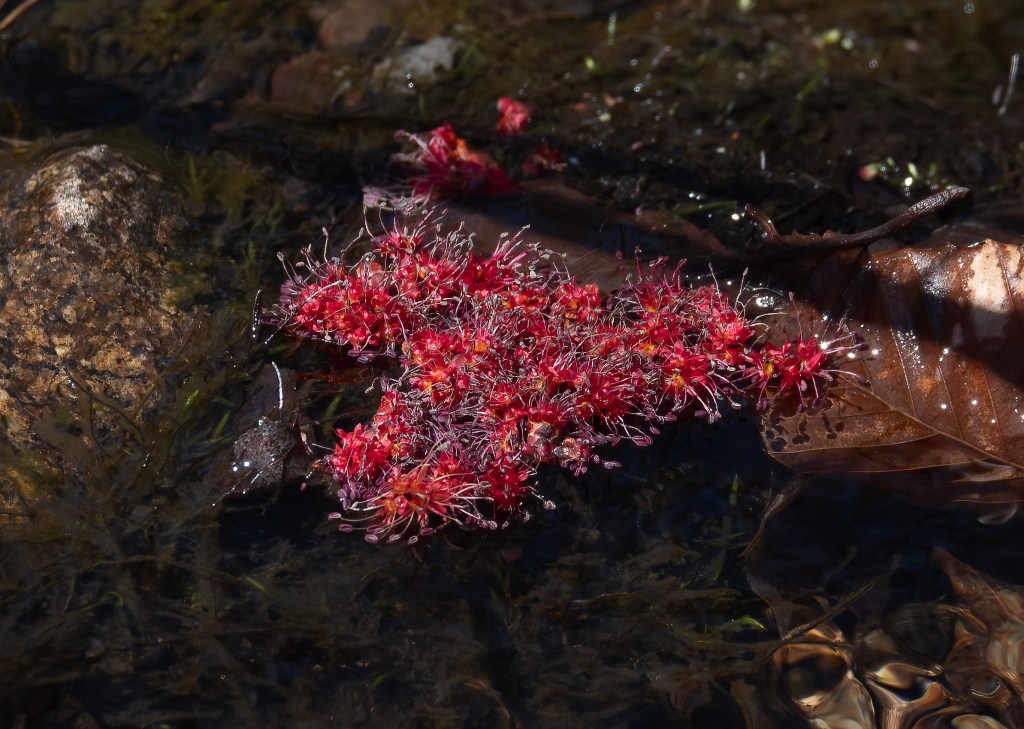
In the woods, the red maples have been flowering. Some trees bear only male flowers,
and others only female ones.
The pollen is spread by the winds to the female flowers, which eventually produce the seeds as winged samaras. The male flowers fall gently off into the streams, where the waters had gathered them into a heart:
I found a strange plant called Snakeskin Liverwort, or Snakewort, Conocephalum salebrosum:
It is a non-vascular plant, a primitive small creeping thing whose name is very descriptive. Each leaf (or thallus) is covered in polygonal bubbles which are air pores:
It has a distinctive smell, and is also called Great Scented Liverwort or Cat’s Tongue liverwort. It needs moist places (this was right next to the stream), partly because of the lack of veins to transport water, but also because for reproduction the sperm must swim through water from one plant to find another plant with eggs.
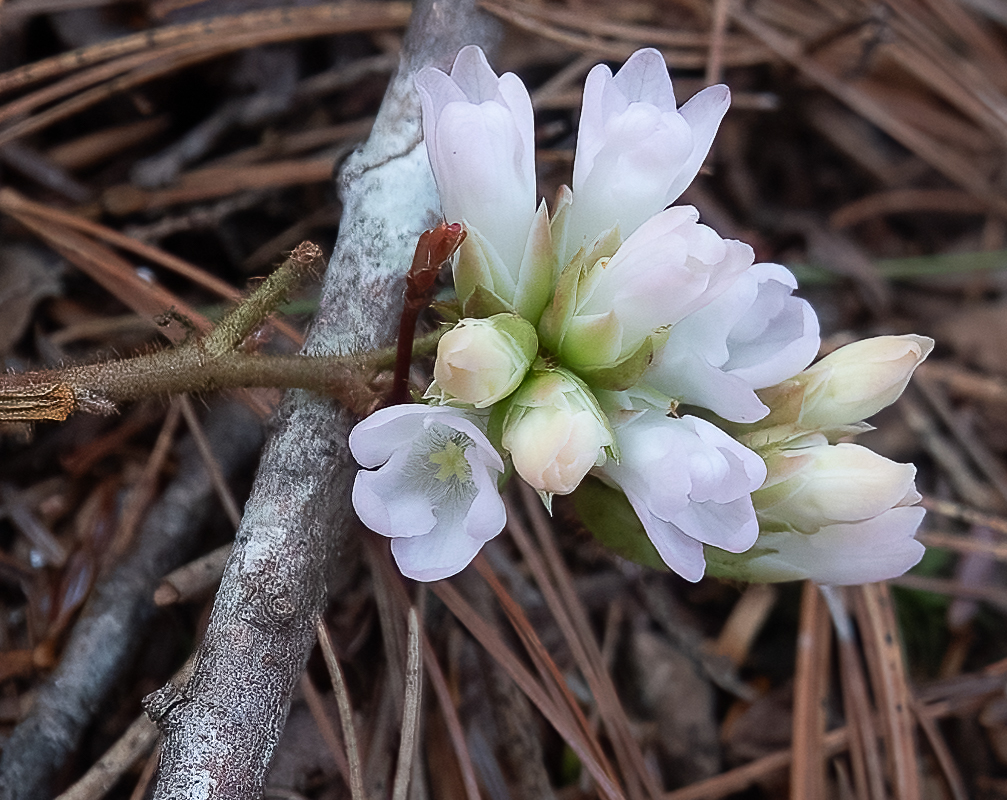
And the very earliest blooms, as always are the trailing arbutus:
I still have more to show you from Botswana, but spring is finally here in Lovell, and I have a few things to share with you. Today, my topic is waterbirds.
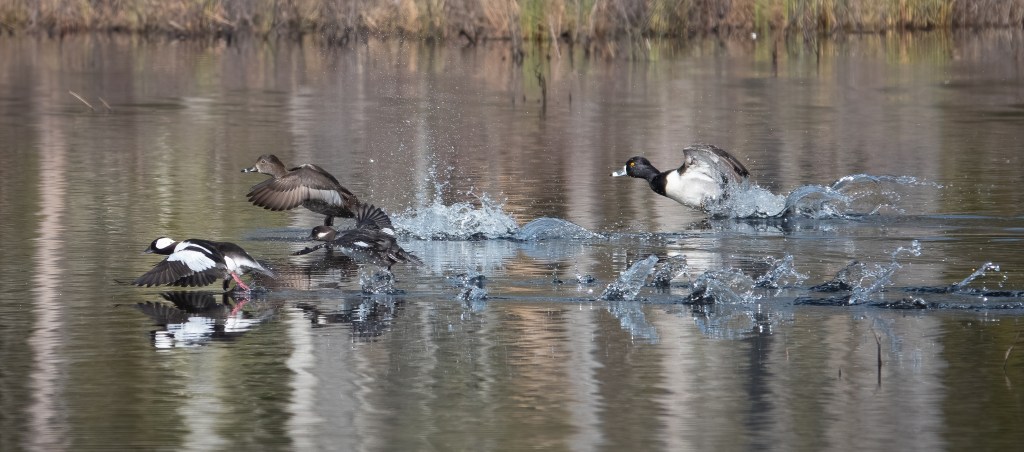
Ducks pass through here en route to breed in Canada. The males are in breeding plumage, so they look very smart. Here is a ring-necked duck, a close relative of the UK’s tufted duck
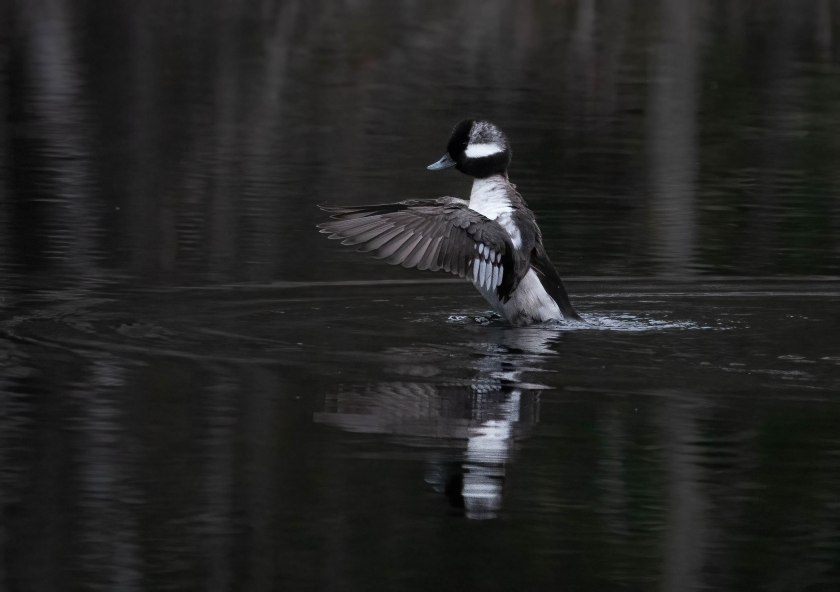
and a pair of buffleheads:
In flight, you can see that the two buffleheads closer to the camera are much smaller than the ring-necked ducks behind them.
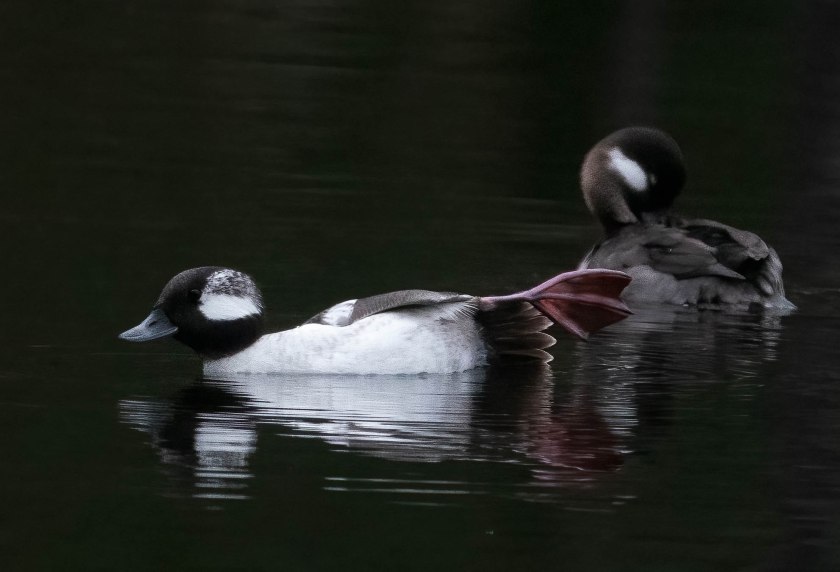
One male had a head patch that was half white and half grizzled gray. I haven’t been able to find out if this is a juvenile, or an unusual variant . He is staring into the depths below.
A little stretch:
and a wave of his deep magenta feet:
Other types of duck stay and breed here, like the hooded mergansers:
And don’t ignore the mallards. For most of my life I thought all ducks were mallards. and although I know better now, they are still among my favorites. This pair were having a private moment on a tiny secluded pond deep in the woods, and they strayed into a sunbeam.
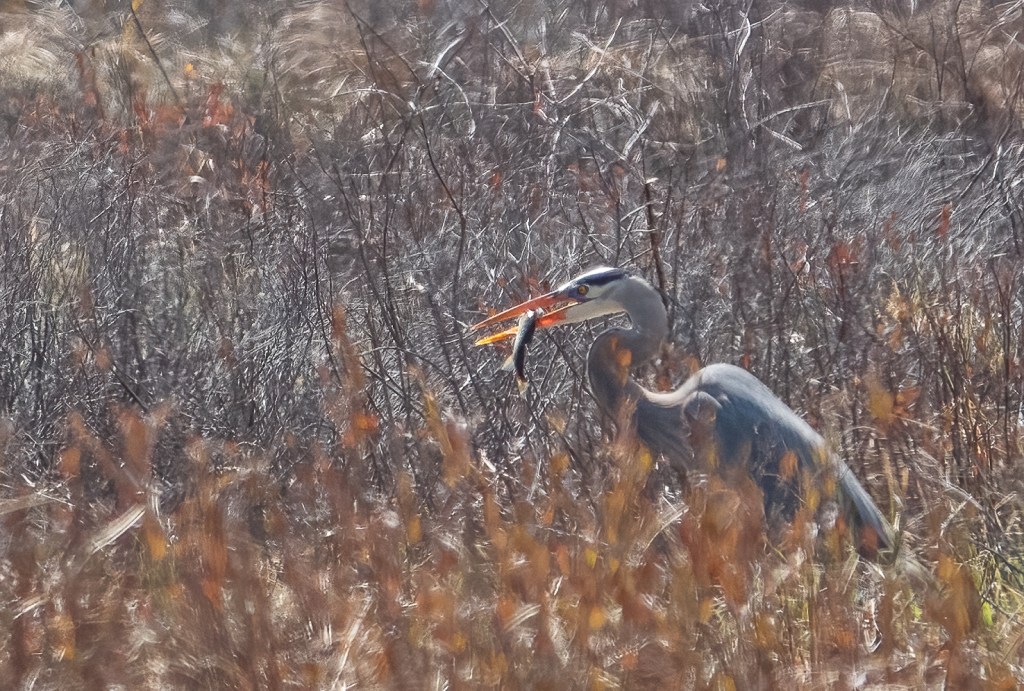
Great Blue Herons stay all summer. In years of watching them, I had never seen one actually catch a fish until last week. As luck would have it, I was in the midst of moving to get a better angle, so this photo is rather wobbly.
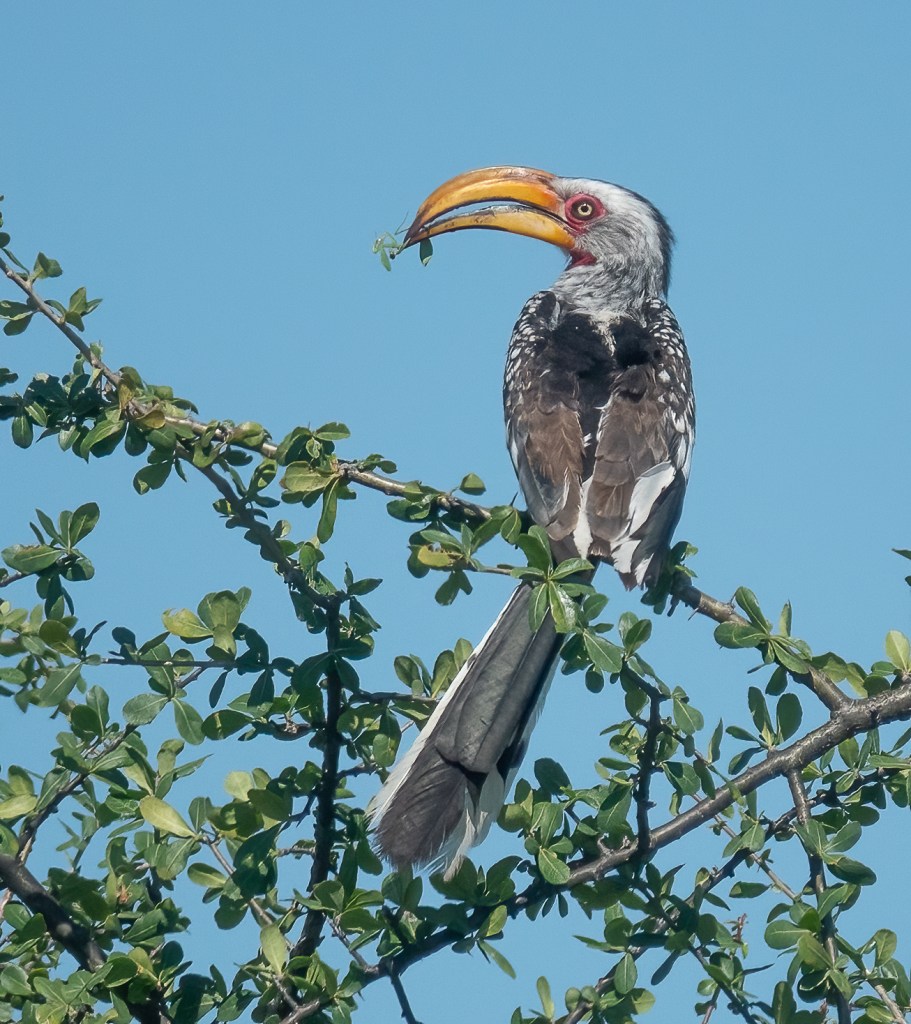
Their humungous beaks make hornbills look clumsy, but they aren’t. In these photos they dexterously (can you use that word when a beak rather than fingers is involved?) manipulate food or nesting materials.
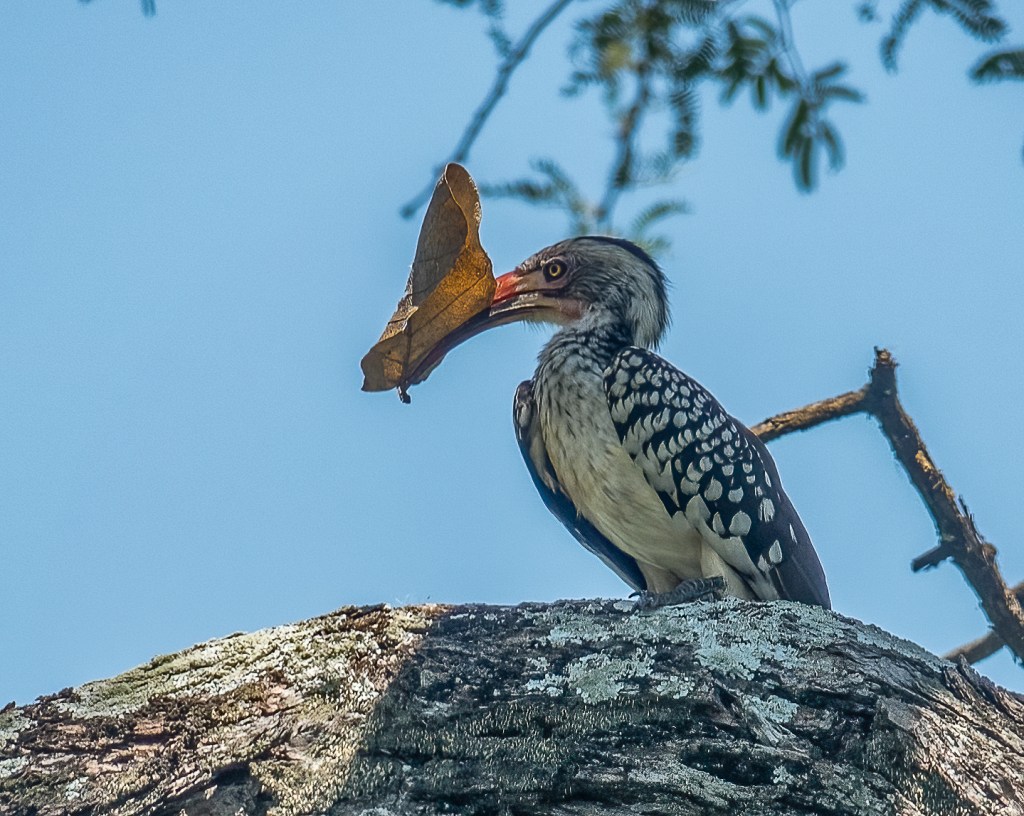
The Yellow-billed Hornbill is probably lining his partner’s nest:
tossing the leaf in the air to adjust his grip:
In the same tree, a Bradfield’s Hornbill is feeding on berries:
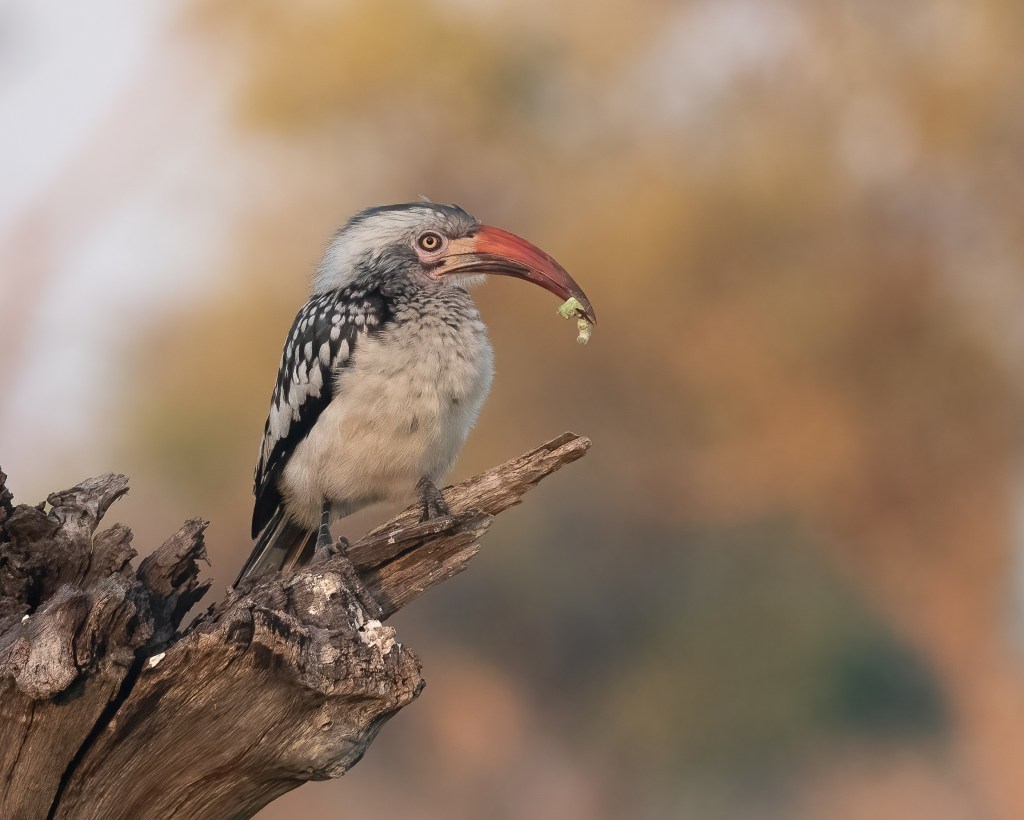
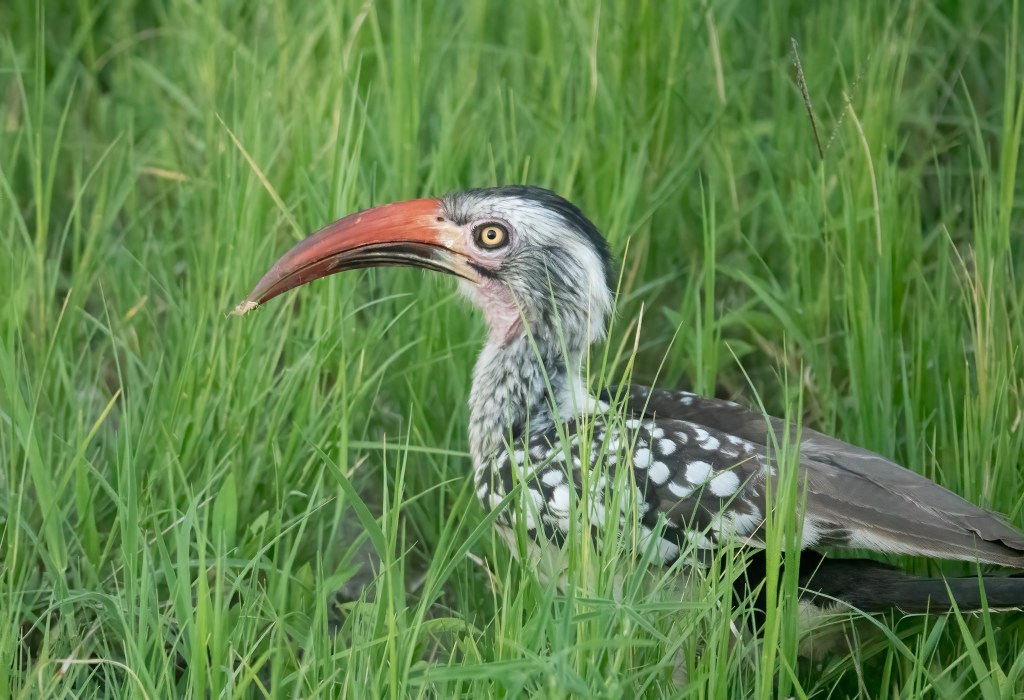
A Red-billed Hornbill delivers an extra leaf to his mate, to supplement her bedding while she is walled into her nest till the young fledge:
This one has a juicy caterpillar:
and here a grasshopper:
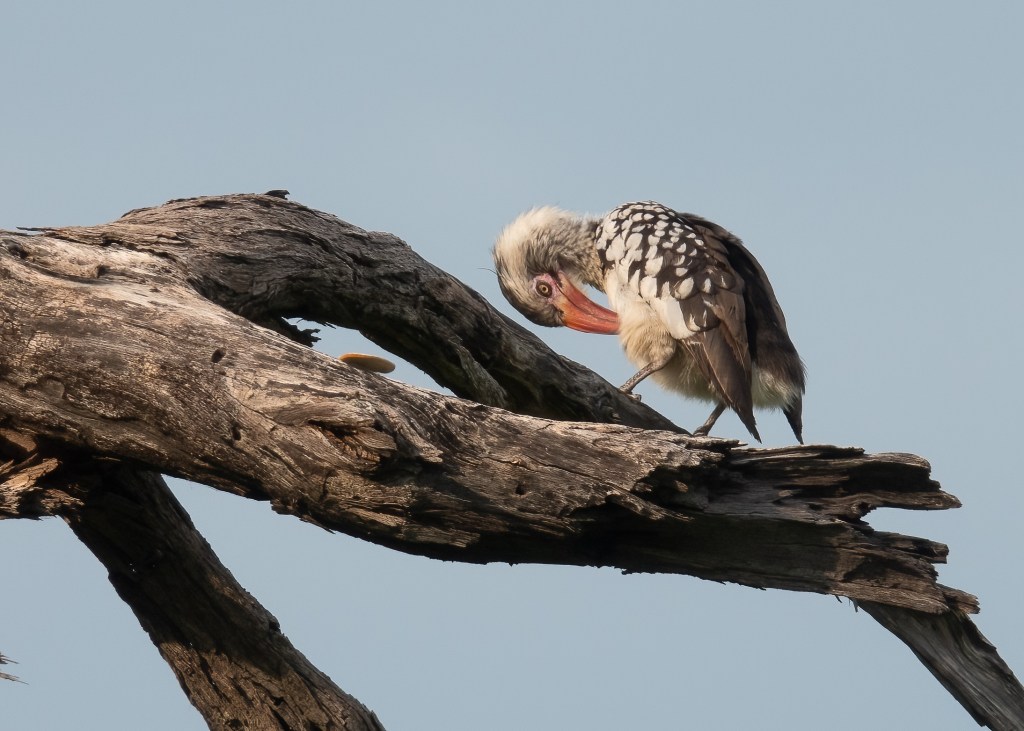
Next morning, he undertakes his toilette, tweaking individual feathers into place:
to good effect:
In flight, these birds are often given undignified names: The Flying Banana, The Flying Chilli Pepper. But they deserve better.
I rather like storks, not just because they nest on chimneys and deliver babies under gooseberry bushes. They have a sort of stately demeanor that pleases me.
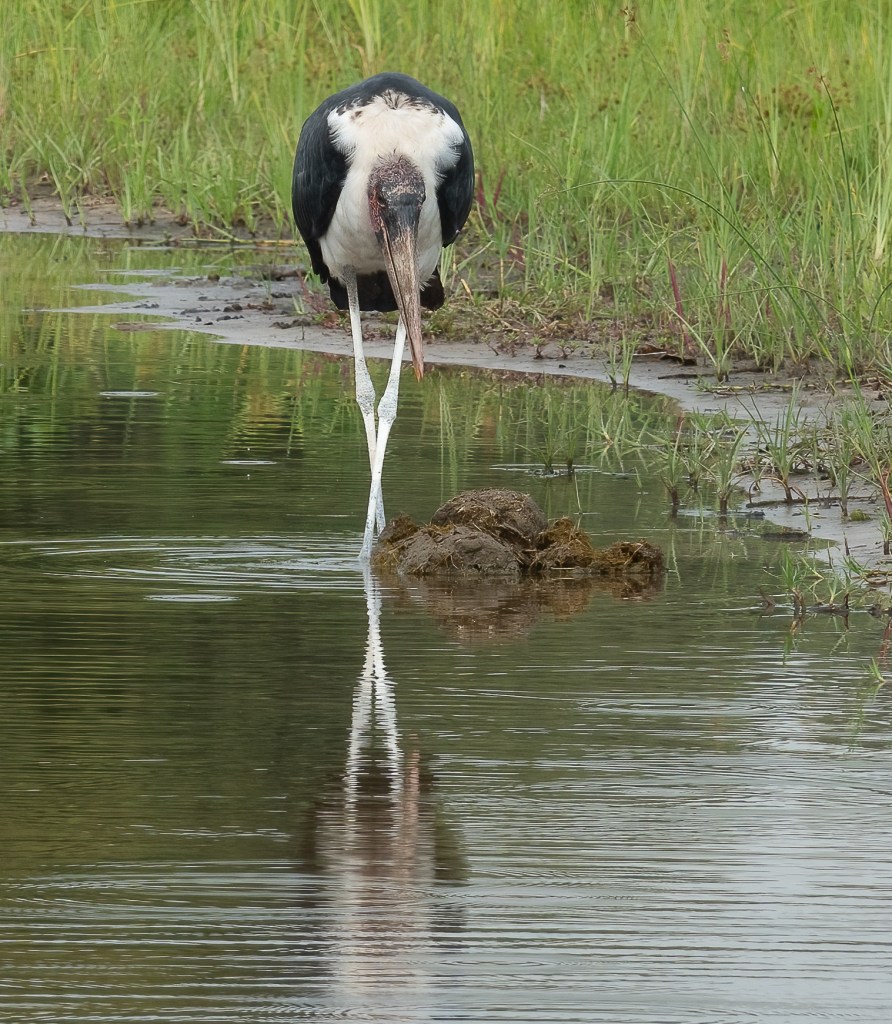
In Khwai there were three I want to show you. One was new to me, the Woolly-necked Stork, Ciconia microscelis. The dark plumage is more sumptuously hued than this photo shows.
The name of the second, the Open-billed Stork, Anastomus lamelligerus, aka the African Openbill, is obvious: this is the most closed its beak gets:
It wandered along the edge of the Khwai River at dusk, looking for the tiny water snails that it favors. But it came up empty while I was watching:
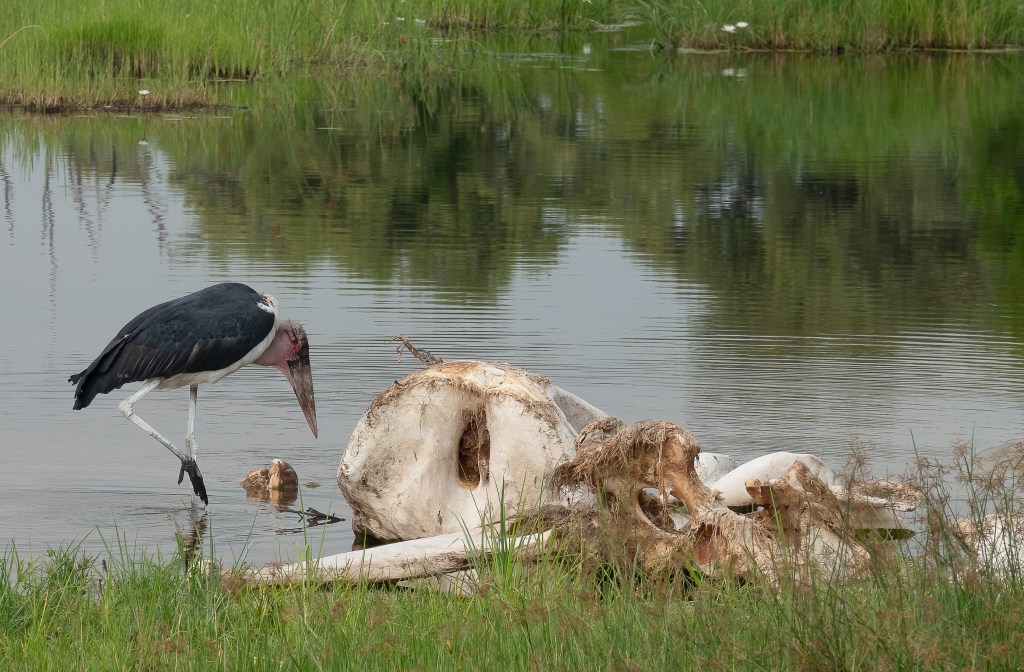
The best known of these is the less appealing Marabou Stork, Leptoptilos crumenifer, a scavenger. It has found the carcass to die for (sorry):
The elephant skeleton, our guide told us, had not been there on his last visit, so it was fairly recent. The tusks are taken by the authorities so as not to encourage their trade.
I do not think there was much left to glean:
so the stork hawked* (sorry again):
and moved on:
*In British English, ‘stork’ and ‘stalk’ both rhyme with ‘hawk’.
At first glance the Hammerkopf is an ungainly bird, with a bizarrely shaped head; I photographed these in 2019 in Ethiopia, in their usual pose on a jetty at a fish market waiting for handouts.
It is in fact a species of stork, and stands about 22″ high. The overall impression is rather homely, even dumpy. I have seen them hunting like herons, wading in shallow water.
But it turns out that head is really shaped for speed:
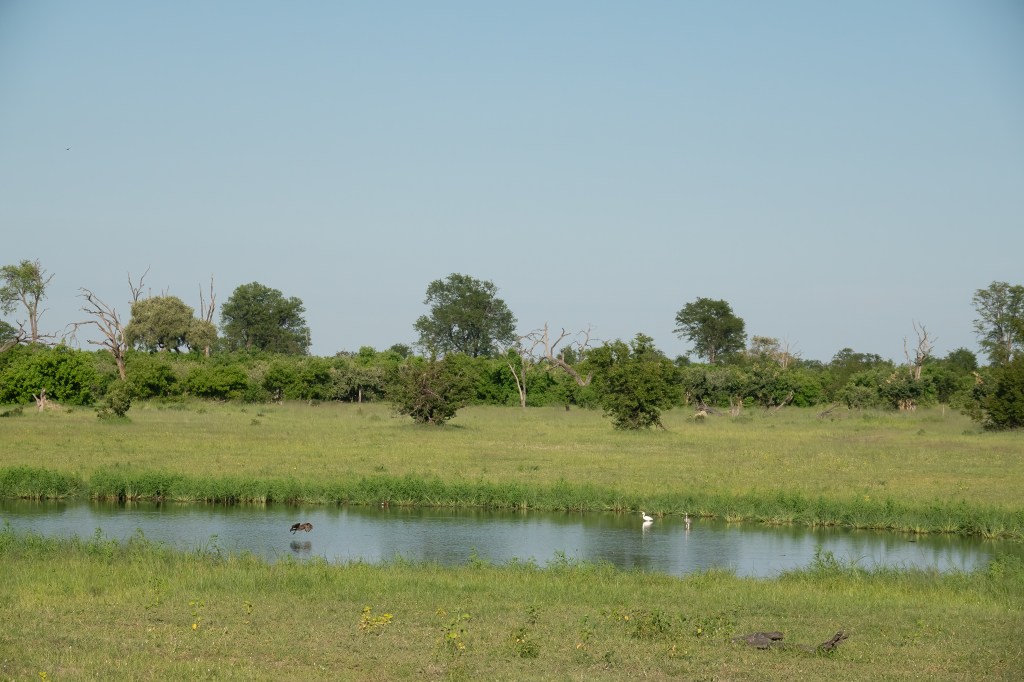
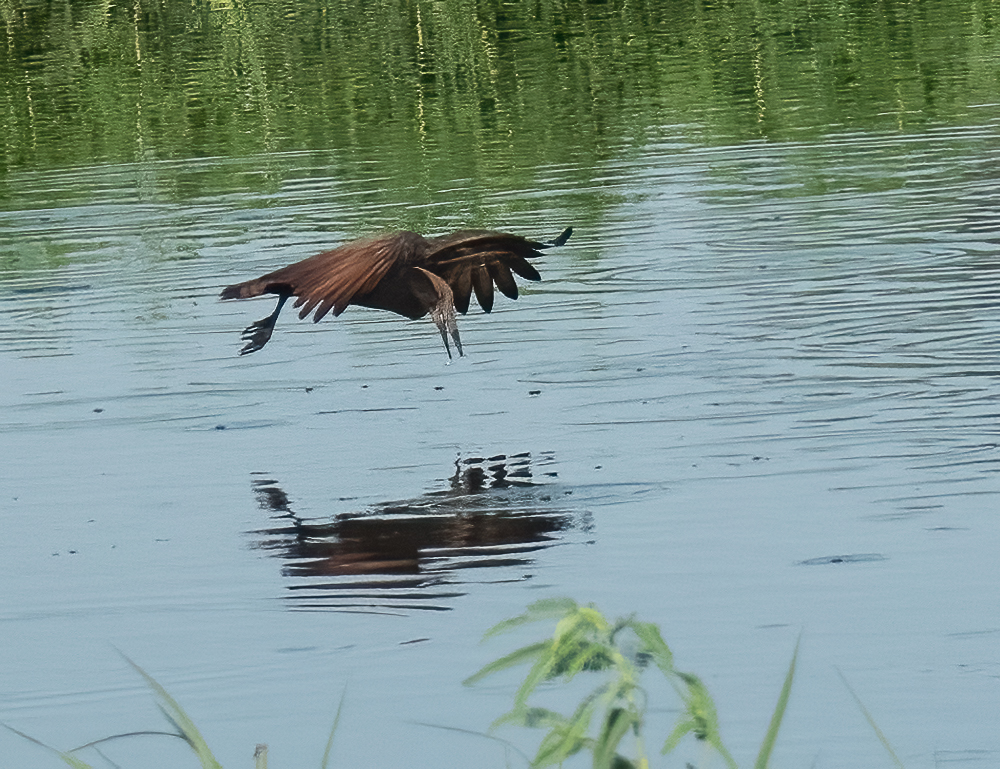
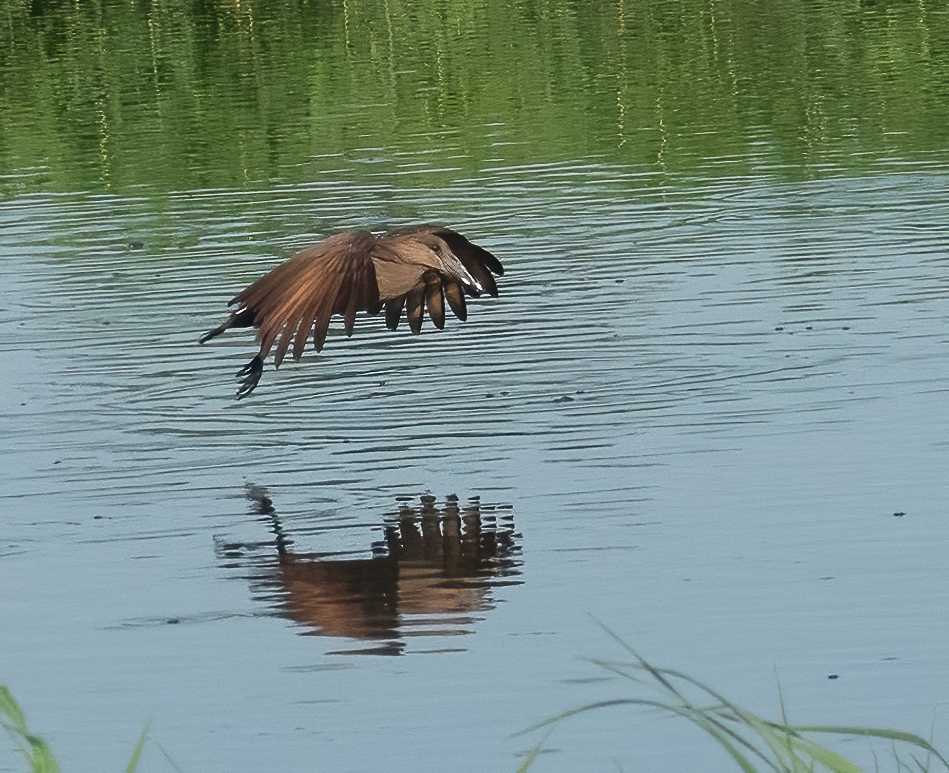
Let’s see the proof. This is a small pond in the Khwai Community Campgrounds between the Okavango and the Chobe. The brown bird flying low over the water on the left is a Hammerkopf.
It hovers:
and then, so lightning fast that I couldn’t see it until I looked at my photos, it lowers its head, beak agape:
dips into the water:
and grabs a tiny silvery fish:
The fish is often invisible, but the beak is dripping, proof of that dive:
It carries the fish off to the bank to feast. They made pass after pass across the pond, and for the life of me I couldn’t ever see the moment of catch.
Here is a video, with the crucial portion slowed down and one frame actually frozen so you can see it.
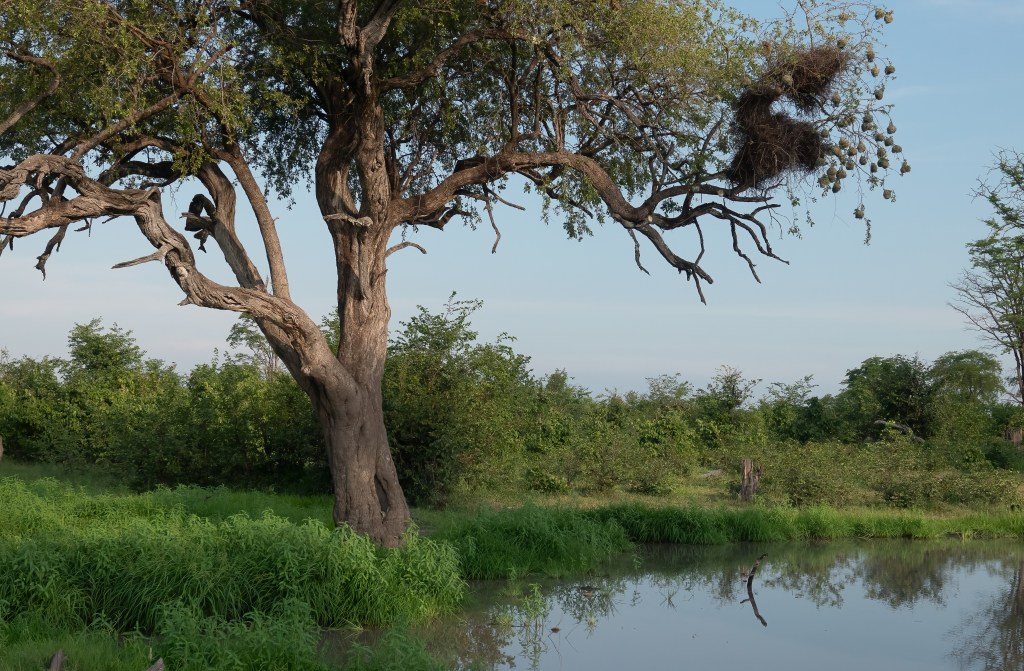
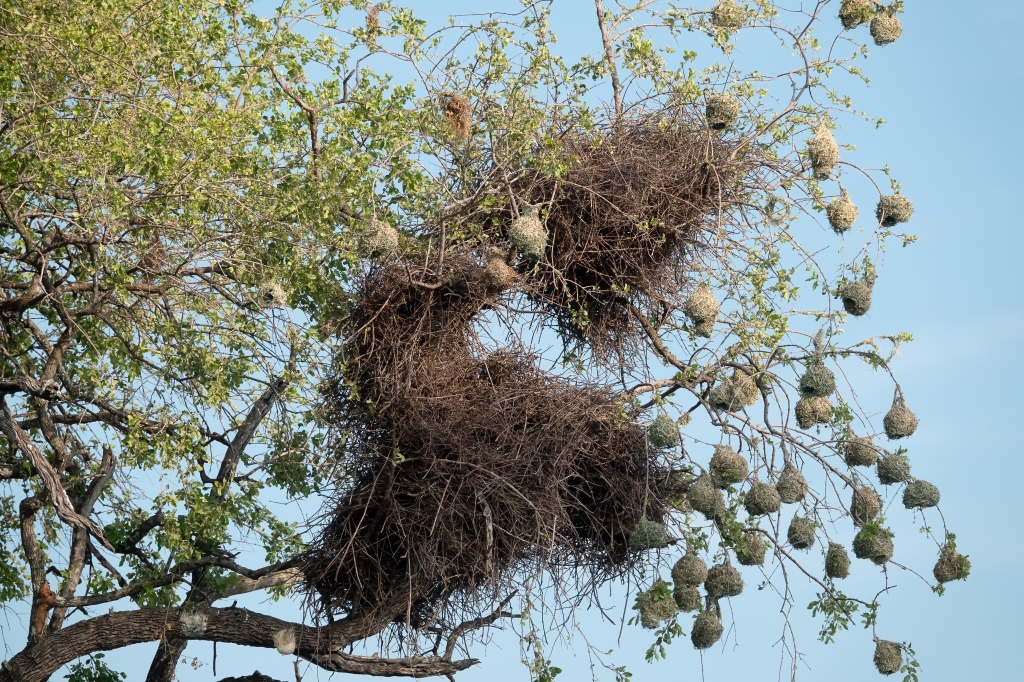
There are various weaver birds in the Khwai. The Red-billed buffalo weaver builds huge communal scruffy nests. The Village Weaver builds much neater individual nests with an entrance at the bottom. And they sometimes choose the same tree, as here, top right:
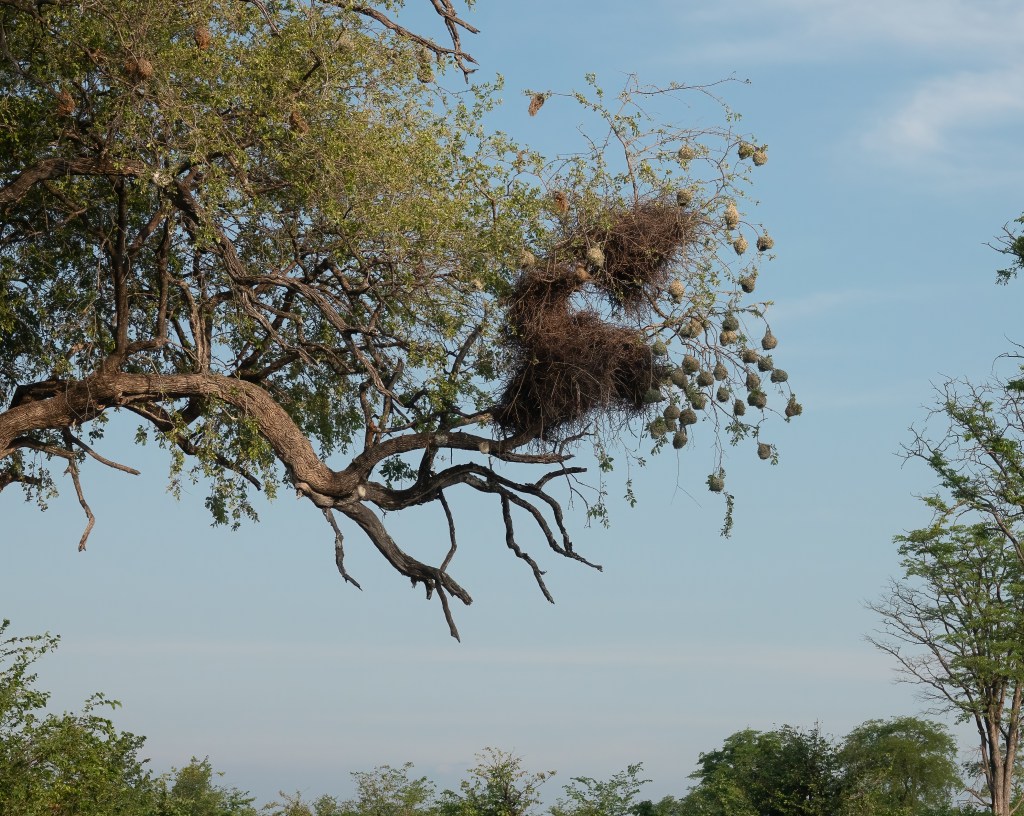
Zooming in,
you can see the twiggy buffalo weaver technique vs the delicate woven grasses of the village weaver:
The village weaver nest starts with a ring, a sort of trapeze, which forms the scaffolding for the finished product. You can see one bottom left in the photo below.
Confusingly, the bird in photo above is a buffalo weaver, close to the village weaver nest.
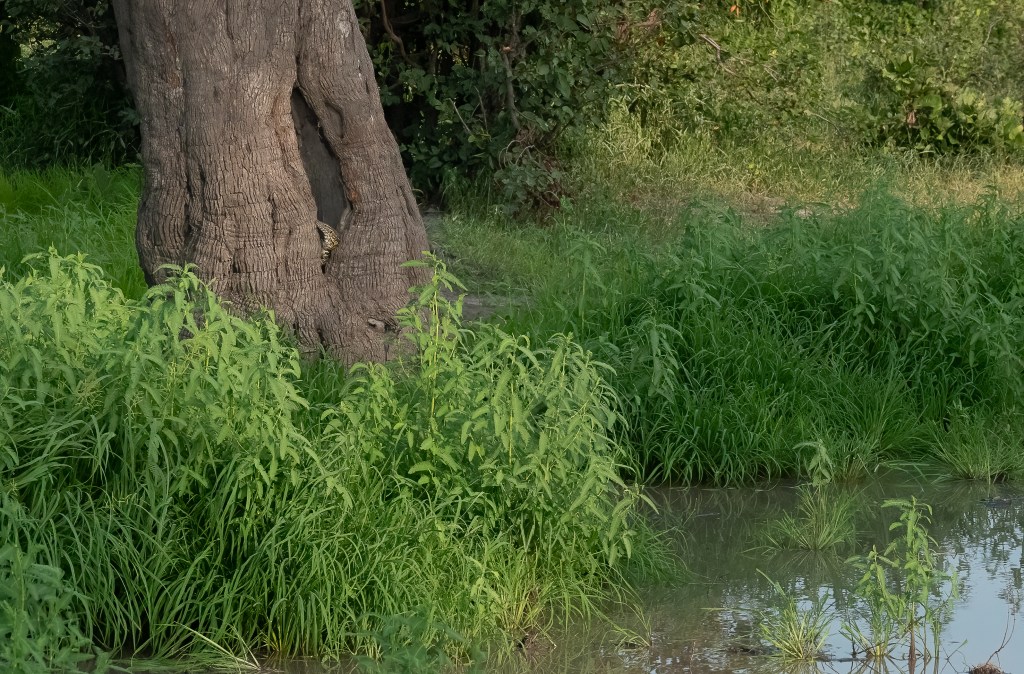
We were admiring the nests, when TJ, cleverly looking down, noticed movement in a hole at the base of the tree:
It was a Nile Monitor, aka Water monitor, Varanus niloticus, related to the Komodo Dragon. It is Africa’s largest lizard, at up to 220cm long, and is not endangered.
It poked its head out and looked around,
but although we waited it decided not to fully emerge.
Monitors are carnivores, and its nesting hole was cleverly chosen, within easy reach of falling eggs or baby weaver birds.


































 Eyes on the Wild