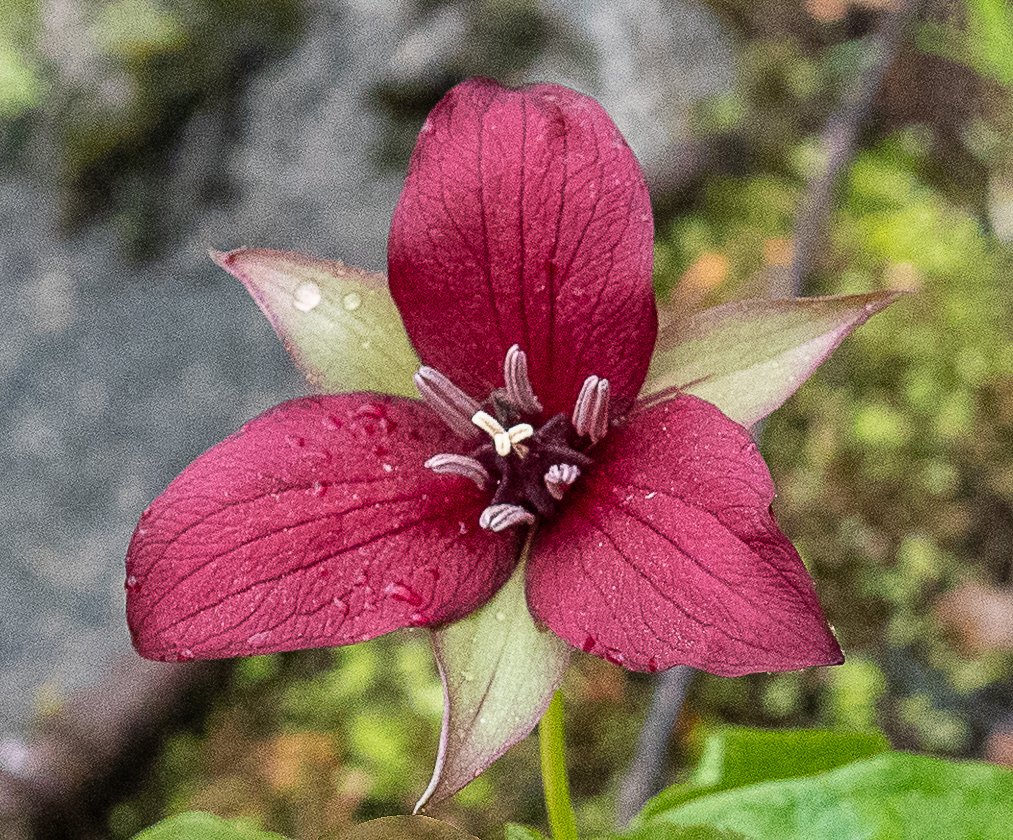
The oldest cinnamon on earth

I write more often about animals (insects, reptiles, birds, mammals) than plants, but I glory in it all. Look at a corner of my wetlands back here in Maine.
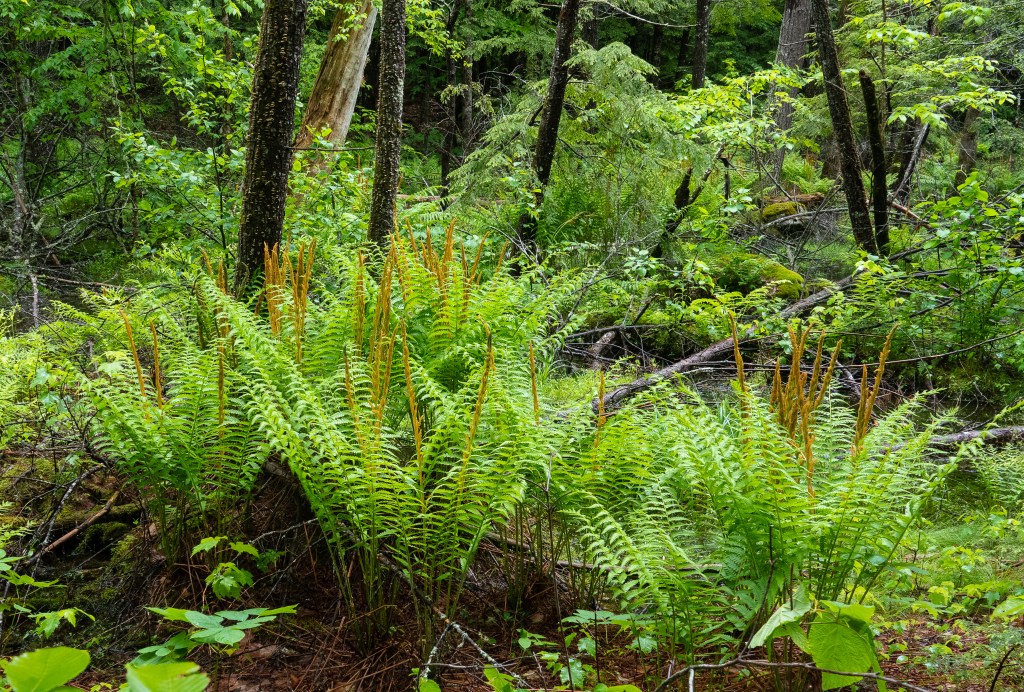
These rusty spikes in the foreground were familiar to the dinosaurs 180 million years ago, and have barely changed since.
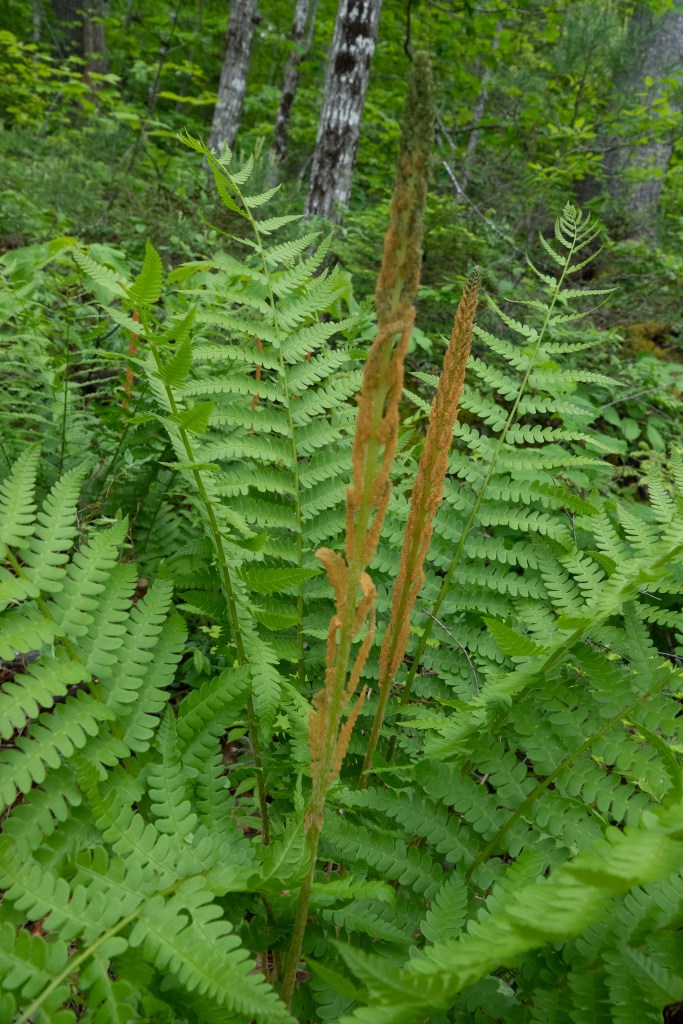
They are Cinnamon Ferns, Osmundastrum cinnamomeum, and are considered a living fossil. Their name comes only from their color: don’t put them in your apple pie. Unlike our more modern plants, they do not produce seeds. They reproduce by spores, like fungi do.

The ferns are six feet tall, and they send up specialized dark green fertile fronds,
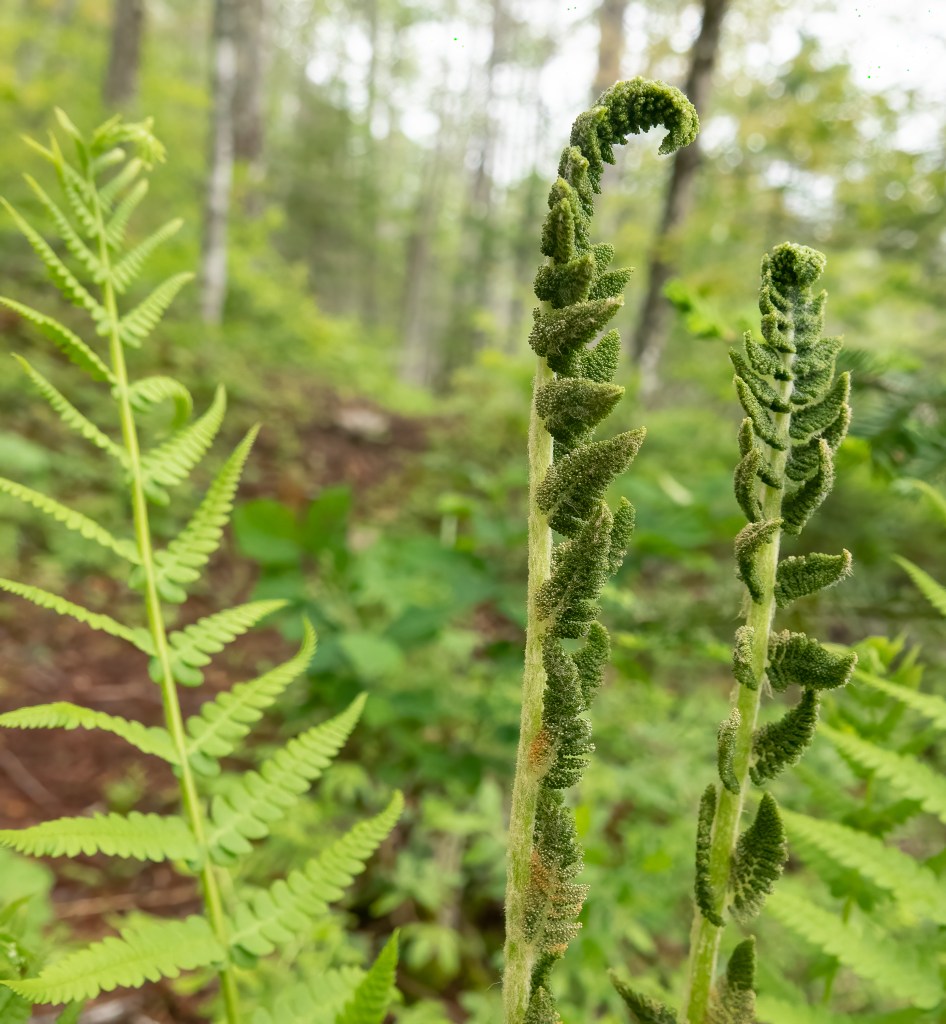
The fronds are covered in tiny globules called sporangia, within which the spores are gestating.

As they ripen, they turn a cinnamon orange, like the flanking spikes below:
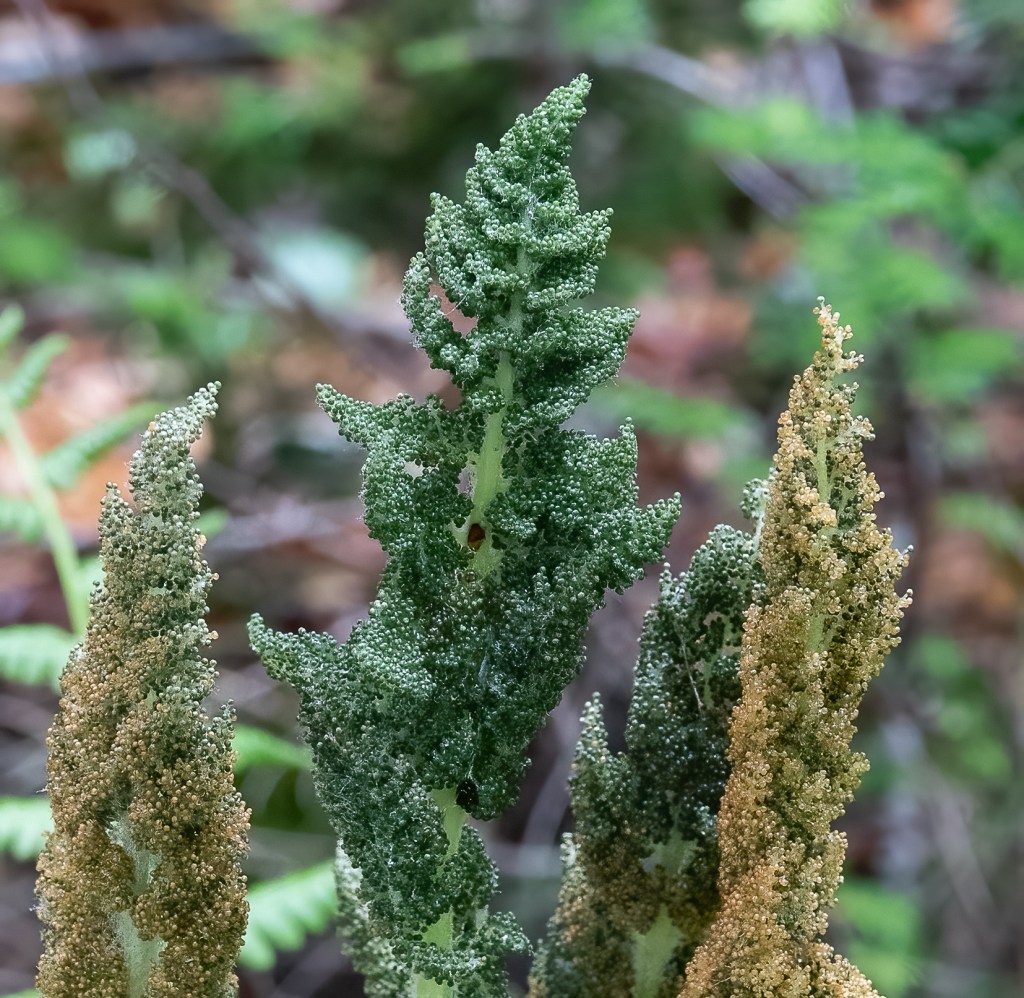
working from the bottom up:

until eventually the whole spike blazes with color:

In extreme close-up, you can see that the tiny globules open up like a clamshell and release their spores:
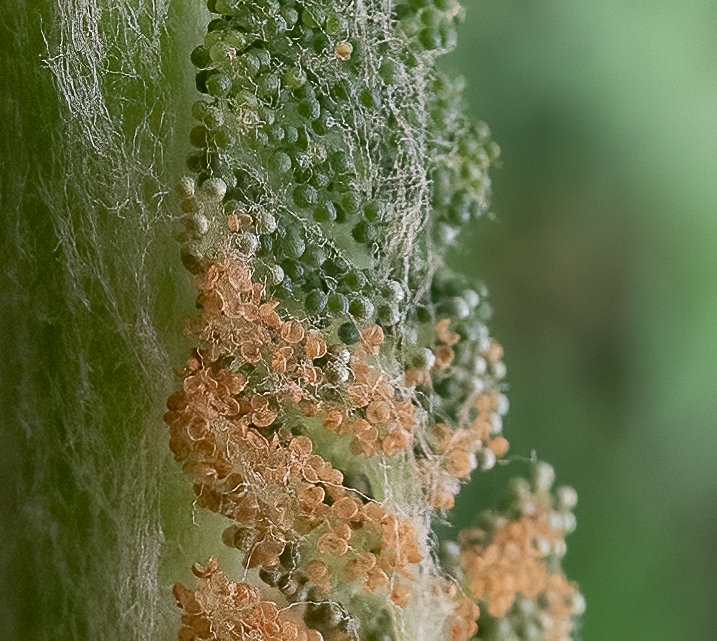
Each sporangium is by my calculation about 1/60″ inch (0.4mm) across. A spore is about 50 micrometers in size ( a micrometer is 1/1000 of a millimeter). One sporangium can produce up to 500 spores, and a single stem can produce 52 million.

I picked a few ripe fertile fronds and brought them inside. The next morning there was a dusting of green spores on the sheet of paper. The first photo includes an American nickel for scale.

The second one is a close-up of an opened sporangium surrounded by some of its spores:

I have not even tried to photograph the spores themselves in close-up, unless someone would like to lend me an electron microscope?

If you’d like to know more, explore this site:

https://www.amerfernsoc.org/about-ferns

And, to end, a wonderful image of spores by Rogelio Moreno:
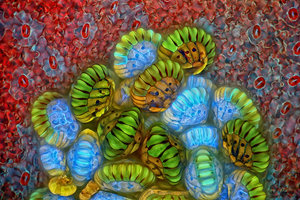
Nikon TE300, S Plan Fluor 20x/0.45, fluorescence (UV-2B), Canon 6D mounted on the front port of the TE300, image stacking.

The Limits of Flight

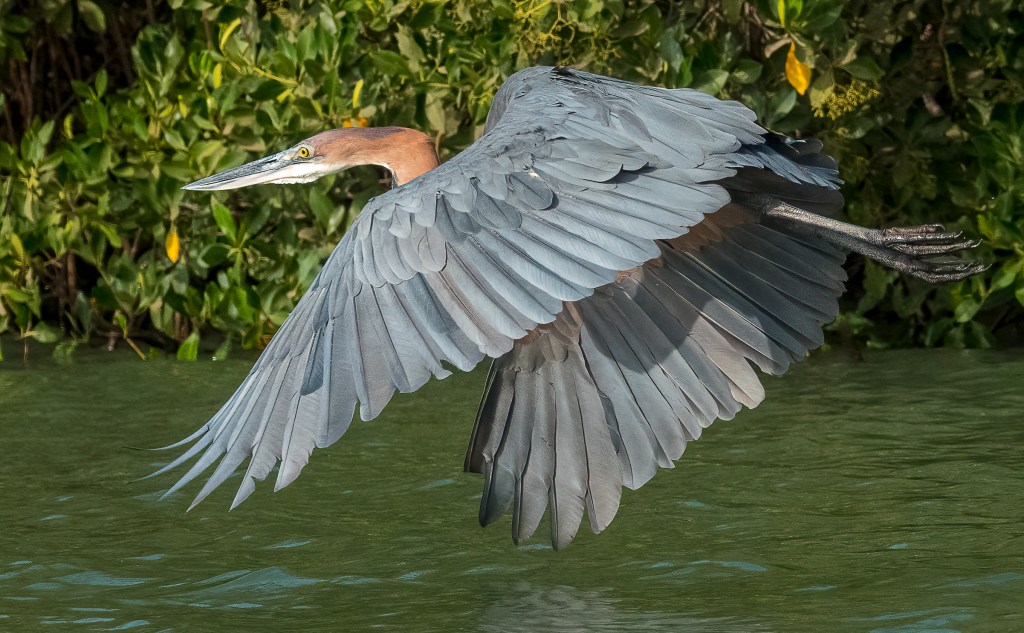
The African Goliath Heron, Ardea goliath, is one of the world’s largest flying birds. It weighs up to 5Kg (11 lbs), is 1.5m (5′) tall, and has a wingspan of 230cm, or 7′ 7″.

This one stood in the Gambian mangroves as we drifted along, looking at something overhead:
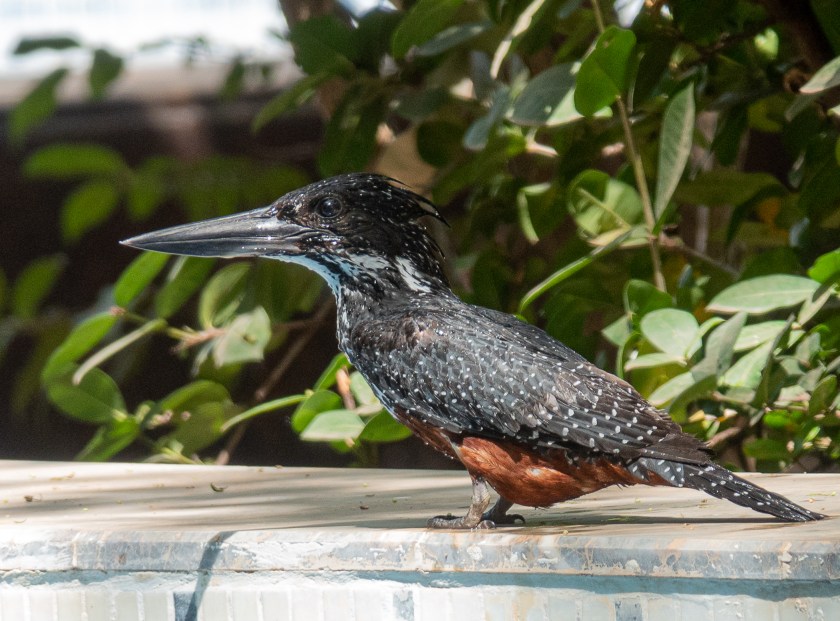
They hunt passively, waiting for an unwary fish to swim by, and then they pounce with that lethal beak.

They only eat 2 or 3 fish a day, but big ones, over a pound each, so they gobble about 25% of their body weight a day. And they can live for 22 years.

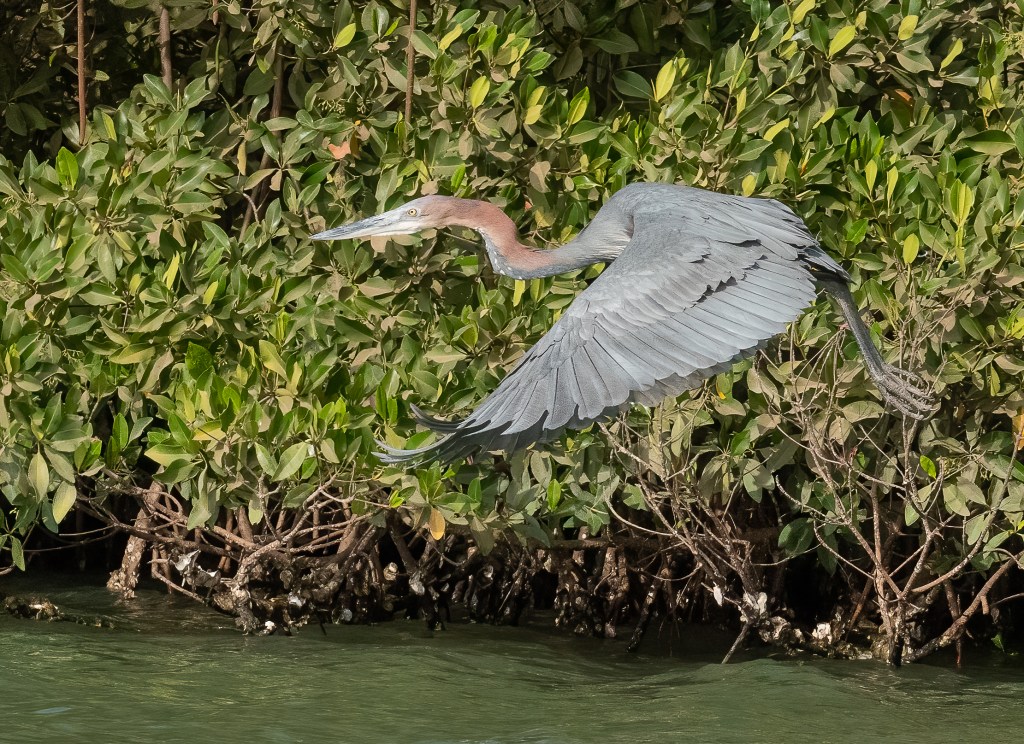
The full glory of this huge bird shows best in flight, I think:

How on earth do they do it? Rayner (1988) is a fascinating article on the aerodynamics of bird flight. Herons have large wings in comparison to their load (weight divided by wing area), which puts them in the same group as thermal soaring birds like hawks, storks, and eagles. They have similarly shaped wings too, broad with squarish tips, and separate primary feathers.

The surprise is that the Goliath Heron can fly at all. It is distinguished by having a very slow wing beat of 1.8 beats per second, and this puts it at the outer limits of all birds and near the theoretical limit of possible flight (apologies for the poor quality of the graphic, I couldn’t find a better one; the vertical axis is wing-beat rate, and the horizontal axis is mass):

PS That very slow wing beat is why I was able to get sharp flight photos even from a moving boat. Here’s another one, just taking off on a different flight, though quite possibly the same heron:

As you can see, gaining height takes time! The jumbo jet of the avian world.

Wattle-wearers

[I seem to be alternating continents, but I still have lots of Gambian birds to show you!]

Wattles are brightly colored fleshy outcroppings, usually on the head of a bird. Some are around the eye, some near the bill or under the chin. They are thought to attract the opposite sex, and indeed in some species they only appear in breeding season, or get larger, or are limited to the males. This trio have wattles in both sexes, all year-round.

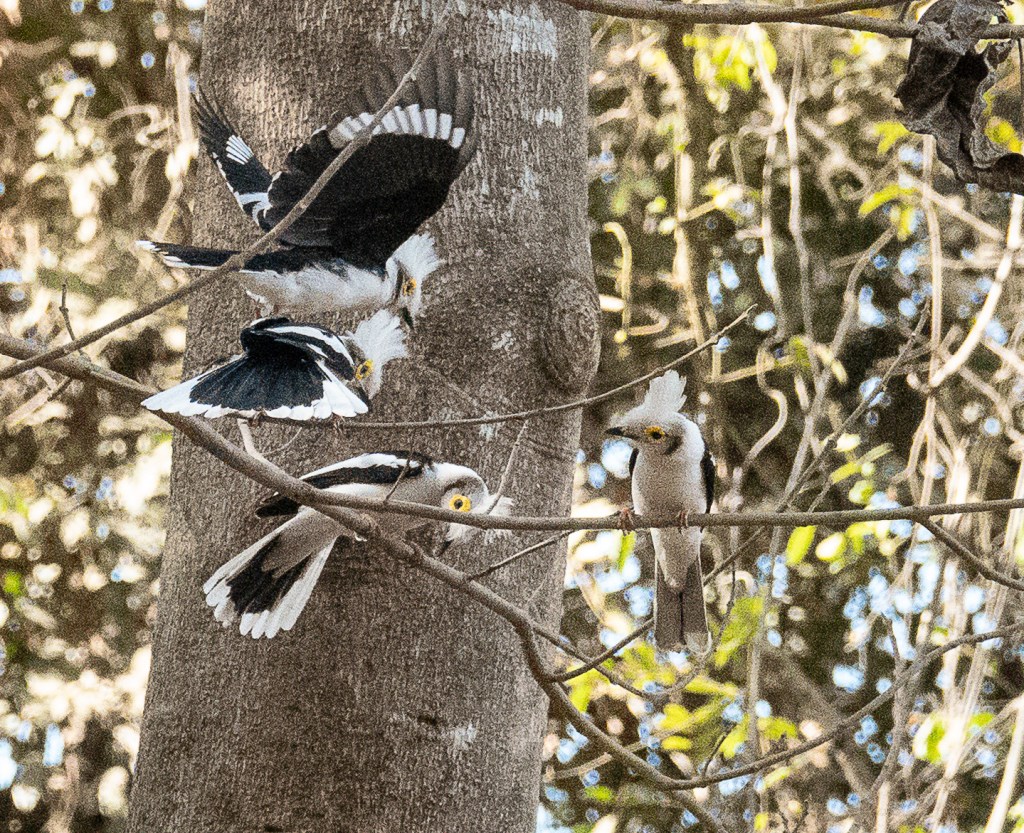
The White-crowned Helmetshrike, Prionops plumatus, has a splendid feathered crest, and fleshy yellow eye-wattles that look like an artificial plastic sunflower:

These are social birds, and very versatile.

They forage as a group, eating insects (on the leaves or ground, and occasionally in flight), but also lizards, and fruit.

Somehow they seem rather parrot-like to me.

Common or Brown-throated Wattle-eye, Platysteira cyanea, (female, below) are usually in pairs, foraging for insects in vegetation and in flight. The red eyebrow wattles are fleshy, not feathery.

My final Gambian wattle-wearer is the Wattled Lapwing, Vanellus senegallus, whose yellow wattles droop down from the corners of its bill:

(The bird lurking in middle in the foreground above is a Spur-winged Lapwing).

Both sexes carry wattles.

PS You might have noticed that all the helmetshrikes are looking downwards. One of our group had brought with him an app with the sounds of Gambian birds, and a tiny loudspeaker. He placed it at the base of the tree near the helmetshrikes, and played helmetshrike calls. They were fascinated by it. This is a very controversial technique, many people worry that it disturbs the birds’ natural social order and that it can interfere with courting and breeding. Our guide did not bring this technology himself, but he allowed it to be be used, and none of the rest of us objected. I did discuss the issue with our guide, and he said that he would never allow it to be used in breeding season. We did indeed get a much closer look at some birds than we would otherwise have done, but I feel somewhat guilty that I didn’t protest. Or I may be over-reacting. Let me know what you think in the Comments.

I have also just discovered that the Audubon Society has taken a strong stand against the use of playback, and that none of the photos we (ie me) took using this technique could be entered in their contests:

https://www.audubon.org/news/why-photographers-should-reconsider-using-playback-field

Luckily I never planned to do that anyway.

The kettle-drummer of the wild: the American Bullfrog

[All these photos and videos were taken last week at Gardens in the Wild in Framingham, Massachussets, the home of the New England Wildflower Society. Highly recommended! and the frogs are used to people, so they are much less skittish than they are around me in Maine. ]

The American Bullfrog, Lithobates catesbeianus, is a substantial chap. He can weigh up to 0.5Kg, more than 1lb. The bullfrog male’s mating call is low in pitch, with a frequency around 200-300Hz, and can be heard for up to one kilometer. Here is a recording (made in Maine a year or two ago.)

These calls are very very loud, and yet they call with their mouths closed. How do they do it?

When the male calls, he fills his bright yellow throat pouches with air. Each call lasts approximately 0.5 seconds: I have slowed down this video so you see this more clearly:

I had always thought that was why his calls were so loud.

But it turns out that is wrong. The inflated pouches are used as a sort of air reservoir so that air can be recycled to the lungs across the vocal folds where the sound is actually produced. Some sound is indeed then transmitted to the world through these pouches, but that is not the main source. The male has a greatly enlarged tympanum (ear-drum), the round patch behind the eye, as you can see in the photo.

It is this which hugely amplifies the sound energy, being responsible for some 98% of the energy actually transmitted. (Purgue 1997). Its resonating frequencies match those of the calls, so effectively it acts as a drum. (Purgue says you can see the eardrum move, but even when I slow my videos right down I can’t detect this!).

Even if I can’t see the eardrums move, what I can see is the whole body vibrations that are transmitted to the water: look at those ripples radiating outward as the frog calls.

Note also how much smaller the female’s ear-drum is: hers is used just to transmit sound to her inner ear, like ours.

There is always something new to learn: who knew that ear-drums could be a two-way sound system. They even look just like a high-end stereo speaker!

PS More on the generation of the initial sounds: (Ryan and Guerra 2014) ” In most frogs, air is expelled by contracting trunk muscles surrounding the lungs, which pushes the air through the larynx .. The incoming air causes the vibration of the vocal cords and the larynx itself. The air then enters the buccal cavity and passes through the vocal slits to inflate the vocal sac. One of the most conspicuous and near-universal traits of male frogs is the vocal sac. Its main function is to recycle air from the lungs to the vocal sac and back again. The vocal sac also radiates sound.”

PPS The kettle-drums used in classical music are more formally called timpani, essentially the plural of the same word as an ear-drum, tympanum. Hence my title.

PPPS It took about 250 photos to get those two still shots of the 0.5 second period when the vocal sac is inflated!

The asymmetrical crab

Although The Gambia was a bird-focussed trip, rules are made to be broken.

Nature tends to be symmetrical: creatures have two hands, four feet, six legs, eight tentacles etc. West African Fiddler crabs, for example, have eight legs and two front pincers, and the females look the same on both sides, unsurprisingly.

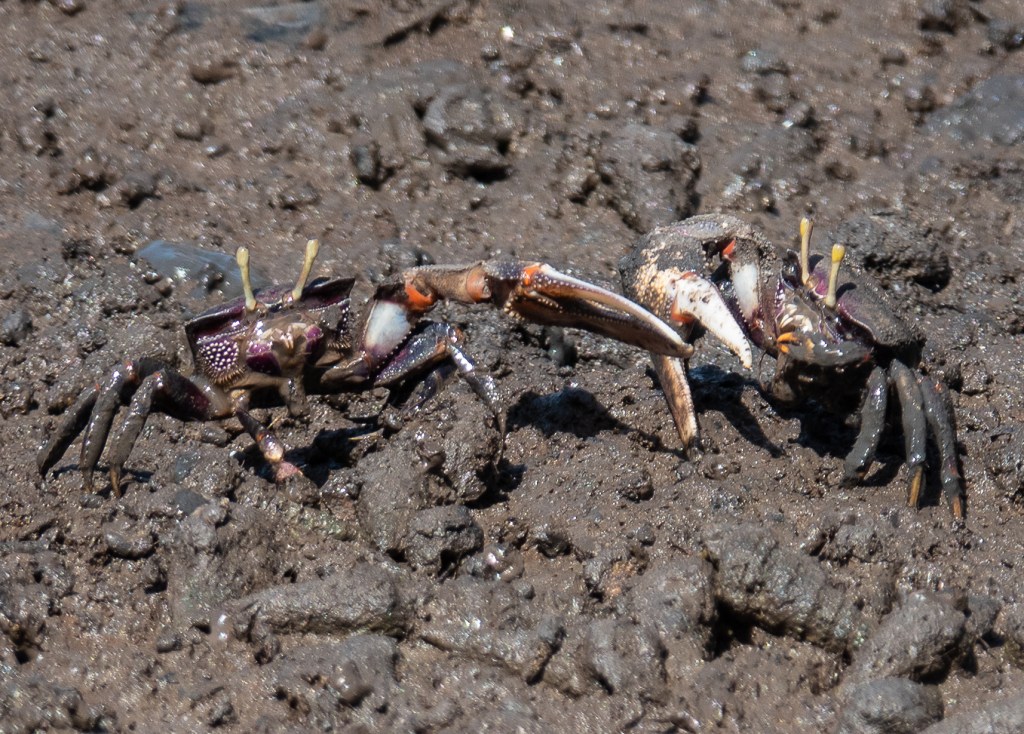
BUT, the males are in no way even-handed: one claw is huge and one is tiny. Here is a typical male Afruca tangeri, abut 50mm (2″) wide and 25mm (1″) long, feeding in the tidal mudflats of the mangrove swamps:

The tiny claw is used to delicately select minute portions of food, and the huge claw is used to fight other males:

but also to attract the female, who goes for a nice big claw (and also for the most impressive claw-waving dance.)

Their Portuguese name is ‘boca-cava-terra‘, meaning “mouth-dig-earth”. The small claw is used for feeding, finding food in the mud, and then carrying it to the mouth:

They filter through the muddy mouthful, and then drool out the unwanted residue; their mouth is just below where the two white markings converge:

I took a video of them feeding, all the while keeping their stalked eyes on the other guy. (Notice how the left-hand one occasionally uses his smaller pincer t0 knock off the accumulated debris from his chin.)

The male population is roughly 50:50 left-clawed vs. right-clawed, and depending on their relative claw placement they seem to have techniques for fighting face-to-face or side-by-side. This video shows a different species in combat:

The local Green Monkeys forage for these crabs. Here is a youngster, who came away from the mud-flats empty-handed:

PS Imagine if we used our left arm only for fighting, and our right hand only for eating. Sounds awkward? In fact there are indeed human cultures in which only the right hand is used for food, so we are not as distinct from the fiddler crab as you might imagine.

PPS Now that I think about it, crabs are ornery in other ways too. Most of the world’s creatures navigate the world forwards, but crabs famously scuttle along sideways. I wonder if their brains are just wired differently?

Kingfishers III: Small but lovely

[This is my last kingfisher post from the Gambia. I’m going to give you a break from birds for a little while now, I think. That’s the plan, anyway!]

The Striped Kingfisher, Halcyon chelicuti, is a mere 17cm long. It is another woodland kingfisher.

It swoops down to the ground from around 3m high, to catch insects, with an 80% success rate.

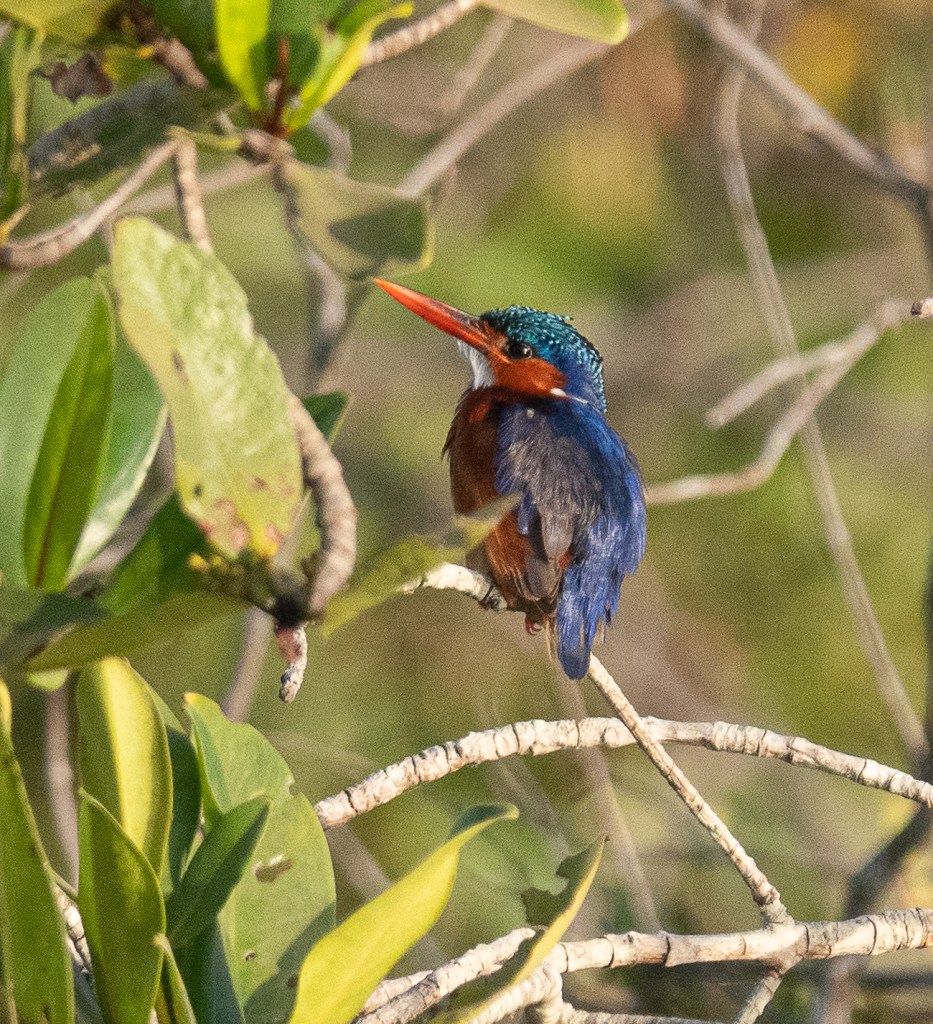
The Malachite Kingfisher, Corythornis cristatus, is a proper kingfisher: it actually fishes, from perches around 2 feet above the water, and prefers shallow water only a few inches deep..

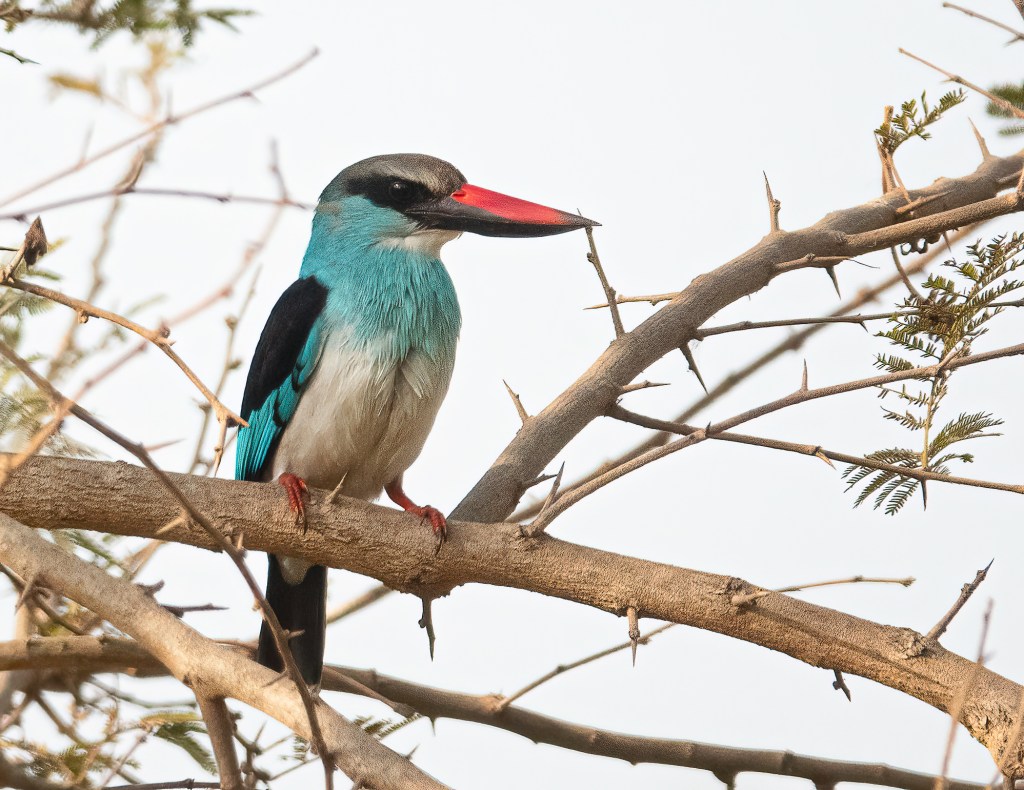
The tiniest of all, at 13cm, it is exquisitely plumaged, a tiny flash of iridescent blue in the mangrove roots:

Fantastic Mrs Fox

[A little late for US Mother’s Day, which was two days ago, but worth suspending my kingfisher posts for.]

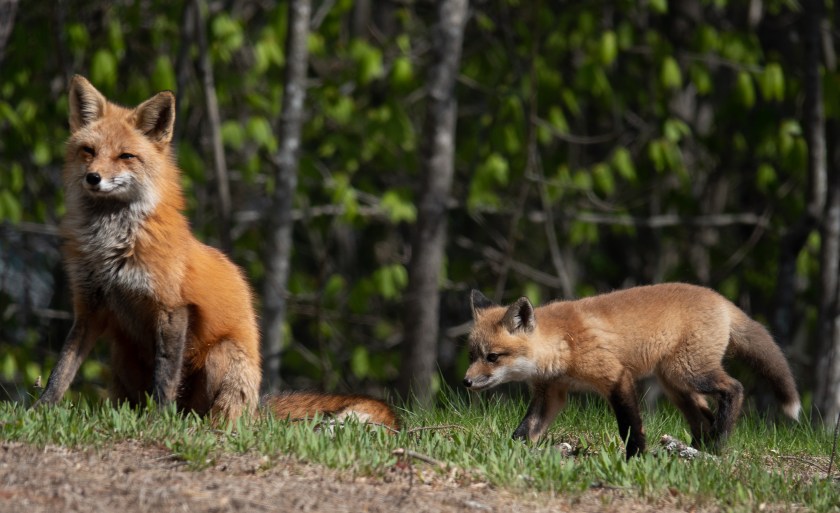
I slammed on my brakes, because out on the grass in front of a nearby house was a mother red fox with four cubs. No camera, and my beagle quivering with excitement in the truck. So I drove home (5 minutes away), dumped the dog and grabbed the camera.

She was very relaxed, but vigilant:

The cubs were skittish, and scattered when I stopped the truck. They only emerged one at a time:

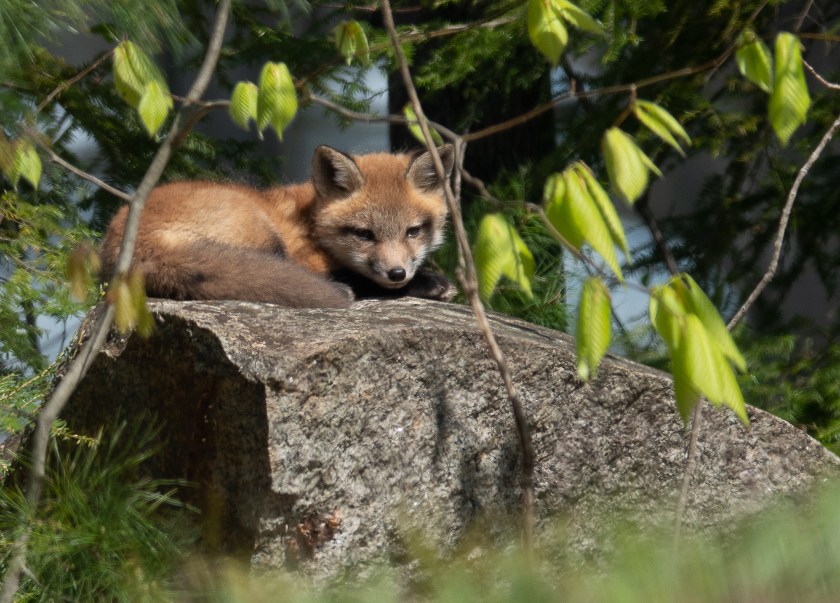
There was a large rock partly screened by leaves, so they felt safer there, and she groomed them:

Then this one took a nap:

The cubs were quite large:

and copying the mother’s every move:

.

The cubs looked healthy, and so did she, until she ran.

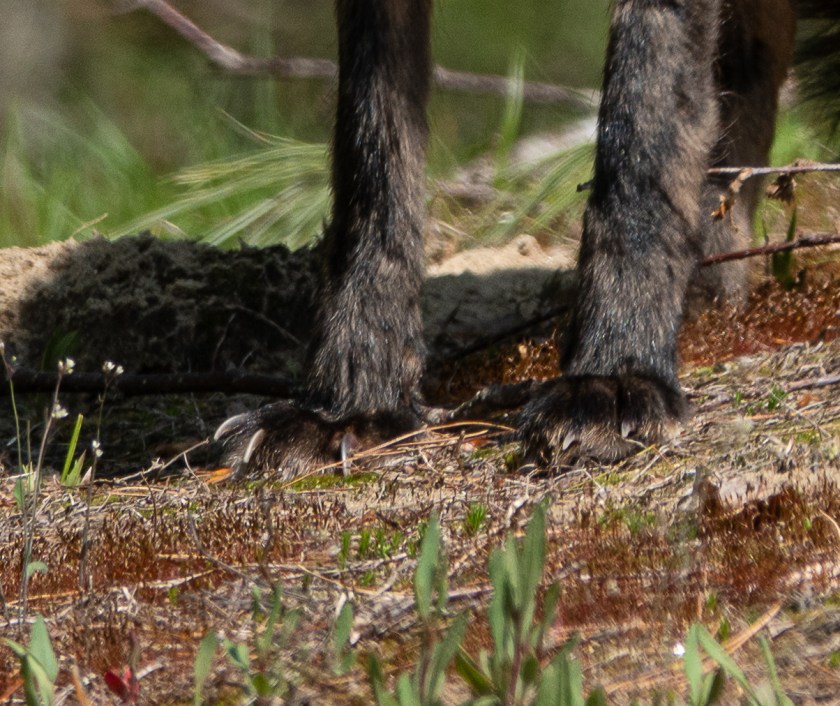
It then became apparent that although she moved fluidly and fast, she only used three legs, and that her right front leg was injured. Here is a close-up of her front feet, showing that the claws on the unused foot have grown long from lack of contact with the ground:

The leg also looks thinner, as if the muscles have wasted. According to a neighbor, she has been injured for four years, and despite that she has raised cubs every year.

She gets my mother-of-the-year award, Fantastic Mrs. Fox (with thanks to Roald Dahl.)

Kingfishers II: Big and bold

The Giant Kingfisher, Megaceryle maxima, is a majestic bird measuring 46cm (18 in) . The female (below) has a streaked chest and a reddish lower belly; the male reverses the coloring!

I only ever saw females on this trip,

Although in Zambia five years ago I did see a male:

Back in the Gambia, this one diving on a fish could have been either:

They eat mainly fish, but also frogs and even crabs. And that beak must strike terror into the heart of any target: this is the view the victim gets just before the denouement.

Not as big at 25cm, but far more cheerful, is this Blue-breasted Kingfisher, Halcyon malimbica:

From behind it is a brilliant turquoise:

It is a tree kingfisher, and not a specialist fish-eater. It mainly eats invertebrates, including insects and crabs, beating them on the ground before eating them. That huge bill must help.

Kingfishers I: Action

[We saw several different kingfishers in The Gambia, each in their own way lovely, so I’m doing three posts just about them. ]

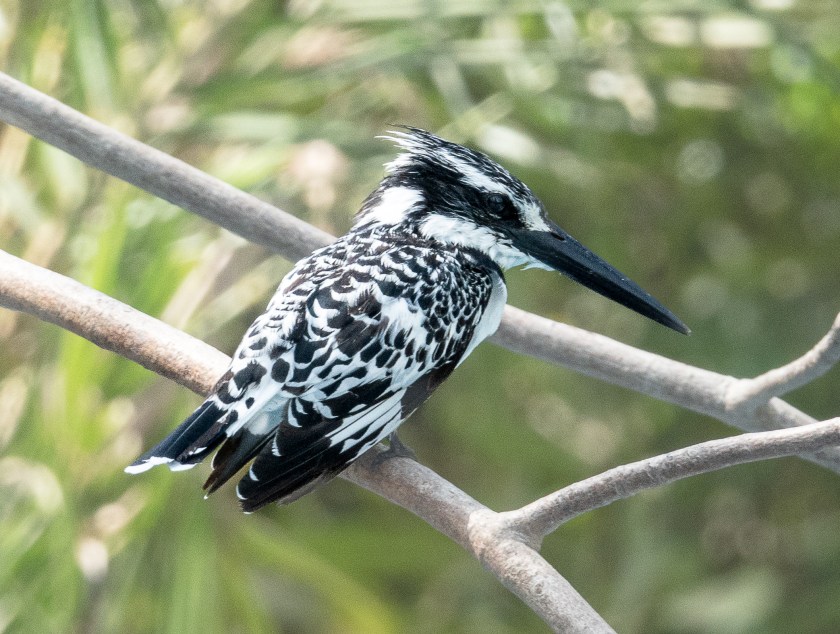
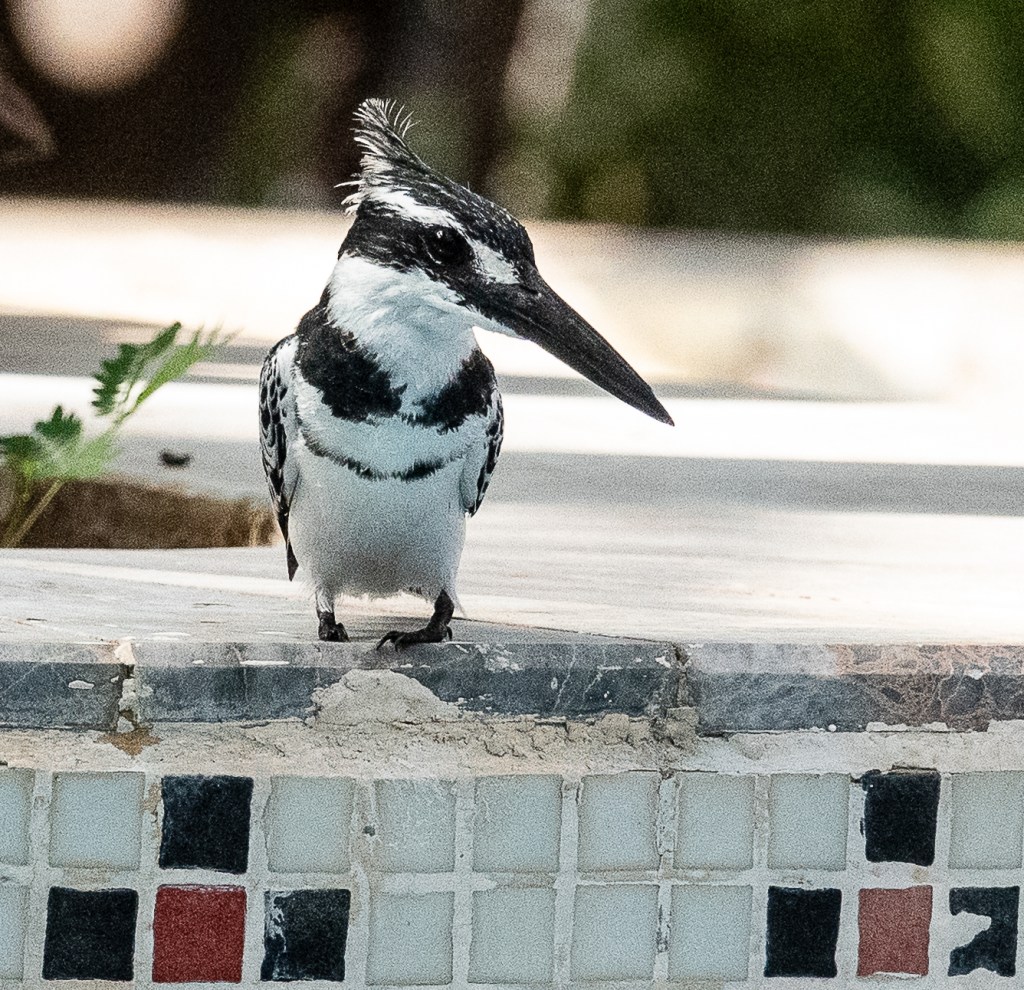
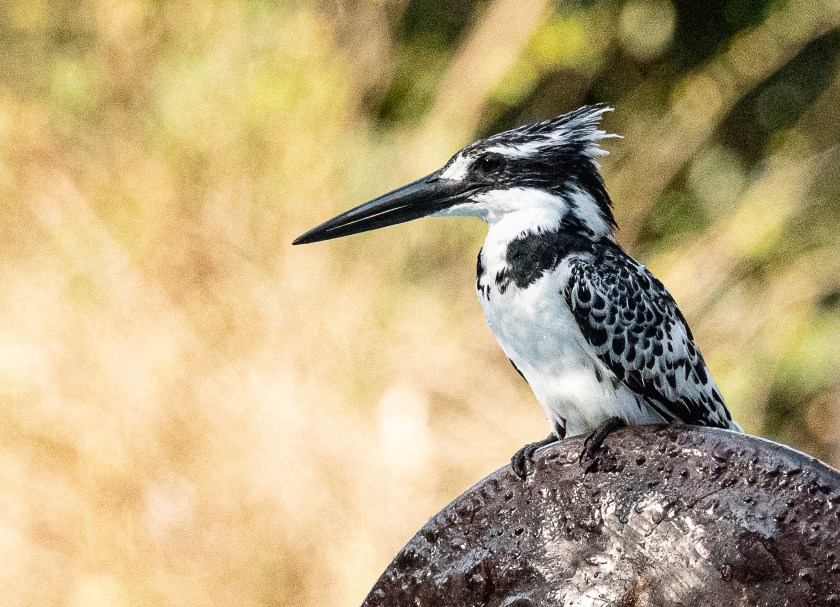
Pied Kingfishers, Ceryle rudis, are common throughout sub-Saharan Africa.

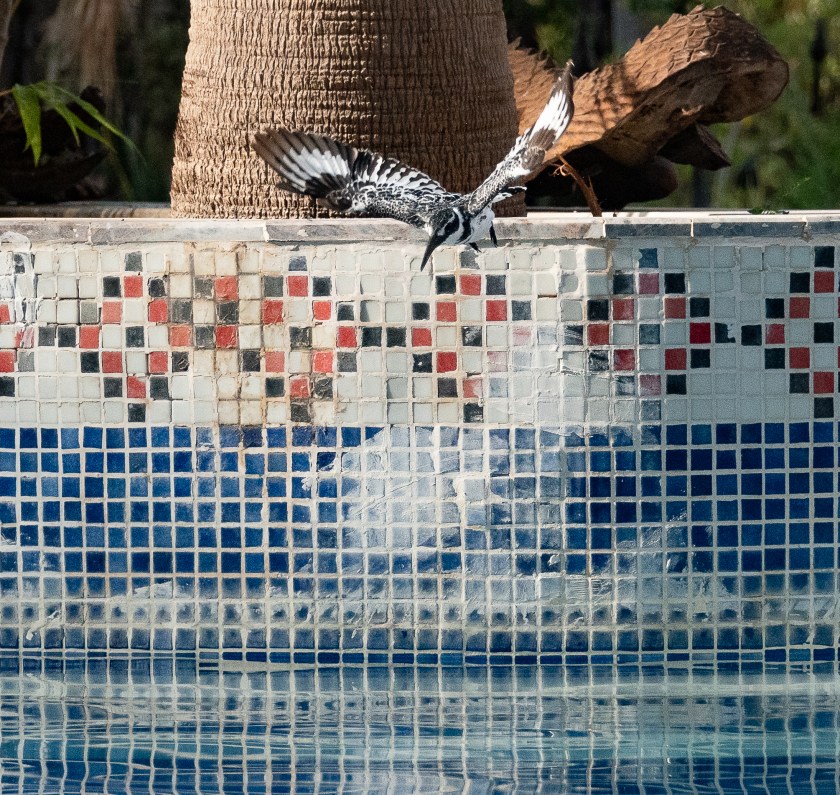
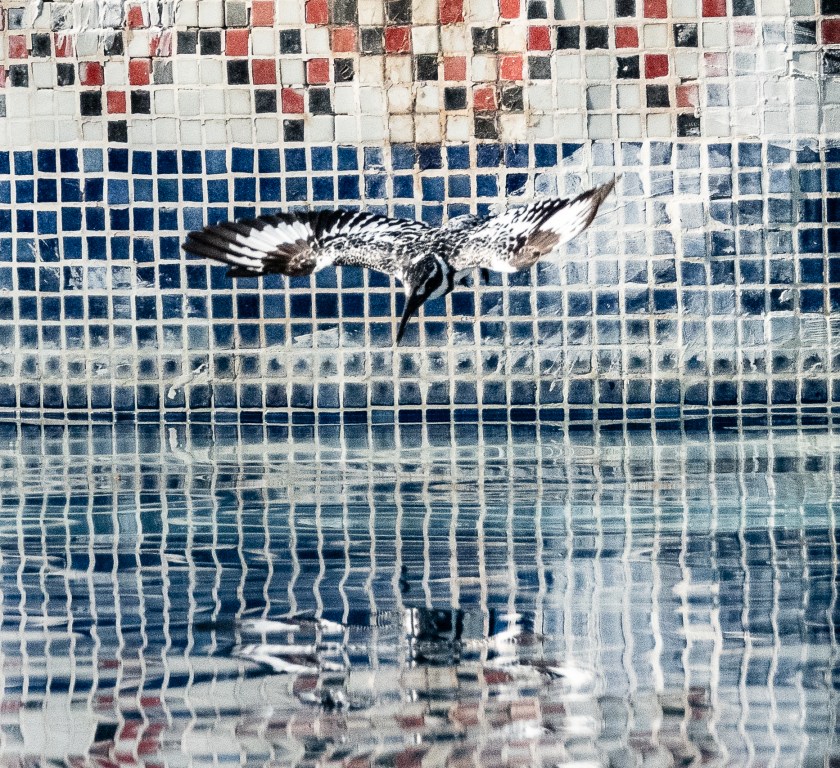
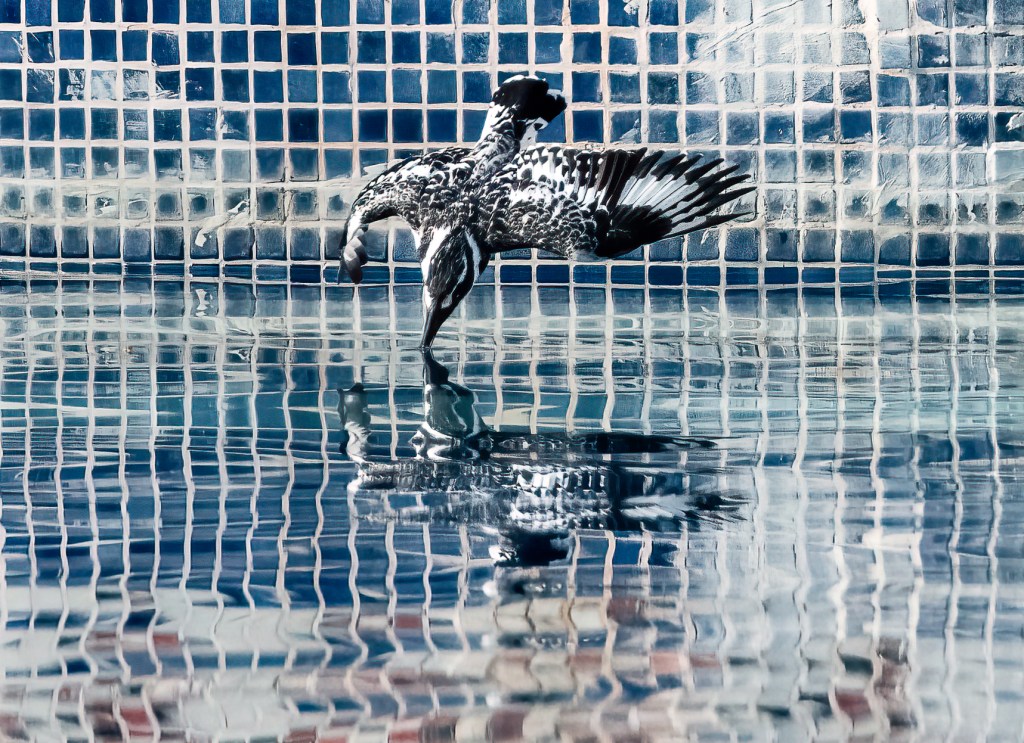
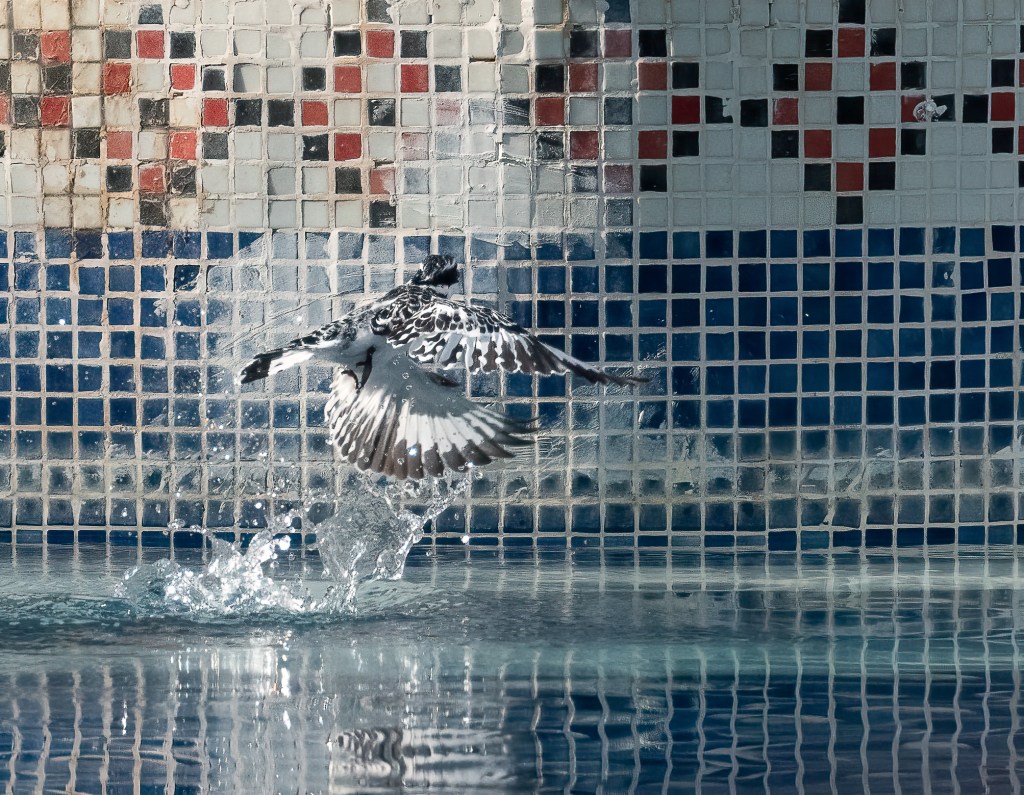
I’m showing you this one because he repeatedly dived into the pool and returned to the same perch, so I took a burst of shots, and put together this sequence; the two black breastbands tell you it is a male:

He launched himself:

Dived,

and emerged..

and back to his perch. And all in a total of two seconds:

Later the female (only a single black breast-band) had a dip from a separate perch:

April is the cruelest month*

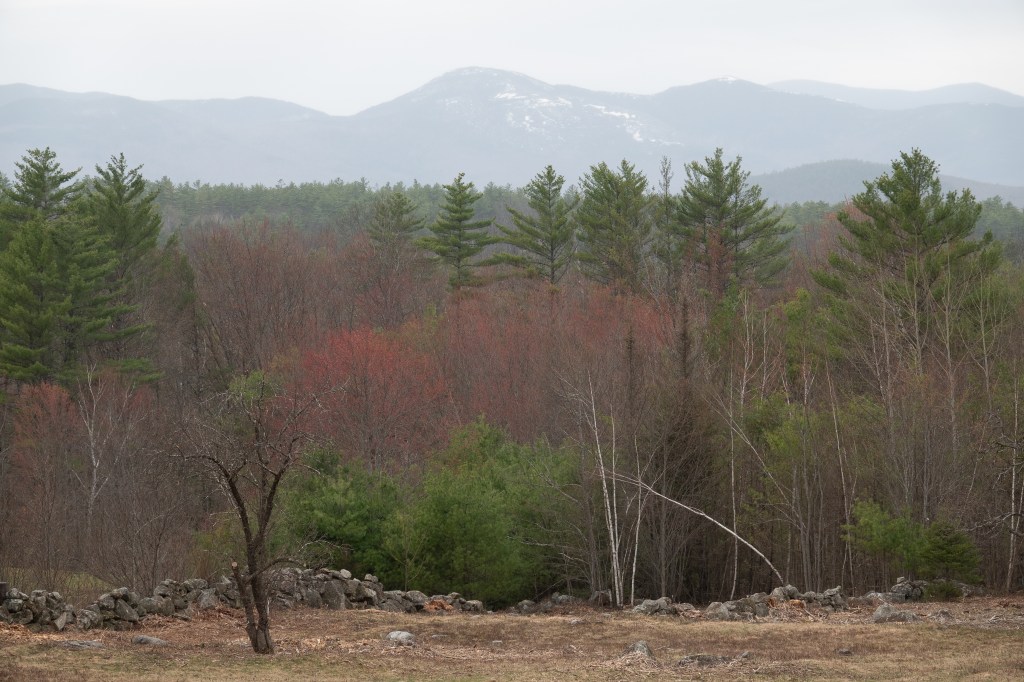
[I usually tell a story about some particular animal, bird, bug, or plant in my blog, and recently I have been bingeing on The Gambia. But I know that some of you are always curious about what is happening in my corner of Maine, so this is a sort of current affairs report from Lake Wobegon, and then I may go back to The Gambia for a while! It’s a long blog, with no special storyline, just early spring in Western Maine.]

When the month began, it was was definitely still winter:

Snowstorm, April Fools Day

But as the month unfolded, life poked through

Buds swelled:

Striped Maple


some with the promise of flowers soon to follow, their tightly knotted buds making a bird out of the unfolding leaves:

Hobblebush

Red Maples flowered in a distant red haze:

and in close-up:

Male Weeping Willow catkins opened:

A few brave early wildflowers opened too. Trailing Arbutus, usually white but occasionally a luscious pink:

or an early violet.

Northern White Violet

Or Bloodroot, complete with the necessary insect to pollinate it:

Migratory songbirds returned, some to stay, and some passing through en route to the far North:

House Finch
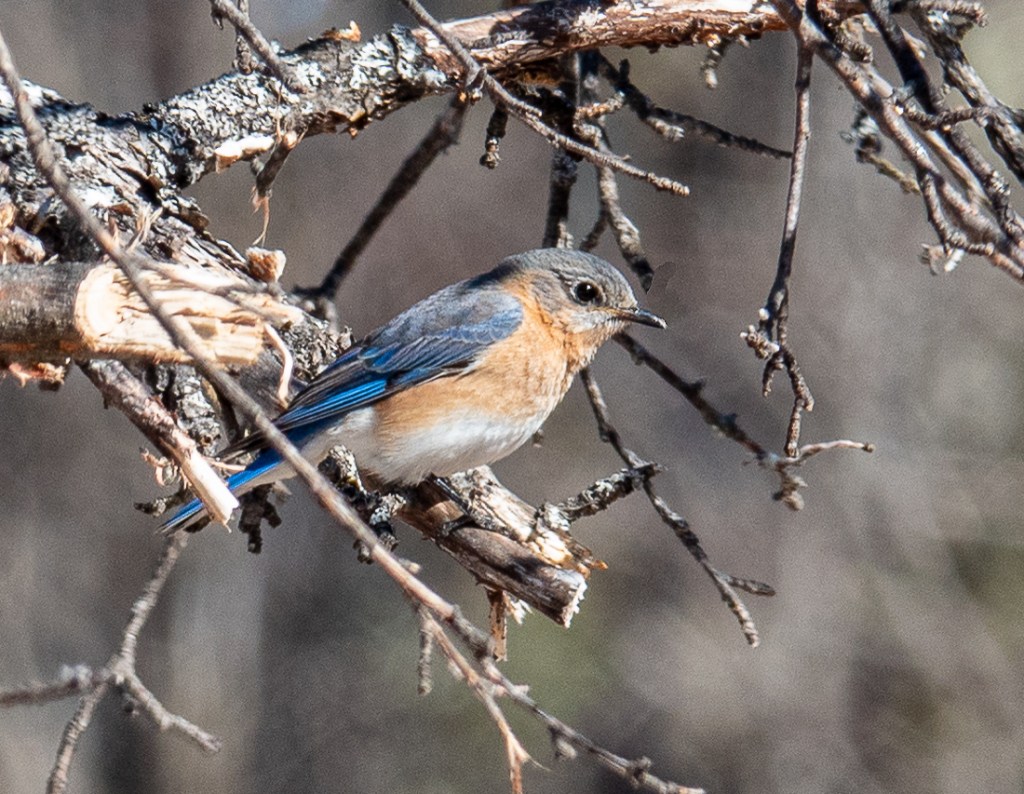
Eastern Bluebird

Song Sparrow

Yellow-rumped Warbler
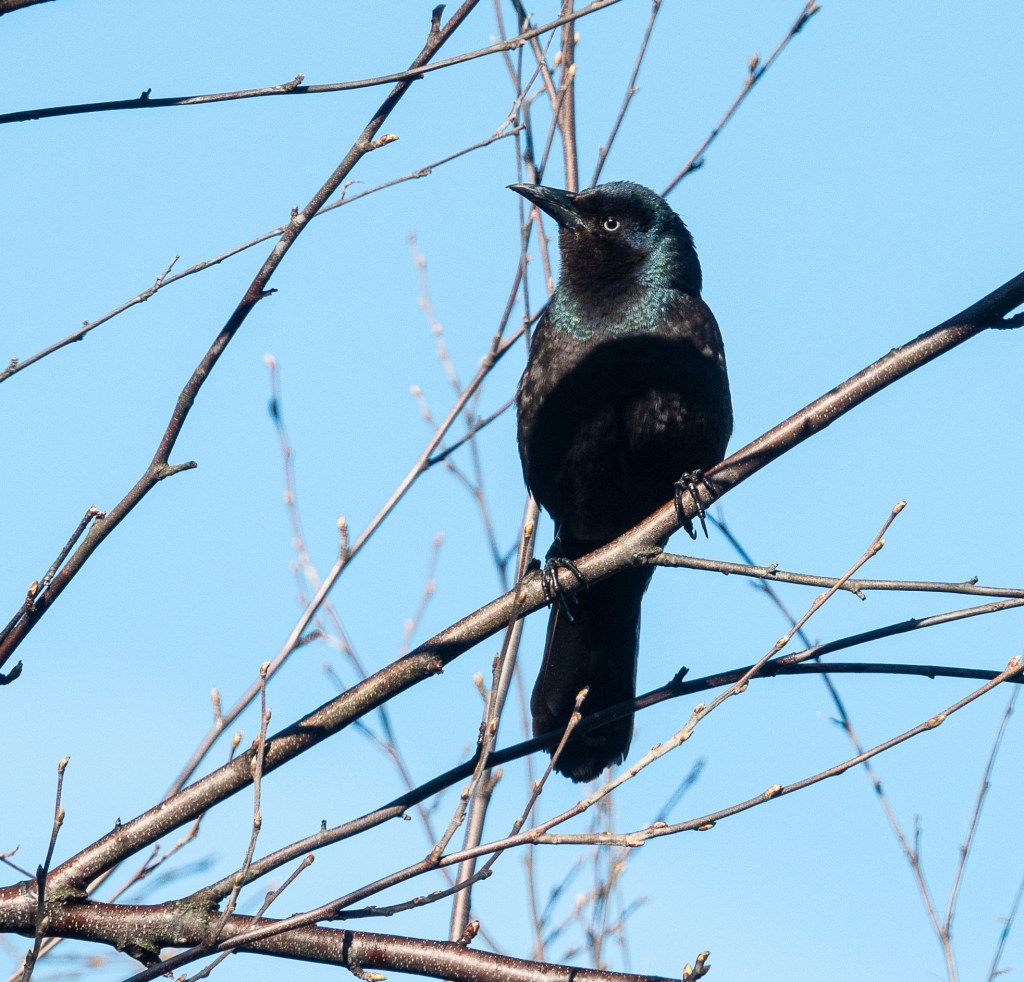
Common Grackle

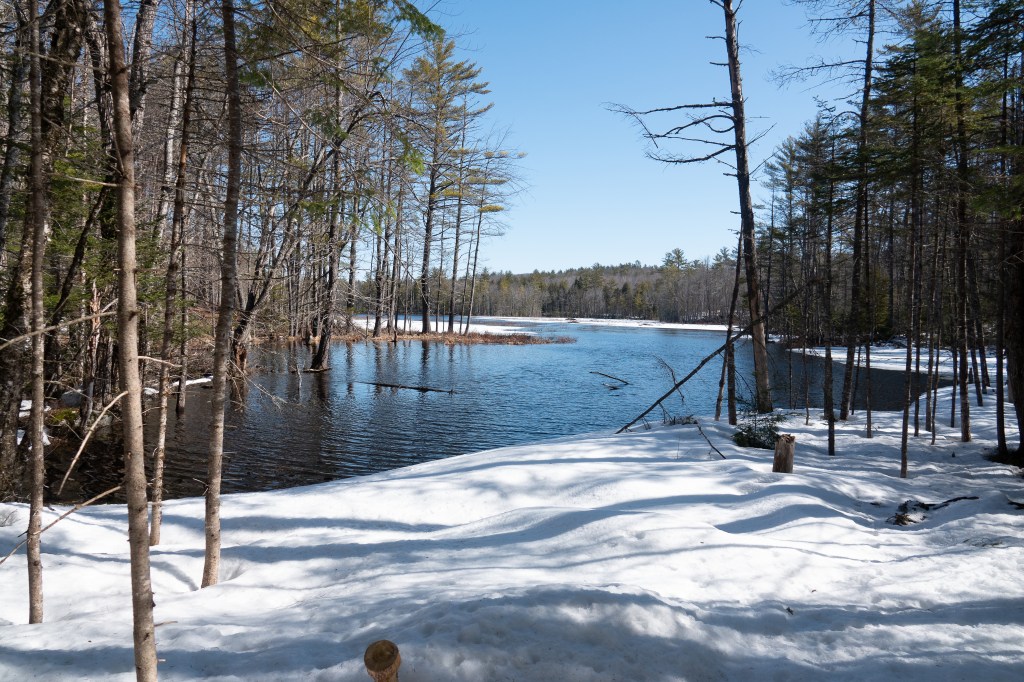
Waterbirds came back too, some while the ponds were still partially iced over, and my kayak invisible under the snow:

Hooded Mergansers in flight
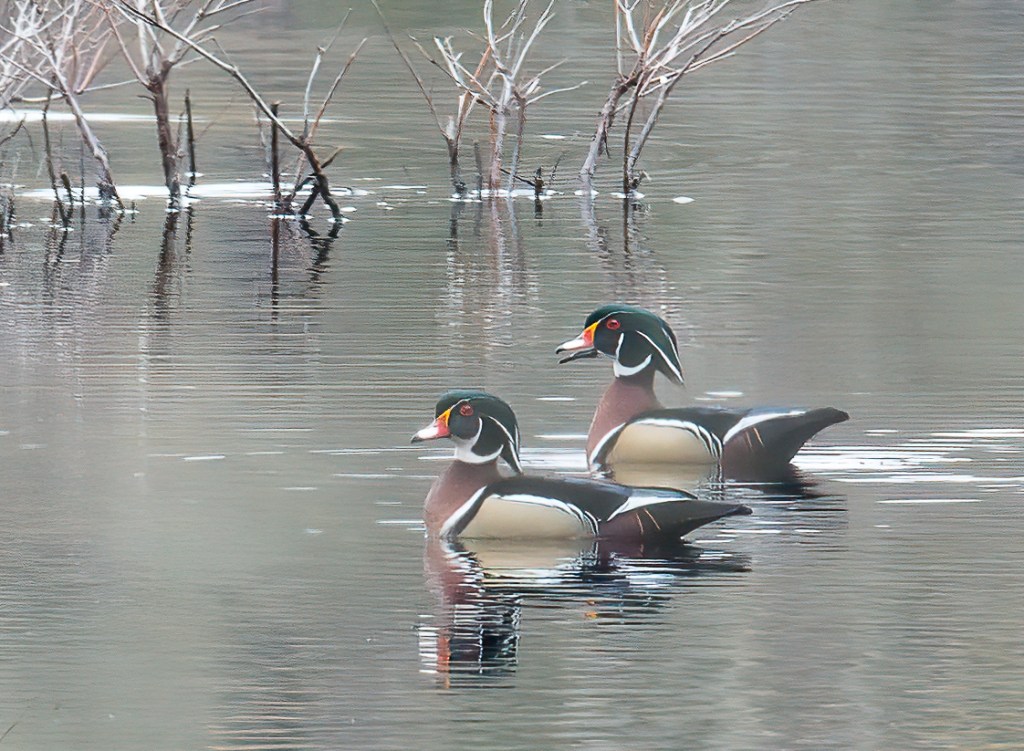
Male Wood ducks
Canada Geese

Some came a little later:

Blue Heron

Some are only passing through:

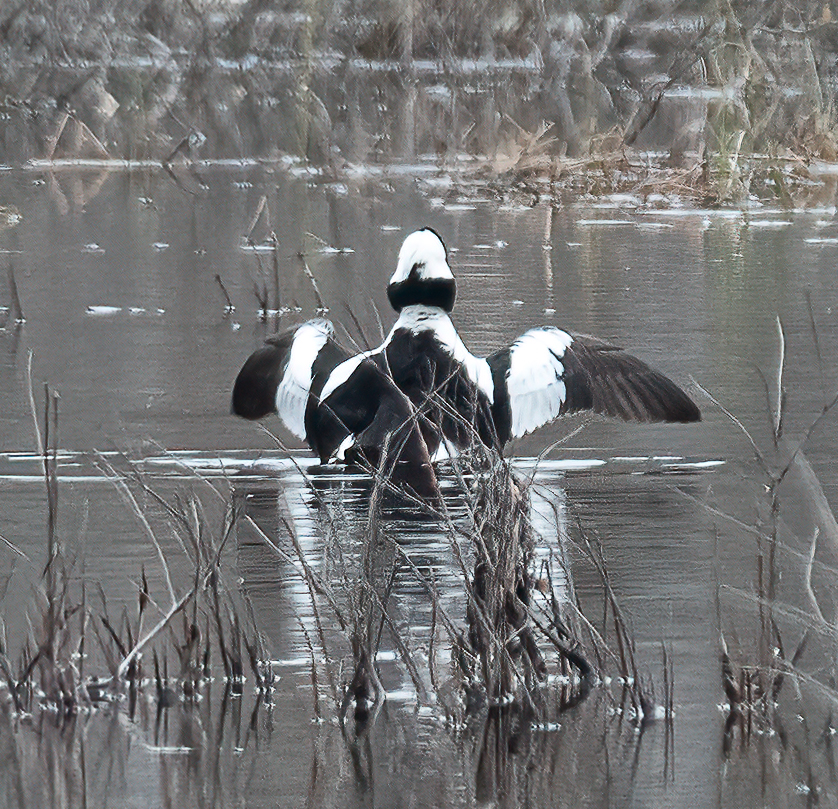
Bufflehead

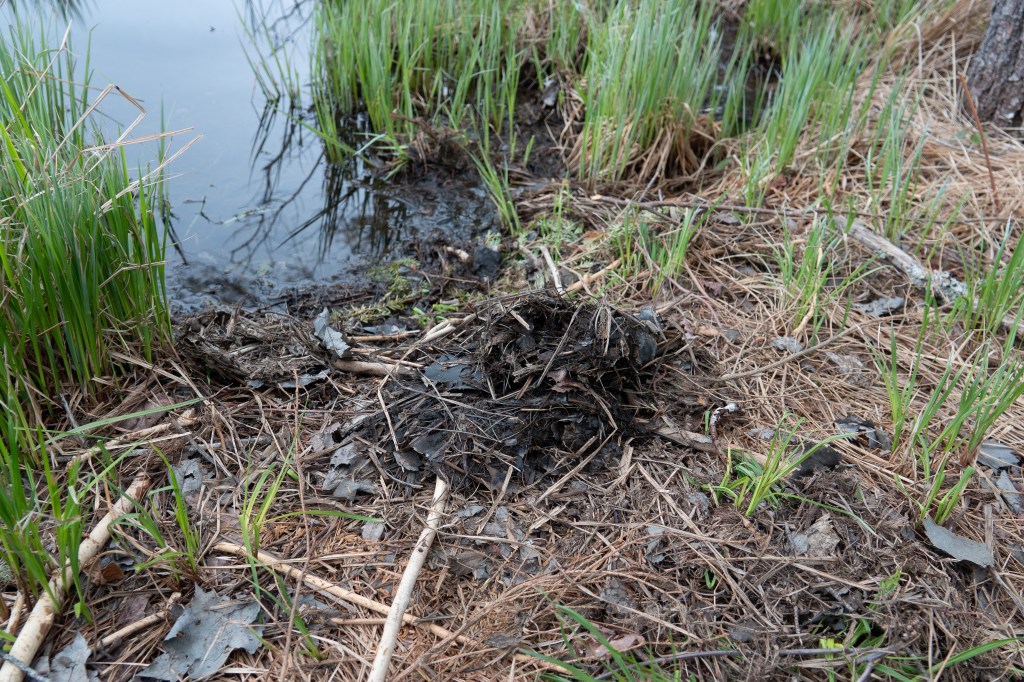
The beaver emerged from their lodges and left scent mounds around the shoreline:

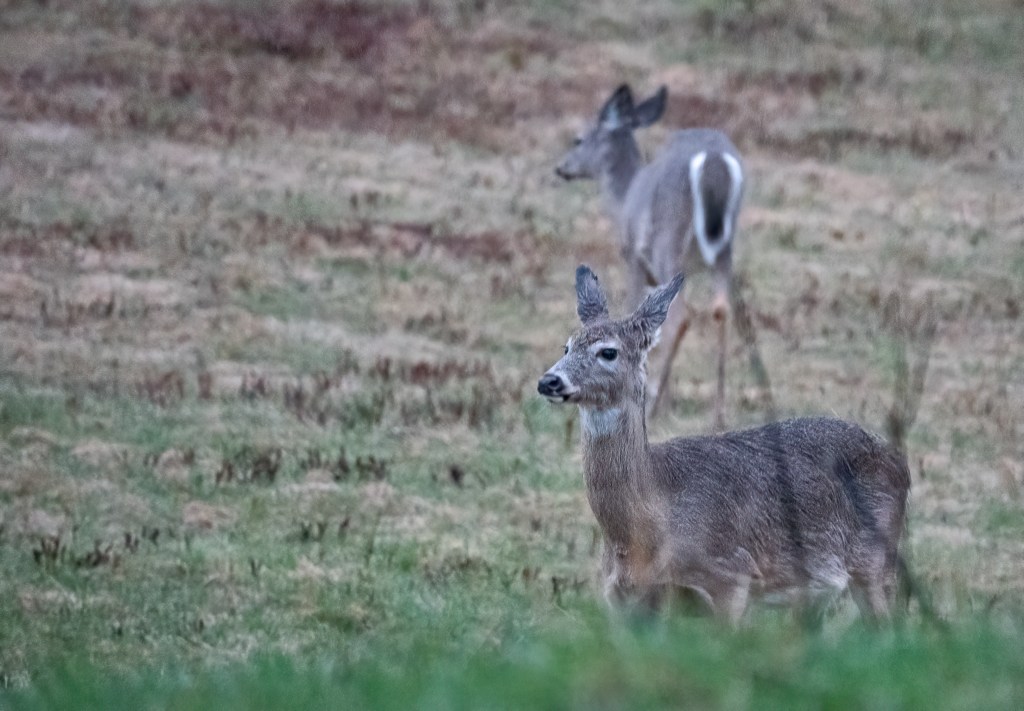
The deer, in their grey winter coats and hungry from a long lean winter, came out at dusk near the house to graze:

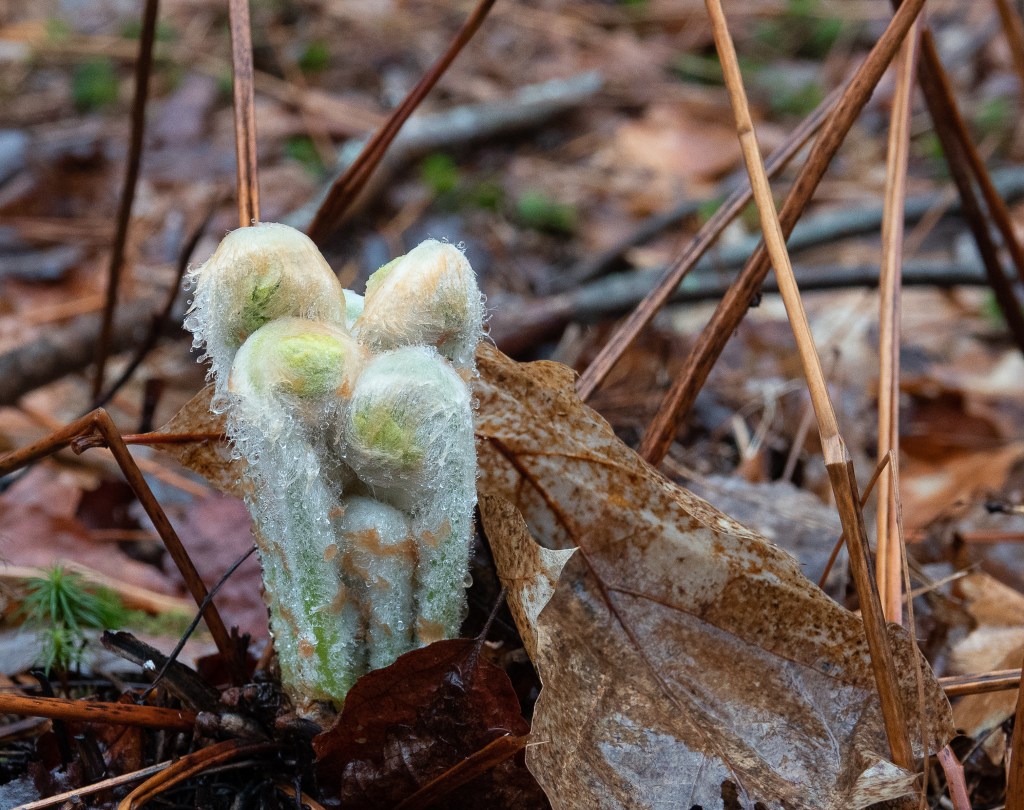
The ferns pushed up their swaddled fronds:

:

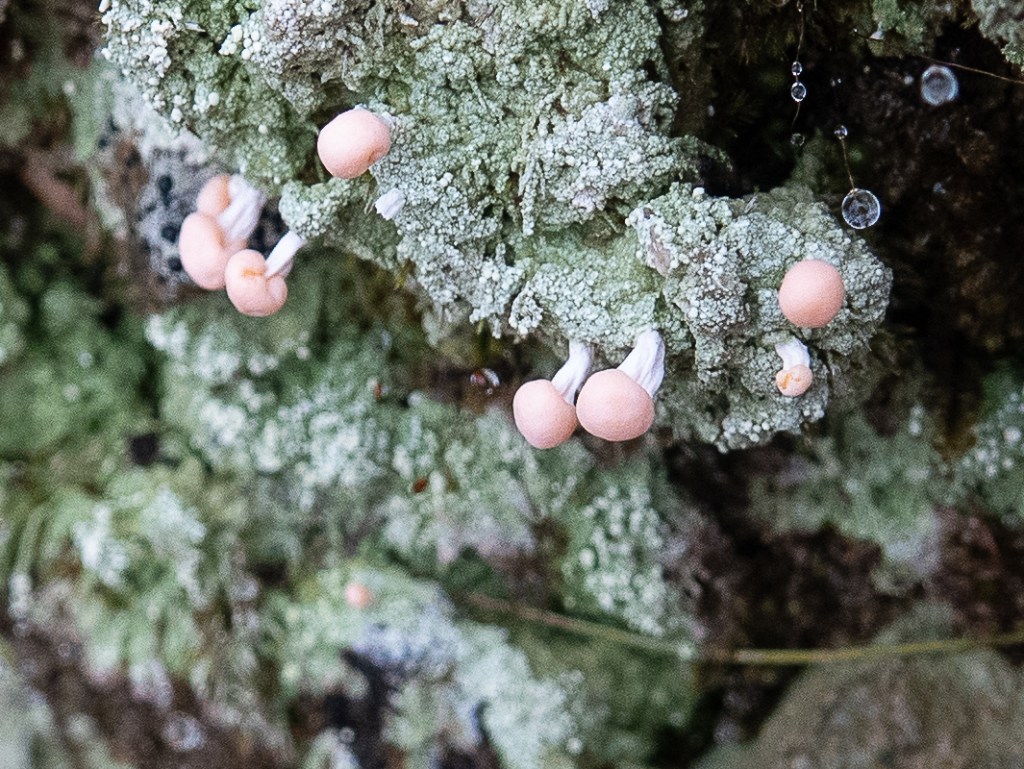
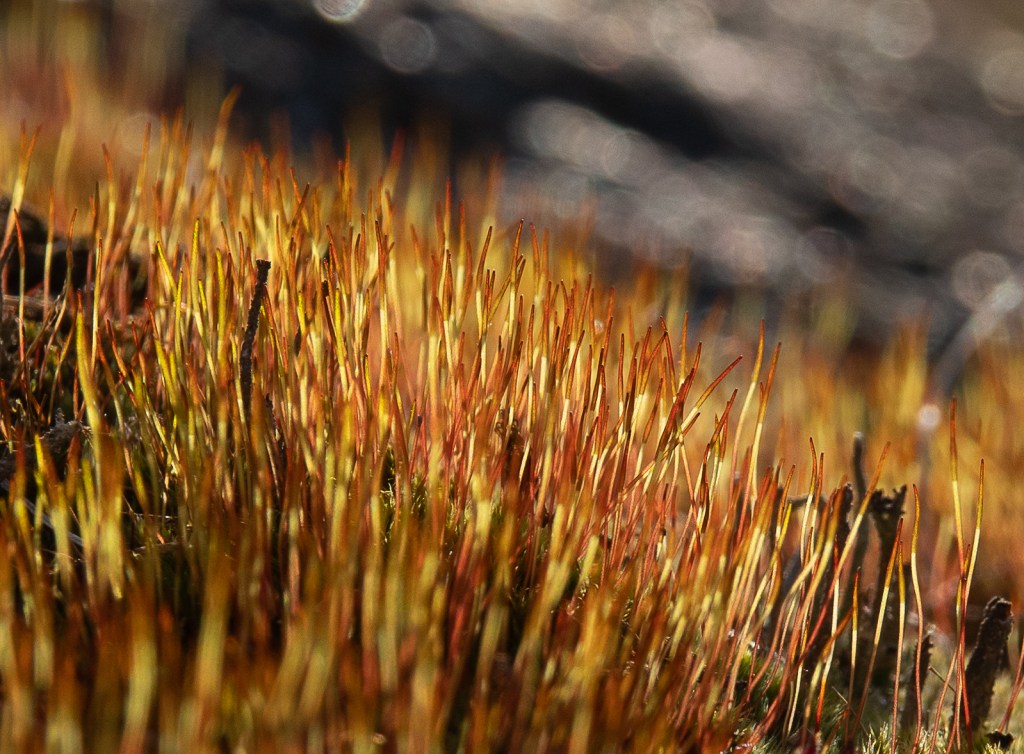
Even the lichens and the mosses unfurled their spore capsules:

Pink Earth Lichen

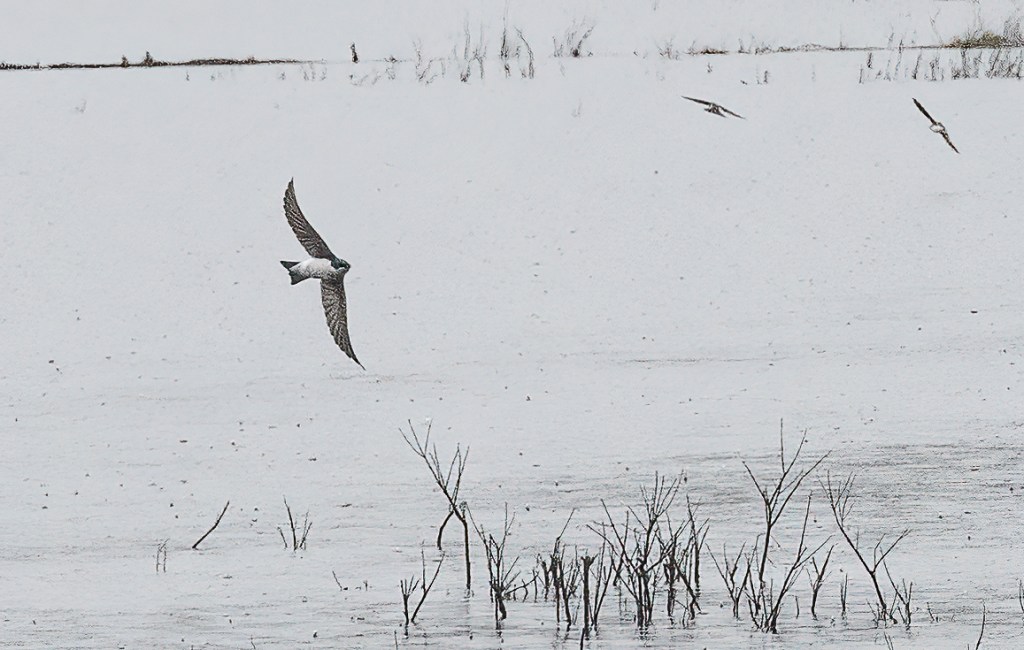
My title is of course the first line of T. S. Eliot’s ‘The Wasteland’. We may yet get more snow, but it won’t stay long, and all the promise of an incipient spring lies in the air, giving the lie to “April’s cruelty”. If you need proof, even the swallows have returned, swooping low over the pond in the rain.

Tree swallows

PS I sent this out this morning, April 30, because the forecast was for rain all day, which meant no chance of adding more photos on this last day of the month. But then the rain eased up for an hour, out I went, and these are the result

A Red Trillium, or Wake-Robin (such a charming name):

And the Hobblebush earlier in this post, with the flowers just opened: