The Violet Turaco: the pigment bird

[I have just returned from The Gambia in West Africa, looking at birds with the photographer and guide Oliver Smart of Naturetrek. I’ll be doing several posts from the trip, perhaps interspersed with anything interesting in Maine now that I am back.]

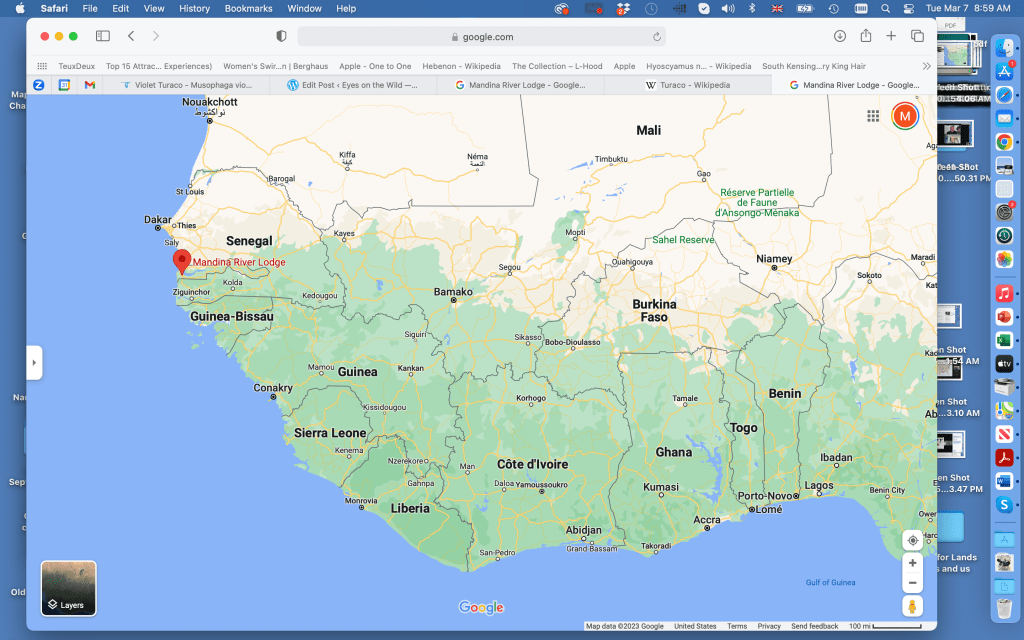
First, to situate you for the weeks ahead, here is a map showing where the Gambia is in West Africa. The red pin is our lodge, Mandina River Lodge.

The Gambia is a very unusual shaped country, along two sides of The Gambia river, and entirely surrounded by Senegal. The river is 10Km wide where we were, so there are no bridges until the 1.2 mile Senegambia bridge, 120 Km up-river, which opened in 2019.

So, on to the birds. These pictures were taken over several different encounters.

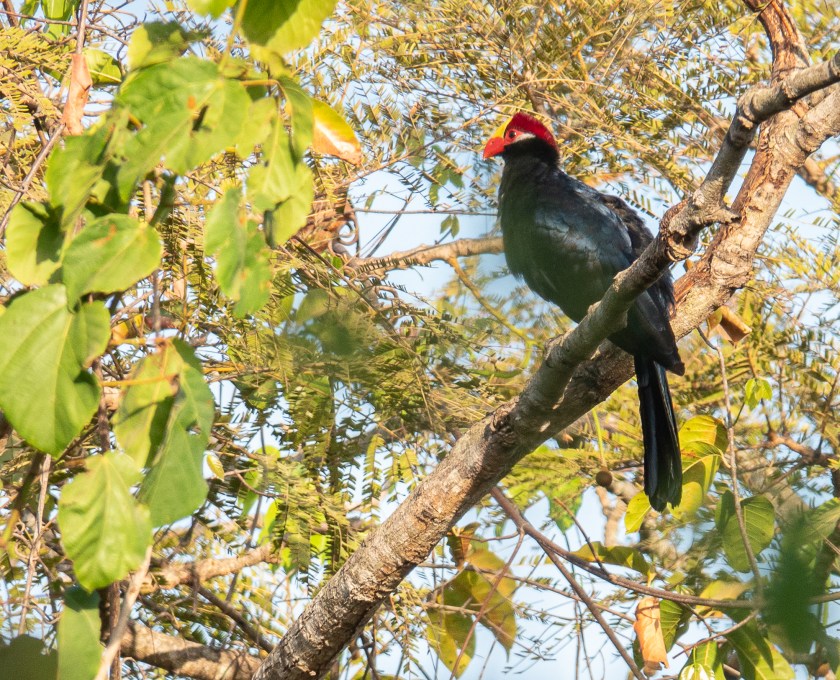
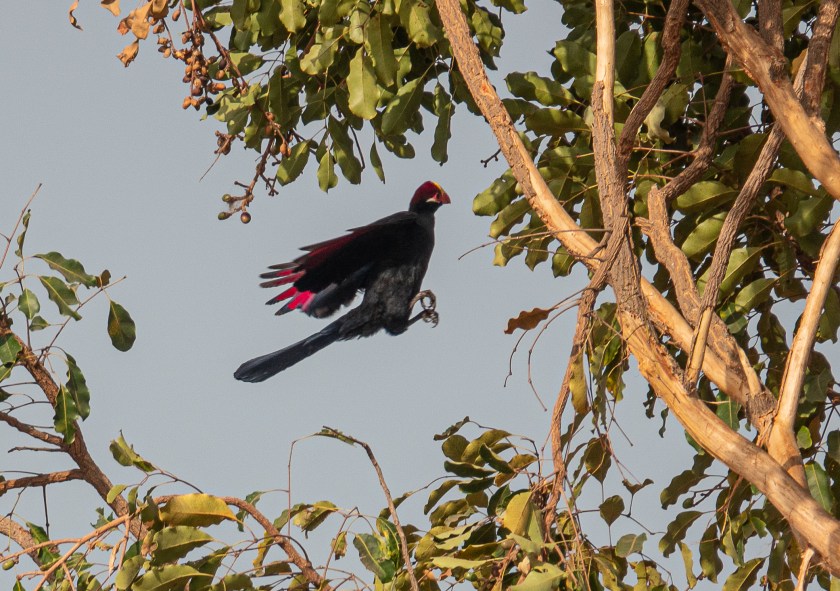
Sitting high in the tree was a plump purplish-black bird the size of a large pigeon with a long tail, a crimson head and a chunky reddish-orange bill:

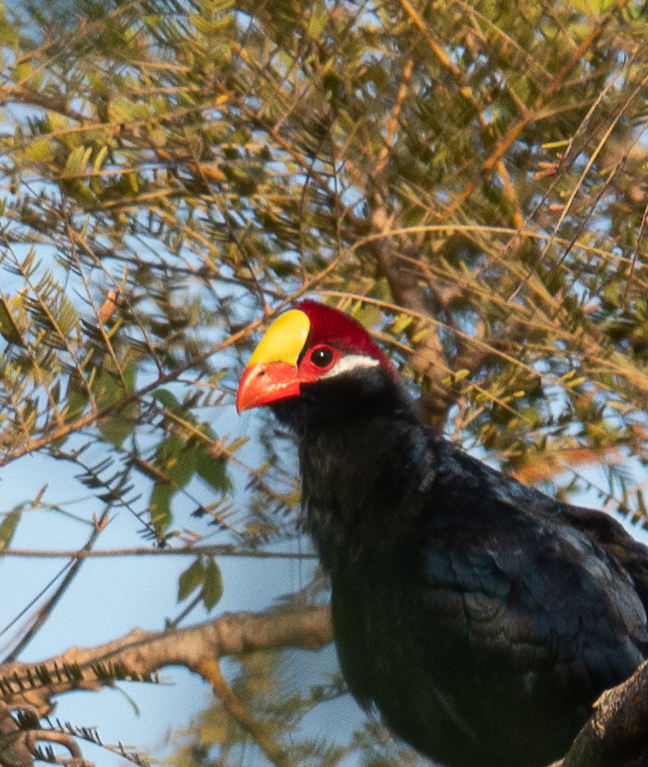
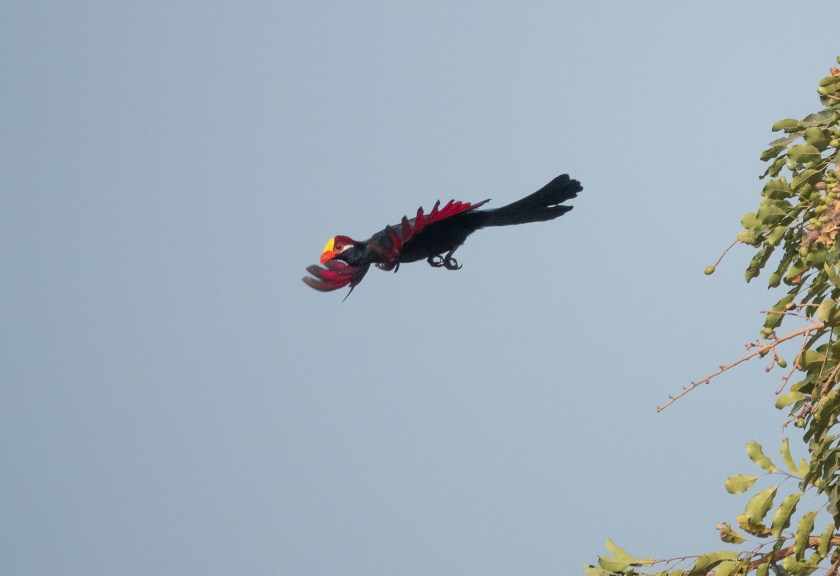
It was a Violet Turaco, Musophaga violacea. The yellow forehead is a hard casque, and the red eye-ring is bare skin., which you can perhaps see better in the not-very-sharp photo below:

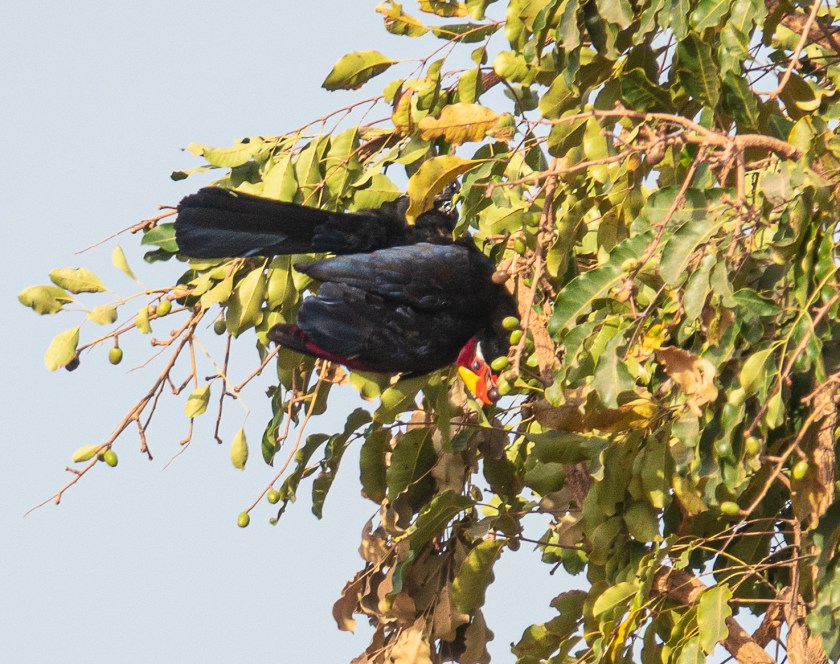
Weighing in at 360gm, and about 50cm long, its scientific name means “banana-eater”. It gorges when it finds a productive fruit tree, hanging upside-down if necessary to reach the ripest fruits, especially figs:

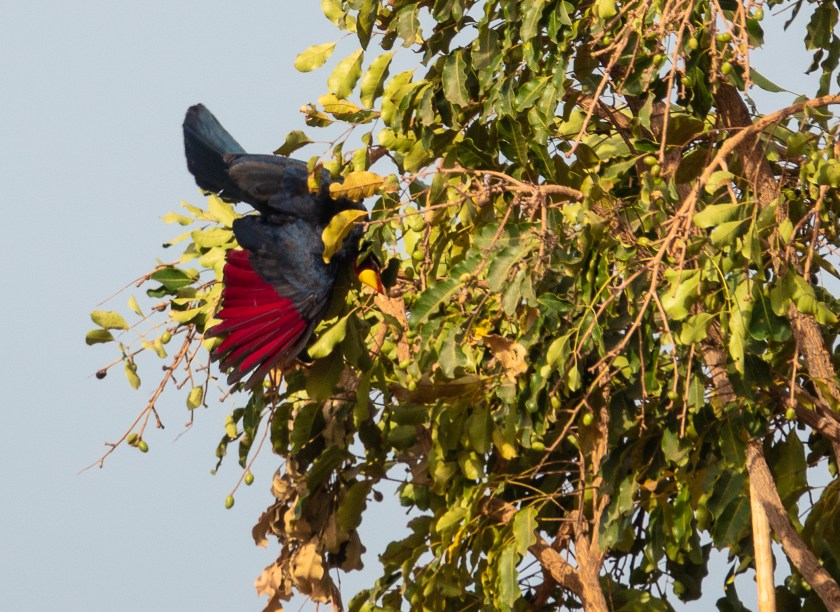
The flight feathers are deep crimson, visible in the next photo as it spreads its wings to keep its balance:

or on a short flight to a new branch:

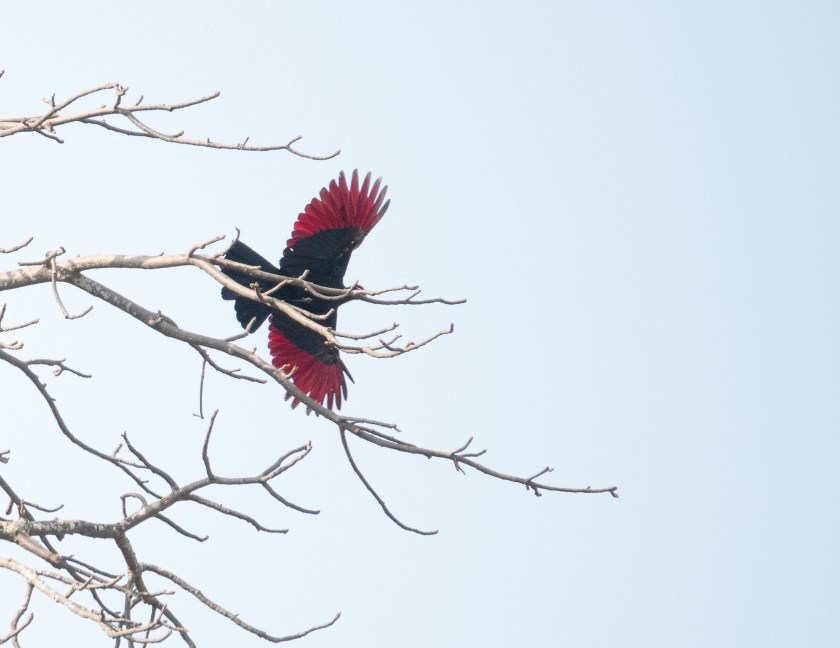
But when it really takes off:

and spreads its wings fully, just look:

The crimson color is produced by an entirely different pigment from the reds of all other bird families, and called appropriately turacin. Hence my title.

Another oddity: it has ‘semi-zygodactylous’ feet: the fourth (outer) toe can be can be brought around to the back of the foot to nearly touch the first toe, or brought the front near the second and third toes. I failed to photograph this!

The Violet Turaco is not endangered and lives across a swathe of West Africa, but it has been little studied. The main threat seems to be the international trade in exotic birds: it is just too spectacular for its own good. In captivity they live a long time. The current record is 37 years.

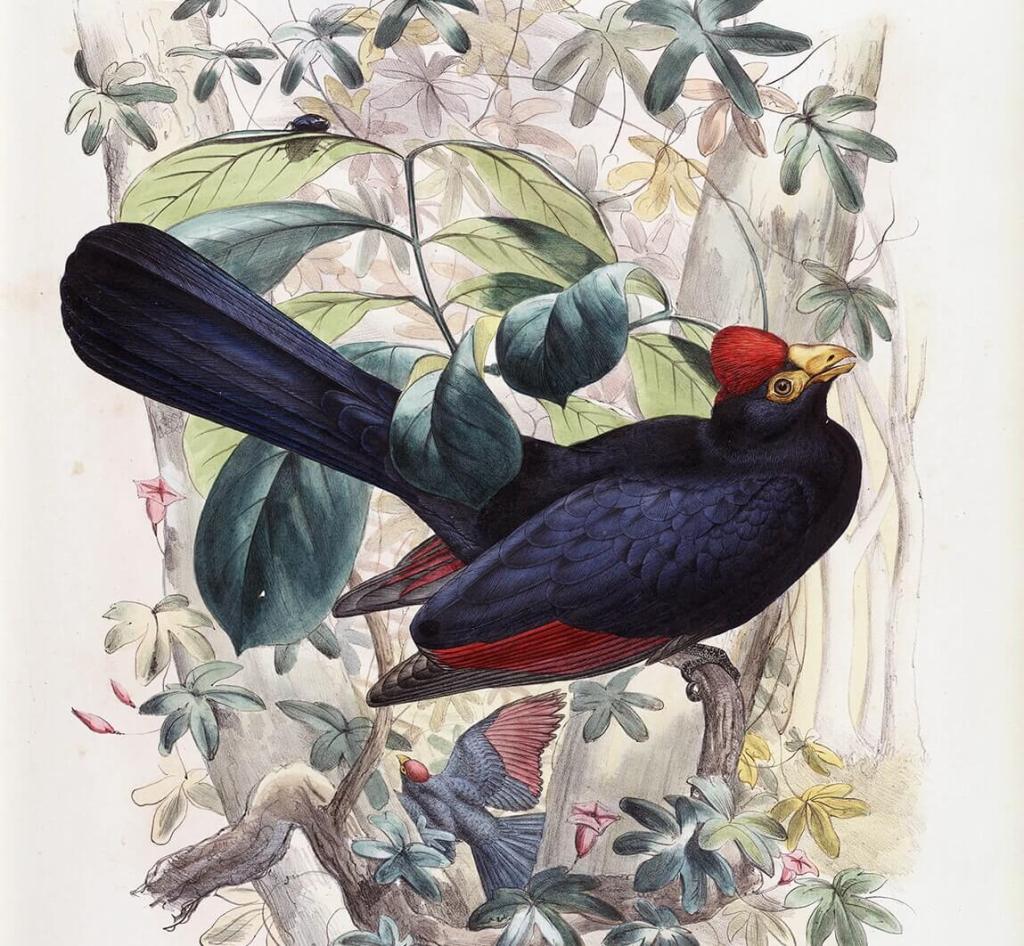
I end with Herman Schlegel’s 1860 painting of a Turaco for the Royal Zoological Society – also known as Natura Artis Magistra, the oldest zoo in the Netherlands.

An imperial gift

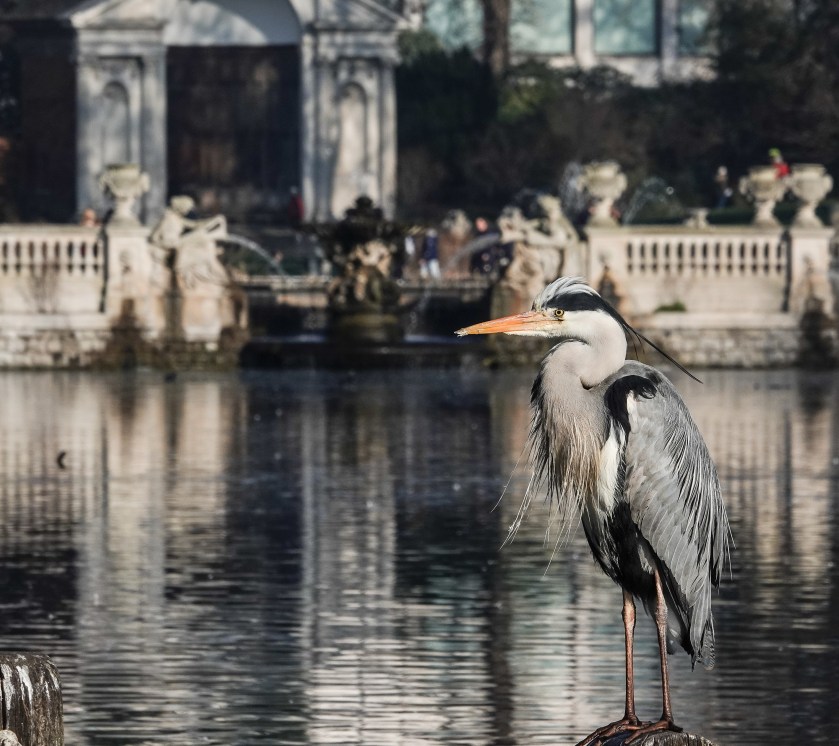
The Grey Heron has a range that ranges from England to Japan.

They are imperial birds. This lacquered Japanese cosmetic box was given to Queen Elizabeth II by the Emperor of Japan for her coronation in 1953. It was made around 1900 by Shirayama Shōsai. It was the first post-war diplomatic gift, indicating a new era of friendship, and is on display right now in the Queen’s Gallery at Buckingham Palace.

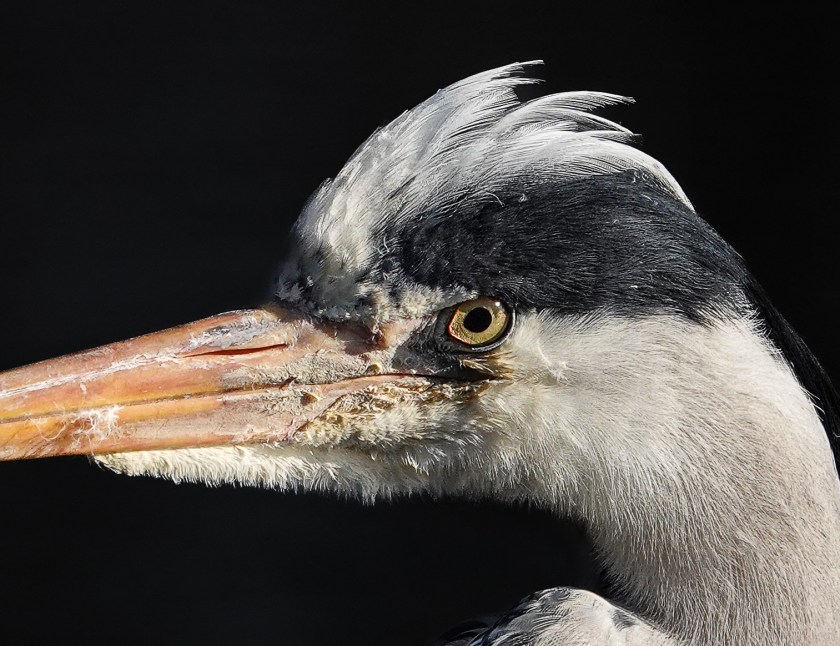
Meanwhile, this one was grooming itself in the gardens next to Kensington Palace the other day, crest on display, oblivious to us passing peasants:

It was joined by two indolent swans, the property of the King:

Like the one on the lacquered box, it spent much time on one leg:

Serious grooming began:

But it was watching me, maybe checking for signs of insurrection:

PS: I’m off to The Gambia tomorrow, and hope to have some good things to show you on my return in about 10 days.

The giraffe with five ossicones

Preface: I’m now in London, but with nothing special to report, and definitely no giraffes, so I thought I’d dig out a couple of postings I composed but never sent out. Here’s one, from my Kenya orphanage trip in April 2018.

The 48,000 acre Soysambu Conservancy was set up by Lord Delamere, whose predecessors figured prominently (to put it mildly) in Kenyan high society back in the Out of Africa era. It contains a very healthy population of Rothschild’s Giraffe, about 10% of the world’s total of around 1600 (IUCN 2016 estimate).

The Rothschild’s Giraffe, Giraffa camelopardalis rothschildi, is the only species where the male is born with five ossicones: two large ones on top of the head, used for fighting and often rubbed bald, plus two smaller ones behind the ears, and one in the middle of the forehead.  This not very good photo shows all five:

Male Rothschild's Giraffe: you can see the 5 ossicones

The ossicones are made of ossified cartilage, not bone. At birth, they are not attached to the skull, and lie flat, so the poor mother can give birth without problems. Later in life they fuse to the skull.

Recently, lions have moved in to Soysambu from neighboring Lake Nakuru National Park, and we were driven around by Rowena White, known to her friends as ‘the lion lady’,  who helps to monitor the lions for Lord Delamere. We didn’t see lions, but we had a lovely day. Here are some highlights.

What look like twin young giraffes, part of a  group of about 20, quite unbothered by the buffalo.

The conservancy has 10% of the world population of Rothschild's giraffe

A baby buffalo with mother next to him, and the magnificently horned father behind her:

DSC08139

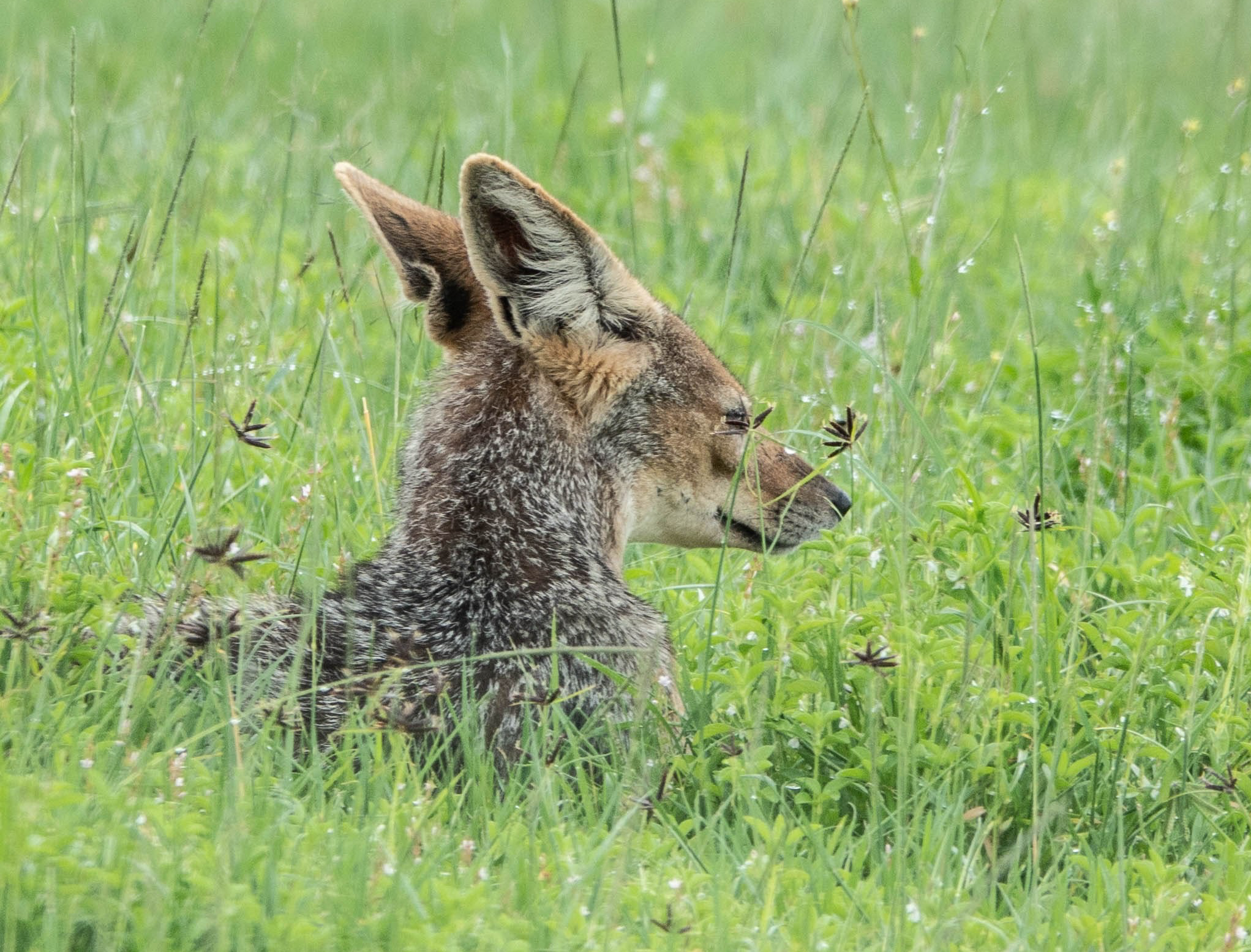
A jackal resting in the long grass, with an impressive pair of ears.

Black-backed jackal

And a tortoise,  ambling along through the wildflowers:

Leopard tortoise

DSC08200

A Lilac-breasted Roller, Coracias caudatus:

DSC08144

And then we had lunch, taking care to stay on the verandah because Rowena regularly sees leopards prowling around the terrace!
DSC08340

I did an earlier post from Soysambu Conservancy’s Lake Elementeita, about flamingos. Here’s the link in case you missed it: https://eyesonthewild.blog/2018/06/28/in-the-pink/

If you’d like to know more about their conservation work, read here:

Till death us do part?

Pond skaters, aka Water Striders, Aquarius sp., are so familiar to anyone who frequents streams and ponds that we rarely stop to look closely. And if we do, it’s not so easy, because they rarely stay still for long. Next time, though, especially in the spring, pause and observe. Here is what I saw some years ago on a Maine May day.

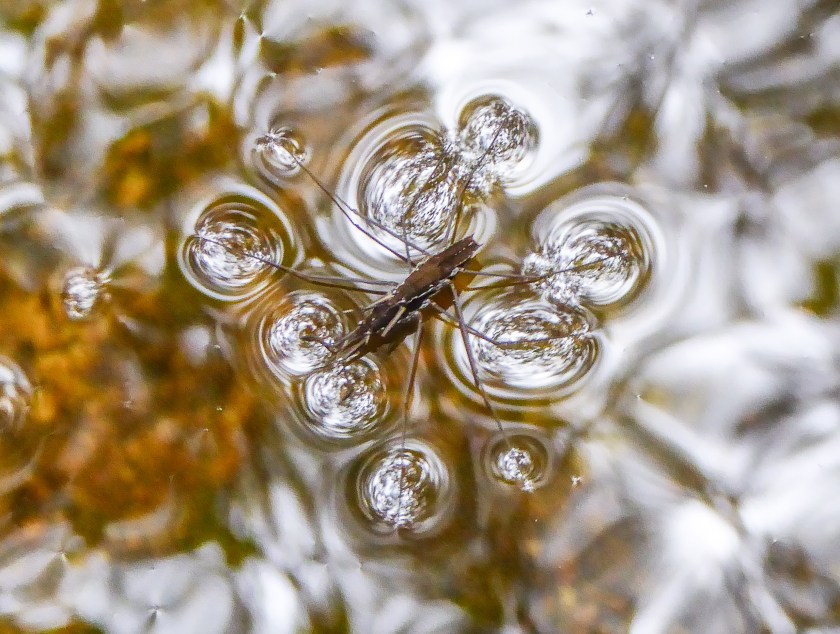
What first caught my attention was a strider with far too many legs:

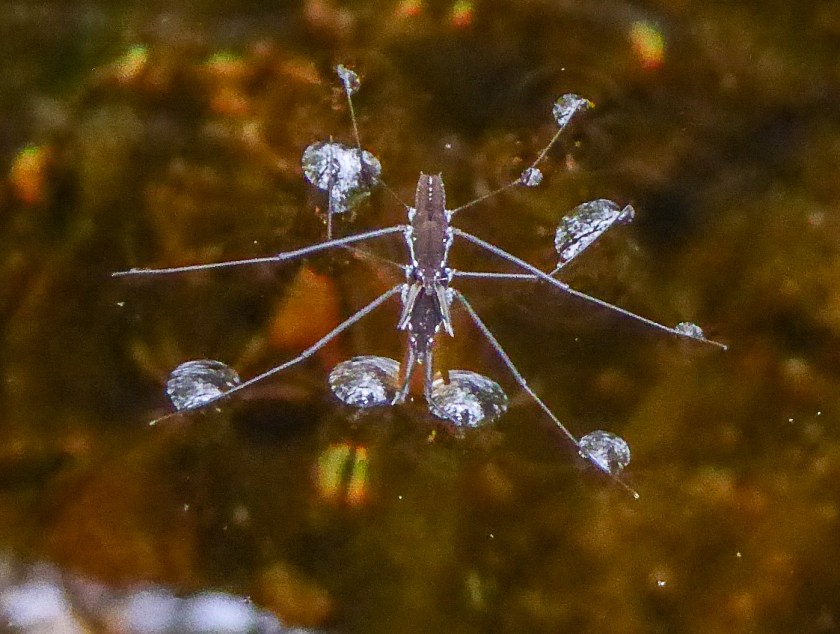
On closer inspection it was clear there were two striders, one atop the other, mating. They skated around on the surface as one, and I realized there were other tightly bonded pairs in the same quiet backwater:

There didn’t seem to be any real action , and I didn’t see any pairs either coming together, or separating:

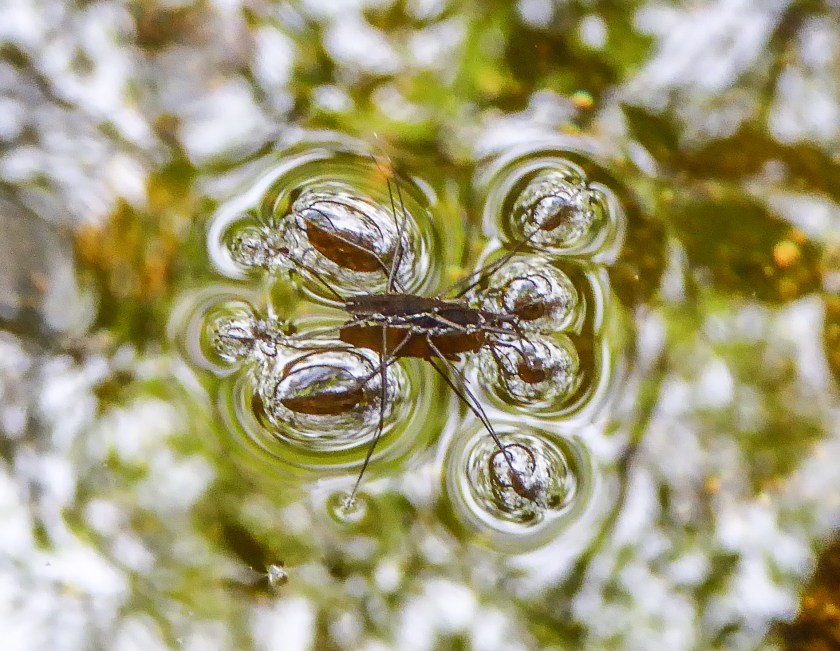
They use the surface tension to stay afloat, so the tip of each leg creates a sort of dent in the surface, and disturbs the leaf reflections in a magical pattern. The next picture not only has two courting couples, but one of the right-hand pair seems to be holding something.

When I got home, I started reading. Mating water striders stay conjoined for the entire reproductive season (!), which can be all the warm months. The male has no intention of letting another one displace his sperm, so he stakes out his female and there he stays. But after a while they get hungry, so they don’t hesitate to catch a passing insect and have dinner, as you can see above .

In France the same year I got a clearer photo of this romantic dîner-a-deux:

Trust the French to combine a little dalliance with an amuse-bouche.

PS Wikipedia has this fascinating description of how the two lovers hook up. (Water Striders are members of the Gerridae family.)

“Sex discrimination in some Gerridae species is determined through communication of ripple frequency produced on the water surface. Males predominantly produce these ripples in the water. There are three main frequencies found in ripple communication: 25 Hz as a repel signal, 10 Hz as a threat signal, and 3 Hz as a courtship signal. An approaching gerrid will first give out a repel signal to let the other water strider know they are in its area. If the other gerrid does not return the repel signal, then the bug knows it is a female and will switch to the courtship signal. A receptive female will lower her abdomen and allow the male to mount her and mate. A non-receptive female will raise her abdomen and emit a repel signal.”

Given the duration of the liaison, it’s a big decision. And maybe their system works better than Tinder, or indeed Bumble.

PPS Water striders are carnivorous. They often feast on insects that have fallen into the water and drowned. These ones are eating a dead dragonfly:

PPPS Their whole bodies are covered in miniscule hydrofuge hairs, which repel water, so they don’t get waterlogged and sink.

Grouse galore

In England grouse was something I ate occasionally, if I was lucky, but never saw. Here I see them occasionally, but never eat them. You can’t have everything.

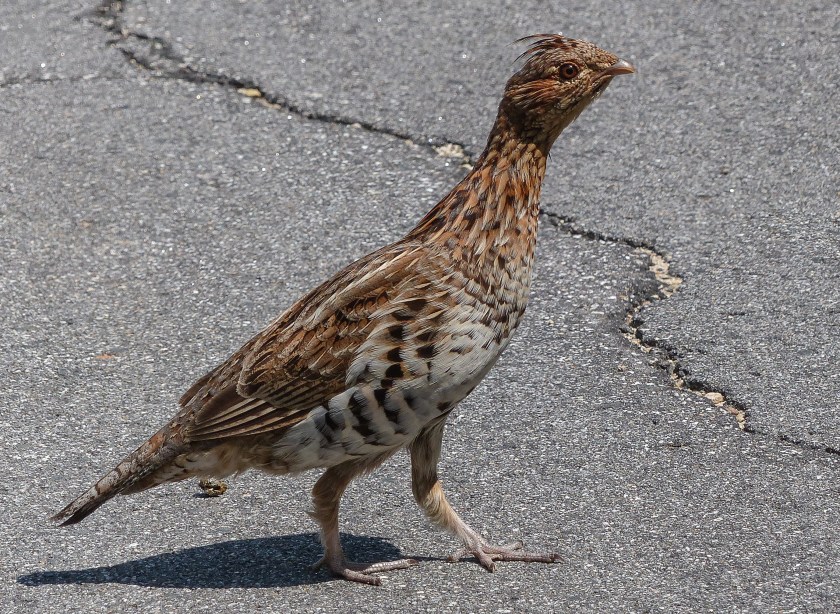
We have Ruffed Grouse and Spruce Grouse around here. The Ruffed Grouse, Bonasa umbellus, live in my woods, and are common. The Spruce Grouse, Canachites canadensis, live higher up the mountains, and are rarer. They are both secretive (mostly), and you hear them flying up from the ground when you disturb them, but rarely get a good look. They seem to be more visible in the fall, coming out of the woods and crossing the roads. I’ll start with the Ruffed Grouse. This is a female:

She clambered over a stone wall, and off into the woods:

The male lingered. You can see that he has a neck ruff, not extended here:

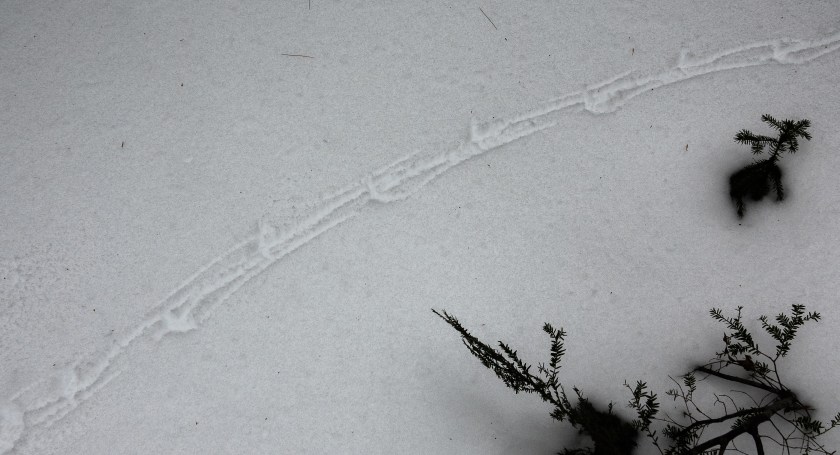
In the winter you find their tracks in the snow:

Sometimes they drag their tails as they walk:

and in close-up:

The underside of their feet grow miniature snowshoes called pectinations in winter, to help spread their weight. The photo below is from this terrific website: https://www.canadiannaturephotographer.com/waynelynch6.html

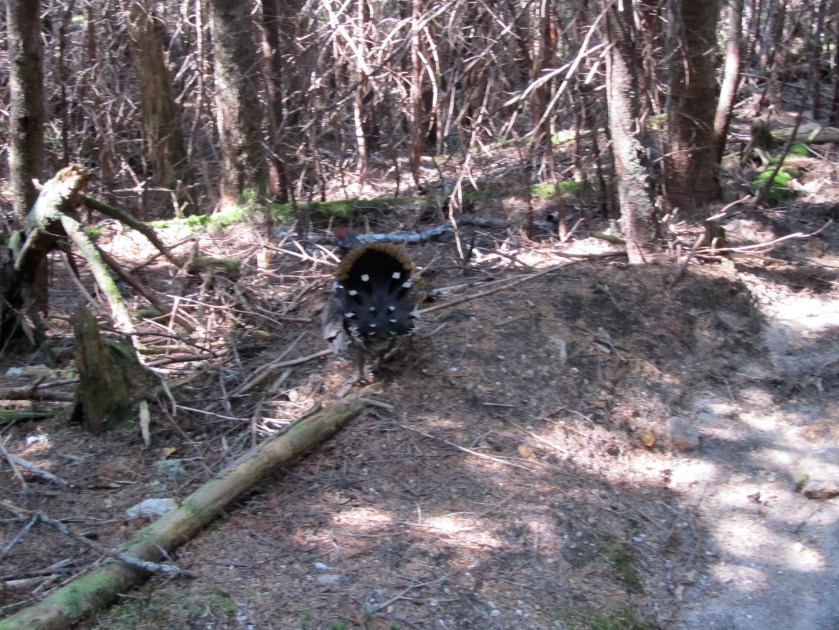
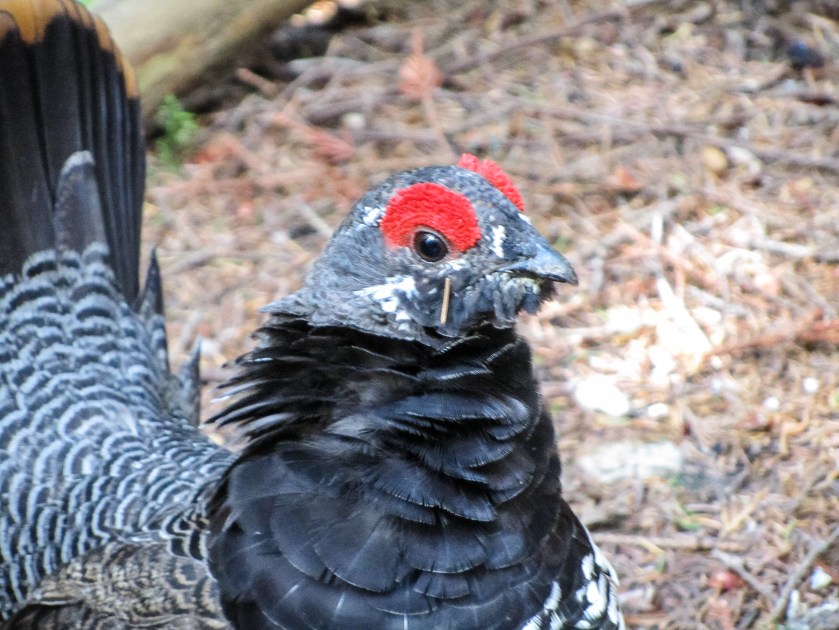
I have only seen Spruce Grouse once. We are at the southern edge of their range, and so they are more likely seen at higher elevations. It was in the fall, not breeding season, but for some reason a deluded male was dancing for his inamorata. I was hiking with only a tiny camera, and he was energetic, so they are a little blurry, but the red eyebrows are quite impressive! Here he is before he really gets going. Notice the log. This is his stage.

The favored log is in an open space under spruce (!):

Once his tail is up and those eyebrows are raised, he is quite a sight, He turns sideways so she can admire the eyebrows:

and when he comes straight towards you he is not easy to ignore:

He swirls around:

and as he dances he drags his wings, just visible here:

Ready for his close-up, eyebrows raised. Best brows since Mr. Spock.*

Oh how I wish I had taken a movie. Here’s one I found online: https://youtu.be/j75J3CVr_Rw

A description from Birds of the World:

“Upon locating a female during the breeding season, a territorial male exhibits a series of characteristic behaviors: erects much of the plumage (particularly the breast and tail feathers), droops wings slightly, erects the superciliary combs, bobs the head vertically, and often pecks the substrate (ground or branch) while presenting the side of the head, thereby showing off the combs. The Tail-swish (Figure 13), Tail-flick (Figure 13), and Head-jerk displays (Table 6) are the primary male courtship displays. The tail-swish involves moving slowly forward with head and tail erect and undertail coverts spread widely (17), and walking with an alternate spreading of lateral rectrices that is synchronized with the movements of the legs. This gives an exaggerated swaying motion that is accompanied by a swishing sound, produced by the movement of the rectrices. The tail-flick is the climax of the Tail-swish Display and follows a short rush. The male stops suddenly near the female with wings drooped and snaps the rectrices laterally where they are held briefly before being closed (60). The Head-jerk Display occurs when the male squats near the female and stamps his feet rapidly. The wings are spread slightly away from the flanks, rectrices are repeatedly fanned, and the head is turned rapidly from side to side in a jerky manner. Males may remain in this position, often motionless, for short periods of time.”

*Just to remind you of Mr Spock’s eyebrows:

Seeds for the year ahead

Like any gardener, at the start of the year my mind turns naturally to seeds. Something to do with new resolutions and new generations, even if spring is still far off. My favorites are the ones that are packaged in dramatic pods, or that float on the wind, or both. Today there is a breeze, so I shall show you some airborne ones.

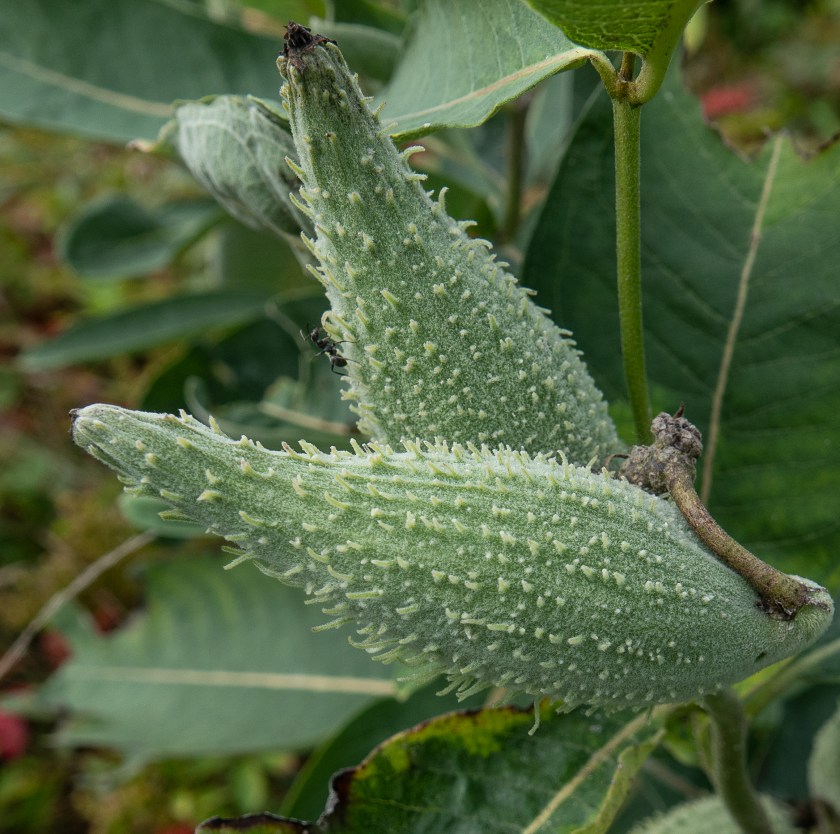
Top of my list has to be common milkweed, Asclepias syriaca. The young pod is big and green and luscious looking

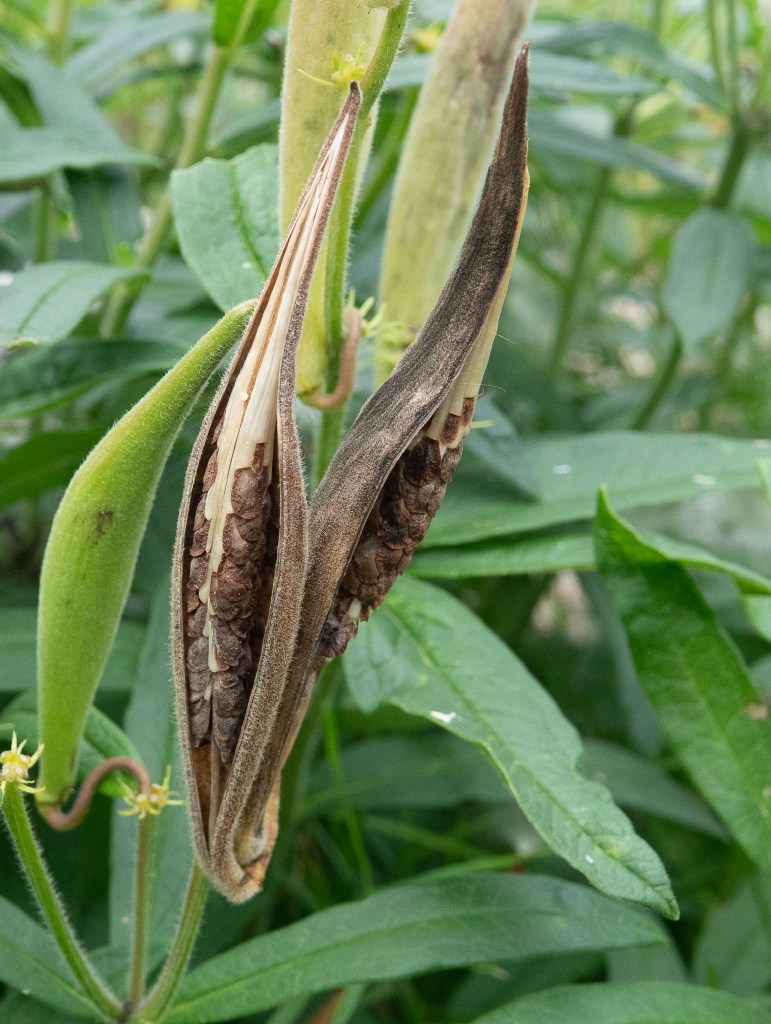
but then it dries, and splits open to reveal rows of tightly layered seeds,

each of which has its own tiny parachute .

The pod opens wider, and the seeds escape captivity and head out into the world.

The empty pod is sculpturally elegant,

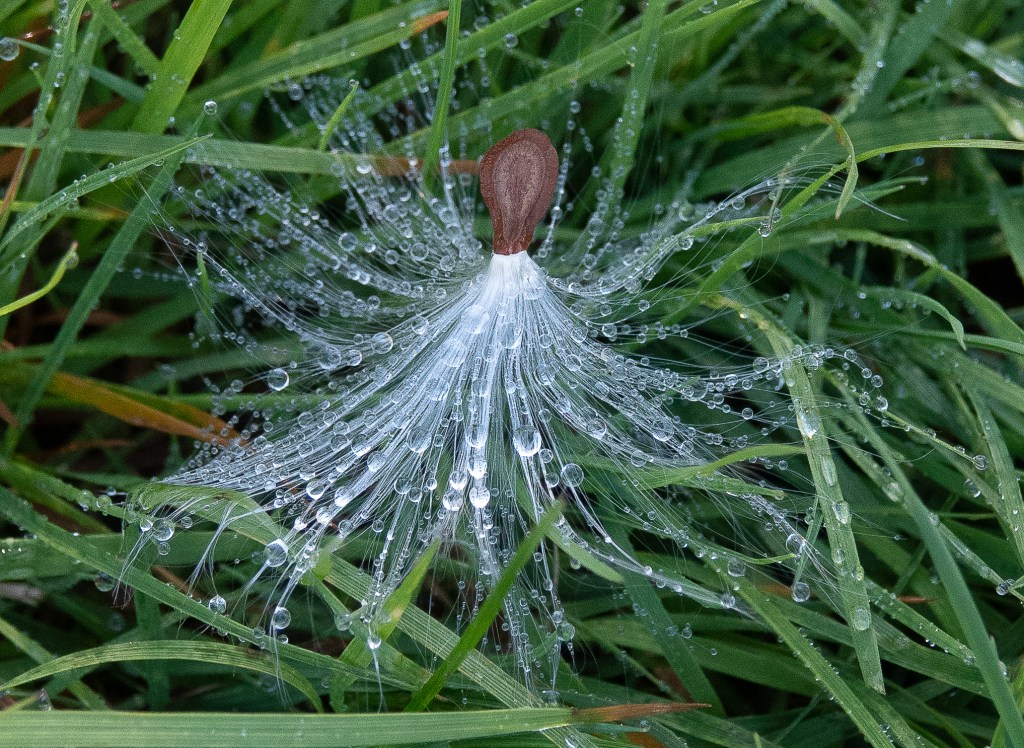
and in closeup after a heavy dew, the individual seeds look like a many tentacled octopus, or the aigrette from a 1920’s dancing girls’ fan.

The superficially rather different plant, Butterfly Weed, Asclepias tuberosa, has similar seedpods on a smaller scale:

that also contain skydiving seeds:

Not so dramatically, but still prettily, the common wild clematis, Clematis virginiana, bears seeds with personal aerial equipment too, but they are not protected by a pod. They start like this:

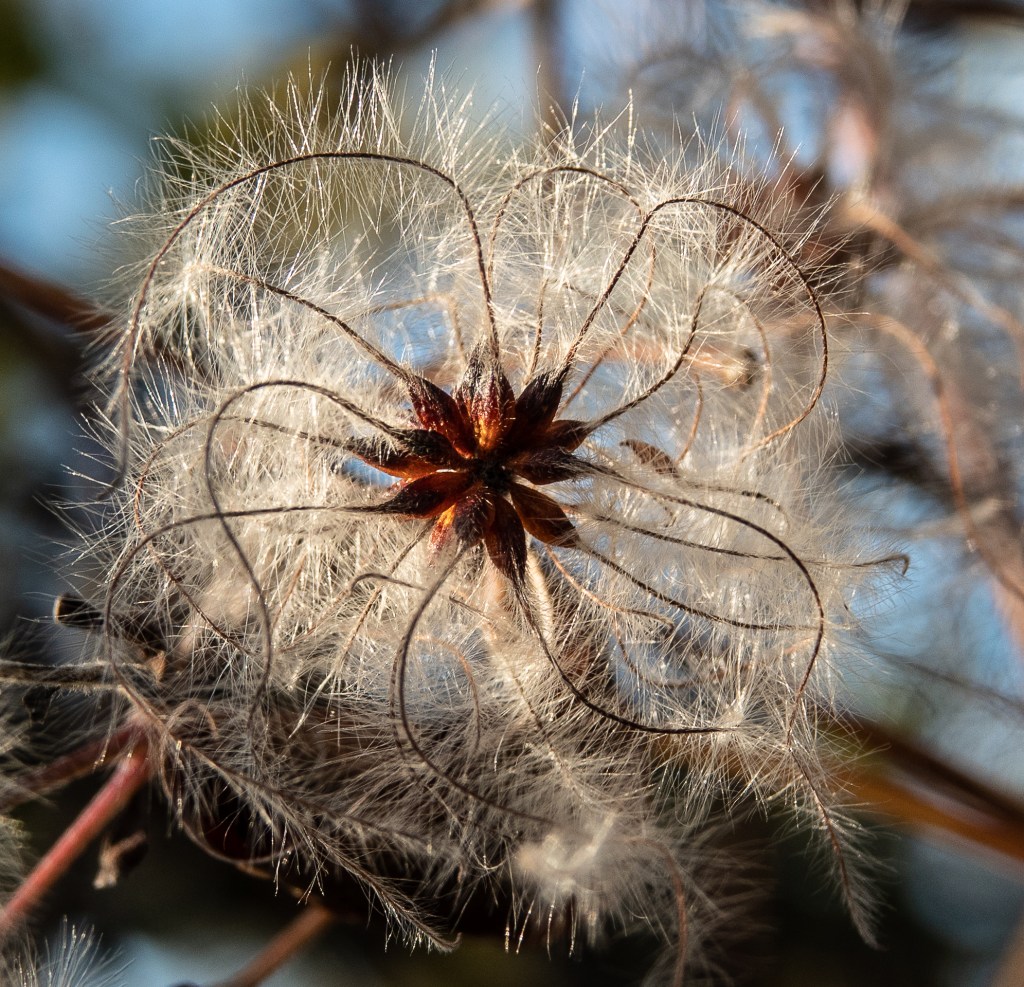
and as they mature the whole seed head becomes a white fluffy mass, giving the plant the common name of Old Man’s Beard (mixed here with Winterberry)::

Each seed has a long tail with a feathery fringe, which helps it get airborne.

Sort of a cross between a kite and a sperm.

Icing

To end the year, a hymn of praise to the beauty of ice, solid water, water that is essential to all life on earth.

We only caught the edge of the big storm that devastated much of the US over Christmas, and by the time it reached us it had turned to rain, lots of rain, 3″per hour at times. The rise in temperature melted some of our existing 17″ of snow, so we had water pouring into our streams and rivers, raising water levels by several feet.

.

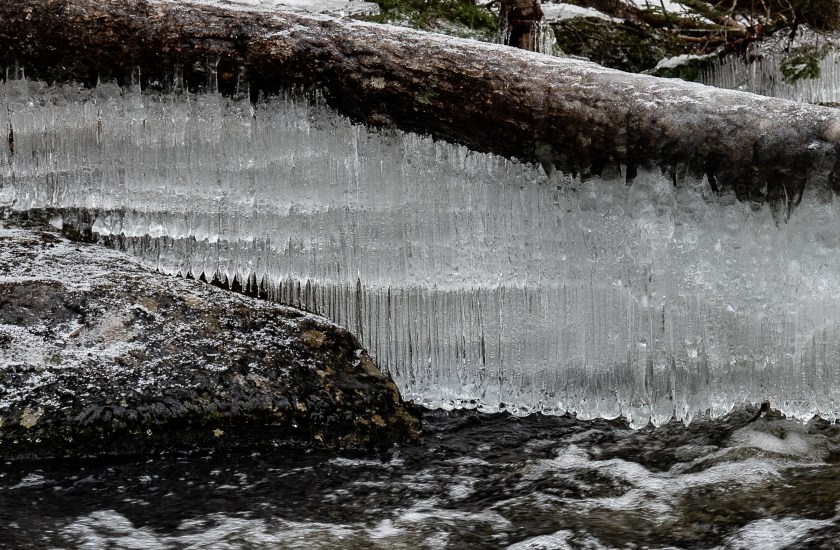
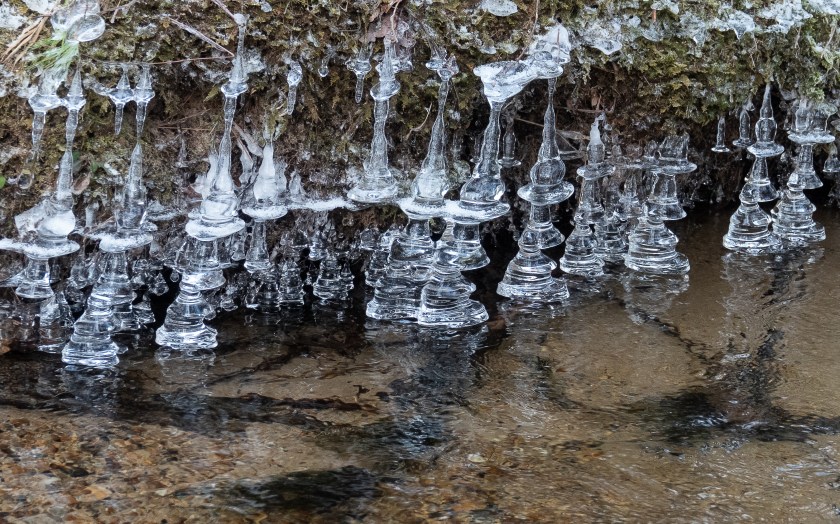
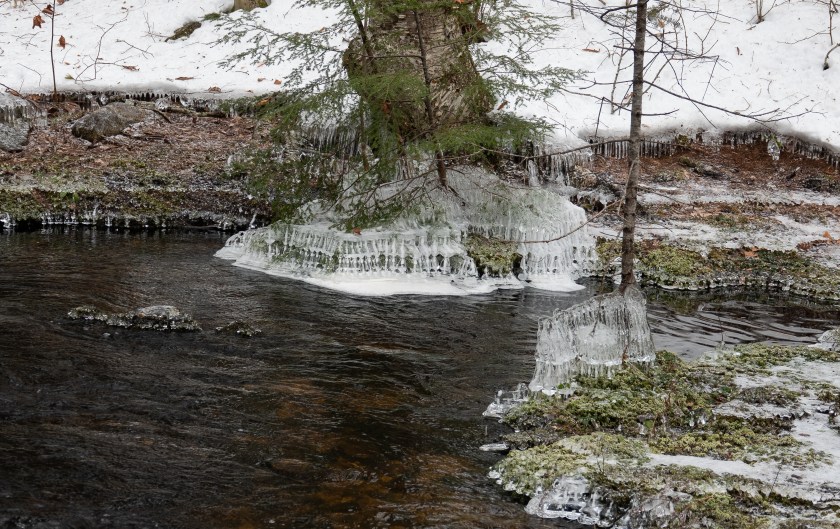
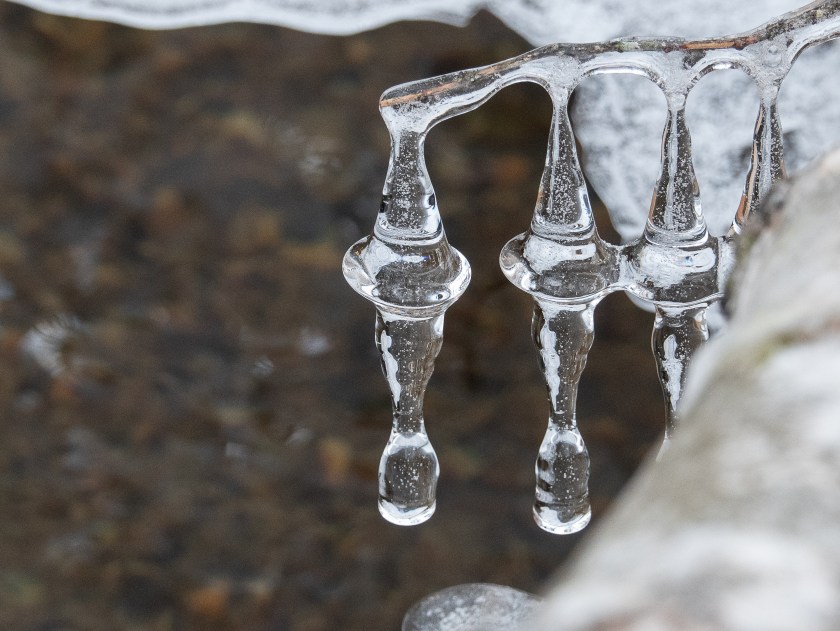
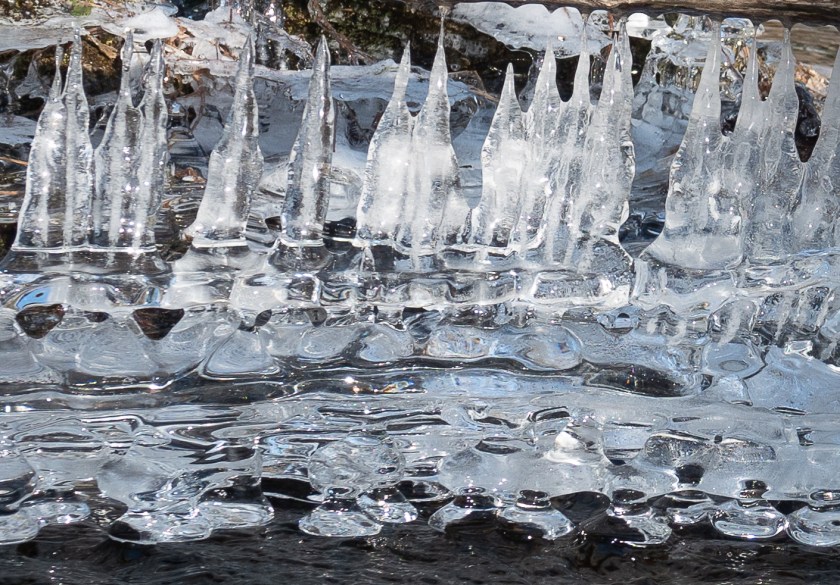
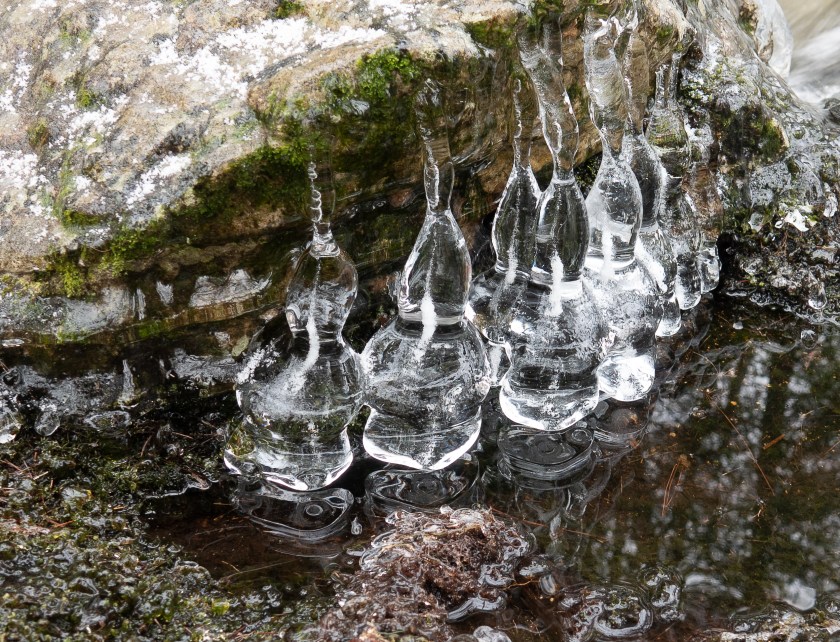
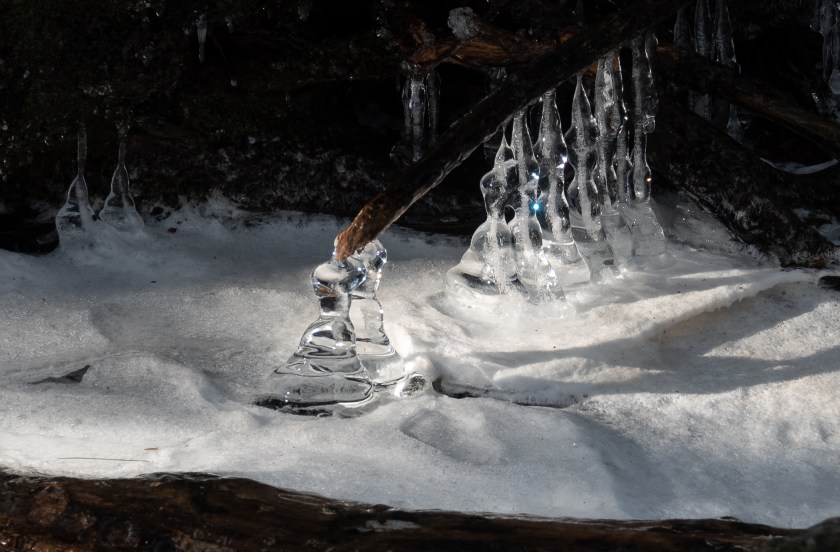
And then the temperature plummeted. On the surface, at the edges, and everywhere within reach of the spray and the splash the water turned to ice, and then as the water levels fell and drained away from underneath, ice continued to form. And created some of the most beautiful ice formations I have ever seen.

A curtain of ice with the beaver dam behind
.

.

Stalactites fringe the banks
.
Pillars form round the tree roots
.
Petticoats festoon the branches
.
Diamonds pile on the rocks
Christmas baubles everywhere
Chandeliers hang from fallen logs and rocks
.
.
Still water freezes too
.
Swirling around the leaves
.
pushing up slabs on the pond
On land, glass spheres ward off the evil eye
natural marbles an inch across
and tiny stalagmites accrete around small stalks
.
.
Needle ice* squeezes out of the ground like toothpaste
And the house is also decorated

Thankyou for joining me, and farewell 2022. Welcome 2023. Happy New Year.

PS In the first version of this post I casually, and wrongly, called this “hair ice”. Hair ice is real, but this isn’t it! I posted about actual hair ice a couple of years ago, here https://eyesonthewild.blog/2020/03/30/the-crystalline-spring/

Fishing owls, really?

[It’s been a quiet winter on my pond. It had still not fully frozen over when I left last weekend, so the otters cannot rest out on the ice.They are there, but far off in the distance. So I am showing you some posts from various past trips that I stockpiled for moments like these!]

When I think of an owl, I think of the night: a shadow with huge eyes, and a silent ghostly flight through the trees and grasslands in the pursuit of mice. But not all owls are like that. There are four species of owl that hunt fish, not mice. They hunt by day as well as by night, by sight not sound, and their own flight is not silent.

The best known is probably Pel’s Fishing Owl, Scotopelia peli, which I have seen in Zambia.

They still have large eyes because they are mostly nocturnal, but they sometimes hunt during the day. They snatch prey from the surface of shallow water, using surface ripples as cues (though I don’t understand how they can do this at night!).

Our more familiar prototypical owls have a facial disc, which serves to collect and concentrate the sound of their prey in the dark, like this Barred Owl:

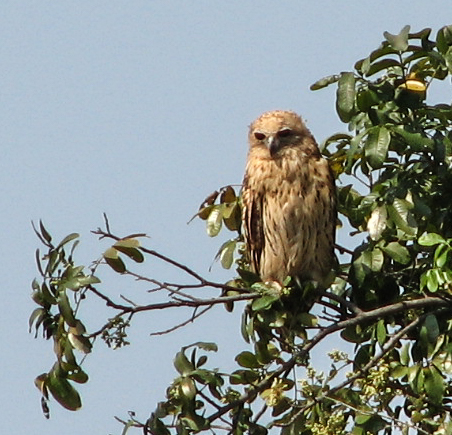
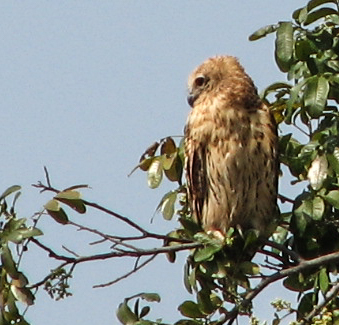
Fishing owls more or less lack this, because transmission of sound from water to air is too poor to be useful. Here is a Brown Fish Owl, Ketupa zeylonensis, from India, also lacking that dramatic facial disc.

Just as they cannot hear the fish, the fish can’t hear them, so the owls don’t need and don’t have the specialized feathers that make flight silent in most owls.

Another adaptation is beak position. Fishing owls’ beaks are longer than most other owls, better for holding slippery fish, and more or less between their eyes, higher on the face than in other owls.

Again, the reason for this is unclear. They catch their prey by dangling their talons in the water from flight, not with their beaks. This Brown Fish Owl is coming in to land, not fishing, but you can get the idea.

PS The world’s very largest fishing owl is the endangered Blakiston’s Fish Owl, and I highly recommend Jonathan Slaght’s thrilling book on his quest for this owl in Siberia, “Owls of the Eastern Ice: A Quest to Find and Save the World’s Largest Owl”.

A painted heron

I last told you how Winslow Homer painted a dying Goldeneye duck. He wasn’t the only painter inspired by dead birds.

A month later, I was back at the National Gallery for a Lucien Freud show. He is chiefly famous for his portraits and his nudes, but there amongst his early work was this heraldic Dead Heron (1945) (and yes, it was hung this way up):

It may look like a 3-D collage, but it is just paint. The details of the feathers are marvellous:

Sad though a dead heron is, somehow the care Freud has taken is a way of honouring it.

As luck would have it, two days earlier I had been to the London Wetland Centre (wonderful place) to look for water birds, and there was a real and very much alive Grey Heron, Ardea cinerea, flaunting his overlapping layers of grayish wing feathers

His long neck was all curled up, and his head was tucked in, and his black topknot and epaulets were blowing in the breeze:

He is nearly as big as the North American Great Blue Heron, but not quite.

Around him there were coots, teal, and a brave crow taking a running jump off a rock for its morning ablutions:

He almost completely immersed himself and had a good splash :

and emerged sparkling and refreshed.


Even London pigeons in Hyde Park take an early bath.

Birds don’t have to be rare to make me smile, but it certainly helps if they are alive.

PS Researchers recently published a study in Science showing that seeing birds makes people happy. I can confirm that.

https://www.nature.com/articles/s41598-022-20207-6

Almost outsmarted by a beaver

I have been playing cat and mouse with a beaver, and for quite a while I was losing. It is the time of year when they are cutting down trees to strengthen their lodge, and create a food stash. So I thought if I could find a tree that had been freshly cut but not yet dismembered, and put a game camera on it, I might get footage of a beaver cutting down more of the tree. But that’s not quite how it went.

I found a freshly cut hemlock:

so I put a camera on it and went away for a week. When I came back, no change. So I walked a little further, found a newly felled maple, and moved the camera to that.

Aiming it just right is tricky, but I was careful, and confident. Over confident. Next day, most of the tree had been cut off and towed away, but somehow he’d done it without ever triggering the camera.

There wasn’t much left, and it looked too big for him to take, so I took down the camera and moved it to yet another tree. Next day, I returned to the original tree out of interest, and not only had he come back again and cut even more off, but he had made a scent mound right by the tree, making it quite clear who was the boss. (The scent mound is the heap of dark wet leaves in the foreground. ) And the new tree that I had put the camera on had not even been visited.

To add insult to injury he had also returned to the first hemlock, eaten some cambium from under the bark, and cut off some branches, but of course I had no camera there either.

The nutrients are in the cambium, the dark brown living layer under the bark. He isn’t interested in eating the wood itself.

By now I was getting grumpy. I was about to go away for two weeks, so I found yet more half-cut trees, and spent a long time positioning two cameras and testing them by pretending to be a beaver so as to be sure he would break the beam and trigger the camera:

Two weeks later, without much hope, I checked the first camera: nothing. But the second one, miraculously, had a series of very short videos. He had come out of the water on two different days, always at night. I’ve edited them into two clips.In the first one he has a good scratch and a bit of a groom:

and now he is ready for his close-up:

In this single frame extracted from one of them you can get a good look at his webbed back feet, hand-like front feet, and two goofy incisors.

And below you can see the underside of his leathery tail:

One day maybe I’ll catch one in the midst of cutting down a tree. I’ve left a camera out, just in case!

PS The sharp-eyed amongst you may notice that the shot of me crawling around is actually dated later than the beaver videos. It is a re-enactment designed to show you what it takes to get these shots, rather like the crews in David Attenborough shows! I can always aspire to greatness.