Even snakes can fall in love

I was with fellow docents for the Greater Lovell Land Trust, plus four remarkable children, looking for dragonflies hatching. Two people had seen two water snakes earlier in the week, and to our delight, one emerged from the pond:
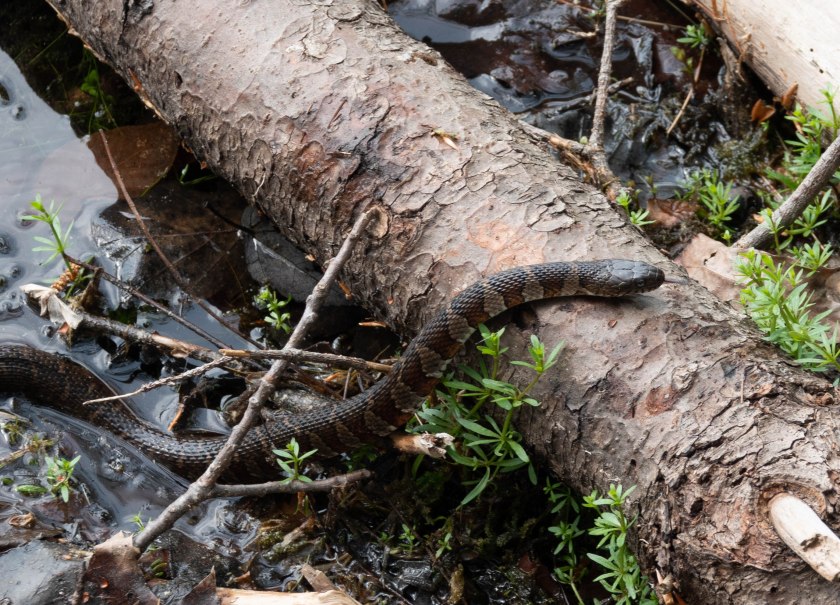

This is a Northern Water Snake, Nerodia sipedon, not poisonous, but quite bad-tempered, and a distinct deterrent to what is now (in the UK) called “wild swimming”. This was about 2 feet long, but they can grow to 5 feet. It meandered around, and disappeared. But not long after, it reappeared alongside a much larger one, and they headed for the hills:
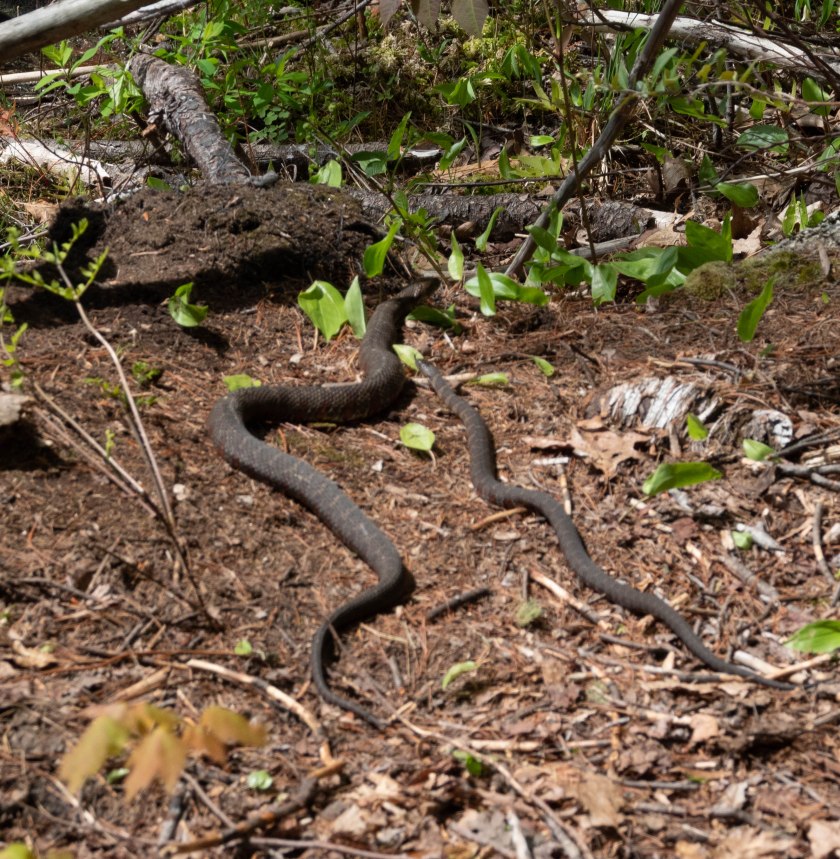
The bigger one is the female. They didn’t go far, and curled up in a very cosy embrace:

We watched as they bundled up together, impossible to disentangle one from tother:
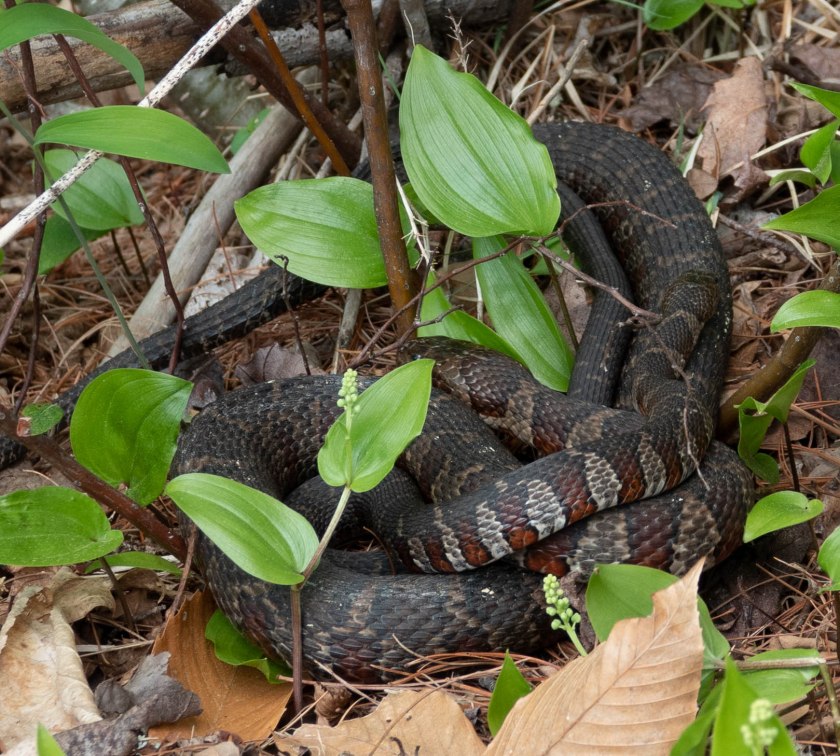
The two snakes encircled each other, looking unnervingly like a solitary two-headed snake:

At intervals the smaller male endearingly rested his smaller head on the female’s larger one:

All of this is part of the foreplay, really; the male rests his cheek on the female and rubs her gently. Eventually, he aligns his body with hers, and tries to get the crucial parts into alignment.

From time to time they convulsed, briefly, and this video makes it pretty clear what was afoot; we were nothing but voyeurs:

Then they moved off, now twisted into a braided skein:
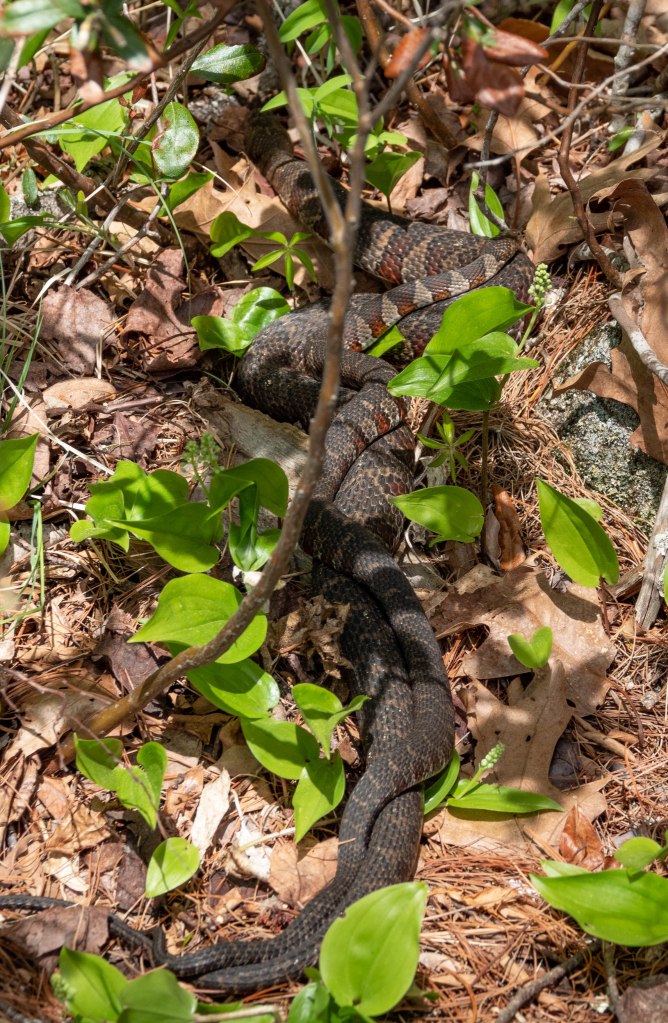
As they moved, the smaller male lay almost motionless balanced on the back of the powerful female:
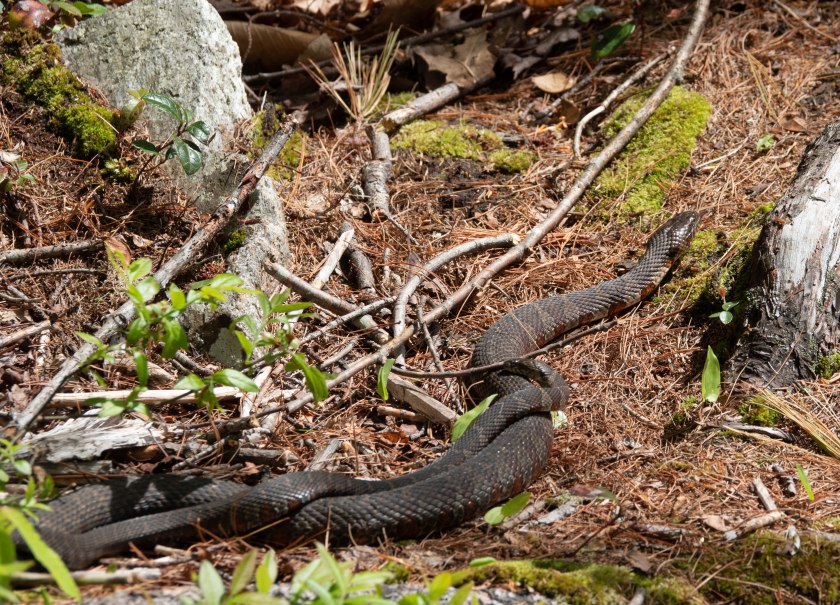
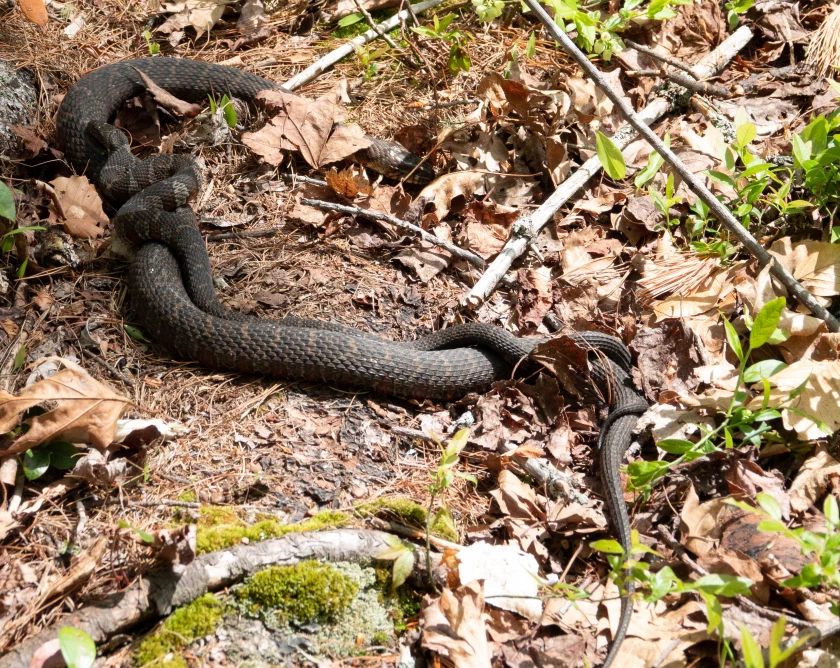
How do the mechanics work? Snakes have openings under their bodies near (but not at) the tail, called cloaca. The mechanics of mating involve lining these up so that the make can insert one of his two hemipenes to deposit his sperm, and then seal it in with a copulatory plug (which also keeps any other males out).

Since the action all happens underneath, closeups are heard to get. Here I think they are just disconnecting; the female’s tail is on top, and the male’s body is belly-up.
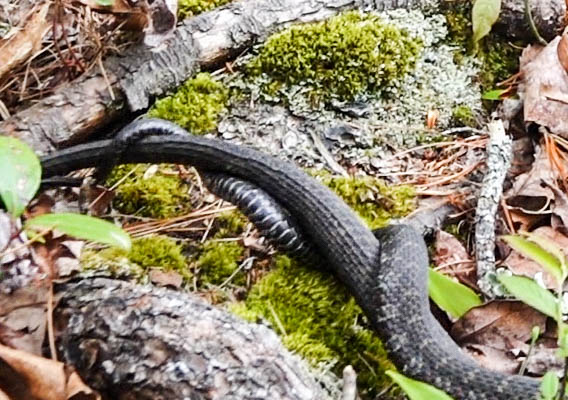
I’ll end with one more video:

We left them alone. In 3-5 months she will give birth to as many as 36 live babies, each about a foot long..

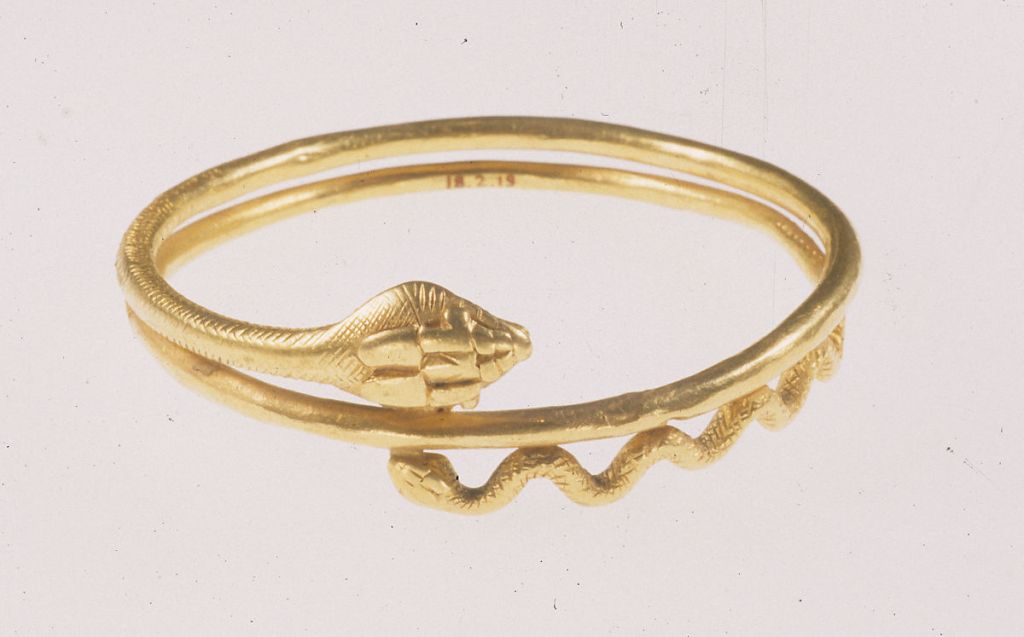
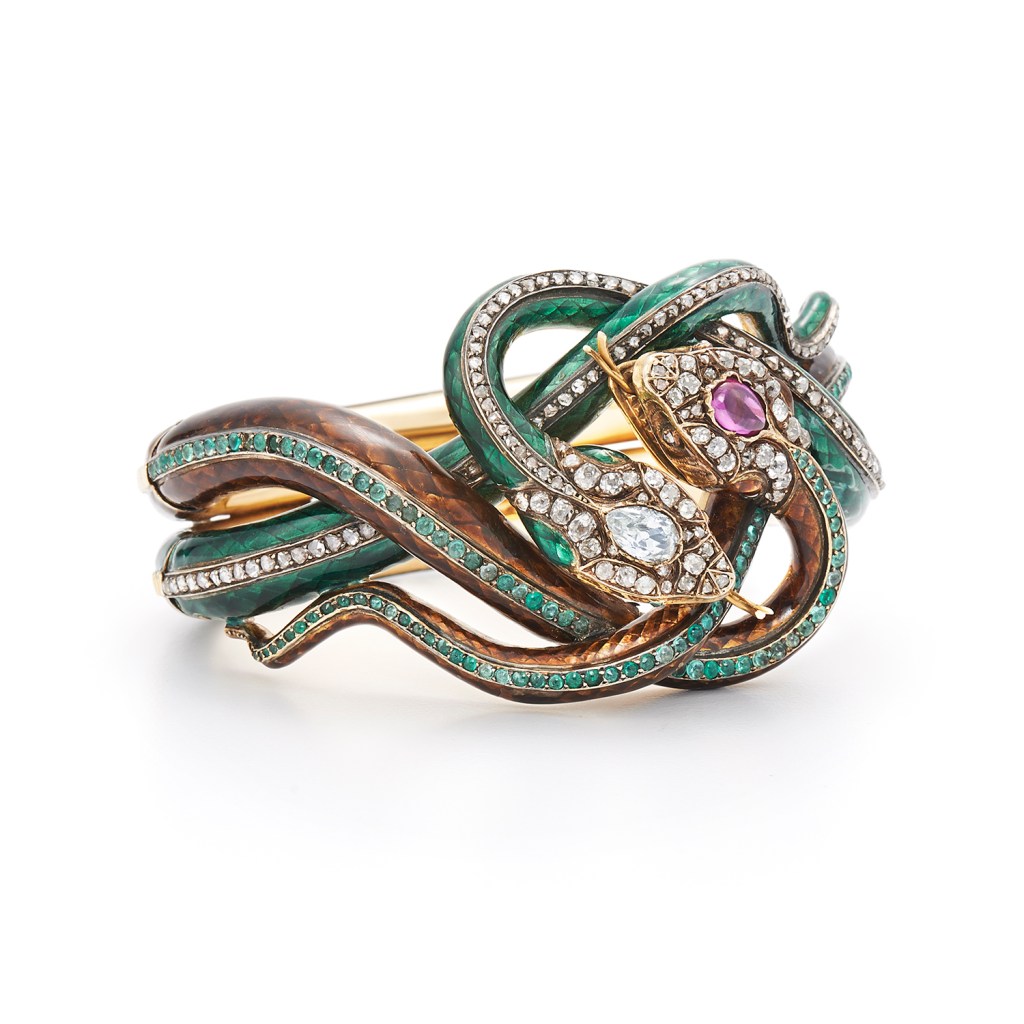
PS For 2000 years, intertwined snakes have been a symbol of faithful love. This bracelet is from the 1st century AD, from Roman Egypt:
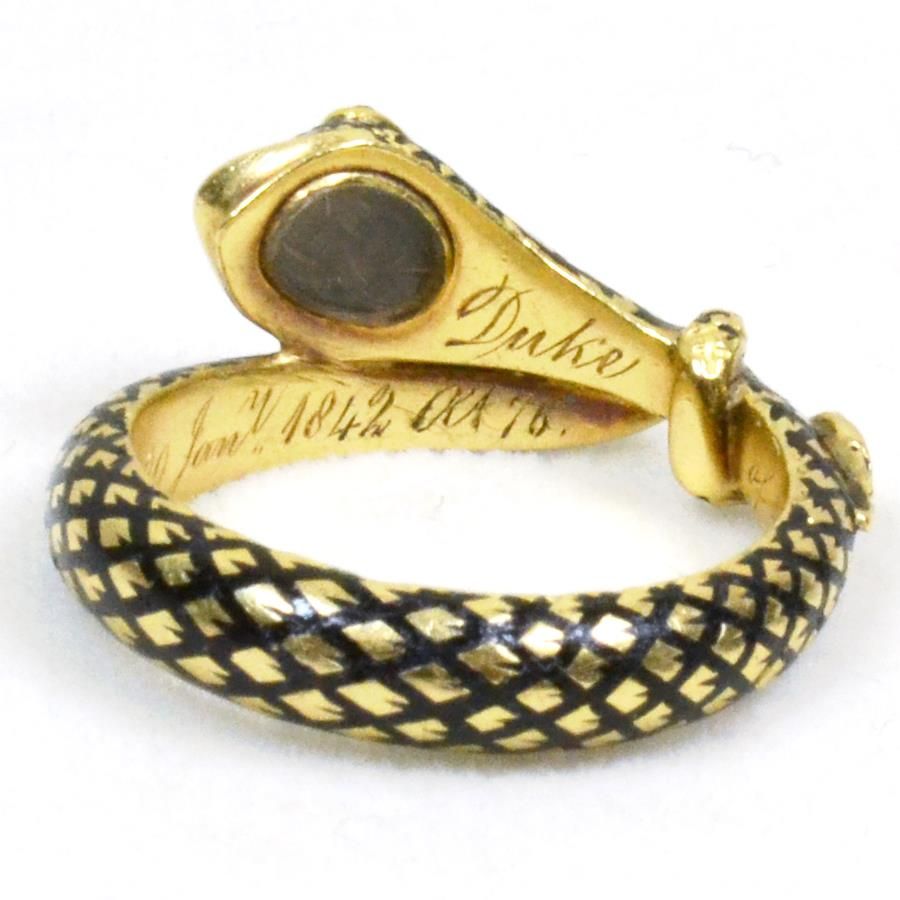
Prince Albert gave Victoria a snake engagement ring , here is the inscription on the inside:
Some of this jewelry does not appeal to my 21st century taste, but this 19th century enamel and diamond bracelet is on my wish list, though occasions to wear it would be rare:
The first blush of spring

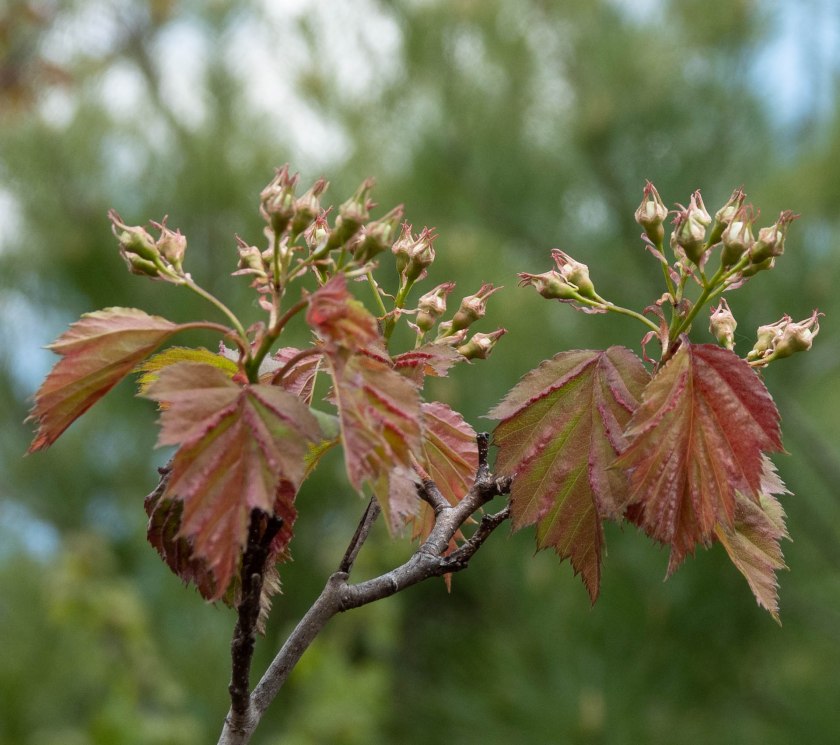
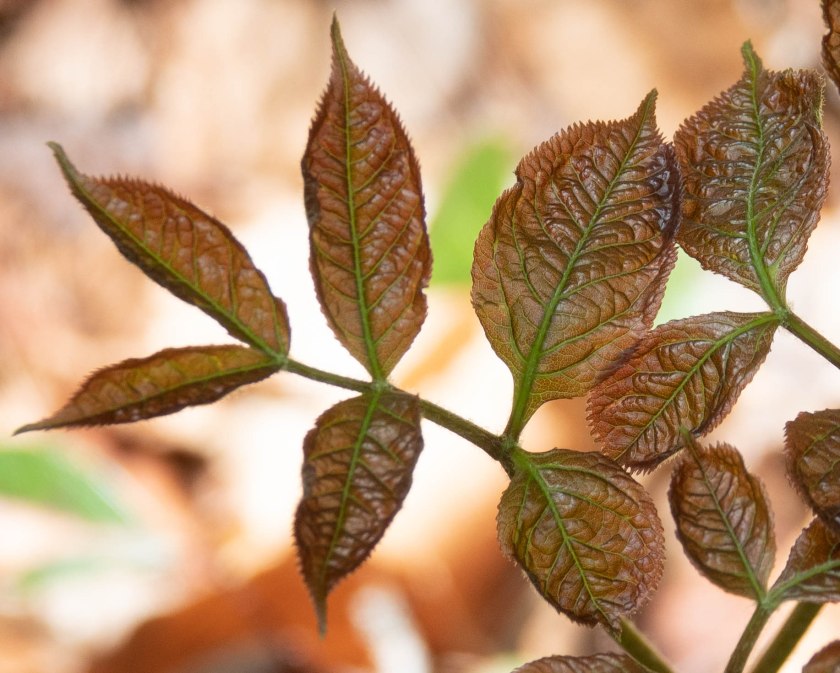
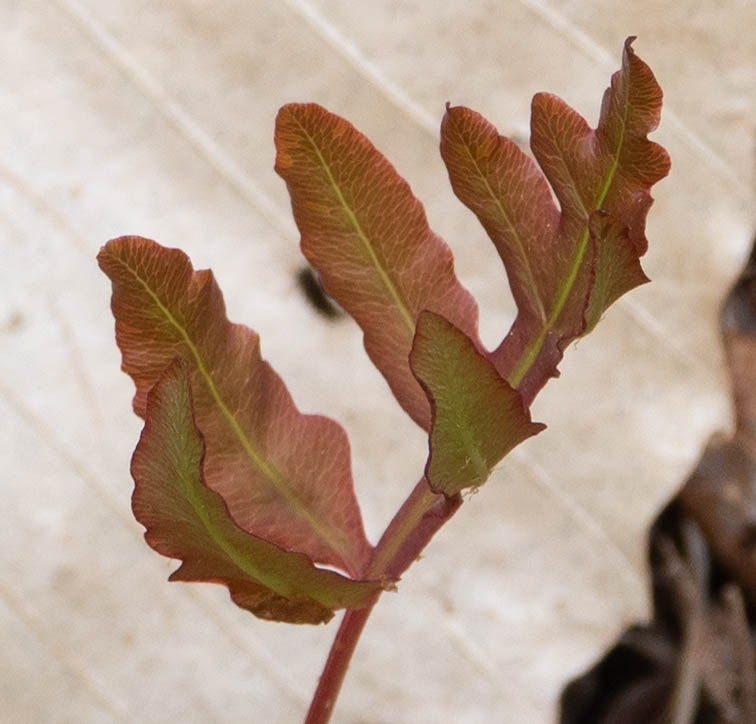
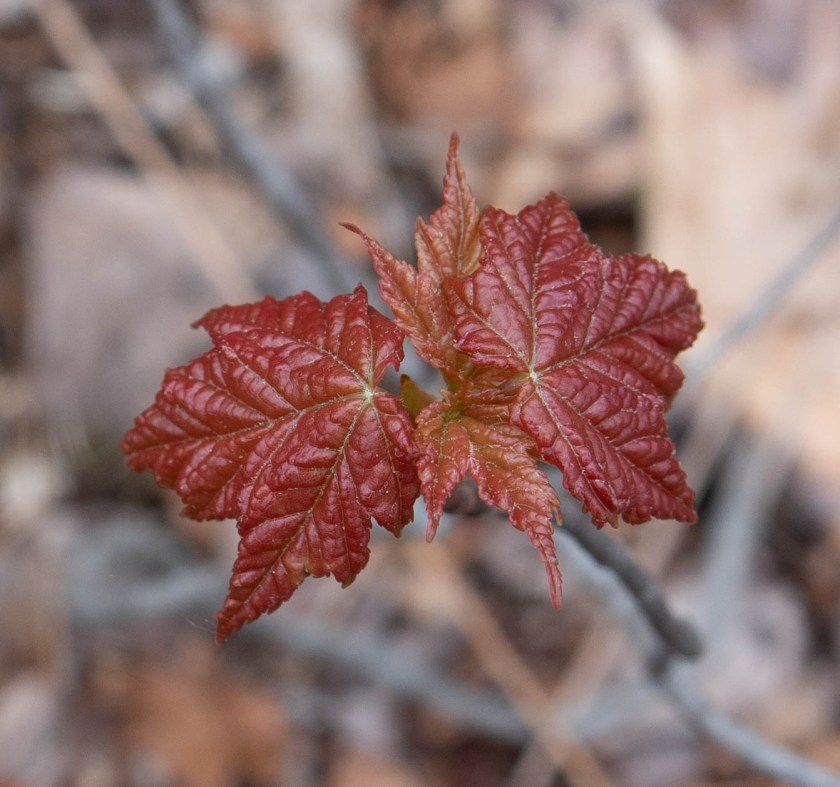
We associate red leaves with the fall, but every photograph in this post was taken this spring. These plants don’t stay red, they turn green, but why do they start off this way?

No-one knows, but a recent suggestion is that the “juvenile reddening”makes the tender young leaves less discernible to some insects that might devour them, and the associated chemicals make them unpalatable.* Below is a hawthorn:

And a beech:

All sorts of plants start like this. Here is a Wild Sarsaparilla:

And here is a fern:

The phenomenon is found not only in many trees, like this maple:

but also in many tiny plants, like this miniscule fern:

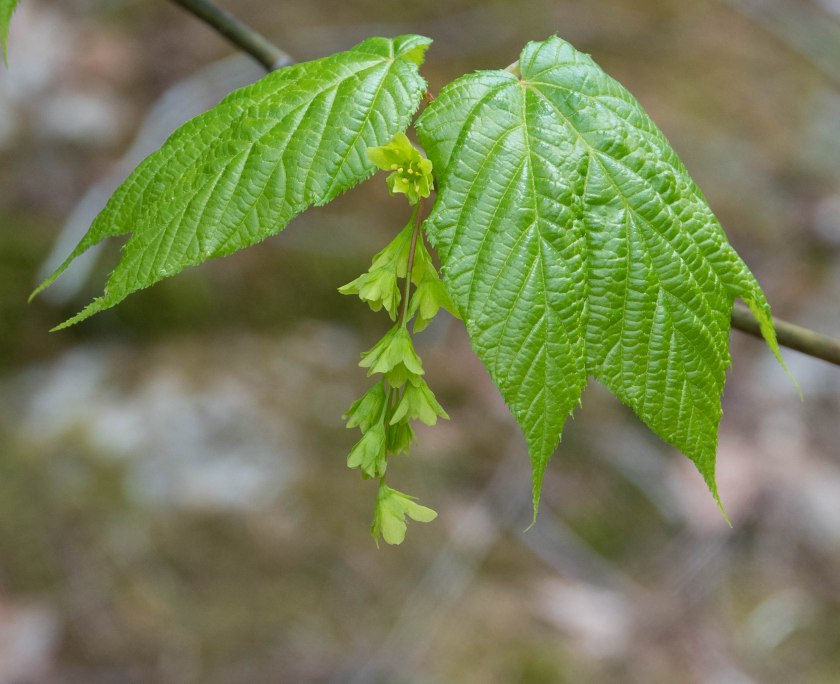
And then the red leaves turn green, and the flowers appear. Hard to believe this Striped Maple is the same plant as the one in the very first photo:

*A little more science. The chemical that makes the leaves red (in fall or spring) is called Anthocyanin, and the tree uses energy to produce it, so it must serve some beneficial purpose. It seems to be more common in young trees than in mature ones, and in poor soils. It may protect somewhat against drought, and late frosts. One theory was that it acted as a sunscreen, but recent work has debunked that idea, leaving the insect-deterrent effect as the leading contender for now.

“Compared with red phenotypes, green phenotypes suffered greater herbivore damage, as judged by the number of leaves attacked and the area lost to herbivory. .. The decreased reflectance in the green spectral band and the concomitant leveling of reflectance throughout the 400-570 nm spectral range may either make red leaves less discernible to some insect herbivores or make insect herbivores more discernible to predators, or both. Moreover, excessive herbivory may be additionally discouraged by the high phenolic concentrations in red leaves.”

Karageorgou and Manetas 2006

Synchronised swimming, merganser style

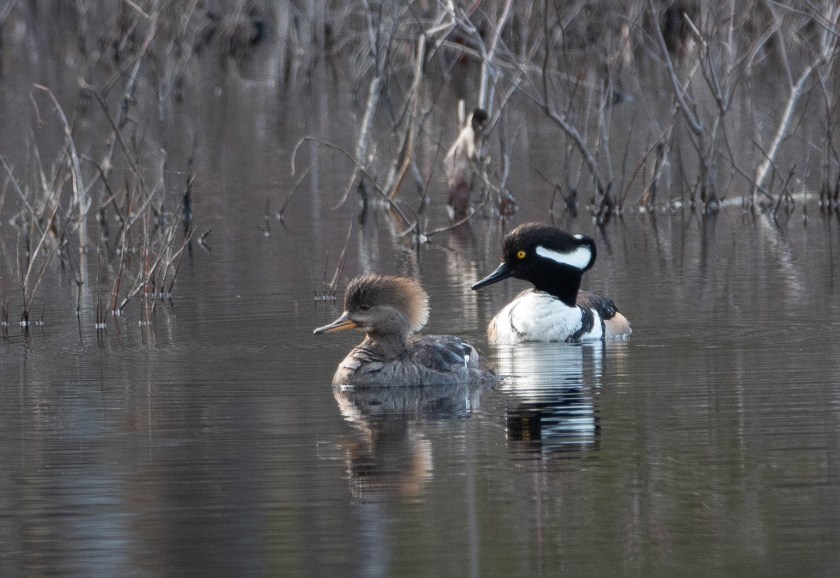
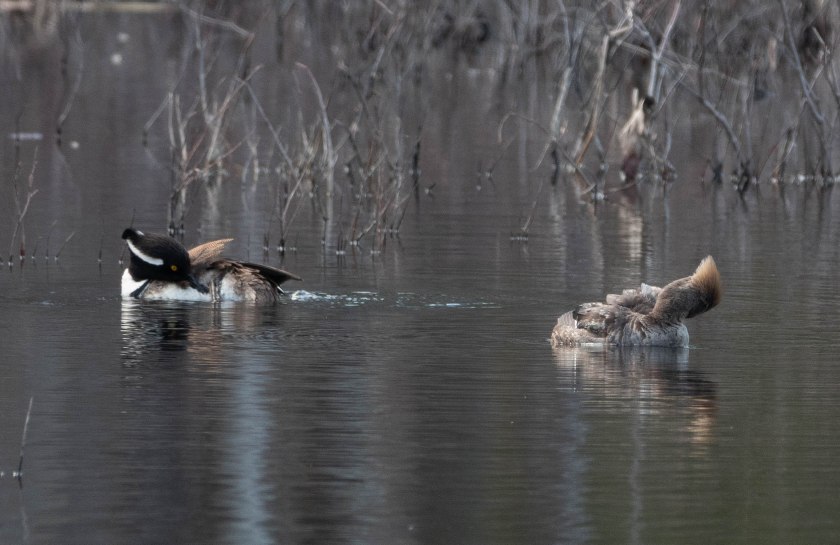
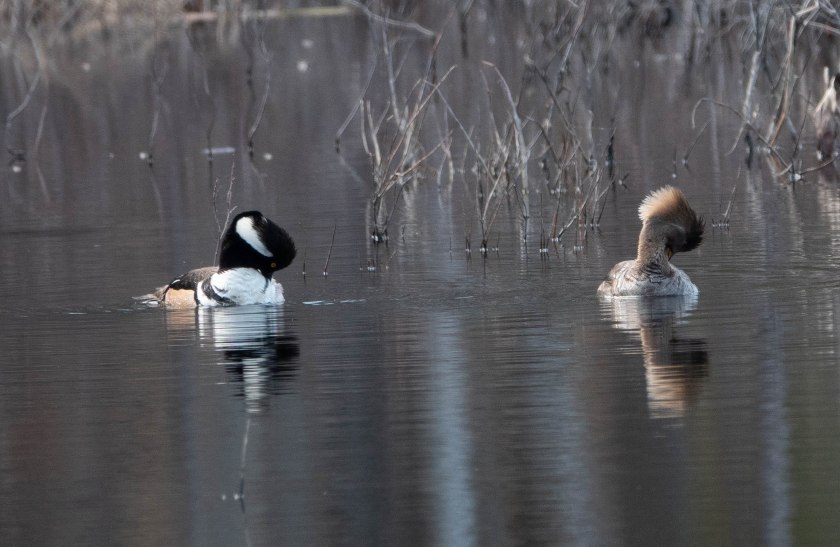
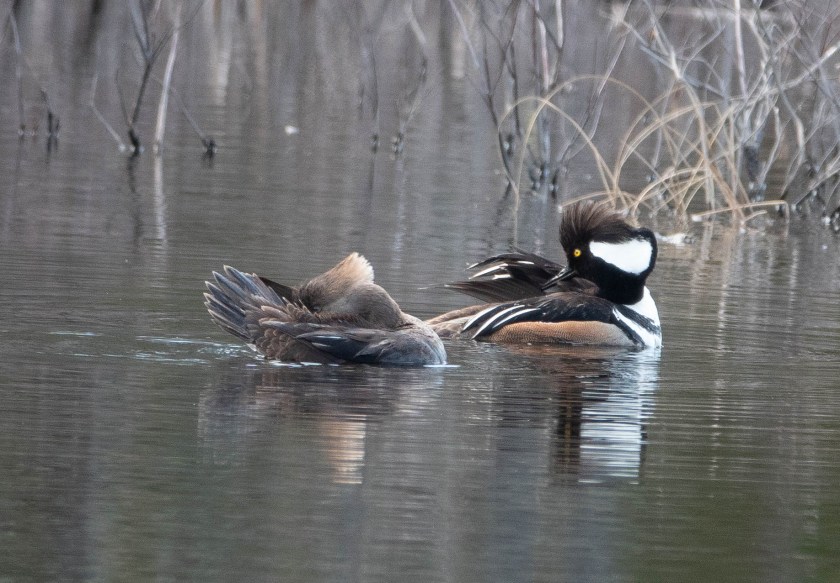
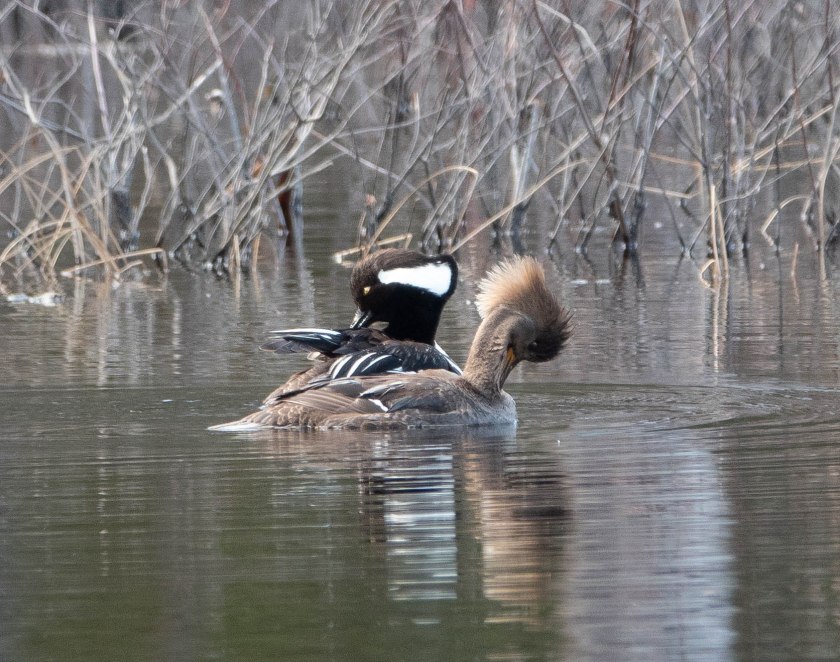
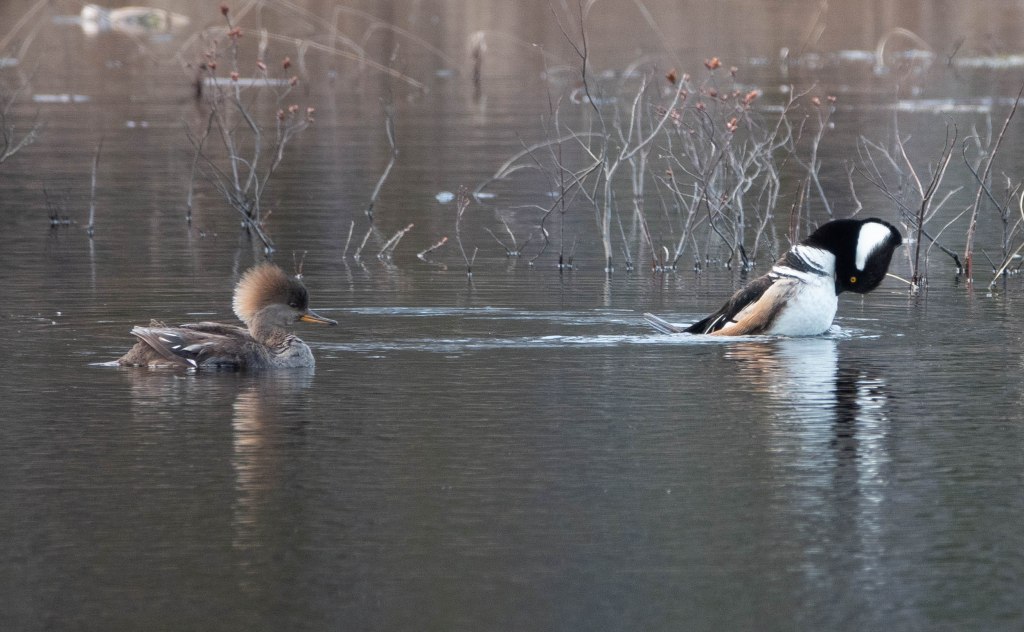
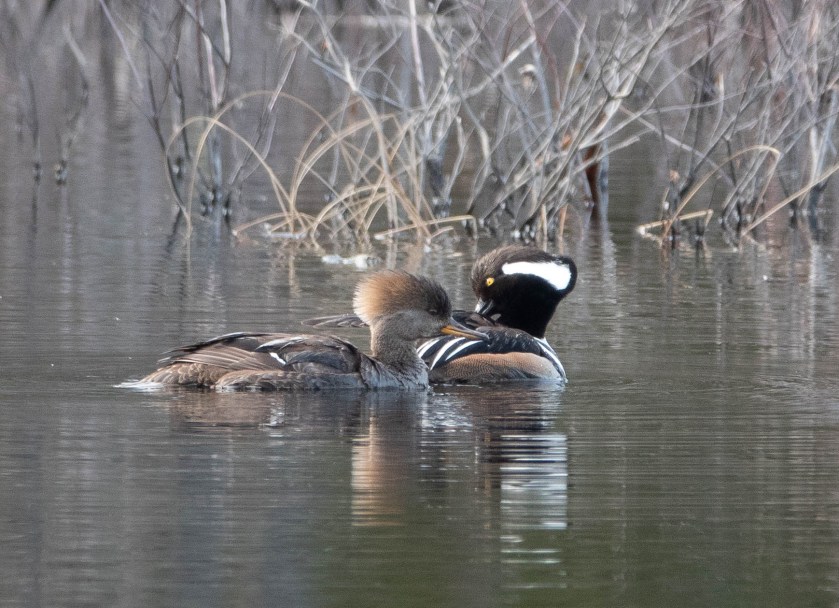
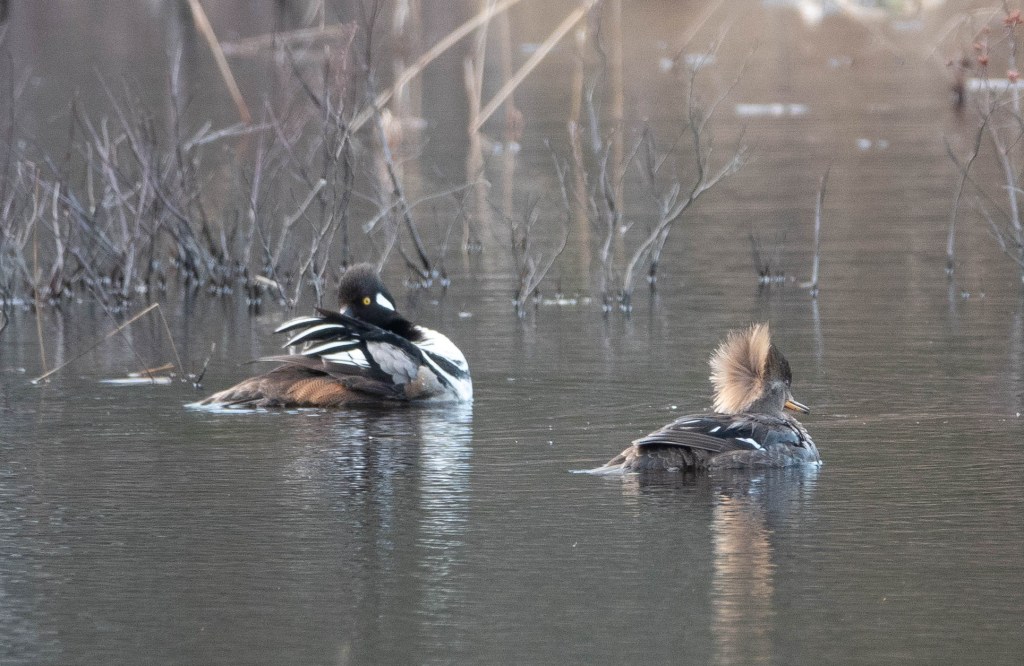
I watched a pair of Hooded Mergansers, Lophodytes cucullatus, the other day, grooming as they swam, and I could swear they were matching their moves to their mate. Look at this.

First, the happy couple:

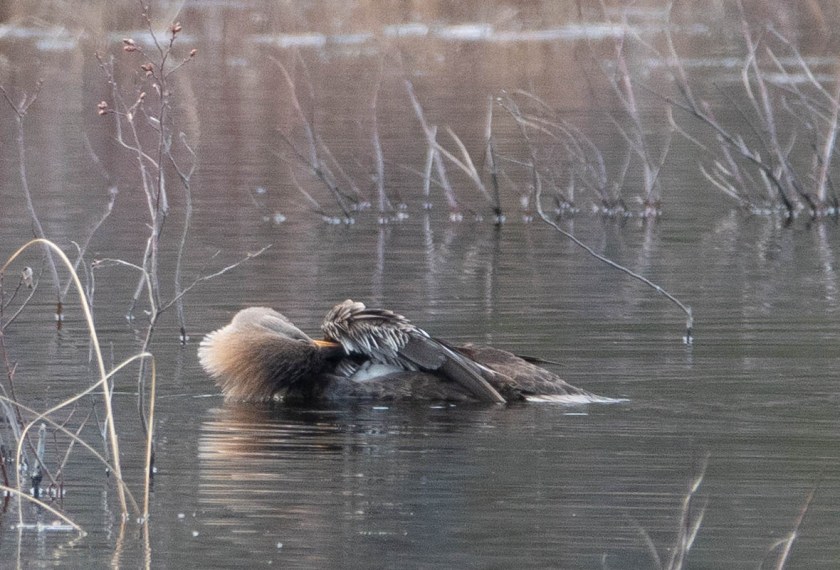
They began with under the wing

Then behind the ear

Now the armpit (do ducks have armpits?):

A slight failure of coordination here (five point deduction):

The male did the occasional show-off solo, watched admiringly by his consort:

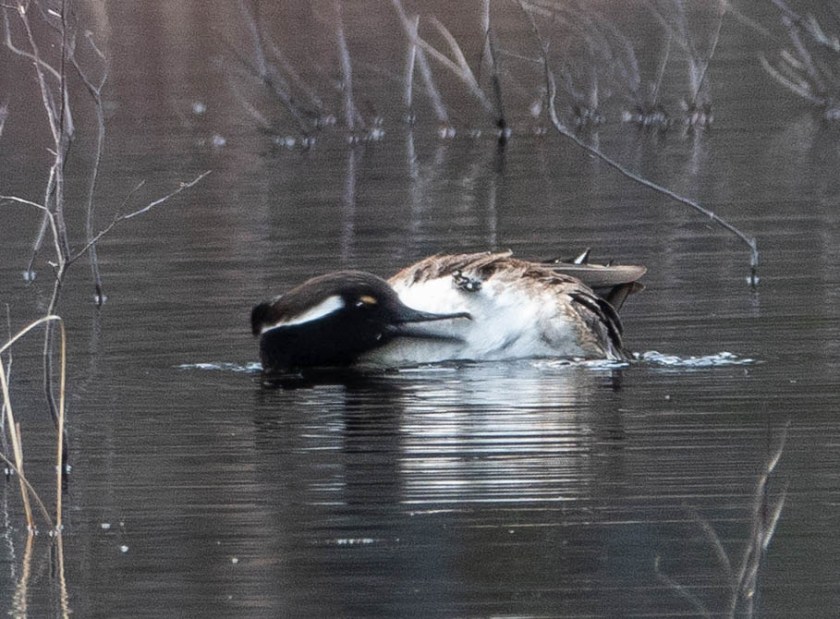
And then they each lay on their sides in the water and tended to their bellies:

(This last manoeuvre was simultaneous, but they had drifted a little apart so I couldn’t get them in the same shot.)

And they looked deep into each other’s eyes.

I have tried to discover if this was chance, or whether coordinated grooming is part of their pair bonding ritual, but to no avail.

But I like to think of it as akin to standing in the bathroom with your loved one, blowdrying your hair together, and reaffirming your vows. Though no matter how hard you try, a stiff breeze can play havoc with that hairdo.

Snapping a Snapping Turtle

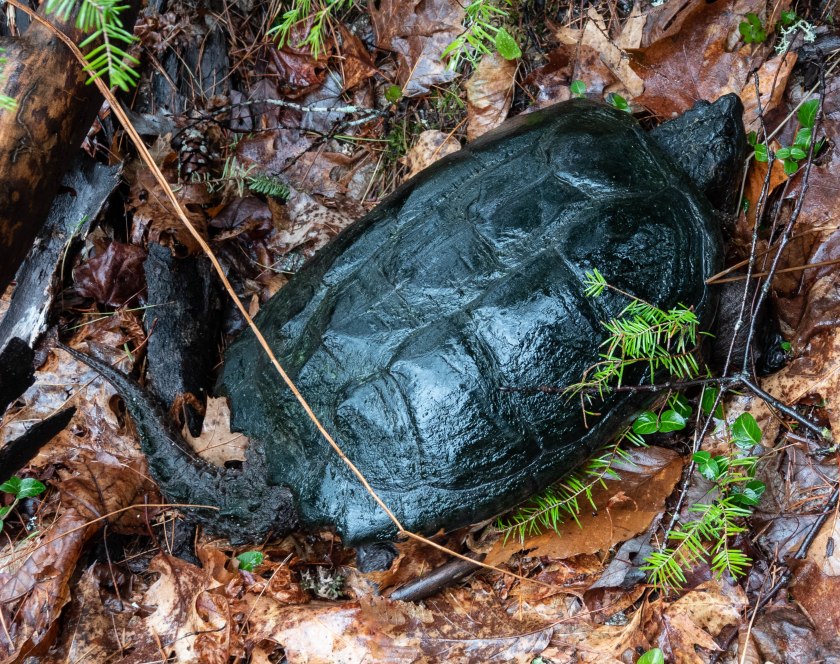
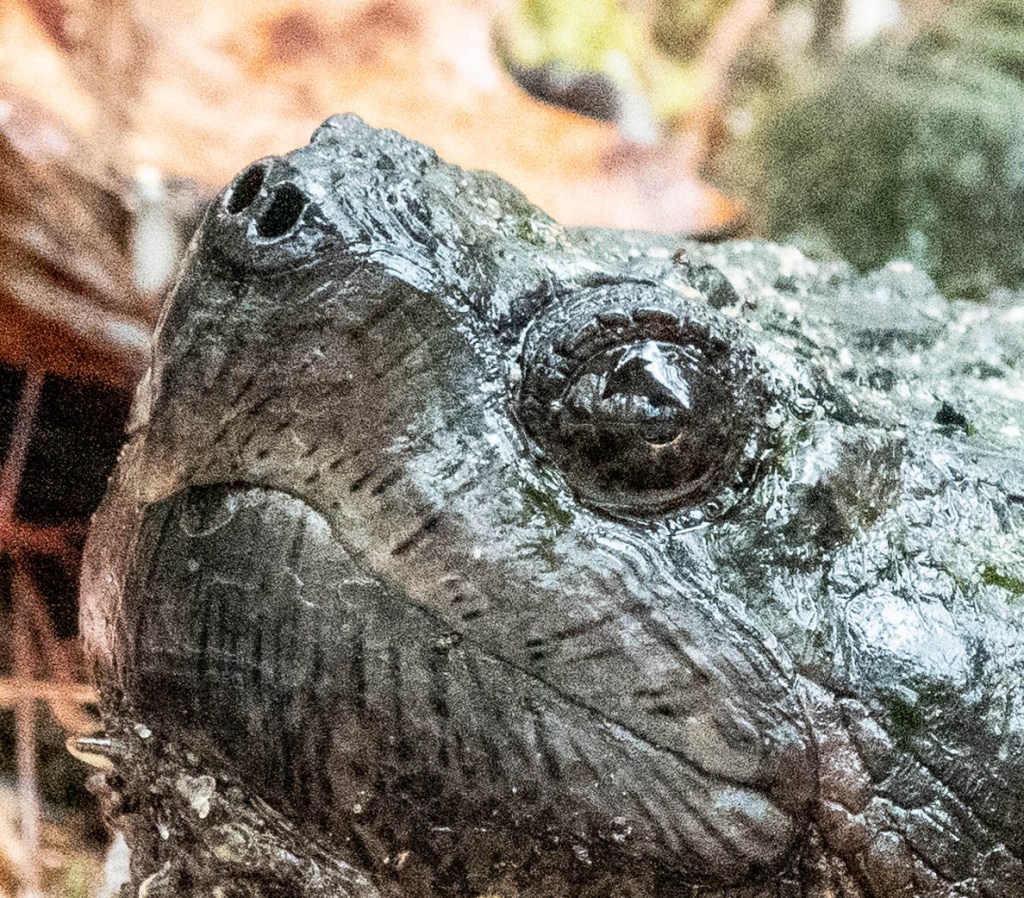
Snapping turtles, Chelydra serpentina, are ugly brutes, and not to be messed with. I’ve never had good enough photos before to do a post about them, but now I have. One was crossing the road near my house this morning, and two nice people had stopped to help it cross, and prevent any cars from running it over. When it made it into the woods, I got my camera.

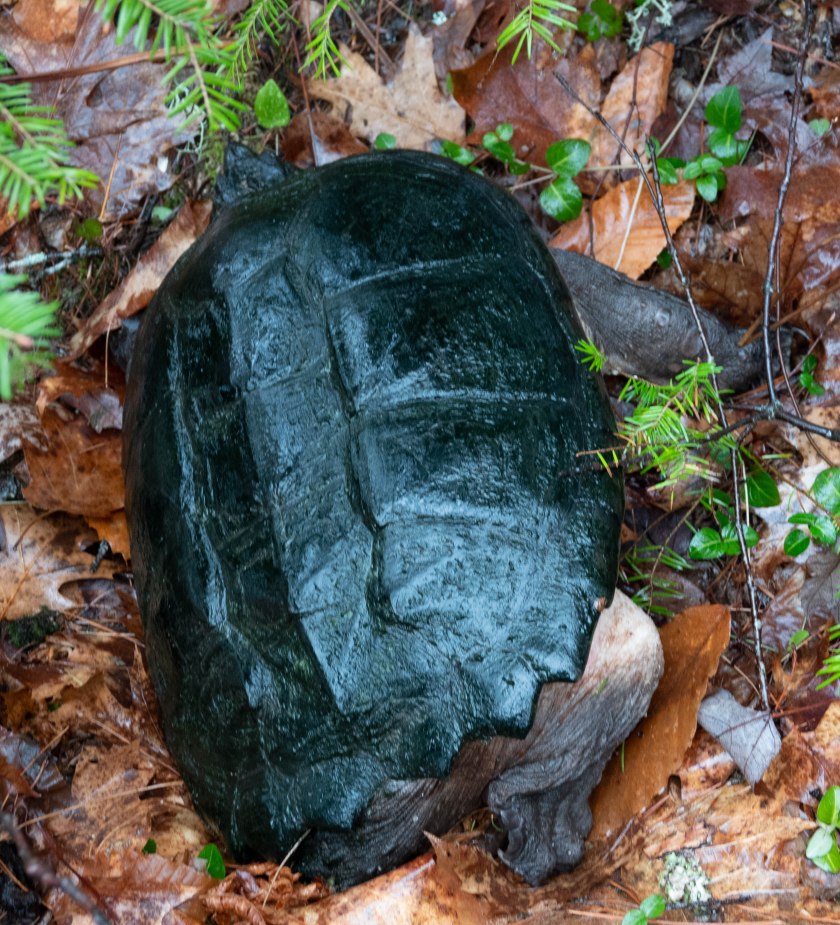
It was raining, so the shell looks shiny black, but when it is dry it is a dark brown, and this one was about 14 inches long. It has a long tail (above), and thick strong legs with huge claws (below):

and its body sort of oozes out from under the shell:

Unlike other turtles they can’t fully retract their heads and legs into their shell, so they display what Wikipedia calls “a combative disposition” when they feel threatened. They have been known to bite through a broomstick.

When the head is fully out, it is quite long, with a charmingly retroussé nose:

You can see if you look carefully that its upper lip has a sharp central beak , and it has little round nostrils:

They have remarkable eyes, with a sort of tortoiseshell iris, which seems appropriate.

They live in ponds, lakes and streams, and they can give a very nasty bite, so little children are warned not to dangle their toes in the water, just in case. They eat pretty much anything, about 1/3 plants and the rest fish, frogs, carrion, insects, crayfish, ducklings, you name it, including possibly children’s toes.

Like all turtles they sunbathe, to bring their body temperature up high enough for their metabolism to work properly. But they mainly sunbathe on the water’s surface, and quickly dive back down deep if they hear someone coming, so this is a rare look at one out of the water, not a great photo, but you can see the huge claws

Females do not breed for 15-20 years. They come up on land and find a nice sandy place to dig a suitable hole and lay 20-40 eggs, starting in April through to June, which may have been why this one was in the woods. I took this photo down in Massachusetts a few years ago; she has buried her eggs and is heading off, never to see her offspring again:

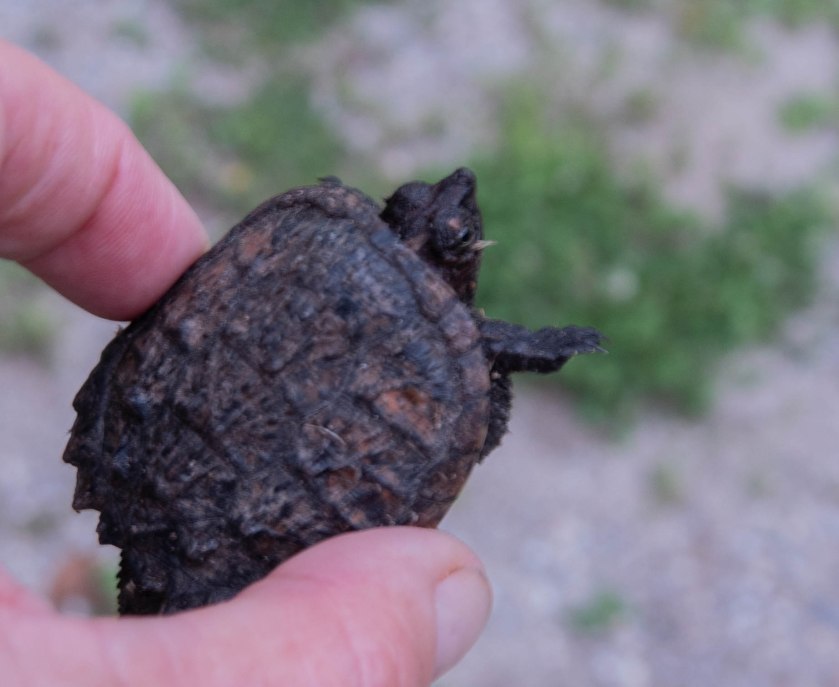
80% will be eaten by predators, such as raccoons and foxes, but for the lucky few, in the fall, after three to six months, the babies hatch:

Hard to believe that if this tiny creature lives for 100 years it can grow to 60 pounds (though most are between 10 and 35 pounds).

Bonanza: beaver and bald eagle in one glorious day

Every now and again the stars align.

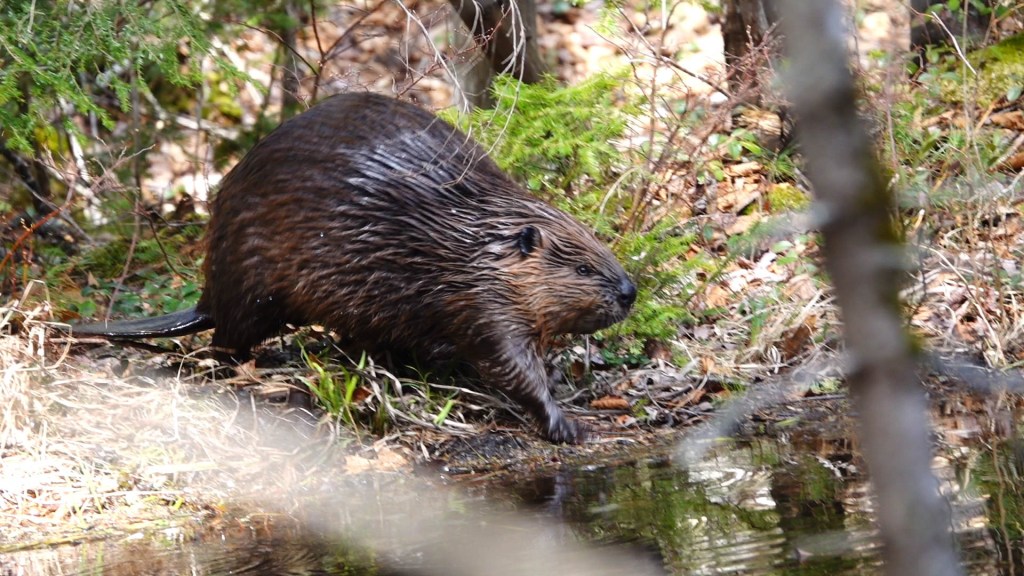
The other morning, I had tied my long-suffering dog to a tree and crept quietly to the shoreline, stopping behind some small trees. Nothing. Then in the distance I saw a V-shaped wake: coming straight at me, so fast it created a bow wave all its own, was my beaver.

It curved gently to the left, slowed, and headed straight for the shoreline, without noticing me.

I realized it was going to get out of the water, and I switched to movie mode. To my delight, I realized I was watching it making a scent mound. Beavers scrape up leaves, grass, any vegetation either from the bottom of the pond, or on the shoreline (as here). Then they deposit castoreum scent from their castor sacs, and also secretions from their anal glands. This marks their territory, and tells other beavers if they are family, near neighbors, or unknown. Watch what this beaver does; it is very quick, and you may need to watch it twice. (There is also an elegant dive at the end.):

Beaver are vulnerable out of the water, which is why they don’t waste any time. Notice that the beaver first makes the mound, then lowers its bottom onto it. Dogs, on the other hand, first defecate, then cover it with soil.

And here is the grassy heap he/she leaves behind (both sexes do this, but males do it more!). The water is at top right, and the mound of dead grass is right by the water’s edge. I bent down and tried to smell the castoreum (after all, I’ll never get a fresher chance than this) , but no dice.

Then he (or she) returned to the water:

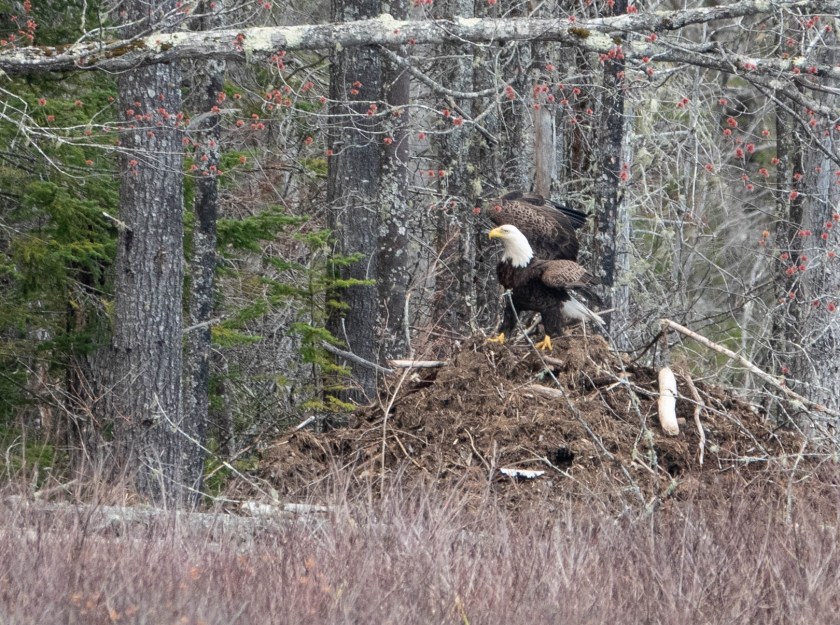
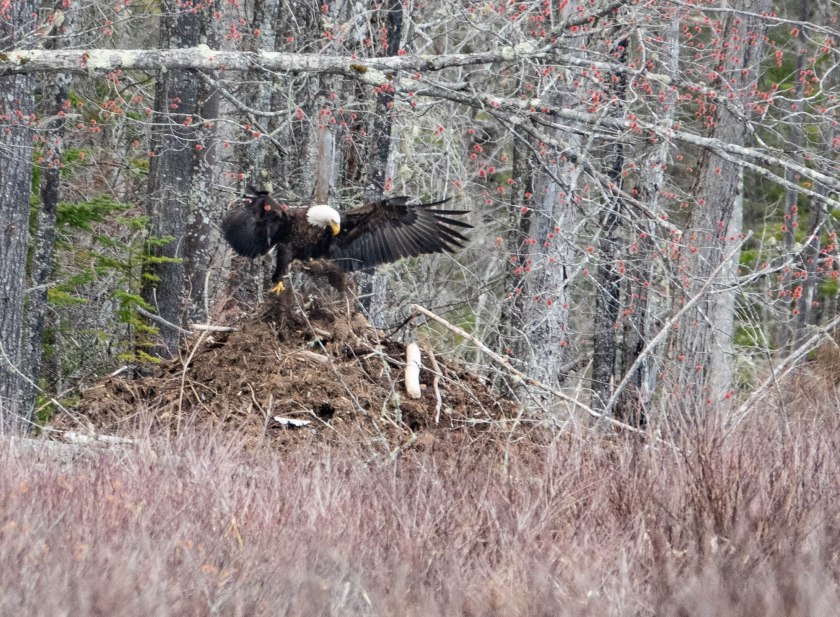
In the afternoon, I was back, palely loitering behind a scruffy tree, when a huge shape swooped down and across the pond. Bald eagle. It went up into a tall pine, and I think it had something it was eating, hard to tell from so far away. But then, to my delight, it flew down and landed on a perch thoughtfully provided by the morning’s chief actor, the beaver, or one of its relatives..

Beaver mounds are excellent vantage points, and this eagle settled down for a few minutes, still very far away, but in full view. It stretched and organized its wings:

then took a patrician pose, gazing out over the pond:

After a while something caught its eye. It took off:

and rocketed back low across the pond, as if locked onto a target:

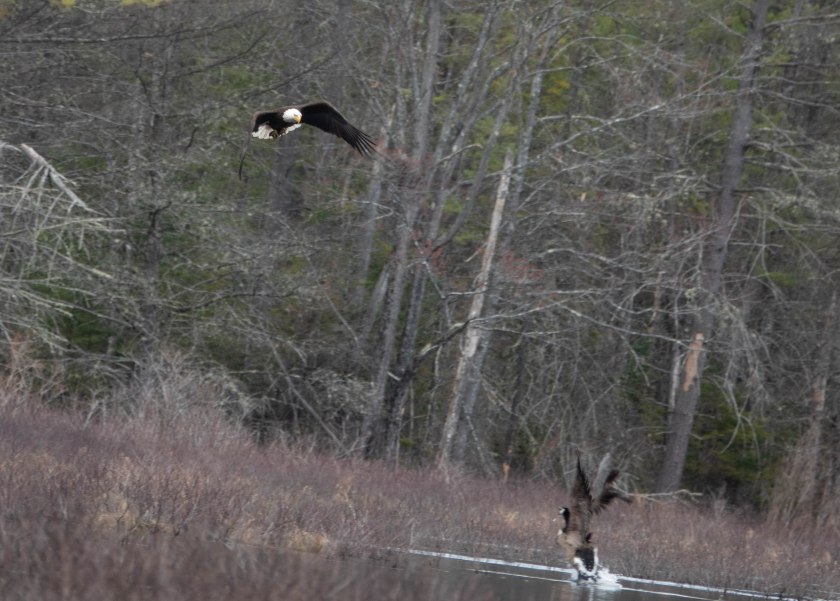
I realized it was aiming for two terrified ducks, which rose in a panic (the goose in the background didn’t budge.)

The ducks had good reason to be scared. Bald eagles will stoop onto waterfowl, though their success rate is apparently low, so this rather feeble attempt may be typical! It never did dive on them, just flew away, taking its magic with it.

Flying 20,000 miles a year

[My last South Carolina post, I think.]

Talk about airmiles. The Red Knot, Calidris canutus rufa , a sandpiper, enjoys the reputation of undertaking one of the longest migrations in the natural world, a round-trip as long as 19,000 miles. They breed in the high Arctic, but they over-winter all along the coasts of the Americas, as far south as Patagonia. This map shows their range in the Americas:

They weight in at under 5oz, yet they can fly 5000 miles without touching the ground.

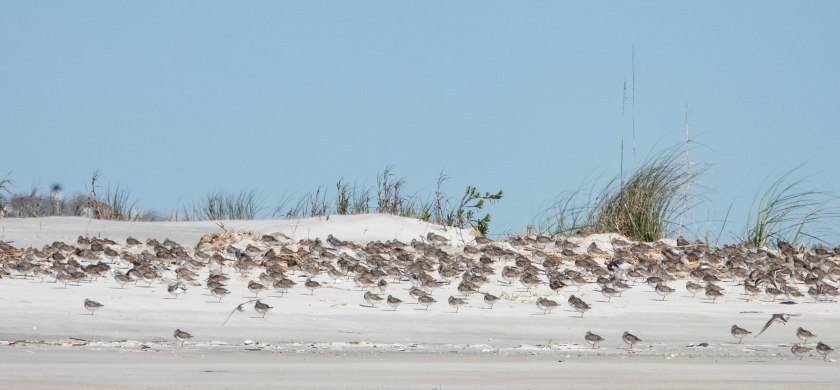
In South Carolina, there is a population that over-winters there, but it is also a stop-over point for birds who have come from much further south and are on their way to their Arctic honeymoon hotels. The numbers are huge:

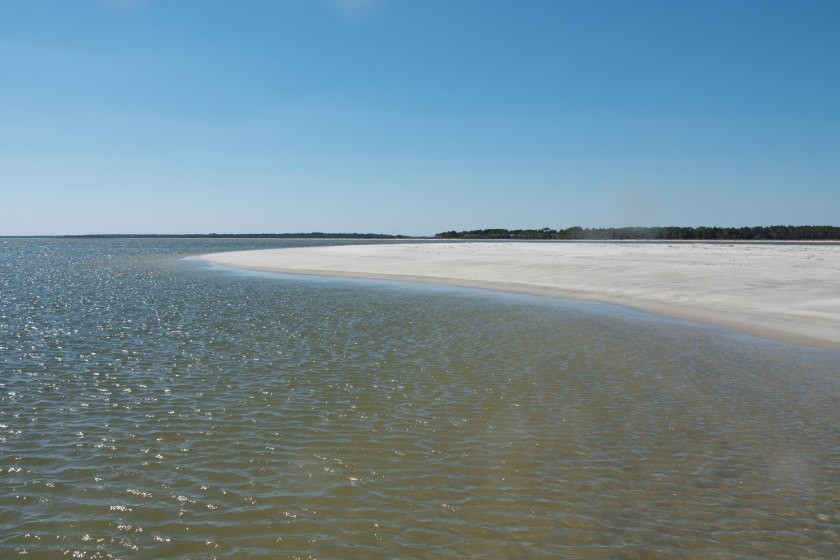
These are on a low-lying unoccupied sandbar island, now protected from humans during migration and nesting season, called Deveaux Bank. All the photos are taken from a boat offshore, which was bobbing around, so they are a little quavery! It is serenely beautiful:

What, for the Red Knots, makes it “vaut le détour”, as the Guide Michelin would say, is the presence of vast numbers of prehistoric horseshoe crabs mating and laying small green eggs.

The eggs are a rich and very digestible food source to support these birds on their long migration, but the horseshoe crabs were over-fished, both because they make good bait for fishermen, and because scientists use their blue blood (yes, really, see below for more*) to test for bacterial contamination. Probably as a result, Red Knot numbers dropped sharply in the 2000’s, and in 2014 this subspecies was listed as threatened by the US Endangered Species Act.

Once they reach breeding season, their plumage acquires a reddish color, as you can see in the image below from the All About Birds website:

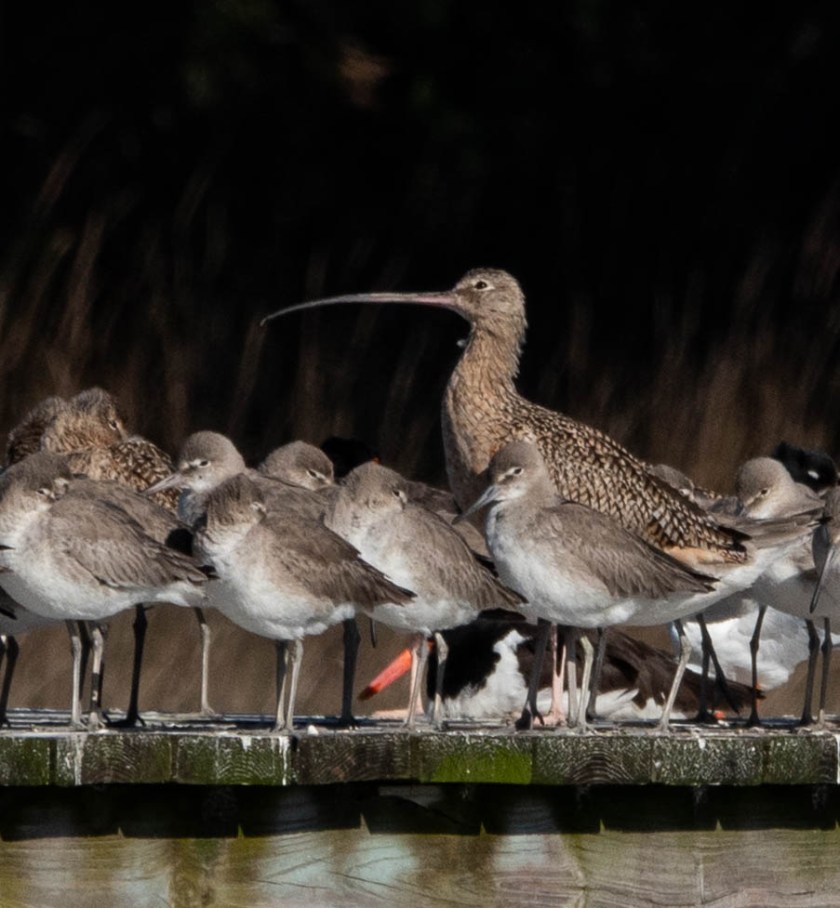
but at the moment they are grayish buff. In flight, the birds have a white line running the length of their wings , like the center bird in the photo below (The larger reddish bird with a long bill is a Marbled Godwit. )

Deveaux Bank is crammed with birds, including a colony of Brown Pelicans

On our return boat journey to Wadmalaw Island, we saw a Long-billed Curlew, apparently the first seen around here in some time, with an oystercatcher curled up beneath his feet:

Long-billed curlew

A magical day off the shore of this ever-changing sandbank island.

P.S. I am very grateful to Dana Beach, who took me to Deveaux, and who was instrumental through the Coastal Conservation League in getting it protected in 2015. Here is some more information:

Deveaux Bank

*For more about the scientific use of horseshoe crab blood, read this:

https://www.theatlantic.com/technology/archive/2014/02/the-blood-harvest/284078/

A classical woodpecker

The Pileated Woodpecker, Dryocopus pileatus, also known as a logcock, has a splendid Latin name, about which more later. To start, let’s find one.

In the woods, the first thing you notice is a pile of wood chips,

and when you look up, you see a strange rectangular hole, which looks as though it was made by a human with a fretsaw.

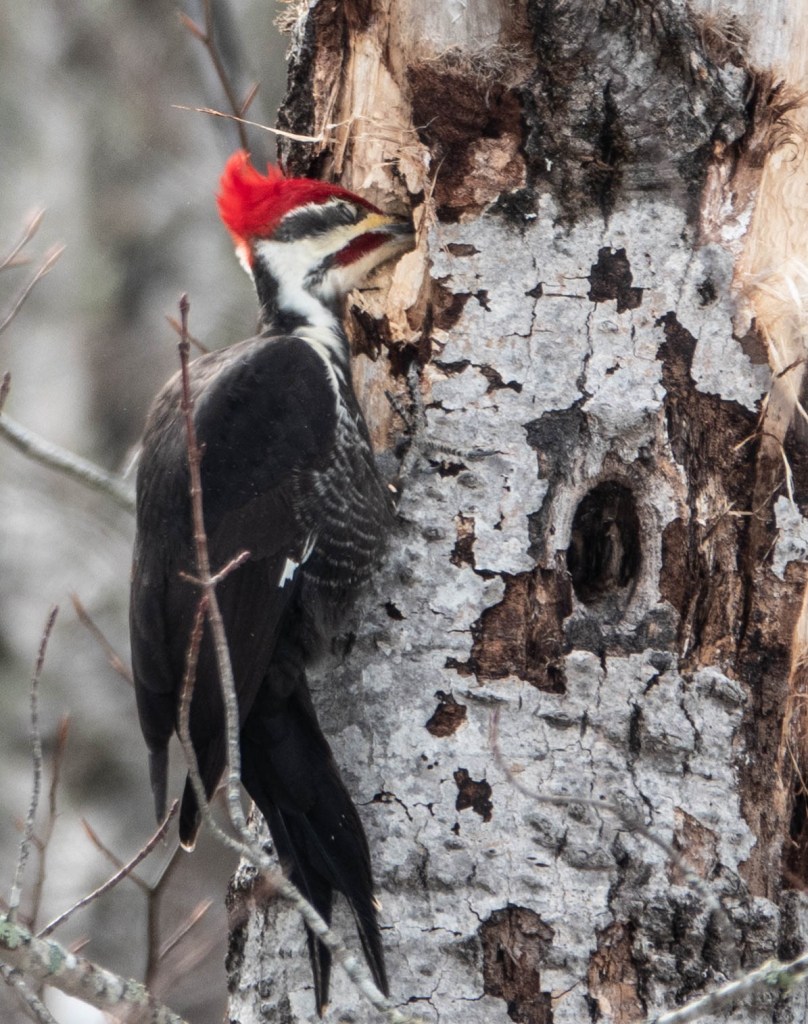
Then you might hear hammering, and there he is.

They are the largest woodpecker in North America, 16-19inches in length. You can tell this one is a male by his full red cap that extends all the way to his beak, and by his red ‘moustache’ (which is actually alongside his bill not above it), and he has a fine powerful bill:

He uses that bill to bash away noisily, which is usually how you find them. .

This one is excavating for food, and he has now found something and is probing deep in his hole, with his crest raised and his eyes half closed in ecstasy:

Look closely at the shape of that red crest and cap. Now stay with me here: look carefully at the seal of the US Senate, below, and the red shape in the top center.

Does it remind you of anything? Despite appearances, the US Senate did not put a woodpecker on their seal. Instead, for quite different reasons, both refer to the felt cap worn by freed slaves in late Republican Rome, or pileus in Latin. Here Odysseus is wearing a white one:
But by the Renaissance it is usually red, and signified eastern origins, here on the Kings from the East,

Then it was adopted by the French revolutionaries, who referred to it as the Bonnet Rouge, or the Phrygian cap.

The Senate chose it as a symbol of liberty, and the ornithologists chose it simply for the physical resemblance between the pileus and the woodpecker’s cap, and named this bird Dryocopus pileatus.

PS John J Audobon’s 1838 text on this bird is well worth reading:

https://www.audubon.org/birds-of-america/pileated-woodpecker

In the pink: Roseate spoonbills

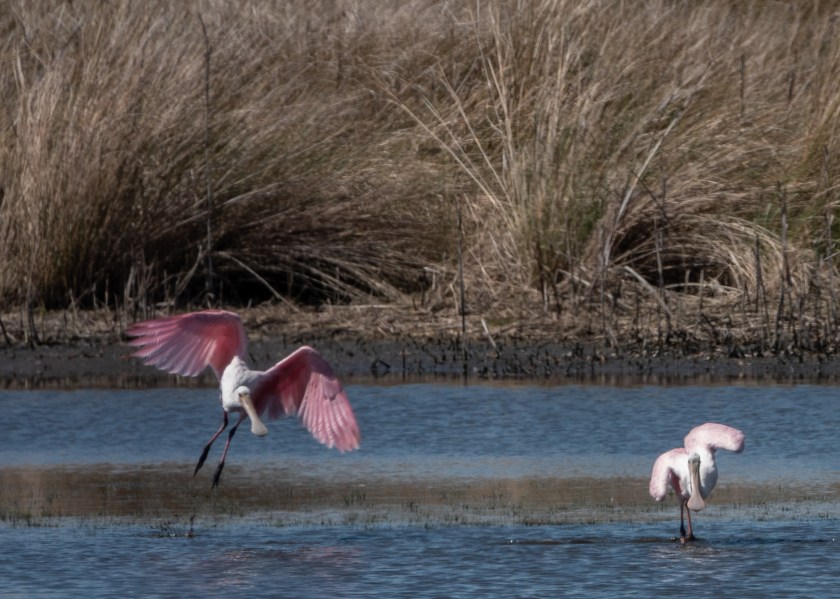
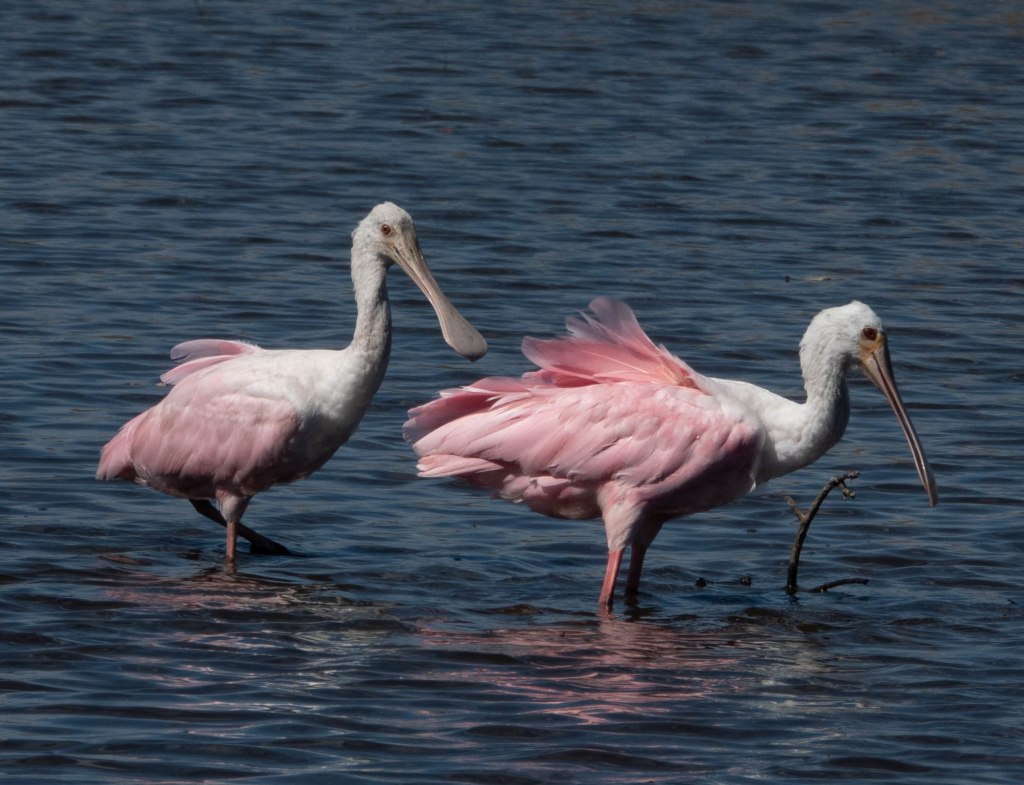
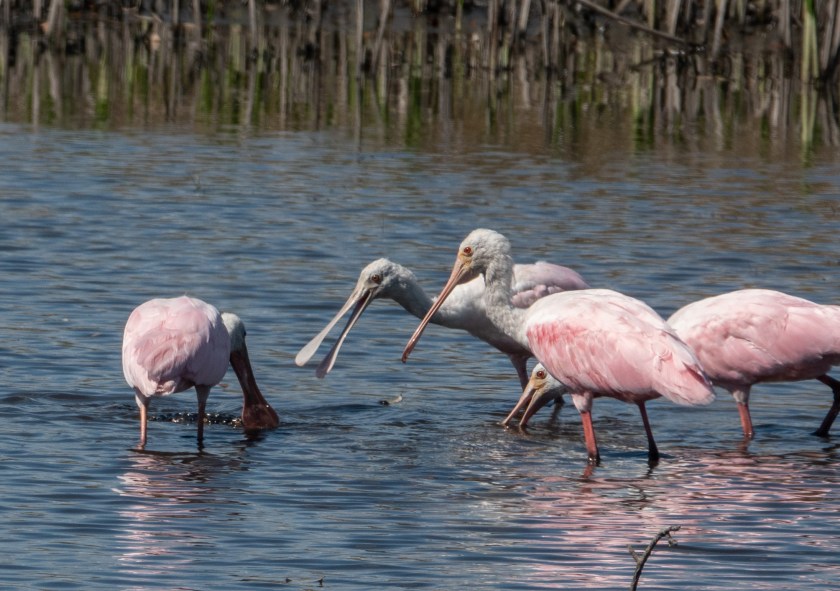
Roseate spoonbills, Platalea ajaja, are an ill-assorted mixture of delicate beauty and clumsy absurdity. Their elegant feathers shade from white through shell-pink to coral, but their comically oversized bills are spatula-shaped with rounded ends. They are a New World species, and I have seen them once before, in the Pantanal in Brazil. In the USA, they are limited to coastal areas in Florida and Texas

To my delight, there is one tiny (non-breeding) colony of them here in South Carolina, at the Donnelley Wildlife Management Area, and the conservationist Dana Beach explained how to find it, so off we went. We drove around in a circle for a while, failing to see anything, and just as we were on the verge of deciding to abort, there they were.

They are waders, nearly three feet tall, and mainly feed on crustaceans and fish.

The crustaceans are responsible for the pink coloration of their feathers (just as they are for flamingoes), which get pinker with age.

Lesser Yellowlegs and Roseate Spoonbill

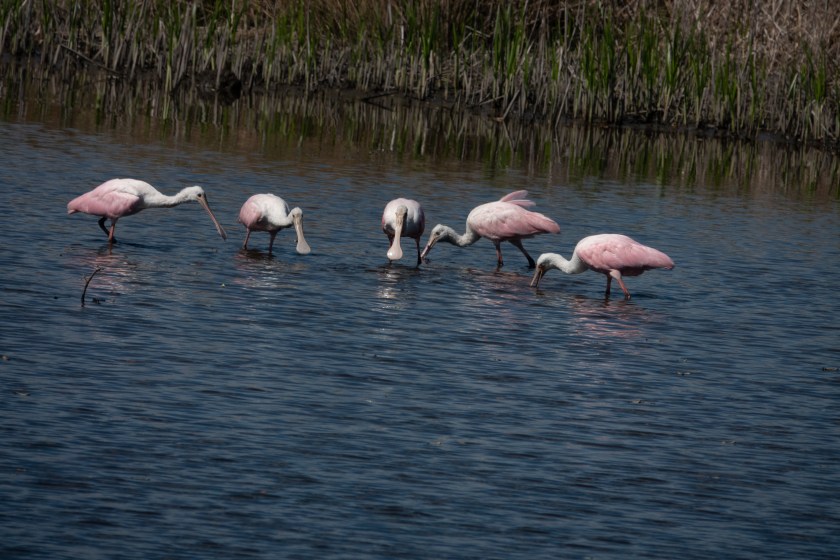
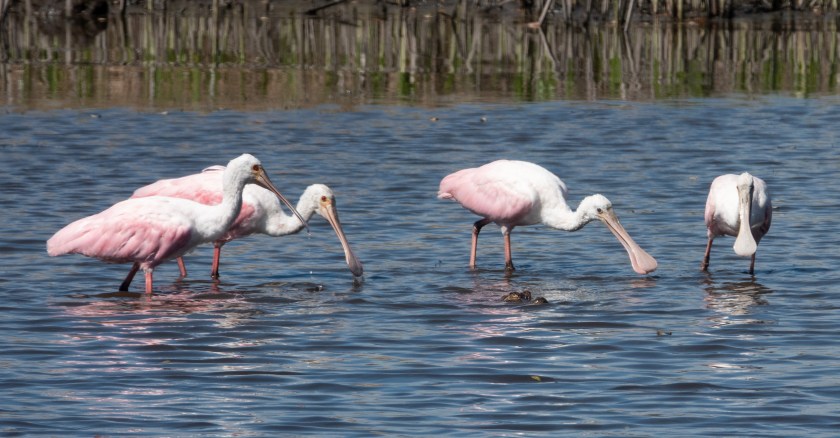
They feed by scything their bills from side to side as they slowly move forward:

The bills are translucent:

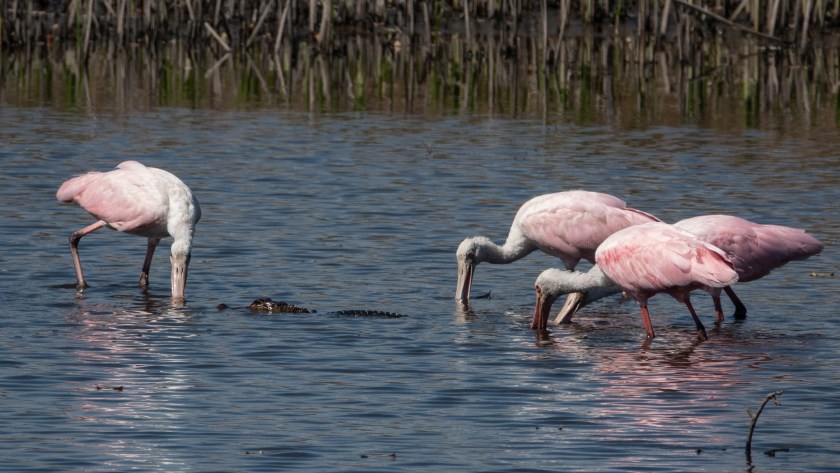
We admired them for a while, then decided to picnic a little further down the pond. They moved too, and as we continued to watch we realized that they were behaving rather oddly. They were clustered together, poking at something in the water.

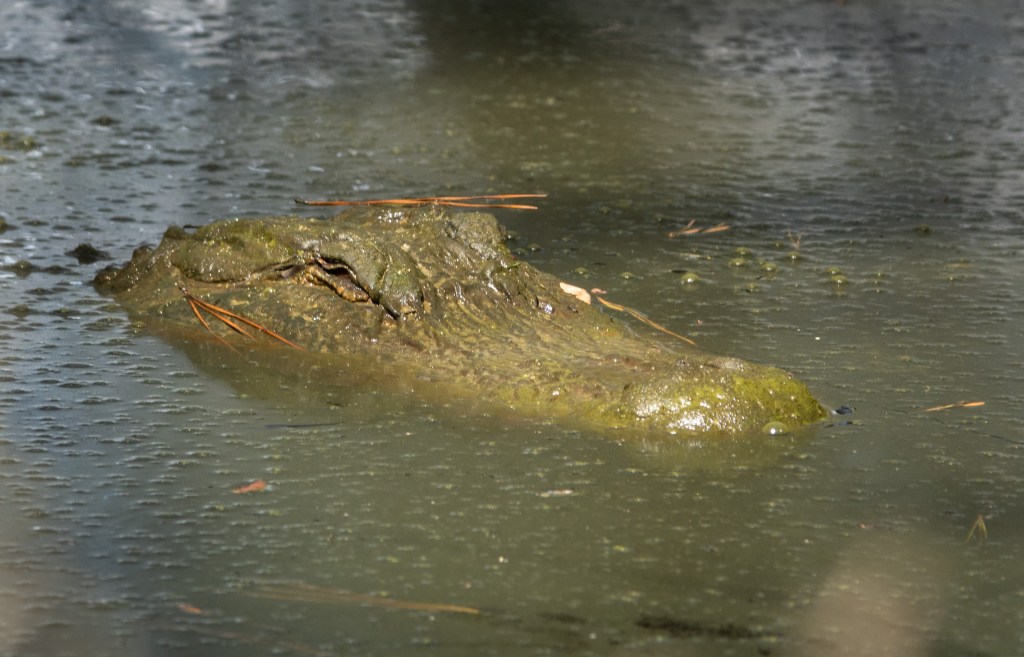
It was an alligator, and they poked and pecked at it for more than five minutes, and the alligator was astonishingly not goaded into retaliation.

Occasionally it did spook them a little:

But not enough to scare them off:

We have since asked around, and failed to find any reports of this behavior, except for one story in the Daily Mail!

https://www.dailymail.co.uk/news/article-2170900/Curious-spoonbill-birds-peck-ish–alligator-fortunately-unwanted-attention-didnt-make-deadly-reptile-snap.html

Alligators are in fact useful to spoonbills, because they eat predators like raccoons who might otherwise threaten the spoonbills’ land-based nests, so I don’t know why the spoonbills harassed it (nor why it didn’t fight back). One possibility is that its skin was encrusted with tiny edible creatures that spoonbills enjoy, and that the alligator is happy to be rid of, just as tiny fish groom bigger fish.

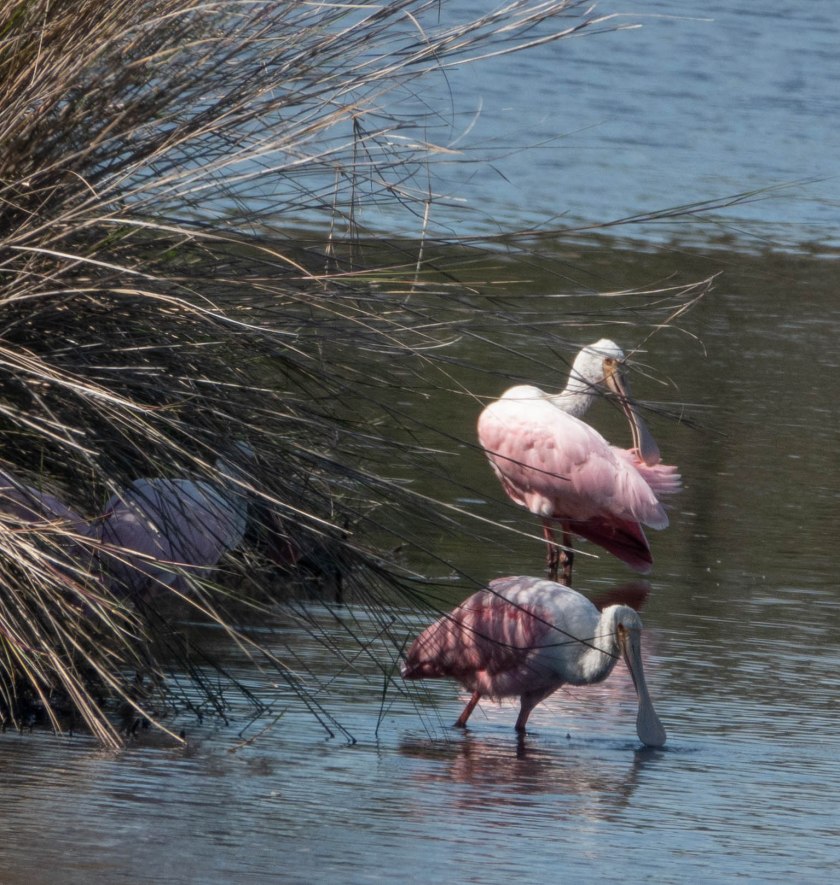
After all that activity, the show ended with a grooming session:

PS All of these are juveniles, since they have a completely feathered head. After about 15 months it becomes pale yellowish green and nearly bald.

Pick a side: Warm-blooded vs cold-blooded

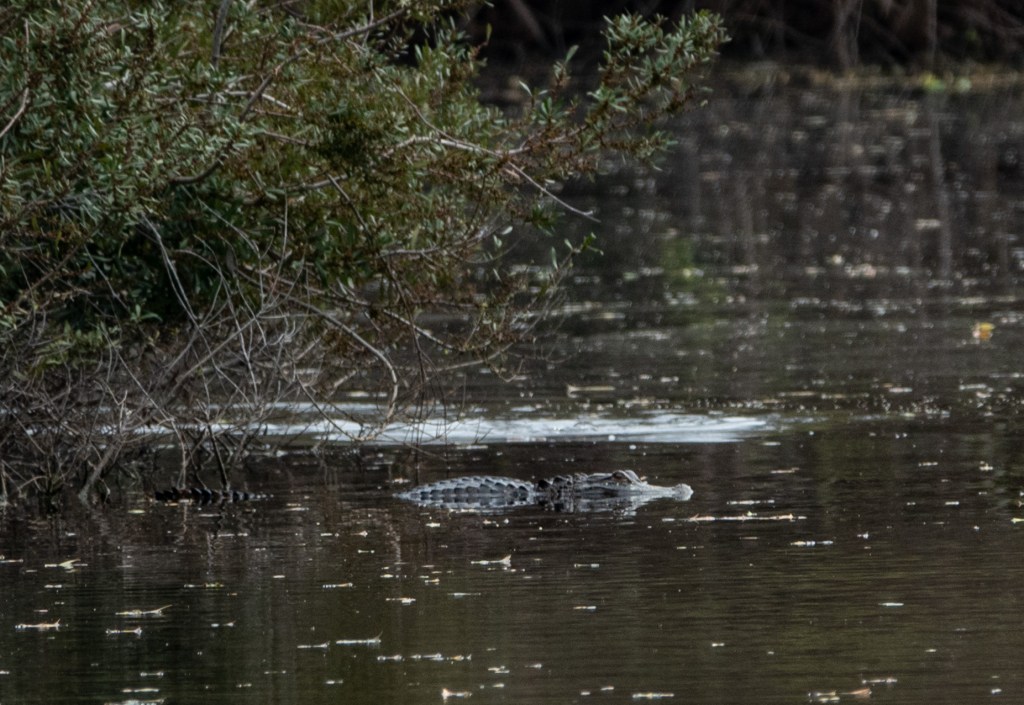
We all know that at one point dinosaurs ruled the world, and then, somehow, us mammals took over. But modern mammal vs reptile encounters can go in either direction. You may well think I am obsessed by otters, but I was truly not thinking about them down in South Carolina. Instead, I was keeping my eyes out for alligators:

There was a small one in my friend’s pond, and I had just got it into focus when what should swim round the corner into the shot but… an otter:

After a brief moment’s reflection, it wisely dived, and that was that.

I started to Google “Do alligators eat otters?”, and what I found astonished me. Story after story showing the reverse: an otter killing and eating a sizable alligator.

https://www.nationalgeographic.com/animals/article/140306-otter-alligator-florida-predator-photos-wildlife

Down in the Pantanal, the BBC filmed a family of giant otters winning a fight with a caiman.

Of course, alligators can and do eat otters, but it isn’t considered newsworthy so it barely shows up in a Google search. But “otter eats alligator” turns up dozens of stories!

And then I returned home to Maine, and there was my very own warm-blooded otter, with a large cold-blooded fish, and not an alligator in sight.

So it seems that the mammals still win…

PS The ice is melting, and as soon as some open water appeared so did the waterfowl. There is still plenty of ice, as you can see, but I spotted Canada Geese, Green-winged Teal, Hooded Mergansers, Common Mergansers, Common Goldeneyes, Wood Ducks, and American Black Ducks.

Fighting back

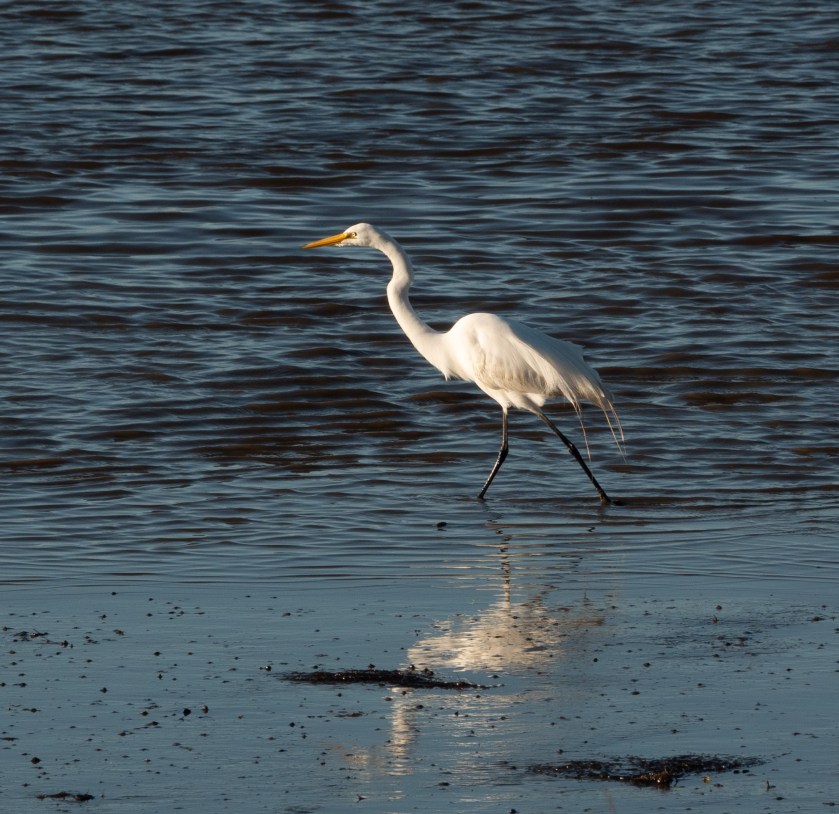
I have spent the last three weeks on an island in South Carolina called Wadmalaw, a very soothing place in the Low Country delta landscape (where Carolina Gold rice was once the principal crop). At low tide the mudflats are the hunting ground of the majestic Great White Egret:

These highly successful three-foot-tall birds are widely distributed, but they mainly breed in warmer climes. This one non-breeding one is in the Cotswolds, by a fresh water stream:

Back in Wadmalaw, they stride along the water’s edge:

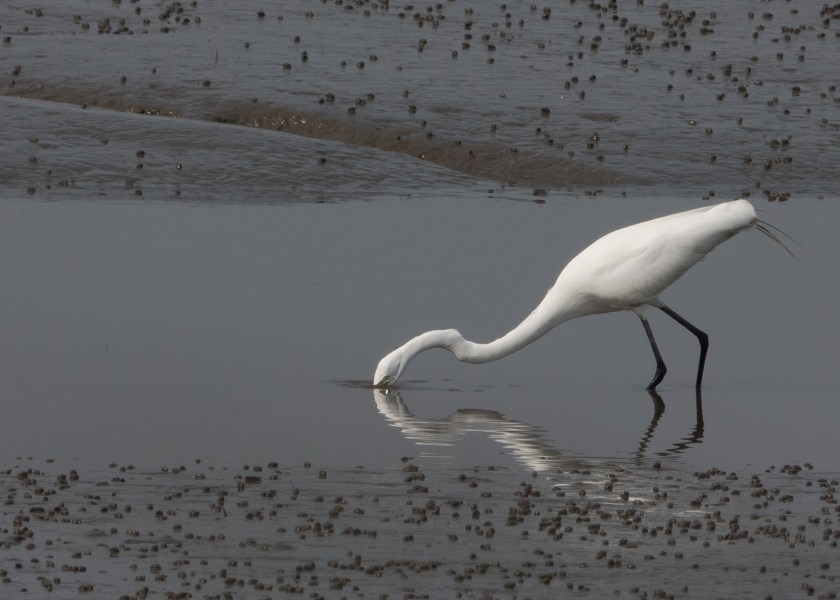
pouncing on small fish and crustaceans:

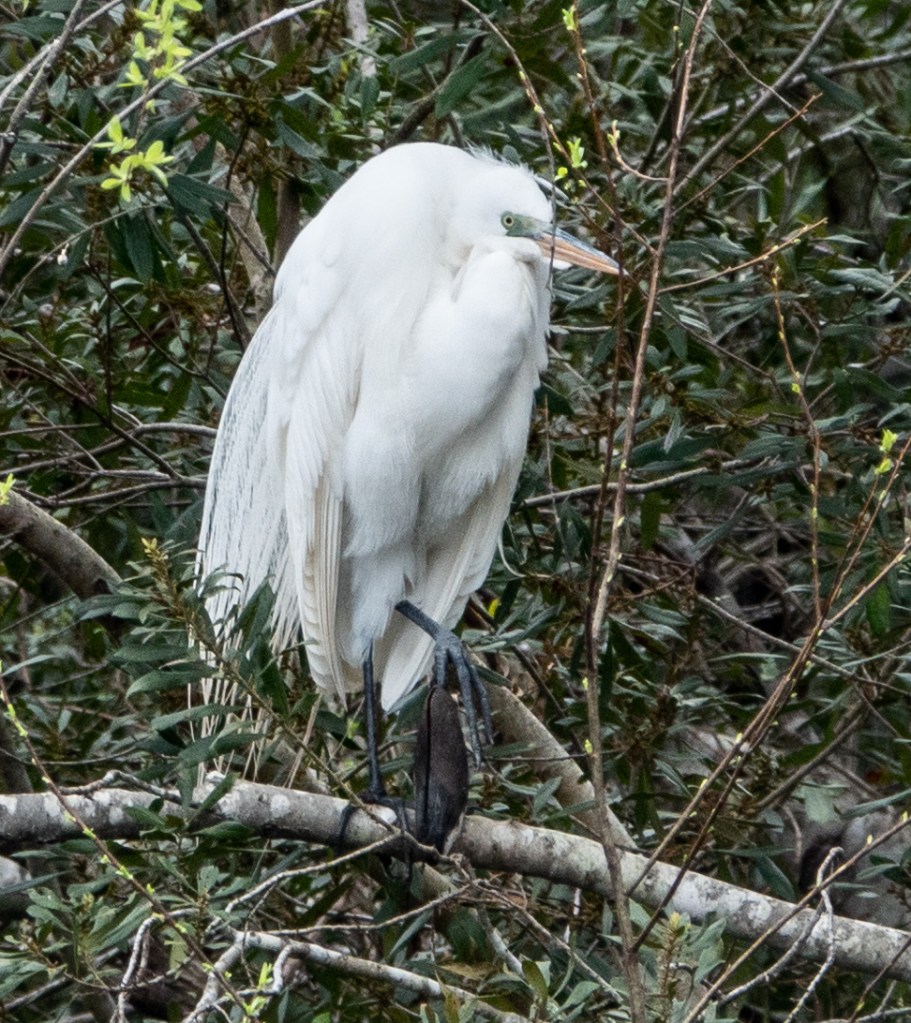
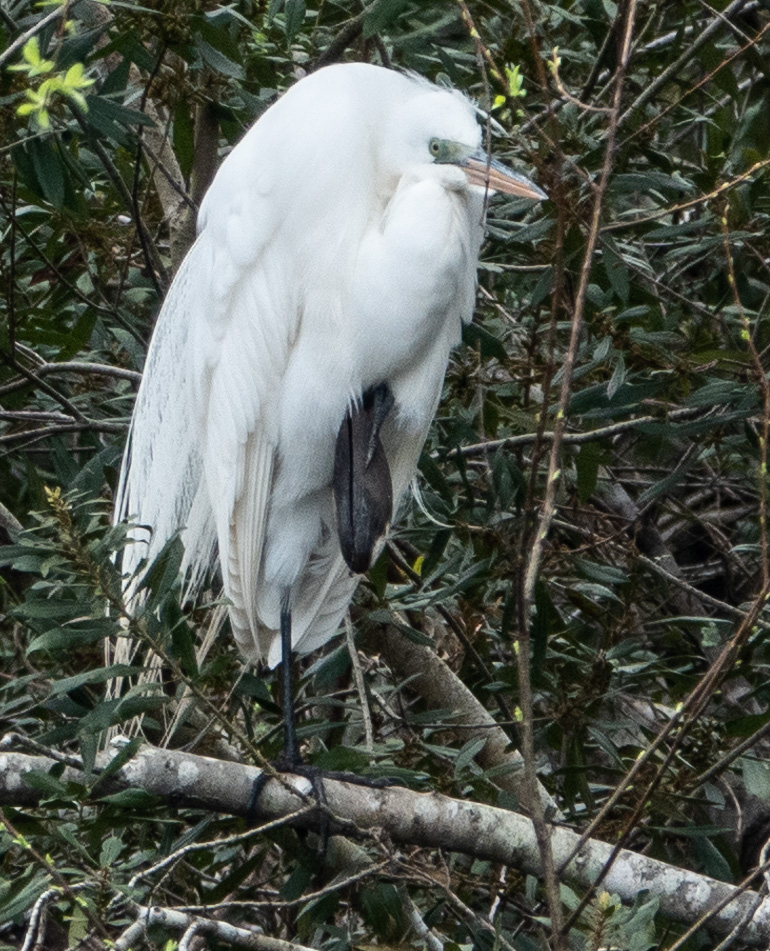
But even shellfish can fight back. This next egret was roosting on the edge of a former rice impoundment ( a small pond dug to serve as a fresh-water reservoir for the rice fields). Look at the raised foot: its toe has been trapped by a mussel:

The poor bird seemed unable to dislodge it:

The ornamental toe-ring did not seem to seriously impede the bird. It did some stretches and downward dogs (downward egrets?):

This is actually a part of its courtship display, called “crouching” and indeed it is in breeding plumage. You can see the long scapular aigrettes (extending beyond the tail):

Also signifying breeding readiness is the greenish skin around the eye, and between the eye and the beak (the lores), and the orange bill.

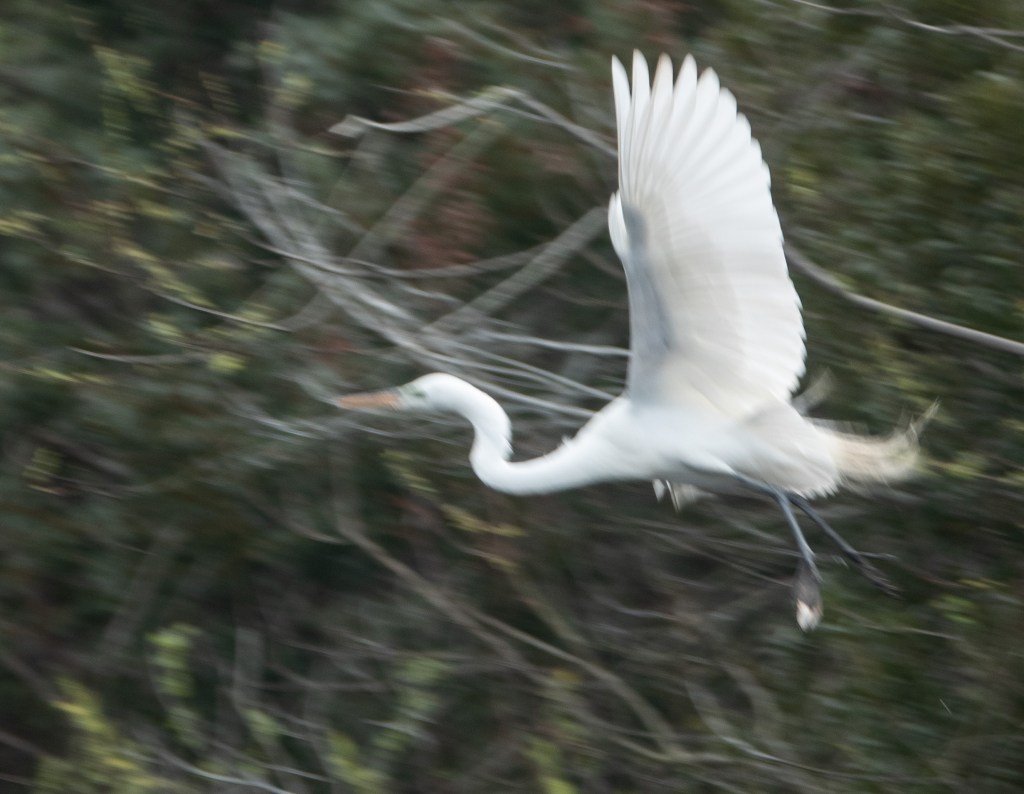
Eventually this male flew off, mussel dangling below, and joined a second egret deep in the trees on the opposite side of the pond, perhaps its mate. Let’s hope she likes mussels.

PS This bird is probably a male, although females also assume breeding plumage, and do a little displaying once the pair bond is formed. A beautifully detailed description of Great White Egret courtship displays can be found here:

Mock, D. W. (1978b). Pair-formation displays of the Great Egret. Condor 80:159-172.

PPS Here is a short video of a slightly different portion of its mating dance,