Squirreling away

American Red Squirrels are pretty small, only 6.5-9″ long (excluding the tail) and Eastern White Pine cones are nearly as big, up to 6″. They contain a tiny seed at the base of each scale, and the squirrels love them. They prefer to dine on a lookout, like a tree stump, large rock, or in this case thirty feet up in a white pine. This video shows the tree, the large one in the center of the frame, and zooms in on the squirrel just as it irritatingly decides to descend. (When you play the two videos in this blog, they are not as dark as they look here.)

Luckily I had been watching it earlier, taking photos from ground level far below, and you can see what a humungous cone it had unearthed from the snow:
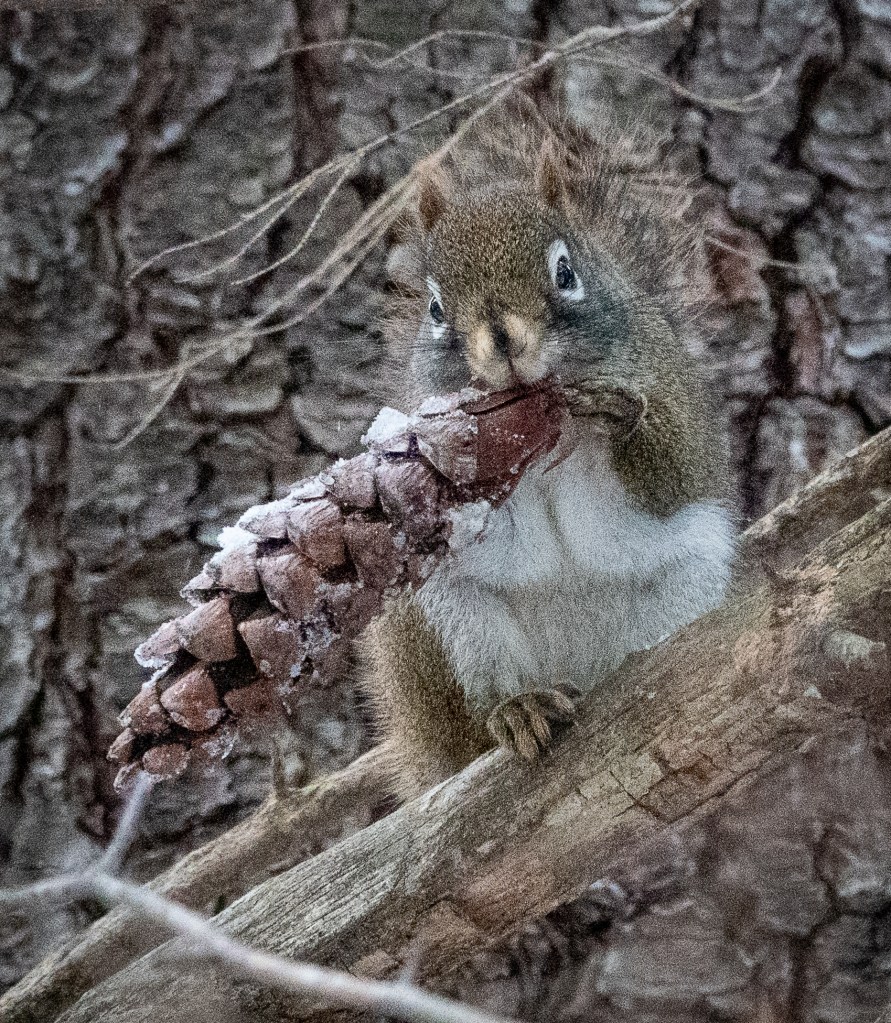
Starting at the bottom, it removed one scale at a time, and ate the one or two seeds at the base. It carefully worked its way up the cone, one scale at a time, holding on tightly to its trophy:

When it has finished, it will leave just the central spine behind, surrounded by a litter of scales:

Below is a video of the squirrel tucking in. By now he has worked his way half-way down the cone, and he reminds me of a Frenchman eating an artichoke:

American Red Squirrels, Tamiasciurus hudsonicus, particularly like the cones of pine and spruce and they cache their food, sometimes underground, but not always. This squirrel had collected heaps of pine cones at the base of his special tree, and also beneath several others nearby.

I counted fifty at the base of this tree alone, and was rather impressed by the care with which they had been arranged, most of them neatly lined up, and largely pointing in the same direction, away from the tree. Perhaps it gives the squirrel the same satisfaction as reorganizing the sock drawer gives us on a grey day.

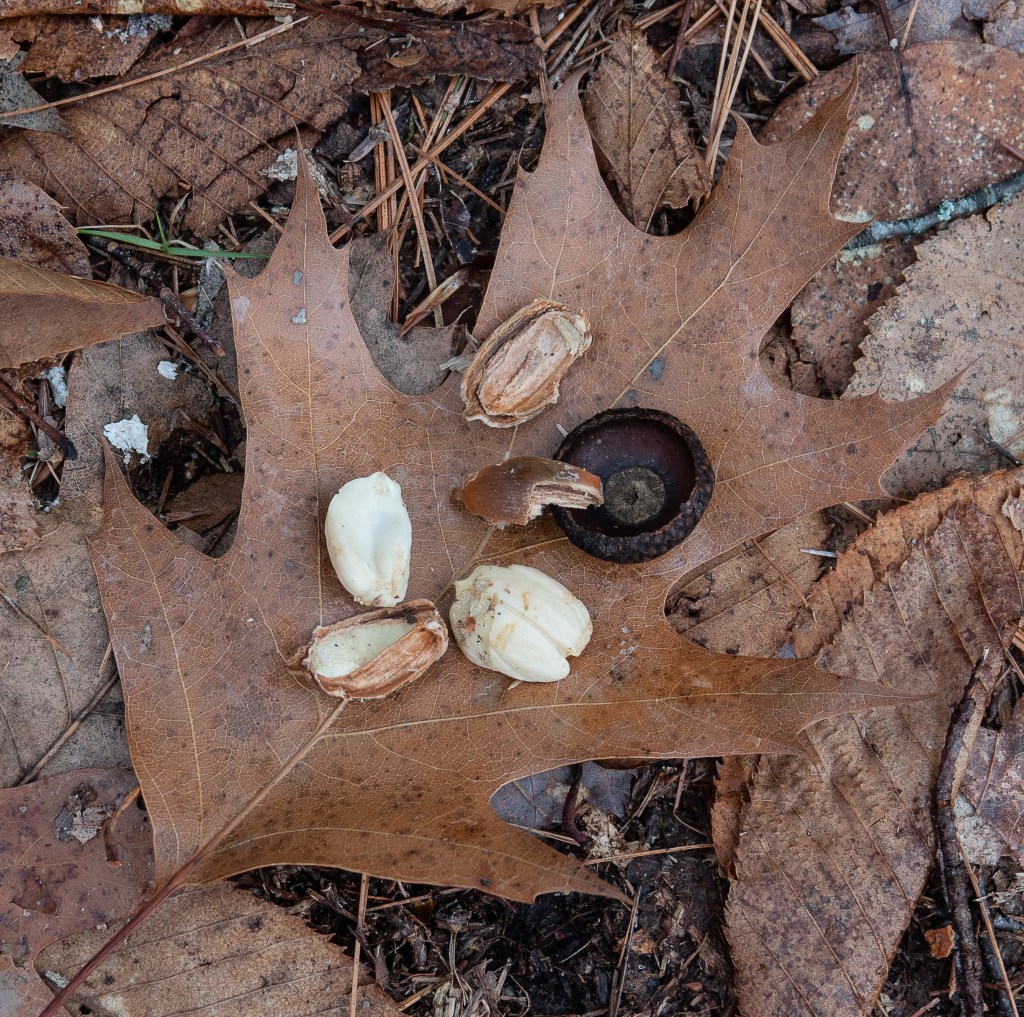
They also eat other nuts: this one had started in on a Red Oak acorn:
PS The scientific name Tamiasciurus comes from the Greek ταμίας “tamias”, meaning treasurer or steward, or one who collects. Apt.
Grand Designs of the Wasp World II

My last group of nests are built of paper, which the wasps create by chewing wood fibre into pulp. So in the Three Little Pig story they are the house of wood or sticks!

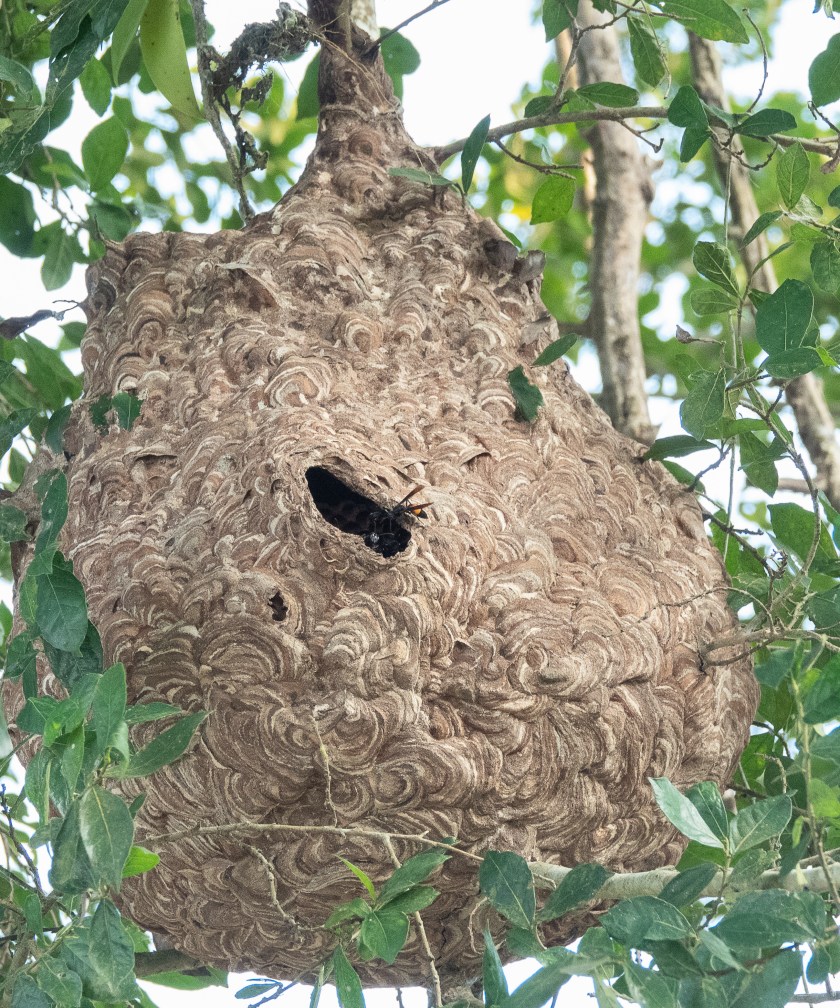
Hornets and paper wasps are eusocial* insects, and live in large colonies. In Assam, I found this hornet nest, probably Vespa analis judging by the beautifully scalloped pattern of the nest; the huge nest dwarfs the hornet in the middle, and must contain a sizable colony:

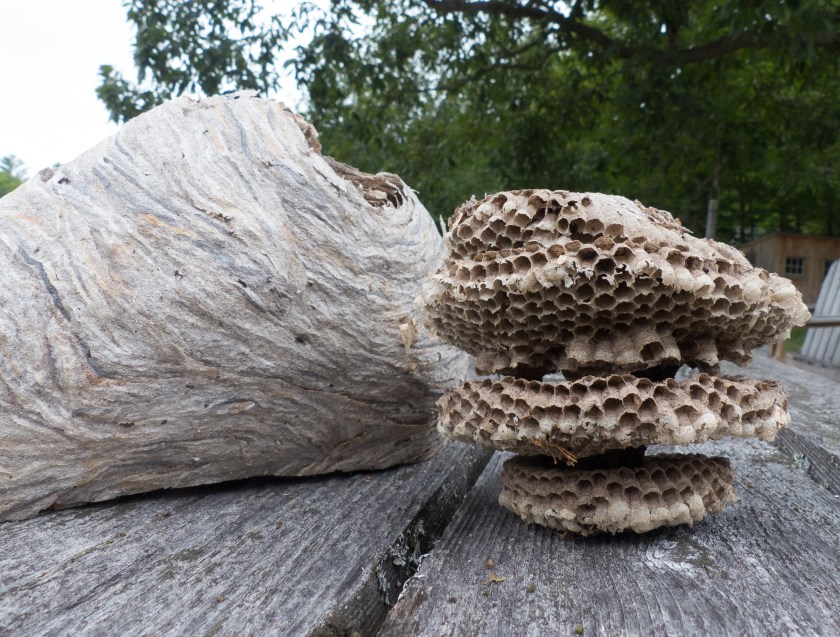
The next photo is the nest of Maine’s Bald-Faced Hornet, Dolichovespula maculata, not quite as big, but still a very respectably sized abode. They can reach two feet tall, and contain up to 700 workers:

They are intricate constructions. The outer case is layer upon layer of paper, like a mille-feuille pastry.

The outer layer conceals tiers of honeycomb chambers. This disembowelled one was in a lilac bush in my garden, and its inhabitants were responsible for a nasty sting which blew up one side of my face to unattractive proportions last summer.

The nests are built freshly every year, so taking one apart during the winter in the interest of science is OK, and also safe (post-frost) because only the fertilized queen survives the winter, and she hibernates elsewhere .

The Northern Paper Wasp, Polistes fuscatus, builds a smaller nest, and the cells are exposed, like this one under the eaves of our cottage. They are not very aggressive, and you can watch them at work, from a safe distance.

The queen lays a single egg in each cell. The developing larva is fed by the workers with such delicacies as masticated caterpillars. If you look carefully, you can see the light brown larvae in two of the cells near the bottom left of the photo below, and in the cells a little higher up there is a greenish sludge that I think is caterpillar puree.

When the larva is fully developed it spins a silken cream-colored lid for its cell, beneath which it pupates. You can see one in the centre of the photo above. Soon after, a new wasp emerges from the pupa, cuts off the lid, and crawls out into the world.

* Eusocial insects show an advanced level of social organization, in which a single female or caste produces the offspring and nonreproductive individuals cooperate in caring for the young.

Grand Designs of the Wasp World I

[Here is another post that I saved from a warmer month, to provide material to keep me going through this bleaker time of year.]

The three little pigs built their houses out of straw, sticks, or bricks. And so do wasps.

Imagine a wasp’s nest. Paper, hanging from a tree or some eaves, right? Well yes, but that is not the whole story.
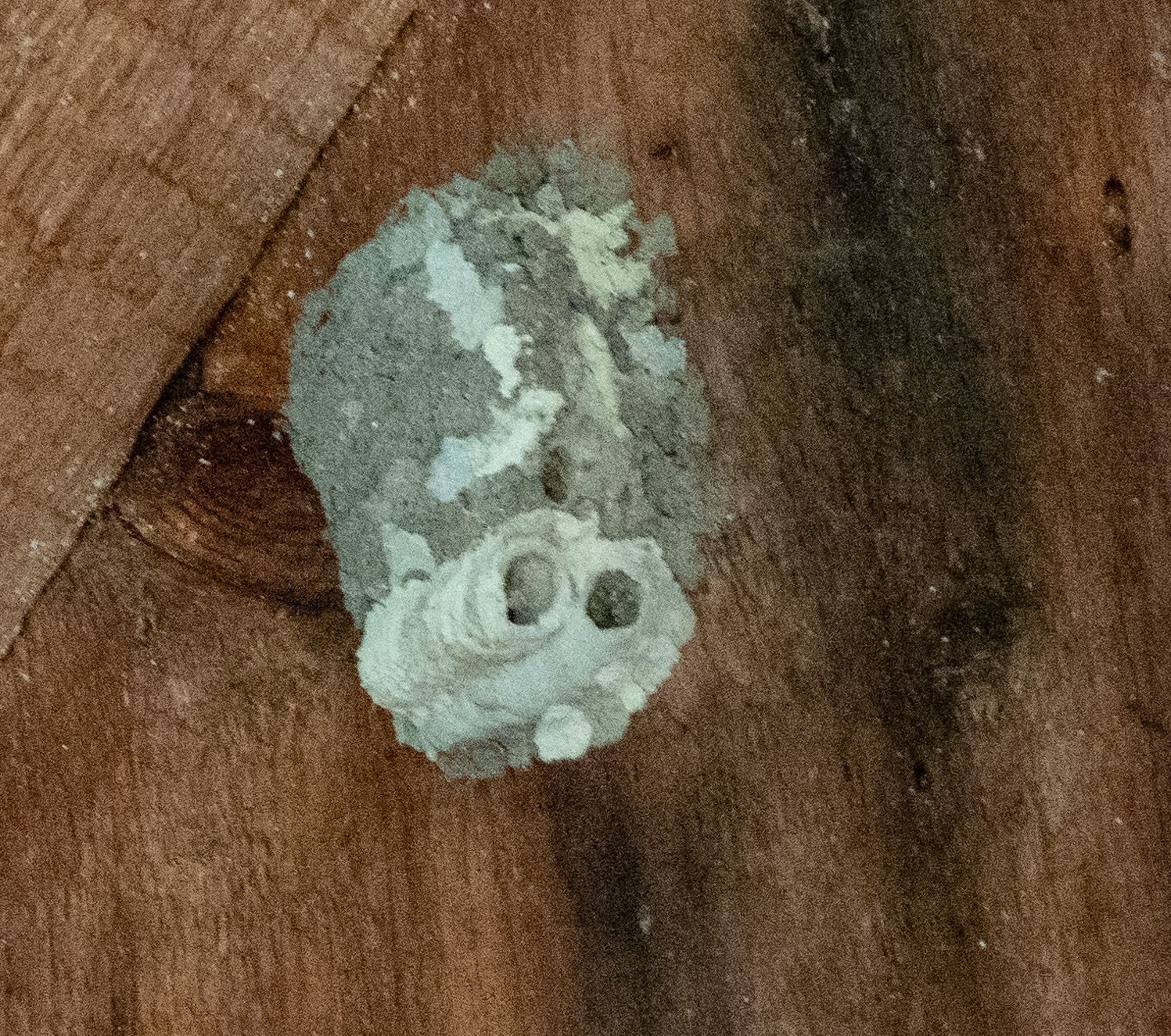
These wasps build their nests of mud (bricks!):

Mud dauber wasp nest

And add to them year by year:

Mud dauber wasp nest

The stucco nests are made by the Black-and-Yellow Mud-dauber wasp, which collects little balls of mud from puddles, and carries it to its building site. The different sources of mud produce the multi-coloured effect. 

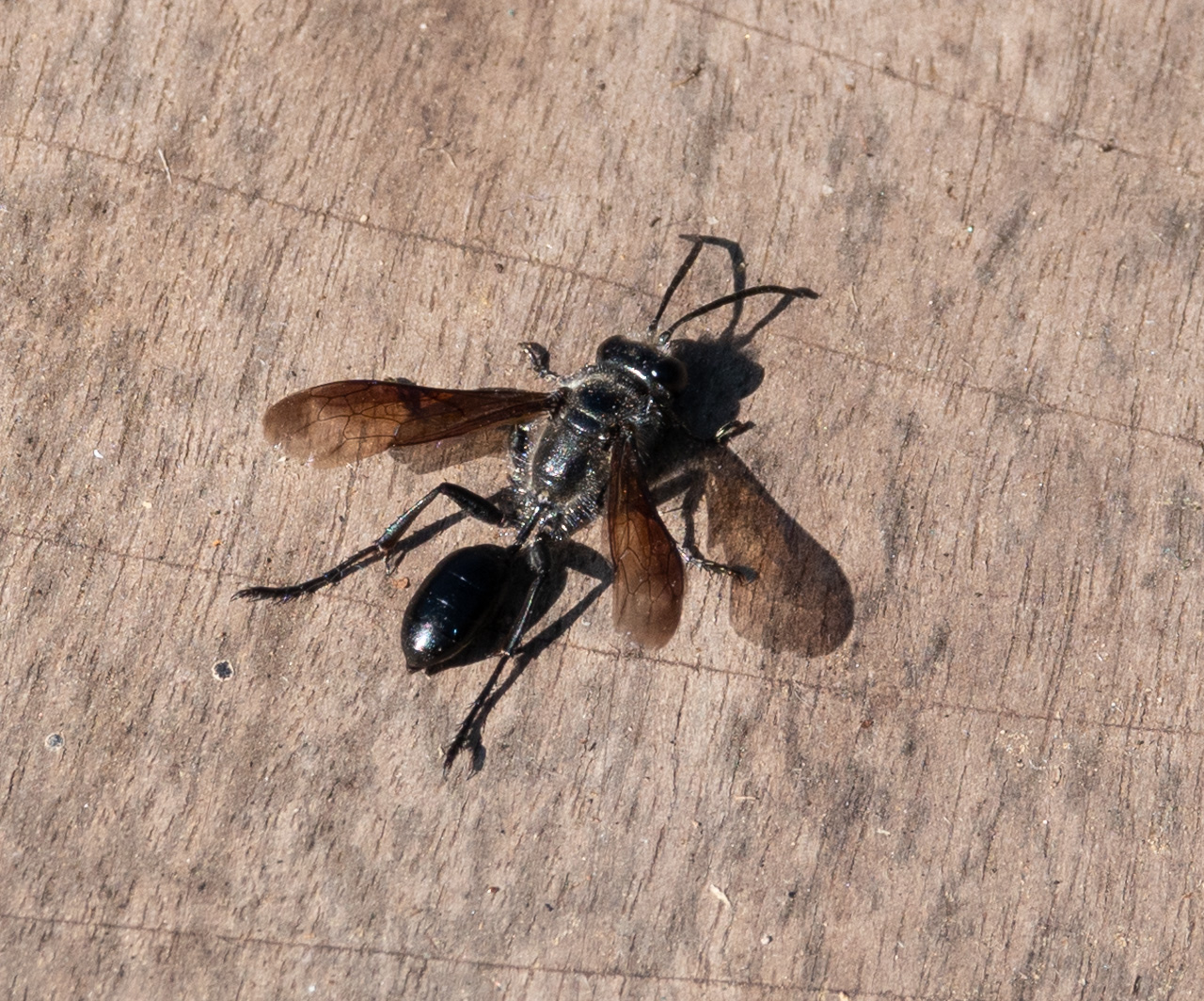
The Grass-carrying Wasp, Isodontia mexicana, builds its nest of grass (straw!):

Grass-carrying wasp, Isodontia mexicana

These solitary wasps wriggle into crevices, like this one between two shingles, where they lay their eggs:

Grass-carrying wasp, Isodontia mexicana

Then they carry grass in their mandibles and seal the hole up:

Grass-carrying wasp, Isodontia mexicana

In this last photo you can just see an empty papery whitish carcass of a tree cricket which they stash to feed their larvae.

Grass-carrying wasp, Isodontia mexicana

Next time, I’ll return to those familiar paper nests, made of masticated wood pulp (wood!), and take you into their innermost workings.

Beavers III. Preparing for lockdown: filling the freezer

[Thursday November 26th 2020 is American Thanksgiving, and I wanted this post to arrive in time for the day, which is why it is coming so fast on the heels of my last one.]

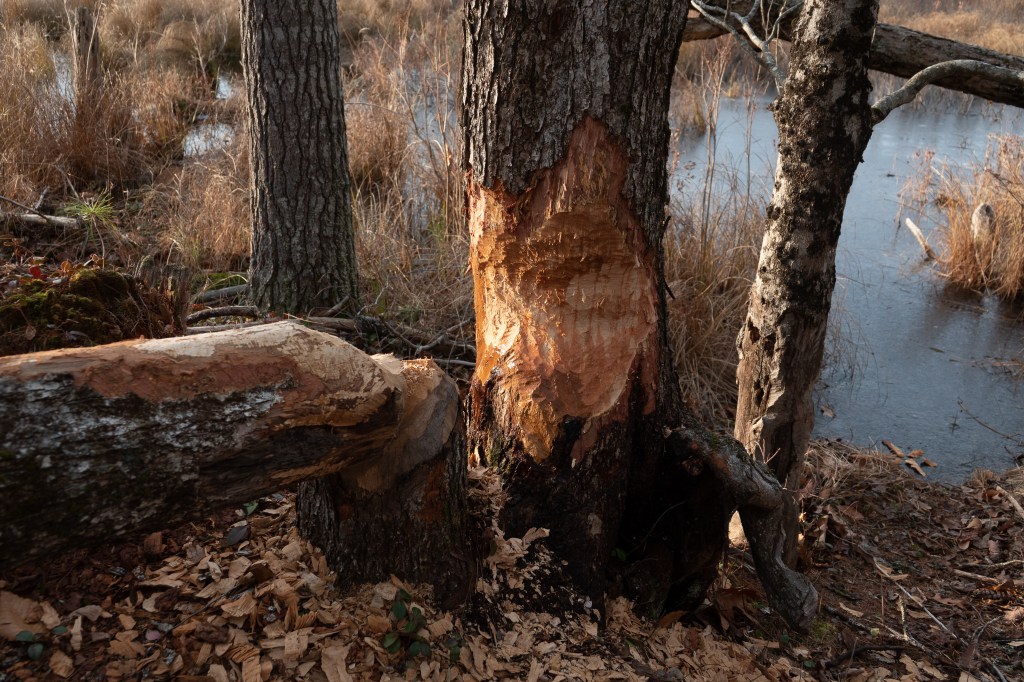
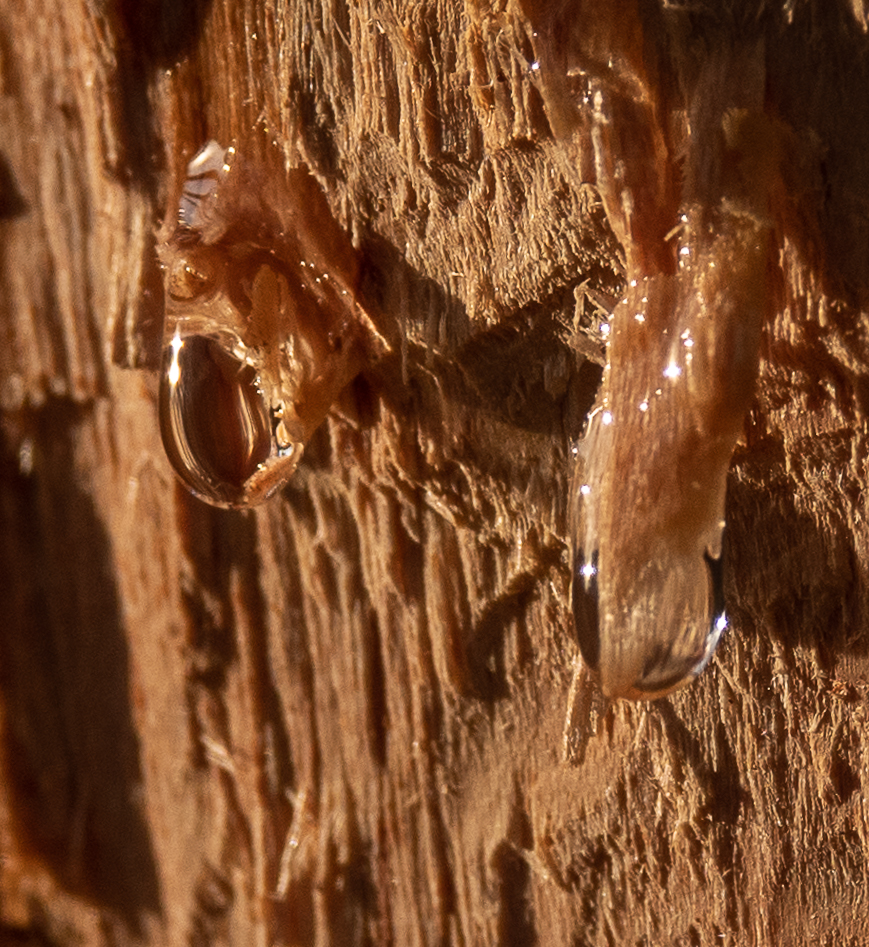
My lockdown preparations include filling the freezer, but obviously I didn’t have to design and manufacture my own freezer. Beavers basically do. In the summer, they eat fresh green plants, but these don’t store well. However, their digestive systems allow them to eat the nutritious cambium layer of woody plants and trees, which can be stored just fine; these two photos show an oak tree recently cut by a beaver, and the cut surfaces of the tree were oozing sap on an unexpectedly warm day:

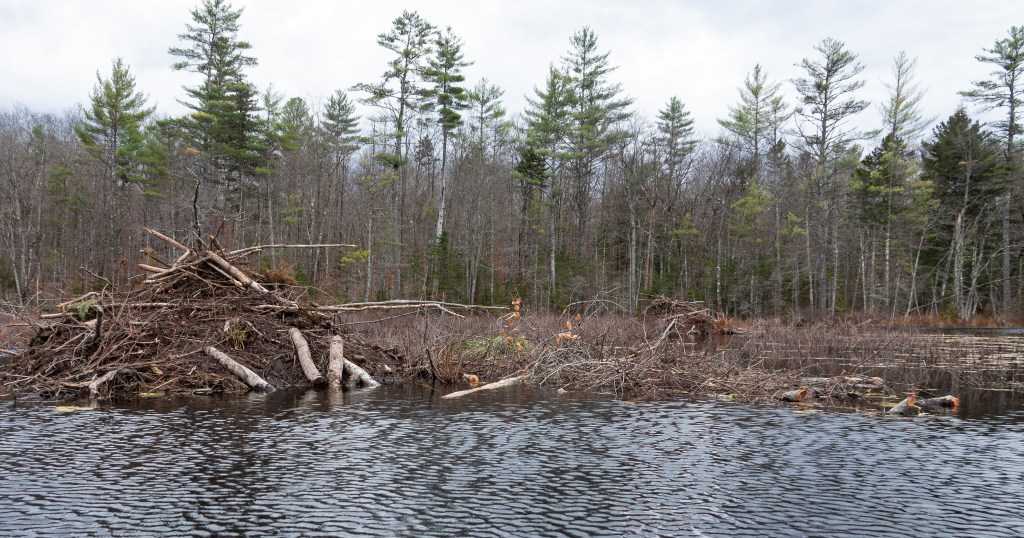
So how do they store them? The pond will be frozen soon, and it won’t thaw till the spring unless global warming intervenes. The beavers prefer not to emerge to forage on land, where they are vulnerable, so they lay down a stash of small and smallish twigs and branches, in a sort of floating raft, which they gradually weight down with larger branches. When the ice forms, this larder will be accessible from under the ice, and should keep them going through the winter months. In this photo, you can see the growing food pantry stretching off to the right of the lodge:

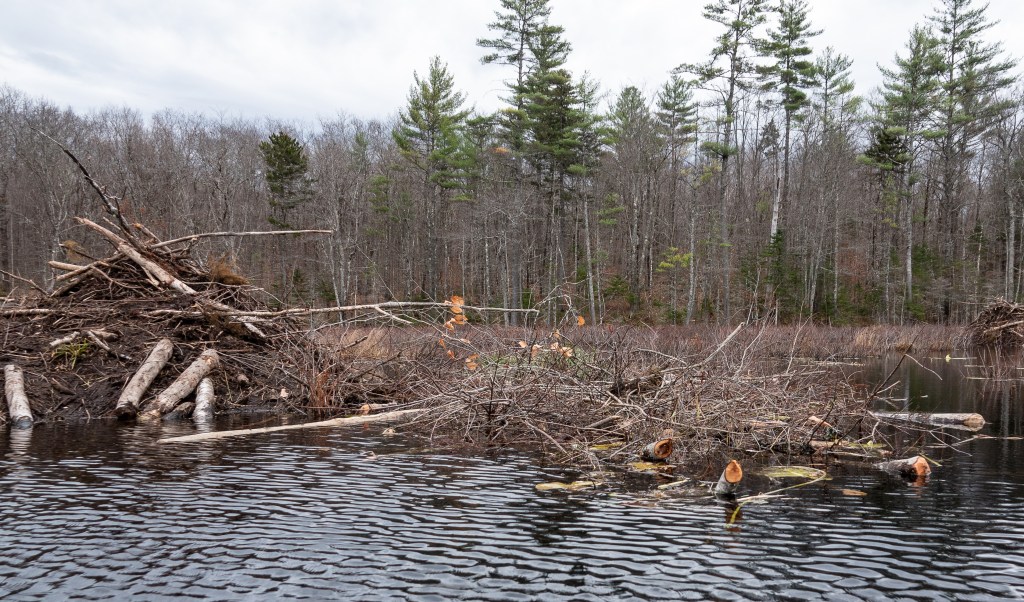
and a slightly closer shot here:

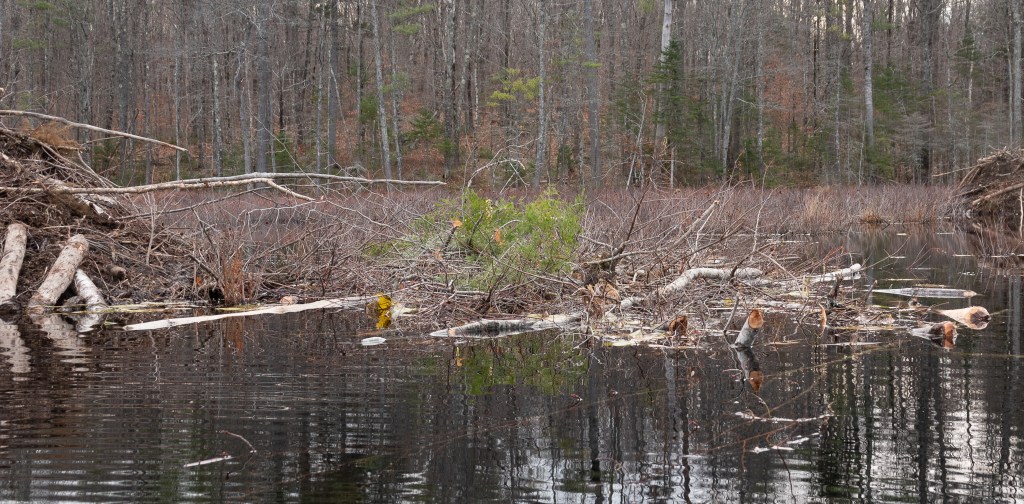
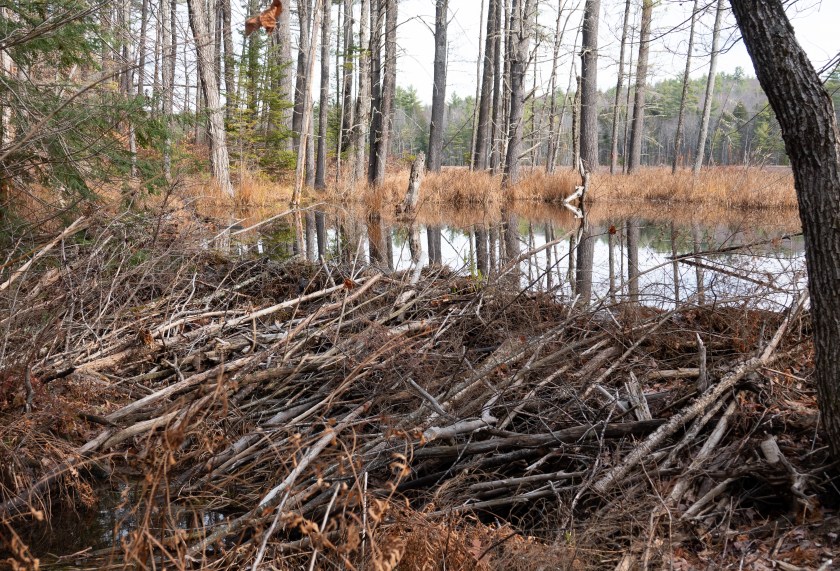
If you look carefully, in the right foreground there are larger branches sticking up out of the water. Their bottom ends have been rammed into the muddy bottom to help hold the cache in place. A couple of days later I took another look. They had added some larger stuff on top, to help weight it down so that their favorite foods stay sunk beneath the ice.

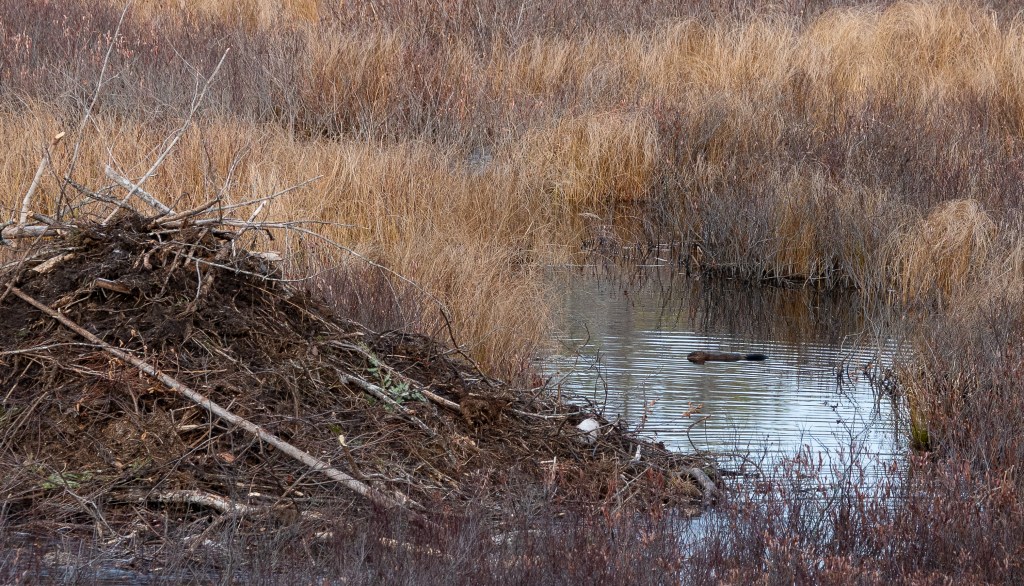
All of this is done at night, so all year I have not seen them at work. On November 15th this one was swimming languidly around one lodge, admiring his work (the beaver is what looks like a floating log on the right!).

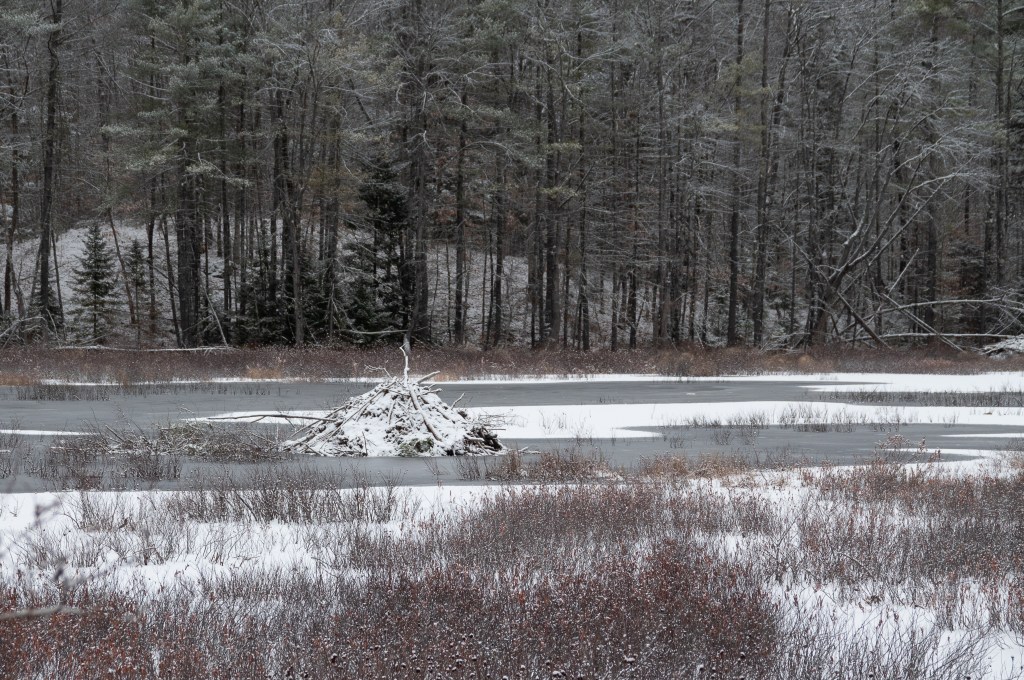
A good thing too, since overnight on November 18th the whole pond froze, and in places the ice was thick enough to bear my weight. And today, November 25th, it snowed a little, transforming the perfect cone of the lodge into a miniature Mt Fuji:

Winter is here, and it is time for Thanksgiving, and to remember how lucky those of us are who have food in our freezers, and are still well and alive in this wondrous world, in this time of Covid.

PS There are actually three lodges on my pond, all fairly near each other, and all seem to be under renovation, but only two have visible food stashes. I don’t know if this is one family that has decided they’d like separate bedrooms, or if they are unrelated but willing to tolerate neighbours. You can see all three in this photo, though one is far in the distance, between the other two:

PPS The dam needs regular maintenance too, but this one is in good shape, so they haven’t done much to it this year.

A beaver’s work is never done II

[The second part of the beaver’s labor of Hercules. One more part will follow, on their food preparations.]

Now that the beavers have got everything ready, the construction project can begin.

The lodge may be a new-build, or a renovation of a fixer-upper. This year, it was the latter. This one is out in the middle of the pond,

so I took my kayak out to get close enough for a good look.

There is no intricate weaving like a bird’s nest, but the beavers create a rough tepee, and a hole is left open at the top for air to escape.

Once the structure is in place, they add a layer of mud, plastered down carefully:

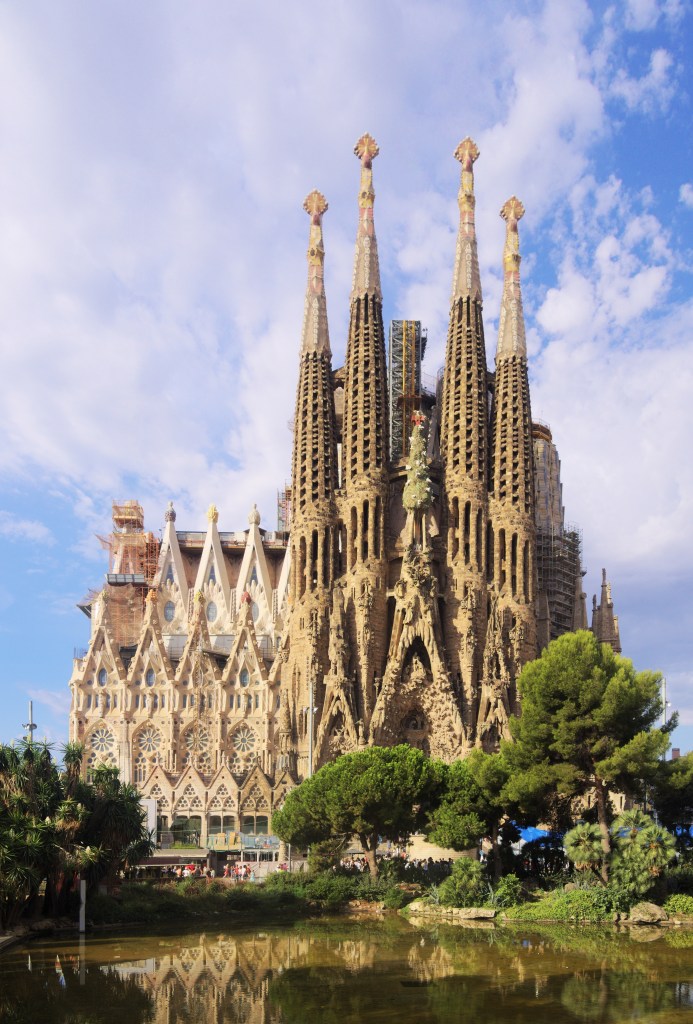
More branches and mud get added as they see fit. Sometimes they seem to get over-excited and build higher and higher, like this exuberant creation, the Sagrada Familia* of Western Maine:

If this was a new lodge, once they have created a giant heap they would excavate the inside from underwater, creating a chamber for the adults and, hopefully, their young, who will be born in mid-winter.

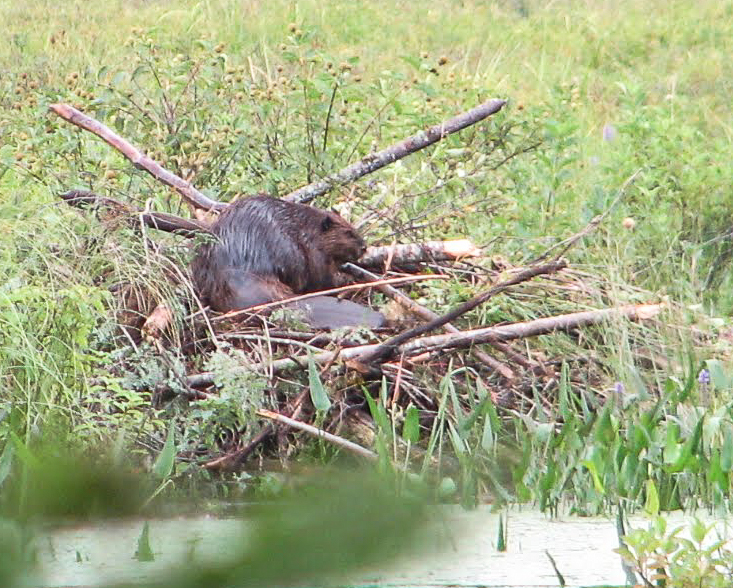
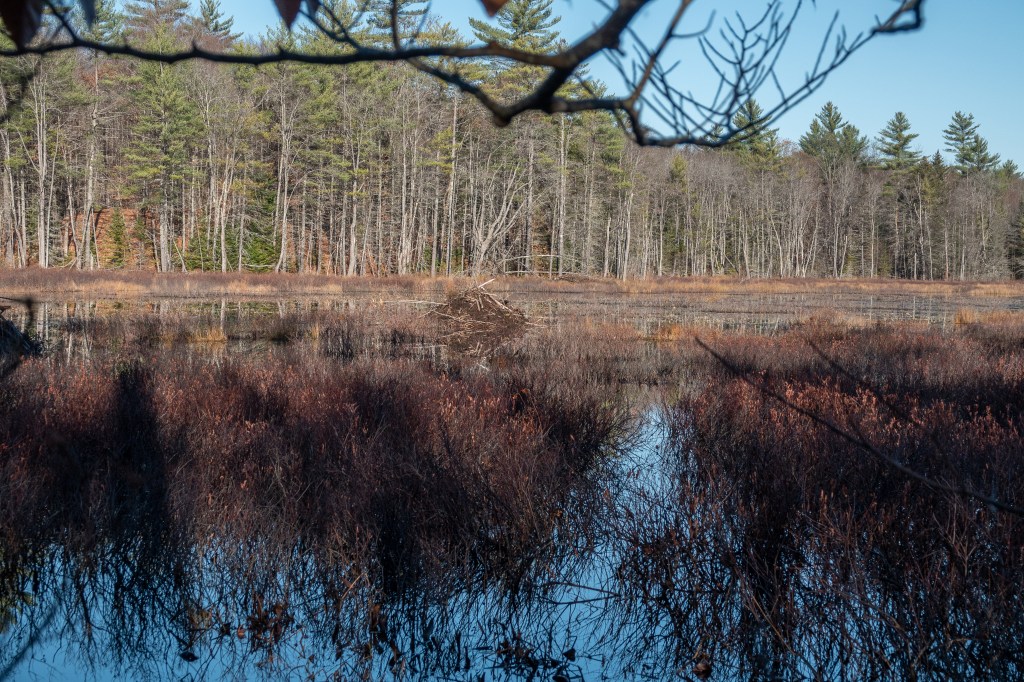
Because they are nocturnal, I rarely see them at work, but eight years ago I captured this shot of a beaver building his abode, on the same beaver pond:

Talk about D.I.Y. I think I’d rather get the builders in.

* Sagrada Familia is a cathedral in Barcelona designed by Gaudí, started in 1882, and scheduled to be finished in 2026! It is famous for its pseudo-Gothic over-the-top extravagance:

OLYMPUS DIGITAL CAMERA

A beaver’s work is never done I

[This is the first of two or maybe three posts, that together tell a saga.]

It is November, and I am now cocooning, planning a bathroom painting project, stocking the freezer, and knitting a Christmas stocking for my granddaughter. But a beaver’s version of settling in for the winter is much harder work.

They survive the cold months largely inside their lodge, built of sticks and mud, with an underwater entrance. This is much more work than choosing the right paint color. The supply chain logistics are formidable.

First you cut down your tree(s):

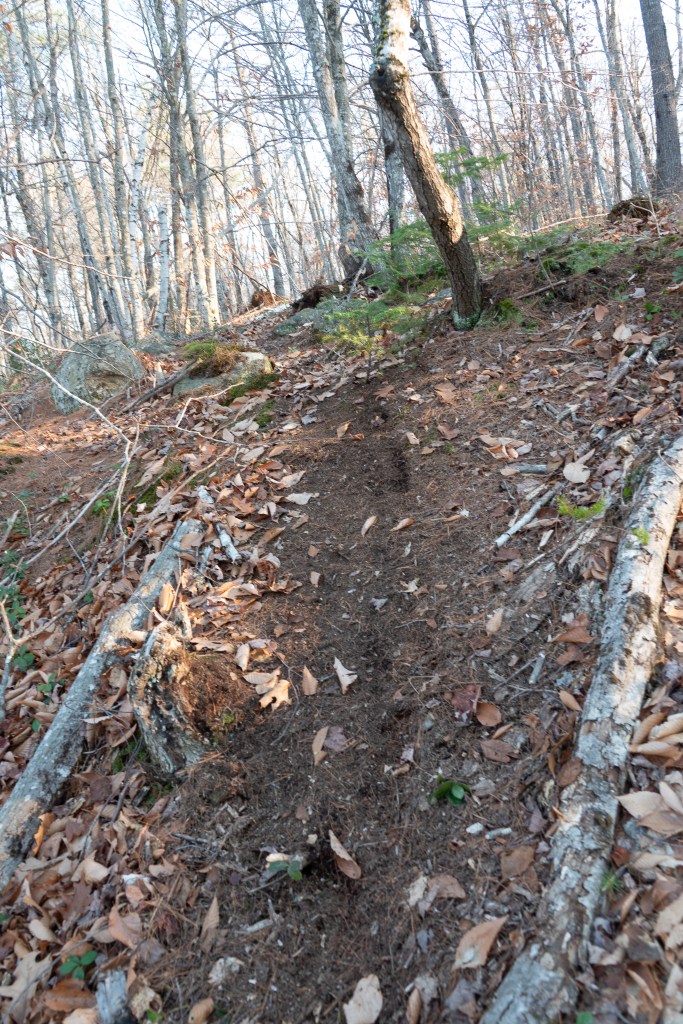
If necessary, you drag them cross-country, including down steep hills, to the water’s edge:

You cut off all the small branches (see later), but don’t waste all that nutritious cambium. Then you chew off all the outer layers from the trunks that are too big to use.

The middle-sized branches and slender trunks are cut into pieces small enough to manage:

Finally, you float everything useful down the canals that you’ve created through the rushes, to your distant lodge:

Once you have your raw materials in place, you have two tasks. Get the lodge watertight and cosy, and lay down food supplies for the winter. And that is the subject of my next post.

Tufty caterpillars

Winter is coming here, and things are quieting down.  I will take the opportunity from time to time to show you things from earlier this summer that for various reasons I never sent out.

The world of caterpillars is one that fascinates the inner child in all of us, ever since we read for ourselves or to our children and grandchildren Alice in Wonderland, and then  The Very Hungry Caterpillar by Eric Carle. Some of my favorites.

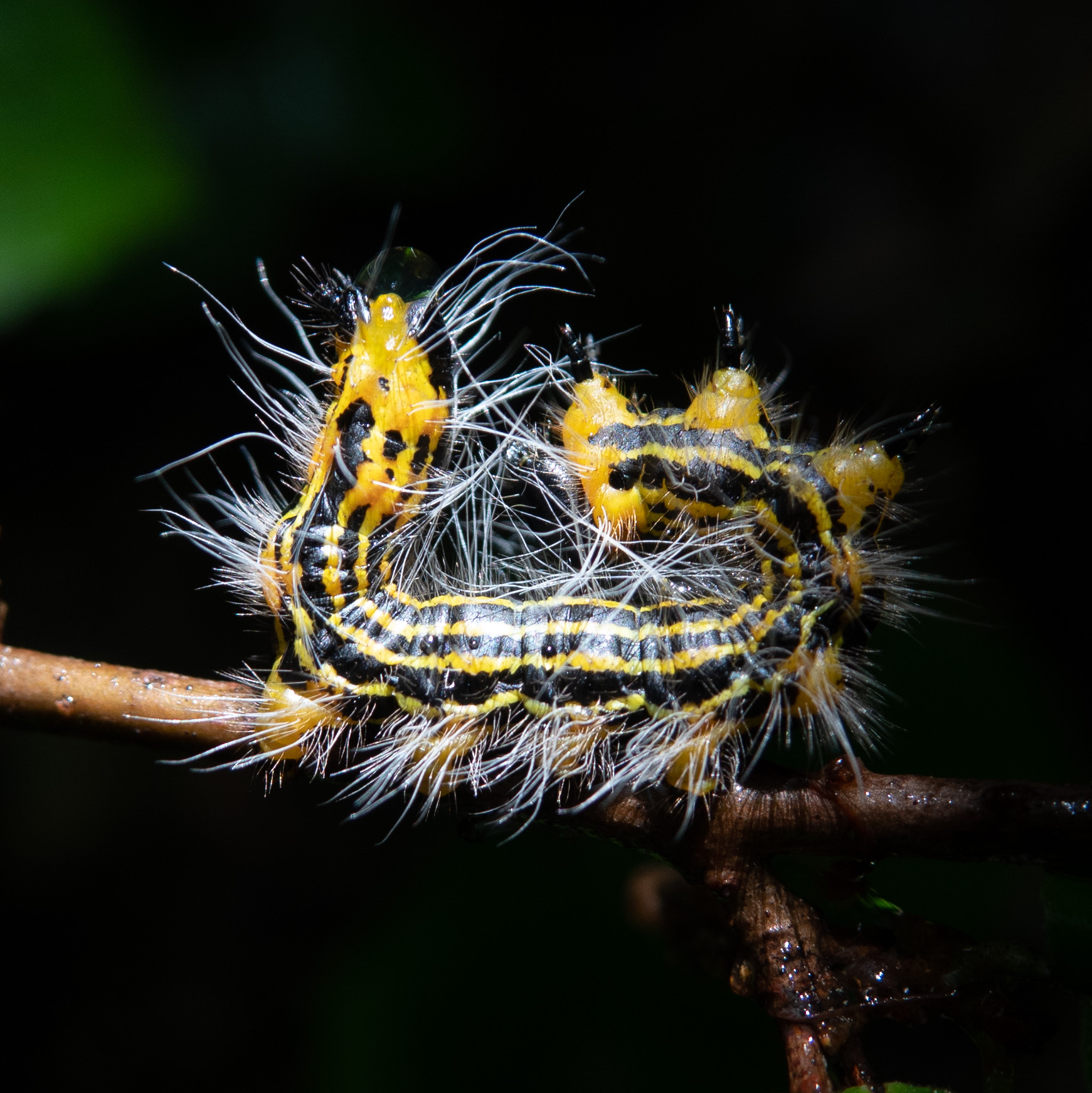
This is a Yellow-necked caterpillar, Dayana minister, in defensive posture, holding on only with its prolegs and curving up both ends of the body in a perfect yoga pose. *

Yellow-Necked Caterpillar

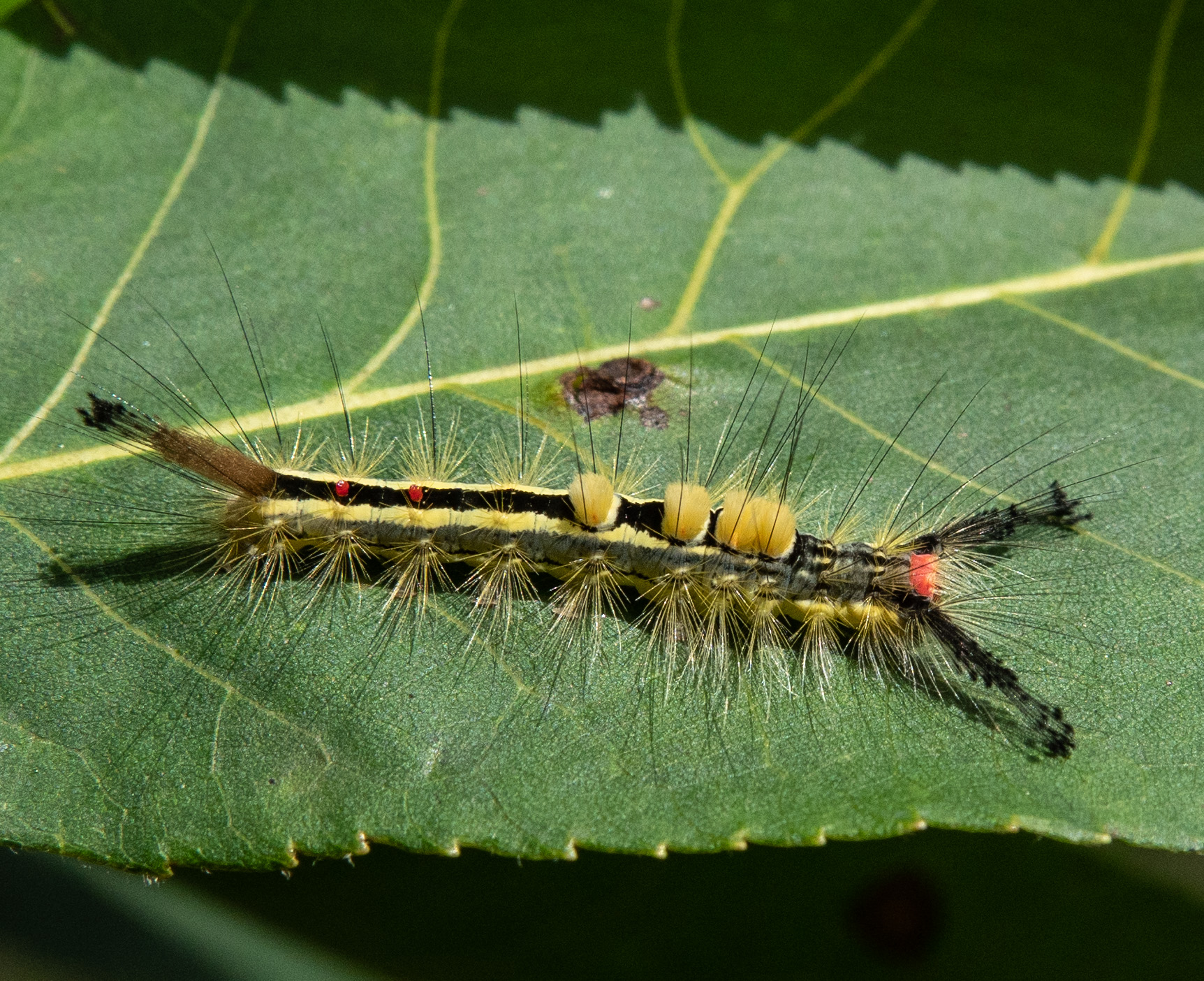
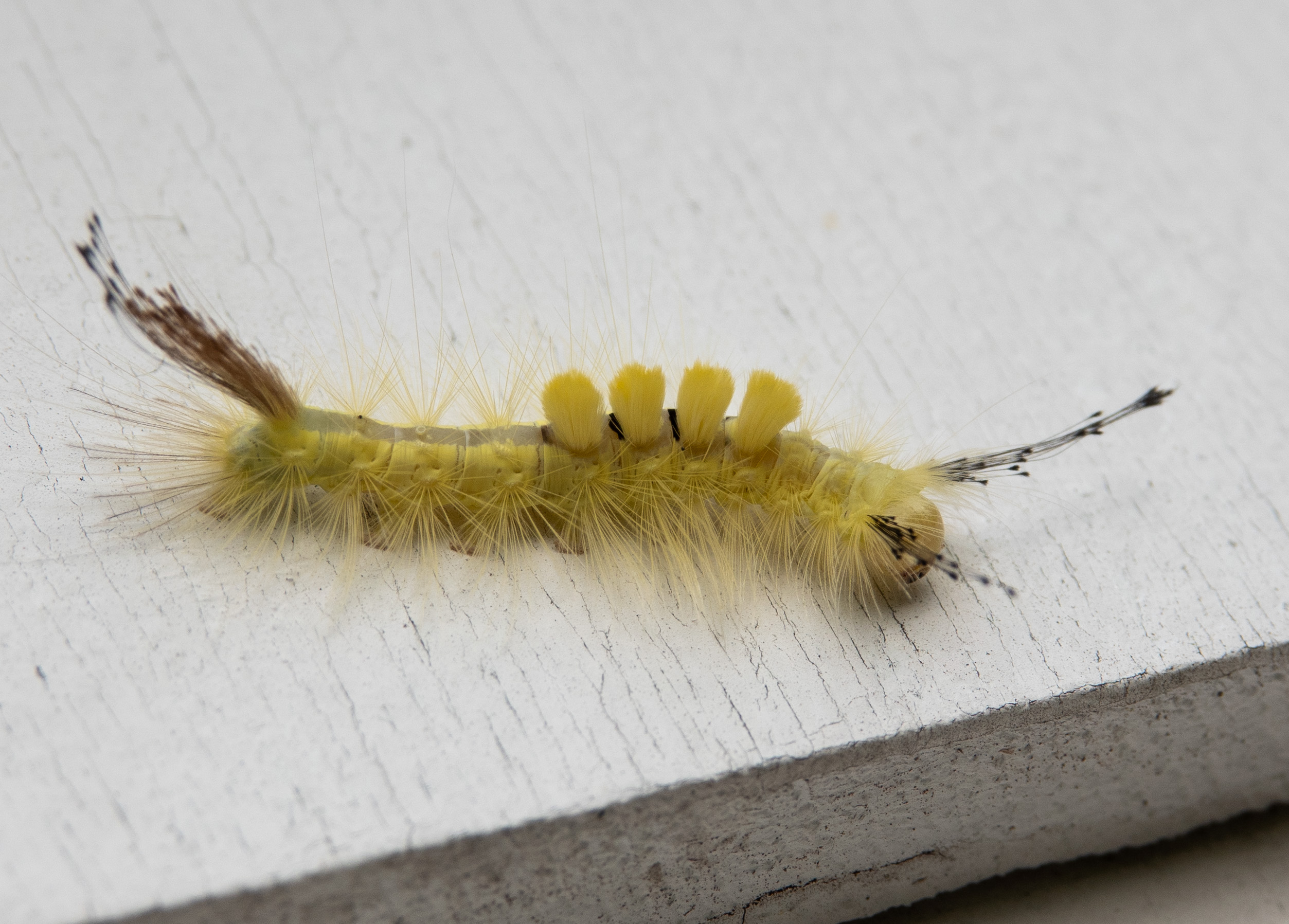
The true stars of the punk caterpillar world are the tussock moths. This is a White-marked Tussock moth:

White-marked tussock moth

A Definite Tussock mothWhite-marked Tussock Moth, Orgyia leucostigma

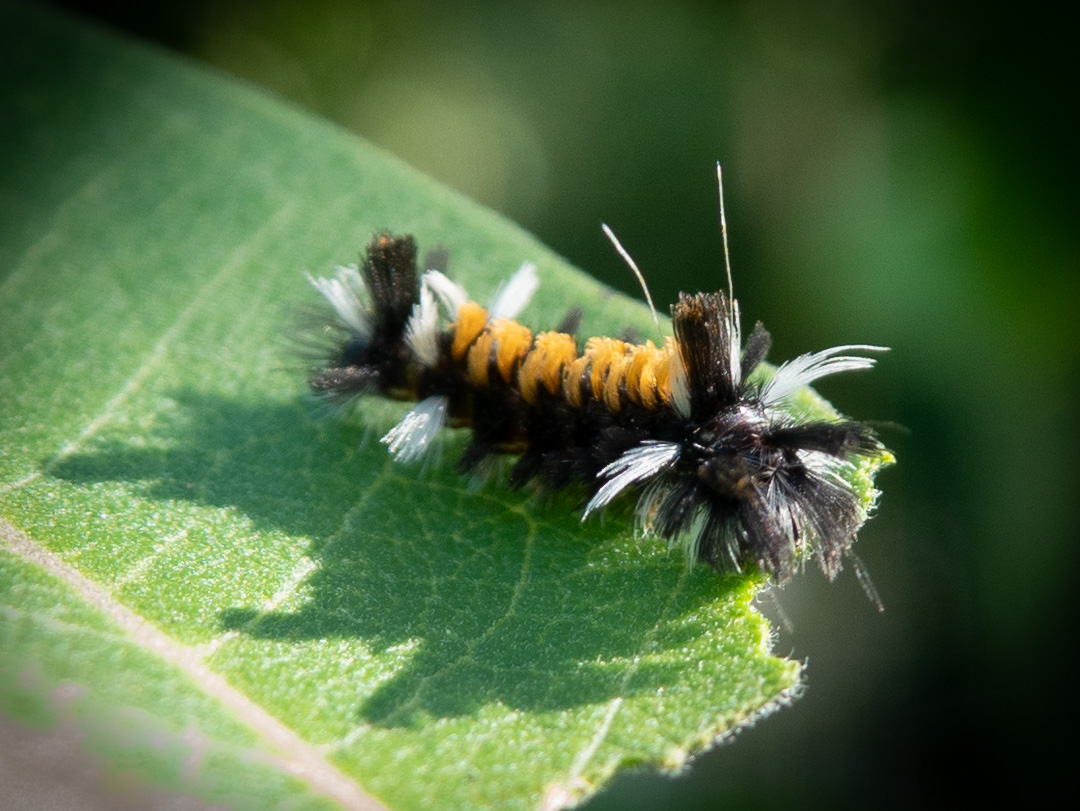
A Milkweed Tussock moth, looking just like a miniature schnauzer:

Milkweed tussock moth

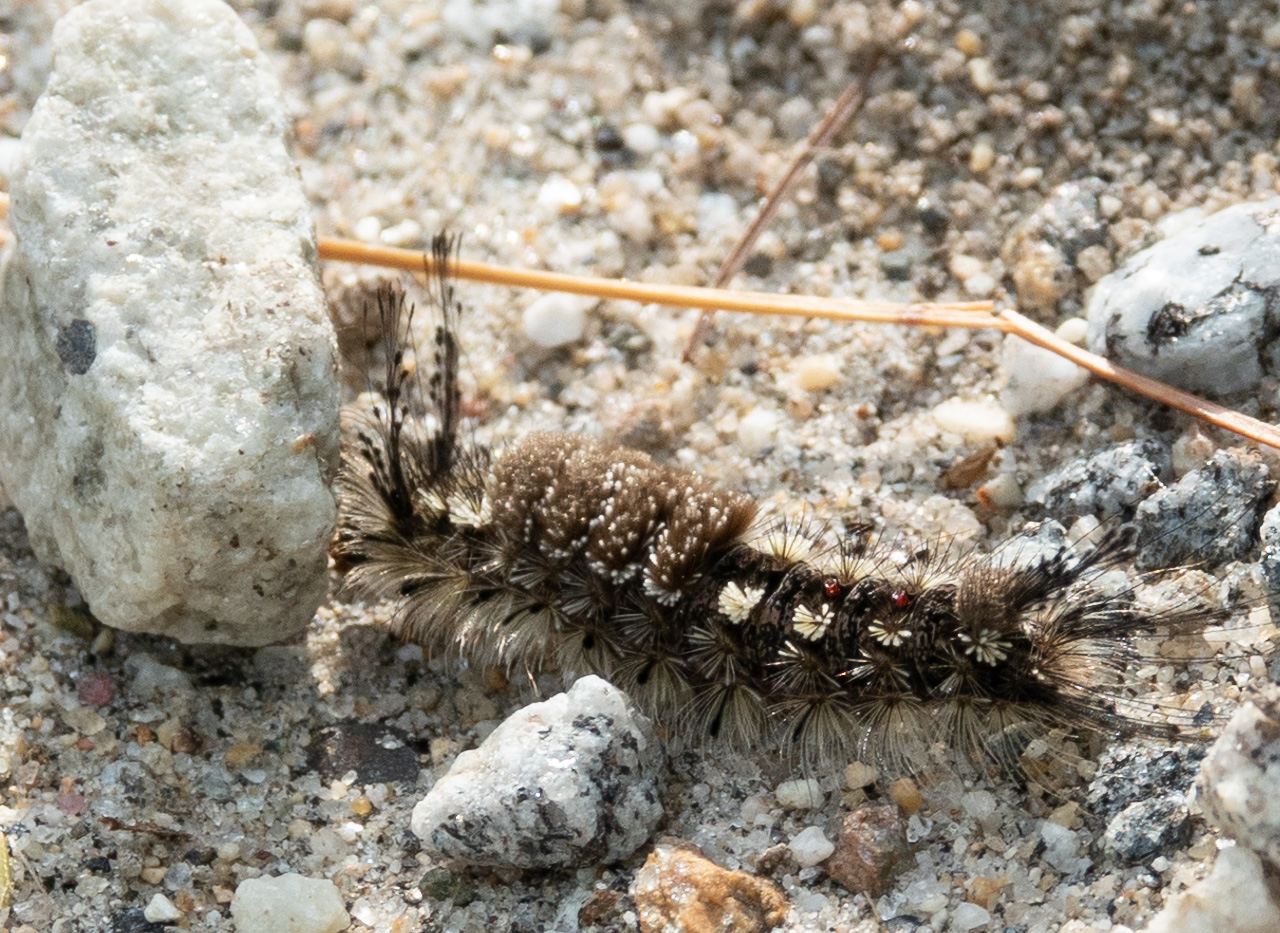
A Pine Tussock moth

Pine tussock moth caterpillar

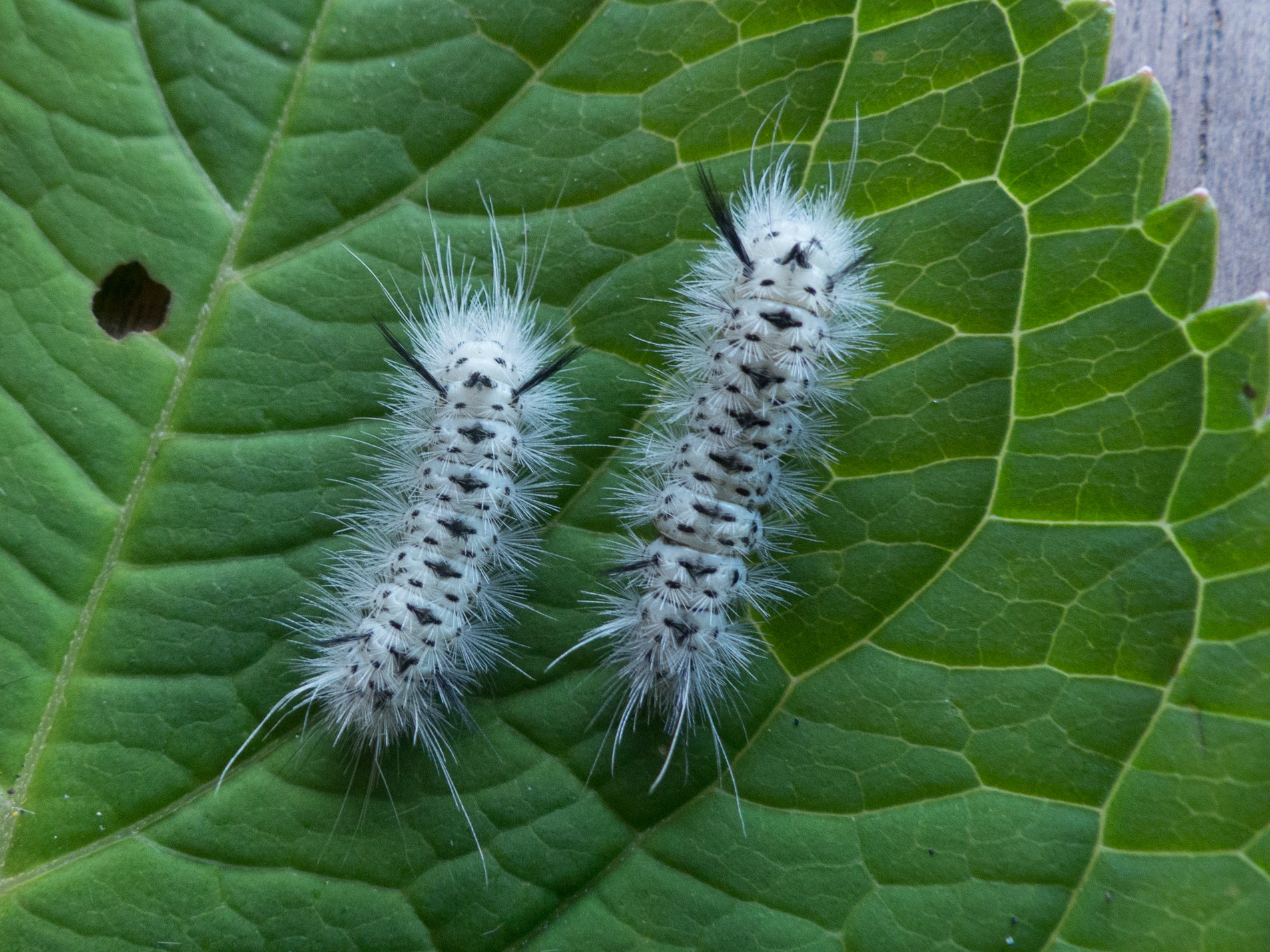
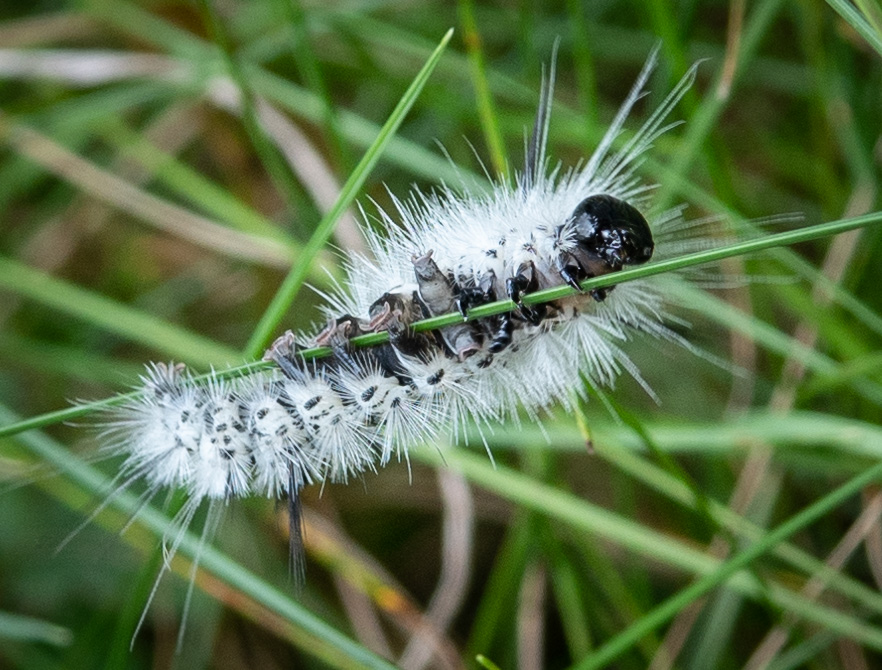
And two Hickory Tussock moths:

Hickory Tussock Moth caterpillar

Caterpillars have very cool feet; the one in the photo below is traveling at full speed, so the first pair of prolegs are in mid-air.*  Olympic gymnasts on the balance beam cannot compare.

DSC06737

Not so endearingly, the spines (setae) of tussock moths can cause skin irritation. Each spine (seta) has a tiny poison sac at its base.

Diagram of urticating seta and associated venom gland of whitemarked tussock moth (Orgyia leucostigma).

Figure 25. Diagram of urticating seta and associated venom gland of whitemarked tussock moth (Orgyia leucostigma). Redrawn from Gilmer (1925) by Jane C. Medley, University of Florida.

* Caterpillars have six true legs, like the butterflies and moths that they will become, and several further sets of prolegs, stubby short plump appendages that support the rest of their long bodies.

Fine feathers make fine ducks

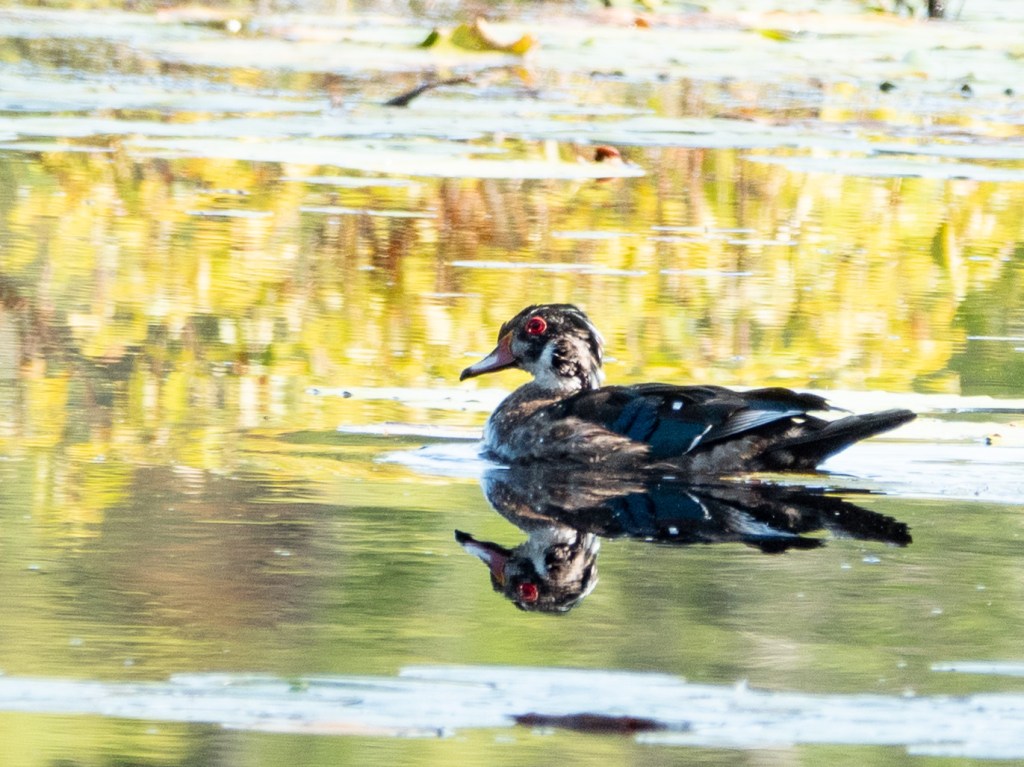
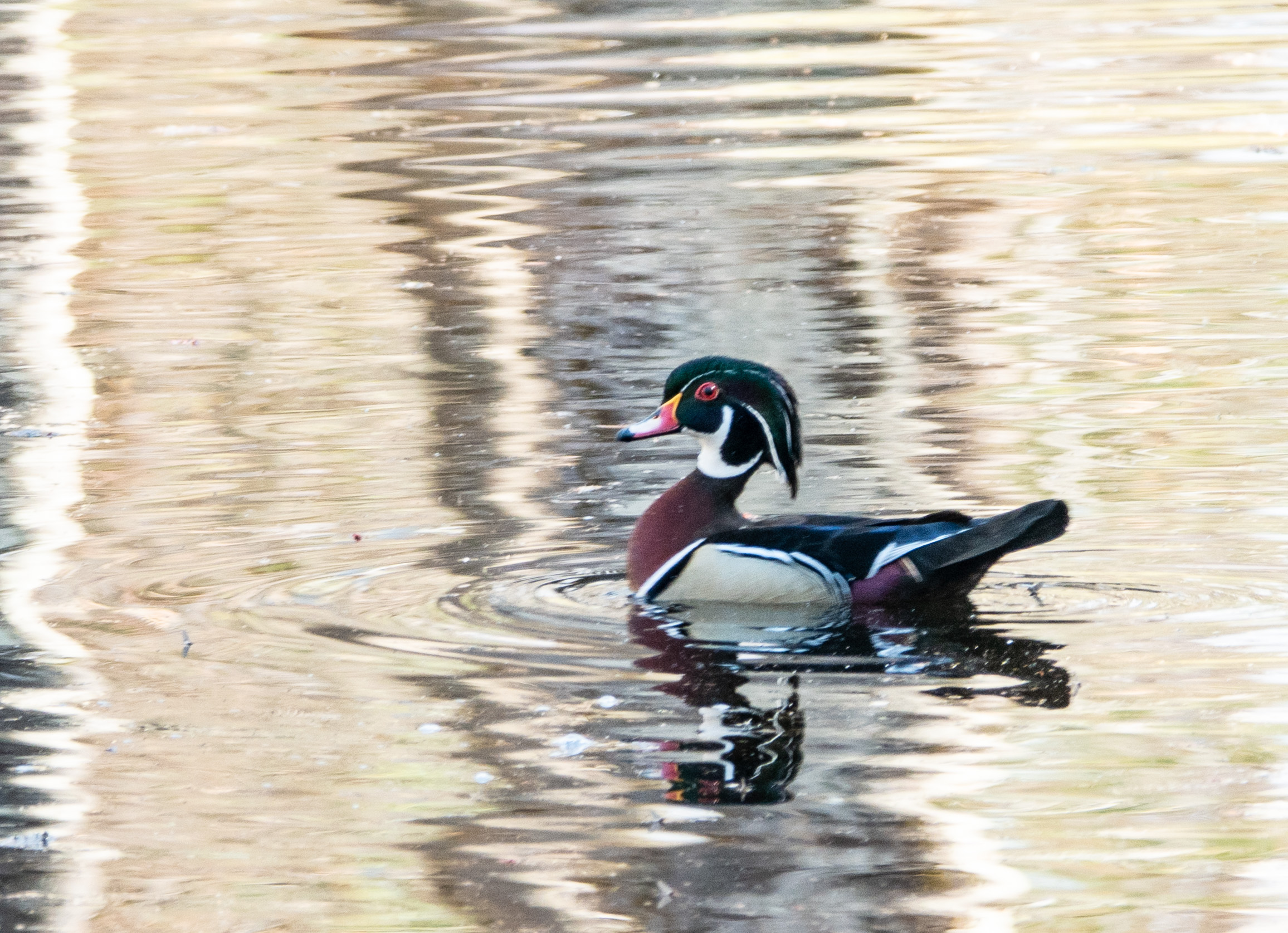
During all that child-rearing that you saw in my last post, the male was sometimes around, helping out, but by July 2nd his breeding plumage was largely gone, and he was changing into “eclipse” plumage, a rather wonderful term for a bird whose glory has faded now that he has his mate. (Although I am not sure I want my current natural hair color to be termed my “eclipse” phase.) The white neck markings remain all year.

Wood duck

By the middle of August, the birds have dispersed, and I found this solitary male, now in full eclipse plumage, but still with his distinctive red eye

Wood duck

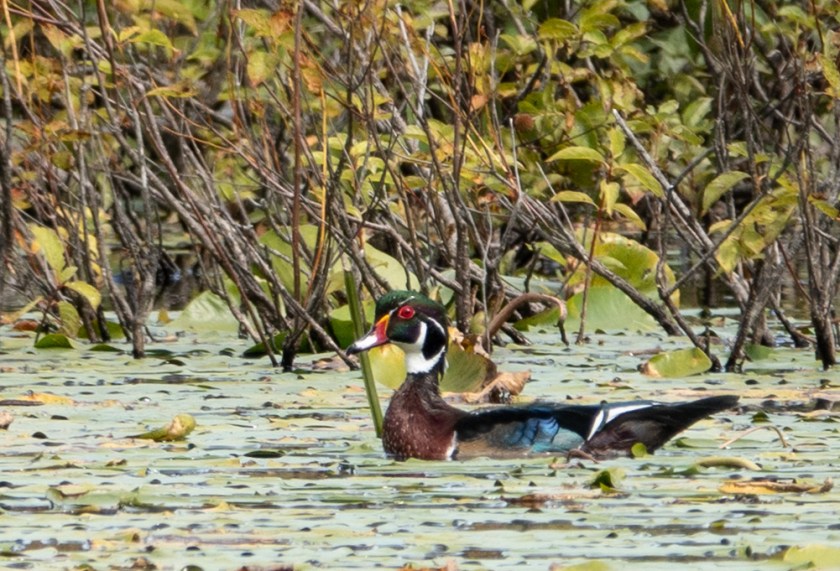
The eclipse plumage is short-lived. As summer starts to wane, they prepare for a new season. Instead of waiting for spring, they set out to attract the females even before the migration starts. This September 7th photo of a scruffy and embarrassed-looking male shows the first glimpses of the return of the breeding plumage

On September 12th , his head is getting there, but the rest of him is still pretty drab.

But look at him on September 2oth: the head is transformed, but the body is not there yet

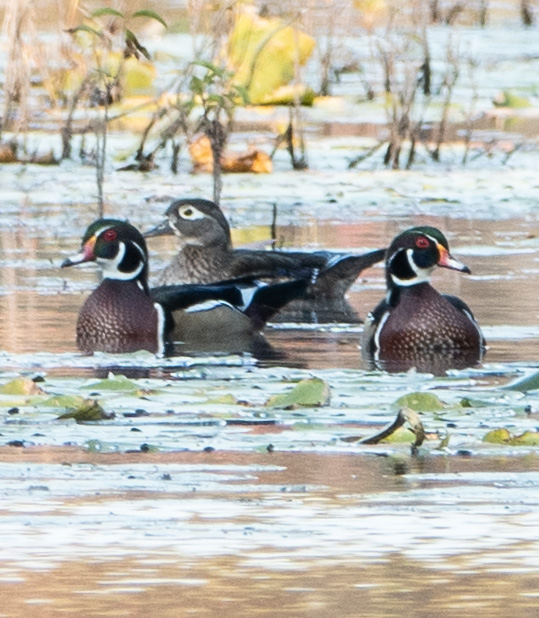
Finally by September 26th he and his friend look like this, and this new attire seems to be pulling the birds, (a 1960’s UK expression, for readers too young to know), since they were accompanied by two females, one of which is in this shot.

Just for comparison, here is his outfit on May 12th, so he still lacks a few final touches:

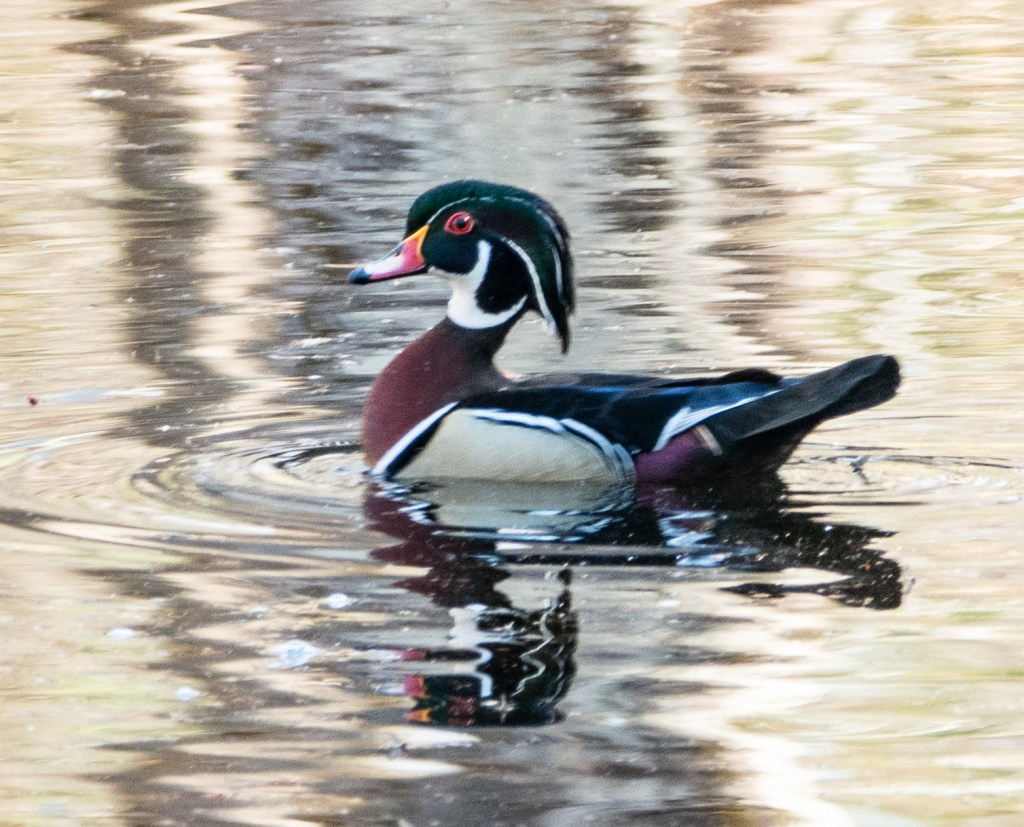
But on October 12th, he is returned to his former glory, floating on the autumnal reflections:

PS: The mechanics of molting are quite complex. Like many ducks, there are two molts each year, in spring and fall. In the spring, only the body feathers are replaced, removing the bright breeding plumage and producing the more discrete “eclipse” plumage. In the late summer to fall, first all the wing feathers are replaced, simultaneously, meaning that for about three weeks they cannot fly. Then, once they are mobile again and able to flee from predators, the body plumage is molted and the highly visible breeding plumage comes back in. They are now ready to attract females again and pair formation begins. Because they are helpless for part of this long molting process, they often fly to special secluded molting grounds in the far north, returning to the breeding ground once the process is complete. But some stay in situ, as my photos show.

PPS: I have told this story as if I have been following a single male through his plumage changes, but of course I cannot tell one male from another, so I am sure it is a series of different ducks!

Wood ducks galore

Of the local ducks that breed here, the most dramatic are the Wood Ducks, Aix sponsa.  They are here from spring to fall, and I have been watching them for the whole breeding season, starting on March 28th, too far away for good photos.

They are very shy, but a pair flew in over my head on May 12th without noticing me, and settled down. The males in breeding plumage are extremely handsome, bedecked in an almost military outfit:

Wood ducks

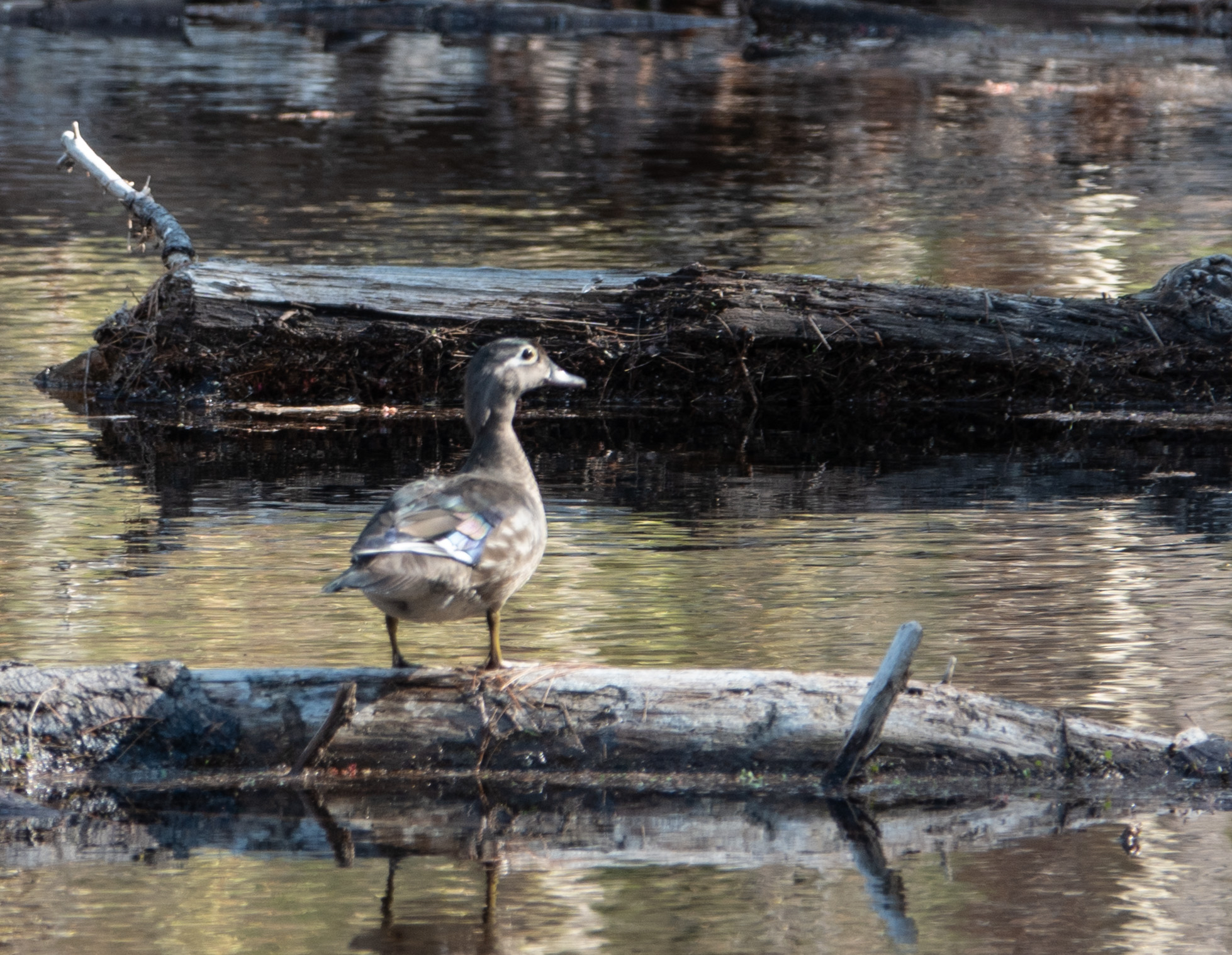
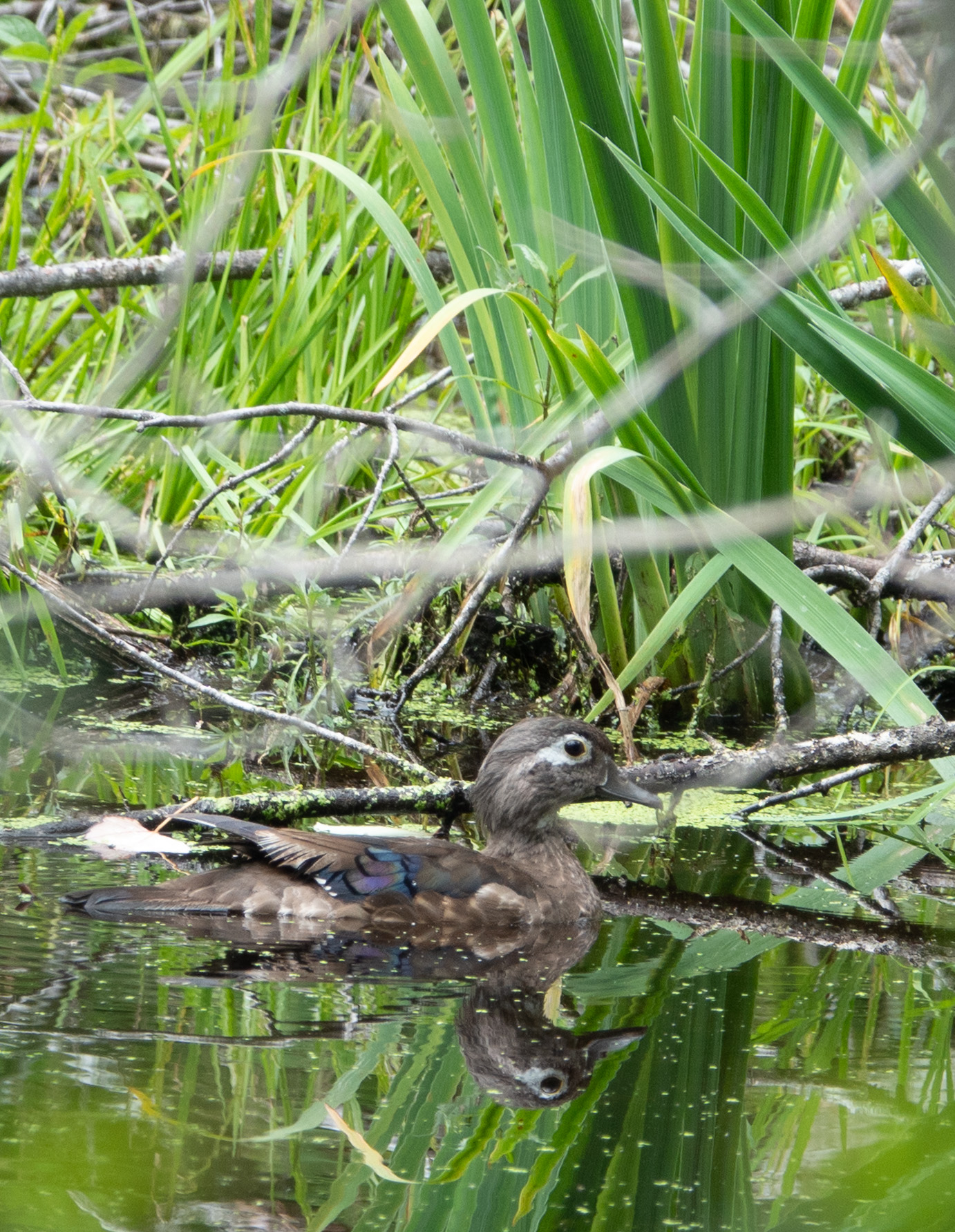
The females are much more discreet, but the large oval white eye marking helps to distinguish them from any other brownish duck:

Wood ducks

This year they are breeding on my biggest beaver pond.  They nest in holes in dead trees, like this one, which I suspect is where they were breeding this year:

Possible wood duck nest hole

Once they have ducklings, they become easier to photograph, because they cannot fly off when they hear the slightest sound or catch a tiny movement. The next photo was taken on June 18th:

Wood duck and ducklings

On July 2 all six were still there, and beginning to leave her side and venture out alone:

Merganser duckling

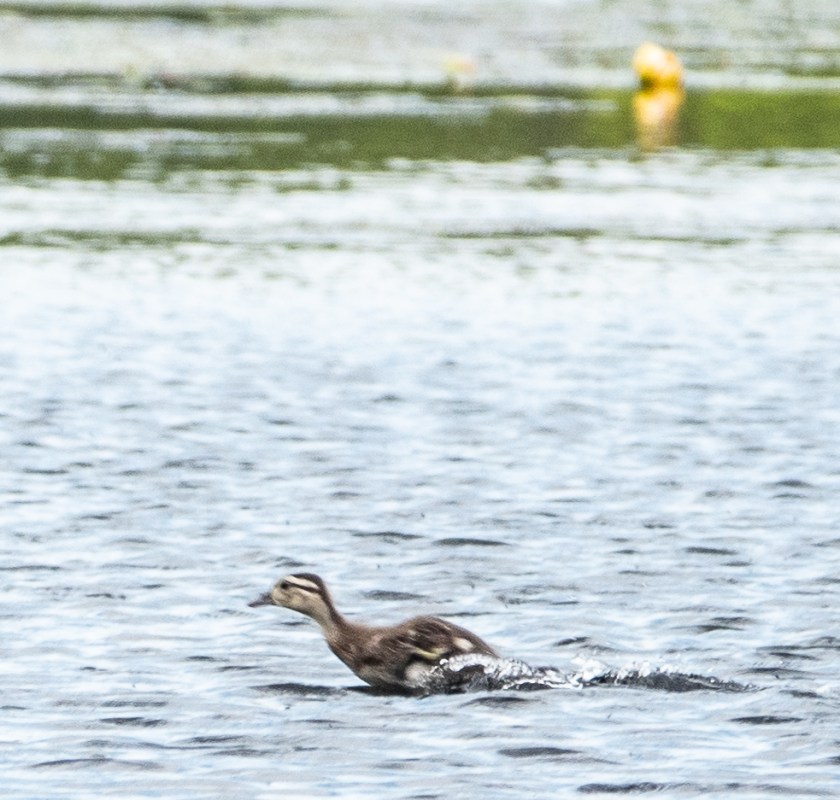
Still too small to fly, if startled they ran along the top of the water, desperate to get to the safety of the rushes:

This image has an empty alt attribute; its file name is dsc08122.jpg


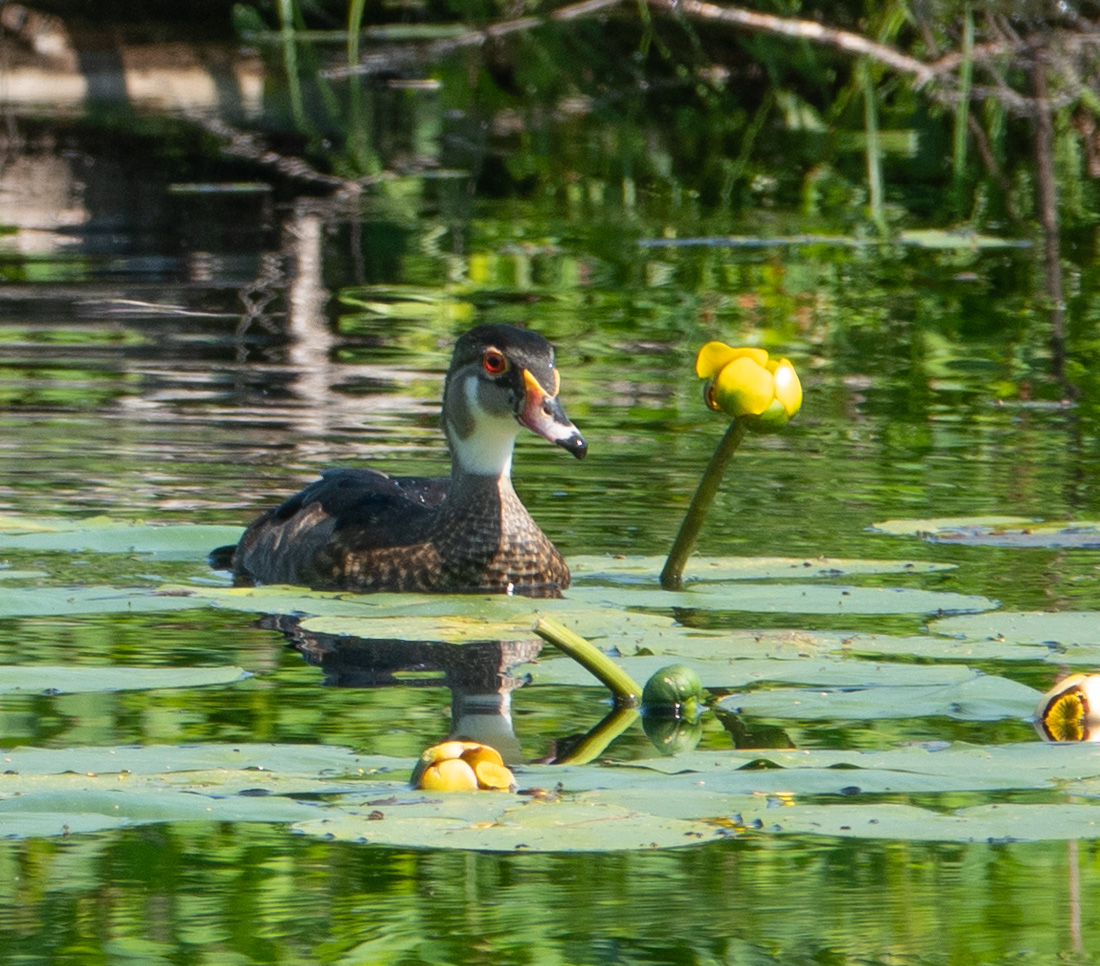
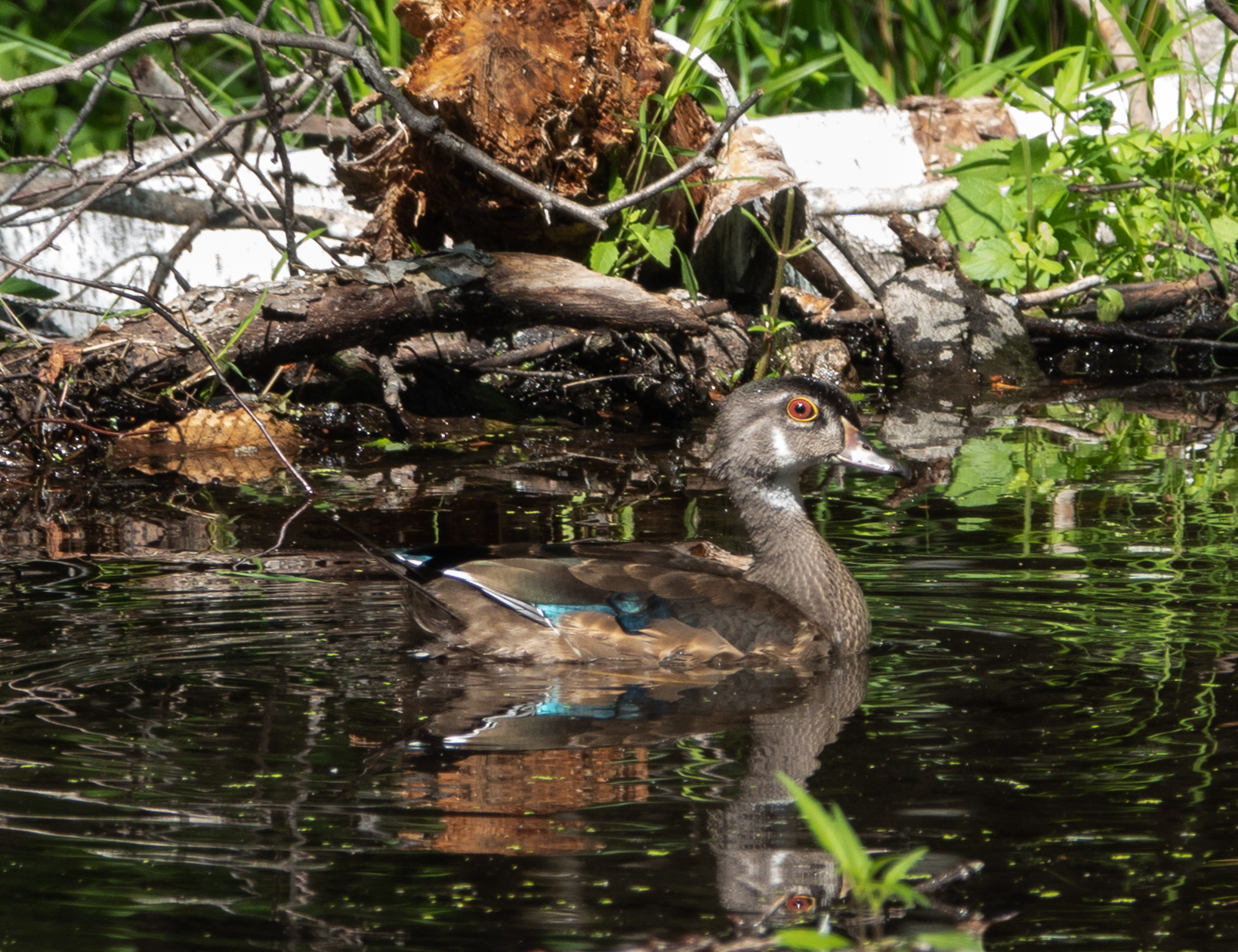
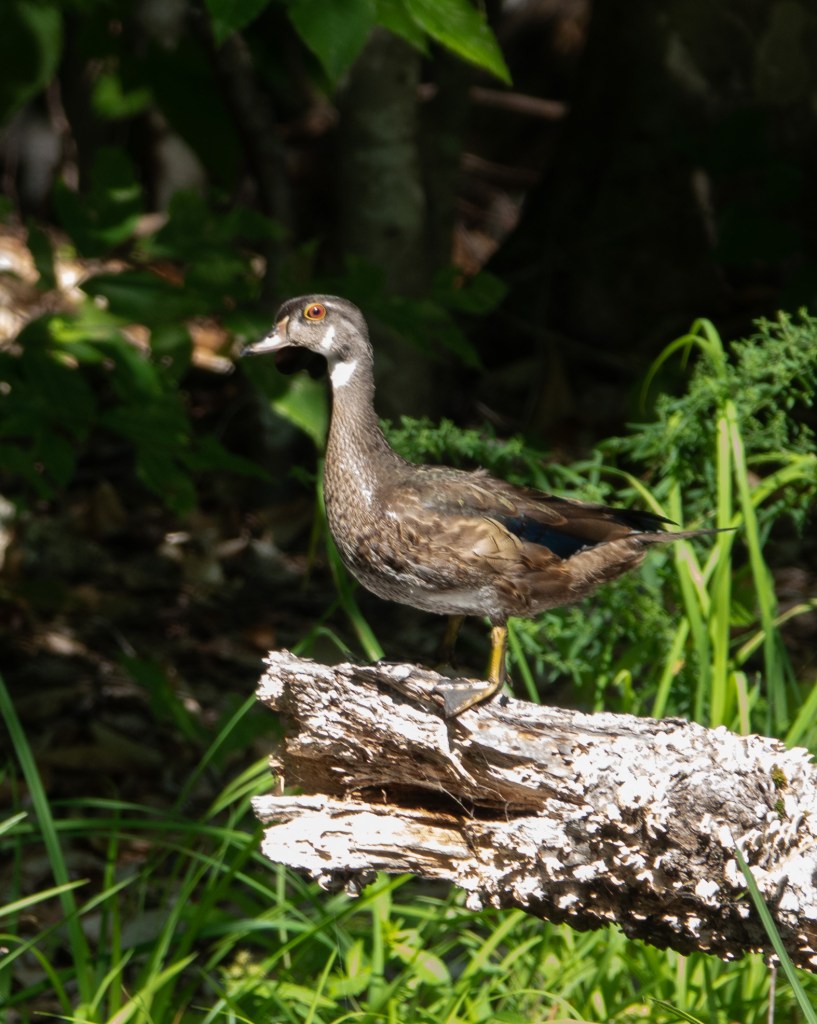
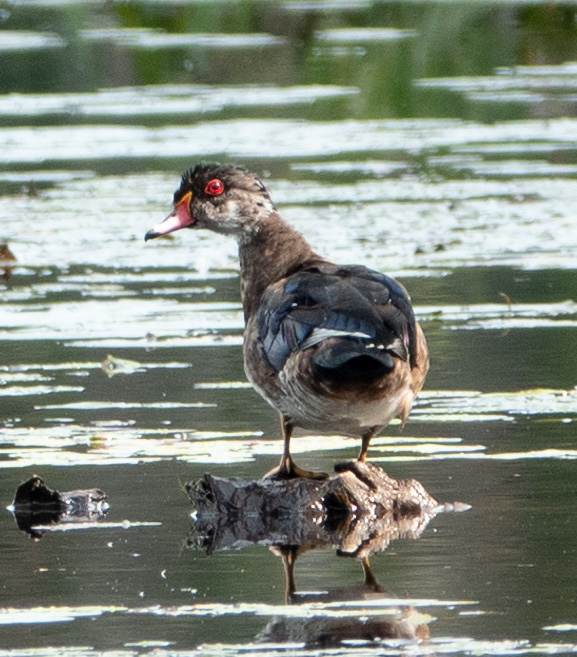
By late July, I found a solitary female on a tiny secluded beaver pond; either she had raised her brood, or never had one, who knows.

Wood duck

Wood ducks normally have one brood a year, but occasionally they have two. This female had very young ducklings on August 4th, so it could have been her second brood:

And on August 29th I saw what I am fairly sure are two new grownups, one female (left) and one male, distinguished by their white head markings. The male does not yet have the adult’s red eye.

Welcome to the next generation.

I saw my last wood duck this year on October 18th. They are leaving for Florida, very sensible, really.

PS Next time, I will show you how the male’s plumage changes with the seasons.

Mushrooms in and mushrooms out

The familiar ecological roles for mushrooms are as helping trees grow in a symbiotic relationship with their roots, and then living on decaying wood and thereby helping to break it down. But they also have relationships with animals.

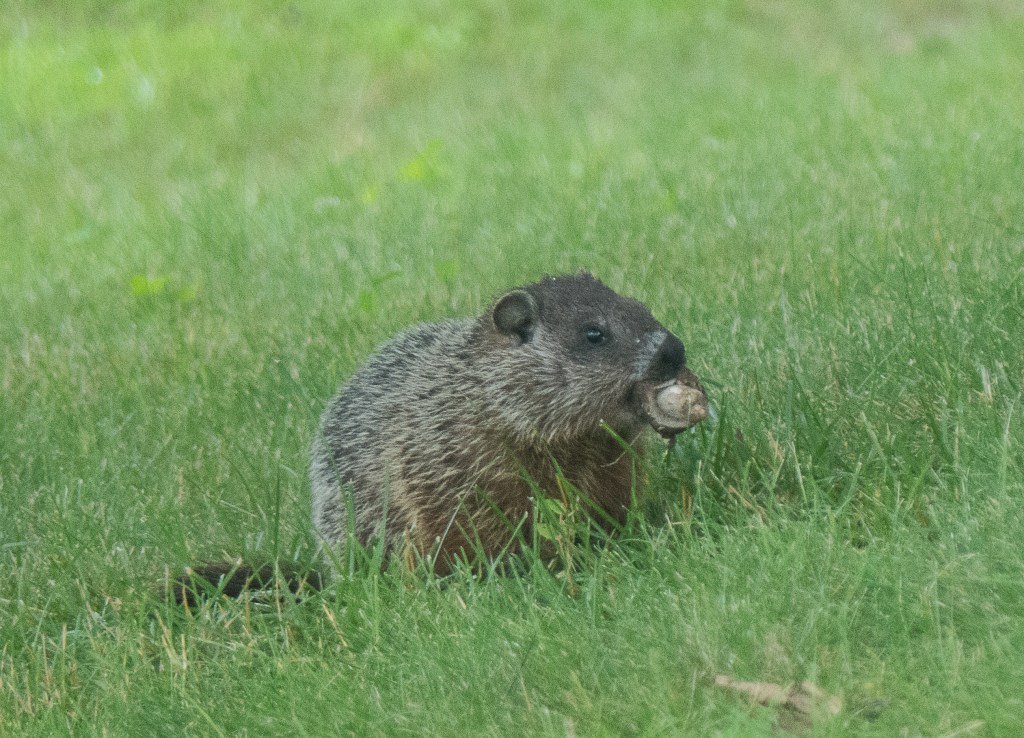
They are a food source. A surprising number of mammals love a tasty mushroom, like this woodchuck:

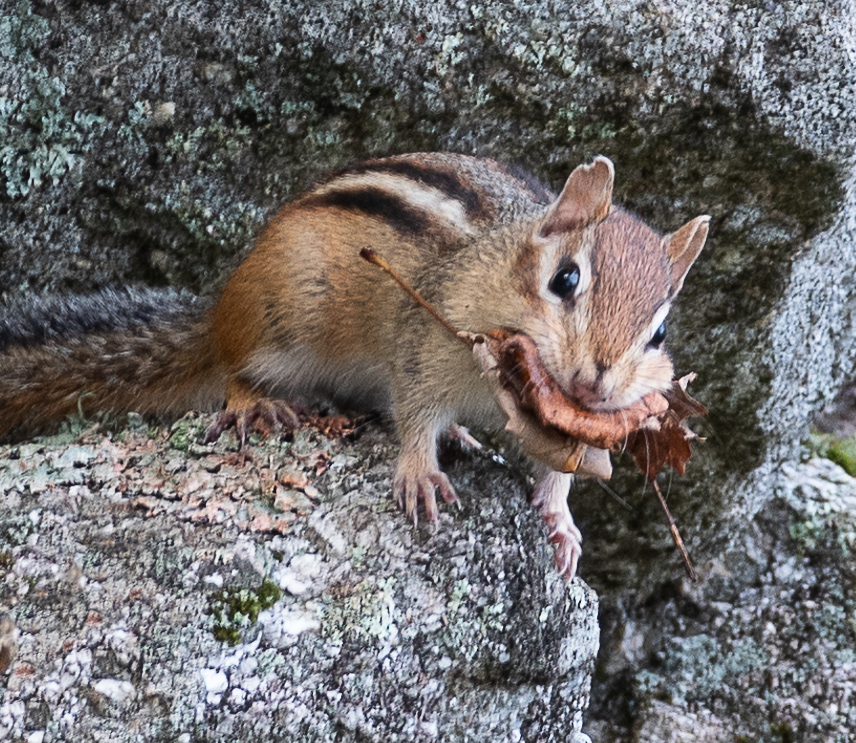
and this chipmunk, who has carefully folded a large one in half to make for easier carrying, complete with a sort of dead leaf sandwich filling.

Squirrels store them for the winter by perching them up in trees to dry, which may be what gave the Italians the inspiration for dried porcini.

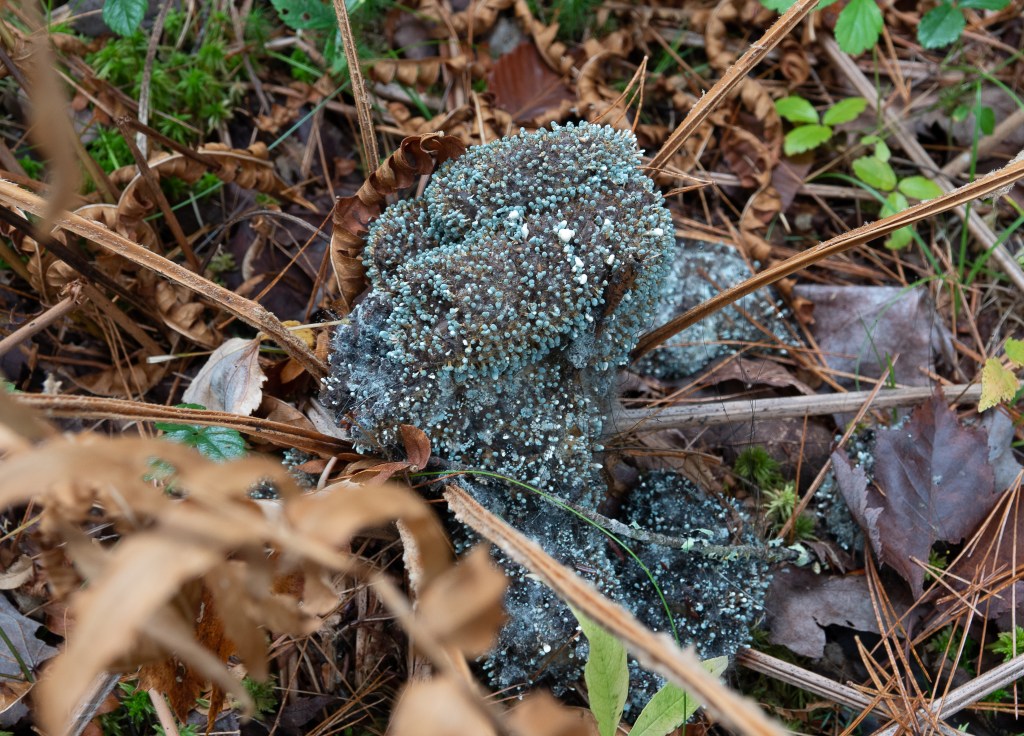
But the great cycle of life goes on, and some mushrooms thrive on the by-products of mammals, poop. This is bear poop, and it is entirely covered in a pale blue fungus called Penicillium vulpinum .

Here it is in close-up:

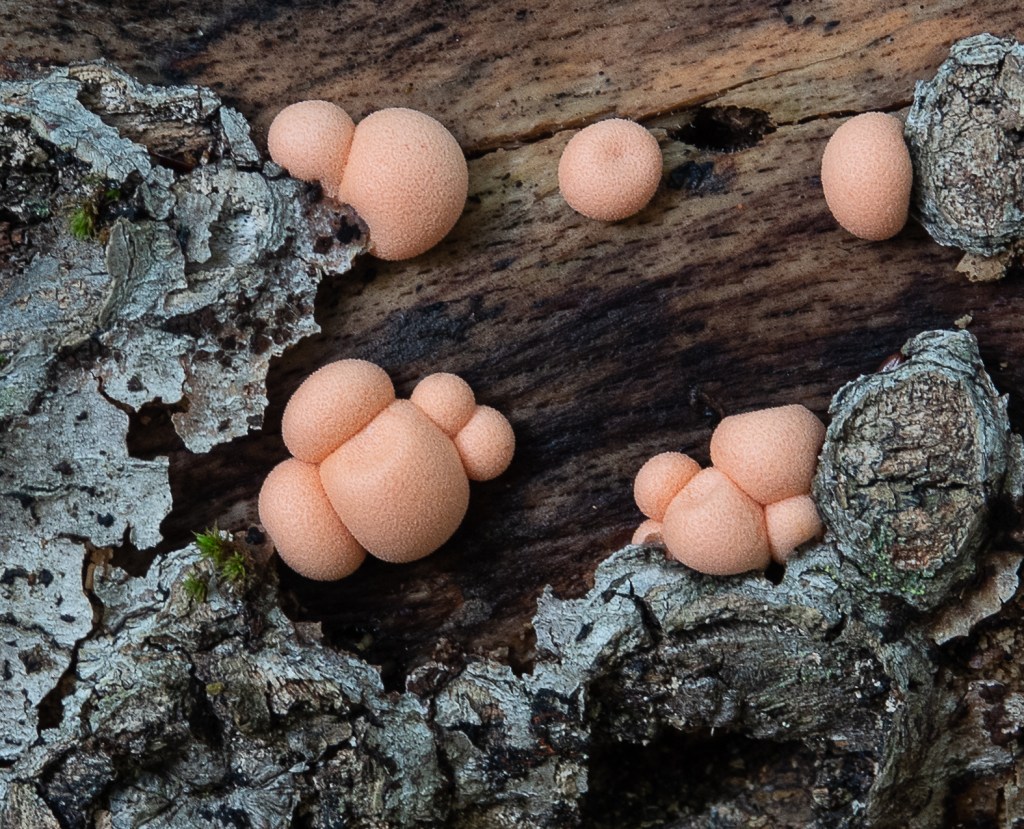
In a rather disconnected leap, inspired by the notion that another by-product of mammals is milk, this slime mold fungus rejoices in the name of Wolf’s Milk, Lycogala epidendrum.

If you puncture a young specimen, out oozes an orange gluey substance, which I suppose must be the source of its name. Since I am fairly sure that actual wolf’s milk is white, it doesn’t explain much. But it certainly has a whiff of Halloween to it, so maybe we should think of werewolves?

PS Thanks to Leigh Hayes for the ID of the blue fungus on the bear poop!