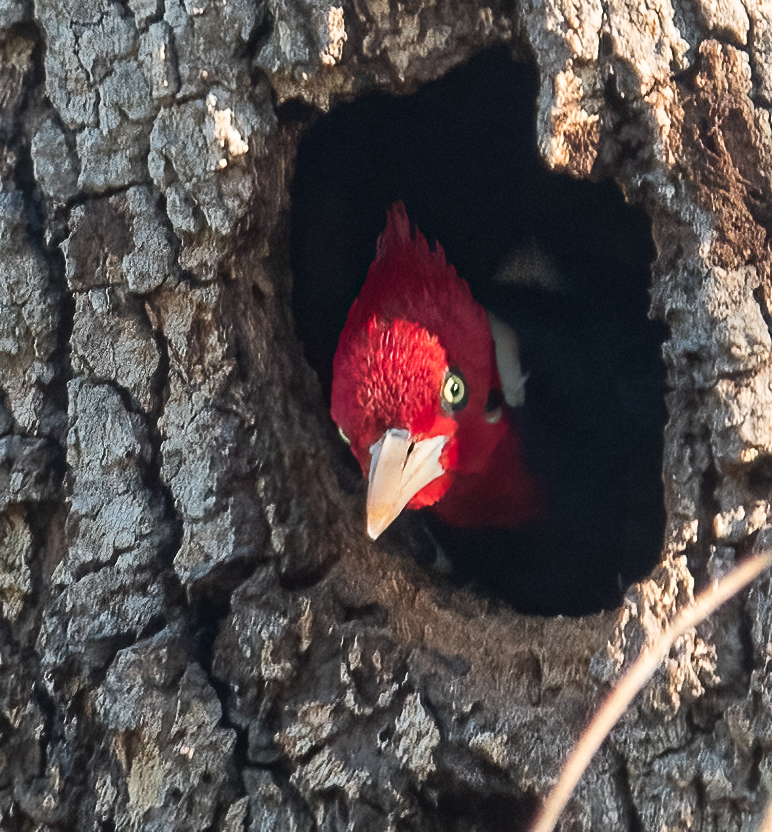
Woodpeckers worldwide just ooze character, and the Pantanal has a range of species. I already showed you a Campo Flicker. But how about this Cream-backed Woodpecker, Campephilus leucopogon, a dead ringer for Woody the Woodpecker of cartoon fame:
It refused to come out of its nesthole, but in the second photo you can admire its crest, and just glimpse its white back:
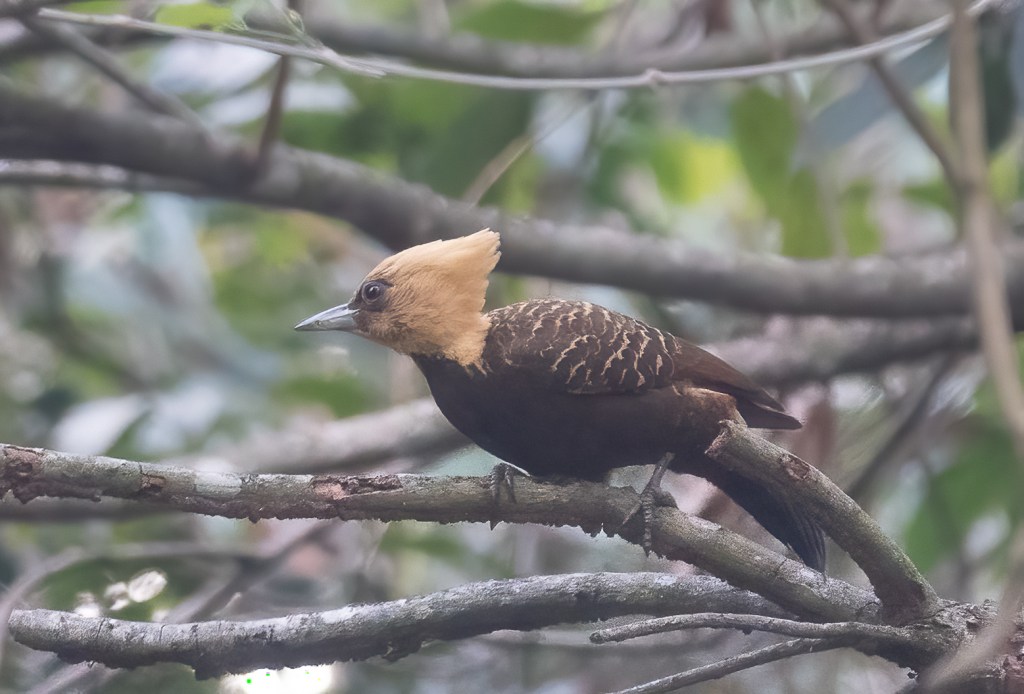
Much more discreetly colored is the Pale-crested Woodpecker, Celeus lugubris, feeding deep in the trees:
She is a female; the male has a red cheek patch.
And conveniently out in the open, the boringly named White Woodpecker, Melanerpes candidus, gives us a beady eye:
It takes me happy to tell you that none of these is thought to be endangered.
PS I mistyped ‘happy’ in the last sentence, and my spellchecker serendipitously autocorrected so it read “It makes me hoopoe to tell you”, which seemed appropriate.
PPS This is my last post from the Pantanal. It’s not that there is not even more to show you, but it feels like time to move on, at least for now!
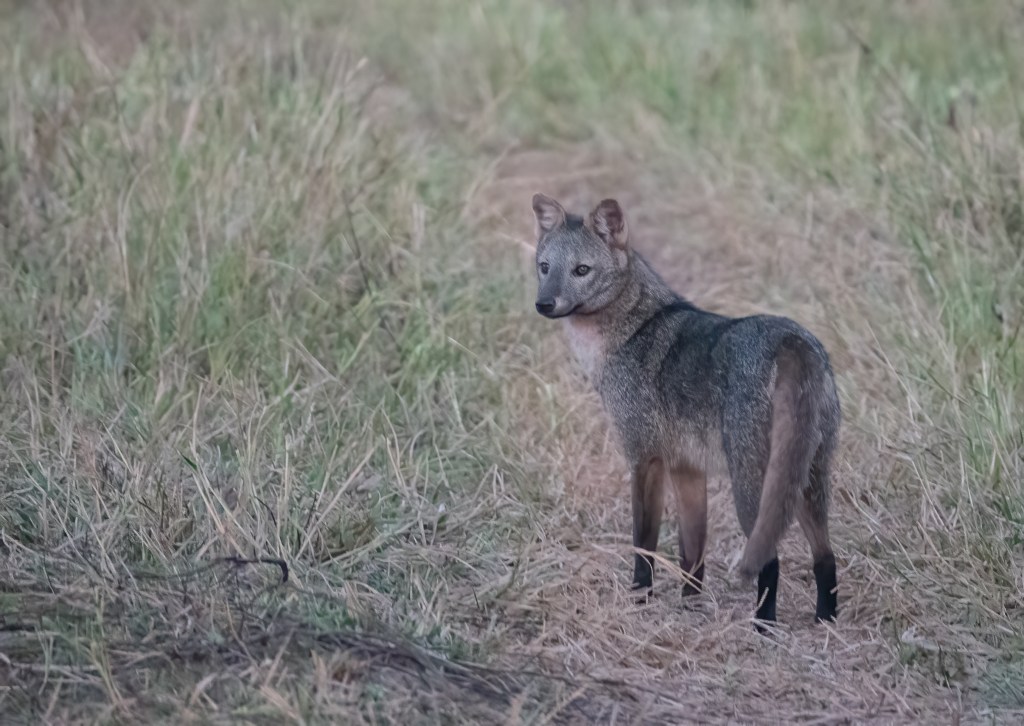
The star mammals are of course jaguars and tapirs, but there are other mammals to be seen too. At dusk, we often saw small delicate crab-eating foxes, Cerdocyon thous, usually in pairs:
They do not immediately run off, so we got a good look:
As their name suggests, they eat crabs, but also small mammals, amphibians, fruit, pretty much anything, including kitchen scraps from lodges. I found them rather charming.
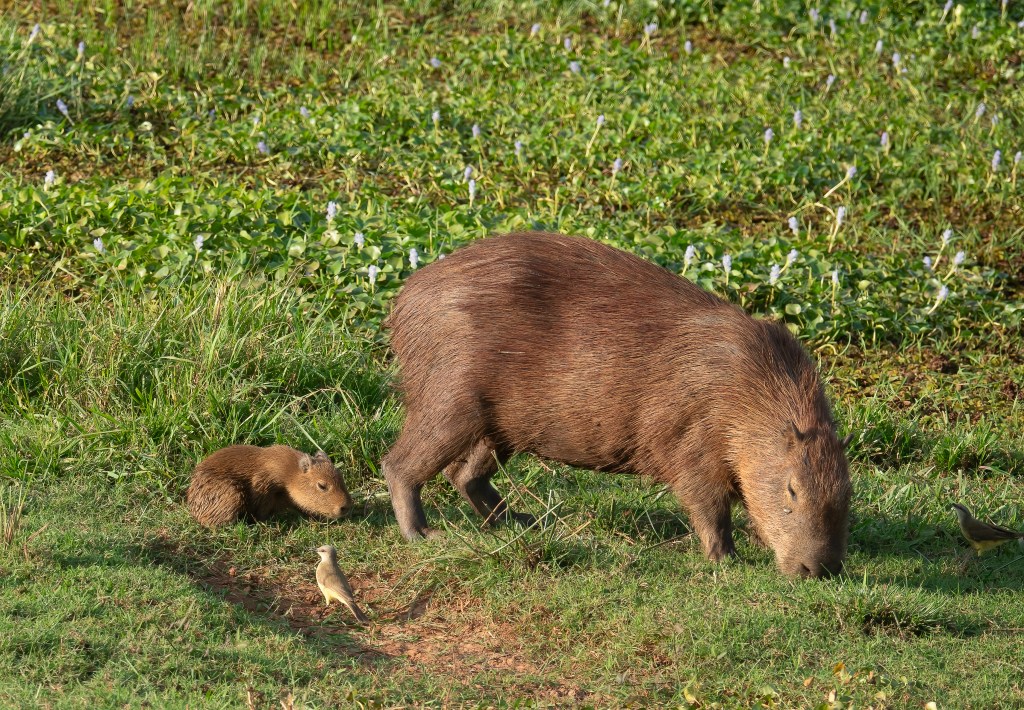
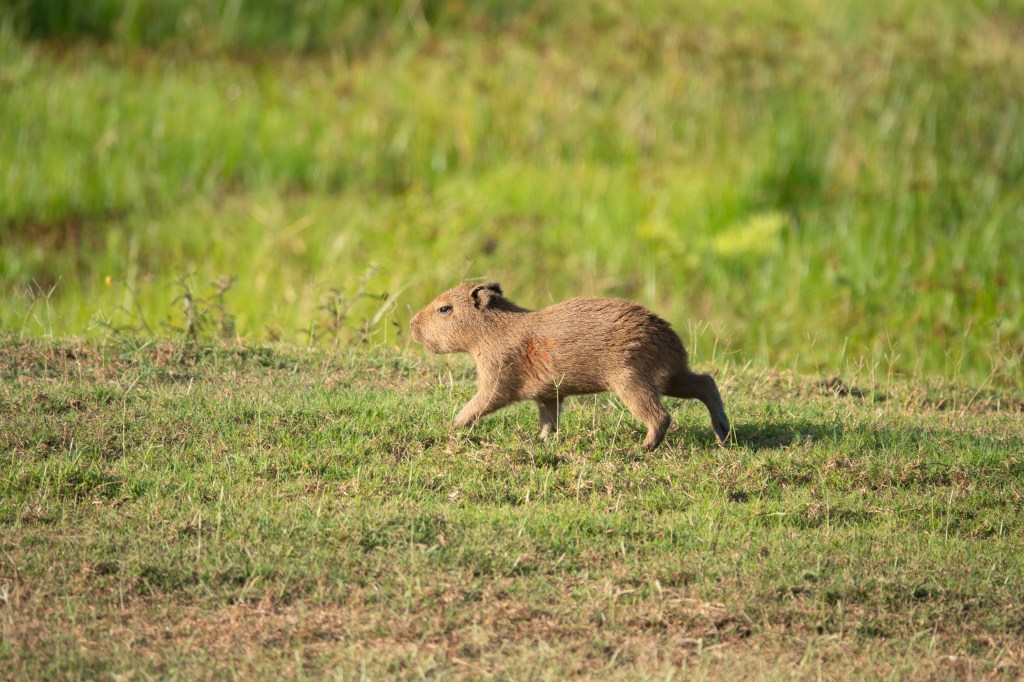
The most ubiquitous and laughable mammals are the capybaras, Hydrochaeris hydrochaeris, although we saw far more of them ten years ago in the Northern Pantanal than we did in the south. They are like giant guineapig/beaver crosses, and are the world’s largest rodents.. This mother and baby hung out near Caiman Lodge.
The guides had named the baby Bean.
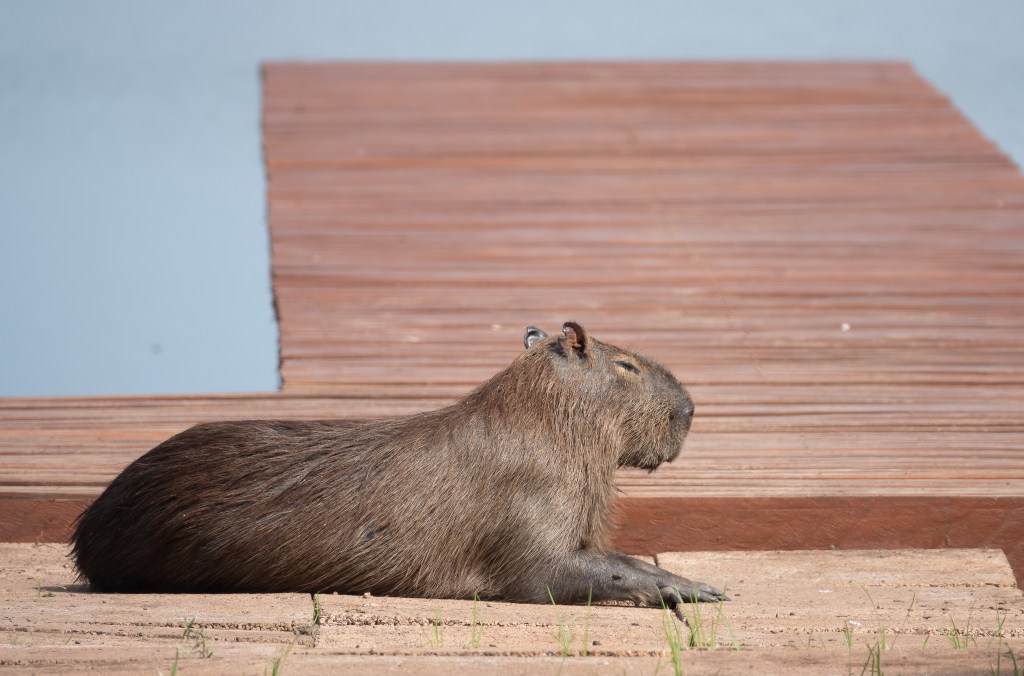
An adult male can weigh 50Kg, and makes a good meal for a caiman. The dock at the lodge is a pretty safe space:
They are vegetarian, and eat water plants especially. An egret is standing on the submerged shoulders of this one:
A family group were grazing in the shallows, and some unseen predator, almost certainly a caiman, made a charge from the left. Look carefully and you can glimpse two tiny babies in front of the leaping adult’s back, peering out through the water hyacinths as the adults scatter:
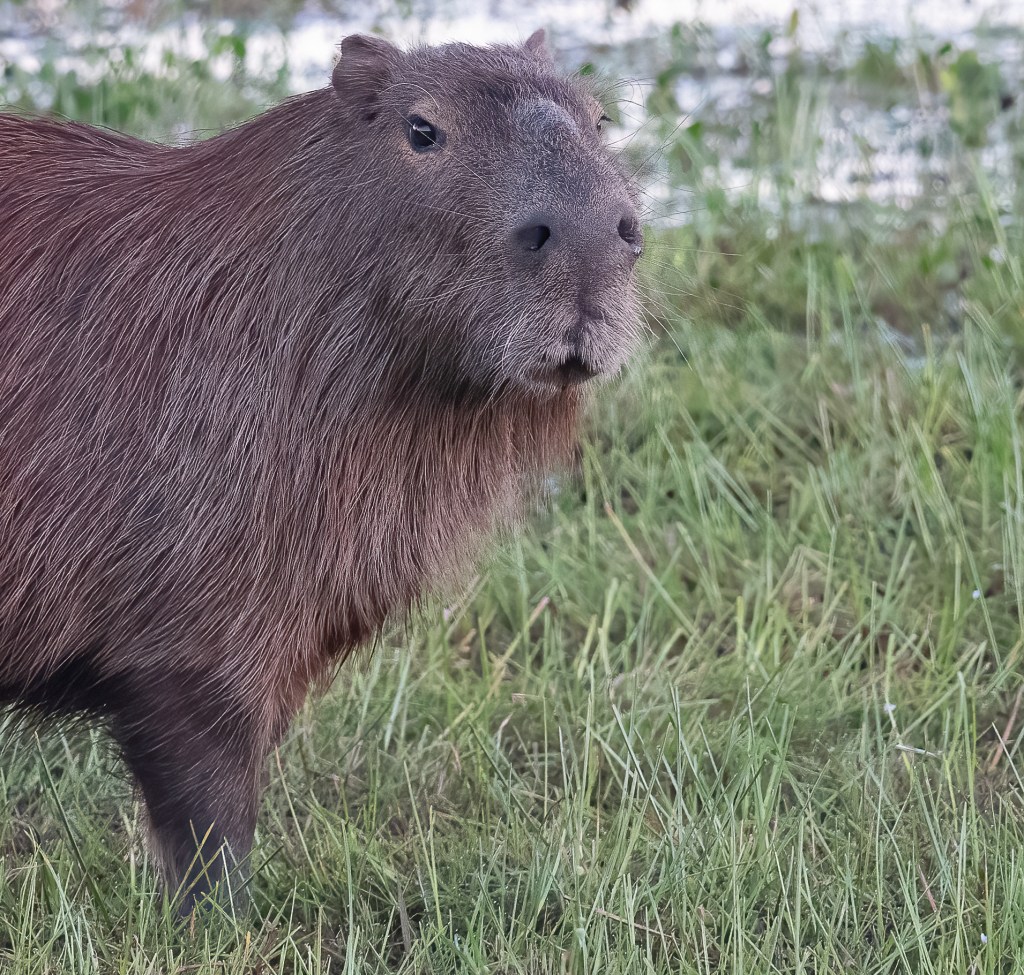
They have a large scent gland bump between their eyes:
and they rub this against the lower branches of trees to mark their territory:
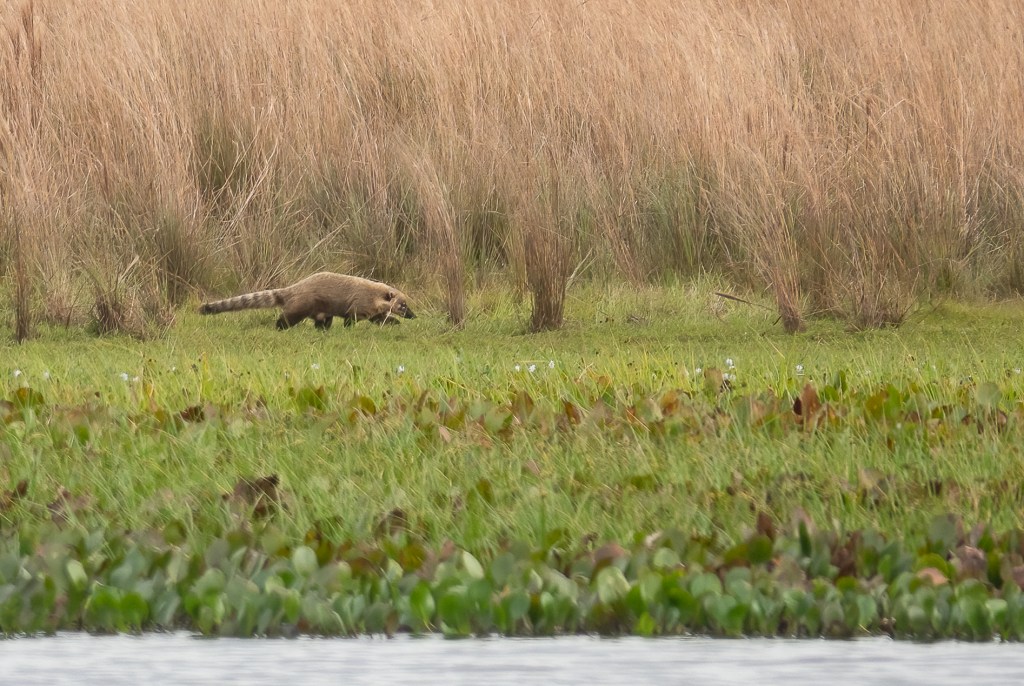
Finally, the Coati, Nasua nasua, a relative of the raccoon, and also an omnivore. We saw solitary males on three occasions, but only briefly. This one was on the far side of the river, and stayed visible for long enough to photograph :
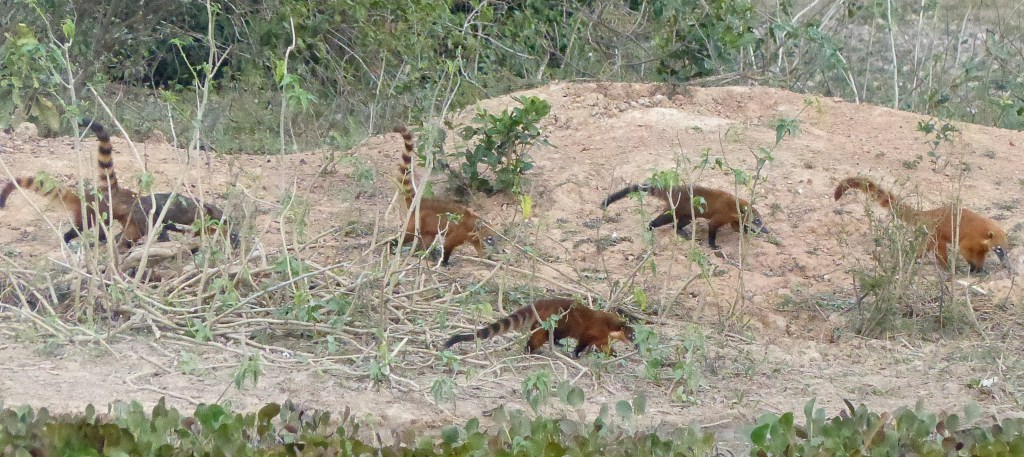
On our previous trip, we saw large groups of females and youngsters, like this, often with their tails in the air:
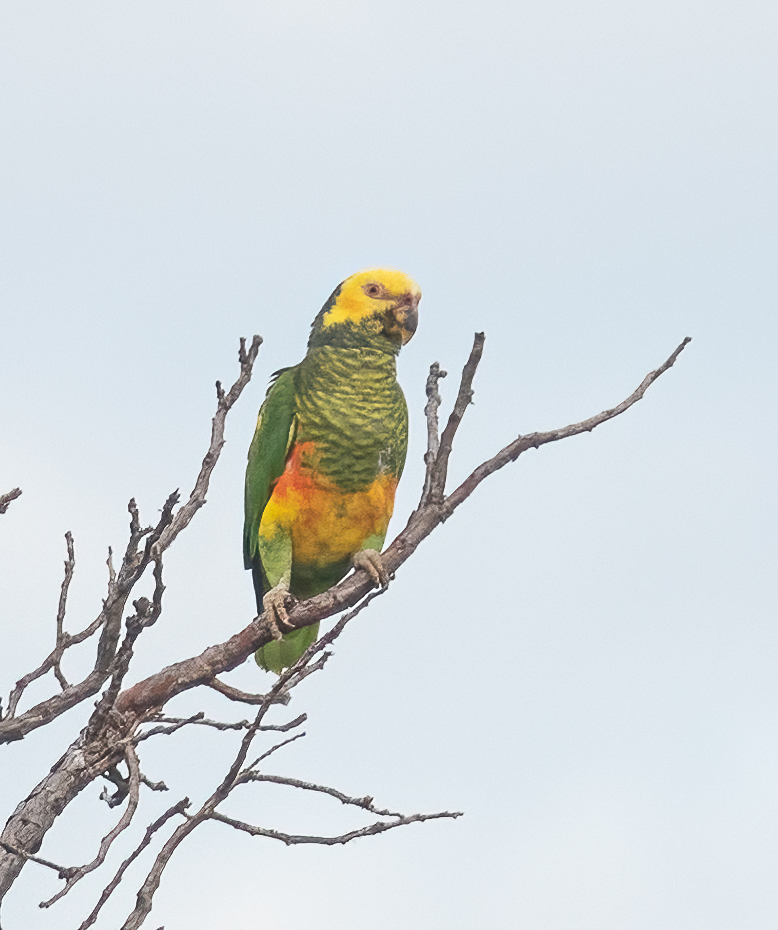
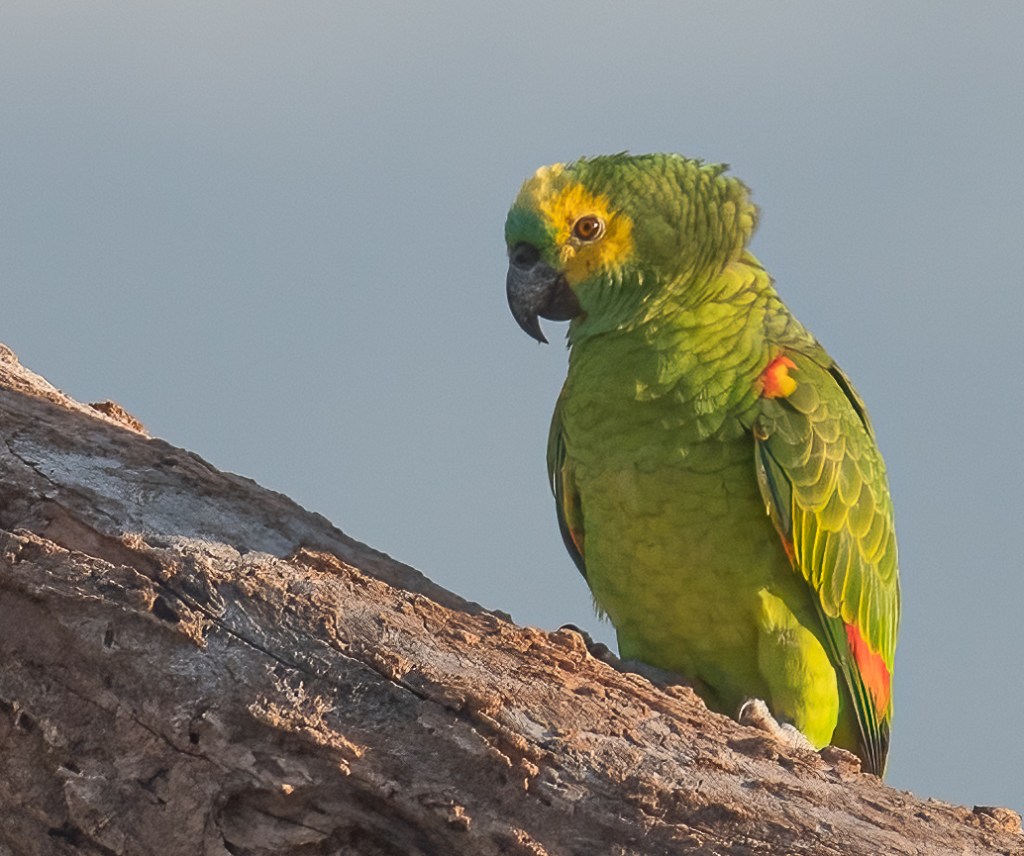
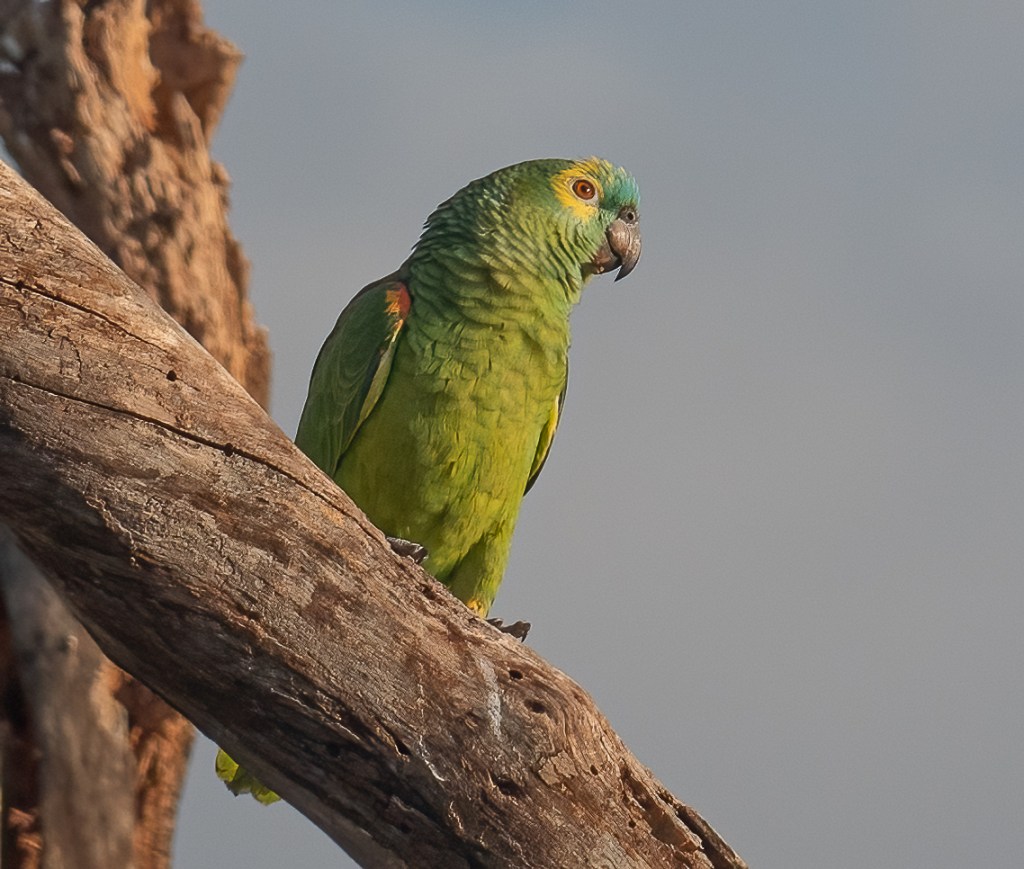
The Pantanal would be a good place to be a pirate: a big choice of macaws, parrots and parakeets to carry on your shoulder. That very desirability is, of course, why the pet trade poses such a threat to some of these birds. Here, in no particular order, is a gallery of the ones I managed to photograph:
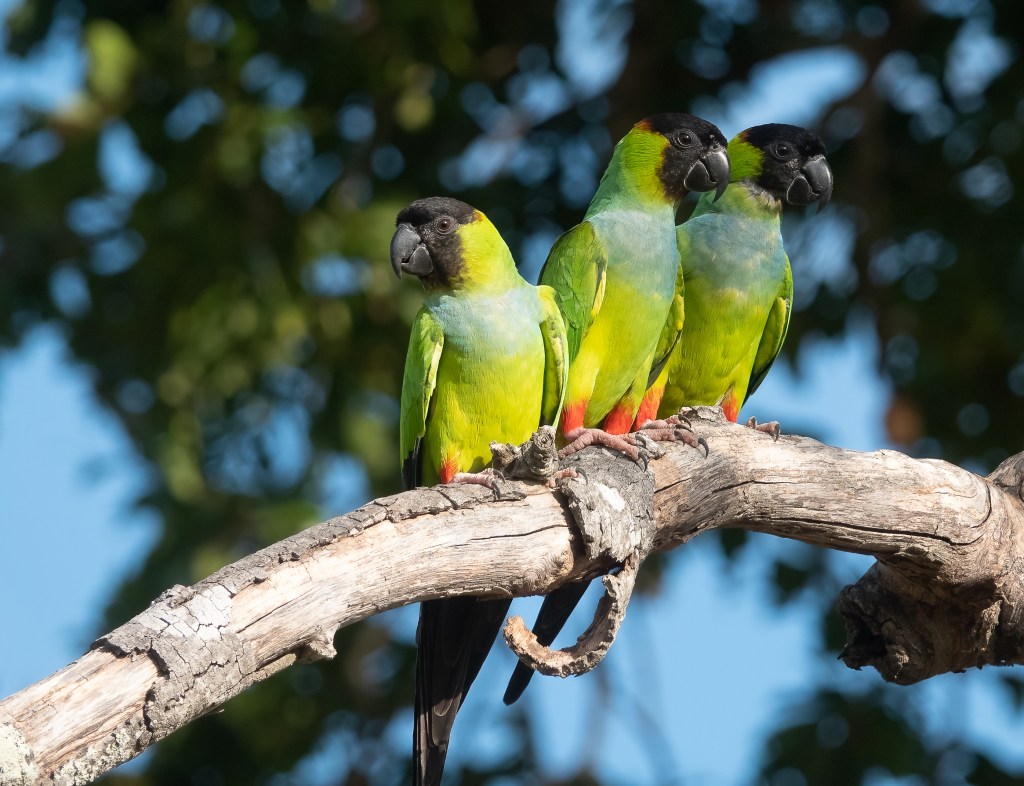
Nanday Parakeets
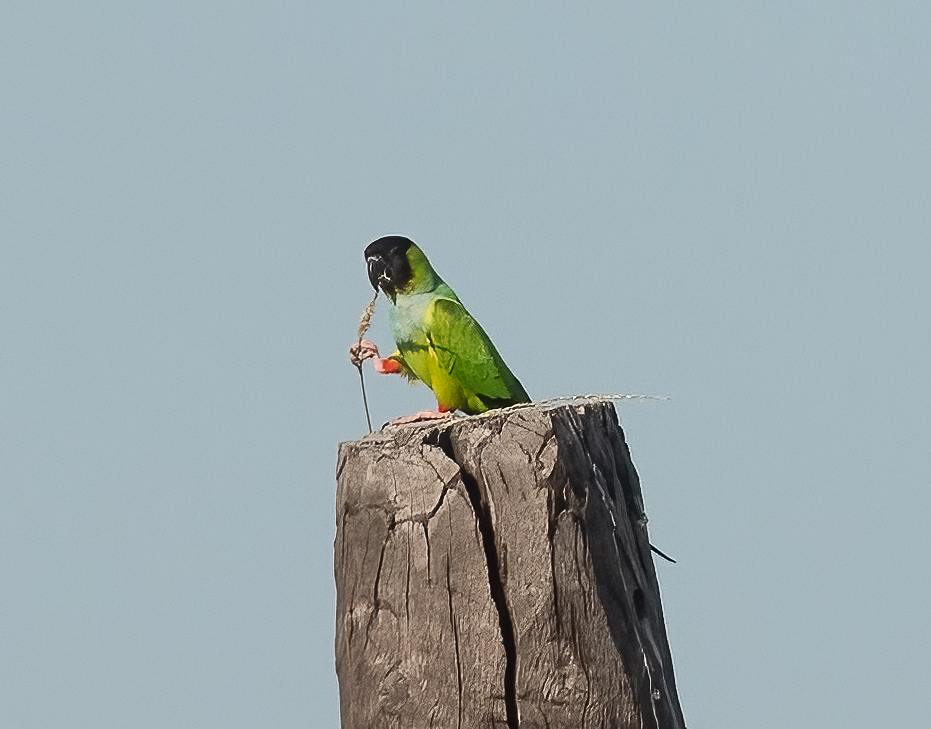
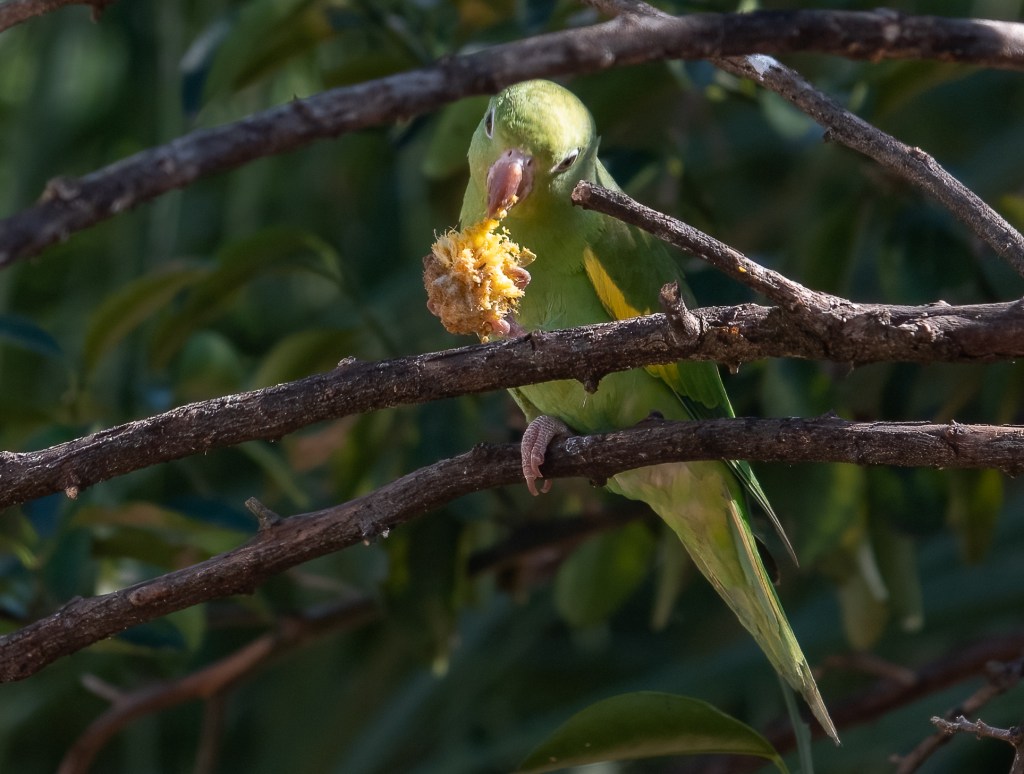
At first my overactive imagination thought that this one was using a tool, but disappointingly it was just chewing on a grassy seedhead.
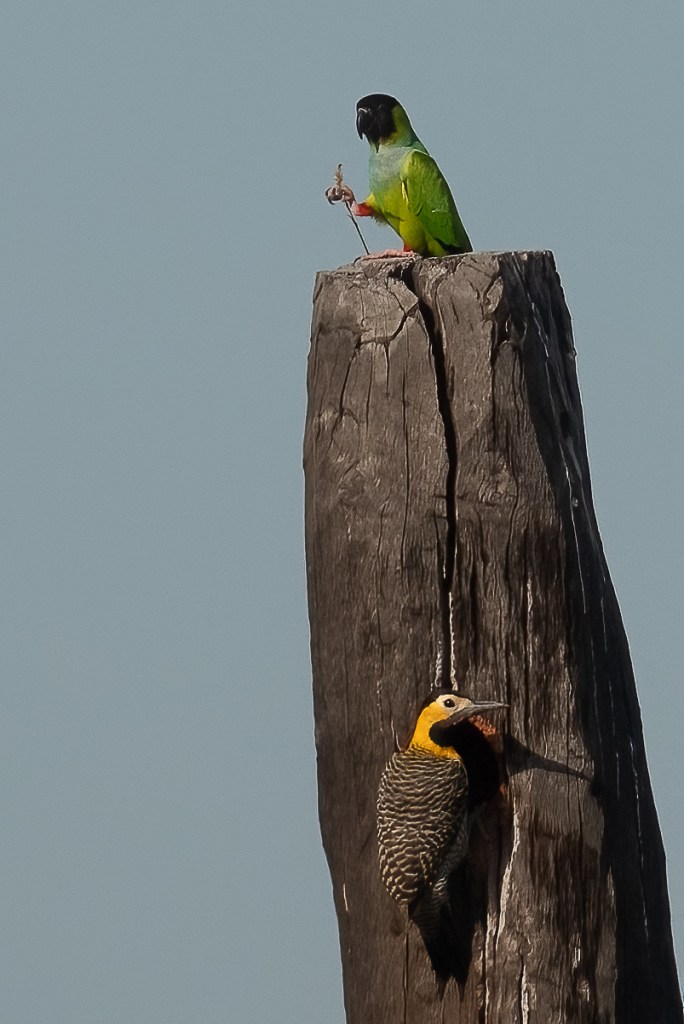
Nanday Parakeet
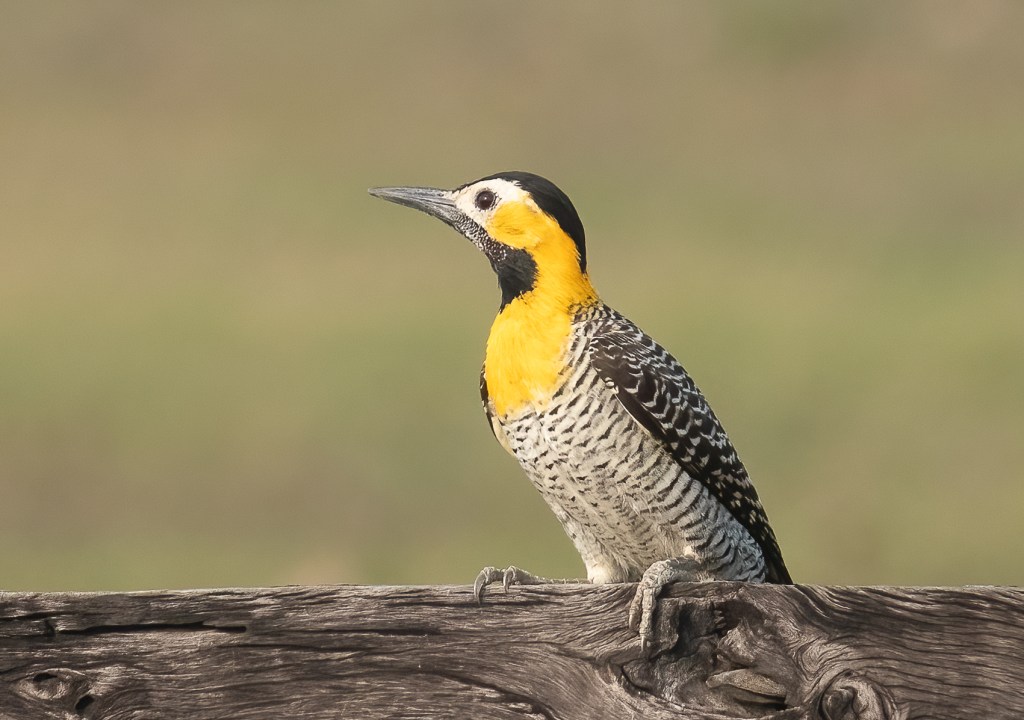
and just underneath it on the same fencepost was a Campo Flicker, a ground-feeding woodpecker:
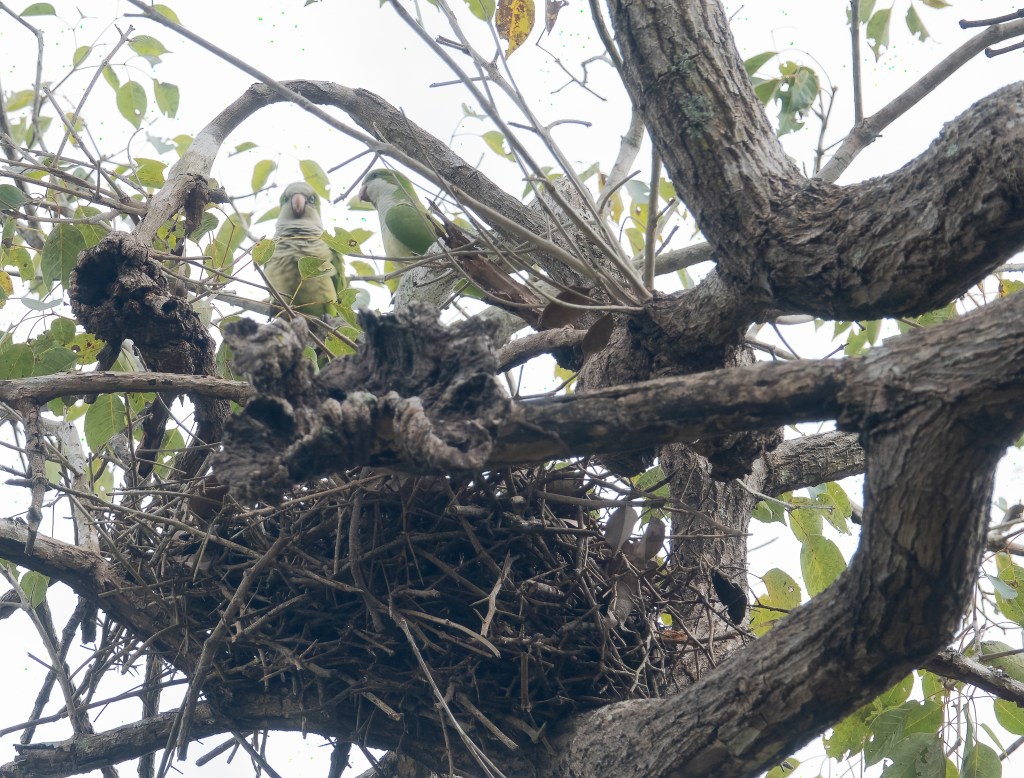
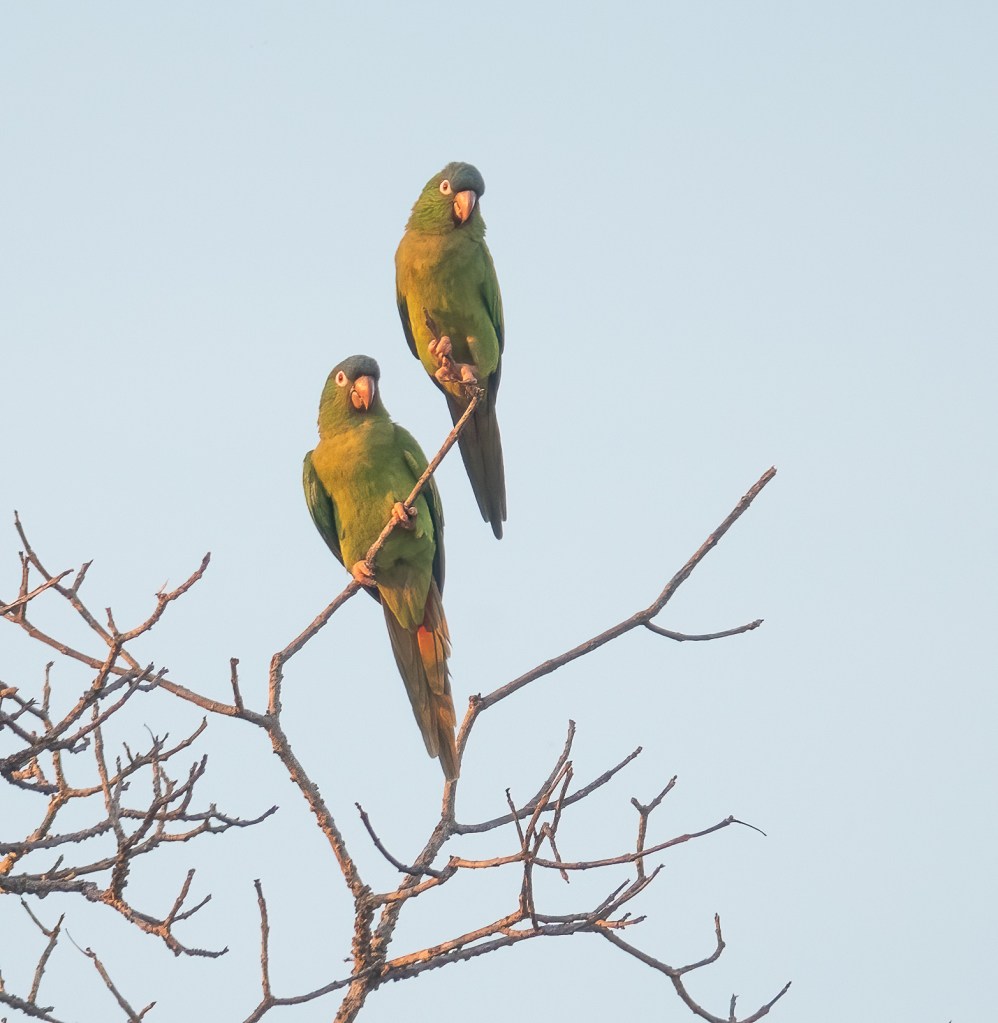
Nanday Parakeet and Campo FlickerCampo Flicker in close-upMonk Parakeets on communal nestBlue-crowned ParakeetYellow-chevroned parakeetYellow-faced ParrotTurquoise-fronted ParrotTurquoise-fronted Parrot
To get you in the mood, listen to this video while you read the rest of this post. It is Martin Nystrom’s As the Deer played by the NewWin4 String Quartet:
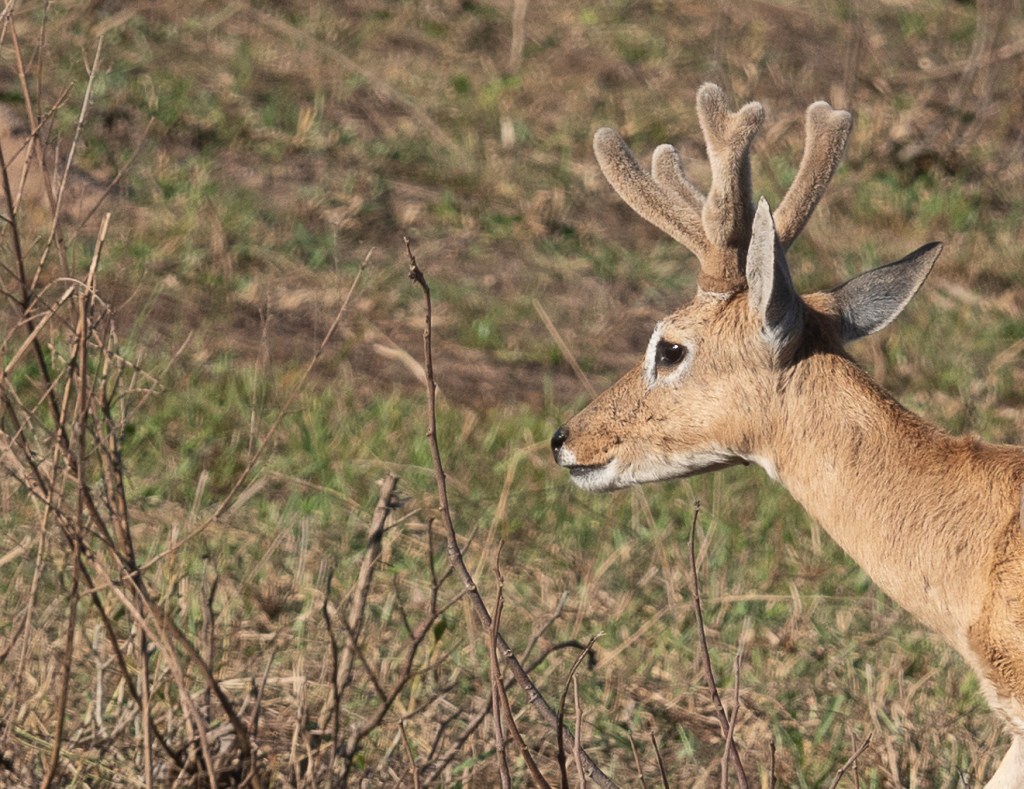
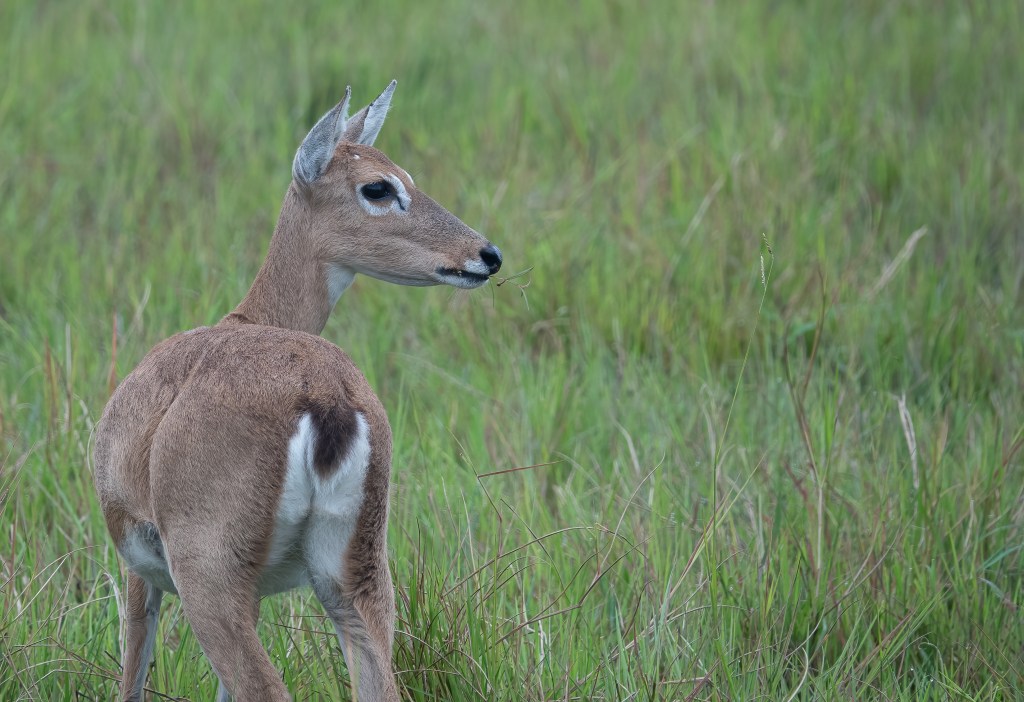
There are four species of deer in the Pantanal, all food for jaguars! The Pampas Deer is very similar to the American White-tailed Deer, but smaller.
The males were still growing this year’s antlers:
The does, of course, have no antlers.
When they are scared they raise their small tail in imitation of their North American cousins, though I never did get one to do this for my camera. This one is running from a nearby jaguar, but the cattle tyrant on its back is still hanging on.
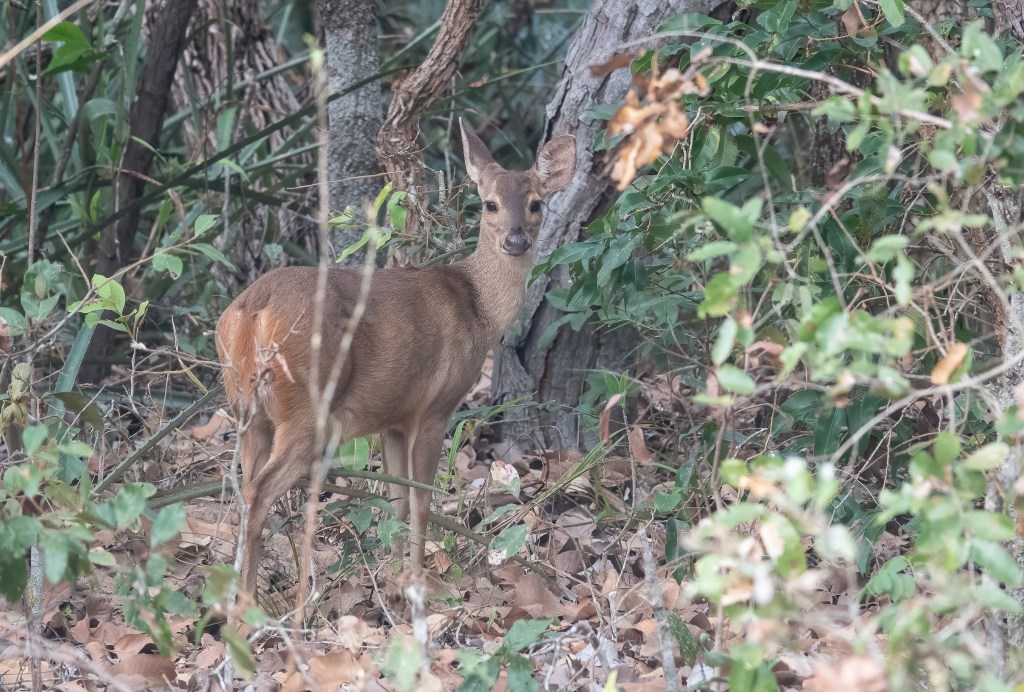
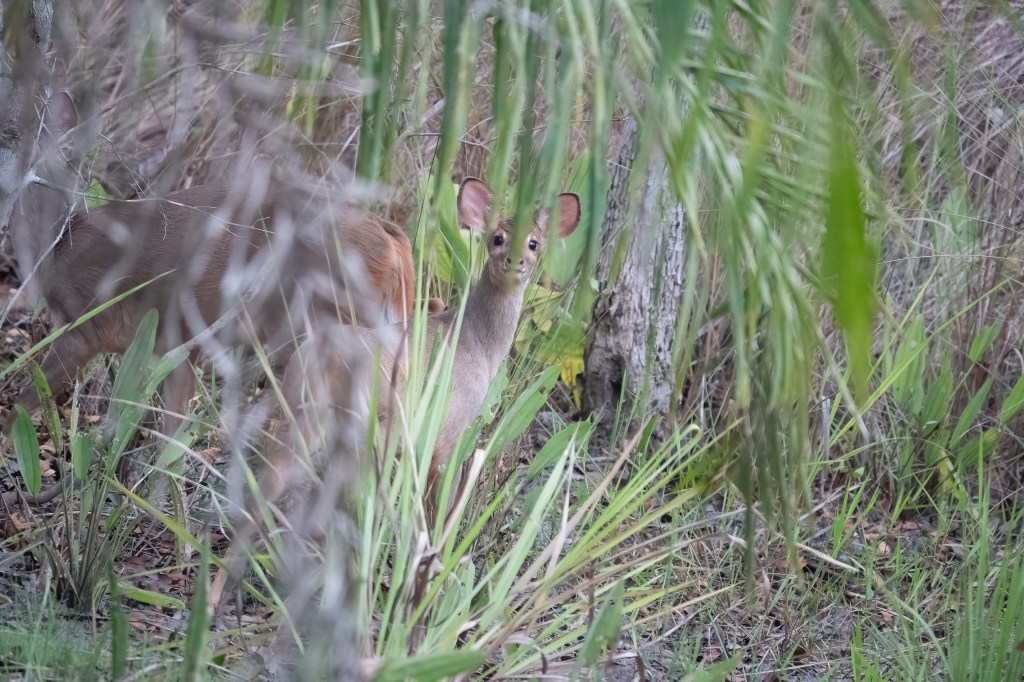
There are two small species of Brocket Deer, shy solitary woodland creatures. This is the Brown Brocket Deer (also called Grey):
The male has tiny spiky antlers:
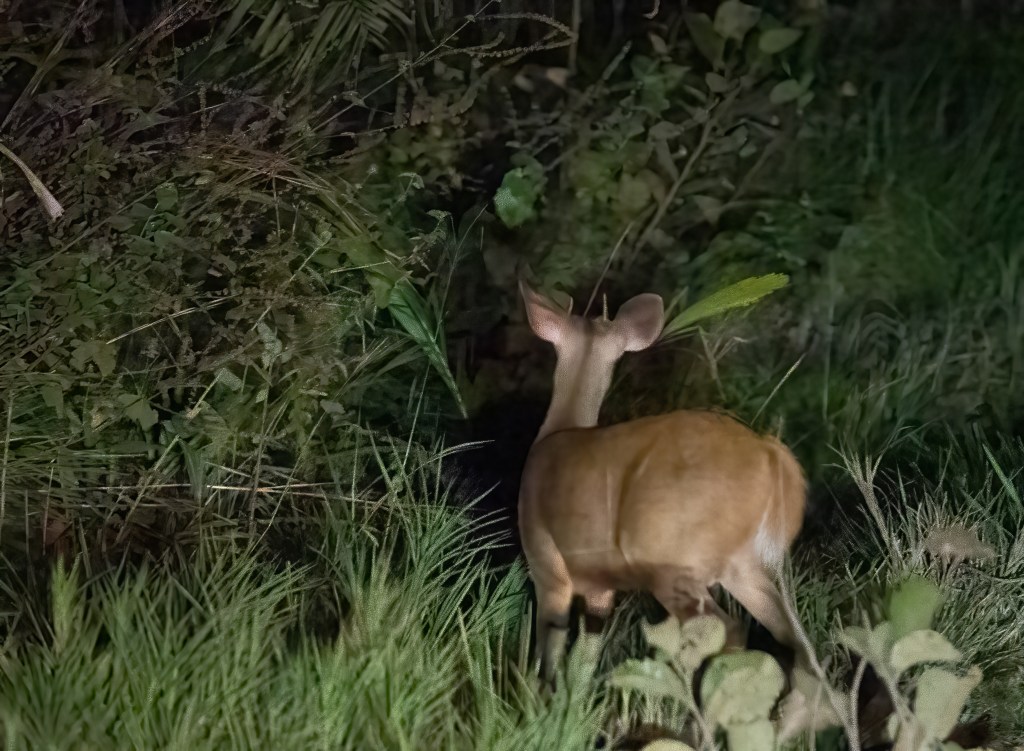
Its cousin is this a male Red Brocket Deer.
It was with its mate and a tiny fawn, and our vehicle separated them on opposite sides of the road. The fawn inspected us warily:
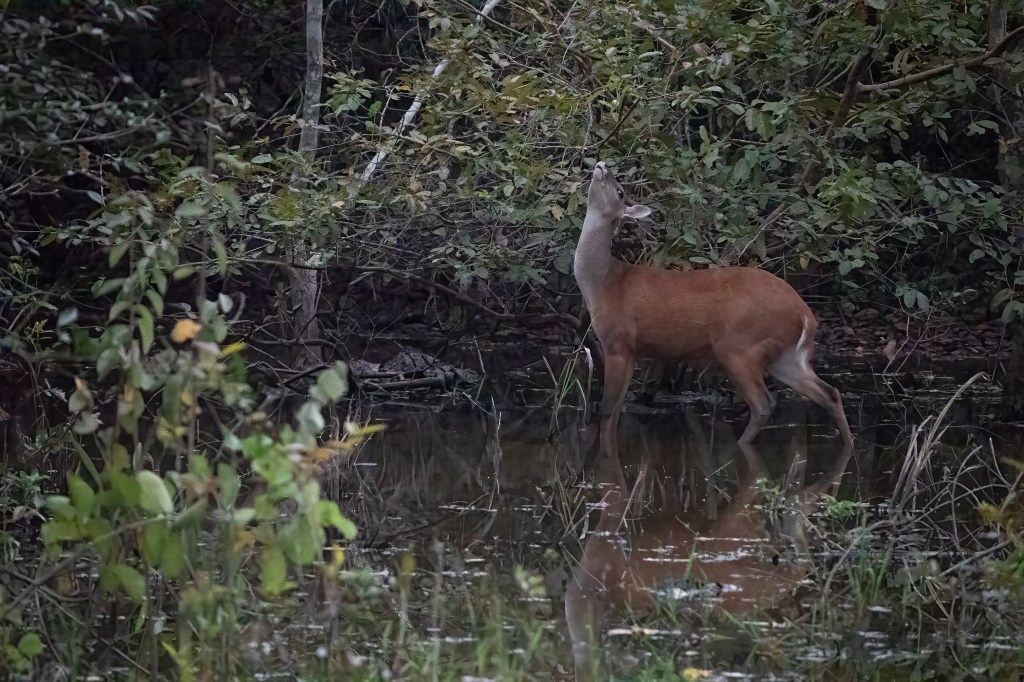
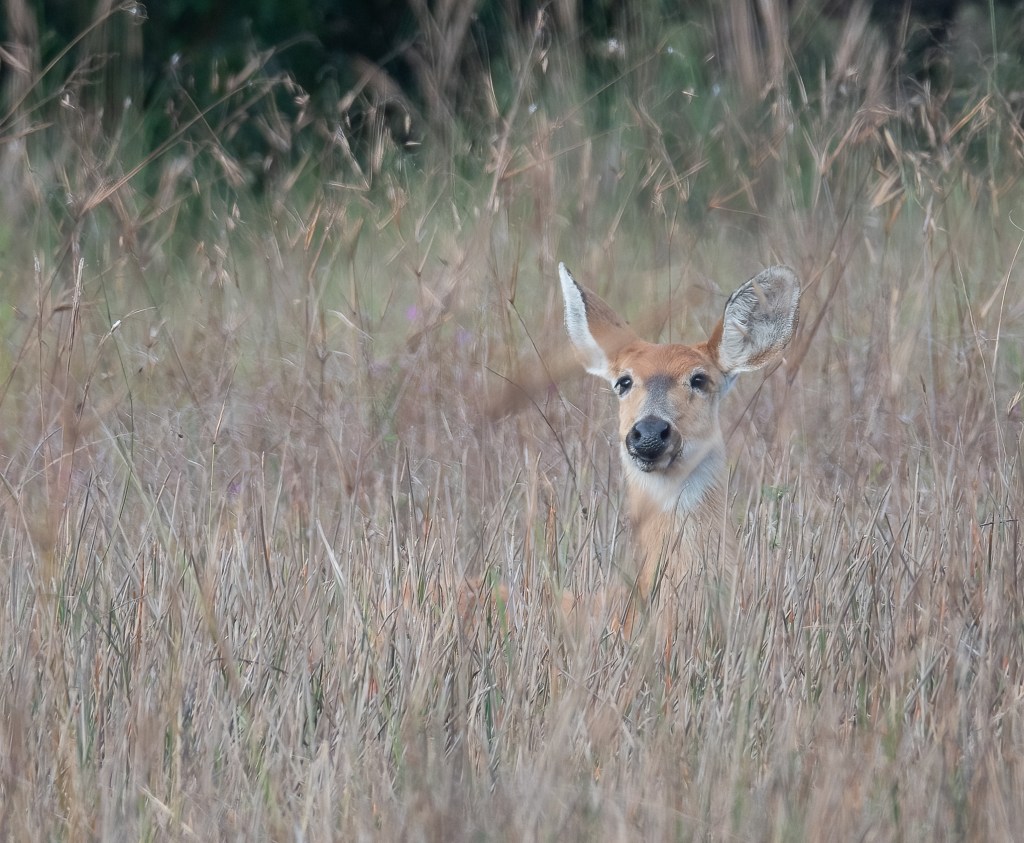
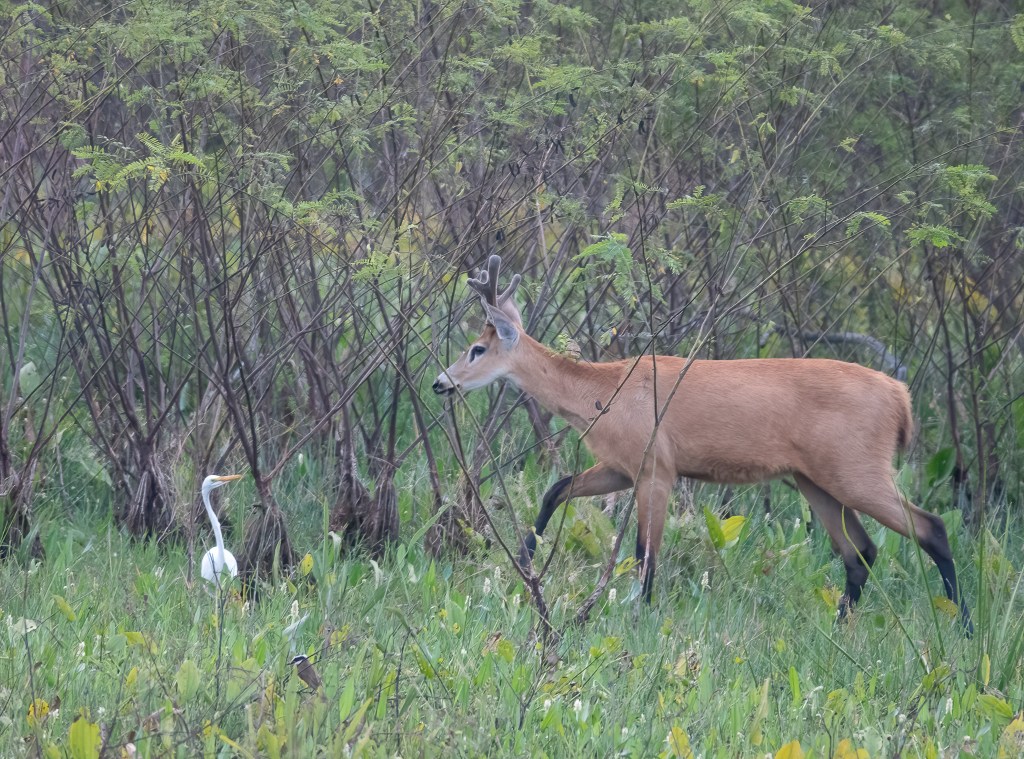
The largest deer in the Pantanal is the Marsh Deer, 1.2m tall and 2 long. It likes long reeds and grasses, with just the head rising above the marsh:
Out in the open their size is more apparent, towering over the egret and the kiskadee in the foreground.
Meanwhile, back here in Maine, we have only one species, the White-tailed Deer. A doe and two still-spotted fawns were caught on my game camera two weeks ago. Notice how long their black-and-white tails are compared to the Pampas deer. (I fear that to watch the whole video and see the charming fawns you may have to scroll back up and turn the music off. )
If the music is still playing, relax and let it soothe your spirit.
Last time, I showed you ground birds. These, by contrast, live in the trees, as proper birds do.
The White-throated Piping Guan, Pipile grayi, is a handsome chap.
White-throated Piping Guan
I find it surprising that a bird this large (about 69cm long) lives almost entirely in trees, foraging for fruit. It looks like a ground bird, but isn’t. It has a white wattle under its chin:
It is found in a fairly small area, including Eastern Bolivia, Southwest Brazil, and Northern Paraguay. Under pressure from habitat loss and hunting, its population is thought to be in decline, and the IUCN classifies it as Near Threatened. It is still pretty common in the Pantanal, I am glad to say.
Here is a gallery of a few more handsome feathered pinups:
I think you’ve got the picture: the Pantanal is paradise if you like birds, but beware of going with birders if you don’t! You will spend long hours as the sun sets and the cocktail hour beckons, waiting while they admire yet another new species.
The Red-legged Seriema, Cariama cristata, is a delicate ground bird, about three feet high, with pink legs and beak, pale blue eye-shadow and a crest on the bridge of its nose (well, beak). Sort of like a punk mustache.
It wanders around the grasslands feeding on insects, small snakes, even mice and also grains and seeds. When it finds a snake, it kills it by shaking it hard and beating it on the ground.
It is often with its mate:
Occasionally they are in larger groups, like these. The local people say that if one stands on a termite mound, rain is coming.
They do not seem to be endangered, though they are sparse, but they are found across a large area in the grasslands south of the Amazon, from E. Bolivia to the Atlantic. Their habitat may even be increasing, as deforestation creates more of the open areas they like.
Among the large ground birds we saw, my other top favorite is the Bare-faced Curassow, Crax fasciolata, winner of the “Best Hairdo in the Pantanal” contest. Here is the male:
and here is his girlfriend:
The male is up to 85cm long and weighs as much as 2.8Kg, like a big chicken or a very small turkey. They eat mainly fruit, and seeds.
They are probably monogamous, but very little is known about their social lives. Classified as Vulnerable, the Pantanal is one place where they are still fairly common.
Tapirs are very soothing animals. They are placid aquatic herbivores, who browse in the wetlands. The size of a small pony, they have a dapper little crewcut of a mane.
In 2017 I posted about a tapir that I saw in the Amazon Basin rainforest in Ecuador. Here in the open grasslands of the Southern Pantanal the experience was very different. In this ecosystem, they are strictly nocturnal, probably because they feed out in the open, and the jaguars would be a threat. In the daytime they sleep in the forests. At Caiman Lodge they are just starting to monitor them and understand more about their range and lifestyle. They estimate that the ranch is home to between 100 and 250 tapirs, but they are secretive, so this a guess. We saw two.
The first was a tagged male that we stumbled upon by chance, at night, feeding in the wetlands.
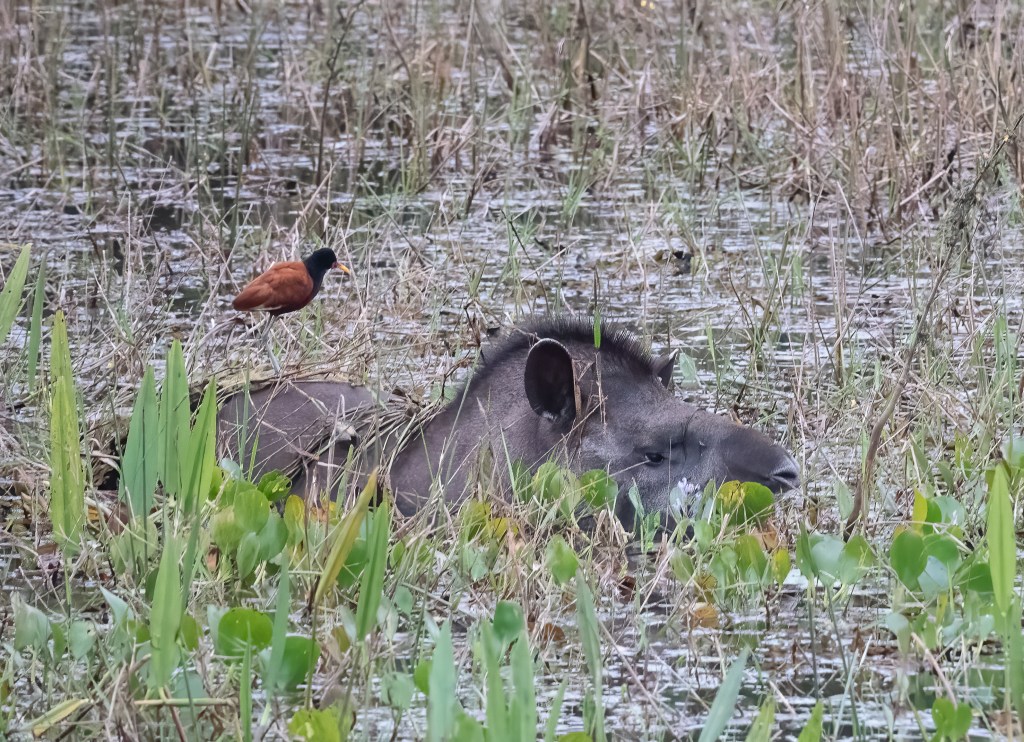
The next day we saw an untagged female, who had emerged from the woods in the late afternoon for a cool bathe followed by a semi-submerged nap:
A jacana used it as a convenient island.
She has a baby., which we didn’t see. As it fell dark she began to forage, and we caught her in our lights:
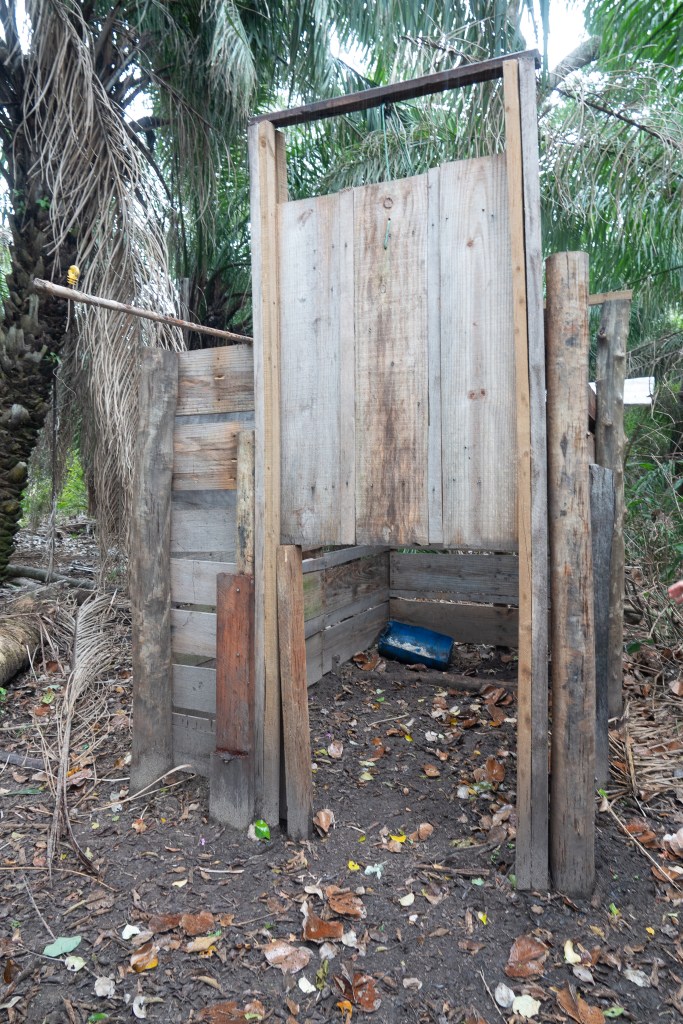
Catching one to tag it is accomplished by baiting this trap with a salt lick in a blue plastic tub. Unable to resist, they are lured in, the door is lowered, and the animal is stuck.
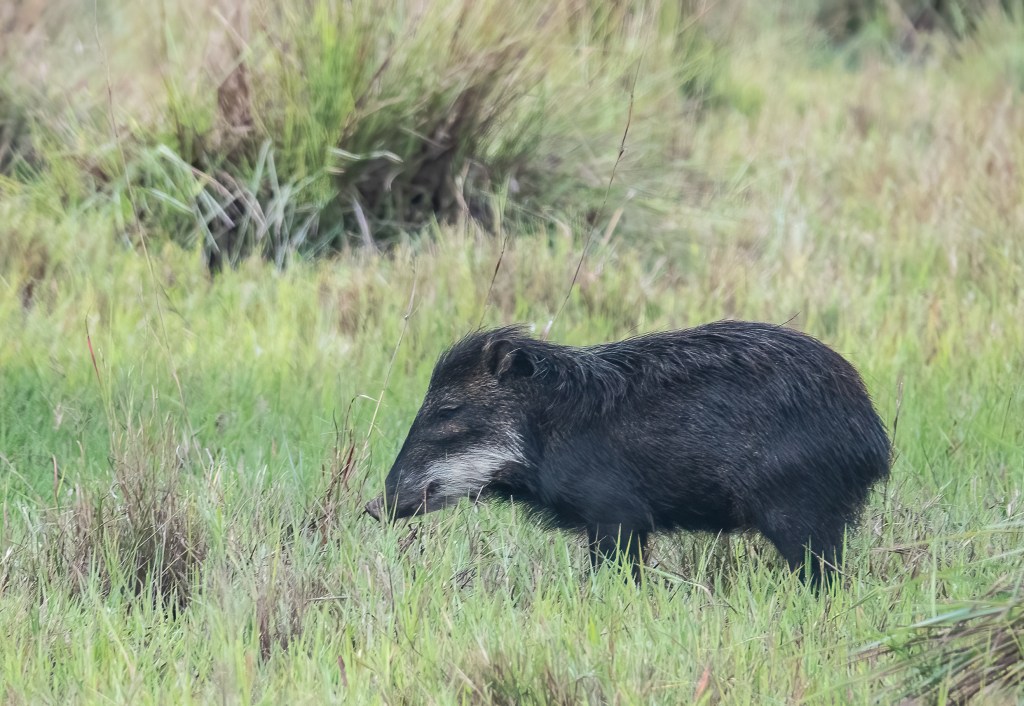
The fierce little white-lipped peccaries also like the salt, and sometimes steal it:
PS The South American tapir, Tapirus terrestris, is up to 2.5 m (8.2 ft) long and an average weight around 250 kg (over 500lb). It stands up to 108 cm (43 in) at the shoulder. They can live up to 40 years, and are sexually mature at about four years old. The IUCN classifies it as Vulnerable, and the Pantanal is at the southern end of its range.
The Jabiru Stork, Jabiru mycteria, is a gigantic bird. Its name means “swollen neck” in Guaraní, and at five feet tall, with a nine foot wingspan, it is the largest flying bird in Central and South America.
The bright red skin at the base of the neck changes color with mood; paler when calm:
darker when excited or threatened:
They mate for life, up to 36 years, and nest high in dead trees, returning to the same nest year after year.
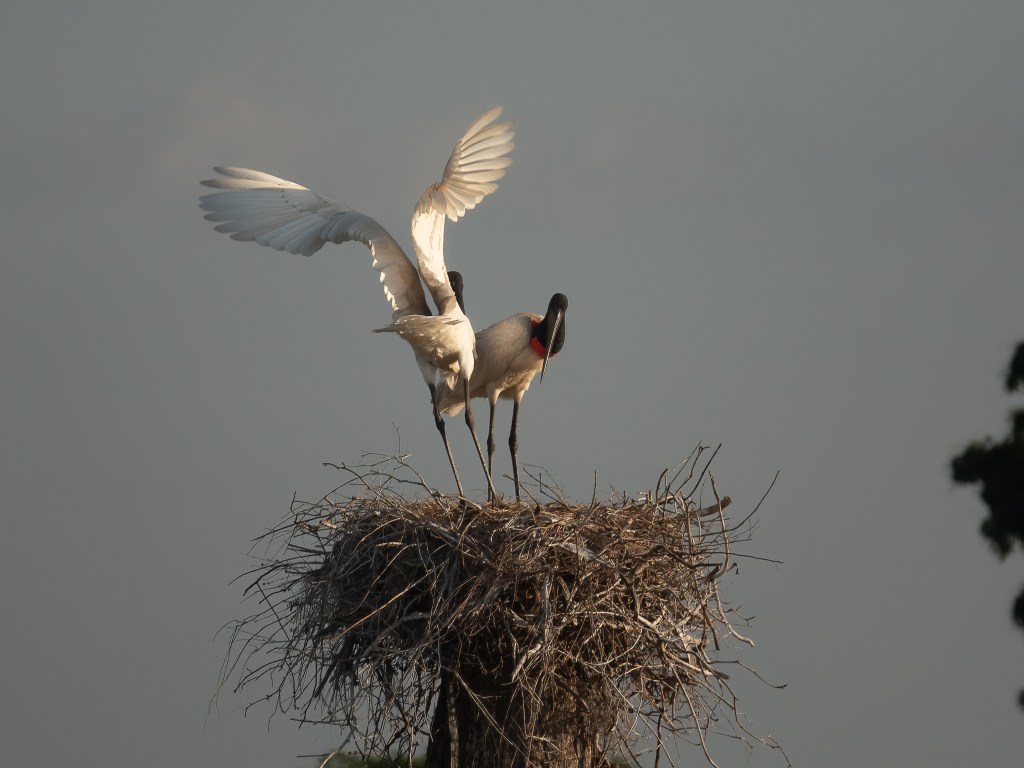
The pair below were not even fazed when their tree toppled in a storm: they just nested on top of the truncated stump. The fact that there is a livestock corral right beneath their nest does not disturb them. Not even the cowboys lassoing the bleating lambs:
However, if random people like us come too close, they glower and hood their wings:
Once the eggs (2 to 5 in all) are laid they tend them carefully,
turning them from time to time.
Both parents take turns to tend the nest, so the shift change gives us a chance to see both together.
After a brief overlap, in which one assumes they pass on a report on the condition of the eggs, and advice on when they next need turning, the outgoing shift takes off:
vast wings beating strongly as it heads off to feed.
They eat frogs, fish, insects, and even small rodents. They coexist comfortably with wood storks and various egrets,
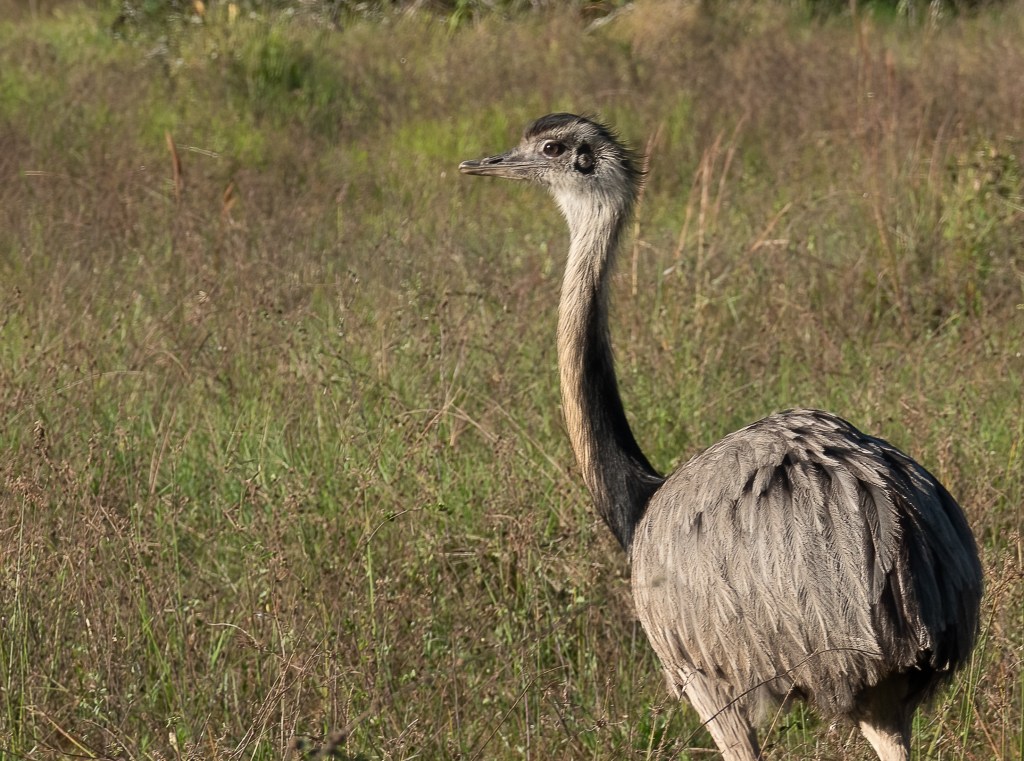
as well as rheas, and other large birds. This one nearly landed on a rhea, a large flightless bird up to 1.7m (5′ 7″) tall.
A quiet yoga pose is the image that remains with me.
PS Here is a photo of a pair of the Greater Rheas, Rhea americana, distant relatives of ostrich and emu.
and a close-up.
The IUCN classifies it as Near Threatened, with its population in decline.
*My title owes apologies to Lewis Carroll’s Jabberwocky, here translated into Portuguese by August de Campos::
JAGUADARTE
Era briluz. As lesmolisas touvas roldavam e reviam nos gramilvos. Estavam mimsicais as pintalouvas, E os momirratos davam grilvos.
“Foge do Jaguadarte, o que não morre! Garra que agarra, bocarra que urra! Foge da ave Fefel, meu filho, e corre Do frumioso Babassura!”
Ele arrancou sua espada vorpal e foi atras do inimigo do Homundo. Na árvore Tamtam ele afinal Parou, um dia, sonilundo.
E enquanto estava em sussustada sesta, Chegou o Jaguadarte, olho de fogo, Sorrelfiflando atraves da floresta, E borbulia um riso louco!
Um dois! Um, dois! Sua espada mavorta Vai-vem, vem-vai, para tras, para diante! Cabeca fere, corta e, fera morta, Ei-lo que volta galunfante.
“Pois entao tu mataste o Jaguadarte! Vem aos meus braços, homenino meu! Oh dia fremular! Bravooh! Bravarte!” Ele se ria jubileu.
Era briluz.As lesmolisas touvas Roldavam e relviam nos gramilvos. Estavam mimsicais as pintalouvas, E os momirratos davam grilvos.
Just to remind you, here is the original. Perhaps ‘Beware the Jubjub bird’ would have been a better title, but Jabiru and Jabberwock have the same rhythm.
The Jabberwocky, from Through the Looking Glass , 1871, by Lewis Caroll:
‘Twas brillig, and the slithy toves Did gyre and gimble in the wabe; All mimsy were the borogoves, And the mome raths outgrabe.
“Beware the Jabberwock, my son! The jaws that bite, the claws that catch! Beware the Jubjub bird, and shun The frumious Bandersnatch!”
He took his vorpal sword in hand: Long time the manxome foe he sought— So rested he by the Tumtum tree, And stood awhile in thought.
And as in uffish thought he stood, The Jabberwock, with eyes of flame, Came whiffling through the tulgey wood, And burbled as it came!
One, two! One, two! And through and through The vorpal blade went snicker-snack! He left it dead, and with its head He went galumphing back.
“And hast thou slain the Jabberwock? Come to my arms, my beamish boy! O frabjous day! Callooh! Callay!” He chortled in his joy.
‘Twas brillig, and the slithy toves Did gyre and gimble in the wabe; All mimsy were the borogoves, And the mome raths outgrabe.
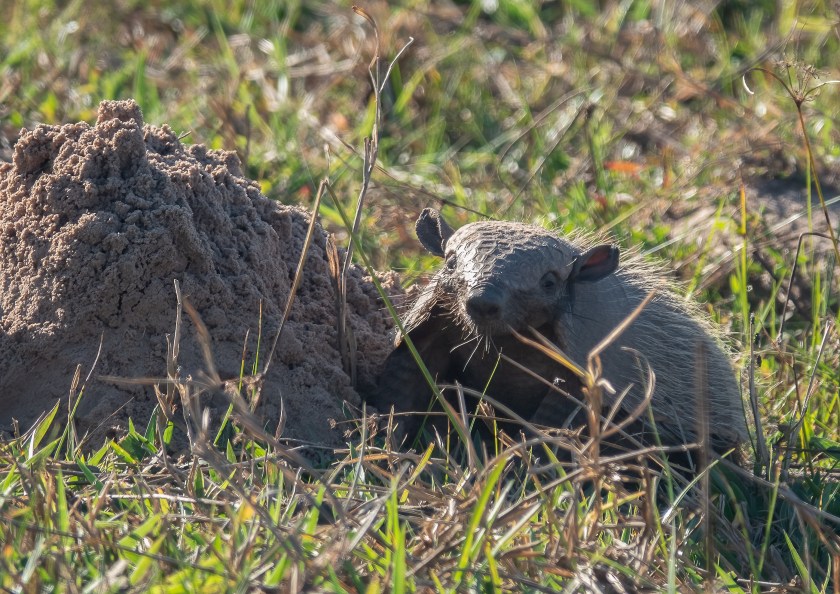
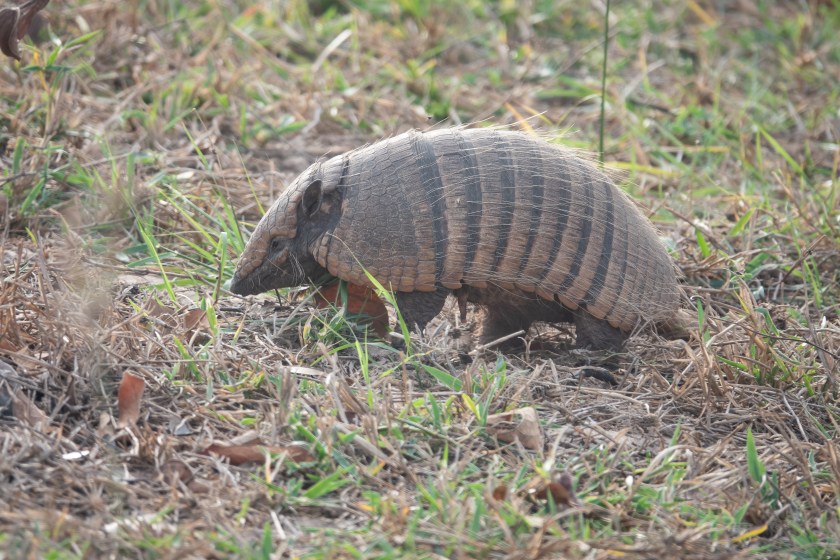
Armadillos are very strange mash-ups. The small ones are like guineapigs with scales, and the bigger ones remind me slightly of armored capybaras. Here is a six-ringed armadillo:
Despite the scales, they are mammals, and suckle their young. This one is a female, if you look carefully you can see her teats.
They are anteaters, and at Baia das Pedras the pampas were littered with small piles of earth where they had been digging for their dinner. The larger holes were their dens.
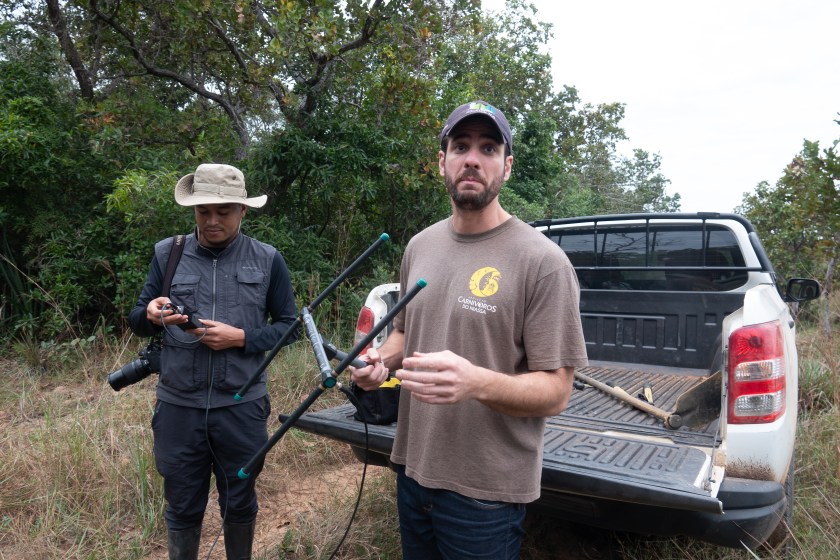
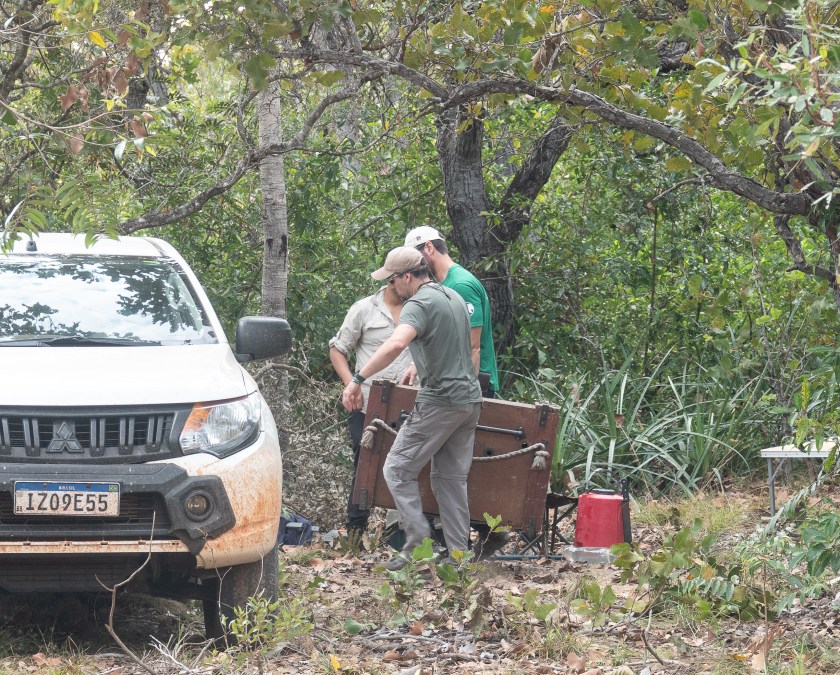
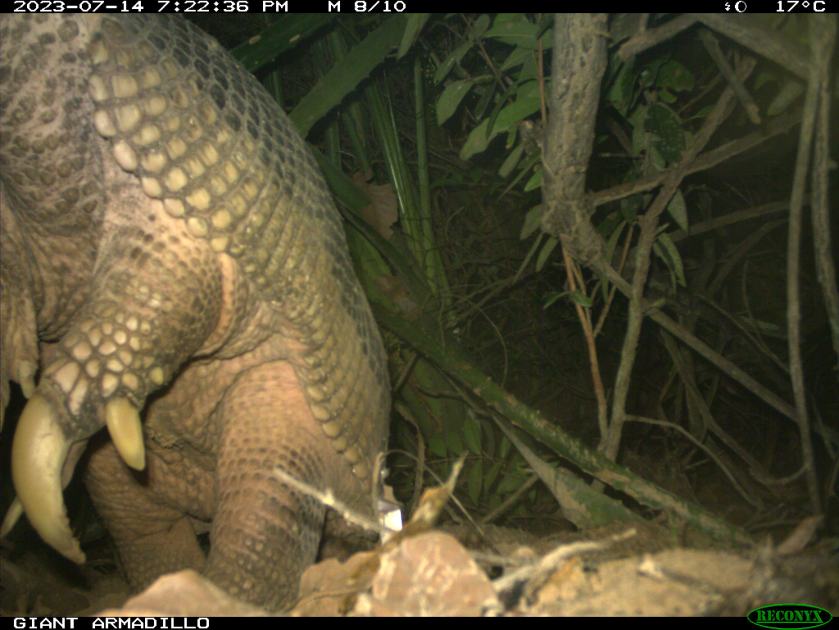
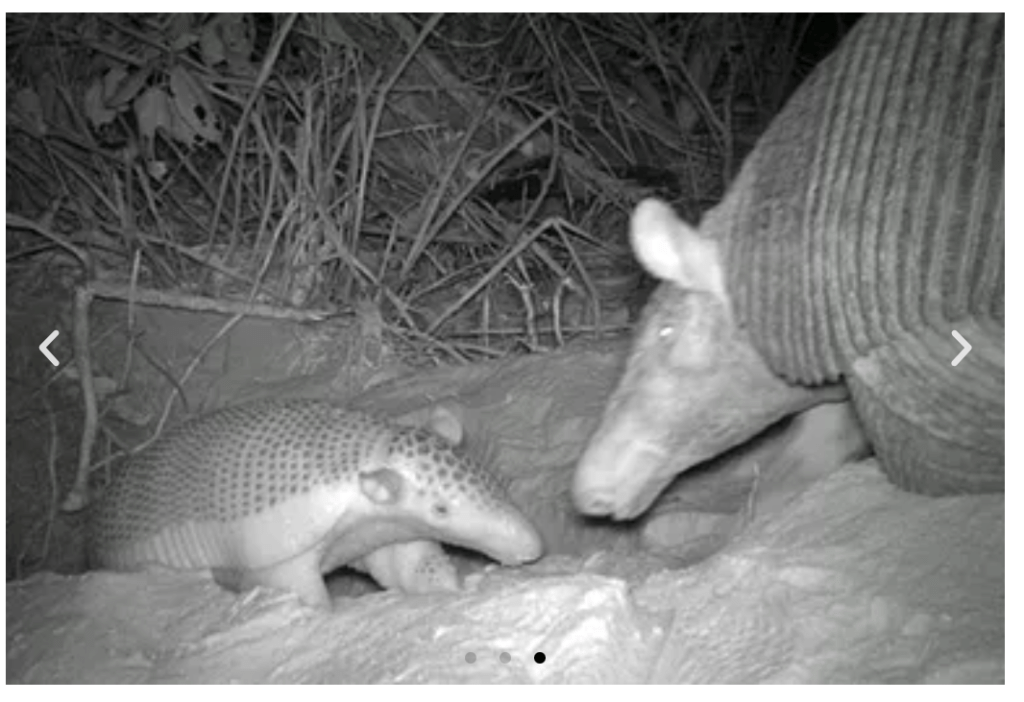
The biggest of all is the Giant Armadillo, a nocturnal recluse about whom little is known. They are now the object of study for Gabriel (right) and Carlos, a visiting researcher from Colombia:
Our hostess, Rita, has lived on her farm for her entire life, and had never seen one until the research team appeared. Over the past ten years they have been tagging and monitoring about forty of these animals to learn more about their range and their habits.
They start by finding one of the huge mounds they excavate for their dens, where they sleep the day away:
Then they put a trap over the hole, and when the animal emerges at dusk it is caught, and crated.
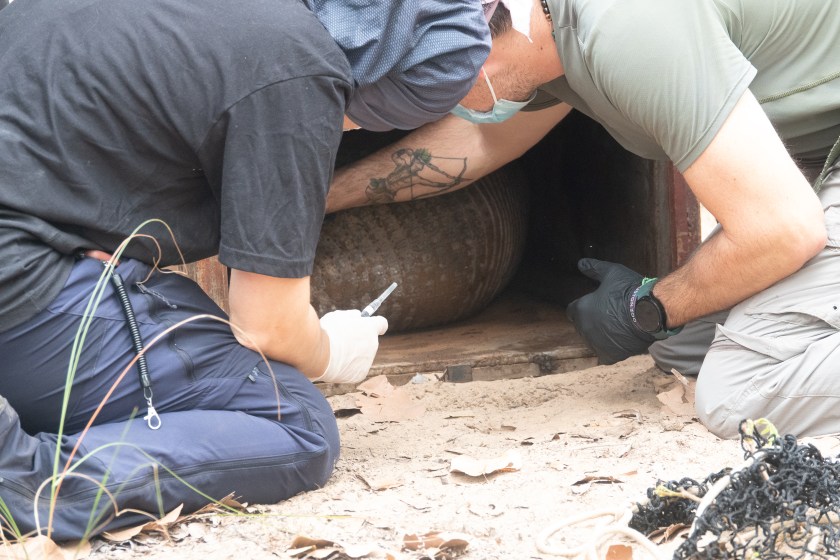
Early the next morning, they set up a field operating theatre on the tailgate of a pickup. Here is the armadillo, asleep in the crate:
He is anaethsetized:
After ten minutes his vital signs are checked:
and he is weighed, all 35Kg of him:
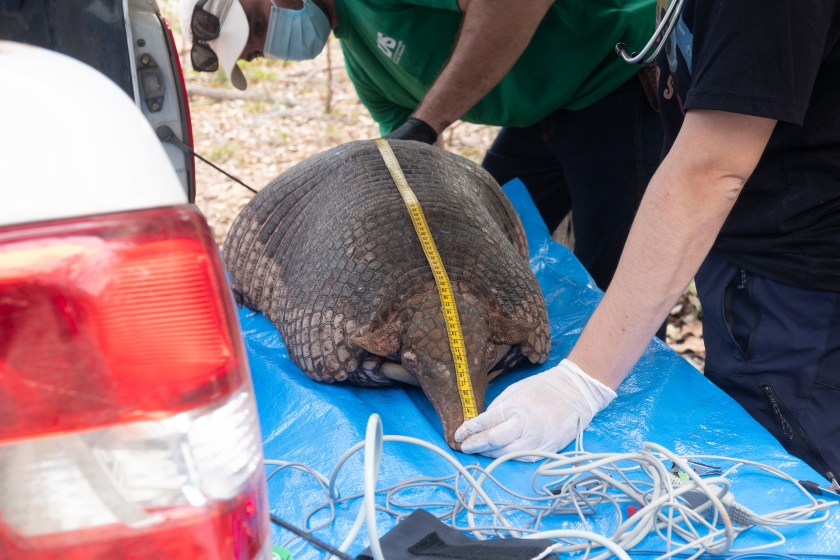
He is given a good scrubbing so his belly is clean for the upcoming procedure, and then he is lifted onto the tailgate operating table, and measured, totaling 1.35m from nose to tail:
The veterinary team are masked and gloved, and then they prep for the implantation of a tiny transmitter under the skin of the armadillos belly. He is clearly a male!
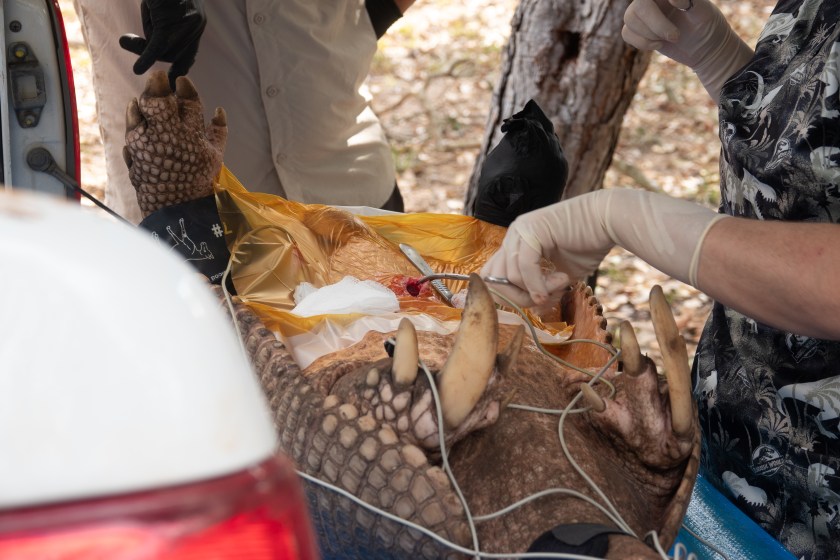
The spectacular claws are for all that digging. Next he is fitted with a blood pressure cuff:
Then they attach a heart monitor, before the sterile field is made ready, followed by a small incision, into which a tiny transmitter is inserted. It will work for several years.
Separately, they attach a more short-lived external GPS tracker to his carapace, because it has a larger range. “Carlos” was named after one of the team members, and here he is five days later, none the worse for wear:
and showing his enormous claws. You can still see the water mark where his belly was scrubbed clean, but his back retains years of accumulated dirt!
Thanks to Gabriel for the last two photos.
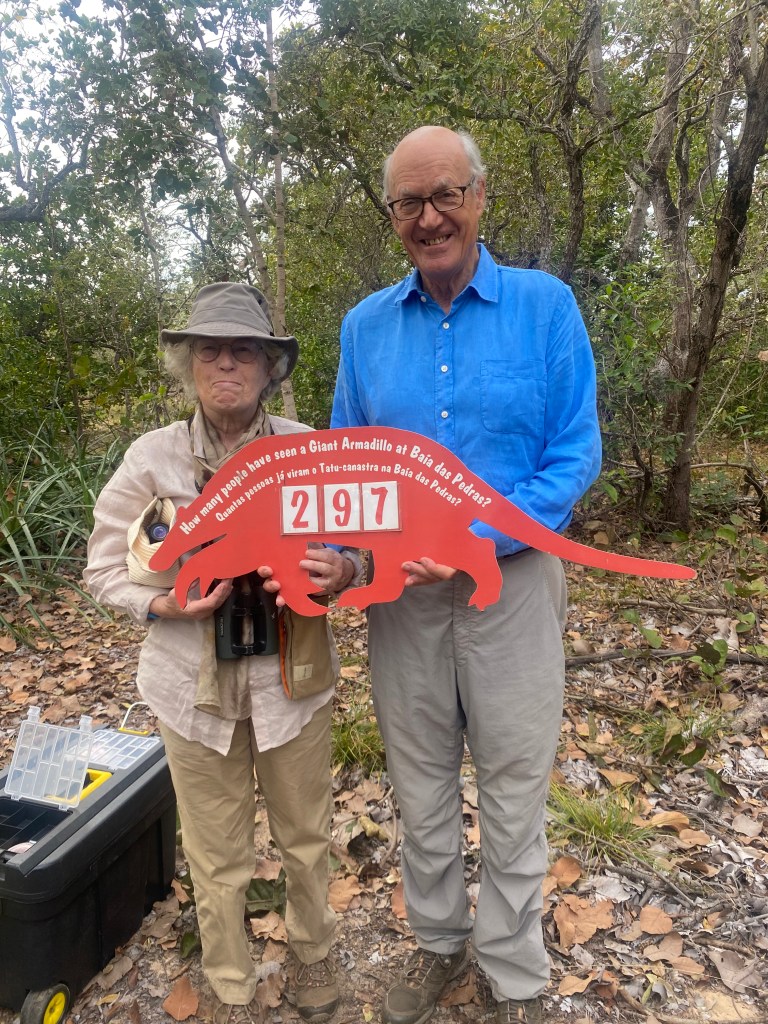
Being permitted to watch this highly skilled team at work was a great privilege, and a huge piece of luck that they caught an armadillo while we were there. We are among a select few: here are our friends Jane and Stephen with documentary proof of their presence.
PPS: Here is a link to the project that monitors Giant Armadillos.
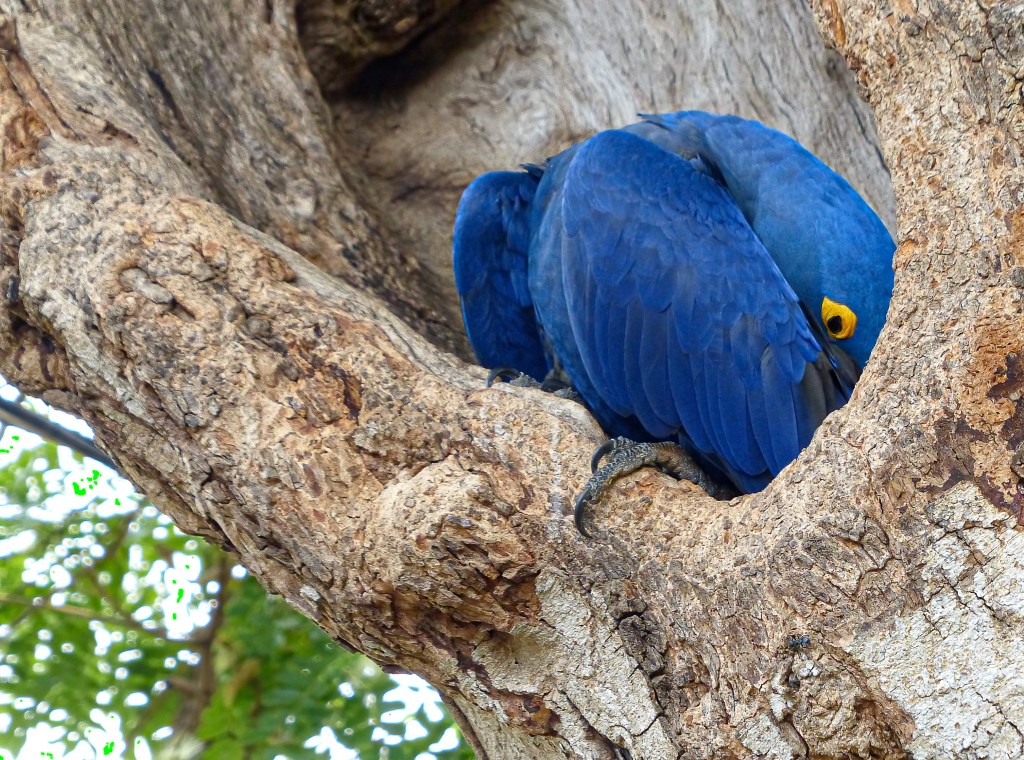
Ideally, macaws nest in existing holes in old trees,
which they then enlarge by ‘beaking’ away at the edge and chipping off wood shavings.
These are in turn used to line their nests.
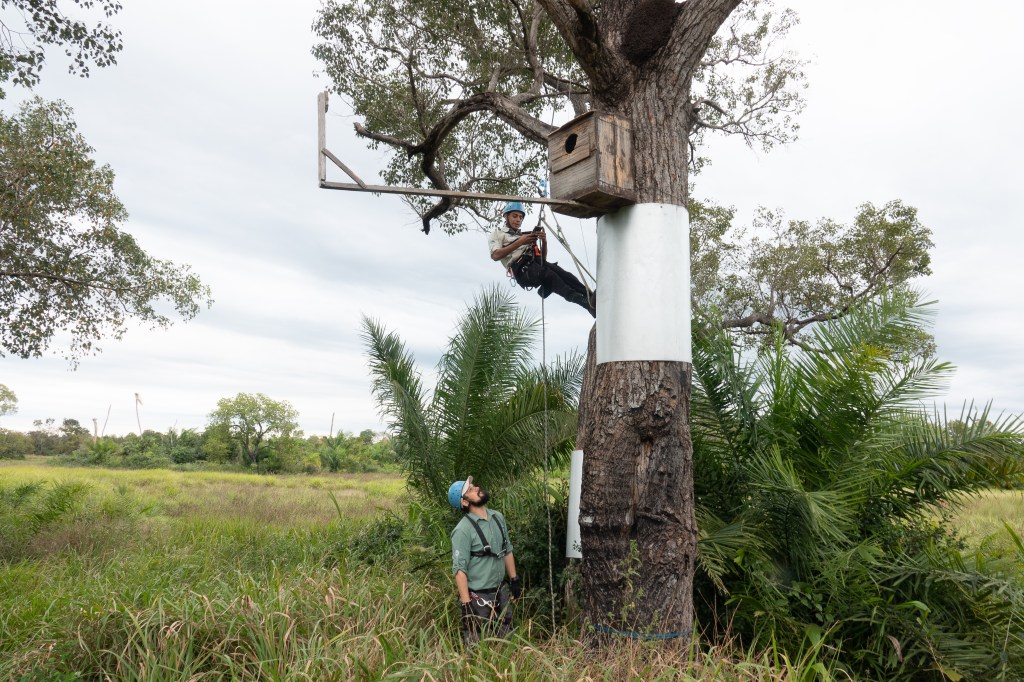
Because of the demand for natural nest sites, the Hyacinth Macaw Project not only researches the birds’ behavior and populations, but also sets up nest boxes. They monitor both the natural nests and the nest boxes.
The metal strip is to keep predators from accessing the nest, something I do on my Wood Duck boxes here in Maine. It turns out to also inhibit the spread of fire.
The team climb up, inspect the inside for fresh wood chips that might indicate it is being used, look for damage from their ‘beaking’ that might need repairing, and photograph the inside. This extra-tall box houses a camera at the top. The bottom front corner needs repair, before the wood chips fall out.
The macaws do not like the intrusion:
The natural holes are monitored in the same way. This tree has been monitored for about 30 years. A smartphone is poked in to “see” the interior, while the displaced macaws complain loudly.
In the breeding season, you can tell the females by their curved tail feathers, bent from squeezing into the nesthole.
Merlin, an eerily accurate Cornell app that identifies birds from their songs and calls, consistently told us that these were Blue-and-gold Macaws, but they are a different species. The researchers told us that Hyacinth Macaws have various geographical dialects, and that Merlin was trained on macaws from the North Pantanal, where they sound like Blue-and-golds.
PS You can read more about the Hyacinth Macaw Project here:
PPS Caiman Ecological Refuge was hit by a terrible fire in the second half of September 2019. Its devastating effects on the macaws and their food source is documented here.


























 Eyes on the Wild