I fear I may be boring you. If so, stop reading. It’s just that some moments light up your day in such a way that you cannot stop yourself wanting to show them to anyone you encounter, and this was one of those. I was filming a solitary otter on the ice, and then …
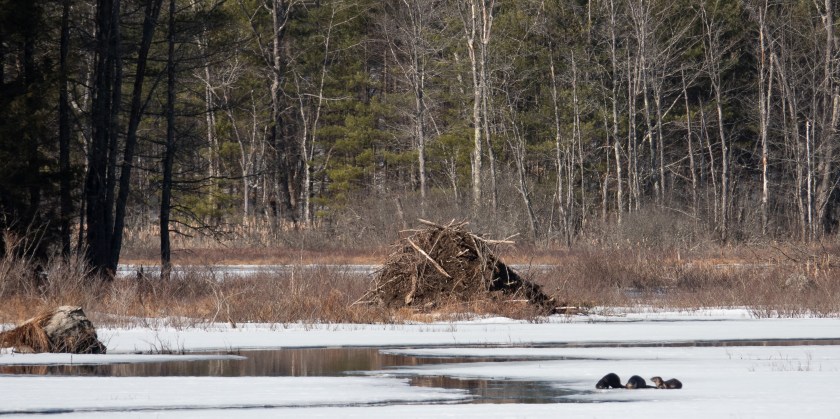
This is the land where my otters live, shared with the beavers who built the huge lodge behind them:
As the video starts, she is alone… but not for long… (try to watch it fullscreen, and don’t miss the somersault):
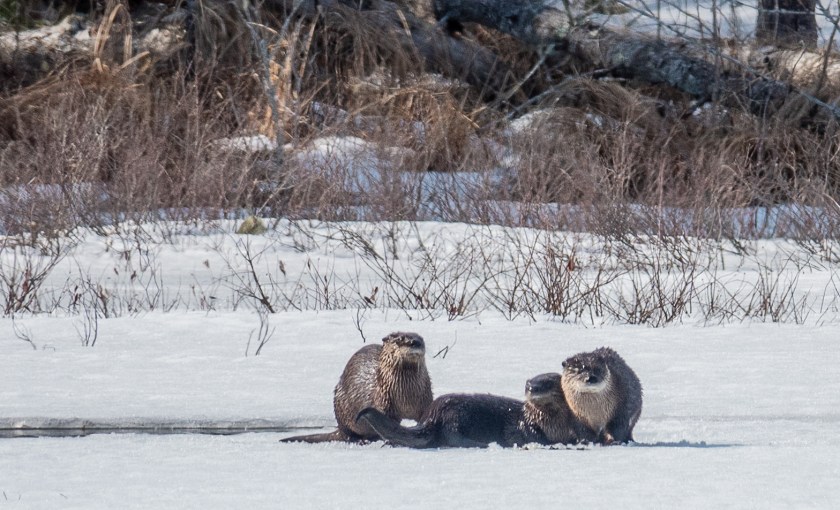
I think it was the mother and last year’s young again, two of them are rough-housing while one is resignedly letting them roll around on top of her. Here they are in closeup, the mother in the centre:
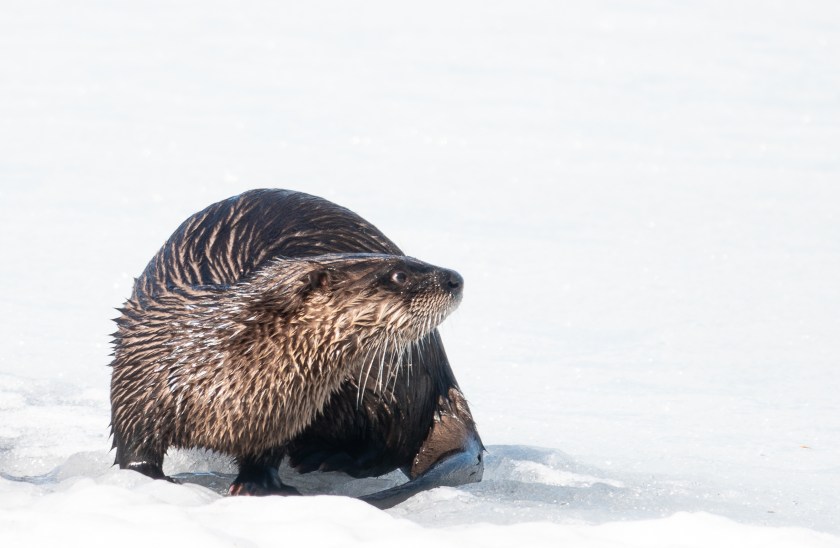
Two days earlier, another magical encounter. I was showing a friend’s grandkids the otter pond, and carefully refraining from promising otters, when one popped up 20 feet from us, and stayed there.
This has NEVER happened to me before, the kids of course had no idea that it was the sighting of the year!
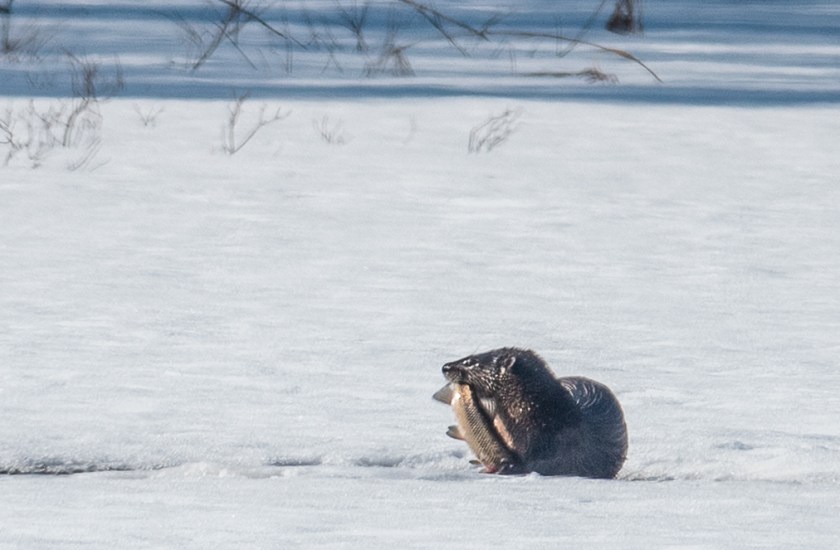
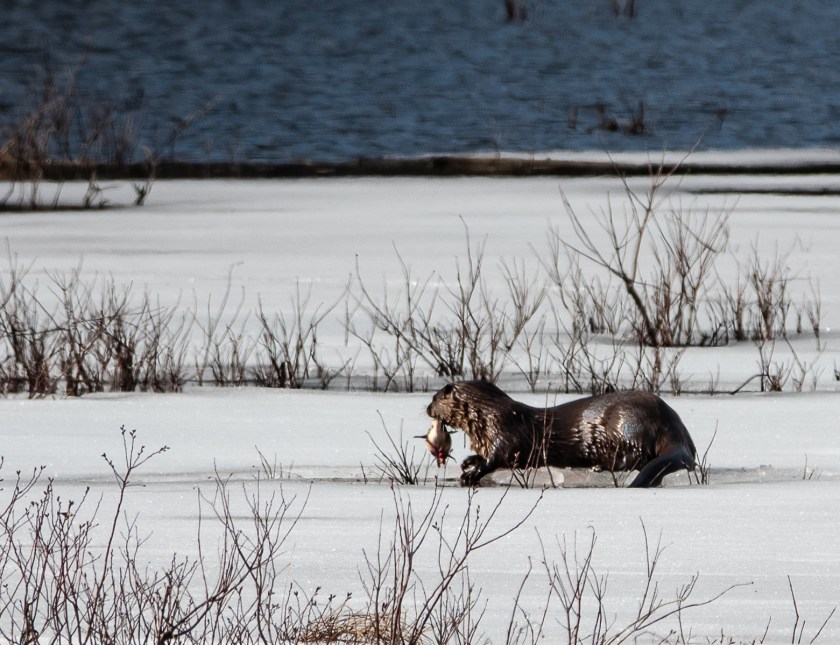
Finally, two days before that, here is the biggest fish I have ever seen one catch. My piscine expert thinks it is a large-mouth bass.
It took seven minutes to eat the whole thing.
I will really try not to post about otters again next time. Sorry.
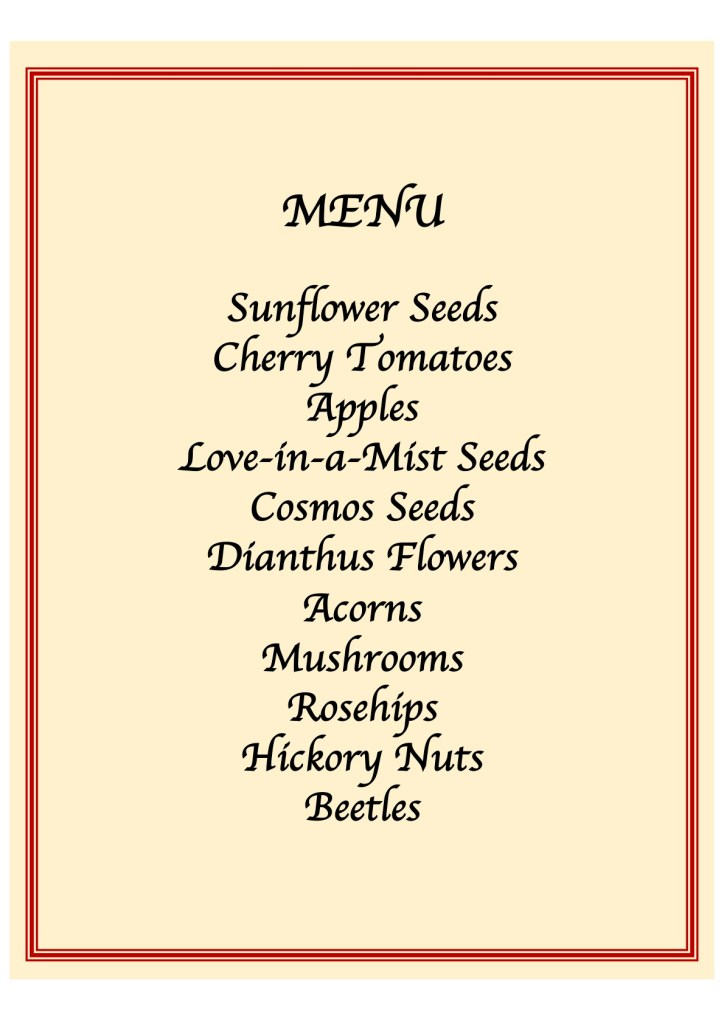
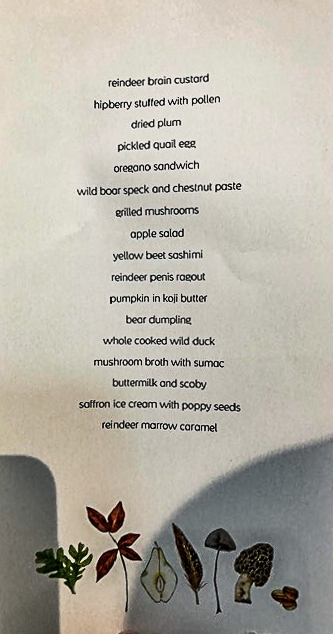
It reminds me of a menu from Noma, the three-Michelin-star Copenhagen foraged restaurant (actual menu at end of this post!):
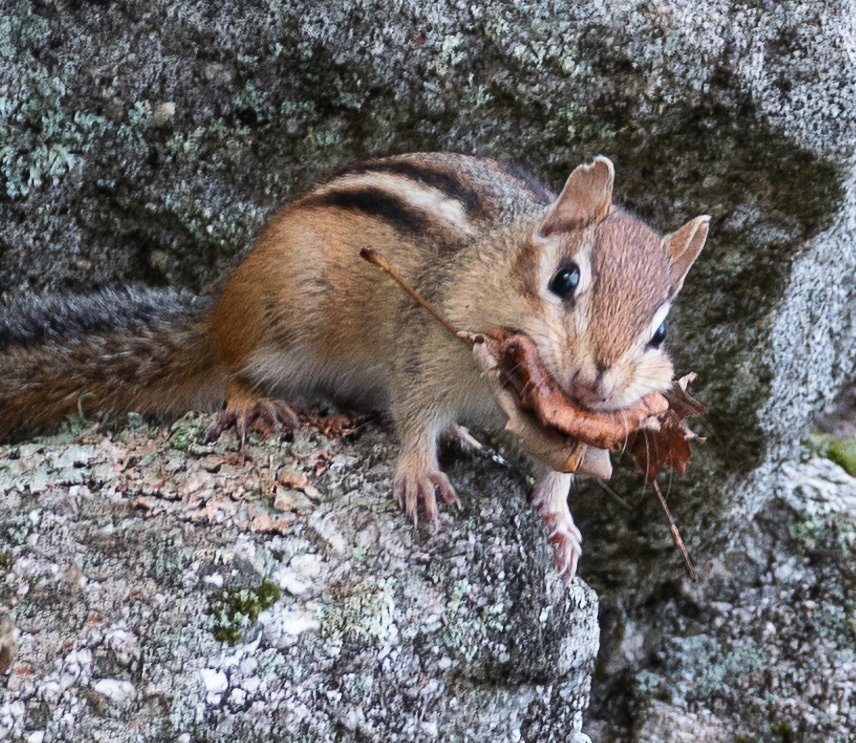
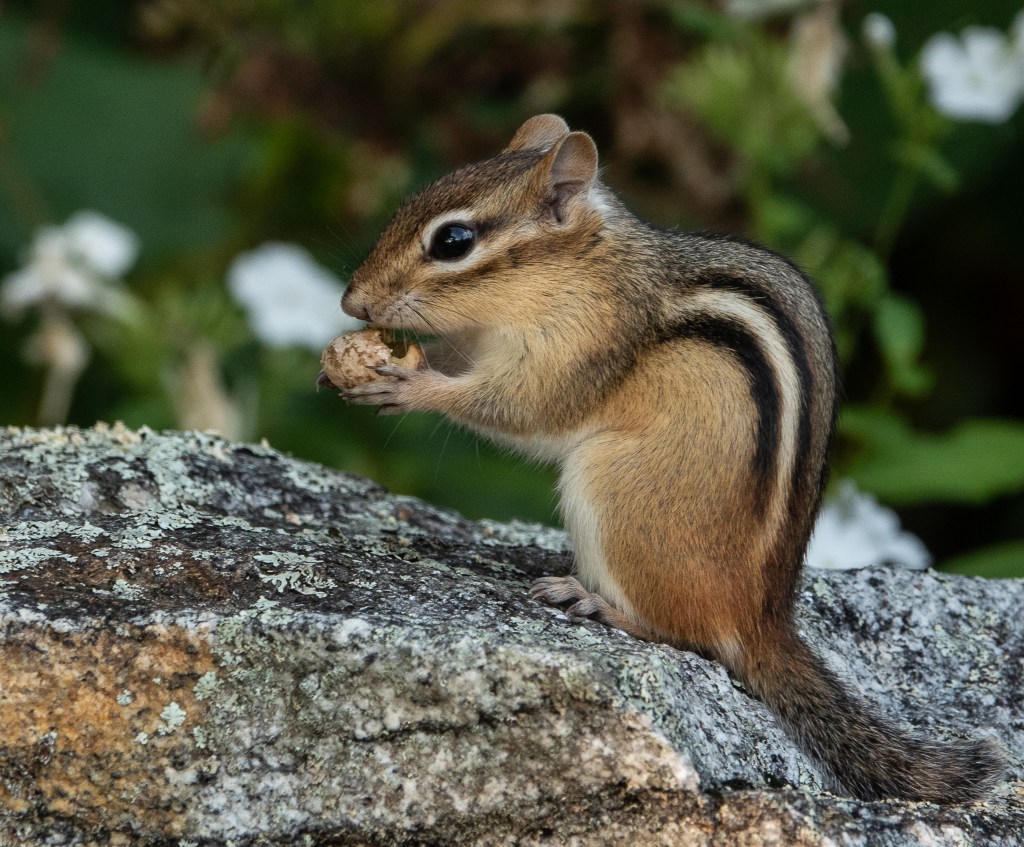
Eastern Chipmunks, Tamias striatus, have a varied diet. They eat lots of sunflower seeds, and are easy to train if bribed with a trail of seeds:
Given half a chance they make off with their cheeks full and cache them back at base camp:
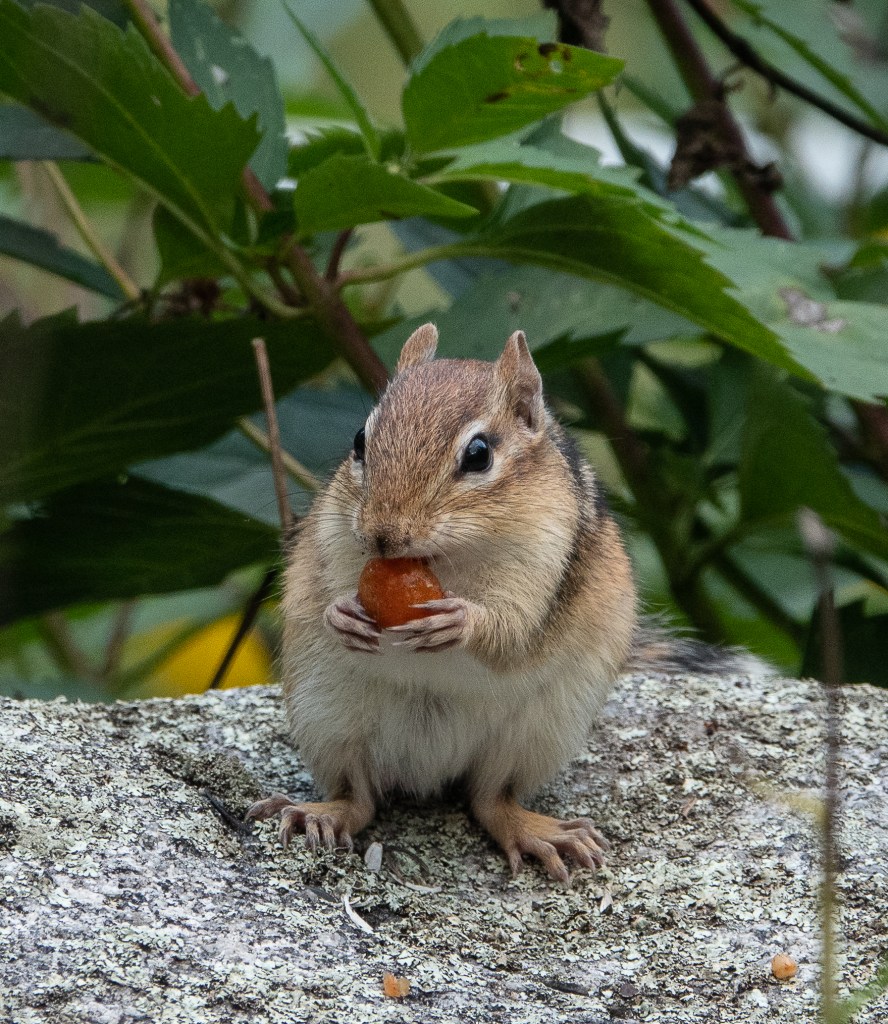
They devour many other foods inadvertently provided by humans, like cherry tomatoes
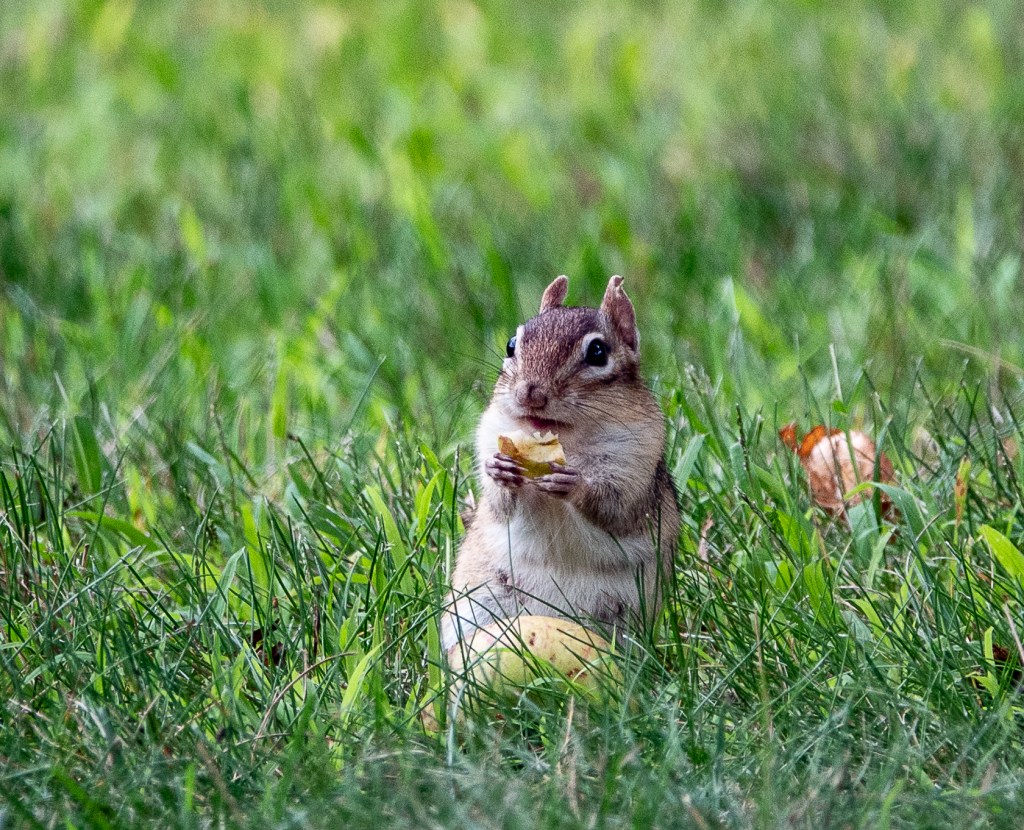
and apples
They also like the flowers and seeds from cultivated flowers like Love-in-a-Mist:
and cosmos
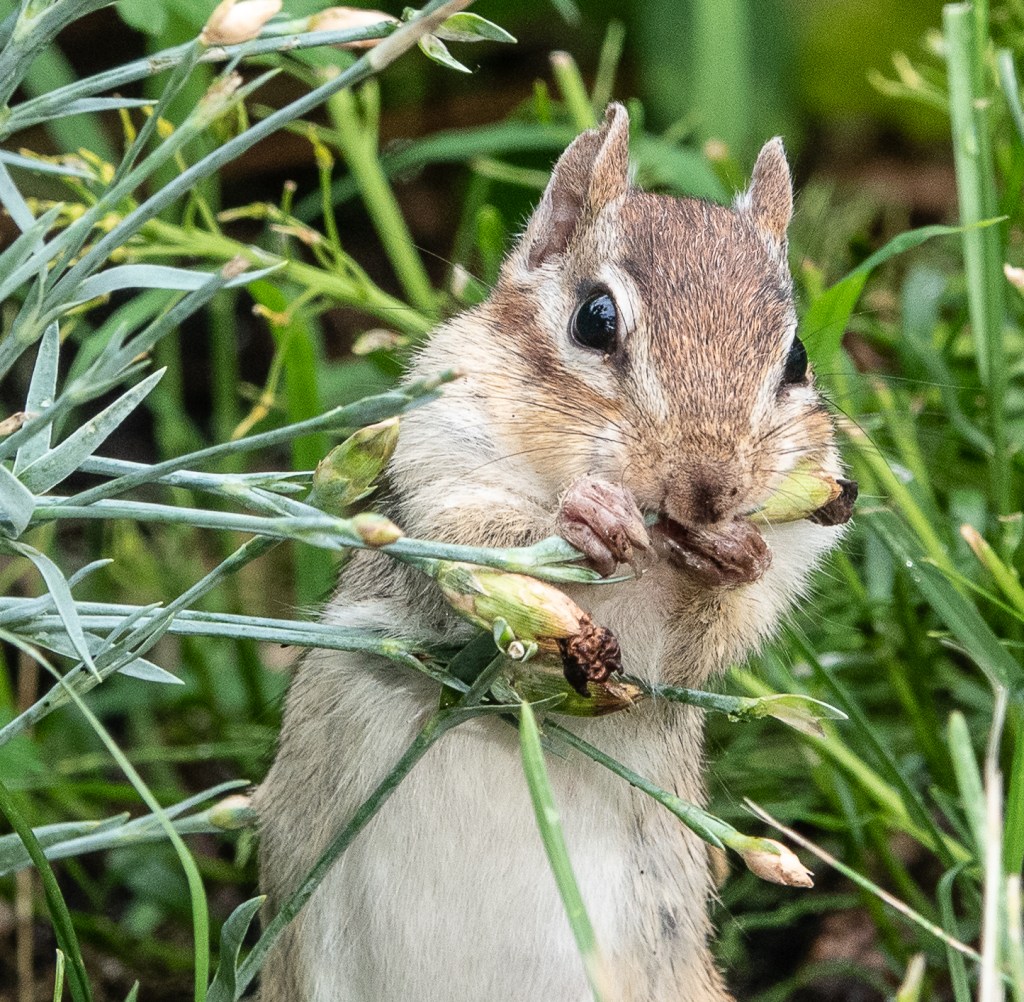
and dianthus:
including infuriatingly the flower buds:
Here is an action video:
If you watch carefully once I zoom in, you can see that they actually eat only the base of the flower, where the nutritious ovary is, and discard the actual flower*. This is what is left:
But they are more than capable of feeding themselves from wild sources, like acorns:
mushrooms:
Rose hips:
Hickory nuts (very hard to get int0, but apparently worth the effort)
Here is a brief video of one gnawing on a hickory nut:
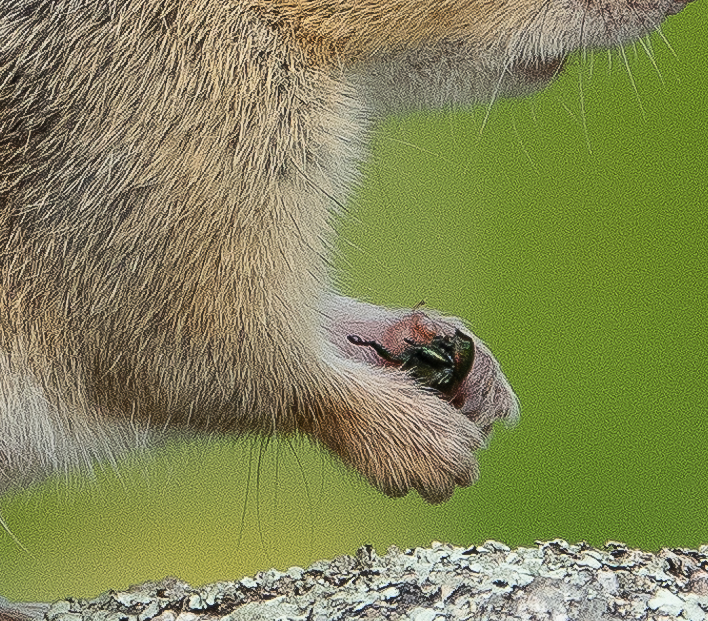
And finally beetles (something I showed you before):
These are just the snacks I have watched them tuck away on camera. There are undoubtedly more.
*After the flower is fertilized, the ovary becomes the fruit, and contains the seeds. This is the nutritious part of the plant.
PS An Ohio study showed that beetles, caterpillars and and fungi are the mainstays of their summer diet. In the spring and fall, the balance shifts to a larger proportion of acorns and hickory nuts (easy to cache).
John A. Wrazen and Gerald E. Svendsen (1978) Feeding Ecology of a Population of Eastern Chipmunks (Tamias striatus) in Southeast Ohio. The American Midland Naturalist , Vol. 100, No. 1 pp. 190-201
Right now, they are still ‘hibernating’. Chipmunks are not true hibernators. but they enter a torpid state with decreased body temperature and heartbeat. They wake every few days to feed on stored food. They will wake up fully in a few weeks as the weather warmsand the snowpack melts.
[This post focusses on their diet and their digestion, and may not be for everyone! You may want to skip two of the later photos, but the second and final video should raise a smile, trust me.]
My otters like the sunshine, and they are late risers, waiting till the temperature rises to its peak in the afternoon to put in an appearance. I look for them daily, and two days ago we had an unseasonably warm day, 57F, and there they were at 2.30pm for the first time in several weeks.
Otters are carnivores, and they eat fish, crustaceans, and from time to time small reptiles, mammals or birds. This one caught a good sized fish, probably a sucker, which is the preferred prey because they are slow moving and take less energy to catch.
The two below have one each
They eat the entire fish, crunching it up with powerful jaws. It clearly takes some work:
as does the swallowing.
The video below shows one munching away while a second one comes and goes empty-mouthed. Once the meal was complete, the first one went off hunting again for its second course.
What goes in must come out, but they have a very effective digestion, so what is left is a black and tarry residue. (Skip the next 2 photos if you prefer, but don’t miss the final video.)
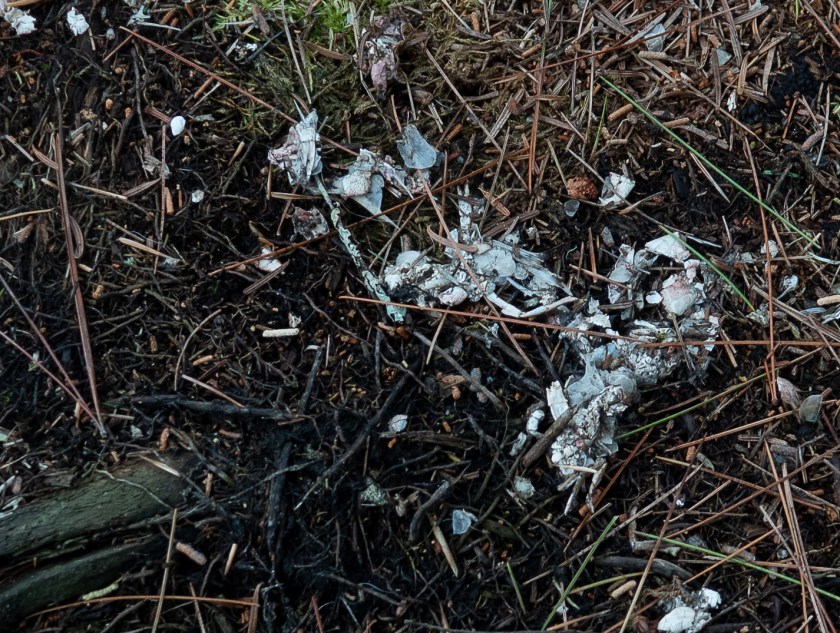
If you find old scat that has been rained on for a wile, the tar dissolves to reveal fish scales, and tiny fragments of crustacean carapaces.
Sometimes the scat includes insect parts, such as dragonflies, but they may have first been eaten by the fish, which were in turn eaten by the otter. The food pyramid in action.
I had my camera set on video and focussed on both otters, when one left the icehole and set off across the ice for no clear reason. It took me some time to work out why it was doing a jig in the middle of the pond.
If you can’t work it out on a first viewing, watch it again, on full screen if possible! And enjoy that little slide.
They need about 2-3lb of fish per day, and hunt for up to 50% of their day. During the thirty minutes that I watched them I saw these two catch five fish between them, so they seem to be doing OK, and have survived the winter so far. Then the temperature plummeted and the winds whipped up and I retreated, underdressed.
PS The research on their digestive system seems to have been done largely on captive animals with a very different diet. They are known to have a high metabolic rate and a fast digestive system. They do not stick around in highly polluted rivers, but as water quality improves they have been returning.
PPS Sadly, trapping of these stunning animals is still permitted in Maine. The season runs from Oct 31-Dec 31. Population figures are hard to find: in 1988 they were estimated at 18,000, and the annual “harvest” runs around 600 p.a.
[Back to warblers, after a week in Boston away from my personal wildlife patch, where the most exciting thing I saw was a purple finch.]
For me, many of these warblers look so similar that even after hours with a bird book I’m not sure I’ve got it right. Luckily if I register them on eBird with a photo, I will be quickly corrected if I mess up. The ones below have been through the process!!
A group of Magnolia Warblers, Setophaga magnolia, is known as a corsage, suggesting a link to the plantations and debutantes of the American South, through which it migrates en route to its winter home in Central America. In fact, it is named after the tree in Mississippi in which the species was first identified in 1810. This is a female in its first winter, with a distinctive grey neckband.
It has a barred tail, which it often fans out like this (terrible photo, but you get the idea!):
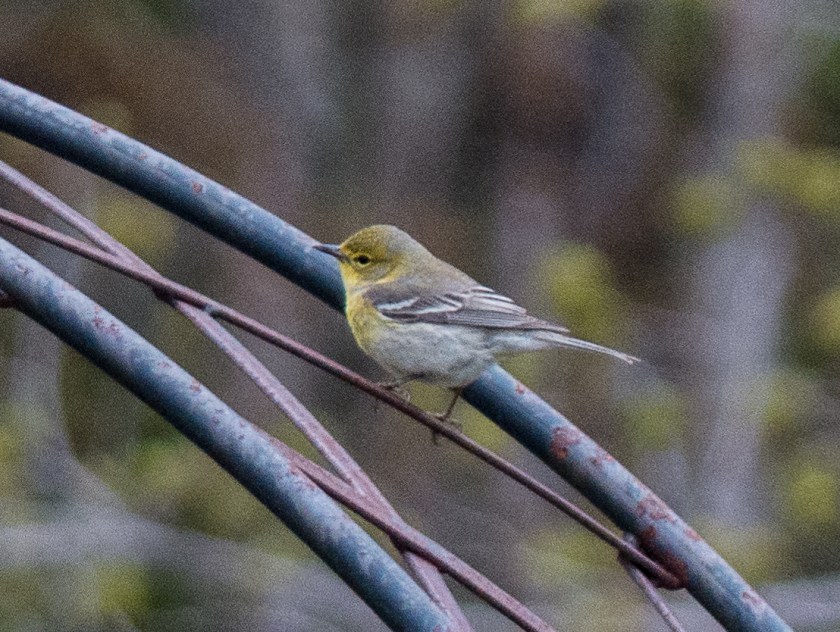
The Pine Warbler, Setophaga pinus, is dingier, but with a gentle charm:
A group of these is called a cone, easy enough to remember! Maine is the northern edge of their breeding range. Unusually among the insectivorous warblers, their digestive system adapts to allow them to eat seeds in the fall and winter.
The less common Bay-breasted Warbler, Setophaga castanea , is rather dowdy in its non-breeding plumage. This photo, as you can see, was caught when it briefly settled on a twig; this is a non-breeding female or immature bird.
Today’s final warbler is the much more striking and easy to identify Chestnut-sided Warbler, Setophaga pensylvanica,
This male is desperate to attract a mate:
They are common around me, in an area where small young saplings are moving in. I found this nest in the winter-time, and fits the descriptions and photos of one of theirs:
Maine has two species of Flying Squirrel, Northern and Southern (oddly!). The Southern ones, Glaucomys volans, are smaller, chipmunk-sized, and have white bellies. They are the ones that live around my big hickory tree. They are strictly nocturnal, so I put out a game camera, and got this video:
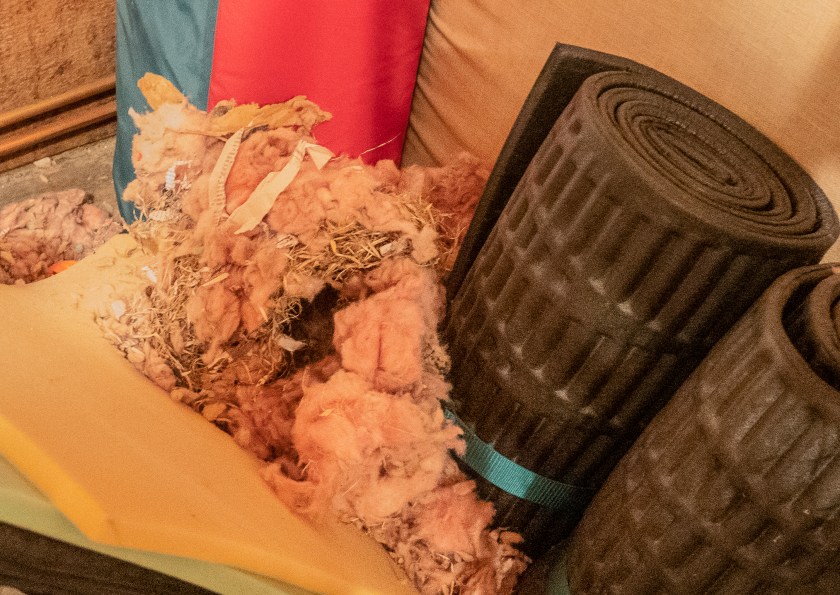
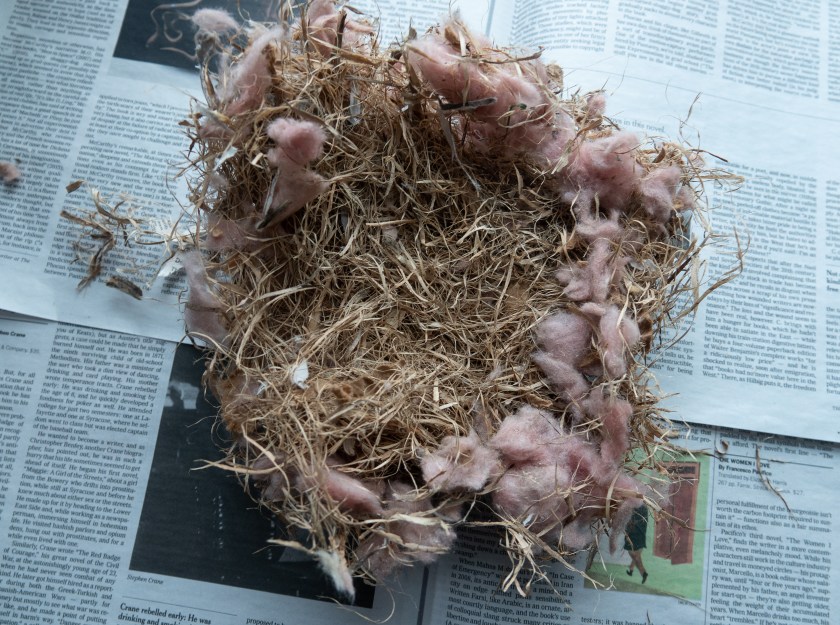
They build big dreys more than a foot across, and if they can infiltrate they like warm dry attics, like mine. This winter I discovered a large spherical pink mass of insulation in an attic closet, clearly excavated from between my rafters, next to a rolled up camping mattress.
Unfortunately I didn’t think of photographing it before I gently prized it open, to reveal a cavity in the centre:
I carefully removed the top section and turned it over. The whole interior was beautifully lined with dried grass:
Apparently flying squirrels, unlike our other squirrel species, are fastidiously clean, and they never defecate in their nests.
Flying squirrels don’t actually fly, they glide, using flaps of skin that link their wrists to their ankles, and making them almost square in flight! This terrific set of images was made by Stan Tekiela and comes from the Minnesota Conservation Volunteer website. Click to access marapr2019_young_naturalists.pdf
In 2019 the BBC Autumnwatch team brought sophisticated infra-red night cameras to my back yard and filmed the flying squirrels.
Needless to say, they got much better video! The cameraman was Mark Yates and the voiceover is Chris Packham.
Many years ago we found a terrified little flying squirrel in broad daylight in the bathroom. It had got in somehow, and was trapped. We opened the window, closed the door, and left it to escape, which it did. I do so wish I had taken a photo; it remains the only one I have ever seen in daylight.
PS Squirrels in the house can do serious damage. To see what they can do, look at the photo below:
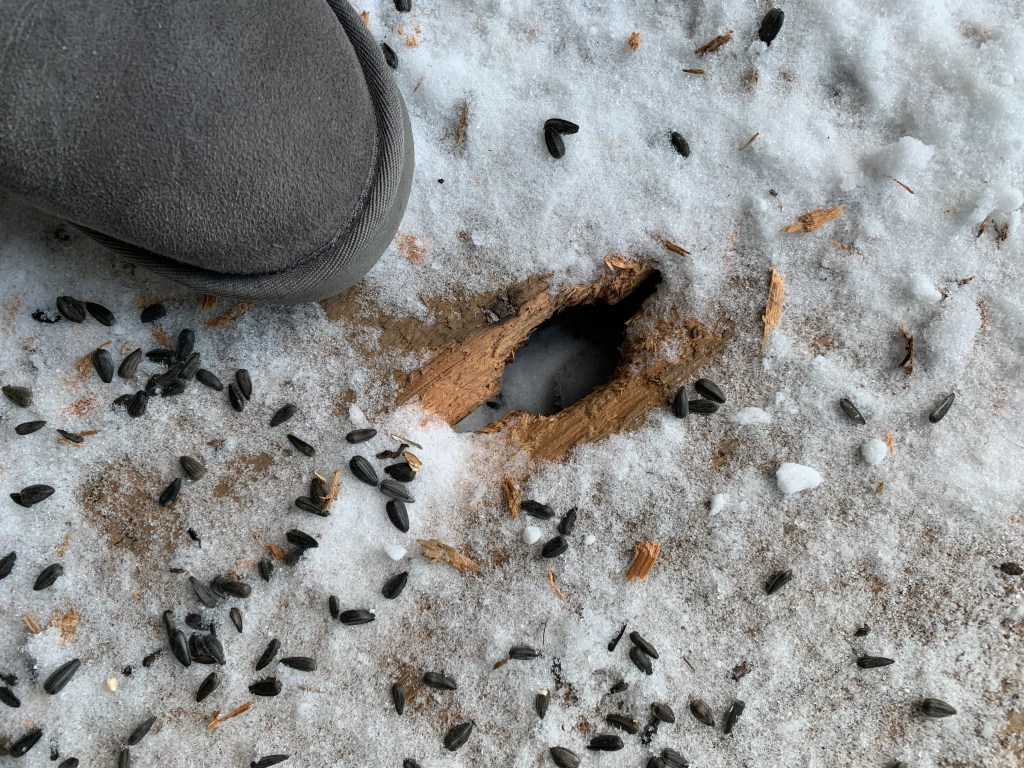
This hole in the floorboards of my shed was gnawed from underneath by a squirrel, mostly likely a red squirrel, while I was away and the shed was closed up, to get at some sunflower seeds inside. The grey thing in the top left is the toe of my boot, for scale. A good thing it wasn’t my kitchen door instead.
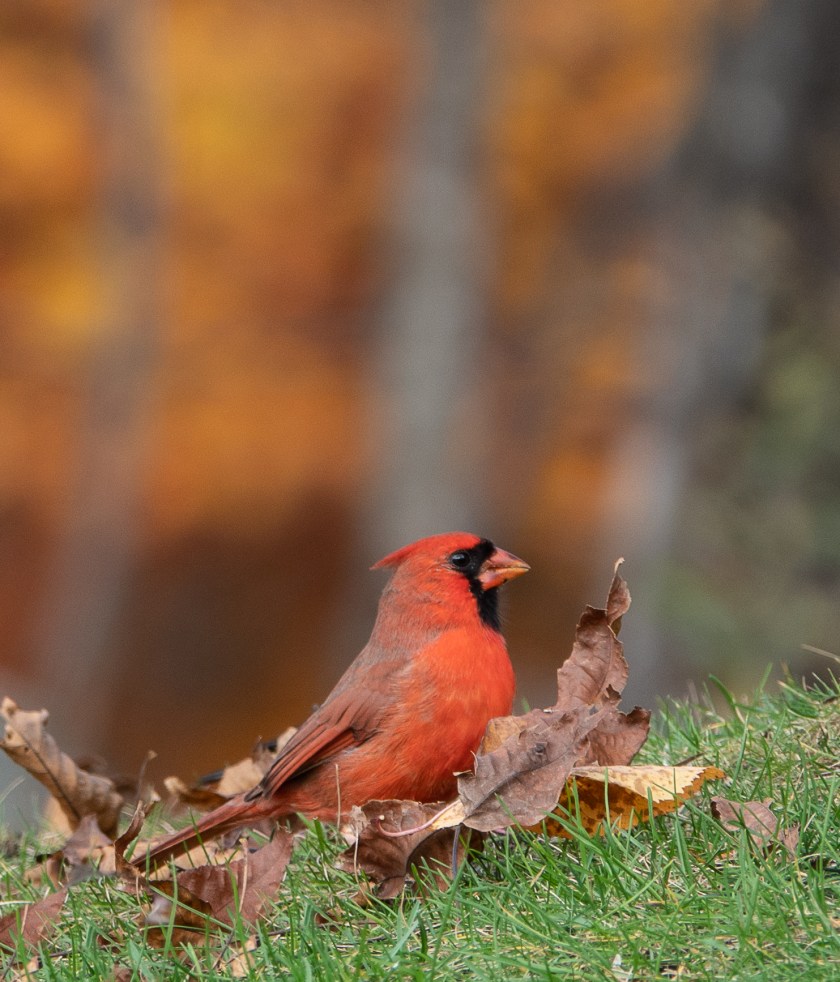
The flamboyant Northern Cardinal, Cardinalis cardinalis, is out of place in generally discreet New England. The female has the good taste to keep her red plumage to a few decorative touches on underwing, tail and crest, and of course that beak:
But the male is full-on gaudy:
They live here all-year round, and in the winter they frequent bird-feeders and bring a touch of fire to the monotone landscape:
How they survive the winter temperatures is beyond me: the night after I took this picture it was -16F, or -27C.
They are middle-sized birds, smaller than a blue jay:
or a red squirrel:
Their beaks are designed for seed-eating:
They are estimated to number around 110 million, so they are not endangered. In fact their population is slightly increasing in the northern part of their range, including Maine, while slightly decreasing in the south. Climate change??
They are socially monogamous during the breeding season, and pairs may even winter over together, but this winter so far I have only a solitary male. You will be delighted to hear that both sexes sing, and mated pairs perform duets to strengthen their bond, including counter-singing where one echoes or repeats what the other has just sung. Not sure whether this would work well for me and my husband. Males also counter-sing when they encounter neighboring males, to announce their territorial claims. This recording is a male and female pair counter-singing. It is unusually long for cardinals.
(Macaulay Library ML 54675. Sylvia Halkin )
PS For a human counterpart of the male cardinal’s color and cocky demeanor I offer you this satirical painting of a different sort of cardinal by the 19th century French painter Vibert. It is aptly entitled “The Preening Peacock”. He, of course, does not have a mate to sing to.
[As I send this, I am in Boston, where we had 23.7″ of snow yesterday, but no otters!].
Otters love to slide, and although they are said to do it in play, they also put it to practical use as a means of locomotion. This is all about sliding.
My videos are taken on my camera, hand-held and wobbly ( a style much admired by avant-garde directors). Nonetheless, from time to time I inflict them on my readers.
Here is a very short clip of a sliding otter, which I have slowed to half-speed. Although I have seen their tracks in the snow I’ve never watched them doing it before. It reminds me in its nonchalance of Nadal sliding to reach a ball on a clay court:
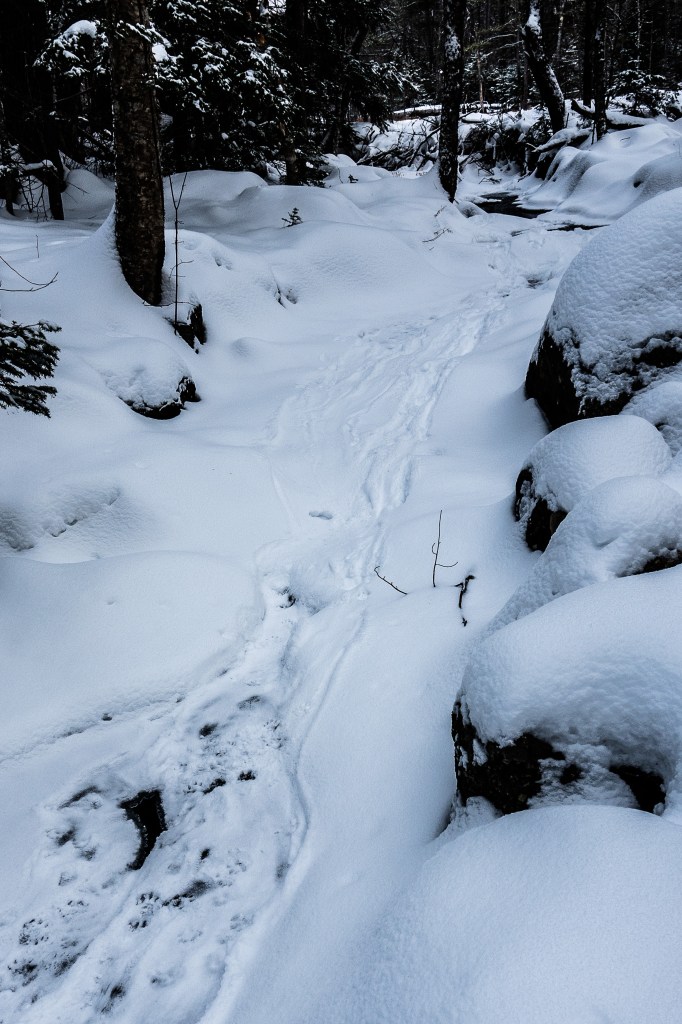
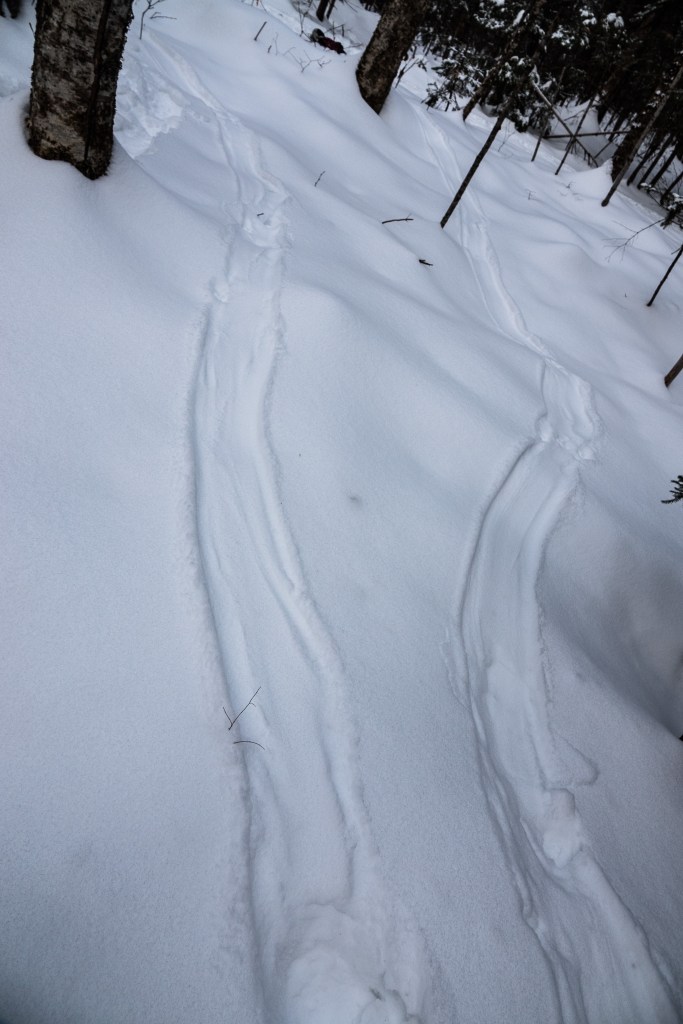
When an otter or two decides to really travel, they can use this slide technique to cover big distances. The other day we had two inches of fresh powdery snow on top of an icy crust on top of a ten-inch base layer. I decided it was too good to miss, so I went out skiing in the woods towards the beaver pond. And there, going across my ski trail, were two parallel otter slide tracks. You can see one in the foreground, heading from my ski trail (bottom right-hand corner) off to the left, and a second one just visible in the background,
It had only stopped snowing an hour or so earlier, so they were absolutely fresh. I needed my snow shoes, so I went home, and changed my equipment. On my return, I first followed the tracks north towards my beaver pond, which is frozen solid. My tiny beagle cleverly discovered the only patch of thin ice, and fell in. Disaster. Just as I was about to throw down my camera and get on my belly to rescue her, she managed to hoist herself out onto the ice. So we went straight home to dry her out.
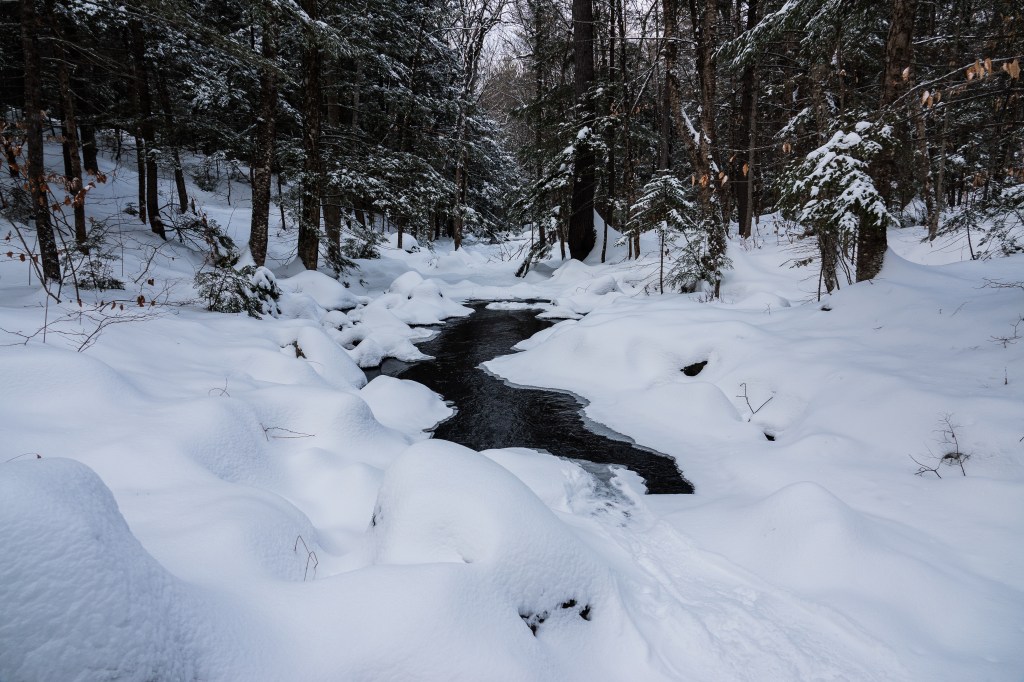
I phoned a friend, and she and I set off again, on snowshoes, and without the dog. We returned to the beaver pond, and realized they had emerged from the water just where my dog had gone in (!), climbed over the beaver dam, and down to the stream bed. The dam is in the background of this shot at the top of the photo, with the pond invisible behind it:
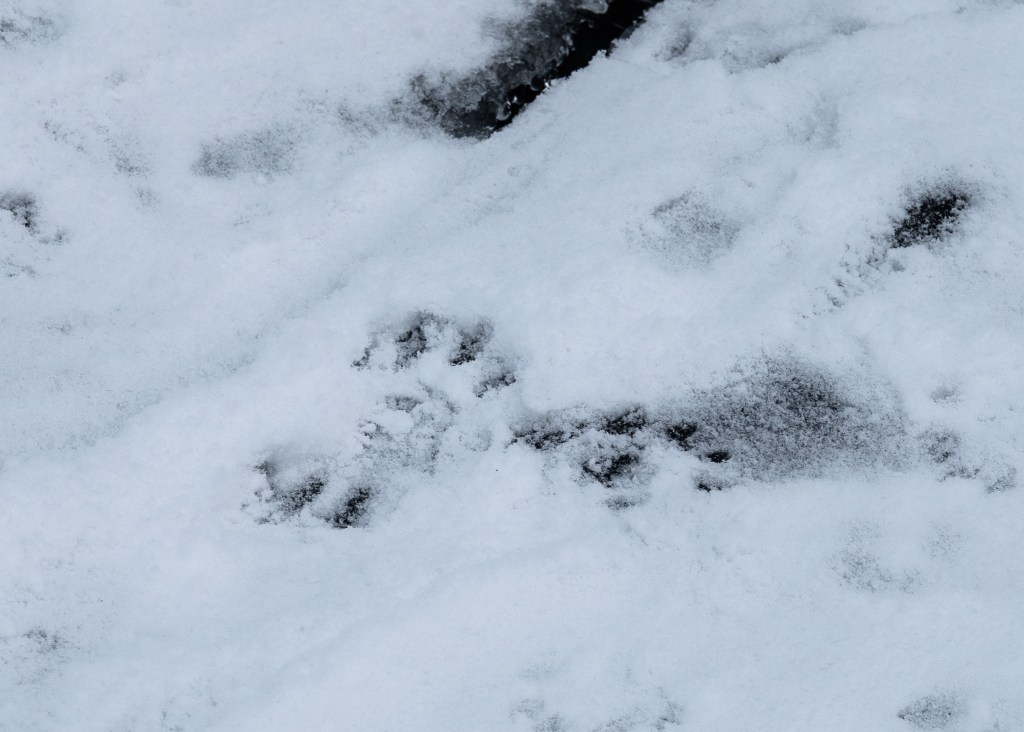
The otters seemed to have been messing around on the ice, possibly grooming, or even eating a fish? Here is a close up of their prints:
They followed the stream for a short distance (look at the tracks at bottom right of the photo)::
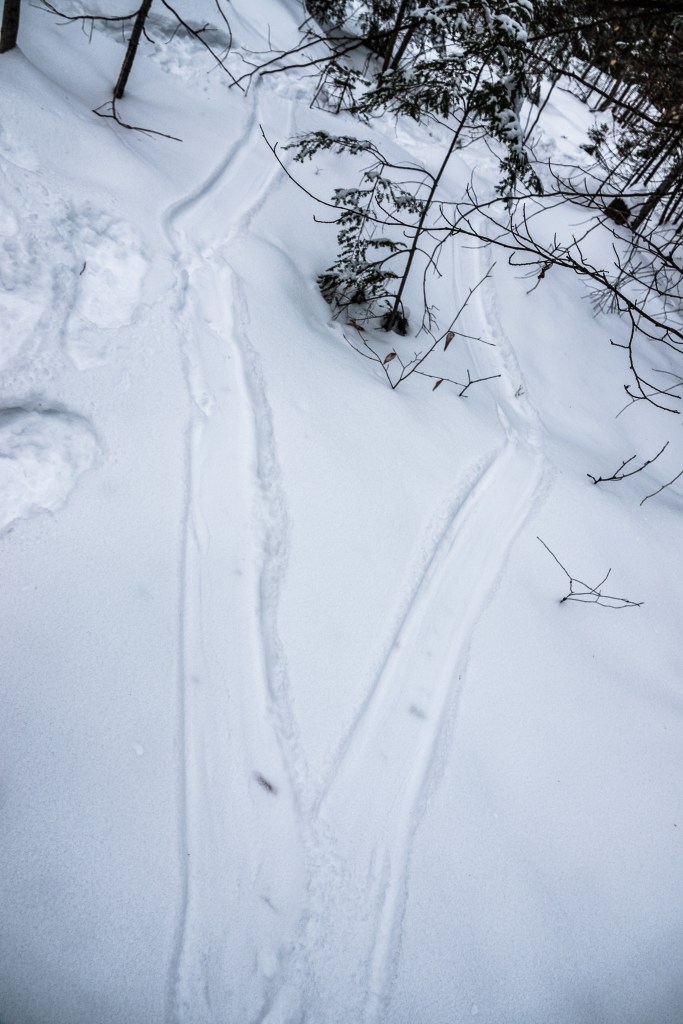
Then they peeled off into the woods, heading who knows where? The tracks were roughly parallel, about 7″ wide, but sometimes they’d part to go on opposite sides of a tree, then rejoin each other:
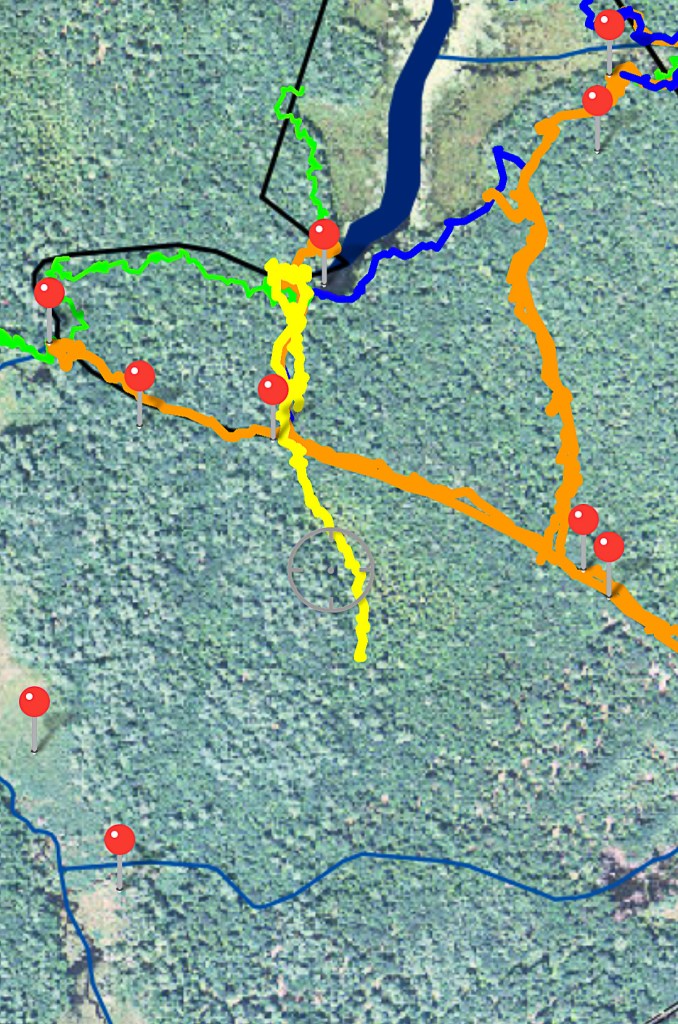
I used my GPS app to record our walk, and we tracked them from the beaver dam southwards for 0.6Km, the yellow line on the map. Then we ran out of time, and they were still a long away from the nearest water, though they seemed to be heading for the small stream at the bottom of the map, about 0.4Km further on..
For most of the way the ground was more or less level, but sliding was their preferred technique. Occasionally they had to waddle to go up and over (or under) a fallen tree or small boulder, which looked like hard work, but otherwise they slid, putting their paws down for the odd shove. The longest single slide we saw was about 20 feet. Most were six feet or so between boosts. It was a magical close encounter, a window into their lives.
PS Thankyou, Leigh, for your company, your tracking expertise, and your own wonderful blog, Wonder my Way, https://wondermyway.com .
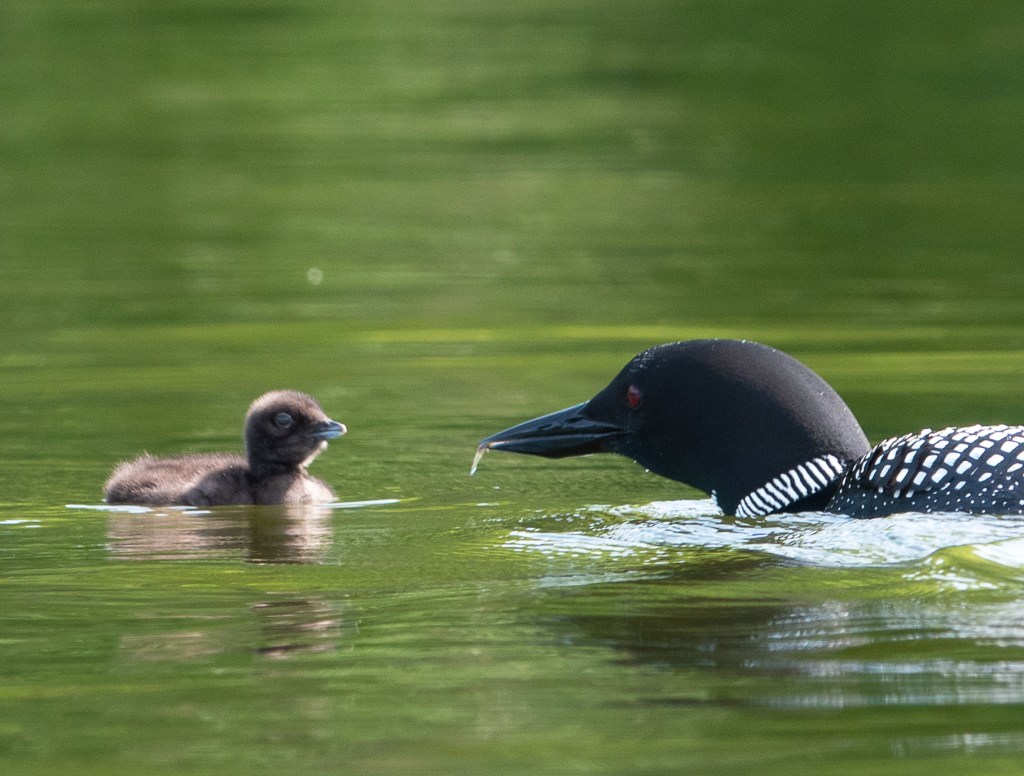
Loons, aka Great Northern Divers, spend their summers on largish lakes like ours in Maine. There they breed, and solicitously proffer minute fish to their chicks:
Photo by Moira Yip
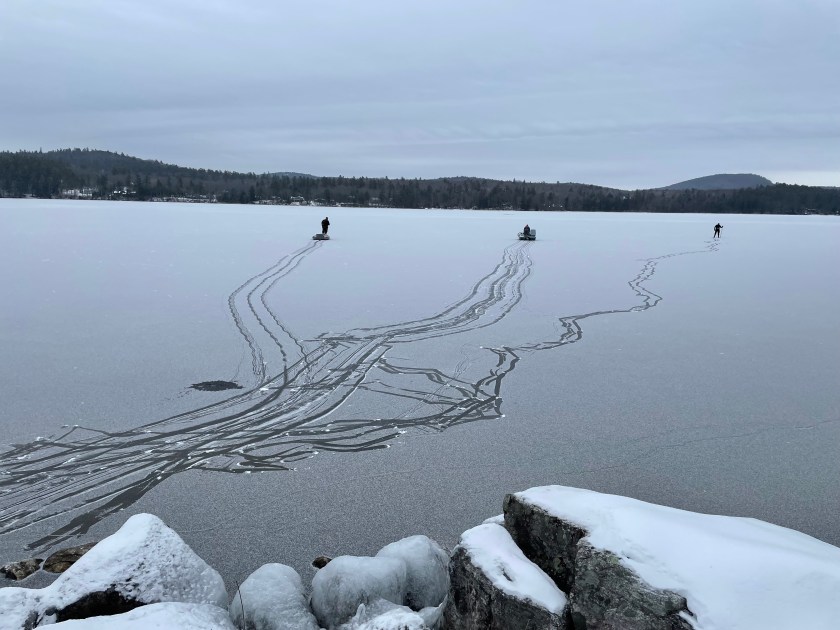
But the lakes freeze in the winter, and the ice is much too thick for them to break through to reach the fish.
Photo by Heinrich Wurm
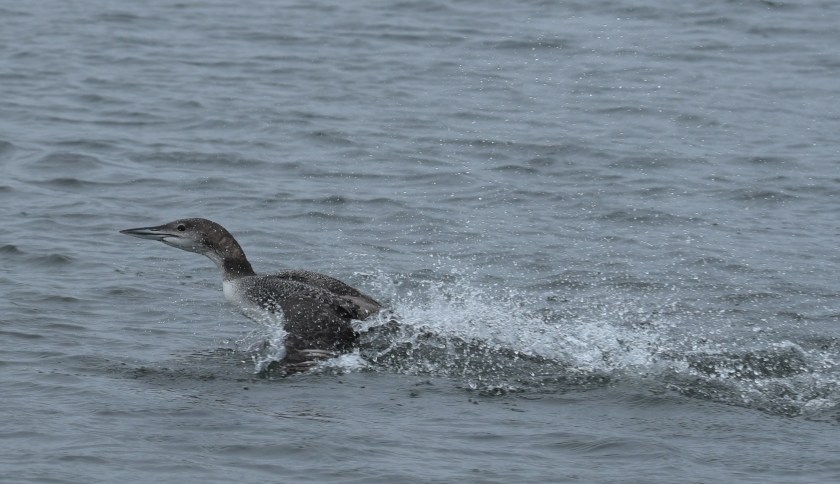
So they migrate either south, or to the coast. But sometimes the inexperienced young, or the old and sick, leave it too late, and get stranded. They have heavy bones that help them to dive deep, so they can need as much as 1/4 mile of open water as a takeoff runway. This one tried, but never got airborne.
Photo by Heinrich Wurm
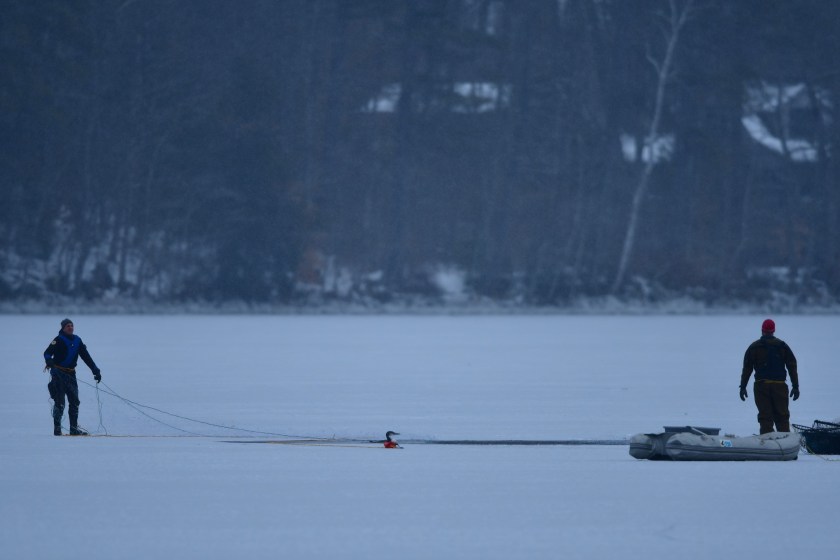
Five juveniles found themselves marooned in steadily shrinking pools on our lake last week. What to do? Call Paw Patrol? Bad idea. Rescuing the loons takes planning, expertise, and courage. Getting close will mean venturing onto thin ice, and well-intentioned people put their lives in jeopardy if they don’t understand the risks. Call the experts, don’t do this yourself.
The heroes of this hour were close to home. Heinrich Wurm was on the shore when he heard the loons calling out while hopeful bald eagles were circling overhead; Laura Robinson coaxed the troops into action and contacted Lee Attix our local loon expert and mentor. The actual rescuers were Bill Hanson, Lucas Savoy and Chris Persico of Biodiversity Research Institute; Diane Winn from Avian Haven of Freedom, Maine (very appropriate) made sure the birds were healthy before being released to the Atlantic.
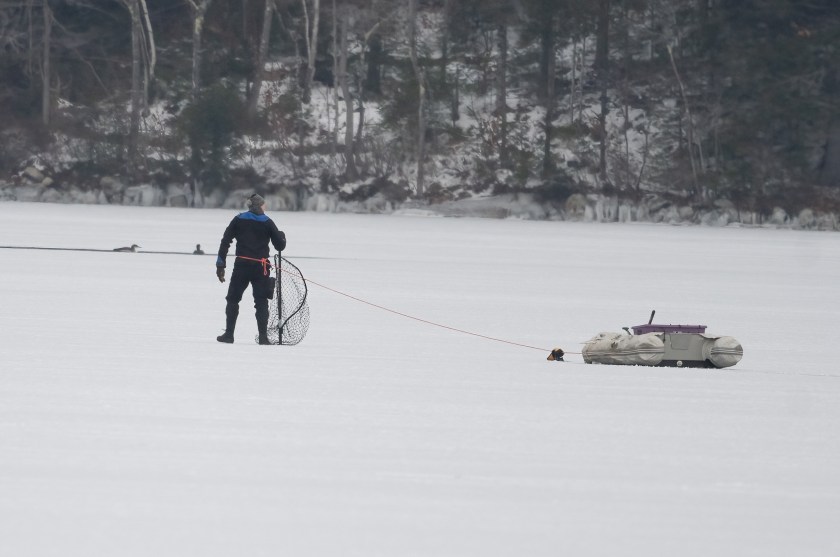
They use a 300′ seine (or gill?) net, and dip nets, and they have rafts on the ice to transport the loons, and if necessary for the humans to hold onto. Here they are with the seine/gill net, which they can use to move the loon out of the water and onto thicker ice so they can get closer:
Photo by Laura Robinson
Then the dip net is brought out:
Photo by Laura Robinson
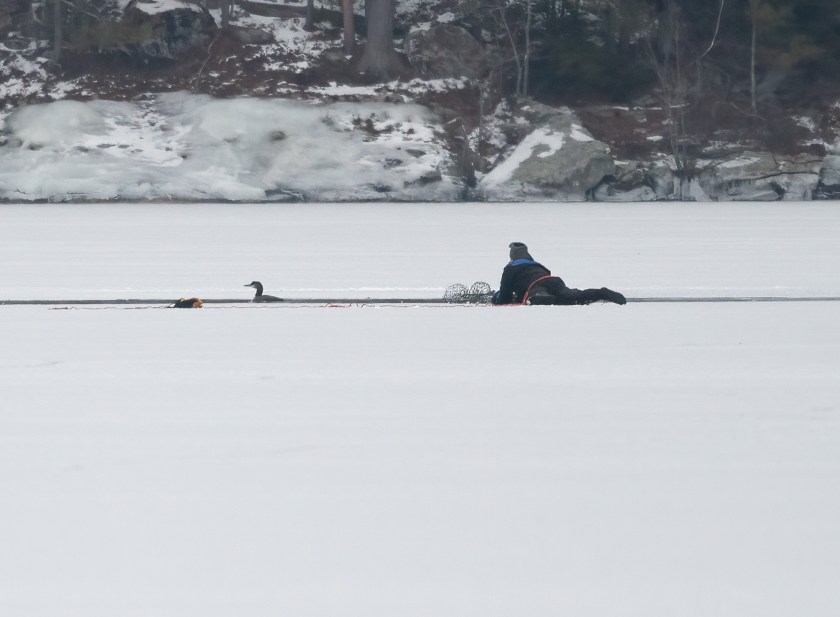
and maneuvered into position:
Photo by Laura Robinson
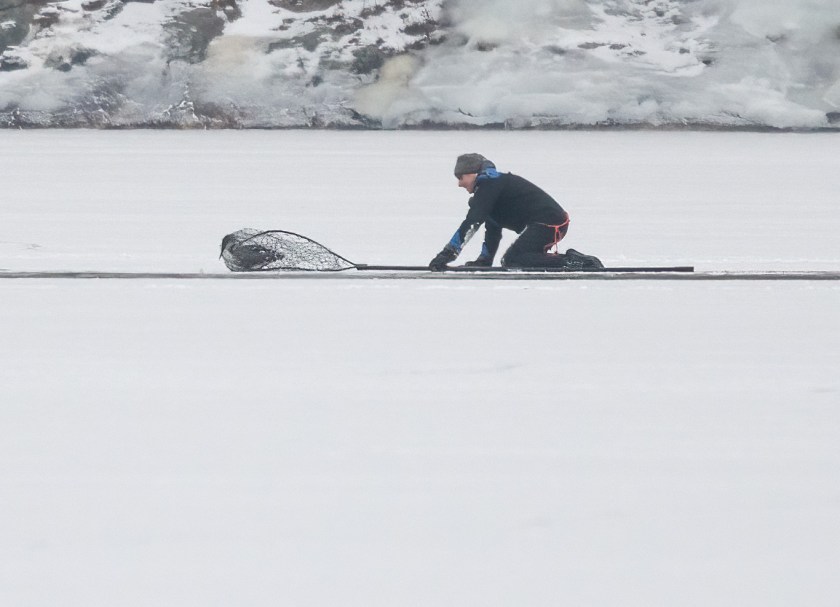
Finally, success:
Photo by Laura Robinson
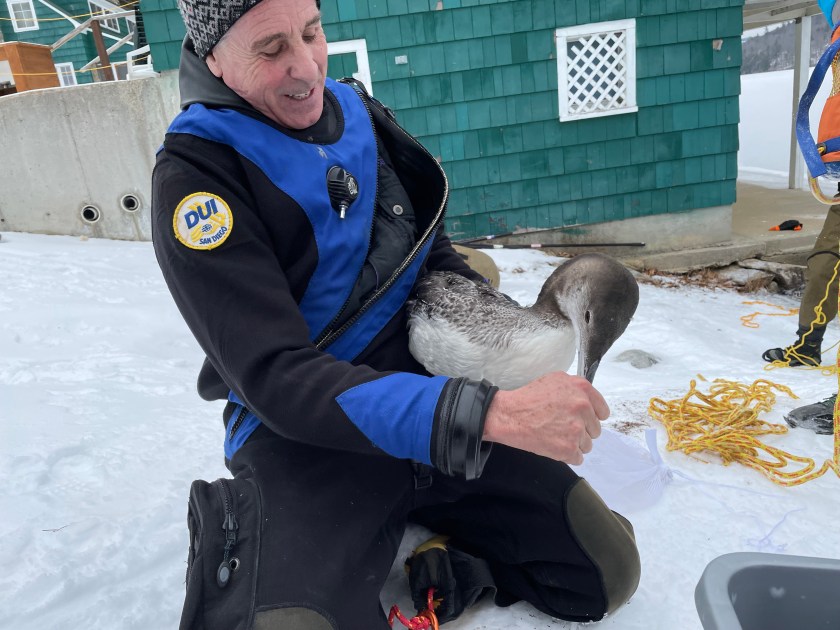
The birds are then taken to the lab, where they are examined, weighed, measured, photographed, and banded. Notice the more subdued winter plumage, compared to their dapper black-and-white summer breeding plumage:
Photo by Laura Robinson
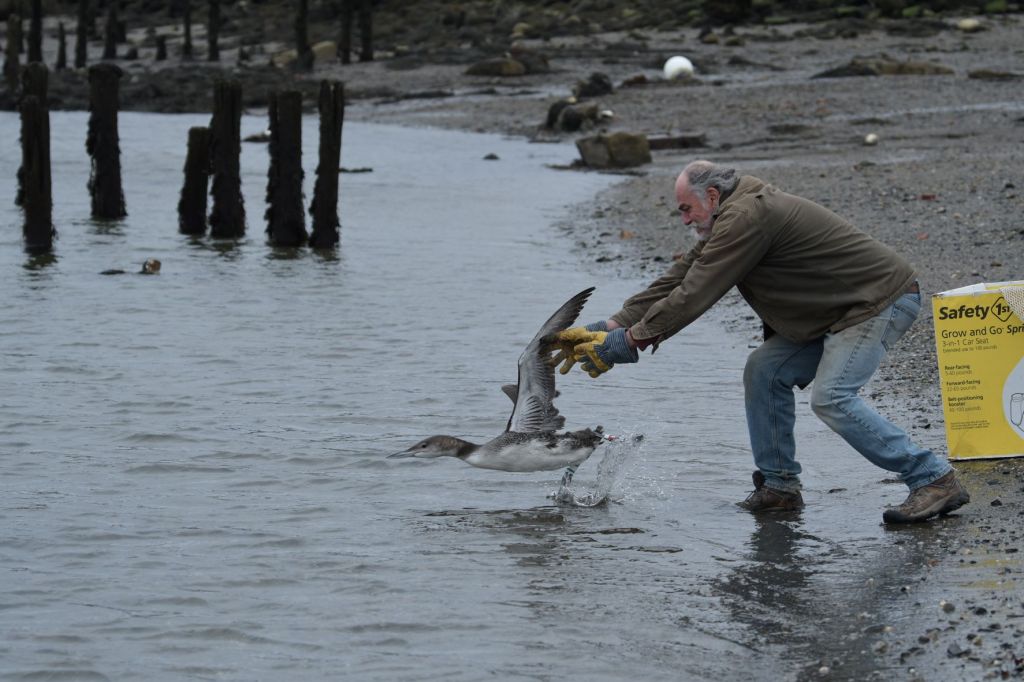
They were then triumphantly released on the coast, where they are supposed to be at this time of year!
PS I played no role in this expedition, and can take no credit whatsoever. The photographs in this piece were taken by Laura Robinson and Heinrich Wurm. The rescue team on the ice was made up of Bill Hanson, Chris Persico and Lucas Savoy, backed up by a big team of professionals and volunteers. Well done everyone.
[In mid-winter here in Maine only a few birds and animals stay in town, and are neither nocturnal not hibernating. So I’ll be returning more than once to the active ones, and interspersing that with archived but never-posted blogs. Today, a break from warblers, and back to the otters.]
A whole summer can go by without a glimpse of an otter. They can stay underwater for up to 8 minutes and swim at 6mph. If they are on the surface, they swim low in the water, barely raising their heads to catch a breath, and they are dark brown shapes in a matching brownish pond.
If they emerge to eat a fish they are often concealed by the thick vegetation in the shallow water at the pond’s edge.
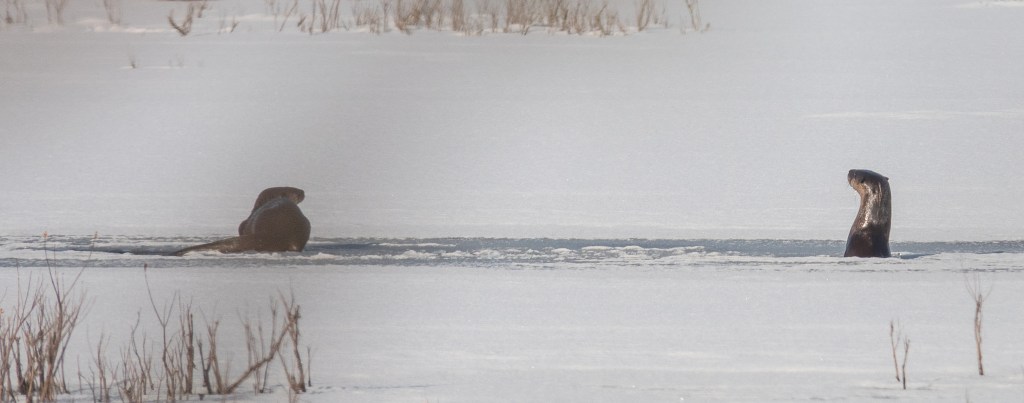
But in winter, the game changes. They are hunting under the ice, and so they can’t breathe on the move, but only by finding a hole and surfacing. They create the holes and keep them open, at least for a while, so they use the same holes all the time. My otters seem to base themselves at a hole for an hour or so, diving under the ice for 2-3 minutes to hunt, then returning to the hole to breathe. They usually come out for half a minute or so, having a little rest, and maybe a little light grooming. If they catch a fish they lie on the ice, crunching away, in full view, and strikingly dark against the snow. All I have to do is watch the holes, and if it happens to be a time and day when they are hunting nearby, I will see them. Even more helpfully, they seem to like the period between about 1pm and 3pm, so I usually go out looking for them right after lunch.
They have one hole relatively near the shore, so I got some closer shots one afternoon.
The one on the right has just emerged and is having a good shake:
This youngster is nuzzling its mother, below (the father plays no role in rearing the young):
At one stage I thought I had been spotted:
One “periscoped” to get a better look:
Then they settled down again:
By now, you are no doubt thinking that winter otter spotting is easy. To dispel that impression, let me point out that the pond is half an hour’s walk each way through sometimes thick snow. I am out every day at least once, sometimes twice, on snowshoes or spikes, for 90 minutes or so per trip, and I can go days or even weeks without seeing a single otter. Today the temperature was 2F, (-17C). No otters. But if it was too easy it might lose its wonder, so I am content.
PS: They can periscope quite far out to improve the view; this shot is taken from further away on another occasion:
My previous two warblers, the Palm Warbler and the Yellow-rumped Warbler, both had partially yellow plumage, so like Malvolio I’ll stick with that hue. Today’s stars are the pedestrianly named Yellow Warblers, who make up for their unimaginative singular moniker by a trio of glorious collective nouns: a sweetness, a stream, or a trepidation. Second in line today, the Common Yellowthroat, also a warbler. They don’t seem to have their own collective noun.
The Yellow Warbler, Setophaga petechia, is widespread in North America, and breeds in Maine. It winters in Mexico and South America. This is a female; I have never seen a male:
You can see why a group of them is called a sweetness.
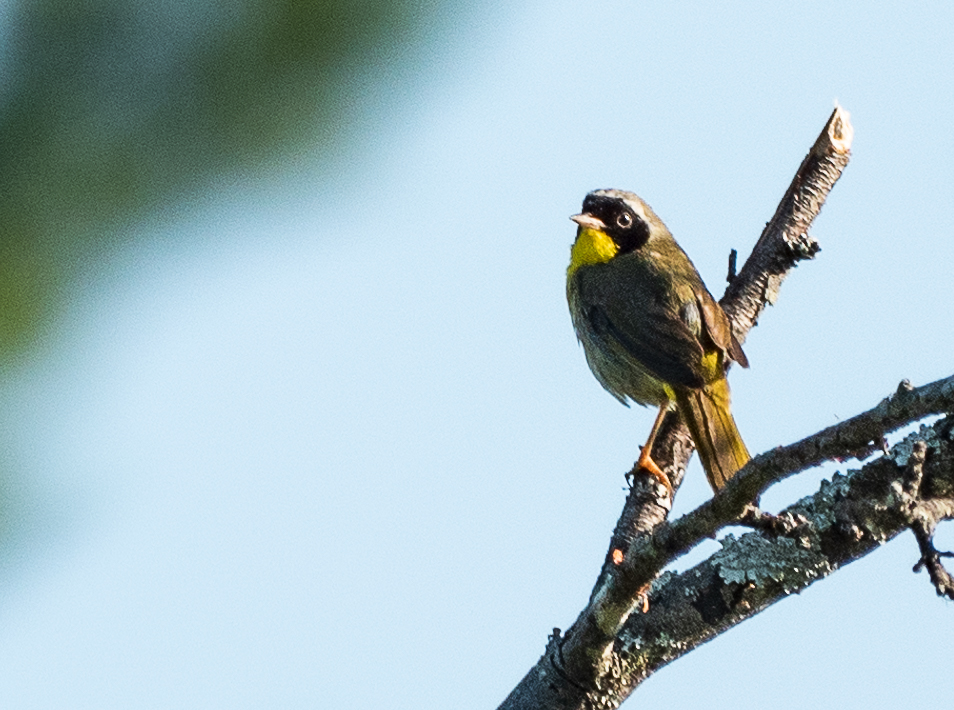
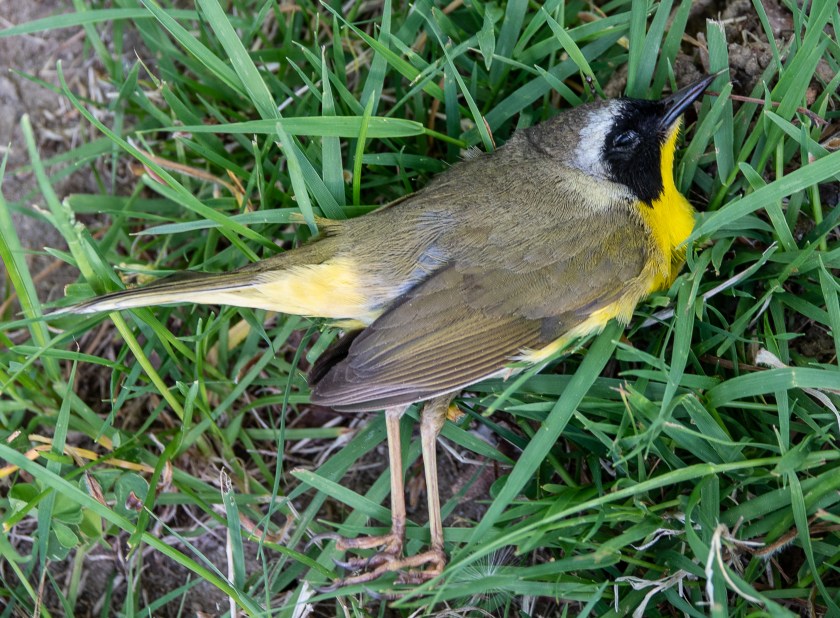
The Common Yellowthroat, Geothlypis trichas, also breeds here, and it doesn’t go as far south in the winter. The male is striking, with the eponymous yellow throat, a jet-black mask, and white eyebrows.
For a better look at his plumage, I resort to this sad photo of one that flew into my glass screen door, and never regained consciousness.
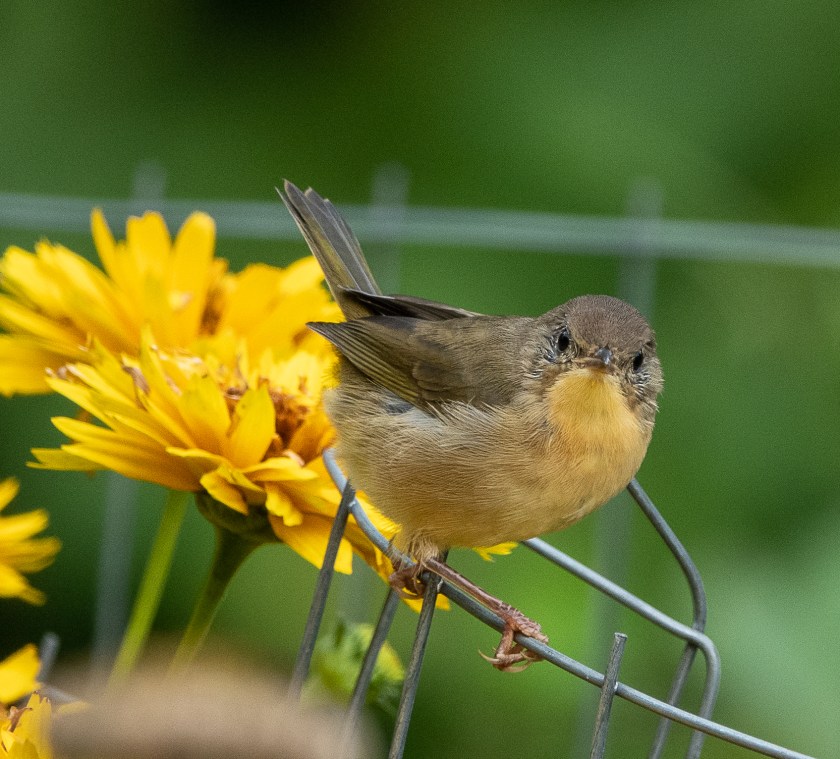
In the mid-West, the male is also called the Yellow Bandit, for obvious reasons. The female, as usual, is more sedately garbed:
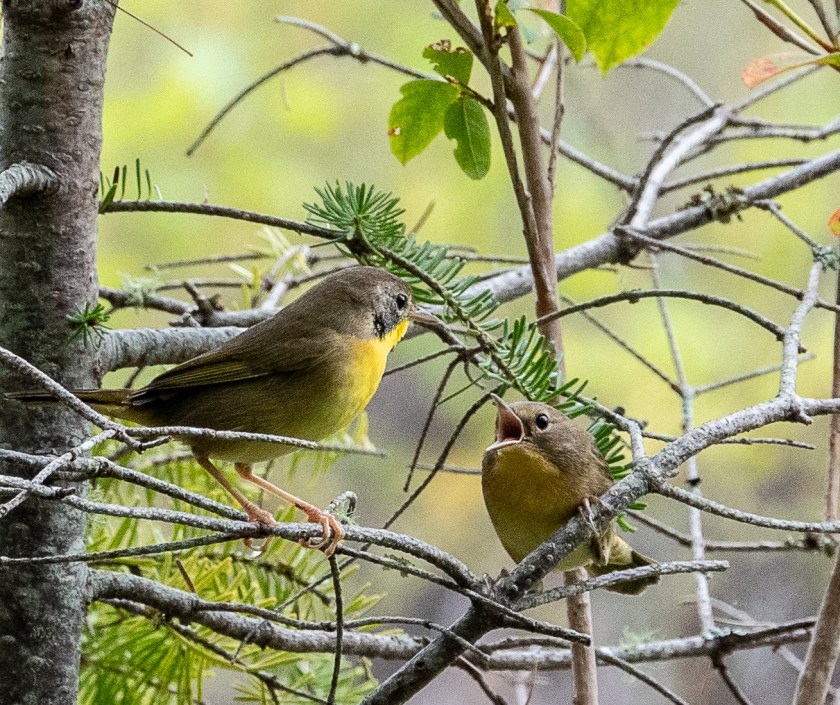
They were nesting near my pond, where I found these two fledglings, in juvenile plumage:
The one on the right seems to think her brother might feed her, but no such luck.
PS In Shakespeare’s Twelfth Night Malvolio wears yellow stockings under the false impression that it will delight Olivia, the object of his love. It doesn’t work.























 Eyes on the Wild