Be still my bleeding heart…*

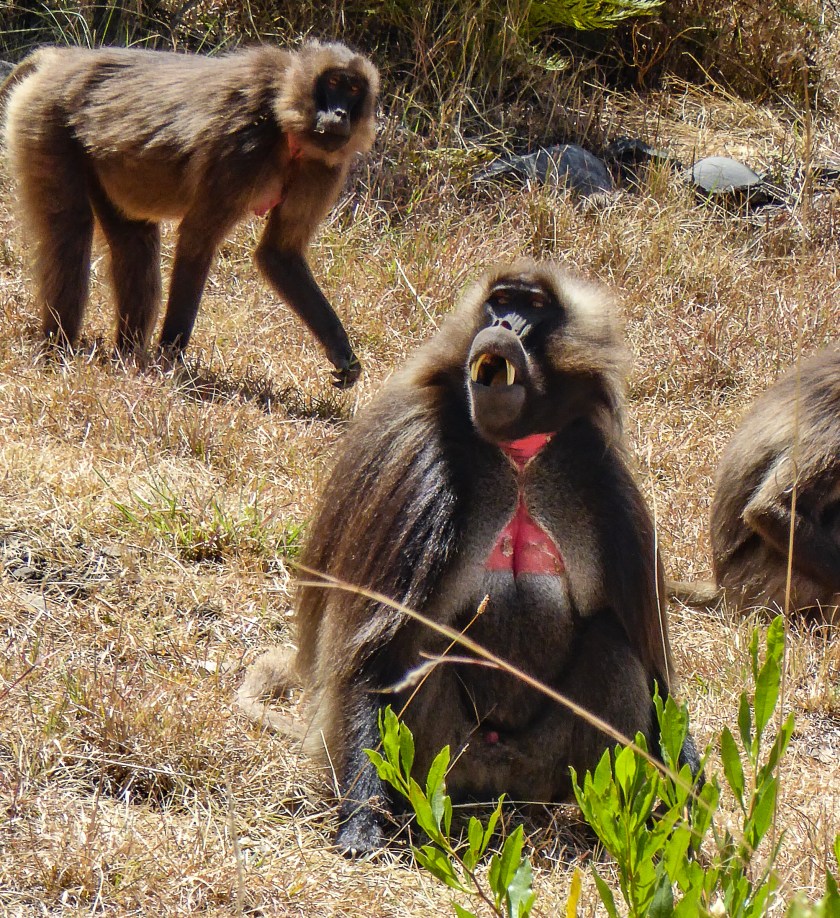
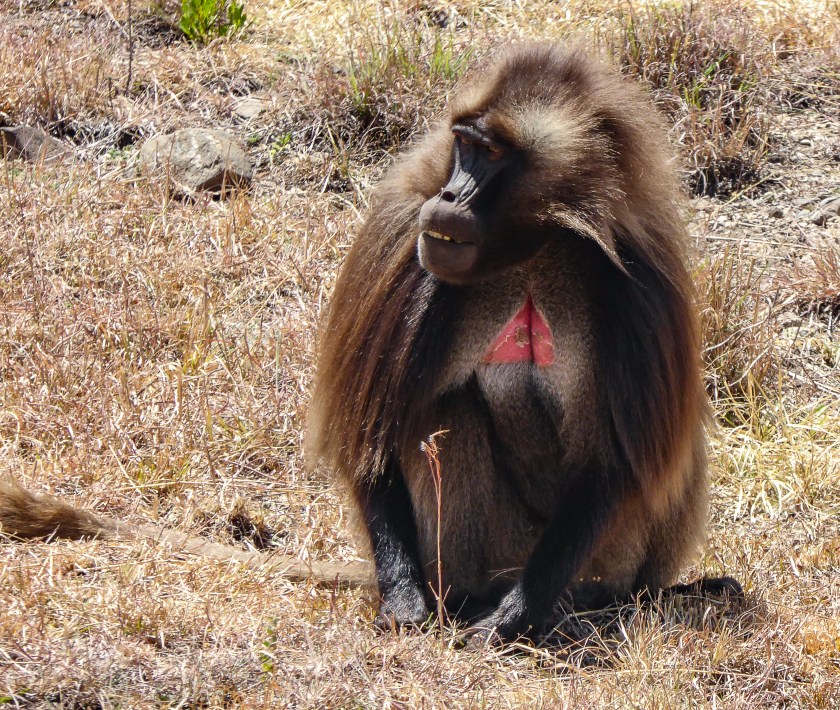
No-one is surprised to find birds (like robins) with brightly colored breasts, but mammals that are similarly caparisoned are rarer. The gelada monkey, Theropithecus gelada, is a glorious exception. Named after the Amharic word for the species, both sexes have astonishing red skin patches on their chests: the first photo is a female, and the second is a male:

P1030694

Geladas

In males, the redder the chest patch the more dominant and successful the male (Bergman et al 2009). Bright bottoms are more common than bright tops in the primate world; one theory has it that colorful bottoms would be wasted on geladas because they are “bottom-feeders”… my term for their feeding behavior, as the next post will explain.

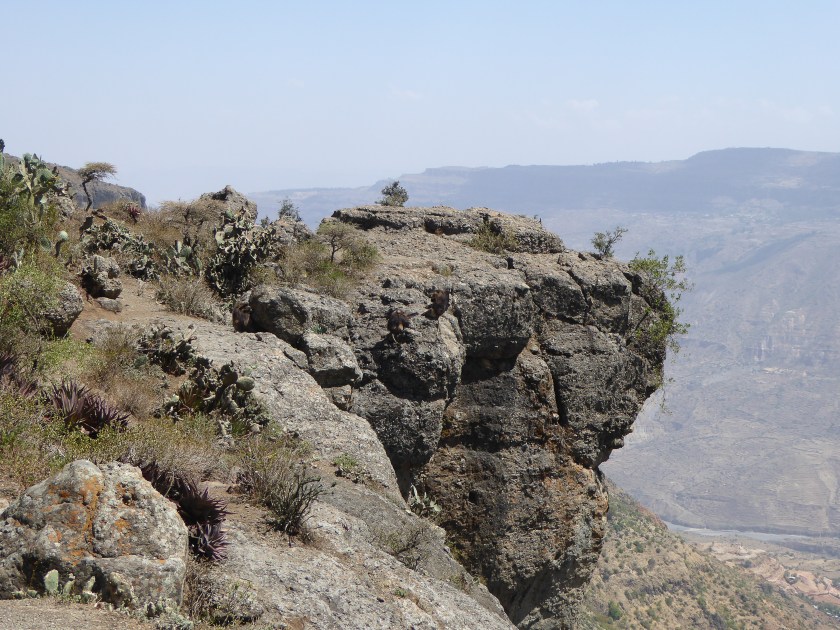
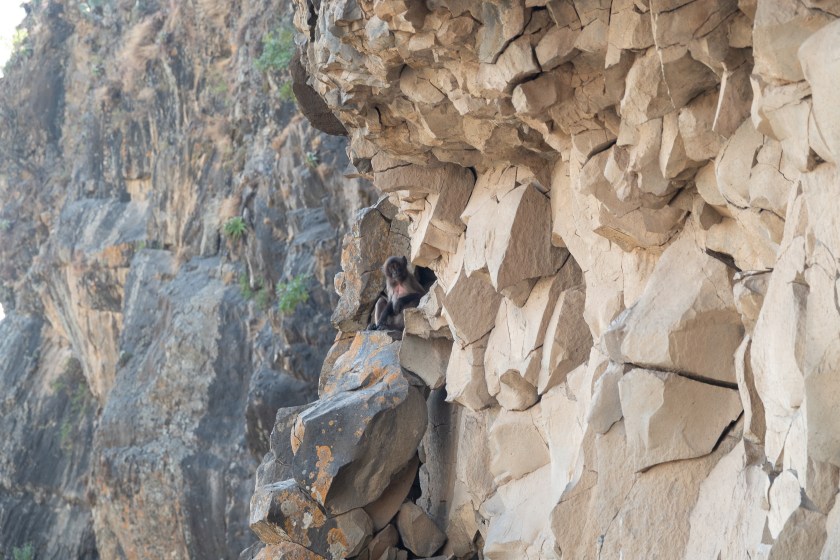
Geladas are found only in the highlands of Ethiopia, where they sleep and socialize on rocky cliffs. In the photo below the small dark brown blobs in the centre where the plateau tips over into cliff are geladas:

P1030596

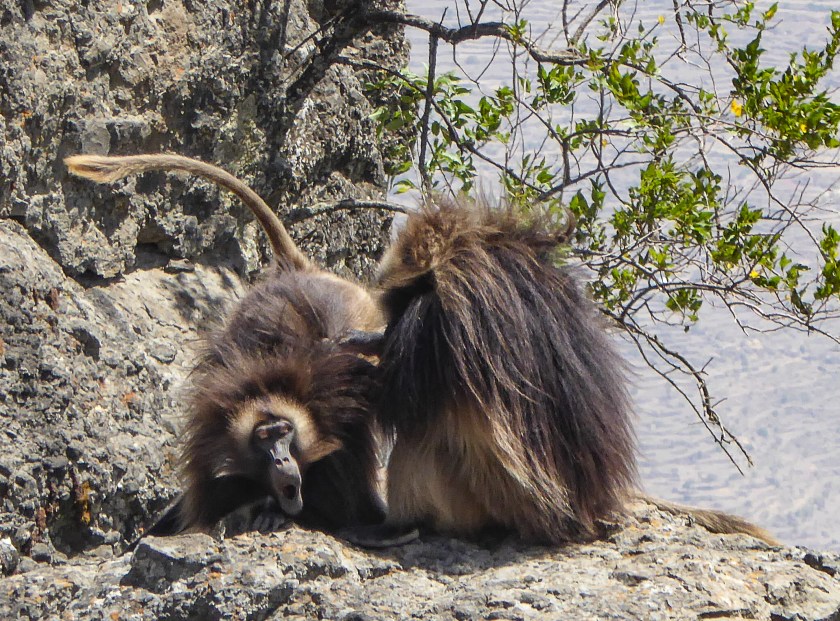
They seem to enjoy flirting with danger: here is a closeup of two of them:

P1030610

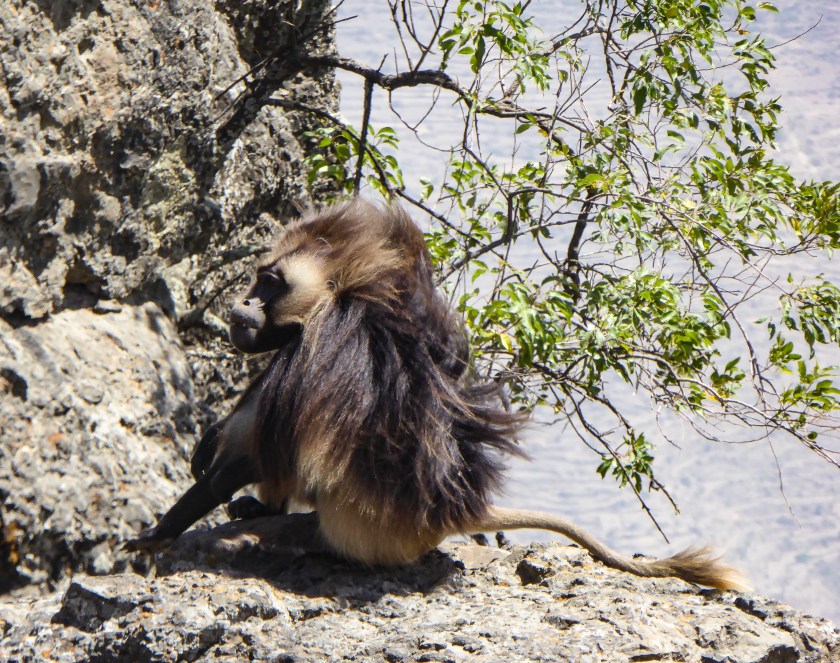
And this male, with his shaggy cloak:

DSC08719

And this curious baby:

DSC08772

In my second installment, I’ll have some action shots… watch for the next post.

* Apologies for the excruciating  title! And also for the photo quality: my camera broke halfway through the last day, the gelada day, and so these are taken with a small point-and-shoot backup.
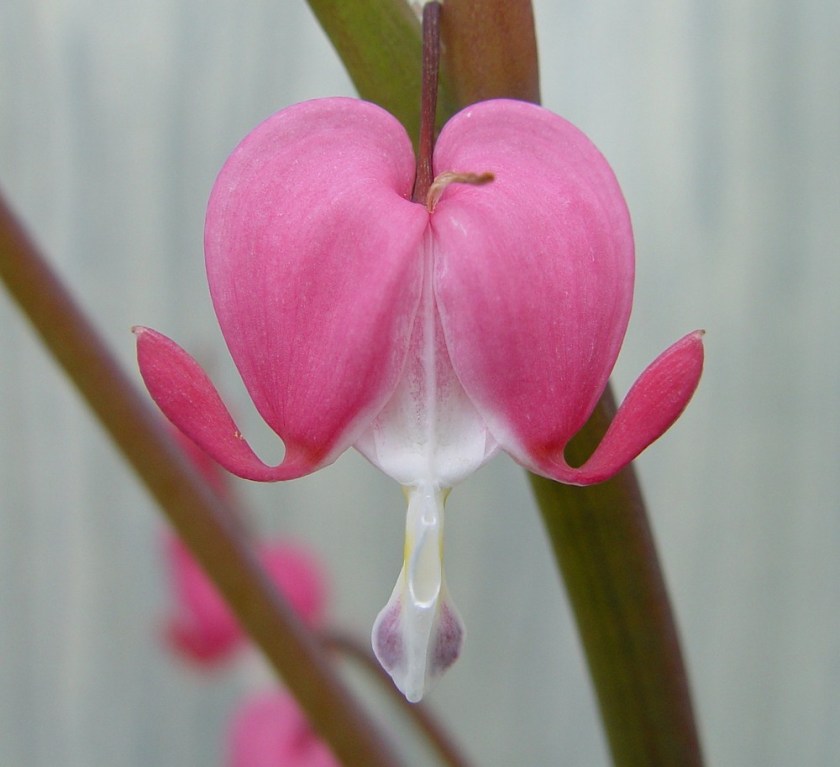
*The gelada shares its bleeding heart nickname with this flower, Dicentra spectabilis:

lamprocapnos-spectabilis-fl-ahaines-a


Ostrich legs

The ostrich roams the great Sahara.
Its mouth is wide, its neck is narra.
It has such long and lofty legs,
I’m glad it sits to lay its eggs.

By Ogden Nash

I ended last time with a story of how the oryx got its horns and its black-and-white markings …. and as the story goes, they won them off the ostrich in a bet…. https://www.flickr.com/groups/715897@N22/discuss/72157604112895106/72157604357025025

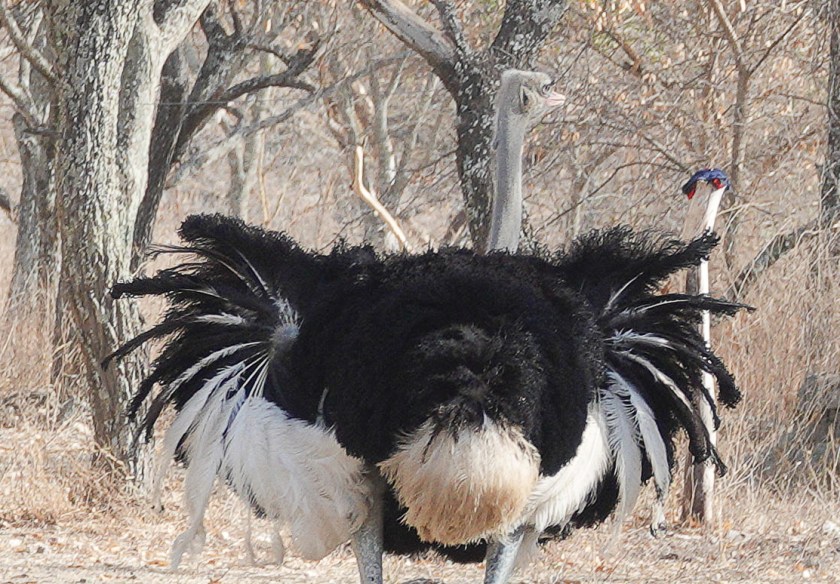
Here is a male Somali Ostrich, and you can see how an antelope might covet that coat:

Somali Ostrich

The drab female is presumably what you get when the oryx has run off with the ostrich’s finery.

Somali Ostrich, female

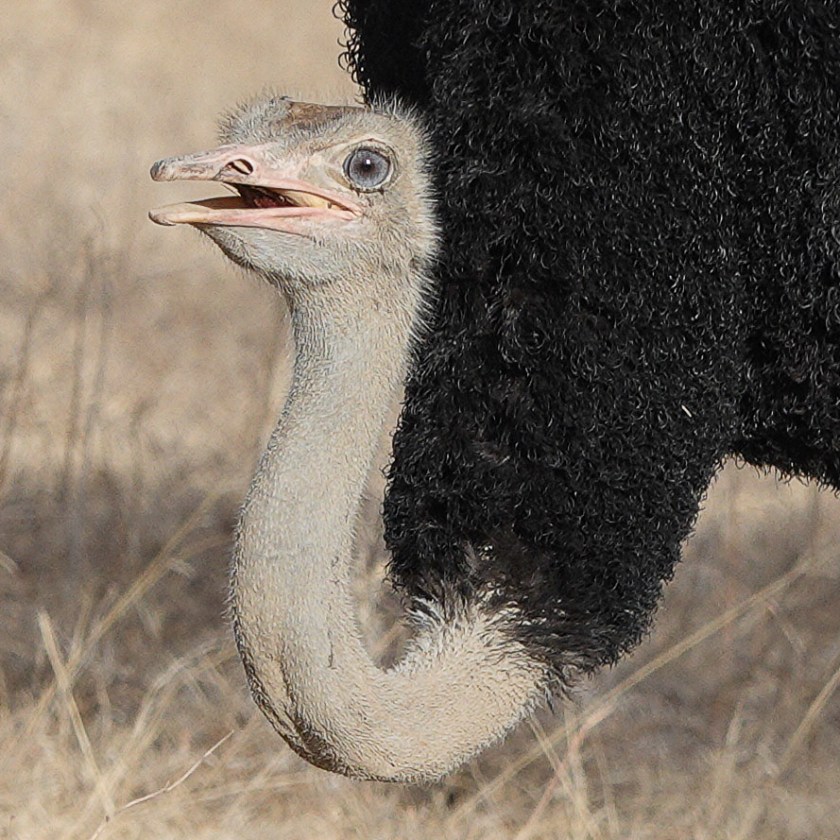
The ostrich never did have horns,  although they might distract attention from his balding pate:

Somali Ostrich

These ostriches are Somali Ostriches, Struthio molybdophanes, found only in the Horn of Africa. They browse on bushes, whereas the common ostrich prefers to graze on grass. They also differ from the common ostrich in having blueish (instead of pinkish) skin on their neck and thighs: this one would win a knobbly knees contest* hands down.

DSC09108s:

* English seaside towns in the 1950’s loved such contests, for those of you too young to remember, or on the other side of the Atlantic.

31a4bfd518c2a8a4698f92e607e98189

And anyway Dennis Smith rightly points out that the ostrich’s knobby joints are the analogs of human ankles, not knees, as this picture shows:

screen-shot-2019-03-20-at-8.44.51-pm.png


Oryx frolics

Mirage-like, the oryx materialized out of the desiccated landscape of Awash National Park.

Beisa Oryx

For my money, the oryx is the smartest turned-out antelope on the planet. I saw my first ones in Namibia in 2016, where they are the species Oryx gazella, also called gemsbok, and are to be found standing under every tree:

p1110337.jpg

But here in Ethiopia they are a different species, Oryx Beisa, and they are endangered:

DSC08653

You can see the difference: the tail is only black at the end, no black patch on the rump, and less black on the belly and legs too. (The rest of these photos are all of this Ethiopian species.)

Both sexes have those amazing horns, for which they have been hunted almost to extinction:

DSC08532

The mother goes off alone to give birth, and the young can run immediately. Their black markings do not appear for several weeks, when they rejoin the main herd.  These are still very young, but they already have tiny horns.

Beisa Oryx

Oryx beisa is now extinct in much of its former range, and the remaining 12,000 or so are found only in Ethiopia, and parts of Kenya and Tanzania. Like all oryxes, they are adapted to an arid environment and can go days without drinking. In addition to the thorny scrub plants, they seek out thick-leaved plants, wild melons, roots and tubers. They feed in early morning or late afternoon, when the dew forms and the plants can increase their water content by up to 40% compared to midday.

I came across a lovely folk tale about how the oryx got its horns, and its elegant black-and-white markings:

https://www.flickr.com/groups/715897@N22/discuss/72157604112895106/72157604357025025

Next time I’ll show you what happened to the loser in this tale..


Horn(bill) quartet

Time for birds, I think.

Ethiopia has nine species of Hornbill, of which I saw and photographed five. They are the most unlikely birds, with bills that seem disproportionate to their bodies. These bills are in fact well adapted to their omnivorous diet which includes fruit, insects and even small animals. I’ll start with the smallest bill: a female Northern Red-billed Hornbill, Tockus erythrorhynchus. 

Northern Red-billed Hornbill, female

Her mate has a larger bill, and looks correspondingly self-satisfied::

Northern Red-billed Hornbill, male

They were perched in the same tree, and are probably a monogamous pair. When it comes time to nest, the female retreats to a hole in a tree, and walls herself in. The male then feeds her and the young chicks through a small hole until they are big enough to safely emerge. Very 1950’s.

The Hemprich’s Hornbill, Lophoceros hemprichii, has a strong sturdy bill:

Hemprich's Hornbill

Whereas the Eastern Yellow-Billed Hornbill, Tockus flavirostris, has a curvier bill in a cheerful yellow, always held pointing jauntily upwards:*

DSC08647

Most dramatic of all is the large Silvery-cheeked Hornbill, Bycanistes braves, photographed in the parking lot of an urban hotel:

Silvery-cheeked Hornbill

It is a mystery why on earth anyone would name this bird after its discreetly silvered cheeks rather than after the blindingly enormous casque on top of its bill. The casque acts to amplify sounds and is also likely that in males the bigger the casque the higher the status (it can take years to grow to full size). Its weight may also help in digging, and in attacking bark to get at insects.  

The monster of the hornbill group is the Abyssinian Ground Hornbill, Bucorvus abyssinicus, which I’ll save for another time.

*In Southern Africa, this habitual posture led people to think of the Yellow-Billed Hornbill as a symbol of optimism, as this legend illustrates: https://www.sabisabi.com/blog/9551/african-tales-4/


“Richly habited in a mantle..”*

Near Lake Langano, early in the morning, the Abyssinian Black-and-White Colobus monkeys were feeding in the trees. Their proper name is Mantled Guereza, Colobus Guereza, and they are the popinjays of the monkey world:

DSC09444

Their total length goes up to 170cm, or which 100cm is tail! The mantle is the long white fringed fur across their shoulders, like the fringes on John Wayne’s leather jacket.
large

They are not endangered, perhaps because oddly they prefer secondary forest to primary forest. The new growth may provide more leaves and twigs than the old growth trees. They have a digestive system more usually found in ruminants, so they can digest very fibrous material. This one is eating a twig:

DSC09429

*My title is a quote from Shakespeare’s Henry VIII. And Abyssinia is the old name for Ethiopia.


The rarest wolf

My first of several posts from my Ethiopian trip has to be the Ethiopian Wolf, Canis simensis, the most endangered carnivore in Africa, with only four or five hundred left in the wild.  More than half live in the Bale Mountains, southwest of Addis Ababa, our destination, up at 4300 meters (14,000 feet).

Screen Shot 2019-03-04 at 10.19.22 AM

Our wonderful guide Abiy found us seven, none very close, but I managed a few photos. Here is the star:

DSC06825-2

He or she was hunting the small mammals that live in the Afroalpine vegetation :

DSC06851

Getting close,:

DSC06862

But not catching anything, so he headed off up the hill, out of sight:

DSC06857

Males are up to 40″ long and 24″ high, weighing up to 43 lbs, about coyote size. They have a notably long thin skull.

DSC06811-2

This one was solitary, but we also saw a group of three, and a typical pack is a family group of around six.

DSC06913

These wolves may be rarest canids in the world. Under Ethiopian law killing a wolf incurs a two-year jail term. The main threats to their survival are interbreeding with the local dog population, and rabies. Vaccination is being used to reduce this threat. There is an excellent Wikipedia entry here: https://en.wikipedia.org/wiki/Ethiopian_wolf


Biting bark

[I’m off to Ethiopia tomorrow, so expect no posts for a couple of weeks, and then a change of subject matter on my return!]

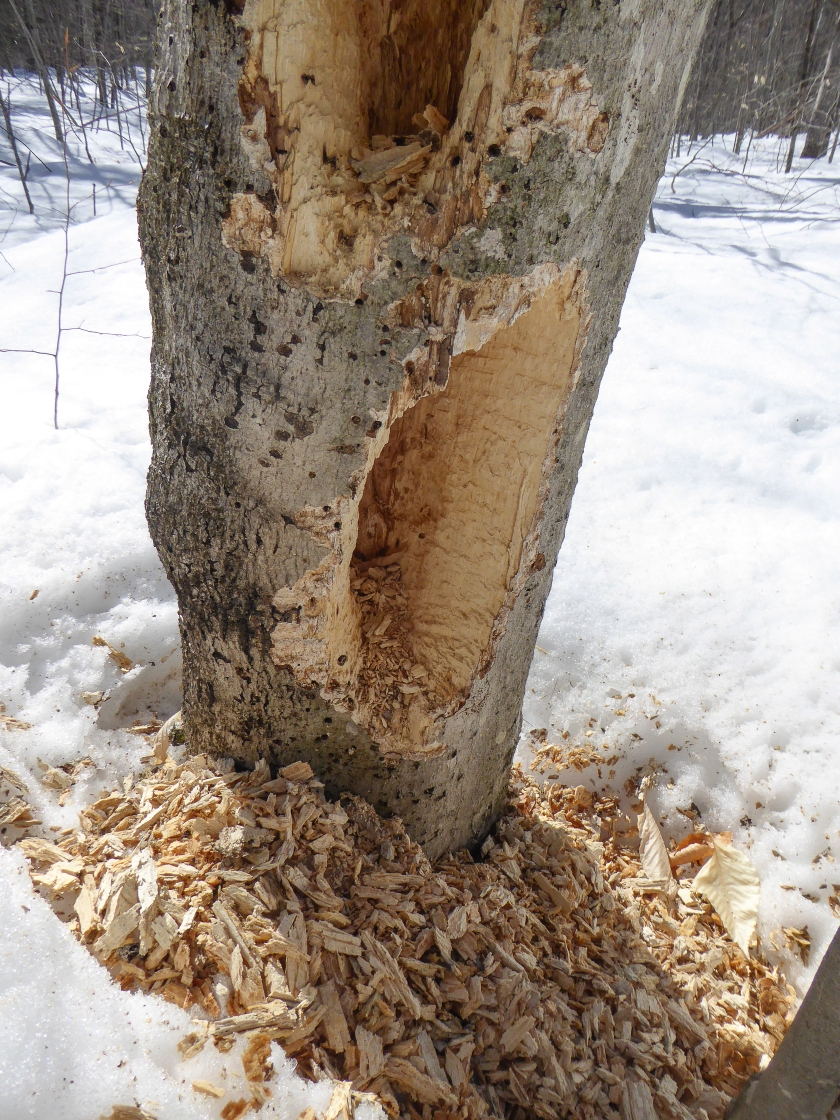
A surprising number of animals find a use for tree bark.

In my last post two grey squirrels were getting together in the treetops, but my sharp-eyed husband noticed that they had already prepared for the consequences of their dalliance: higher in the same tree was their drey:

squirrels

The base is made of leaves, but look at the top: a mound of shredded bark.

And indeed if you now take a second look at their marital embrace, you can see that earlier one of them had been hard at work harvesting bark:

grey squirrel

Foresters hate grey squirrels as much for the damage they do to trees as for any effects on our native red squirrel population.

Beavers of course operate on an altogether larger scale.

Beaver

This quite sizable tree was felled behind my house in Maine a few years back, and within a few days they had systematically stripped off huge areas of delicious bark.  What they like is the living cambium underneath the bark itself. It is the innermost phloem layer that carries nutrients from the photosynthesizing leaves to the rest of the tree, so it contains delicious sugars and minerals.

P1180818

Sometimes it may also help them get a grip when they are maneuvering a log into position for a dam or lodge:

P1200108

and often they just gnaw the bark off a standing tree, sometimes killing it.

Hemlock bark, beaver

Porcupines love tree bark.

porcupine

My friend Leigh posted impressive evidence of porcupine work in her blog recently:  scroll down about half way for the porcupine aftermath photos:

Poking About Among the Trees

Many other animals, including deer, rabbits, voles and mice eat bark too. Apparently so can humans:

https://www.offthegridnews.com/extreme-survival/edible-tree-bark-the-ultimate-survival-food/

Bark also has its own mysterious beauty:

Bark World, by Olivia Bayard (from The New Statesman, July 2016)

Rough, tough to touch,
grooved ridged scaled –
textures and fissures
teeming with the fuss and
stress of being –
dark crevices
crammed with mini-beasts
– woodlice, beetles, borers –
and wispy spiders, that scurry
across burled highways –
algae
lichen moss growing warmth, cover
over tiny birds tight in dark holes,
feather to feather, beak to beak
– a claw here, an eye there –
flutter shuffle, first squawks
and squeaks –
and the deep inside,
where sap rises rich and quick,
grains, circles, lines,
the yearly marks of tell-time –
old time,
now time, pest, blight, disease time,
warming time, losing time,
a stopped clock at felled time.

Love in the cemetery

Happy Valentine’s Day!

I live near Brompton Cemetery, a grand Victorian green oasis near Chelsea FC.

DSC07584

The story behind this extraordinary gravestone is one of the more remarkable ones: https://en.wikipedia.org/wiki/Reginald_Warneford

But this week, the sun was shining, and everyone decided it was spring. The trees:

DSC07667

The birds:

DSC07623

You can hear this European Robin, Erithacus rubecula, song here:

And the squirrels, doing their Cirque du Soleil trapeze act imitations:

DSC07636

After playing hard to get in a “mating chase”:

DSC07722

She selected one from a trio of suitors, and there they enjoyed a precarious tryst high, high in the treetops. The tail says it all:

DSC07745

She will have a litter of 3-4, after a gestation of 44 days. Females can breed at 10-12 months, and often have two litters per year. They may live to the age of 5, so at up to 8 young per year for four years, that is 32 young per female. There are about 2.5 million grey squirrels in the UK, and you can see why their introduction from the US has overwhelmed the more sedate British reds.

Their Chinese name is sōngshû, or ‘pine tree mouse’, 松鼠. The second character looks very mouselike!

PS My computer refuses to put the right accent on the ‘u’ in sōngshû. Sorry to those of you who know it should be a ‘v’ shape, not a little hat. 


Mirrors of the Soul

Most mammals (including the great apes) and many species of birds have dark brown eyes.

P1090661

We forget that humans are unusual in having a wide variety of eye colors: brown, blue, grey or hazel/green.

And in fact elsewhere in the animal kingdom, we find the same eye colors recurring. This Ugandan Grey-necked Crowned Crane, Balearica regulorum, has pale grayish-blue eyes.

Grey Crowned Crane

This Common Cormorant in Central London has eyes greener than those of any human outside Scifi movies:

Cormorants

And this dragonfly goes one step further:

P1070467

But we also find eye colors that in humans would need contact lenses:

Look at this White-eyed Buzzard in India:White-eyed Buzzard

Or the lemon yellow eyes of the Indian Jungle Owlet:

Jungle Owlet

or the tawny eyes of the lion:

dsc07681

and the tangerine eyes: of the Namibian Southern White-faced Scops Owl, Ptilopsis granti

Southern White-faced Scops OwlMaddest of all, the cherry-red eyes of the loon (aka Great Northern Diver):

DSC07796

The dragonfly aside, the mechanism for all these eye colors lies in the outer layer of the iris, called the stroma. Dark brown eyes result from the presence of melanin in the stroma.  Blue eyes happen when the stroma contains no pigment and is translucent. This layer scatters the white light, and it scatters the shorter blue wavelengths the most, giving rise to the perception of blue eyes. If the layer has a little more collagen, the blueness is dampened and the eyes look grayish. Green eyes result from the presence of a little melanin only, mixing with the reflected blue to create green.

There are actually two types of melanin, and the full range of colors found in my photos above depends mainly on which type of melanin is found. Here is a great chart, if you’d like to know more.

Melanin Content and Eye Color

Eye color Melanin Presence on Front Layer of Iris Melanin Presence on Back Layer of Iris Dominant Pigment Type
Brown Heavy Normal Eumelanin
Blue Light Normal Eumelanin
Gray Even less than blue Normal Eumelanin
Green More than blue eyes, less than brown Normal Pheomelanin
Hazel More than green, less than brown Normal Pheomelanin and Eumelanin
Amber Heavy Normal Pheomelanin
Red or Violet (in humans) None or extremely little None or extremely little n/a


PS Humans are also unusual in having the colored iris surrounded by a large white area, the sclera. This makes it easy to notice the direction of other people’s gaze, a useful trait when cooperating with others.

Natural eye makeup

Many animals and birds have striking markings around their eyes, made of fur, feathers or just plain skin. Why?

Pale circles round the eye may help gather extra light for animals that feed in reduced light. Dark circles around the eyes may reduce glare for animals that feed in bright light. Often, though, these markings have no precise function. They either disguise the eye, or break up and confuse the head contours, or aid in species recognition. Here are some examples.

The American red squirrel has elegant white semi-circles above and below its eye, probably helpful in noticing predators when feeding in dappled light:

DSC04670

Raccoons famously sport dark highwayman’s masks, but it seems unlikely that reducing glare is their main function, since raccoons are largely nocturnal:

raccoons

Wood frogs too have dark masks, and they live mainly in thick woodland, where the light is not bright. (Though the dark lines in front of the eye may help in accurately targeting prey.)

P1010298

But the Southern Masked Weaver’s dark mask may indeed be an adaptation to reducing the glare of the Namibian desert:

Southern Masked weaver

And the Egyptian Goose, although this one now lives in Hyde Park in London, originates from Africa and so its dark eye circles may not just be the result of a late night out, but may have given it an edge in that bright light:

dsc07131

My last few examples are almost certainly not aids to vision of any kind. Just like our eye makeup, they may serve to attract a mate. Whatever works for you…

In Maine, the wood doves have pale blue eye-liner: a look I am considering for next summer.

dsc04722

In Ecuador, both the male Masked Trogon  (first photo) and the female (second photo) wear red-rimmed spectacles:

Male masked trogon.

Male masked trogon.

As does the Zambian Three-banded Plover:

Three-banded Plover

Here in the UK, the common blackbird has sharp yellow circles:

dsc07312

But these are outdone by the Ecuadorian the Cock-of-the-Rock’s astonishing yellow goggles:

Cock-of-the Rock, orange variant on Eastern slope of Andes

Finally, by popular demand, the Plate-Billed Toucan: not exactly an eye ‘ring’, but the most flamboyant choice of eye shadow shades that I know:Plate-billed Toucan

Humans need more help:

james-charles

[James Charles is sponsored by Covergirl. He is the beauty blogger phenomenon who stopped traffic in Birmingham last week. ].

If you’d like to know more about natural eye makeup, read this:

Ficken, Robert W., Paul E. Matthiae, and Robert Horwich. “Eye marks in vertebrates: aids to vision.” Science 173.4000 (1971): 936-939.

PS There is a separate story about the color of the eyes themselves. Maybe I’ll look at that next.