“The choreographers of biodiversity”

The wondrous diversity of the insect kingdom is under threat as our environment changes and shrinks (from an insect’s perspective, anyway). But I still find new ones all the time. Today I’m going to be disciplined, and restrict myself entirely to beetles. Just when you think you’ve seen them all, along come four new beetles all at once.

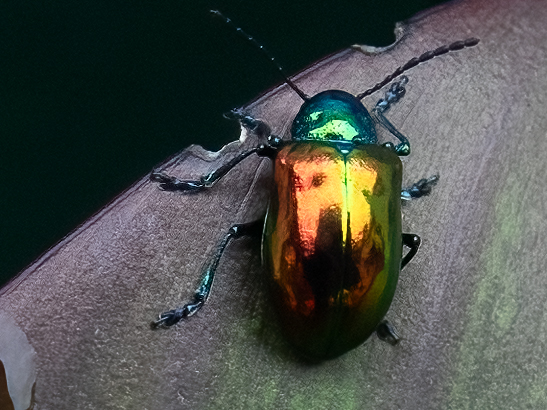
The Dogbane Leaf Beetle, Chrysochus auratus, a fragment of polished stained glass, is about 10mm long:
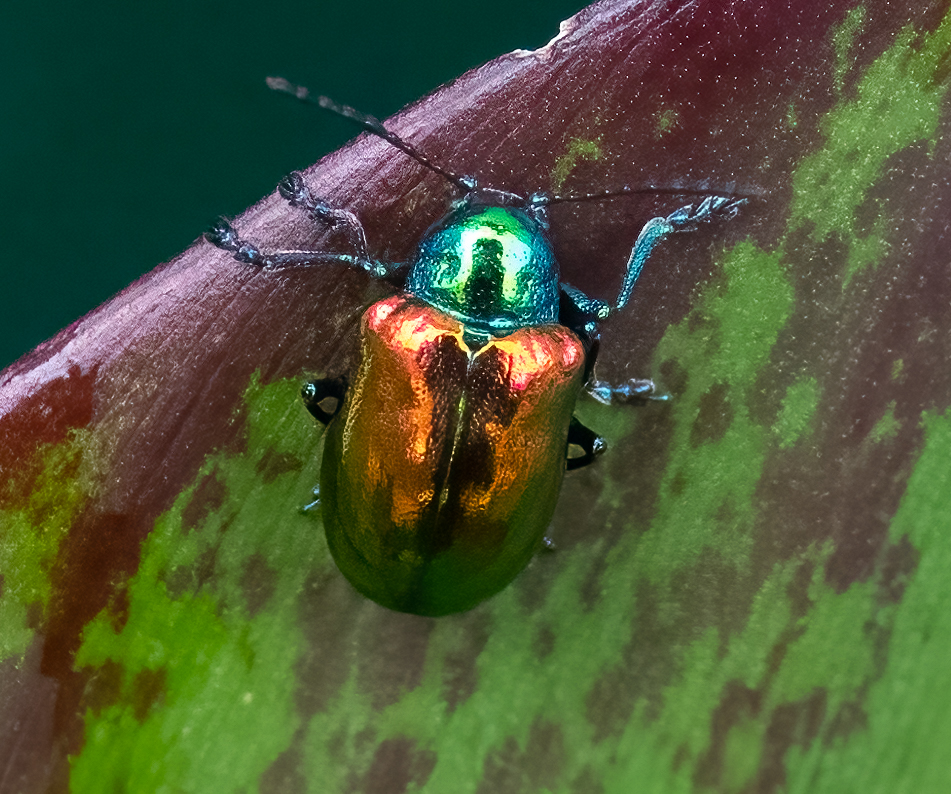
The color is structural, and varies depending on how the light hits it:
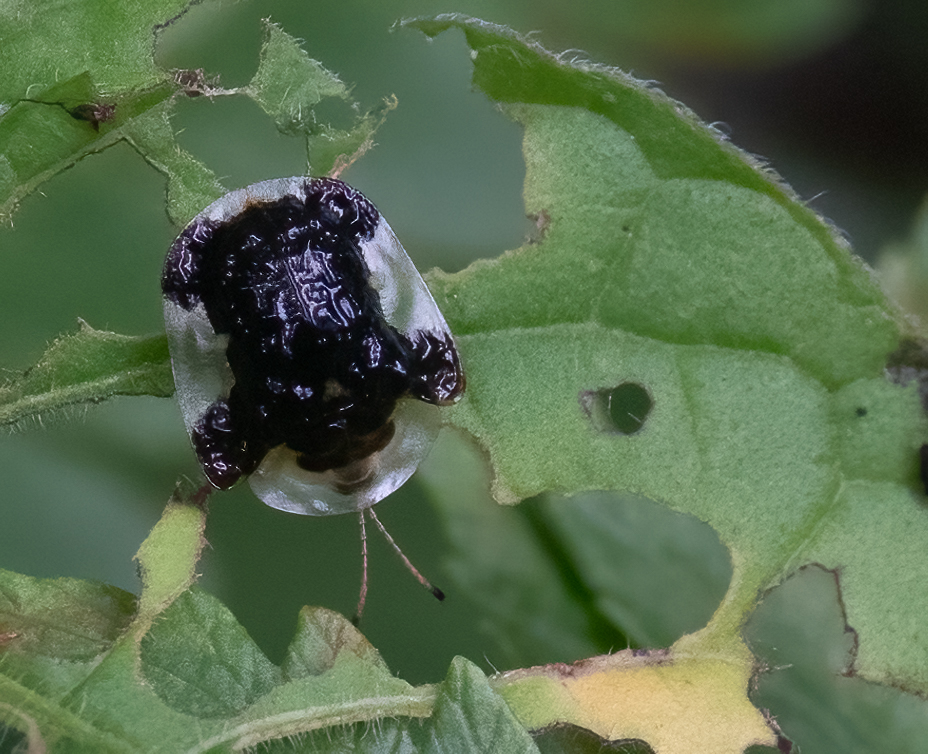
The Clavate Tortoise Beetle, Plagiometriona clavata, looks for all the world like a tiny 7mm long teddy bear. Its translucent carapace totally covers its body and legs, so it looks just like a tortoise. It has also been described as looking like a World War 1 US infantry helmet! In life, they’re brown or green, but turn black when dead, though I could swear it moved its antennae.
The Swamp Milkweed Beetle, Labidomera clivicollis, sports a smartly tailored livery of orange and black:
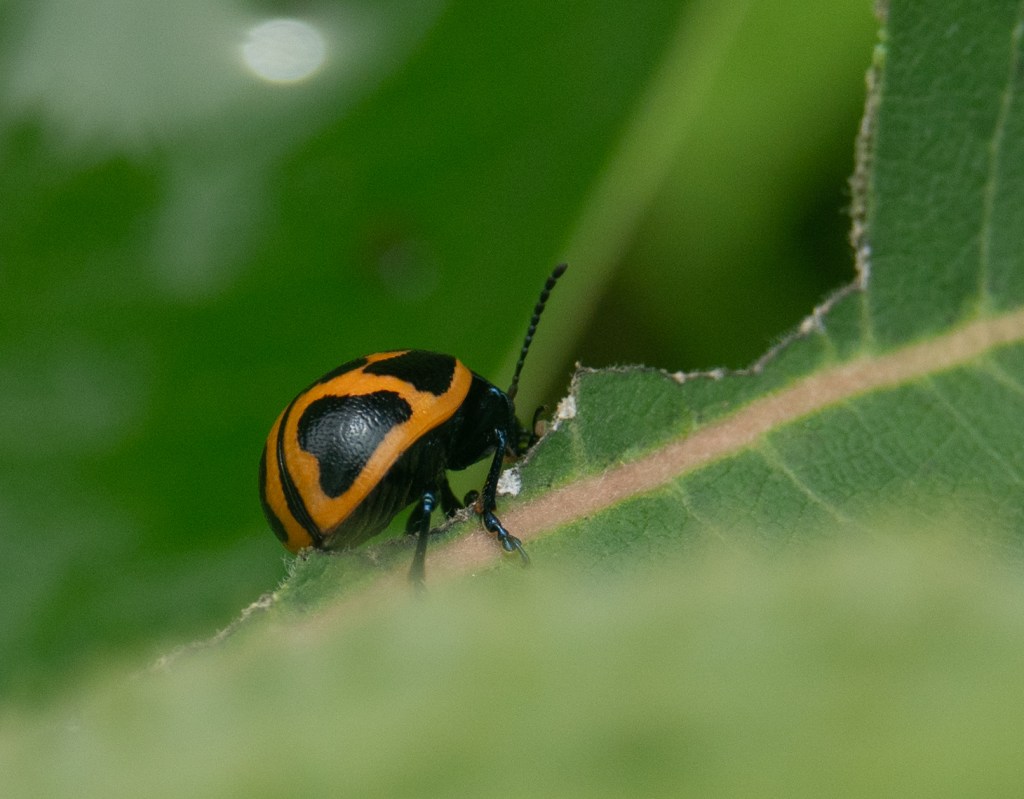
These 10mm beetles are adapted to the poisonous milkweed leaves, but even so they eat the leaves from the outside in, avoiding the main veins. Some reports also say that they first sever some of these veins to reduce the sap flow. They’re not exactly camouflaged (!) but that aposematic coloring warns predators that they may not be good to eat.

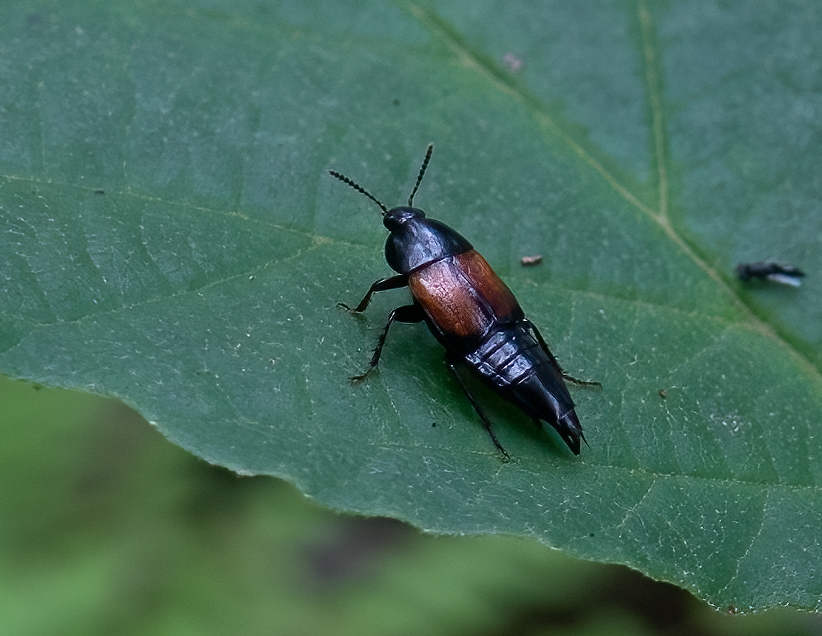
The Crablike Rove Beetle, Tachinus fimbriatus, has wing cases (elytra) that cover only half of its wings and abdomen, which stick out the end, unprotected. It measures about 9mm. There are thought to be around 66,000 species of rove beetles, dating back to the Triassic, and they are mostly predators. This particular one feeds on rotting mushrooms.
PS My title is taken from the great scientist E.O. Wilson, who said: “In the intricate dance of nature, insects are the choreographers of biodiversity.”

PPS The Dogbane Leaf Beetle turns out to have fascinating adaptations for its specialized diet of dogbane leaves. Read more here:
https://en.wikipedia.org/wiki/Chrysochus_auratus

Fledglings and bathtime

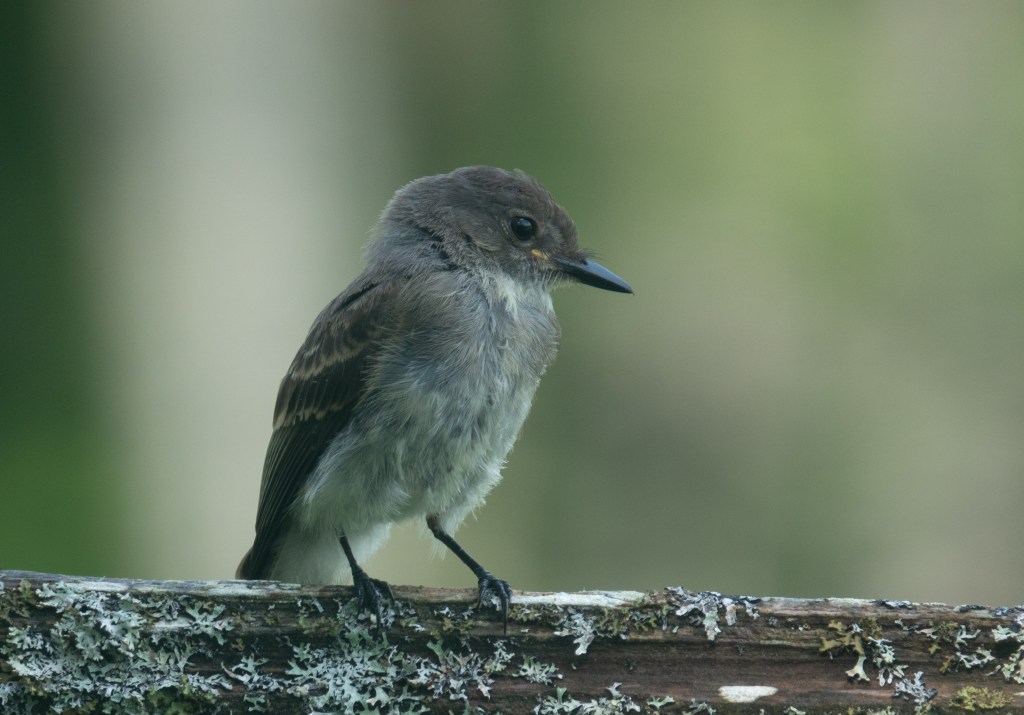
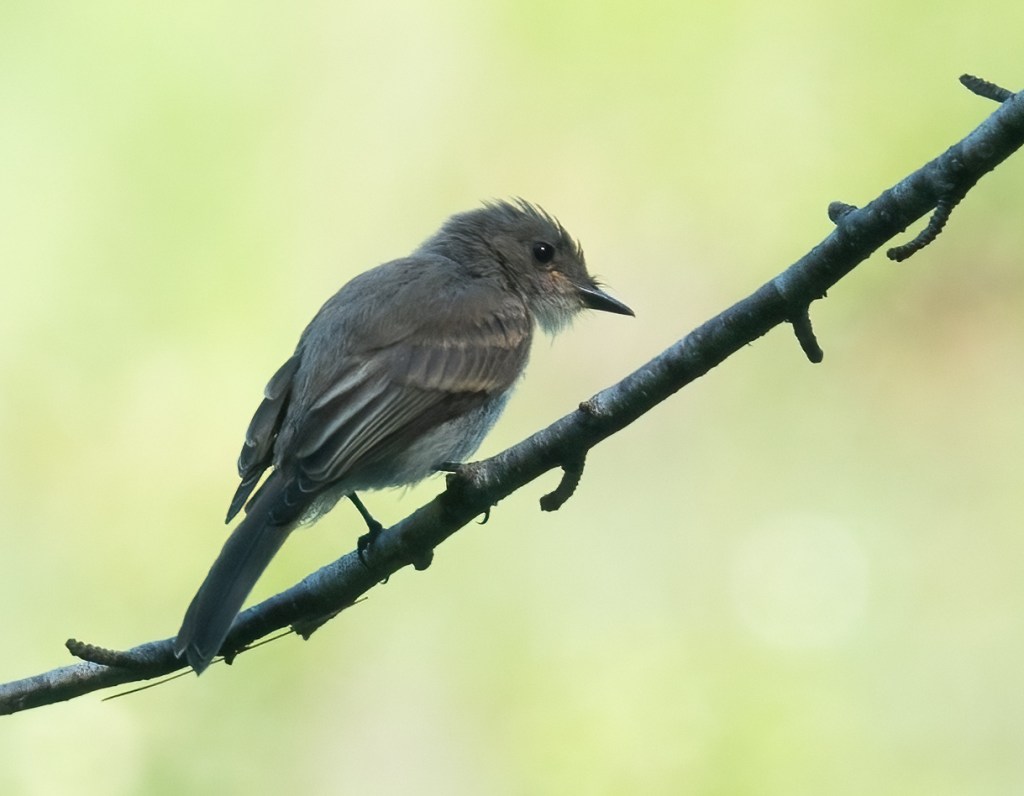
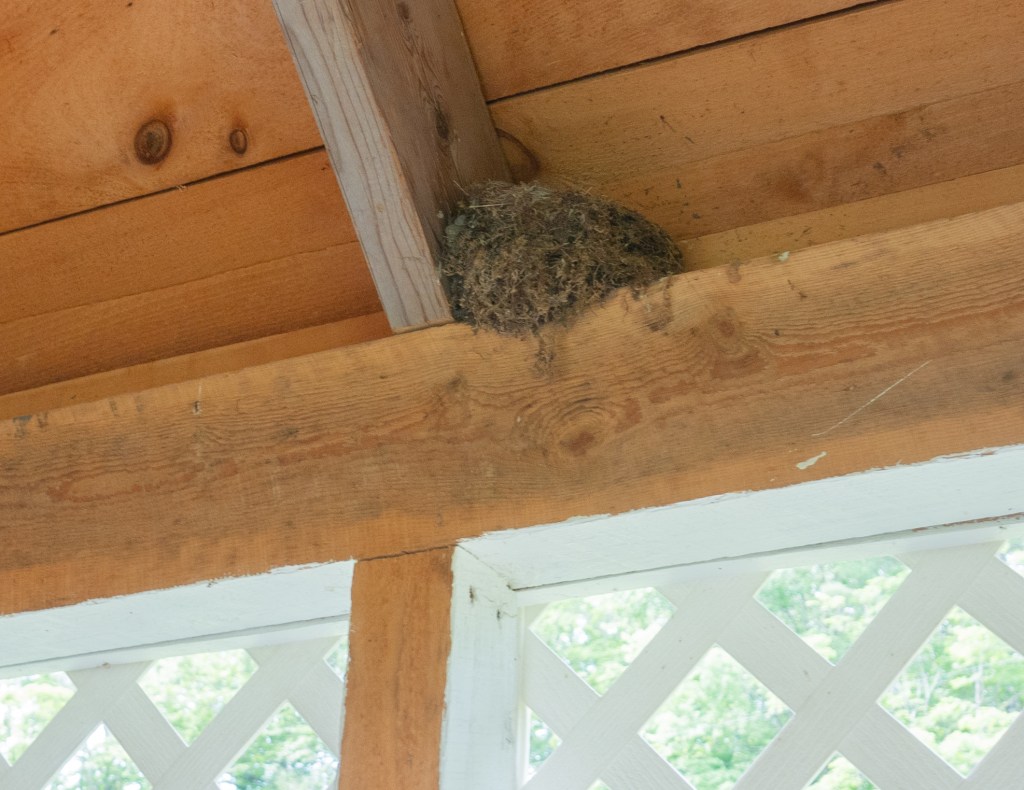
Phoebes often nest under eaves, and these ones nested inside a latticed shed that holds our generator!

The babies have now fledged, and are learning to fend for themselves. The yellow corners of the mouth are the gape that babies have, not yet all gone.

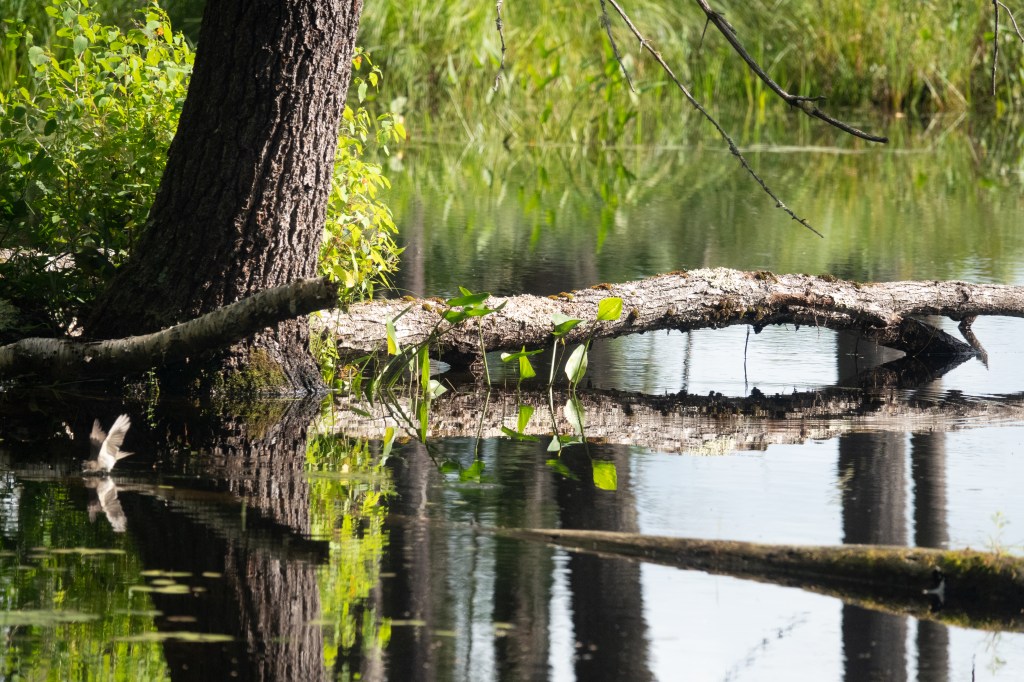
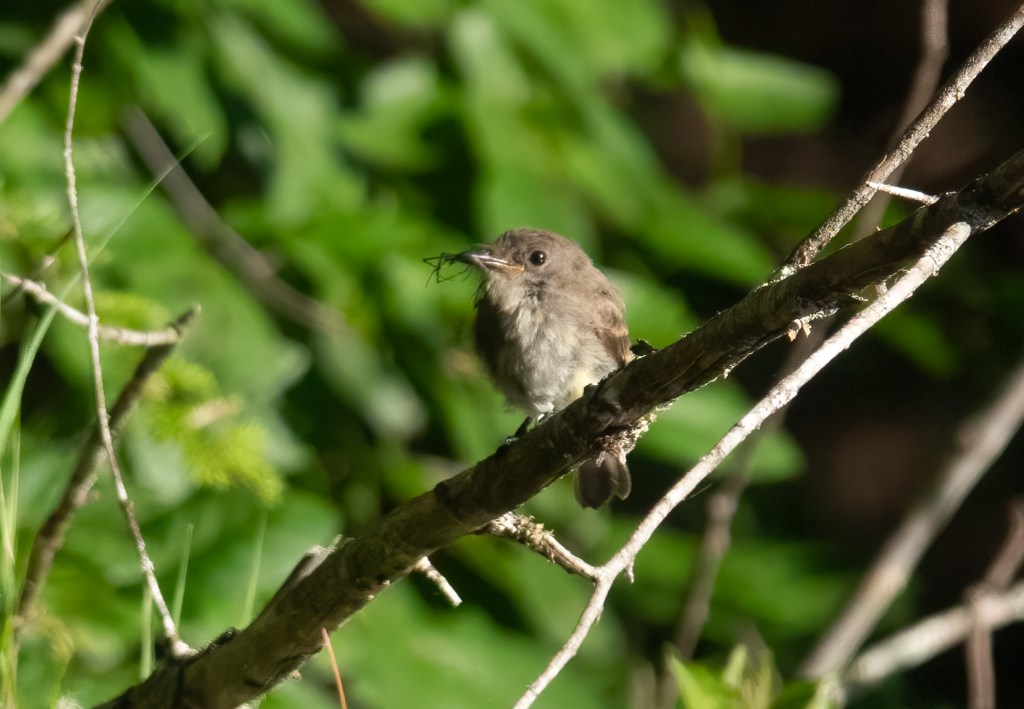
They are insectivores, flycatchers, often catching their prey in mid air. This one has been hanging around my beaver pond, perching in the overhanging trees,

and is hunting successfully:

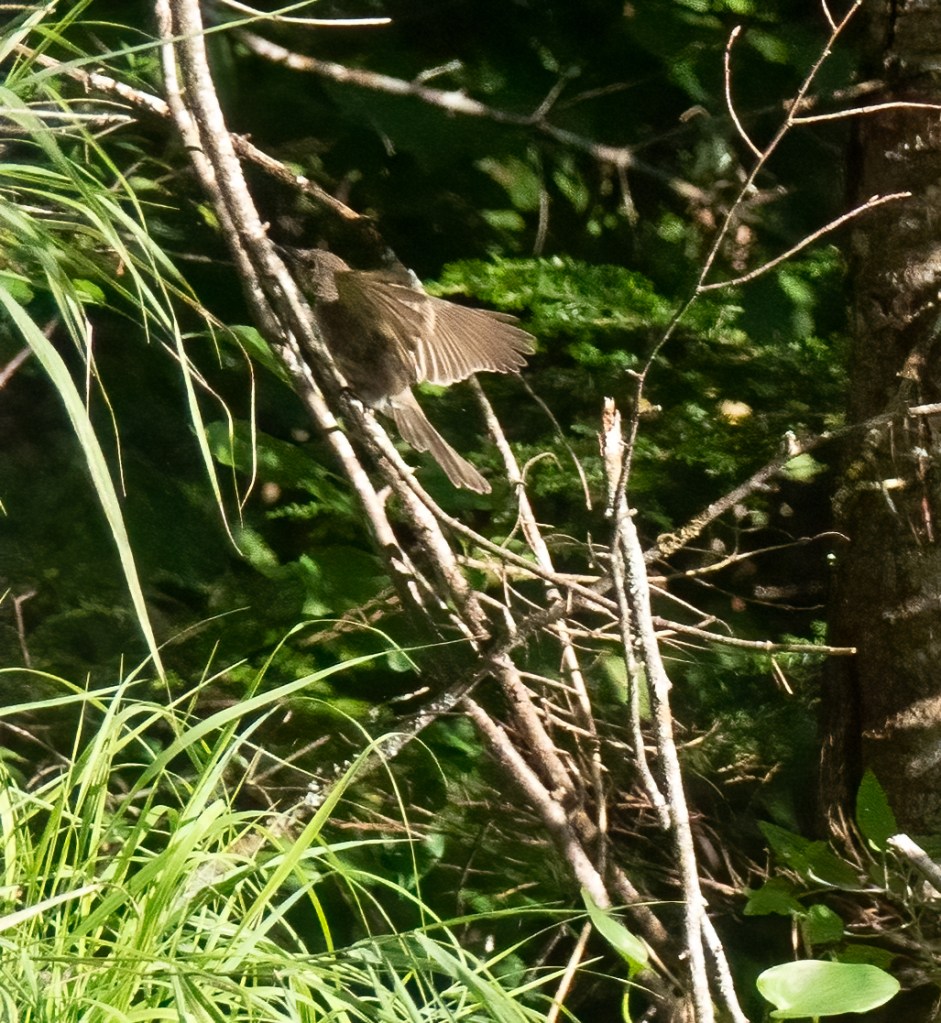
They also snatch bugs from twigs, hovering the while.

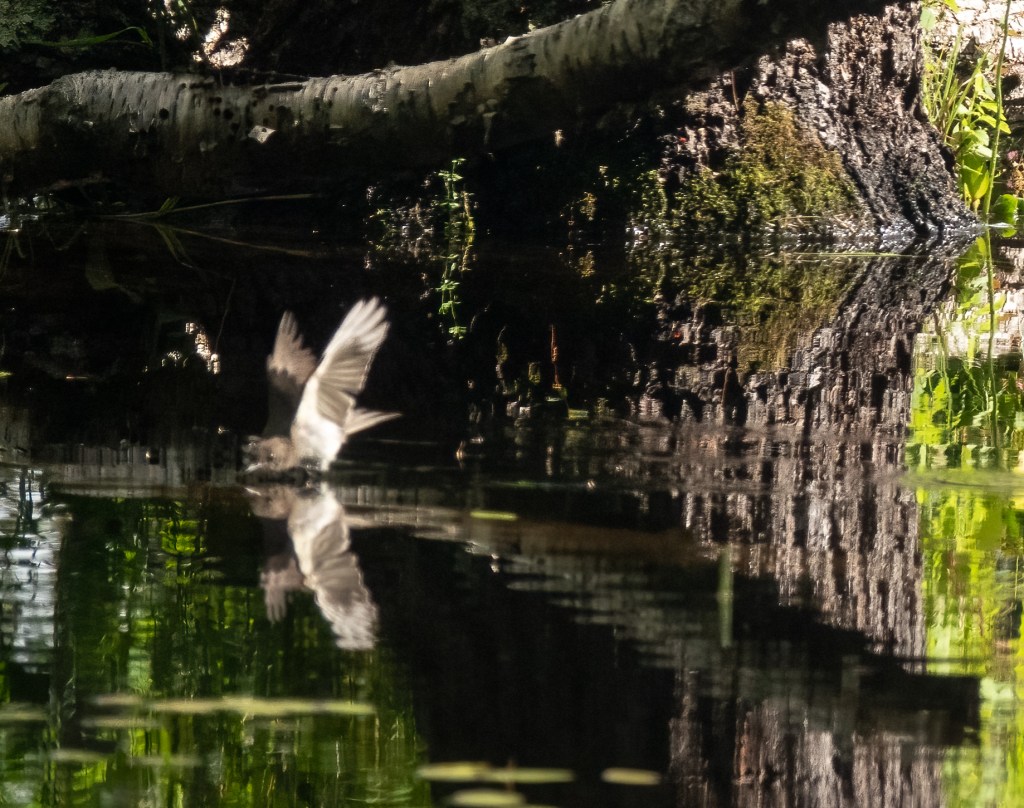
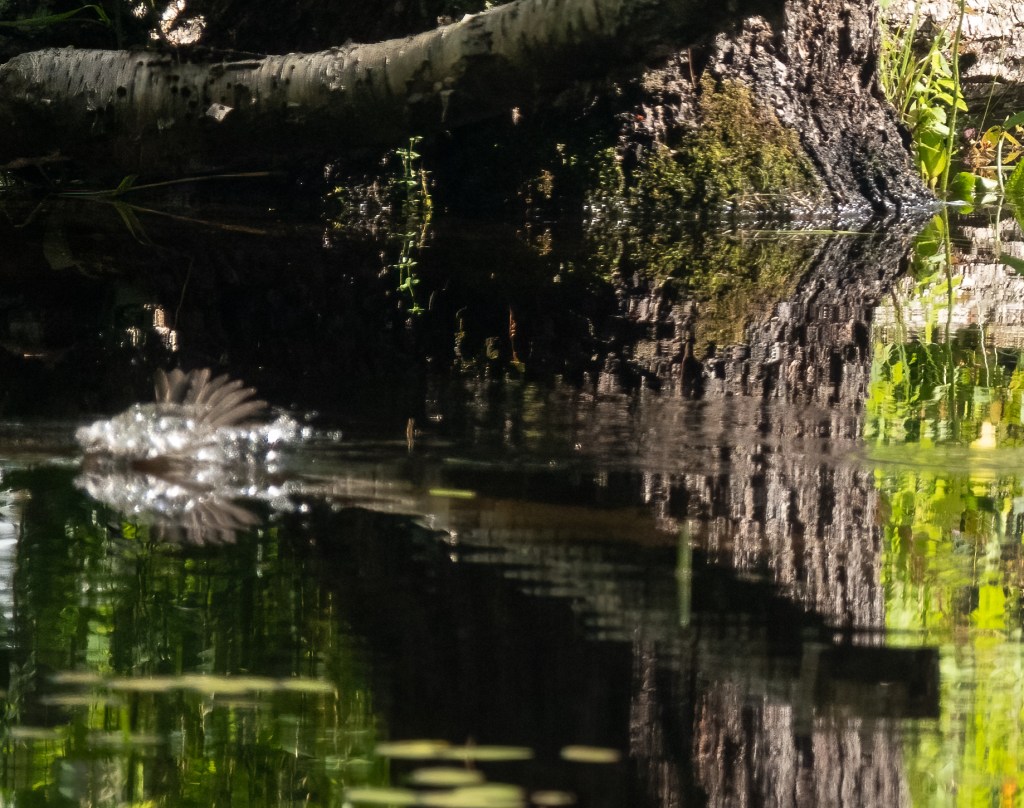
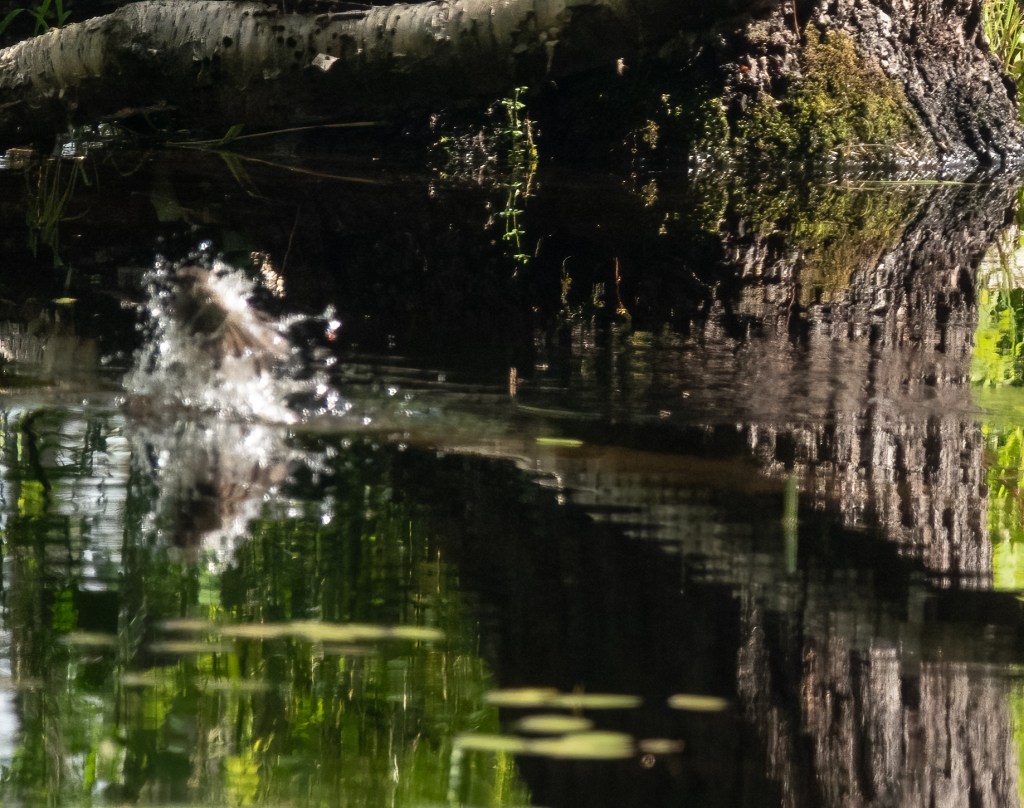
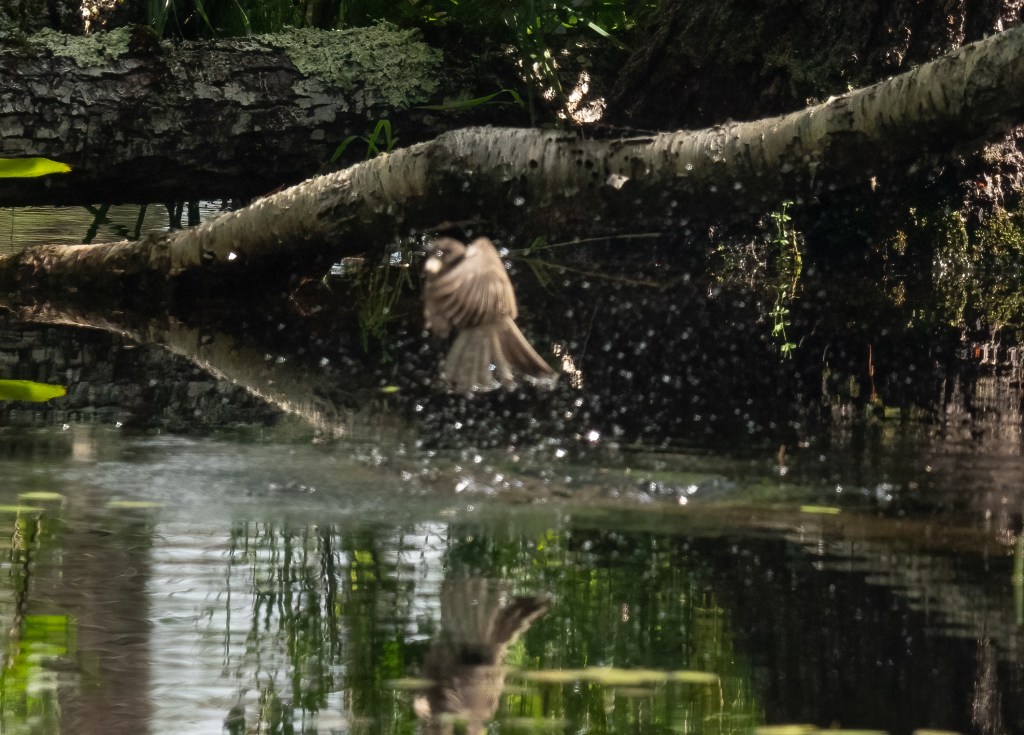
I have been enjoying bath time. This fledgling has been well brought up, and starts its day with ablutions. According to Cornell’s Birds of the World, Eastern Phoebes swoop down from a perch and wet their head and breast, keeping their wings as dry as possible, then return to the perch to groom. This is incredibly hard for me to film, because you don’t know when they are going to launch, where they are going to hit the water, and the return trip perch-water-perch takes less than one second. This sequence is the best I have got, but it will give you a rough idea of their technique.

You can see that the top of its head, chin and breast are still damp.

“Guttation!” I muttered with delight

As a linguist, I never met a new word I didn’t like, and “guttation” is no exception.*

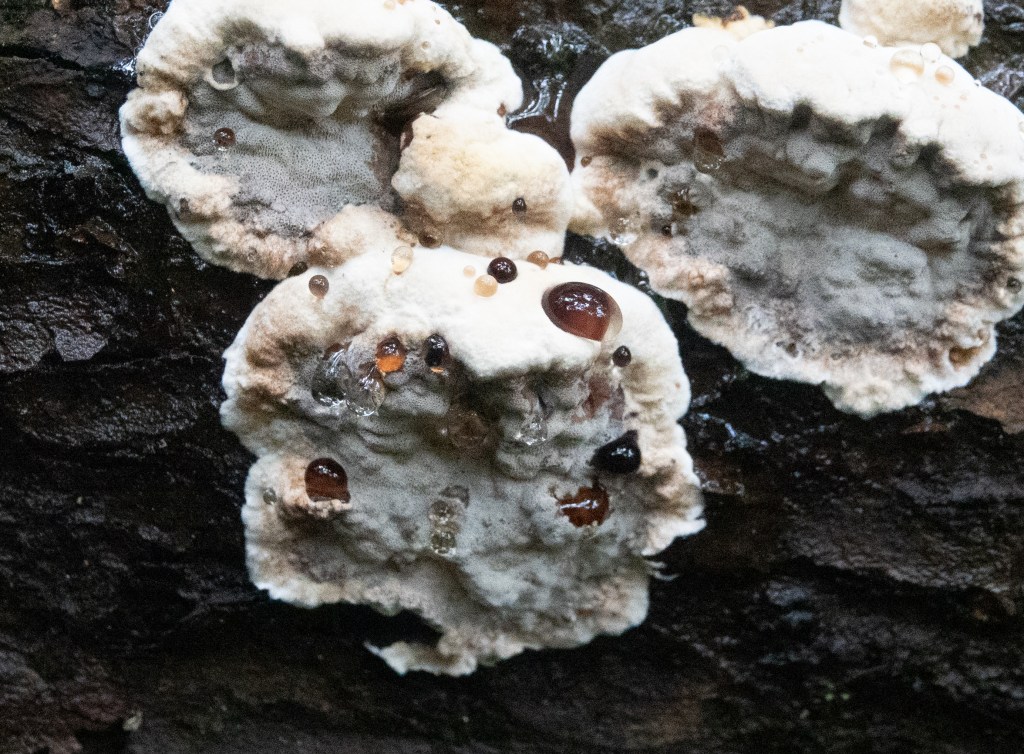
I unearthed this splendid word when I was trying to understand what I was seeing on the surface of a crusty fungus growing all over a dead log:

It was oozing droplets, a few clear, many amber, and some black and tarry:

I eventually identified this fungus tentatively as Ionotus glomeratus. It doesn’t seem to have a common name.

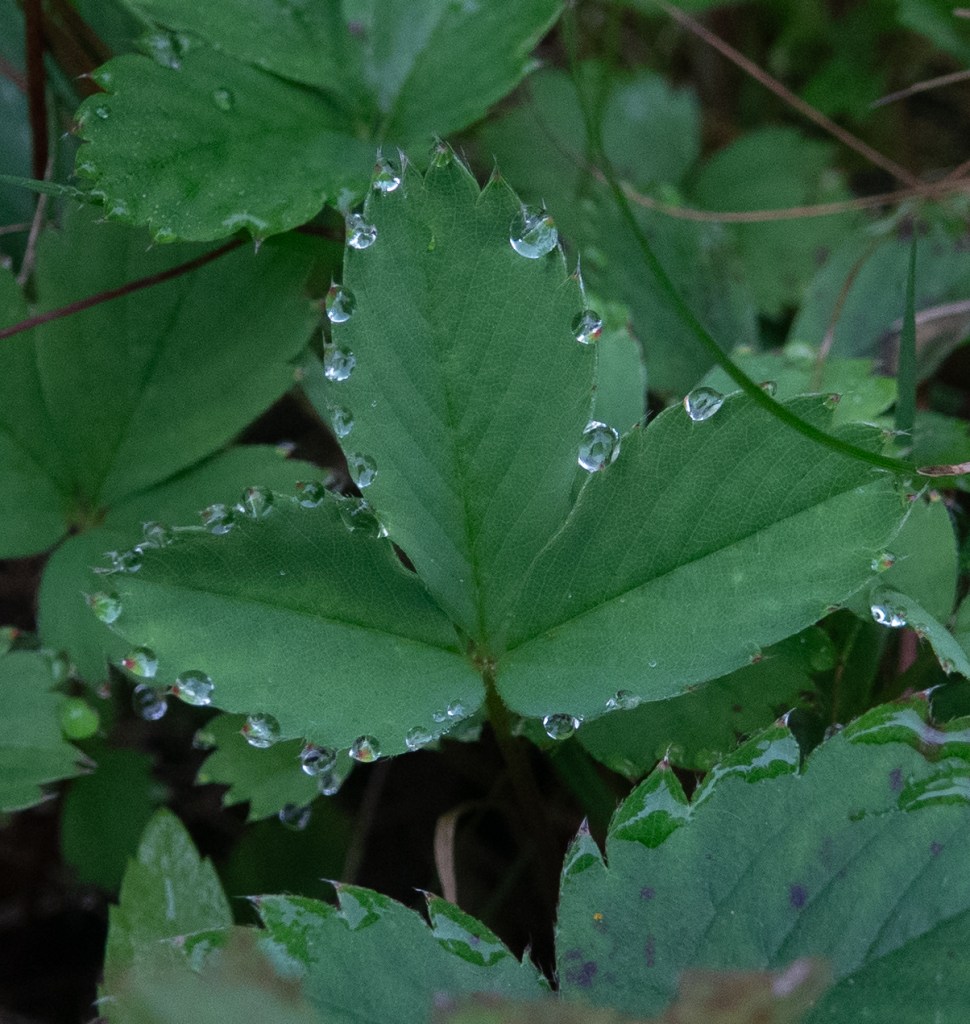
The mechanism of guttation in plants is better studied than in fungi. Here is a strawberry leaf, exuding droplets of sap from the tips of its leaves:

When the ground is saturated, and the leaf is still growing the water pressure forces the sap up through the xylem until it sweats droplets from small structures called hydathodes. It happens mainly at night, when transpiration is suppressed, so it is best seen early in the morning. The liquid is not plain water, but is rich in sugars and potassium, so many insects consume it as an important part of their diet.

In fungi, we know less, but it is clear that the liquid here is also not just water, but contains a range of secondary metabolites. This unidentified mushroom is exuding a clear liquid.

And this Hemlock Varnish Shelf seems to be bleeding:

PS * The word “guttation” comes from the Latin gutta, meaning a drop of liquid. It has survived with its meaning essentially unchanged in many Romance languages: French as goutte, Spanish as gota, and Italian as goccia.

PS Not all plants do this, and nor do most fungi. The reasons are mysterious. In fungi, the droplets contain all sorts of chemicals, some of which seem to be poisonous to competing fungi. But their place in the ecosystem is still largely a mystery. Krain and Siupka 2021 say “researchers have already found numerous mycotoxins, antimicrobials, insecticides, bioherbicides, antiviral, and anticancer agents in exudate droplets. They belong to either secondary metabolites (SMs) or proteins and are secreted with different intensities.

Hands up

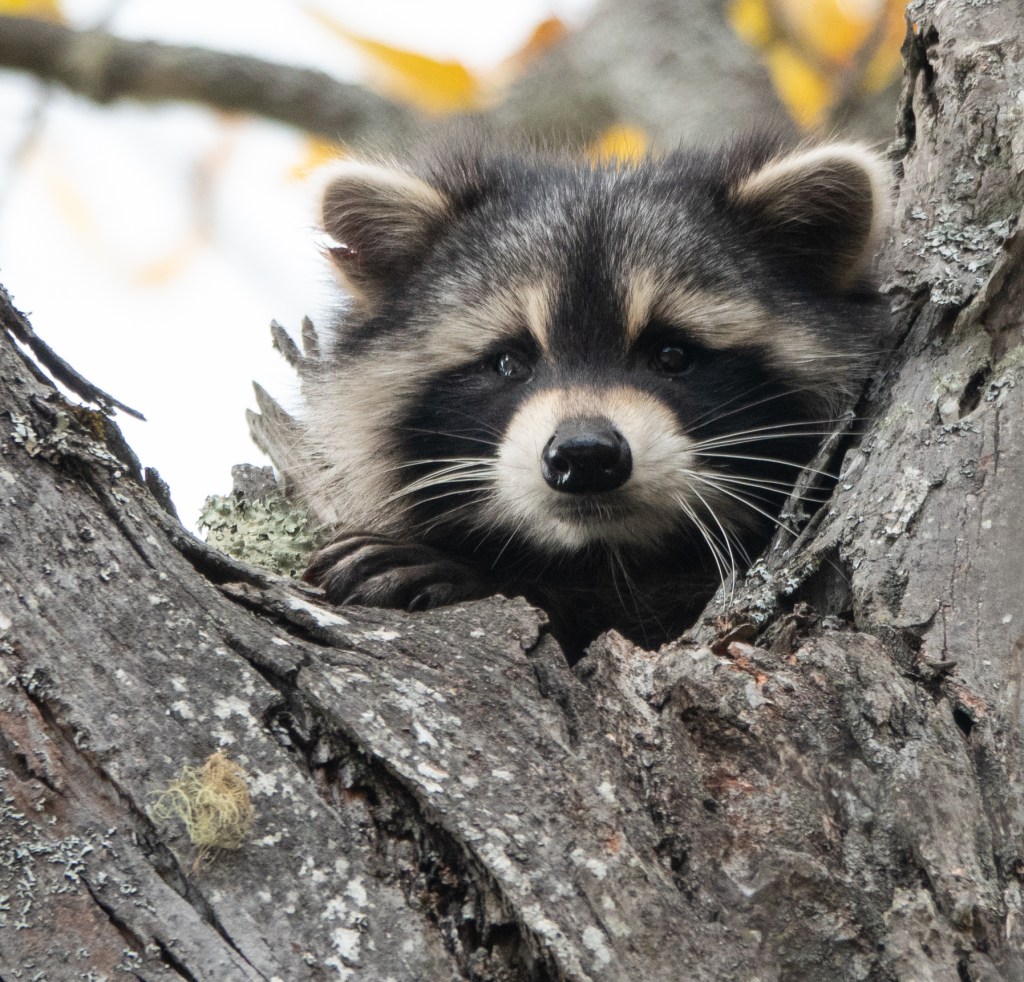
My game camera, positioned on a beaver trail, caught no beavers at all, but instead it caught a raccoon family hunting.

For anyone unfamiliar with raccoons, they are charming:

Nevertheless I know many people loathe them because they get into their trash and cause havoc, or indeed attack their bird feeders, as this video shows:

But those clever hands are designed for a different kind of foraging. In their natural habitat they eat aquatic invertebrates, like crayfish. They hunt at night, and have very sensitive forepaws, or hands, which they use to search in shallow water for their prey.

The video below was taken deep in the woods in the pool just downstream of a beaver dam. I have spliced together several videos. At first you see a single adult, questing for food at the water’s edge. Half way through, the adult is joined by four babies, each of whom is copying its parent’s technique. The mother and first baby appear together briefly at 22 or 23 seconds in, at the left of the frame, and then wander off, but there are three more babies to come.

You can see that they are not looking into the water (and anyway it’s nighttime!), but trusting entirely to their hands.

The moral of this tale is that if raccoons still have access to natural habitats, they sensibly prefer crayfish to garbage, as do the French, who particularly like theirs in a bisque .

(photo from https://honest-food.net/crayfish-bisque-recipe/ )

PS The five fingered raccoon forepaw, or hand, has no opposable thumb, but it can be used to grasp in several ways.

The diagonal lines show the different ways the hand can fold to grasp something, and the asterisk shows how they use a scissor grasp between two and three digits. (Drawing from Iwaniuk and Whishaw 1999.)

In addition they use both hands together, and roll food between them. The hand is especially sensitive when wet, and the fingers end in tiny vibrissae, or whiskers, that allow the raccoon to sense food without actually touching it. For those who enjoy a little more detail, Welker and Seidenstein 1959 studied how much of the sensory area in the cerebral cortex of a raccoon is devoted to its hands. The answer is a lot, nearly 4 times as much proportionately as in a rhesus monkey, for example. The brain has specialized areas for each digit, and also for five different areas of the palm. You can see why it is sometimes said that raccoons “see” with their hands.

Getting the builders in

We should all wish for contractors like these.

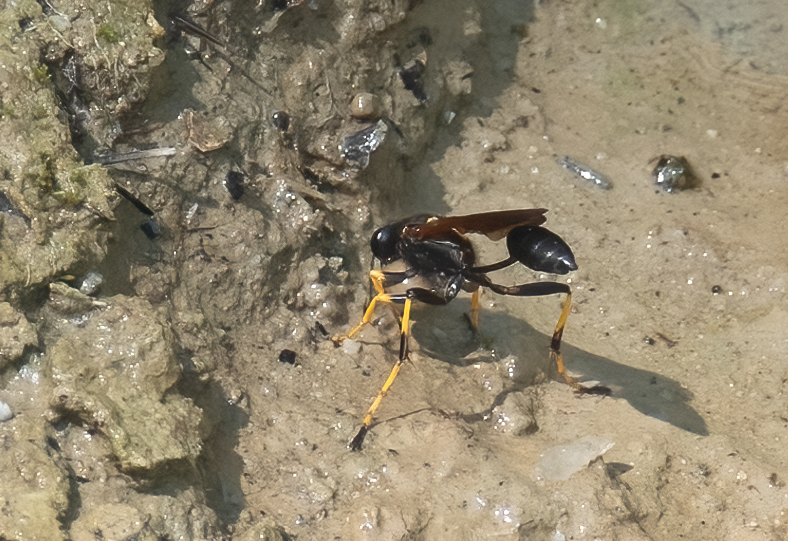
Yellow-legged Mud-dauber Wasps, Sceliphron cementarium, were diligently collecting mud from small puddles in an abandoned rock quarry near me. They would spit into the mud, and push it together into a tiny ball (by her front left legs):

in their enthusiasm they go head-down in the mud:

Once it was formed into a nice ball:

they clutch it to their abdomen, and fly off:

I tried but failed to get a mid-air shot!

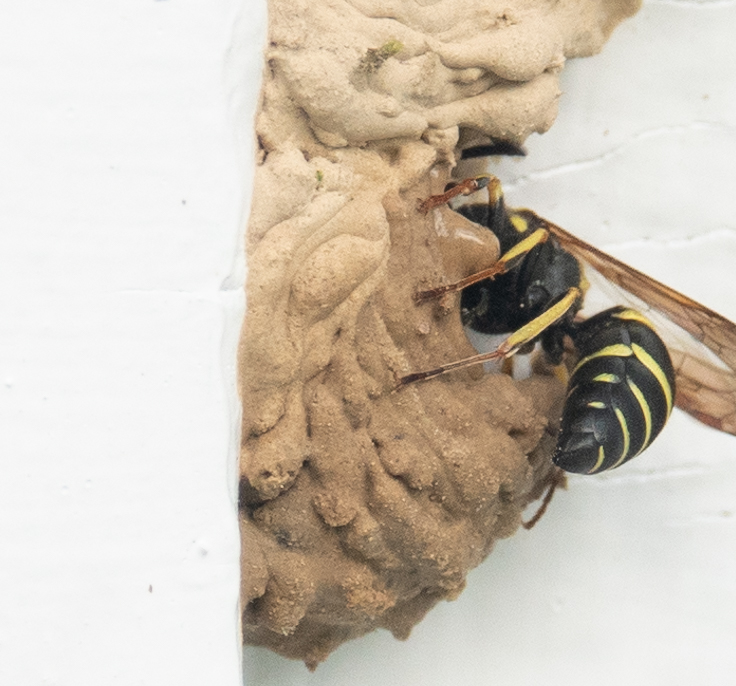
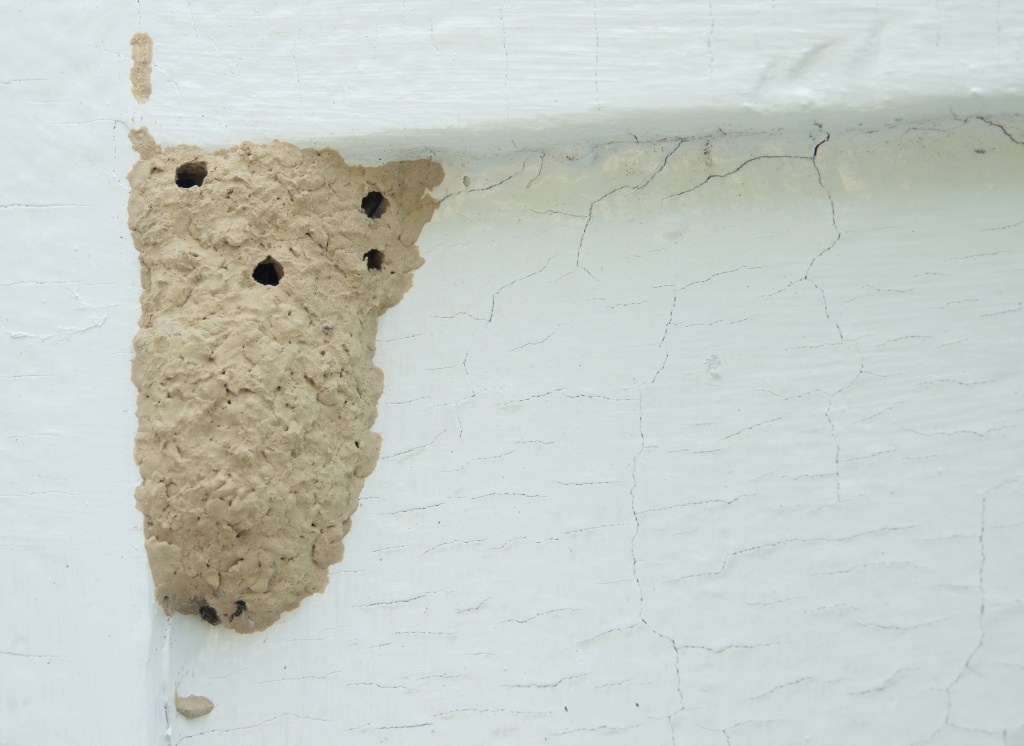
I never found their nests, but a similar technique is used by the Catskill Potter Wasp, Ancistrocerus catskill, who used her mud to sculpt two of these tiny edifices in the corners by my back door.

They are destined to be the sarcophagi for paralyzed sawfly larvae, onto which the wasp lays an egg, after which she seals the whole thing up.

The egg will hatch into a larva which will then feed on the sawfly larva, pupate, and emerge as an adult wasp.

Now that the next generation was fully incarcerated, I was trying to decide whether to slice it open to inspect the contents, when something unexpected happened.

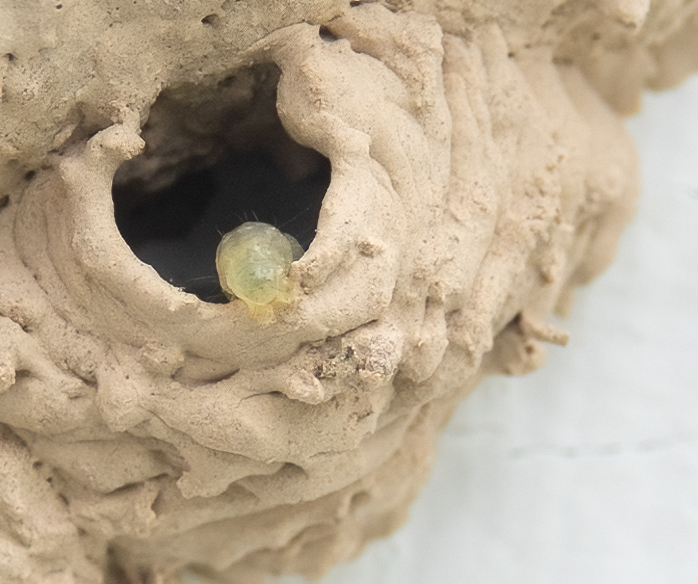
The wasp built an addition, and poking out of it was a tiny grub.

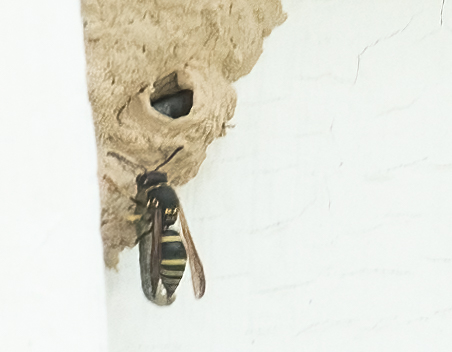
Then the wasp herself appeared, all 1/2″ of her, dangling a paralyzed grub of some kind as food for her offspring.

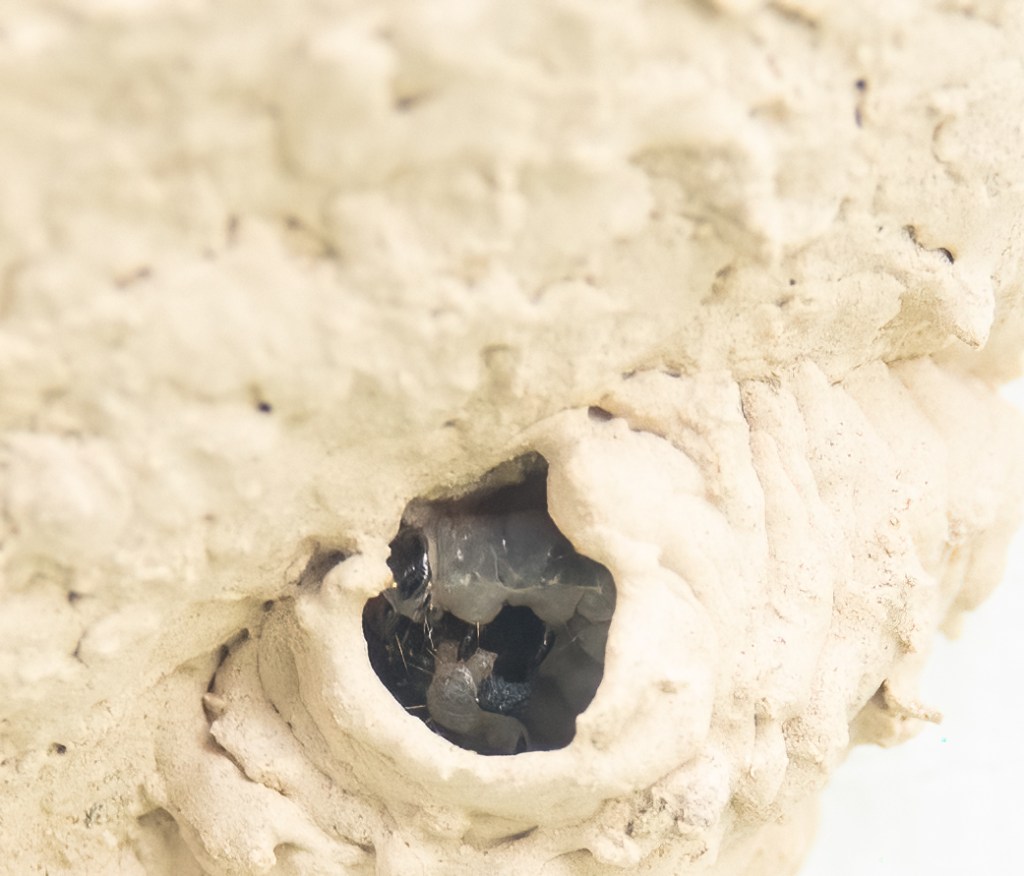
She stuffed it into the chamber, and once she had left I took a photo through the tiny opening:

It looks rather ferocious…

The food supply was evidently complete, because less than two hours later she had sealed it all up, and started to construct another cell.

This time I got photos of the process. She carried in her lumps of mud:

and used wet liquid mud laid down in rows rather like making a coiled pot.

Once she had inspected it,

she then settled in bottom first, and stayed for some time, presumably laying an egg.

She emerged, one last check, then left for the day. Next morning, she returned, and sealed this one up too:

Then she started another:

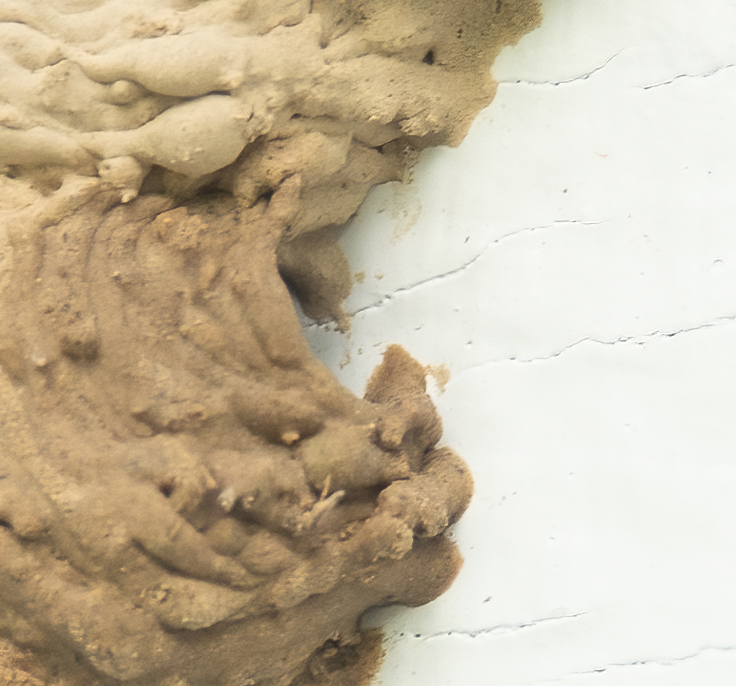
In aggregate she built six or eight chambers, and then finally the process seemed to have come to an end. The entire condo was given an additional mud cladding. It is 1″ across at the top, and 1 3/4″ long.

And she left, job done.

I read that the adult wasps would not emerge till the spring, but I was keeping watch just in case, and blow me if one morning I glanced at these muddy storage units, and discovered that two of the cells had escape hatches:

By my estimate, this was about a month from when the eggs were laid. One week later, there were four holes:

The next generation is launched.

A rose by any other name…

(Oops, I hit “Publish” by mistake before I intended to. Apologies for the second post of the week! )

I have found myself interested in the unusual names boasted by some moths. This interest was sparked by finding a striking Confused Haploa Moth, Haploa confusa, on the step of my porch, below the light. It actually is named ‘confused’, and its behavior may have been also. There is no clear consensus as to why it has such an odd name.

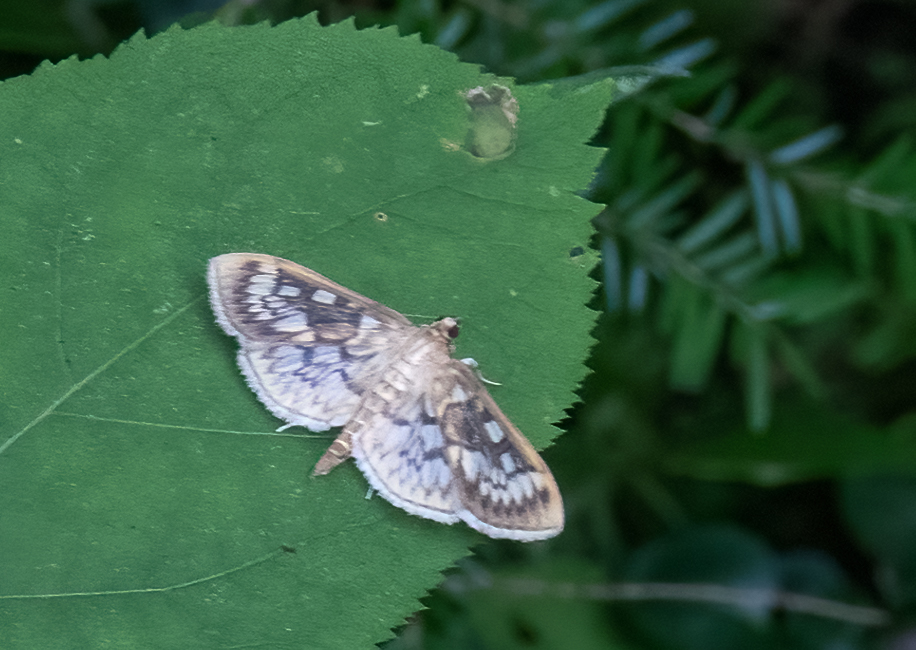
A new one for me is the Zigzag Herpetogramma Moth, Herpetogramma thesteali. Its common and scientific names use the Greek words for ‘reptile’, and for ‘drawing’, I think because its pattern looks like the scales of a snake.

The Virginia Ctenucha Moth, Ctenucha virginica, has a name from the Greek stem κτεν- meaning “comb”, in reference to the showy antennae of the male below:

It has a metallic blue body, and despite its name it is found as far North as Labrador, with Virginia being the southern end of its range.

The Northern Petrophora Moth, Petrophora subaequaria , brandishes a name that comes from the Greek for “rock” and the Greek suffix -φορος meaning “carrying”. I cannot for the life of me work out where this name comes from. As for the subaquatic portion of its name, that is even more mysterious. If anyone knows, do enlighten me.

Rather unusually, the caterpillars of this moth eat ferns, despite the compounds in fern leaves that means most insects avoid them.

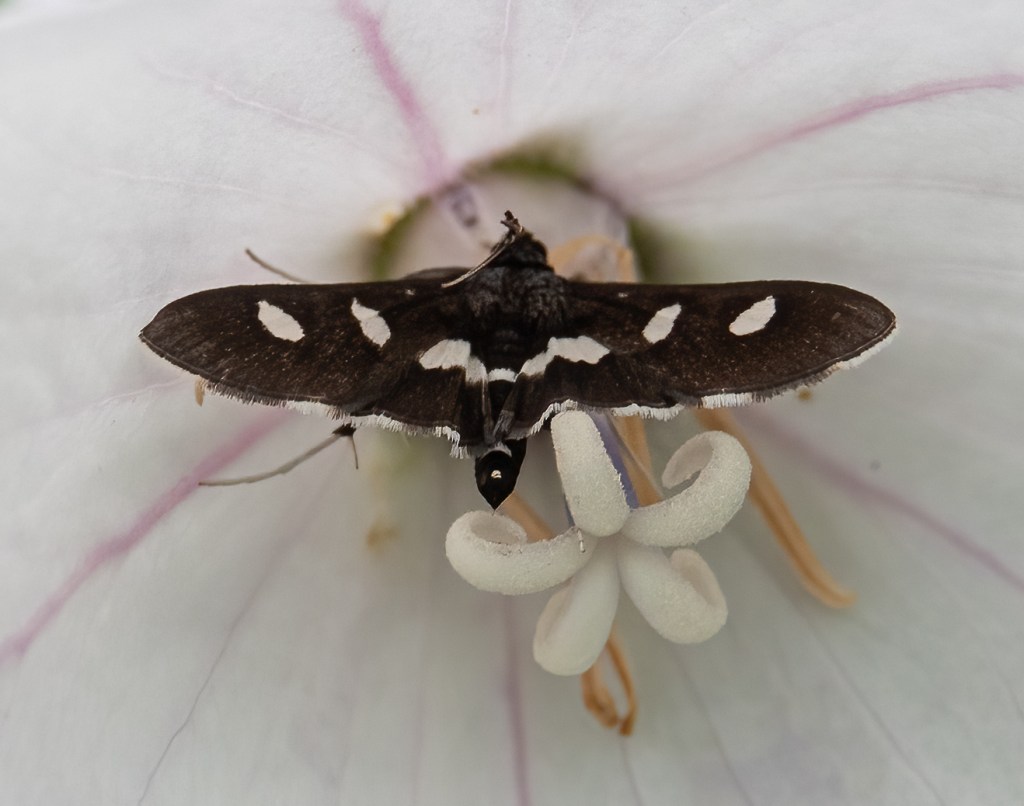
Grape Leaffolder Moth, Desmia funeralis, must be named for its funereal costume:
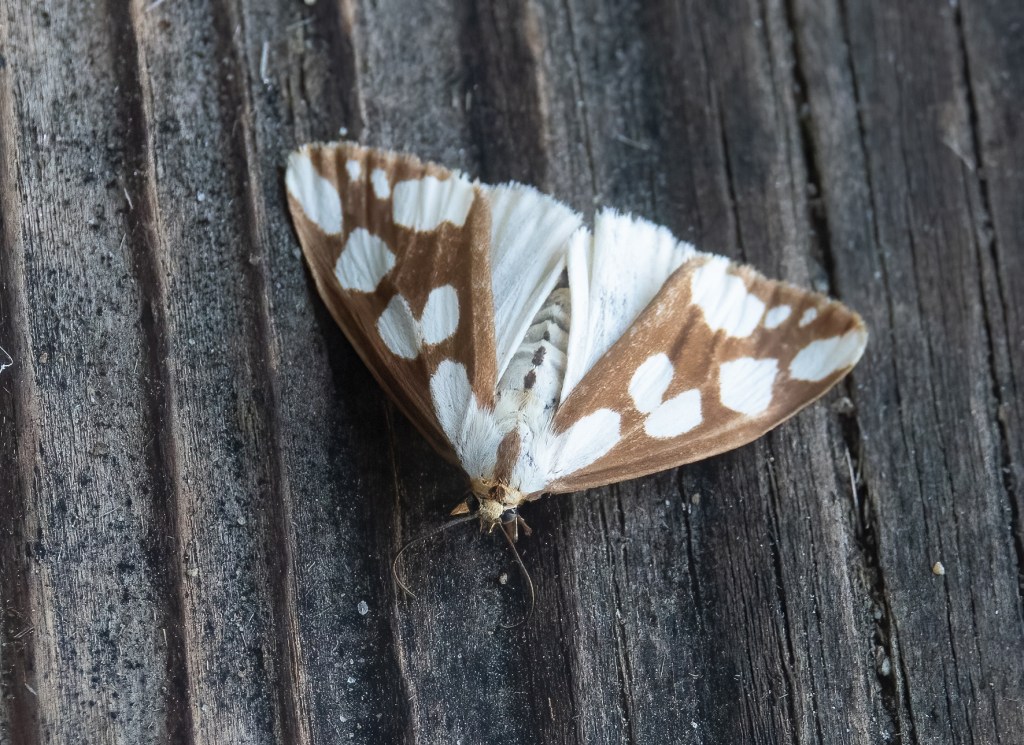
The Large Yellow Underwing, Noctua pronuba, has a glorious scientific name. ‘Noctua’ means “night owl” and ‘pronuba’ means “maid of honor”. Fitting names for a nocturnal beauty .

I could go on and on but your eyelids may need propping open by now. As you fall asleep, dream of moths.

A meal of small plates

An accumulation of small things can add up to a banquet of delights.

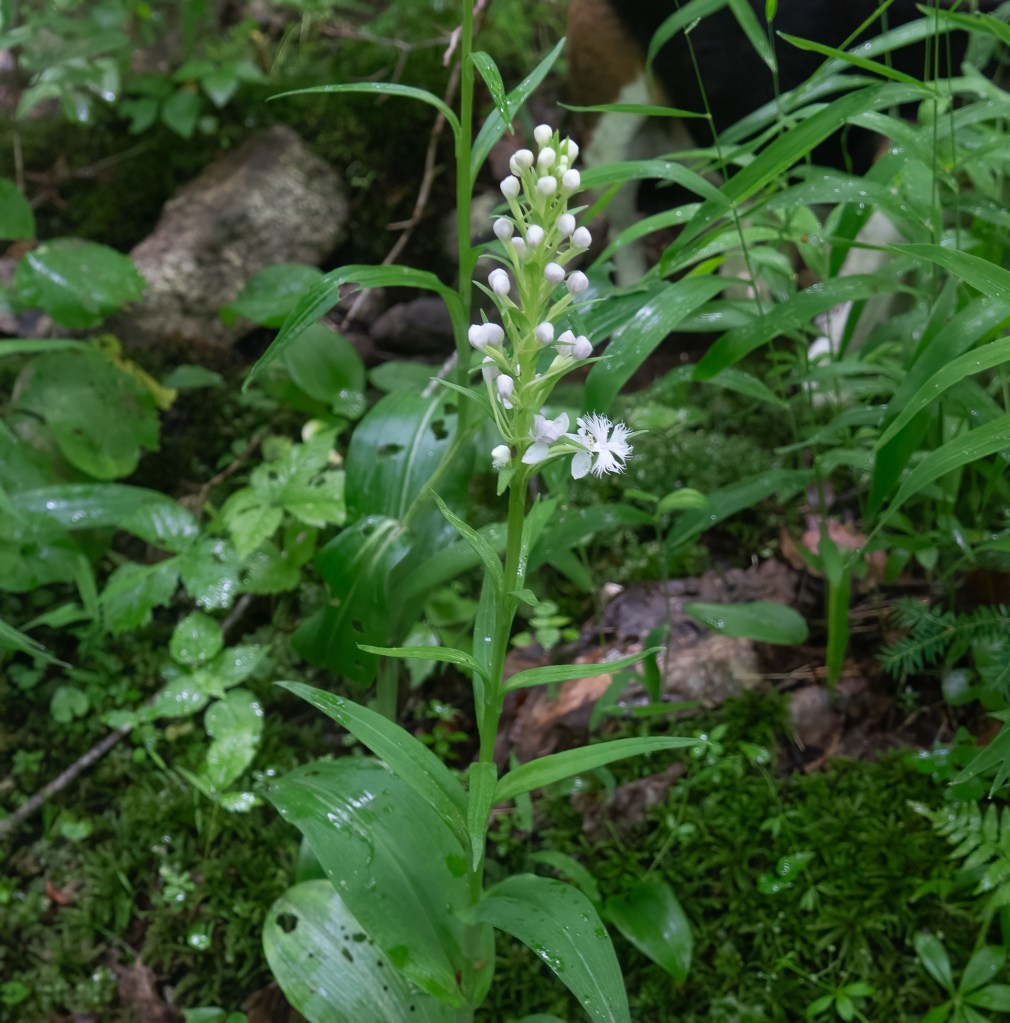
Deep in the woods by a stream I found a pure white orchid, about 18″ high, that I had never seen before.

Being me, I of course identified it as something only known in Maine at one site nowhere near me.

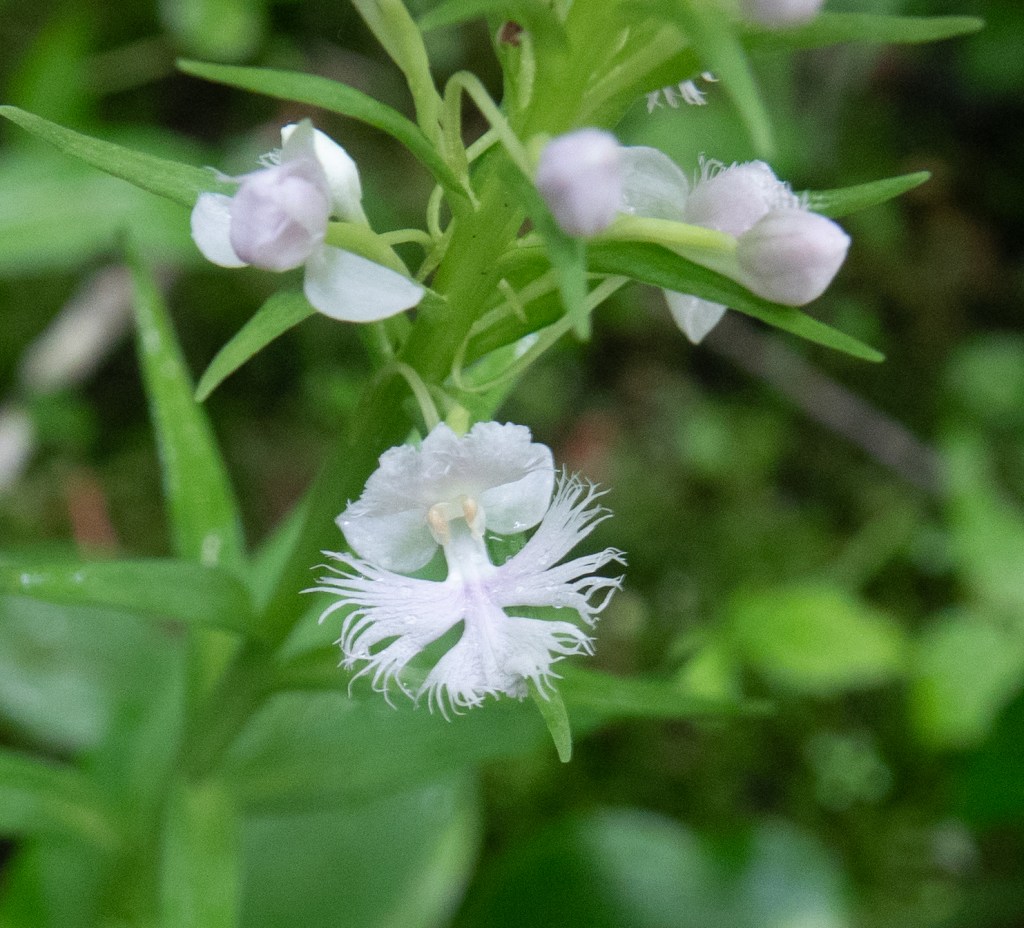
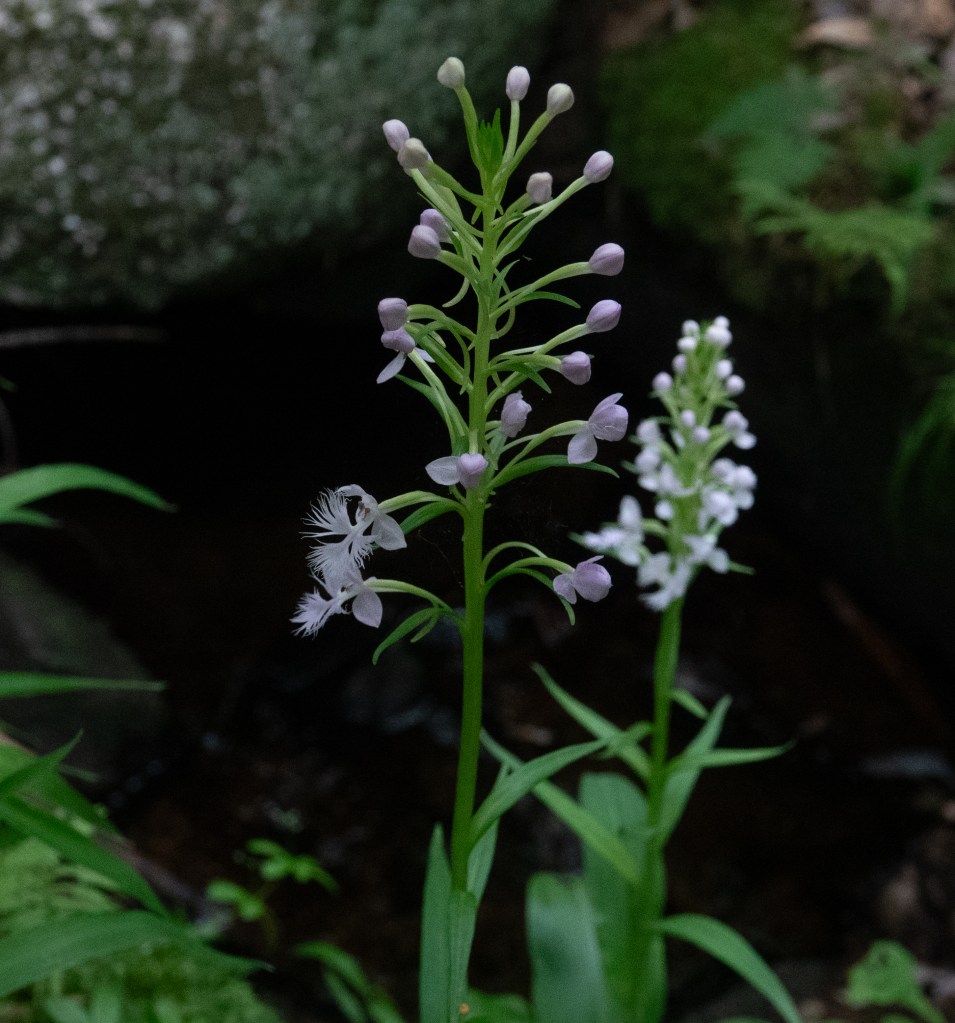
I was wrong. My white orchid was actually a purple orchid, a Greater Purple-fringed Orchid, Platanthera grandiflora, to be more precise, which perversely is occasionally white. I was forced to accept this when the second stalk more sensibly produced pale purple flowers. The turncoat sister stalks in the background of this shot.

Despite its deceptive behavior, it is very beautiful.

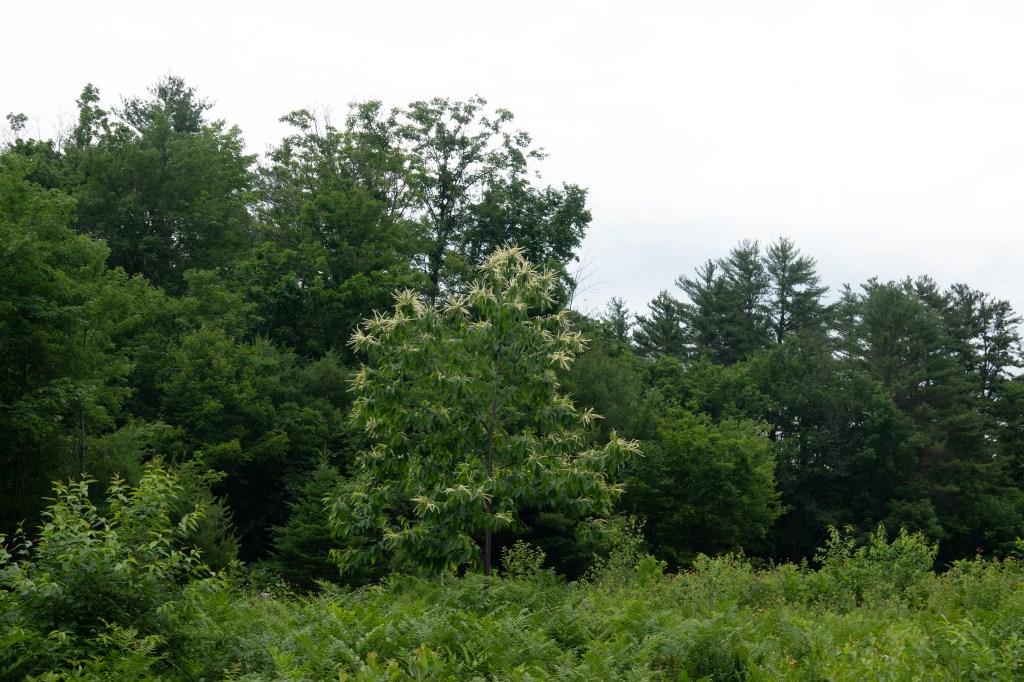
The American Chestnut has pretty much disappeared after the chestnut blight imported from Asia killed about 4 billion trees in the 20th century.

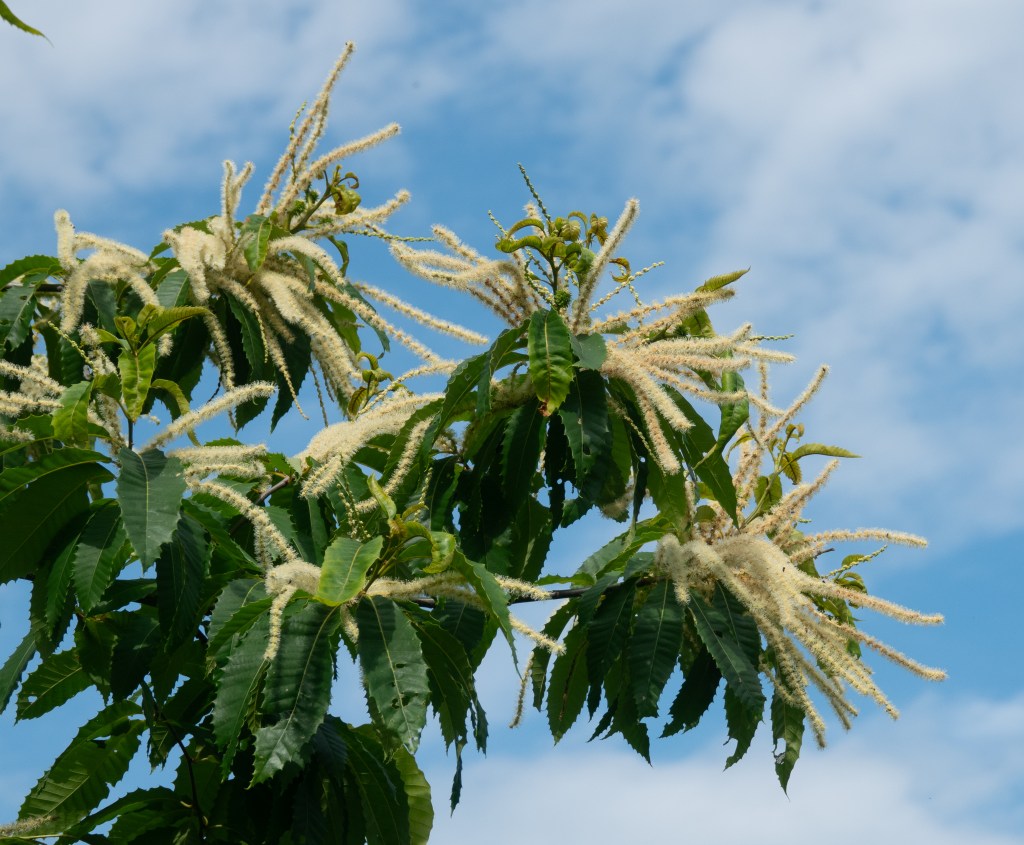
But every now and again one decides to grow, and lo and behold there is a very healthy-looking sapling on the edge of my field, maybe twenty feet tall, and in full flower:
I know that they often start off fine, and then succumb a few years later, usually before the tree reaches sexual maturity. That this one is flowering suggests it is currently beating the odds, so for now I am just enjoying it:

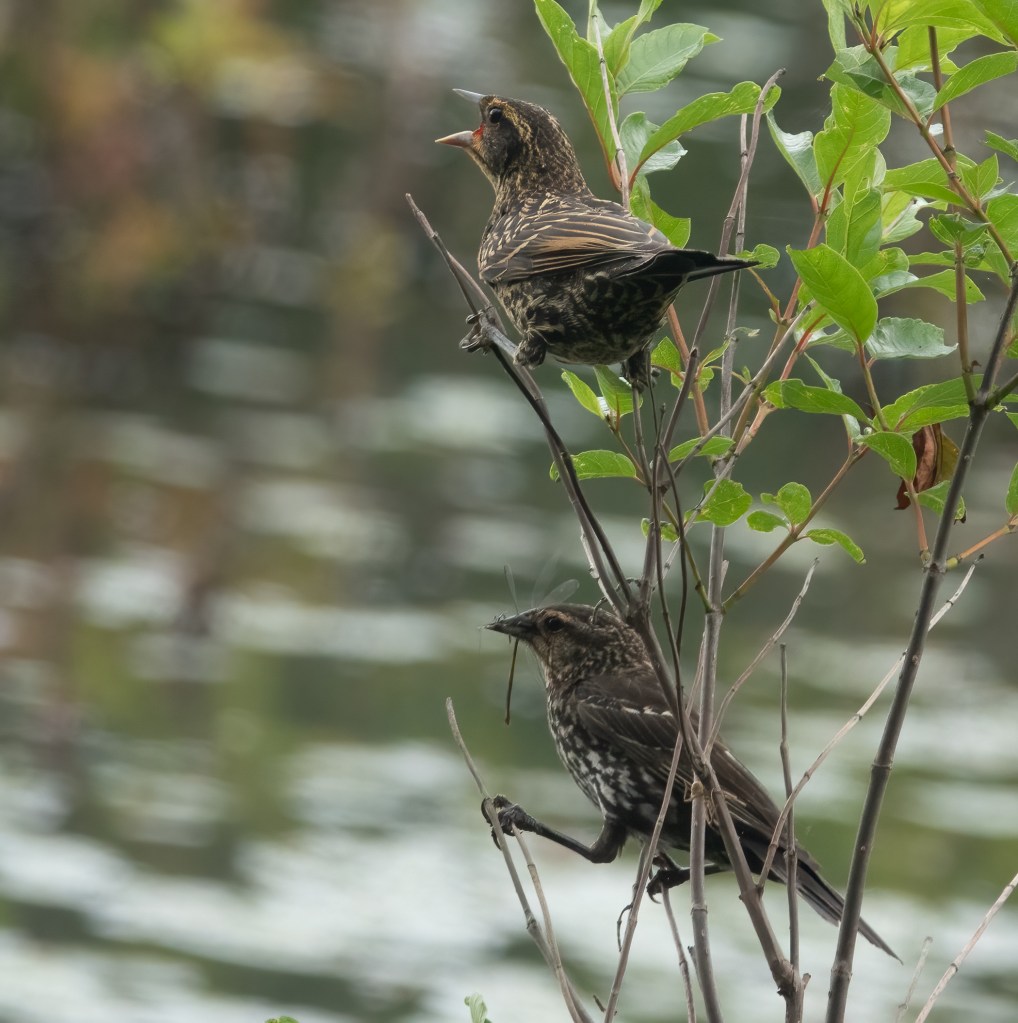
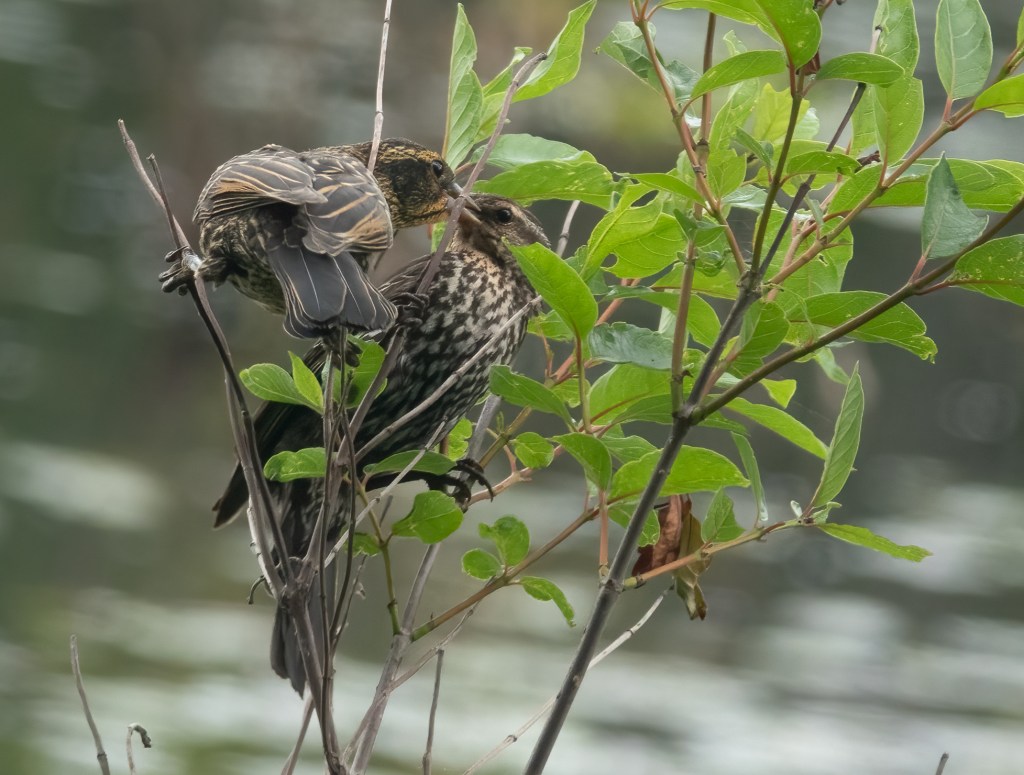
The Red-winged blackbirds have been nesting on my beaver pond, and the young have now fledged. They are still being fed by their diligent parents.

The mother (bottom) has caught a dragonfly (look carefully). The fledgling, top, is starving.

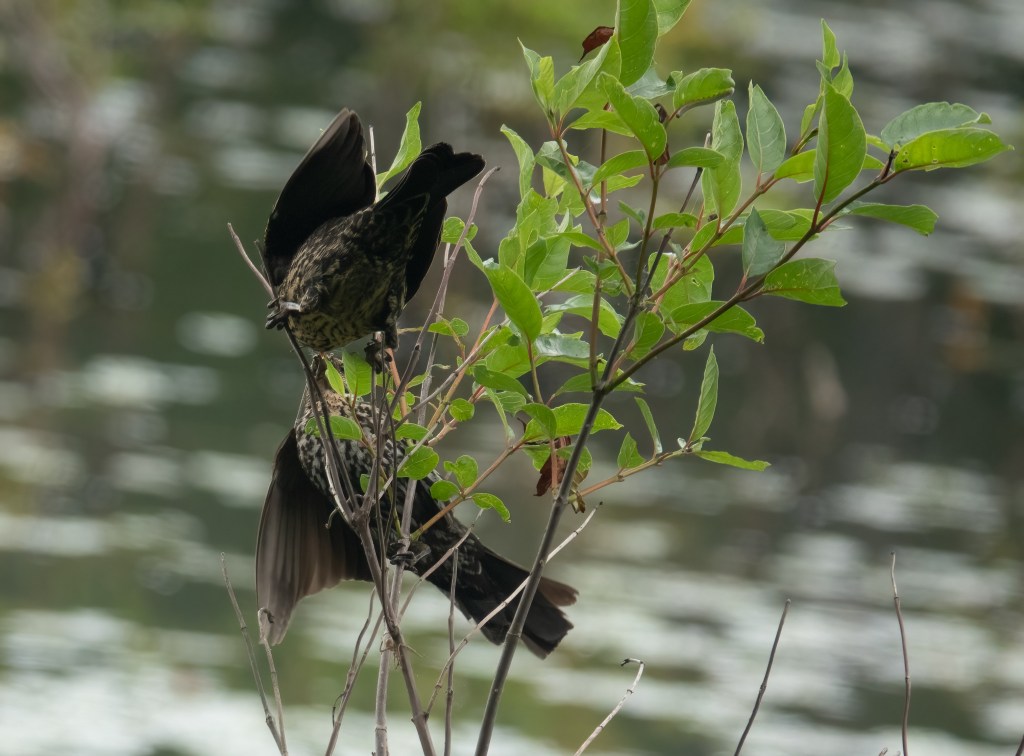
She moves higher,

then stuffs the dragonfly into the youngster’s mouth (the mother is on the right). She had two to feed, and kept up a steady flow of provisions.

Otherwise, all is calm. The American Black Ducks have seven ducklings, and the stray loon was still there when I wrote this, and apparently healthy. (He/she has now moved on.)

And I am replete.

Study in Black-and-White

[This is, finally, my last post from my Botswana trip. I hope you enjoyed the ride. For a while now it will all be my backyard woods in Maine.]

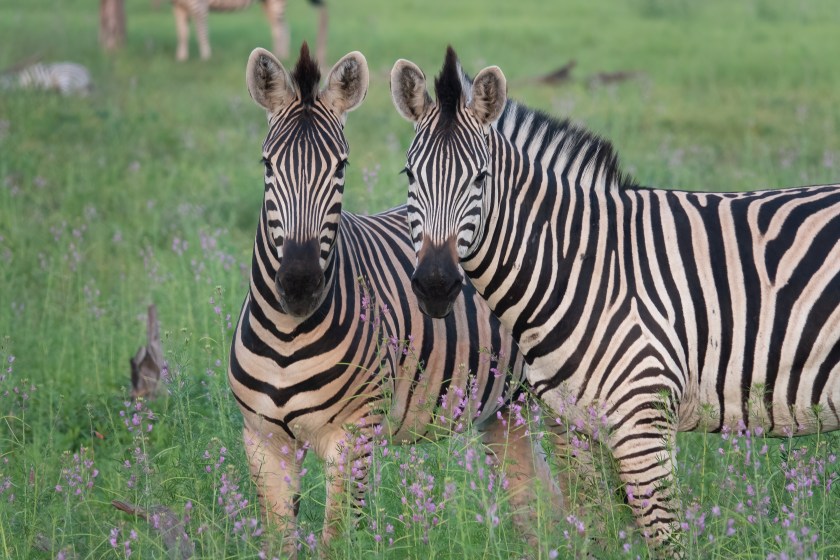
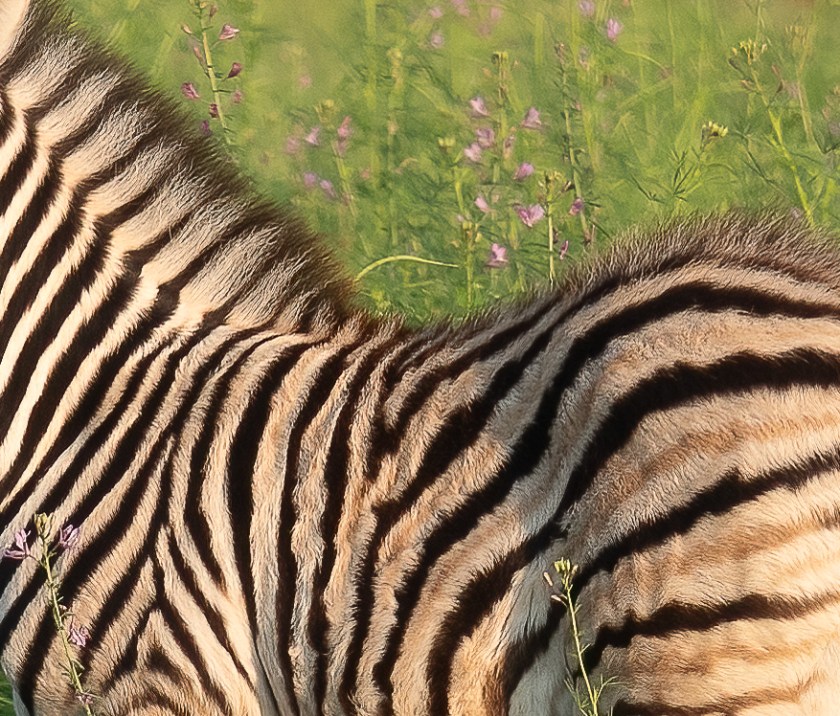
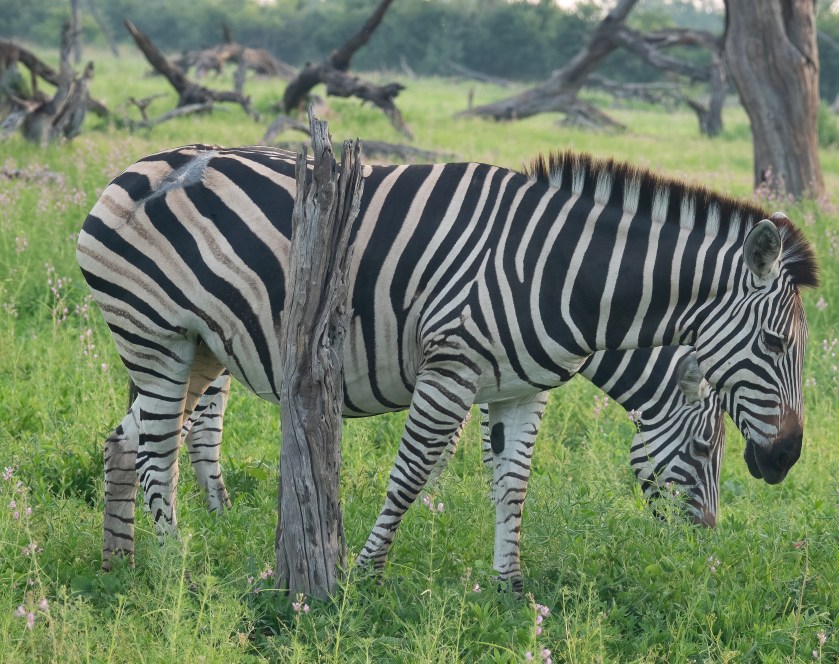
The zebras in this part of Africa are Burchell’s (or Plains) Zebra. Their stripes are separated by ghostly brown shadow stripes, and each animal is slightly different. Look for example at the center of their noses, just below the eyes.

Or the necks of the front two below:

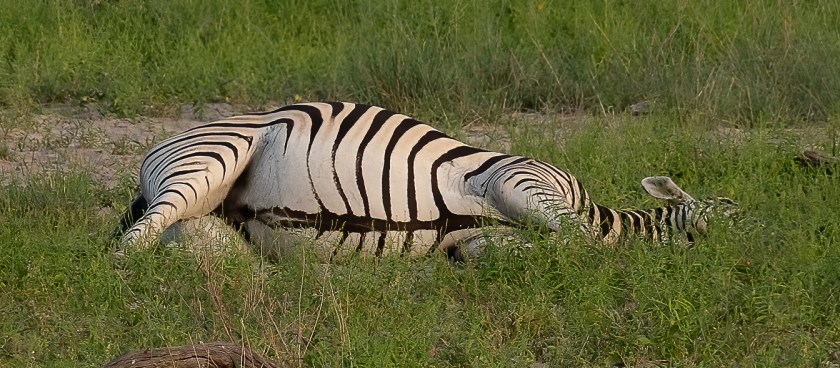
The stripes form a corset all the way under their bellies to the middle, as displayed by this snoozing animal:

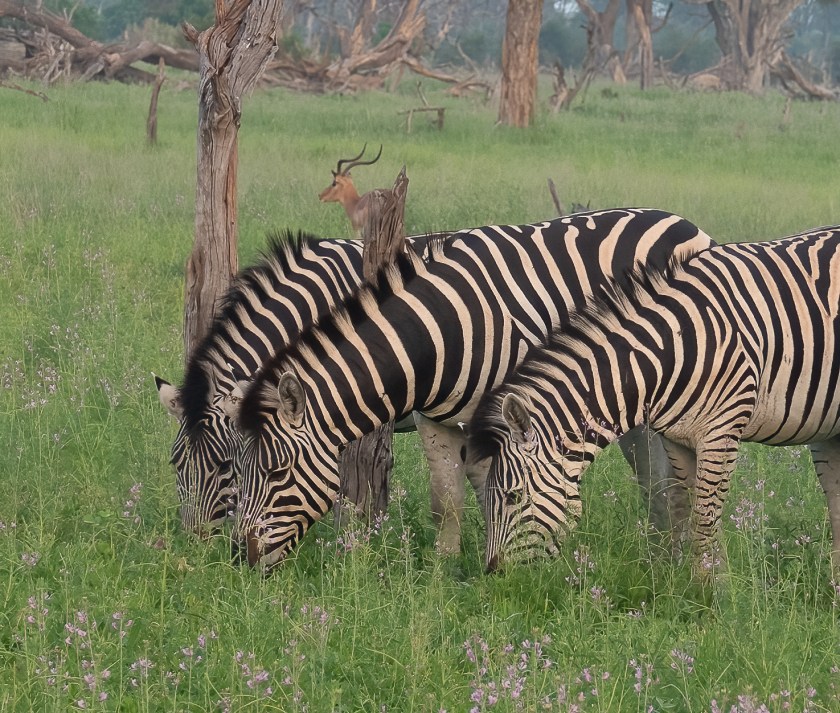
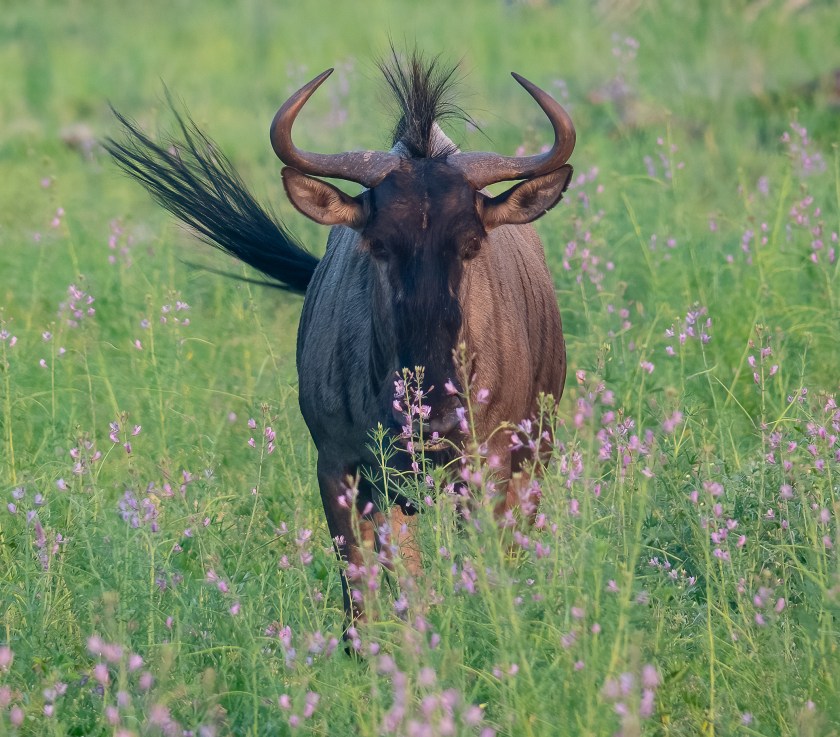
These were in a mixed group with wildebeest (and impala):

The wildebeest, potentially intimidating, do not seem to bother the zebras:

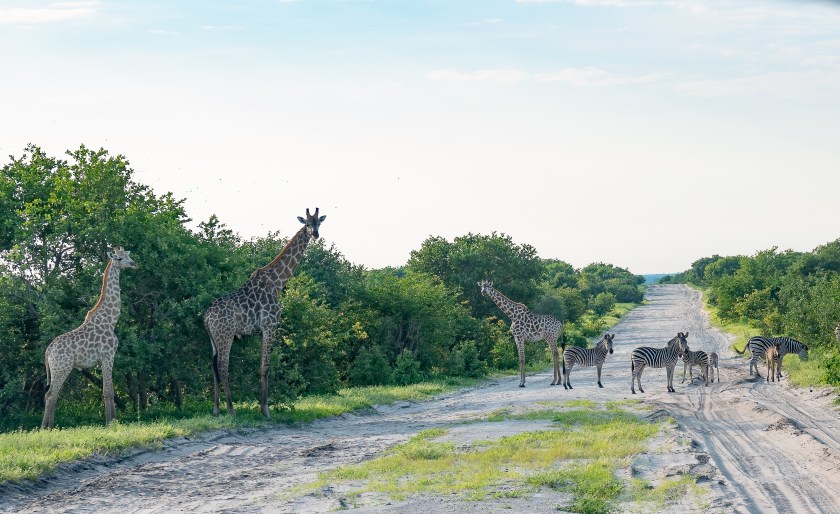
On another occasion they were mingled with giraffe:

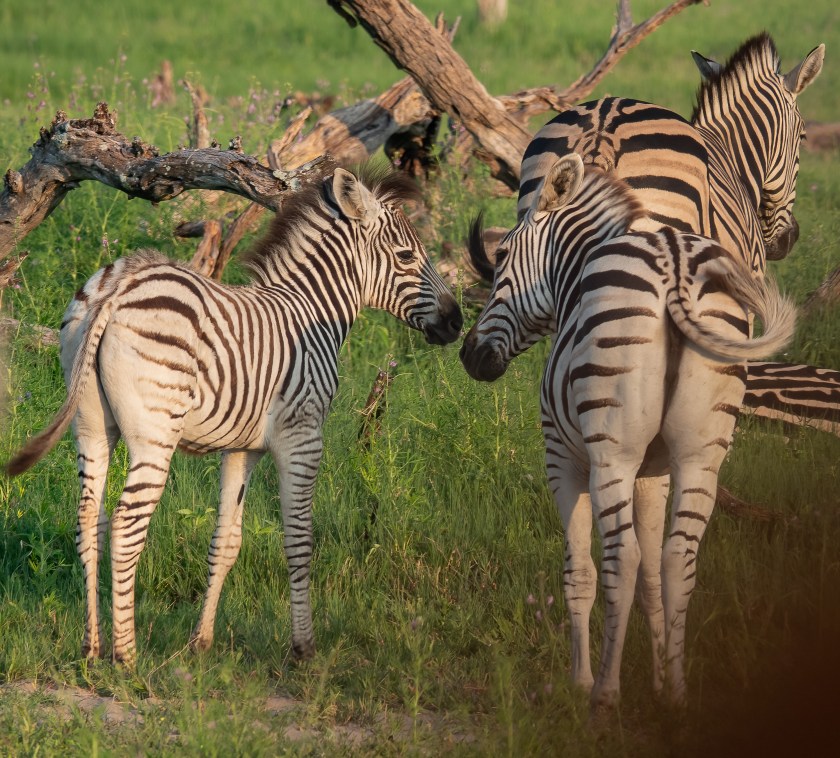
The mothers and babies are a delight.

Most of the babies were quite big in February, but still very affectionate:

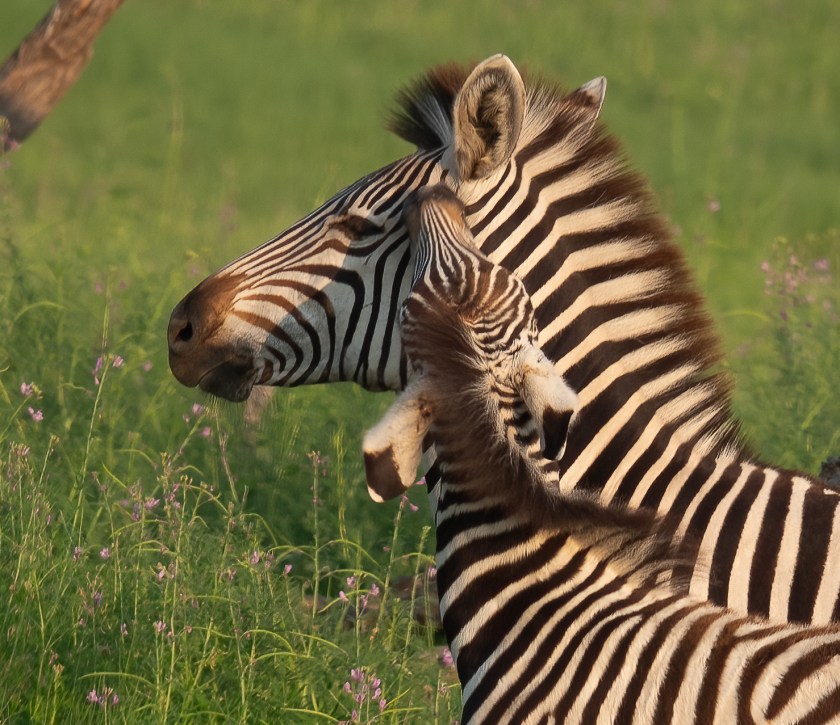
They are somewhat independent now:

but their coat is still fluffy:

Zebra often host oxpeckers, which remove parasites. This one has three:

And some show wounds from encounters with lions. Look at the rump of the one below:

The dark circle on the inside of its foreleg is a callous, often called a Chestnut. It may be the vestige of a gland like those that antelope have, but it seems to have no such function in the zebra. Domestic horses have these too, on all four legs.

The life of a little loon

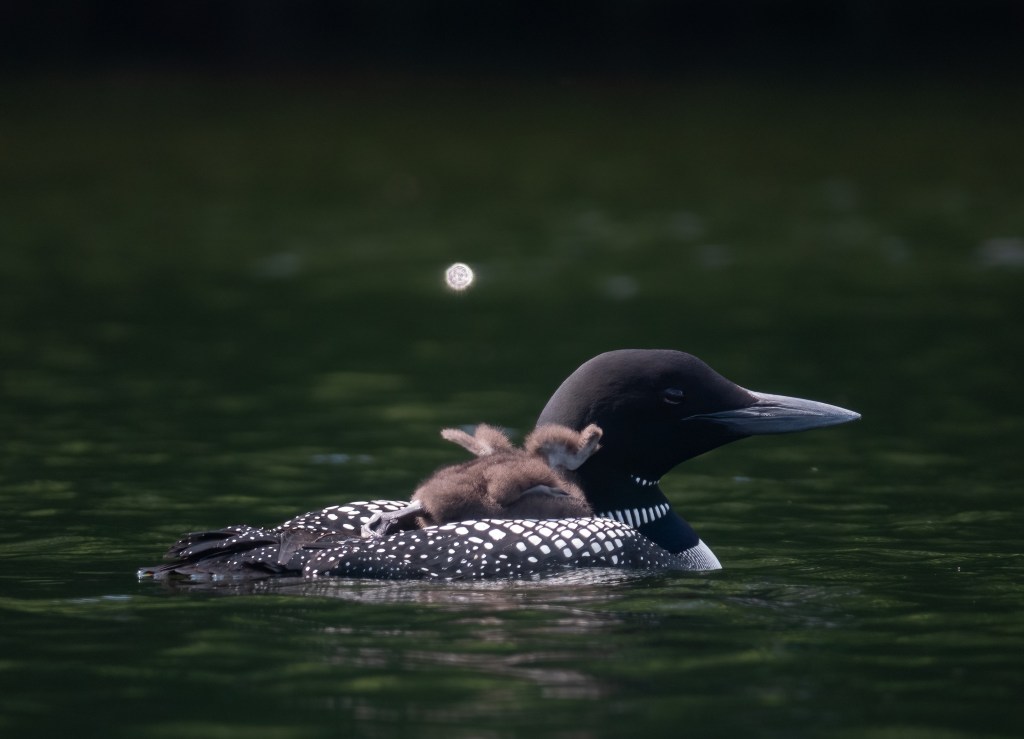
The pair of loons on a pond near me (not my beaver pond) had two chicks about 10 days ago. One did not last long, taken by an eagle or a snapping turtle no doubt. But I photographed this one from about 8 days old.

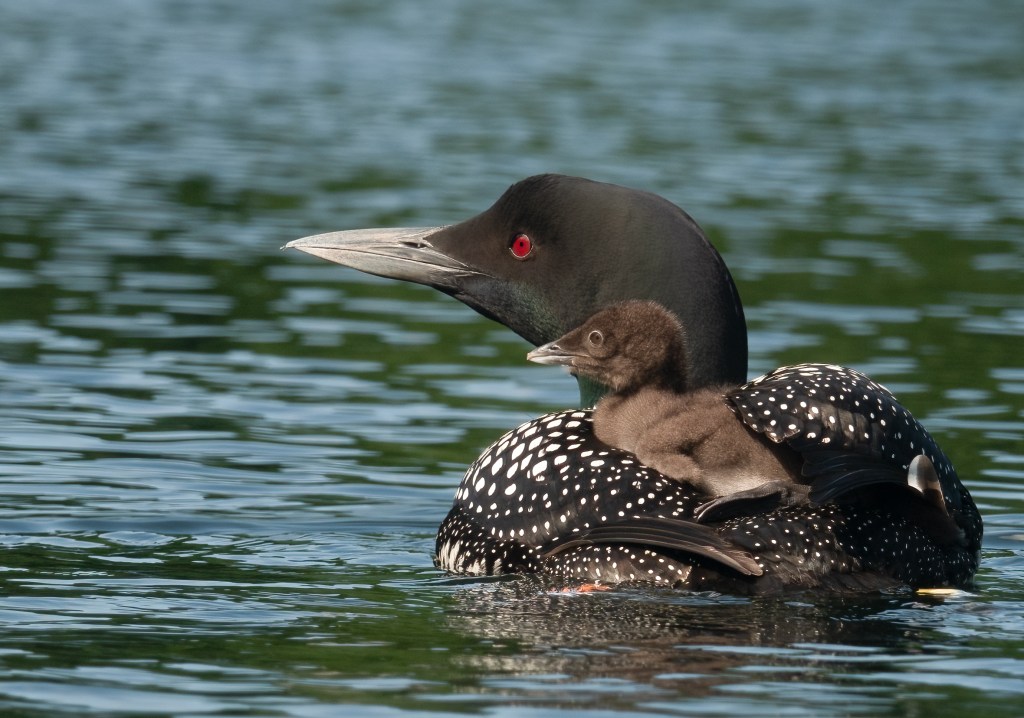
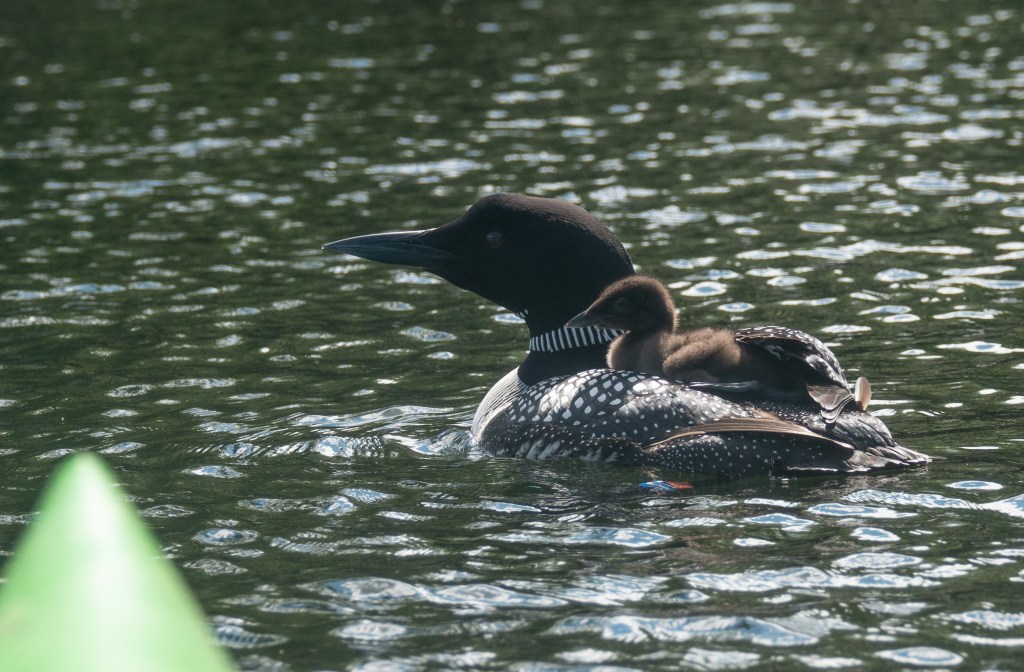
At 10 days old, it still rides on its mother’s back when it feels like it.

It nestles in between her wings, so it can’t fall out sideways, and she sometimes places a foot behind it, so it can’t slide off her back if she accelerates.

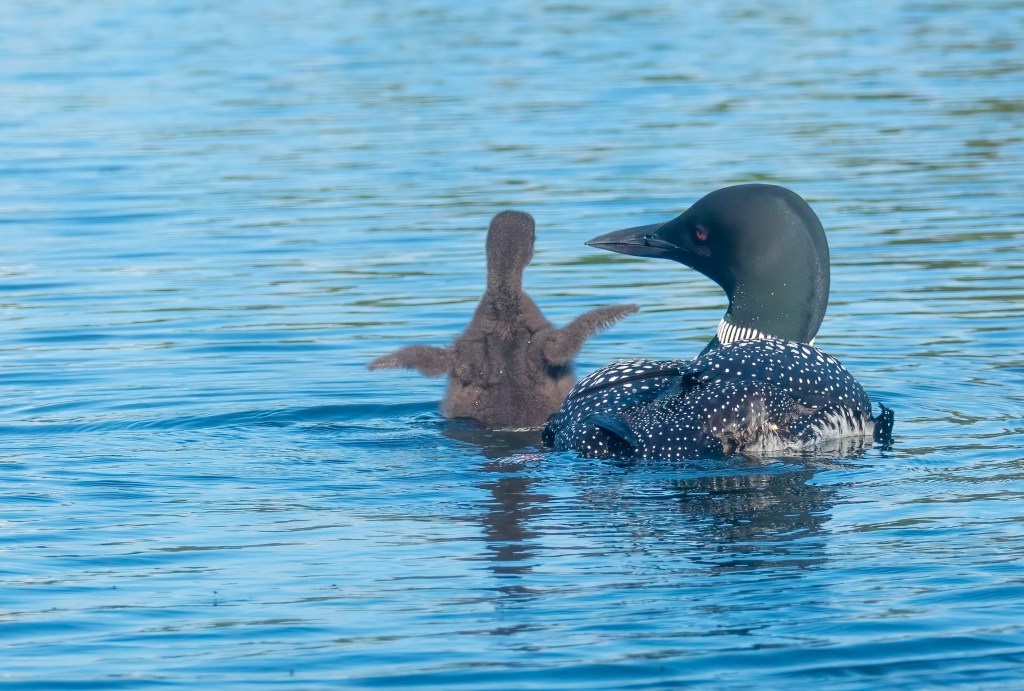
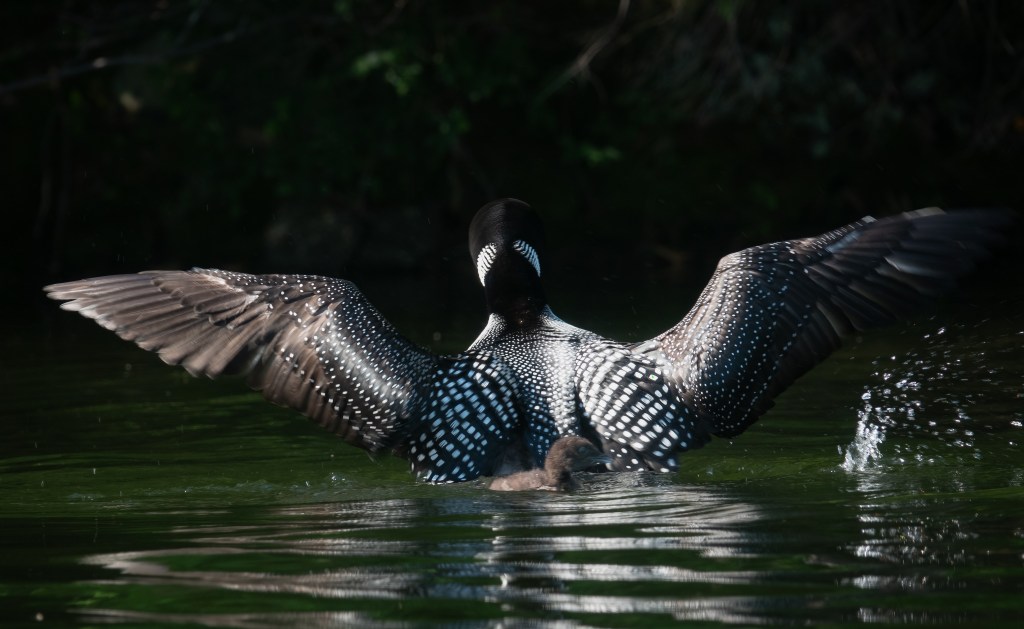
But like any youngster, it gets adventurous. The dismount.

From around three days old, it dives for short periods, and exercises its tiny wings:

Sometimes it tucks its head in and sleeps beside the mother, bobbing happily up and down alongside. She makes sure it doesn’t drift away by gently using her foot as a corral:

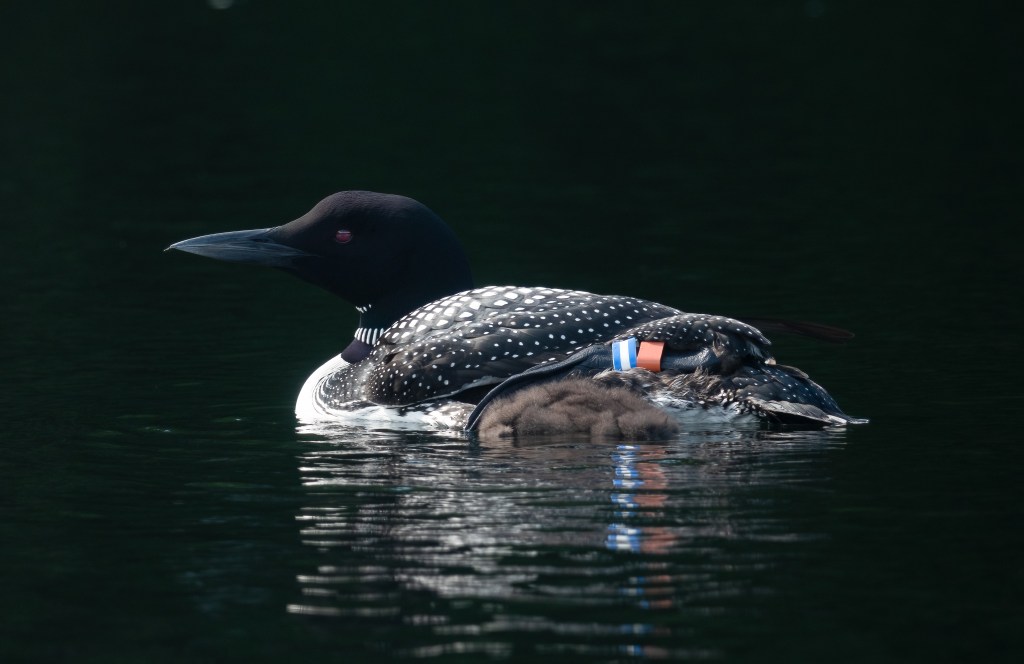
Like many loons around here, she is banded, and has bred on this pond before. Experience shows.

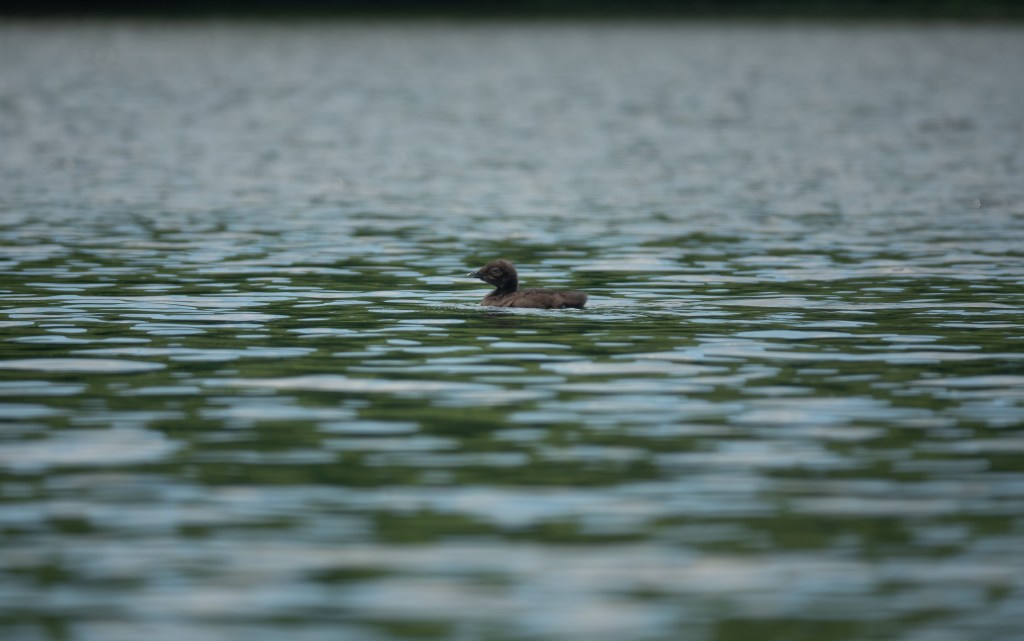
The chick gets hungry, so the parents go fishing, leaving the chick alone and vulnerable

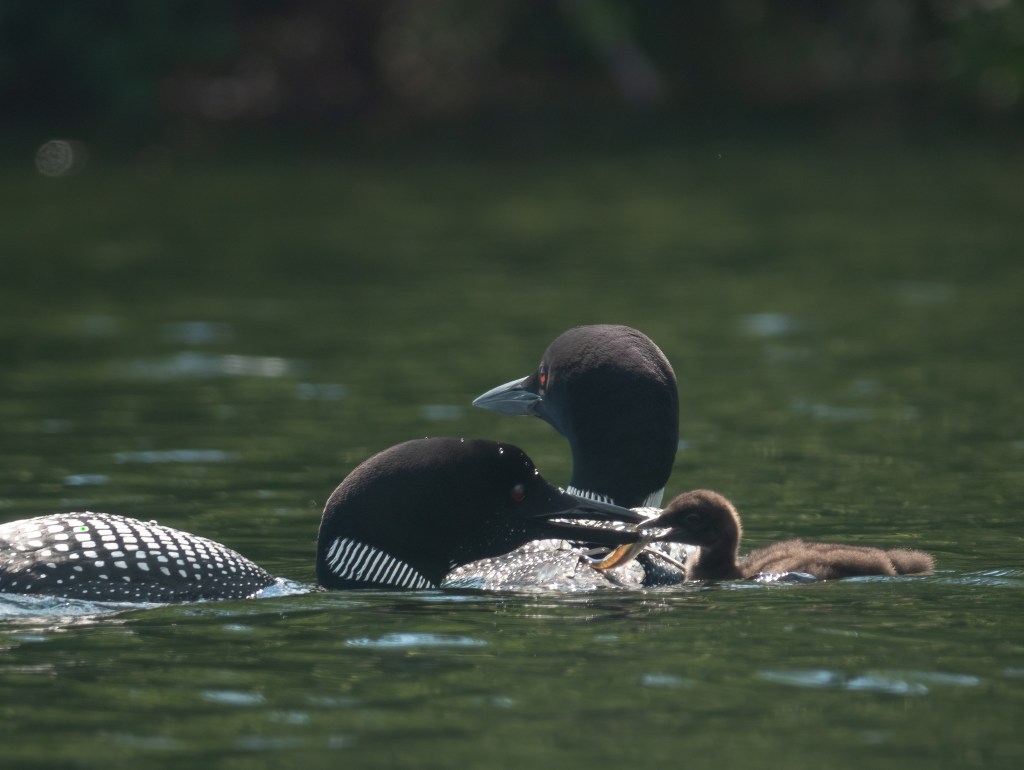
but they return with supplies:

It will have to eat a lot if it is to grow up to be as big as its parents:

PS: I am sometimes asked how I get these shots. I kayak out, and sit some distance off, maybe 30 feet away, if possible in a direction where the light is right. I stop paddling, and just watch quietly, taking the odd shot. They are very relaxed, and sometimes swim straight at me and cross just in front of my bow:

If I ever get the impression they are changing their behavior because of me, I back right off. I also never kayak straight towards them, and try not to look them in the eye. These shots came from four sessions, each of an hour or so.

Creatures of the night

The Cape Hare was fairly easy to see at night in the Makgadikgadi, because out on the open dried-up pan they froze in the headlights:

They have enormous eyes, being mainly nocturnal:

and of course big ears:

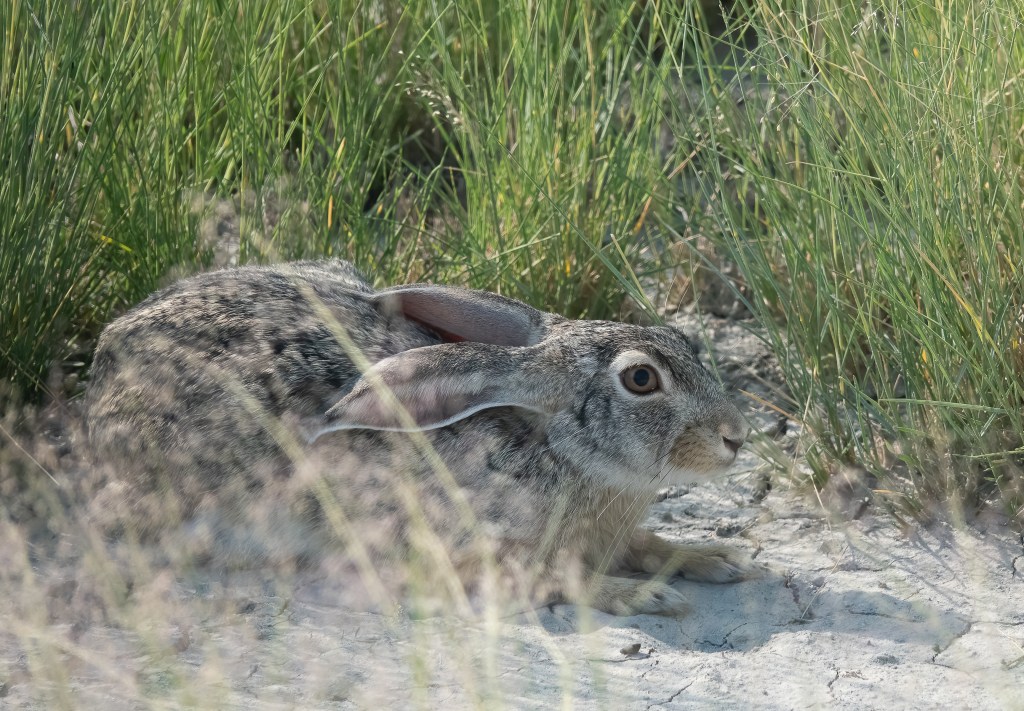
In the daytime, they are very well camouflaged:

But their response to danger is still to hunker down and stay very still, so it is possible to get a good look:

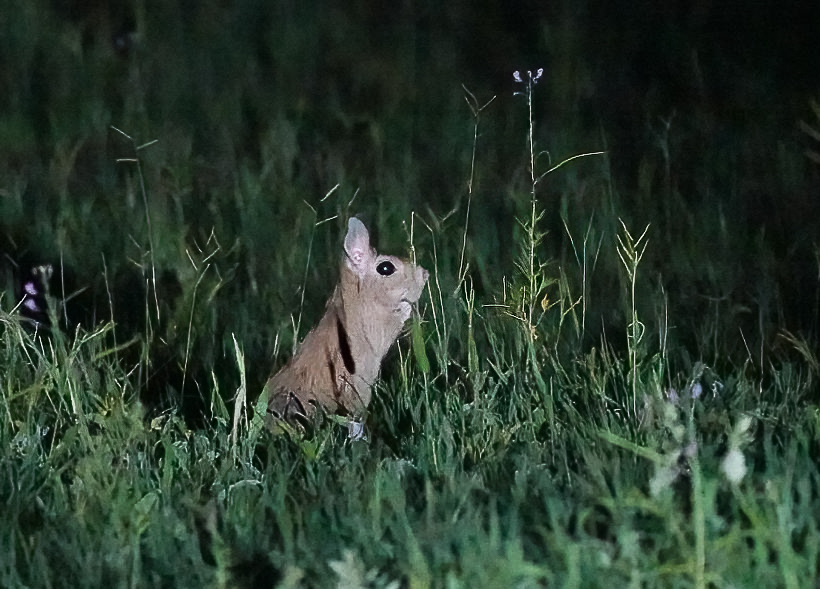
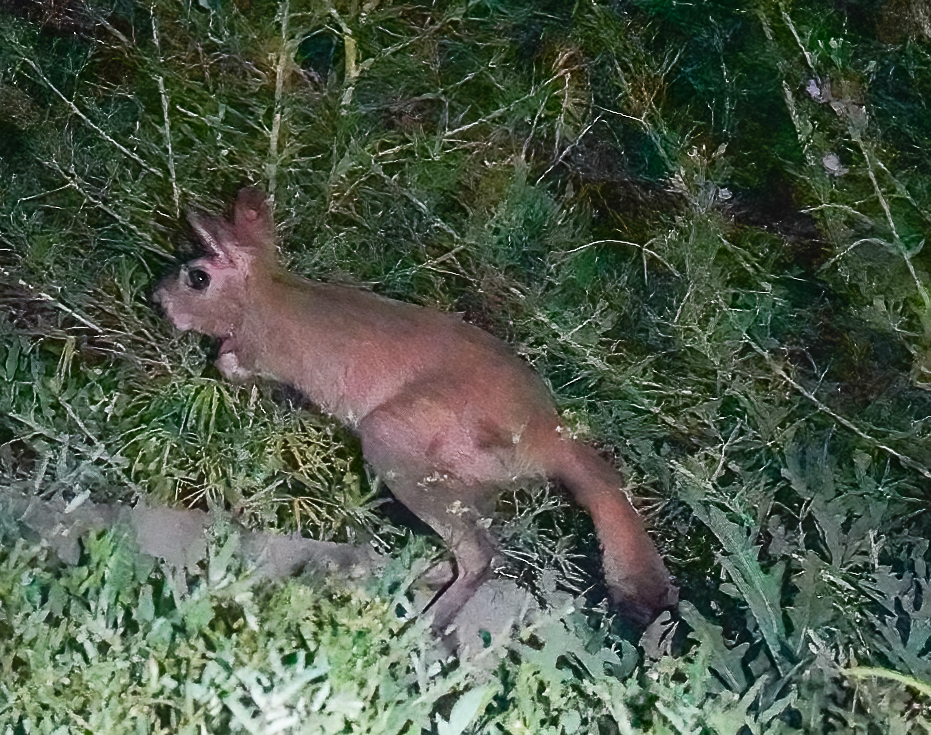
On the night drives in the Makgadikgadi we regularly glimpsed yet another animal I had never heard of, called a Springhare, Pedetes capensis.

It is not in fact a hare at all:

and it bounds through the long grass like a tiny kangaroo with a long tail that it uses for balance.

It is nocturnal, and impossible to photograph. (All these photos were taken by my brilliant friend Annie).

Here is a video (not ours!), showing its long tail and how it hops around: https://www.youtube.com/watch?v=67Kt3R3C7Ec

They’re saltatorial rodents, able to leap up to two meters, and they are herbivorous and live in burrows. The genus used to have only one species, which the taxonomists have now divided into two. Both live in dry parts of Africa.

Last, but most beautiful, was a serval, cleverly spotted by Laura:

The most elegant little cats, about which I have written before. It lingered, so we got a clear view:

before it nonchalantly wandered off into the darkness: