[I seem to be alternating continents, but I still have lots of Gambian birds to show you!]
Wattles are brightly colored fleshy outcroppings, usually on the head of a bird. Some are around the eye, some near the bill or under the chin. They are thought to attract the opposite sex, and indeed in some species they only appear in breeding season, or get larger, or are limited to the males. This trio have wattles in both sexes, all year-round.
The White-crowned Helmetshrike, Prionops plumatus, has a splendid feathered crest, and fleshy yellow eye-wattles that look like an artificial plastic sunflower:

These are social birds, and very versatile.

They forage as a group, eating insects (on the leaves or ground, and occasionally in flight), but also lizards, and fruit.
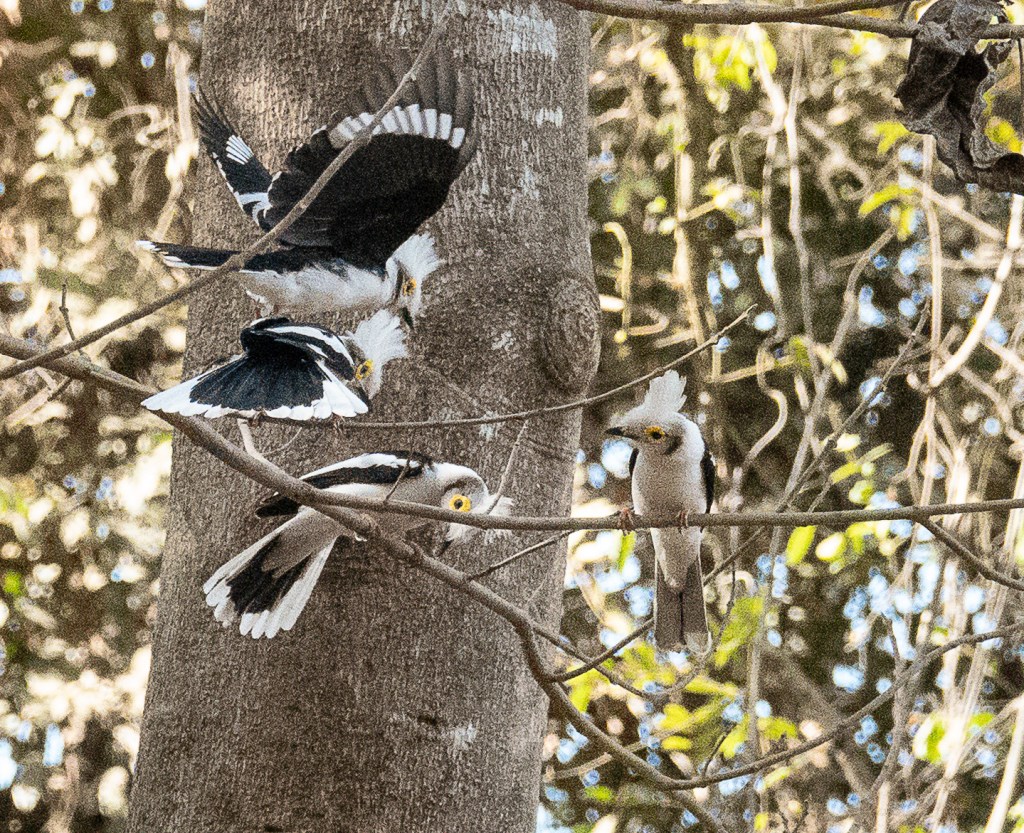
Somehow they seem rather parrot-like to me.

Common or Brown-throated Wattle-eye, Platysteira cyanea, (female, below) are usually in pairs, foraging for insects in vegetation and in flight. The red eyebrow wattles are fleshy, not feathery.

My final Gambian wattle-wearer is the Wattled Lapwing, Vanellus senegallus, whose yellow wattles droop down from the corners of its bill:

(The bird lurking in middle in the foreground above is a Spur-winged Lapwing).
Both sexes carry wattles.

PS You might have noticed that all the helmetshrikes are looking downwards. One of our group had brought with him an app with the sounds of Gambian birds, and a tiny loudspeaker. He placed it at the base of the tree near the helmetshrikes, and played helmetshrike calls. They were fascinated by it. This is a very controversial technique, many people worry that it disturbs the birds’ natural social order and that it can interfere with courting and breeding. Our guide did not bring this technology himself, but he allowed it to be be used, and none of the rest of us objected. I did discuss the issue with our guide, and he said that he would never allow it to be used in breeding season. We did indeed get a much closer look at some birds than we would otherwise have done, but I feel somewhat guilty that I didn’t protest. Or I may be over-reacting. Let me know what you think in the Comments.
I have also just discovered that the Audubon Society has taken a strong stand against the use of playback, and that none of the photos we (ie me) took using this technique could be entered in their contests:
https://www.audubon.org/news/why-photographers-should-reconsider-using-playback-field
Luckily I never planned to do that anyway.
 Eyes on the Wild
I love the plastic sunflower eyes! They really do appear to be soft toys placed in position. I don’t feel qualified to judge on the use of sound recordings, but thanks for your great photos.
LikeLike
What interesting wattles on all those three kinds of birds. If there are known possible issues with birds, then speakers with recordings shouldn’t be used. It seems that it’s more for human ‘amusement’ and offers no benefits for the birds. I think a speaker is messing with the birds’ brains.
LikeLike