One Ibis, three Ibides?

Birds of the wetlands, with long curved bills, I have a fondness for ibis, even though I can’t work out which plural is preferable: ibises, Latin ibes, Greek ibides or just plain collective ibis.

We saw three new species (to me) in the Pantanal. The most handsome was clearly the Buff-necked Ibis, Theristicus caudatus:
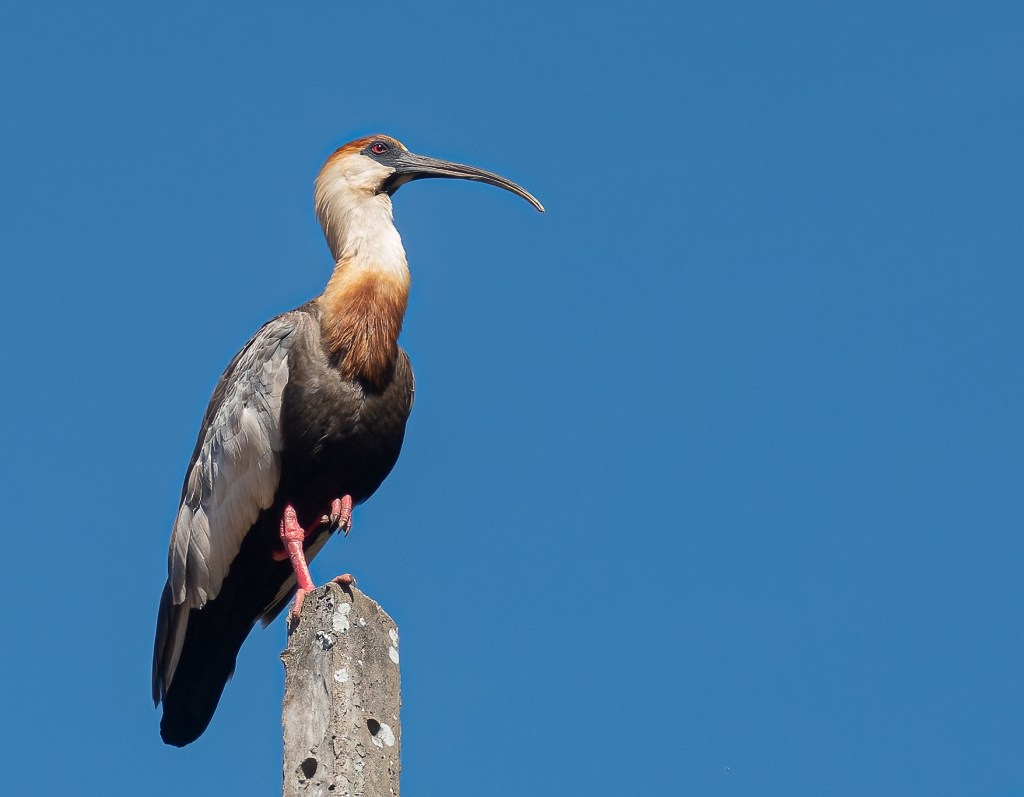
They are comfortable with humans, and this one was hanging around in the garden of Baia das Pedras. At dawn, they perched on the palms:
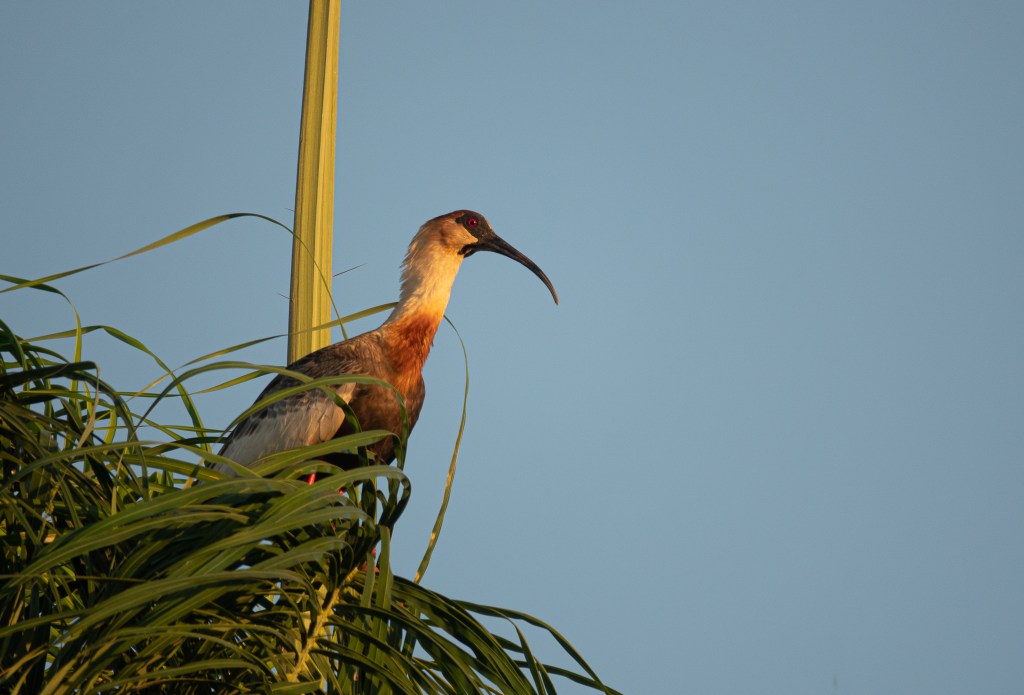
They forage for insects and small vertebrates, often far from water.

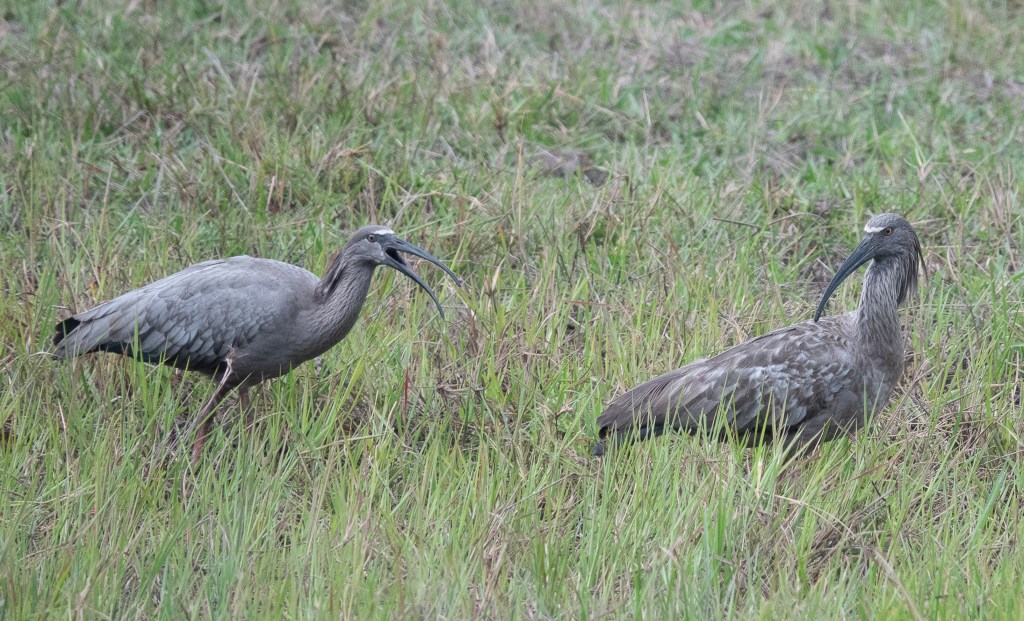
The easiest to miss are the Plumbeous Ibis, Theristicus caerulescens, in their subtle blue-grey plumage. They are typically wetland birds, like most ibis, and feed on mollusks and insects. The youngster below still clearly expects handouts, but the mother is having none of it.
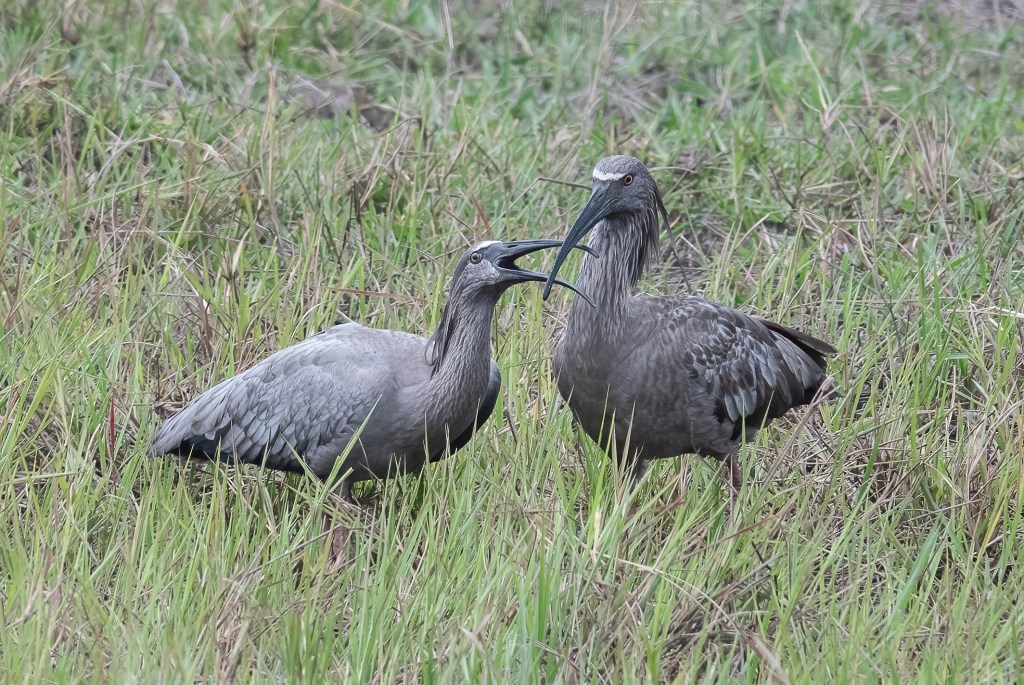
and walks off:
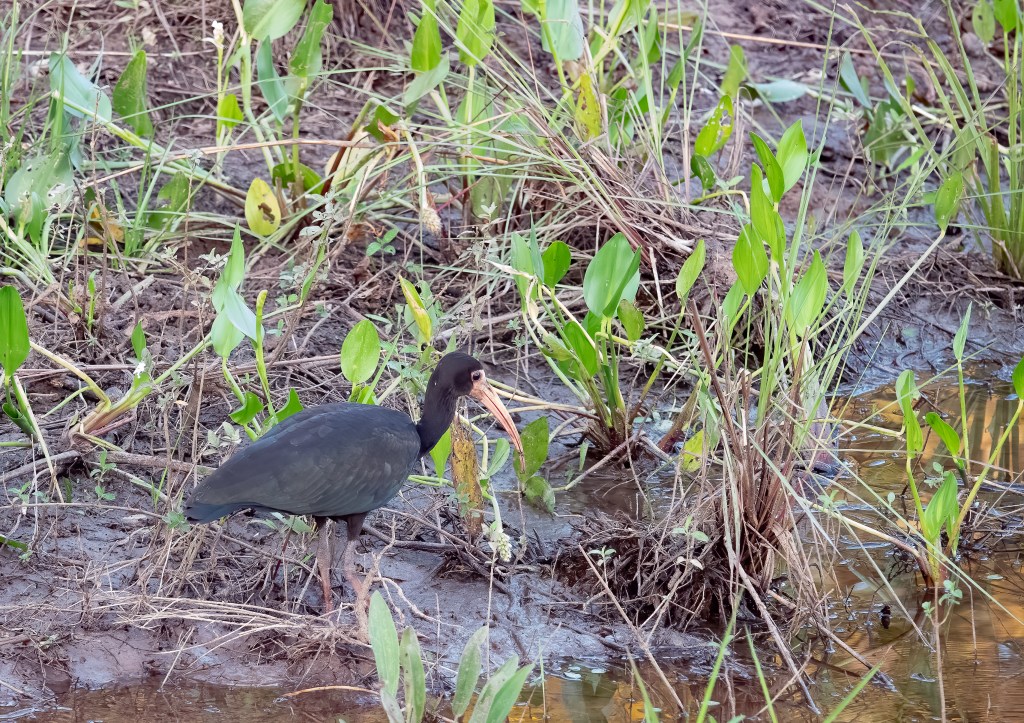
The Bare-faced Ibis, Phimosus infuscatus, do not make a big first impression,
until they gather in large flocks:
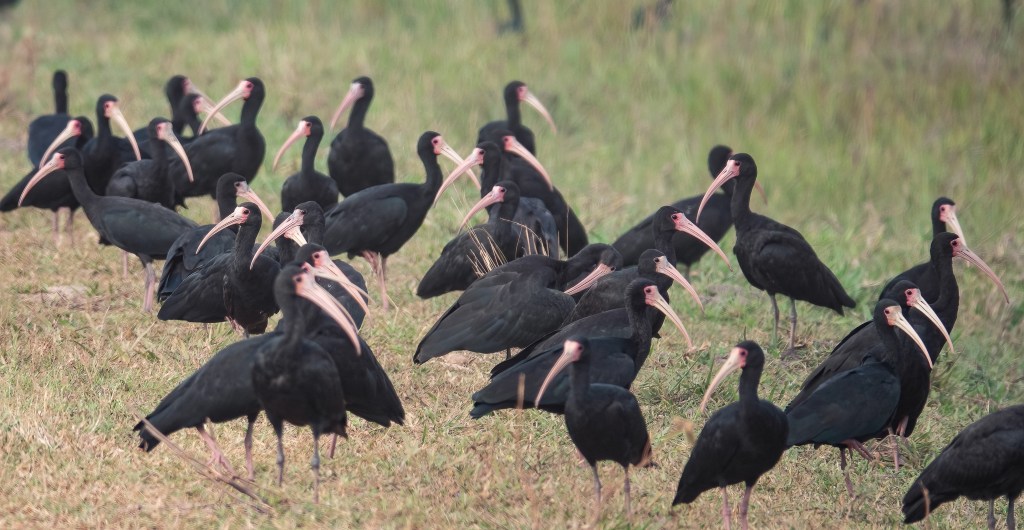
En masse, they remind me irresistibly of a convocation of 17th century plague doctors. A perfect match down to the black eyes with reddish rings around them.
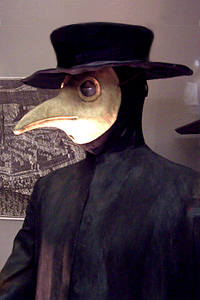
If it weren’t for the fact that this species of ibis is not found in the Old World, you would think they had deliberately copied its costume (Actually, the mask’s long “beak” was filled with herbs in the vain hope of combating infection.) I suspect the mask might have instead been inspired by the distantly related but similar looking Northern Bald Ibis, Geronticus eremita, which went extinct in Europe in the mid 17th century. The plague mask is thought to have been invented by Charles de Lorme in Paris around 1619.

PS Ibises are tactile foragers, sensing their food with bony bill-tip organs called Herbst corpuscles, whose origins go back to the Cretaceous. Du Toit, Chinsamy, and Cunningham (2020) say this:

“The remote-touch bony bill-tip organ, used for remote tactile probe foraging; comprising groups of mechanoreceptors, known as Herbst corpuscles, embedded within densely clustered pits in the bone at the tip of the beak …..”

Memorize this, and all you need to impress is for someone to ask you the question to which this is the correct answer.
The Giant that Eats Ants II

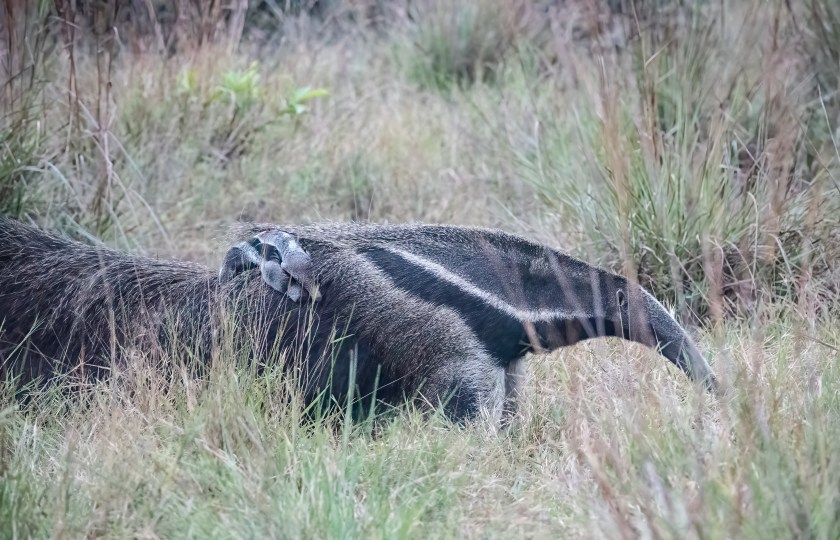
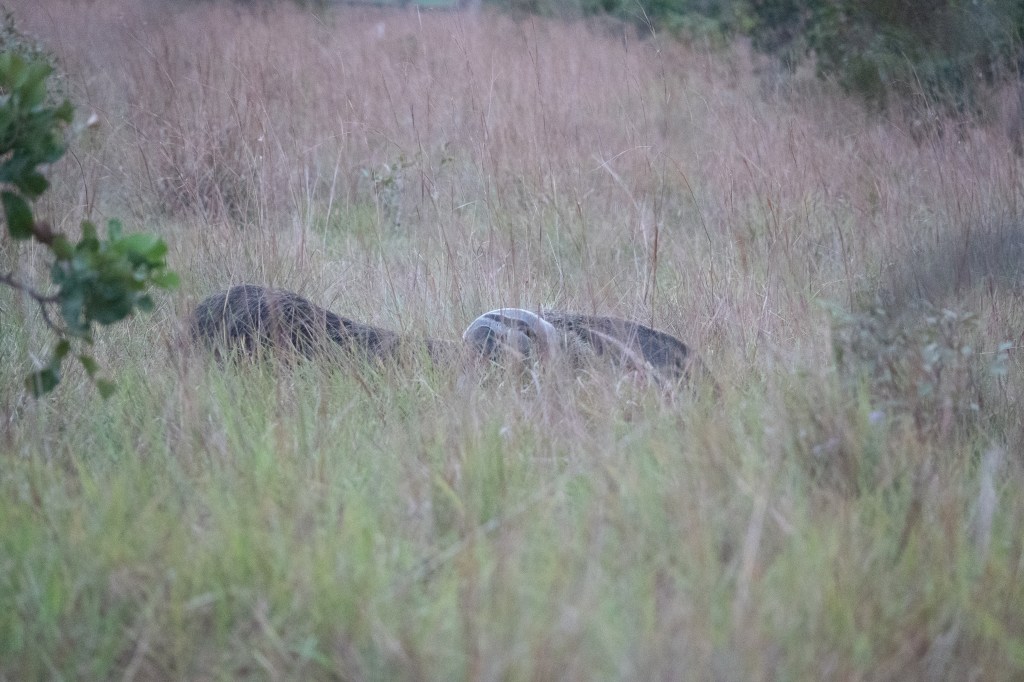
We had begun learning to identify the large dark low shapes of distant Giant Anteaters. This time in the long grass we saw two shorter shapes, following each other closely.

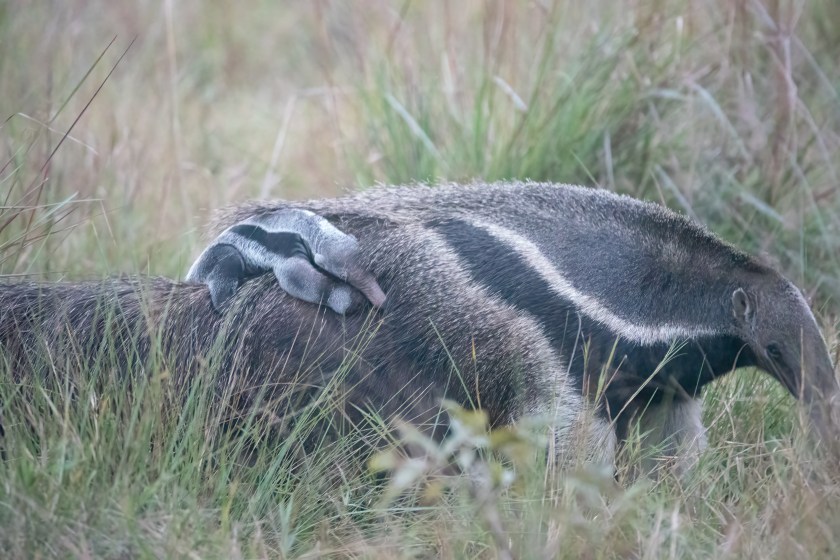
The guides, of course, knew exactly what it was: a single anteater, with a baby riding sidesaddle on its back, bisecting the usual single dark silhouette into two shorter ones.

It was so young that it had that floppy look of newborns, and we showed the photo to Danilo Kluyber, the wildlife vet for the Giant Armadillo and Giant Anteater Project (more about them in a later post.). He estimated it at no more than two weeks old. At birth, it will have weighed about 1.2Kg.

It was holding on tightly with tiny tiny hands, at the end of the back and the base of the tail. Look closely in the center of this photo to see its hand:

We walked very slowly and very quietly, stopping if she showed any signs of alarm, and we got a really magnificent look:

And in close-up you can see that this irresistibly cute small animal is a perfect replica of its mother.

It will ride around with her for a full year. When it needs to nurse, she lies down and the baby just crawls around to feed, without having to get off. She will stay with her mother for up to two years., and she may live till the age of 14 years in the wild, perhaps 26 in captivity.

So there you have it, one of the great moments of my life.

PS: Wikipedia says this about the Giant Anteater’s conservation status, as assessed by IUCN in 2013: “The species is listed as vulnerable by the International Union for Conservation of Nature, due to the number of regional extirpations, and under Appendix II by CITES, tightly restricting international trade in specimens of the animal and its parts and derivatives. Between 2000 and 2010, the total population declined by 30%. In 1994, some 340 giant anteaters died due to wildfires at Emas National Park in Brazil.The animal is particularly vulnerable to fires due to its slow movement and flammable coat.”

Wildfires are part of the normal cycle in the Pantanal, but since this 2013 assessment there have been fiercer and more extensive fires than usual, which cannot have helped. This story makes the scale of the problem clear.

https://www.reuters.com/business/cop/planet-heats-brazils-anteaters-face-rising-extinction-risk-2022-11-07/

The Giant that Eats Ants: I

I’ve just returned from the South Pantanal in Brazil, my second visit. My first visit was ten years ago, to the North Pantanal, long before I had a blog. Both trips were quite magical, and I’ll show you some of what I saw.

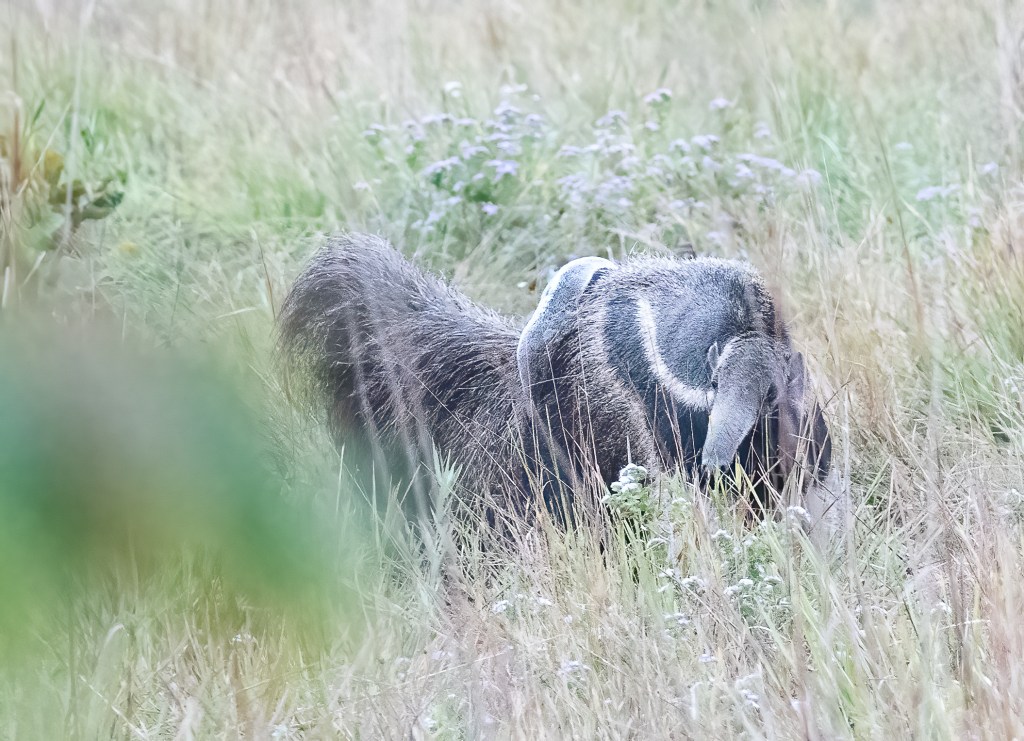
I’m starting with the animal I most wanted to see on this trip, because it is the one I didn’t see last time.. the Giant Anteater, Myrmecophaga tridactyla. For me it has almost mythical status. As a child, I read and re-read Gerald Durrell’s 1954 book Three Singles to Adventure, in which he chases a giant anteater across the pampas, trying to lasso it. So now I am happy.

These animals are huge, up to 8 feet long and 100lbs. They are 1/3 head, 1/3 body, and 1/3 tail.

As you can see, this is not exactly wilderness. The Pantanal has for 200 years had vast cattle ranches, but some, including Baia das Pedras, are now devoting much of their effort to conservation. The idea is to make a mixed model viable, cows and wildlife too. And since cows and deer don’t eat ants (or anteaters) , and anteaters don’t eat cows and can usually find their way through the local fences, it works. (Jaguars are more complicated, for another day.) We saw this one from very far off, and to reach it we walked through still-flooded fields in knee deep water in our hiking boots. It was worth every squelching step.

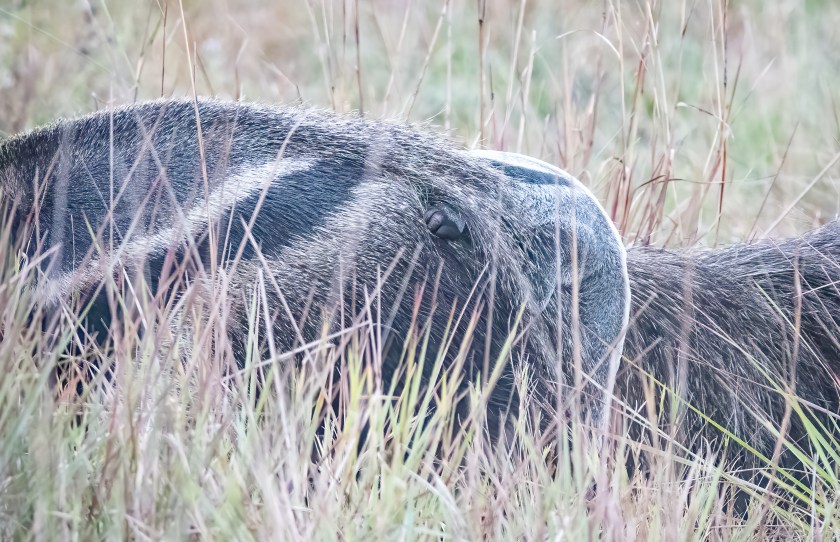
Here is a close up of the remarkable head, which houses a 2-foot long tongue, but no teeth.

They have three huge claws on the front foot, for ripping apart termite mounds. They are very hard to see in the long grass, but you can glimpse them here if you look carefully, at bottom right. .

You have probably also noticed that when you look at one of these creatures it is remarkably hard to tell what you are looking AT. Their odd shape, coupled with the stripes, creates a very confusing image. They emerge into the grasslands from concealment in small above-water hummocks of trees and bromeliads :

and forage for ants.

They conduct commando raids: fast in, and fast out, before the soldier ants counter-attack. If they do, they use their front feet to swipe them off:

The best is yet to come, but with great restraint I will wait for my next blog, and so must you.

PS They are related to the Three-toed Sloth, something else I have never seen..

All puffed up

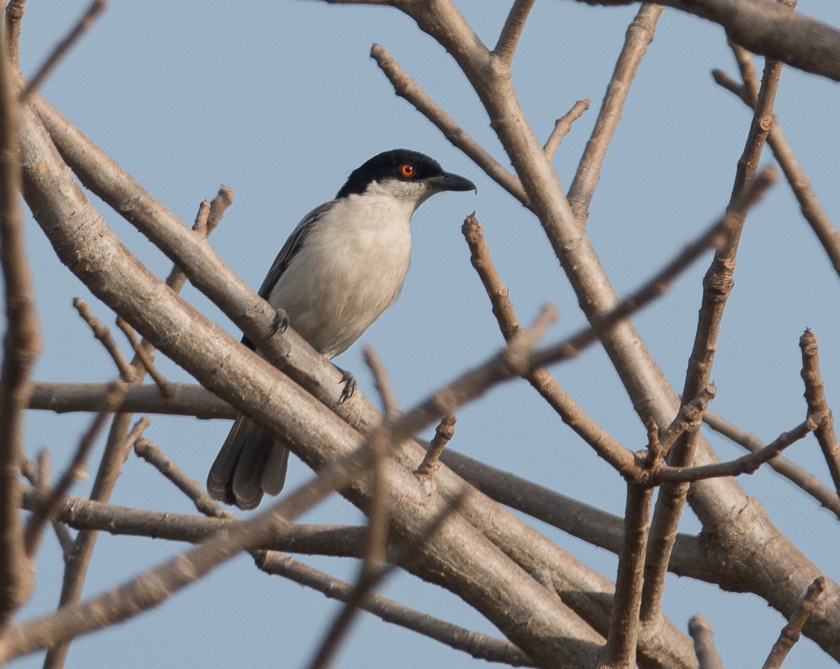
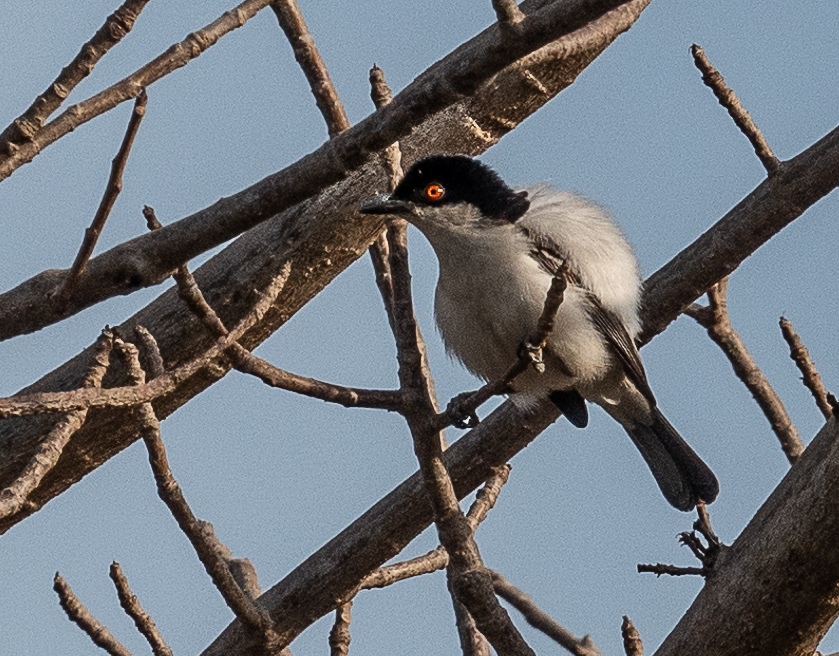
A smart but fairly ordinary bush shrike, the Northern Puffback’s name gives away its claim to fame. Its scientific name is Dryoscopus gambensis, meaning ‘tree-watcher’, and this one lives up to its name:

It forages stealthily for insects, mostly in the canopy, but sometimes coming down to the top of tall bushes. Birds of the World describes it as “retiring, secretive and easily overlooked”.

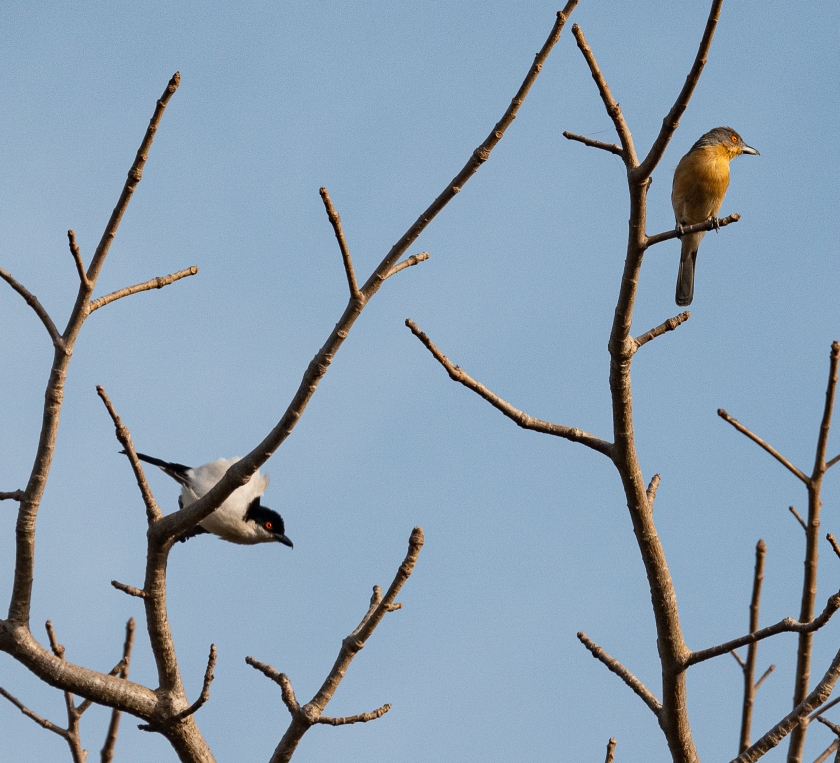
But when it is courting, watch how the male transforms himself:

He does this by puffing out his white back and rump feathers to cover the darker back and base of his wings, till he looks like a fluffy pompom. In the next photo the bird at top right is the female. She looks entirely different, but she too has a bright orangey-red eye:

.

Northern Puffbacks range across the tropical woodlands of central Africa north of the equator, and are not currently threatened, but habitat loss is a worry, and in some countries they are apparently killed for traditional medicine.

The Beautiful Sunbird

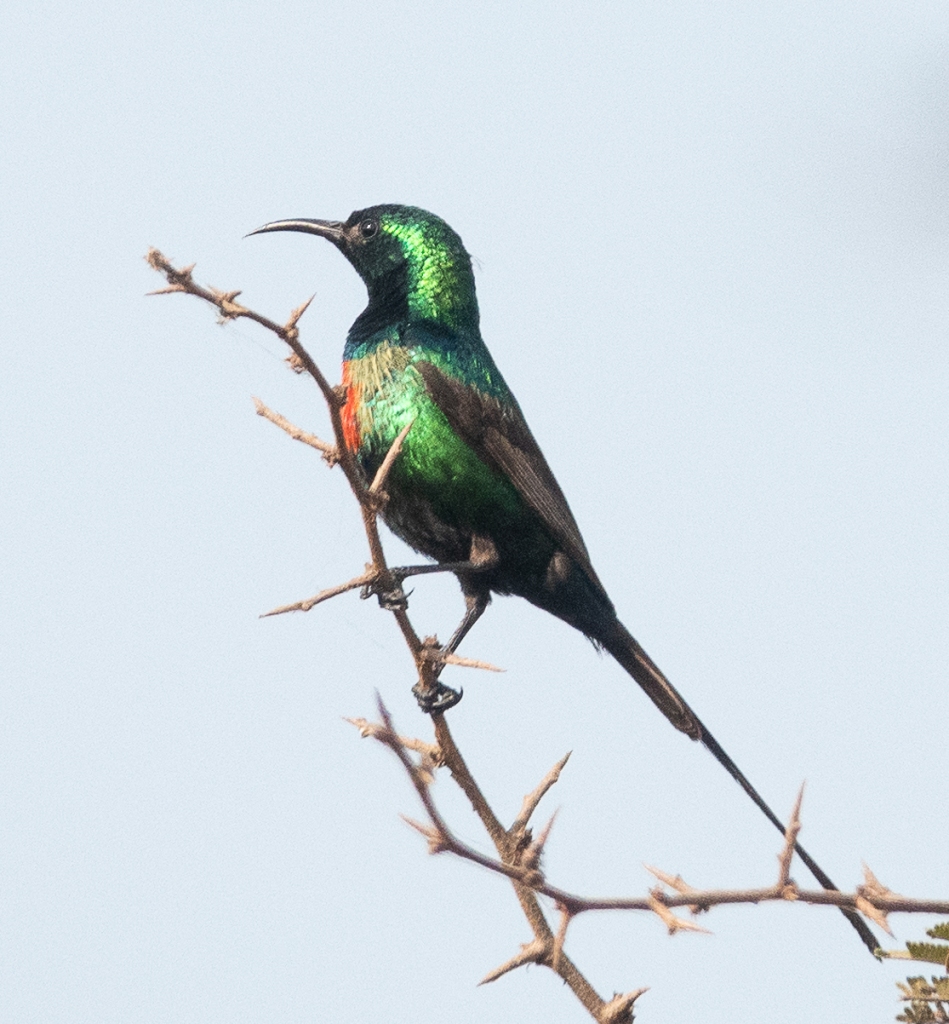
Sunbirds are small birds with long curved bills that feed on nectar and flowers. The male Beautiful Sunbird, Cinnyris pulchellus, is about 10cm (4in) long with another 5cm (2in) of tail and weighs up to 10g; here he is in his iridescent breeding plumage:

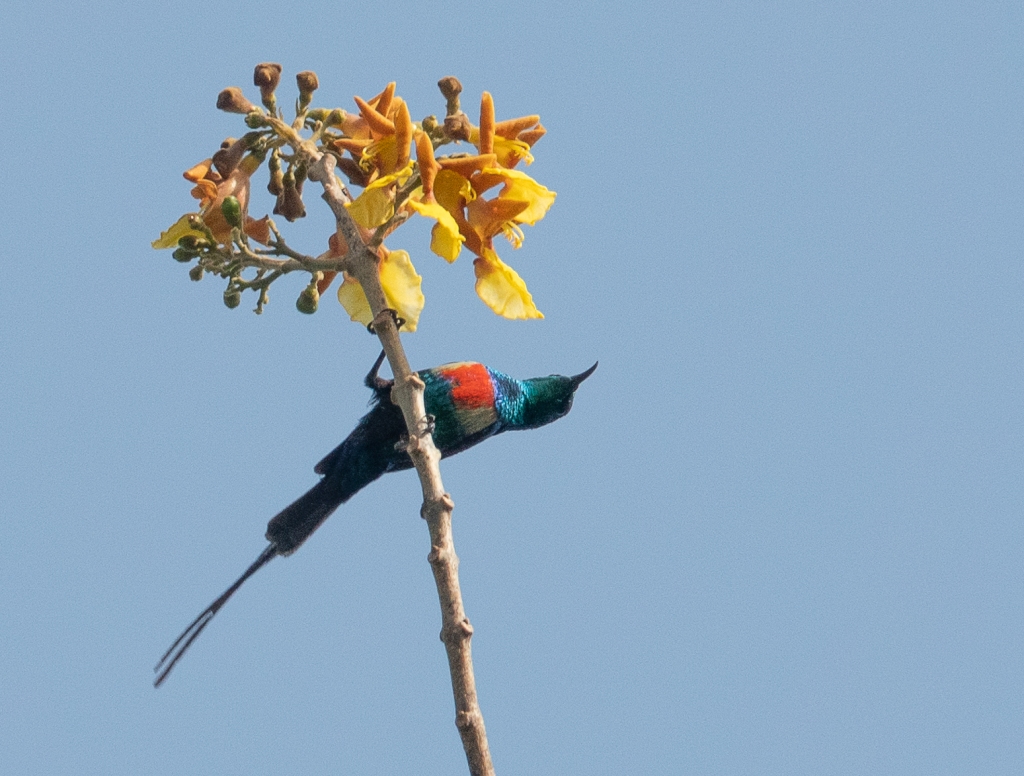
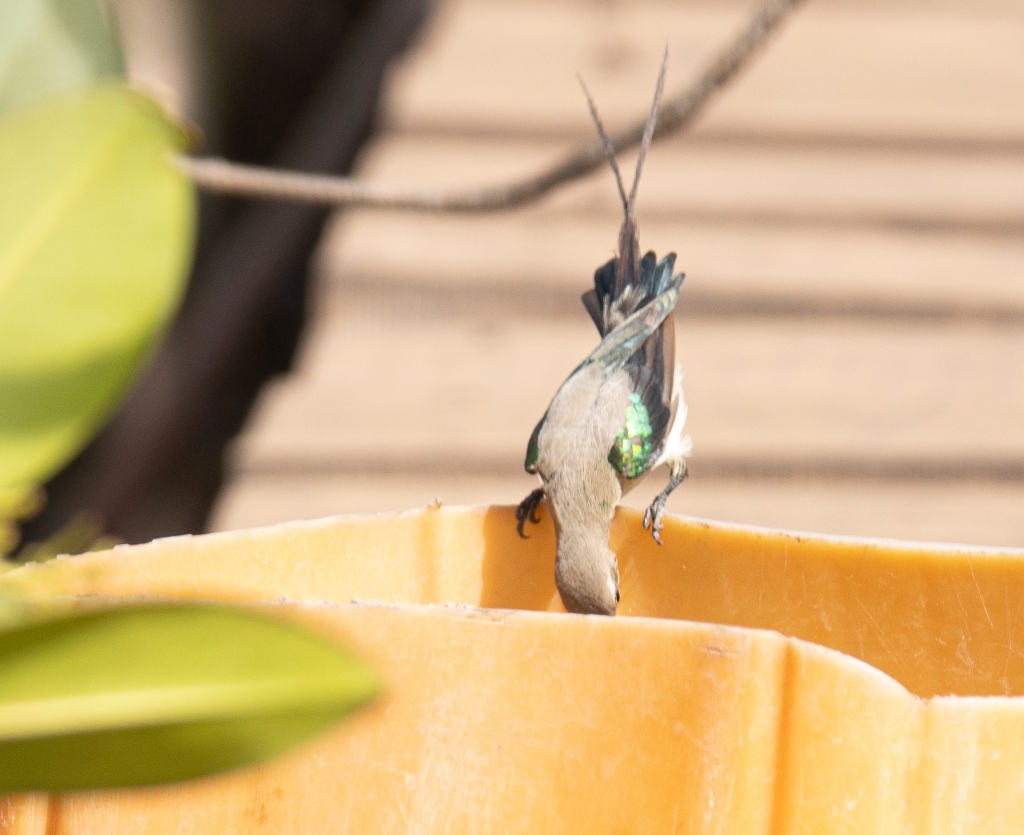
When he turns, you can see his chest colors (sorry about the blurry photo):

His non-breeding (eclipse) plumage is much more subdued; this one is drinking from a container in the grounds of our lodge.

In The Gambia March is the end of the breeding season, so the one above has shed his glad rags.

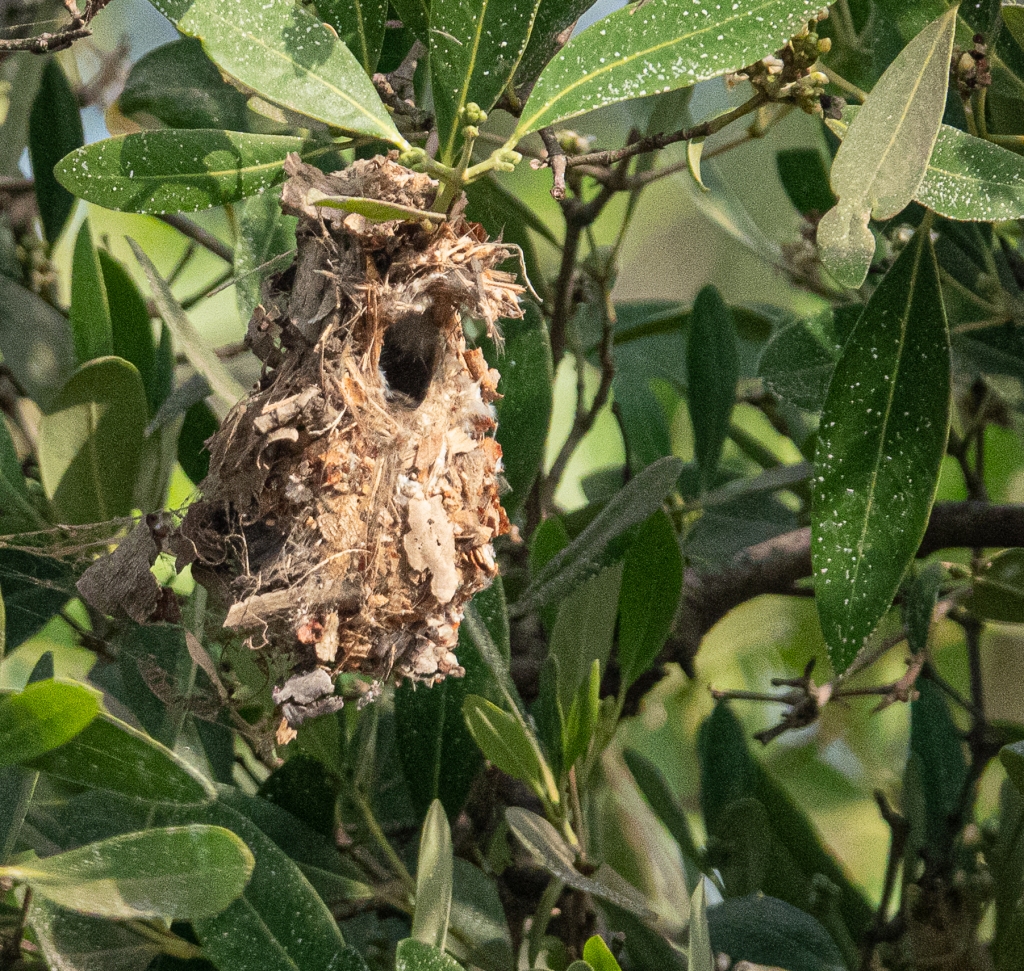
They build a nest out of almost any available vegetation or soft substance, including snakeskins, cobwebs, and lichens. Some nests, including this one, have a charming roofed porch over the entrance:

This nest seems to be made mostly of grass and bark, with downy feathers escaping from the entrance. They lay only 1-2 eggs. It was suspended from a tree about 3m above the ground.

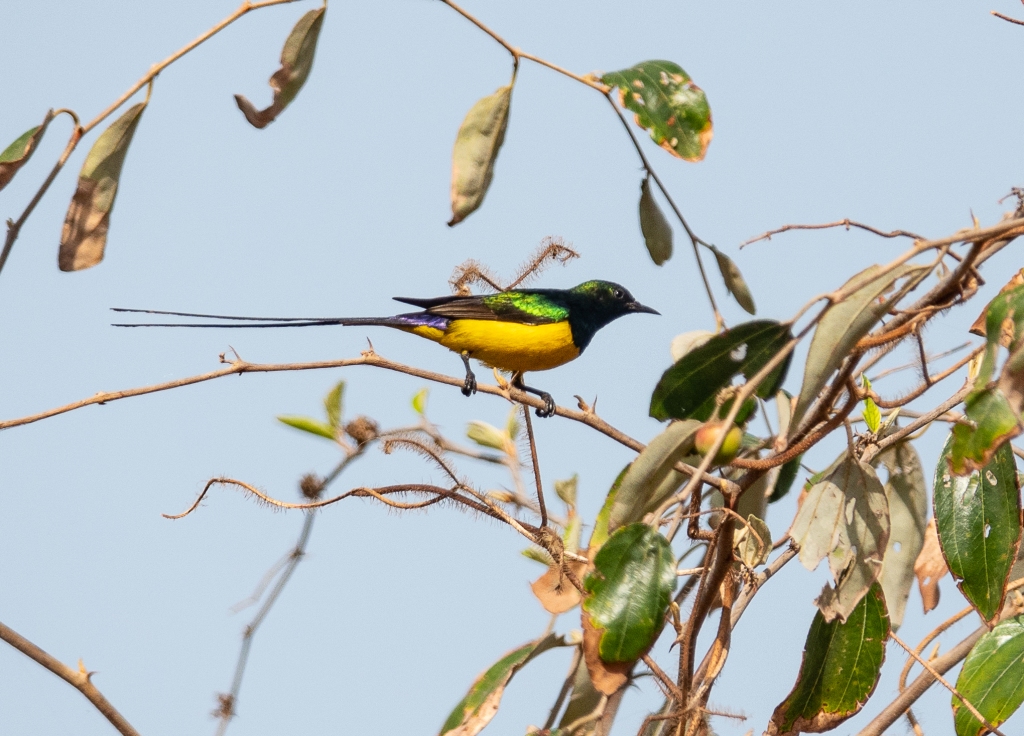
I end with a photo of a male Pygmy Sunbird, Hedydipna platura, in his breeding plumage. He is smaller than the Beautiful Sunbird, weighing in at a mere 7gm. But his long tail streamers and purple rump compensate for his diminutive stature.

Mating Ebony Jewelwings

[I’m back in Maine, briefly, then off to the Pantanal in Brazil for a bit. One or two more Gambian posts will reach you while I’m gone.]

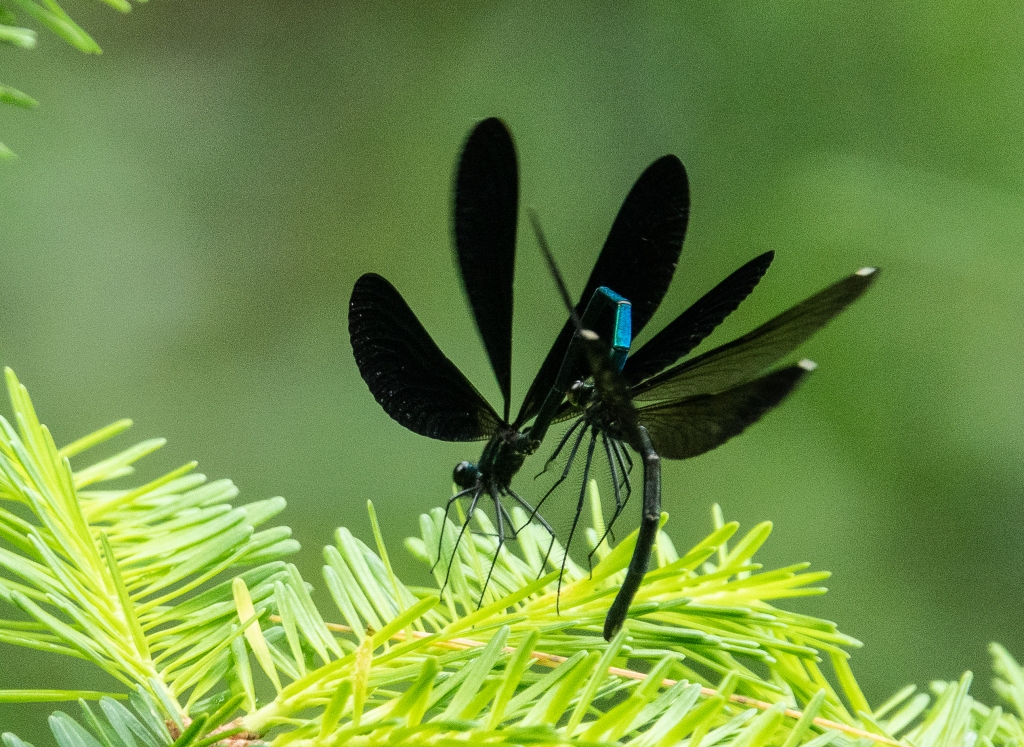
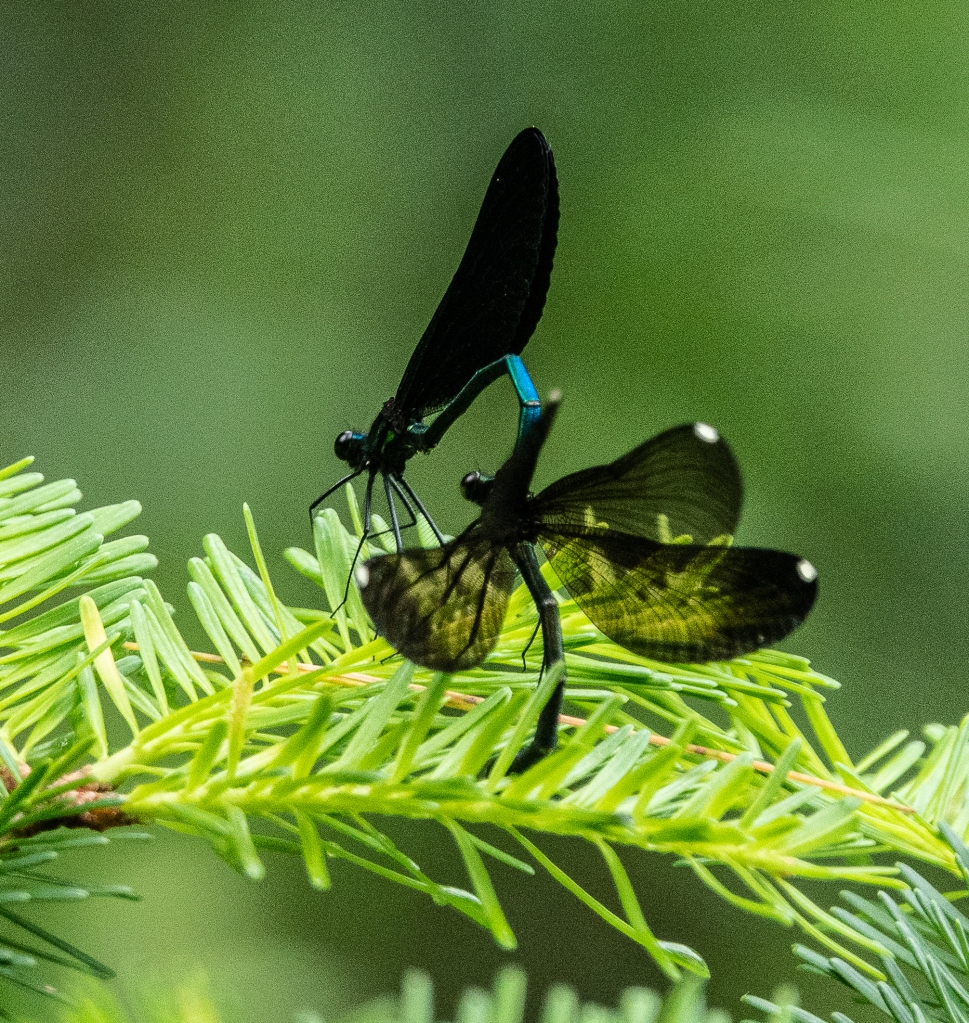
For me these are the most magical of all damselflies. Jet black, with iridescent bodies, the females have contrasting pure white wingtips. They flit around close to my ponds and streams.

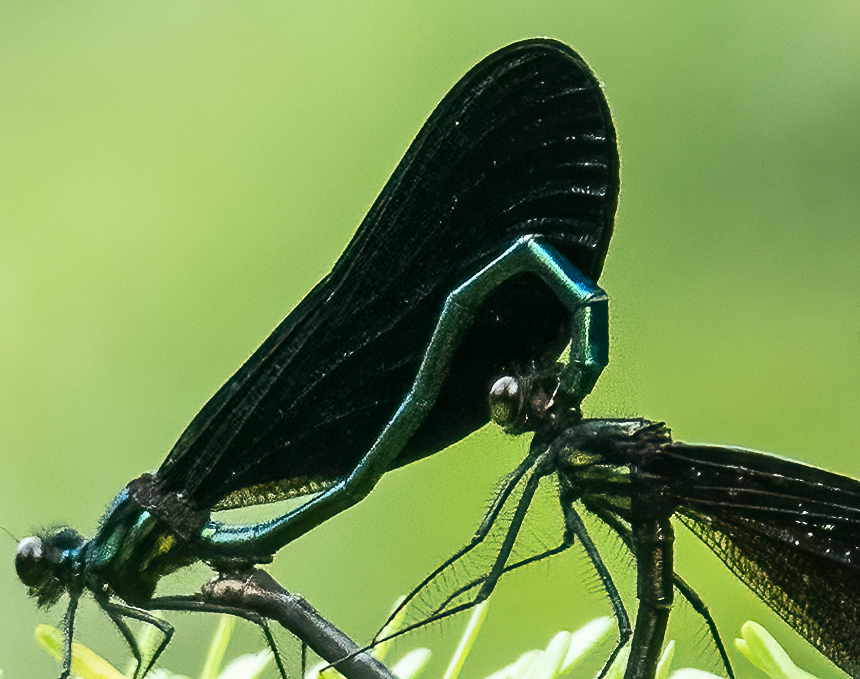
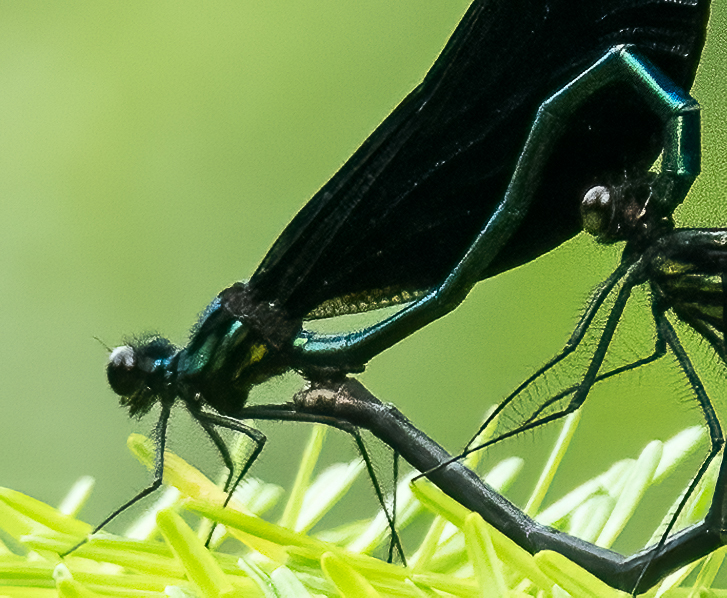
At the moment they’re mating. It is a complicated process. The male on the left uses his abdomen to clasp the poor female by the back of her neck.

If the female is not keen, she may struggle:

maybe forcefully

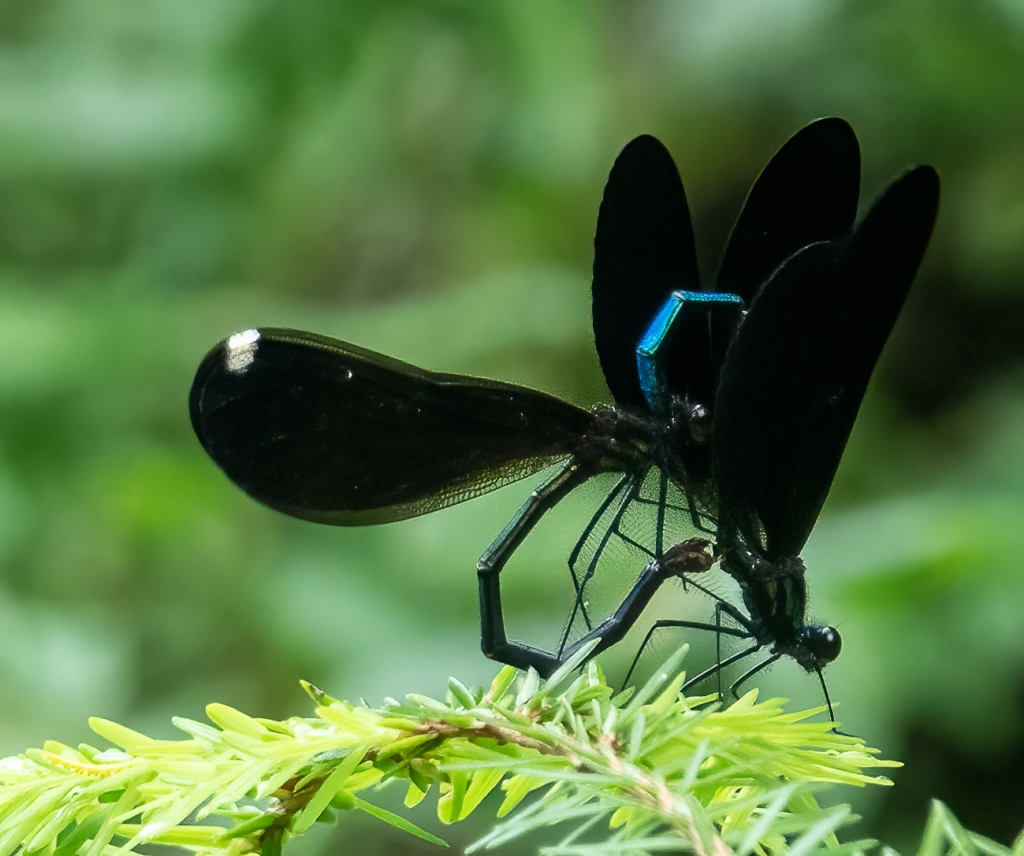
but if she likes him, she lifts her abdomen up receptively:

and they mate.

His sperm is actually produced at tip of his long thin abdomen, and he transfers the sperm to his penis on his second abdominal segment. So that is where the female must place her genitals, to receive his sperm. She is up to the challenge.

Mercifully even the Kama Sutra does not demand such contortions of us humans.

PS The male can also use his penis to scoop out any sperm left by earlier males!