Nesting macaws

Ideally, macaws nest in existing holes in old trees,

which they then enlarge by ‘beaking’ away at the edge and chipping off wood shavings.

These are in turn used to line their nests.

Because of the demand for natural nest sites, the Hyacinth Macaw Project not only researches the birds’ behavior and populations, but also sets up nest boxes. They monitor both the natural nests and the nest boxes.
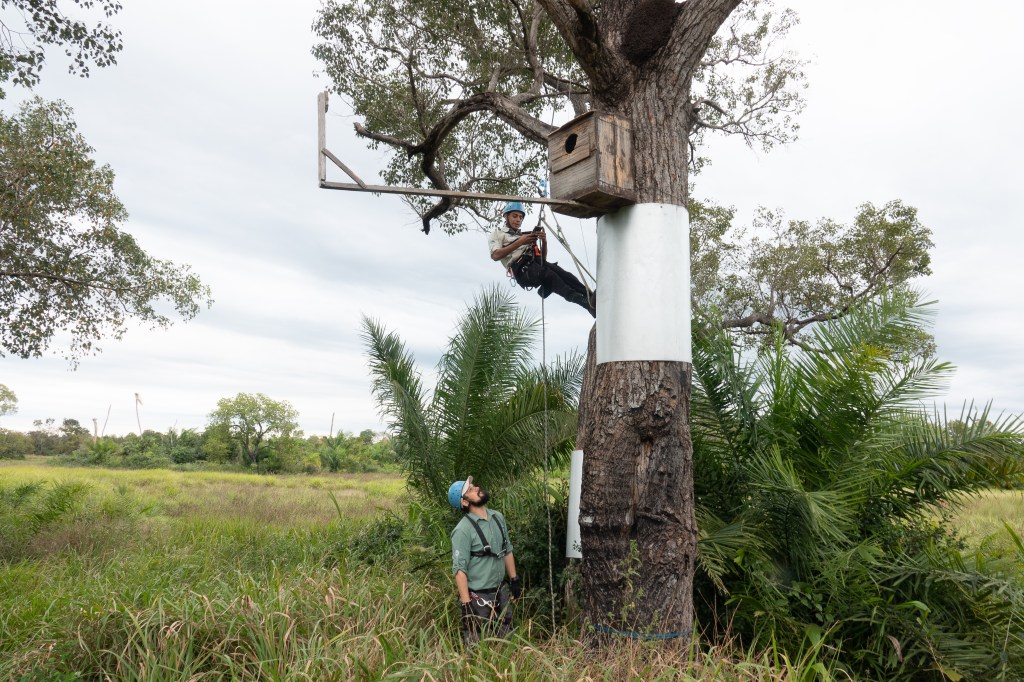
The metal strip is to keep predators from accessing the nest, something I do on my Wood Duck boxes here in Maine. It turns out to also inhibit the spread of fire.

The team climb up, inspect the inside for fresh wood chips that might indicate it is being used, look for damage from their ‘beaking’ that might need repairing, and photograph the inside. This extra-tall box houses a camera at the top. The bottom front corner needs repair, before the wood chips fall out.

The macaws do not like the intrusion:

The natural holes are monitored in the same way. This tree has been monitored for about 30 years. A smartphone is poked in to “see” the interior, while the displaced macaws complain loudly.

In the breeding season, you can tell the females by their curved tail feathers, bent from squeezing into the nesthole.
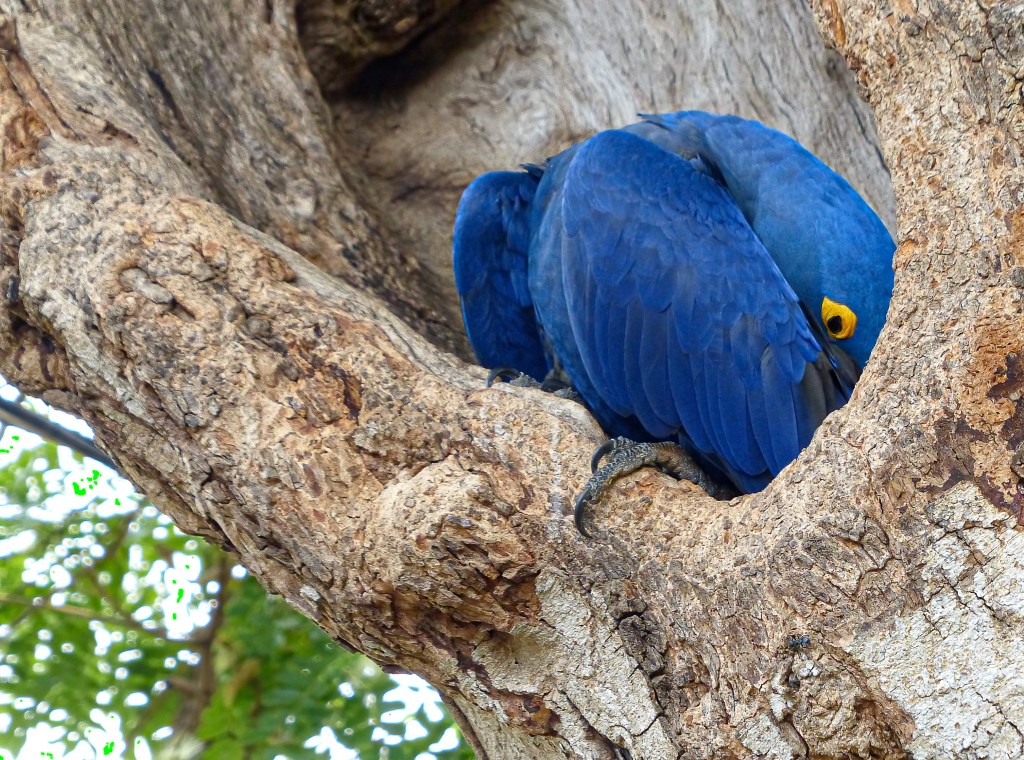
Merlin, an eerily accurate Cornell app that identifies birds from their songs and calls, consistently told us that these were Blue-and-gold Macaws, but they are a different species. The researchers told us that Hyacinth Macaws have various geographical dialects, and that Merlin was trained on macaws from the North Pantanal, where they sound like Blue-and-golds.

PS You can read more about the Hyacinth Macaw Project here:

PPS Caiman Ecological Refuge was hit by a terrible fire in the second half of September 2019. Its devastating effects on the macaws and their food source is documented here.

Red and green and blue: Macaws

Think of three-foot long flying rainbows.

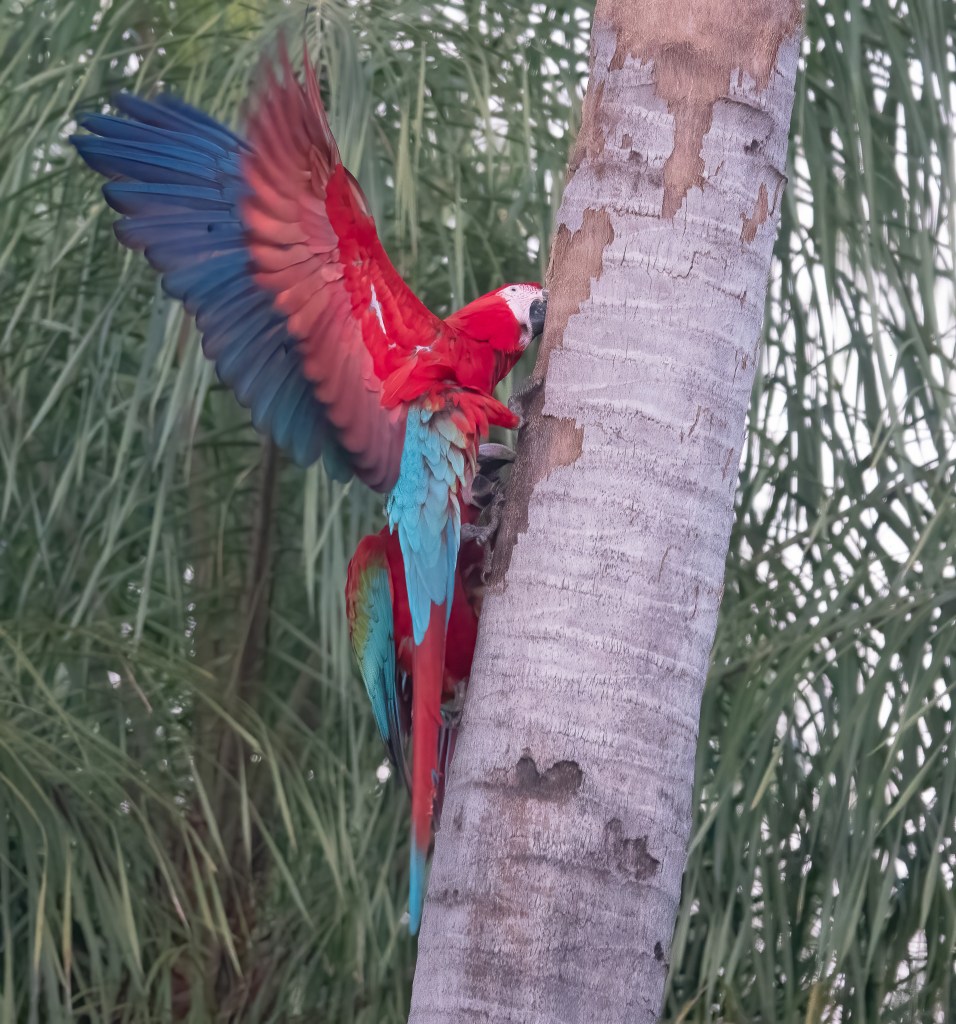
Macaws are a sub-group of parrots, native to Mexico, Central and South America. They have larger beaks, longer tails, and barer paler facial areas than other parrots. Two large species decorated our trip to the Pantanal. The Red-and-Green Macaw, Ara chloropterus, and the Hyacinth Macaw, Anodorhynchus hyacinthinus.

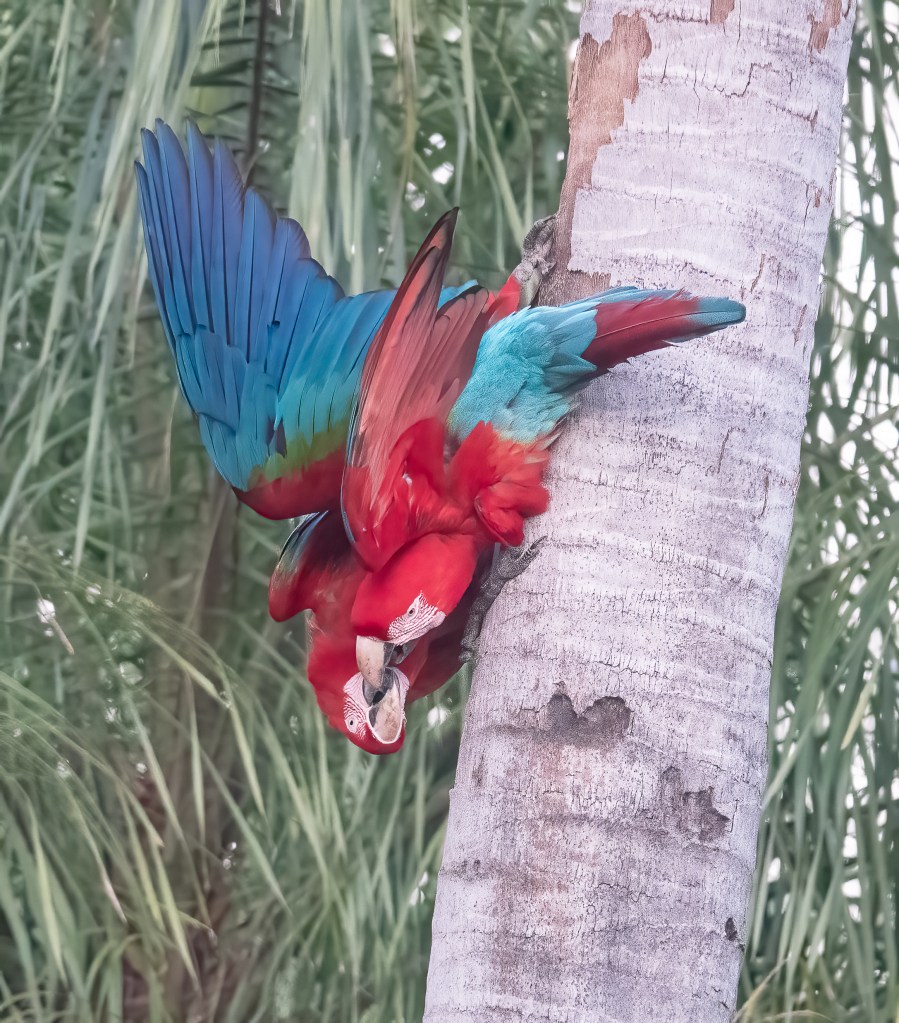
The Red-and-Greens were nesting in a dead palm-tree behind Baia das Pedras.

They would appear at first light, and canoodle affectionately upside down outside the nest hole.

A macaw’s facial feather pattern is unique, like our fingerprints.

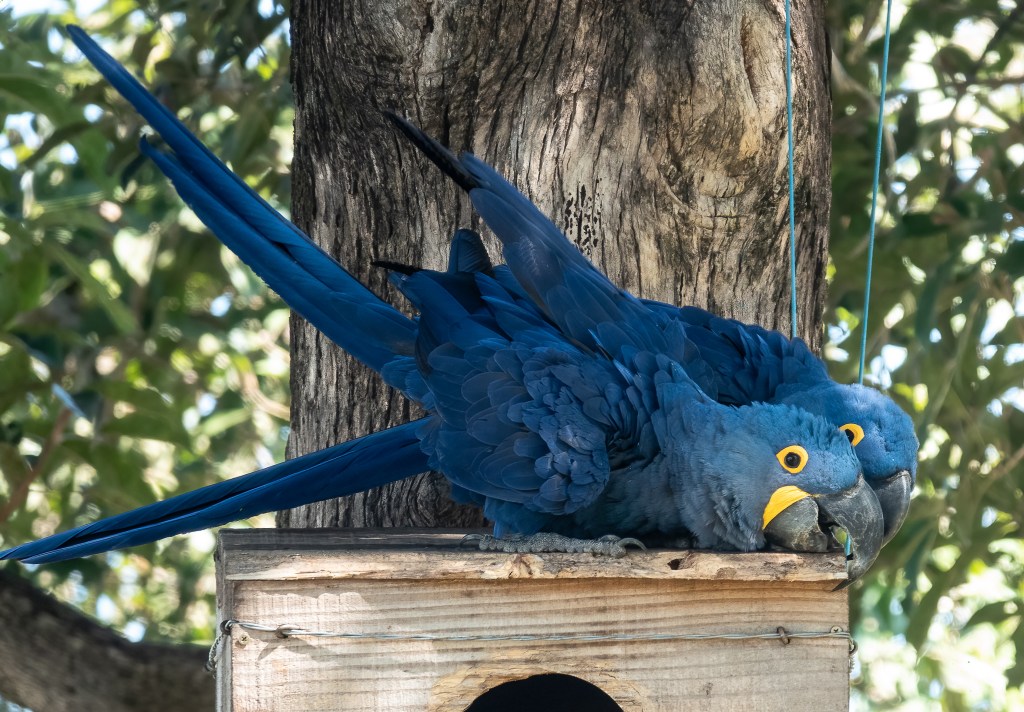
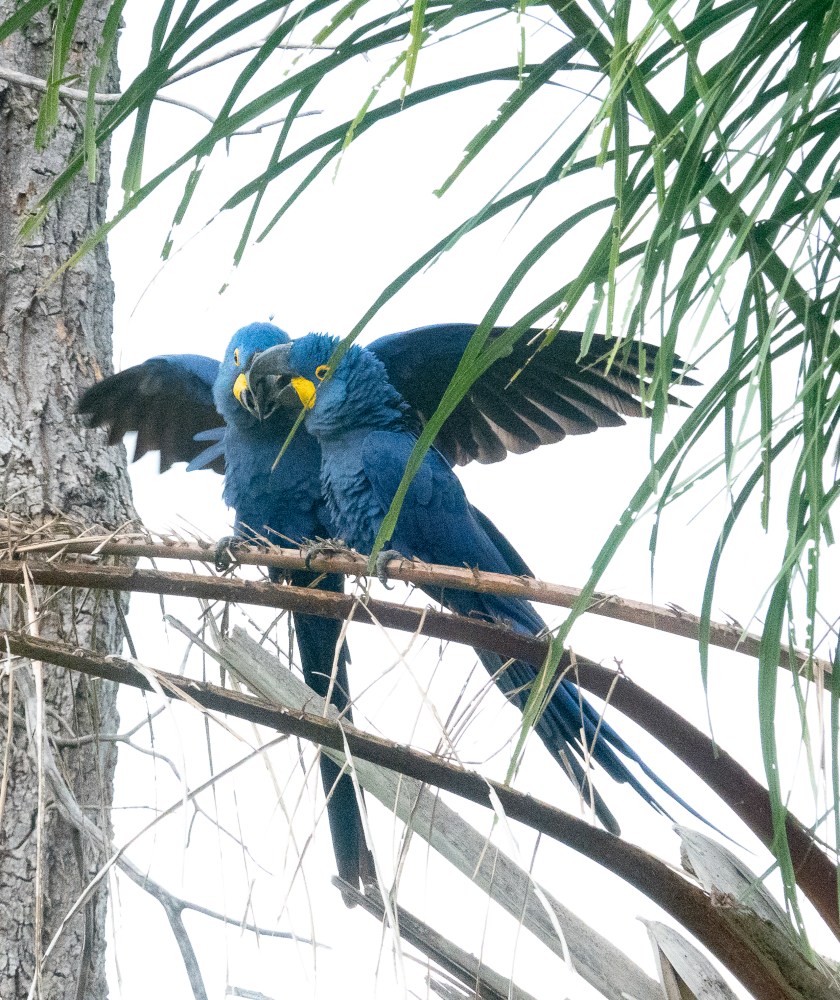
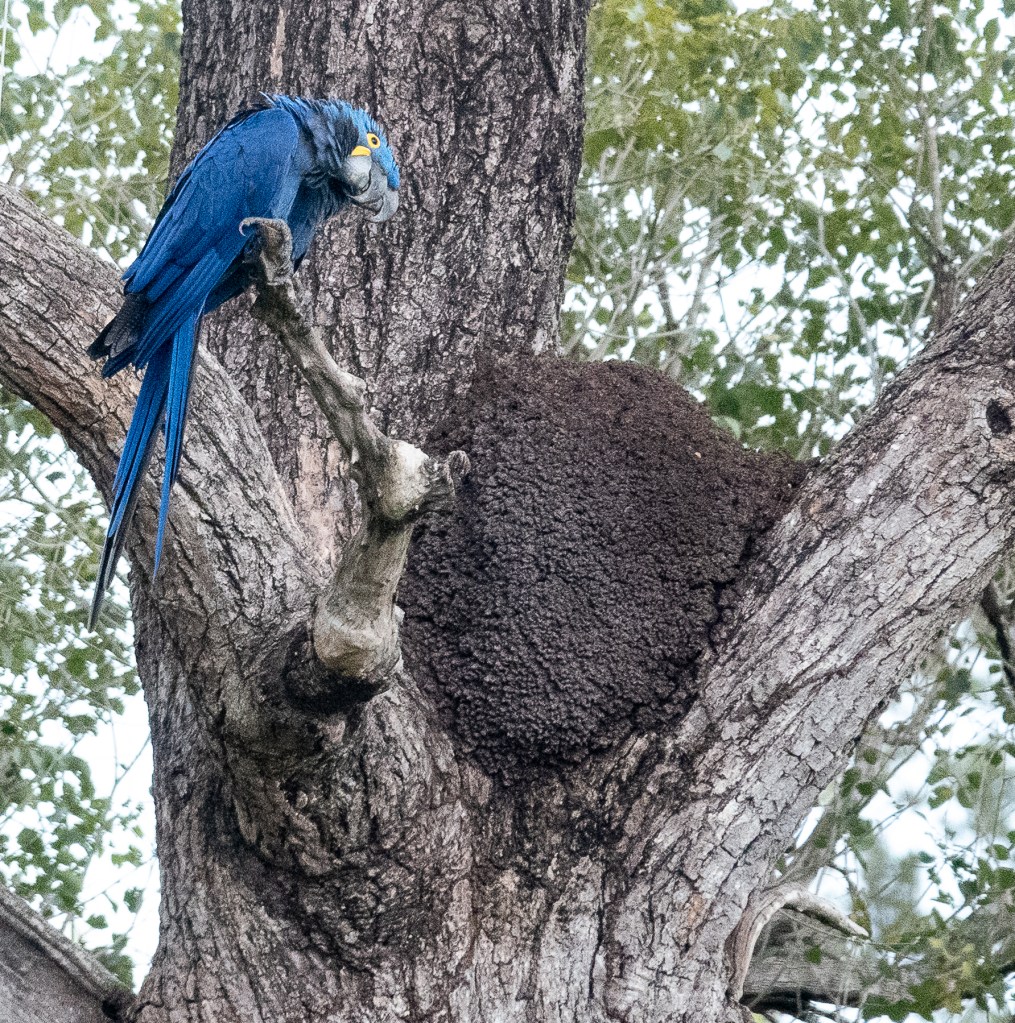
We saw (and heard) Hyacinth Macaws, routinely around our second stop, Caiman Lodge, partly because it is the base of the Hyacinth Macaw Project. In the Hyacinth Macaw the bare facial patch is smaller than many other macaws, being limited to a yellow patch around the eyes and near the base of the beak. One pair were nesting in a nest box in the grounds:

These irresistible birds are monogamous, and under the right circumstances they mate for life, which can be up to 50 years.

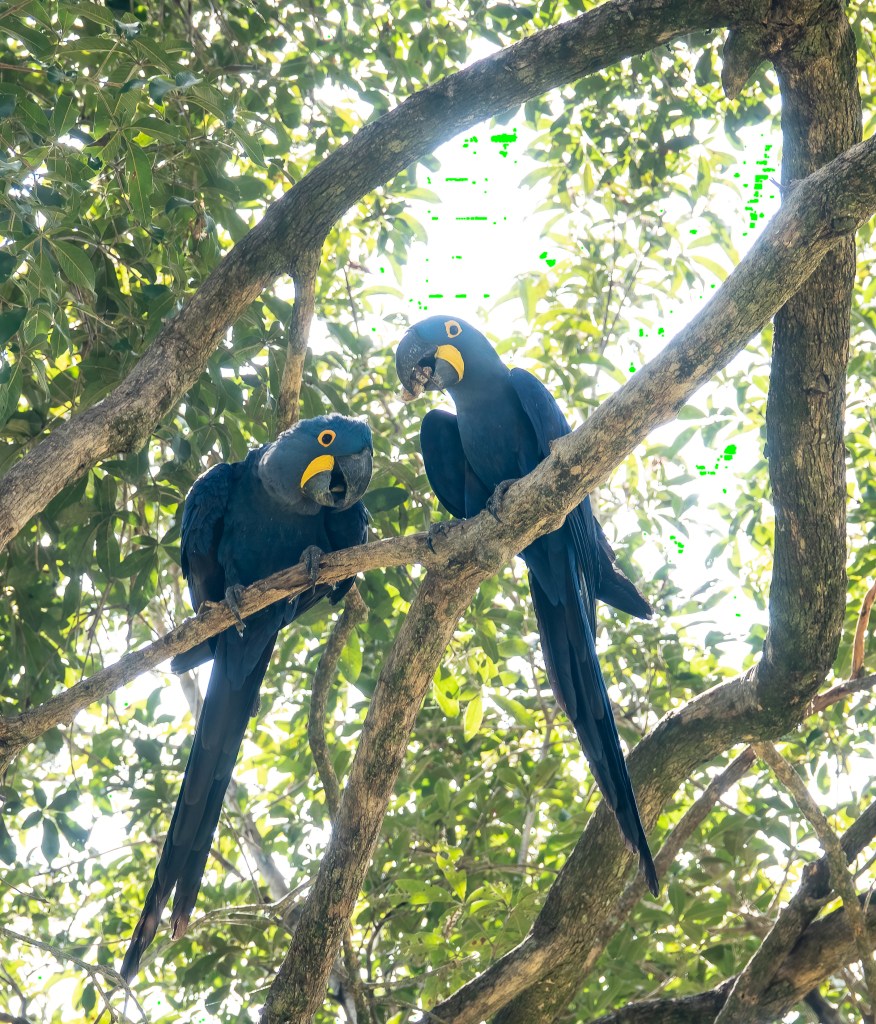
If you get too close to their nest, they squawk from a nearby branch:

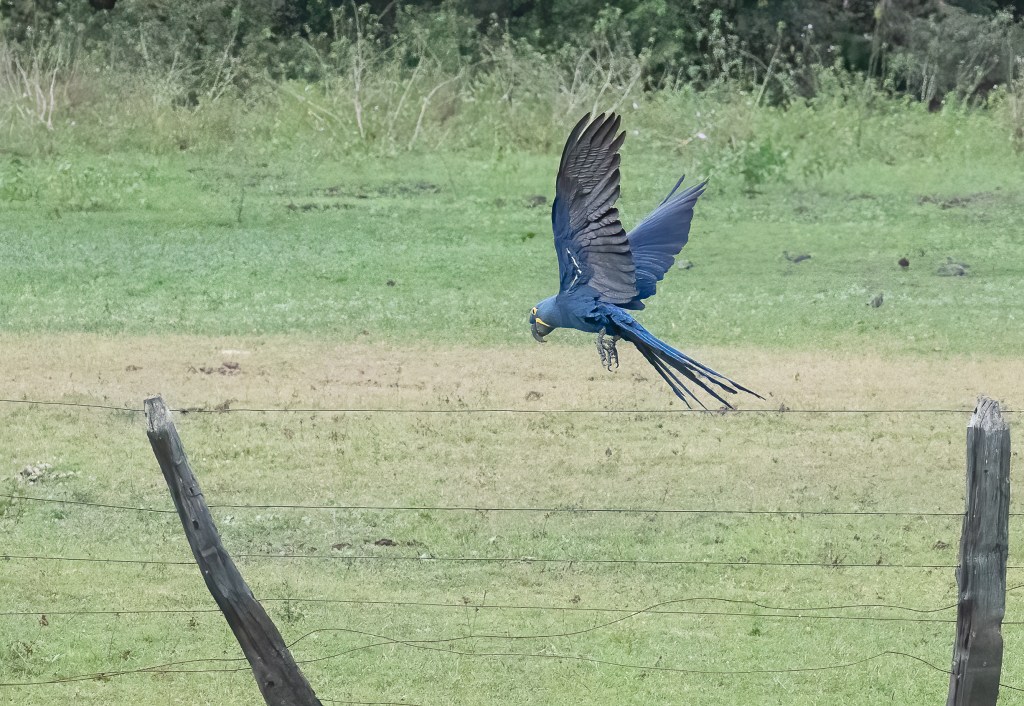
The largest flying parrot in the world, the hyacinth macaw measures 1 m (3 ft 3 in). with a wingspan of up to 1.5m. It weighs up to 1.7 kg (3 lb 12 oz). Here it is in flight.

Hyacinth macaws are listed as Vulnerable by the IUCN. There are thought to be around 6500 left in the wild, 5000 of which are in the Pantanal. There are many reasons for their decline. Habitat loss and the pet trade are obvious issues. Another reason is that hyacinth macaws are picky eaters. In the Pantanal, they feed exclusively on the nuts of just two species of palm tree.

Their breeding behavior also makes them fragile. They don’t breed till they’re seven years old. The breeding cycle takes about 7 months: one month of incubation, nearly four months before they fledge, and then another two months or so of being fed by their parents. A big investment of time and energy. They rarely raise more than one chick, and they don’t breed every year.

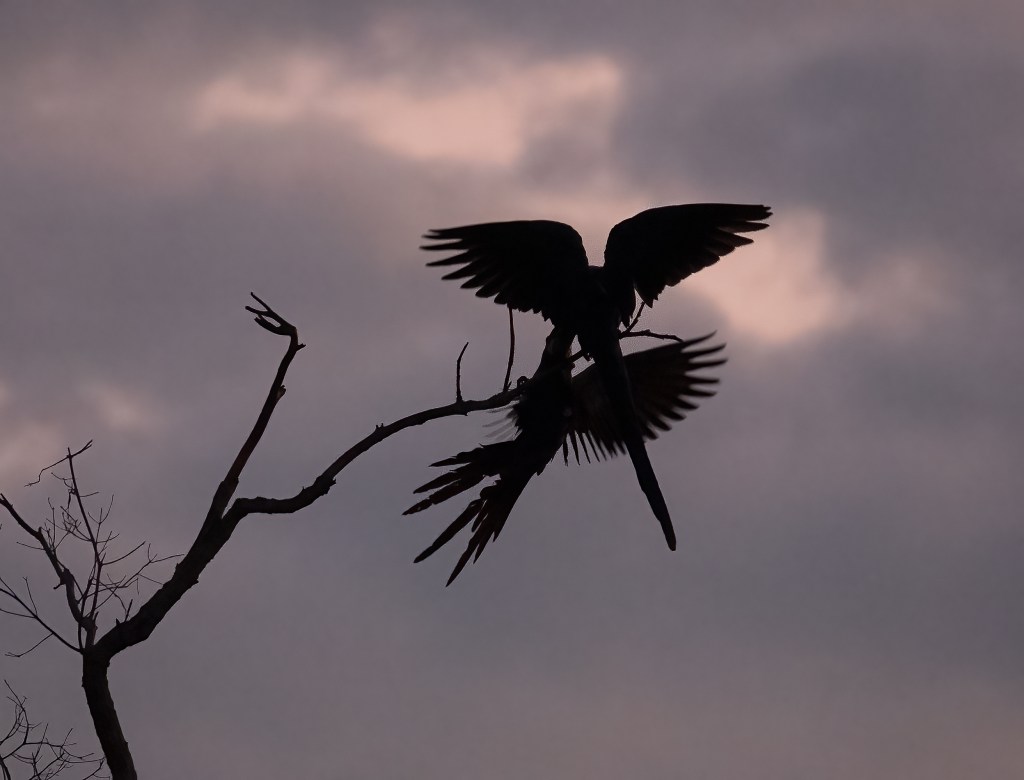
This pair were mating high in a tree at sunset; they hang horizontally under a branch.

A third macaw joined them, perhaps a young hopeful male?

They nest almost entirely in large (over 60 year-old) Manduvi trees. Increasing fires threaten the young trees, so large old ones are becoming fewer and farther between, and competition for nesting sites is fierce.

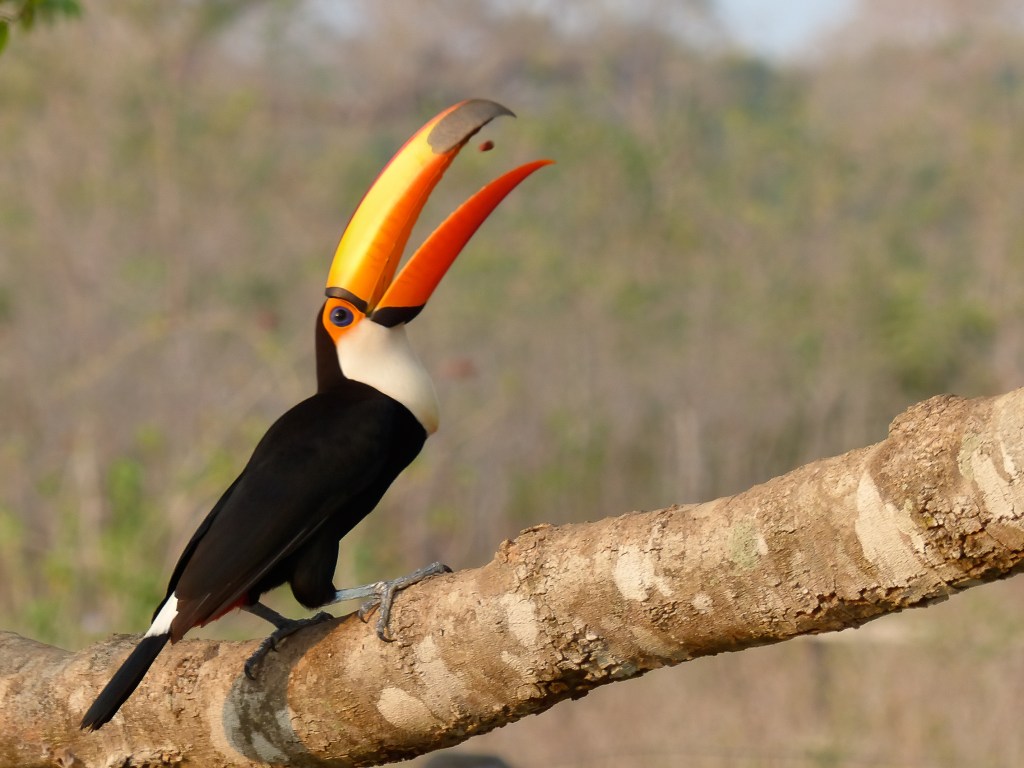
Manduvi trees rely on the Toco Toucan for their seed distribution. So to protect the macaw we must also protect the toucan (not that we really need an additional reason!)..

The Hyacinth Macaw Project monitors the natural macaw nests, and also puts up nesting boxes to provide extra nest sites. More on this next time.

Hyacinth Macaw

Downsizing: Lesser in name only

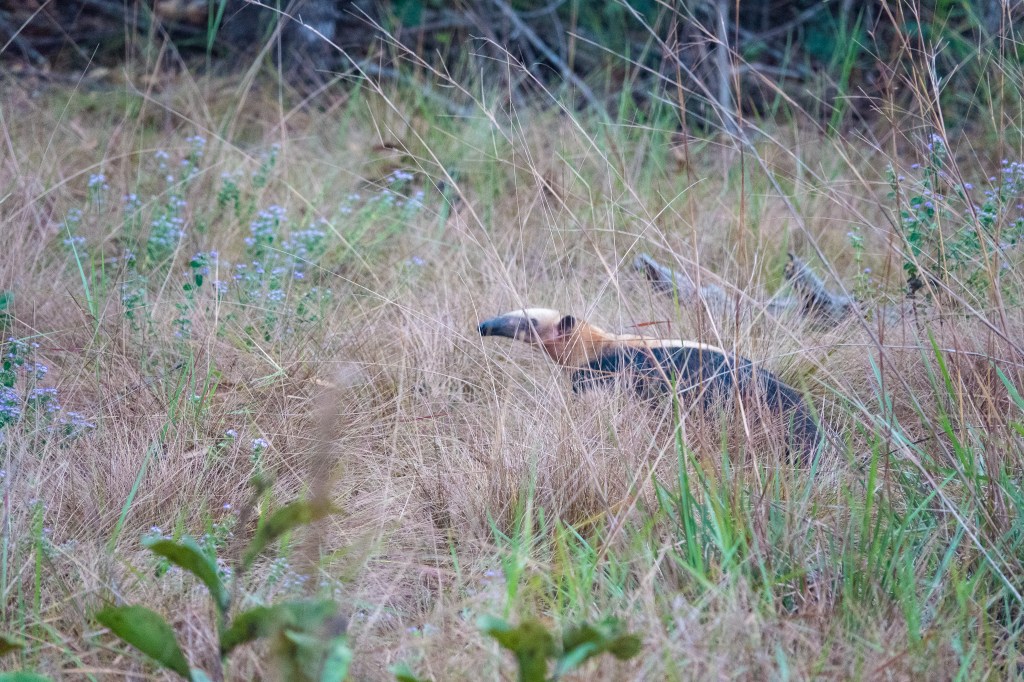
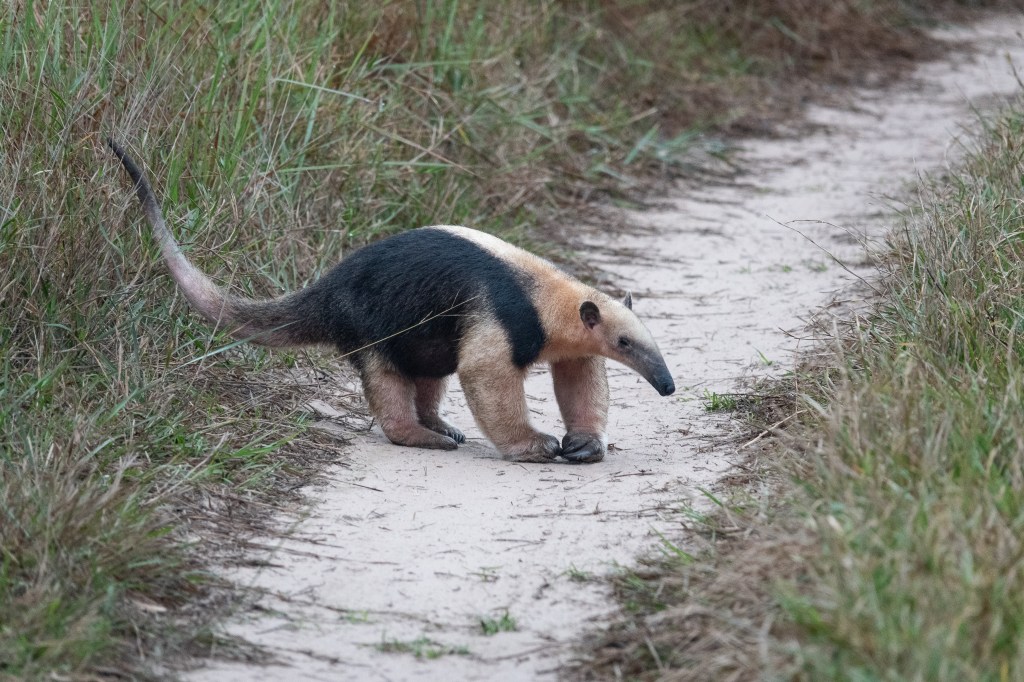
The Lesser Anteater, or Southern Tamandua, Tamandua tetradactyla, also lives in Brazil. They are mainly nocturnal, and on my last trip I just glimpsed one on a night drive. But this time, we got lucky. Strolling in the long grass near the trail was a lovely black-and-tan shape.

It ambled across the track:

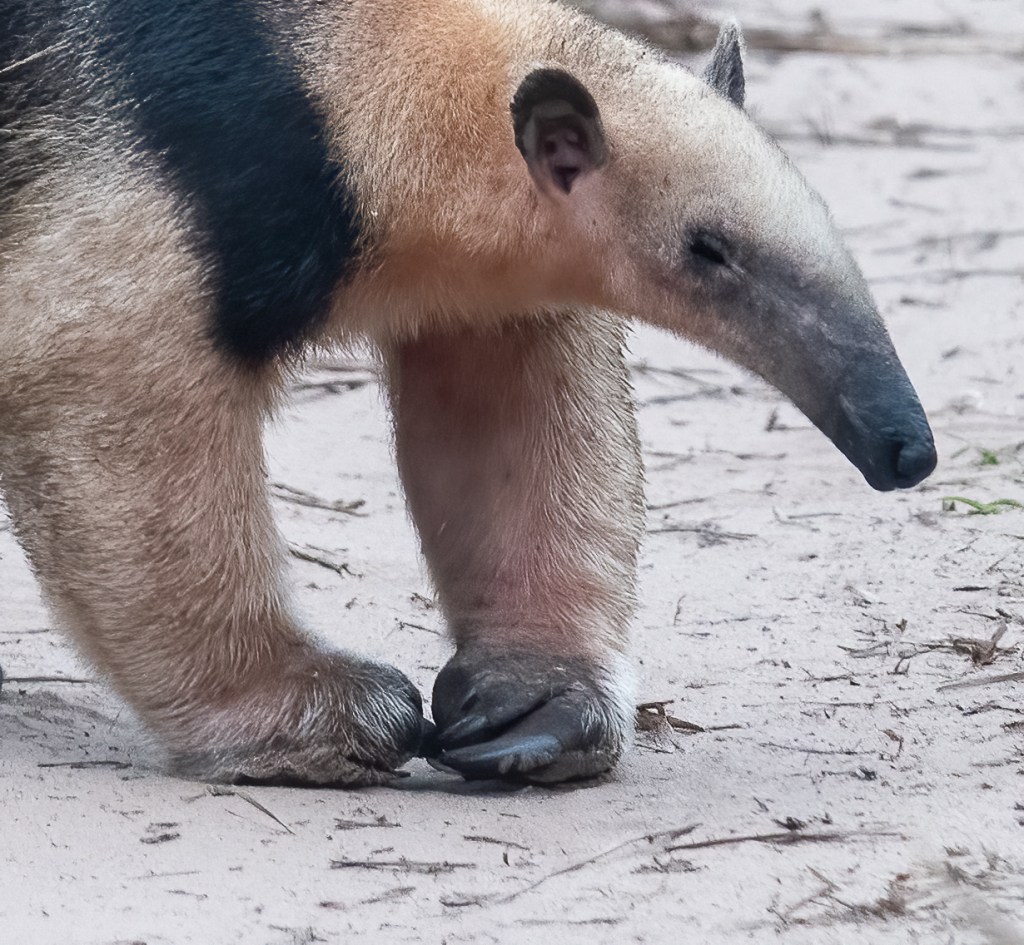
Just like the Greater Anteater, its main diet is ants, and it has four huge front claws (the Greater Anteater has three) for tearing apart those termite mounds:

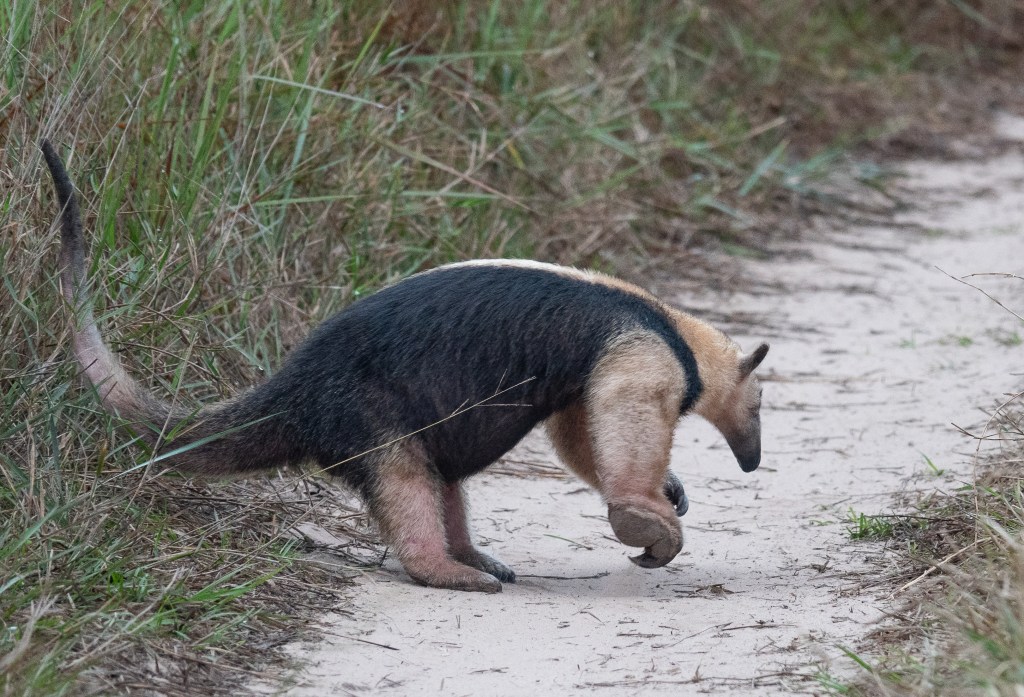
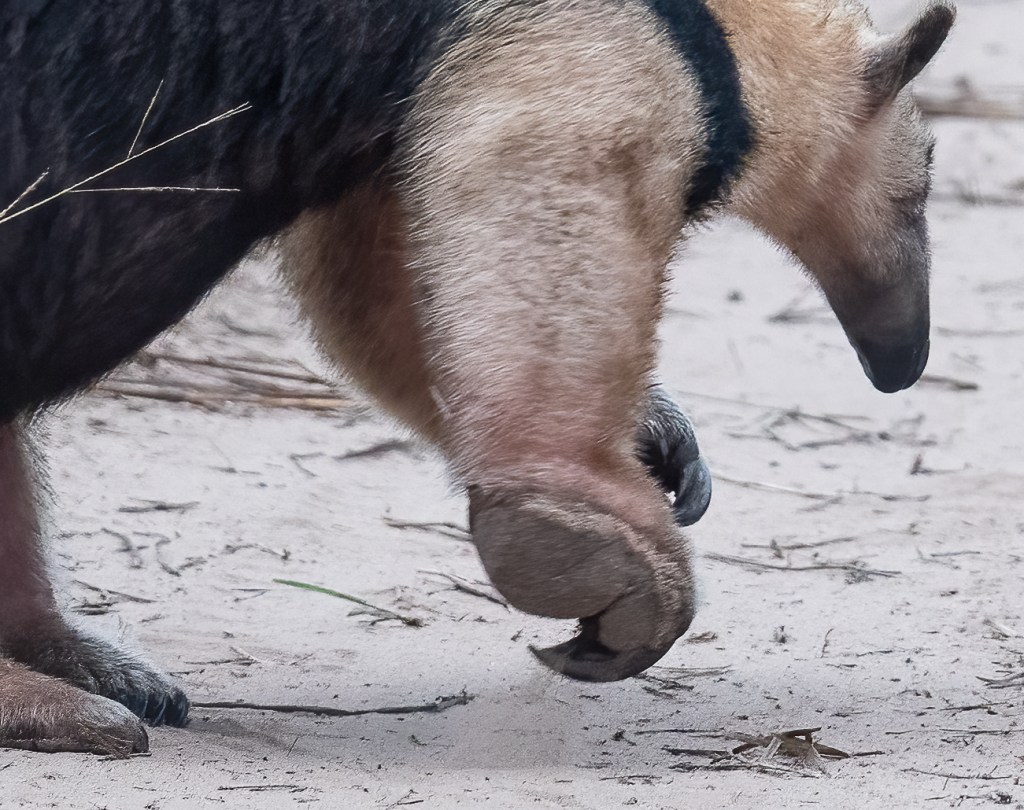
They are rather impressive, so much so that they force it to walk on the sides of its feet:

In closeup, you can see that the thickened skin of the footpad is on the side of the front foot, not u derneath:

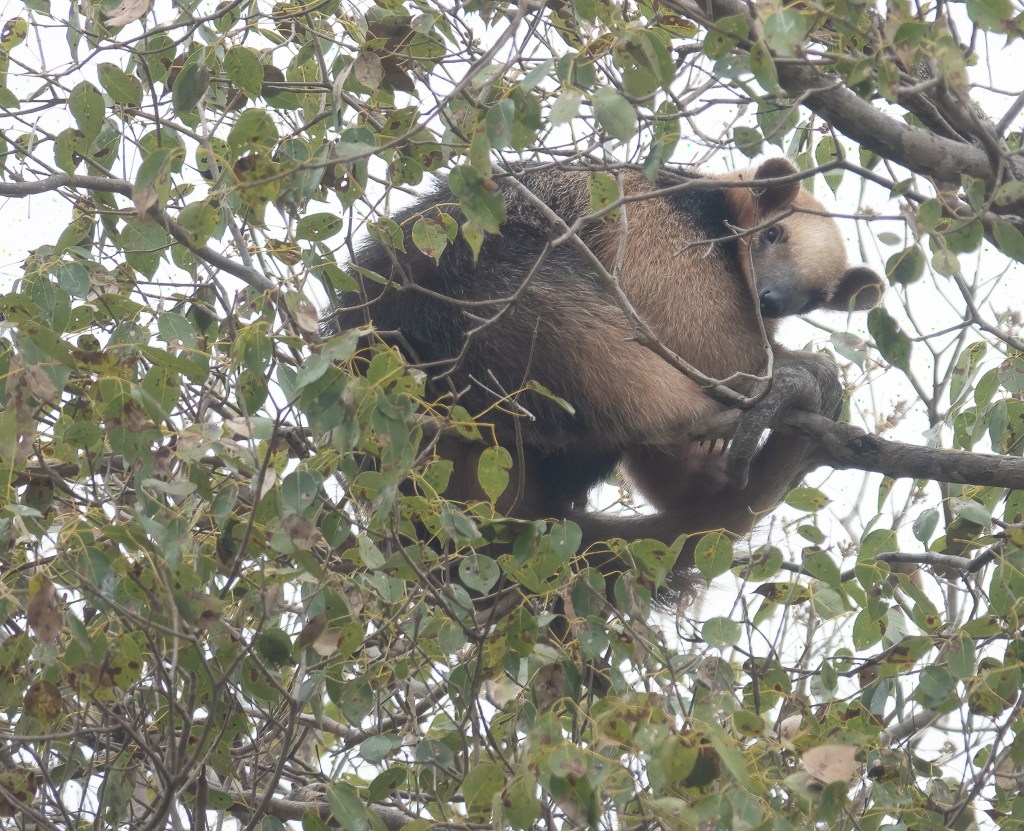
In the daytime, it sleeps high in the trees. At first glance, we thought this blob was a nest of some sort,

but then we realized it was something much better: a slumbering tamandua:

Considering that it can weigh up to 19lbs (though 10lbs is more typical), it is astonishing that it can hang on up there. Its body is up to 3ft long, plus another 2ft of prehensile, partly bare, tail, which you can see curled around the branch here:

This short video is the closest to an action shot I have!

These anteaters also feed in the trees, eating the species of aboreal termite that builds these big nests:

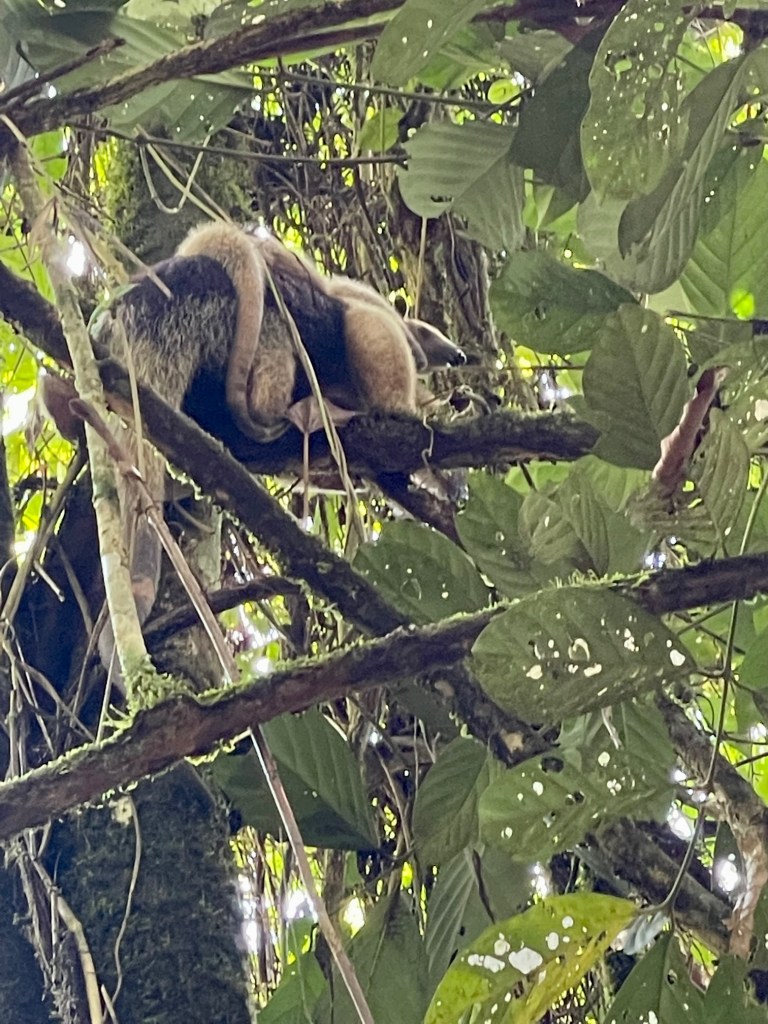
It shares with the Greater Anteater the charming habit of carrying its baby on its back, though we didn’t see this.

However, a friend of mine, Anne Mansbridge, photographed a Northern Tamandua mother and baby in a tree in Costa Rica. Lucky her, and thankyou for the photo.

The Southern Tamandua range covers much of South America from Venezuela down to Southern Brazil, and they are not considered endangered, I’m happy to say.

Jaguar encounters II

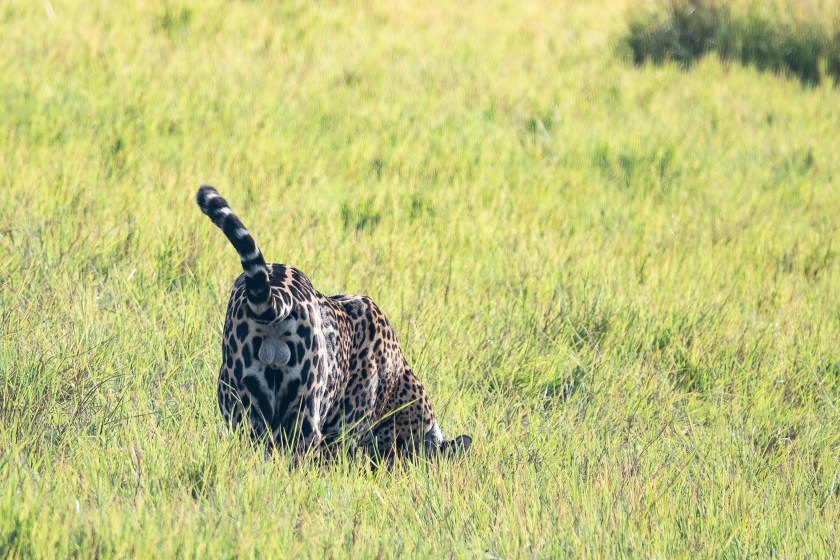
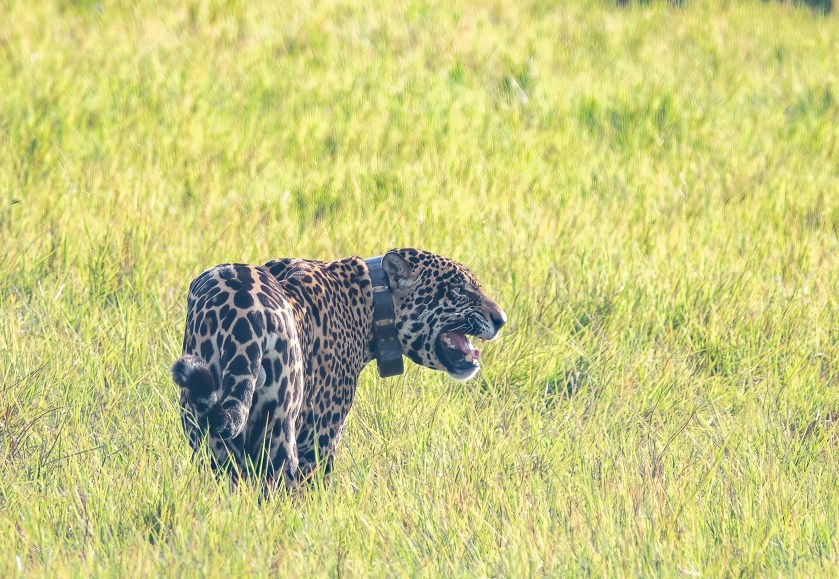
This is Acerola, a super-confident alpha male. He emerged from the long grass

then strolled along the dirt road with a full belly, supremely uninterested in us:

Definitely not a hungry cat.

In the Northern Pantanal, jaguars tend to eat capybara, but in the Southern Pantanal, on these vast cattle ranches, the jaguars most certainly like to eat beef. Ten jaguars on a cattle ranch next door to the one we stayed on were monitored for 2 1/2 years between 2001-2004. The researchers counted their kills, which “were composed of 31.7% cattle (9.8% adults and 21.9% calves), 24.4% caiman (Caiman crocodilus yacare), 21.0% peccaries (mostly Tayassu pecari)”. No other species was above 5% of their diet.

From https://academic.oup.com/jmammal/article/91/3/722/846646

This diet has advantages to the jaguar (lots of juicy cows to eat), but it also poses a threat to their survival. Jaguars are classified by the IUCN as Near Threatened, mainly due to habitat loss and conflicts with cattle ranchers. The Wildlife Conservation Society estimates there are about 5000 left in the Pantanal, and maybe 10,000 in the Amazon.

Some forward-looking landowners are looking for ways to accommodate both cattle and jaguar in a careful balance. We were staying at Caiman, a vast cattle ranch of 131,000 acres, large areas of which are set aside as protected. 76 different jaguars were sighted in 2022, and 200 since 2011. The jaguars coexist with the cattle, and the cattle owners sign contracts agreeing that they must expect up to 3% losses to jaguars, after which they will be compensated. The ranch has a sizable ecotourism program (another revenue source for them), and it also hosts the Onçafari research and rehabilitation project, which studies the animals, and also has the first ever successful program of reintroducing captured animals to the wild. You can read more here..

We followed Acerola one day, and he was behaving oddly. He had his head down in the grass in one spot for a long time, but he did not seem to be eating.

When he eventually raised his head, his expression was very distinctive:

He had been scenting a receptive female, and this expression with his upper lips curled back, mouth open, is called the Flehmen response. It allows her pheromones to reach special receptors on the roof of his mouth just behind his top incisors. This video shows the behavior more clearly; I have cut out most of the very long time that he had his nose down and back to us just sniffing!

It is a privilege to see such magnificent animals in the wild, and coexistence with humans may be their only chance of survival.

Jaguar encounters I

Nowadays, jaguars are found from Mexico to Argentina, but there are none left in North America. So they are one of the most exhilarating animals to see on any South American trip. The ones in the Pantanal are some of the largest of all. A male can measure 2.5m and weigh 130Kg, with only lions and tigers being larger.

Finding them is not easy. Where we stayed, six are collared, and somewhat habituated to vehicles, so using a radio antenna it is possible to find them, but only if they cooperate. On one afternoon we narrowed a jaguar down to a clump of trees and scrub, and sat still for at least an hour hoping it would emerge, but it never did.

To collar a jaguar, the research team first find tracks or signs, then put up a camera trap to confirm its presence, then set a snare. They rush to the scene, tranquilize it, weigh it and take bloods, then collar it, and let it free. The next step is to find it again using the radio antenna, and get it used to seeing the vehicles, which can take a while.

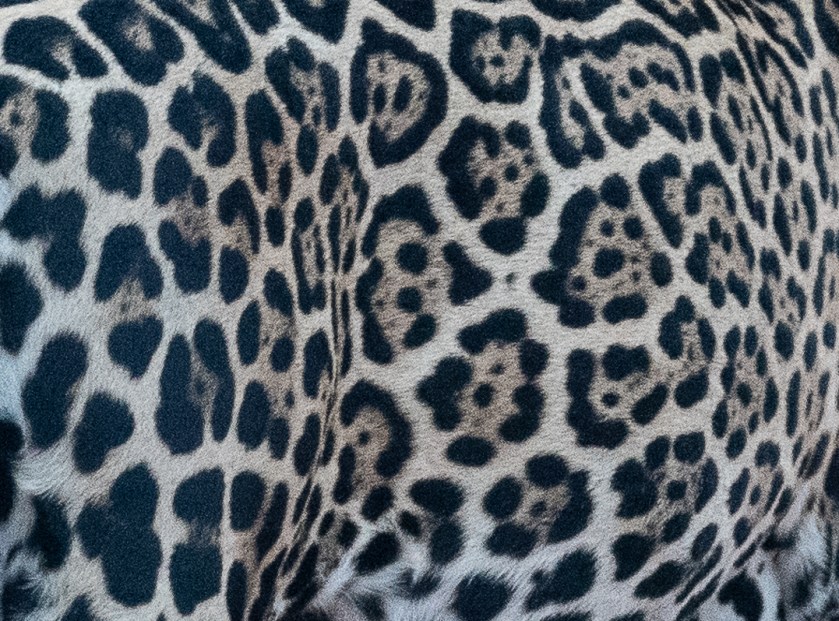
The team recognize the jaguars by their patterns of rosettes, distinctive for each animal:

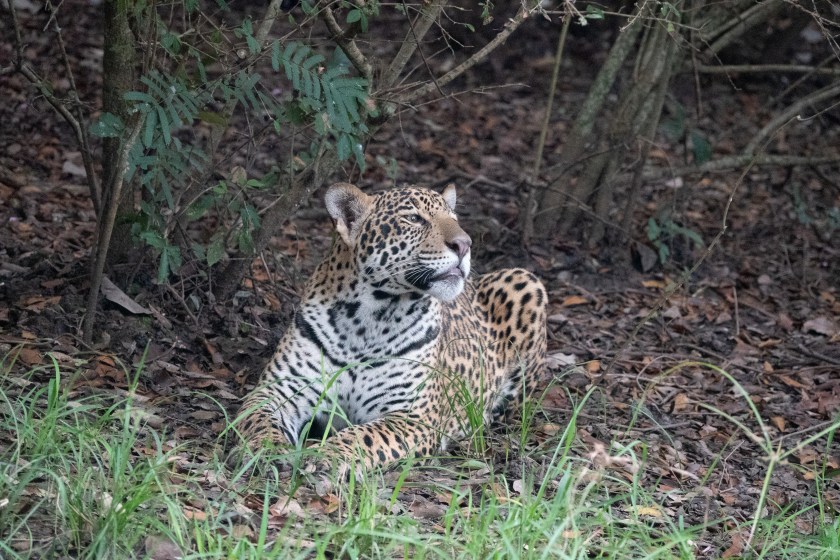
Our best sighting was a mother, known as Suriya, and her one-year old female cub, Juba. (A male cub has already set off on his own.) The mother is collared, and habituated to vehicles. The cub is not collared, but stays with the mother. Here they are, cub in front and mother behind:

You can see the size difference more clearly in this shot:

They walked through the lush grass for a while:

then settled down in the shade of some trees:

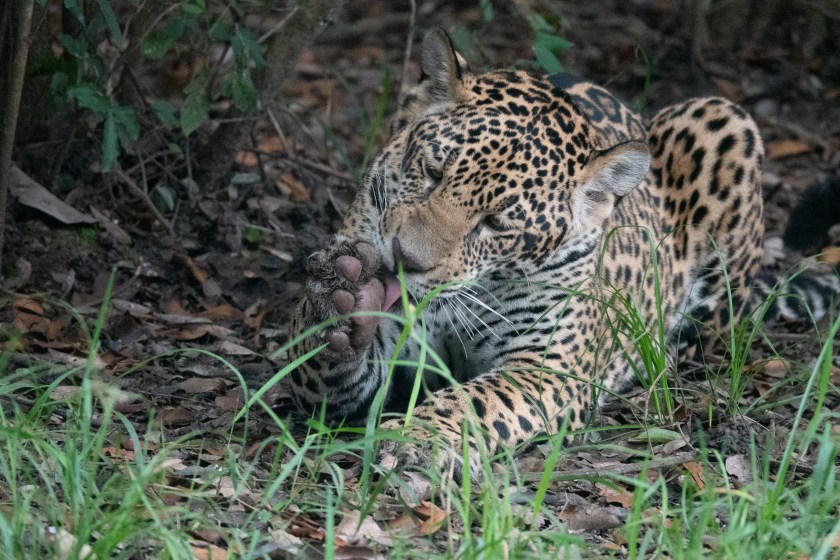
Sporadic grooming followed:

After a while the bored youngster stalked and ambushed her snoozing mother (just visible deeper in the undergrowth):

Later, they encountered and startled a Pampas Deer in some bushes, but it escaped in the nick of time, unharmed.

In my second jaguar post I’ll talk about conservation concerns and projects, and introduce you to Acerola, a big male.

And I’ll leave you with this lovely 19th century image of the “South American Tiger”.

98 Teeth: all the better to eat you with

The Pantanal is a huge wetland, ten times the size of the Everglades and fifteen times the size of the Okavanago. The red roofs just left of centre are Baia das Pedras, our first stop.

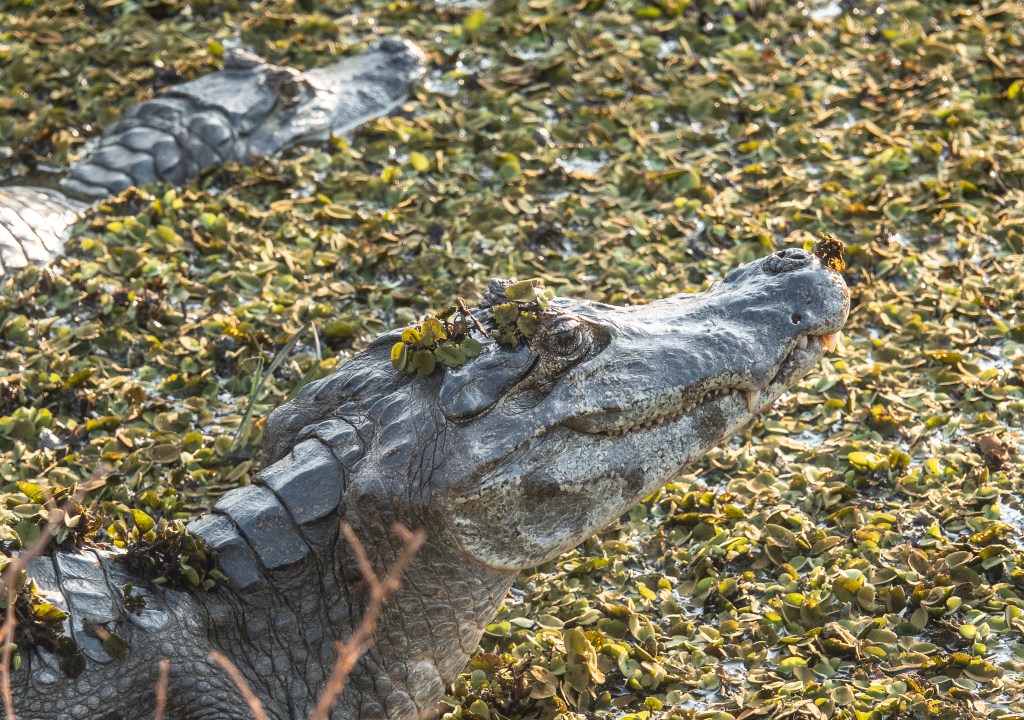
Much of it is flooded from November to March. This makes it splendid habitat for an estimated 35 million caimans. The fellow below used to be called the Spectacled Caiman, Caiman crocodilus to be precise. Its name comes from the ridge circling the front of the eye. However, it is now considered a separate species, the Yacaré Caiman, Caiman yacaré.

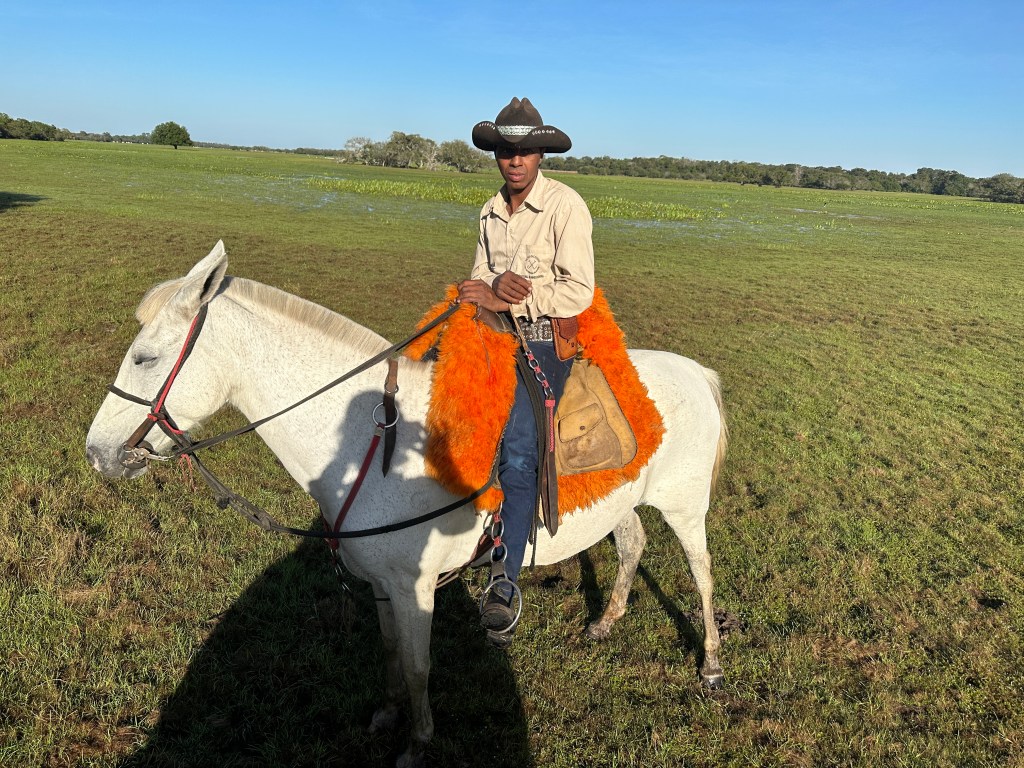
Males are 2-3m long, and 58 Kg. They are not really dangerous to humans, but when we were riding through the shallow water one of the cattle dogs was attacked, and only just escaped. The Pantaneiro horses didn’t bat an eyelid.

Caiman have the usual intimidating crocodilian array of teeth, seventy-eight of them, which they use mainly on small aquatic prey, such as fish and amphibians, but they also eat carrion and capybara (and apparently dogs.) As water levels drop in the dry season, they congregate in huge numbers on the receding shorelines. The rains were late this year, so there was lots of open water left for them when we were there.

We went out fishing, giving a waiting caiman a wide berth.

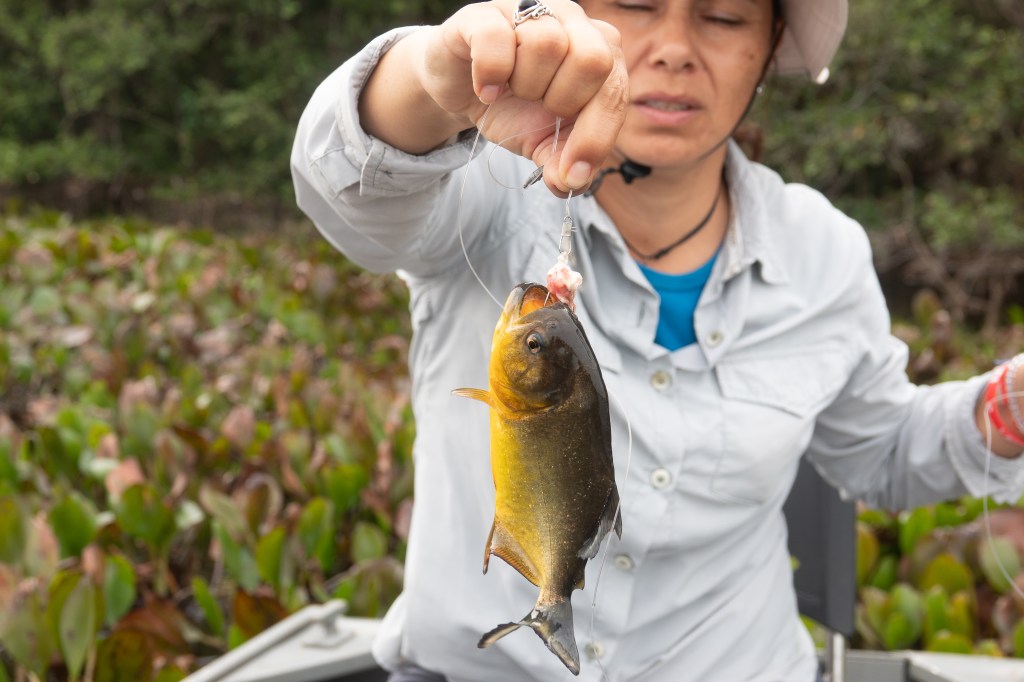
We caught piranha on makeshift poles, baited for us by our guides. As soon as the meat touched the water, Jane got a bite, and she turned out to be our champion fisherman. Here our guide Alessandra nervously displays her catch for its portrait:

The hooks were removed, very cautiously, avoiding those famous teeth, all twenty of them:

When we looked up, a caiman was circling.

Our boatman dangled a piranha over the side, and the caiman lunged:

The boatman managed to pull the fish close enough that he could cut the nylon line, but it is clear this doesn’t always happen. Look closely at the next photo, towards the rear of the lower jaw:

This photo is interesting for a different reason. Near the snout, one of the lower teeth has grown right through the upper lip of this animal.

Apparently this is the norm on large adult males. The lower teeth are in general invisible when the mouth is closed, being behind the upper teeth. The 4th maxillary tooth, however, slides into a special fossa (groove) on the upper jaw, but it can wear a hole through the bone and lip and then it can been seen when the mouth is closed, as here.

In crocodiles, by contrast, the lower teeth are just visible even when the jaw is closed. This chap is snoozing by the Luangwa river in Zambia.

PS Our riding guide, the owner of the lucky dog. Admire his traditional saddle and his belt.

PS My title aggregates the number of teeth in a caiman and a piranha!

PPS “Piranhas have a single row of extremely sharp teeth that runs all the way around their mouth, top and bottom. Each tooth is tightly fitted to the next tooth. In fact; they’re so close that they actually overlap. 

Piranha teeth have three sharp, triangular cusps. The central cusp is by far the largest, and it’s razor sharp. The two smaller cusps on either side of the center cusp are used to lock each tooth into the teeth on either side of it. The razor-like teeth are wide from front to back, and narrow from side to side–like a straight razor.

When the piranha closes its mouth, the top and bottom rows of teeth act together to form a pair of scalpel sharp scissors.” From https://a-z-animals.com/blog/piranha-teeth-everything-you-need-to-know/