After three days in the Makgadikgadi, our itinerary had us moving to the well-named Deception Valley in the Central Kalahari Game Reserve, the second-largest game reserve in the world, bigger than the Netherlands.
I start with a saga, one that brought home to us how helpless we are without the skilled support team that shepherds us around these wild, places. If you’re interested, read on; otherwise, skip down to the wildlife.
After breakfast we set off in our safari vehicle with water and lunch; the team struck camp after we left, and sped off in their lorry to get there ahead of us and set up anew in the Kalahari. After a day’s driving in 40C temperatures, the last four hours of it on dirt roads and out of cellphone range, we arrived at dusk. No welcoming tents, no truck, no team, no food, no beds…. although it did turn out that the large duffel-bags on the ground contained folded heavy canvas tents, and many many different length tent poles. It was getting dark, there are lions in the Kalahari… so sleeping under the stars was not an option. We set to work, under the leadership of our guide TJ and the 5 foot tall housekeeper, Mighty.
It took us an hour per tent (more like marquees than tents, in terms of weight, and technique).

Once we had two tents up, we decided that we could fit in four people per tent, and it was time to stop, so that’s what we did, sleeping on the floor of the tents (the beds were in the missing truck). Our guide slept on the roof of the safari vehicle, and the six of us plus Mighty slept in the tents. We had enough water, and a single bottle of wine, one apple each, and half a packet of biscuits to share.
We rose in the morning (to say we felt rested would be an exaggeration), and agreed to do a two hour game drive, then drive back the way we had come until we could make contact with the truck. First, we proudly photographed ourselves with one of our laboriously erected tents!

Until this logistical glitch (debacle?), we had not realized our guide had no satellite phone for emergencies, which was somewhat unnerving. After two hours, we met the youngest member of the camp team, who had hitchhiked from the broken-down lorry to tell us what was happening. It had two flat tires, and only one spare. It was suggested that we could wait for the lorry, then head back to the camp again… but we declined, and asked for a hotel with a bed, a shower, and food! Or even a spa…
None of us (combined age about 430 years) really wanted to be in the Kalahari desert without emergency contact capability, and it had also turned out to be so dry we saw very little, including no aardvark or aardwolves, the principal goals of the trip. Instead, we asked for options, and ended up spending the remainder of the trip in a lovely camp site near the Okavango… of which more later.
Back to wildlife. We did see a few things worth telling you about in the Kalahari, so here goes.
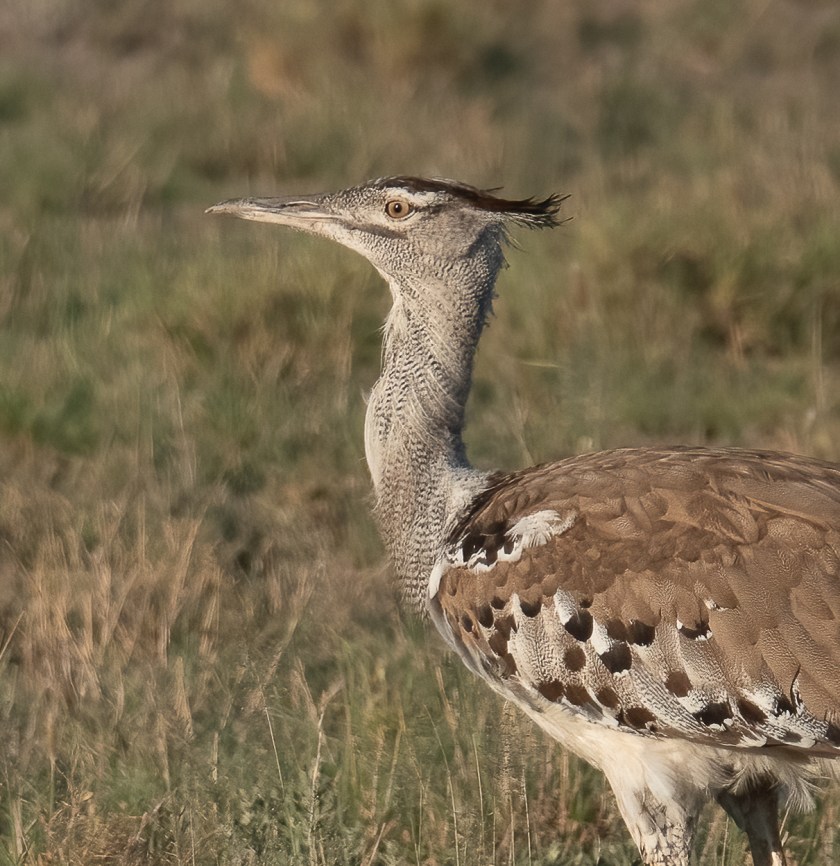
This is a Kori Bustard, Ardeotis kori, the world’s largest flying bird. Males can weigh up to 20Kg.

He struts along, big enough not to worry much about predators, though he has very poor forward binocular vision, with extensive blind spots.

He was hunting for insects in the dry grass:

A fine figure of a bird:
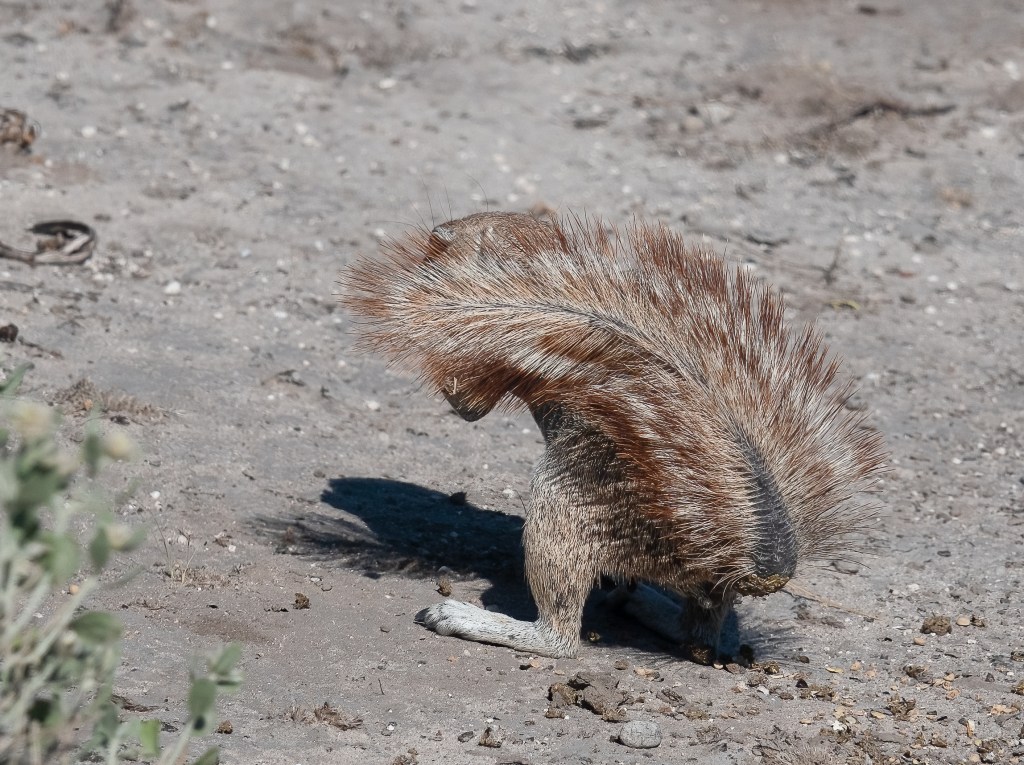
Smaller, and more nervous, the Cape Ground Squirrels, Geosciurus inauris, live in holes, and emerge to feed.The female in the movie below may be pregnant, her nipples are enlarged and she has a big belly:
To get a better view, they stand fully erect:

and when it is too hot, they turn their backs to the sun and use their tails as sunshades:
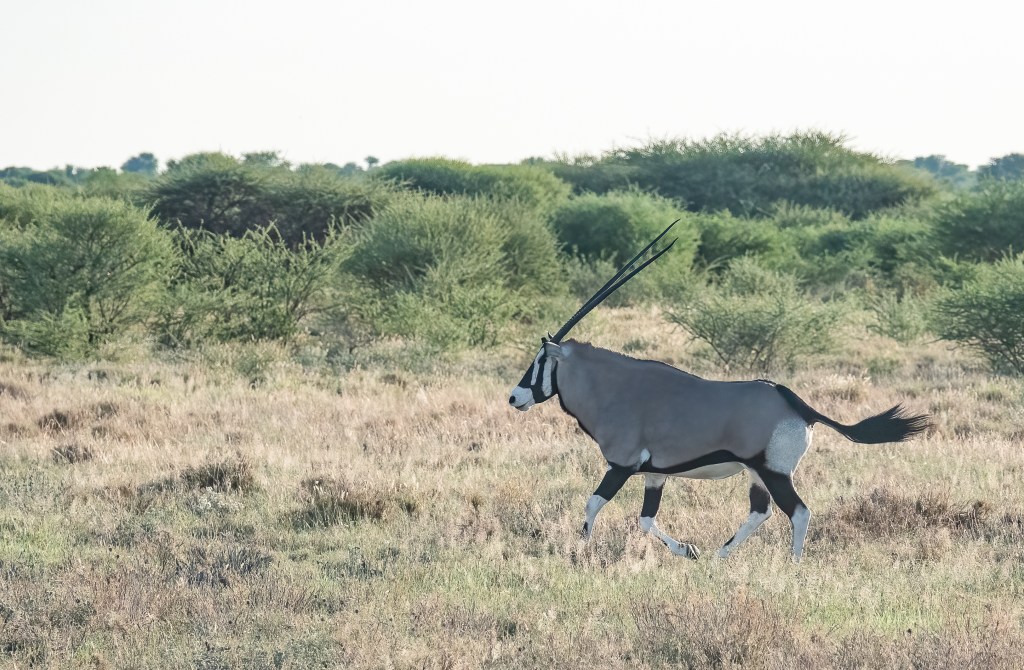
There are bigger mammals too; here is a splendid Gemsbok (aka Oryx):
And of course there are lizards. This is a breeding male Ground Agama, Agama aculeata:

After a few minutes those bright red spots faded and the head coloration also shrank and dimmed:
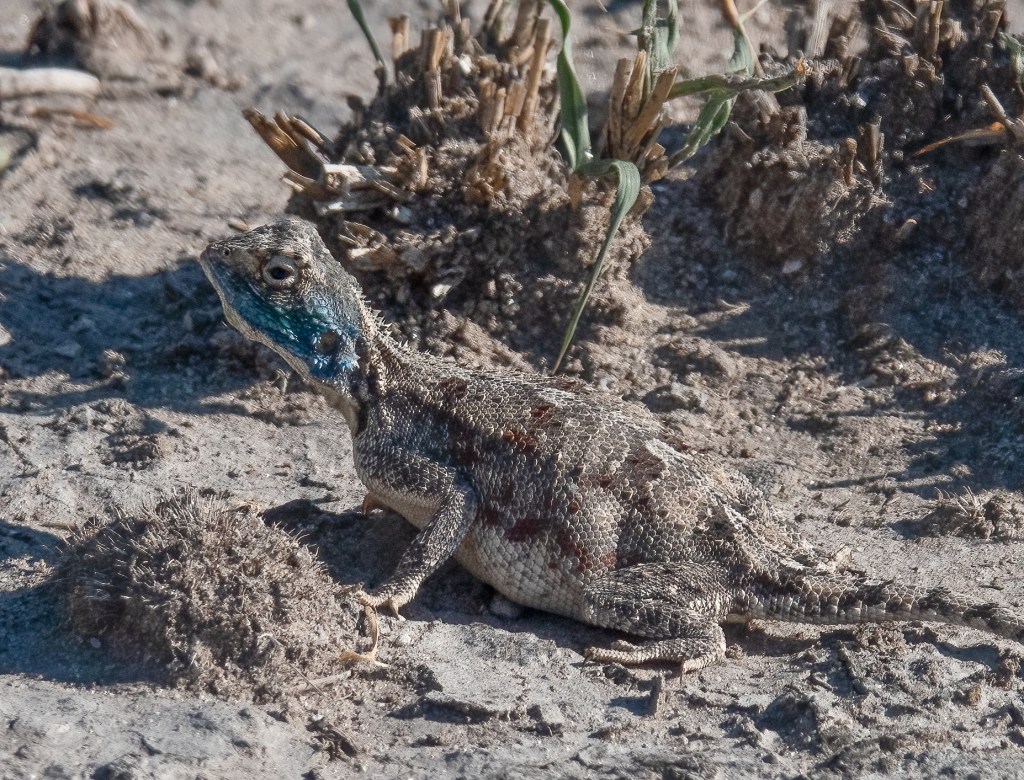
The brighter colors are probably associated with courting or excitement, but they make the lizard more conspicuous, so when it is not courting the colors fade. Unlike chameleons, they are not thought to change to deliberately match the substrate, but once the colors fade it is astonishingly well-camouflaged:

Two birds to end with. The Lanner Falcon, Falco biarmicus, is a favorite of falconers. It preys on birds , some quite large, like ducks:

and a male Red-Backed Shrike, Lanius collurio, which winters here but breeds in Europe:

PS I usually give full credit to our trip organizers in these blogs, but this time I’m keeping quiet. Once they knew of our plight, they handled everything very well, and we would travel with them again, so I don’t want to give them a public negative review.
 Eyes on the Wild
Great pictures in spite of dryness, lack of sleep. And food!!! Anne
>
LikeLike
Wonderful story well told!
Sent from Outlook for iOShttps://aka.ms/o0ukef
LikeLike
(3rd try: yesterday, this am & now). Apples keep Lions away! Wine & biscuits…& glasses? Next time pack cheese! Shrike picked a precarious spot to land.
LikeLike
What an adventure. I don’t think you’ll be using that safari company again. Bx Briony Bax MBEhttp://www.saidiacharity.org
LikeLike