Before I leave the very dry regions of the Makgadikgadi and then the Kalahari, let me share a few more delights.
The Leopard Tortoise has a beautiful shell, both top:

and bottom.

We started to speculate as to how the shell grows. One suggestion was that, like a lobster, it sheds its shell and a new bigger one is waiting underneath. No. In fact, each scute grows outward in rings. The tortoise’s bony shell is attached to the spine and ribs, so just as bones grow when a child grows, so do tortoise shells. The keratin scutes are a covering, and they too grow with the animal, just like our fingernails do. This shell of a dead tortoise has lost some of the keratin scutes, so you can see the bony carapace underneath.

When the tortoises are young, up to 6 or 7, counting rings gives you their age, but after that they may grow a lot in good year and not at all in a dry year, so it is an unreliable gauge.
Moving on, there were butterflies, some extracting minerals from elephant dung,

others more photogenically on flowers:

There was an amazing species of enormous beetle, in both places, which our guide told us was a Blister Beetle, and shouldn’t be touched (though in fact he picked one up). On my return, I identified it as a quite different, and harmless, species, the Giant Jewel Beetle, Sternocera orissa . Here is one feeding on acacia:

and here it is on our guide’s hand, to show its size (about two inches).

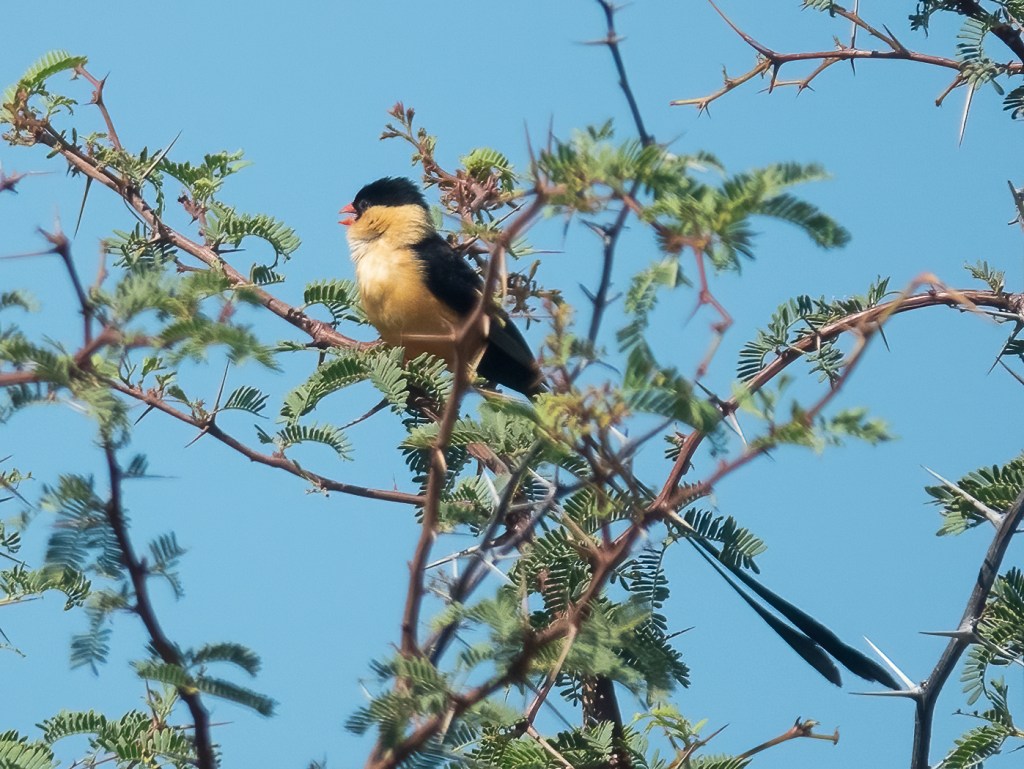
The male Shaft-tailed Whydah, Vidua regia, in breeding season is a small but spectacular bird, with 20cm tail plumes twice as long as its 10cm body:
And I’ll stop there, without showing you the Bateleur eagle or the black-winged kites or the ….. so much to marvel at.
 Eyes on the Wild
That carapace is amazing!
LikeLike
The tortoise bottom shell looks like a lovely quilt!
Thanks
LikeLike
‘marvel’ is the key word to all your animal adventures
LikeLike
That is really fascinating. The bit about the square patterns on the shell almost feels like April 1st! But it clearly isn’t. Thank you for another enjoyable read.
Mary
LikeLike