The wondrous diversity of the insect kingdom is under threat as our environment changes and shrinks (from an insect’s perspective, anyway). But I still find new ones all the time. Today I’m going to be disciplined, and restrict myself entirely to beetles. Just when you think you’ve seen them all, along come four new beetles all at once.
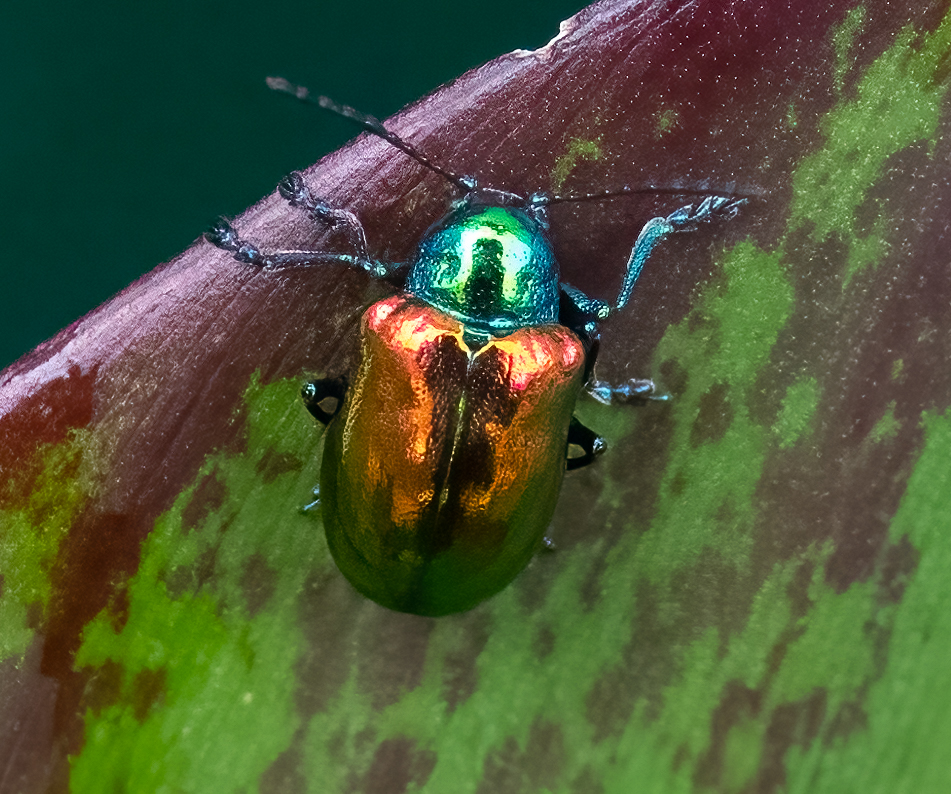
The Dogbane Leaf Beetle, Chrysochus auratus, a fragment of polished stained glass, is about 10mm long:
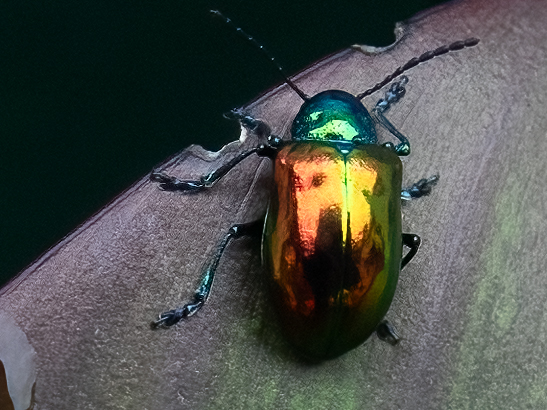
The color is structural, and varies depending on how the light hits it:
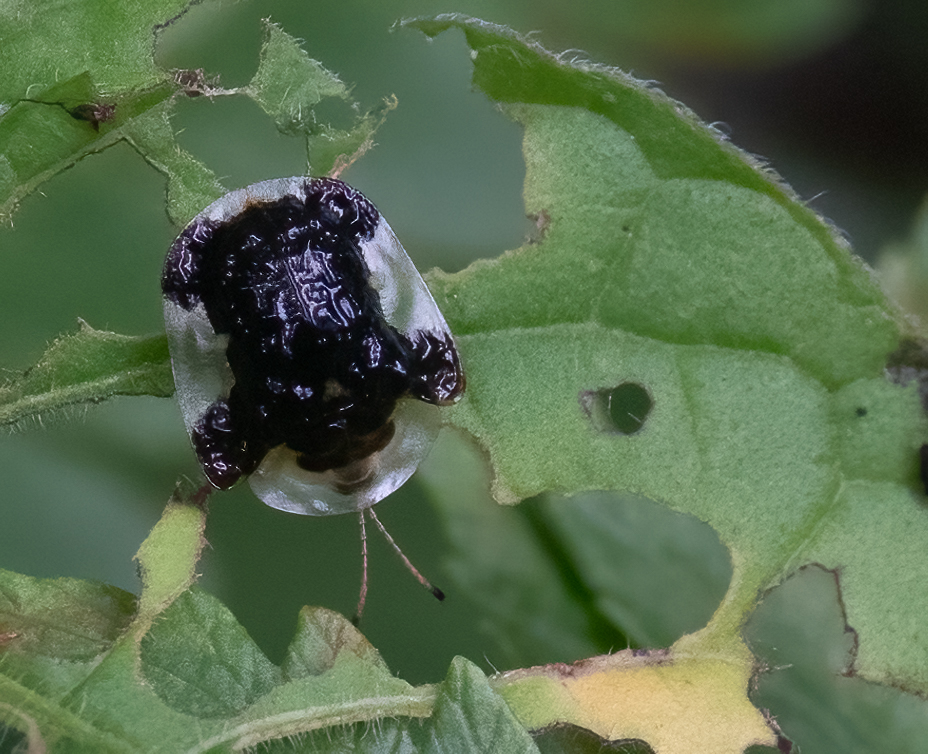
The Clavate Tortoise Beetle, Plagiometriona clavata, looks for all the world like a tiny 7mm long teddy bear. Its translucent carapace totally covers its body and legs, so it looks just like a tortoise. It has also been described as looking like a World War 1 US infantry helmet! In life, they’re brown or green, but turn black when dead, though I could swear it moved its antennae.
The Swamp Milkweed Beetle, Labidomera clivicollis, sports a smartly tailored livery of orange and black:
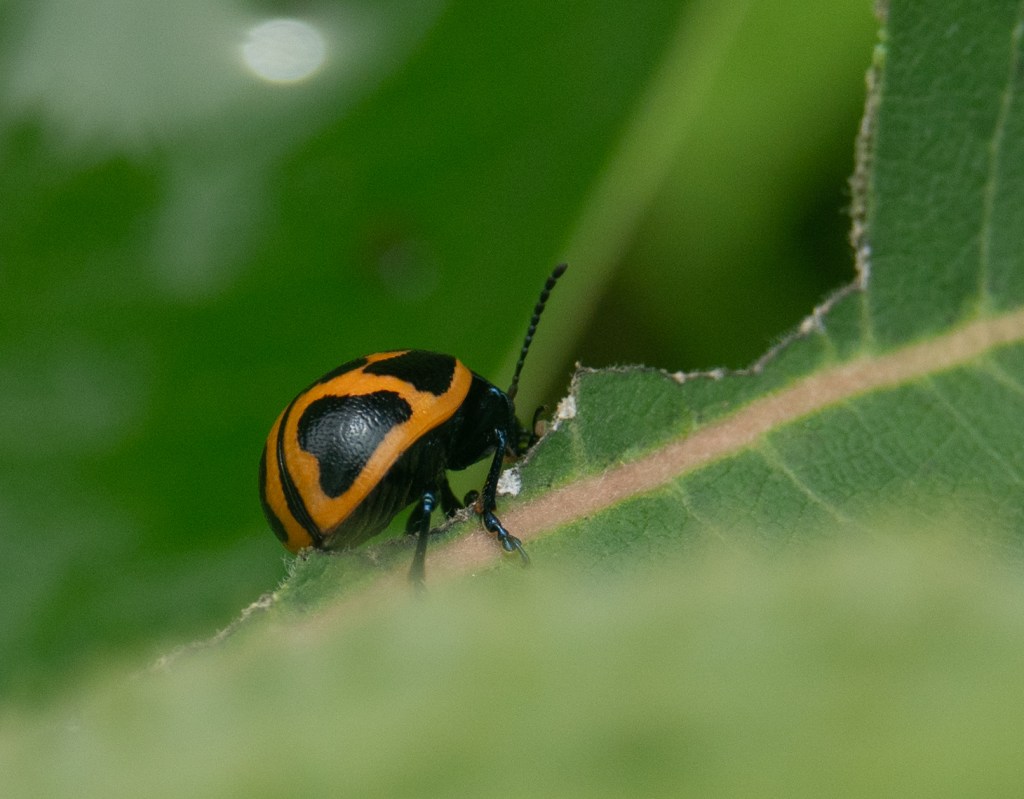
These 10mm beetles are adapted to the poisonous milkweed leaves, but even so they eat the leaves from the outside in, avoiding the main veins. Some reports also say that they first sever some of these veins to reduce the sap flow. They’re not exactly camouflaged (!) but that aposematic coloring warns predators that they may not be good to eat.
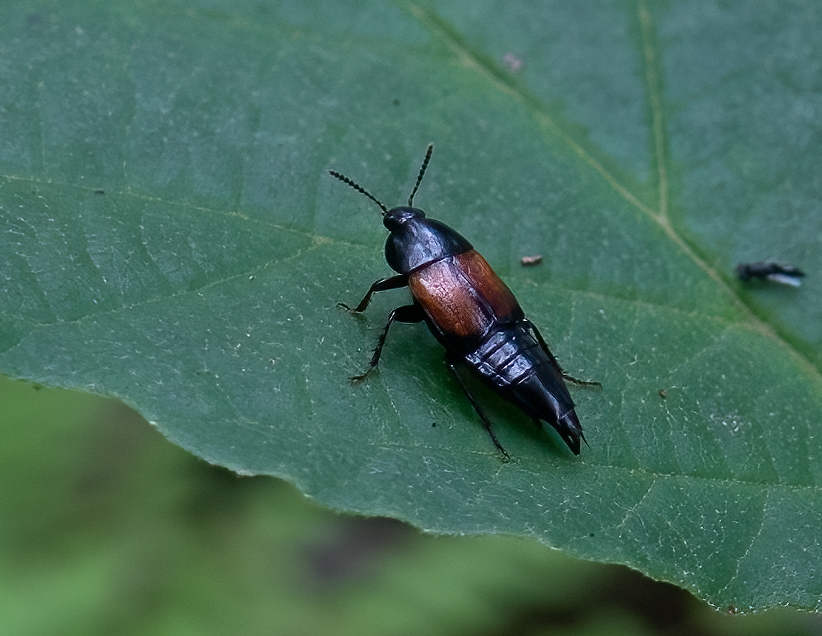
The Crablike Rove Beetle, Tachinus fimbriatus, has wing cases (elytra) that cover only half of its wings and abdomen, which stick out the end, unprotected. It measures about 9mm. There are thought to be around 66,000 species of rove beetles, dating back to the Triassic, and they are mostly predators. This particular one feeds on rotting mushrooms.
PS My title is taken from the great scientist E.O. Wilson, who said: “In the intricate dance of nature, insects are the choreographers of biodiversity.”
PPS The Dogbane Leaf Beetle turns out to have fascinating adaptations for its specialized diet of dogbane leaves. Read more here:
 Eyes on the Wild
Hi Moira. Brilliants photos, once again! I’ve found our Canon Digital Rebel camera with a big zoom lens, so I’m hoping we can start to find interesting fauna to photograph. I’ve seen one beetle recently – the Eastern Hercules (https://www.pubs.ext.vt.edu/content/pubs_ext_vt_edu/en/ENTO/ENTO-148/ENTO-148.html); it was honestly hard to miss him. We also saw a Luna moth (same link as above) – truly huge and impressive. -Paul
LikeLike
(2nd time writing a comment…) Great close-ups! Bugs, beetles & insects are such an interesting group. I’ve had the Tortoise beetles on 🍅 plants…they munch little round holes in the leaves.
LikeLike