[I have (as you’ve noticed if you read this regularly), been obsessed with my Chile trip, but in January while my Chile blogs were still in full flow, I went to Spain on a different mission, so I thought I’d take a week off from Chile to show you why.]
This post has been planned for a few weeks, but after my previous post it just couldn’t wait any longer ! In case you missed it, I saw my first bobcat on my beaver pond in Maine… read on.
There are four species of lynx in the world. Where I live in Maine, we have bobcats, which are technically lynxes, (Lynx rufus), and the Canadian Lynx (Lynx canadensis), which seems to moving back into some areas of the state. In Europe, there are two other species. The European Lynx (Lynx lynx) is found in northern and eastern Europe and eastwards across northern Asia. But the rarest of all is the Iberian Lynx, Lynx pardinus, found only in Spain and Portugal. I really wanted to see this, and you will understand why when you see their tufted ears and endearing facial ruffs:
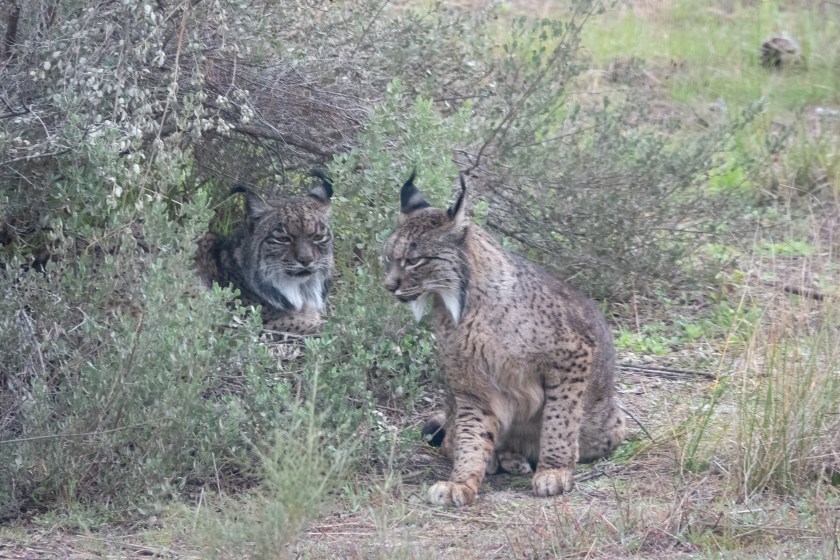
In 2002, the Iberian lynx was on the verge of extinction, with only 94 individuals left in two isolated subpopulations in Andalusia. It was considered the most endangered feline in the world, classified as Critically Endangered by the IUCN.

A hugely successful conservation program, focussing on improving habitat, restocking and keeping healthy their main food of rabbits, and a breeding and reintroduction program, means that now there are over 2000 in the wild, and in 2024 they were re-classified by the IUCN as Vulnerable.
These two small areas are still the best chance to see them, so that is where we went. We started in Huelva, in the Doñana National Park. On our first day, we had 180mm (7″) of rain, the most rain in 24 hours in eight years. Needless to say we saw nothing. The next day, most of the roads into the park were flooded, and again we saw nothing.

So on we went to Andújar, further north. First day, no lynx, but a group of lovely male mouflon.

On the second day, we heard that a lynx had been seen, and we roared off in the hope of catching it. Initially, no luck, but then someone spotted it, lying on a rock about 800 meters (nearly 1/2 a mile) away, circled.
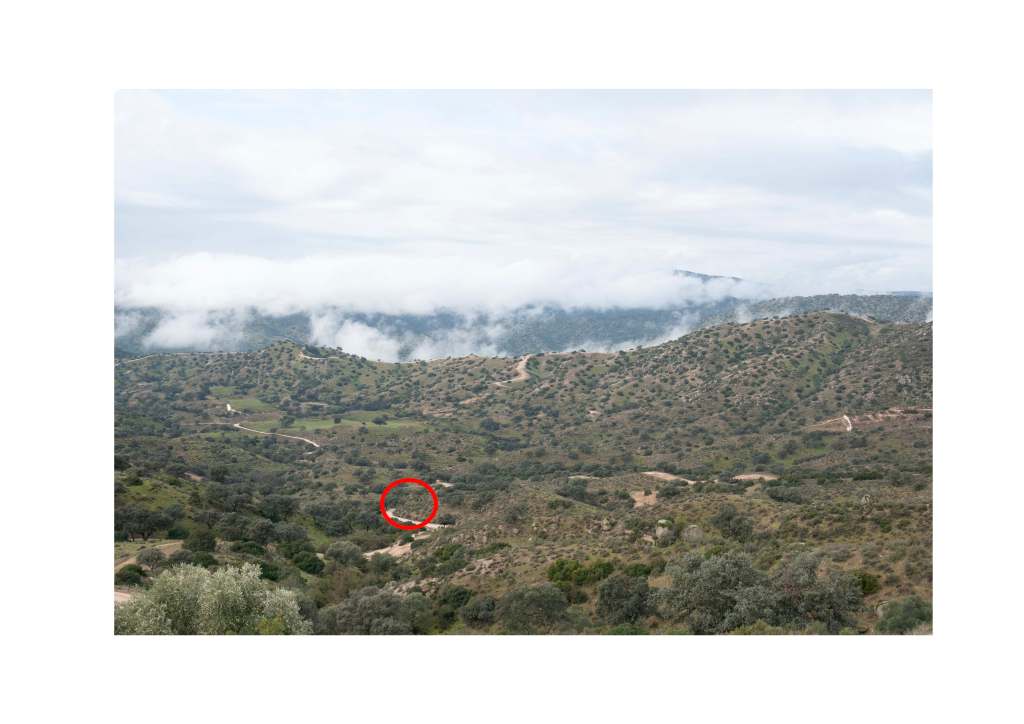
The dirt track and surrounding landscape is only open to rangers, so this was the closest we got. There was the lynx, lying on the rock facing away from us, with its head up. Here is my best photo (!); the black spot is the tip of its tail, and the two smaller black spots are the tips of its ears. .
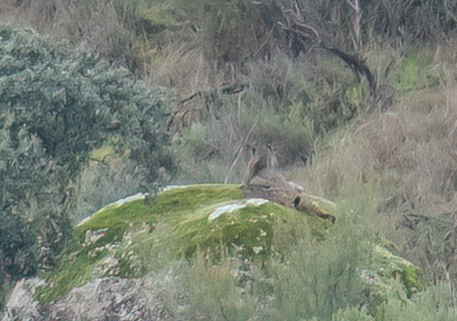
This was our only view in the wild, the fruits of four days of trying.
But … so as to keep the suspense up, I omitted to tell you something. In Doñana National Park (our first stop), there is a reproduction centre called El Acebuche that houses a pair of lynx in about 5 acres of wild countryside. Over the years, their offspring have been used to repopulate the area, so successfully that reintroductions are now being sent as far as Portugal. They’re aging, but still there. They hunt rabbits in their enclosed area and may not be seen for days. The centre is not open to the public, but our guide got us in, and we were very lucky. Not only were they hanging about near the viewing area, but they weren’t hiding behind a bush, and they weren’t asleep (though dozy!). These photos were taken through a pane of glass, under lowering skies, but I hope they give you a sense of these glorious animals.
This is Felix, the male.
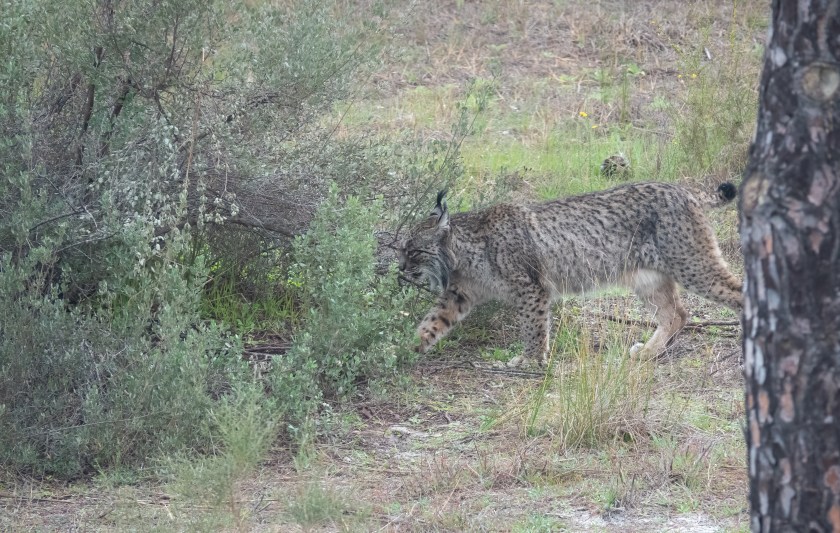
And this is Dama, the female:

They were deliberately chosen from the two different geographical areas, to mix the gene pools, but they seemed like a fairly contented couple:

Felix had apparently originally had another bride, and when Dama first arrived he was not initially friendly, which could be intimidating judging by these teeth:

Indeed, on one occasion while we were there he snarled at Dama, asserting his dominance:

and you can see how she cringed:
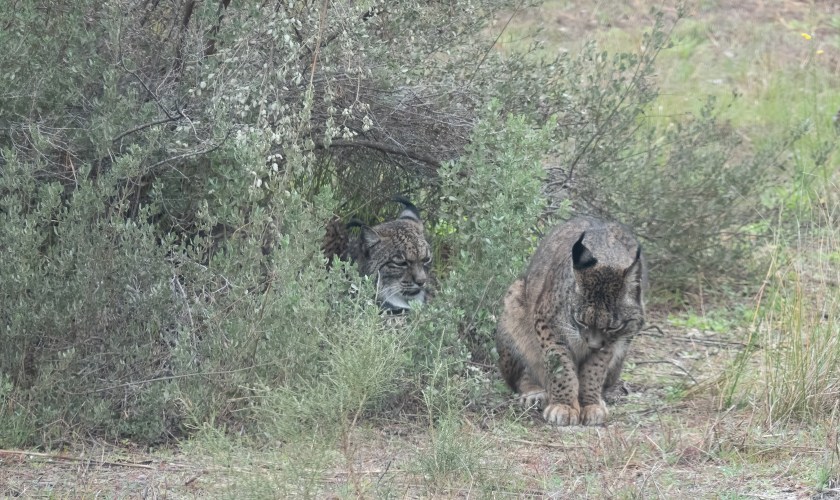
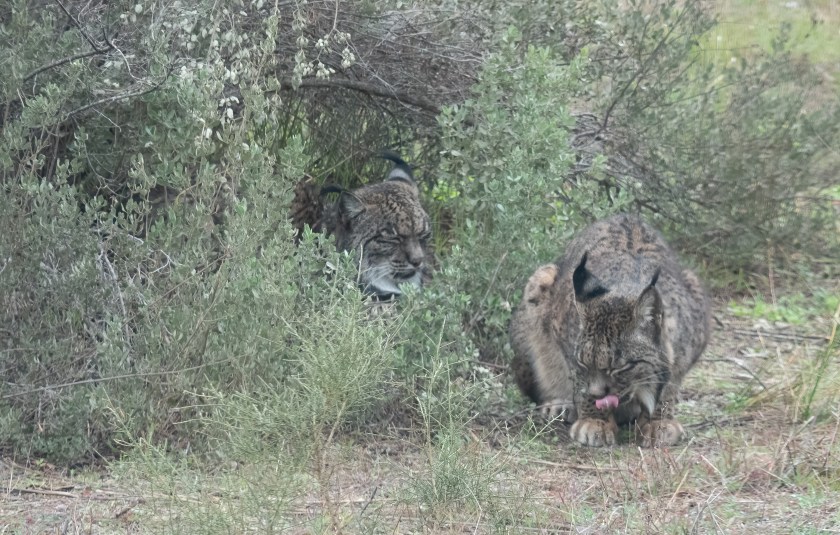
But she too can be fearsome, look at that glare:

They are not huge, the larger males can be up to 32″ long (not counting that stubby tail) and 35lbs in weight. But they can dispatch a rabbit with ease.


So, a partially successful trip, and exhilarating to know that sometimes animals can be brought back from the brink of extinction. If you’d like more technical details about how this was done, read this: https://www.researchgate.net/profile/Eduardo-Roldan/publication/382183227_The_Iberian_lynx_ex-situ_conservation_programme_from_birth_to_release/links/66911a173e0edb1e0fdebfff/The-Iberian-lynx-ex-situ-conservation-programme-from-birth-to-release.pdf?origin=scientificContributions
PPS Our trip was organized by Naturetrek, and our guide was Byron Palacios.
PPPS William Blake’s famous 1794 poem could equally well have been written about the lynx, it seems to me:
Tyger Tyger, burning bright,
In the forests of the night;
What immortal hand or eye,
Could frame thy fearful symmetry?
In what distant deeps or skies.
Burnt the fire of thine eyes?
On what wings dare he aspire?
What the hand, dare seize the fire?
And what shoulder, & what art,
Could twist the sinews of thy heart?
And when thy heart began to beat,
What dread hand? & what dread feet?
What the hammer? what the chain,
In what furnace was thy brain?
What the anvil? what dread grasp,
Dare its deadly terrors clasp!
When the stars threw down their spears
And water’d heaven with their tears:
Did he smile his work to see?
Did he who made the Lamb make thee?
Tyger Tyger burning bright,
In the forests of the night:
What immortal hand or eye,
Dare frame thy fearful symmetry?
 Eyes on the Wild
So amazing to see. What beautiful fur and markings. The photo of the little rabbit reminded me of the terrible cruelty of nature, ah, Life!
LikeLike
You must have been so thrilled! More wildlife adventures! In the first photo, the Lynx on the left looks very human, to me.
LikeLike