[In March I spent a couple of weeks in England visiting family and friends. I’ll do two or three posts about what I saw there.]
The common seal, aka the harbor seal, Phoca vitulina, lives along the temperate and Arctic coastlines of the Northern Hemisphere, in both Europe and North America. There are several colonies on the east coast of England, including a small one near friends of mine in Norfolk, where we stayed in March. And they are not hard to see up close. You just walk along a broad sandy beach for a mile or so, to where a small river opens into the North Sea, and there they are, asleep on the shore:

or doing nothing much of anything in the shallow water.
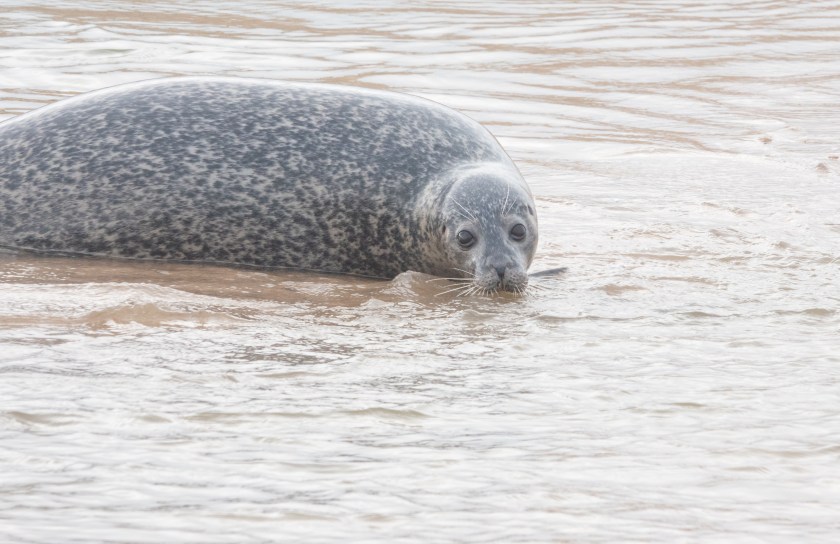
Like many sea mammals, they are adapted to underwater life. I went down a rabbit-hole of curiosity about how they sense their world, so this post is heavy on information and rather dull grey photos! What follows is mainly based on an excellent summary in Hanke and Reichmuth 2022.
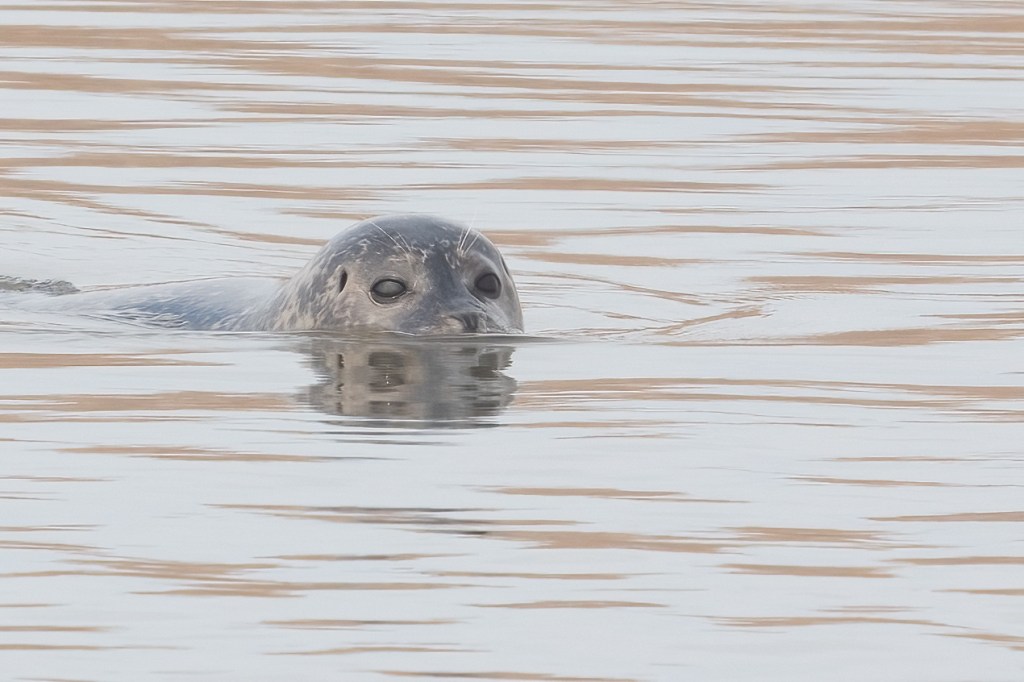
I’ll start with smell, then hearing, vision, and touch. Unlike us, they can close off their nostrils, and also their ears. In this first photo the seal’s nostrils, and also its ears (the little holes behind the eyes) are open:

In the second photo, its ears are still open, but its nostrils are closed:
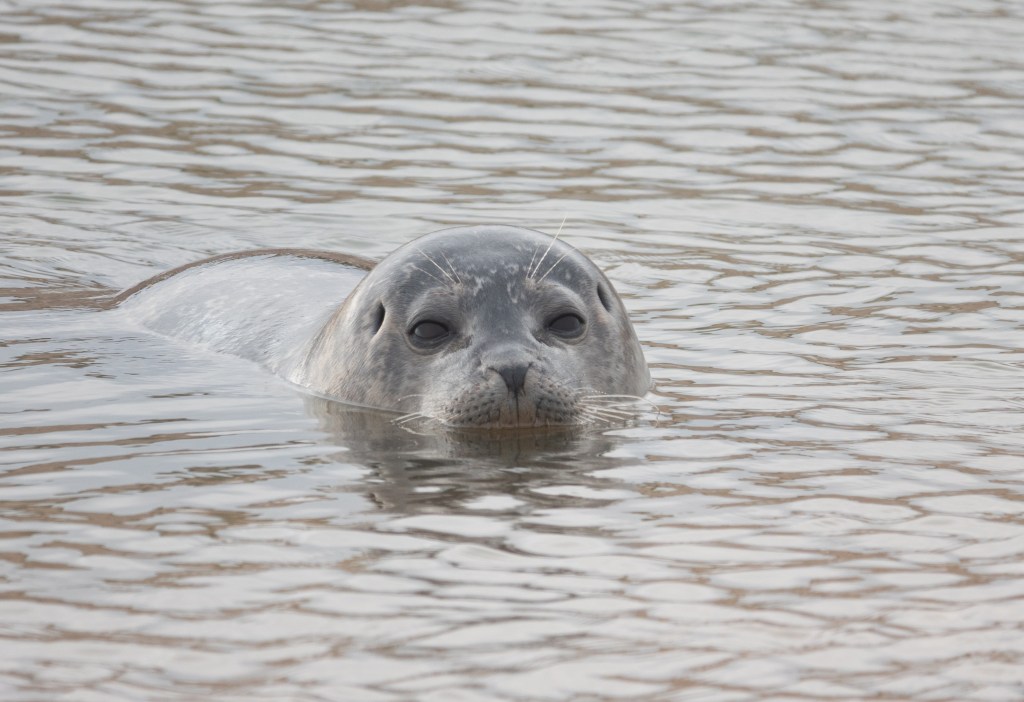
We have to hold our noses when we jump, into the water to get the same effect. Their sense of smell has been little studied, but there is reason to think they use it above water, but presumably not below, given the closed nostrils when they dive.
To show you the closed ears is harder, but in this shot both eyes and ears are closed; the eye slits are roughly vertical, and the ear slits are just below the eyes, roughly horizontal.
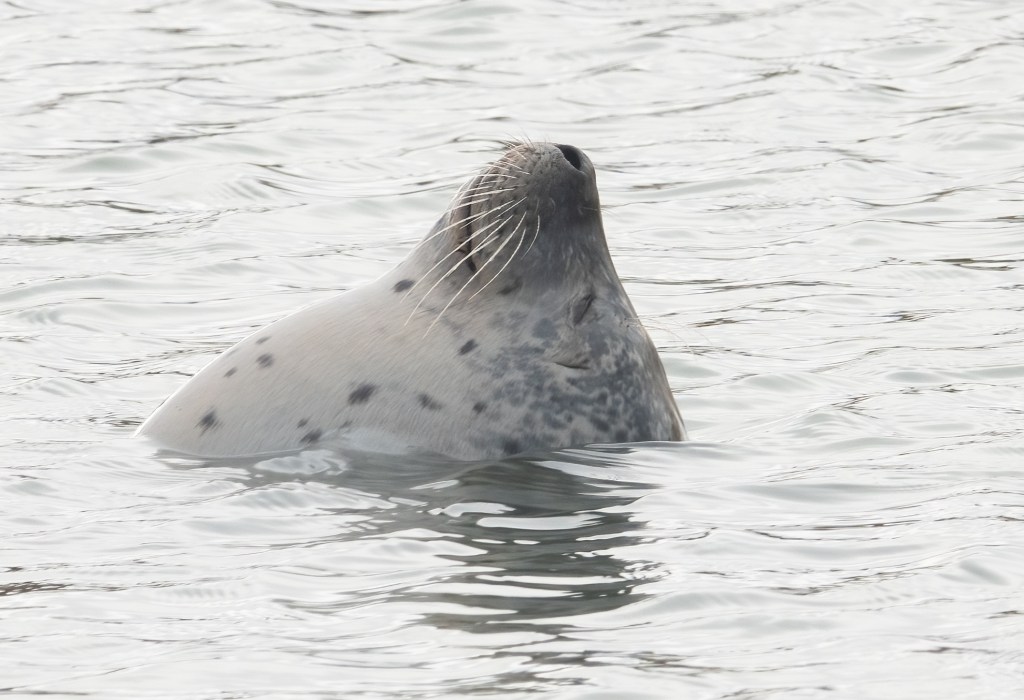
Unlike sealions their ears have no external flap (or pinna), making them more streamlined. Here is a sealion’s ear for comparison, notice the tiny backward facing flap, which can be sealed when diving:
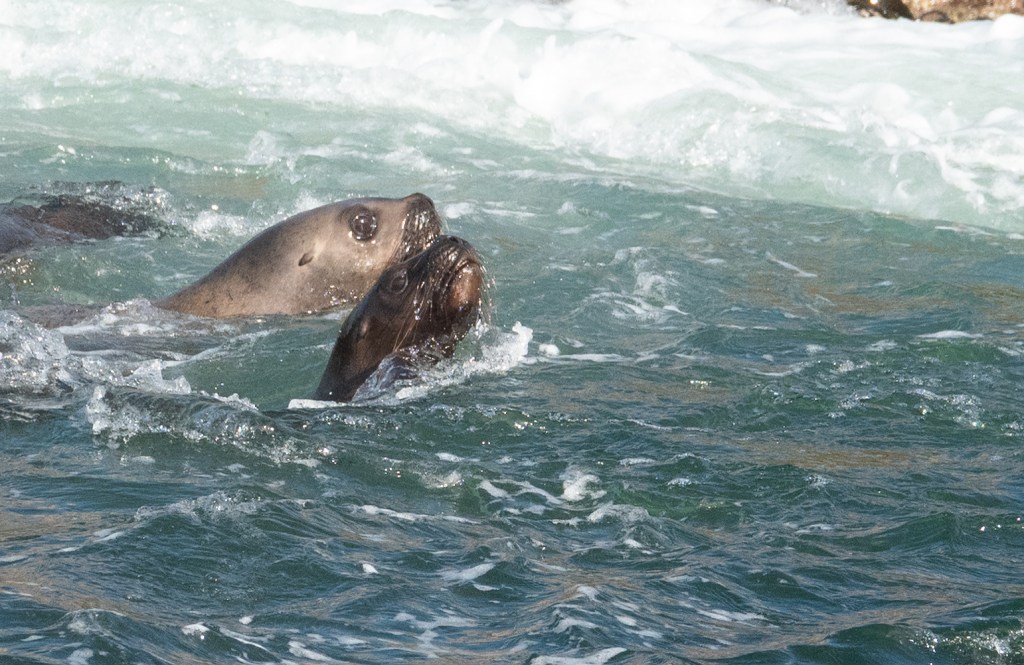
Even though seals close their ears as they dive, their underwater hearing is excellent, better than that of another set of (semi-) aquatic mammals, the sea otters. Presumably this is achieved through their bones and body tissues, straight to the inner ear. Their aerial hearing on the other hand is worse than that of sea otters, and also worse than that of true land carnivores. (Ghoul and Reichmuth 2014)
Their eyes are adapted for seeing clearly both in air and in water. Their cornea has a special flattened front surface, which allows for the same refractive index in air and in water. To boost the light signal in dark conditions, they have a reflective layer behind the retina called the tapetum lucidum that amplifies the light. They must also deal with big light variation, so their pupils can dilate in murky water by a factor of 70 (compared to our human ones, which only change by a factor of four), and shrink in bright light to the size of a pin, and thus invisible in the photo below:
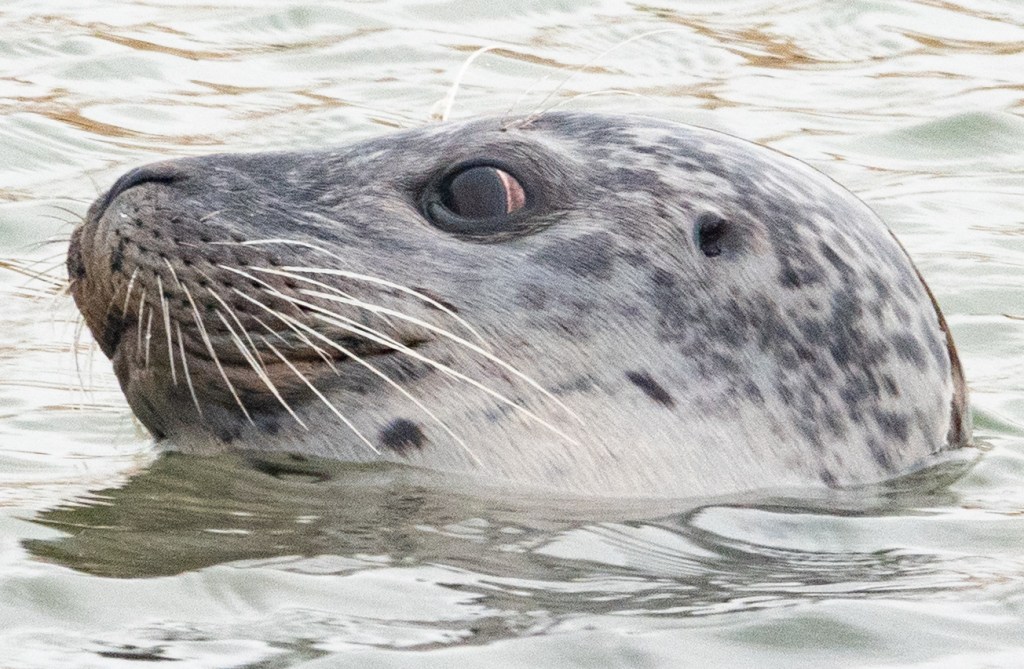
But what my grandchildren would call their “super-power” comes from their whiskers, or vibrissae, up to 100 on their noses and more elsewhere. In addition to exploring the world through touch, these can sense both the dramatic vortex currents caused by a suddenly fleeing fish, and the subtle waves created by a breathing but otherwise motionless flatfish.
When they yawn, their teeth are impressive , giving them a good grip on a fish, and the ability to crunch it up, bones and all.

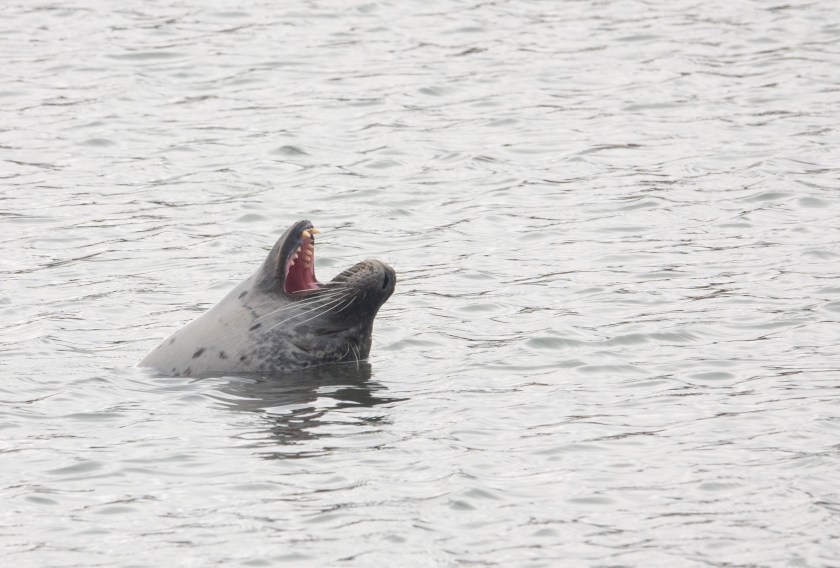

One last adaptation. Although their front feet are webbed for swimming, unlike sealions they have protruding claws that can be used to hold fish: (Hocking et al 2018).

They sleep on the sand, but they also sleep in the water, vertically, in a stance called “bottling”, which I found quite charming:

They’re soothing to watch, positively soporific on land or in the shallows. They often lounge around in a sort of banana stance:

This one was disturbed by an approaching smaller seal:

Another one was quietly wallowing, splashing around occasionally in a reaction to other nearby seals, which counts for highly energetic behavior by slumbering seal standards:

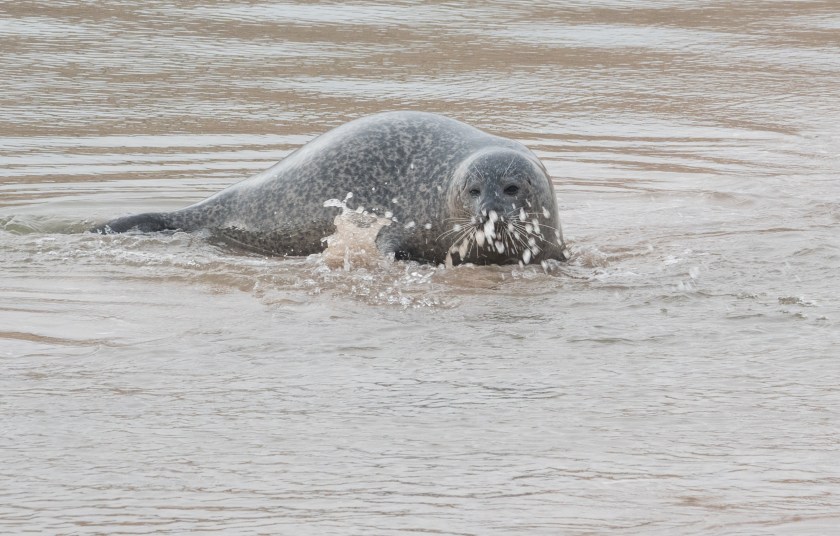

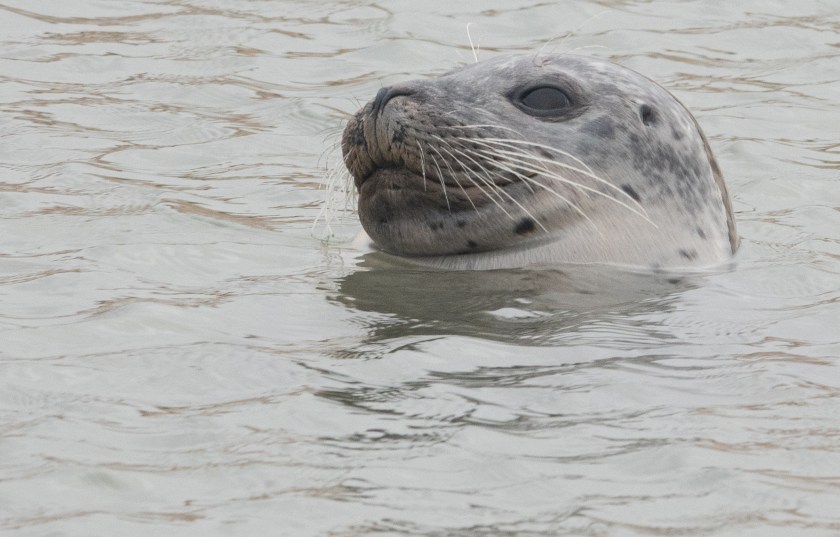
But they are also inquisitive, waking up enough to give me the eye:
 Eyes on the Wild
Such incredible photos, especially the face!
LikeLike
Nice to see them in the wild. I remember watching the Seals at the Boston Aquarium 50 years ago. Great info about their adaptations.
LikeLike
Thank you for this excursion into seal science! They do seem less easily
spooked – perhaps less exposed to sharks and Orcas?
Did I ever tell you that in my teenage years I spent several summers
with distant relatives on a farm in Suffolk and remember trips to town –
Bury St.Edmonds – as well as to the “seaside” quite well? But there
were no seals then (1958).
H
LikeLike