The American Chestnut disappeared in a few short years after the chestnut blight, imported from Asia, killed about 4 billion trees in the early 20th century.
But every now and again one decides to regrow, and lo and behold a few years ago I noticed a very healthy-looking sapling on the edge of my field. By last year it was maybe twenty feet tall, and in full flower:
I have read that very few trees reach the flowering stage before succumbing to the blight, but perhaps I had a winner?
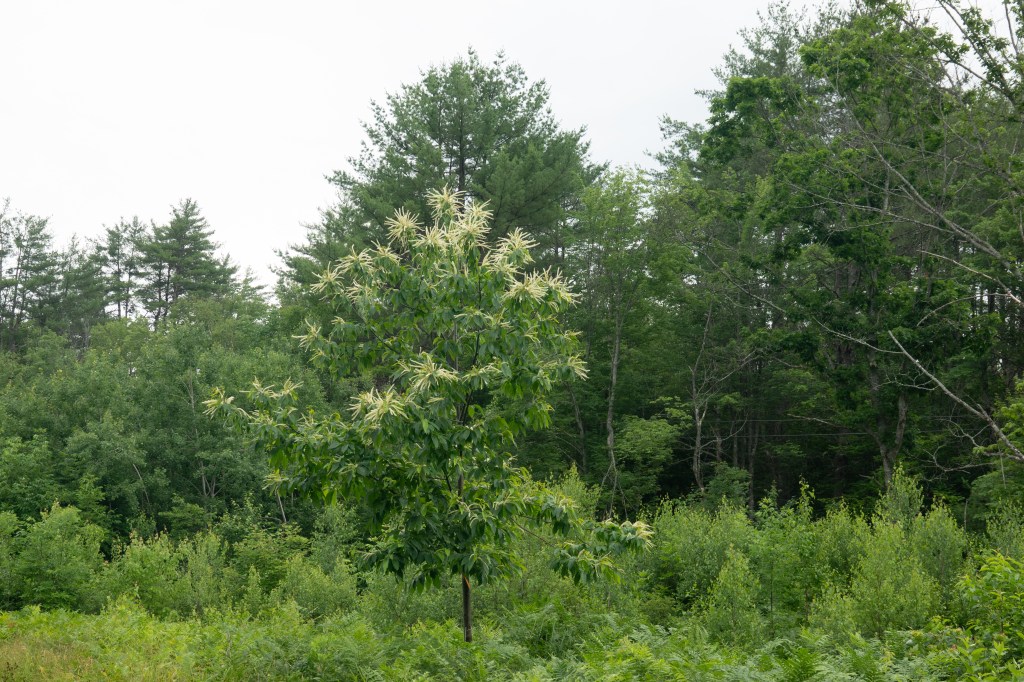
This year, it flowered again. The long creamy fronds are the male flowers, full of pollen that the Common Eastern Bumblebee gorges on. The smaller round prickly ones are the female flowers, which will eventually become the fruit.
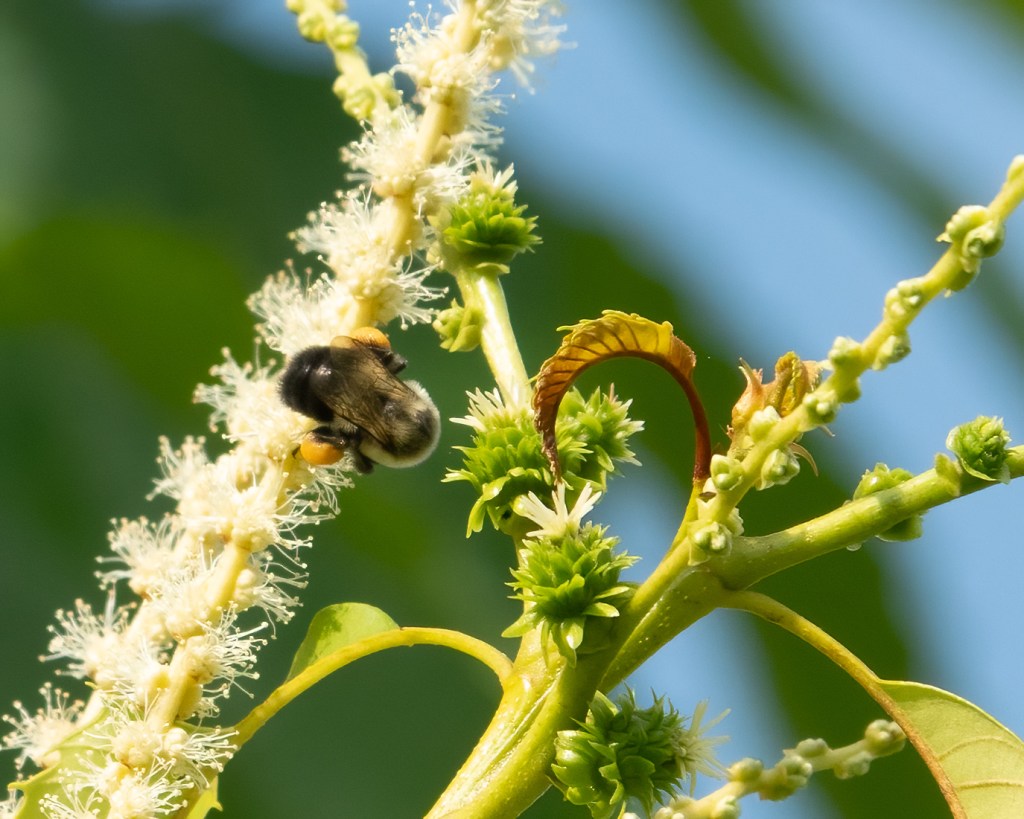


These photos were all taken on July 6th.
Five days later, on July 11th, the entire tree drooped:

Two days later, on July 13, it was moribund:

and three days after that, on July 16, it was dead.

The speed with which this fungus kills is horrifying. Ten days from healthy-looking flowers, to death.
The blight is a fungus that enters the tree through a small wound of some kind, creates a canker. Once it girdles the tree, it is doomed:

The trees send up suckers from the roots and the base of the trunk, and all of those below the canker were entirely healthy, but everything above it was brown and dead; the arrow points to the canker, and you can see healthy shoots in the foreground and to the left.

Most of my posts are (I hope) joyous, but this is a dispiriting tale of loss.
 Eyes on the Wild
I saw one flowering on a ridge in North Carolina a few years ago. I was so hopeful – but the speed of this at the edge of your field – so disheartening.
LikeLike
I feel bereft. I saw the blossom last year and was so hopefull. I had no idea this was so rapid.
Sorry for all.
LikeLike
I was just telling Catherine how much I look forward to your blog because it is so uplifting. Then I said “Let’s read Moira’s latest as a bedtime story”.
I think we’ll both be having nightmares involving 8 billion dead trees.
More seriously, we’re sorry to hear about your chestnut tree. It looked beautiful. We have watched documentaries about how they all died, and how the young ones die quickly, but the speed of your tree’s death is astonishing.
Sadly, I heard that efforts to create a disease resistant strain have failed after several years of apparently promising results.
LikeLike
Oh Moira! This is so sad. Your photos are beautiful. I remember a huge chestnut on our property growing up. I don’t see it anymore when I drive by and now I know why.
LikeLike
Incredible and scary, how quickly that fungus attacked the Chestnut tree. Beech Leaf Disease (BLD) is harming Beeches since 2012.
LikeLike
I am so sorry to see what has happened…..it was such a beautiful tree and hard not to hope that somehow it would be resistant. Stunning and scary how quickly it goes….. still important to document the good and the bad…!
LikeLike
Heartbreaking. Also, I could not figure out how to leave a comment. No box was responsive to my typing.
Dennis Smith
LikeLike
That’s shocking that it happened so fast. Such a valuable outlier of a chestnut, gone in a flash; what a loss.
Sad for you, Moira. For all of us really, but especially for you.
Joe
LikeLike
Just like our elms — they get to about twenty feet, then die fast. xx
>
LikeLike