Wild Bactrian camels, Camelus ferus, are found only in very small numbers now, maybe 800 only, in remote parts of the Gobi. We didn’t expect to see them and we didn’t. But we were very taken with the next best thing, domestic Bactrian Camels, Camelus bactrianus. They are not closely related to the wild Bactrian Camel, having diverged maybe 1 million years ago, and they too have two humps.
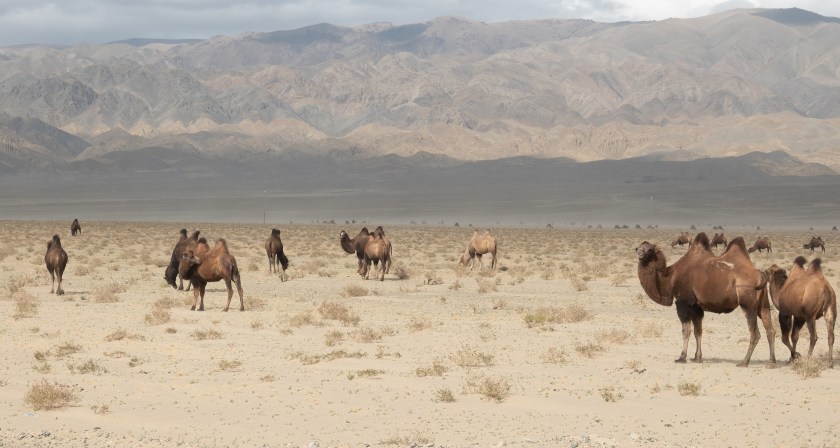
The humps are fat, not water, and a way to store energy. The Mongolian population totals around 400,000 domestic camels. They roam free across the stony steppes, doing a convincing impersonation of wild animals!

They’re big mammals, the largest in their natural range. Overall height ranging from 230 to 250 cm (7.5 to 8.2 ft), head-and-body length is 225–350 cm (7.38–11.48 ft). Body mass can range from 300 to 1,000 kg (660 to 2,200 lb). They can have a rather ungainly look, as if assembled by committee.


A family may own anything from a handful of camels to several hundred. A castrated male costs about US$400. The herds you see may belong to more than one owner. There are two young ones in the photos below:


When their owners want them, they are rounded up by motor bike: one is approaching in the background.

Our guide pointed out that they ride their motorbikes (and indeed drive their vehicles) pretty much as if they were still on horseback:

My friend Jane made a video:
Their adaptations to the extreme climate in which they so successfully live make them very valuable additions to human societies. They were domesticated around 4000BCE, and used as pack animals on the Silk Road, for riding, but also for milk, meat, hair, and leather. Gers (yurts) may have camelhair in their felt insulation, they may be tied together or packed up with camel skin ropes and bags, and moved from place to place on camels’ backs.
Their adaptations for their harsh home climate include long eyelashes, and nostrils that close, to protect them from sandstorms.

They have tough mouths, and can eat thorny vegetation. If desperate, they will eat skin from carcasses, and even rope, sandals and tents!

They can go without water for months at a time, but when water is available Wikipedia says they may drink up to 57 L (13 imp gal; 15 US gal) in one go. They also routinely eat snow for moisture, unlike most mammals.
A splendid animal:
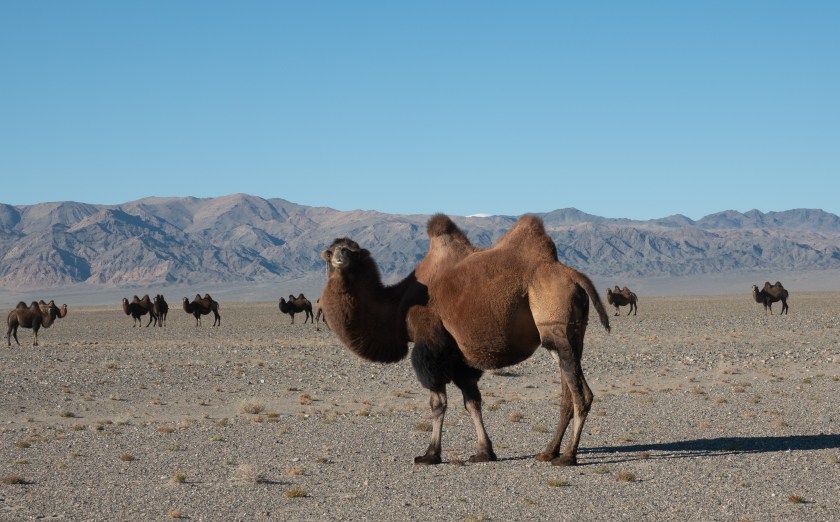
And their proud owners get together to race them at the annual festival; they ride them pretty hard, but I assume they recover, since they’re too valuable to risk their health:
PS The way to remember that Bactrian camels are the ones with two humps is that Bactrian begins with B, and placed on its side the letter B has two humps!


What an interesting animal! Imagine drinking that much water at a time…incredible. What about their sodium & potassium levels….must all work!
LikeLike
Really enjoyed all your posts from Mongolia. As a matter of interest, a man from Benenden, a village
LikeLike