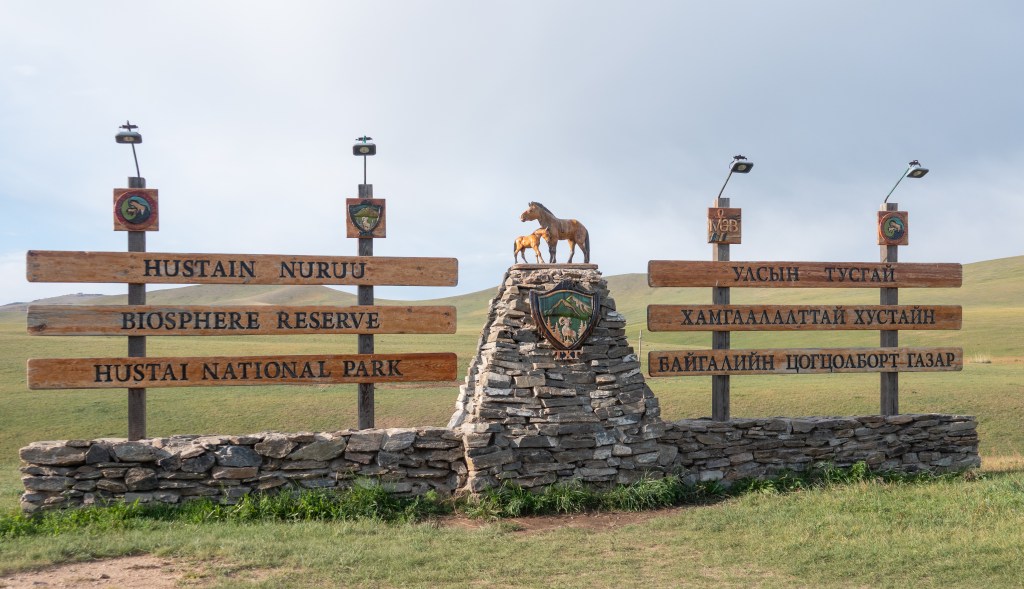
Our second major destination in Mongolia was Hustai National Park, less than two hours drive from the capital Ulaanbaatar, not nearly as isolated as the Altai, and at a lower elevation.
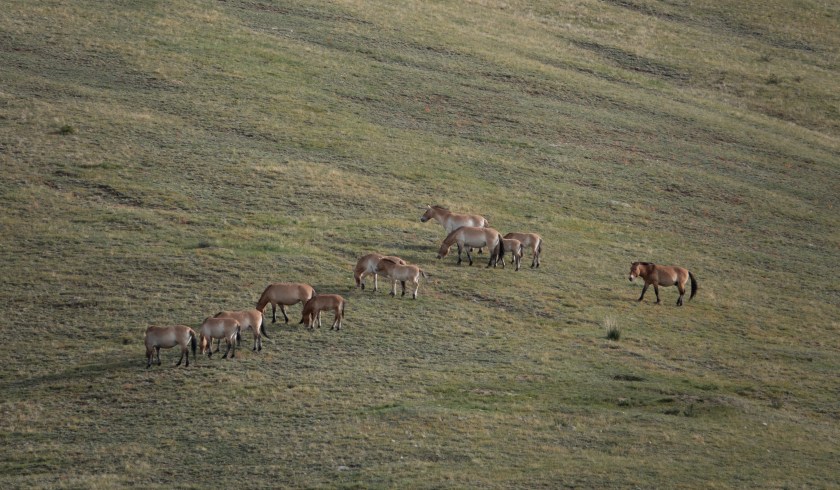
We had two main goals: Pallas’s Cat, and Przewalski’s Horse. Only the second of these wishes came true, and this post is about those horses, known locally as takhi. Below, from a distance, is a typical social unit: the stallion is at right, with two or three mature mares, and their offspring of up to three years old.
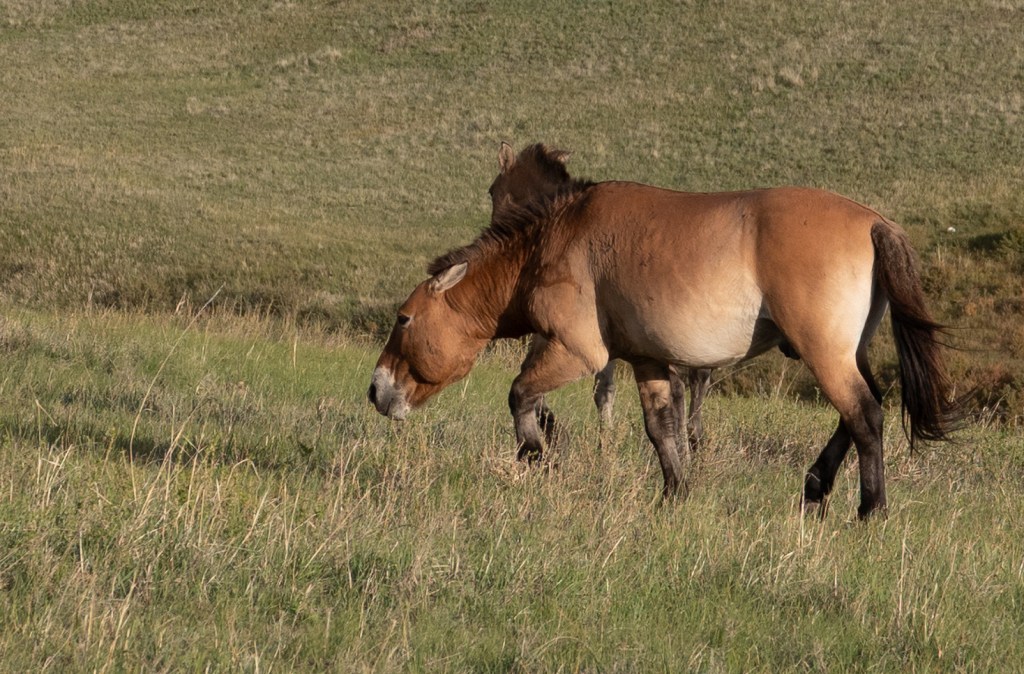
Closer up, these are handsome animals:
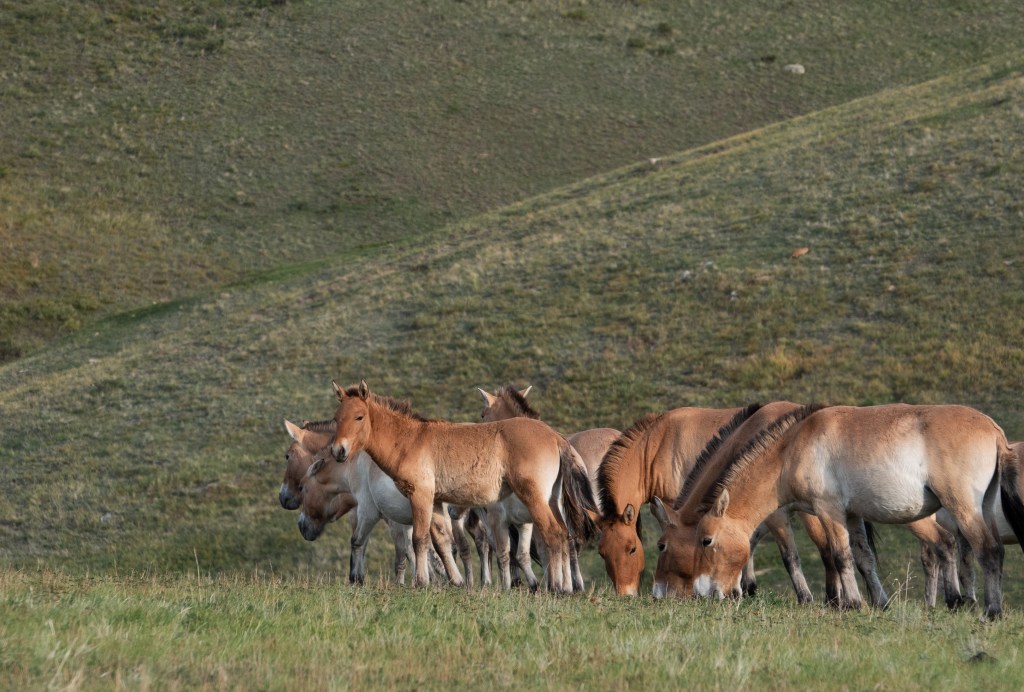
They are special because their lineage separated from that of domestic horses at least 38,000 years ago, perhaps as much as 160,000 years ago. They have 33 chromosome pairs compared to 32 for ordinary horses. Other “wild” horses are actually feral domestic horses, but these are truly wild. They were extinct in the wild, and were brought back from about twelve animals in zoos, re-released into their ancestral central Asian homelands. The total population is now thought to be around 2000 animals, of which around 120 live in Hustai National Park.
They are stocky, 12-14 hands high, and strong. They weigh about 300Kg.

The stallion keeps a close eye on his females and foals, making sure they stay together:

The affection between mothers and foals is evident:
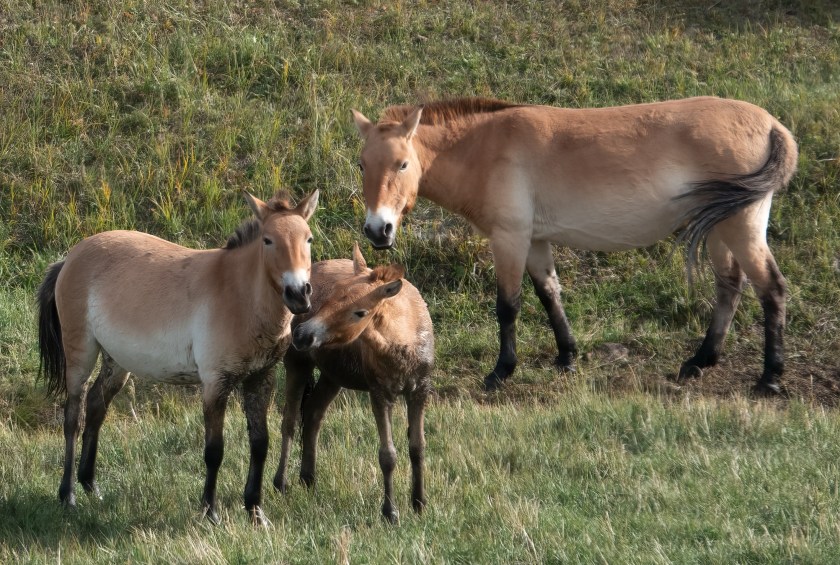

Przewalski’s horses have a distinctive appearance.
Their overall coloring is something called pangaré, in which there is pale fur around the eyes, muzzle, and belly. This is thought to be protective, and is found in other wild equines such as the African wild ass. Starting with the head, their profile is convex, not to say Roman:
and their stiff upstanding dark mane has paler hairs at the base, and no forelock:

At the rear, their back has a thin dark dorsal stripe, and the base of the tail (the dock) is longer than in domestic horses, while the tail hairs are shorter:

Finally, their legs have horizontal stripes, or bars, easiest to see on the forest of legs in the front group below:

All of these traits are instances of “primitive markings”, found in other wild equines and more rarely in domestic dun horses.
The painting below is from the Lascaux caves in France, dated to about 20,000 years ago, and looks remarkably like a Przewalski’s horse.

PS There are frequent incursions of herds of domestic horses from outside the unfenced national park. A domestic stallion is not strong enough to mount a Przewalski’s mare, so any foal she has will always be pure-blood Przewalski’s. The reverse is not true, so a foal born to a domestic mare could have been sired by a Przewalski’s stallion. The local herders thus encourage their herds to enter the park, and the rangers shoo them out again, in an ongoing game!
PPS For full details of the challenges of bringing back a diverse population from only 12 ancestors, see here: https://pmc.ncbi.nlm.nih.gov/articles/PMC9686875/

 Eyes on the Wild
very interesting to read about these Horses…descriptive & wonderful photos!
LikeLike
truly fascinating – that lineage. And the link to the Lascaux cave patio g. Thank you – as always
LikeLike