Frost Flowers

I’m going somewhere warm for the next couple of weeks, so while I’m away I’m arranging to send out this hopefully last seriously wintery blog post!].

Ice can look like diamonds:
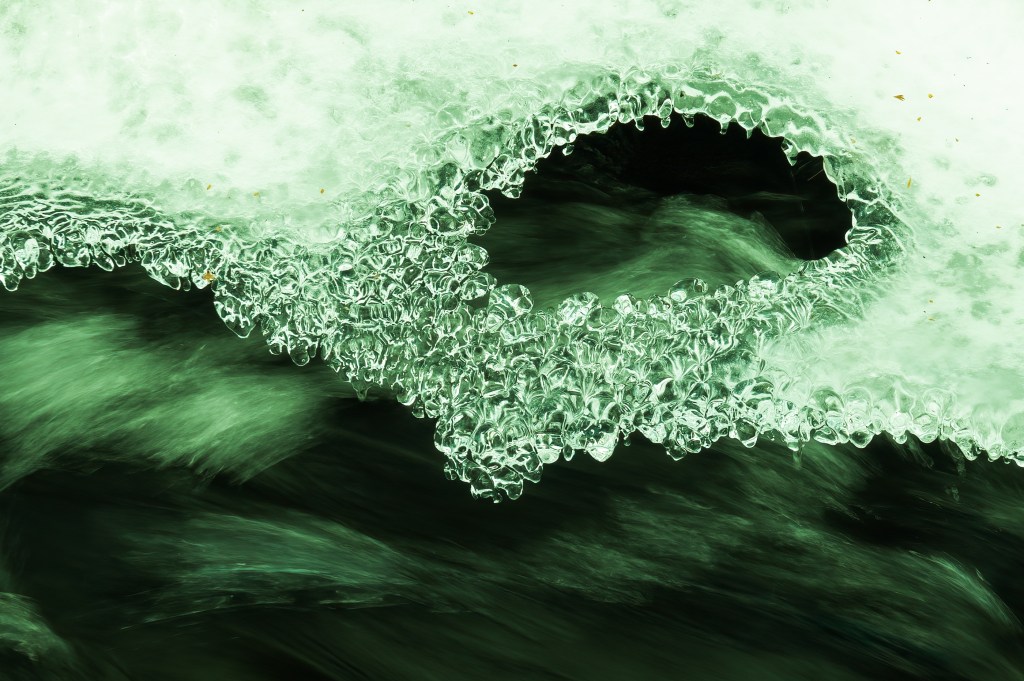
But its beauty can also be subtler: the physics of freezing is a transformative force. Some weeks later, and it had been very cold, -3F (-19C) at night. The stream was mostly frozen, and covered with snow, with only a few fast-flowing stretches still open.
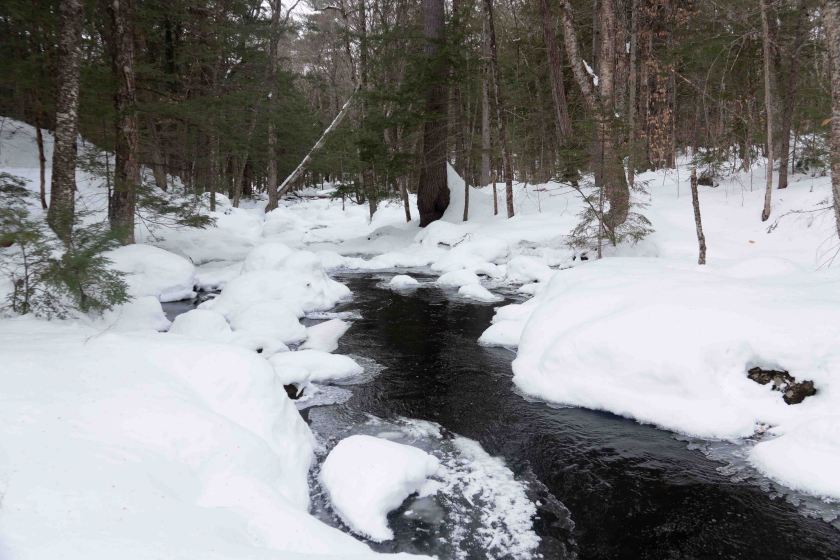
Where the ice meets the water, a new paper-thin layer of ice had formed, and this created the perfect conditions for the formation of frost flowers:
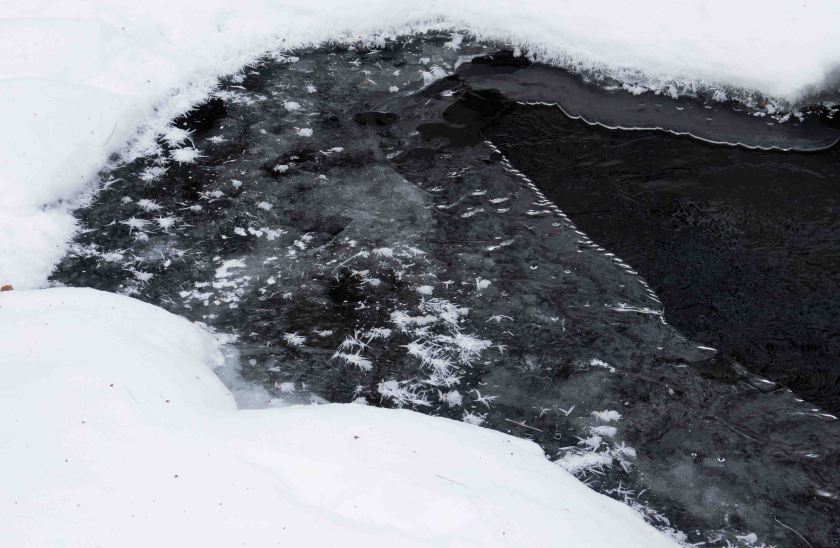
Here is a close-up:
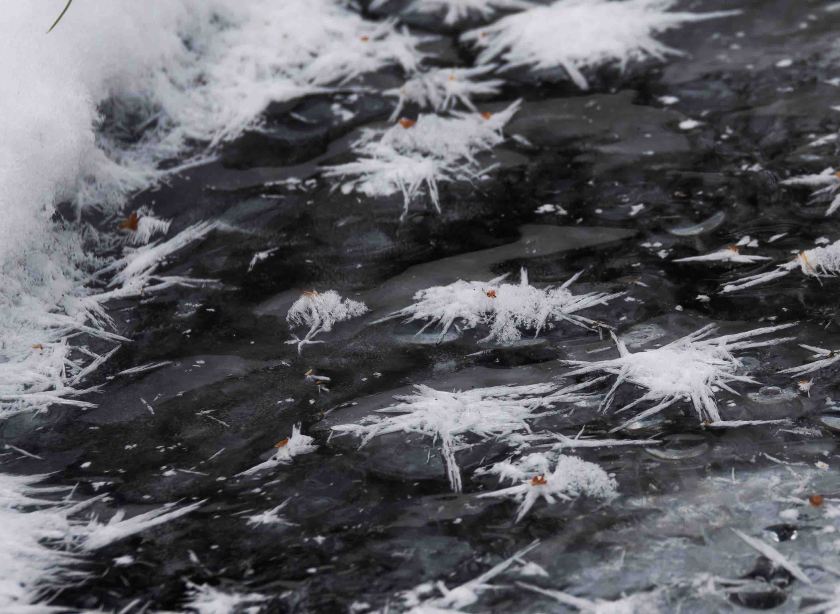
Wikipedia explains how they form:

“Frost flowers form when a layer of relatively warm ice is exposed to still, cold air that is at least 15 °C colder. For example, this would occur when freshly-formed ice at 0 °C underlies cold air at -30 °C.  In this situation, water vapor sublimates from the surface of the ‘warm’ ice. As this moist air rises into the colder overlying air, the temperature drops, and the air becomes supersaturated. The final result is a layer of supersaturated air, lying directly above the ice (just like how steam forms above the surface of a hot mug of water on a cold day). Any protrusions from the ice surface stick up into the supersaturated air, and end up being covered in hoar-frost like crystals (i.e. frost flowers) due to condensation. ….

Typically, frost flowers are only found on new ice, when the air temperature is very low. This is because thin, new ice has a temperature close to that of the underlying, warm water. As ice thickens, its surface becomes much colder, and it is harder to get the necessary ice/air temperature difference needed for frost flower growth. Over fresh water, these conditions are only found when the air temperature drops dramatically below zero in a short amount of time, leading to a sudden freezing event. “

The previous day at my house it had reached 30F (-1C), then dropped to -3F (-19C) at night: textbook conditions!

In one spot a small animal, probably a mink, had crossed from the bank onto the ice, spilling a little snow. These provided nuclei for the frost to grow:
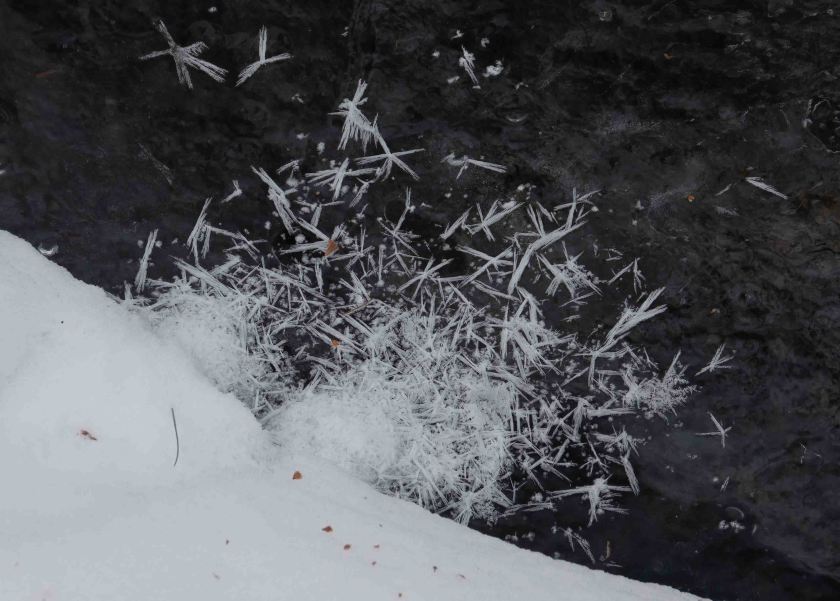
Closer up, they were lovely; I couldn’t get any closer without falling into the stream!
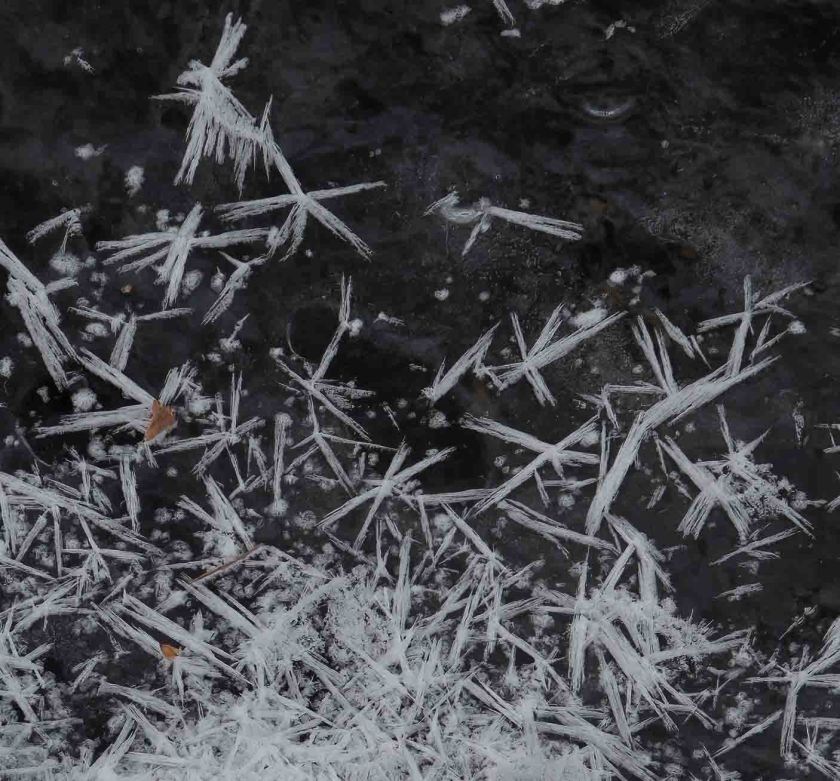
Frost flowers can be much more three-dimensional than these, which were fairly flat to the ice, but they were up to 3cm across, and still beautiful.
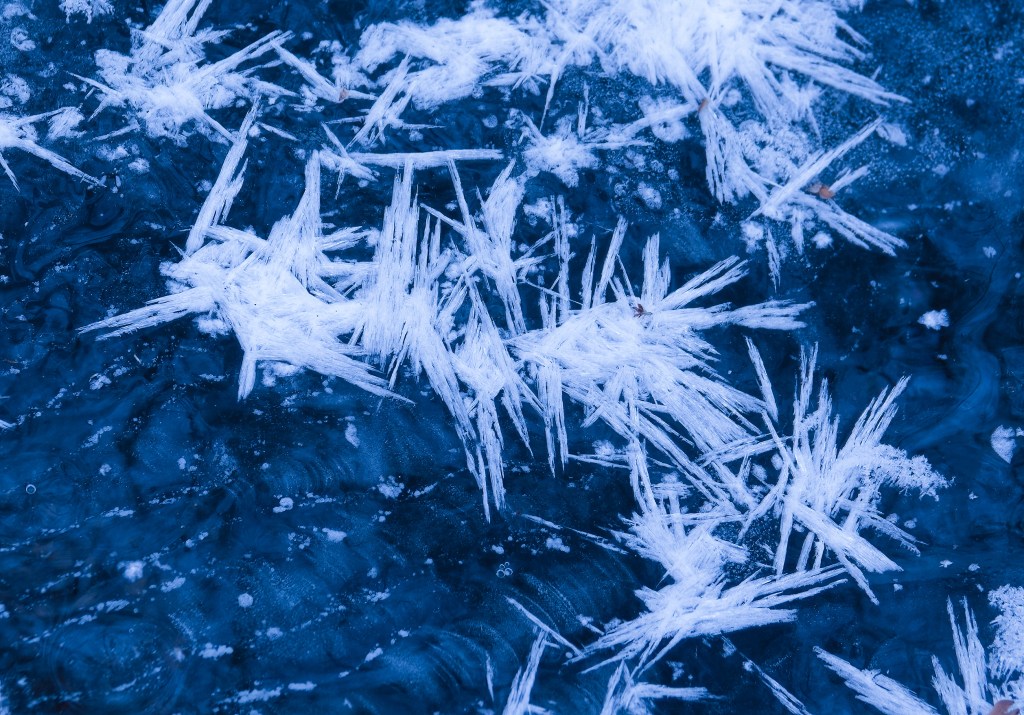
The next day they were gone.

PS In case it isn’t obvious, the colors in the first and last photos have benefited from a soupçon of digital manipulation, in the interests of art, if not science.
Vulgar Europeans

The European Starling, Sturnus vulgaris, is one of the commonest birds in the world. Native to Eurasia, it is now widespread in North America. Birds of the World tells the famous tale of how this came about: “All North American starlings are derived from 80–100 founders released in 1890 and 1891 in Central Park, New York City. This was sponsored by an acclimatization society headed by Eugene Scheiffelin—an effort to introduce all the birds mentioned in Shakespeare’s writings.” Extraordinary notion.

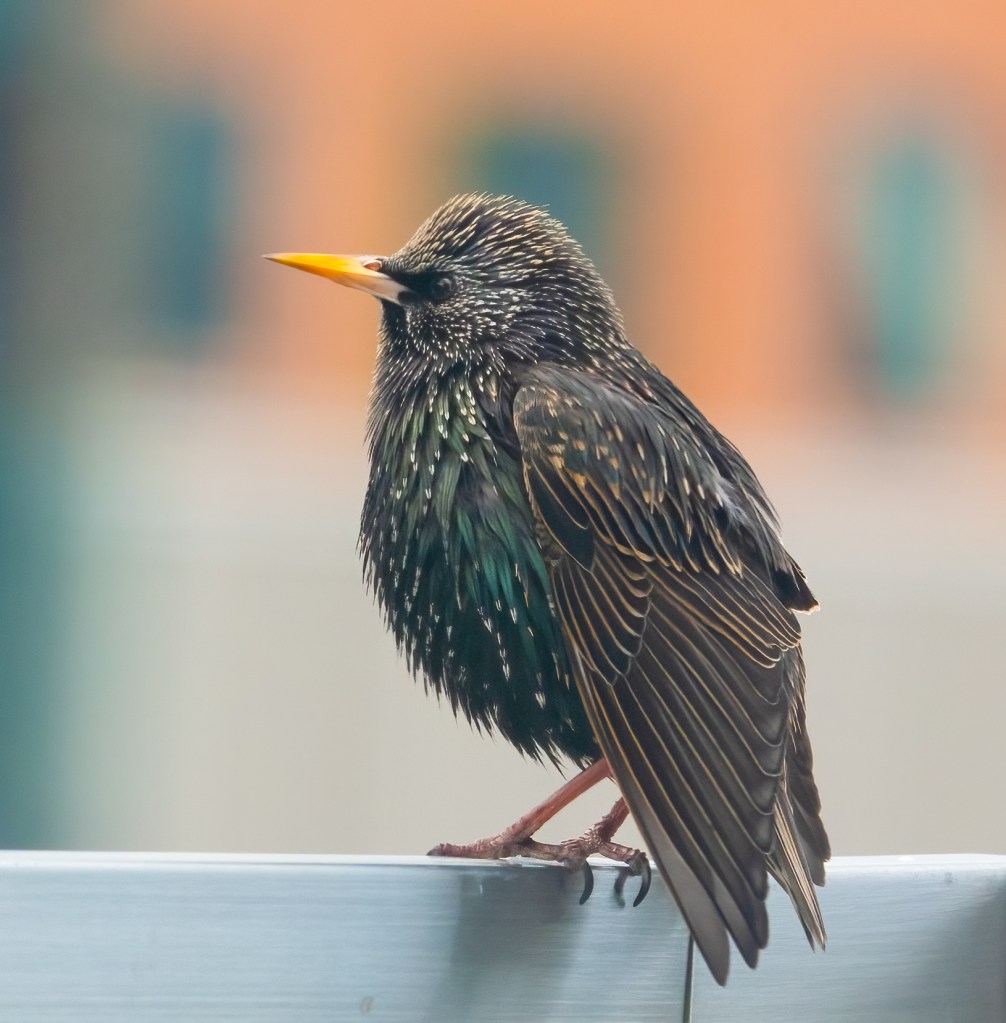
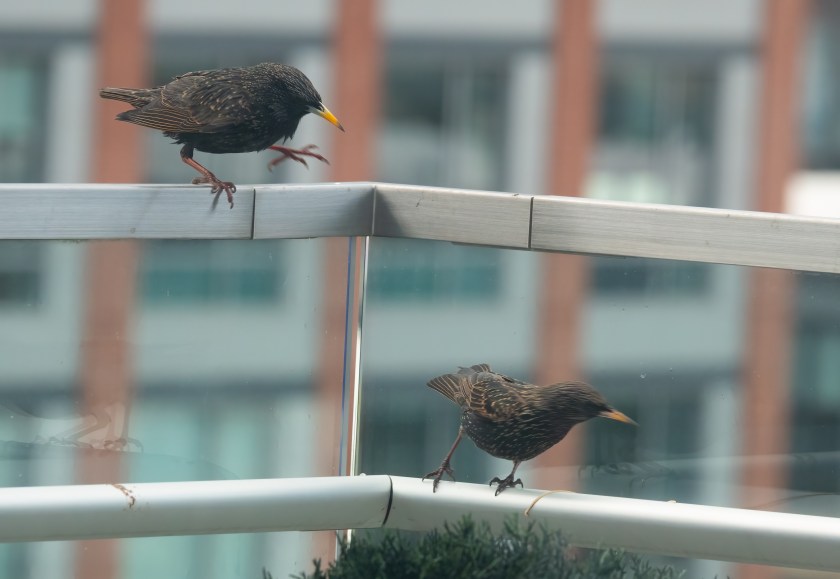
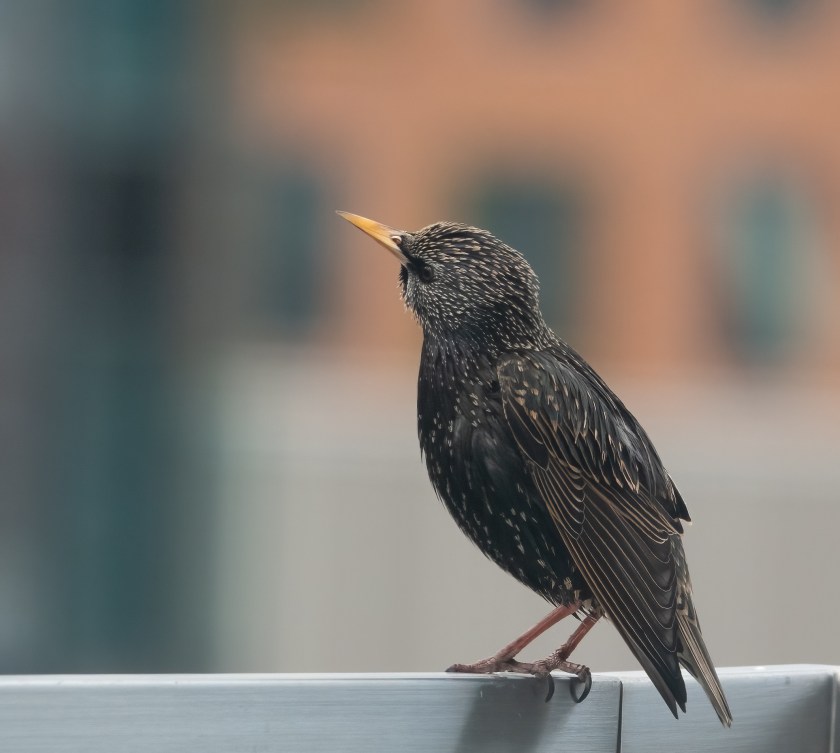
As I write here in Boston in nearly March they are beginning to socialize and will soon be nesting. As a child I thought of them as rather boring blackish birds, but that is not really fair. In their breeding plumage they are largely black, but with an iridescent sheen, and a yellow bill. This is a female, since the base of her lower bill is pinkish:

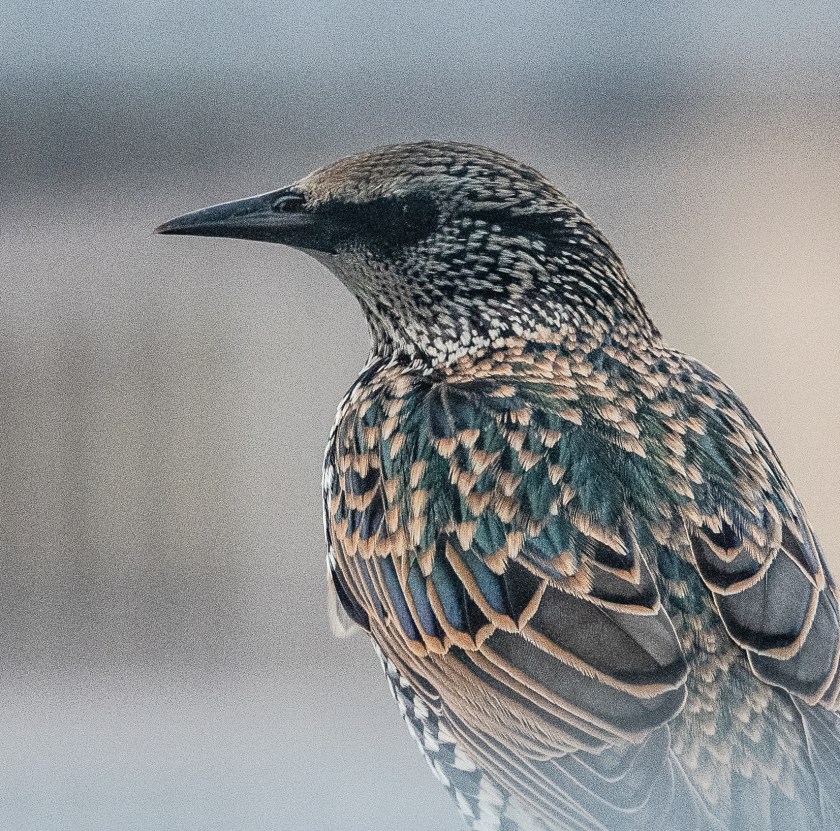
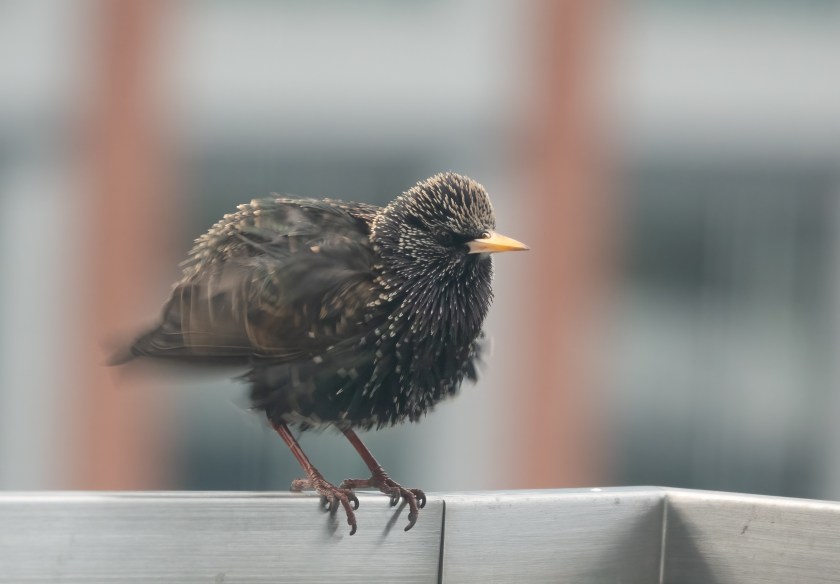
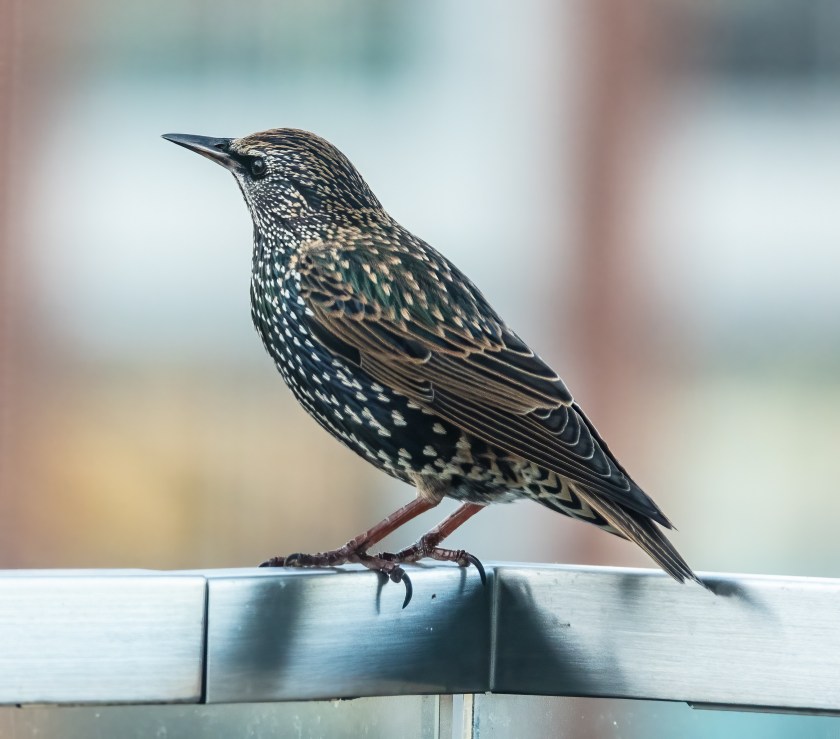
In their non-breeding plumage they are quite lovely, almost every feather tipped with white or chestnut, and the darker feathers glinting wth green iridescence, though their bill is now black. These photos were taken in October, soon after their annual molt:

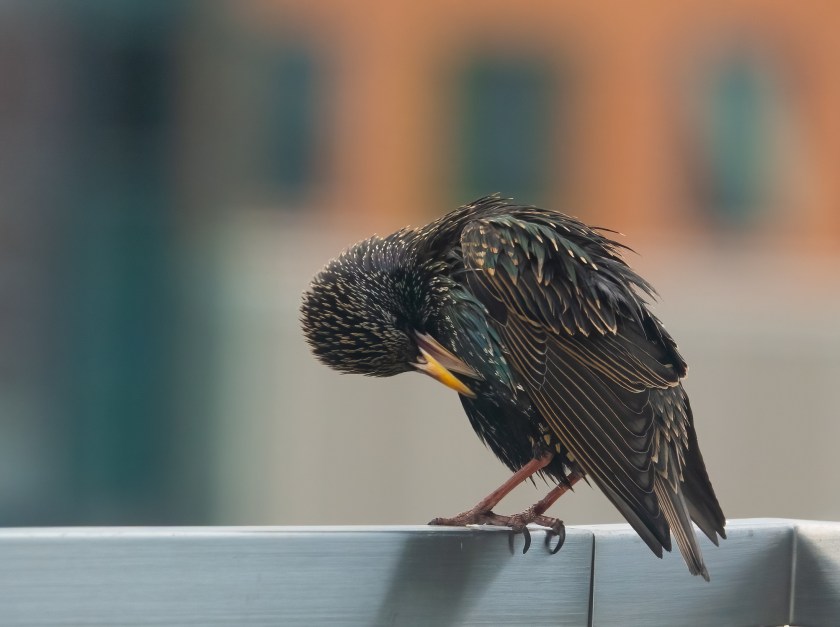
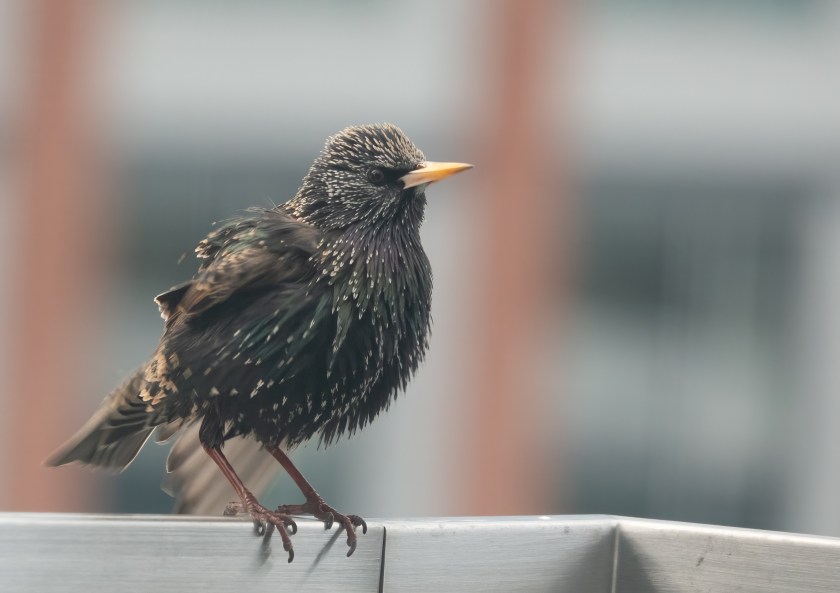
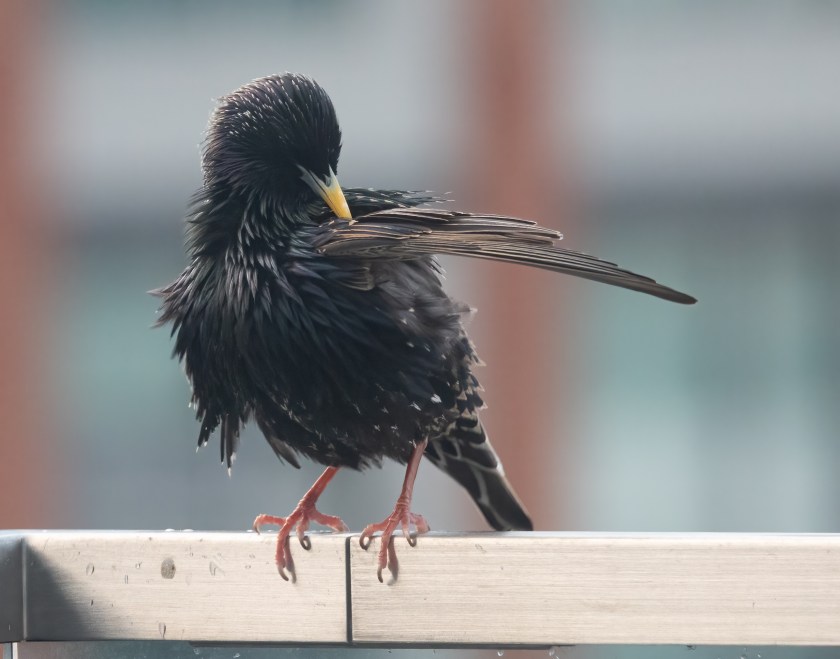
But by March, their beak has turned yellow, signaling a readiness to breed, and the light tips on their feathers are wearing off after months of ferocious grooming sessions:

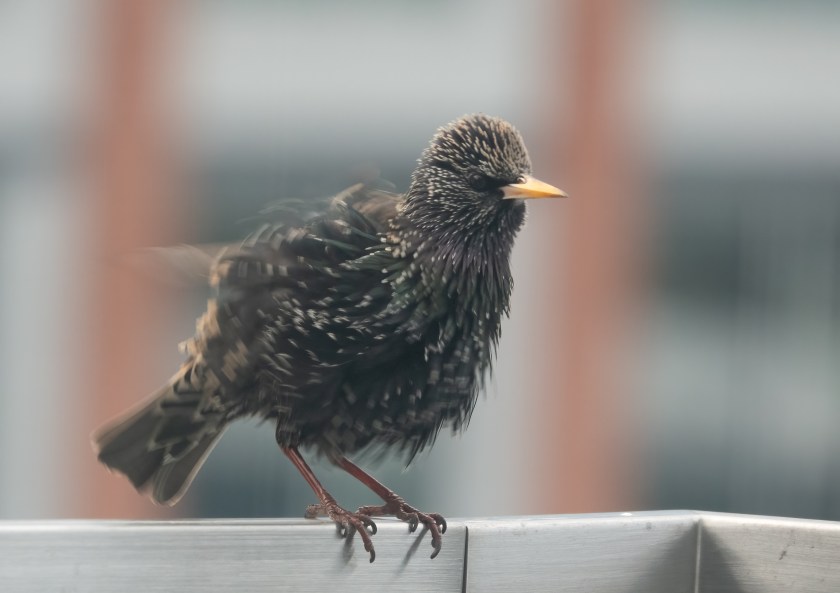
This one is shaking itself out:

But they are still rather handsome, and the iridescence is becoming more visible:

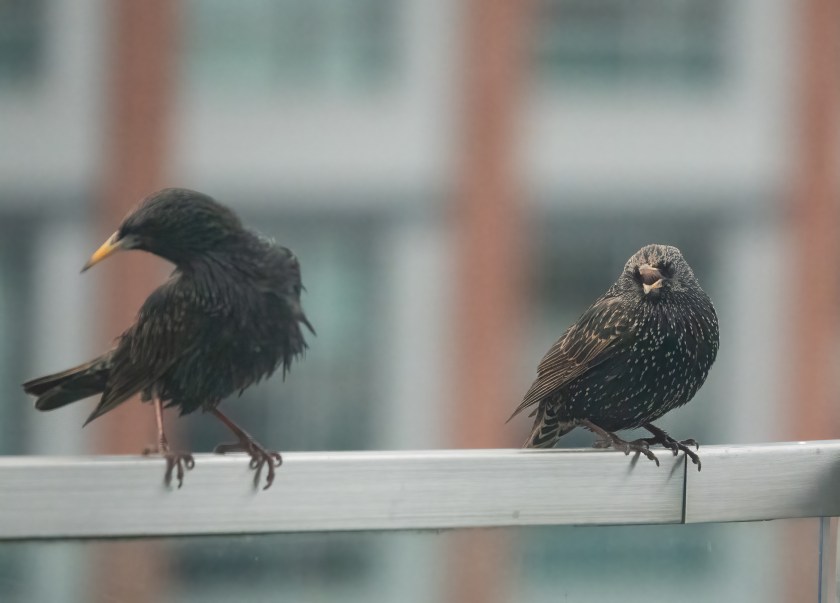
By May, the drabness prevails: this is a male, almost all black, with a bluish base to his bill:

I have to say that the black male on the left below did not seem to impress the more colorful female,

who flew off:

Unlike us, starlings can see in UV, and the ‘drabber’ plumage is the breeding plumage because those light feather-tips of early winter hide the iridescence that attracts a mate. But it’s complicated; according to Bennett et al (1997) “it is low UV and green reflectance, in combination with high violet and red wavelengths, that females prefer. “

These photos were all taken on the eighth floor balcony of a modern high-rise in the middle of the city. Starlings are adaptable!

How otters date?

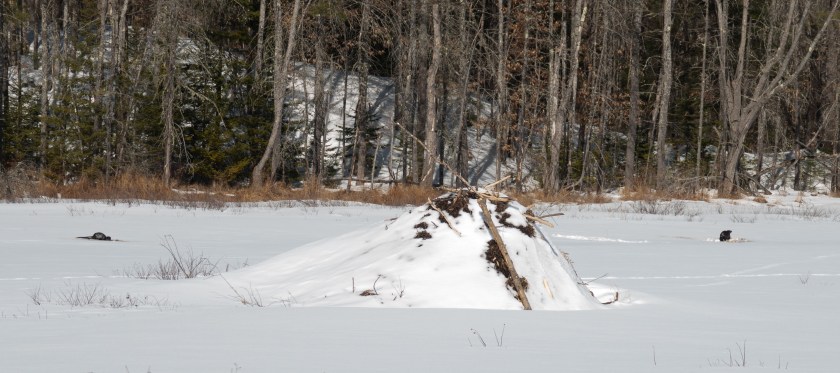
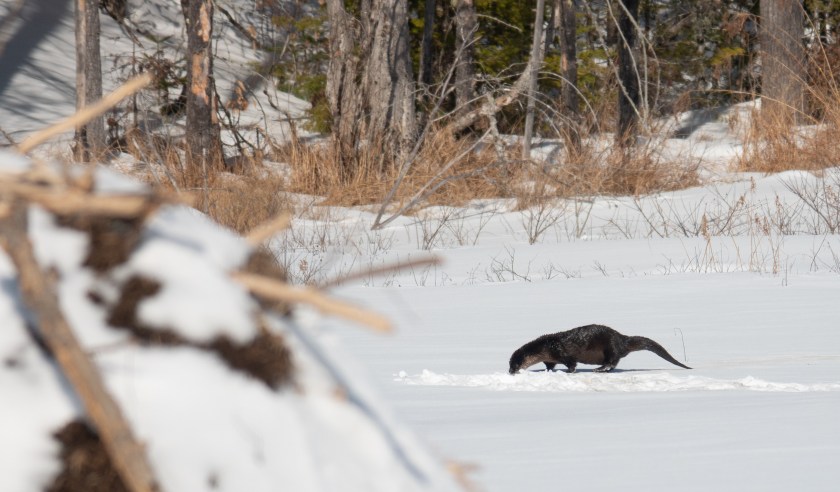
[I’ve been watching my otters as usual, and I am fairly sure I have been peeping in on how they meet up and find a match. Many of these photos are from a long way off, but they nonetheless tell a story that I hope you will find convincing.]

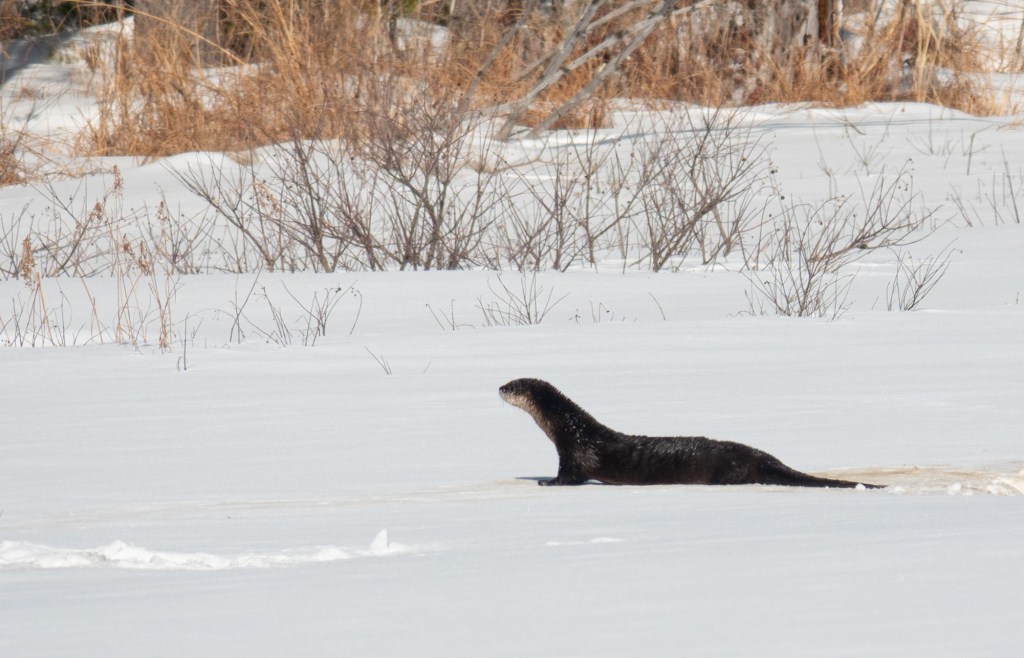
Most of the winter, if I see otters together I assume they are a mother and last year’s young. They behave like puppies, rolling around, diving in, and playing, often fishing out of the same hole in the ice.

Recently their behavior has changed. I haven’t seen two otters together in a while, and when there are two they occupy separate holes and keep their distance.

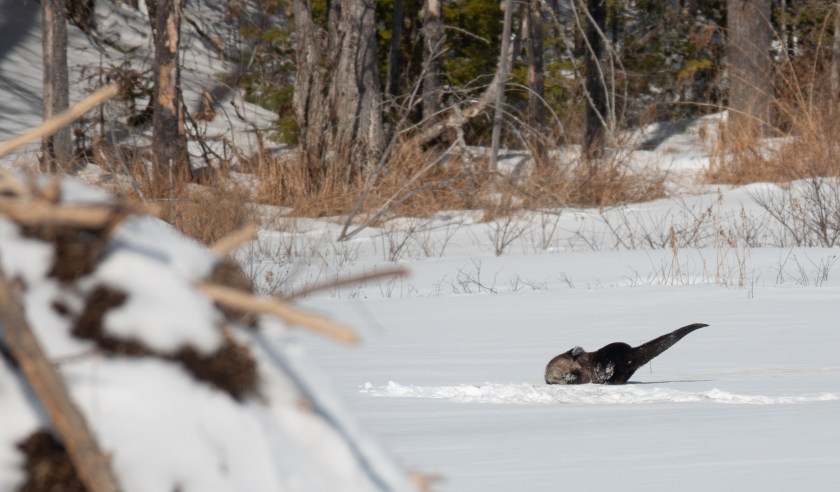
A few minutes earlier, there had been only one, using the righthand hole, emerging and walking/sliding a short way off to poop. Then he dived and came up in the lefthand hole, where he stayed. Suddenly, a second otter appeared in the right hand hole. He came out and looked towards the other otter with interest.

Then he went over to where the first otter had pooped and rolled, and had a good sniff:

and a roll:

Both otters then continued to fish from their separate holes for a while. This was slightly untypical behavior, but I didn’t think much of it, till today.

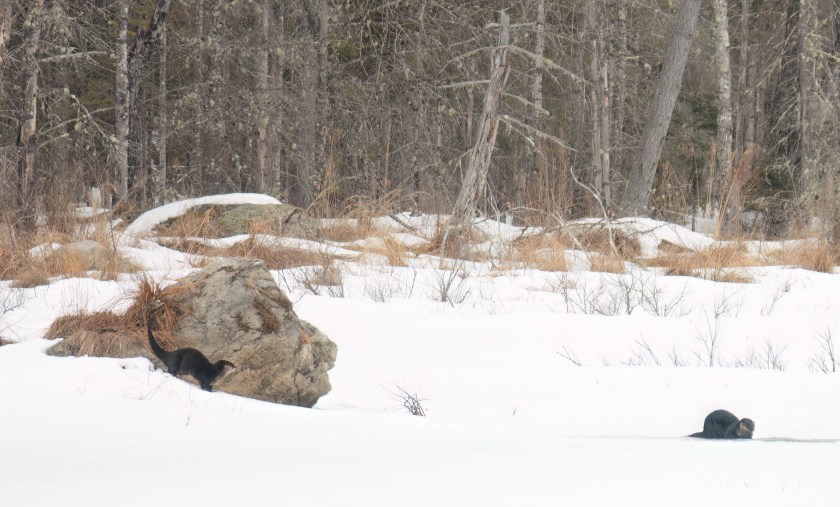
At the far end of the pond, on a warm and very gloomy day, were two otters together. One went off to poop by a large rock, and on its return the other one went off to the same place and used the exact same spot. Nothing very unusual about that.

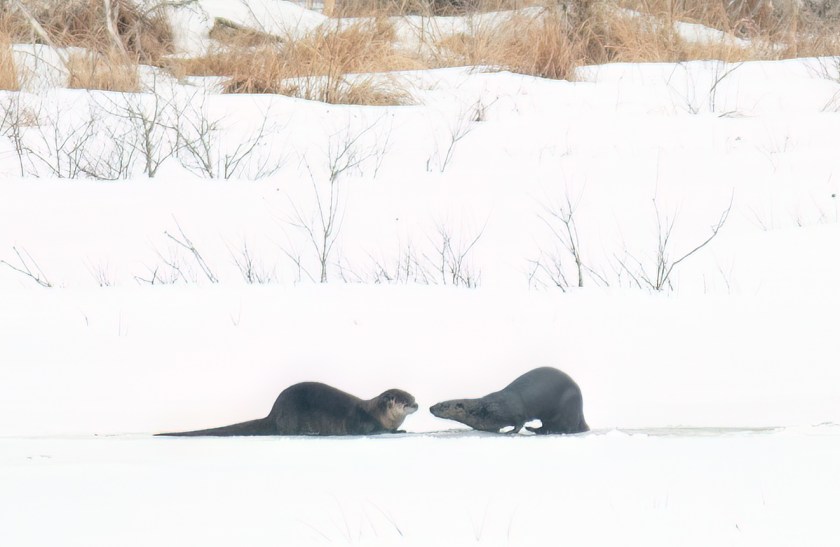
But when they got back together, things got interesting.

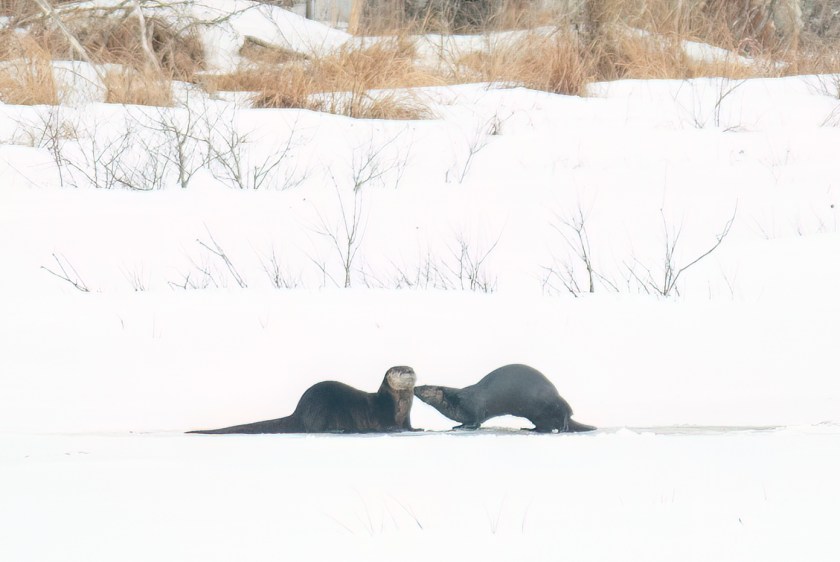
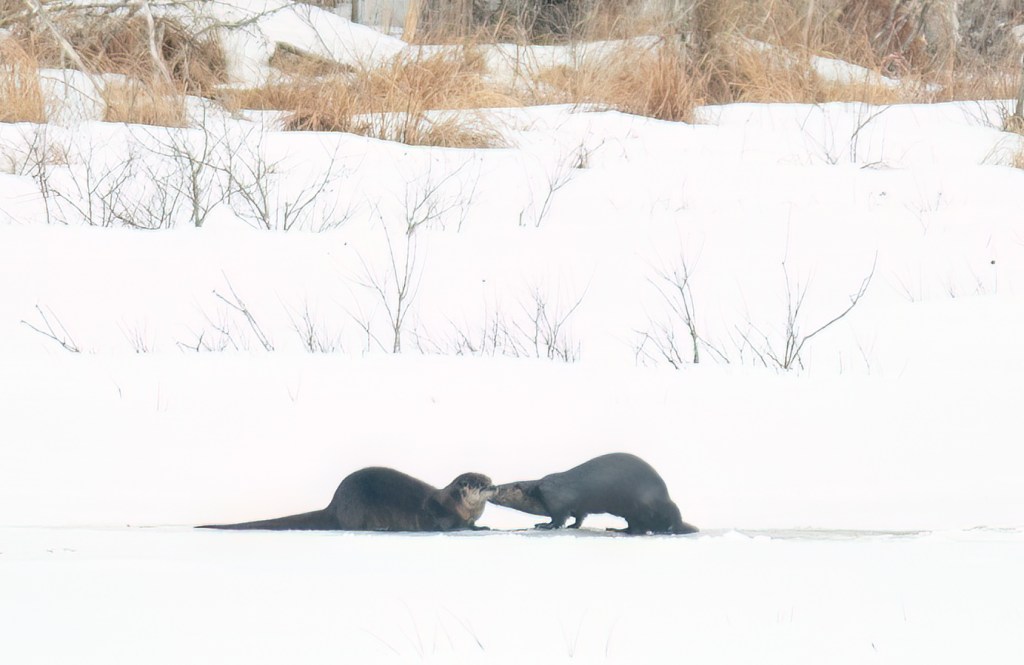
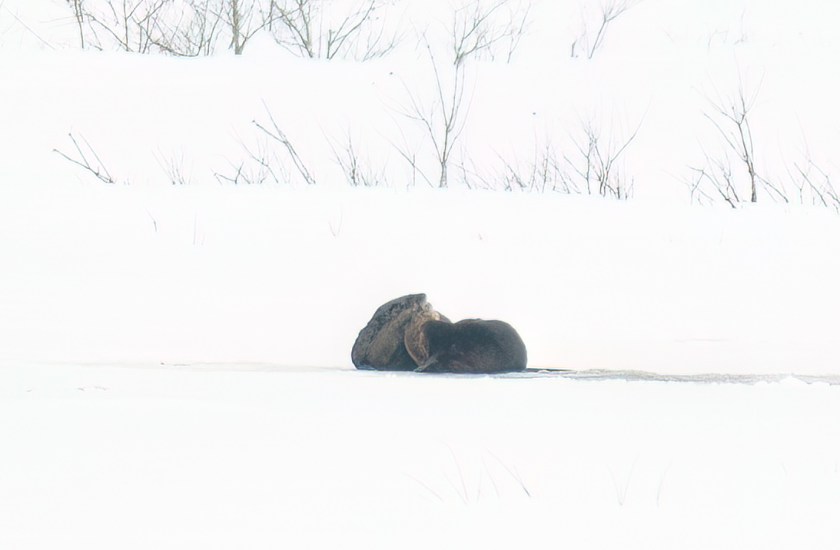
One of them spent some time smelling the other one’s head and neck closely:

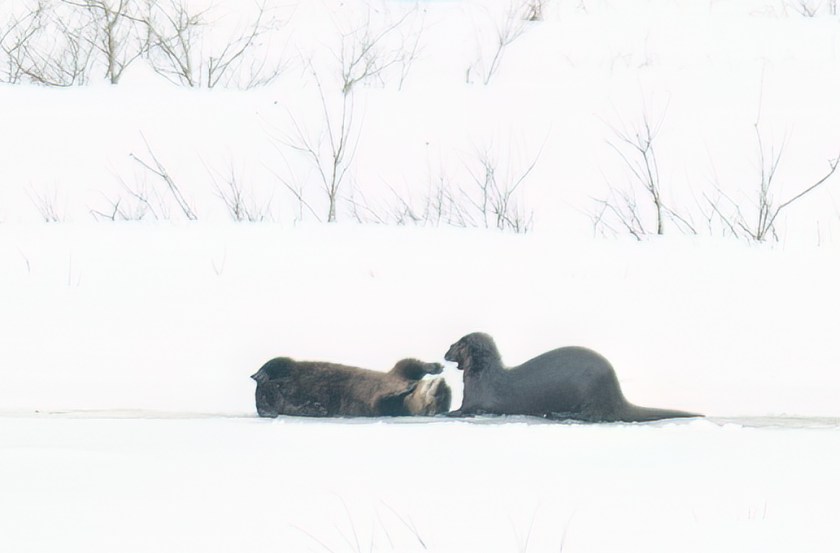
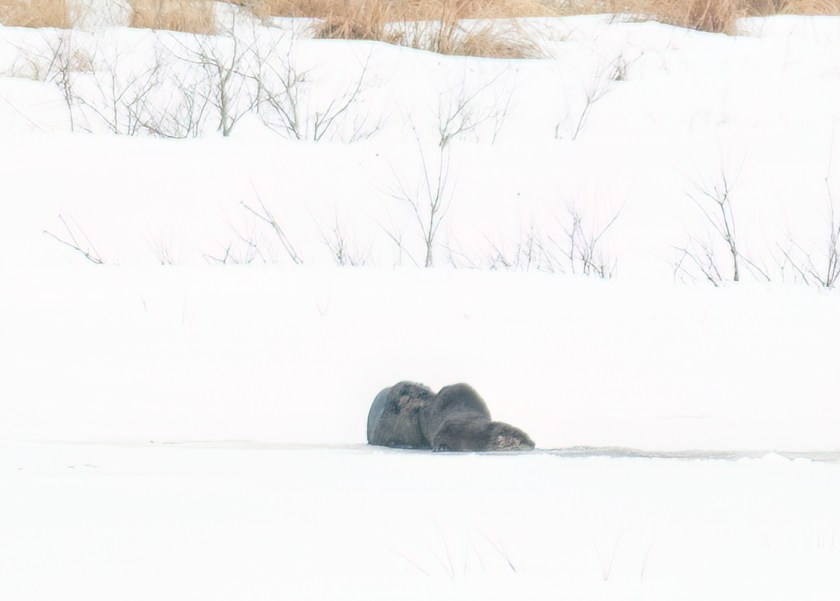
At one point the right-hand one seemed to bite the neck of the other one, who wasn’t too pleased, but didn’t move away (no photo!). Then the left-hand one rolled over:

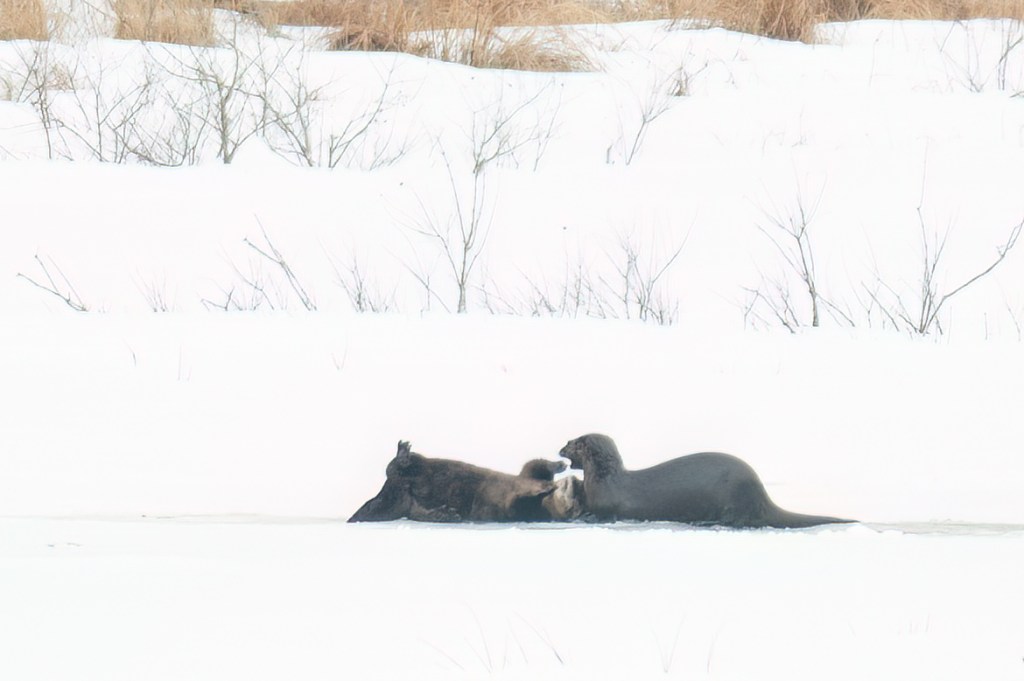
and cosied right up:

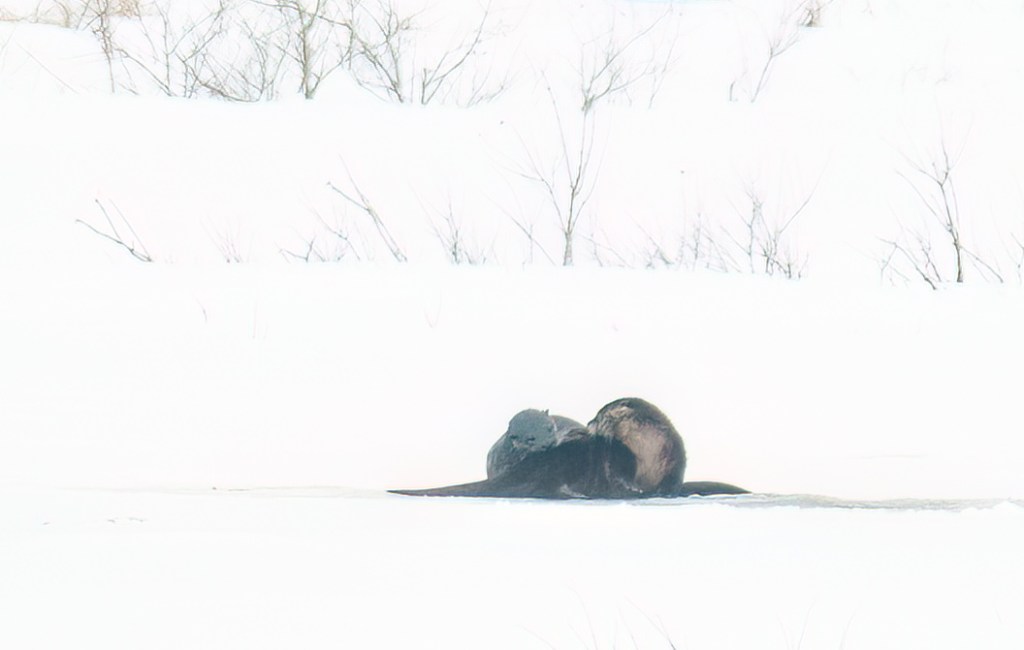
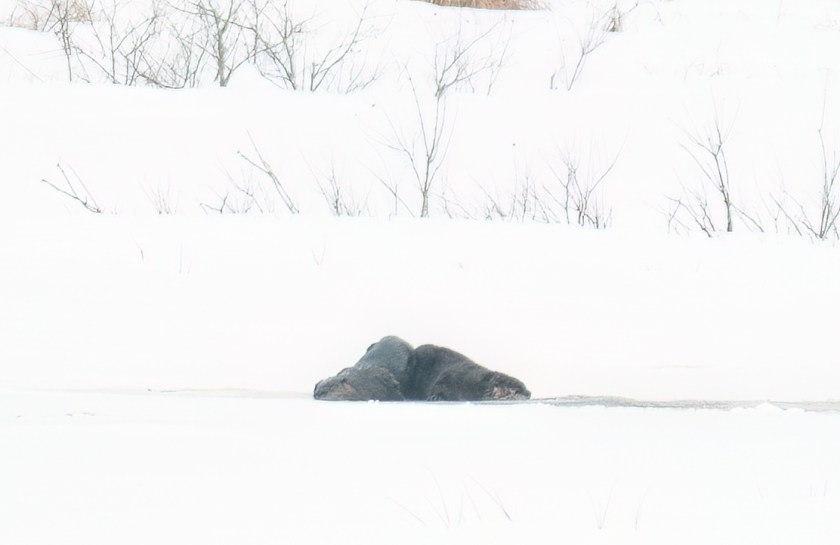
A little later, they put their heads together:

Time for a nap:

I am not sure I am interpreting all this right, and I will never know, because I had to leave, and now I am away for several weeks. It is the mating season for otters, so I could be right. Males do bite females’ necks during courtship, and rolling around is typical too (but they roll all the time anyway!) One slight doubt: females are about 20% smaller than males but these two don’t seem to have much size difference?

By the time I get back the ice will almost certainly have melted, and any courtship will have long since been consummated, so I end with a link to the only video I could find of river otters mating. It is very, very long, but around six minutes in you can see a commotion in the water, where clearly something is going on, and then they emerge from the water onto land, already conjoined, and making charming chirping sounds. From then on they stay on land, so you can watch and listen for a while if you want.

I have read that they mate in the water only, but other sources say it can be in the water or on land, and this video confirms that!