I had not planned on any more “wet fur” posts, but this was irresistible.
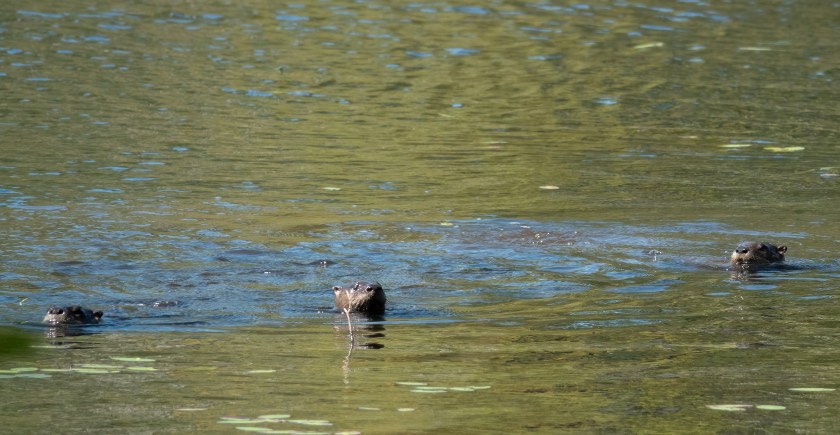
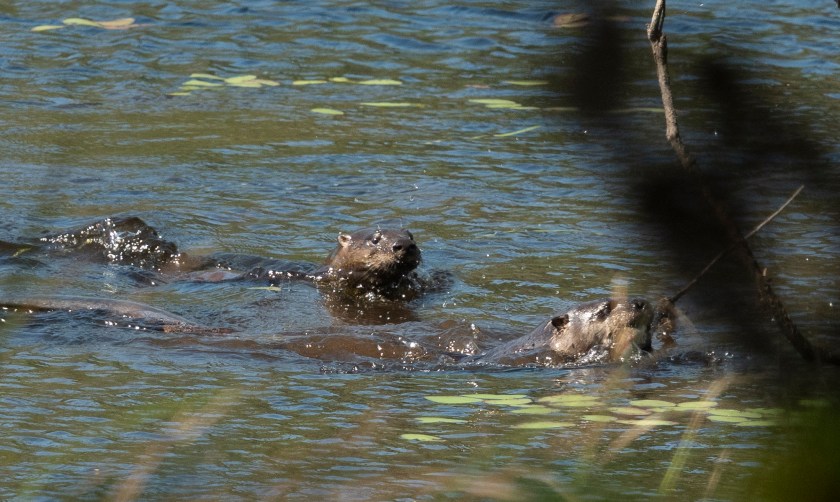
Ten days after the fish-eating otter in my recent post, a group of three appeared.
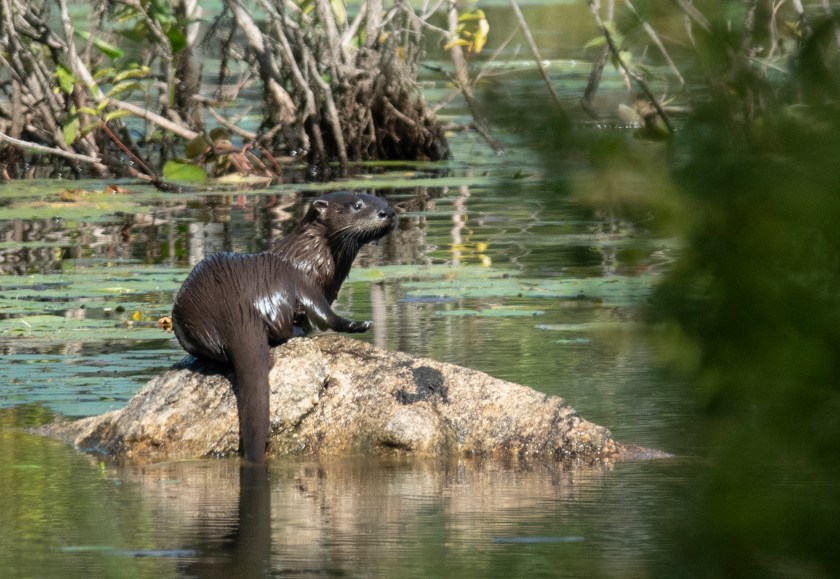
One sunbathed on a small rock.
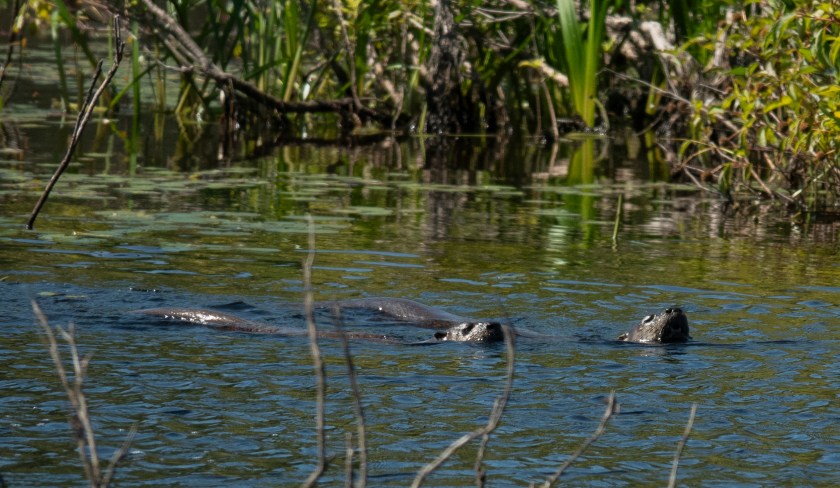
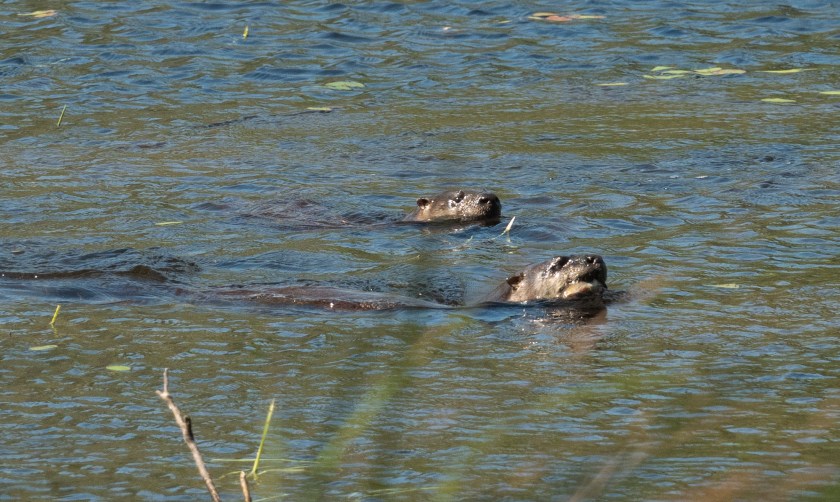
Two swam around in formation for a bit, catching the occasional fish, and moving northwards up the pond as I followed quietly in the bushes.
Some diving and splashing, and then they suddenly turned towards the shore, and me. The one in front had a fish, and the other was shadowing him in the hope of a mishap:
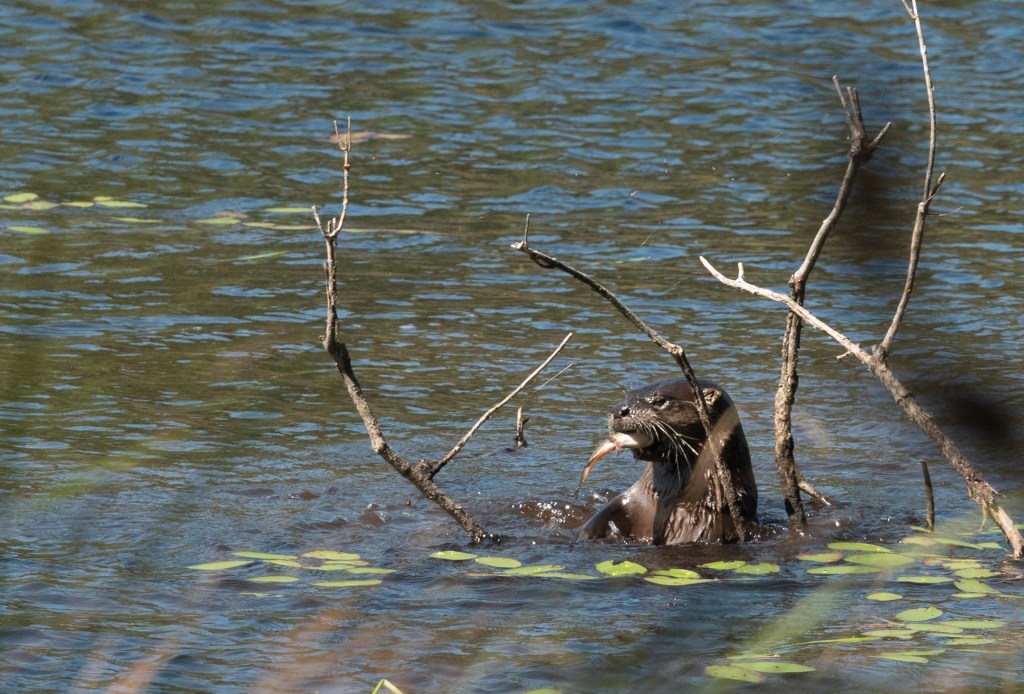
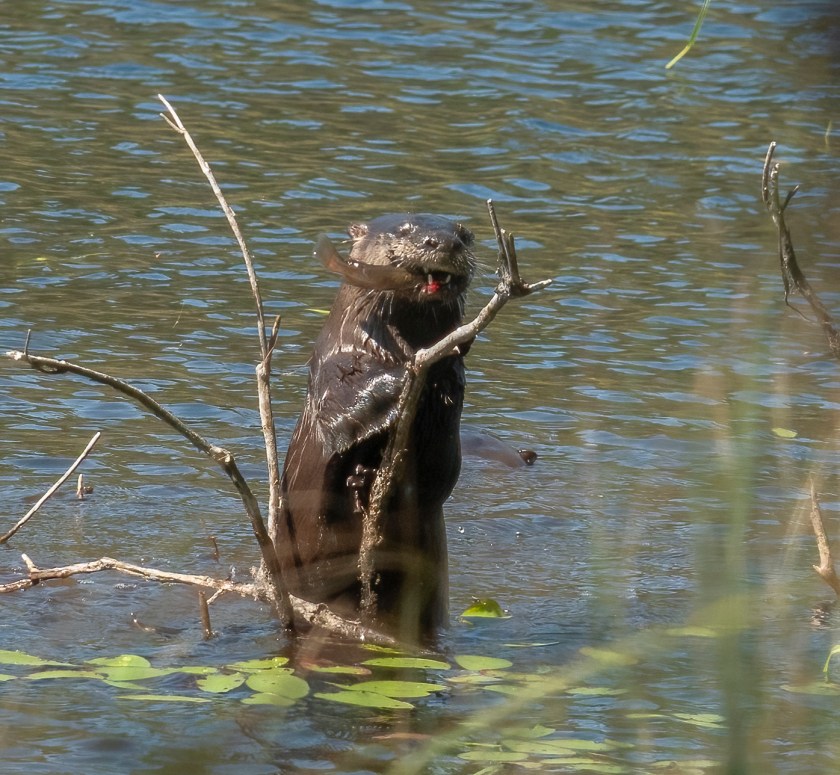
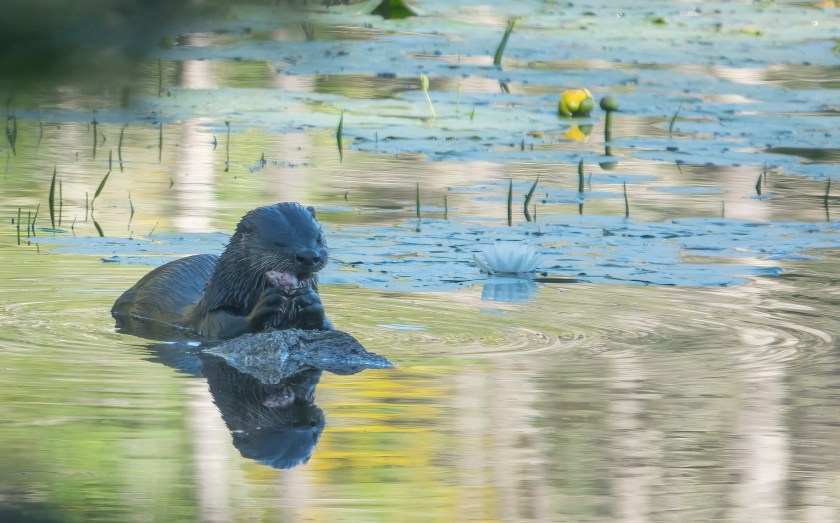
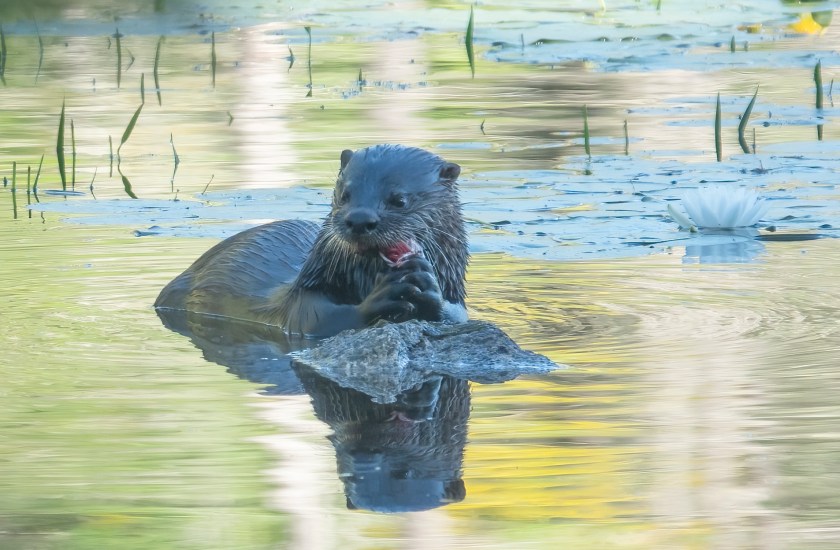
The owner of the fish needed to get out of the water to eat it, and to protect it from its marauding sibling, so it headed for the closest option, a fallen branch sticking partly out of the water.
Still a bit low down:
With some difficulty, it hauled itself high enough for safe eating:
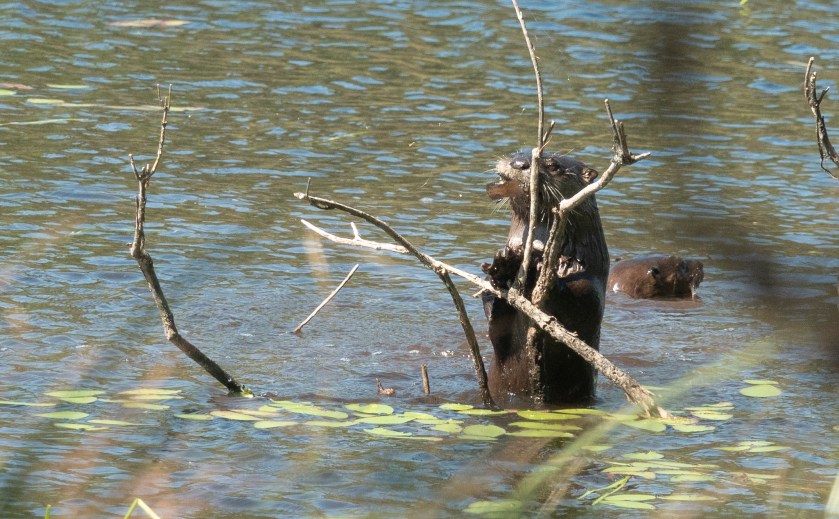
Teetering slightly precariously on its inadequate perch:
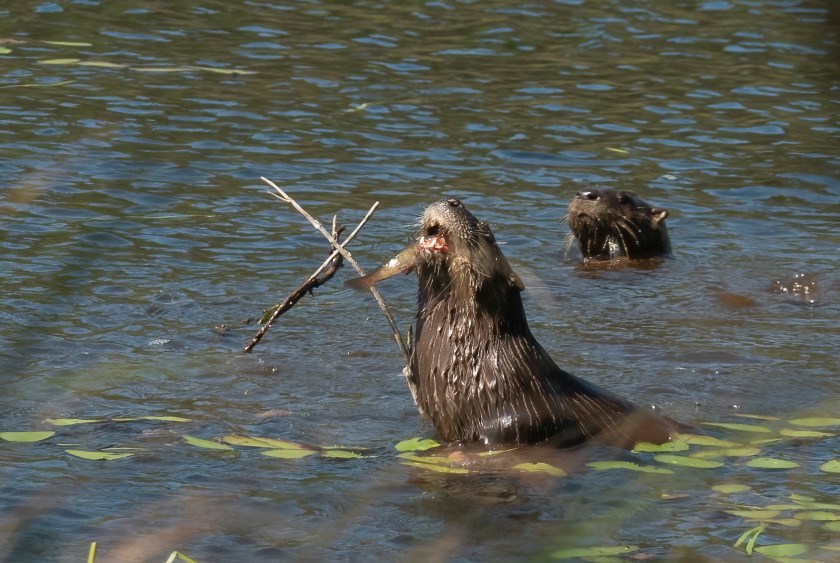
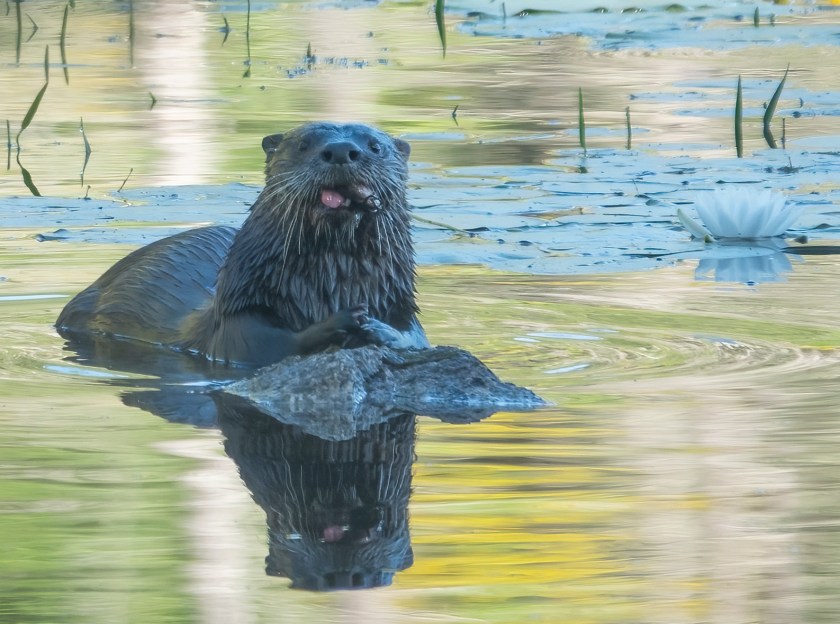
it set to work:
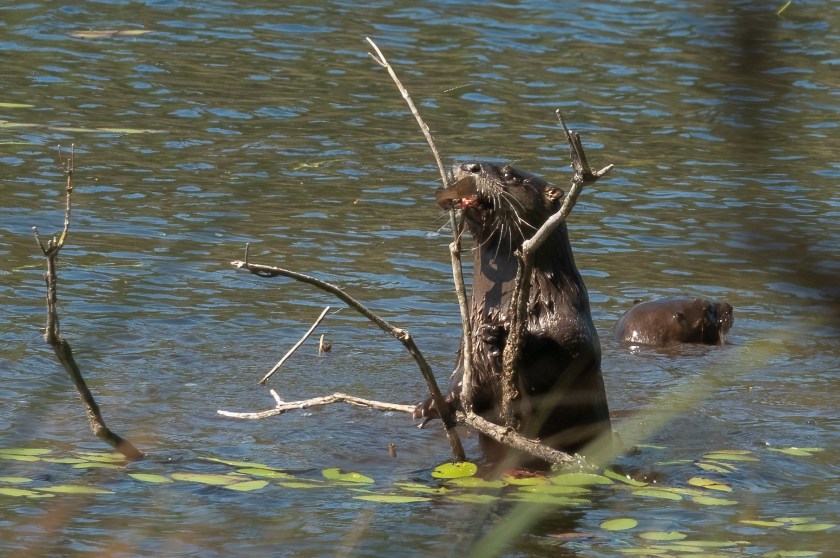
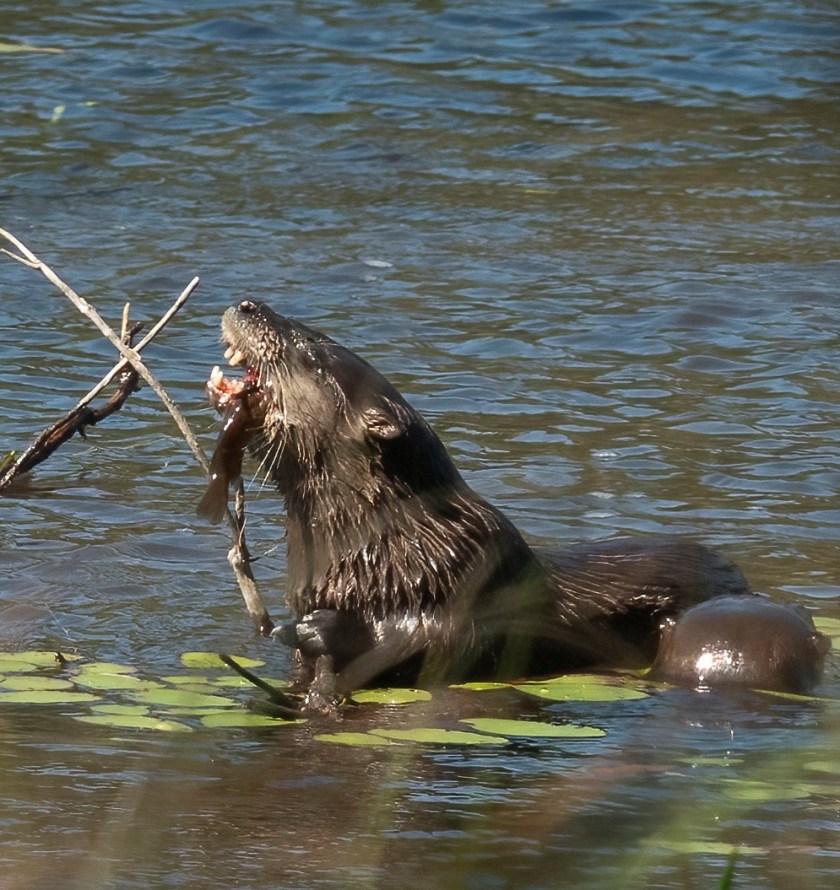
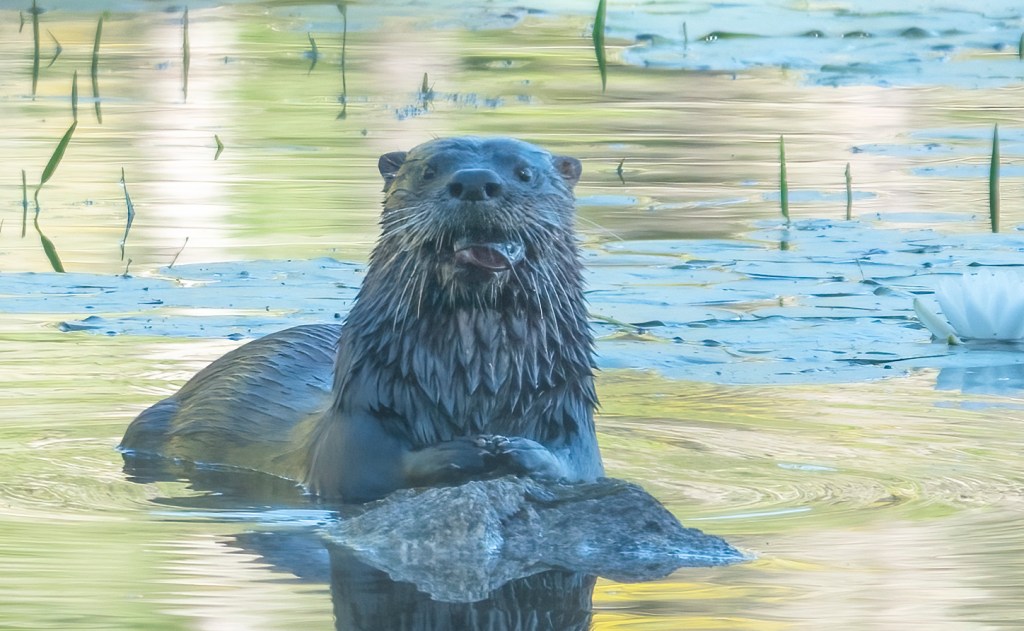
As the branch slowly sank, the second otter lurked close by, just in case:
Their teeth are impressive:
There were no slips, and the second otter, crestfallen, swam away hungry.
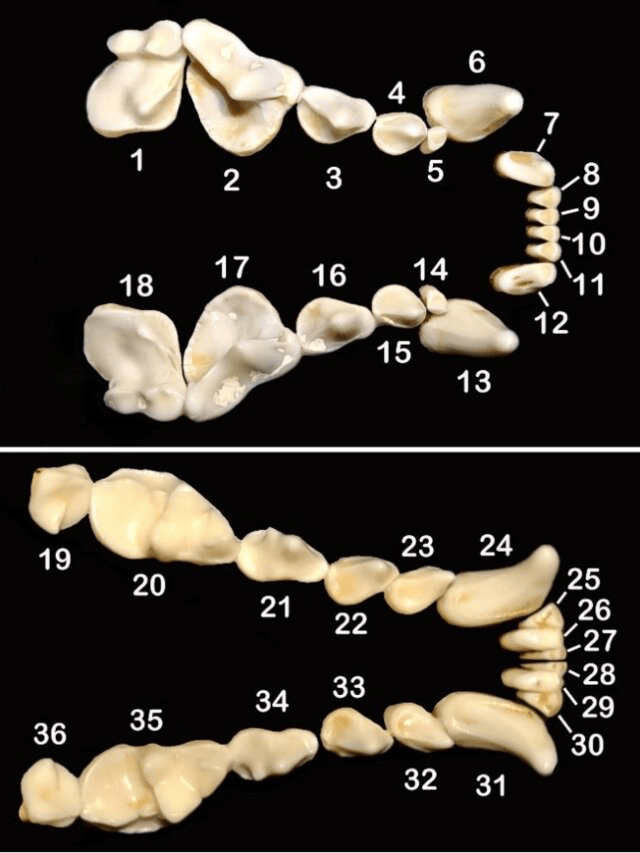
PS Here is a picture of the otter’s teeth, showing its four huge canines, from Tumlinson et al (2022)
The day after I saw the beaver, a even more special encounter..
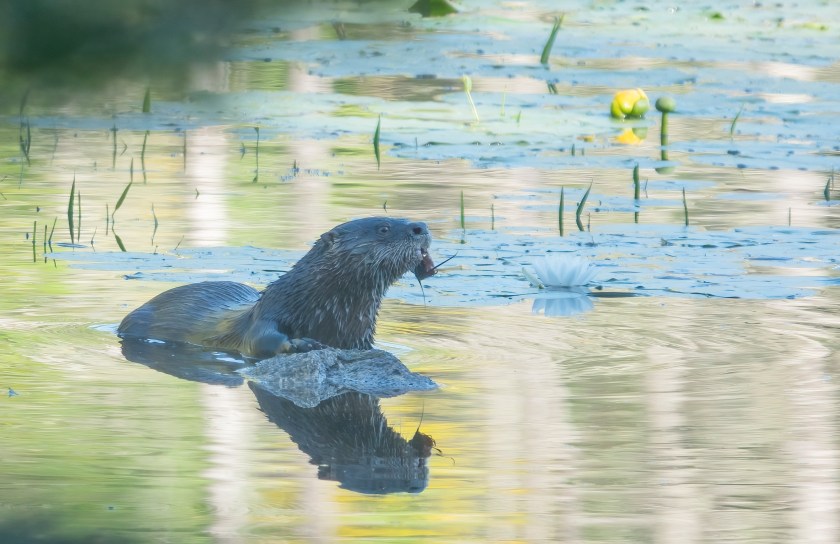
I saw two otters at a distance, swimming, diving, and apparently fishing. I swiftly headed in their direction, towards a spot which they often use in the wintertime, and just before I reached it I glimpsed one, through the trees, hauled up on a rock devouring a fish. There was a space between two branches at knee height, so I crouched down, slowly, and took these pictures.
It was in deep shade, with the sunlit water at its back, but the photos I hope still give a sense of its pleasure in the meal, and the power of its jaws.
I think it sensed my presence, but it was hungry, so it finished its meal:
The fish, I am told, is a hornpout, another name for the Brown Bullhead, a type of catfish.
In maybe six years of watching otters on this pond, I have never before seen one out of the water eating a fish close by. St. Cuthbert, the patron saint of otters, was watching over me. *
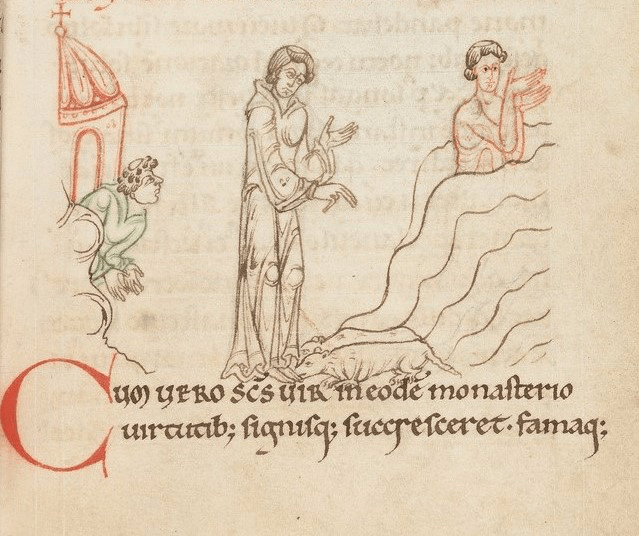
PS St. Cuthbert was a 7th century Northumbrian monk. The historian Bede tells that Cuthbert used to pray standing waist-deep in the freezing North Sea, and the otters used to come and lie on his feet to warm them, then dry them with their soft fur.
Mammals are the hardest things to see in our northern woods. But it’s been a good month for furry creatures, so I thought I’d show you a few.
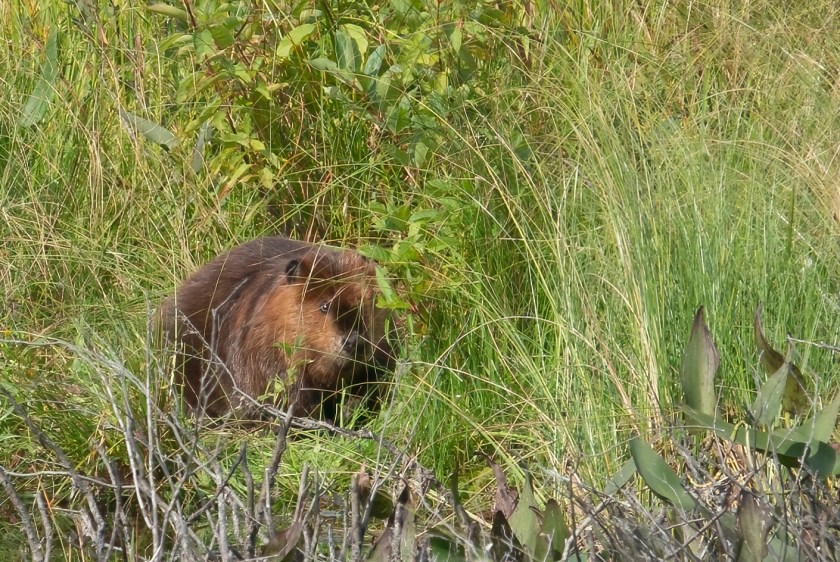
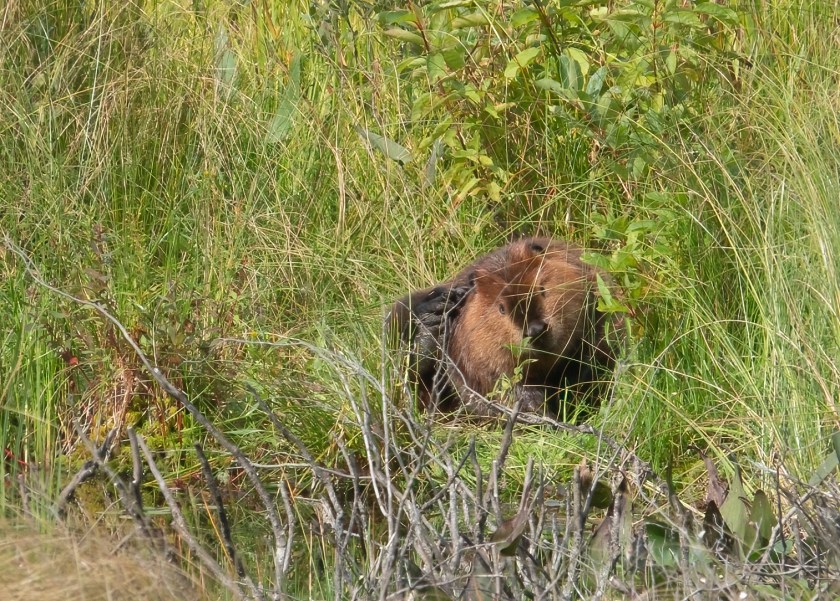
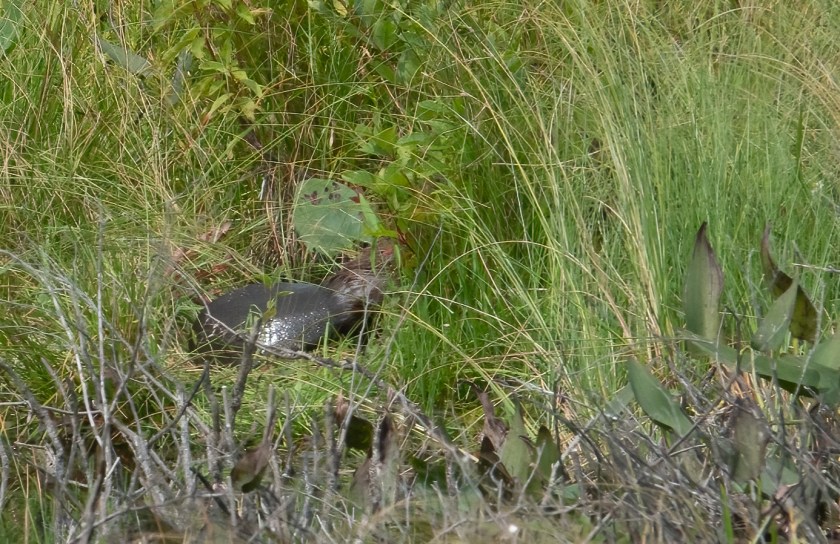
I have been very worried about our beaver pond, because the water levels are extremely low, and it’s not clear that the dam is being maintained. But this week I saw a beaver, out of the water (rare), sunbathing on dry land in broad daylight, with glossy healthy-looking fur. It was there two days in a row in the same spot at 9am. It must have heard me, but it was far out in the pond on a mound, and felt safe enough to ignore me.
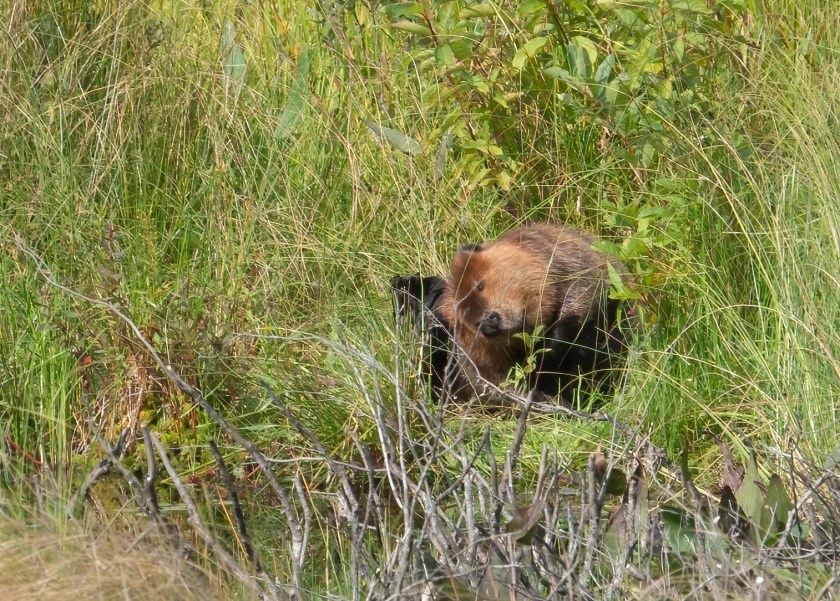
It was grooming too, using its webbed hind feet for a good scratch:
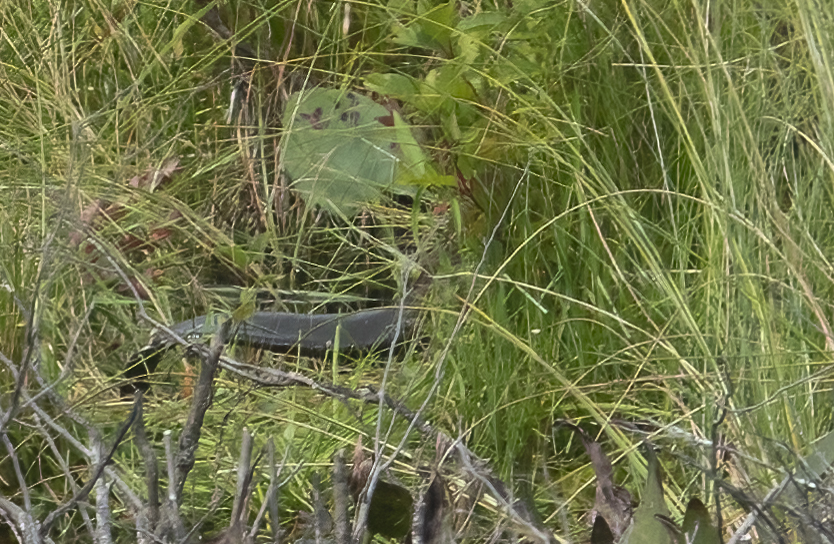
When it eventually moved on, the tail was the last evidence of its presence as it headed off to the right into the grasses:
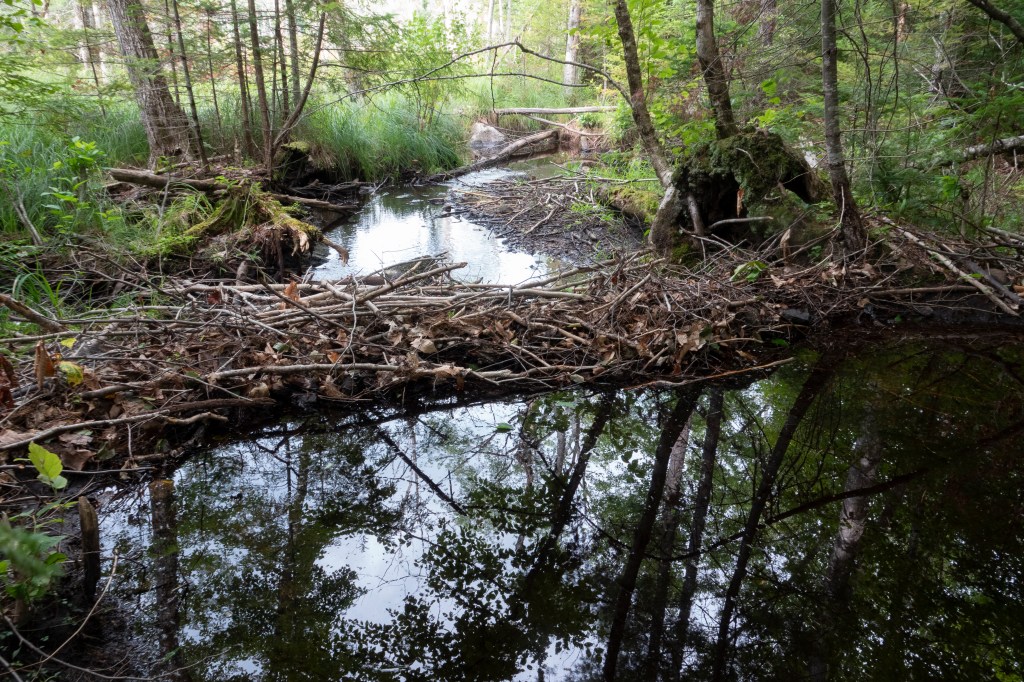
As I walked on, I crossed a tiny stream that flows into the pond, and to my delight there was a small dam, freshly constructed.
If you look carefully, past the dam, on the righthand shore, there is a sort of landing, where the beaver has been bringing sticks and stripping the bark for a snack.
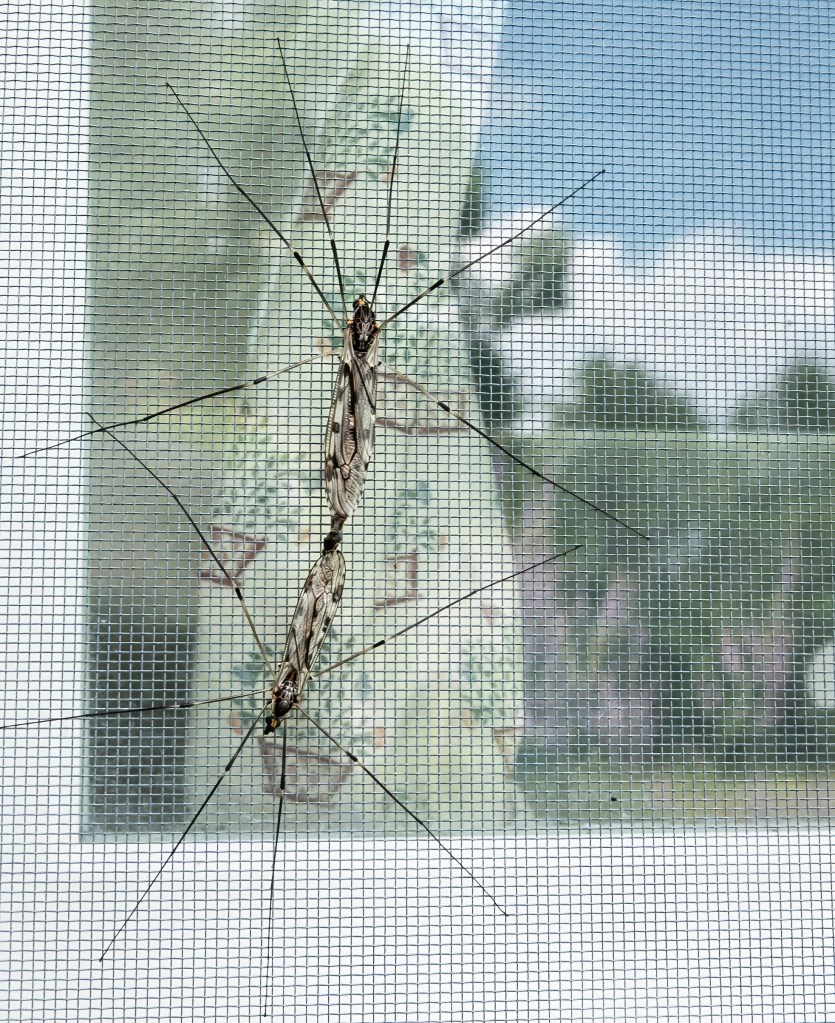
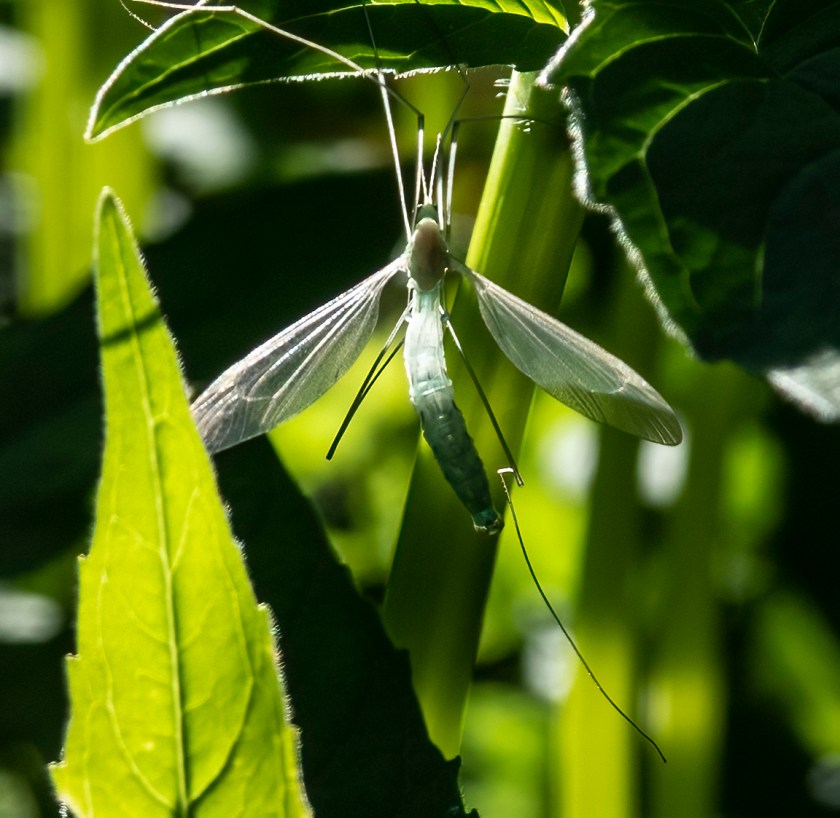
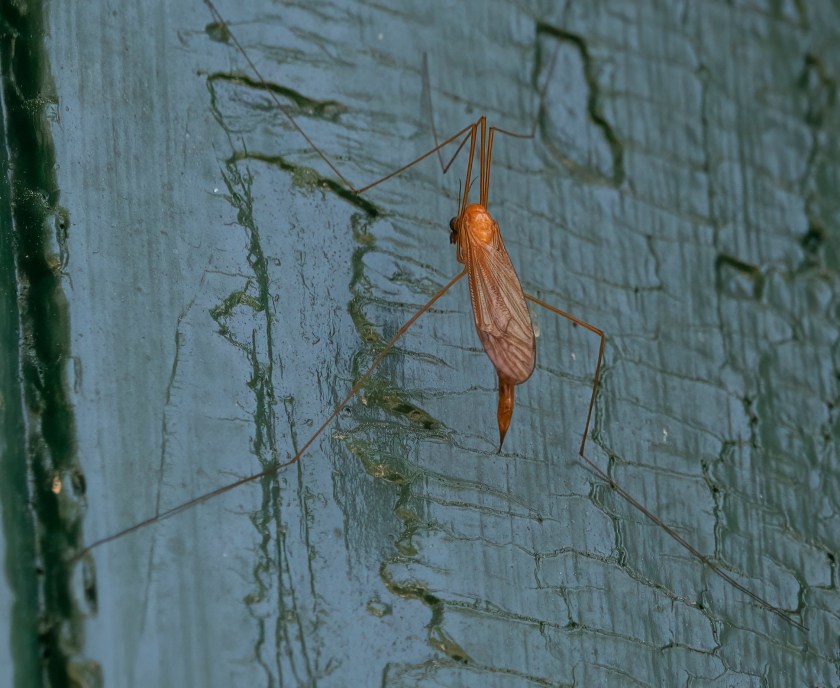
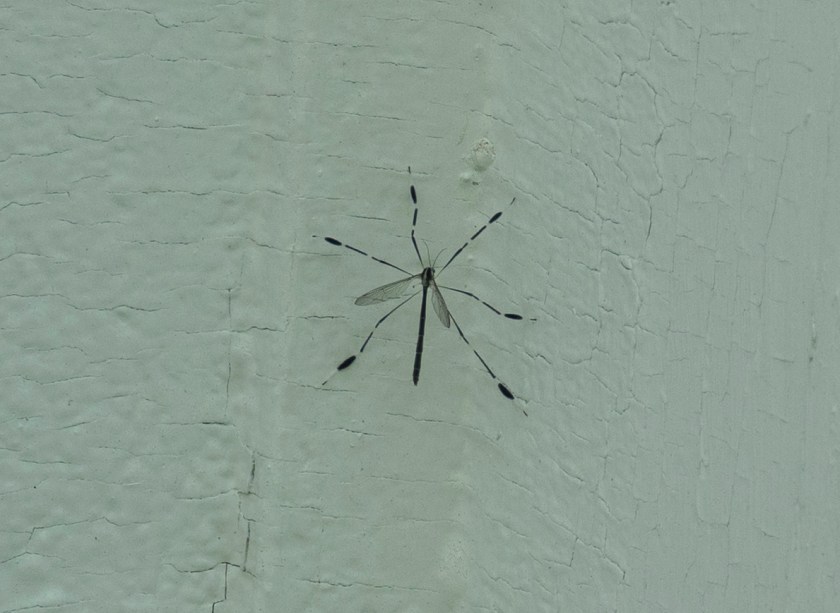
Crane Flies are harmless, elegant insects that I sometimes find on my porch screens in the mornings.
The product of this encounter will be first an egg, then a larva (called a leatherjacket), then a pupa. They emerge from their pupa, and gradually dry out into their adult form:
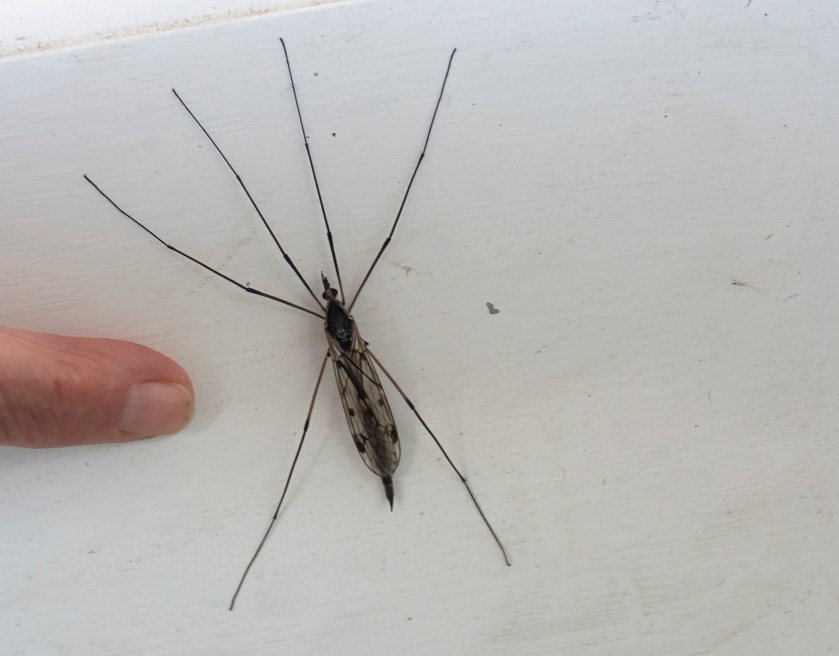
Most of them have no functioning mouthparts and are unable to eat as adults, living only a few days, and focussing entirely on sex. They come in a range of shapes and sizes, this is a Giant Cranefly, Pedicia albivitta, whose body is 1.5 inches long::
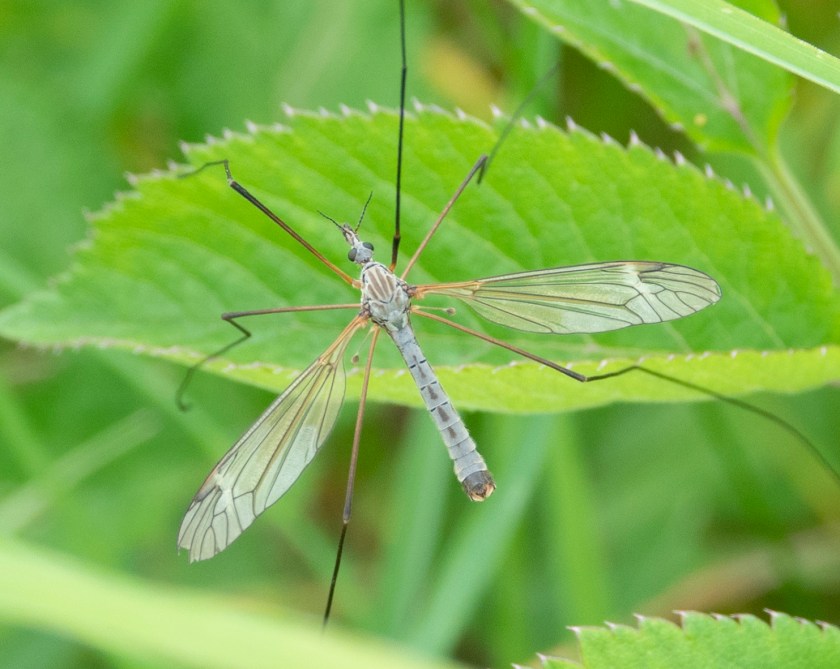
Most Crane flies have elaborately veined wings like this Tipula dorsimacula:
Most have subdued coloring, but not all. This is a Ferruginous Tiger Crane Fly, Nephrotoma ferruginea:
Some are smallish, this Eastern Phantom Crane Fly, Bittacomorpha clavipes, has a 0.5 inch long body:
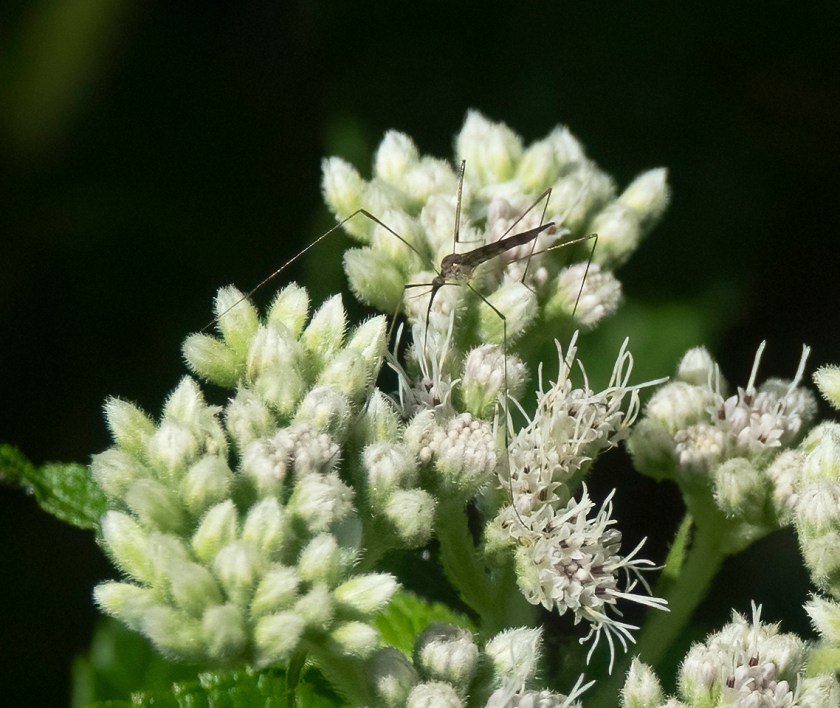
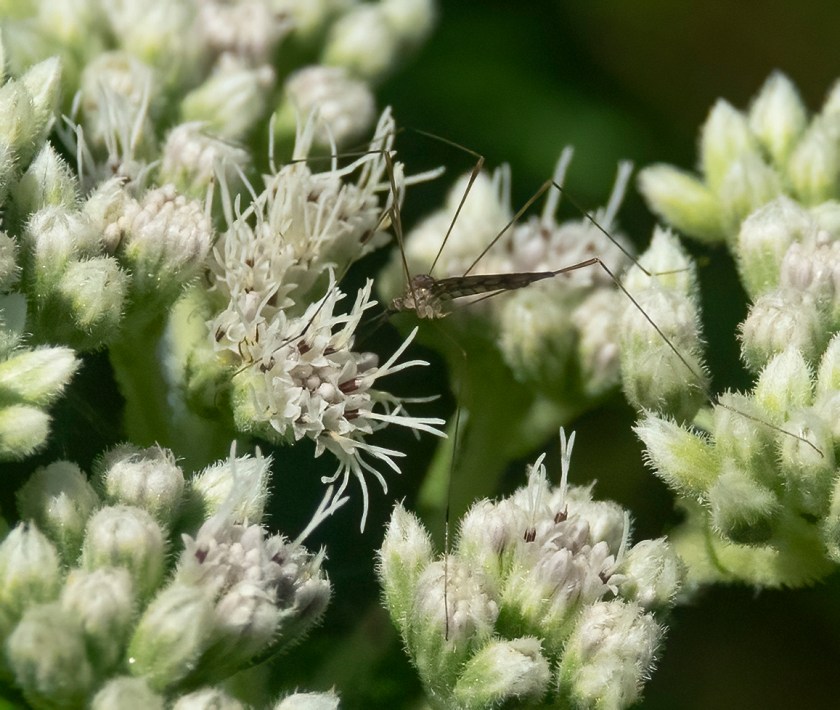
Geranomyia rostrata is an even smaller crane fly with a body length of about 0.16 inches. Its claim to fame is that it actually has functional mouthparts, and feeds on nectar as an adult. It does this with its unusually long, black, proboscis that can be more than half as long as its body.
It is usually near water, and this one was feeding on a Common Boneset flower.
While it feeds it bounces or bobs up and down, doing squats as it repeatedly jabs its proboscis into the florets.
Those extraordinarily long delicate legs are what is called “deciduous”. Just like the leaves on a tree, they can be easily detached from the body if a predator pounces, and like a lizard’s tail they can go on twitching to distract the predator. Unlike a lizard’s tail, they do not re-grow. Luckily, this one still has all six legs.
The iNaturalist app (iNat) has transformed how I and many others interact with nature. BiN (Before iNat) I would see something, and spend hours with one of a shelf-full of books trying to work out what I had seen. Now, I photograph it, enter a location, and show iNat the picture. And it knows! Or at least it gives me a shortlist of possibilities. It also shows me a map of where else it has been seen. Occasionally, mainly for small insects, it turns out it has hardly ever been seen in Maine, and I think, proudly, that I have documented a rarity. But have I??
Numbers can be low for many reasons other than real rarity; here are some of those reasons:
a thinly populated area, with few observers, true of my corner of Maine
it is only just starting to colonize an area, for a variety of reasons, so it may be locally rare but globally common
it lives in inaccessible environments such as marshes, or high in trees
it is drab and commonplace, so no-one thinks to submit an observation (house spider, ant)
it is hard to see and photograph, because it is very tiny, or well-camouflaged, or never stops moving
its numbers are indeed dropping, for environmental reasons such as climate change or habitat loss
I’ll show you a “rarity” or two, but hang onto that scepticism. One encouraging (but not at all conclusive) indication of rarity is that most of them don’t even have a common name! They have all been recorded 5 or fewer times in Maine. I’ve ranked them by the total number of observations, starting with the ones MOST often recorded, and ending with what might be the rarest:
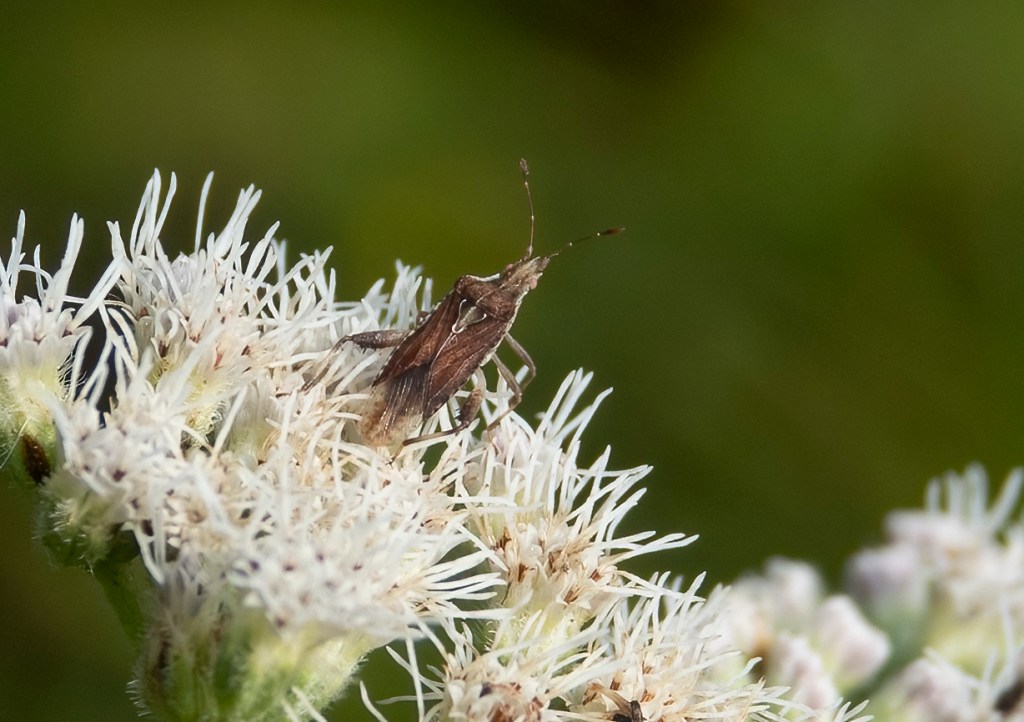
Harmostes fraterculus has 1161 total observations, 5 in Maine. It is on a Common Boneset flower.
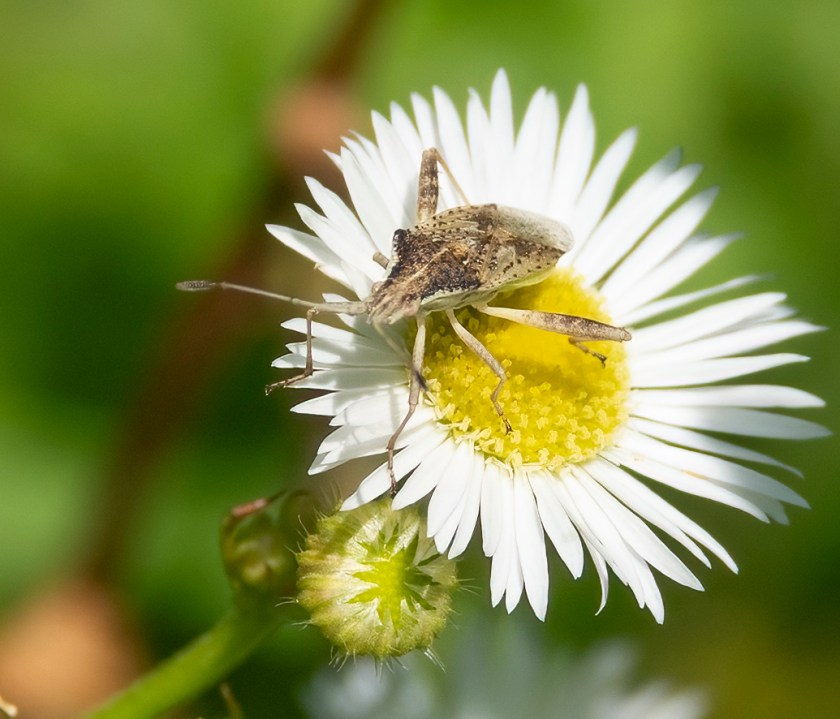
This is compared to 5800 for the closely related Harmostes reflexulus, including dozens in Maine:
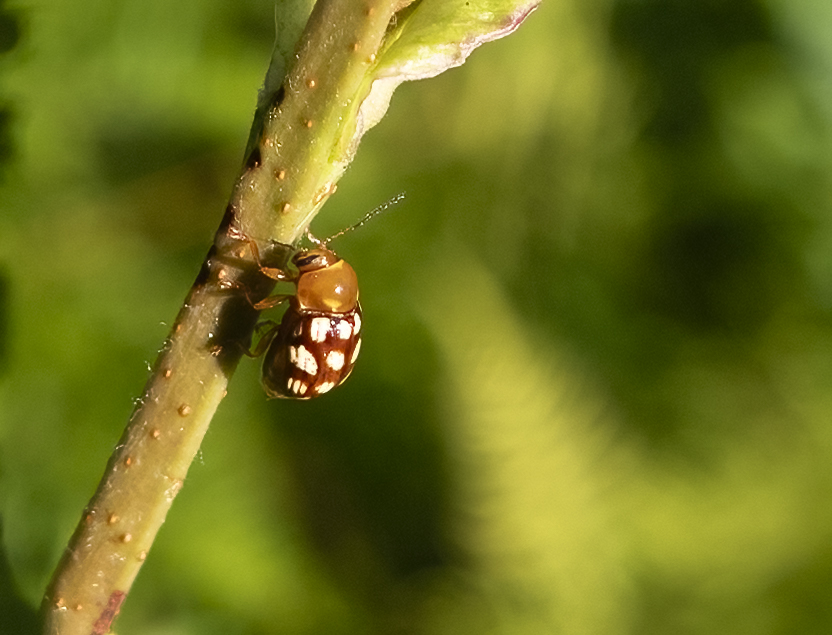
Fourteen-spotted Leaf Beetle, Cryptocephalus guttulatus, has 667 total, only 1 other in Maine. This seems to be the extreme northern edge of its range. A result of climate change?
Stictopleurus punctiventris has 198 total observations, mainly in Canada. Only 5 others in Maine, 4 of them this year.
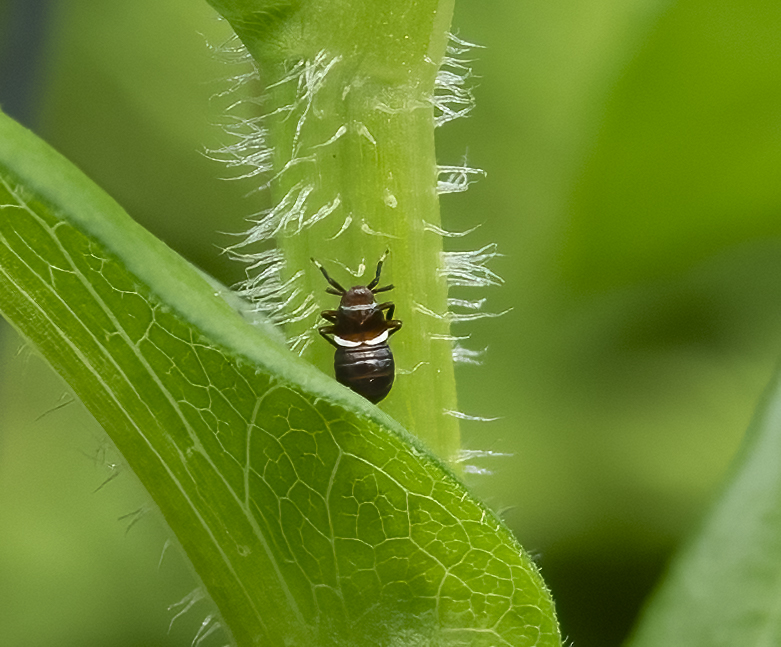
Pissonotus basalis has a mere 29 total observations, from Tennessee to Nova Scotia. None in Maine, except for me. This seems to be the best candidate for a real rarity, but it is very, very tiny, 3mm or o.1″and it also moved fast, so who knows.
To put all this in context, Maine has 370,421 observations of 6114 species of insects, and the most common observation, the Monarch Butterfly, has 4,523 observations. I suspect it would have far more but everyone knows what they are looking at, so they do not think to ask iNaturalist.
Do try it, it is a wonderful app, and you are contributing to citizen science when you upload an observation.
[My final Costa Rica blog post, I think.! Then back to Maine.]
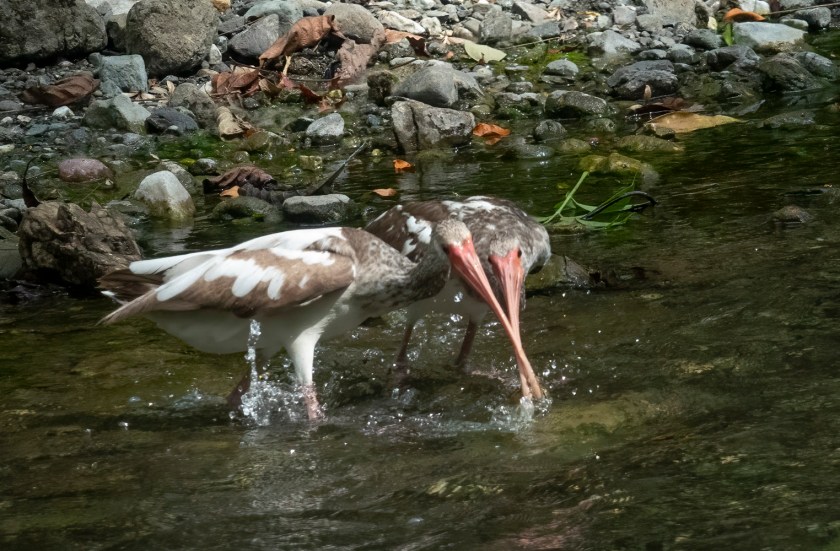
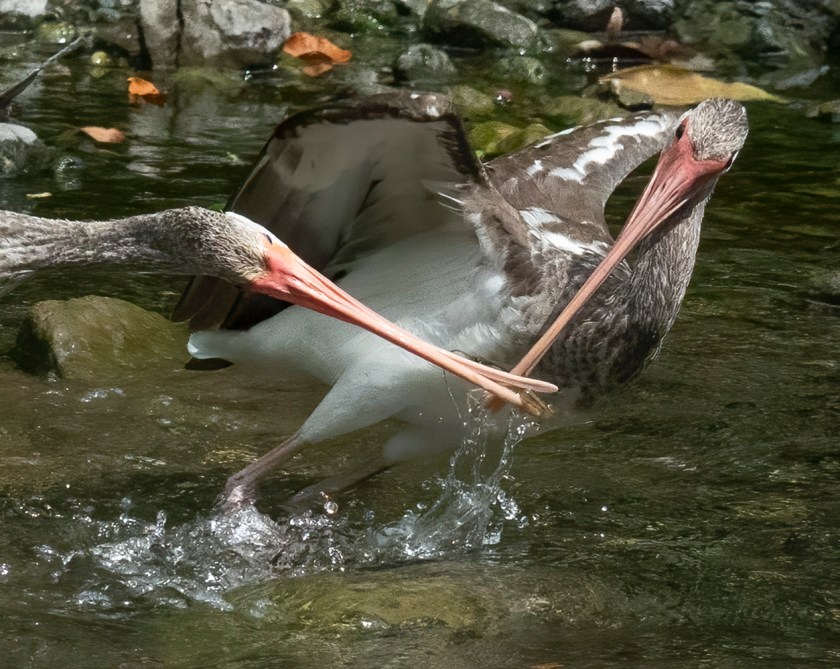
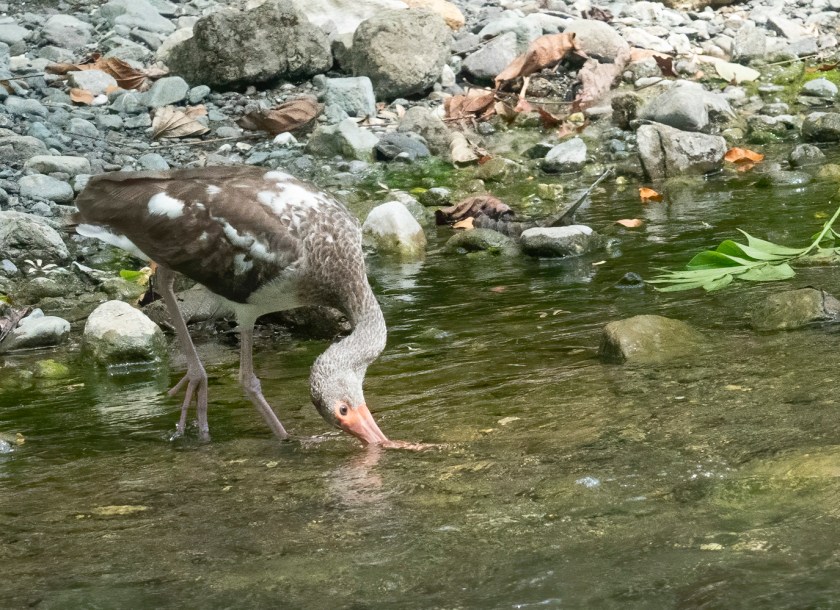
On the Pacific side of Costa Rica, we saw two juvenile White Ibises (or if you prefer, ibes (Latin), ibides (Greek)!), Eudocimus albus. They were hunting for crustaceans in the shallows of a small river:
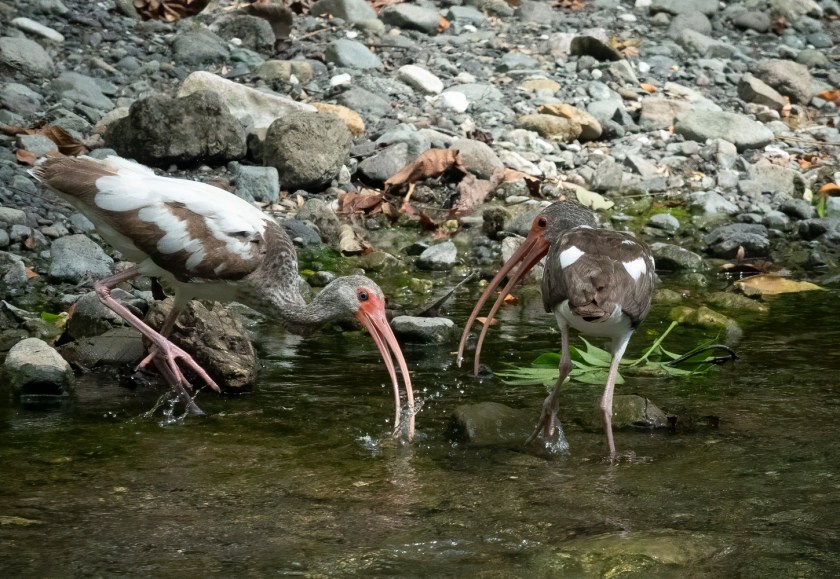
Their eyes focus on the tip of their beak, but they mostly forage by touch. The left-hand one found something:
and a tussle ensued:
The original finder hung on, and brought up a crayfish:
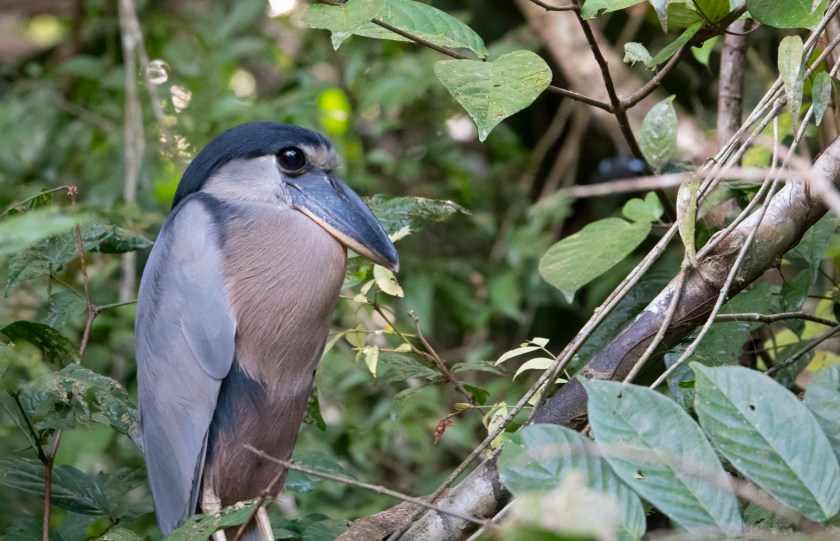
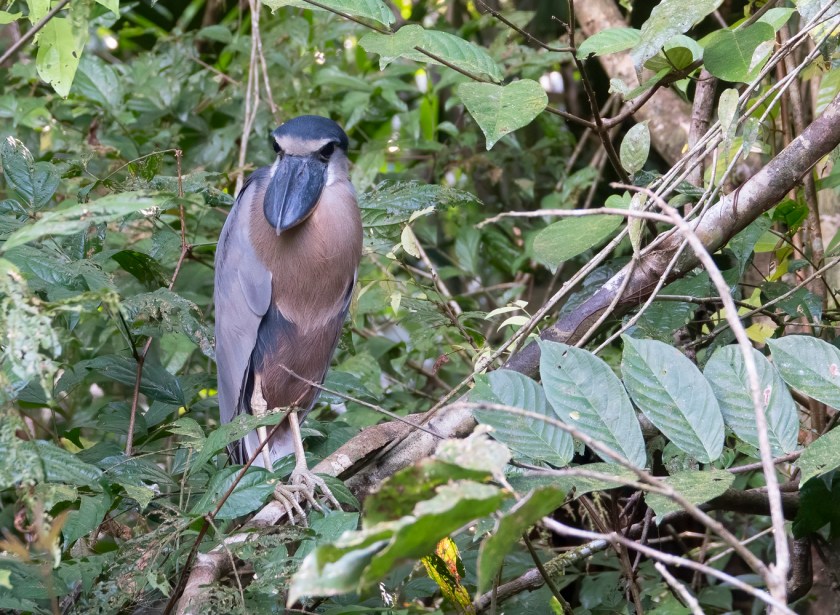
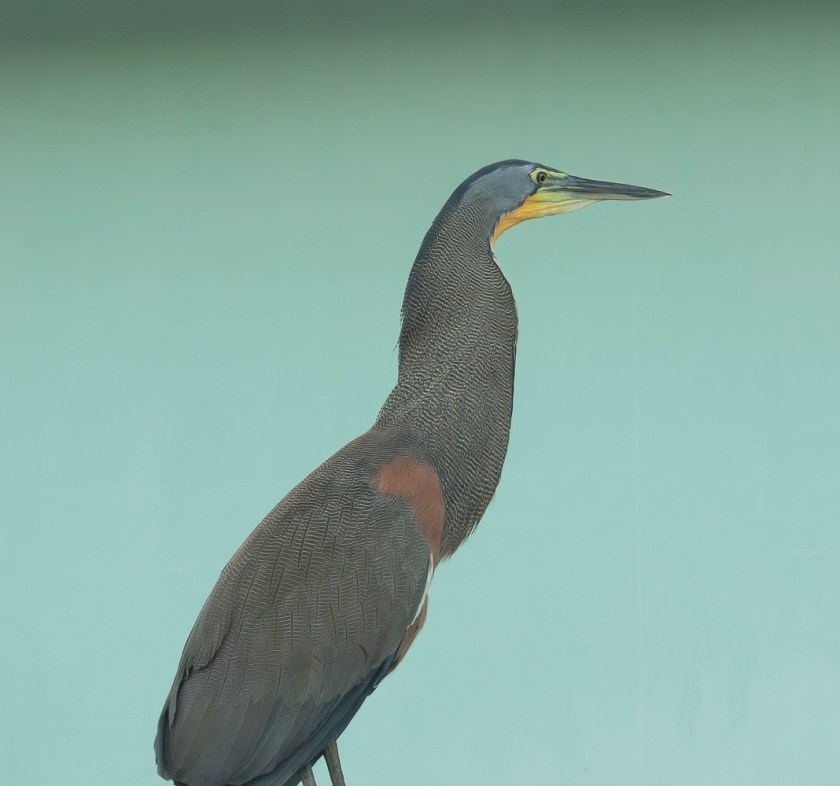
Drifting around the canals on the Caribbean side, in Tortugero National Park, there was a diverse heron population. My favorite was the Boat-Billed Heron, Cochlearius cochlearius. It has large eyes, and is mainly nocturnal:
It gets its name from the keeled bill:
The unusual bill is used as a scoop: the bill is lowered partly underwater and the bird walks forward, thrusting it in front. No other heron species does this.
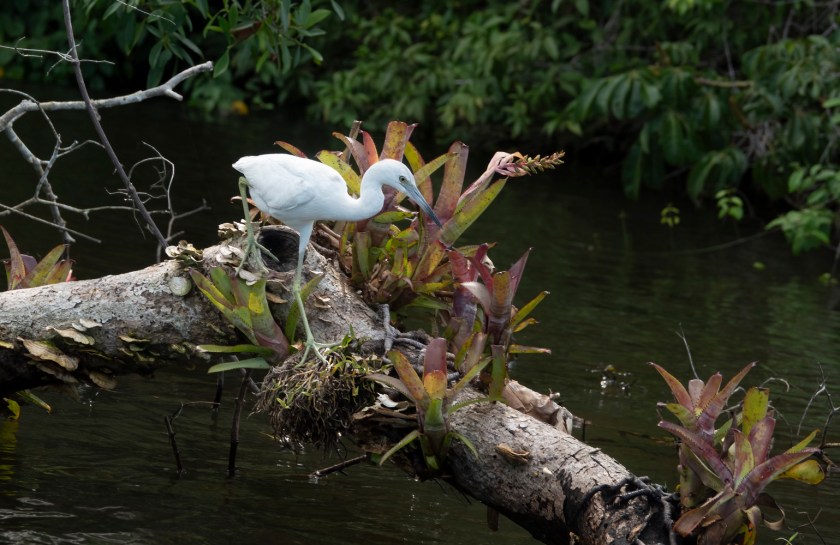
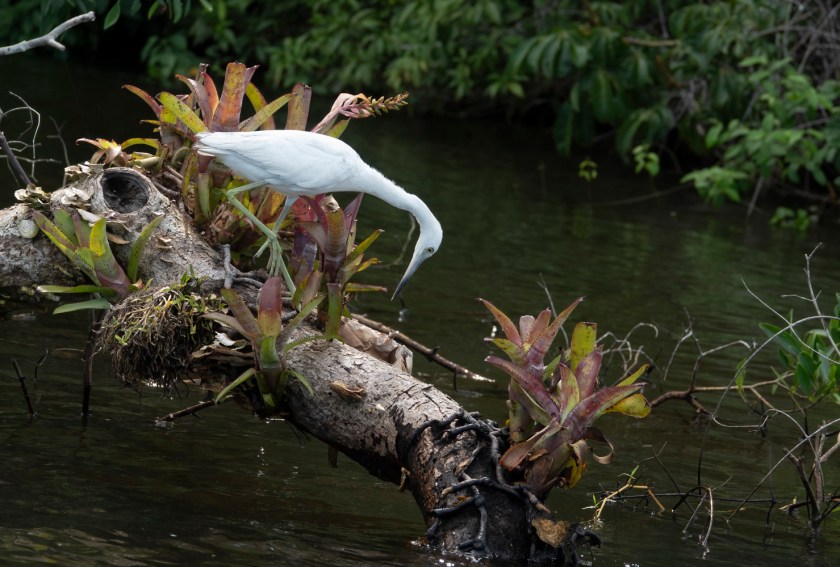
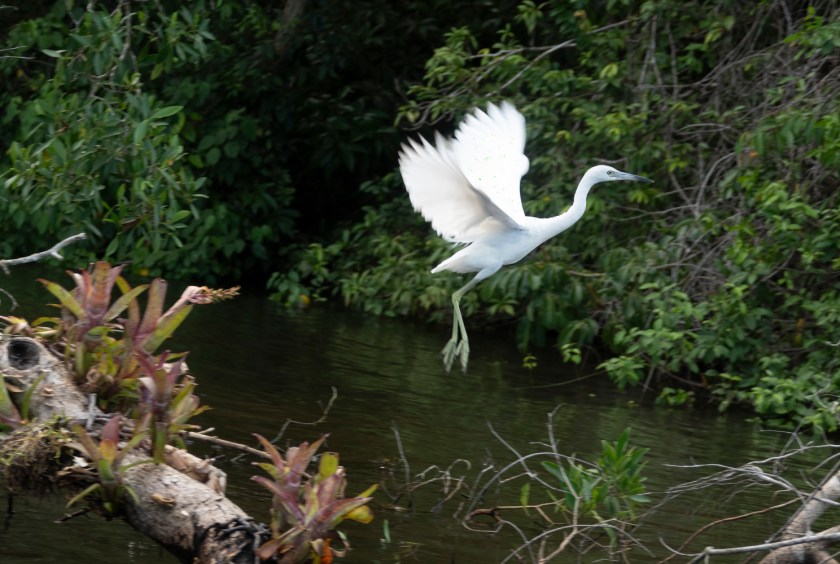
We saw many Little Blue Herons, Egretta caerulea. As juveniles, they’re purest white:
poking around on a fallen tree amongst the bromeliad plants:
but more skittish that the Boat-billed Herons:
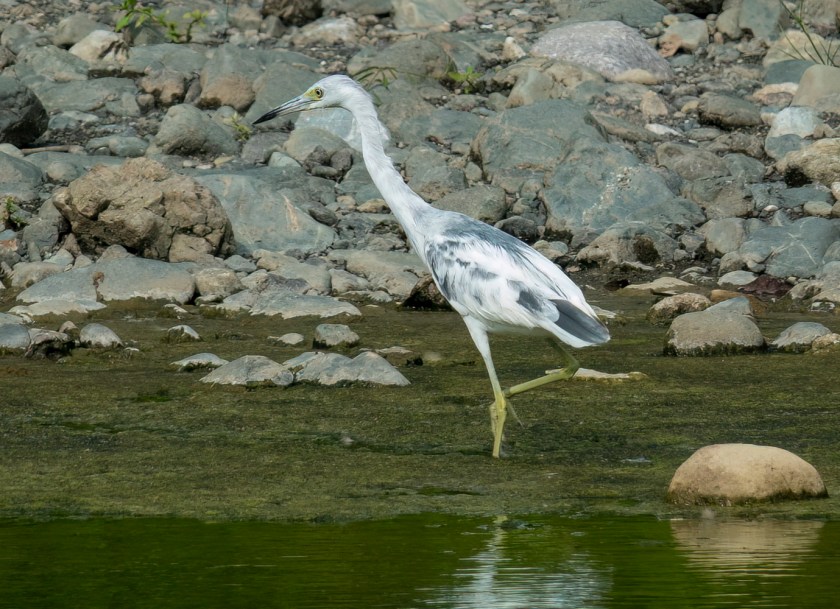
As they get older, their virginal white becomes splotchy:
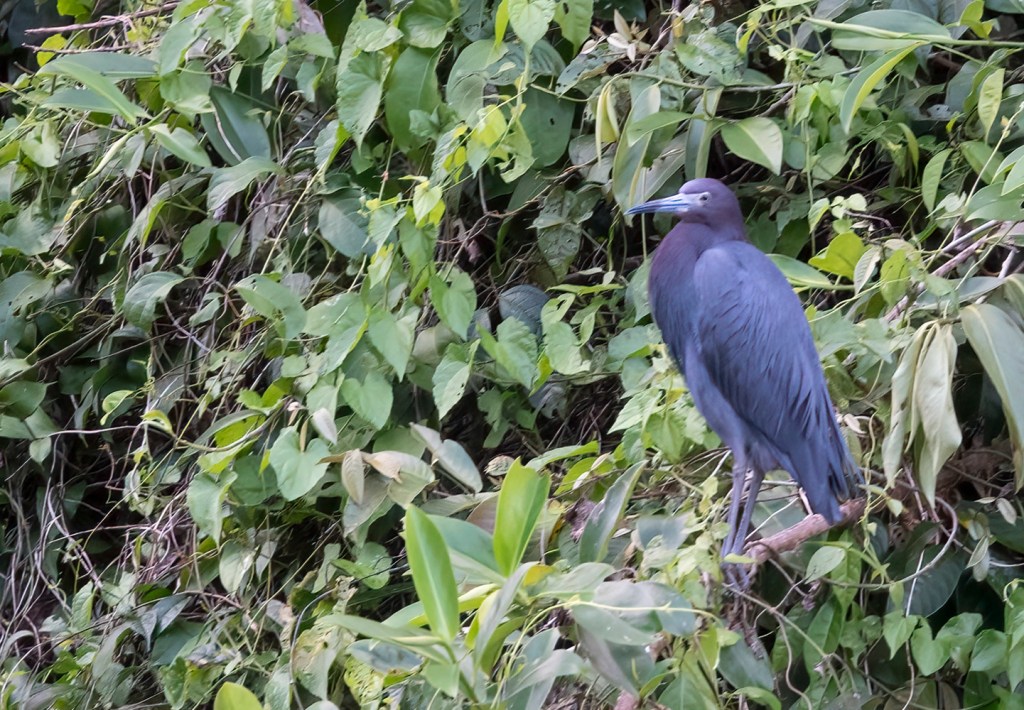
until it is entirely displaced by the adult purplish slaty blue grey:
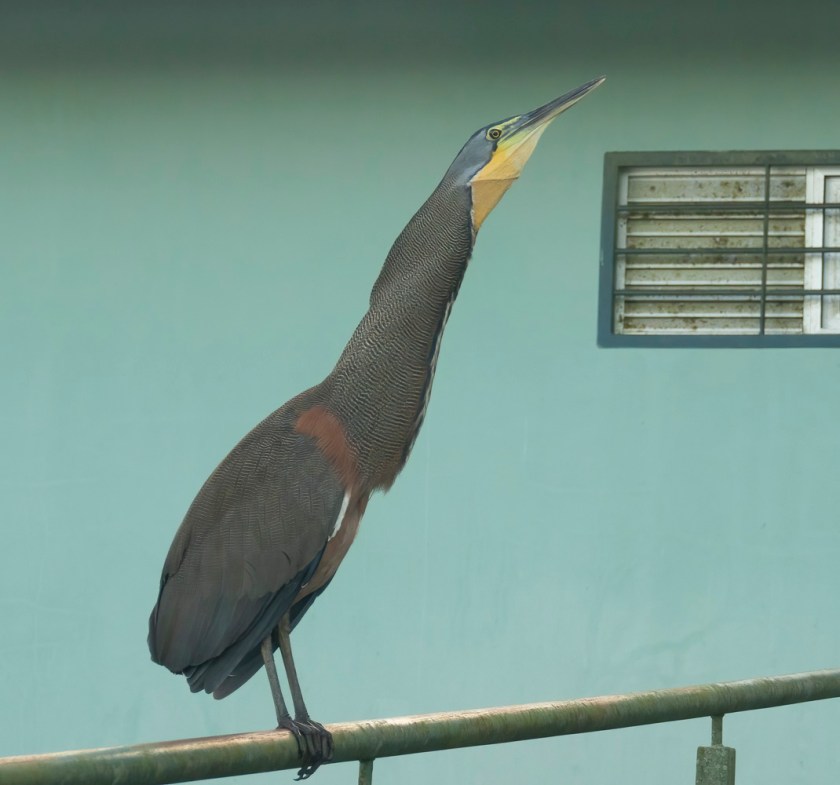
The Bare-throated Tiger Heron, Tigrisoma mexicanum, hung around the dock. This is not a wall-painting, but a real live heron:
From time to time it lifted its head, and gave forth its call:
They sing especially at dusk or dawn, and in the breeding season: listen to this video, which I’ve placed on YouTube in the hope that works (let me know if it doesn’t): https://youtu.be/pwoeHLOaHwM
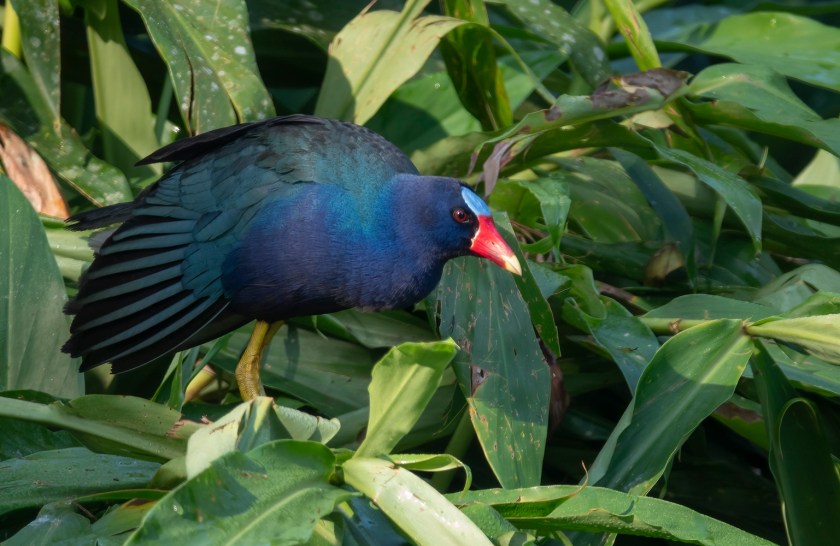
Perhaps the most technicolor bird was this denizen of the littoral vegetation, the Purple Gallinule, Porphyrio martinica:
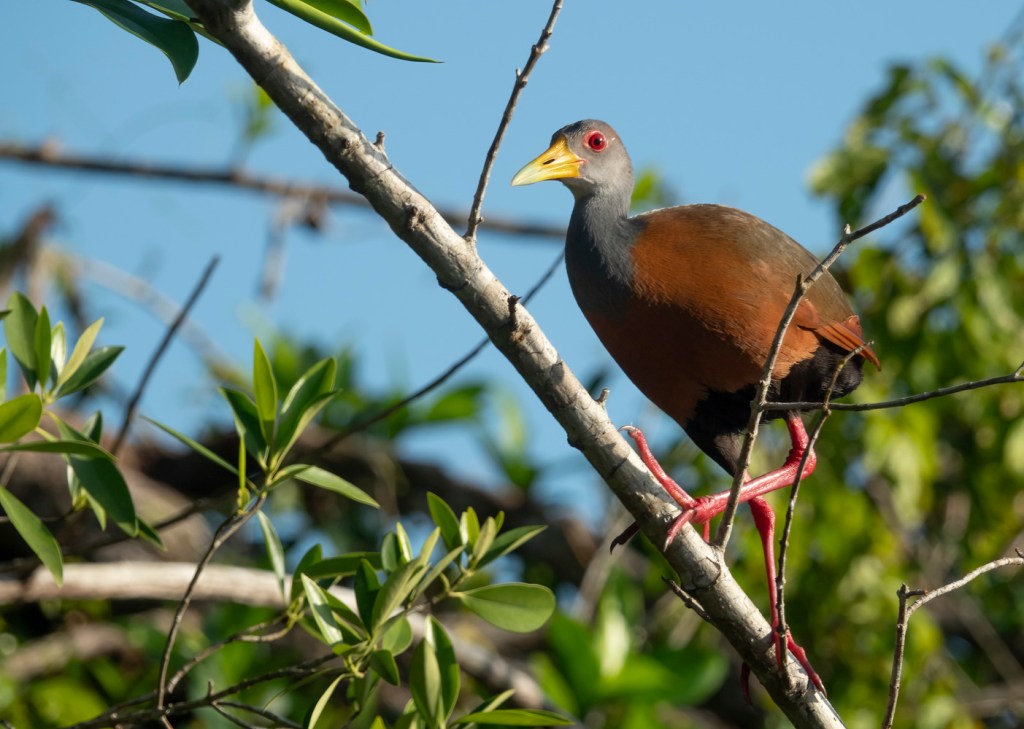
Like its drabber cousin, the Gray-cowled Wood Rail, Aramides cajaneus, it walks on floating vegetation and overhanging bushes:
PS Costa Rica’s location means it often serves as the southernmost part of the range for North American Species, like the White Ibis, and the northernmost part of the range for South American species, like the Gray-cowled Wood Rail. But yet other species are limited to Mexico and Central America, like the Bare-throated Tiger heron.
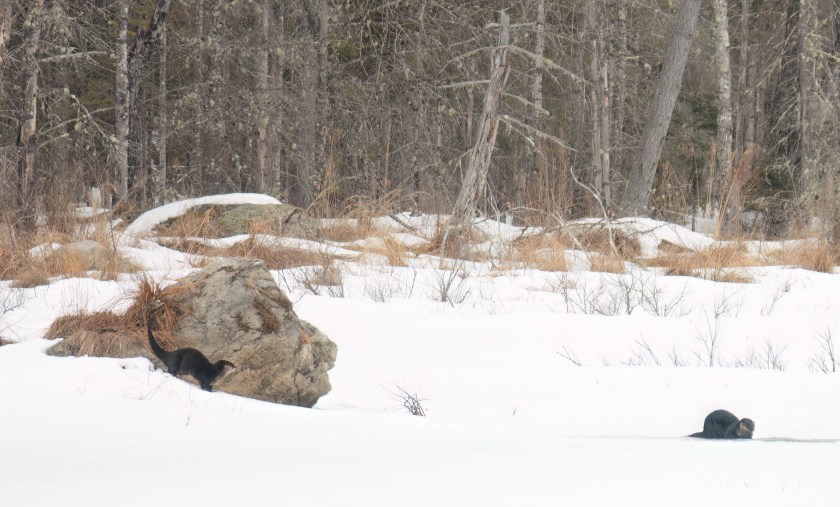
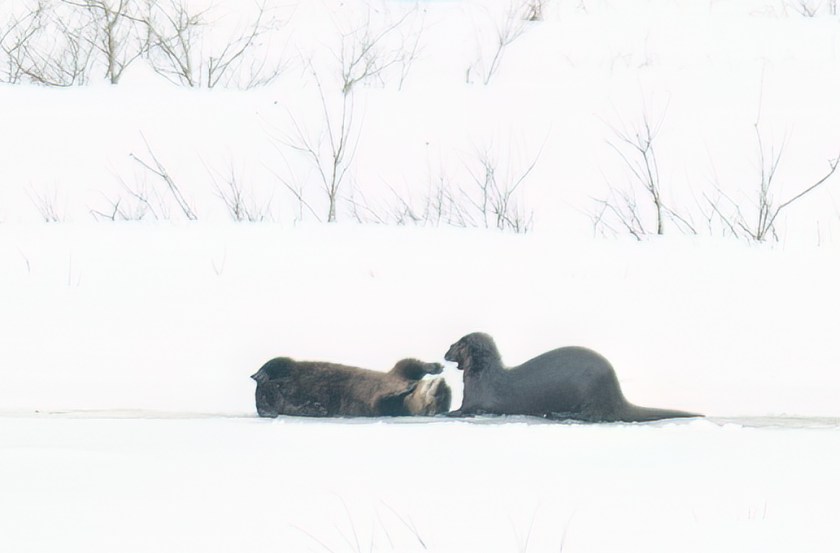
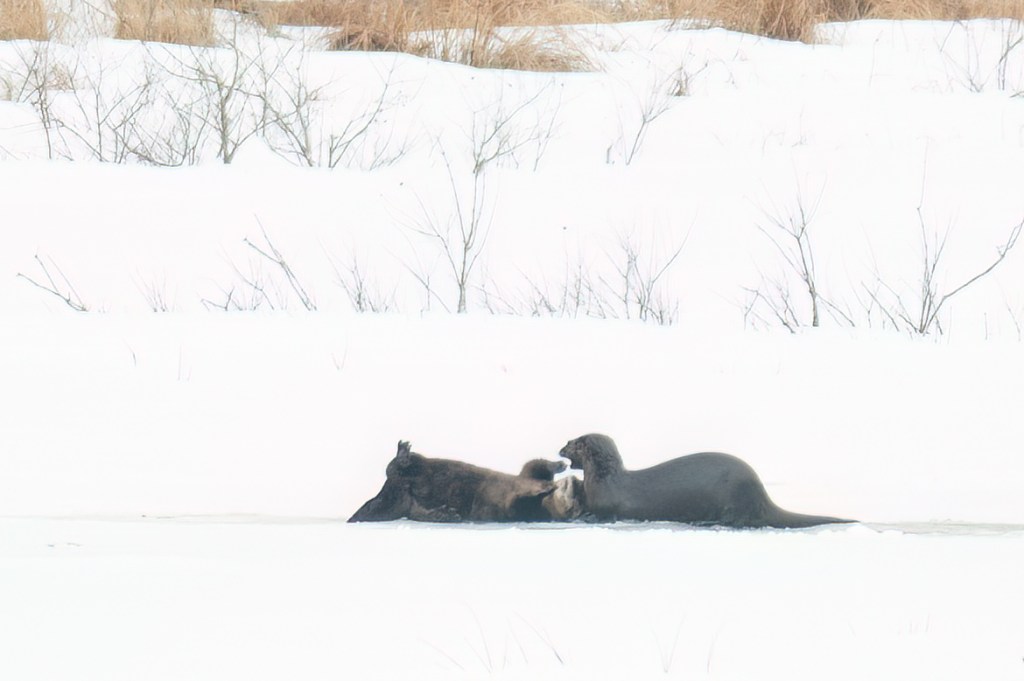
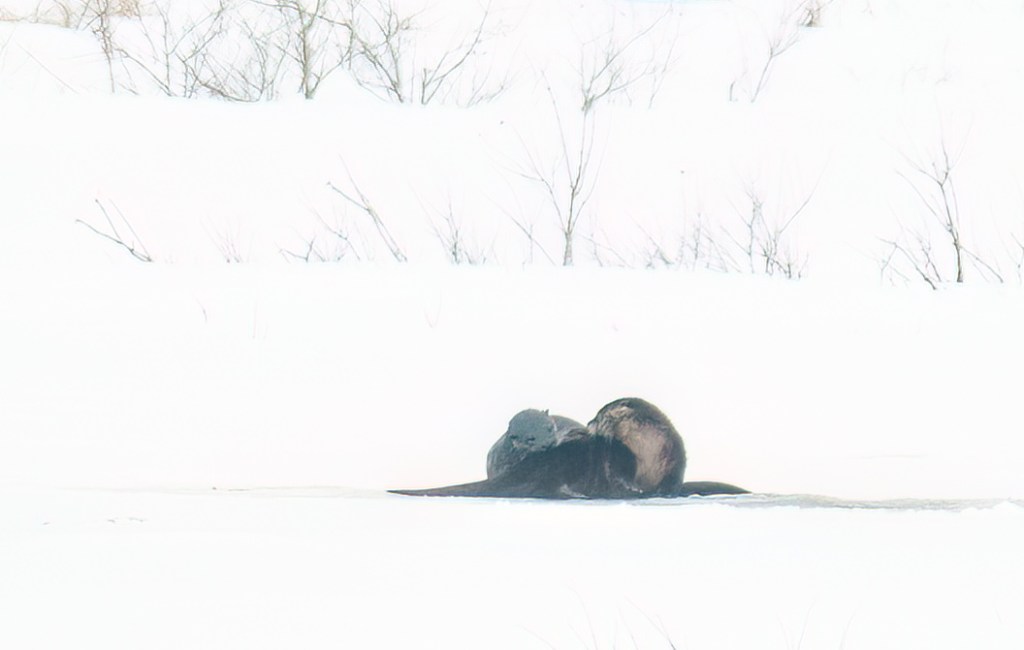
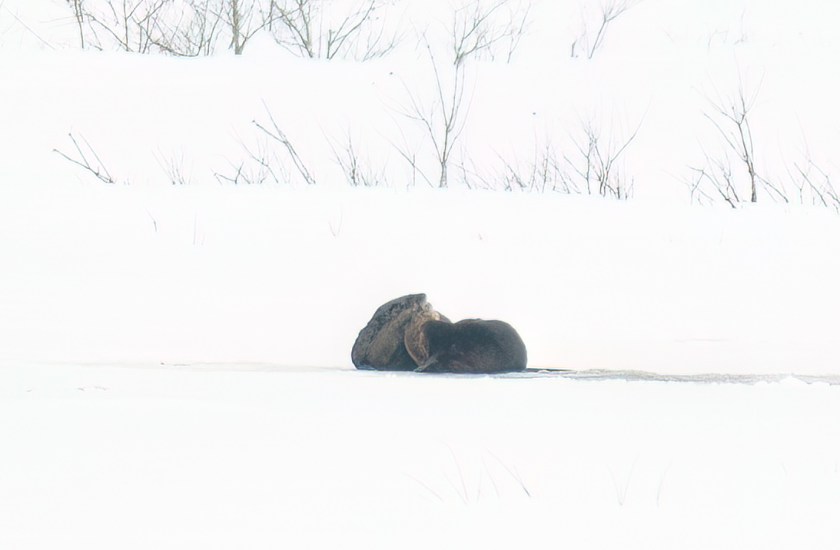
[I’ve been watching my otters as usual, and I am fairly sure I have been peeping in on how they meet up and find a match. Many of these photos are from a long way off, but they nonetheless tell a story that I hope you will find convincing.]
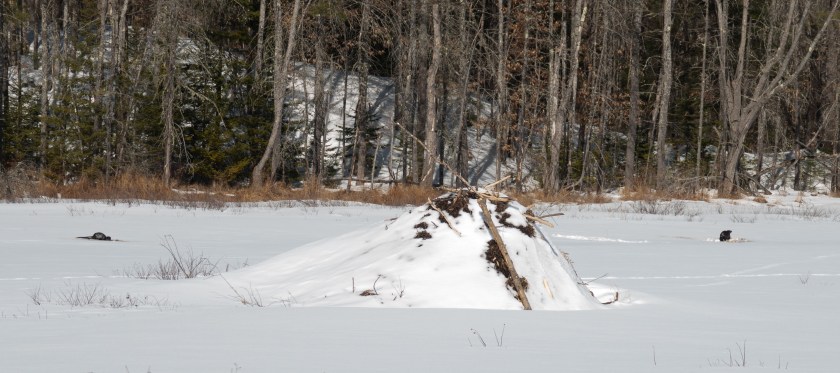
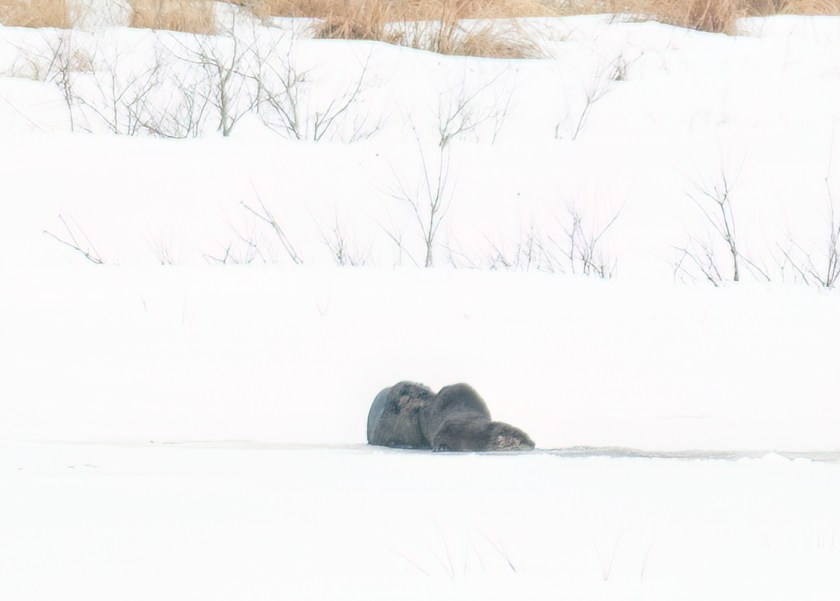
Most of the winter, if I see otters together I assume they are a mother and last year’s young. They behave like puppies, rolling around, diving in, and playing, often fishing out of the same hole in the ice.
Recently their behavior has changed. I haven’t seen two otters together in a while, and when there are two they occupy separate holes and keep their distance.
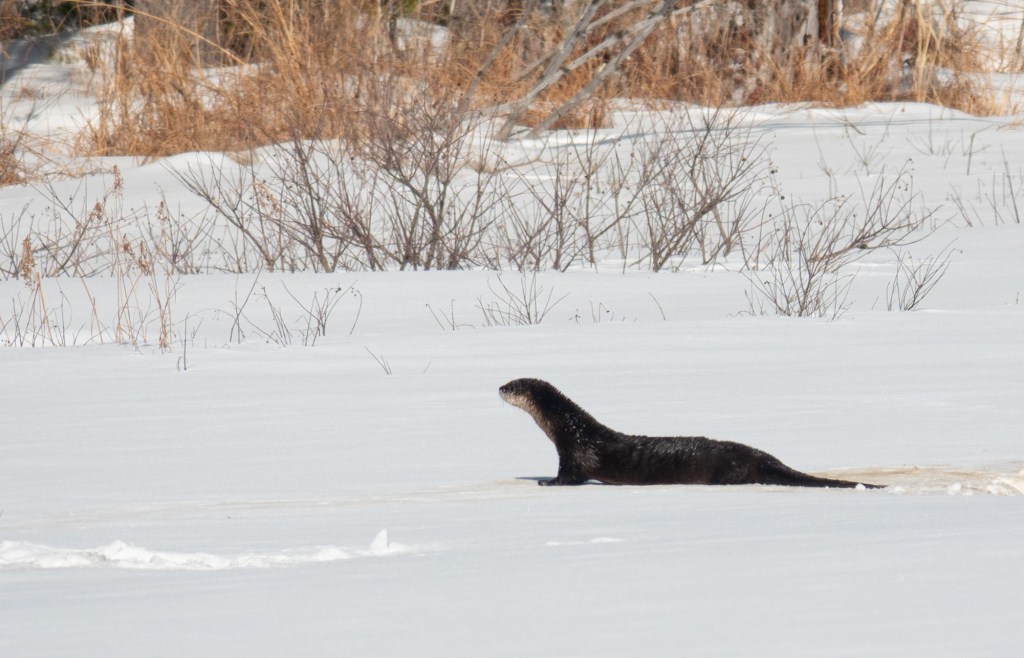
A few minutes earlier, there had been only one, using the righthand hole, emerging and walking/sliding a short way off to poop. Then he dived and came up in the lefthand hole, where he stayed. Suddenly, a second otter appeared in the right hand hole. He came out and looked towards the other otter with interest.
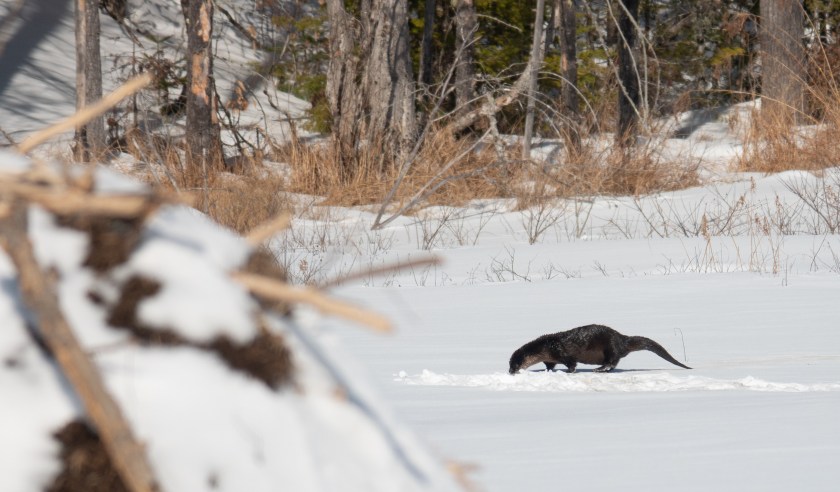
Then he went over to where the first otter had pooped and rolled, and had a good sniff:
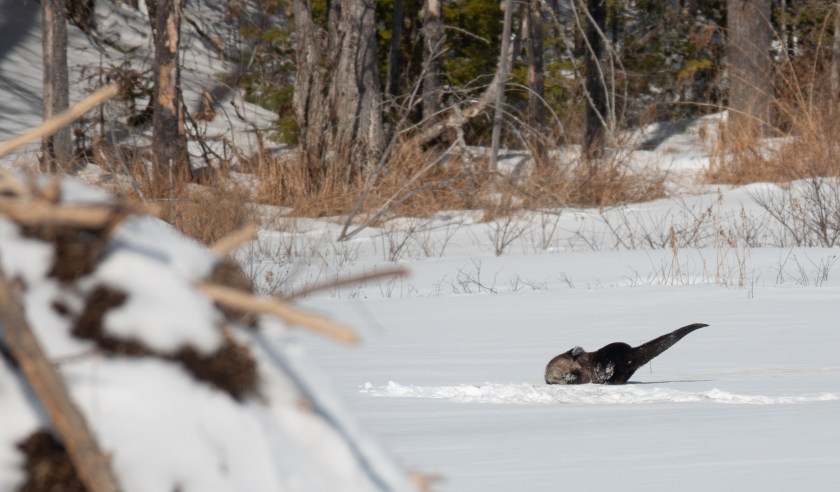
and a roll:
Both otters then continued to fish from their separate holes for a while. This was slightly untypical behavior, but I didn’t think much of it, till today.
At the far end of the pond, on a warm and very gloomy day, were two otters together. One went off to poop by a large rock, and on its return the other one went off to the same place and used the exact same spot. Nothing very unusual about that.
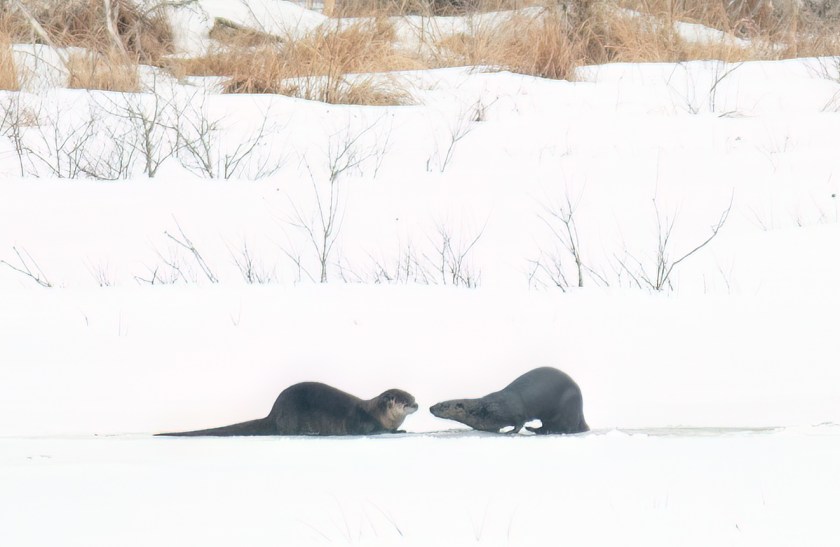
But when they got back together, things got interesting.
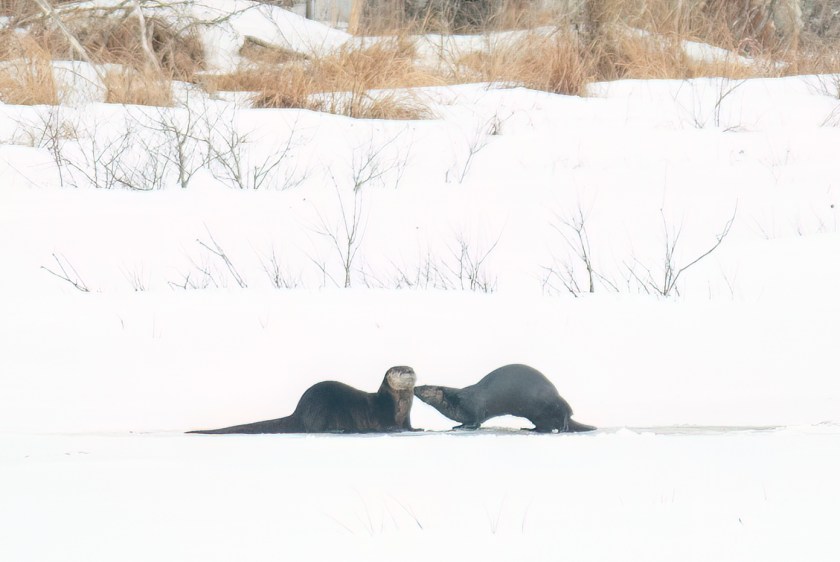
One of them spent some time smelling the other one’s head and neck closely:
At one point the right-hand one seemed to bite the neck of the other one, who wasn’t too pleased, but didn’t move away (no photo!). Then the left-hand one rolled over:
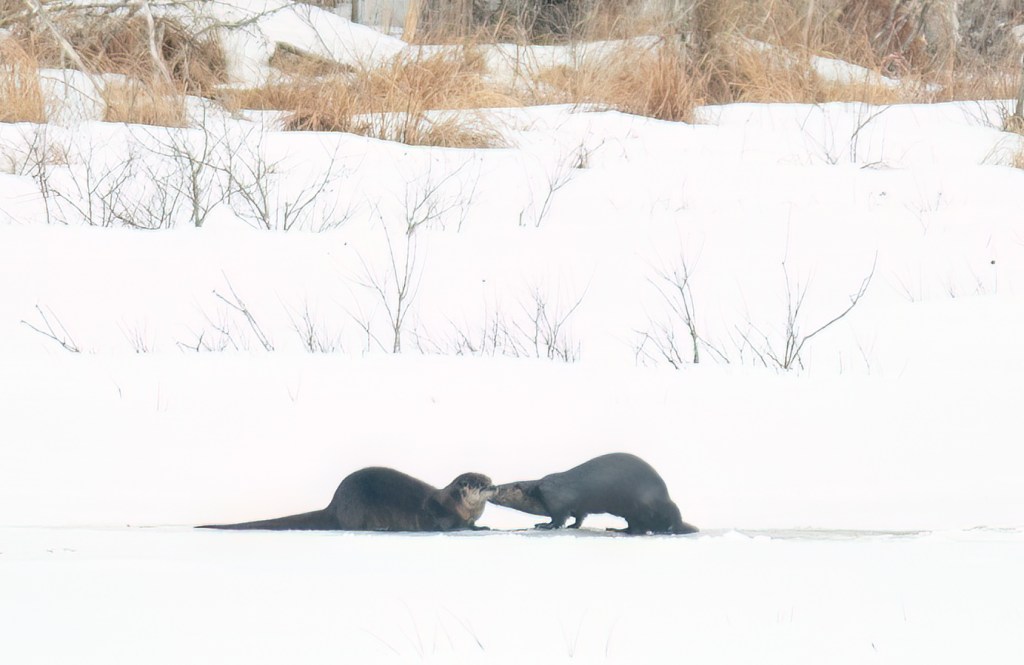
and cosied right up:
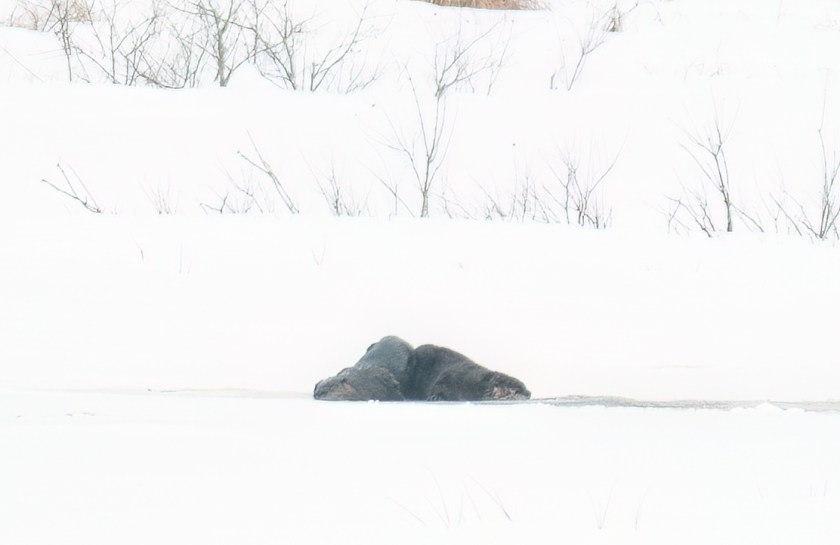
A little later, they put their heads together:
Time for a nap:
I am not sure I am interpreting all this right, and I will never know, because I had to leave, and now I am away for several weeks. It is the mating season for otters, so I could be right. Males do bite females’ necks during courtship, and rolling around is typical too (but they roll all the time anyway!) One slight doubt: females are about 20% smaller than males but these two don’t seem to have much size difference?
By the time I get back the ice will almost certainly have melted, and any courtship will have long since been consummated, so I end with a link to the only video I could find of river otters mating. It is very, very long, but around six minutes in you can see a commotion in the water, where clearly something is going on, and then they emerge from the water onto land, already conjoined, and making charming chirping sounds. From then on they stay on land, so you can watch and listen for a while if you want.
I have read that they mate in the water only, but other sources say it can be in the water or on land, and this video confirms that!
Minks and otters are both Mustelids, a family of long slender mammals whose name comes from the Latin for weasel, mustela, which in turn by some accounts originates from the Latin mūs + tela for “mouse-javelin”, named after their long elegant shape. They are fierce predators, and will eat anything smaller than themselves.
I watched an otter poking around near a large rock, pouncing on something invisible under a small bush, checking out the mess left by some earlier visitor, and then performing the usual bowel evacuation dance.
Usually they fish under the ice, emerge to eat their catch, perhaps defecate, and go straight back under.
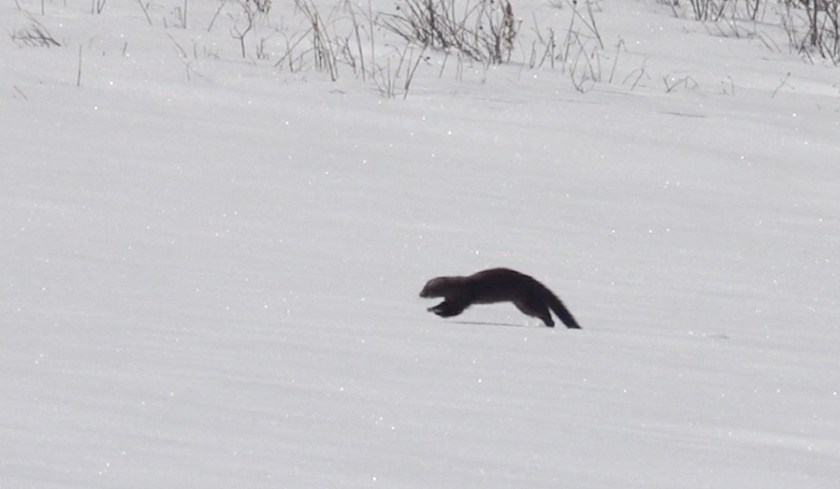
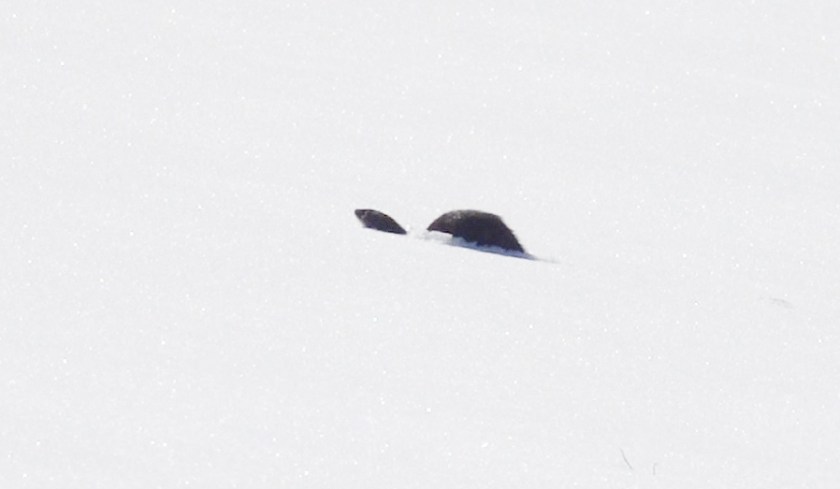
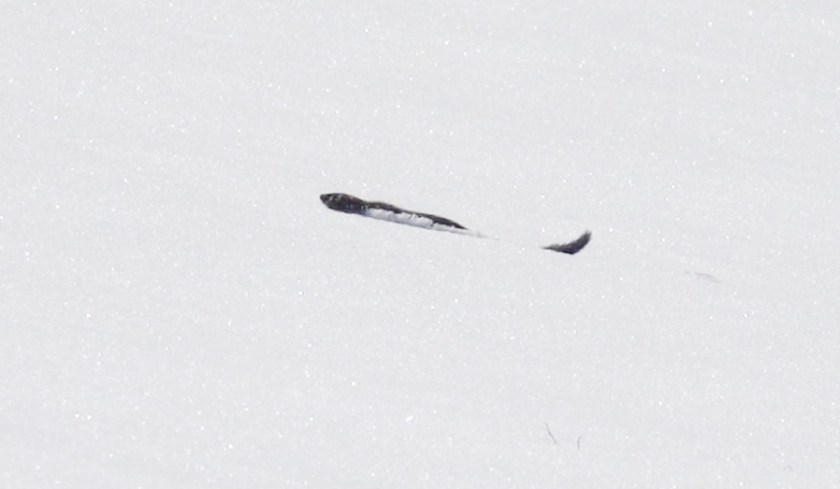
I kept watching, and then a dark shape appeared in the corner of my left eye moving fast away from the rock area. I assumed the otter had surfaced at a new spot, and so I started videoing. But it was small to be the otter, and all dry, whereas the otter had been fishing, and was wet. I wondered if it was a mink?
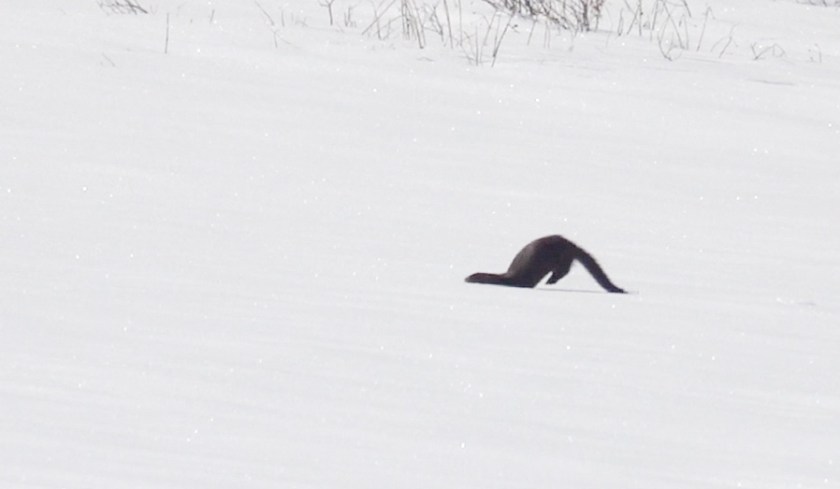
From time to time it paused and looked backwards, but mostly it was bounding at a fair clip. There was 5″ of fresh snow on top of a much deeper base layer, so it was heavy going at times:
especially when it hits drifts near the lodge:
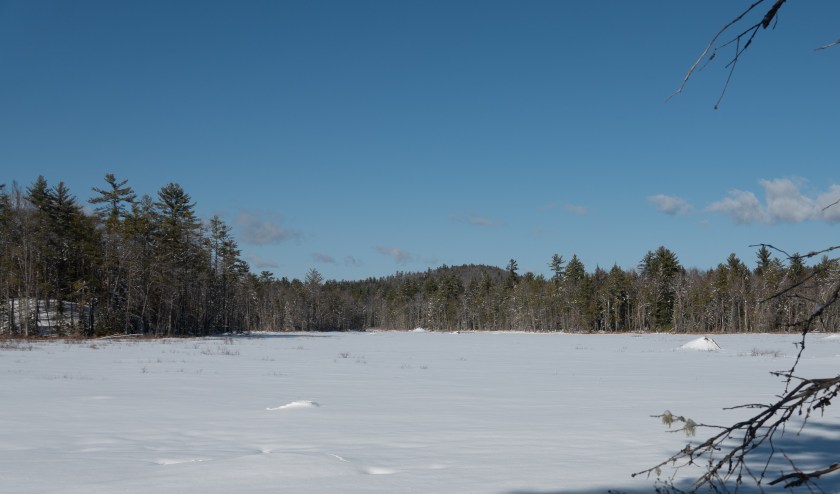
Seven minutes later it had run nearly 1/4 mile down the pond, stopping occasionally, and disappeared at the base of a beaver lodge. (It had started close to the lodge in the distance in the photo below, and ended up at the much closer lodge on the right.)
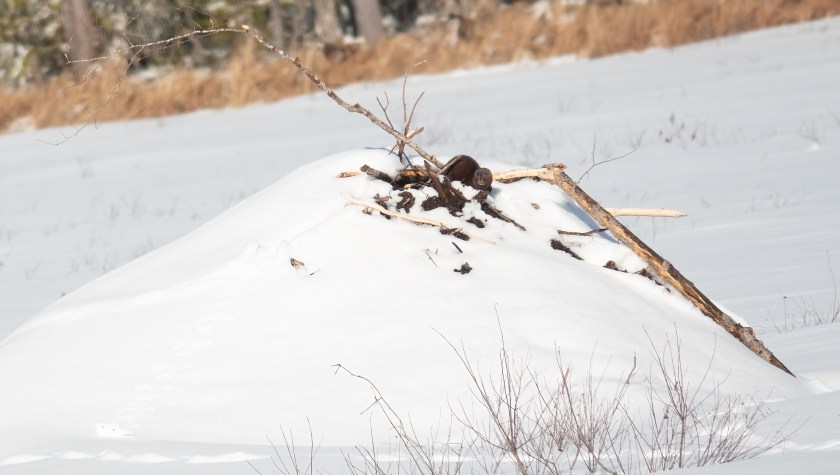
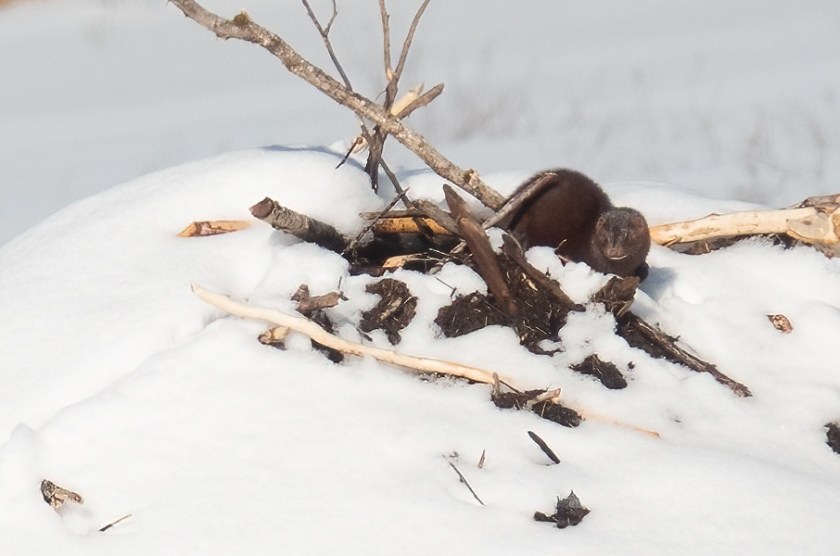
So I moved as close to the lodge as I could and watched. Something moved at the top:
I zoomed in, and realized I was being watched by a mink, all glossy brown and fluffy, with a white patch just visible under its chin:
So what was going on? I think the meter-long otter had scented and disturbed the half-meter long mink, which had run for its life. Otters are known to occasionally eat mink, especially if their territories overlap.
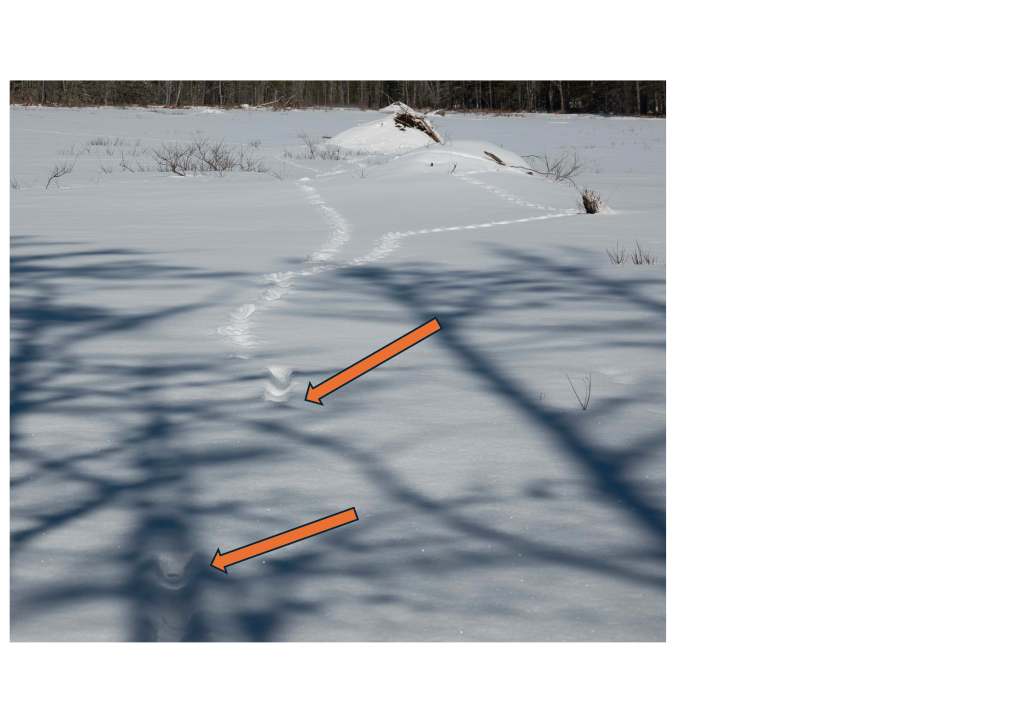
This one had found a safe vantage point, and lived to fight another day. By the next morning, it had left the beaver lodge, occasionally giving up and simply tunneling through the deep snow (my snowshoes sank in a full foot); the tunnel between the two arrows below was ten feet long.
PS Mouse-javelin may well be “folk etymology”, and the real source of the word may be more pedestrian. The suffix -ella is diminutive and familiar, as in Cinderella (or indeed Nutella!) so the ending may be a version of that. If you’re curious, there’s lots of ideas out there on the interweb!
[The other large mammal in Mongolia’s Hustai National Park is the wapiti. It took me some considerable time to understand what we were looking for, because our guide used the names wapiti, moose, elk, and red deer interchangeably. In Eurasia, “elk” is often used for what Americans call moose, but there are no moose in Hustai. We were, it turned out, looking for a close relative of the North American elk, Cervus canadensis, but the subspecies sibiricus. To avoid the confusion with moose, the park rangers call them by the Cree name “wapiti”. “Red deer” was in fact a red herring: it was once thought that red deer, Cervus elaphus, and elk were the same species, but that is now known to be incorrect. C. canadensis has a wider rump patch and paler-hued antlers. ]
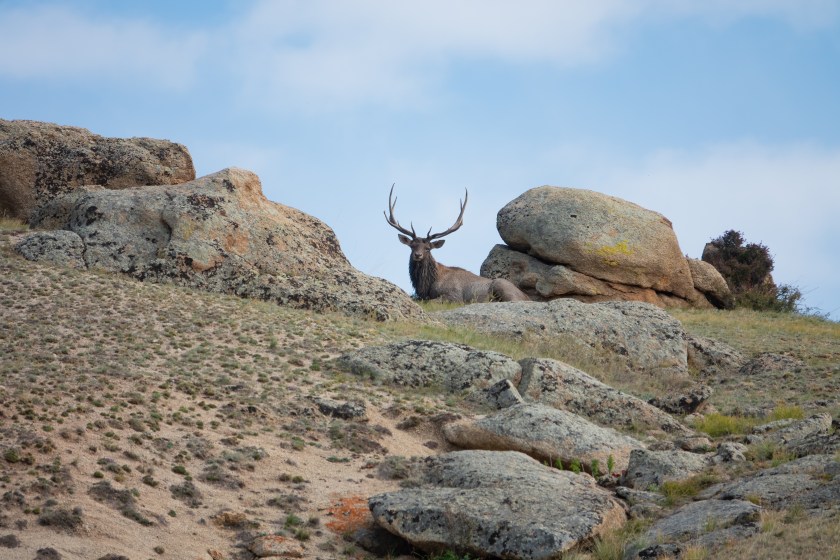
So, let’s stick with wapiti! Hustai has around 1300 of them, and they are not endangered. Here is a handsome bull wapiti, resting from his day’s exertions. It is the mating season, so he either has a herd of twenty or more females to keep under control, or he is trying to win a herd away from another male. Either way, an exhausting job.
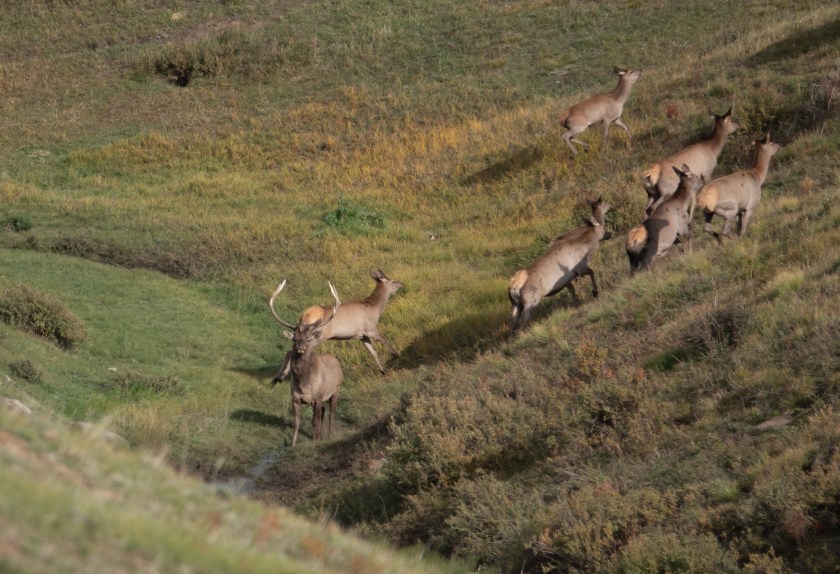
This is a group of females:
Their lord and master rounds them up:
and moves them higher up the hill to a safer spot:
If he senses another male nearby, he may bellow, or rather “bugle”, an eerie sound. He stretches out his neck, and lowers his larynx to make his voice deeper and thus make himself seem bigger.
There was a larger male somewhere off to the left, but there was also a very young male right next to him, a so-called “spike” male (bottom left), whose antlers have not yet branched; eventually, the dominant male will throw him out of the herd.
The male bugled frequently, but best of all was one morning at dawn when we had gone to look for wolves, and we heard wapiti bugling intermingled with wolves howling. Magical.
The herd moved down towards us to drink from a tiny stream.
The male kept a very close eye on both them and us:
When some of them headed across the stream his displeasure was clear:
and they thought better of it:
After all this effort, his reward is near: the tongue licking the air is scenting an enticing female:
There are several different species of antelope and gazelle in the parts of Mongolia we visited. Of these, the Saiga antelope was top of our list, for three reasons. First, this antelope has grazed the steppes since the last Ice Age, alongside the Woolly Mammoth and the Siberian Tiger. Second, it is a bizarre-looking creature, with the older ones developing an extraordinary proboscis-like nose. Third, it almost disappeared from the steppes of Central Asia in the early 2000’s, being classified as Critically Endangered. It has since recovered remarkably, and is now classified as Near Threatened.
The rugged mountains where the snow leopards live are separated by wide valleys of steppe grasslands. This is Saiga territory. They are skittish, so we never got very close, but we saw a herd of around 30 animals sharing the vast flats with sheep and goats (right in background):
and cattle:
They hold their heads low, even when running:
They have Roman noses and a lugubrious face:
Another day we saw a single doe:
walking all alone and solitary across the plains :
What we didn’t see, sadly, was a mature male with a fully developed proboscis, so here is a photo from National Geographic:
The reasons for the saiga’s precipitous decline were many. After the Soviet Union broke up illegal hunting increased dramatically, driven mainly by demand from China for the horns for traditional medicine. The Pasteurella multocida bacterium caused mass deaths in 2015, and the Peste des Petits Ruminants Virus (PPRV) spread from livestock in 2017 and killed nearly 80%. It gets worse. A 2021 study showed that Foot-and-Mouth Disease has also spread into the saiga herds, with a mortality rate of 34%.
The rebound in population is extremely encouraging, but they are not out of danger yet.
PS We also saw Goitred Gazelle in the Altai, and Mongolian Gazelle in the west of the country, but too far away to photograph usefully. Here are some Mongolian Gazelle, grazing alongside a herd of horses:
They’re not endangered at all, I am delighted to say, despite being hunted for centuries: “a passage in the 13th-century Secret History of the Mongols tells how a young Shigi Qutuqu managed to round up a herd of gazelles in a winter blizzard.” (Wikipedia)