[The videos are not always playing, and I’ve failed to workout why. Sorry. ]
The second sloth we saw was a Two-toed Sloth, better called a Two-Fingered Sloth, because it has three toes on its back feet! We were relaxing reading our books before dinner, and Johan our guide appeared to ask if we’d like to come and see his find. These sloths tend to be nocturnal, so we were lucky to see it, and it was at dusk, high-up in a tall tree. So it didn’t look like much!
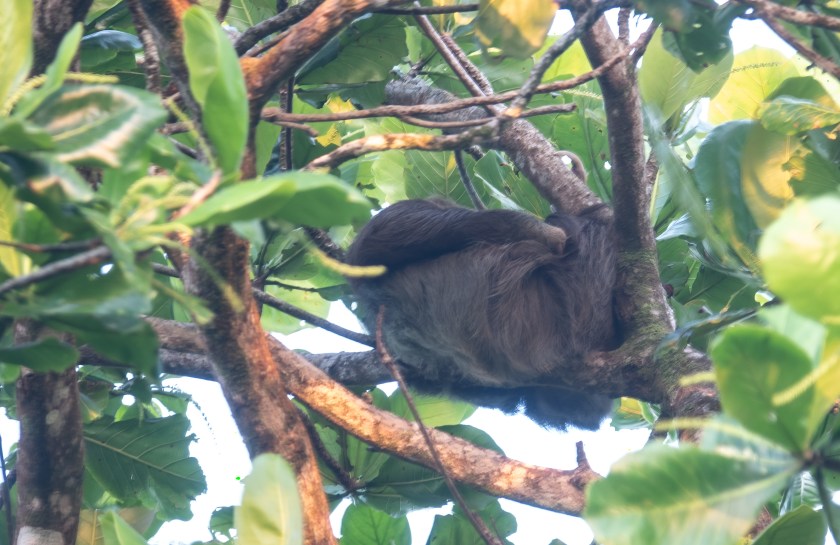
Counting toes was impossible, but then it moved, just a bit:
This is obviously an appalling photo, so let me supplement it with some photos and videos taken through a scope by our excellent guide, the nature interpreter Johan Fernandez. The videos are best watched on full screen if you can.
Time to wake up, apparently.
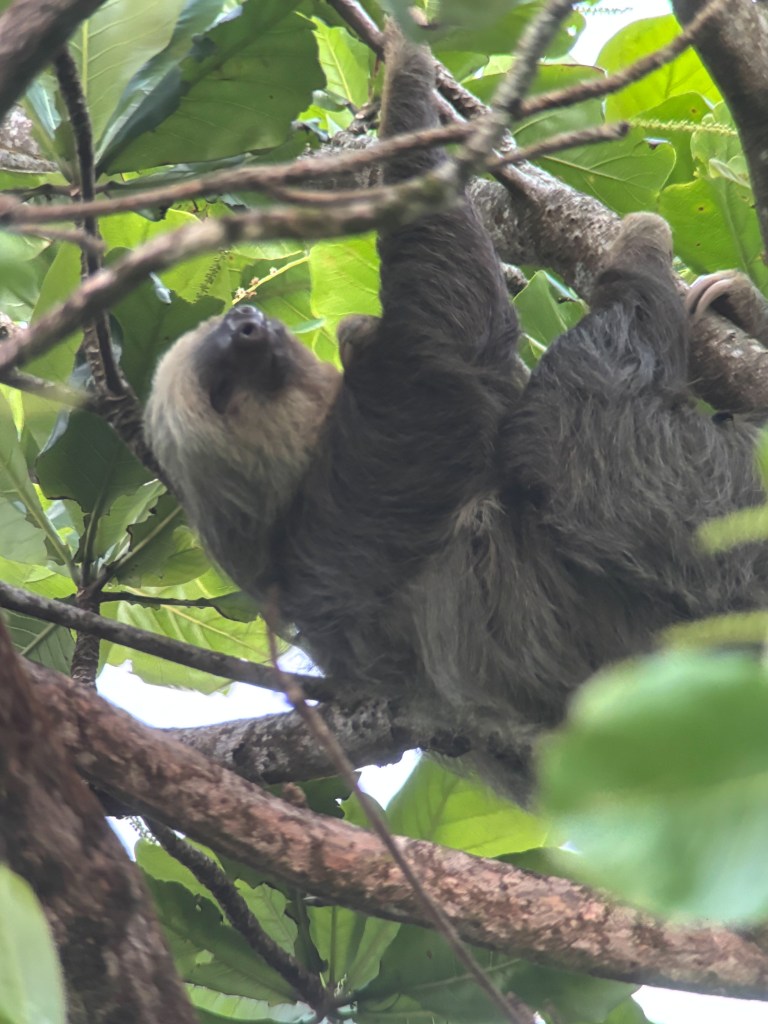
And a pause for a portrait:
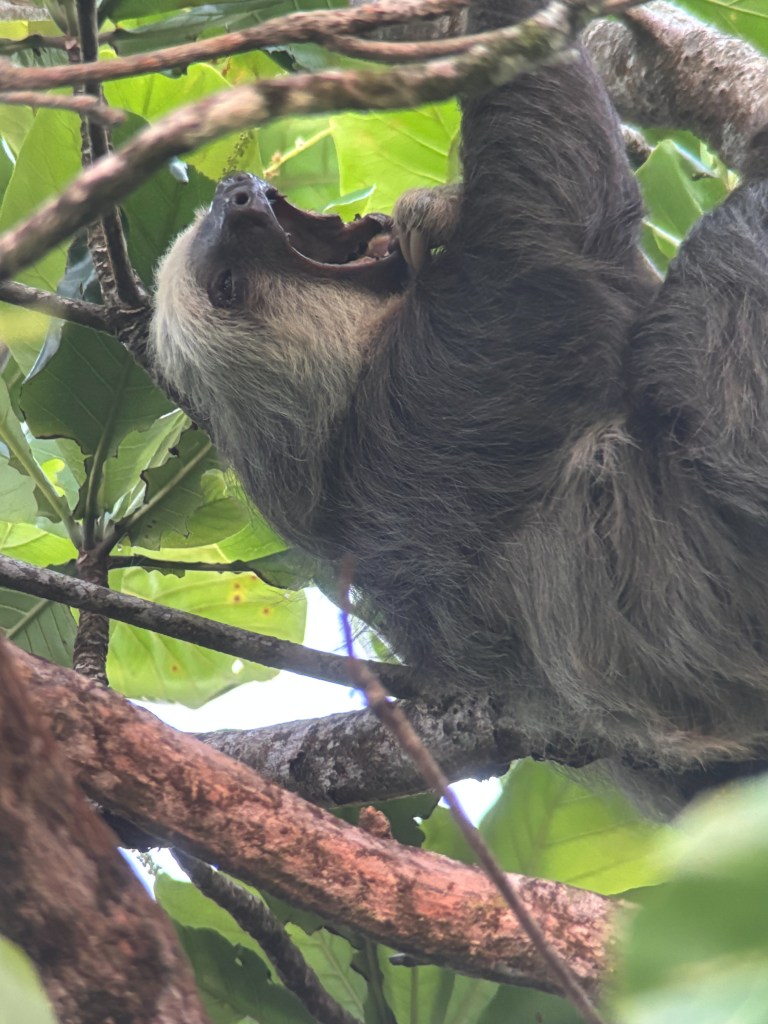
Just like us when rudely awoken from a deep sleep, a yawn seems to help:
In 1749 the French naturalist Georges Buffon described them like this:
“Slowness, habitual pain, and stupidity are the results of this strange and bungled conformation. These sloths are the lowest form of existence. One more defect would have made their lives impossible.”
On the contrary, this slow-mo life style is such an effective way of surviving on a low-nutrition leafy diet that it seems to have evolved twice: Two-toed (Bradypus) and Three-toed (Choloepus) Sloths are separated by 30 million years of evolution, and are in different genera. Among their specializations, Two-toed sloths have the most ribs of any living mammal, 46 to our 24, and this helps support their stomach when they hang upside down.
 Eyes on the Wild
Hi Moira, Once again – fascinating! “Slowness, habitual pain, and stupidity are the results of this strange and bungled conformation. These sloths are the lowest form of existence. One more defect would have made their lives impossible.” -> This passage also describes me in the morning.
LikeLike
I wake up like a sloth – stretch, yawn,stretch some more! Such an odd yet perfectly adapted creature. I love that their fur is it’s own biome!! L
LikeLike
George Buffoon…oops, Buffon obviously didn’t see the adorableness of these endearing animals.
LikeLike