Before I leave the very dry regions of the Makgadikgadi and then the Kalahari, let me share a few more delights.
The Leopard Tortoise has a beautiful shell, both top:
and bottom.
We started to speculate as to how the shell grows. One suggestion was that, like a lobster, it sheds its shell and a new bigger one is waiting underneath. No. In fact, each scute grows outward in rings. The tortoise’s bony shell is attached to the spine and ribs, so just as bones grow when a child grows, so do tortoise shells. The keratin scutes are a covering, and they too grow with the animal, just like our fingernails do. This shell of a dead tortoise has lost some of the keratin scutes, so you can see the bony carapace underneath.
When the tortoises are young, up to 6 or 7, counting rings gives you their age, but after that they may grow a lot in good year and not at all in a dry year, so it is an unreliable gauge.
Moving on, there were butterflies, some extracting minerals from elephant dung,
others more photogenically on flowers:
There was an amazing species of enormous beetle, in both places, which our guide told us was a Blister Beetle, and shouldn’t be touched (though in fact he picked one up). On my return, I identified it as a quite different, and harmless, species, the Giant Jewel Beetle, Sternocera orissa . Here is one feeding on acacia:
and here it is on our guide’s hand, to show its size (about two inches).
The male Shaft-tailed Whydah, Vidua regia, in breeding season is a small but spectacular bird, with 20cm tail plumes twice as long as its 10cm body:
And I’ll stop there, without showing you the Bateleur eagle or the black-winged kites or the ….. so much to marvel at.
After three days in the Makgadikgadi, our itinerary had us moving to the well-named Deception Valley in the Central Kalahari Game Reserve, the second-largest game reserve in the world, bigger than the Netherlands.
I start with a saga, one that brought home to us how helpless we are without the skilled support team that shepherds us around these wild, places. If you’re interested, read on; otherwise, skip down to the wildlife.
After breakfast we set off in our safari vehicle with water and lunch; the team struck camp after we left, and sped off in their lorry to get there ahead of us and set up anew in the Kalahari. After a day’s driving in 40C temperatures, the last four hours of it on dirt roads and out of cellphone range, we arrived at dusk. No welcoming tents, no truck, no team, no food, no beds…. although it did turn out that the large duffel-bags on the ground contained folded heavy canvas tents, and many many different length tent poles. It was getting dark, there are lions in the Kalahari… so sleeping under the stars was not an option. We set to work, under the leadership of our guide TJ and the 5 foot tall housekeeper, Mighty.
It took us an hour per tent (more like marquees than tents, in terms of weight, and technique).
Once we had two tents up, we decided that we could fit in four people per tent, and it was time to stop, so that’s what we did, sleeping on the floor of the tents (the beds were in the missing truck). Our guide slept on the roof of the safari vehicle, and the six of us plus Mighty slept in the tents. We had enough water, and a single bottle of wine, one apple each, and half a packet of biscuits to share.
We rose in the morning (to say we felt rested would be an exaggeration), and agreed to do a two hour game drive, then drive back the way we had come until we could make contact with the truck. First, we proudly photographed ourselves with one of our laboriously erected tents!
Until this logistical glitch (debacle?), we had not realized our guide had no satellite phone for emergencies, which was somewhat unnerving. After two hours, we met the youngest member of the camp team, who had hitchhiked from the broken-down lorry to tell us what was happening. It had two flat tires, and only one spare. It was suggested that we could wait for the lorry, then head back to the camp again… but we declined, and asked for a hotel with a bed, a shower, and food! Or even a spa…
None of us (combined age about 430 years) really wanted to be in the Kalahari desert without emergency contact capability, and it had also turned out to be so dry we saw very little, including no aardvark or aardwolves, the principal goals of the trip. Instead, we asked for options, and ended up spending the remainder of the trip in a lovely camp site near the Okavango… of which more later.
Back to wildlife. We did see a few things worth telling you about in the Kalahari, so here goes.
This is a Kori Bustard, Ardeotis kori, the world’s largest flying bird. Males can weigh up to 20Kg.
He struts along, big enough not to worry much about predators, though he has very poor forward binocular vision, with extensive blind spots.
He was hunting for insects in the dry grass:
A fine figure of a bird:
Smaller, and more nervous, the Cape Ground Squirrels, Geosciurus inauris, live in holes, and emerge to feed.The female in the movie below may be pregnant, her nipples are enlarged and she has a big belly:
To get a better view, they stand fully erect:
and when it is too hot, they turn their backs to the sun and use their tails as sunshades:
There are bigger mammals too; here is a splendid Gemsbok (aka Oryx):
And of course there are lizards. This is a breeding male Ground Agama, Agama aculeata:
After a few minutes those bright red spots faded and the head coloration also shrank and dimmed:
The brighter colors are probably associated with courting or excitement, but they make the lizard more conspicuous, so when it is not courting the colors fade. Unlike chameleons, they are not thought to change to deliberately match the substrate, but once the colors fade it is astonishingly well-camouflaged:
Two birds to end with. The Lanner Falcon, Falco biarmicus, is a favorite of falconers. It preys on birds , some quite large, like ducks:
and a male Red-Backed Shrike, Lanius collurio, which winters here but breeds in Europe:
PS I usually give full credit to our trip organizers in these blogs, but this time I’m keeping quiet. Once they knew of our plight, they handled everything very well, and we would travel with them again, so I don’t want to give them a public negative review.
The elephants hereabouts in the Makgadikgadi find shallow muddy pans and roll in them. Here is a fully dry pan:
When the salty mud dries, the elephant looks almost white.
But as the sun sets, they are gradually transformed:
This was a small breeding herd of females and youngsters. The sun is quickly getting lower:
No rose-tinted spectacles or tot of gin is required to see this effect.
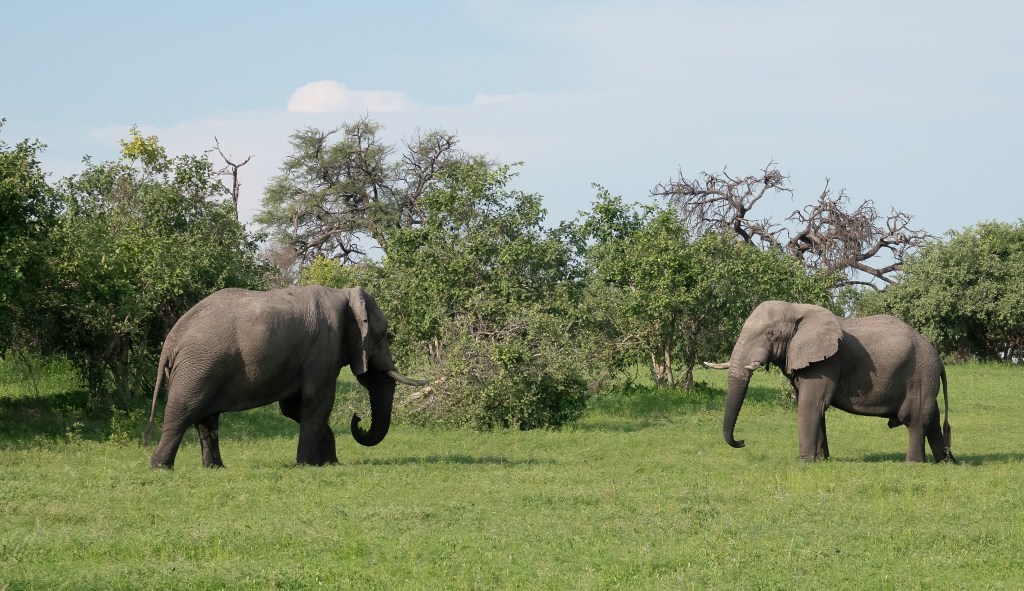
But at this time of year, most of the elephants here are solitary aging males. This one is in musth, shown by the secretions leaking from the gland between his ear and his eye.
If he were still young and virile, he’d be quite dangerous at this time, rampaging around in search of females. But he is near the end of his life, tusks broken off, too tired for all that fuss.
As the elephants move through the landscape, you sometimes find their bedrooms. They choose a small sloping bank, and scrape a depression in it. They lie so that their feet are lower than their head, making it easier to get up in the morning! In this shot, TJ is standing near the head rest area, the feet would be in the foreground.
Here you can see the impression of his wrinkled trunk, and a single tusk:
My final shot of this story is a rare view of the underside of an elephant’s trunk. The sides fold inwards, so he can get a good grip on a bunch of grass or a mouthful of twigs.
Farewell for now, as he and we leave the Makgadikgadi for the Kalahari.
Although the Makgadikgadi pans were mostly very dry, punctuated only by occasional trees and termite mounds
there were a few that retained some water:
and where there is water, there are water birds. These are Blue-billed Teal, Spatula hottentota, formerly commonly known as the Hottentot Teal, a name less used now for obvious reasons.
When their wings are spread, there is a stunning green patch:
You can clearly see below that even this pond is in the process of evaporating into nothingness, and the ducks will be forced to move on.
We had hoped for big flocks of pelicans and flamingoes, but it was far too dry for that. However, we did see comically implausible African Spoonbills, Platalea alba:
lined up as if on on parade:
and Glossy Ibis, Plegadis falcinellus, just plain black at first glance, but a handsome a dark purplish metallic bronze in good light:
with a flash of green when the light catches their iridescent wings:
All three of these birds live year-round in much of sub-Saharan Africa, and forage in shallow water, feeding mainly on invertebrates. They are not threatened, and the ibis have even spread to the Americas. Spoonbills show up more and more often as far afield as Europe and even the UK.
PS As the effects of climate change become more and more worrying, we all know that trees have a major role to play in storing the carbon that is causing the problem. But much less publicized has been the positive role of grasslands, which store their carbon in the soil. Recent research suggests that both natural grasslands like the Makgadikgadi, and managed ones, may be better carbon sinks than forests in unstable, warming, drought-like conditions.
We saw two species of fox in Botswana. Our favorite was the Bat-eared Fox, Otocyon megalotis. Here are four from a distance (in the Kalahari), either a pair with two cubs, or possibly two pairs.
They weigh about 4Kg, and are the only truly insectivorous canids, eating mainly termites. Their teeth are adapted for this diet, and they have no really close relatives, being the only members of their genus. The rest of these pictures were taken in Makgadikgadi NP.
They have enormous ears, which help in thermoregulation;
and they have charming faces:
This one was motionless*,
giving me time for a second close-up:
They are socially monogamous, these two were part of a family of three,
The cub was fascinated by us and sat down close to the vehicle to study us more closely:
Socially monogamous species are not always sexually monogamous, as shown by studies of Extra-Pair Paternity (EPP). In these foxes, though, the level of EPP is low, under 10% of cubs (Wright 2010). This may be one reason that males invest large amounts of time in caring for the cubs: more than the females, in fact. In socially monogamous birds there is known to be a correlation between low rates of EPP, and high rates of paternal care. (Søraker et al 2023).
To close, the other fox species we saw, the Cape Fox:
The omnipresent soundtrack of the Makgadikgadi grasslands was this:
Loud, insistant, and everywhere. The male Northern Black Korhaan, aka the White-quilled Bustard, Afrotis afraoides, attracts the girls by flying along, squawking as he goes, then suddenly dive-bombing her. The guides call them Suicide Birds.
He is quite handsome when strolling calmly along:
But once he’s in the mood for love, his recitative begins:
Take-off, still singing:
Once he reaches maximum altitude, he begins to plan his descent, and his legs go down:
Here he is in closeup, still mouthing off. He will keep it up all day.
If I were a female Black Korhaan, I’d succumb: anything to get him to shut up, rather like tipping strolling minstrels not to play at your table in an Italian restaurant.
The Steenbok, Raphicerus campestris, is a miniature antelope, 24″ tall at the shoulder. The grasses that barely reached the giraffe’s knees rise over the steenbok’s head:
They can melt into the grasses in an instant:
but sometimes they emerge amongst shorter plants, and you can see one entire:
Only the males have horns, short abrupt black prongs just visible here:
And here is a female, one ear folded back, with long eyelashes, and a gland beneath the eye that looks for all the world as though her mascara has run.
By and large, you see only one steenbok at a time, which suggests they are solitary, but our guide told us that there are usually two of them in the neighborhood, staying loosely in touch but not joined at the hip. We did once see a second one appear after the first one startled, which fits his explanation.
The sere Makgadikgadi is an unforgiving environment but steenboks can survive almost entirely without water, getting all the moisture they need from their browsing.
I have just returned from Botswana, on a trip that turned into more of an adventure than we had planned. I’ll tell the story gradually, and I’ll start in the Makgadikgadi Pan grasslands, a vast plain with a 360 degree horizon:*
The endless vistas were covered in a tapestry of grasses and wildflowers, sometimes with flocks of tiny queleas:
The land is dotted with salt pans, a few with water,
but most dry:
The National Park itself covers nearly 5000 sq km, and the entire pan system is 16,000 sq km.
The flatness produces distorted mirage-like sunets:
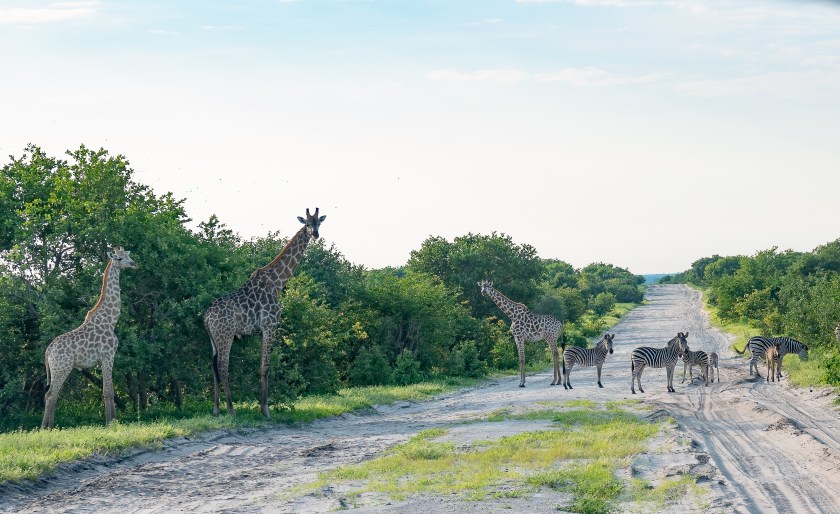
I was with five friends, and our guide TJ, camping. For three days we saw not a single other human being or vehicle, our own private wilderness. Jane, who has eagle eyes, found us five giraffe, four of which are in this photo if you look hard:
As we got closer we got the once-over:
There were two adult females, and three youngsters, two of whom were very young indeed.
These are Southern Giraffe, widespread in Southern Africa. Adults can reach 6m (19 feet) and the babies are six feet tall at birth.
The two smallest are roughly the same age, so the likelihood is that they are from the two different mothers, since twins are extremely rare. One of them kept trying to nurse, and eventually its mother let her/him:
You can tell the sex of the adults by the state of their horns, or more precisely their ossicones. The males fight, so the tops of the horns quickly lose their hair and become shiny:
Males like the one above also have a third ossicone in the middle of their forehead that develops as a sort of callus from head-butting their rivals.
This video is of a male, showing both these badges of combat; the third ossicone can be seen in profile at the end of the video:
At birth the ossicones are cartilage, folded down, and then they straighten and harden as the animal grows. Something went amiss for this female, but luckily she doesn’t need them for fighting:
As the sun went down I stuck the camera out of the moving vehicle, and captured the flavor of the place.
PS Jane is using her phone to try and ID birdsong with Merlin, not to make a call. We were several hours drive from cellphone reception. Merlin was, sadly, pretty hopeless in Botswana
On New Year’s Day, still no snow. Beech leaves in a puddle were striped with light refracted through a skim of ice.
Needle ice pushed up through the dead grass, powered by capillary action, with the water freezing as it reached the cold ai:.
The bottom “stalks” pushed up the previous night’s crop to create tiered candelabra:
and tiny air bubbles were trapped inside the stems:
But finally on January 7 it snowed,
and we went exploring:
Four coyotes had wandered across the field by the barn:
The wind had dragged patterns in the crust:
We had three snowstorms in one week, adding up to around two feet of snow. That’s a tough time for birds. This is a Dark-eyed Junco, Junco hyemalis, weighing in at between 0.5 and 1 ounce.
They eat seeds, and are mainly ground feeders.
They spend the winter in small flocks. There were twenty in my garden that day.
Mourning Doves, Zenaida macroura, are much larger,
with a delicate blue-grey wash under their wings.
This one was alone, but pairs are common. It settled down for a rest, fluffed up against the cold.
Then closed its eyes, and went to sleep:
After all those soothing subtle dove-greys, a startling flash of vermilion, a male Cardinal.
I’m leaving for a few weeks for warmer climes. This will go out while I’m gone. And when I return, I’ll show you where I’ve been. Meanwhile, curl up under your duvet and read a good book, with a glass of wine and a warm dog.
There are animals you rarely see, for various reasons. Some are very rare or shy, some are nocturnal, some are tiny, and others are aquatic and therefore usually far away for a land-bound naturalist.
So you set up your CCTV, aka a game camera or a camera trap. The art is in knowing where to put it. In some spots, no animals might pass by for weeks at a time. But if you know your land well, you have learnt to see small signs: scat, tracks, scrapes, etc, that tell you animals come this way more often
My game cameras are run-of-the mill pieces of kit, sold to amateurs and hunters. Professionals attach a seriously good camera to a beam, and get the kind of pictures you see in Wildlife Photographer of the Year.
I start with a place where animals like to cross the stream. And sure enough, a bobcat, an animal I have still never actually seen:
There is a place on the shore of beaver pond where I found fresh otter scat, so I put up the camera. Here is a selection of what I captured First , an otter, on three different days.
Second, a beaver (at night of course) fetching a hemlock branch from a tree he had cut down earlier and dragging it off to the pond:
And the beaver giving itself a thorough face and bib grooming:
Third, a mink (or the rear section of one!):
And last but not least, Robert Burns’ “Wee, sleeket, cowran, tim’rous beastie”, a mouse:
It’s not the same as seeing the animals for myself, but nonetheless it feels good to know I live and walk amongst them.