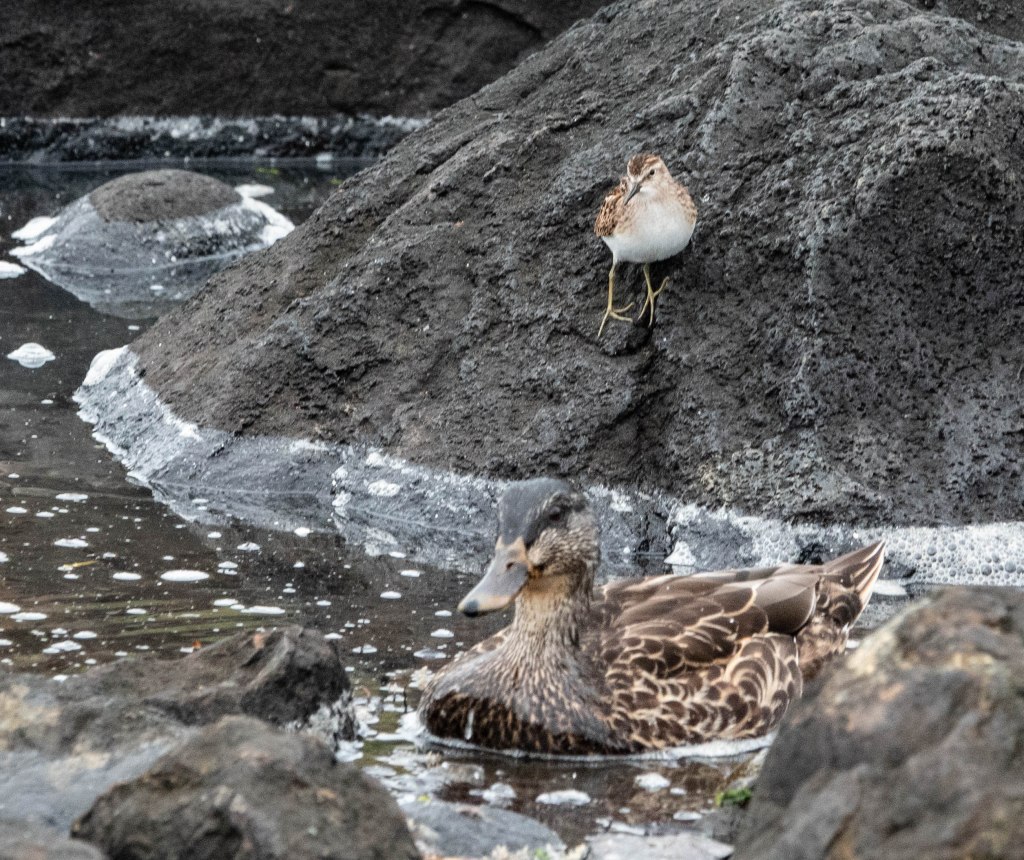
The Least Sandpiper, Calidris minutilla, is the smallest shorebird in the world, weighing in at 20-30 grams, a maximum of 1 oz. It is dwarfed by a nearby mallard:
I stumbled on these sandpipers on Monhegan Island, a perfect speck of land 12 miles off the coast of Maine in the North Atlantic.
Least Sandpipers breed in the sub-arctic Canadian tundra, then stop off here to recharge their batteries before embarking on a heroic nonstop transoceanic migration of 3,000 to 4,000 km to their wintering grounds in northeastern South America.
This group of about six..
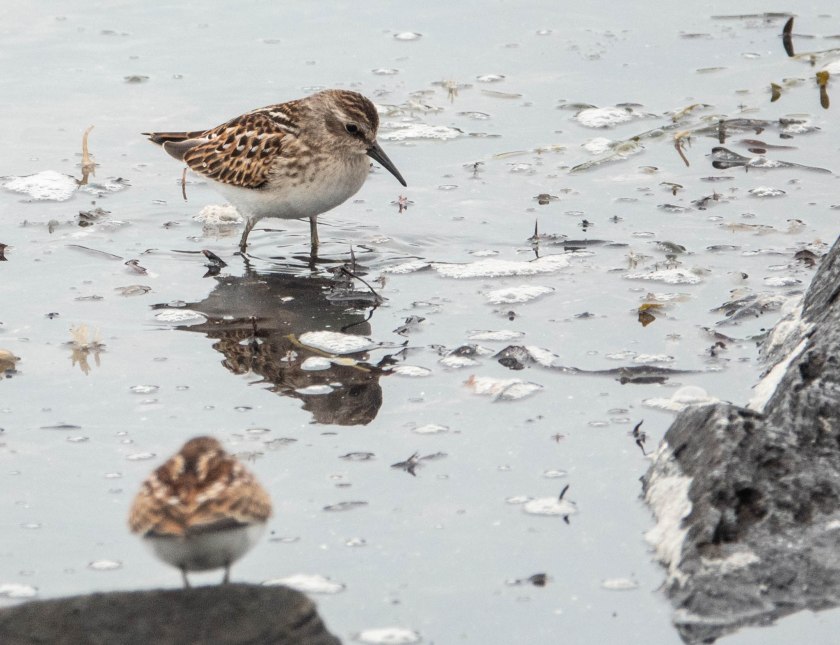
was having a morning wash and brush-up:
Notice their greenish legs, the only sandpiper with legs that color. I think these were juveniles, who migrate later than adults: by now the adults are arriving in South America.
They eat amphipods, especially the mud shrimp, Corophium volutator, which makes up to 88% of their diet in the Bay of Fundy. (Photo from Aphotomarine)
They wade around as the tide goes out, searching for these amuse-bouches:
Soon they will take off for southern climes, only to make the return journey again next spring.
* Collectively, tiny shorebirds are sometimes rather charmingly called “peeps”, hence my title.
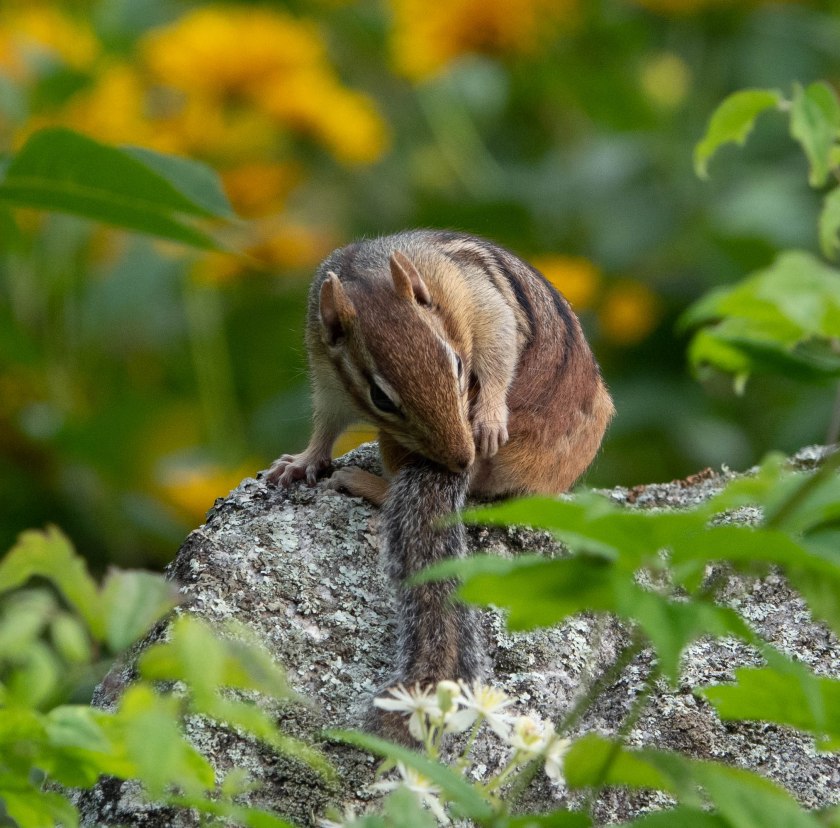
The humble chipmunk is so familiar to us in Maine that we take it for granted. They forage beneath our bird feeders, and balance on the Love-in-a-Mist seed heads:
So, we think of them as flower and seed-eaters. And occasionally mushrooms. This puffball has been peeled by a chipmunk, exposing its purple interior:
But not so fast: sometimes they surprise us. This one is eating….
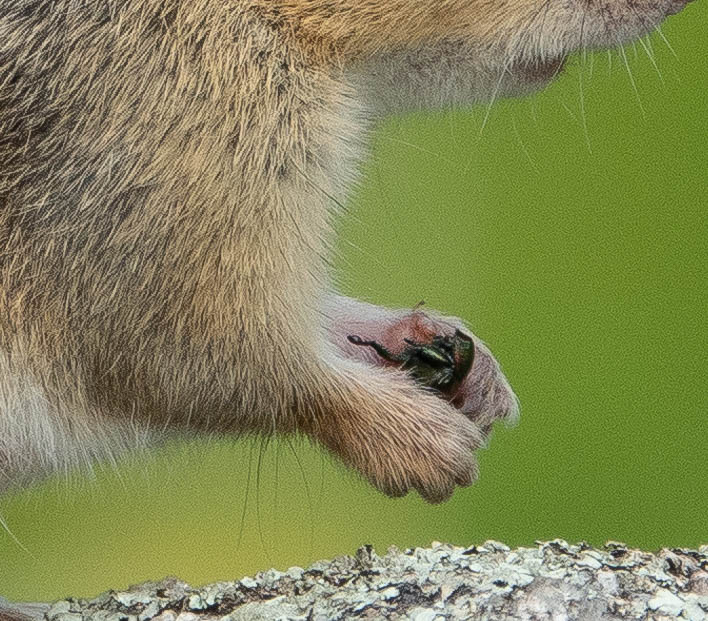
a large black beetle:
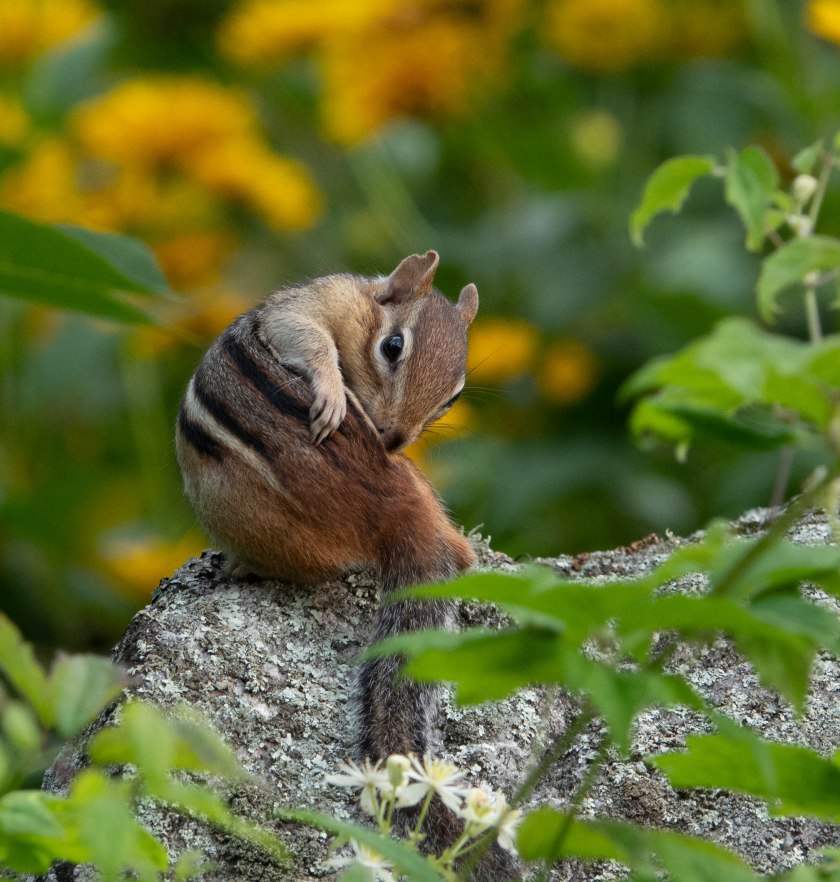
He/she ate everything except the odd leg, and then had a good grooming session:
and to my fascination he was clearly eating something he found in his fur. Fleas? Ticks??
I checked, and indeed insects are a known part of their diet.
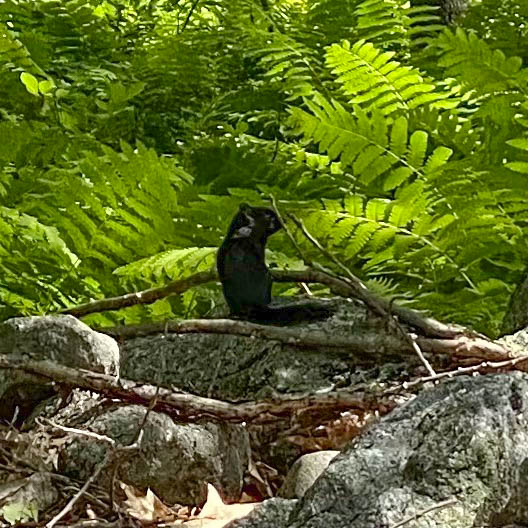
The second surprise this past week was quite different. Look at these photos, taken by my son on his iPhone just up the road from the house:
Believe it or not, this too is a chipmunk. There have been stories of these melanistic variants popping up in our area, but this is the first one seen round our house. I am hoping to encounter it again. But I do miss the stripes.
PS There seems to be no scientific literature to speak of on melanistic chipmunks, and they are generally said to be very rare. Melanistic squirrels, on the other hand, are widely distributed, particularly in more northern climes. In squirrels, melanism is thought to convey two advantages. First, in dark Northern evergreen forests they may be better concealed in the shadows. Second, they are better at absorbing heat, an advantage in cold climates.
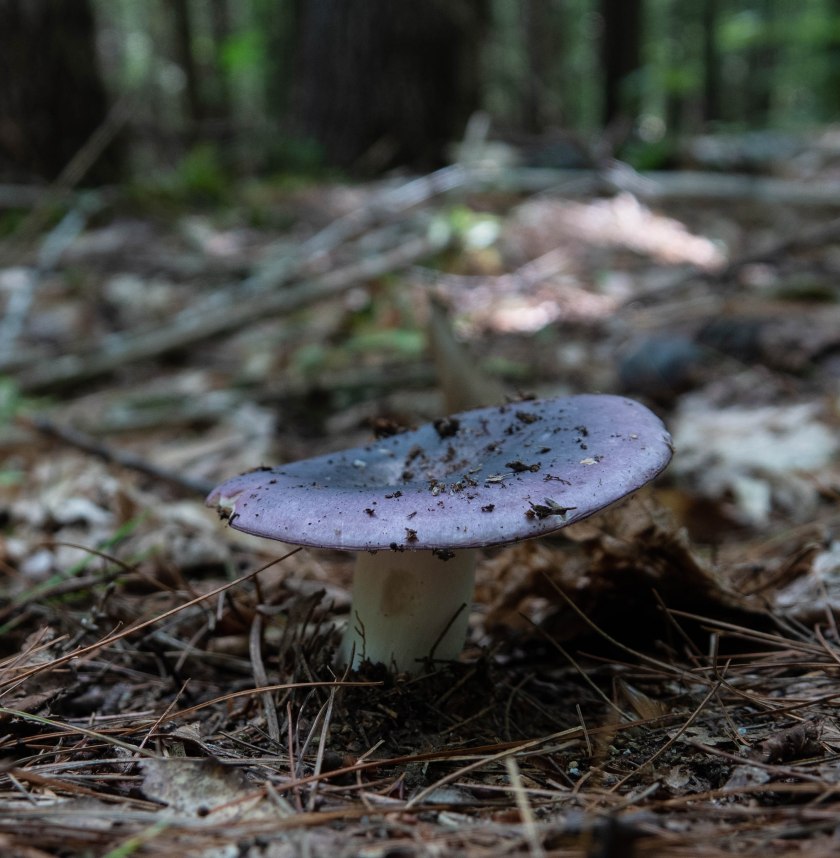
Summer is noticeably winding down. And the mushrooms are coming out. When I walk each day, I always hope to see mammals, birds, reptiles, things that move. But it doesn’t always happen. And when they do appear, they can be fleeting and impossible to photograph. Mushrooms, blessedly, stay put. And they are exquisite.
Here is a gallery, all resplendently pushing up through the leafmold during the past week. Some have gills, some are veiled, some have a spongy underside (boletes), some look exactly like coral. Some are edible, some could kill you. Just admire them.
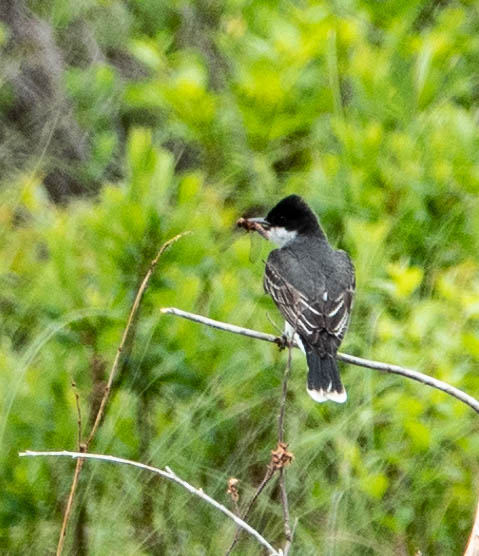
This is an Eastern Kingbird, Tyrannus tyrannus. Quite a name to live up to.
Their name betrays their nature. Fiercely territorial, they are fearless against intruders into their airspace, even eagles:
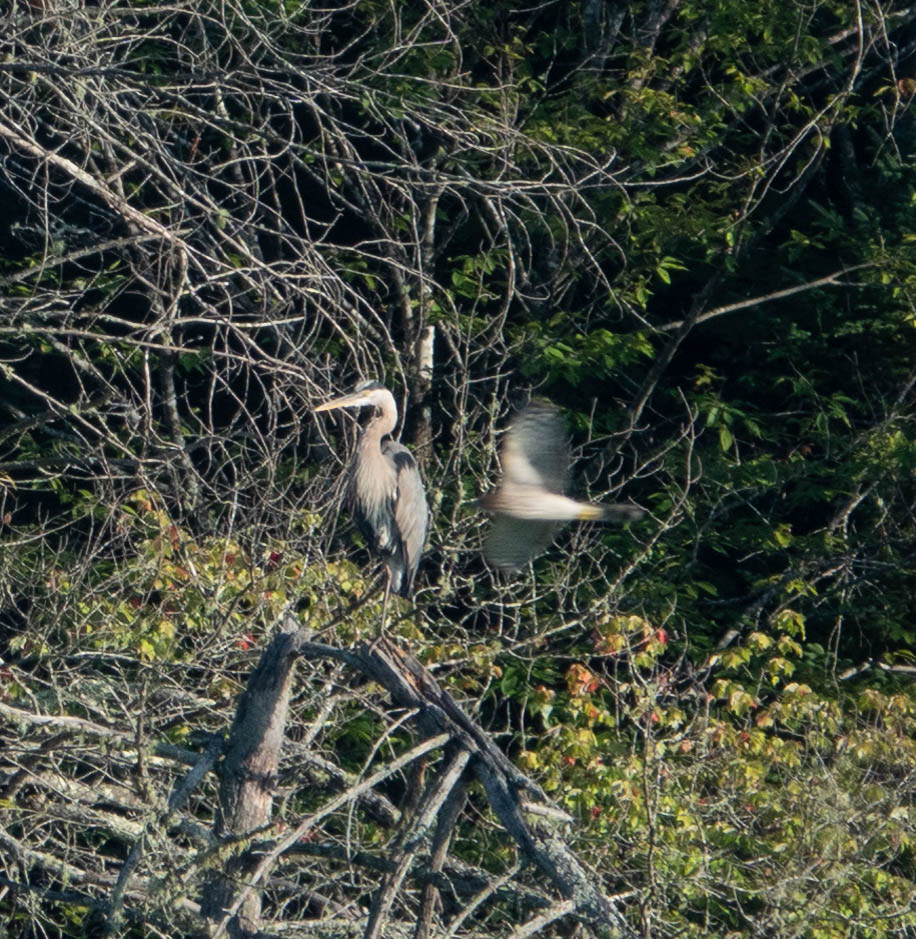
or Great Blue Herons:
Let alone a more evenly matched Belted Kingfisher (on the left below; the kingbird at top right has satisfactorily upset him and is moving on)
In flight their white tipped tail feathers make them easy to identify:
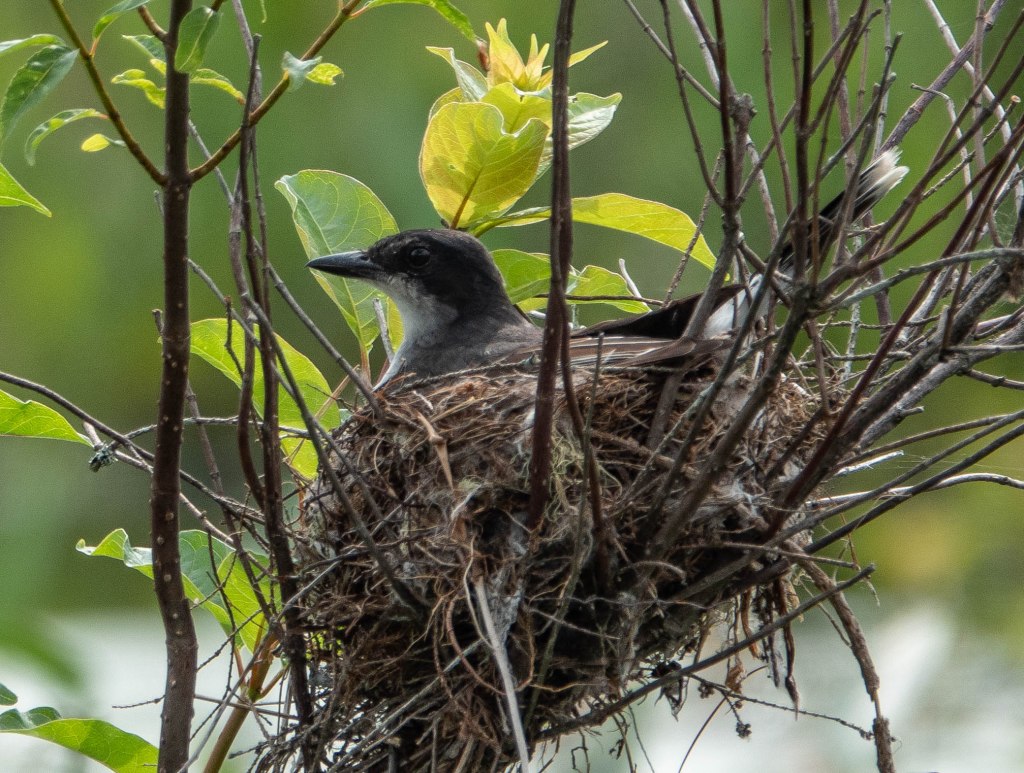
They usually nest in trees, but close to water they sometimes nest low down, like this pair on my beaver pond. They used a nest site from last year, either theirs or a redwing blackbird’s, and rebuilt the nest. The female is on the nest, and the male is standing guard, as he does for 50% of the time. Between them the nest is only left completely unattended about 11% of the time.
By June 28 she was firmly ensconced:
Incubation takes 16-18 days, so I calculated July 15 as the latest possible hatch date, and kept watch from my kayak, from a respectful distance. By July 17, something had changed. She was now sitting on the edge of the nest, gazing lovingly down, so although I couldn’t see into the nest I was fairly sure something had hatched:
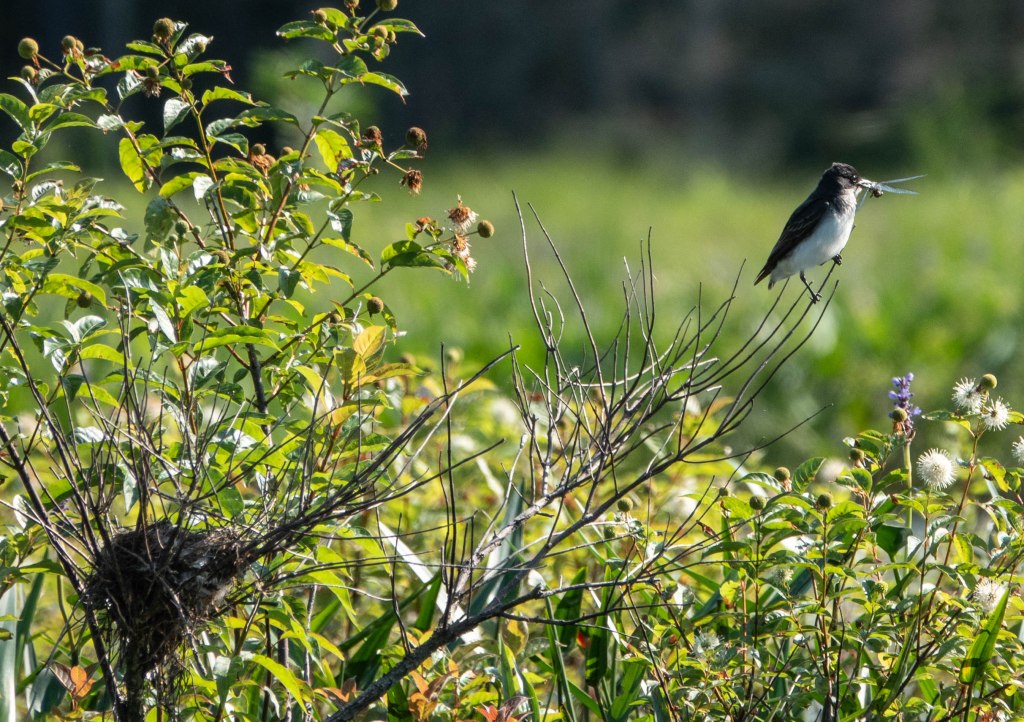
And indeed the parents were arriving with food, first tiny things like little caterpillars, then with larger dragonflies, like this one on July 22:
They also catch bees and wasps, and kill them and remove the stings before feeding them to their young. They are kept busy, making an estimated 5-6 feeding visits per chick per hour, which would add up to 150 visits to this trio over a 10-hour day.
The parents didn’t seem to mind if I let my kayak drift closer, and I finally found a spot where I could see through the twigs, close enough for my zoom lens. The babies are thriving on July 23:
But they are definitely hungry!
Their eyes open at 4-6 days, and the sheaths that will be the proper feathers emerge at day 5, so this one below, quills on its chinny-chin-chin just p[okiong through, is well on its way, and is ambitiously trying to flap its minute wings:
Once the young fledge, they still need 2 weeks more feeding. And by mid-August the southerly migration to South America begins, and they will be gone.
But instead this story has a sad ending. Two days later, I returned to find the nest entirely empty.
One adult was still standing guard, but of the chicks there was ne’er a trace. Not even a feather floating on the water. They were much too undeveloped to have fledged, so I fear a predator swooped, and probably gulped all three in one mouthful. Bald Eagle, Great Blue Heron, hawk, Belted Kingfisher, who knows. That unattended 11% was enough.
PS: This is not an endangered species ( roughly 26 million in the US), but their population has dropped by 38% between 1970 and 2014. Factors probably include increasing forest cover as farms return to woodland in the North Eastern US (which is of course generally good news for our planet), and the plummeting insect populations that are decimating aerial insectivores.
Do leeches make your flesh crawl ? Rather like snakes, many of us recoil from these blood-sucking worm-related creatures. If that is your reaction, either stop reading now or, ideally, read on and learn to overcome your distaste.
Today I have two different leeches to show you.
This is a North American Turtle Leech, Placobdella parasitica. The scientific name placobdella comes from the Ancient Greek roots plac- and -bdella, meaning plate-leech.
They spend most of their lives on freshwater turtles, without appearing to harm the turtle. Like most leeches, they are hermaphrodites, possessing both male and female reproductive organs. One leech deposits a spermatophore , or sperm package, on the back of another, and the sperm are able to penetrate the skin and reach the uterus in the recipient leech. These particular leeches also rear their young, which blew my mind. Follow this link for more detail and great photos:
The other day I joined a Greater Lovell Land Trust group led by the wonderful Nat Wheelwright specifically to look for leeches (yes, I know that is a rather niche activity). We were especially hoping to find the medicinal leech, Macrobdella decora. The first part of the Greek name is a clue: it is BIG.
Nat Wheelwright and I waded into the muddy edge of the pond up to our knees, and chatted while we waited to be found. Nothing. Nat got out, I stayed. And a few minutes later…. (Thanks to Leigh Macmillan Hayes for the photo.)
Like most leeches, it can transform its shape from long and thin to short and fat. At its most elongated, it was about 4 inches long. It made no attempt to latch onto me (thank God), and Nat explained that they only feed on amphibians, fish and turtles, whose body have a sort of algae or slime that seems to attract them. My legs are blessedly not slimy enough.
After some failures, he managed to catch it in his net while I stood very still, and we got a good look at it.
It is a dark olive black, with a line of red dots along its back. The head (and mouth!) is on the right, and the tail ends in large sucker with which it anchors itself. Its belly is a bright orange:
In true Indiana Jones style, here is Nat with the leech:
He did remove it before it crawled into his ear.
In the 18th and 19th centuries, these are the leeches that doctors used to “cure” a multitude of ailments, including fevers, hemorrhoids, and pregnancy! Leech farms sprang up to serve the lucrative market. There is a great potted history of the practice here: https://www.sciencehistory.org/distillations/medicinal-leeches-and-where-to-find-them
But it turns out there really was a benefit to some of this. Leech saliva contains an anti-coagulant, and so it can reduce inflammation in a very localized area. They are now used again in microsurgery and plastic surgery, and there is a thriving high-tech leech farm in Wales!
* My title comes from the quote below. (Finding good leech quotes is not easy! They are pretty much all derogatory.)
“If leeches ate peaches instead of my blood, then I would be free to drink tea in the mud.” Emilie Autumn
“The leech’s kiss, the squid’s embrace, The prurient ape’s defiling touch: And do you like the human race? No, not much.” Aldous Huxley.
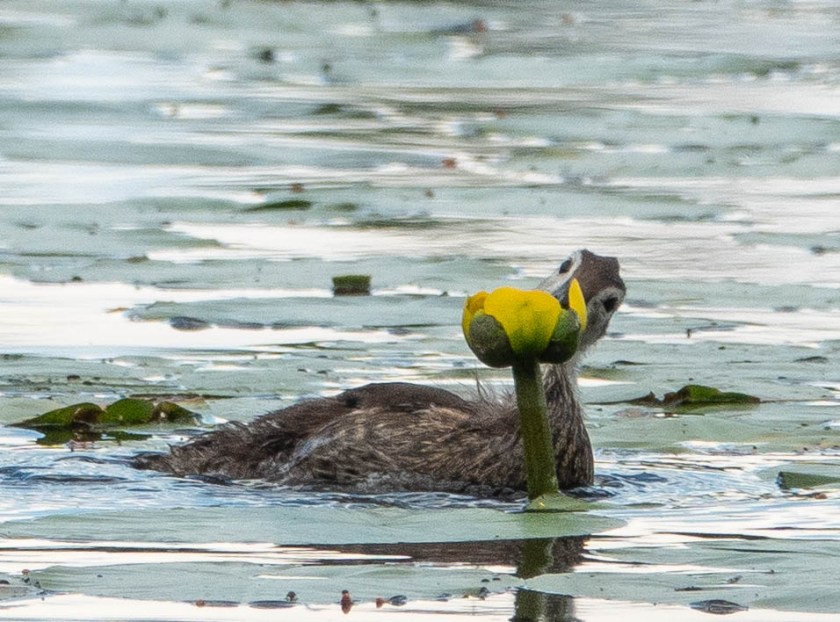
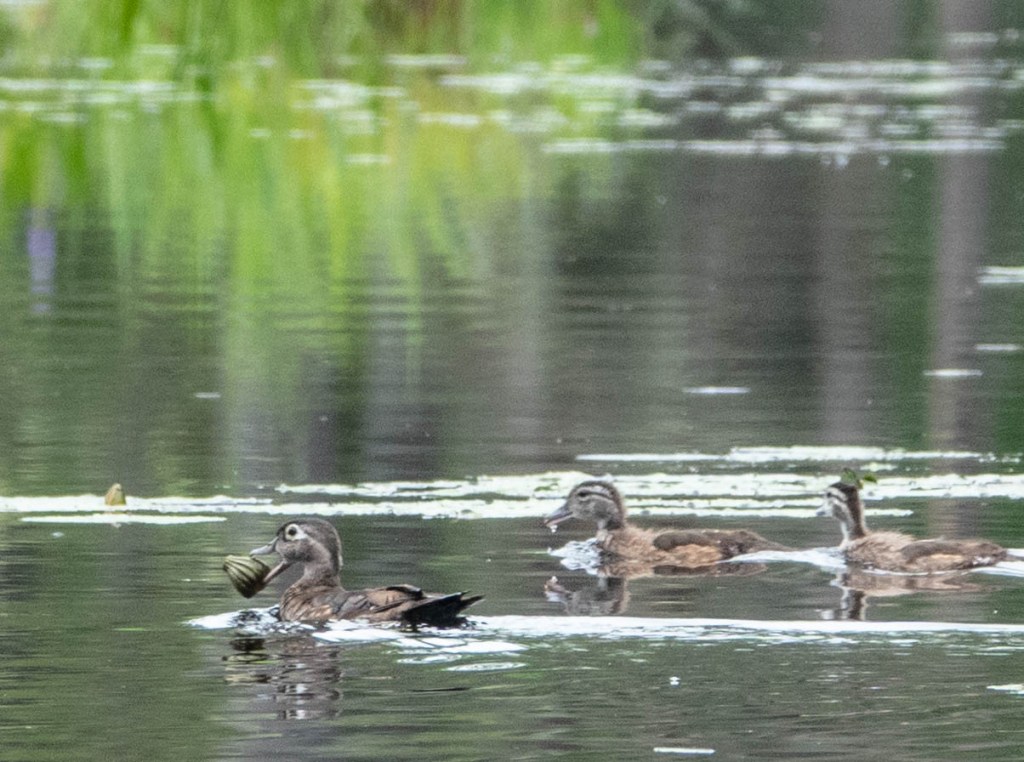
Wood ducks start nesting in mid-April. Incubation is 28-37 days, meaning the first ducklings arrive from mid-May onwards, and I saw two different sets of ducklings this year on June 2, one lot freshly hatched and one lot older. They are elusive, but I see them from time to time, rather surprisingly often eating spatterdock, which seems to be a favorite food*. Here’s one on June 19th:
The next photo shows a mother with two month-old youngsters whose adult plumage is now pushing out their childish down. She has waited till July 14th when the spatterdock flower is over and the ovary is exposed, and carries off her trophy.
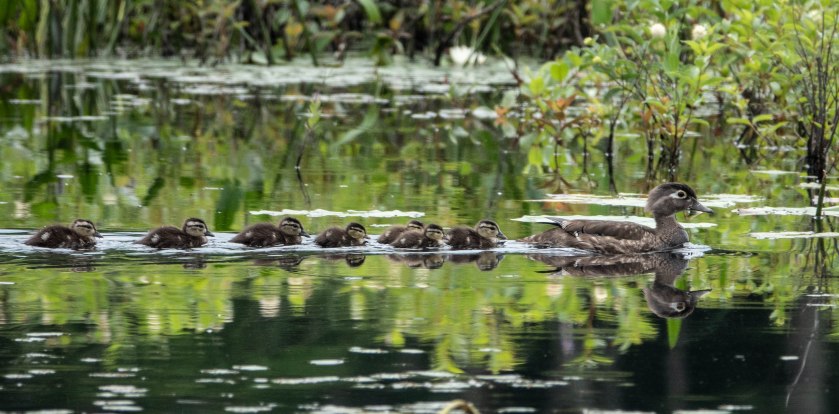
From hatching to flying is about 60 days, so the oldest batch can just about fly now, July 14th. But breeding season is not over! Yesterday, I saw a mother with seven brand new ducklings, each about 5″ long.
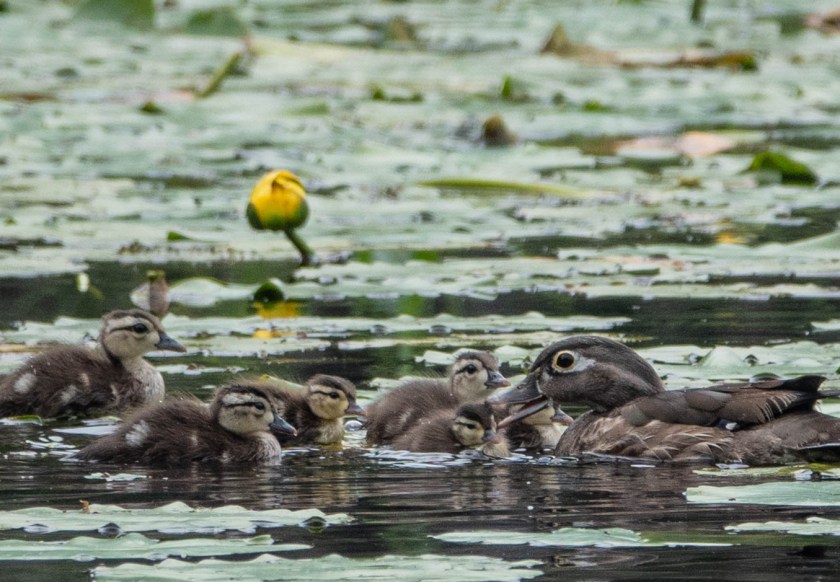
She could be a late starter, or it could be her second brood, perhaps after losing her first lot to predators. Her second brood is being given a safety lecture:
Mid-July is just about the latest date for a successful hatch, and round here second broods are rare, less than 1% of females (they are more common further south).
PS: Aging the ducklings is difficult. here is a description of their plumage, from Birds of the World. “Development of Juvenile plumage in wild birds in Massachusetts (Grice and Rogers 1965): downy pattern fading and first rectrices appearing at 20 d; wing coverts emerging and feathers on breast and belly visible at 30 d; primaries breaking from sheaths and crown feathers visible at 40 d; white cheek marks visible on males and underparts completely feathered at 45 d; body feathers complete except on back at 55 d; many birds (70%) able to fly and eye of males turning red at 60 d; most birds flying and Juvenile plumage almost complete at 70 d. Young birds are able to fly at 8–10 wk”
*Martin and Uhler (1939) say that while Spatterdock seeds have been found in the stomachs of some ducks, they are not a major food. Hepp and Bellrose (2020) do not list it at all as a Wood Duck food. Maybe the ducklings are just playing? But the adult photo makes that unlikely.
[Oops, I hadn’t meant to send this yet, but I hit publish by mistake!]
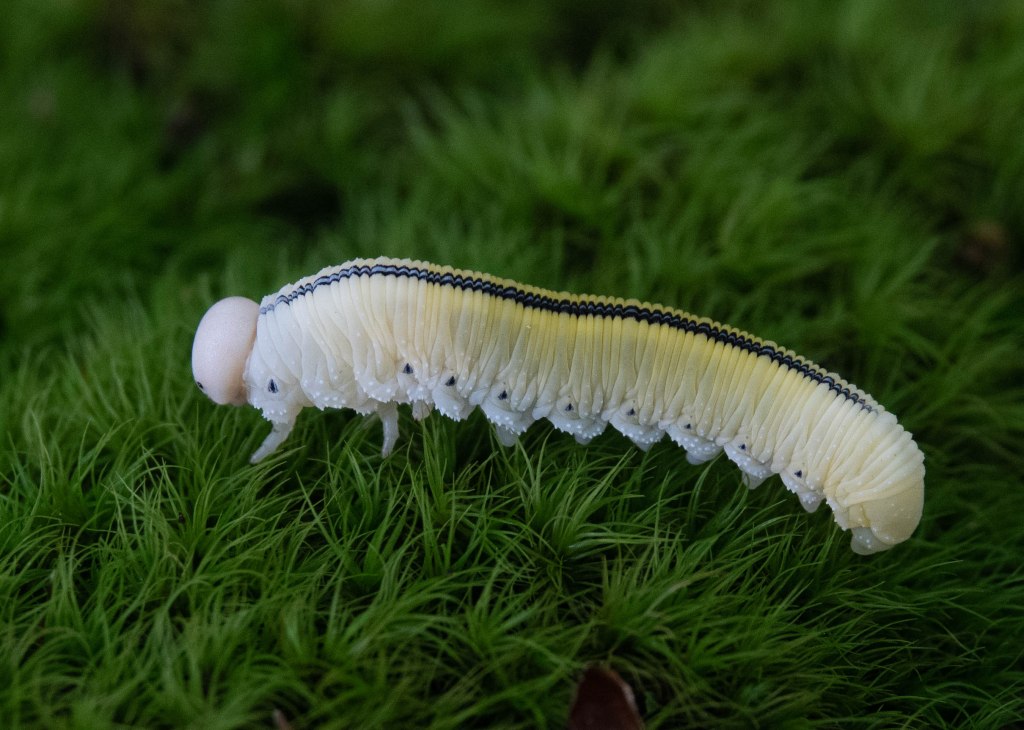
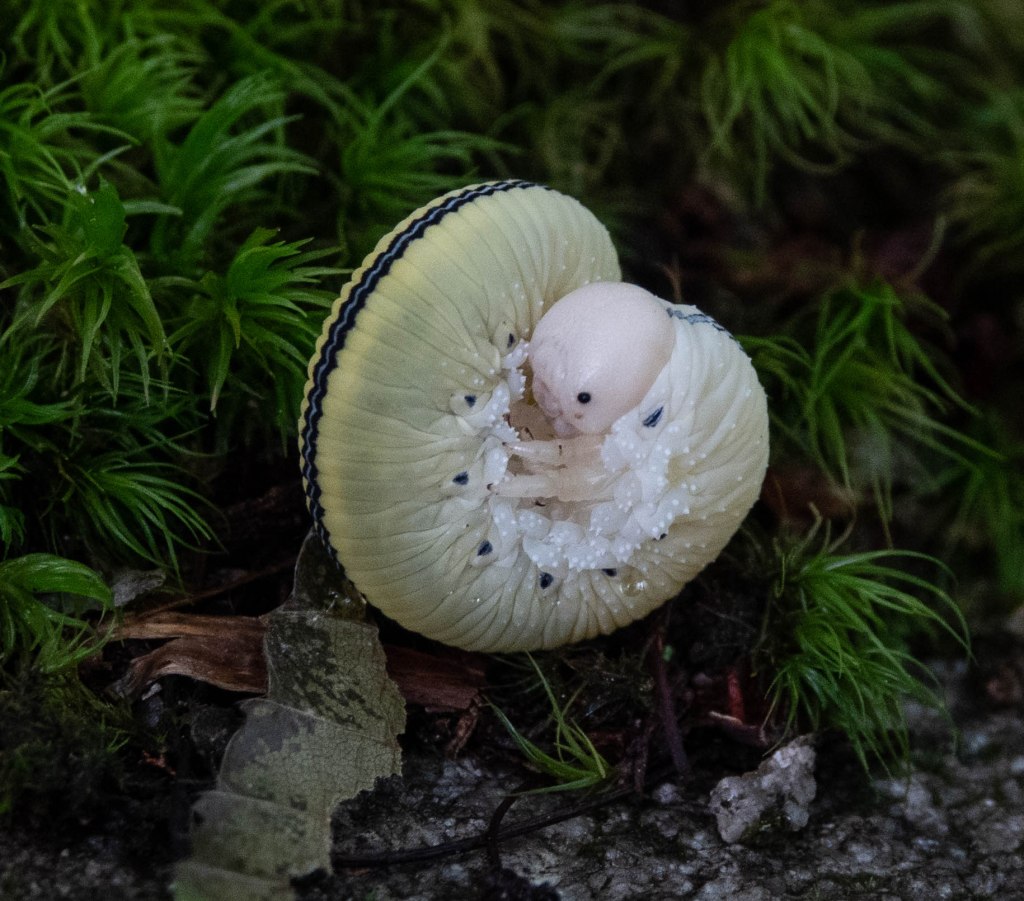
I’ve never heard of sawflies, and now I have seen two different ones, and the larva (caterpillar) of another. Just plain luck. (I do realize some of you probably think I am a little eccentric to get excited about a fly.)
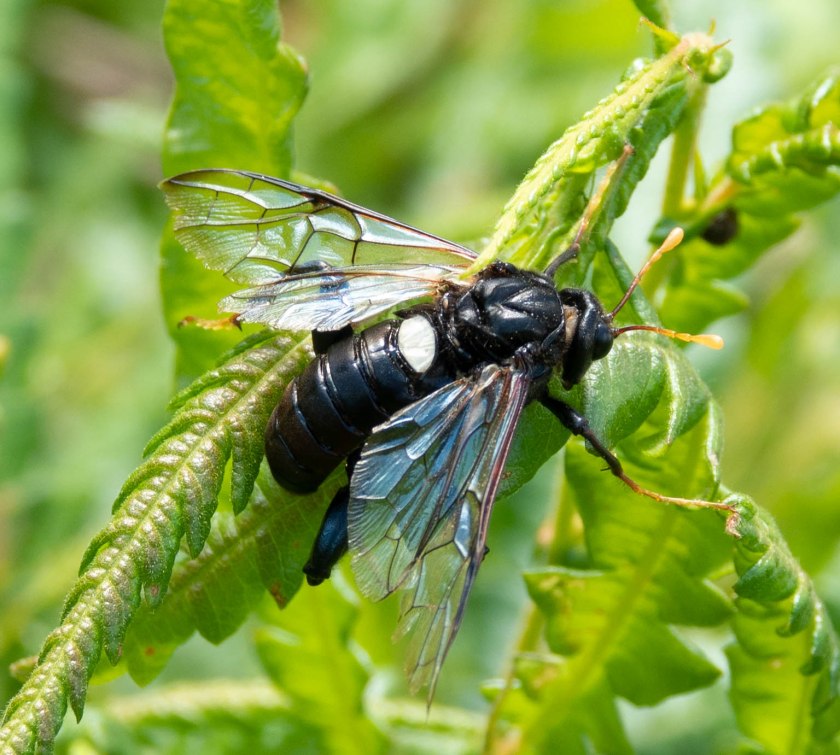
North American Elm Sawfly
Sawflies are in the order Hymenoptera together with ants, bees, and wasps. All of these insects have two pairs of wings, unlike true flies, Diptera, which only have one pair of wings. You can clearly see the four wings in this photo. So they aren’t actually flies at all. They have a saw-shaped ovipositor, hence the first part of their name, but they are nearly all harmless plant eaters.
They have a life cycle with four stages, eggs, larva, pupa, and adult, and the adults only live for about 8 days, which maybe why I haven’t often seen them! These next two photos show the larva of the North Americans Sawfly in the photo above:
Here are the larva and the adult of one called, I think, Monostegia abdominalis.
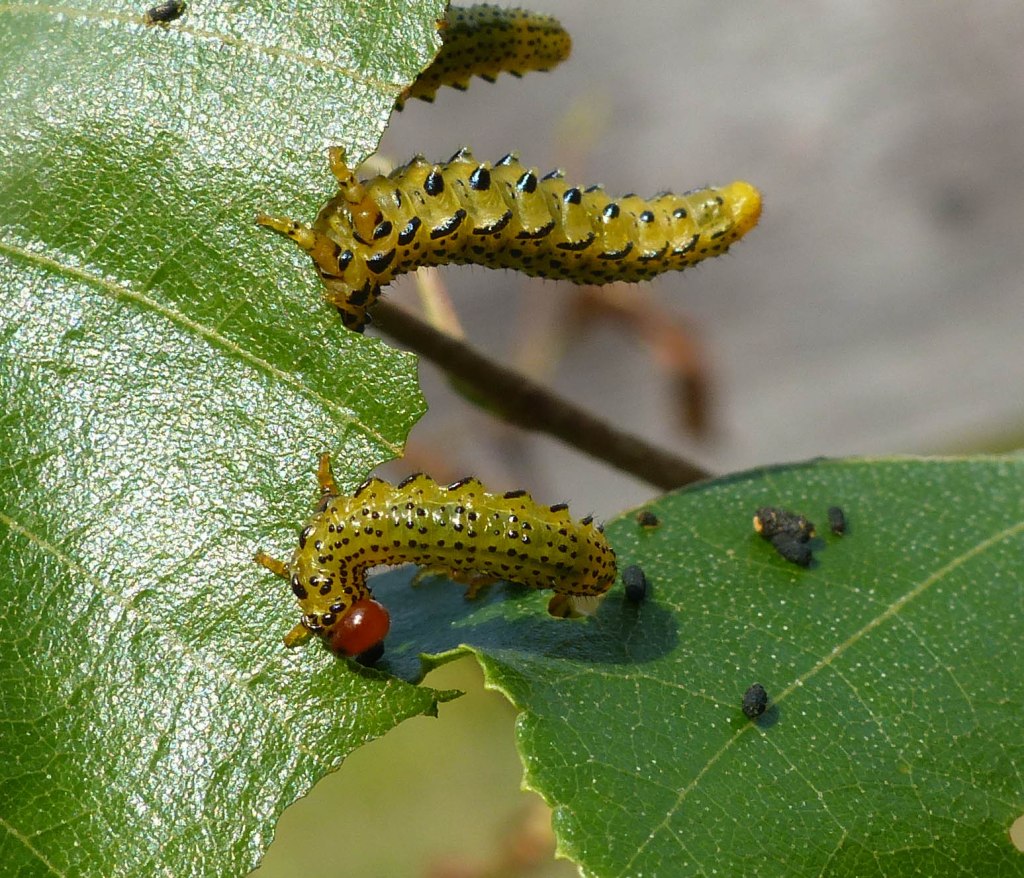
The larva often congregate in large groups to feed, and rear up when startled. I’m not sure which species this is, but they are sawflies, not caterpillars, because they have a pair of prolegs on every segment, and no claws on the prolegs:
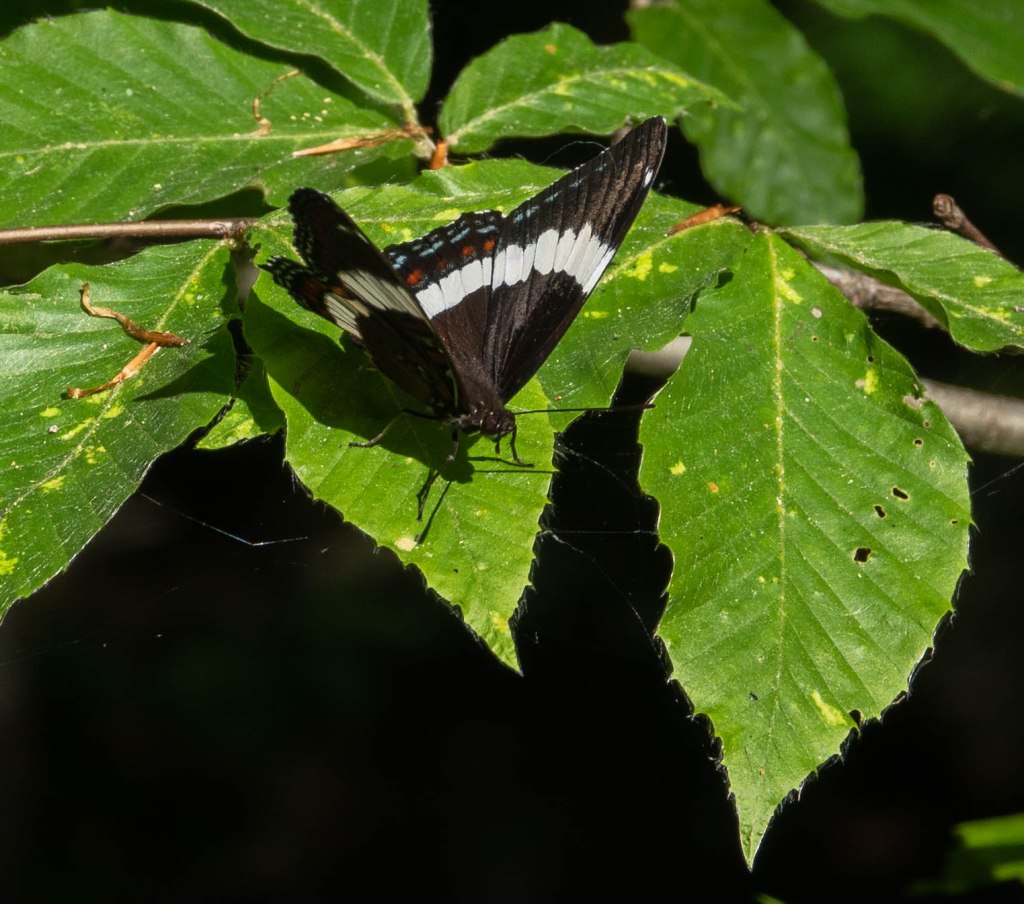
I found a surpassingly ugly caterpillar the other day.
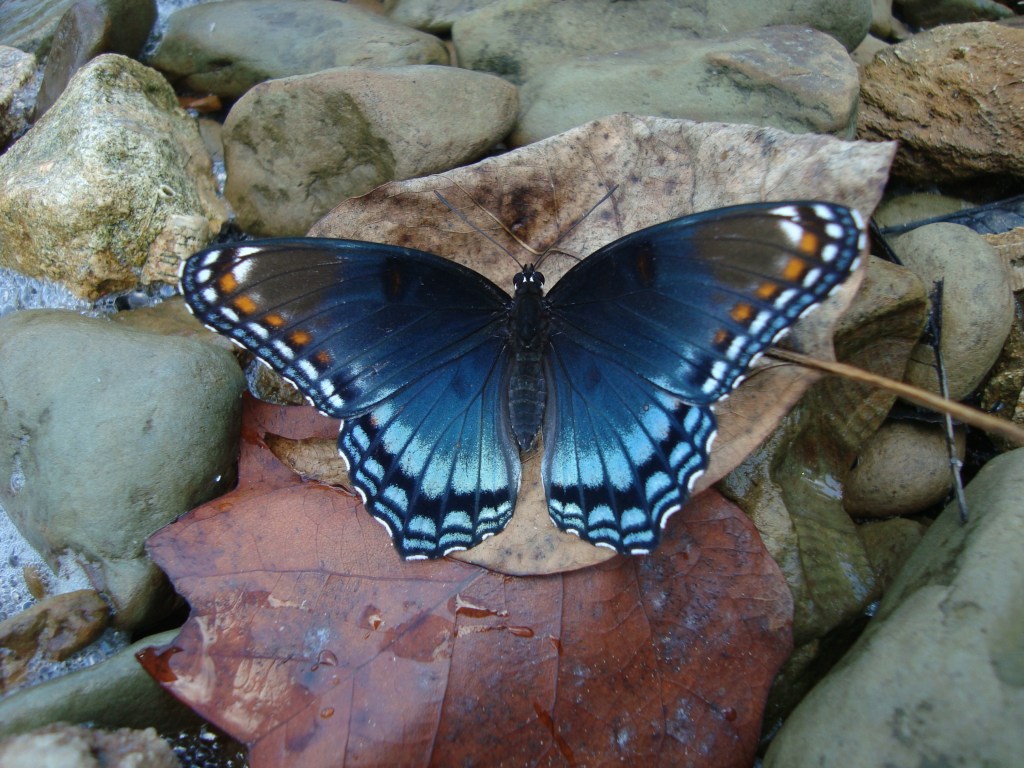
It took me a while to identify it, and even longer to understand the significance of what I was looking at. This unappealing grub transforms into more than one possible butterfly, in a twist on one of nature’s greatest mysteries that has become a famous evolutionary case study.
Round where I live in Maine, the caterpillar is likely to metamorphose into this (photographed last year):
This is a White Admiral, Limenitis arthemis arthemis. Notice the red spots and the blue scalloped border. But go a little further south, and it becomes the Red-spotted Purple, Limenitis arthemis astanyax, totally lacking the broad white wing bands.(photo from Wikipedia)
The southern form mimics the blue hindwing coloring of the very toxic Pipevine Swallowtail, Battus philenor, and their two ranges coincide. This “Batesian mimicry” deters predators. DNA evidence shows that the two colorations hybridize across a zone starting in southern New England, shown below in dark grey (from Ries and Mullen 2008)
Interestingly, the presence of even small numbers of the toxic model in the hybrid zone is enough to maintain some instances of the mimicking coloration. Only when there are absolutely no toxic models present, as in Maine, do the butterflies revert entirely to the non-mimicking coloration. The data are a wonderful example of the importance of citizen science, since they were all taken from the annual North American Butterfly Association’s July 4th Butterfly Surveys going back to 1975. If you’d like to take part in a count, click here for details: https://www.naba.org/butter_counts.html
The really challenging question is how lepidopterists decide whether these two wildly different wing patterns should now count as two species. Although they look entirely different, they can nonetheless interbreed and produce fertile offspring (hence the hybrids), so they are not genetically isolated from each other. *
The controversy continues.
*It reminds me somewhat of dogs. These two animals, a mastiff and a Yorkie, are both of the species Canis familiaris. Cross-breeding to produce a hybrid might be mechanically challenging, but the resulting Yorktiffs would no doubt become the height of fashion.
At this time of year, the trees are in leaf, casting deep shade, so the woodland wildflowers are mostly over. But the ones on the edges of our shrubby, swampy ponds get water and sunlight, and are flowering now. I thought I’d show you some of them, starting with the smallest blooms. No dramatic stories, just modest beauties in hidden places. Let us take our pleasures where we can.
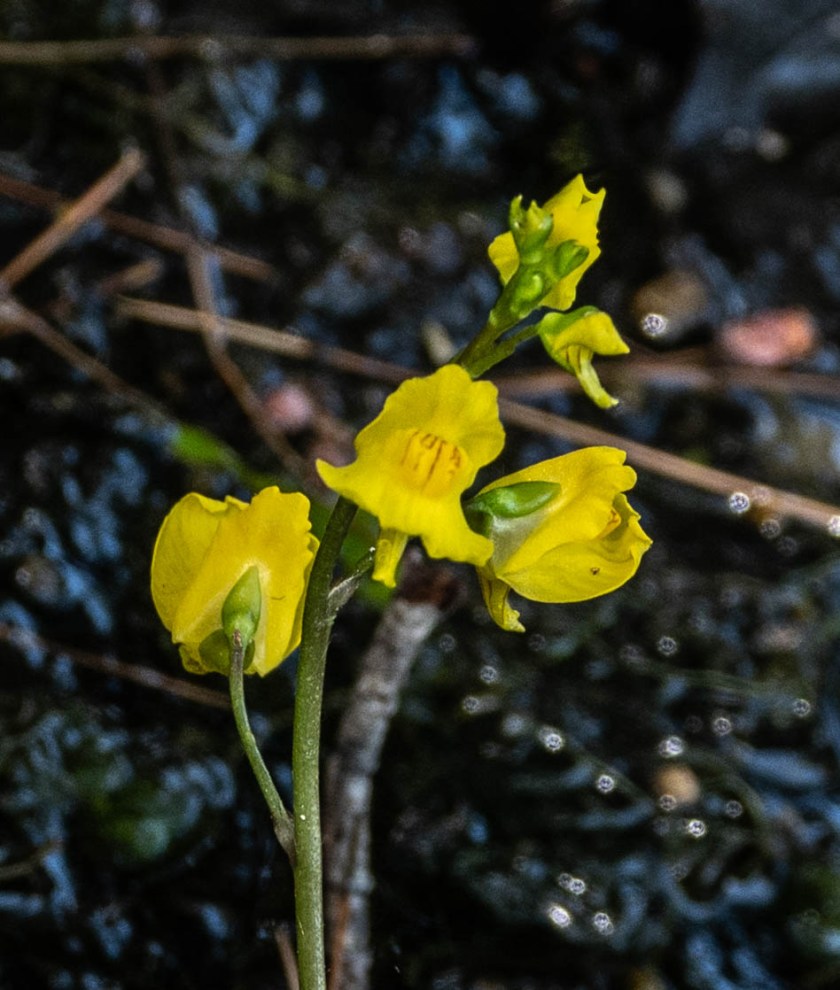
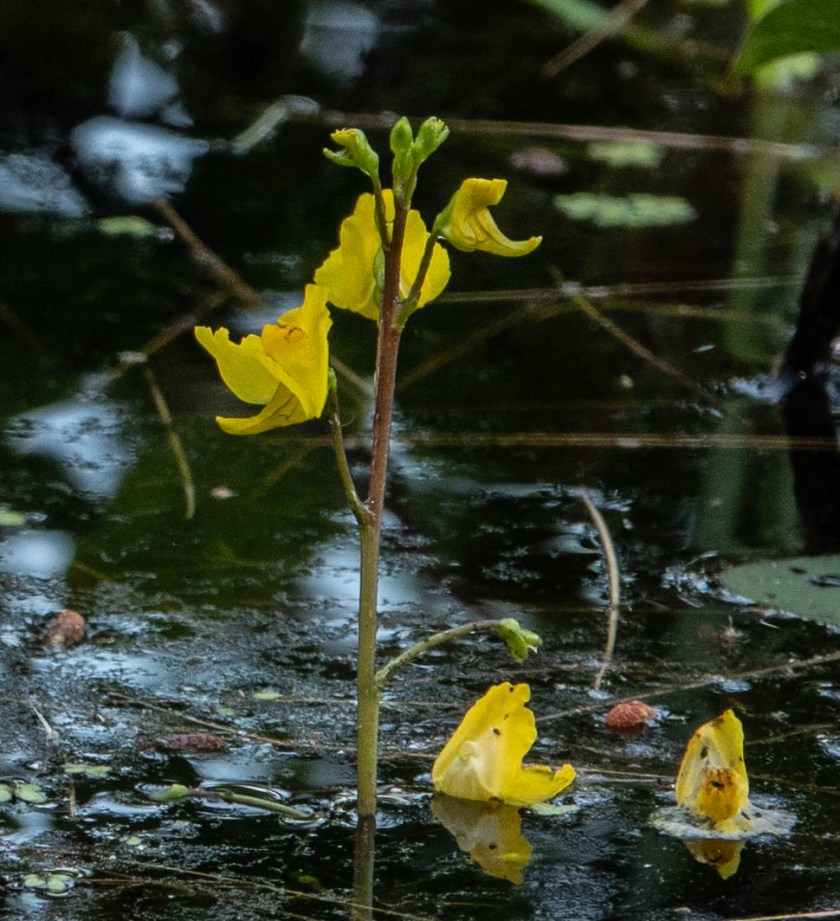
Horned bladderwort , Utricularia cornuta , 1/4″ grows either in the shallow water, or on the muddy foreshore.
The “horn” is at the base of the flower, easier to see in the next photo.
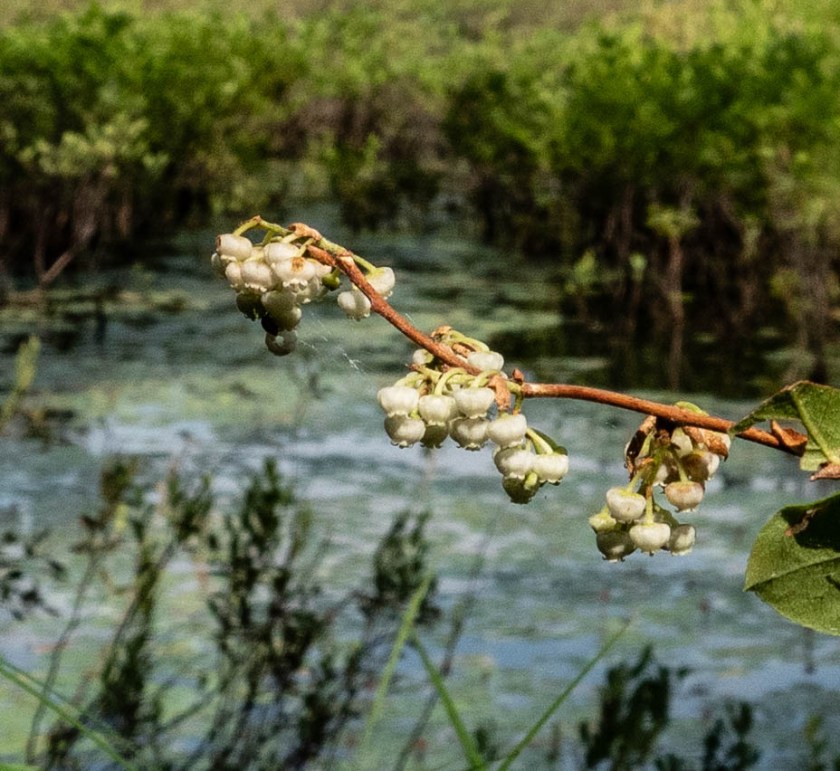
High Bush Blueberry, Vaccinium corymbosum, 1/4-1/2″, is a tall bush that grows at the shoreline, producing its famous berries in late summer:
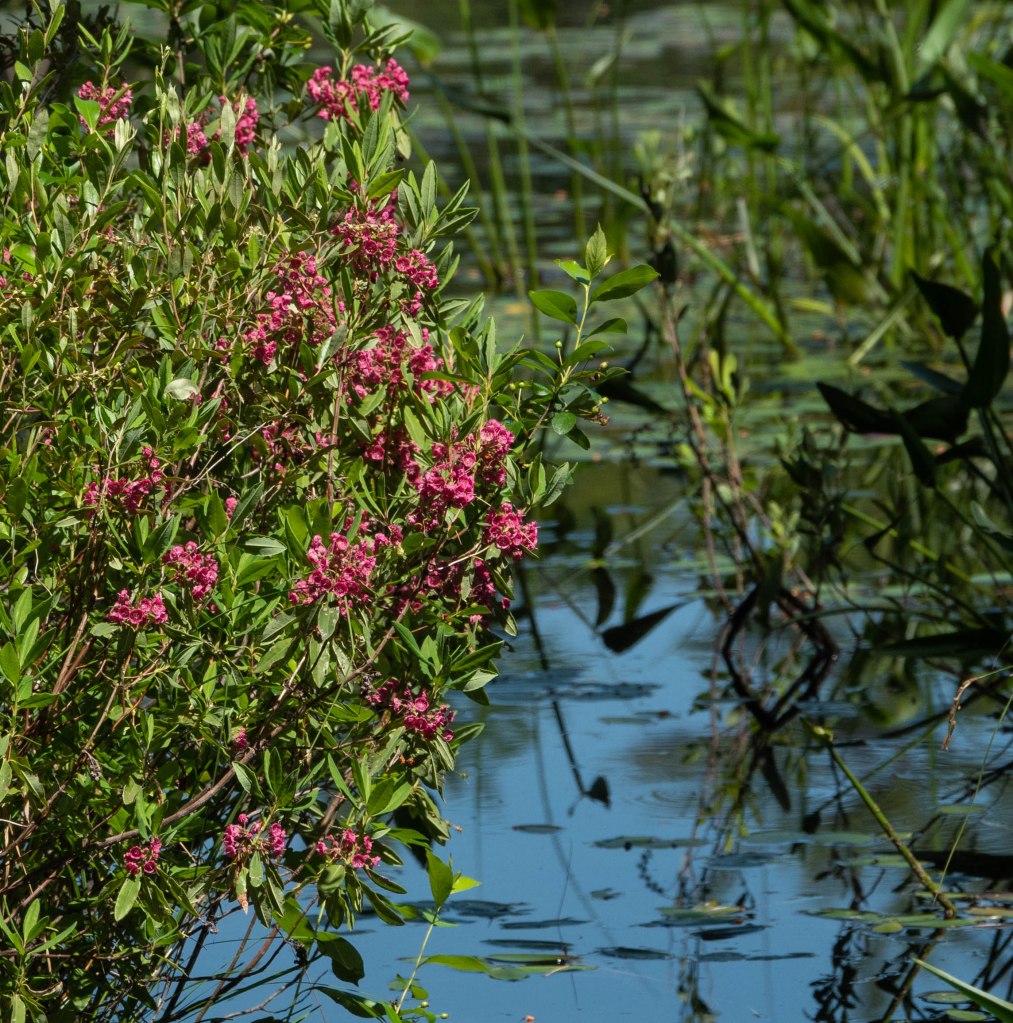
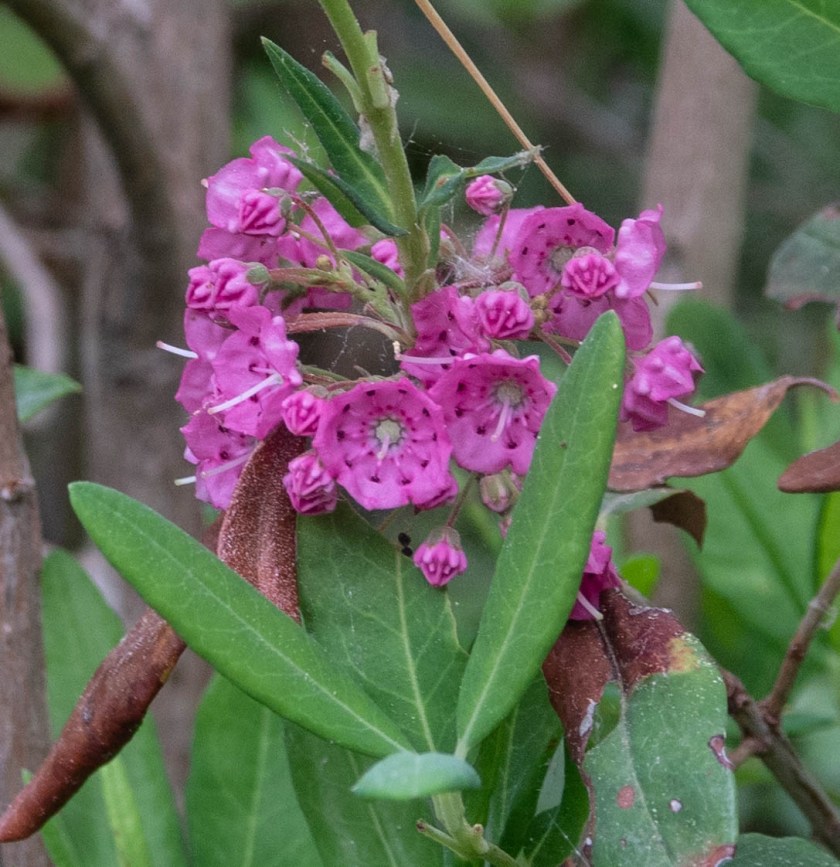
Sheep Laurel or Bog Laurel, Kalmia angustifolia, 1/3-1/2″, a relative of the better known Mountain Laurel, forms sizable clumps on the waterline:
Close to, the flowers form a tiny posy:
Rose Pogonia, Pogionia ophioglossoides, 1 3/4″, likes somewhat different boggy habitat. It is an orchid, and these were amongst reeds and grasses, hard to photograph from my kayak:
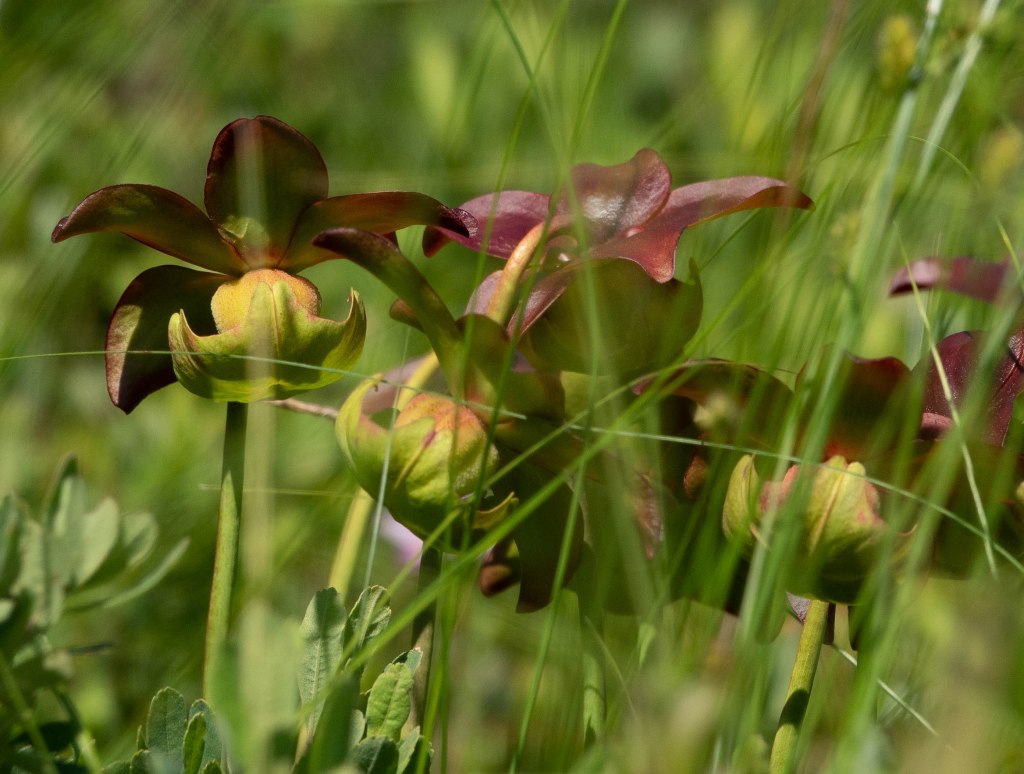
My last flower is the dramatic bizarre flower of the carnivorous Northern Pitcher Plant, Sarracenea purpurea, a sizable 2″ across. It also is found in swampy sphagnum bogs.
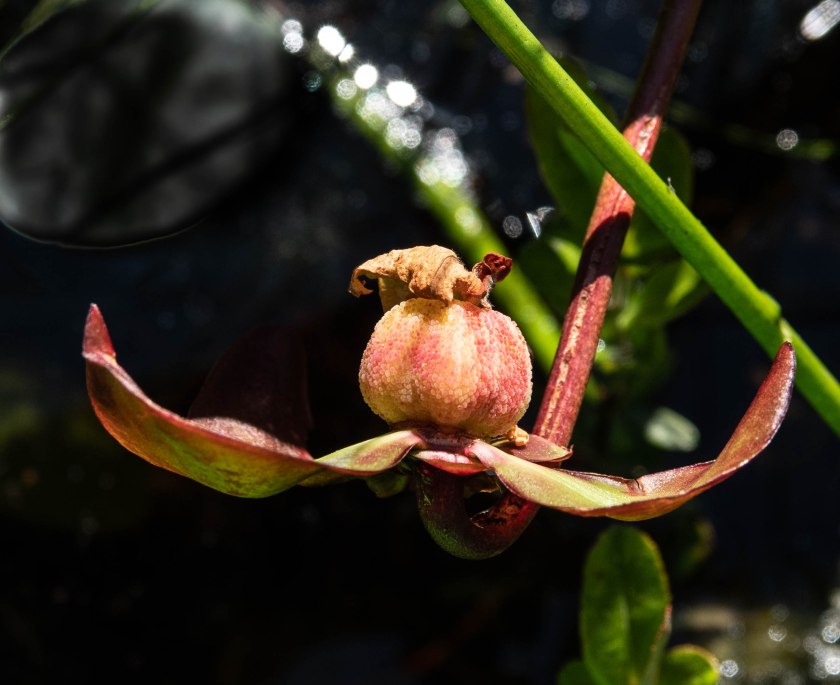
When it has been pollinated, the enormous ovary in the center swells up into a bumpy scaly peach-like globe:
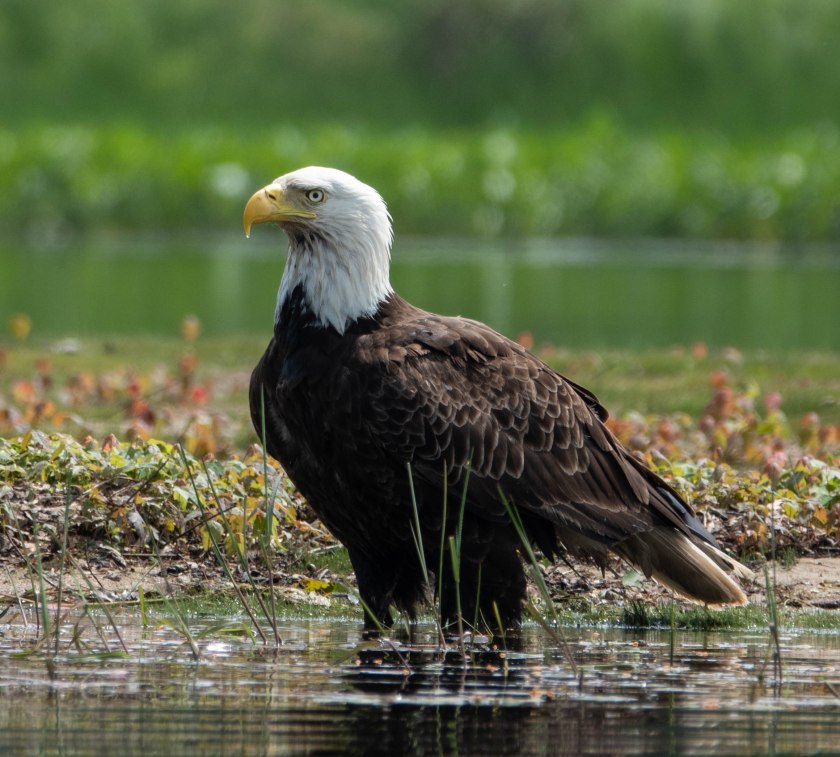
This is not my first Bald Eagle post, but I had an encounter the other day that I think justifies another installment. I was out in my kayak on Charles Pond, a lovely quiet corner of Western Maine much of whose shoreline is now protected by the Greater Lovell Land Trust. An eagle lives there, and is often seen in a tall pine tree:
He was there when we put in, but he then moved over to a sandbar, and settled in. We stayed some way off, but slowly drifted closer. It was flat calm, not a breath of wind. There were three crows lurking nearby, which made us think the eagle had a kill, but we couldn’t make it out. The eagle bent down to the water as if to drink, , and came up with something in its beak that looked like a crayfish, or a salamander, or a small dead fish:
From this angle, he is remarkably unimposing, more like a fuzzy chocolate brownie than the lord of the skies.
So was he hunting, or scavenging? Eagles scavenge a lot, but when they hunt it is normally fish they go for, and from the air or from a perch, not on foot. Stalmaster however states that they will wade in right up to their bellies, submerge their heads, and strike with their beak. This one did indeed get his neck wet, as you can see here, but not his whole head.
Then it wandered around a bit, posing nicely,
and bent again to the water fixing its gaze on something in a way that looks like hunting to me.
Another drink, ending with a plume of water:
A short burst of speed,
and a little more posing.
After a while, it flew up into a nearby snag, and apparently ventured into the nesting territory of a pair of Eastern Kingbirds.
They dive-bombed this enormous eagle, quite fearlessly, for several minutes, getting pretty aggressive, flaring their tails out in a territorial display:
and the eagle clearly didn’t like it one bit, rather the way I react to being buzzed by deer flies:
A female Bald Eagle weighs up to 12lbs, and an Eastern Kingbird weighs 1.3oz, so it’s hardly an equal match.
Eventually the eagle flew off to find a more peaceful perch.
PS: Some extra detail on bald eagle hunting methods: “Another less common technique is wading in shallow water where smaller fish are available. According to Stalmaster, an eagle will wade up to its belly, submerge its head, and strike with its beak….
Bald eagles have a tendency towards species of fish that inhabit shallow water or are surface feeders and therefore vulnerable. Young eagles are much more likely to “catch” fish that have washed up on shore or fish that are floating rather than swimming.” ( from : raptorresource.org)