The Pileated Woodpecker, Dryocopus pileatus, also known as a logcock, has a splendid Latin name, about which more later. To start, let’s find one.
In the woods, the first thing you notice is a pile of wood chips,

and when you look up, you see a strange rectangular hole, which looks as though it was made by a human with a fretsaw.

Then you might hear hammering, and there he is.

They are the largest woodpecker in North America, 16-19inches in length. You can tell this one is a male by his full red cap that extends all the way to his beak, and by his red ‘moustache’ (which is actually alongside his bill not above it), and he has a fine powerful bill:

He uses that bill to bash away noisily, which is usually how you find them. .
This one is excavating for food, and he has now found something and is probing deep in his hole, with his crest raised and his eyes half closed in ecstasy:
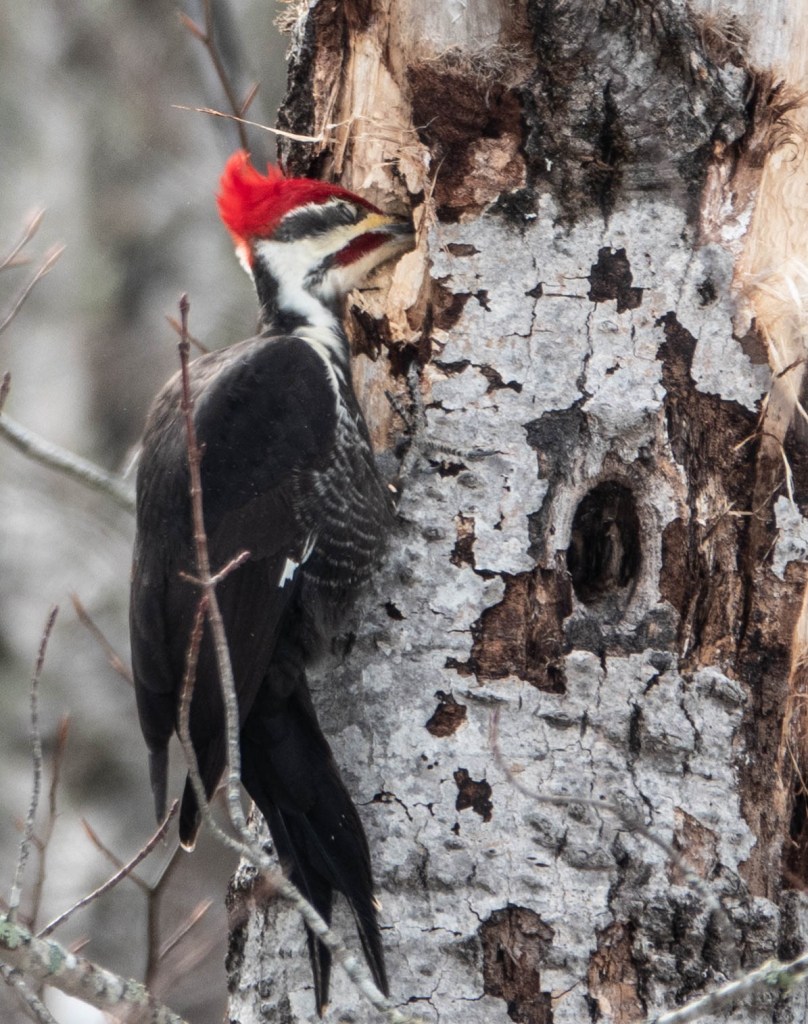
Look closely at the shape of that red crest and cap. Now stay with me here: look carefully at the seal of the US Senate, below, and the red shape in the top center.

Does it remind you of anything? Despite appearances, the US Senate did not put a woodpecker on their seal. Instead, for quite different reasons, both refer to the felt cap worn by freed slaves in late Republican Rome, or pileus in Latin. Here Odysseus is wearing a white one:

But by the Renaissance it is usually red, and signified eastern origins, here on the Kings from the East,

Then it was adopted by the French revolutionaries, who referred to it as the Bonnet Rouge, or the Phrygian cap.

The Senate chose it as a symbol of liberty, and the ornithologists chose it simply for the physical resemblance between the pileus and the woodpecker’s cap, and named this bird Dryocopus pileatus.
PS John J Audobon’s 1838 text on this bird is well worth reading:
https://www.audubon.org/birds-of-america/pileated-woodpecker