Harbingers of death?

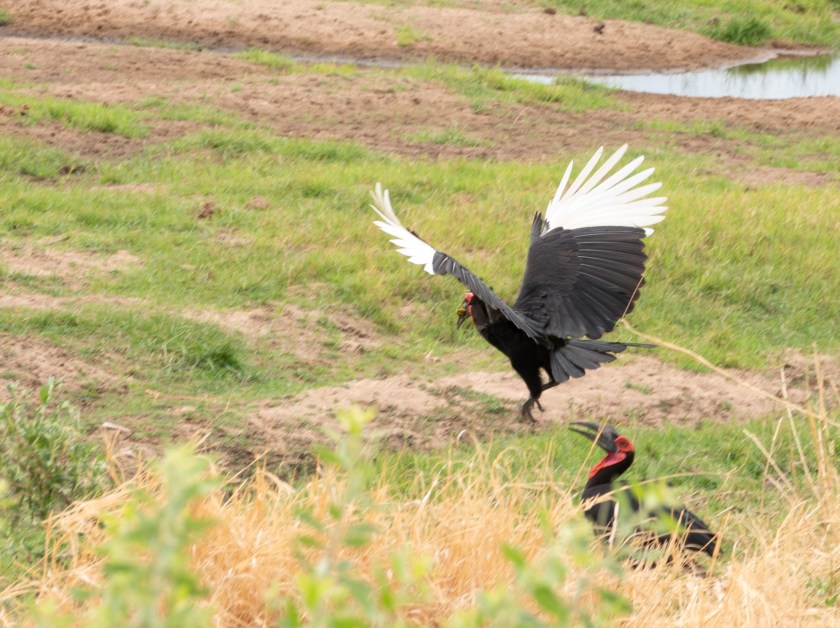
Not vultures, and not scavengers, behold the Southern Ground Hornbill (Bucorvus leadbeateri), a splendid bird up to 4 foot long, and 14lbs in weight.

DSC09577

Their wings can span six feet:

DSC09578

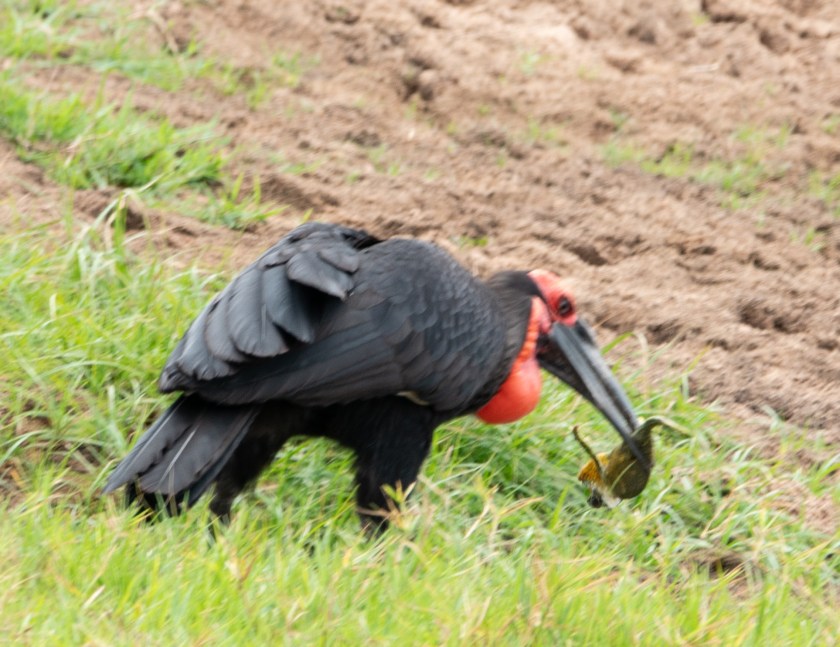
Our excellent guide, Charles Tareta from Kwihala Camp, found us a group of around six foraging near the Great Ruaha River; one suddenly disappeared into the bushes and emerged with a chameleon. He flew off, protecting his prize from his mates:

DSC09585

The chameleon was wriggly:

DSC09591

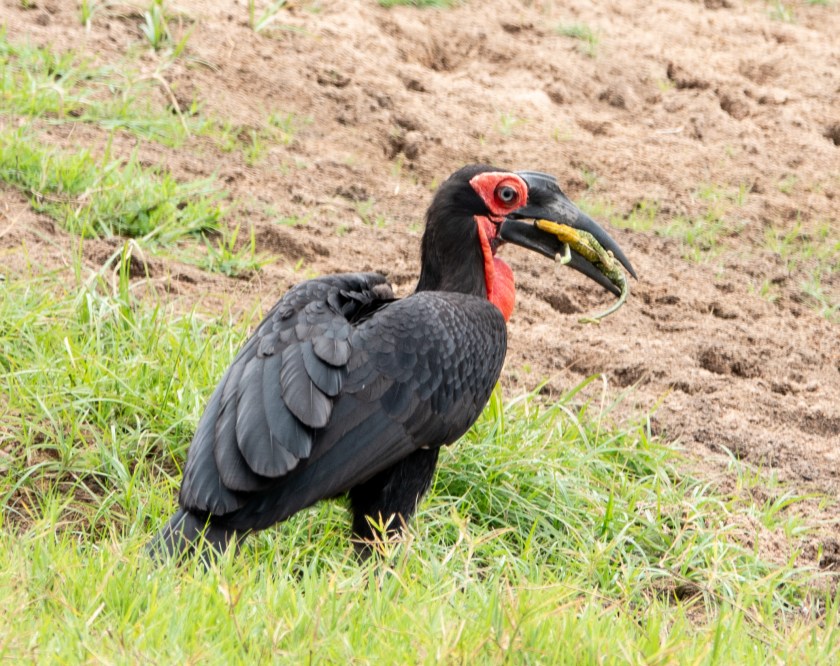
But he got it in place for swallowing:
DSC09598

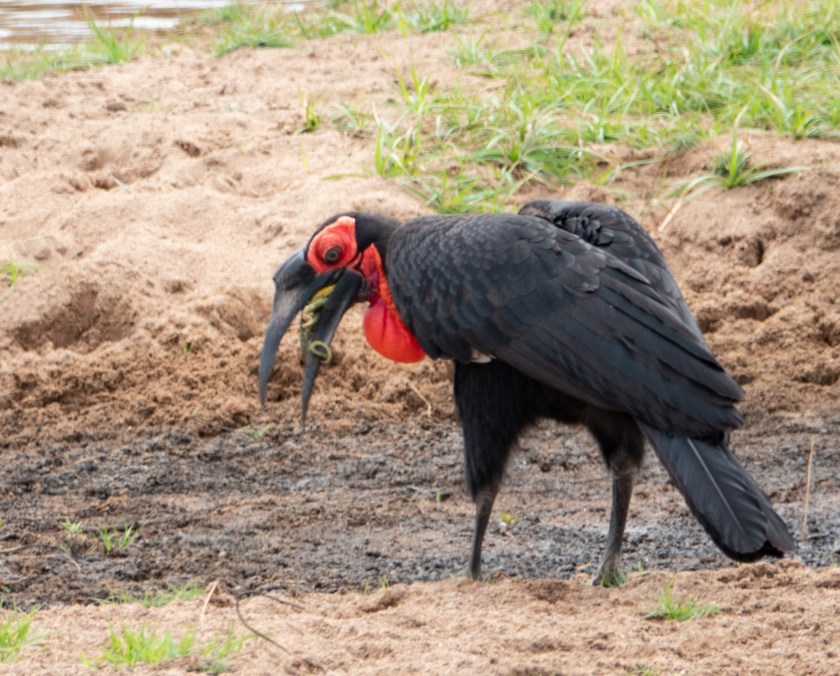
Oddly,  it failed to co-operate, wrapping its tail around the hornbill’s beak:
DSC09614

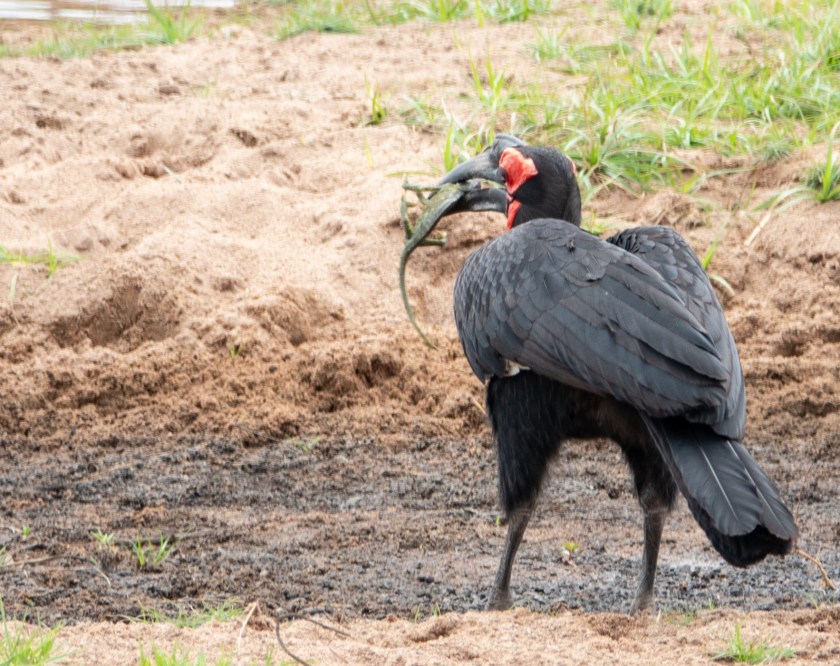
So he had no choice but to disgorge it and start again:
DSC09617

Finally, down it went, just a little remnant of tail spaghetti yet to disappear:

DSC09622

They are listed as vulnerable, as a result of habitat loss and their slow breeding cycle. They only breed every 3 years, the young are not independent for 1-2 years after fledging (the longest of any bird), and they not ready to breed themselves for 6 – 7 years. They live up to 70 years in captivity, 50-60 years in the wild.

Back to my title: like ravens and crows in the West, ground hornbills are culturally associated with death and destruction. In Tanzania, some believe that they host angry spirits, which leads to a taboo on killing them. On the bright side, in many cultures in the region they are believed to be a sign that rain is coming. On balance, then, these beliefs tend to protect the birds rather than threaten them.

It has a lovely booming call, listen here:

PS It is also one of the few birds, along with ostriches, to have eyelashes (actually modified feathers):
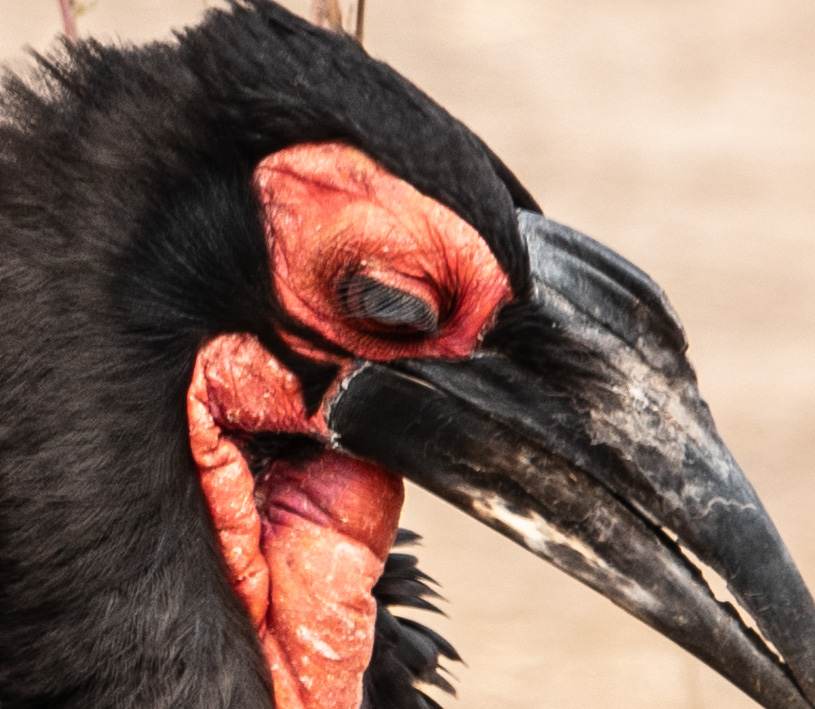
DSC09577

PPS There is one other species of ground hornbill, the Abyssinian Ground Hornbill. The females of this species have all blue skin patches; I photographed this one in Ethiopia last year.
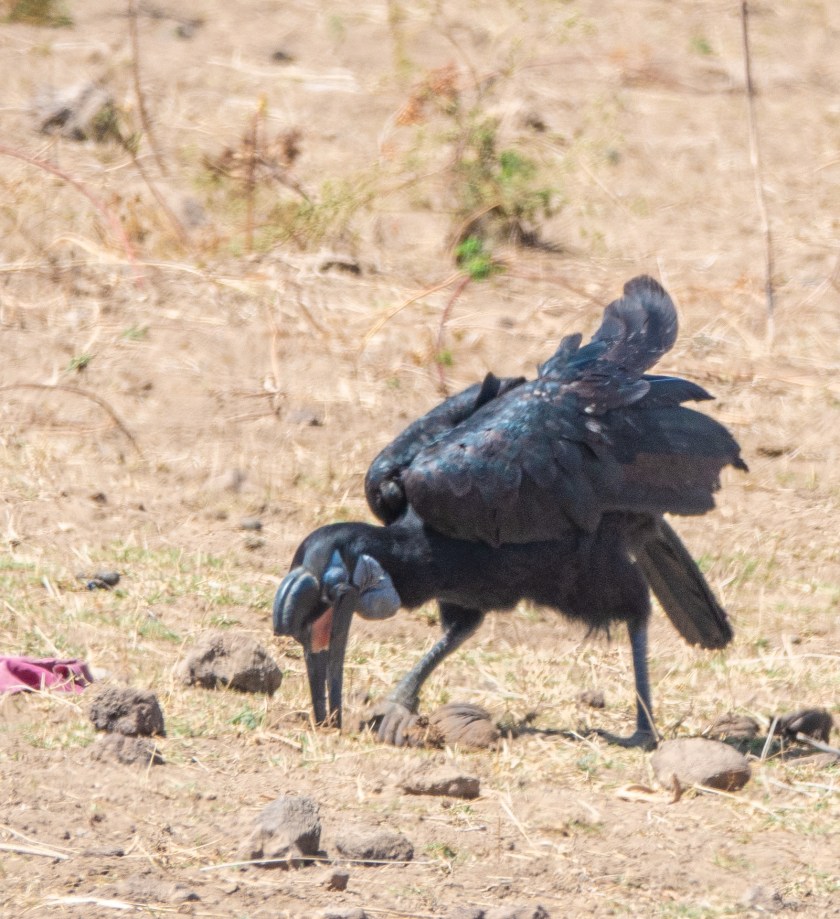
Abyssinian Ground Hornbill

The secret serval

[ I am back from Tanzania, and beginning to go through my photos. Here goes.]

In my years of going to Africa, I had never seen a serval. And I’ll hazard a guess that some of you may not be entirely sure what they look like, and some of you may never even have heard of them.

Ta-daa! Here is my first ever serval.

DSC00759

They are exquisite small cats, with amazing ears and sexy coats. They are not endangered, but hard to see. Depending on when their favorite local prey is most active, servals may be either nocturnal or diurnal. This one was prowling through long grass just before dusk, in the Northern Serengeti near Serian camp.

Their Latin name is Leptailurus serval.  Their bodies are typically around 70cm long, though this one was smaller. They weigh 10-15Kg. They lie still in the long grass with their eyes closed, and listen for smallish rodents with those huge ears (the largest ears relative to body size of any cat). Then they leap, with all four feet off the ground, and descend on their prey, stunning or killing it with a blow from their fore feet. They have a very high success rate, of about 50%, way higher than the bigger cats.

This video shows a young serval trying to subdue an angry snake..


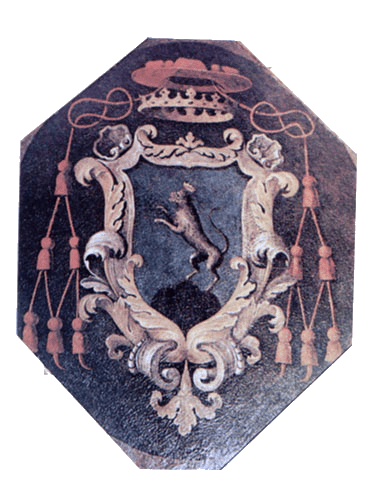
Giuseppe Tomasi di Lampedusa’s famous novel, Il Gattopardo, is called The Leopard in English, but in fact the Italian word means serval, and servals were the symbol of the Tomasi family. They used to be found in Tunisia not far from the island of Lampedusa, and there are attempts to reintroduce them.

Here is the Tomasi family crest: I think you could easily convince me that the central animal is a serval (or not)!

Tomasi_di_Lampedusa_COA

I do see that The Leopard might sell more copies than The Serval, but only if you have never been lucky enough to see a serval.

A mammalian interlude

[This is my last post for a while, because I am off to Tanzania. Enjoy your empty inbox, and watch for a distinct change of ecosystem on my return!] 

You may have noticed a shortage of mammals in these posts this summer. That’s partly because I haven’t seen as many as usual, and partly because some of the ones I have seen were not patient enough to wait for photos. Like the large black bear that crossed the road near my house in early July. Though I did find a rotten tree stump he had ripped apart in a search for ants:

DSC06916

The largest mammal so far this summer was a white-tailed deer in mid-August, crossing the trail under the impression we had now gone past and wouldn’t look her way.

White-tailed deer

She didn’t run, just lingered in the trees nearby and watched us. I wondered if she had a fawn nearby, but we saw no sign of one.

White-tailed deer

White-tailed deer females stand about 36 inches at the shoulder, similar to the UK fallow deer.

The smallest mammals are my chipmunks. This one was having a good groom:

chipmunks

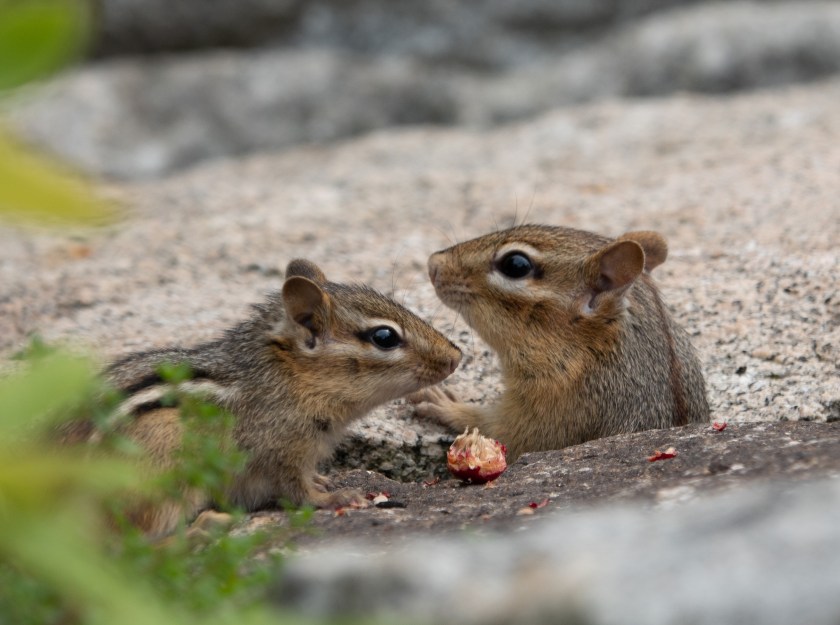
These two below may be a mother and young, Chipmunks have young either in the spring, or late summer, and by 6 weeks, when they first venture out,  they look just like adult chipmunks, but are about 2/3 of their size. The one on the right could be one of this year’s second batch. Litters usually number four to five, but I have only seen these two recently. There is a fox about the place…..

chipmunks

They shared a rosehip (excellent source of Vitamin C, as I can attest to from being fed rose-hip syrup in 1950’s England).

chipmunks

I have never seen two chipmunks socializing before. They usually forage alone, and chase each other off food sources, or feed nearby but cast wary glances at each other. (And since I can read your minds, I am pretty sure they weren’t mating. The lefthand one came briefly, gave me an assessing look, greeted the other one and left almost immediately. And no key bodily areas came into contact. ) What is more, one of them showed a glimpse of what I think is a healthy teat:*

chipmunks

The Native Americans have a lovely story about how the chipmunk got its stripes:

http://www.oneidaindiannation.com/how-the-chipmunk-got-its-stripes/

* Cynics may think it is not a teat, but either a penis (!), or even a tick, but I am fairly sure it is a teat.


The Red Eft: not just a great Scrabble word*

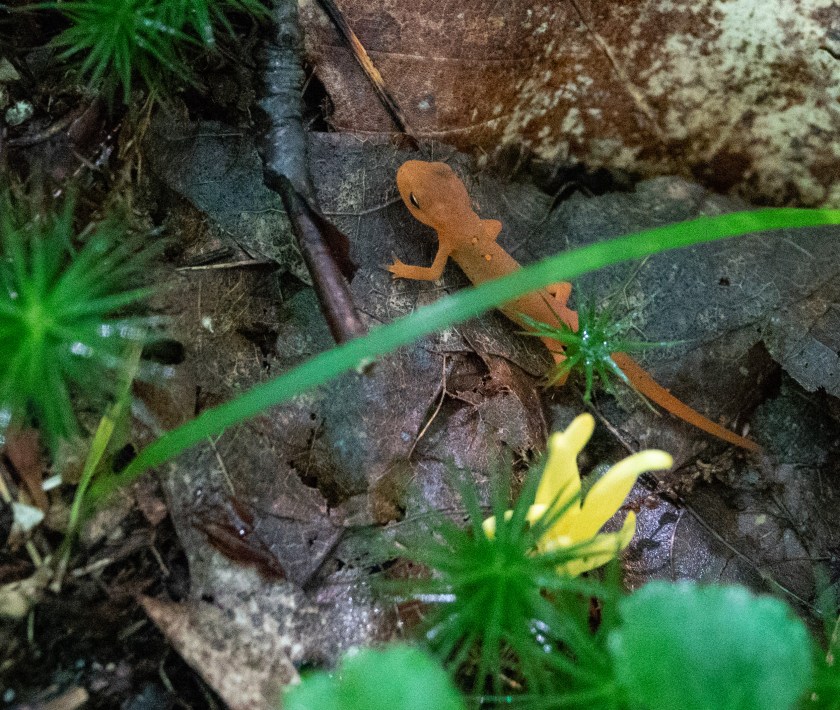
I bent to look at a little bright yellow fungus, and lo and behold, a red eft:

Red eft

I have never seen one before, and I thought it was a salamander. Close, but no cigar. It is indeed in the salamander family, but newts are a semi-aquatic sub-group whose juveniles are terrestrial. The red eft is the juvenile form of the Eastern Newt, Notophthalmus viridescens. The larva is aquatic, and so is the adult, but the juvenile lives on land for two or three years before eventually returning to water.

Here it is in close-up. It is about 2 inches long.
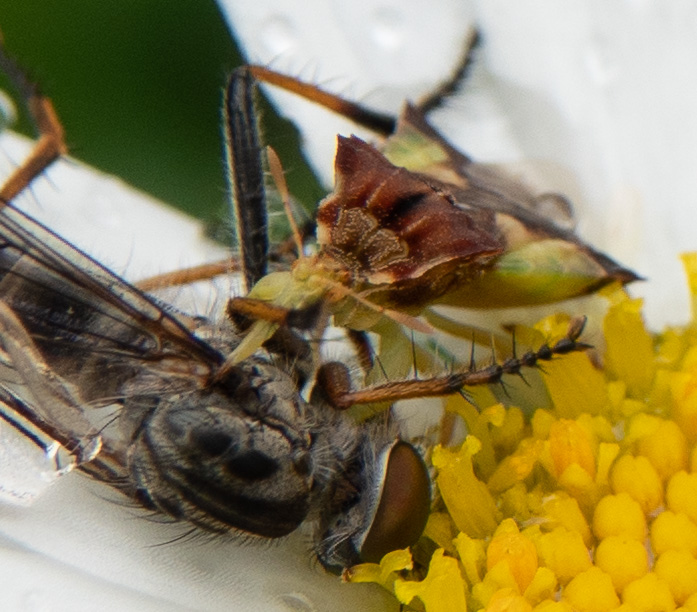
Red eft

The neon orange color warns predators that this is an unwise choice of meal, since the animal’s skin produces a poison called tetrodotoxin. What is more, the tetrodotoxin in these orange efts is seven times more concentrated than that of the green adults (Spicer et al 2018) .

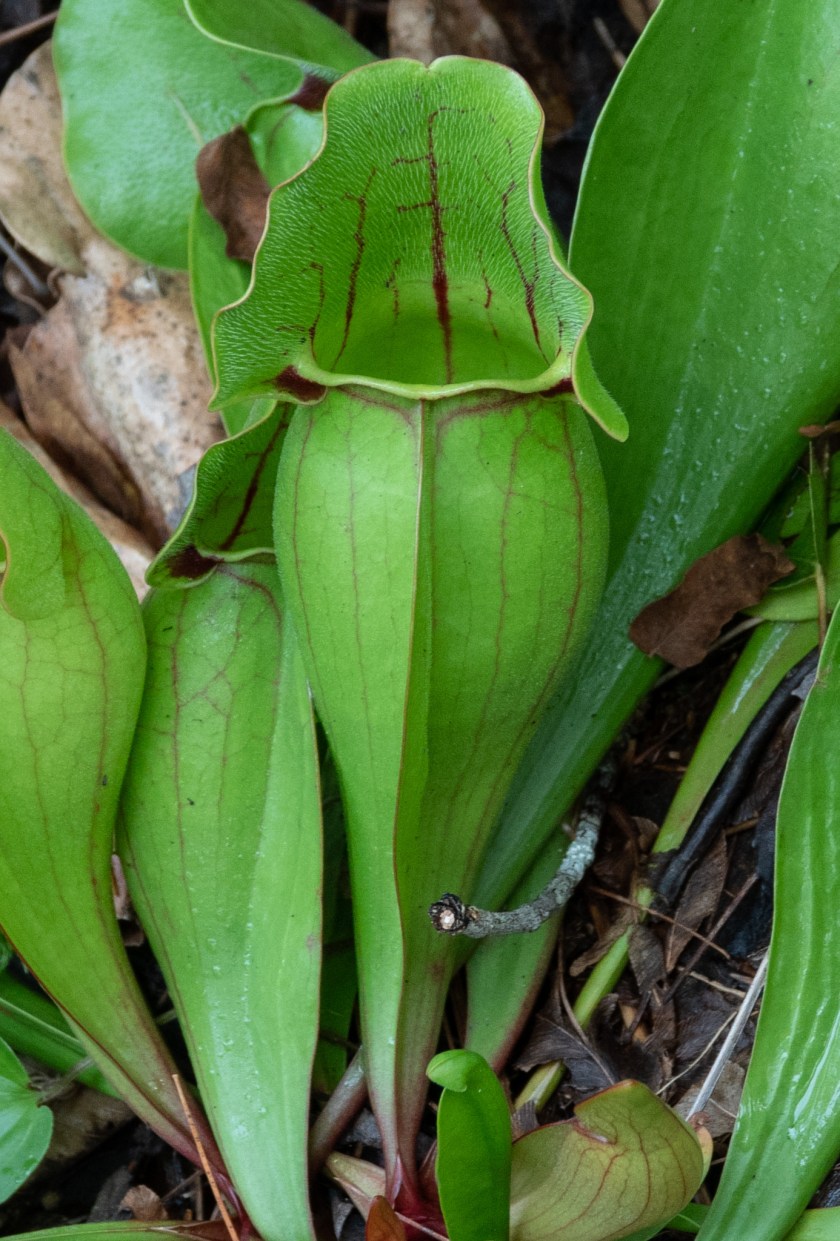
Some Eastern Newt larvae have been found in the pitchers of the carnivorous plant, Sarracenia purpurea. 

Pitcher plants

This cannot possibly be a good choice of home, because even in the unlikely event that the larva survives the gastric juices of the plant and the eft then hatches, when it tries to escape the downward-facing hairs on the inside wall will make the climb out pretty challenging.

Pitcherbnplants

I fear the hefty eft effed as it left .. (sorry, I couldn’t resist. Best said out loud in a Cockney accent with no ‘h’) .

* That name ‘eft’ is from Old English efte. ‘an eft’ became ‘a neft‘ and then ‘a newt’. The juveniles kept the old name.


The lady beetle: Homage to Kafka

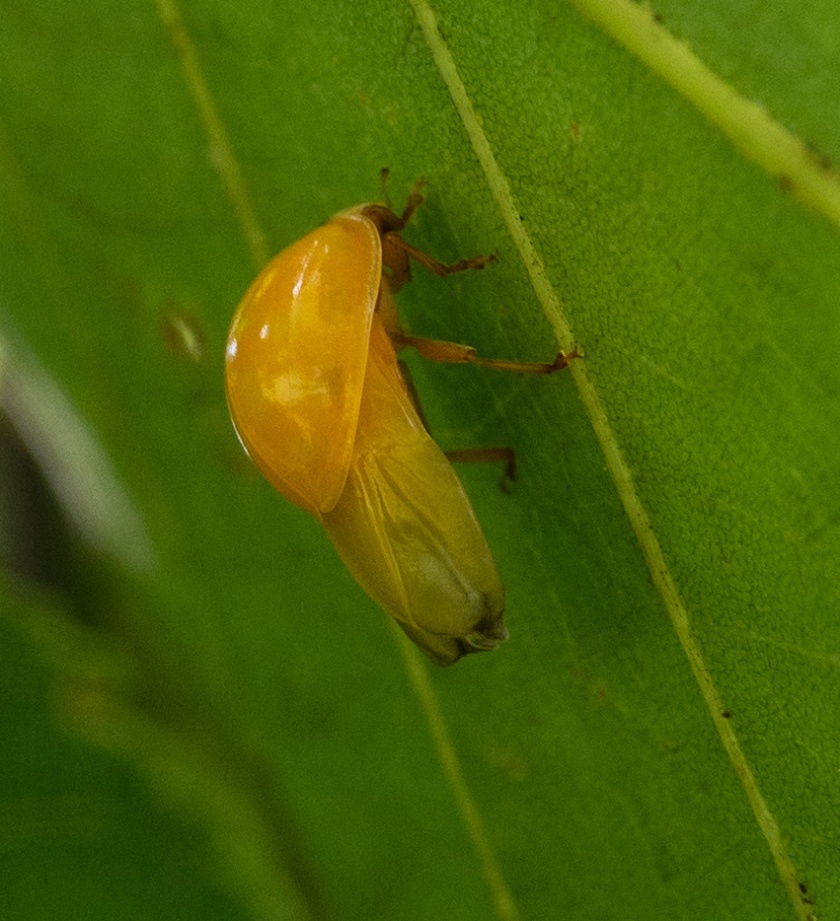
Franz Kafka’s novel Metamorphosis was thought by Vladimir Nabokov to refer to a beetle *, and this is the story of a small beetle that metamorphoses through three distinct stages (post-egg), until it appears as our familiar ladybird (or ladybug in the US).  There are rather a lot of photos today, and little text.

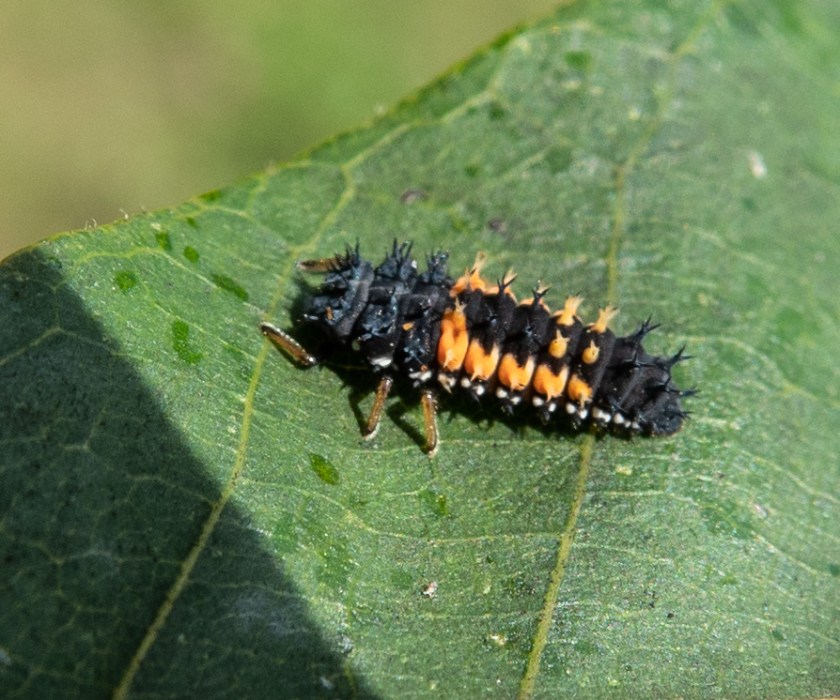
We begin with the larva, this one is I think the fourth of five stages:

Harmonia axyridis, harlequin ladybird

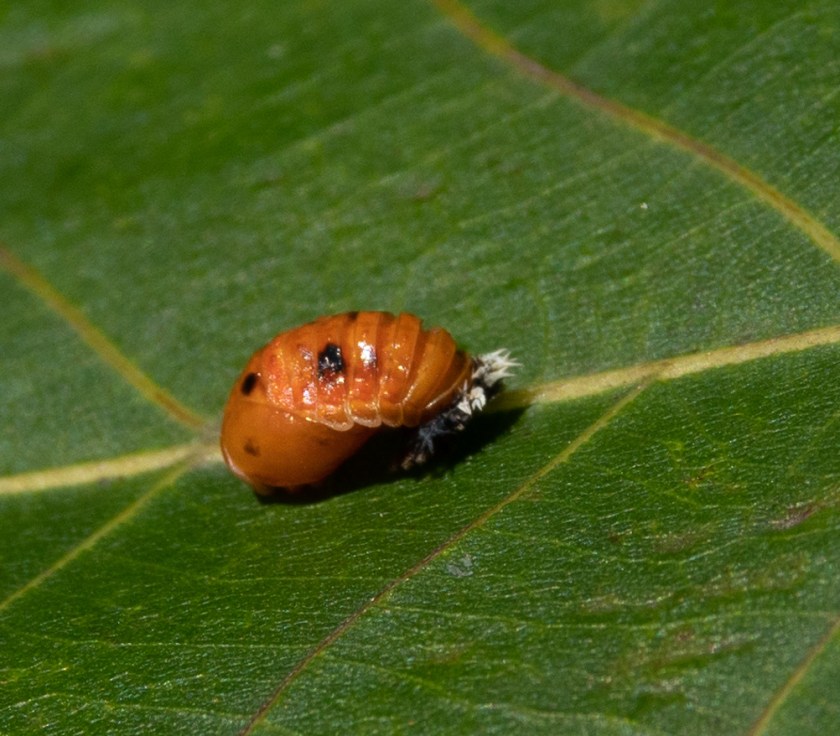
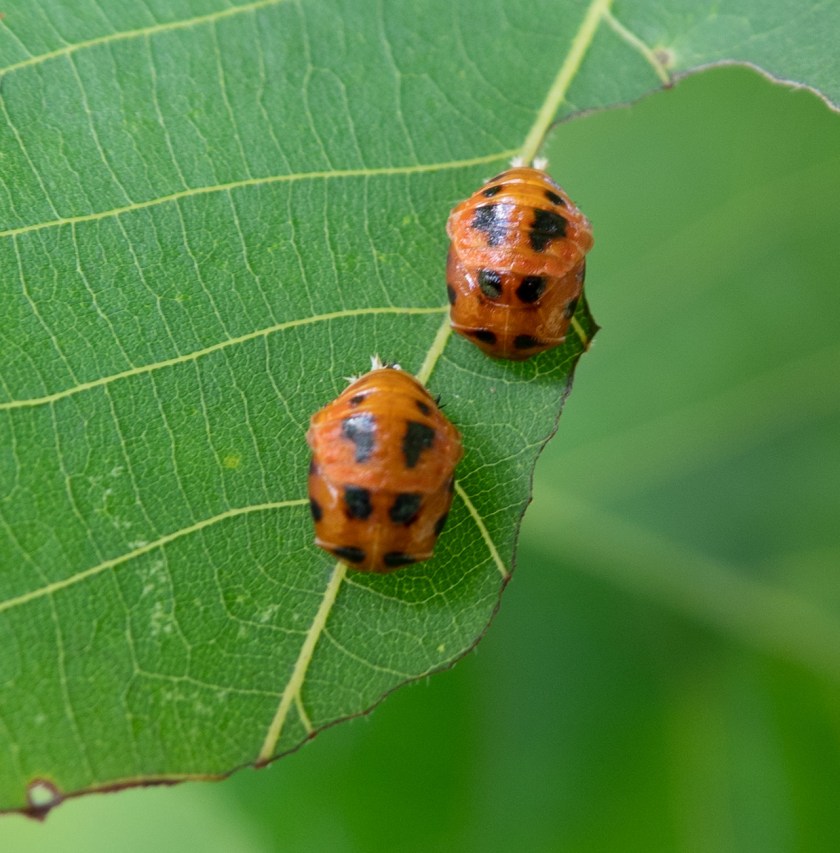
It splits its skin (leaving white spiky remnants still visible), to form a pupa:

DSC07447

or two:

Harmonia axyridis, pupa

The pupa is motionless, and at the mercy of predators:

Harmonia axyridis, pupa

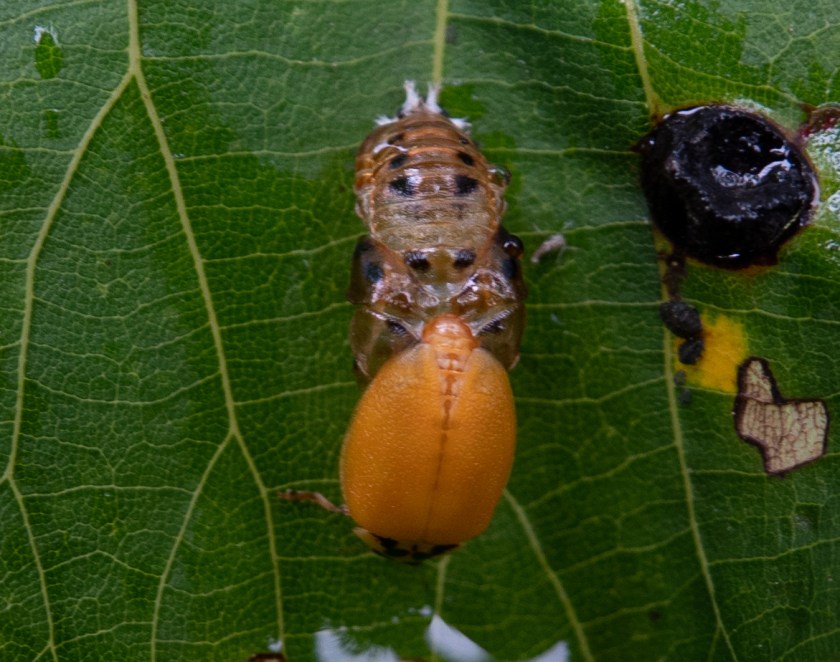
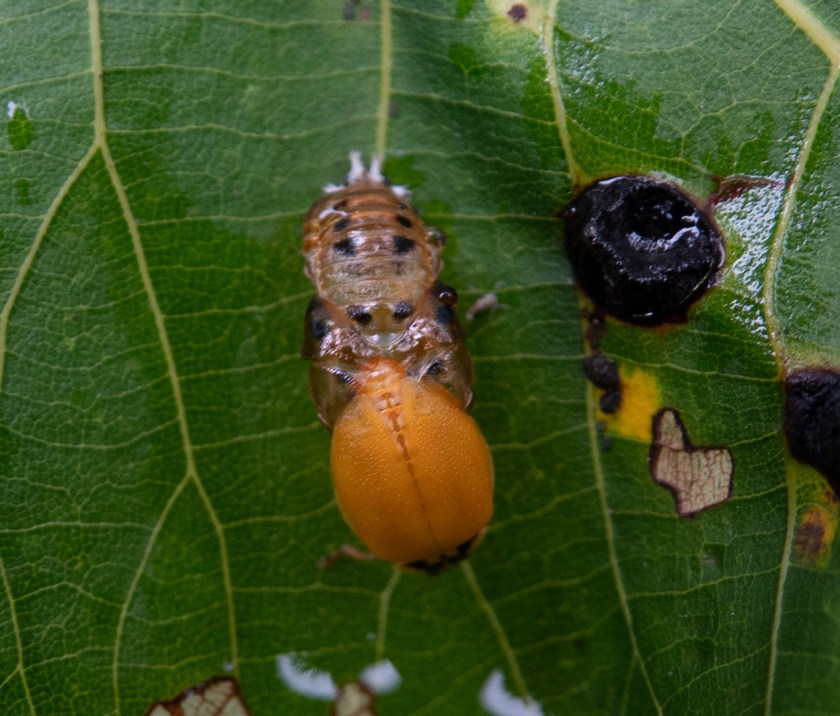
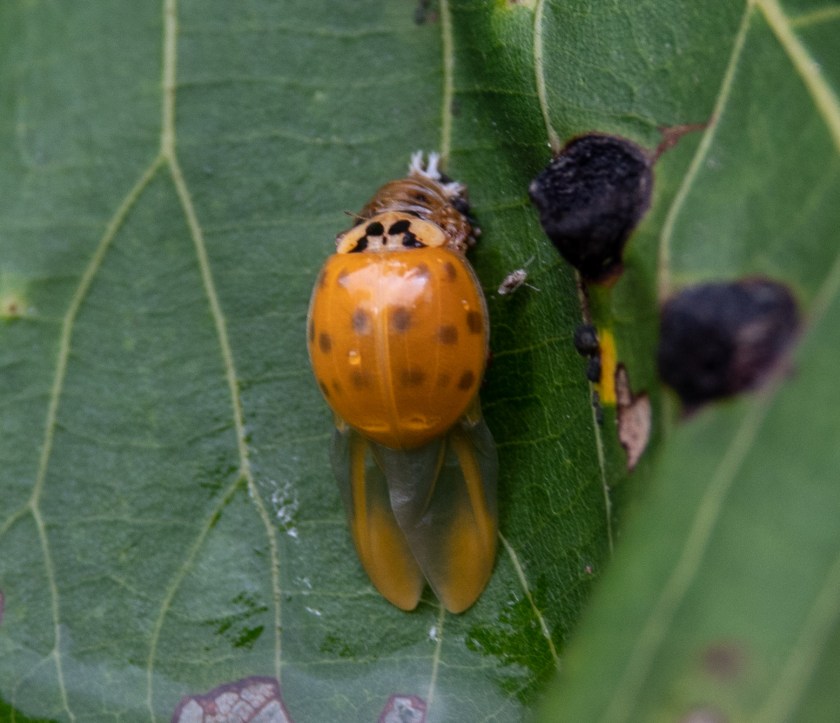
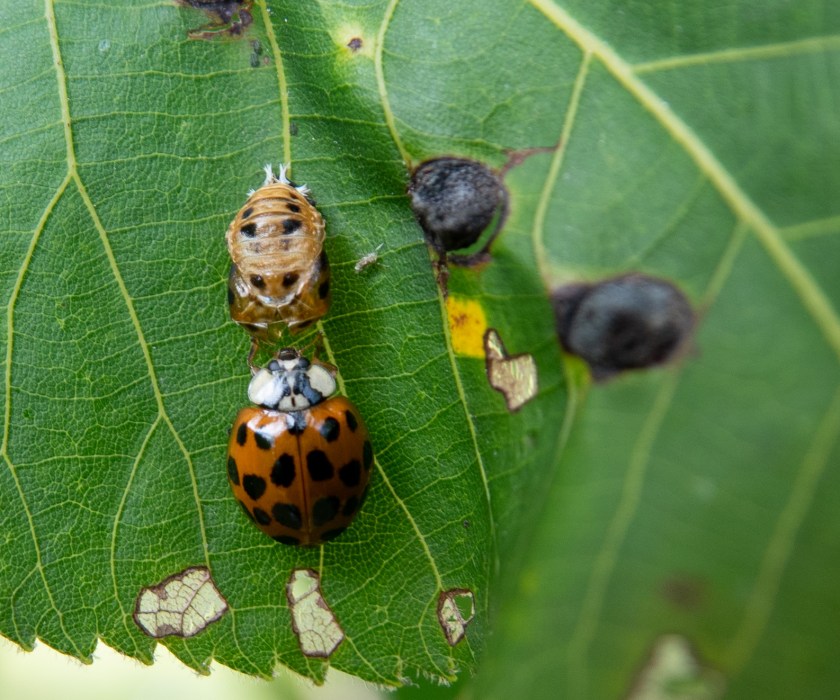
And from the pupa emerges the soft, spotless adult, head first and wings last:

Harmonia axyridis, emergingHarmonia axyridis, emergingHarmonia axyridis, emergingHarmonia axyridis, emerging

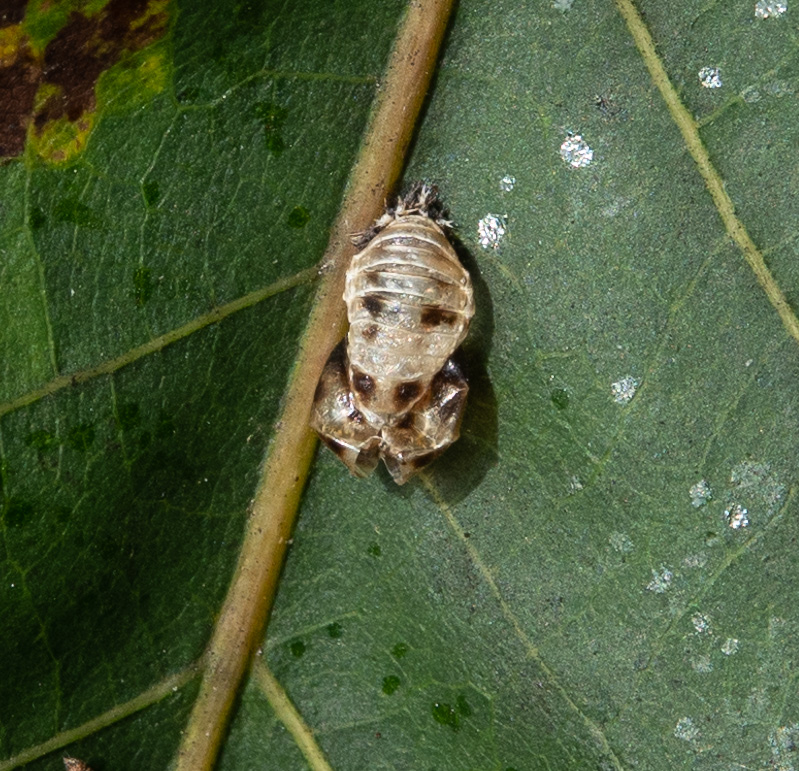
The empty pupa case is left behind:

Harmonia axyridis, pupa

and the soft vulnerable ladybird rests with its wings expanded:

Harmonia axyridis, emerging

Gradually the wing cases harden, and the spots develop. This next photo is taken 2 1/4 hours after emergence:

Harmonia axyridis, emerging

24 hours later, it has fully darkened and the spots have grown too:

DSC08337

Small miracles, every day. here is a time lapse 3 minute video of the whole process:


To be precise, my photos are of a Harlequin Ladybird, or Harmonia axyridis, photographed in Maine, USA, but an immigrant from Eurasia. It is a member of the family Coccinelidae.

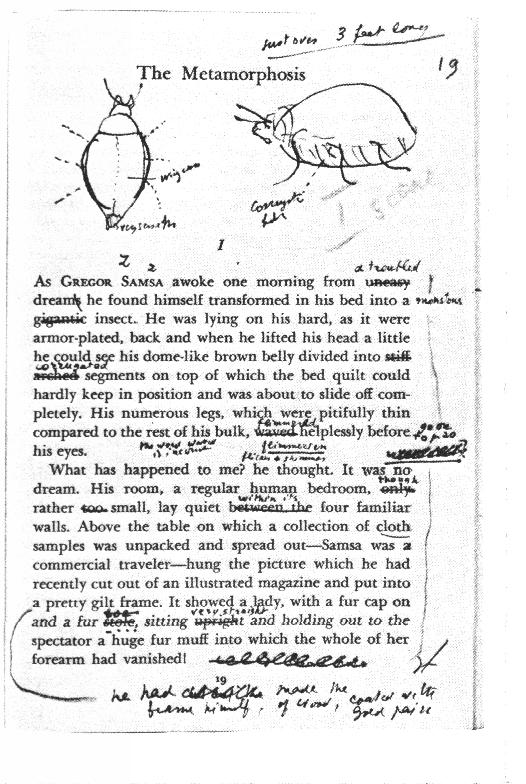
* Kafka’s beetle is sometimes referred to as a cockroach, but Nabokov, who was a renowned lepidopterist, thought it was just a “big beetle”, and drew a picture on his own annotated copy of Metamorphosis. It looks quite like a ladybird to me!

nabokov_on_kafka

From Josh Jones’ blog: http://www.openculture.com/2015/10/franz-kafka-says-the-insect-in-the-metamorphosis-should-never-be-drawn.html

Hummingbirds rock

I love those photos of someone’s dog having a good shake after a swim, water spraying everywhere. But I had never seen a bird shake, until last week. It rained overnight, and in the morning up flew a hummingbird, perched on a twig, and:

DSC07341

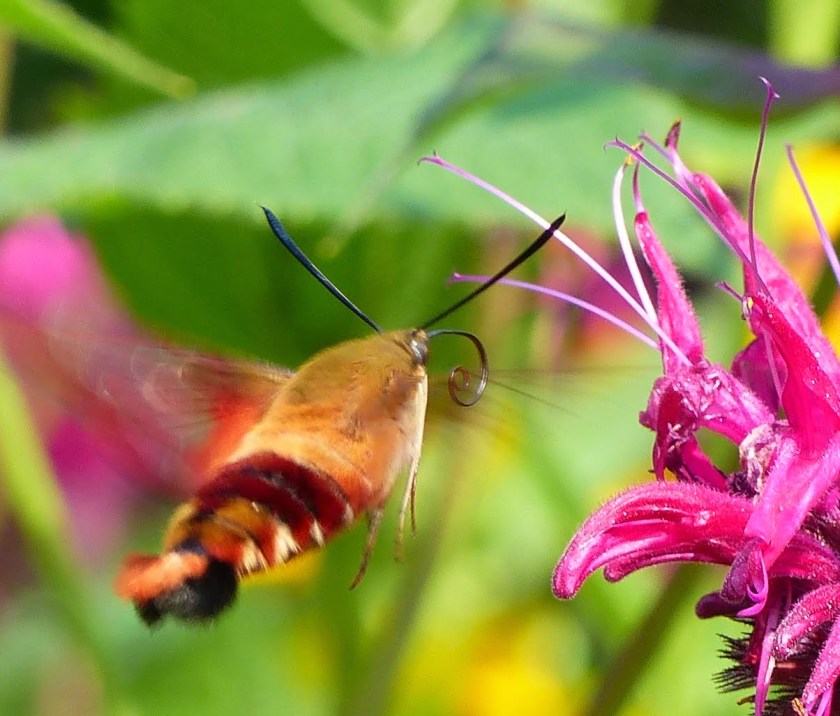
Hmmmmm….is it a bird? No, it’s a moth.

If you see something out of the corner of your eye hovering near red flowers, you automatically think “Hummingbird”, but no, these are Clearwing moths. This one is a Hummingbird Clearwing, Hemaris thysbe

P1020466

They are the size of very large bumblebee, with the long curled tongue typical of moths, and they are quite territorial, very much like actual hummingbirds. These two below had a tiff just after I took this photo, and then one retreated:

Hummingbird moth

The two above are a second species, the Snowberry Clearwing, Hemaris diffinis,  which has dark rather than pale legs, and two dark stripes on its underside. It is sometimes rudely called the flying lobster. I came across these two mating, flying around conjoined, then settling for a short rest on the grass:

Clearwing hummingbird moths mating

The clear wings are supposedly a consequence of losing the usual scales that cover a moth’s wings, because their flight habits are so energetic, though I find this hard to believe.

To see how they mimic hummingbirds, watch this brief video. If a real hummingbird comes close, the moth flees.

Most moths have small bodies and large wings, but these have huge bodies and relatively small wings, so the initial gestalt is very un moth-like.

I am for some reason reminded of a lovely story about Charles Darwin, told by his granddaughter, the author and wood-engraver Gwen Raverat. They were playing Lexicon, a predecessor of Scrabble. He put down ‘moth’, and she added ‘-er’ to the end. Darwin stared at this mysterious word and said “Mow-ther, mow-ther, there’s no such word as mow-ther.”


The Hermit Thrush exposed

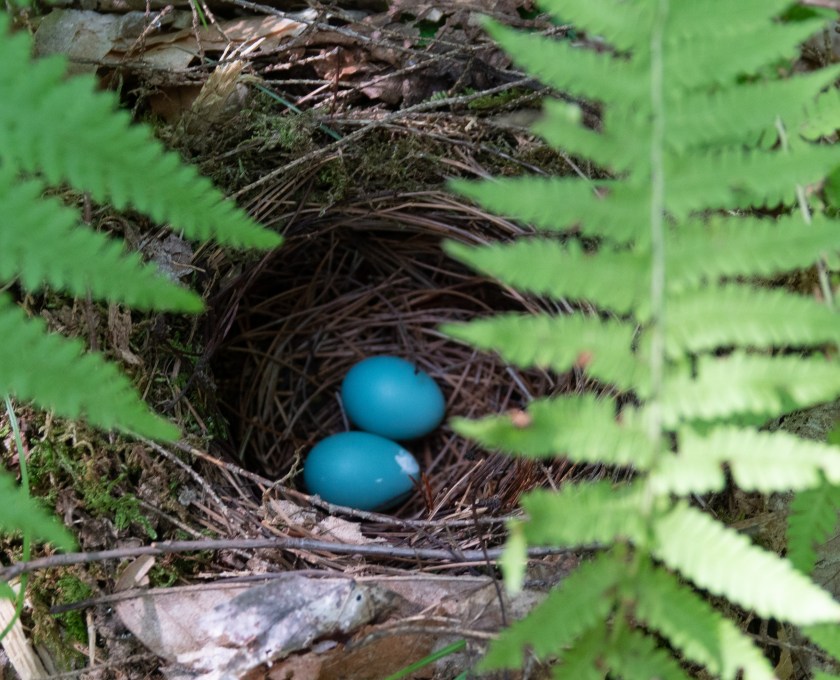
I was walking with a friend in the woods, when a small brown bird suddenly flew up from the ground in front of us. On a lucky day (for us), this suggests we have disturbed a mother, quietly tending her nest. And there it was, concealed under a few small ferns, right in the middle of the trail:

DSC06942

And containing two stunning blue eggs:

DSC06939

The mother usually doesn’t go far, but she is hard to see in the dappled woodland. This time, we found her, a hermit thrush, Catharus guttatus faxoni:

DSC06922

Ground-nesting birds seem to be running a terrible risk of discovery, and indeed studies show that the best predictor of nest success is how well-concealed and camouflaged the nest and eggs are. So why do they have bright blue eggs?? Search me.

Hermit thrushes may have two or even three broods per year, especially if the first brood fails. This brood is extremely late, although luckily for these chicks this is a species that migrates very late, mid-October being common, so they should make it out before winter closes in. Like many Mainers, they over-winter in Florida.

Hermit thrush song is haunting, with short 1.5 second snatches, called song types, separated by 2.5 second silences. Roach et al (2012) studied Maine Hermit Thrush song in detail. Each song type is slightly different, rather like a nightingale, and a male has a repertoire of up to 12 song types. Each male’s repertoire is entirely different. A song bout can have up to 100 song types in it. Listen here:

Human hermits are usually shown in caves, but here is a ground-nesting human hermit: John Singer Sargent’s The Hermit (Il solitario)

restricted

The Metropolitan Museum if Art website says “Sargent based this painting on sketches he had made in Val d’Aosta, in the foothills of the Alps, in northwestern Italy. … When approving The Hermit as the translated title of the picture, Sargent wrote to the director of the Metropolitan, “I wish there were another simple word that did not bring with it any Christian association, and that rather suggested quietness and pantheism.”

Robber ambushed

[Not for the faint of heart]

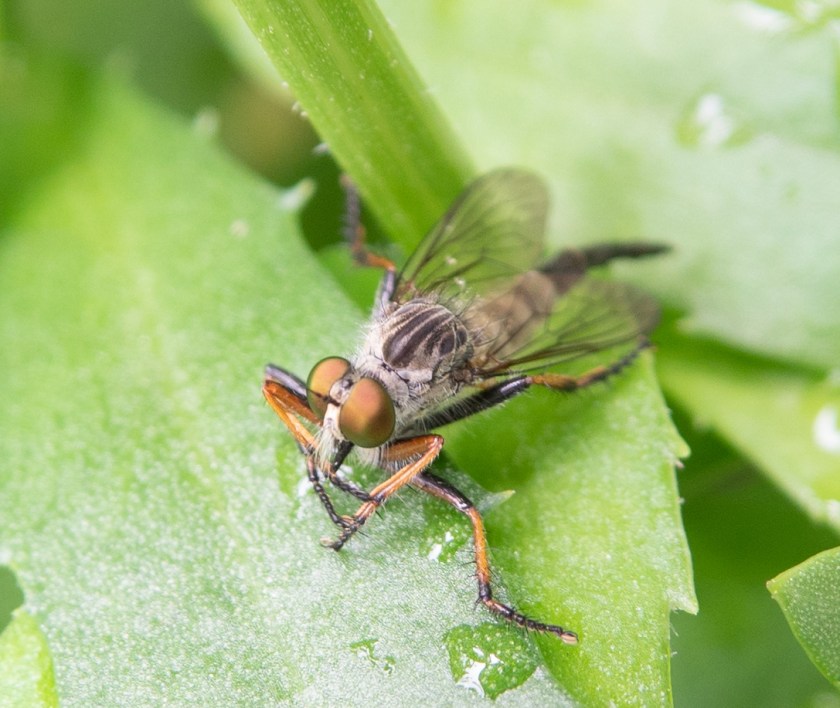
A tiny war was fought in my yard this morning. While deadheading my flowers, I found a fierce battle underway, between a Jagged Ambush Bug, Phymata sp., (right), and a Friendly Robber Fly, Efferia aestuans:

DSC06257

Both were alive and moving, but the ambush bug had the upper hand, and its pale green proboscis was sunk into the robber fly:

DSC06267

I went away for half an hour, and when I came back the ambush bug was alone:

Jagged Ambush Bugs

I searched for the robber fly, and found it lying intact but motionless on a lower leaf:

Friendly Robber Fly, Efferia aestuans

It may or may not have been alive, but it was certainly paralyzed: ambush bugs inject a paralyzing poison through their proboscis, and then eat their prey at leisure. This ambush bug had foolishly allowed its prey to slide out of its formidable grip, uneaten.

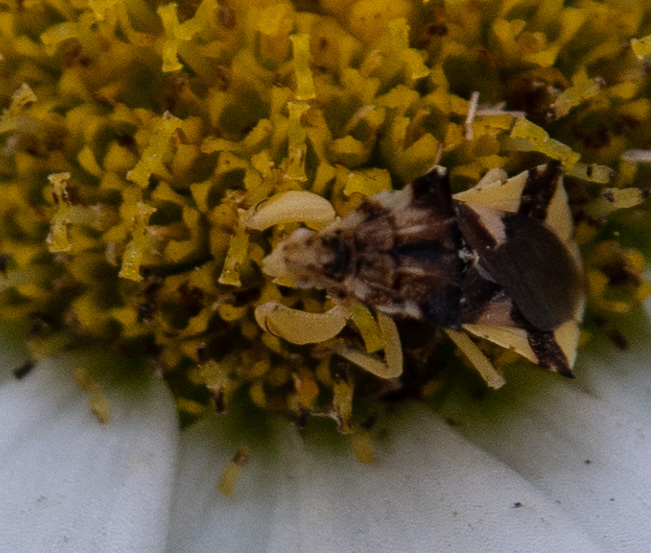
Ambush bugs are so-named because they lie in wait, extremely well-camouflaged, until woe betide the unwary bug that wanders too close:

DSC06343

Below is the same one in close-up, carefully positioned on the yellowy-black centre of the flower where it is almost invisible:

DSC06343

The biblical phrase “they lay in ambush” fits its posture perfectly, and makes me realize why “sit in ambush” or “stand in ambush” just don’t cover it.

Appendix: Extra detail for those other obsessives like me:

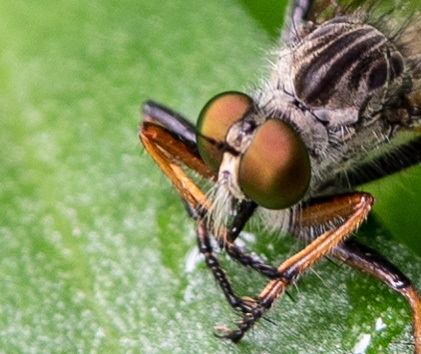
Wikipedia says Robber Flies  “..have three simple eyes (ocelli) in a characteristic depression on the top of their head between their two large compound eyes. They also have a usually dense moustache of stiff bristles on the face; this is called the mystax, a term derived from the Greek mystakos meaning “moustache” or “upper lip”. The mystax has been suggested to afford some protection for the head and face when the flies deal with struggling prey” . You can see one of the simple eyes pretty clearly in the closeup below, and also the bristly mystax (today’s new word.)

Friendly Robber Fly, Efferia aestuans