The bird with no feet sleeps on the wind*

(This post is the second of four about the numbers of legs and toes in the animal kingdom. If you missed the first one, on mammals, you might want to look at it because it explains why I have chosen this theme. It was posted on June 29th: https://wp.me/p90hhh-Dq )

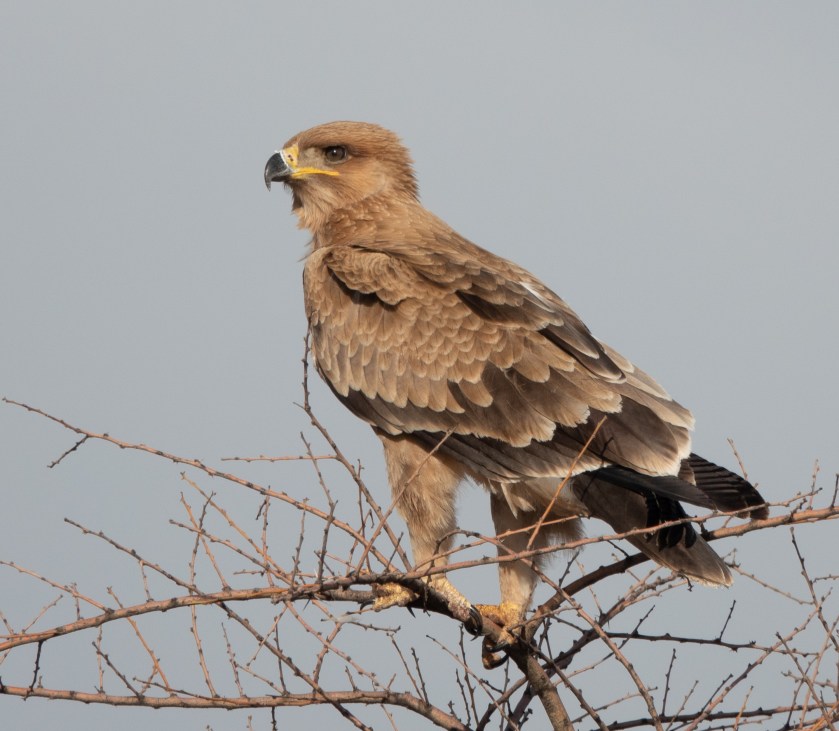
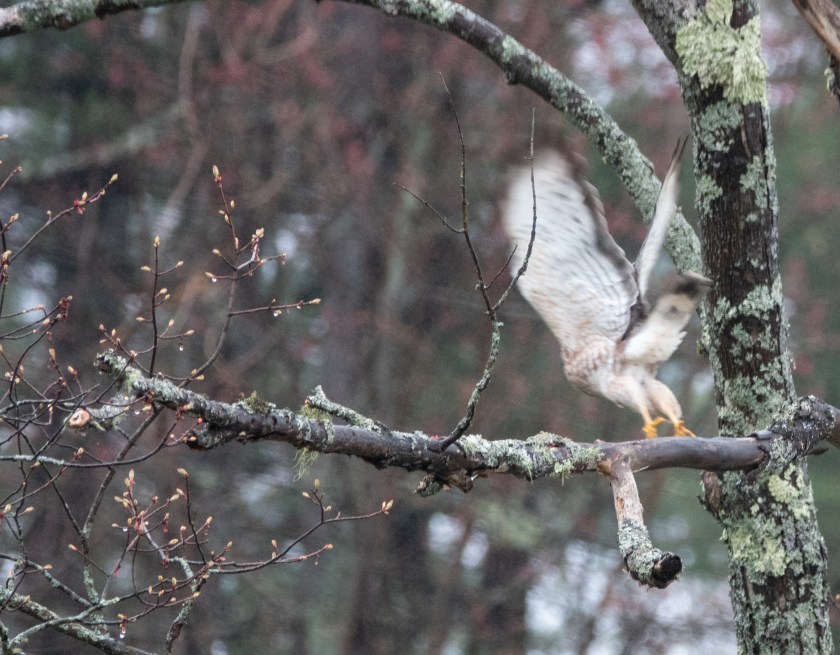
In flight, you can often imagine that a soaring bird has no feet, and never touches down to earth. Witness this Namibian Augur Buzzard.

Buzzard

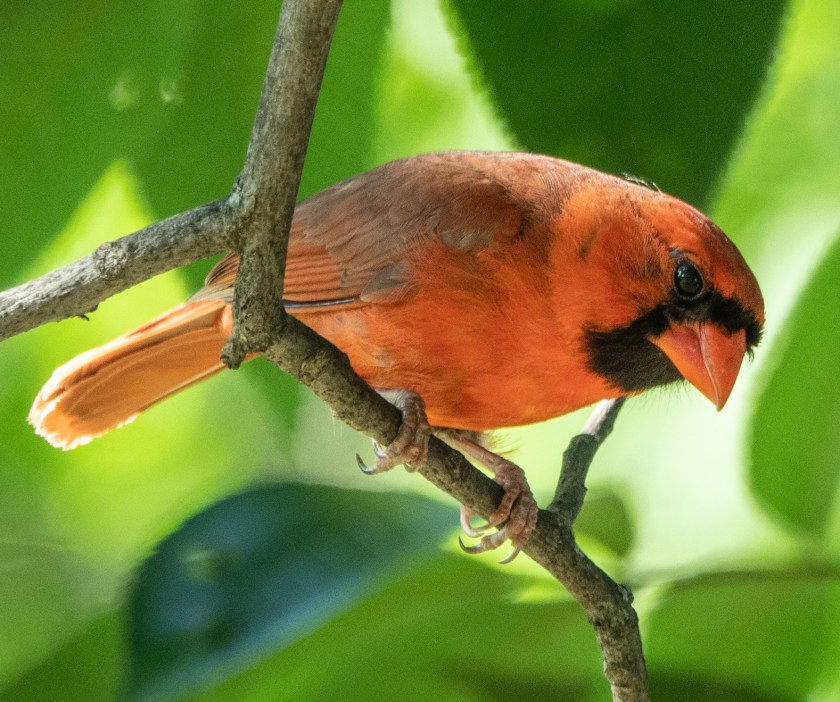
But all birds have feet, and most of those feet have four toes, three pointing forward and one at the back. They work extremely well for perching on twigs, like this cardinal:

DSC03560

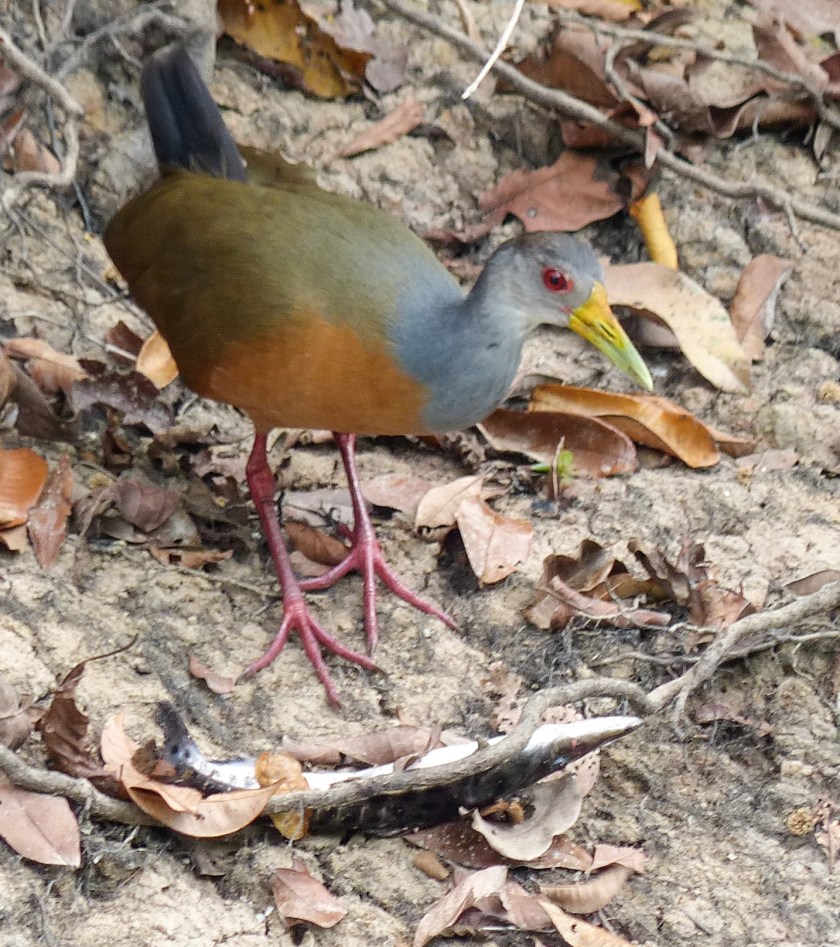
The same toe-count can be adapted to spread the birds weight when walking on tricky surfaces like lily-pads or mud. This Grey-necked Wood Rail in the Pantanal has caught a fish, but a moment later its catch was stolen by a large tegu lizard:

P1070818

The toes can be webbed for paddling, like the three front toes of this swan. Note the small fourth back toe.

swan

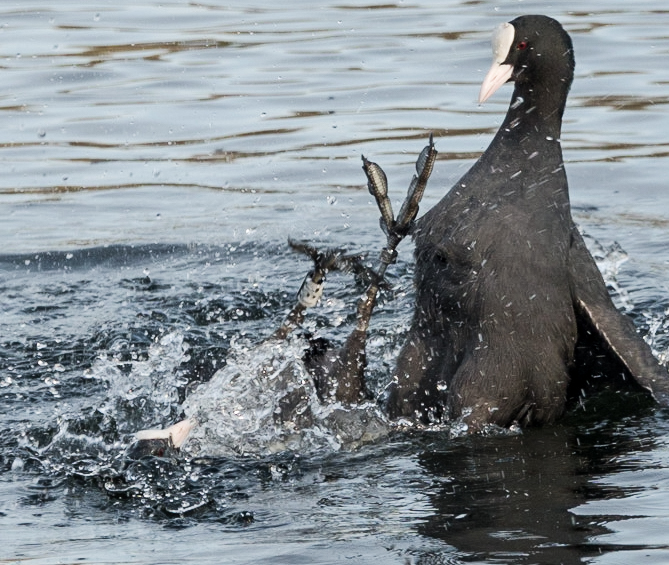
Or toes can be lobed, like this male coot’s, upended by his rival in a vicious kick-boxing match:

Coots

These curious lobes create brilliantly multipurpose feet. In the water, the lobes act like webbing to help with swimming. But on land, when the coot lifts its feet the lobes fold back, making walking through mud easier.

A few birds, including woodpeckers, owls, and parrots, arrange their four toes with two forwards and two backwards. This Hyacinth Macaw is showing the two front toes of each foot:

P1050875

Here is a close up of the foot of a barred owl, sadly found dead by the roadside in Maine:

DSC03914

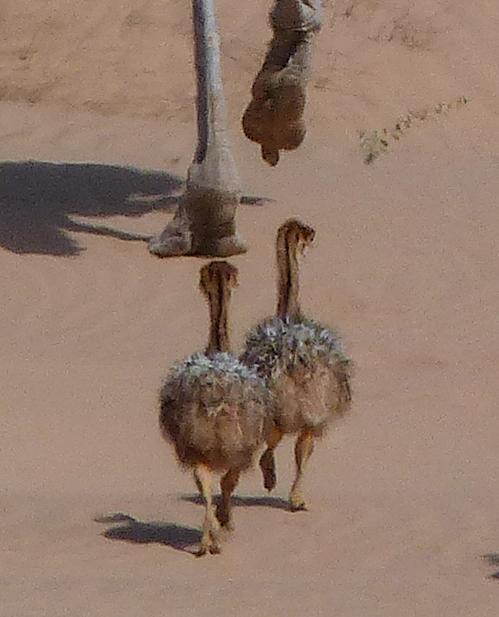
The ostrich is the only bird with just two toes on each foot:

Male ostrich and chicks; female was also nearby.

Just like zebras and horses, with their single toe, the adult ostrich can kick powerfully enough to kill a man or a lion, and just like in humans the innermost toe is the bigger one! (The front foot is the left foot in the rather confusing photo below.)

Somali Ostrich

There may be money to be made in offering pedicures to ostriches…

I’ll keep following this digital count, with reptiles and amphibians next.

* My title is an oblique reference to this passage from Tennessee Williams:

http://www.undiscoveredearth.com/2011/08/15/excerpt-orpheus-descending-tennessee-williams/

The Pobble who has no toes

I read with fascination this week that the genes in charge of growing appendages (arms, legs, fingers, toes, wings,  tentacles…) are now thought to predate the point at which our lineage diverged from that of the octopus. This is despite the fact that octopi, insects, and vertebrates each evolved their very different limbs independently. The same gene determines the number of fingers we have, and the number of suckers an octopus has, and Martin Cohn and his colleagues have now shown that this genetic program dates back at least 500 million years.*

This article inspired me to take a close look at fingers and toes. It turned out to be quite hard to find good photos in my archives: most of the time animals stand in long grass, or in muddy water, hiding their feet, but here goes. (None of these posts pretends to be a full scientific survey: the limiting factor is what I have photos of.)

I think I’ll start with us mammals. Unlike the Pobble, they all have toes, but the number of toes varies from six to one….

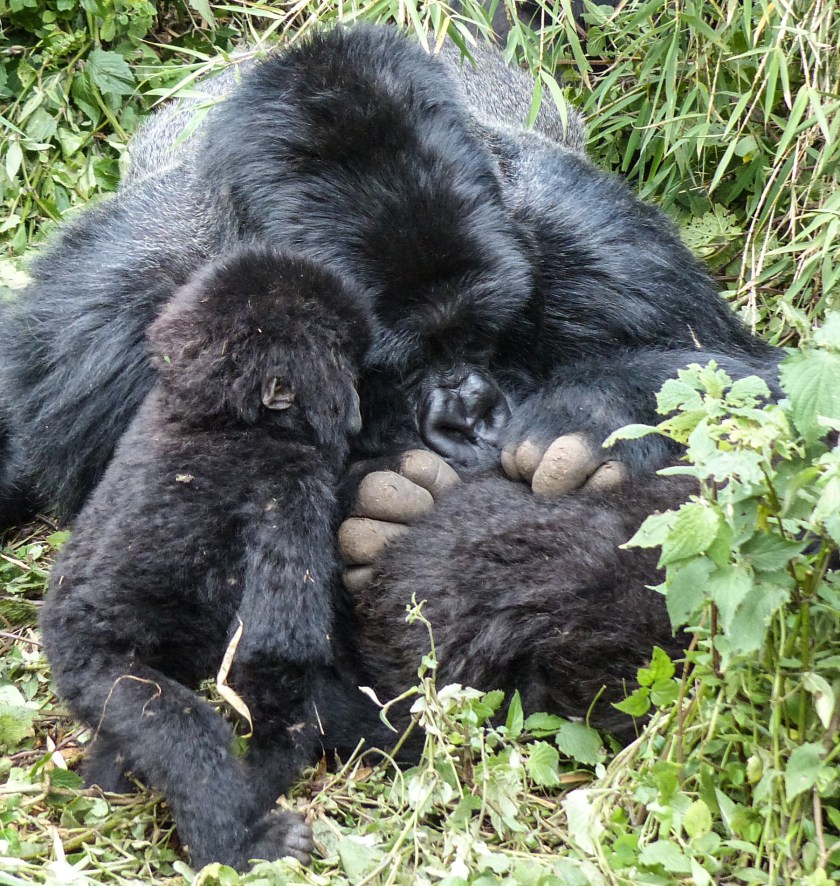
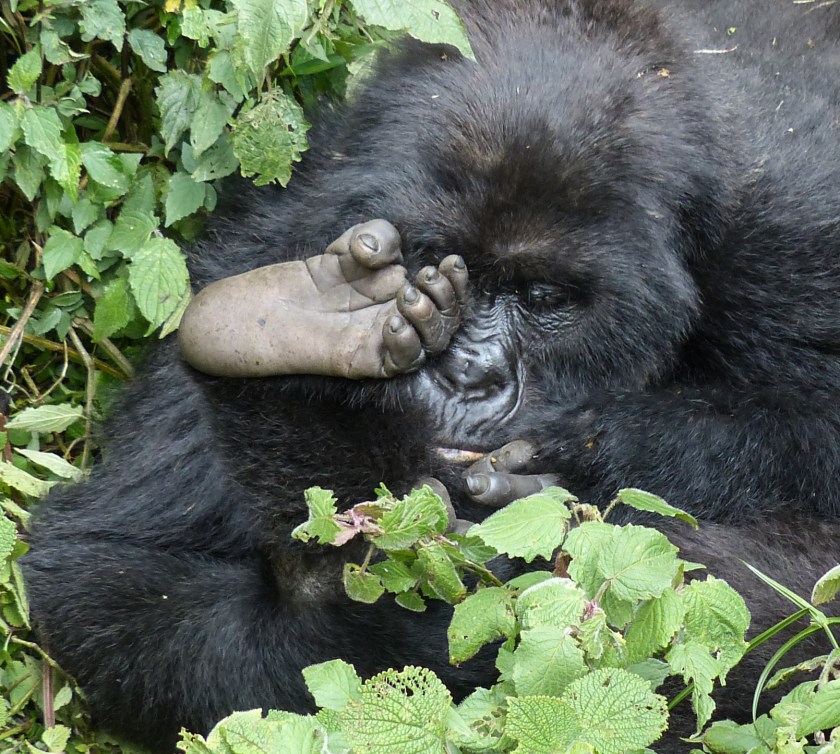
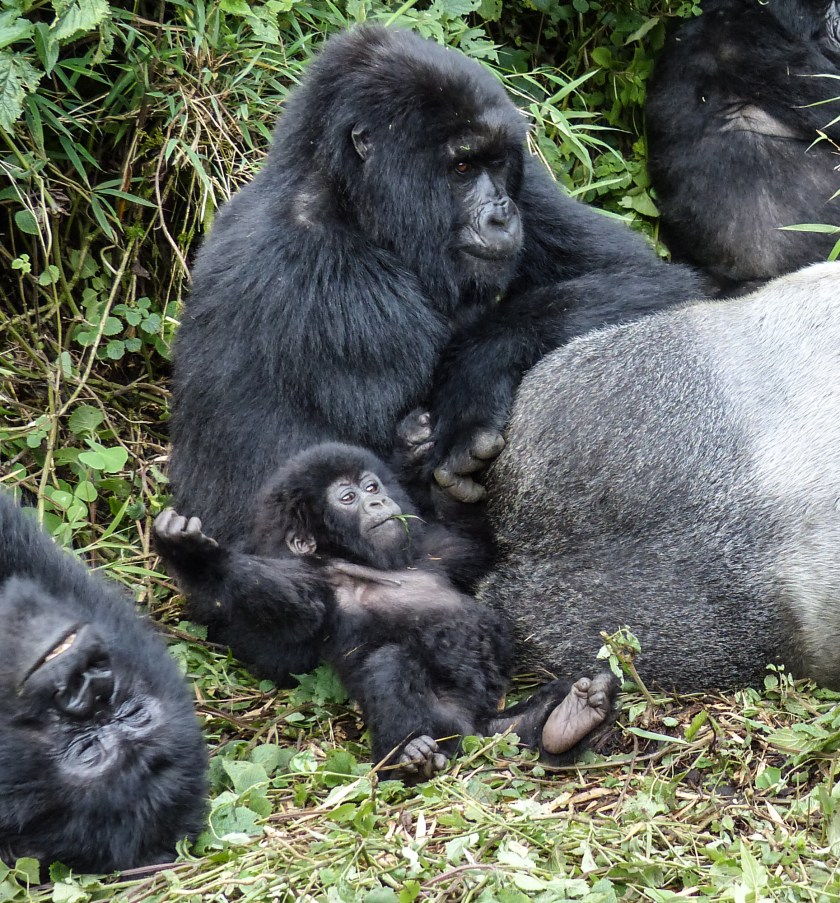
Mountain gorillas, not surprisingly, have the the same number of fingers and toes as us:
P1090707P1090638P1090428

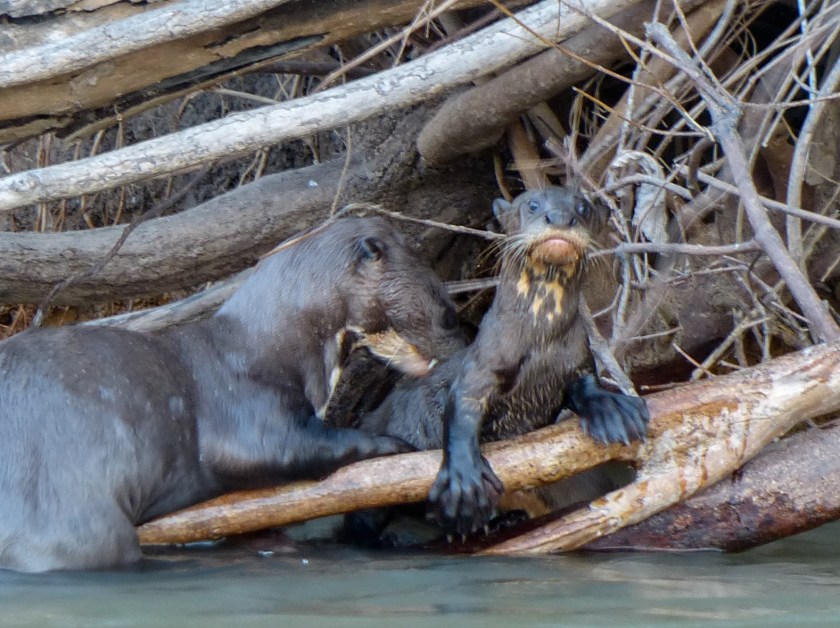
Giant otters also have five toes on each foot, but they are webbed:
Evening grooming sessions, in next few shots and videos

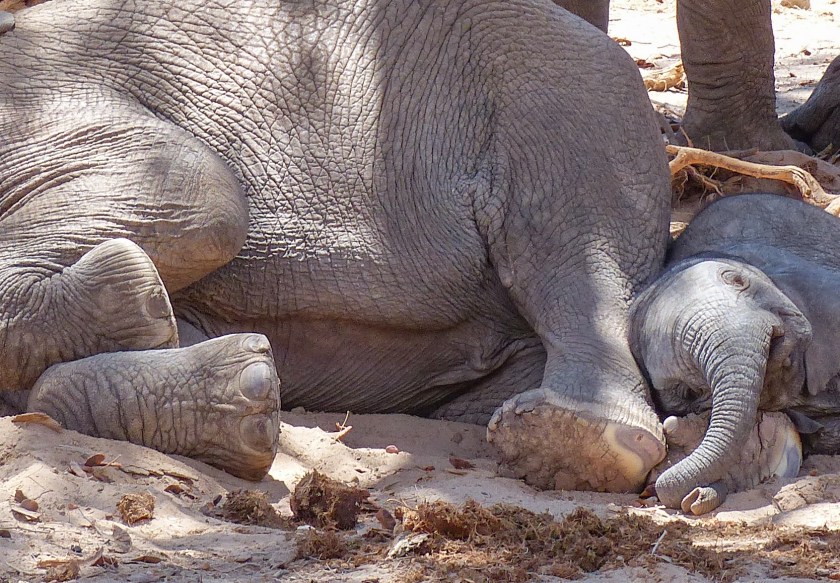
Elephants have five toes, but they walk on tiptoe, so the toe nails are the only way to count.  Like pandas, they have a sixth “toe”. It is inside their foot, and it may help distribute their weight better.
Elephant naptime

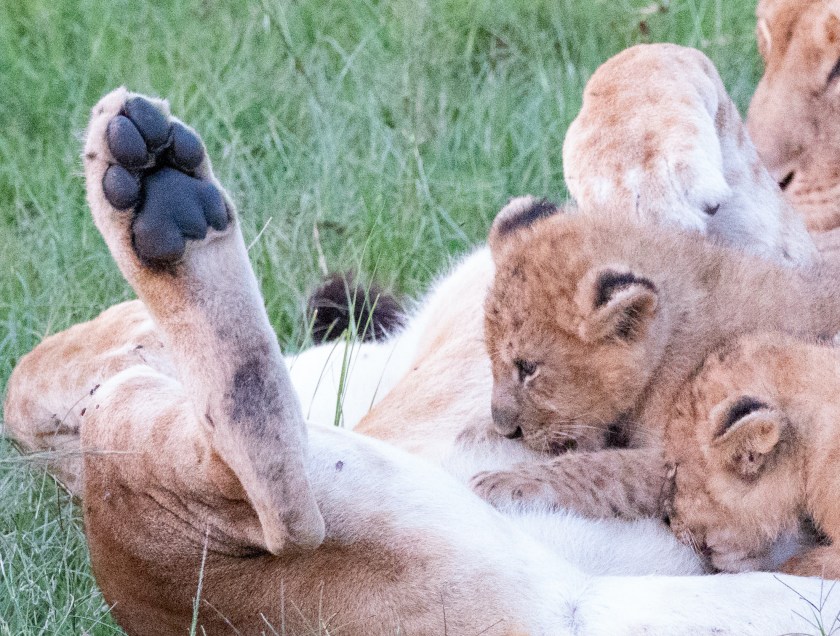
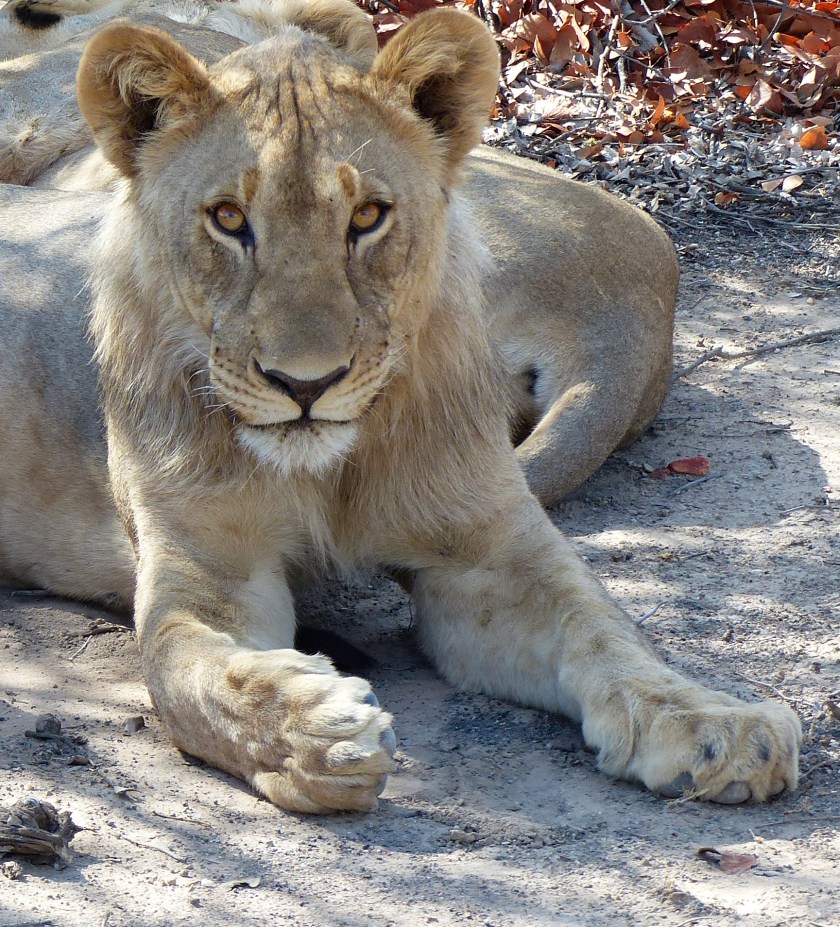
Lions, and other cats, have five front toes and four back ones. Here are the five:
P1120243

and here are the four:

DSC07500

Hippos have four webbed toes on each foot, supporting their enormous weight (you can’t see the fourth toe in the photo):

Hippos

Warthogs, like all pigs, have four toes on each foot but they walk only on the middle two, holding the others clear of the ground, for all the world like a ballerina en pointe. (At speed, these smaller claws may touch the ground. ) So really they have two proper toes.

Common warthogs,mother and baby, with Red-billed Oxpecker

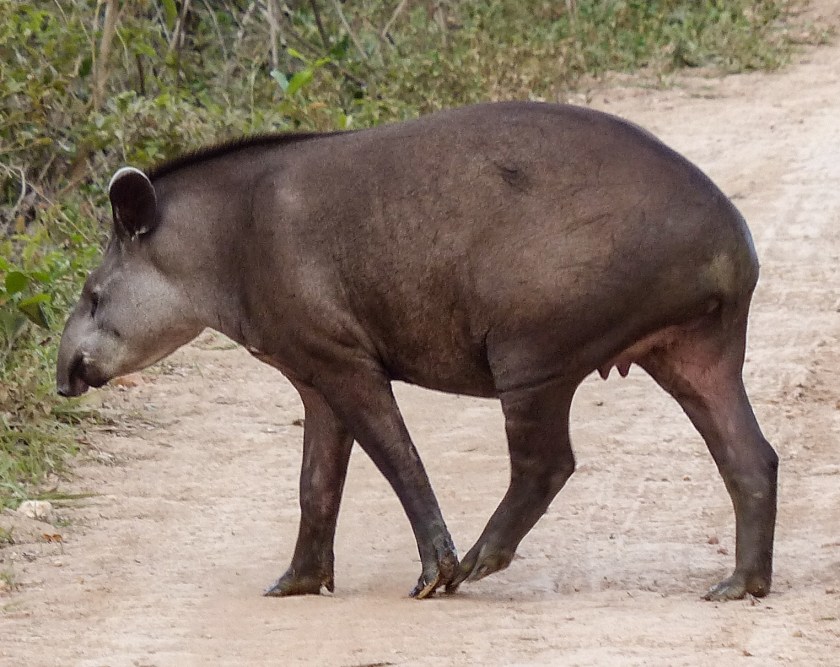
All tapirs, including this South American one in the Pantanal, have four front toes and three back ones. They are the only hoofed animal like this.
P1070904

Rhinoceri have three toes on each foot:

Indian one-horned rhino

Giraffe (and cattle and deer) have two toes, and the dew claws are insignificant:

Giraffe

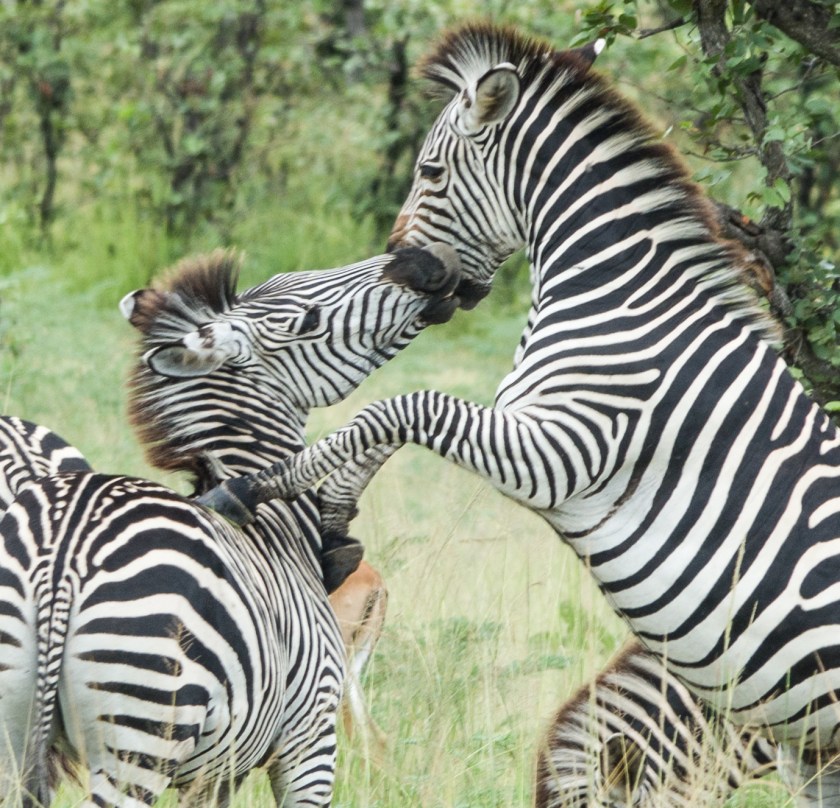
Zebras, and all equines, have all five digits merged into one toe (aka hoof) per foot:
Young male zebra playing

It’s also worth remembering that our bodies are left-right symmetrical, so our big toes are on the inside of each foot. Our development thus has not just to get the count right, but arrange each foot appropriately for which side of the body it emerges from. How clever is that?

Next time, we’ll look at birds.

‘The Pobble Who Has No Toes’

The Pobble who has no toes
Had once as many as we;
When they said "Some day you may lose them all;"
He replied "Fish, fiddle-de-dee!"
And his Aunt Jobiska made him drink
Lavender water tinged with pink,
For she said "The World in general knows
There's nothing so good for a Pobble's toes!"

The Pobble who has no toes
Swam across the Bristol Channel;
But before he set out he wrapped his nose
In a piece of scarlet flannel.
For his Aunt Jobiska said "No harm
Can come to his toes if his nose is warm;
And it's perfectly known that a Pobble's toes
Are safe, -- provided he minds his nose!"

The Pobble swam fast and well,
And when boats or ships came near him,
He tinkledy-blinkledy-winkled a bell,
So that all the world could hear him.
And all the Sailors and Admirals cried,
When they saw him nearing the further side -
"He has gone to fish for his Aunt Jobiska's
Runcible Cat with crimson whiskers!"

But before he touched the shore,
The shore of the Bristol Channel,
A sea-green porpoise carried away
His wrapper of scarlet flannel.
And when he came to observe his feet,
Formerly garnished with toes so neat,
His face at once became forlorn,
On perceiving that all his toes were gone!

And nobody ever knew,
From that dark day to the present,
Whoso had taken the Pobble's toes,
In a manner so far from pleasant.
Whether the shrimps, or crawfish grey,
Or crafty Mermaids stole them away -
Nobody knew: and nobody knows
How the Pobble was robbed of his twice five toes!

The Pobble who has no toes
Was placed in a friendly Bark,
And they rowed him back, and carried him up
To his Aunt Jobiska's Park.
And she made him a feast at his earnest wish
Of eggs and buttercups fried with fish, -
And she said "It's a fact the whole world knows,
That Pobbles are happier without their toes!"

Edward Lear


*Here is a short summary of Martin Cohn’s findings:

https://www.nature.com/articles/d41586-019-01829-9?utm_source=Nature+Briefing&utm_campaign=2f9e8c8999-briefing-dy-20190621&utm_medium=email&utm_term=0_c9dfd39373-2f9e8c8999-44042041



Nature’s bride-tossed bouquet*

On the marshes in Aldeburgh in Suffolk there was a solitary tree-sized elder, full of small birds. A single twig reached leftwards against the sky, and provided a convenient perch for a just-fledged bluetit chick:

Juvenile blue tits

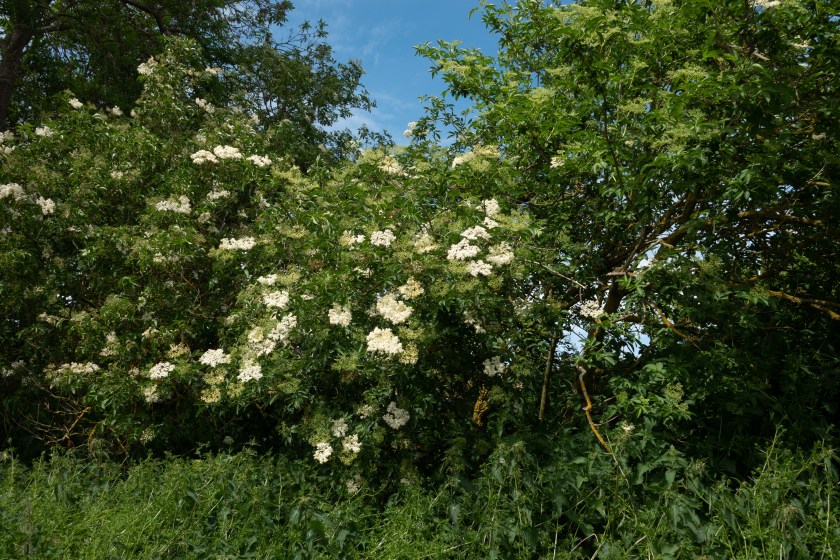
Last weekend the elderflowers (Sambucus nigra) were still in full bloom in the hedgerows:

elderflower

Close up, the flowerheads are exquisite:

DSC00238

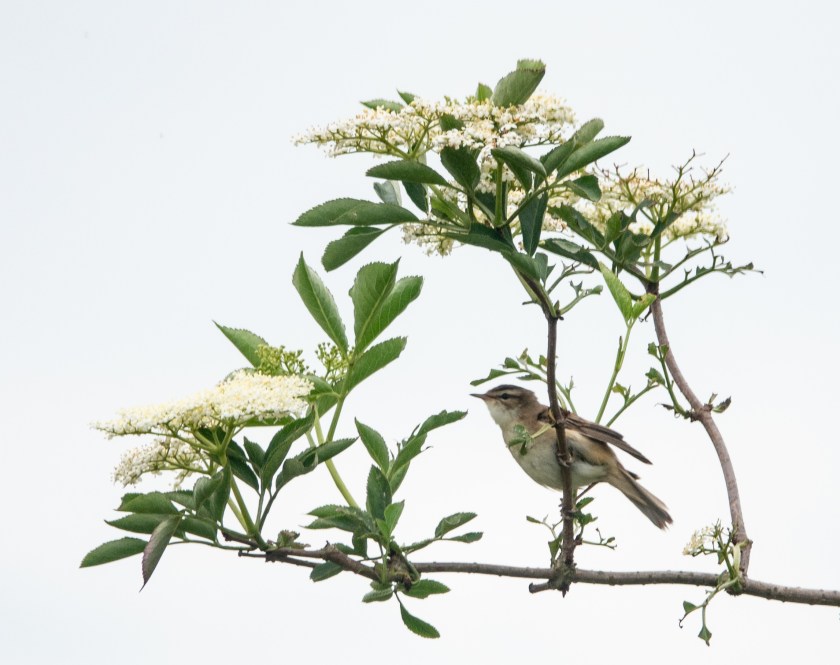
A sedge warbler posed on the same elder-twig:

DSC00962

In Sussex, in the elder-bordered fields, I found these exquisite flowers. I doubt if many of you can guess what they are?

Dock flowers

They are the flowers of dock plants, Rumex obtusifolius. They are no-one’s favorite: scruffy, hard to eradicate weeds, with tall skinny greenish-brownish flowerheads covered in minute unimpressive flowers that we rarely stop to admire. The flowers redden as they mature into these miniature bells. No-one writes poems about dock flowers, but next time, look closely.

In England of course, we pick the elderflowers for elderflower cordial, delicious drunk on its own or with champagne. Here is Jamie Oliver’s recipe:

https://www.jamieoliver.com/features/how-to-make-elderflower-cordial/

* My title comes from the first verse of a poem by Malachy Reynolds,  The Elderflower’s Lament. 

I am the elderflower
Wedded to the hedgerows
Nature’s bride-tossed bouquet.
Not gaudy like the rose….

Follow him on Twitter here: https://twitter.com/MalachyReynolds


The dandelion deserves its close-up too

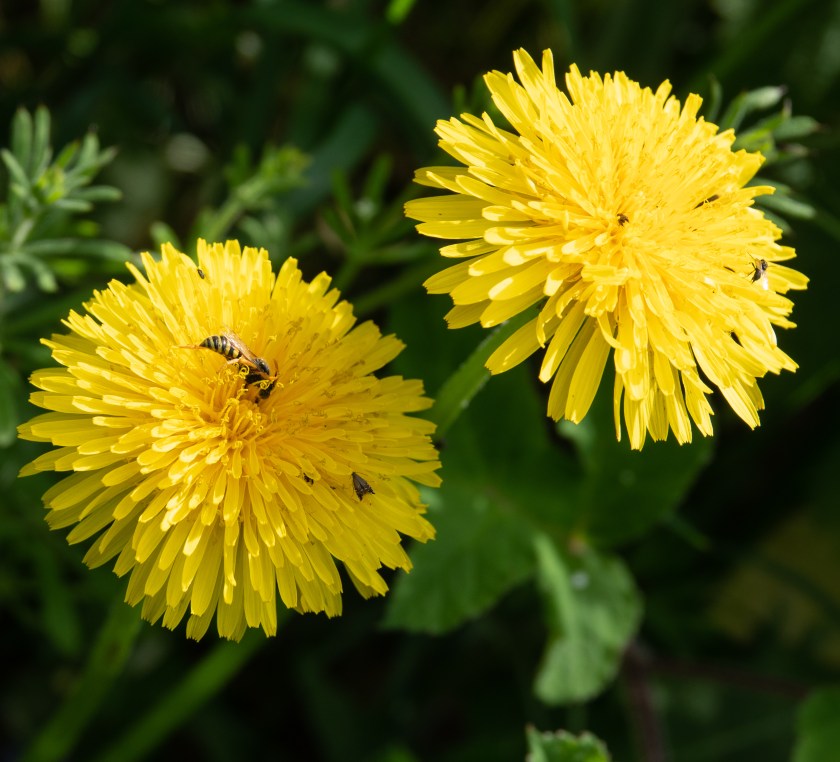
Here is a common dandelion, Taraxacum officinale. Boring!

DSC09930

But the wasp does not agree. She is busily foraging for nectar, deep inside the 200-odd tiny florets that compose the flower-head.

DSC09919

The tall curly things are the stigmas, covered in pollen:DSC09930-2

and the pollen collects on the body of the wasp, who then unwittingly transfers it to the next flower that she visits:

DSC09941
Successful pollination means the dandelion can produce its plumed seeds, each called a pappus, to create that ethereal thing, the dandelion clock:

DSC09897

A single pappus can be seen top left, detaching itself from the seedhead. The word ‘pappus’ is from the Greek for grandfather, whose white beard the dandelion clock resembles. A pappus can fly for a kilometre, and scientists have worked out how they do it:

https://www.insidescience.org/news/how-dandelion-seeds-stay-afloat-so-long

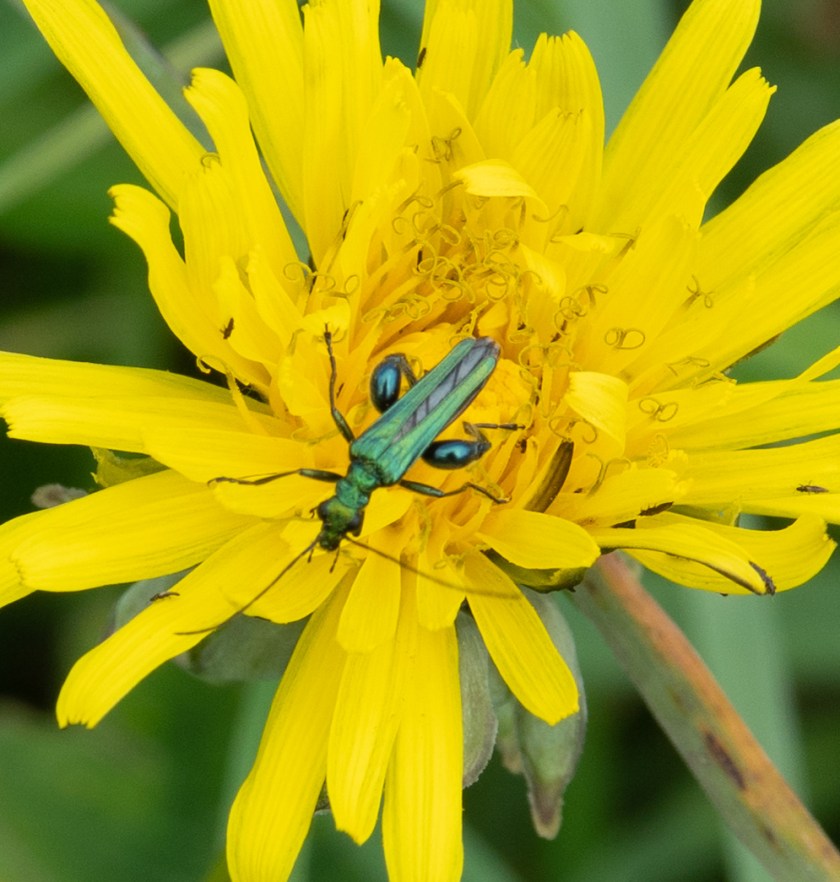
The much smaller coltsfoot is being visited here by a flower beetle. Just like the dandelion, the coltsfoot’s curly stigmas will deposit their pollen on the insect, though I must admit his shiny wing cases don’t seem likely to provide a very good attachment site:

coltsfoot? flower beetle?

Below is a link to a really wonderful piece by Brian Johnston with microscopic photos of the dandelion, showing far more than I can manage with my camera.

http://www.microscopy-uk.org.uk/mag/indexmag.html?http://www.microscopy-uk.org.uk/mag/artjun10/bj-dandelion.html

And I had completely forgotten that my friend Leigh Hayes did a terrific post on dandelions two years ago. Here it is: https://wondermyway.com/2015/05/17/never-call-it-just-a-dandelion/

And do consider following her blog too.

“Sumer is icumen in”*

Since 1970, English farmland birds have declined by 54%. Since 1976, butterflies have declined by 41%. Overall, 12% of farmland species are at risk of extinction. We need to value and fight for what remains. Look carefully, and you will be rewarded still.

When the hares were being elusive, I dawdled, and enjoyed anything that came my way. Most local farmers set aside strips of uncultivated ground alongside their crops, and together with traditional copses these at least provide small havens for small wondiers.

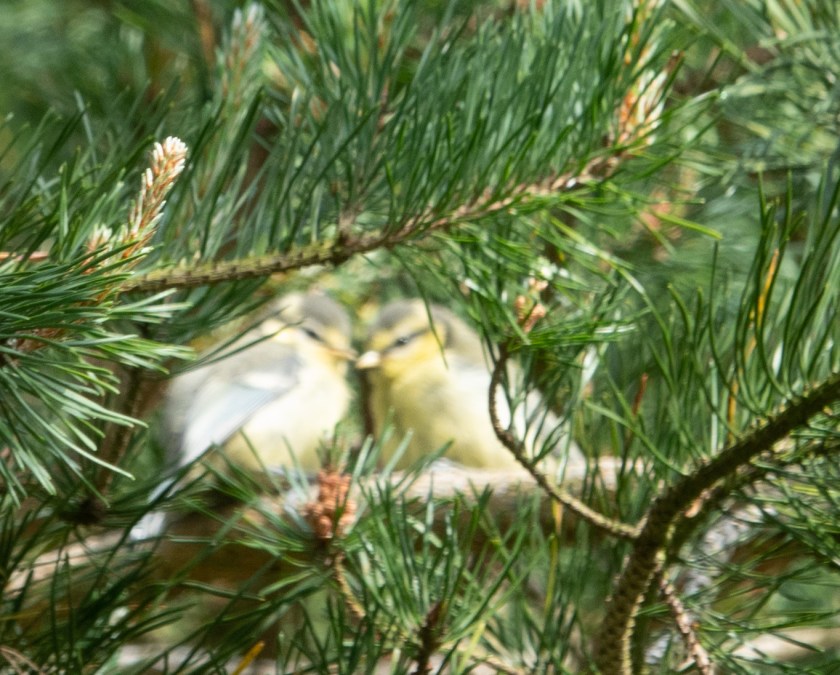
Two baby Blue Tits (sorry about the focus):

Juvenile blue tits

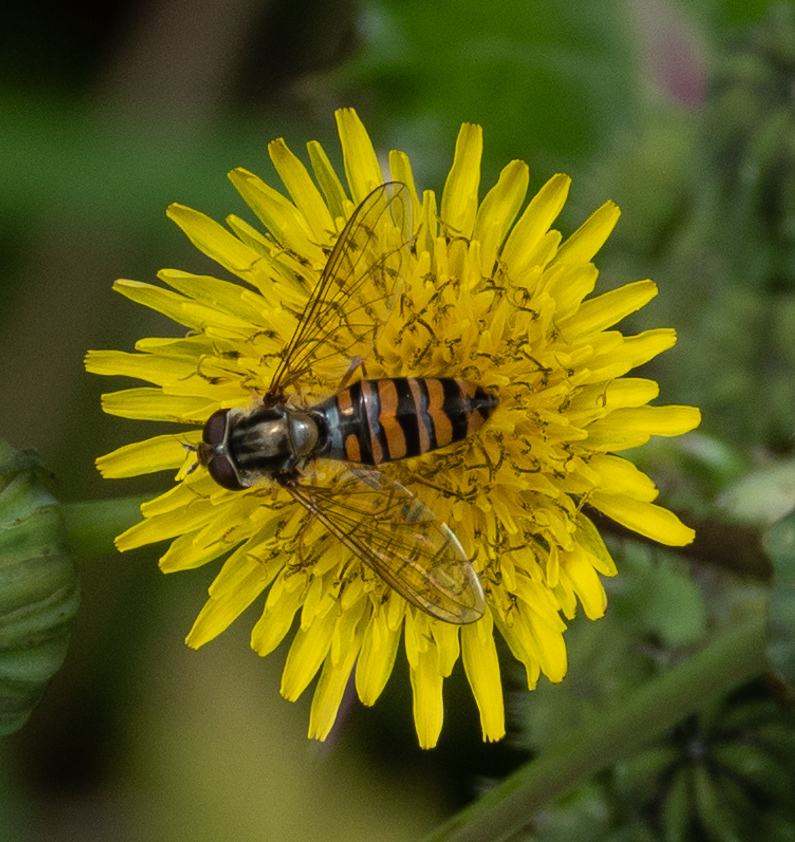
Wildflowers and their attendant pollinators:

DSC00226DSC00410

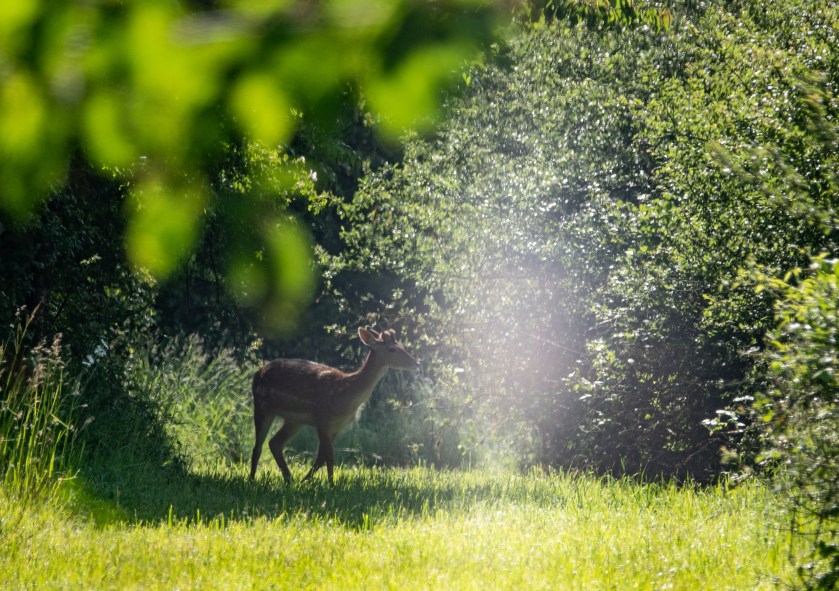
A browsing deer:

DSC00606

An insect licking moisture from a leaf:

DSC00015

A Spotted Orchid:

DSC00421
A Long-tailed Tit:

Long-tailed tit

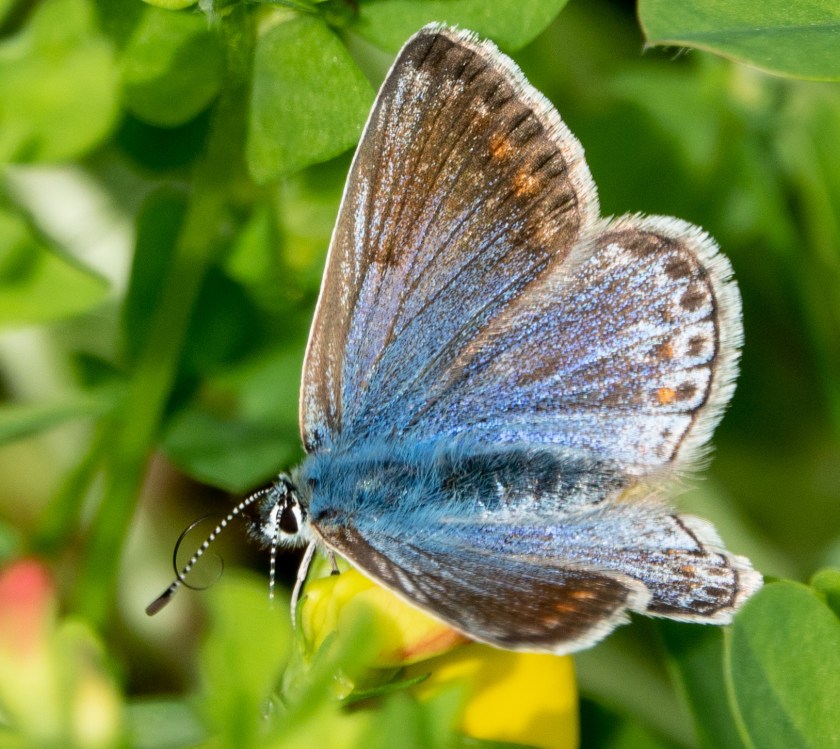
A Common Blue butterfly with its slender coiled black tongue just visible:

Female Common Blue

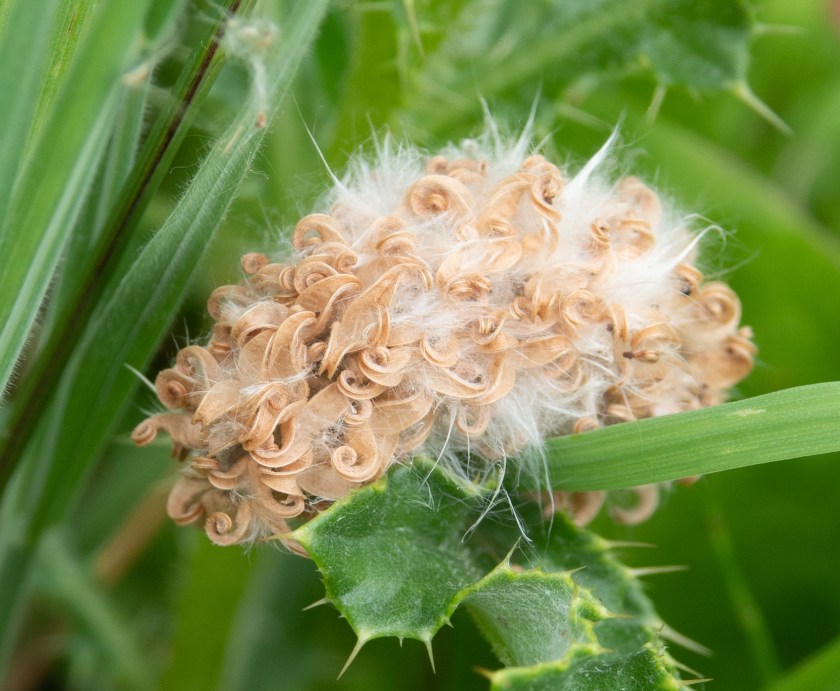
And a mystery seedpod, near the stream, fallen from somewhere: does anyone know what it is?

?plantain seeds??

There is still much left to marvel at even in heavily farmed agricultural land in the 21st century, though this 2016 report makes for depressing reading:

Click to access State%20of%20Nature%20UK%20report_%2020%20Sept_tcm9-424984.pdf

*But beauty remains. Eight hundred years ago, an anonymous poet said it all (modern version below!):

Sumer is icumen in,
Lhude sing cuccu!
Groweþ sed and bloweþ med
And springþ þe wde nu,
Sing cuccu!

Awe bleteþ after lomb,
Lhouþ after calue cu.
Bulluc sterteþ, bucke uerteþ,
Murie sing cuccu!
Cuccu, cuccu, wel singes þu cuccu;
Ne swik þu nauer nu.

Sing cuccu nu. Sing cuccu.
Sing cuccu. Sing cuccu nu!

And in modern English:

Summer has come in,
Loudly sing, Cuckoo!
The seed grows and the meadow blooms
And the wood springs anew,
Sing, Cuckoo!

The ewe bleats after the lamb
The cow lows after the calf.
The bullock stirs, the stag farts,
Merrily sing, Cuckoo!
Cuckoo, cuckoo, well you sing, cuckoo;
Don’t ever you stop now,

Sing cuckoo now. Sing, Cuckoo.
Sing Cuckoo. Sing cuckoo now!

Apparently ‘uerteþ’ (or ‘verteth’) can mean either ‘cavort’ or ‘fart’!

“The man who tells you he has thought of everything has forgotten the hare.”*

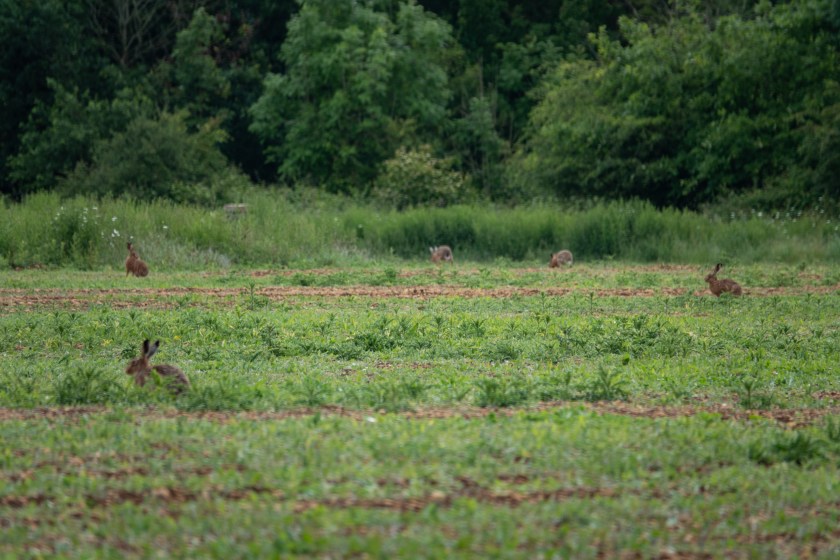
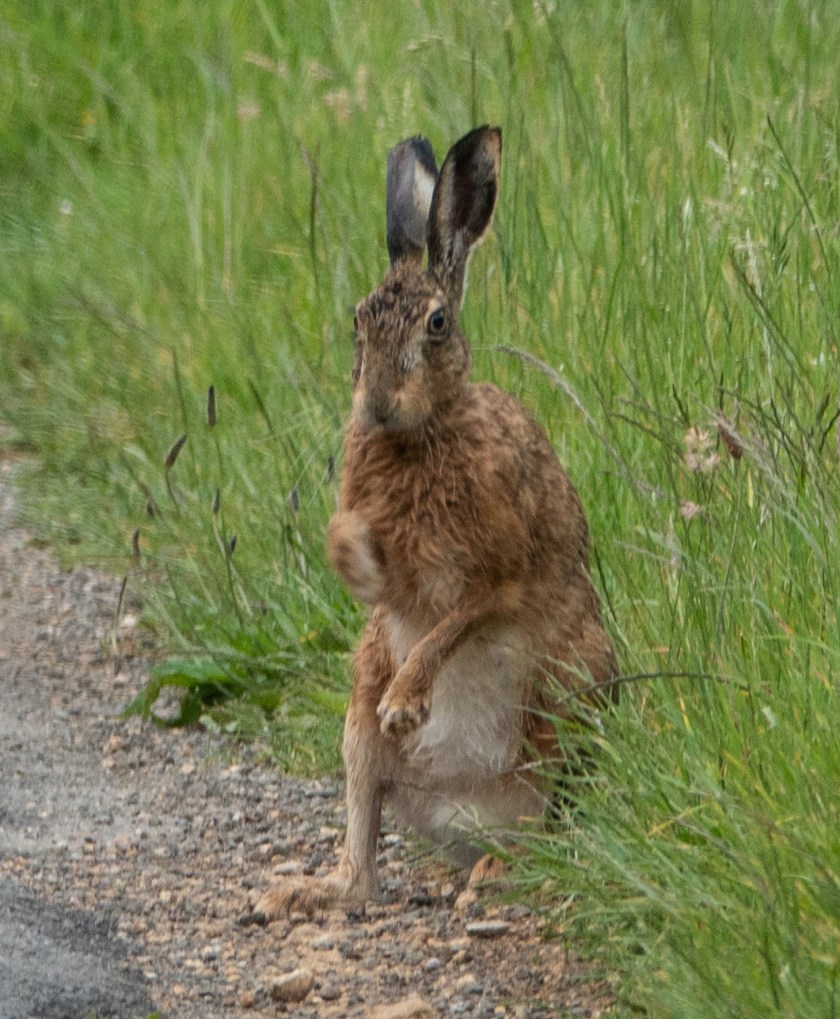
In my Cotswold village there is a surfeit of hares right now.  After years of seeing few and photographing none, this weekend they were everywhere. There are five European Brown Hares, Lepus europaeus, in this photo, out of a total of eight that I saw today:

DSC00769

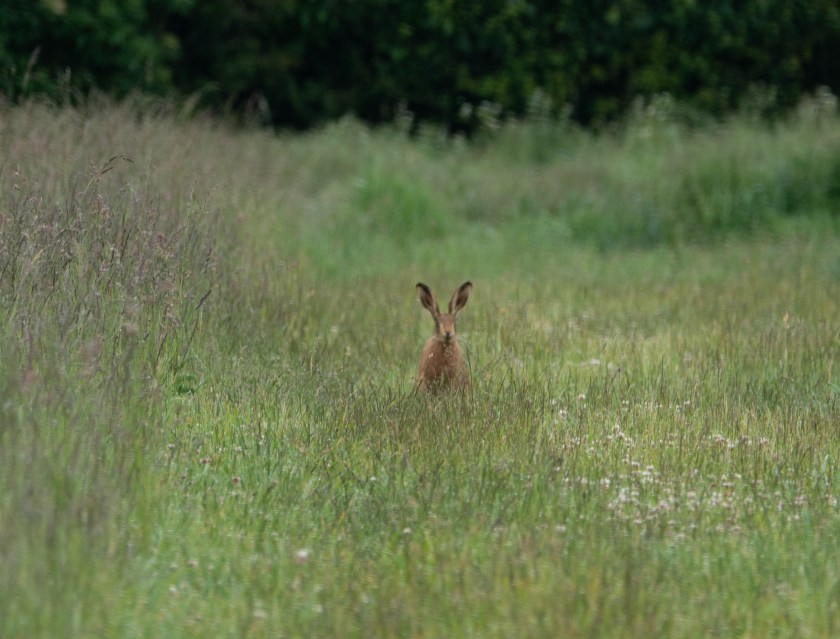
If I wasn’t too close, they watched me warily:

DSC00821

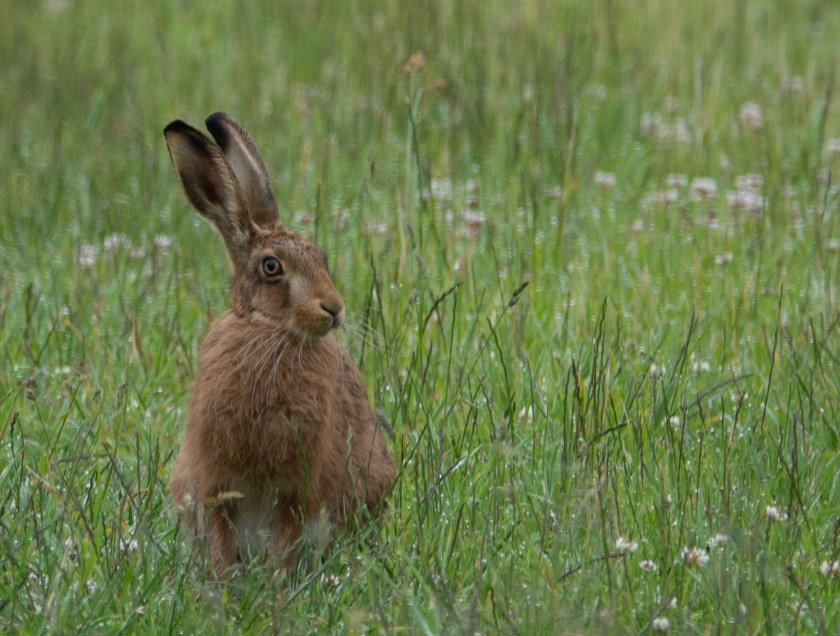
If I played Grandmother’s Footsteps, moving slowly and smoothly when they put their heads down to graze, and freezing when they looked up, I could get close enough to photograph them.

DSC00849

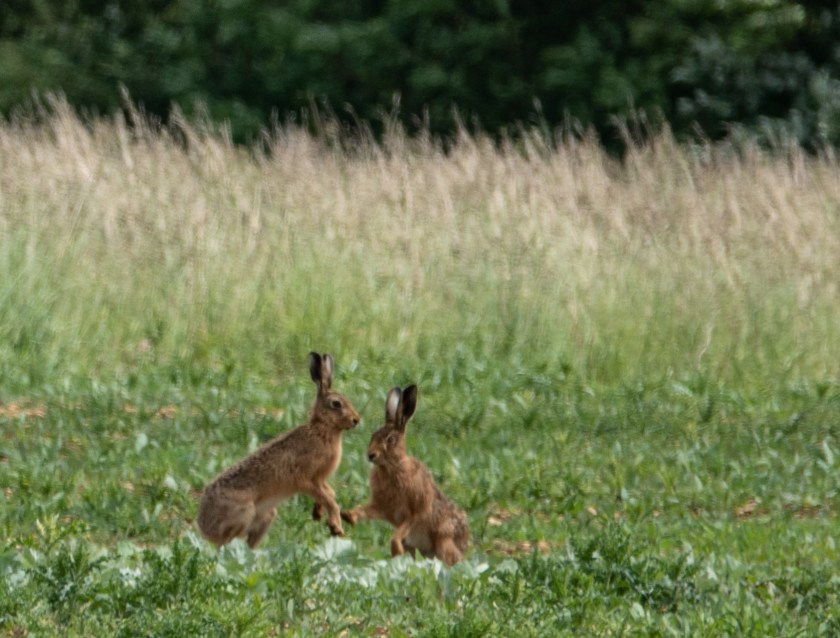
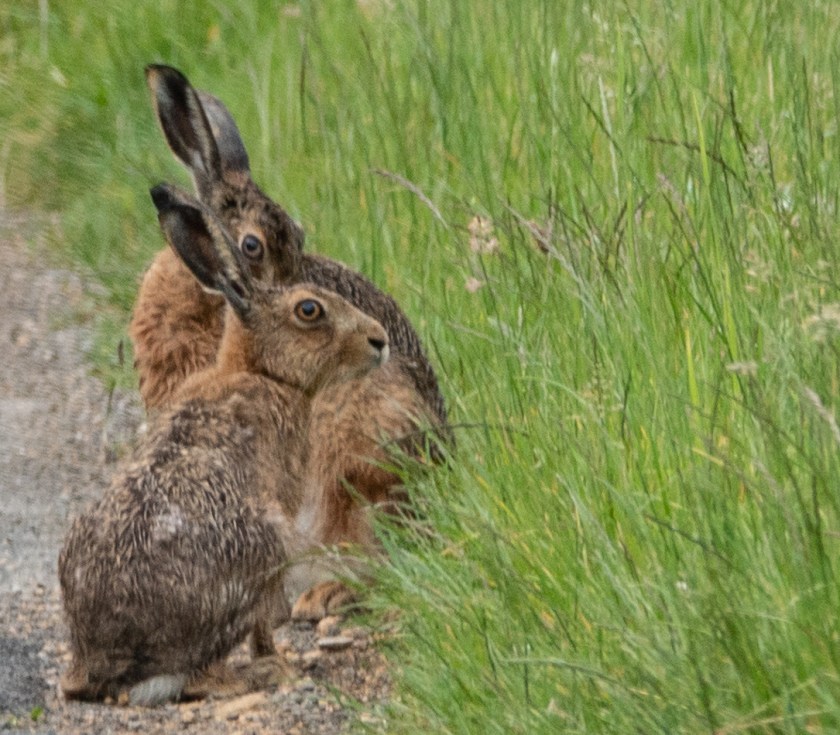
These two did a few seconds of the boxing for which they are famous:

DSC00177

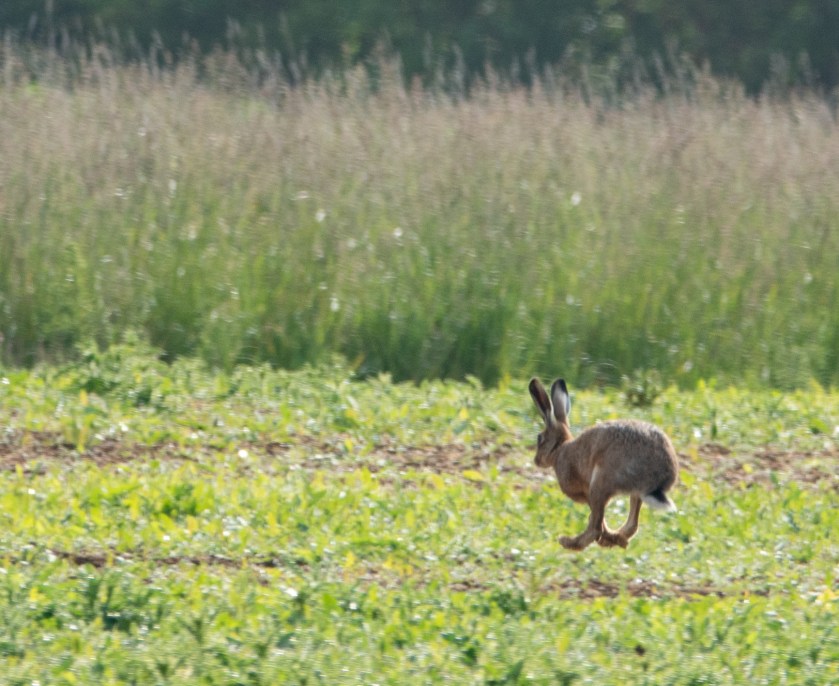
When they run, they cross a large field at up to 70 Kmph, those huge haunches delivering the power of a kangaroo, and the back feet overtaking the front ones:

DSC00484

It may not be obvious, but this one is running fast, straight towards me!

DSC00874

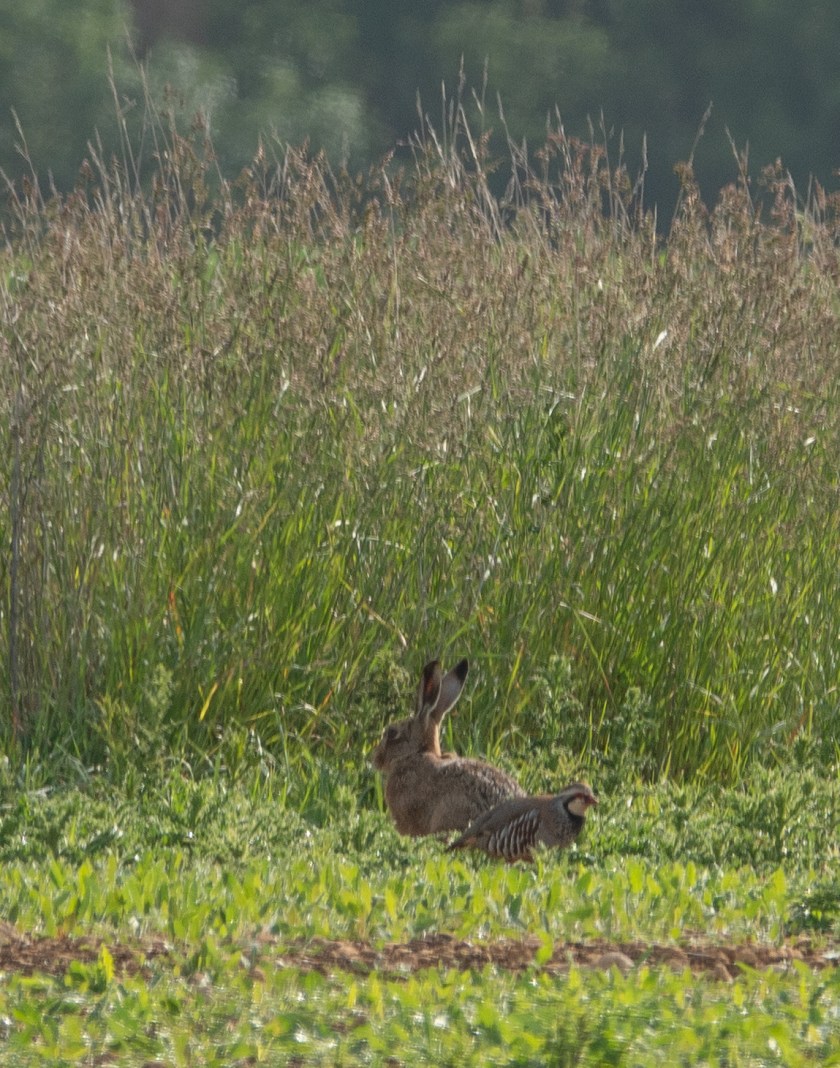
They share the field with variety of birds. This is a Red-legged Partridge, introduced from France for culinary reasons, and now common.

Hare with Red-legged Partridge

After five or six hours of silently stalking them, I came back for one last session, pulled my car over, got out and loudly slammed the door. When I turned round there were two hares by the road maybe 50 yards away, not overly perturbed.

DSC00714

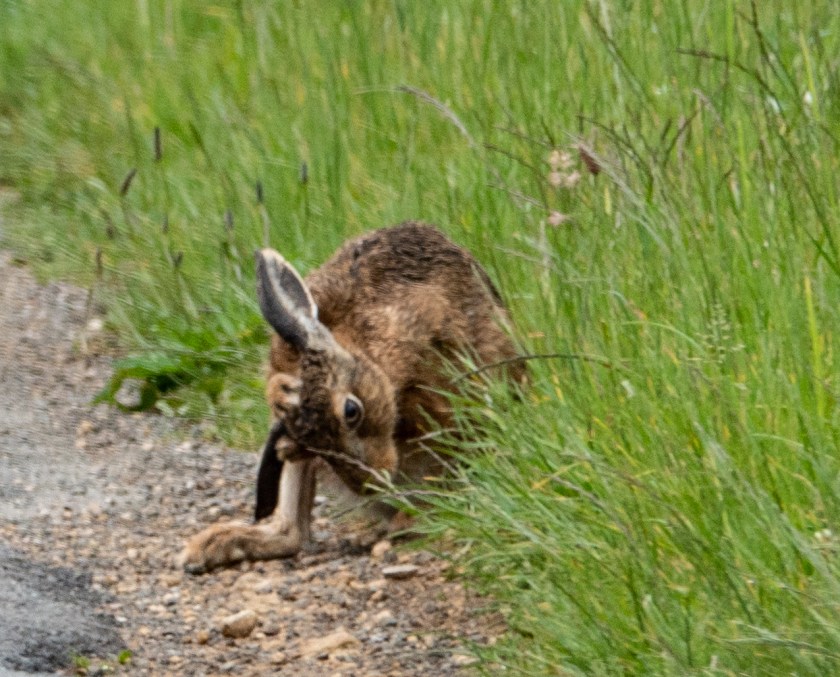
One settled down for a good grooming after the previous night’s rain:

DSC00726

And then a bit of sparring practice:

DSC00737

They were not only eating the wild grasses, but also nibbling the edges of the wheat fields, which the farmers must find infuriating, but they did not seem to go into the centre of the wheat. Apparently they can become a pest, and it is legal to shoot them in certain circumstances, but not in the breeding season. In online farming forums, I found as many messages of appreciation for their beauty as I did complaints about crop damage.

*My title is verse 6 (June) from Anna Crowe’s poem A Calendar of Hares. The full text is here:

A Calendar of Hares


Forbidden fruit*

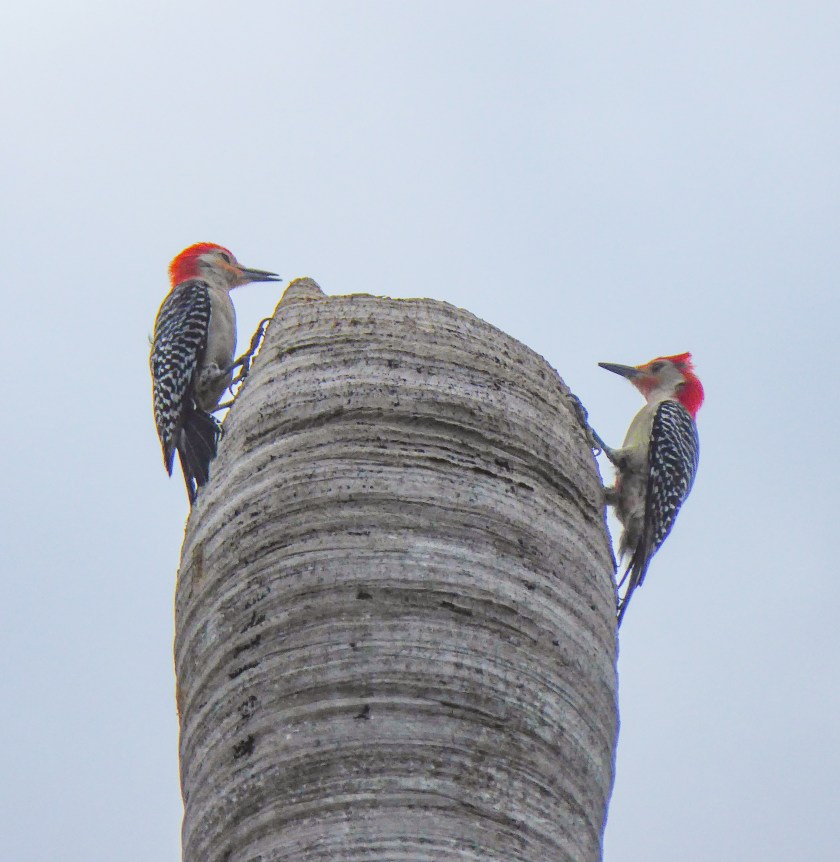
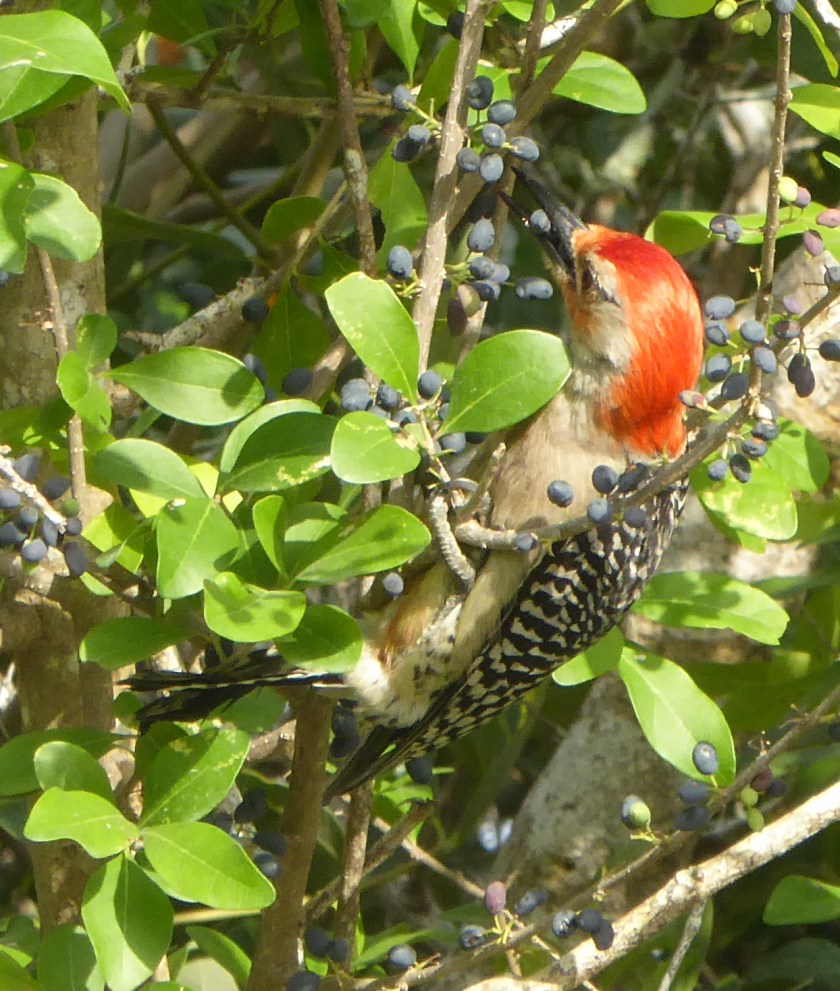
In Florida I saw this pair of Red-bellied Woodpeckers (Melanerpes carolinus) on the top of a dead palm tree.

The Red-bellied Woodpecker (Melanerpes carolinus

We all know that woodpeckers probe rotting wood to retrieve insects, ants, and juicy larvae, so dead and dying trees are where you expect to see them.

But this one had other ideas:

P1040705

As you can see, they are in fact quite catholic in their tastes, and often eat seeds and fruits, not just when kindly supplied for them by human bird-feeders.  This one is a male, because the red covers his whole head; females have red napes only. And you can just glimpse the red on his belly that gets him his name.

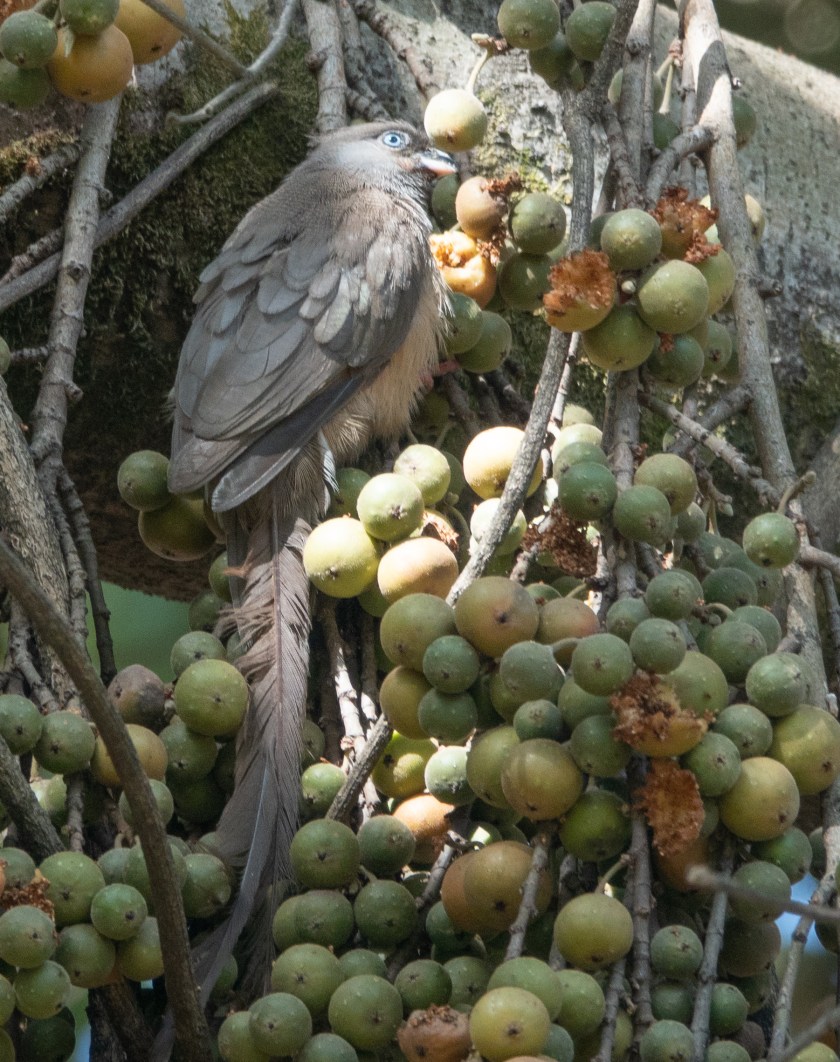
All over the world, fruiting trees are irresistible to wildlife. This mousebird in Ethiopia is gorging on figs:

Speckled Mousebird

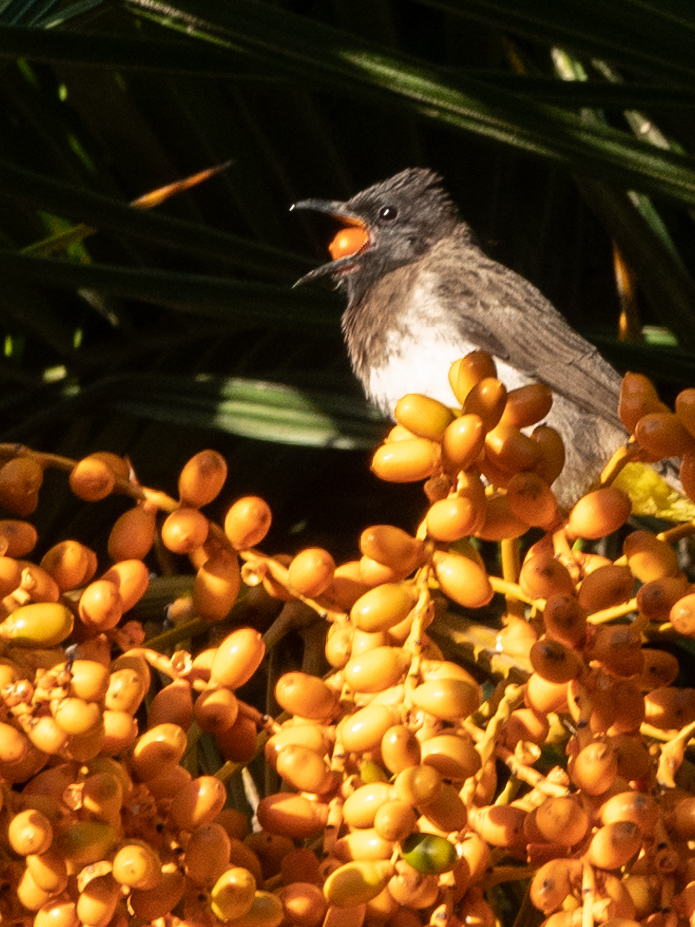
And this bulbul can barely swallow the large yellow berries he has found:

Common Bulbul?

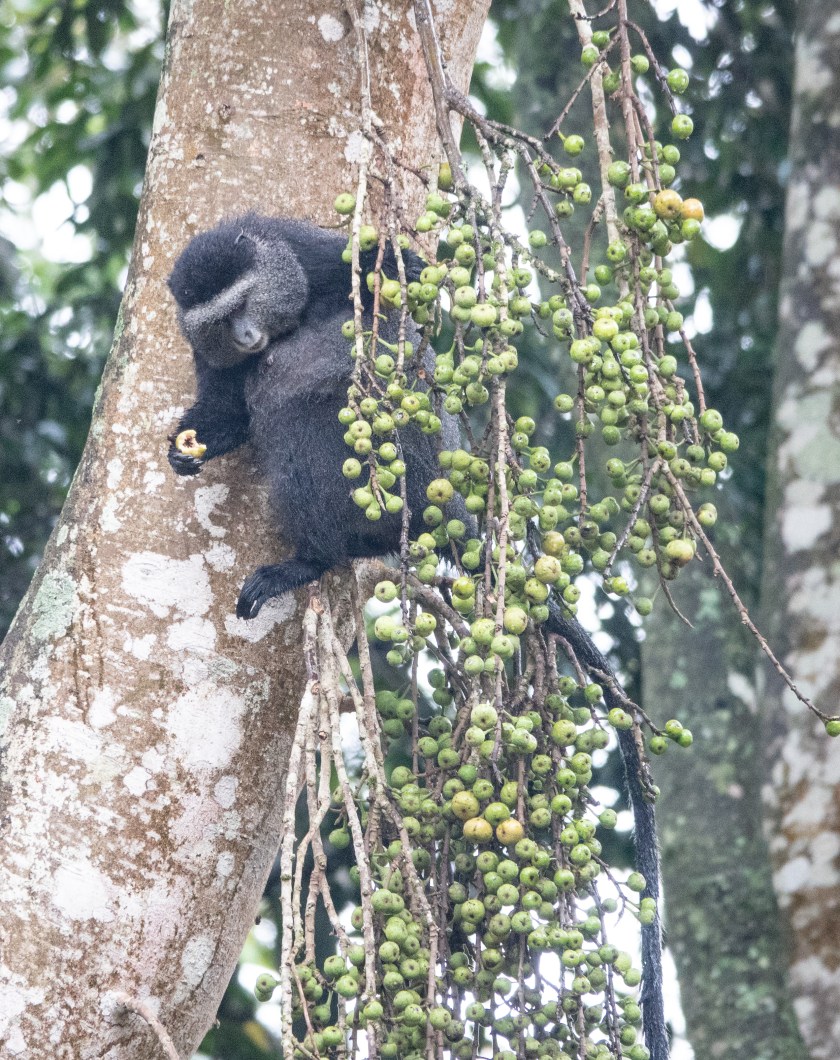
The size of his belly suggests that this Kenyan Blue Monkey has already had more than enough:

Blue monkey, Cercopithecus mitis

* These greedy, wary, faintly illicit feastings reminded me of Emily Dickinson’s poem:

Forbidden fruit a flavor has

That lawful orchards mocks;

How luscious lies the pea within

The pod that Duty locks!


May I introduce the propagule?

In April I was in Vero Beach, Florida for a bewitching week with friends. It is a barrier island, and the inland waterway is bordered by red mangroves Rhizophora mangle.

P1040475

Their name comes from their reddish stilt roots; the above-water sections help them breathe.

P1040397

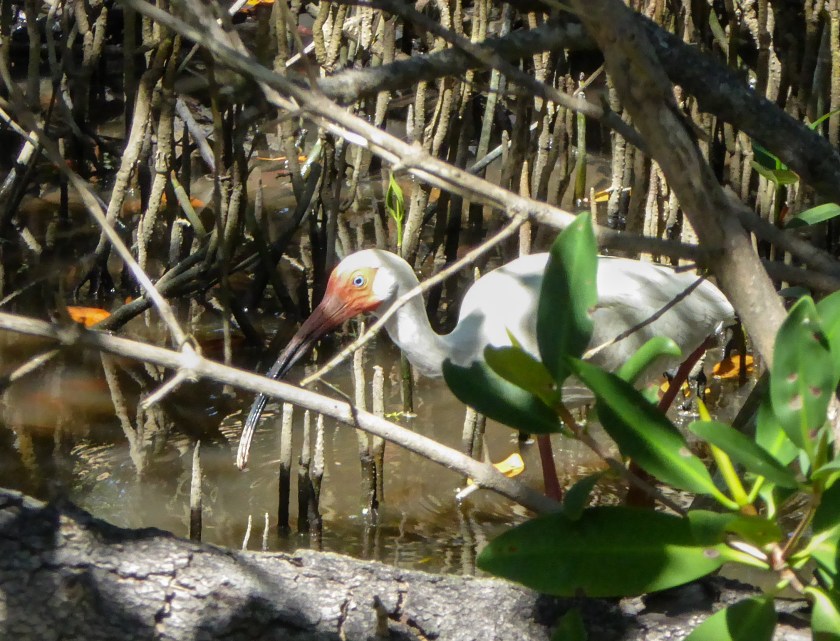
These extraordinary trees and their roots provide important habitat for all sorts of fish, crustaceans and birds, including this American White Ibis,  Eudocimus albus, who is looking for crabs:

P1040339

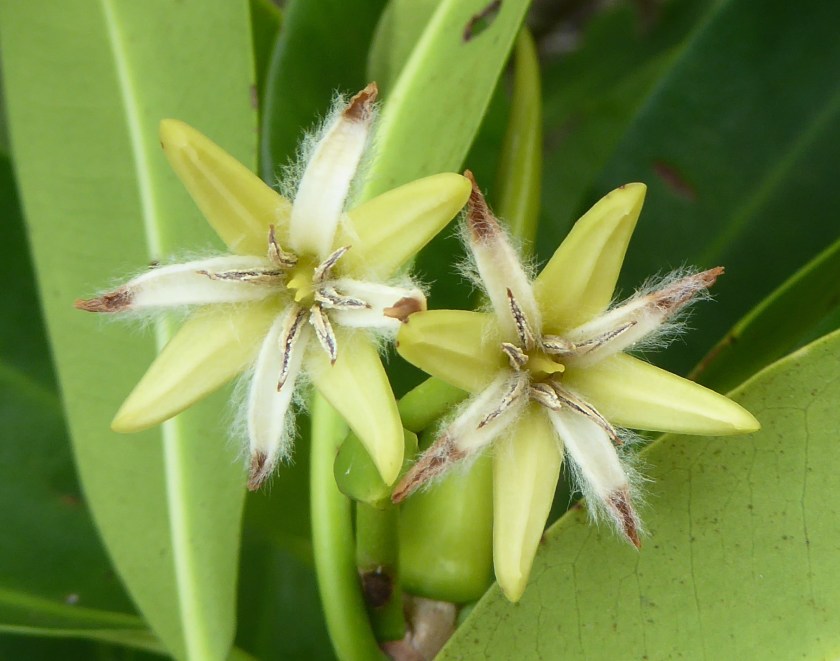
Mangroves live in brackish water, and they have the most unusual reproductive system. They flower, like most plants, producing tiny inconspicuous downward-facing flowers:

P1040767

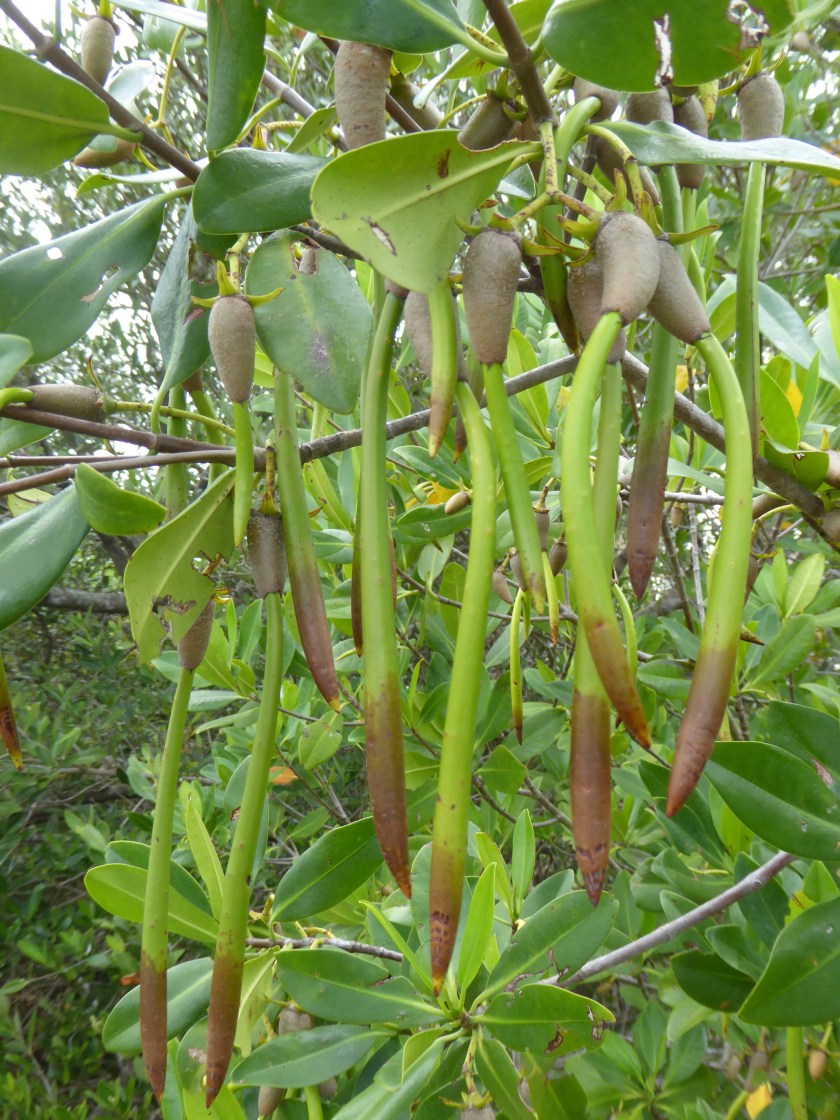
But instead of then producing seeds, they produce propagules, (a brand new word for me, sadly with too many letters to be very useful in Scrabble).

P1040769

These miniature plants stay attached to their mother plant while they grow a longer and thinner root:

P1040761

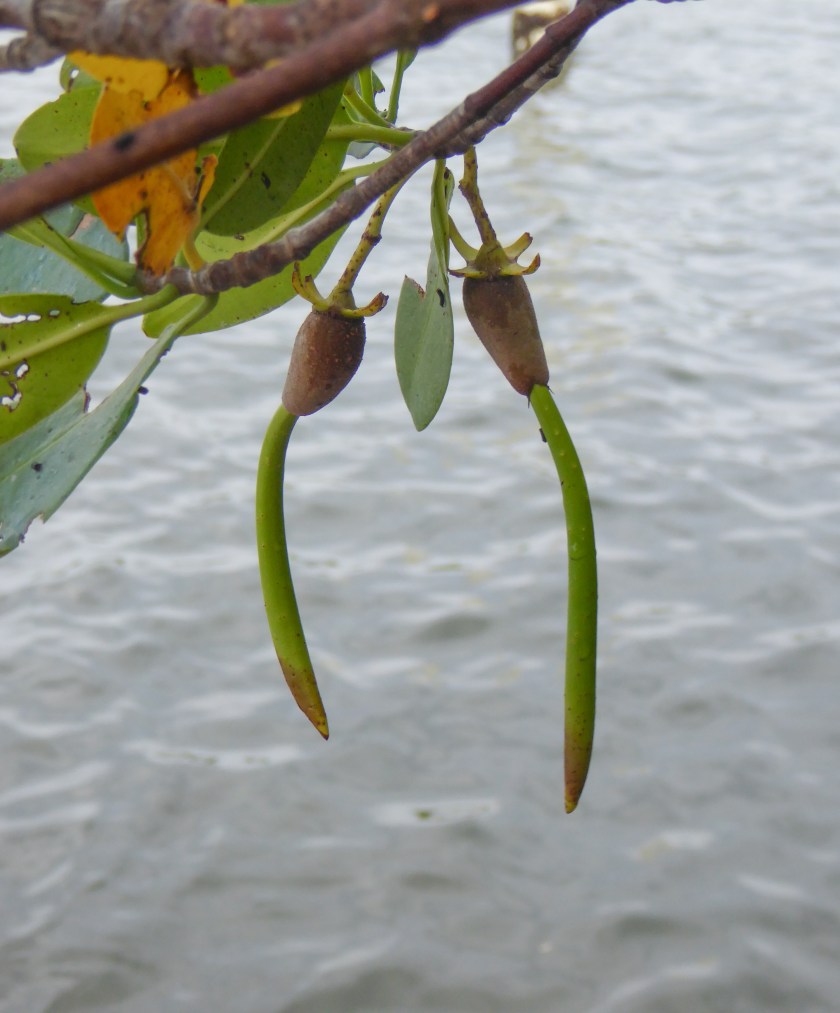
Eventually, they drop off into the water below:

P1040770

Once launched, they bob around vertically and drift with the tides and currents until they stick tip-down in the mud, and become a new tree.

The mangrove edges provide rich pickings for this Little Blue Heron, Egretta caerulea, foraging at low tide:

P1040603

Alone among herons, the pure white immature is entirely differently colored from this adult.

And in these lagoons there be manatees, which the early mariners thought were mermaids. To my delight we saw them, but not clearly enough to photograph, so this will have to do:


P1040754

Florida may conjure up images of Disneyworld, but it still has many wild and beautiful places.  More next time.

“A great eagle with great wings”*

Compared to the Broad-winged Hawk of Maine, the Tawny Eagle of Ethiopia, Aquila rapax,  is of an altogether fiercer order, as his name suggests. His wingspan, at 190cm, is almost twice that of the broadwing, and at up to 3Kg he weighs about six times as much. I rather like his warm feathered breeches.

Tawny Eagle

He feeds on rabbits and other small mammals, lizards and insects, which he catches with his rapacious talons (visible above if you look carefully). He is also an opportunist, not above feasting on the carcase of a dead goat, and in fact carrion is a large part of his diet:

Tawny Eagle, on goat carcase

The Black-chested Snake Eagle, Circaetus pectoralis,  is a tad smaller, and highly specialized:

Black-chested Snake Eagle


Snakes are his preferred food, and he hovers before diving onto his prey (he is claimed to be the only eagle that hovers). During courtship, a pair will feed each other snakes in mid-air, something I would dearly love to see.

My last photo is aa juvenile African Fish Eagle (thanks to Ian for the ID), but even as a teenager it shows the power of those wings that inspired the poets: *A great eagle with great wings, longwinged, full of feathers, which had divers colours, came unto Lebanon, and took the highest branch of the cedar:” Ezekiel 17:3

DSC09324

I’ve just realized I have referred to all my eagles by means of male pronouns: unconscious bias pops up in the oddest places. To keep things real, I have not corrected my prose, but I am clearly not woke yet.

Broad of wing

Before I left Maine,  just down the road from the beaver pond, I saw this Broad-winged Hawk, Buteo platypterus, all fluffed up drying itself after a downpour:

Broad-winged Hawk

When it deemed its feathers dry enough, off it flew:

Broad-winged Hawk

Platypterus means broad-winged, and the aptness of the name is clear from the photo above. This part of the hawk’s name is shared with the sailfish, Istiophorus platypterus, and two flies,  Sciapus platypterus  and Diogmites platypterus . If it reminds you of the word platypus, that is because platypus means ‘broad-footed’.

These small crow-sized hawks hunt by sitting on low branches, watching for prey on the ground. They in turn are preyed on by larger hawks, like the Red-tailed Hawk.

Here is what they sound like: