Do Painted Turtles have teeth?

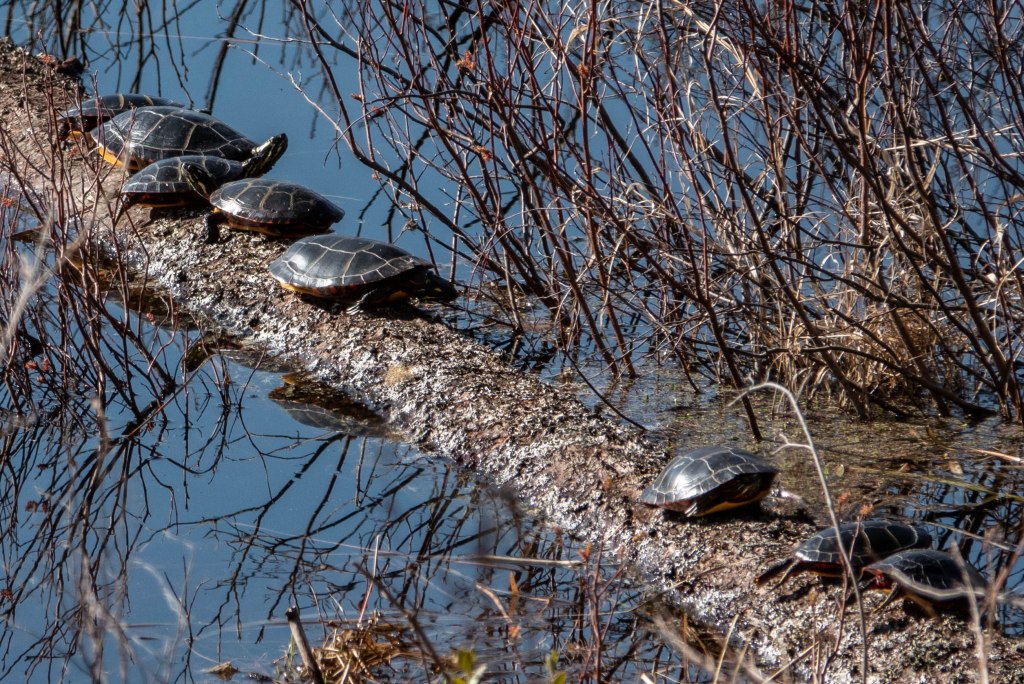
Painted turtles, Chrysemys picta, are perhaps the most-eye-catching creatures on my pond. They’re not rare: this spring there were eight on a log, basking:
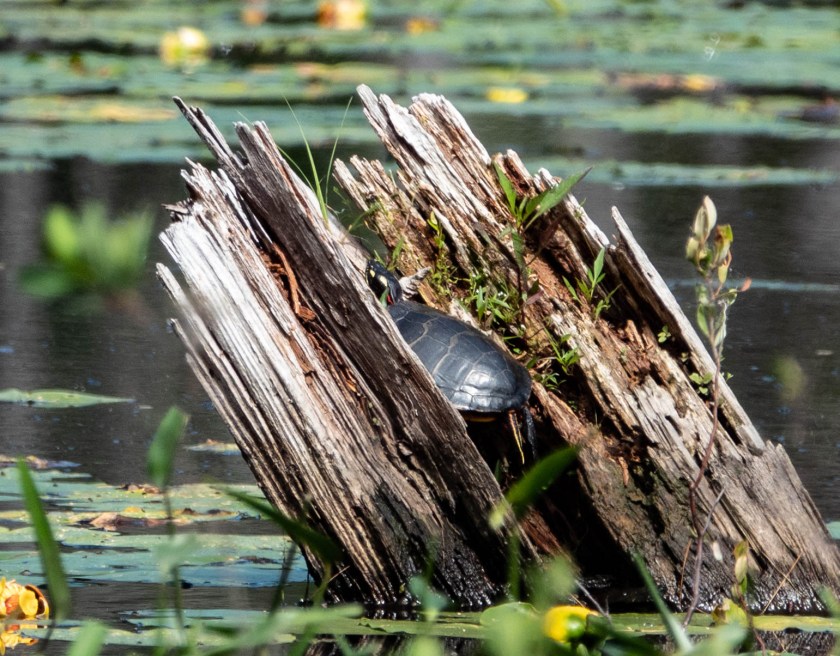
One got wedged in a rotted tree stump. I was all ready to rescue it next day, but it managed to extricate itself.
There were three on a fallen tree some weeks later.
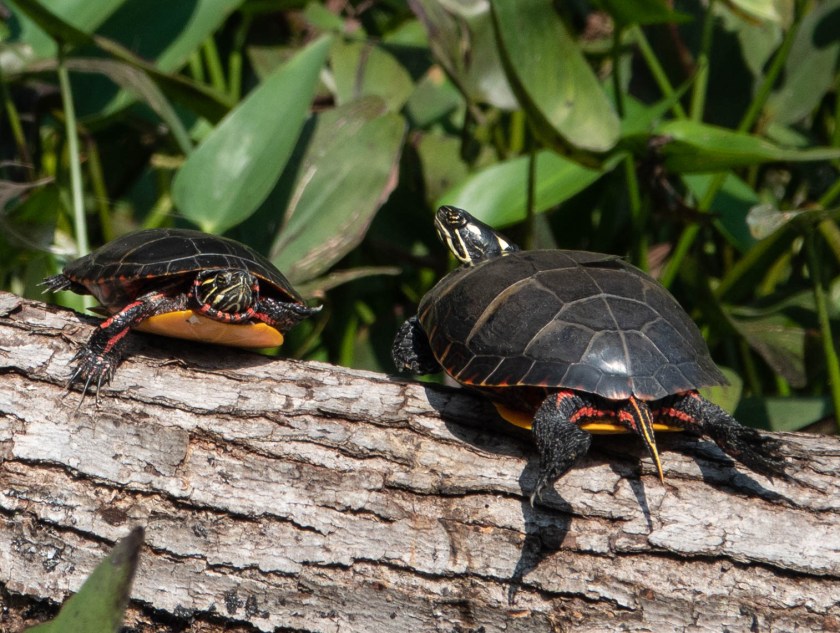
Two dived off when they saw my kayak but the smallest and youngest (and thus the most rash and least intimidated) let me get very close, so I can show you some details.

They have beautiful eyes,
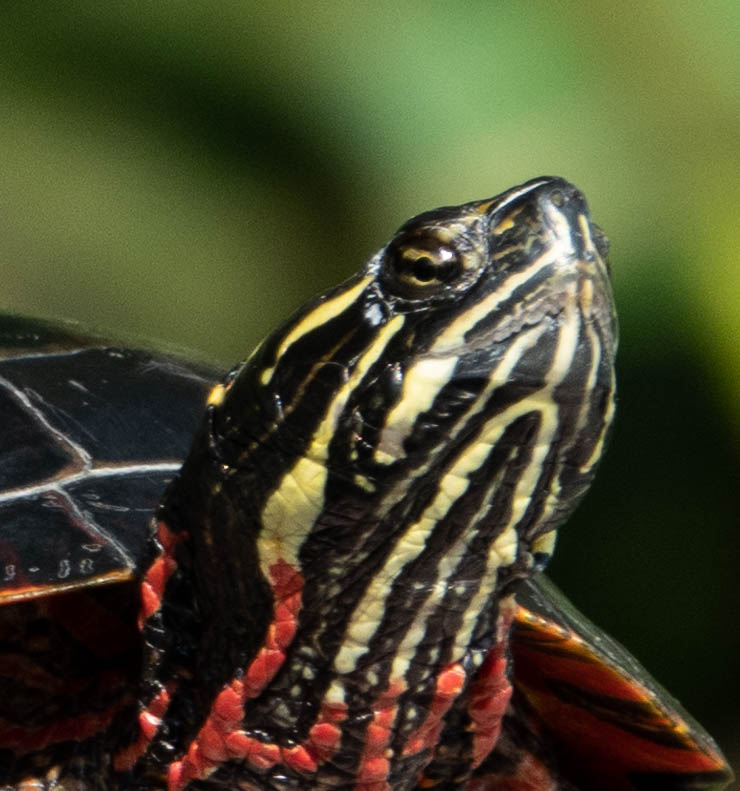
with top and bottom eyelids, both closed in the next photo:
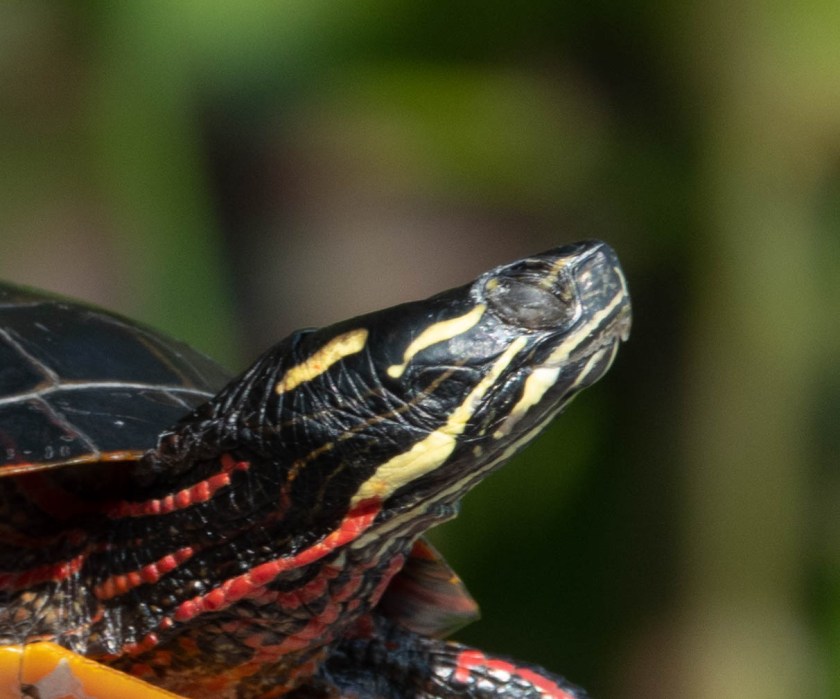
They don’t have teeth, but they do have ‘tomiodonts’ (my word of the week). Look at the center of the upper lip in the next two photos:
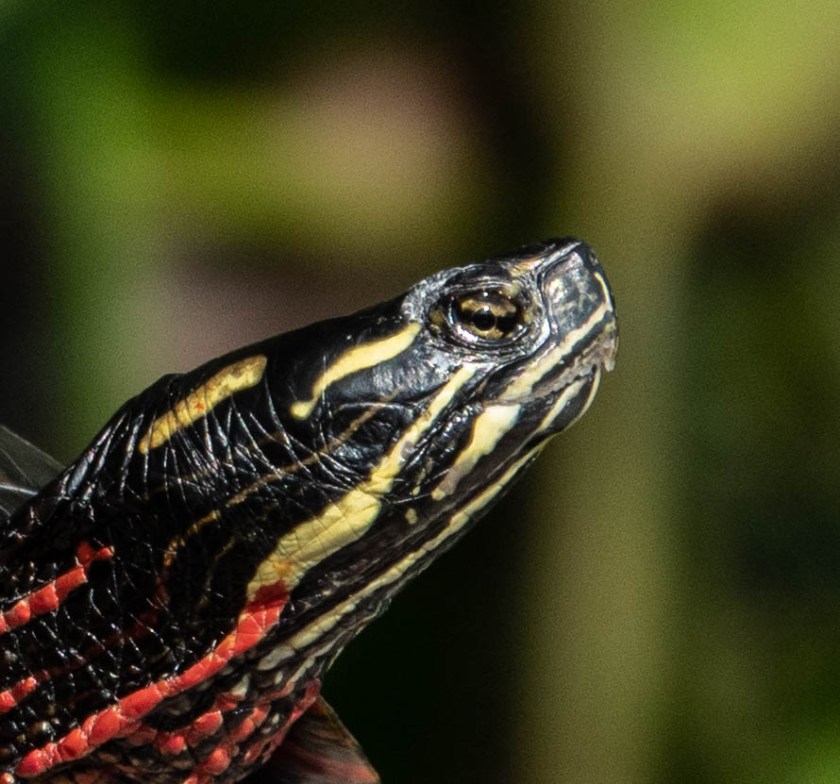
There are two bicuspid tooth-like things, with a notch in between.
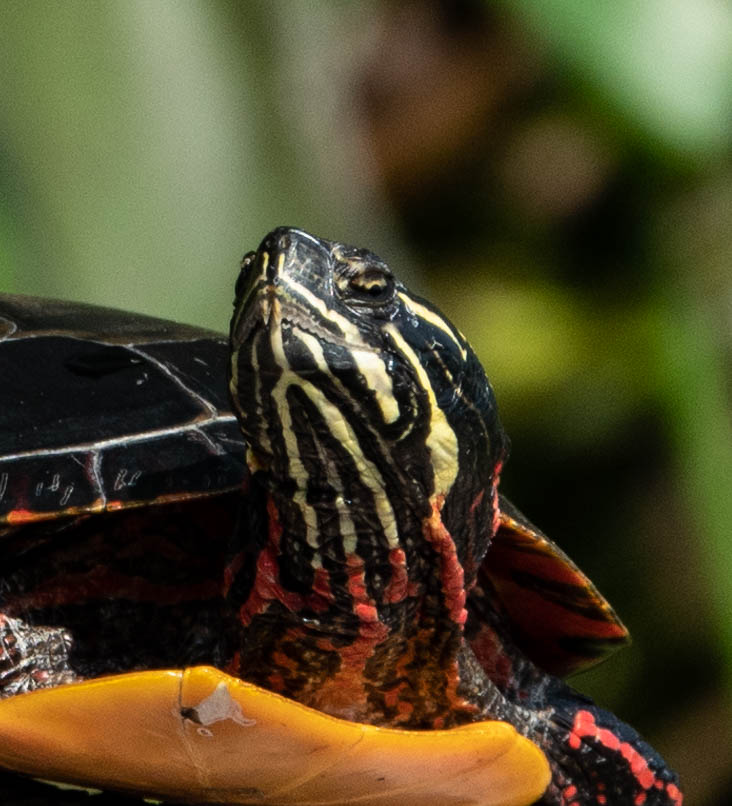
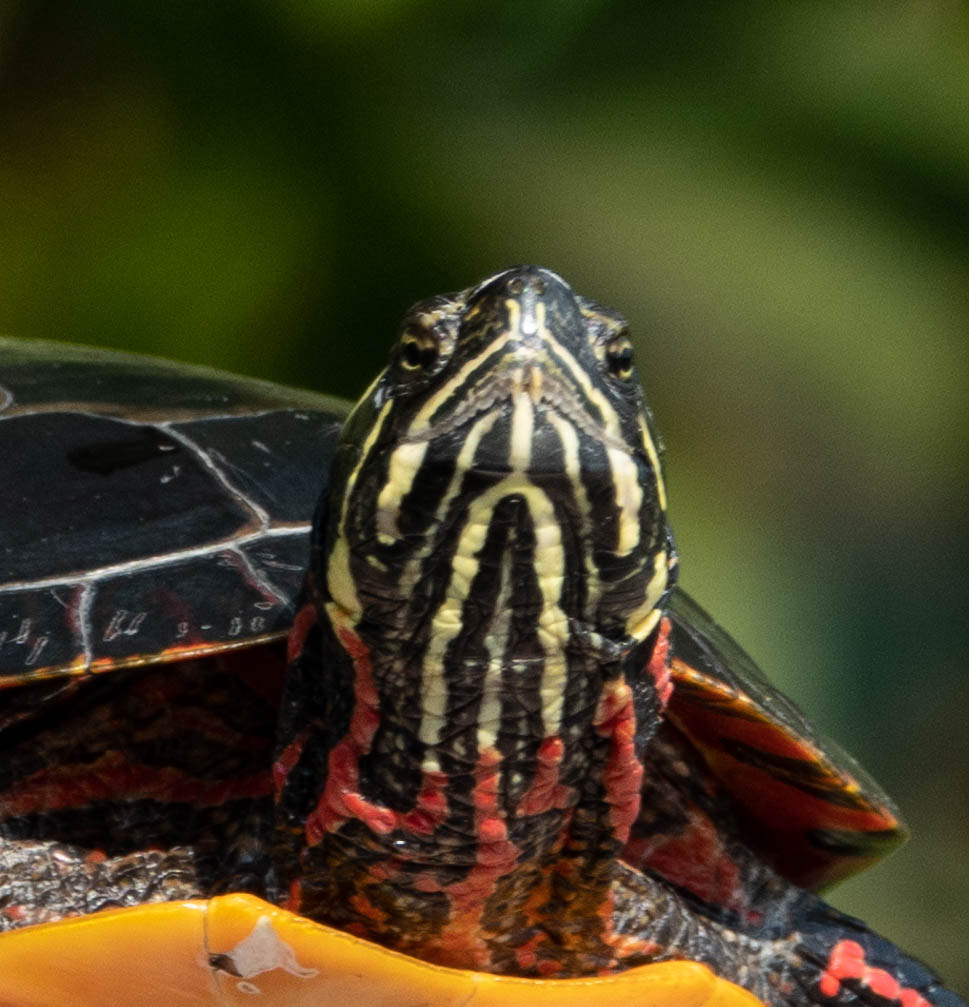
Despite appearances, these are not teeth. Turtles have horny beaks made of keratin (think fingernails) that they use to grasp and crush food, and many species have a notch in the upper beak, flanked by two or even three tooth like tomiodonts. Their function is rather mysterious. Three explanations have been advanced. First, and most obviously, they may be useful in feeding, especially in immobilizing prey. Second, the fact that they are typically somewhat larger in males supports the idea that they may be used to immobilize the hapless females during mating. And third, they may be hangovers from some much much earlier ancestral species, and were perhaps just “spandrels”, in the sense of Stephen Jay Gould, by-products of some other evolutionarily-favored development.

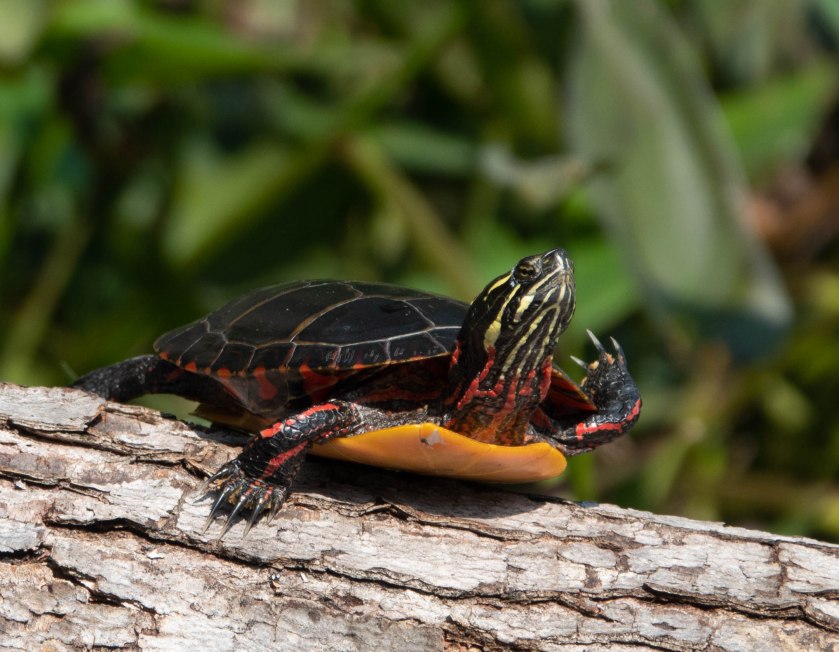
And a parting wave goodbye!
PS If you’d like to know more, read Moldowan et al 2015. He was bitten by one, and it drew blood, so they are effective tools/weapons.
Which way is down??

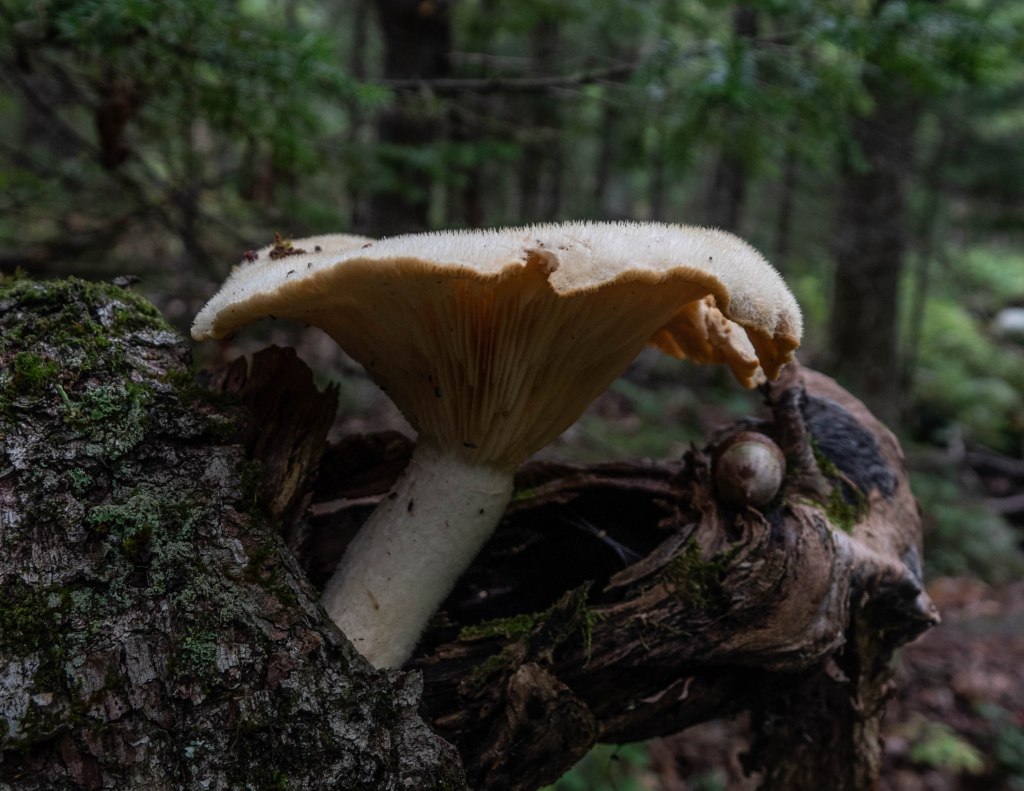
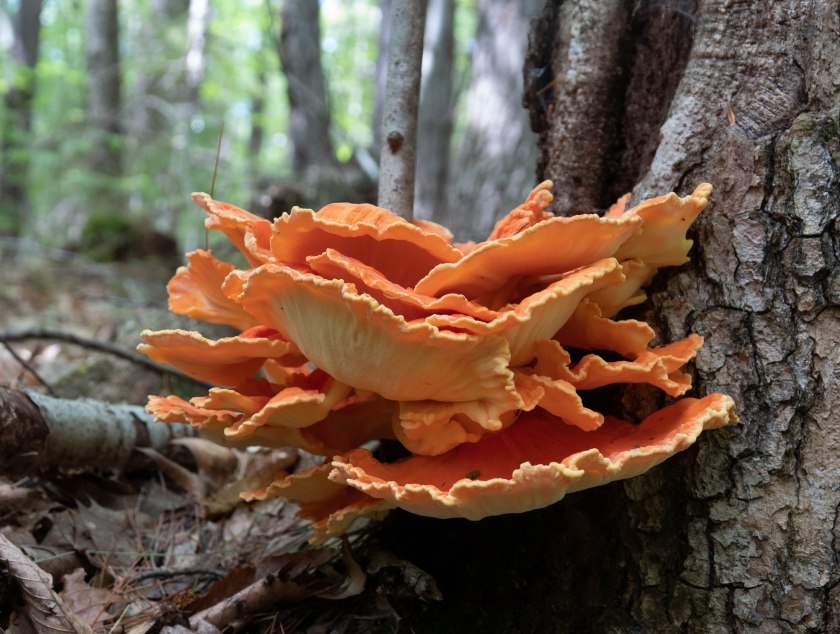
Sometimes I find myself wondering about a phenomenon so ordinary that I had taken it for granted all my life. Mushrooms always orient themselves so that the cap is horizontal, with the spore-producing surface pointing down.

Chicken mushroom

Up to this point, I’m OK. I know that they disperse their spores by simply opening up the gills or tubes to let the spores fall down, and then the wind will catch them. And the upper surface acts to keep the spores dry, essential to their proper dispersal. But here is the question: how does the mushroom know which way is down.

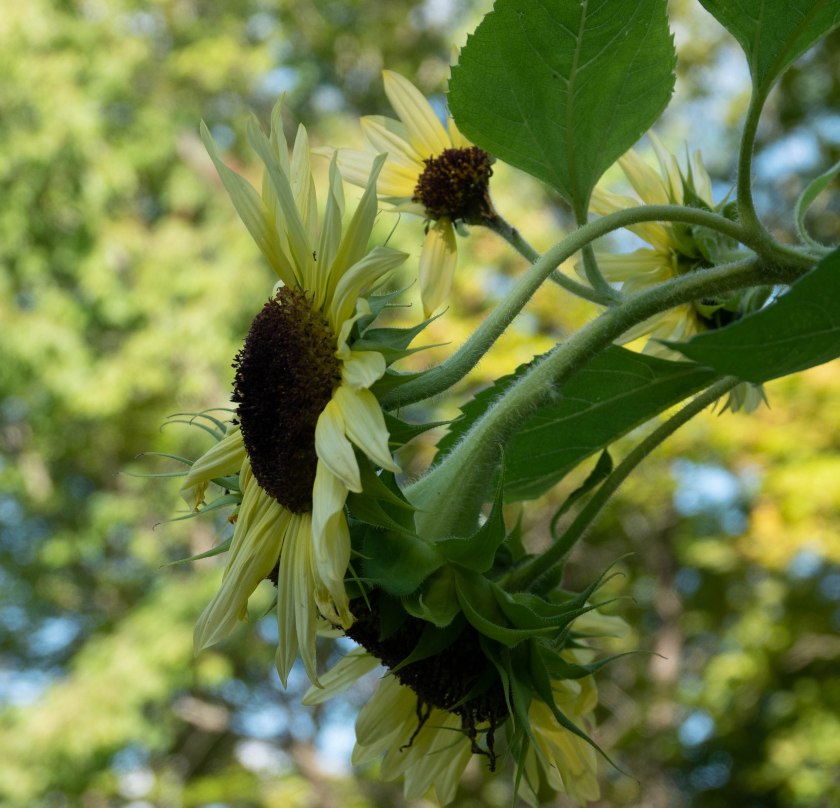
Perhaps it works like in plants. The stalk goes straight up, towards the sun, and the cap just ends up horizontal, at right-angles to the stalk?? But plants have a reason to reach for the sun, they need it to photosynthesize. If they grow in the shade, they may lean sideways towards the sun, and sunflowers turn their entire flower not upwards, but at an angle to face the sun. This one had fallen over in a storm, and contorted itself around back to the sun’s rays.

Mushrooms don’t do this. The cap just faces up and the gills down. And they can grow in very dark places (although some do in fact need light and react to it.)

The urge for the cap to face down is very strong. If the stalk emerges sideways to avoid a rock or a root, it will bend upwards as soon as it can, so that the cap faces down.

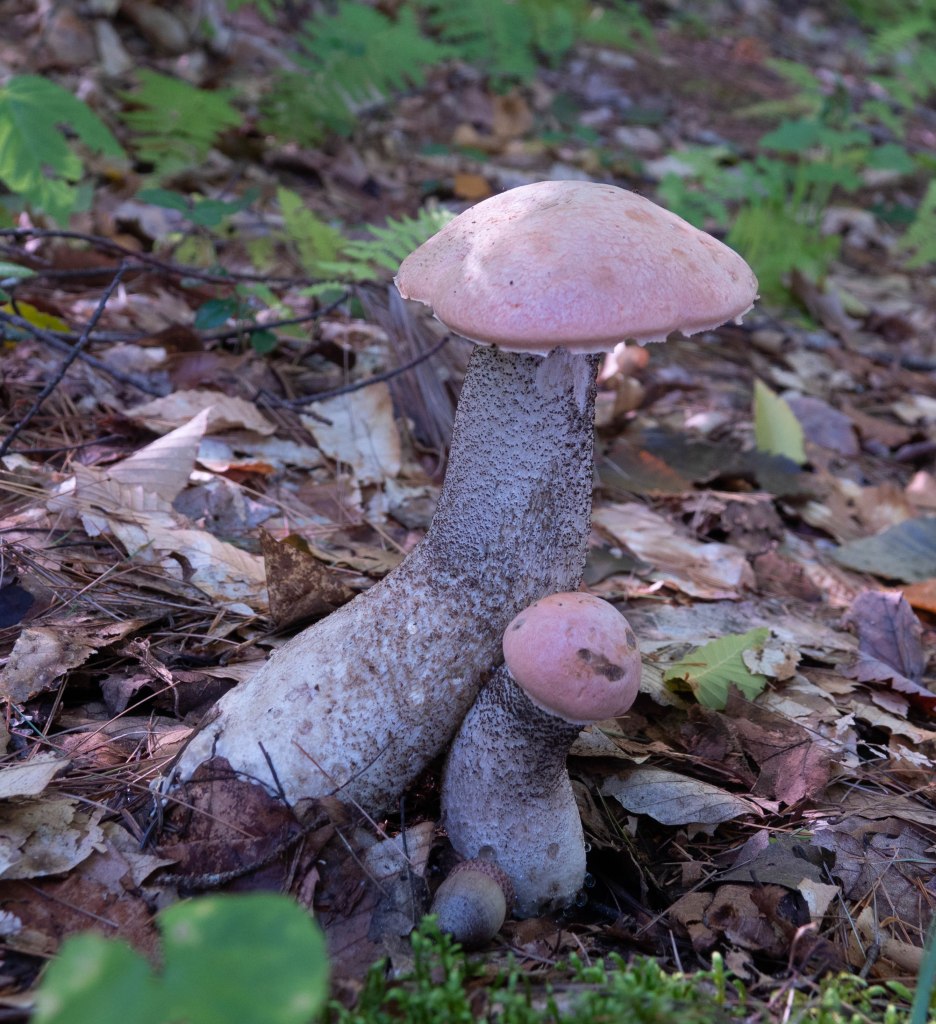
Sometimes the mushroom emerges straight, and then gets knocked over by a passing creature, like a beagle (!).

But the following day it has begun to compensate:

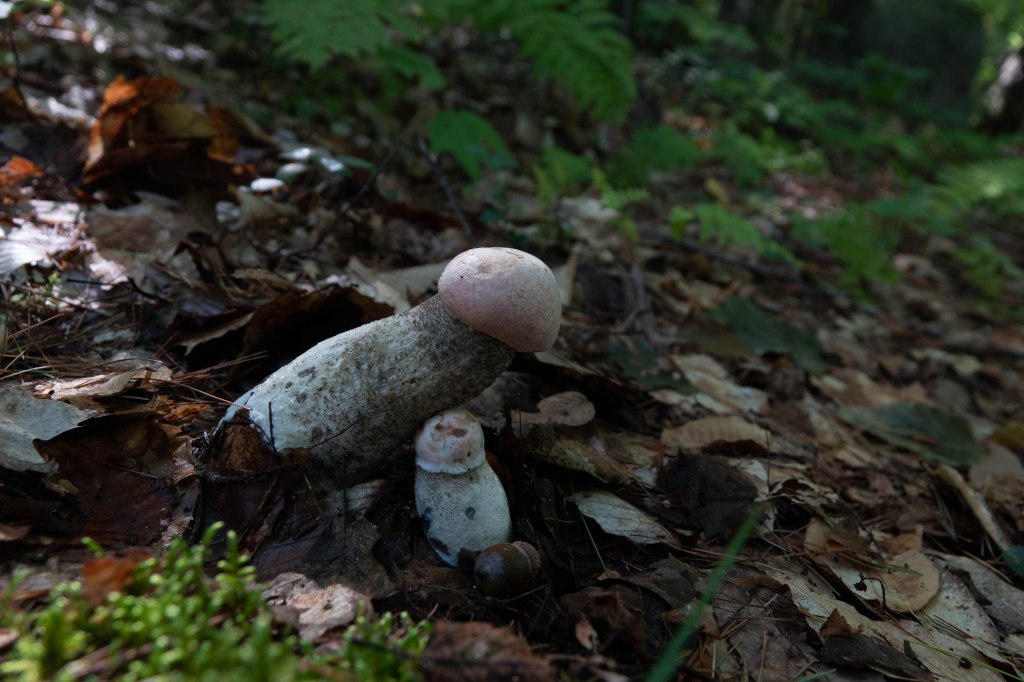
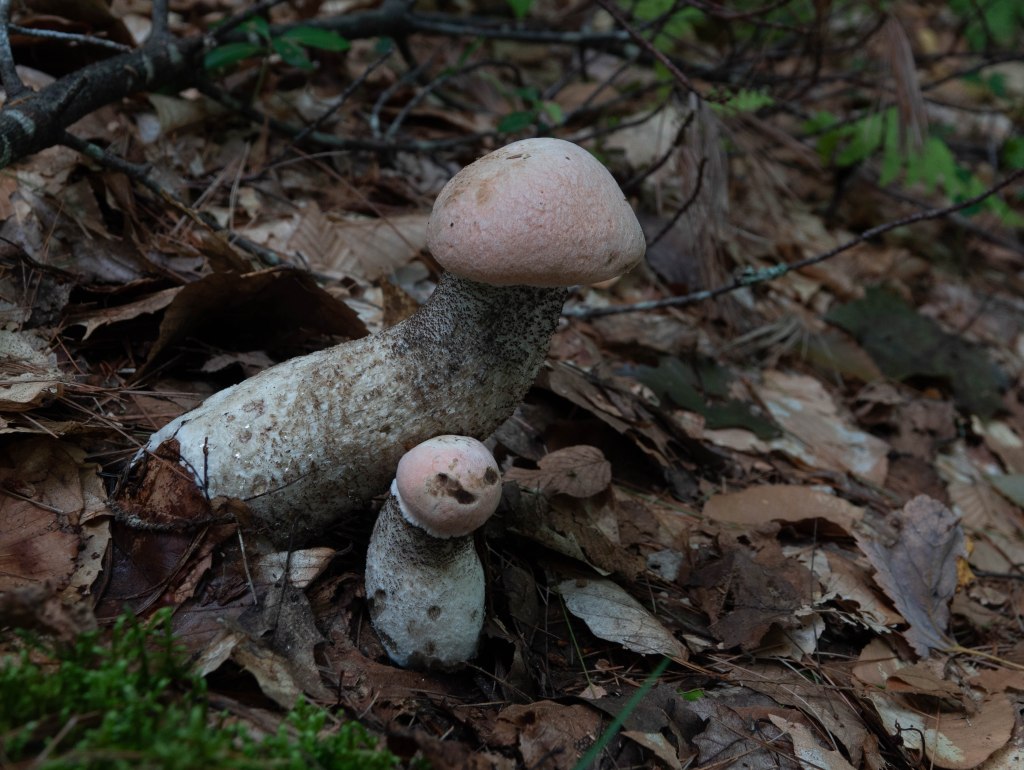
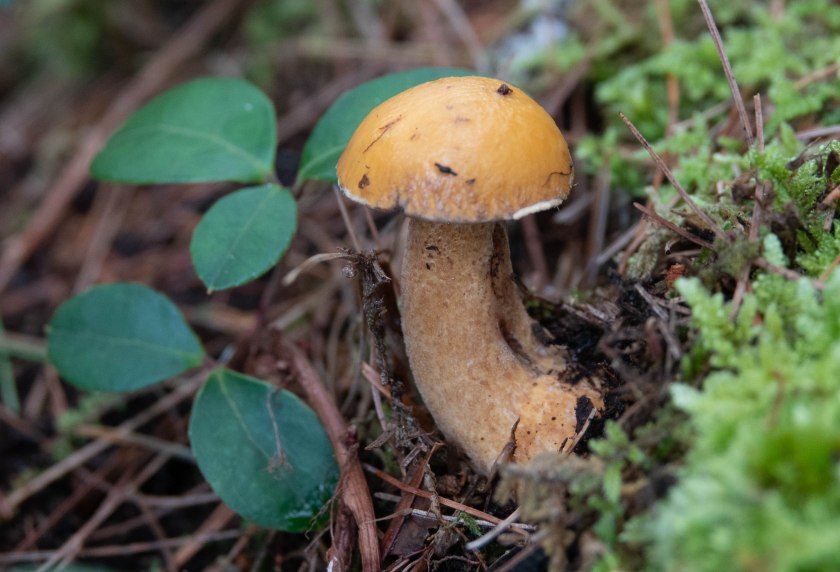
Leccinum sp.

and in one more day it is splendidly resurgent:

This by the way is an 8 inch chunky bolete; there is an acorn at the base of the baby one, for scale.

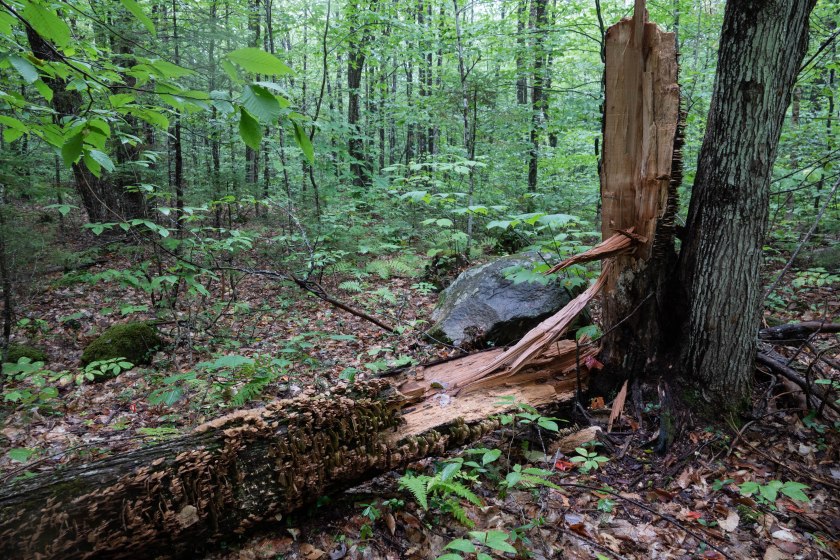
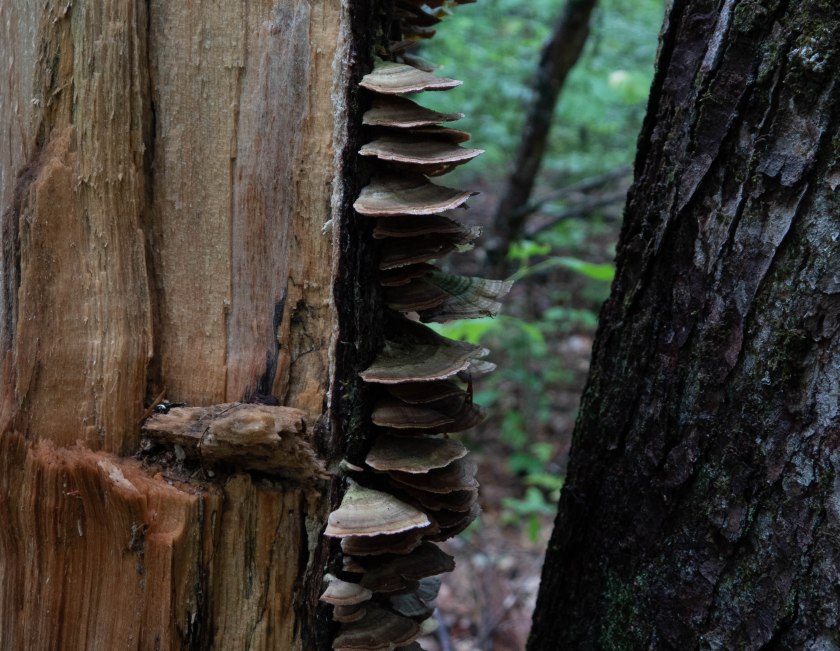
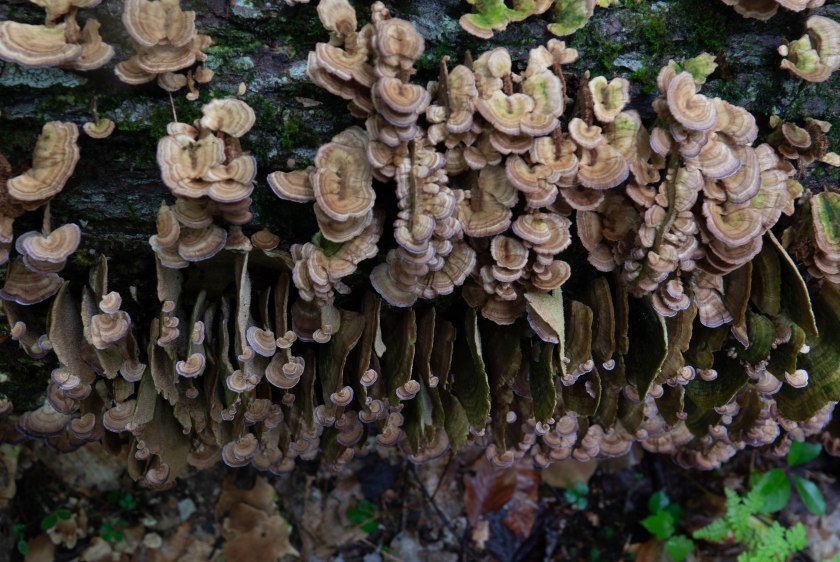
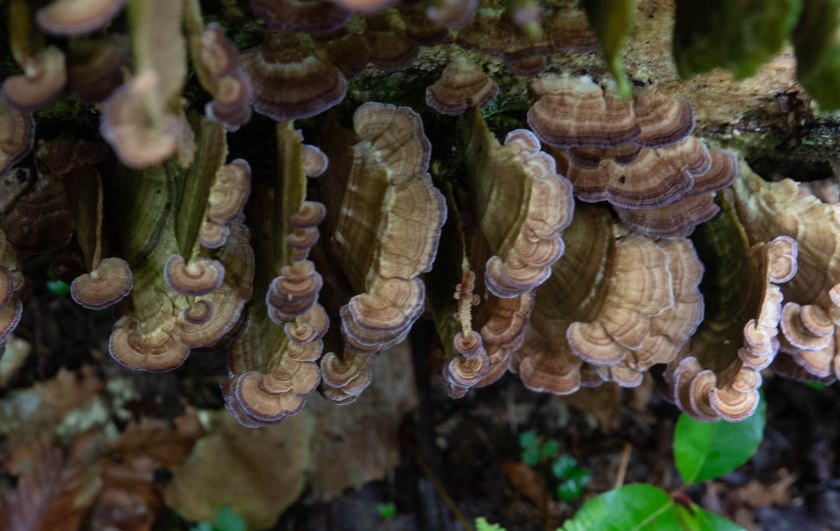
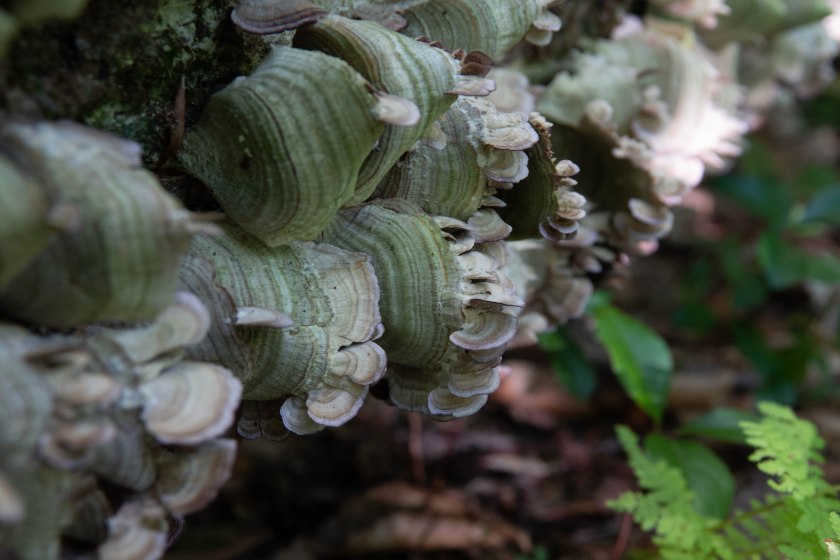
Bracket fungi, with no stalks, grow straight out of the tree at right-angles, like these polypores on the right edge of the still-standing remnant of the trunk below:

And when the tree falls, the new growth simply rotates itself through 90 degrees so it is facing down again. It’s a little hard to explain in photos, so I’ve given you three attempts below. In each image the old fungi that grew before the fall are vertical now, seen thin edge-0n, and the new ones are horizontal.

So how DO they do it?? Remarkably, it appears that they sense gravity. Just like us. Our ears contain tiny calcium beads called otoliths (‘ear stones’), which float around and brush against tiny hairs and thus remind us of which way is up. If they get loose, our sense of gravity goes wrong and we feel dizzy. It seems that fungal cells may have a similar way of sensing gravity, so they always know which way is down. The nuclei in each cell act a little like otoliths, and the whole fungus responds.

The phenomenon is called gravitropism*, and here are two more successful examples.

If you’d like to know more, here is an excellent article.

*The shelf mushrooms that restart new versions at right angles to the previous ones are technically examples not of gravitropism, but of gravimorphogenesis, since the original doesn’t reorient itself, only the new growth is sensitive to gravity.

PS Rather wonderfully, fungi have been taken into zero gravity in space to see how this affects them. Many of them not surprisingly get too confused to form proper fruiting bodies at all!

A brown pin-striped heron? Really?

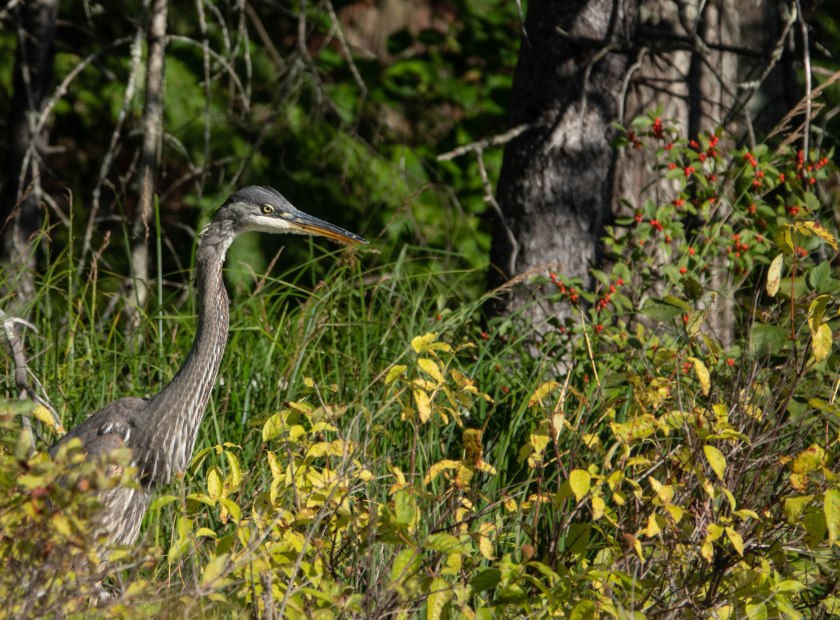
Last week I was kayaking on my marshy beaver pond, and I found a young heron standing in the scrubby shallows, watching me.

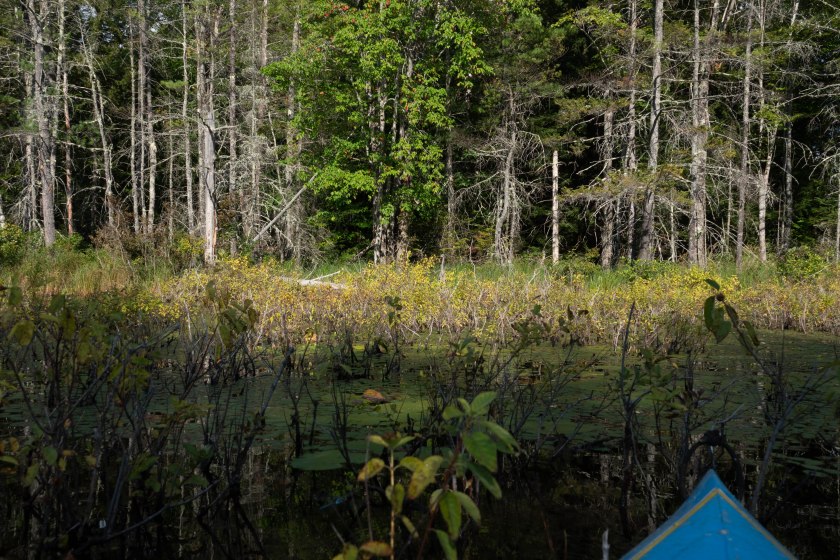
He wasn’t easy to see. In the spirit of “Where’s Waldo?” , can you find him?

He is dead center, just to the right of the bushy green trees in the center of the picture. My kayak is bottom right.

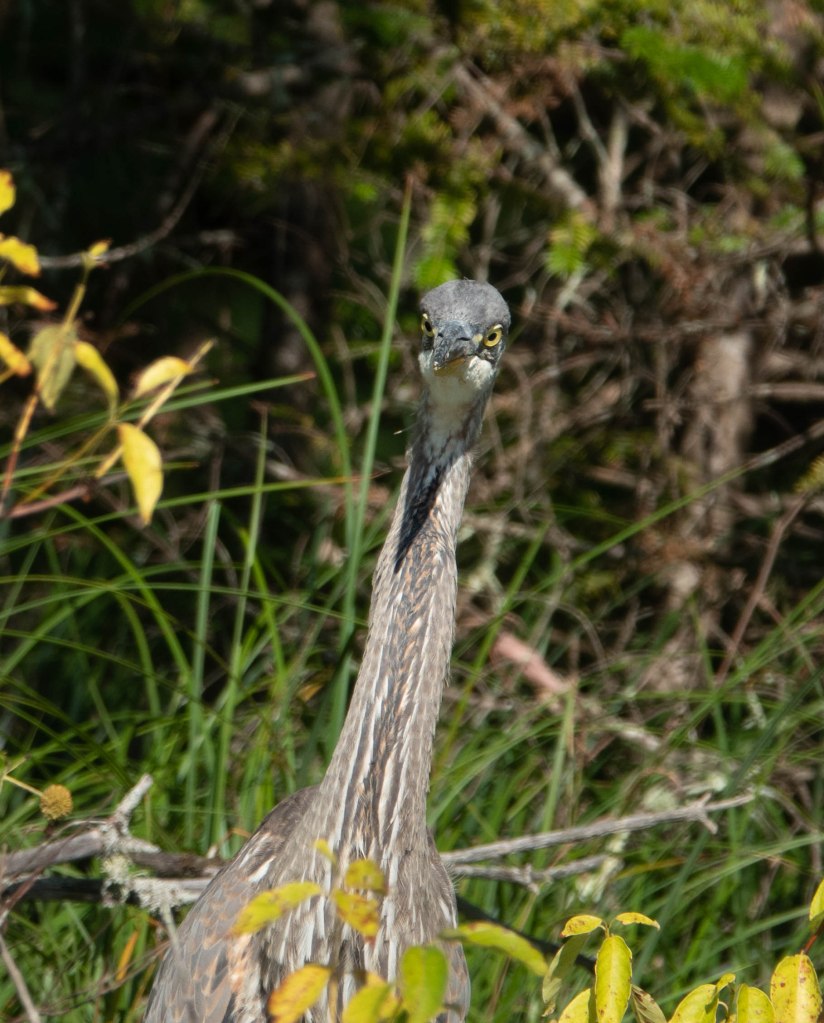
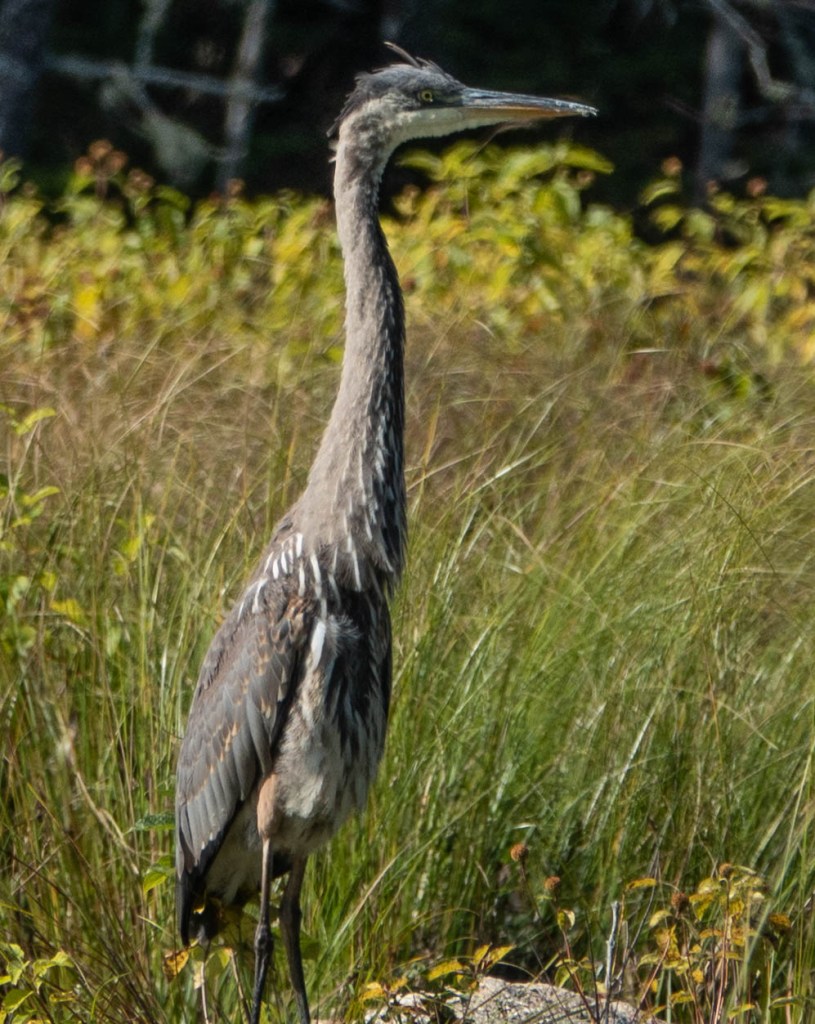
His stripy brownish plumage and all-black cap mark him as a juvenile Great Blue Heron, Ardea herodias:

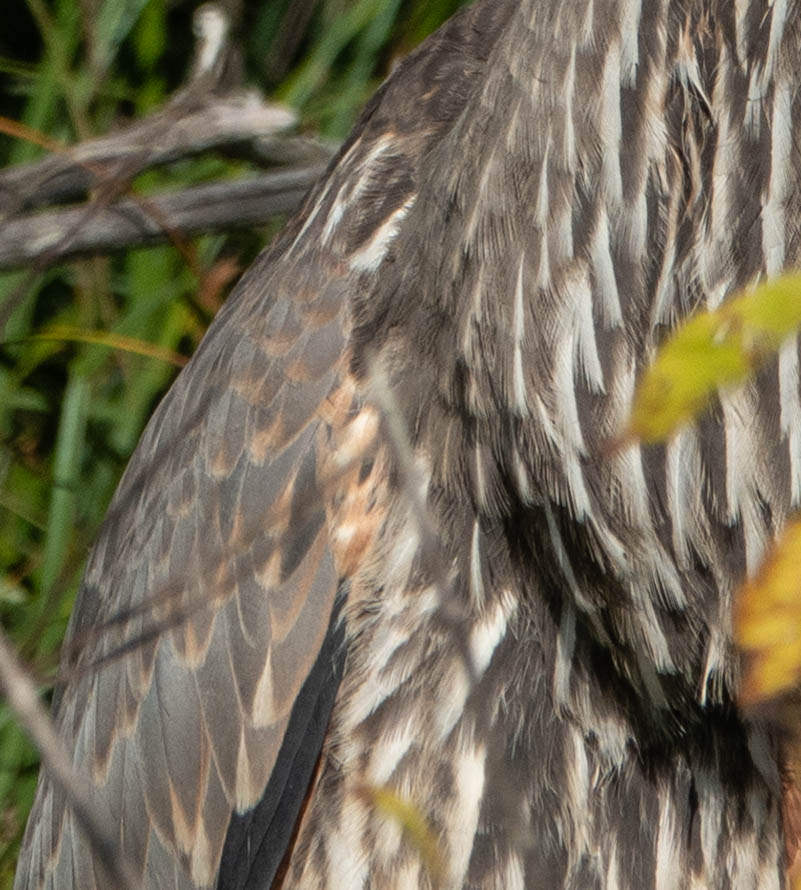
His wing and breast have quite distinct patterns, elegant beyond belief.

He seemed not bothered by my presence, so I gradually got quite close. Something caught his eye, and he curved his neck into the classic S-shaped pose readying himself for a strike:

It was probably a frog, a favorite food of juveniles who are not yet very good at catching fish, but it all came to naught, and I left him in peace amongst the golden leaves and red winterberries:

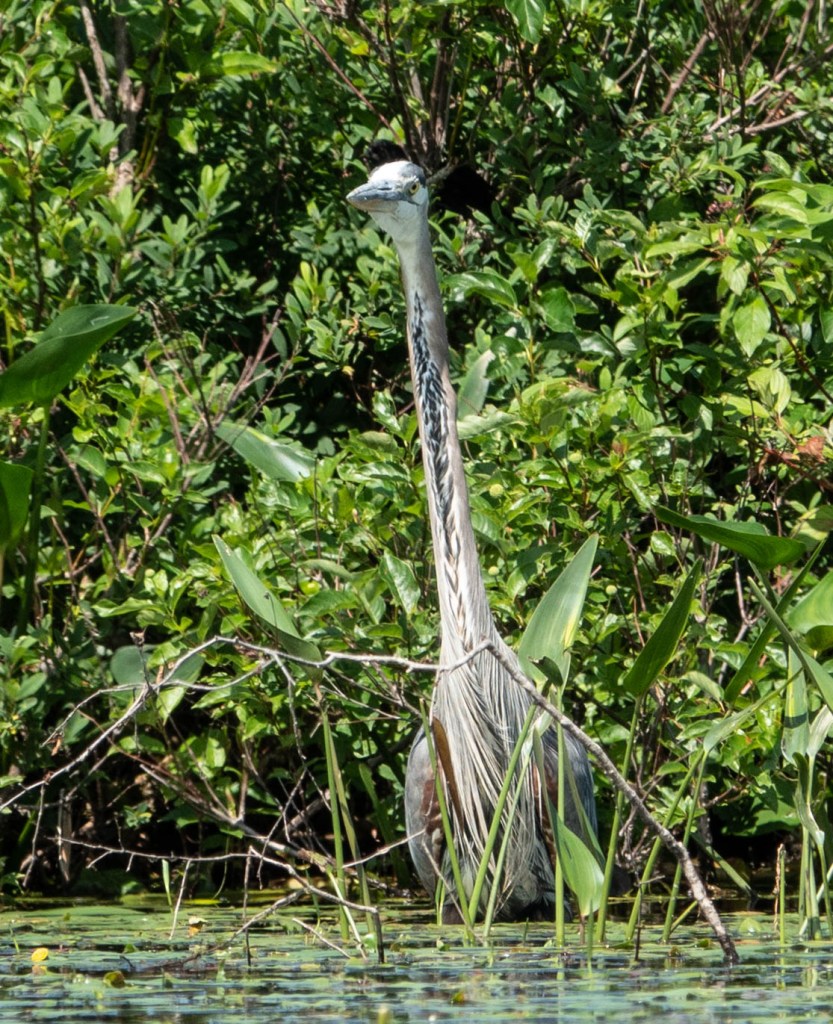
PS: When he is all grown up, his plumage will be quite different. The dowdy brown will fade, and those white streaks are the start of what will one day be a dramatic cascade of white plumes on his chest. Here is the same young bird the next day in a different pose, so you can see the stiff white quills (taken from the far side of the pond, so it’s a bit blurry):

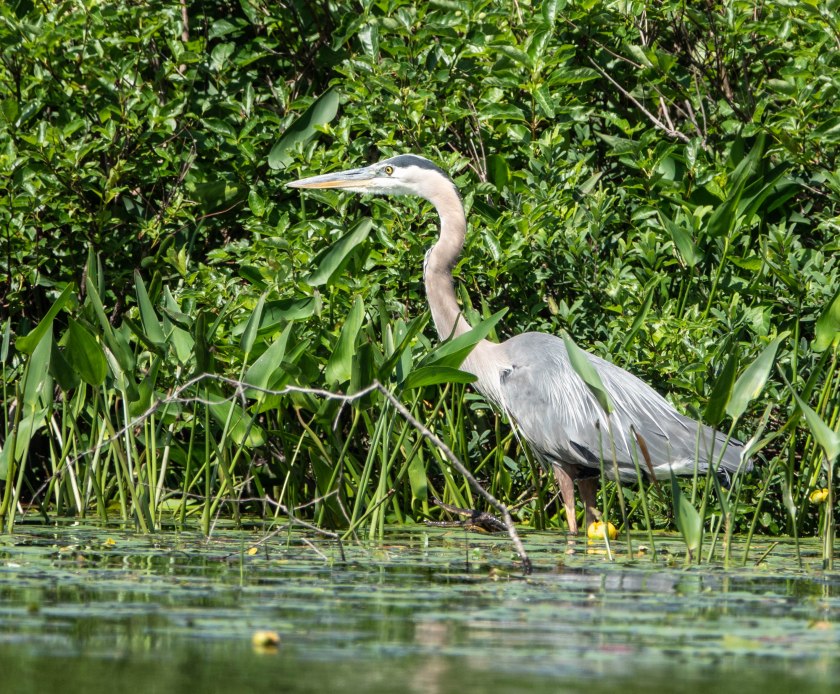
And here is his future self, long neck-plumes and all:

plus a drifting fan of them across his back.

(This one was stalking around the lake in July.)

PPS: Kushlan says: “Herons usually catch prey with a Bill Stab, which is a downward or lateral strike involving fast, directed movement of the head and neck while the body remains still. This is the characteristic capture stroke of the long necked herons, which have full development of specialized neck vertebrae, the elongated sixth cervical vertebra acting as a hinge for the forward strike.”

Kushlan, J. A. 2011. The terminology of courtship, nesting, feeding and maintenance in herons. [online] http://www.HeronConservation.org

Underground Stars

One of the oddest, least plausible creatures in my Maine world is the Star-nosed Mole. Being moles, they live almost entirely underground, and the only ones I have ever seen are dead. These photos were taken this morning, after my dog spent a long time sniffing very tentatively at something unfamiliar. The mole looked peaceful, and as if it had not been dead for long, with no signs of injury.

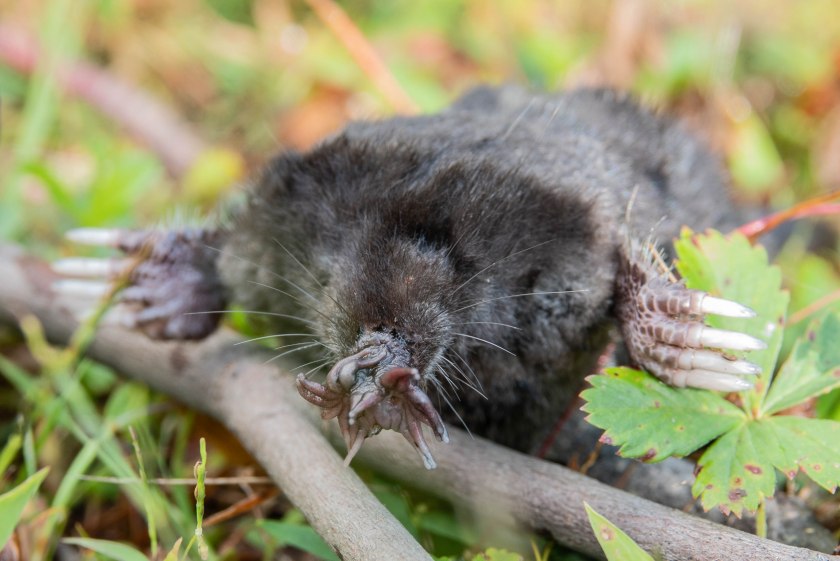
Condylura cristata is native to the Northeastern US. It is a small grey creature, about 8 inches long, 1/3 of which is tail. Its head is at the bottom center below:

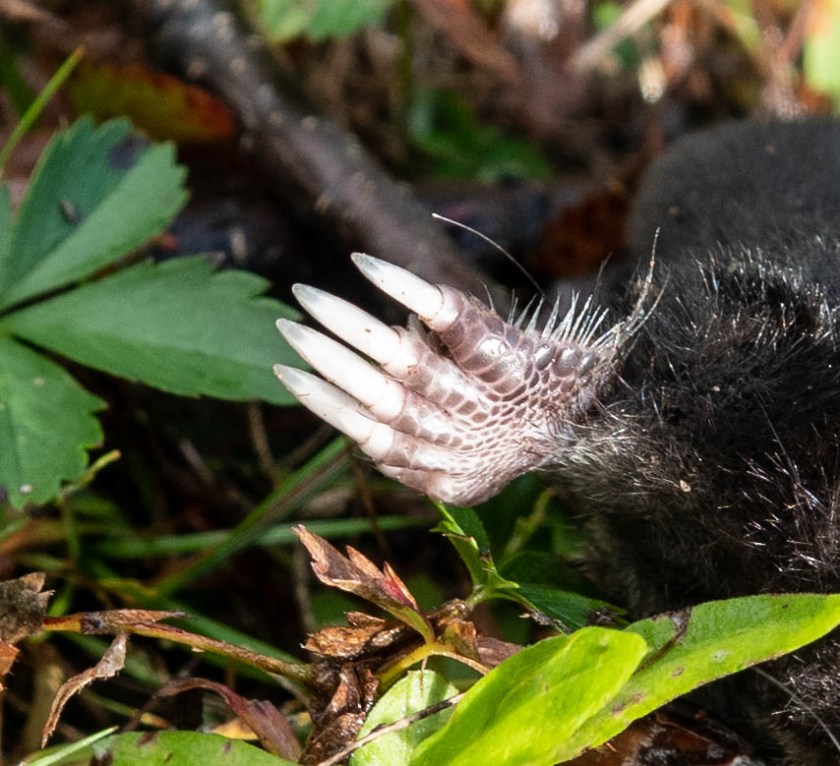
It has outsized feet with five imposing claws for digging:

But the really remarkable thing is its nose. It ends in 22 fleshy finger-like tentacles:

These are covered in sensory receptors that respond to touch and perhaps vibrations. They can each move independently and flex by 90 degrees, and they are sometimes all grouped together pointing forward, and sometimes opened up like petals. Here is a close-up, showing the 11 tentacles surrounding each nostril:
They are covered in 30,000 tactile receptors called Elmer’s organs, that contain more than 5 times the number of nerves in a human’s hands. The mole “sees” the world through these tactile receptors. The tentacles aren’t used for grasping anything, or for digging, just for feeling their world. Someone described it as the “nose that looks like a hand but acts like an eye.” (Their actual eyes are tiny, just visible in the third photo of this post.)

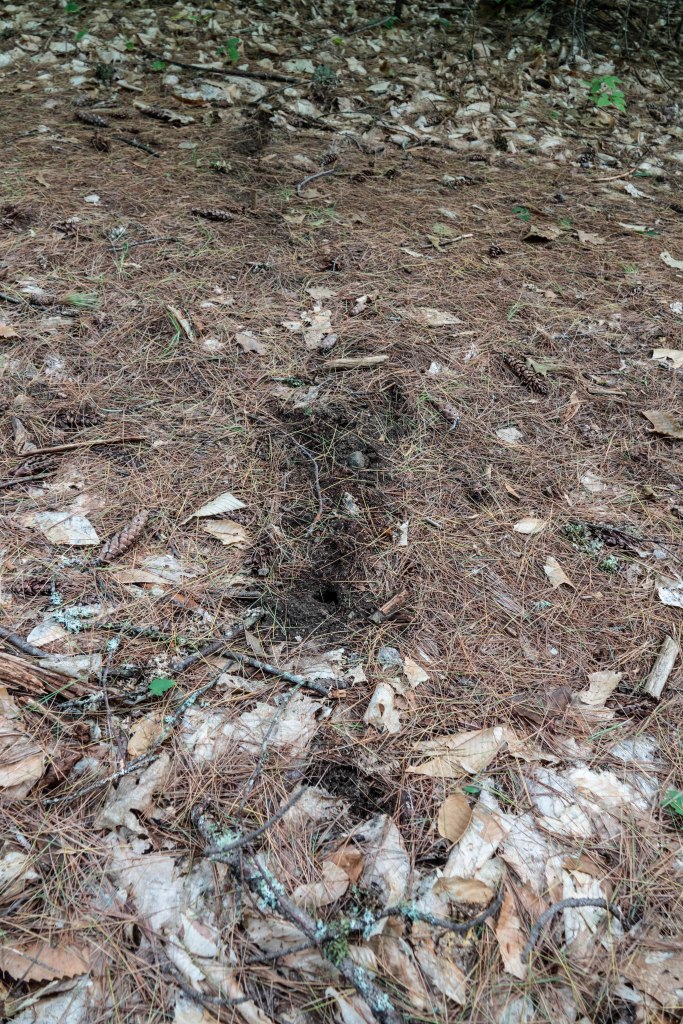
They tunnel underground, deep down in winter but close to the surface in summer, where the earthworms are. The tunnel pushes up the ground, as you can see in this photo, where the tunnel goes from top to bottom of the picture, across a human trail.

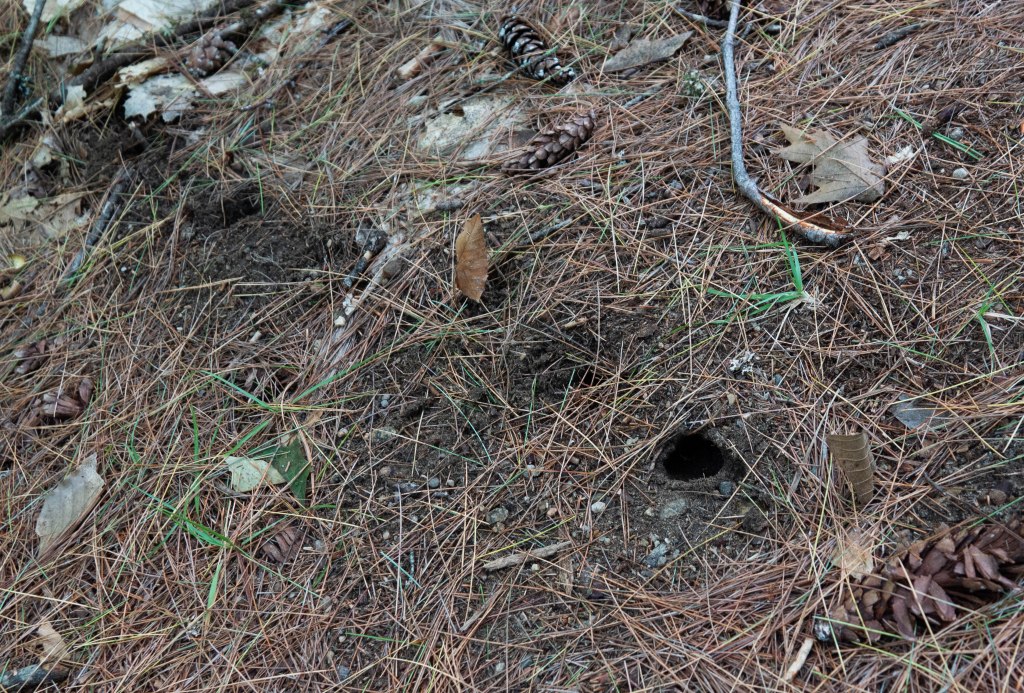
They sometimes break through the surface, as they did in the small round hole bottom right here:

When I was reading up for this post, I discovered to my astonishment that they are very strong swimmers. “My” mole was close to a marshy area and a stream, and apparently this is typical. Although they live on land, many of their burrows end at the water’s edge, and they eat not only earthworms but also aquatic imvetrbertaes. I would give a lot to see one swimming. They use that nose in the water to to sense their surroundings. This wonderful short video shows them foraging both underground and in the water.

It turns out other species may use the same technique, as this fluid dynamics expert explains:

They remind me of a duck-billed platypus, another implausible aquatic fur ball with a cartoon face.

PS Kenneth Catania is a leading expert on star-nosed moles, and he has written a wonderful book about both them and other unlikely creatures, called Great Adaptations. https://press.princeton.edu/books/hardcover/9780691195254/great-adaptations

The Little Wren*

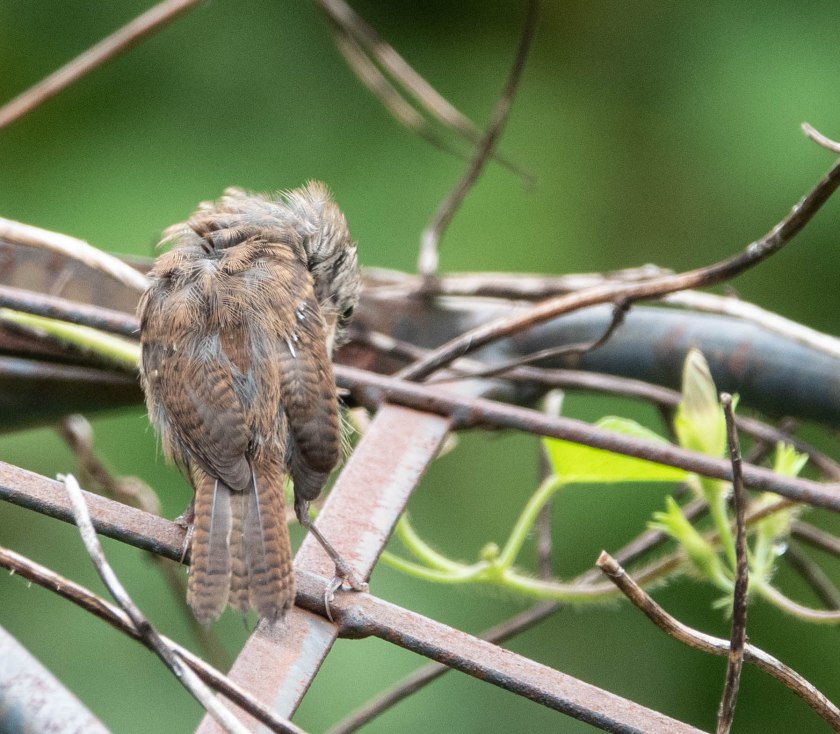
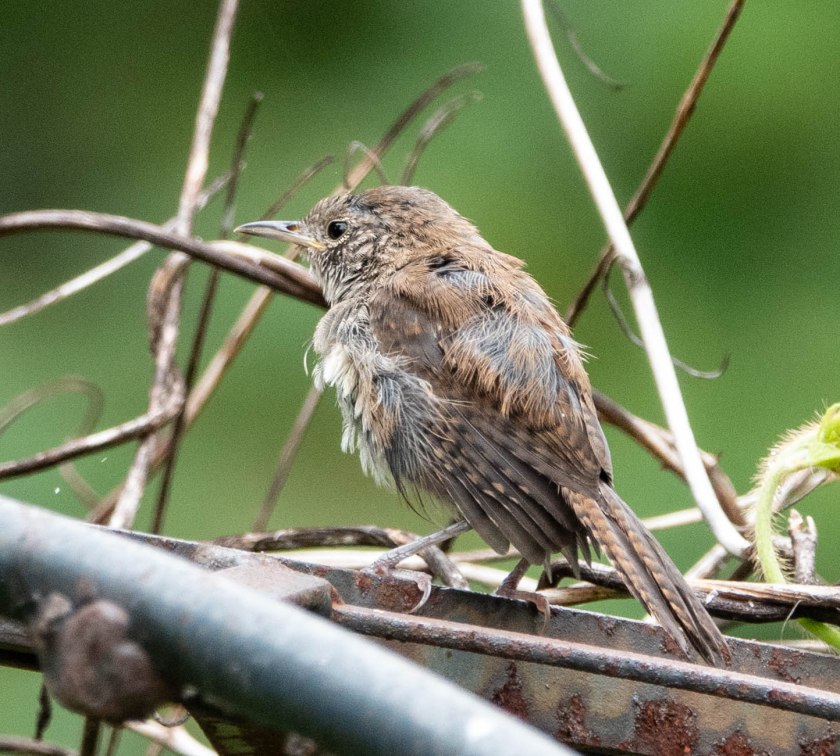
The House Wren, Troglodytes aegon, weighs only 11 grams, or 0.35 ounces. And it is brown, so for someone like me (novice birder, terrible eyesight) they are easy to miss. I have a new app, the Merlin Bird Pro Sound ID, which is the first I have ever used that seems to really work, and the other day it told me I was listening to a House Wren. And then today, I saw one, or maybe two.

First, I saw one on top of a trellised arch in my garden, smaller than the morning glory flower behind it:

It had been raining, and it was preening:

And I think it was a juvenile, judging by the fluffy plumage.

It flew off, and a few minutes later either it or its doppelgänger emerged from the undergrowth with a huge grub:

I have no idea if it was the same one, or just possibly its mother, valiantly still feeding the recently fledged youngster. We are at the Northern edge of their breeding range, and soon they will migrate to the Southern US and Mexico for the winter.

I failed to get a recording of the House Wren song, so I’ve put in this Winter Wren, Troglodytes hiemalis, song instead, also in my garden about a week ago.

PS The North American House Wren is a different species from the wren we have in the UK, whose scientific name is Troglodytes troglodytes. Troglodytes comes from the Greek, meaning “one who creeps into holes”. House Wrens nest in cavities in trees or sometime rocks, so I think that’s the source of its scientific name.

*William Wordsworth knew this well. Here are the first few verses of his poem, A Wren’s Nest, written in 1833 (obviously about an English wren). I have bolded the key phrase that displays his knowledge of their preference for nesting in cavities.

AMONG the dwellings framed by birds 
In field or forest with nice care, 
Is none that with the little Wren’s 
In snugness may compare. 

No door the tenement requires, 
And seldom needs a laboured roof; 
Yet is it to the fiercest sun 
Impervious, and storm-proof. 

So warm, so beautiful withal, 
In perfect fitness for its aim, 
That to the Kind by special grace 
Their instinct surely came. 

And when for their abodes they seek 
An opportune recess, 
The hermit has no finer eye 
For shadowy quietness. 

These find, ‘mid ivied abbey-walls, 
A canopy in some still nook; 
Others are pent-housed by a brae 
That overhangs a brook. …

The Arrow Spider

The familiar spider’s web can be made by any of many species of orb-weaver spider. Most orb-weavers are shades of brown, grey or black, but not this one, in the Maine woods.

She waits in a hole at the center of her web. She is a female Micrathena sagittata orb weaver spider, only 8-9mm long, 1/3 inch. (The male is much smaller and more discretely colored, so it is rarely seen .)

Her abdomen is arrow-shaped (the two rear prongs are black, so they don’t immediately stand out from the background in the previous photo). She has spines at the sides and on her back, easier to see in this side shot:

She is named after Athena, the goddess of weaving, and sagittata meaning arrow-shaped, the same root as Sagittarius the Archer.

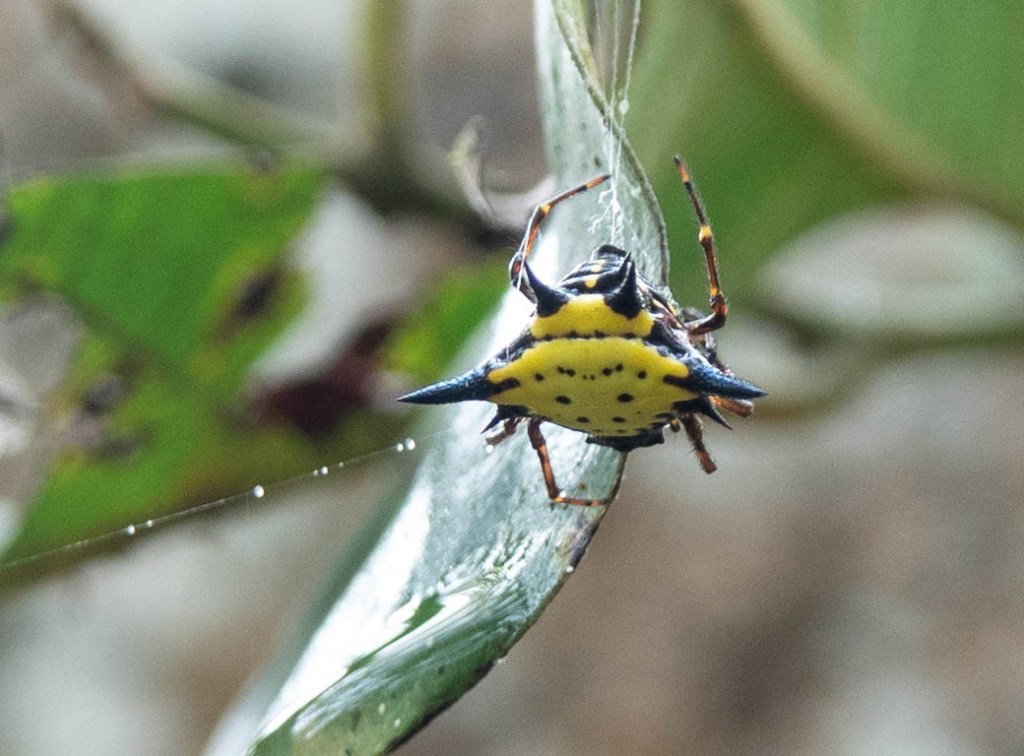
Elsewhere in the world there are other spiders with hardened abdomens with variously shaped spines. I saw this one in Koshi Tappu in Nepal three years ago.

It rejoices in the name of Hasselt’s Spiny Spider, Gasteracantha hasselti. Surprisingly , genetic analysis shows that they are not closely related to the American Micrathena, so the armored exterior seems to be an example of convergent evolution, with clear defensive advantages.

And the colors? Red and yellow often stand as a warning to would-be predators that you might be poisonous. Or they can be an enticement to potential mates, as they are thought to be in the Painted Turtle,

Or both? who knows??

Peeps in transit*

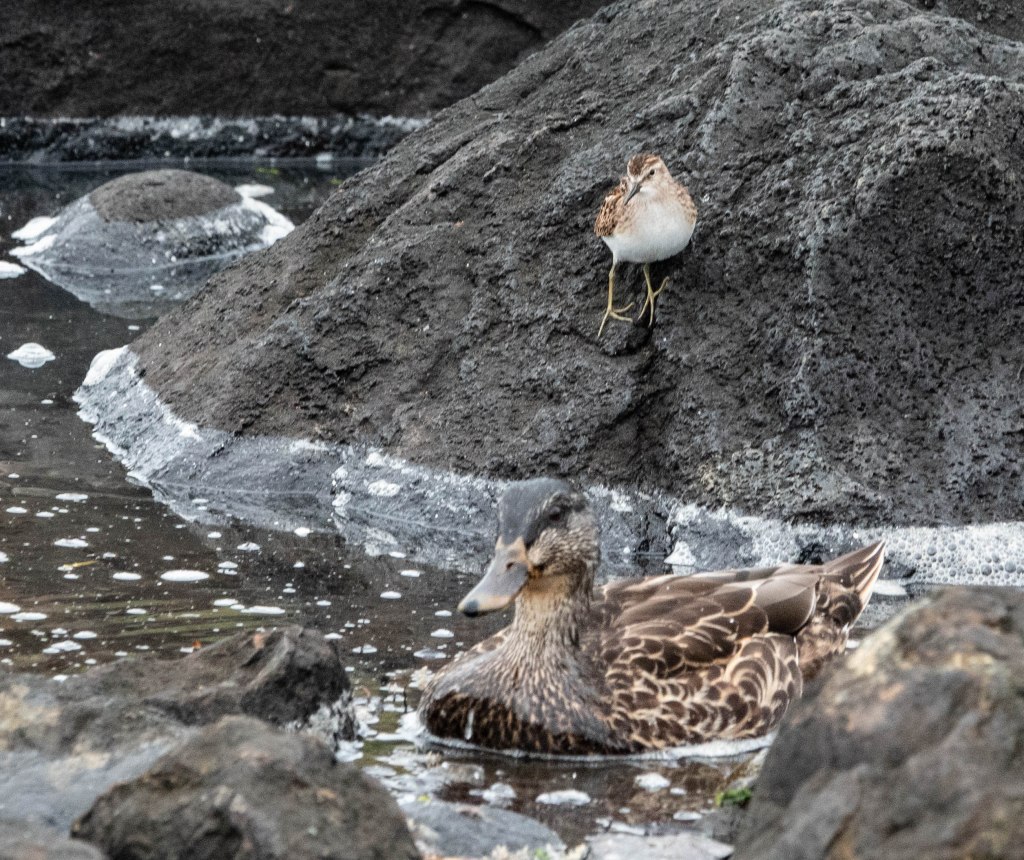
The Least Sandpiper, Calidris minutilla, is the smallest shorebird in the world, weighing in at 20-30 grams, a maximum of 1 oz. It is dwarfed by a nearby mallard:

I stumbled on these sandpipers on Monhegan Island, a perfect speck of land 12 miles off the coast of Maine in the North Atlantic.

Least Sandpipers breed in the sub-arctic Canadian tundra, then stop off here to recharge their batteries before embarking on a heroic nonstop transoceanic migration of 3,000 to 4,000 km to their wintering grounds in northeastern South America. 

This group of about six..

was having a morning wash and brush-up:

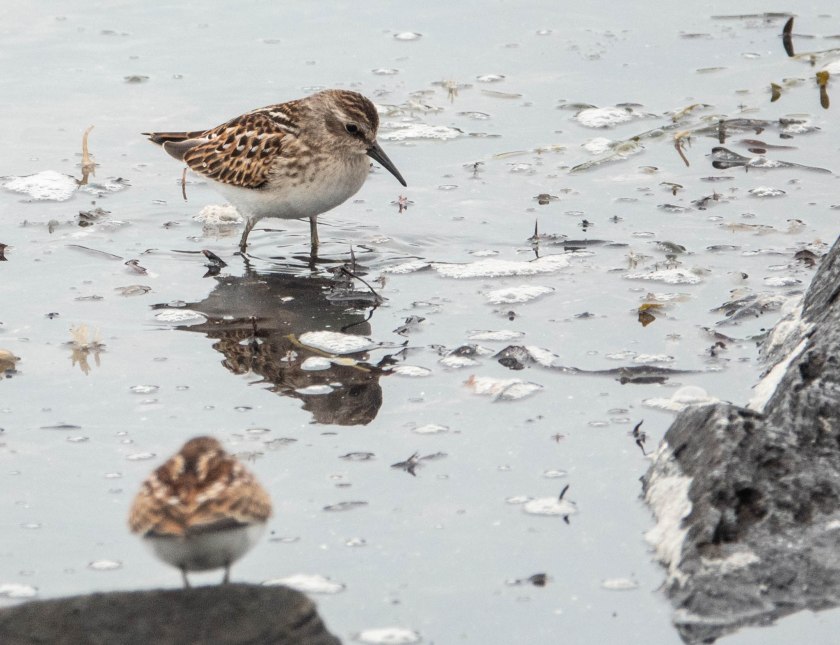
Notice their greenish legs, the only sandpiper with legs that color. I think these were juveniles, who migrate later than adults: by now the adults are arriving in South America.

They eat amphipods, especially the mud shrimp, Corophium volutator, which makes up to 88% of their diet in the Bay of Fundy. (Photo from Aphotomarine)

They wade around as the tide goes out, searching for these amuse-bouches:

Soon they will take off for southern climes, only to make the return journey again next spring.

* Collectively, tiny shorebirds are sometimes rather charmingly called “peeps”, hence my title.

Chipmunk choices and choice chipmunks

The humble chipmunk is so familiar to us in Maine that we take it for granted. They forage beneath our bird feeders, and balance on the Love-in-a-Mist seed heads:

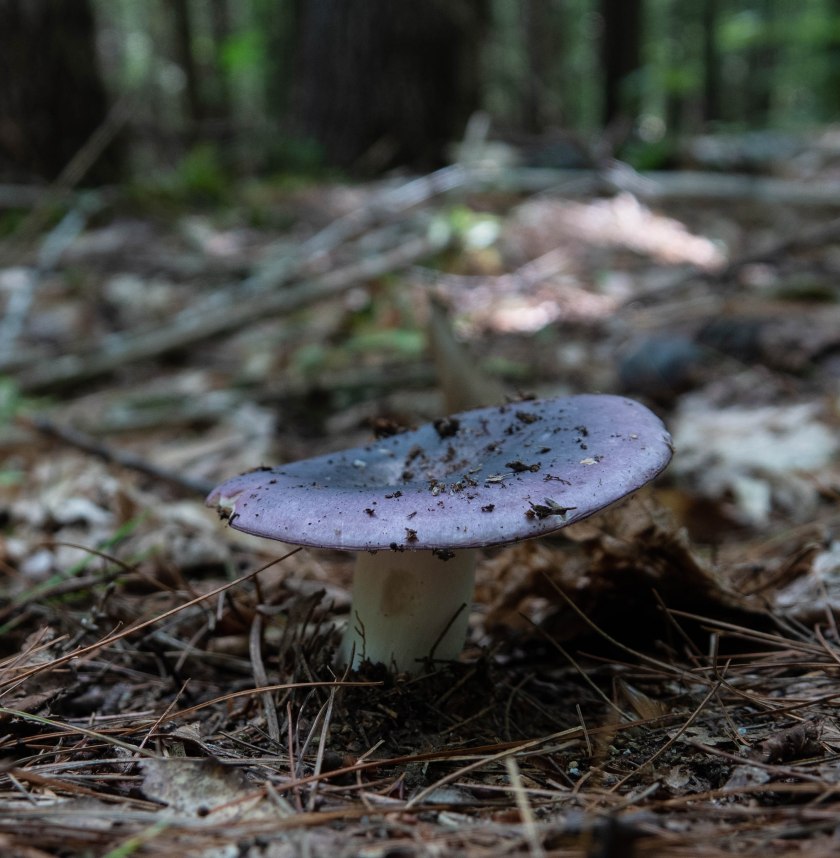
So, we think of them as flower and seed-eaters. And occasionally mushrooms. This puffball has been peeled by a chipmunk, exposing its purple interior:

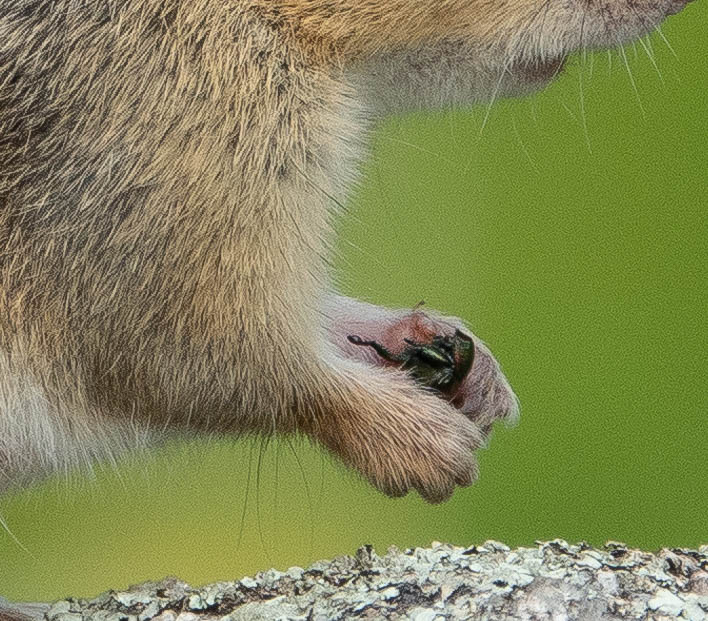
But not so fast: sometimes they surprise us. This one is eating….

a large black beetle:

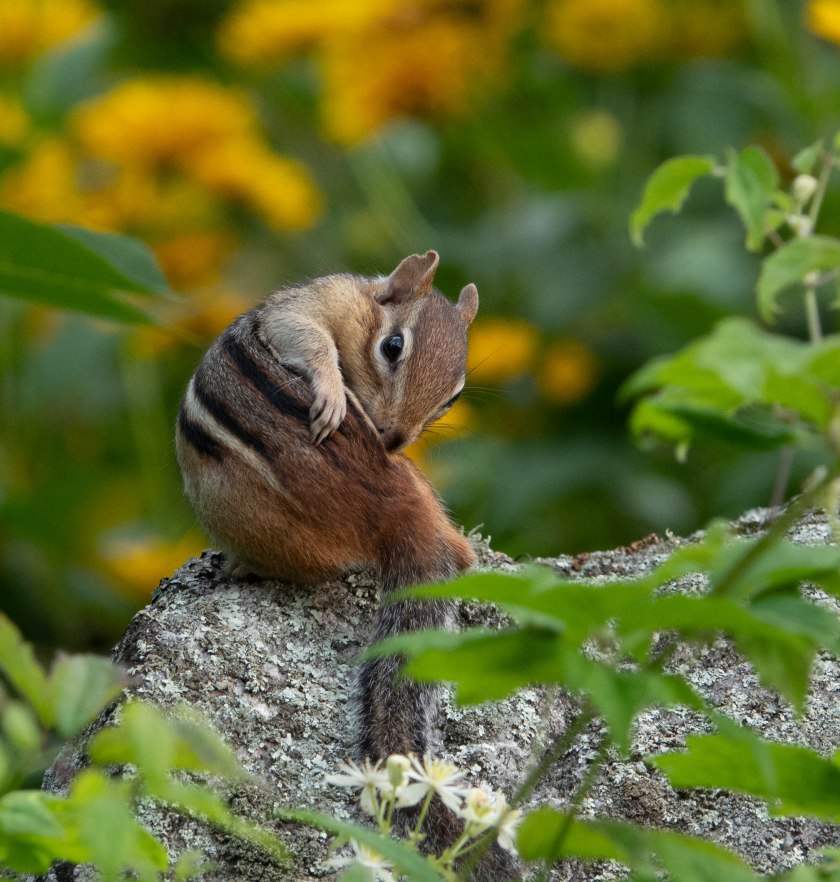
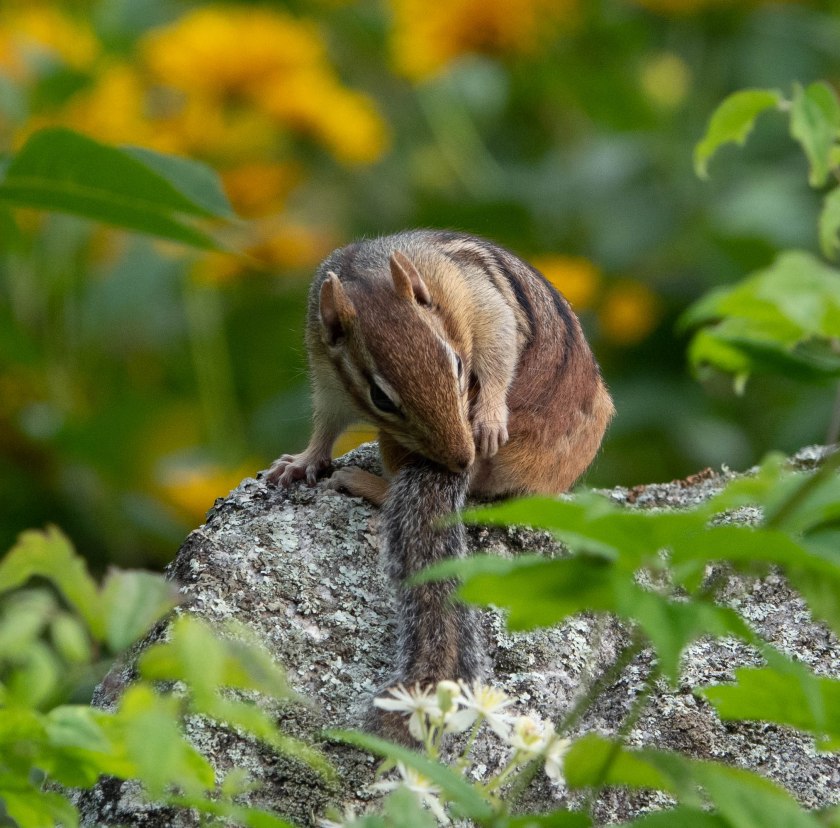
He/she ate everything except the odd leg, and then had a good grooming session:

and to my fascination he was clearly eating something he found in his fur. Fleas? Ticks??

I checked, and indeed insects are a known part of their diet.

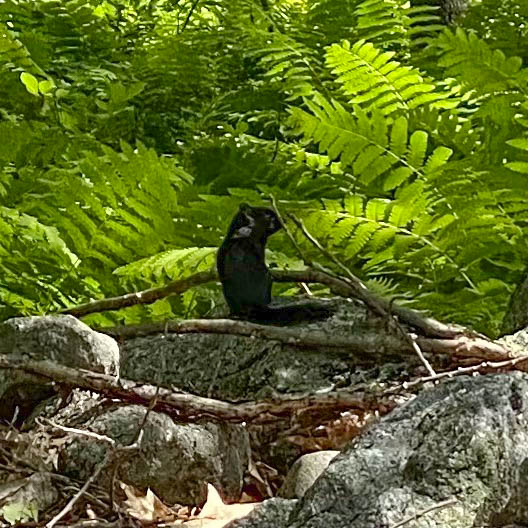
The second surprise this past week was quite different. Look at these photos, taken by my son on his iPhone just up the road from the house:

Believe it or not, this too is a chipmunk. There have been stories of these melanistic variants popping up in our area, but this is the first one seen round our house. I am hoping to encounter it again. But I do miss the stripes.

PS There seems to be no scientific literature to speak of on melanistic chipmunks, and they are generally said to be very rare. Melanistic squirrels, on the other hand, are widely distributed, particularly in more northern climes. In squirrels, melanism is thought to convey two advantages. First, in dark Northern evergreen forests they may be better concealed in the shadows. Second, they are better at absorbing heat, an advantage in cold climates.

The mushroom: a small, mysterious miracle

Summer is noticeably winding down. And the mushrooms are coming out. When I walk each day, I always hope to see mammals, birds, reptiles, things that move. But it doesn’t always happen. And when they do appear, they can be fleeting and impossible to photograph. Mushrooms, blessedly, stay put. And they are exquisite.

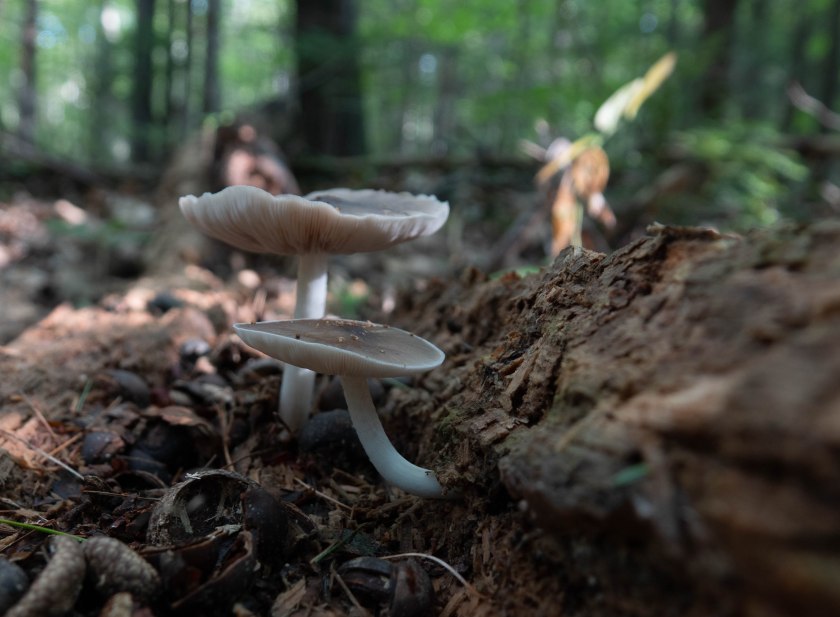
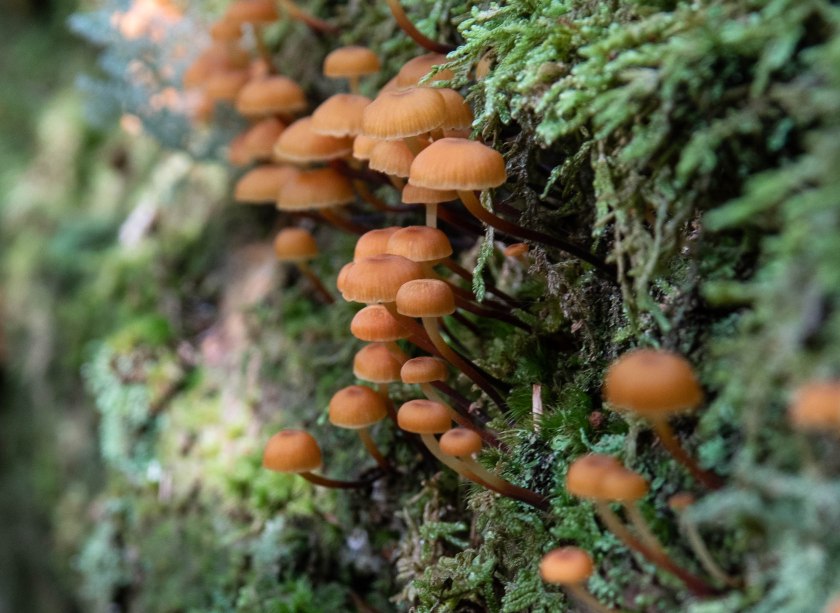
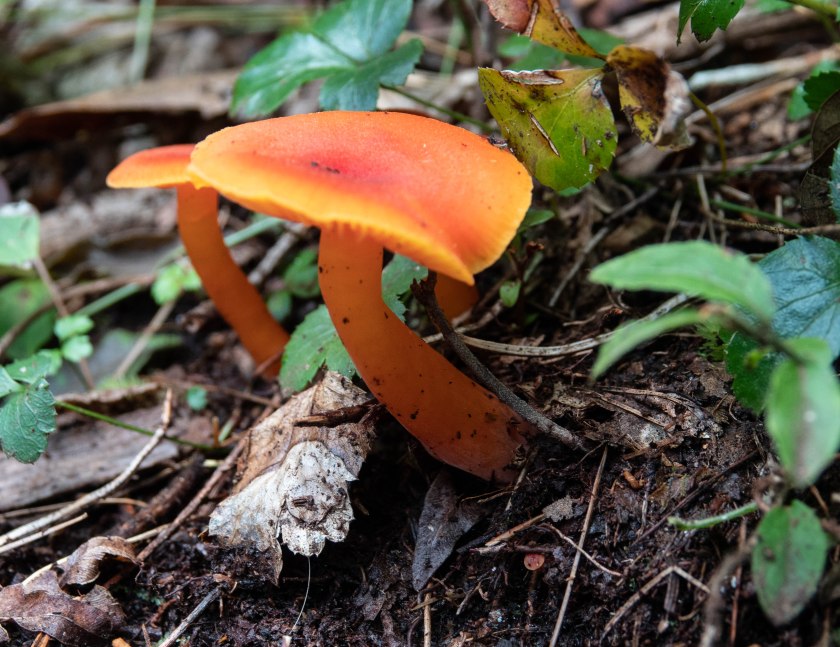
Here is a gallery, all resplendently pushing up through the leafmold during the past week. Some have gills, some are veiled, some have a spongy underside (boletes), some look exactly like coral. Some are edible, some could kill you. Just admire them.

Tyrant parents

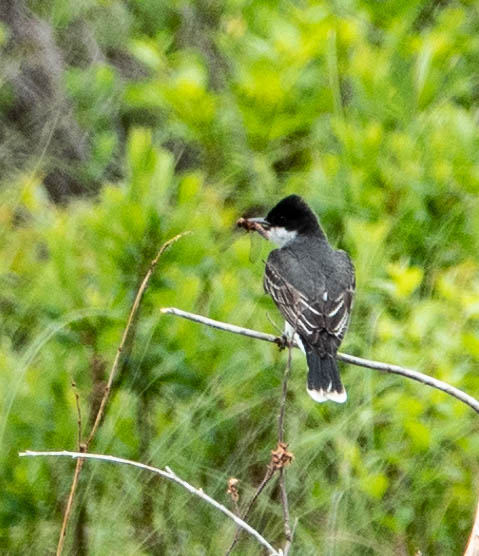
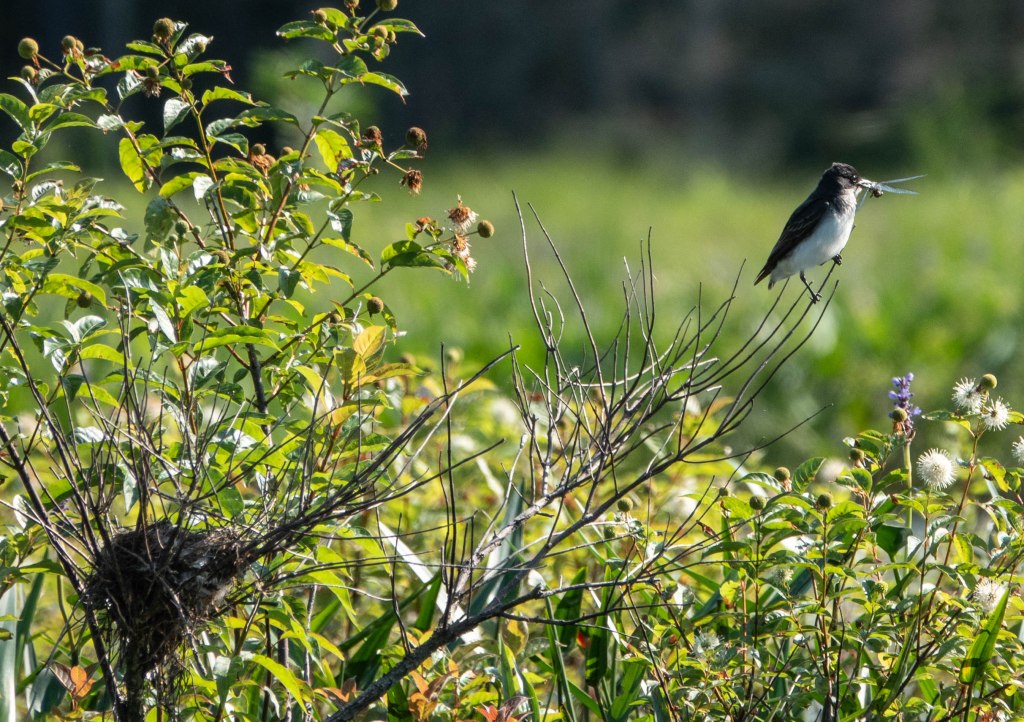
This is an Eastern Kingbird, Tyrannus tyrannus. Quite a name to live up to.

Their name betrays their nature. Fiercely territorial, they are fearless against intruders into their airspace, even eagles:

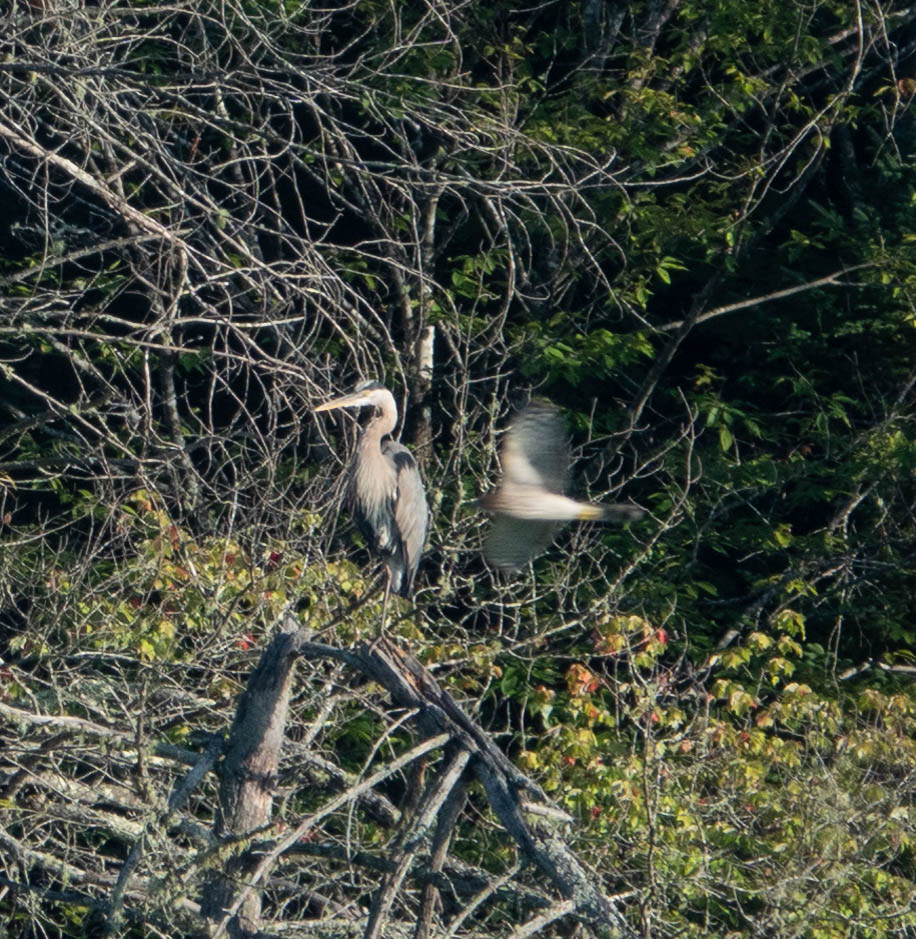
or Great Blue Herons:

Let alone a more evenly matched Belted Kingfisher (on the left below; the kingbird at top right has satisfactorily upset him and is moving on)

In flight their white tipped tail feathers make them easy to identify:

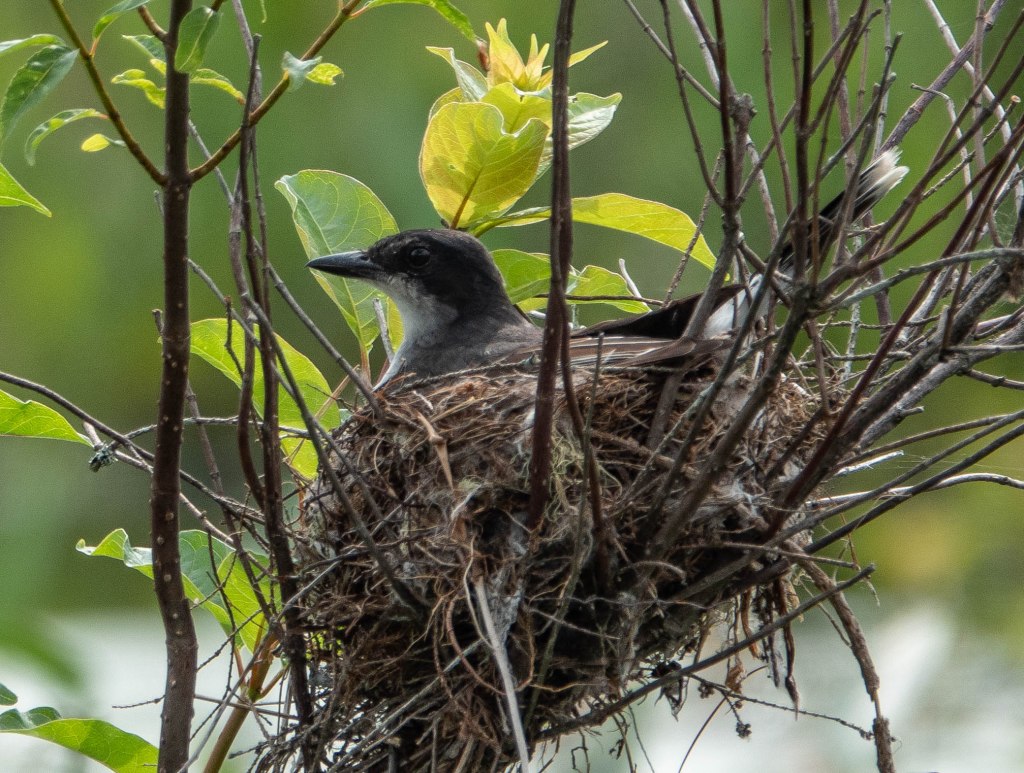
They usually nest in trees, but close to water they sometimes nest low down, like this pair on my beaver pond. They used a nest site from last year, either theirs or a redwing blackbird’s, and rebuilt the nest. The female is on the nest, and the male is standing guard, as he does for 50% of the time. Between them the nest is only left completely unattended about 11% of the time.

By June 28 she was firmly ensconced:

Incubation takes 16-18 days, so I calculated July 15 as the latest possible hatch date, and kept watch from my kayak, from a respectful distance. By July 17, something had changed. She was now sitting on the edge of the nest, gazing lovingly down, so although I couldn’t see into the nest I was fairly sure something had hatched:

And indeed the parents were arriving with food, first tiny things like little caterpillars, then with larger dragonflies, like this one on July 22:

They also catch bees and wasps, and kill them and remove the stings before feeding them to their young. They are kept busy, making an estimated 5-6 feeding visits per chick per hour, which would add up to 150 visits to this trio over a 10-hour day.

The parents didn’t seem to mind if I let my kayak drift closer, and I finally found a spot where I could see through the twigs, close enough for my zoom lens. The babies are thriving on July 23:

But they are definitely hungry!

Their eyes open at 4-6 days, and the sheaths that will be the proper feathers emerge at day 5, so this one below, quills on its chinny-chin-chin just p[okiong through, is well on its way, and is ambitiously trying to flap its minute wings:

Once the young fledge, they still need 2 weeks more feeding. And by mid-August the southerly migration to South America begins, and they will be gone.

But instead this story has a sad ending. Two days later, I returned to find the nest entirely empty.

One adult was still standing guard, but of the chicks there was ne’er a trace. Not even a feather floating on the water. They were much too undeveloped to have fledged, so I fear a predator swooped, and probably gulped all three in one mouthful. Bald Eagle, Great Blue Heron, hawk, Belted Kingfisher, who knows. That unattended 11% was enough.

PS: This is not an endangered species ( roughly 26 million in the US), but their population has dropped by 38% between 1970 and 2014. Factors probably include increasing forest cover as farms return to woodland in the North Eastern US (which is of course generally good news for our planet), and the plummeting insect populations that are decimating aerial insectivores.