Blue whales: the largest animal that ever lived

[This is the first of a couple of posts on whales, as a result of a trip I just took to Baja California (which is in Mexico, as opposed to upper California which is in the USA). All the photos are taken from a small rocking boat, and the whales are usually not that close, so I hope you are not disappointed! The later installments on grey whales have far more exciting photos, because they come much much closer.]

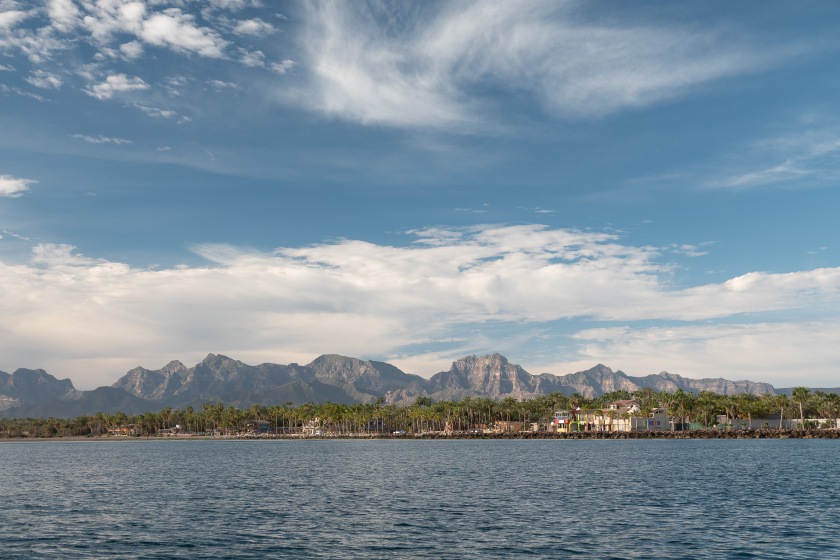
Blue whales, Balaenoptera musculus, breed in the Sea of Cortez (aka the Gulf of California) so we traveled to Loreto in Baja California to find them.
DSC09647

They are the largest animal on earth. One was measured at 98 feet, and 80 feet is common. Here is a photo next to one of our boats. The boat measures 23 feet, and only about 1/3 of the whale, the long grey shape to the right of the boat,  is visible above water:

Blue whale

Or look at the size of this tail, just behind the boat:

DSC09760

They are baleen whales, and eat only krill, astonishing that they can grow to such size.

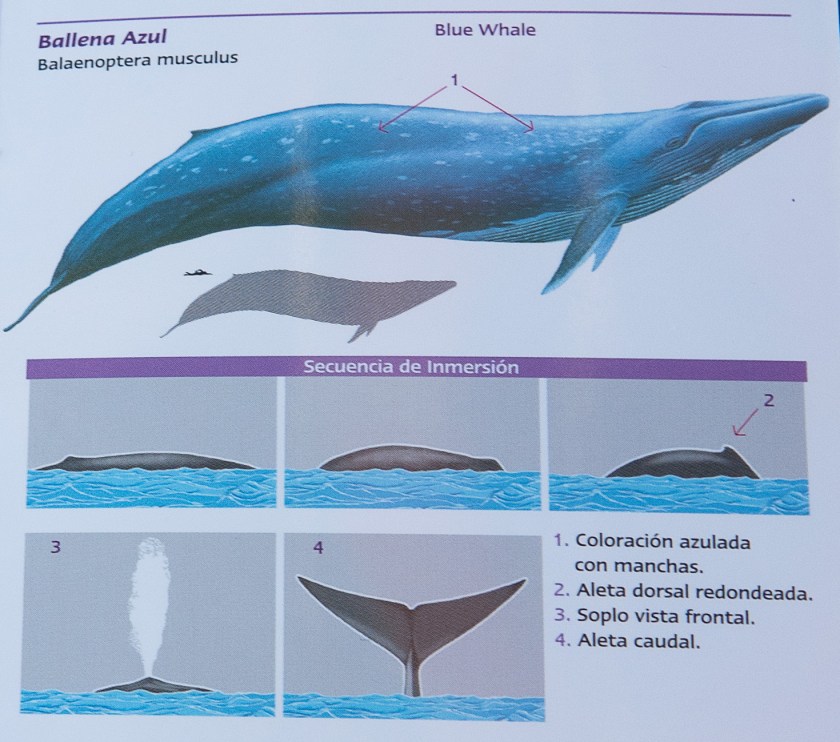
To get a sense of what the whole animal looks like below water, look at this; just above the second image is a tiny shape of a human diver, for scale:
Blue whale

From the small boat,  you only see bits. Here is one blowing, the first part you see above water:

Blue whale

When they dive, you see the muscles that lift the tail, the powerhouse which moves their 190 tons mph at up to 25 knots in short sprints:

Blue whale

And then the tail lifts:

Blue whale

And down she goes

Blue whale

The markings under the tail help in ID-ing individual whales: the one just above is called Calabaza.  The Loreto area has 10-15 whales during the breeding season.  The Sea of Cortez is thought to have about 50 at this time of year.

Wikipedia says: “ The International Whaling Commission catch database estimates that 382,595 blue whales were caught between 1868 and 1978. The global blue whale population abundance is estimated to be 10,000-25,000 blue whales, roughly 3-11% of the population size estimated in 1911.”  Killing blue whales was outlawed in 1967, and the Eastern North Pacific population is back to close to pre-whaling levels of around 1500. Currently the major threats include ship strikes, as can be seen by the tail below; climate change, which may reduce krill populations; man-made noise pollution; and microplastics.

DSC09748

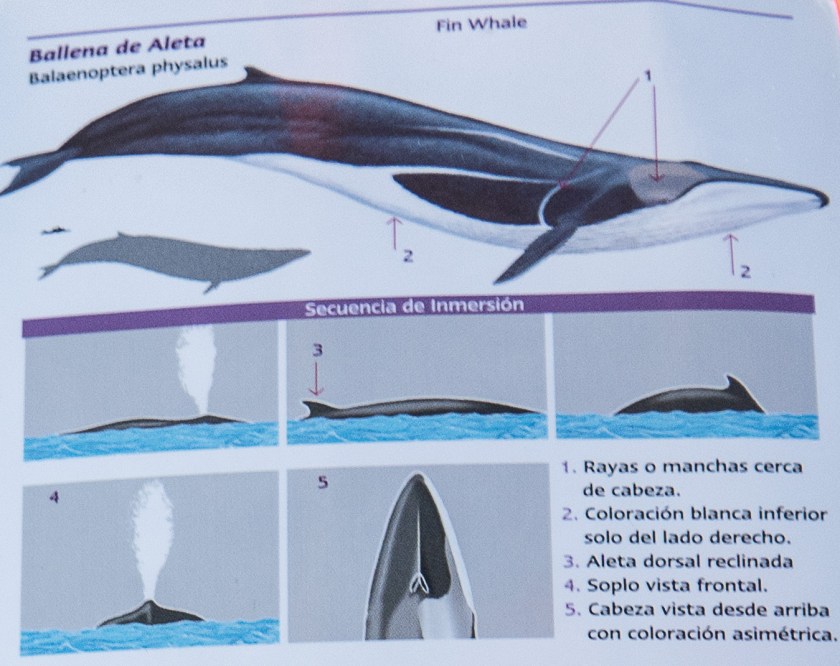
Also in the Sea of Cortez are Fin Whales, Balaenoptera physalis, which are nearly as large. Here is what to look for, and then a photo of one of the pair that we saw:
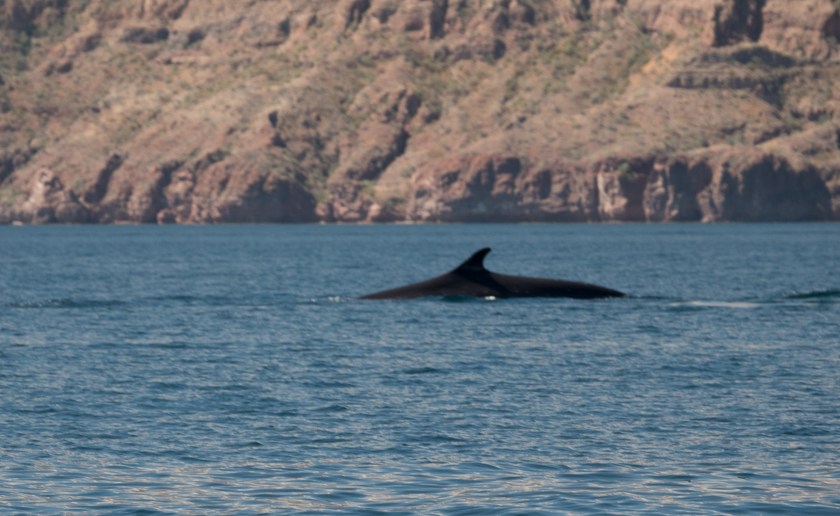
Blue whale

Fin whale

If you compare the Fin Whale’s dorsal fin above to the Blue Whale’s very tiny one below:
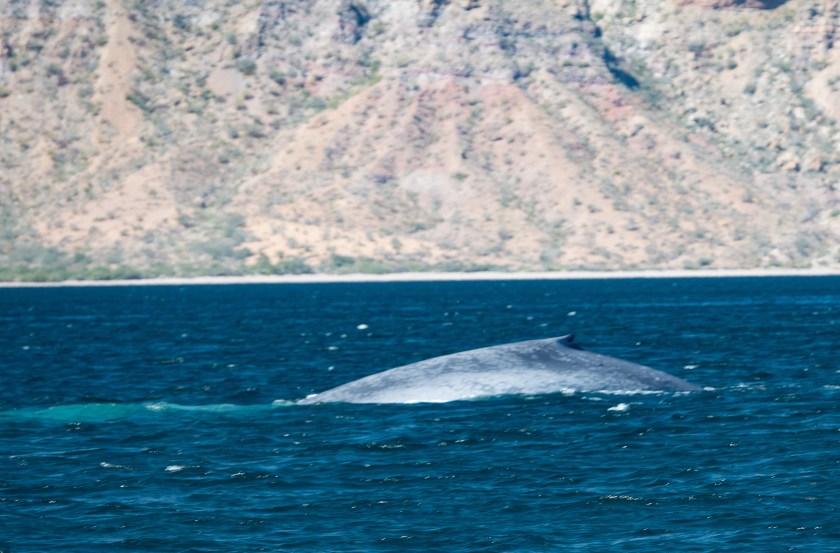
Blue whale

you can then understand why the guides think that this next one is a hybrid:
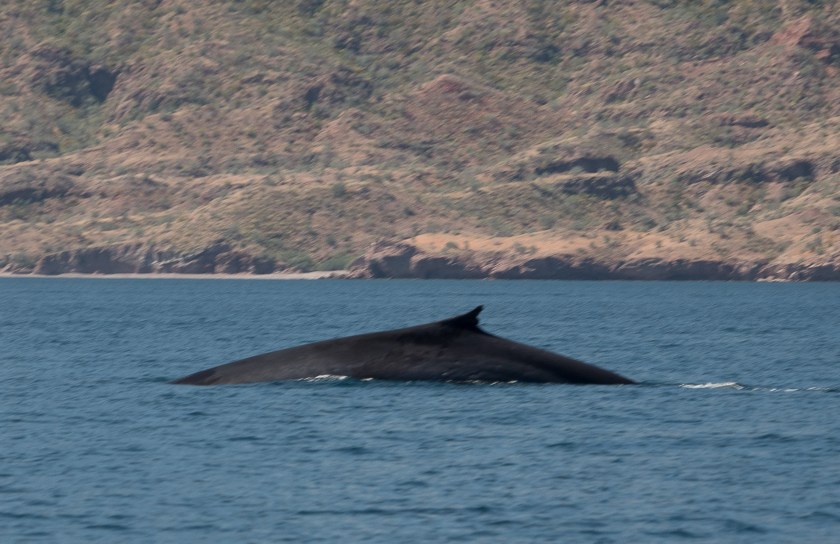
Blue - fin whale hybrid?

Near Loreto, even the clouds look like whales:

Blue whale

PS The first underwater footage of a blue whale was captured in 1980 by Krov Menuhin, a neighbor of mine in England. You can see it here; the blue whale section starts 15 minutes in:

PPS Moby Dick was a sperm whale, and although Herman Melville claimed he was the biggest creature that ever lived, at a maximum of 68 feet this is just not true! Just for fun, and for the grandkids, look at this blue whale size comparison graphic :

blue_whale_size

[Taken from https://www.ocean-institute.org/general-information/blue-whale ]

PPPS Our guide for the Sea of Cortez was the charming Maria Narjela.

PPPPS I entered our sighting of Calabaza into Happy Whale, a registry. I get notified when he is seen again. He was seen four years later in February 2024, which is good news.

Caracaras: carnal carnivores

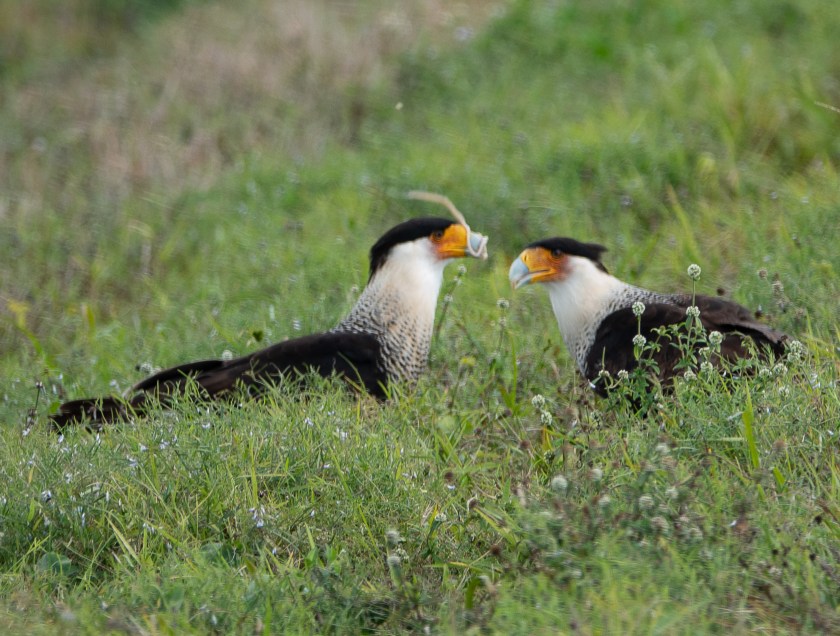
The Crested Caracara, Caracara cheriway, is the Beau Brummell of birds, a dandy with a certain air, sometimes called the Mexican Eagle. And yet he is a falcon, not an eagle, and merely a lowly scavenger.

Caracara

Caracaras are mainly a Central and South American species, and in the United States, they are only found in small areas of Arizona and one tiny area in Florida, south of Lake Okeechobee, where I was lucky enough to find myself.

It is spring and they know it:

Caracara

They are monogamous, staying together as a pair for many years. The mechanics of bird mating are not obvious: here is a good explanation for those of a prurient turn of mind!

https://www.thespruce.com/how-do-birds-mate-386108

I saw two different pairs, both feeding on small mammals. This pair were “sharing” a dead baby raccoon:

CaracaraCaracara

I am afraid that is not spaghetti that you see below.

Caracara

And after dismembering it they took bits off to safer perches to eat:

Caracara

They like open country, and this countryside (Dinner Island Ranch Wildlife Management Area) was amongst vast flat industrial-scale sugar-cane farms; they seemed to like hanging out in the sheds and barns nearby.

On the wing, they are acrobatic and elegant, with a wingspan of up to four feet:

Caracara

The namecaracara” is supposedly from the Guarani Indian traro-traro, after the rattling vocalization that they produce when upset:

My excellent guide Bob Branham knows these parts like the back of his hand, and showed me many good things, especially raptors, some more of which I will show you in the next few weeks! And if you want to see his photos, way better than mine, here they are:

PS I am off to Baja California in the hope of seeing both blue and grey whales. I will report back in two weeks, and I will go silent till then..


Lions: Feast or famine

[I am still organizing my Florida photos, and anyway one can have too many bird posts, so I am returning to Tanzania for perhaps the last time.]

We saw this pride of three lions, a mother, sister and and near-adult son, on several separate occasions in the Ruaha.

lions

They appeared to be struggling. We watched them stalking game, but never getting close enough to launch an attack. They were thin, ribs showing:

lions

The family dynamics were interesting. When the mother approached her sister,  the sister snarled,

lions

But when the mother then approached her son they showed clear affection, gently rubbing noses.

lions

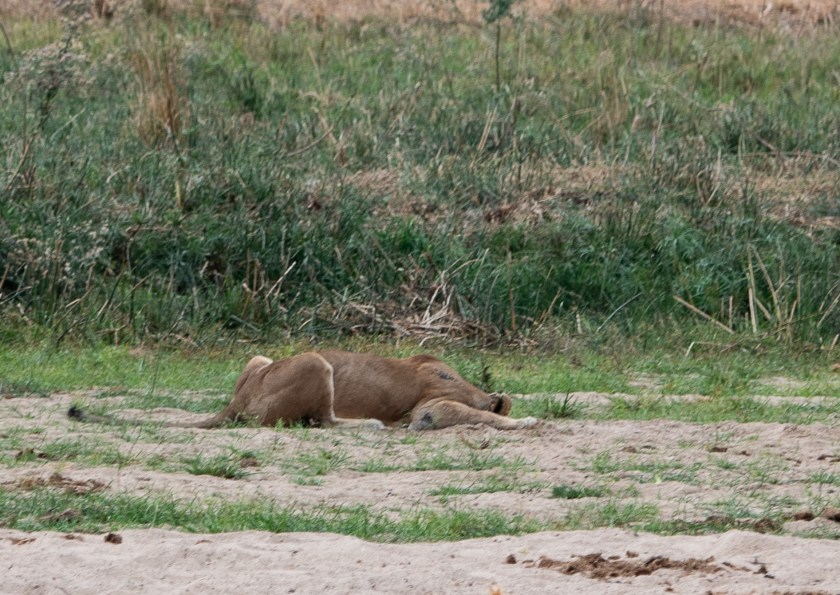
They looked skinny, but sometimes they killed, and late one afternoon we found them, bellies swollen, lying in the setting sun:

lionslions

We didn’t see the actual kill, so this photo is of a different lion, in the Serengeti,  where the rain had begun, and it is quite clear what it had just killed:

lionslions

Survival of the fittest.

P.S. Lions feed every three or four days, and need 5-7kg of meat a day. But they can go without food for more than a week and then they gorge, eating up to 50kg of meat at a sitting – almost a quarter of their weight.

The pelican and the seagull

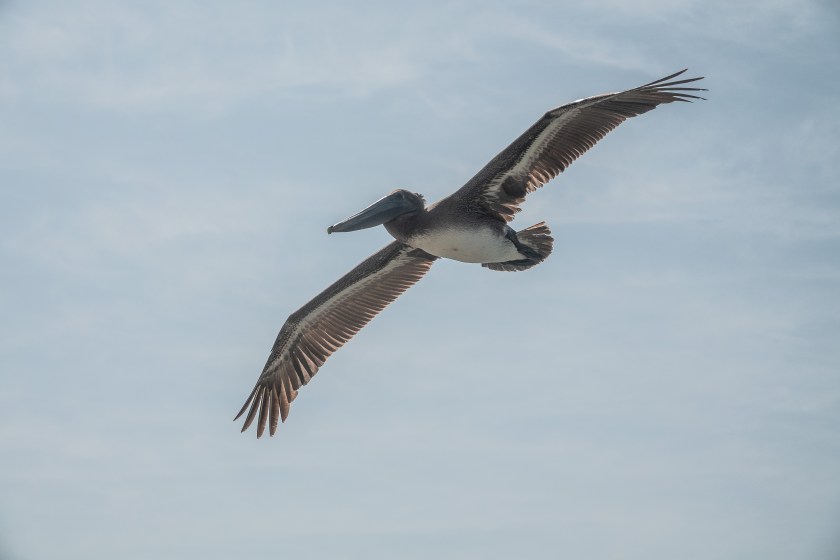
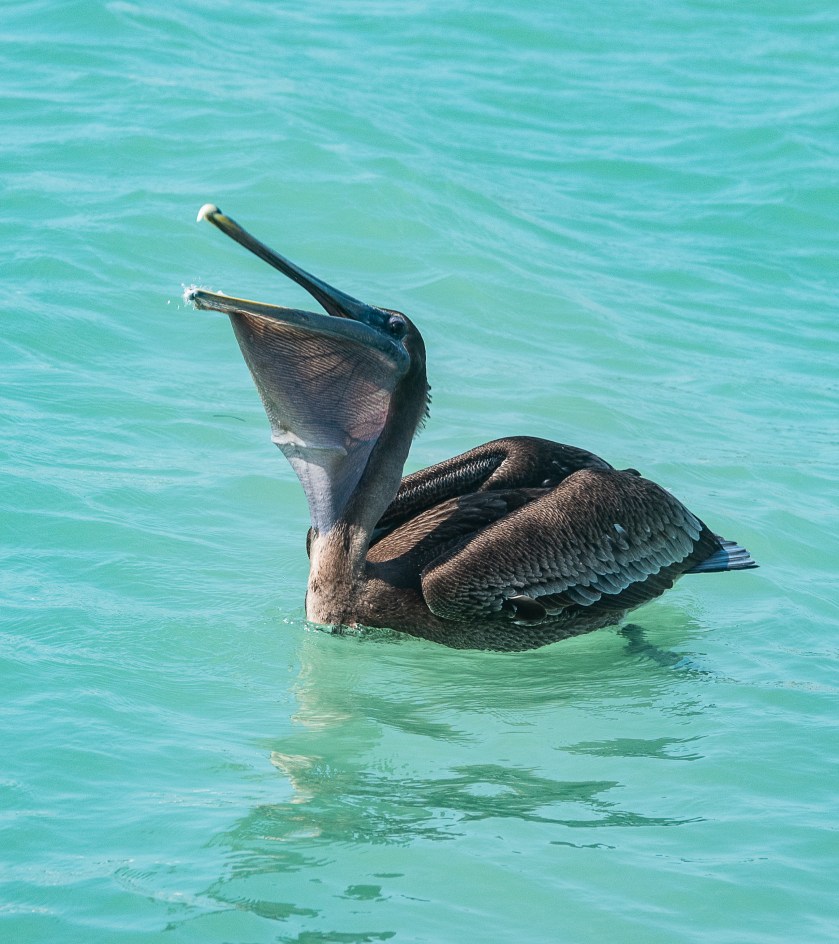
To escape the New England winter, we went to visit friends in Florida for a week. In Sarasota, lounging on the beach, I watched the brown pelicans, Pelecanus occidentalis, soaring on those astonishing wings (their wingspan is over seven feet, much the same as a bald eagle):

DSC09527

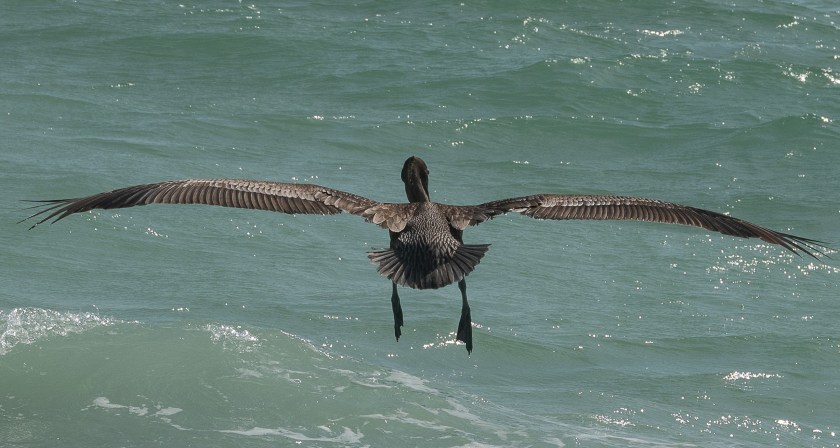
This one is skimming the waves, looking for fish:

DSC09529

and surfing

DSC09532

The adults have yellow heads:

DSC09426

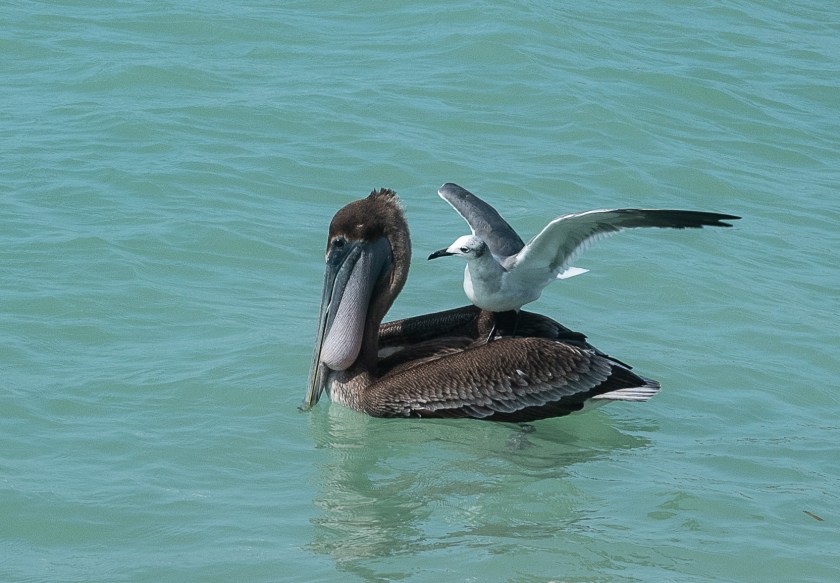
I was watching the pelicans, but the seagulls were watching them too. The moment this juvenile pelican raised its beak out of the water, pouch full of fish, the seagull flew in and stood on its back.

DSC09558

I’m not sure if they had been aiming for the same fish, and the pelican got there first, or whether the gull was trying to steal its catch. Whichever, it failed, and flew off.

DSC09559

And the victorious pelican swallowed a sizable fish, whose shadow is visible through the pouch.

DSC09560

That ridge across the pelican’s gular pouch is the remnant of the hyoid bone. Interesting trivia factoids: (1) The pouch can hold 3 1/2 gallons of sea water. (2) The pelican has no tongue.


The Curious Incident of the Coyotes in the Night-time *

[This post is unavoidably scatological:  if that’s not your thing, skip over the fifth photo and cut to the video…..]

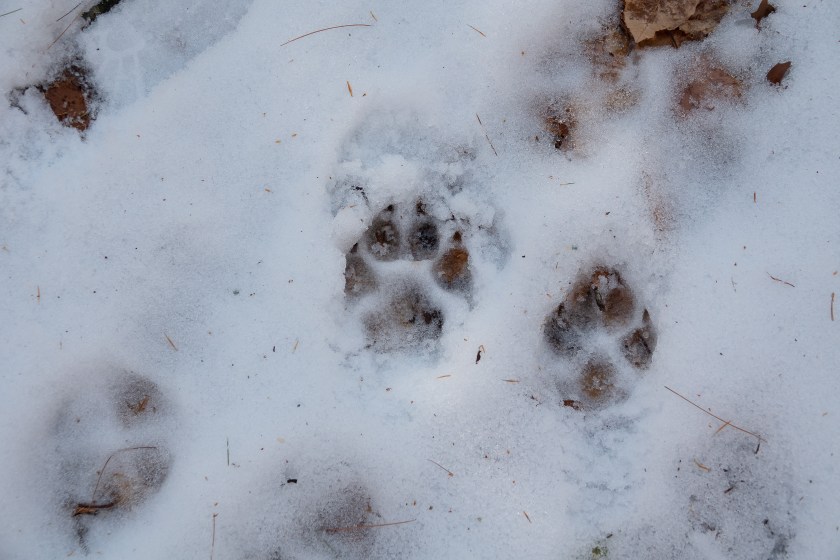
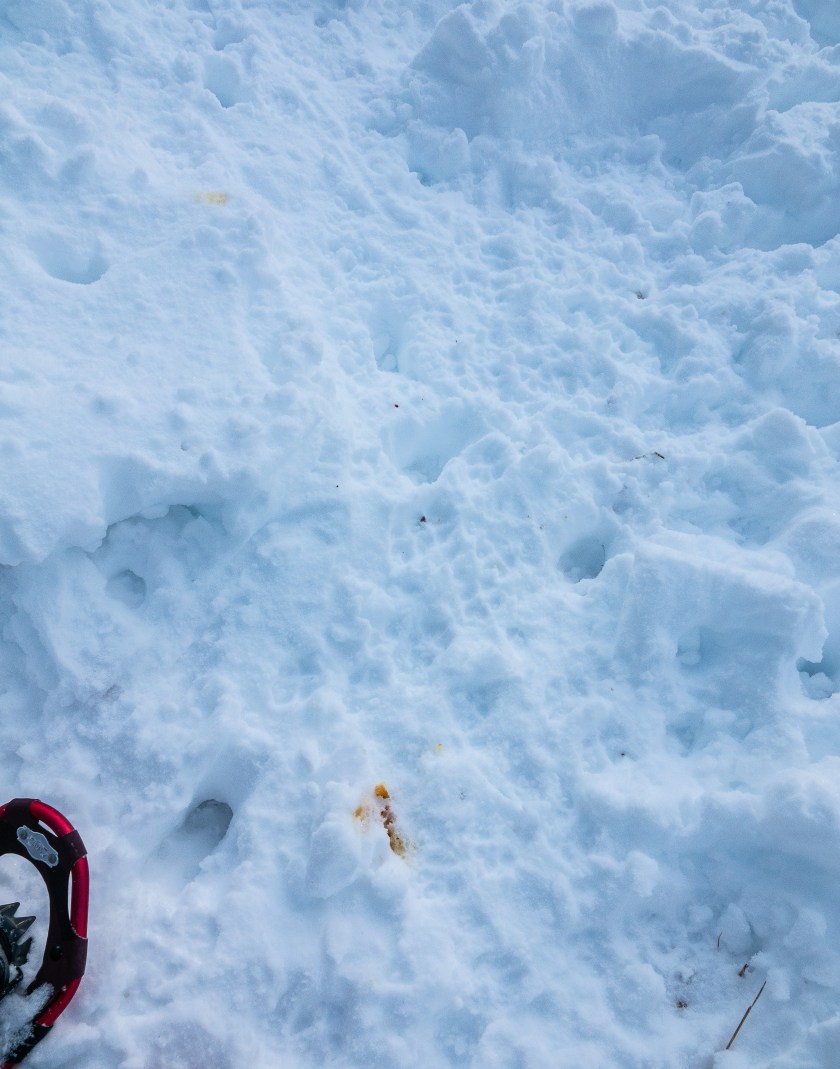
Coyotes, Canis latrans, are nocturnal or crepuscular (one of my favorite words, meaning active at dawn and dusk) so I very rarely see them. Instead, I look for evidence.  It is easier in the winter; there are foot prints:

Coyote tracks

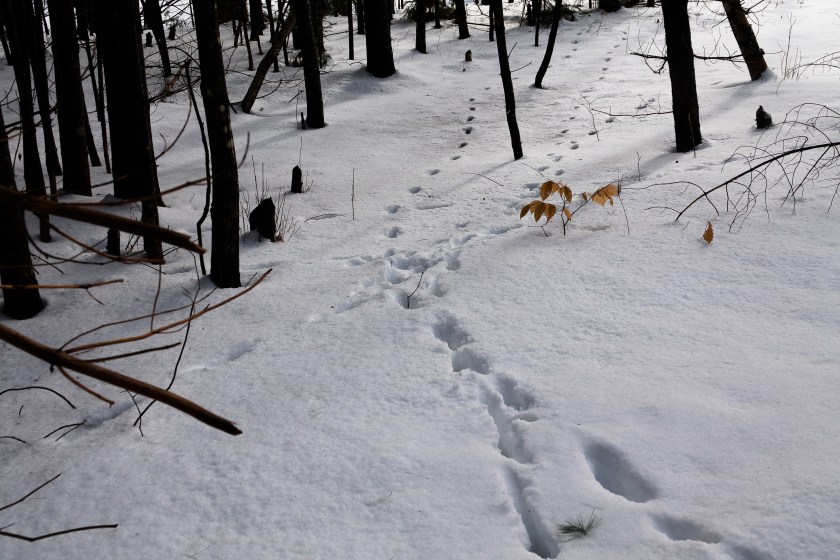
The prints make trails: these ones had a total of 10 trails converging on (or perhaps diverging from) a single cross-roads. I have no idea why; it wasn’t scent-marked, they didn’t seem to stop, but none of them missed that spot. It might have been one coyote going backwards and forwards on five different occasions, or 5 different coyotes each on their own mission. Use your imagination.

coyote crossroads. 10 sets of tracks. 1 coyote on 5 return trips?? etc

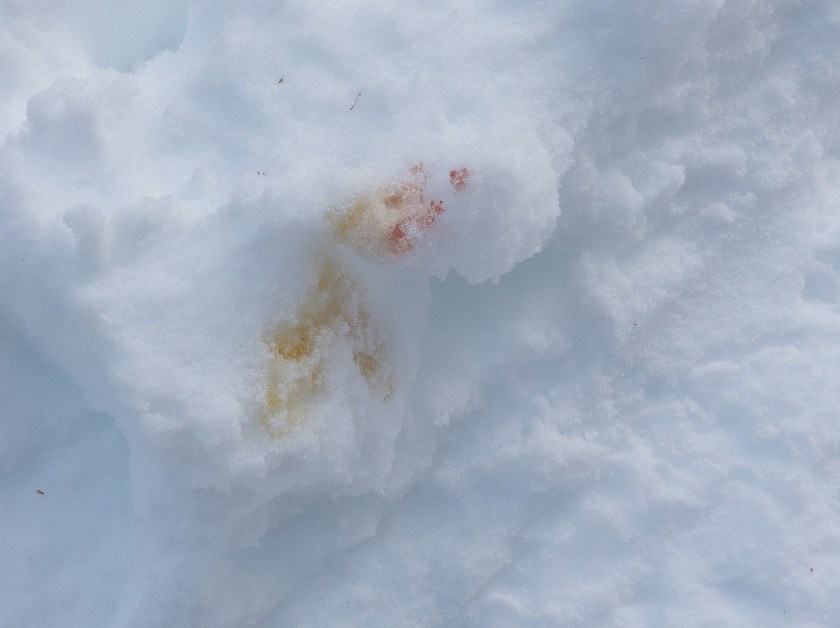
I’m pretty sure that at least two were around. This female had marked the trail with her urine, and you can also see that she was in season:

female coyote urine

Underneath the apple tree, it looked as though two had come together. One spot of urine was female, visible at the bottom of this picture, and another lacked blood, so I think it was a male. The two marks were on the edges of a patch of snow that was trampled down by many, many coyote imprints, as if they had been there for some time, and I like to imagine it was a tryst.

coyotes mating??

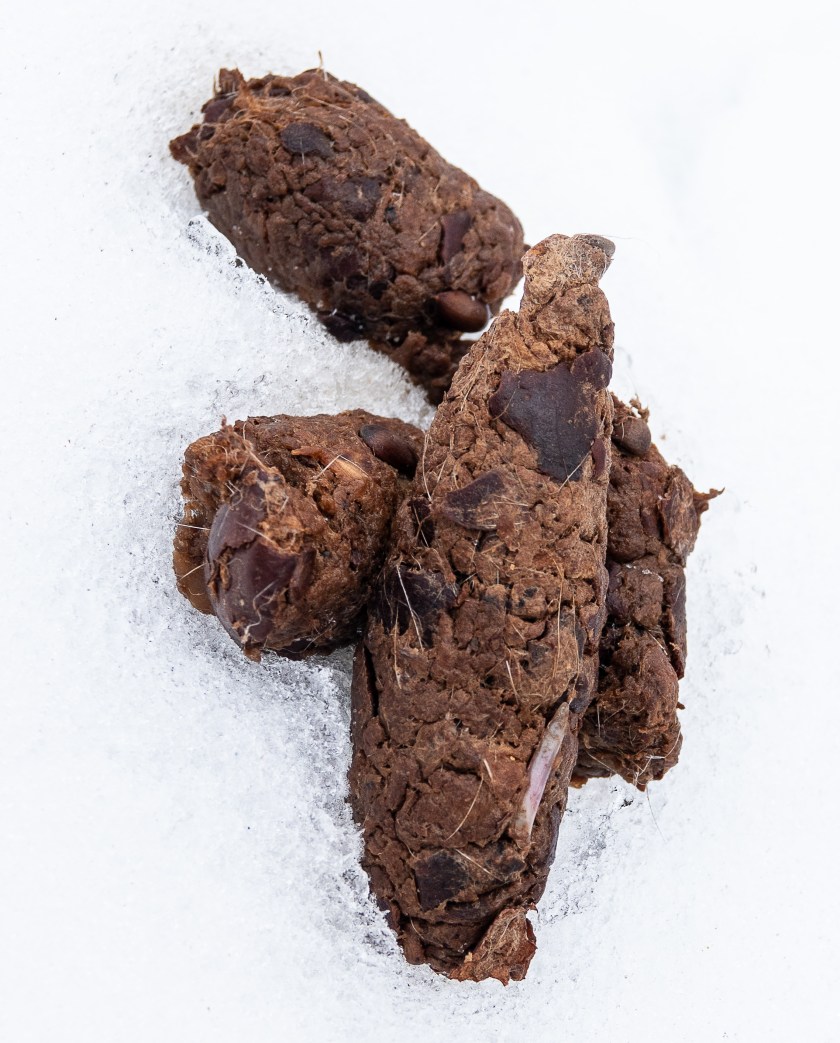
A couple of weeks later, under the same apple tree, they had been feeding extensively. There was scat everywhere, and if you can bring yourself to inspect it closely (not everyone’s cup of tea), you will see a sliver of bone, lots of hair, and chunks of undigested rotten apple from the tree above.

Coyote scat, with bone, hair and rotten apples

We think of coyotes as predators and carnivores, but actually they are omnivores, as this scat makes abundantly clear.

So although I still hadn’t seen the coyotes, they were certainly there. I put up a game camera for a couple of days to see what I got, and meanwhile I heard them yipping at 3am, from just that area. In the morning, I checked the camera videos. (Ignore the date and time on the camera, I forgot to re-set it!).

The social unit for coyotes is an adult pair, and these look like nice fat healthy ones! Eastern Coyotes are bigger than Western ones, and they can weigh up to 40lbs. If they have mated, she will give birth in about two months, and I will keep my eyes open and report back..

Incidentally, the coyote population in Maine is booming, They only moved into the state in the 1930’s, and  there are now thought to be about 12,000 of them.

*With apologies to Mark Haddon, from whose wonderful book I have stolen my title.


Thirsty? Follow that elephant

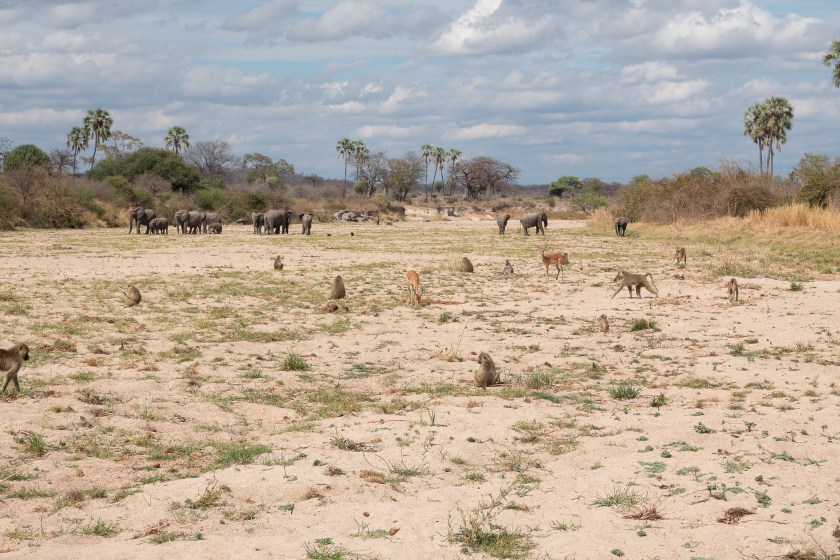
In the Ruaha National Park in Tanzania, there is virtually no surface water in early October. The rivers are still there, but they are flowing underground, so they are called sand rivers.

elephants, baboons, gazelles

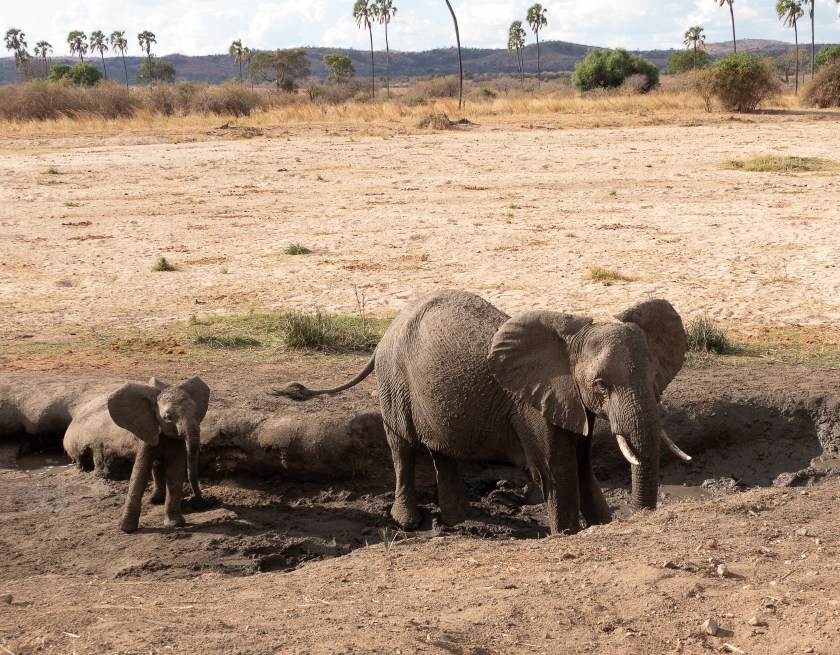
Elephants find places where the water is near the surface, and create mud wallows:

elephants

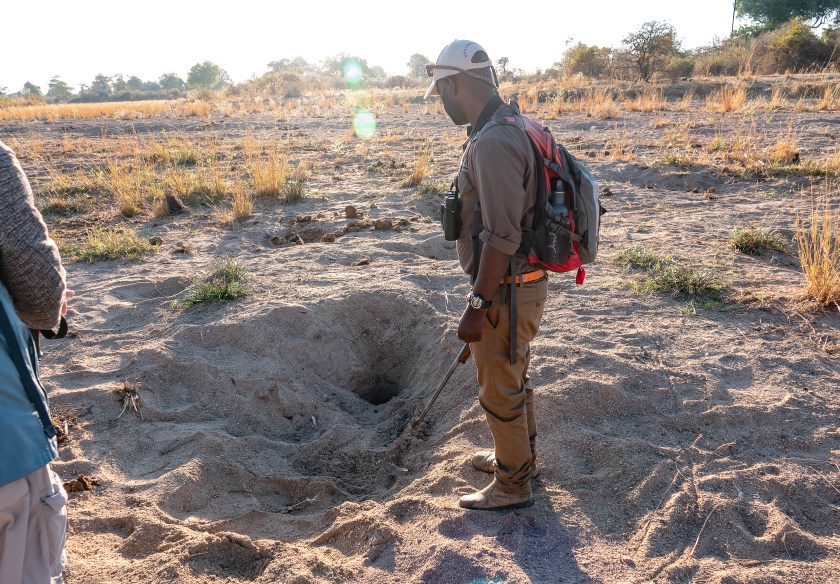
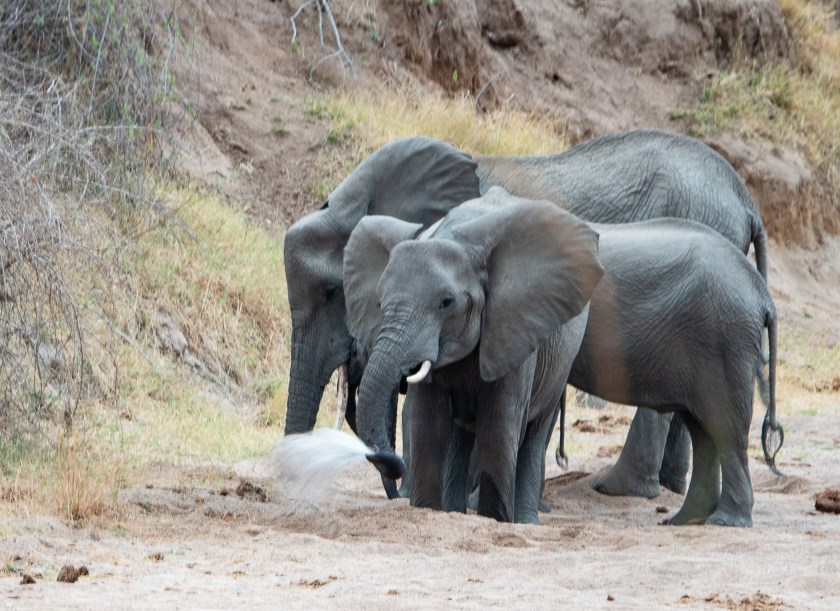
and they drill deep artesian wells down into the sand to reach the clean water:

elephant

This is enough to drink, or have a shower:

elephants

But for other animals it is harder. Some get all the water they need from their food, but some, including lions, need to drink. So they wait till the elephants have moved on, and use their holes:

elephant and lion encounter

The few rivers that used to have year-round water, especially the Great Ruaha River itself, are now regularly dry for several months each year, largely because of over-use by upstream rice farms, which were originally financed by the African Development Bank. The consequences have been dire, with a substantial decrease in populations of the larger animals such as elephant, buffalo and lion.

https://www.ecowatch.com/great-ruaha-river-tanzania-2523947047.html

This remote Ruaha-Ruangwa ecosystem has long been famous for its large elephant populations but the combined pressures of water shortages and direct human aggression have resulted in a horrifying decline. In 2009, the population was 30,000 before plummeting to only 8,272  in 2014, a 76 percent decline over five years. The largest single cause of this is poaching. (Figures from Great Elephant Census 2014).

However, there are reasons for hope.  The 2019 survey showed a big rebound, and the population is now thought to be stable at around 20,000 (although the survey area may be sightly different which makes it hard to compare the numbers directly.).

https://newsroom.wcs.org/News-Releases/articleType/ArticleView/articleId/13470/Massive-Wildlife-Survey-in-Tanzania-Points-to-Elephant-Recovery-In-Key-Landscape.aspx

The birch seed diet

[I find that right now I have two different strands that I want to write about. There are still stories left to tell from Tanzania, but here now in Maine it is deep winter, and that is both beautiful and timely. So I think I will oscillate between the two for the time being. Today, winter prevails.]

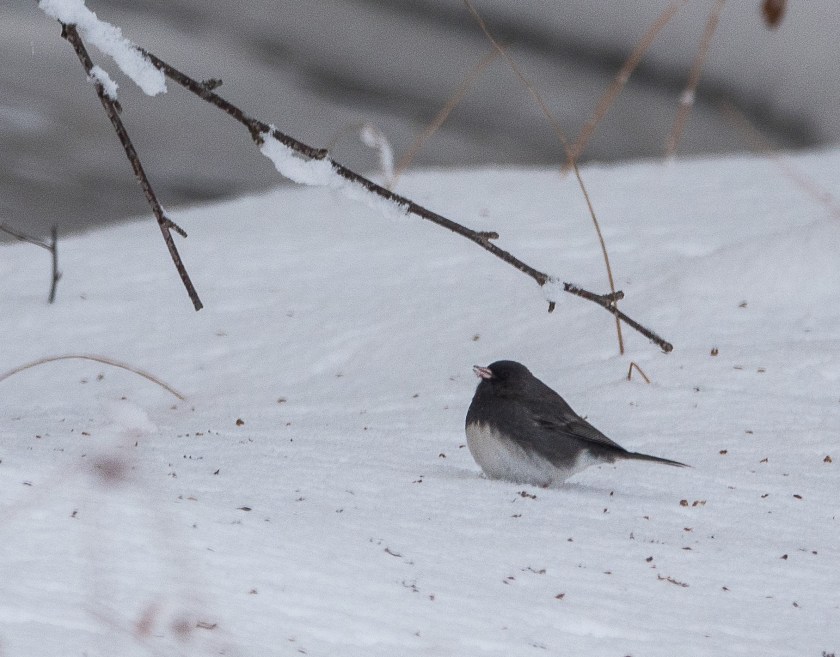
When snow is thick on the ground, food is scarce.  The Slate-eyed Junco, Junco hyemalis,  is a tiny bird, yet it somehow survives through the long hard Maine winter.

DSC08351

Some food sources are easy to see, like these apples rotting away on the tree:

DSC08249

Others are so tiny it is hard to imagine that they provide enough food even for a junco: this one is feeding away but on what?

DSC08278

A large area of snow beneath two gray birch trees was covered in what looked like wood-shavings:

DSC08394

These are the seeds of the birch tree, whose long slender catkin has blown down in the storm, and has been swiftly dismantled by the juncos:

DSC08399

Each seed is minute, with tiny wings, and two little antennae:

DSC08380

The gray birches growing a few yards down the stream have shorter fatter catkins,

DSC08503

and seeds with smaller wings (this seems to be a double-yolker!) :

DSC08499

They gobbled these up too.

The seed is about 2mm across, and 2000 seeds weigh about one gram. The amount of nutrition in these seeds is about 5 Kcal/g, and a junco needs 28 Kcalories per day to survive in the winter, so it needs to eat more than 5g of these minute seeds, or 10,000 seeds. Of course, its diet is varied, and other foods offer more calories, but you can see why it never stops eating. To get my 1500 Kcalories a day I would need to eat 300g of these seeds, or 600,000 seeds. I think I prefer good bread, good cheese, and a glass of red wine.

Sources: 

The calorie data on birch seeds is based on white birch seeds, and is taken from Grodziński, W., & Sawicka-Kapusta, K. (1970). Energy Values of Tree-Seeds Eaten by Small Mammals. Oikos, 21(1), 52-58. doi:10.2307/3543838

The calorie data on juncos is taken from Seibert, H. (1949). Differences between Migrant and Non-Migrant Birds in Food and Water Intake at Various Temperatures and Photoperiods. The Auk, 66(2), 128-153. doi:10.2307/4080440

I am responsible for the maths!

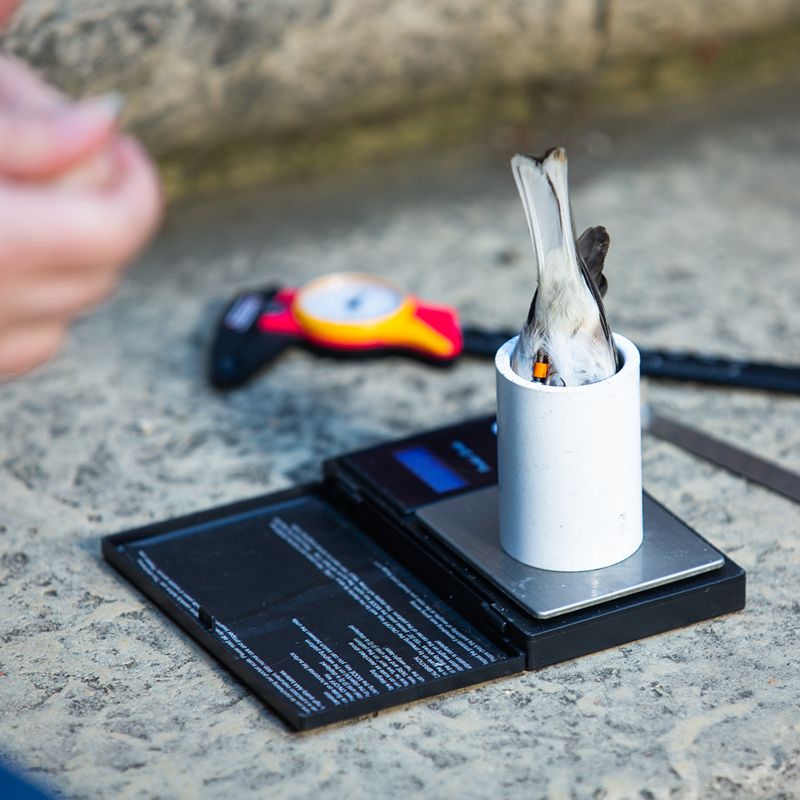
PS How to weigh a junco, from a 2020 article in Nature on the work of Pamela Yeh:

” A dark-eyed junco being weighed: “We have a digital scale,” says Pamela Yeh. “We’ve put a bird head-first in the cup, and it’s dark in there, so he doesn’t move very much.”

d41586-020-00276-1_17602046


How the elephant masters its trunk 2: outreach

Apart from eating, trunks are good for a multitude of other things:

Scratching:

elephants

Making friends

Elephant Orphanage. They are returned to the wild whenever possible.

Wrestling matches:

Male elephants jousting, for fun.

And when you are all grown up they are good for protecting and corralling your baby:

elephants

The multipurpose trunk can also be used to make noise, loud noise! Here are three different types of trumpeting from the Elephant Voices website:   https://www.elephantvoices.org/elephant-communication/acoustic-communication.html

But the best trick of all is to use the trunk as a snorkel, to breathe underwater. This video shows what I mean:

There is an astonishing underwater video out there of a snorkeling Asian elephant in deep water in the Andaman sea, but it is part of a tourist show, so I am not confident that the elephant is being properly treated, and I have chosen not to link to that video.

According to Rudyard Kipling, this wonderful trunk is all the crocodile’s fault…

elephant2


How the elephant masters its trunk 1: the basics

[This is my 200th post. I wonder when I will run out of natural wonders to share?]

Learning to use your trunk is tricky. Young elephants, like young children have to practice their fine motor skills.

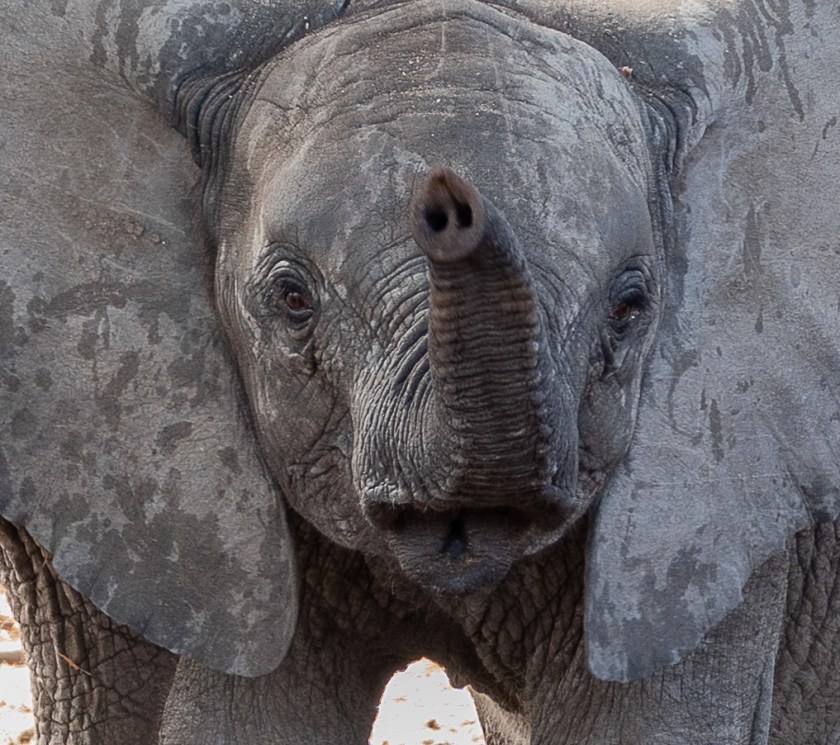
Everybody knows that a trunk is an elongated flexible nose (it is actually the nose fused with the upper lip), and indeed if you look at it from underneath, the anatomy is quite clear, including the two nostrils, which go all the way up! And it can still be used to sniff out two sweaty tourists in their jeep.

elephants

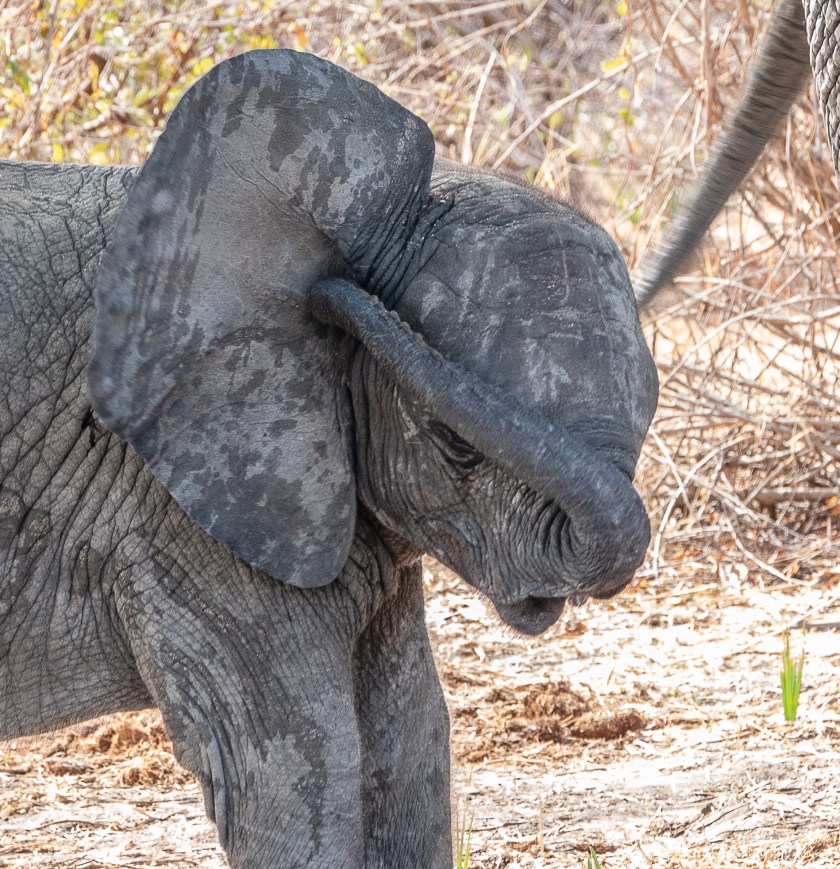
To nurse, you have to get it out of the way, so your mouth can reach the teat:

Elephant

But the trunk comes into its own when you need to reach the water at the bottom of a hole that your mother has dug deep in a dry sand river (an underground river):

elephants

You kneel down, suck up the water, then squirt it out of your trunk into your mouth. You can no more drink it through your trunk than we humans can sniff water up our noses and down our throats. Occasionally you get sand by mistake, but that’s fine if all you want to do is cool down:

elephants

The African (but not the Asian) elephant’s trunk has two flexible “fingers”, that can grasp things tightly:

DSC08936

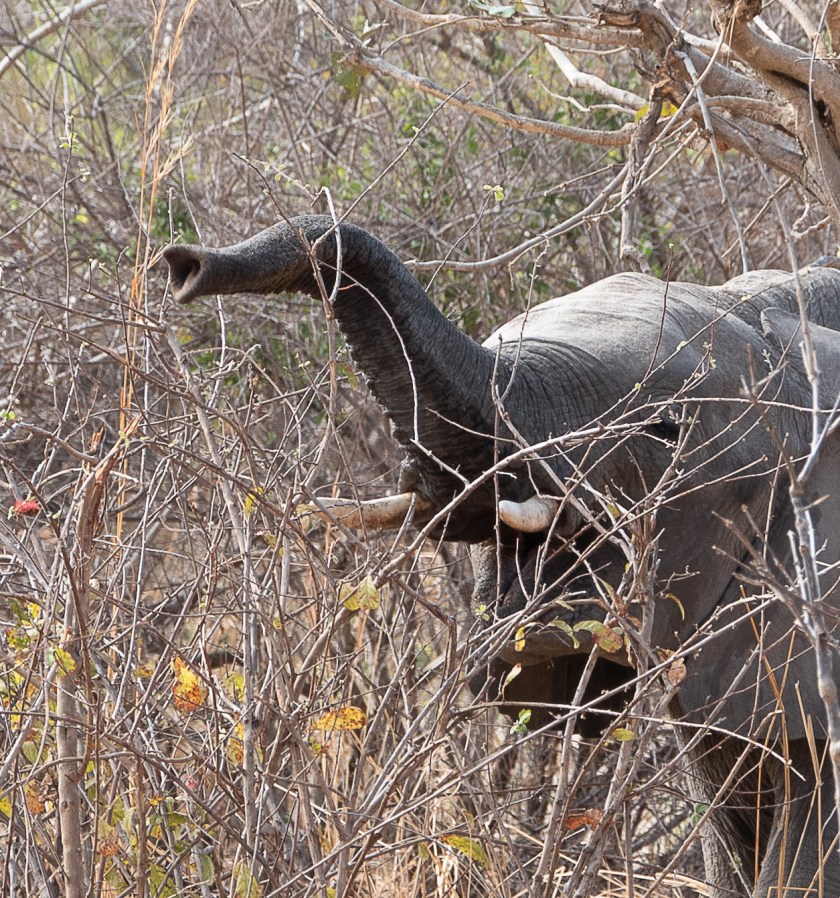
As you get older, you become so dexterous that you can pick tiny leaves and flowers off almost bare spiny bushes:

elephants


elephants

Next time: It’s not just for eating and drinking.

P.S. For the technically minded amongst you, the elephant’s trunk, like our tongues and like octopus arms, is a muscular-hydrostat. (Kier and Smith 1985). It has no bones to keep it stiff. It is a cylinder of fixed volume, so to make it longer, you must make it thinner. It has longitudinal muscles, and transverse muscles, and bending it requires the use of both. So a baby elephant learning to use its trunk to pick leaves is a bit like a baby human learning to use its tongue to make speech sounds. 


Leopards Redux

[I hope you enjoyed your break from my blog posts, and the first 2020 posts’s 7000 mile detour back to Maine. I am not quite done with leopards, though. No self-discipline, really.]

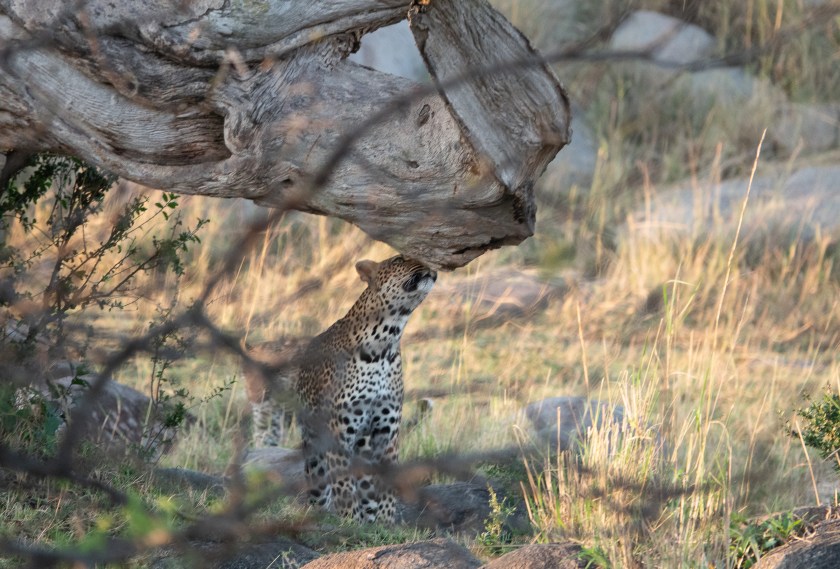
This leopard in the Serengeti had two teenage cubs, and they were returning from hunting early one morning. She rubbed herself against an overhanging tree to scent-mark her territory, sniff another leopard’s scent, or maybe just scratch an itch:

leopard

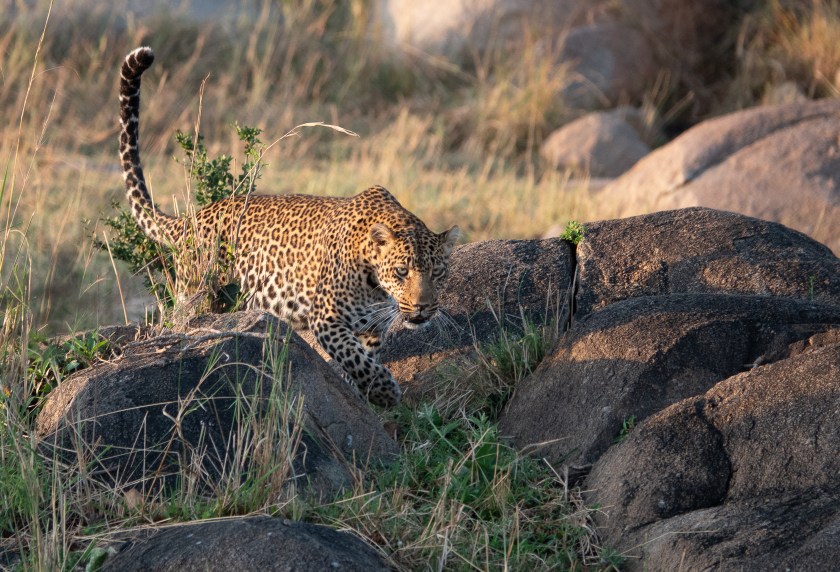
Then she moved towards a large rock formation, where she had stashed the kill:

leopard

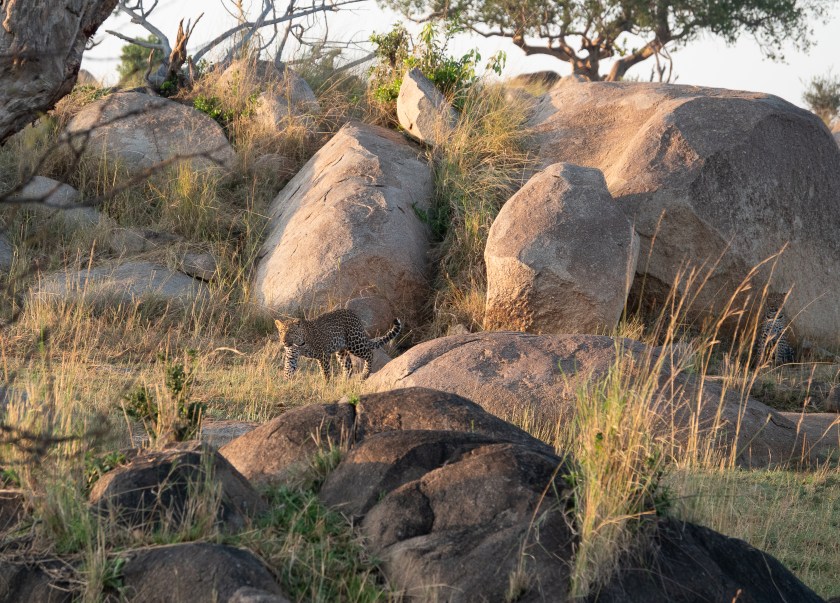
This shot gives a better sense of the rocky outcrops the leopards  favor; they are the perfect place from which to mount an ambush of an unwary passing prey animal:

leopard

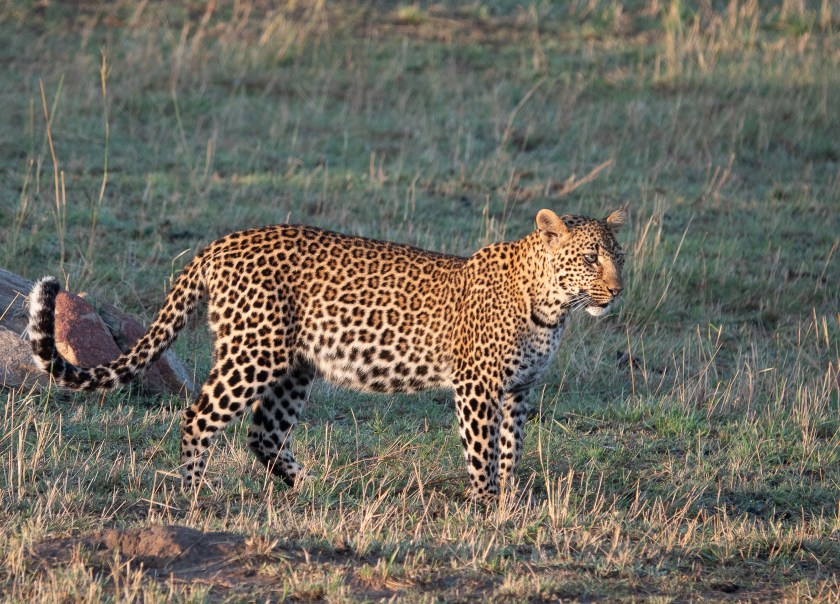
And here is the mother again, posing like a 1930’s Hollywood starlet, except that this coat is truly hers :

leopard

A different leopard, but I couldn’t resist the Eartha Kitt vibe:

leopard

The IUCN classifies the leopard as Vulnerable, and the fur trade is one major threat to their survival. Apart from international buyers, local people use the skins as ceremonial garb, so a project is trying to encourage the use of synthetic furs instead, and seems to be having a surprising amount of success:

https://www.panthera.org/furs-for-life

Still,  I yearn for the days when there was a balance between wildlife survival and local traditions, undistorted by the outside demand for skins.

leopard