Charlotte cocooning

European Garden Spiders, Araneus diadematus, have what is called a holarctic distribution, throughout Northern Eurasia and North America. They are quite large, with females measuring up to 20mm (If you are a regular reader you have seen them weaving their webs in my posts).

During most of the summer their bodies are huge and swollen, like this:

P1030229

But at the end of the summer it all changes. This new svelte female has laid her eggs in this orange cocoon, then woven a mesh over the top, and now guards them.

DSC09783

Here you can see the orange egg sac more distinctly, and the surrounding white net:

DSC09894

It is getting cold, and both these mothers will soon die, but the eggs (up to 800 of them each) survive all winter and hatch in the spring; I took this picture last May.

P1120149

Here is a close-up of the spiderlings:

P1120188

I think these common spiders must have been E.B. White’s inspiration for Charlotte.

The nerds among you might enjoy reading this detailed description of how she creates the egg sac and cocoon:

Before the female starts making her egg sac, she withdraws for several days. She then spins a thin layer of single, tightly-woven silk threads. The first layer is molded by her abdominal movements into a disk, known as a basal plate. Then she crawls underneath the basal plate and continuously turns around in circles spinning the cylindrical wall. The palps are held in contact with one side of this wall while spinnerets are placed on the opposite wall. After about two hours, the cylindrical wall grows to 5 mm in height. Cocoon size is directly related to the size of the spider, but not necessarily to the number of eggs it will hold. Females wait for a few minutes and begins to lay eggs and cover them in a tight pack of silk threads. This becomes the cover plate and the spider continues to add layers of thread to it. The loop mesh ultimately wraps around the entire surface of the egg sac. Females remain close to the cocoon for the next few days in case the threads need repairing. Females die a few days after the egg sac is built. The cocoon will appear unchanged externally while the spiderlings develop for a few months. The offspring emerge in spring and release fine threads of silk from their spinnerets to be carried off by the wind to new locations. Their journey through the air is called ballooning. Wherever each spider drops from the sky will be where its new life begins. (Dewey, 1993; Foelix, 1982; Preston-Mafham and Preston-Mafham, 1996)” from http://animaldiversity.org/accounts/Araneus_diadematus/ 


As summer into autumn slips*

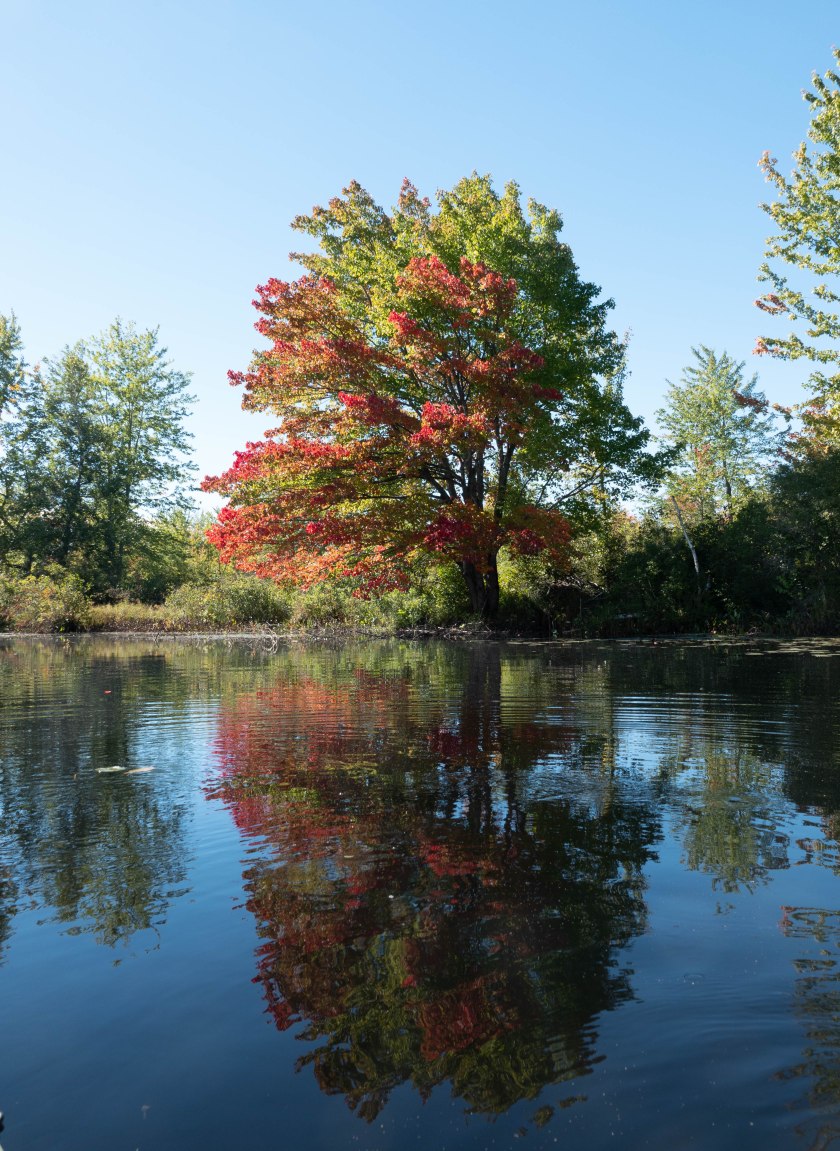
Fall is just about at its peak,

DSC09507

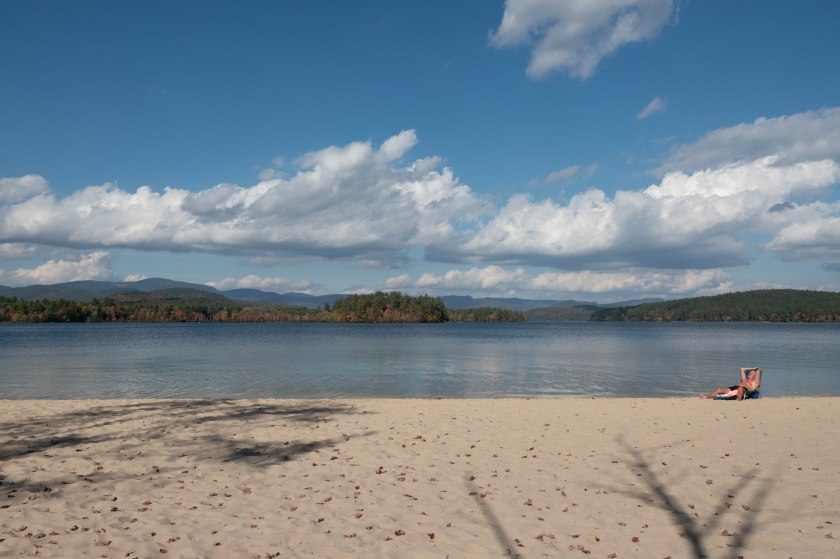
But summer returned yesterday, 81F (27C), and I swam in the lake (freezing).

DSC09790

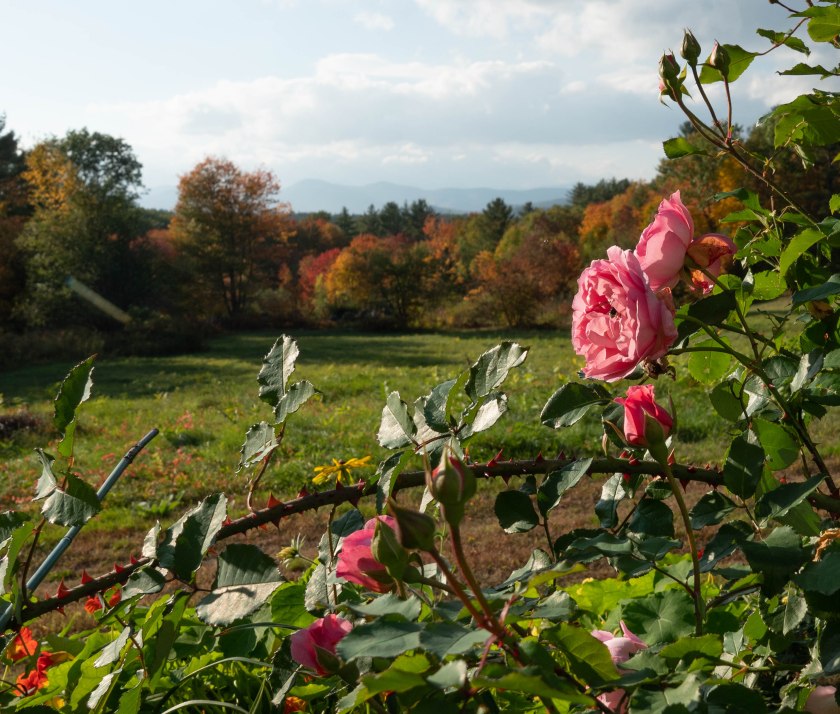
My roses are still flowering on:

DSC09632.

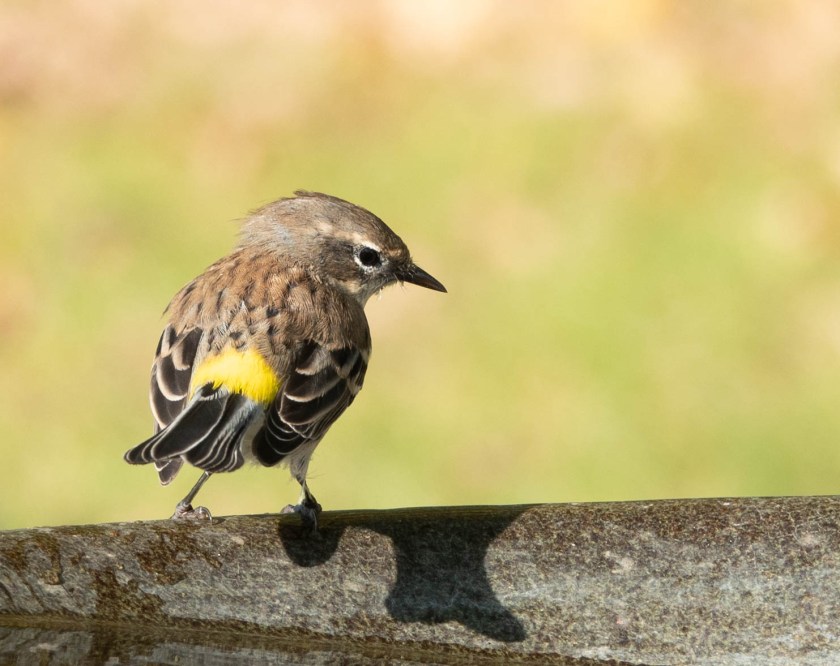
There are birds migrating through that I don’t usually see in midsummer, like this Yellow-rumped Warbler, Setophaga coronata, less elegantly but appropriately known as a butter-butt:

DSC09219

Deep in the woods by a tiny pool, all alone, I found a Solitary Sandpiper, Tringa solitaria. 

Solitary Sandpiper

I have always thought of sandpipers as birds of the seashore, but this one likes shallow freshwater ponds, backwaters, and even ditches. It breeds in the summer in Alaska and Canada, and is passing through Maine on its way to the Caribbean or the Amazon basin for the winter. Not a bad life.

But then I wake up to a morning like this one, and I think perhaps I don’t want to migrate anywhere after all.

DSC09737

* My title is the name of a poem by Emily Dickinson:

As Summer into Autumn slips
And yet we sooner say
“The Summer” than “the Autumn,” lest
We turn the sun away,

And almost count it an Affront
The presence to concede
Of one however lovely, not
The one that we have loved —

So we evade the charge of Years
On one attempting shy
The Circumvention of the Shaft
Of Life’s Declivity.

Fall food: Chapter II

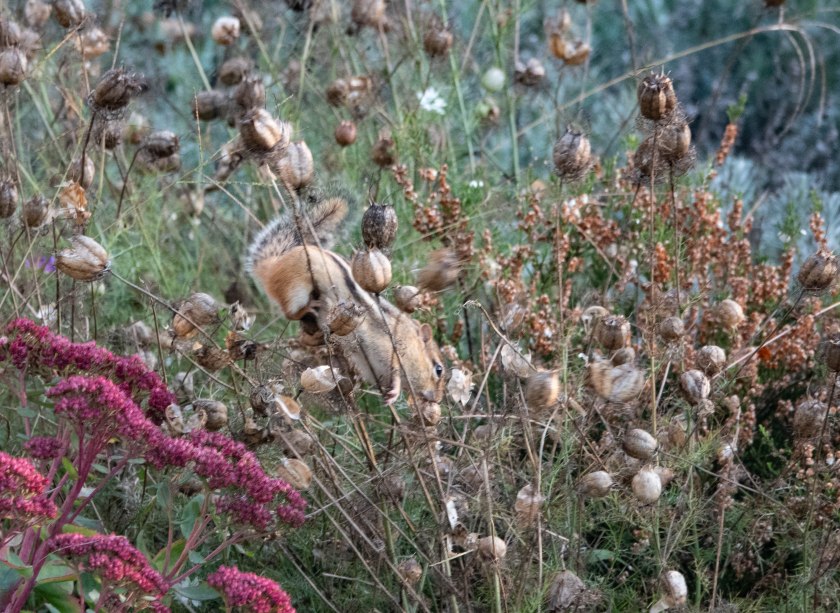
After the vulture, you might prefer the distinctly cuddlier Eastern Chipmunk, Tamias striatus. This one was teetering round in the seedheads of my garden Nigella plants, clinging to the stalks and eating away.

chipmunks


At 2-5oz, or 66-150g, he was just light enough to get away with this, and he reminded me rather of a humungous dormouse. He is airborne, supported only by the flower stalks. You can see that the cheek pouches are beginning to fill up.

chipmunks

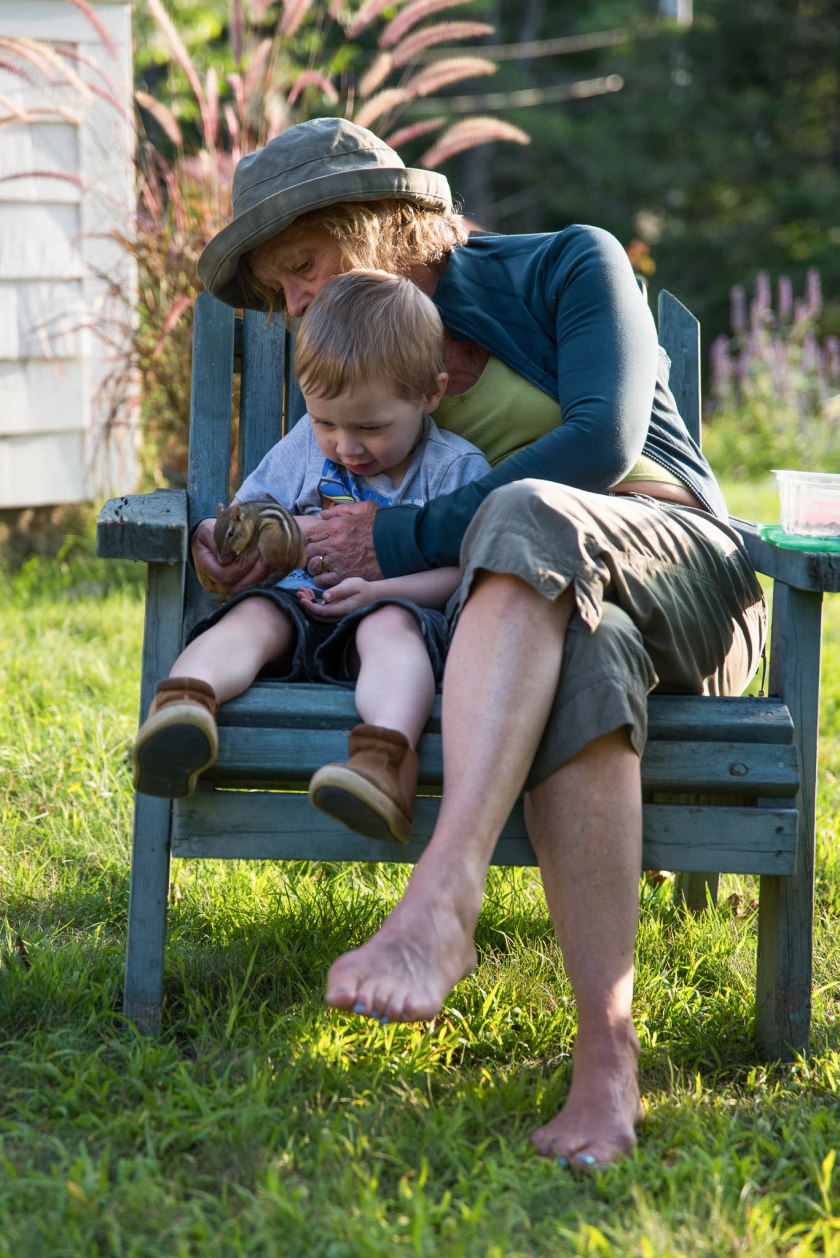
Every summer I train a chipmunk to eat out of my hand (very easy to do), and this summer he got brave enough to come to me even with my grandson on my lap, as you can see in this photo taken by my son..

AYip_20180823_62688


Fall food: Chapter I

Fall is coming, and critters are eating or storing as much as possible against the hard times to come. Two posts on this theme. This first one may not be for everyone!

DSC08730

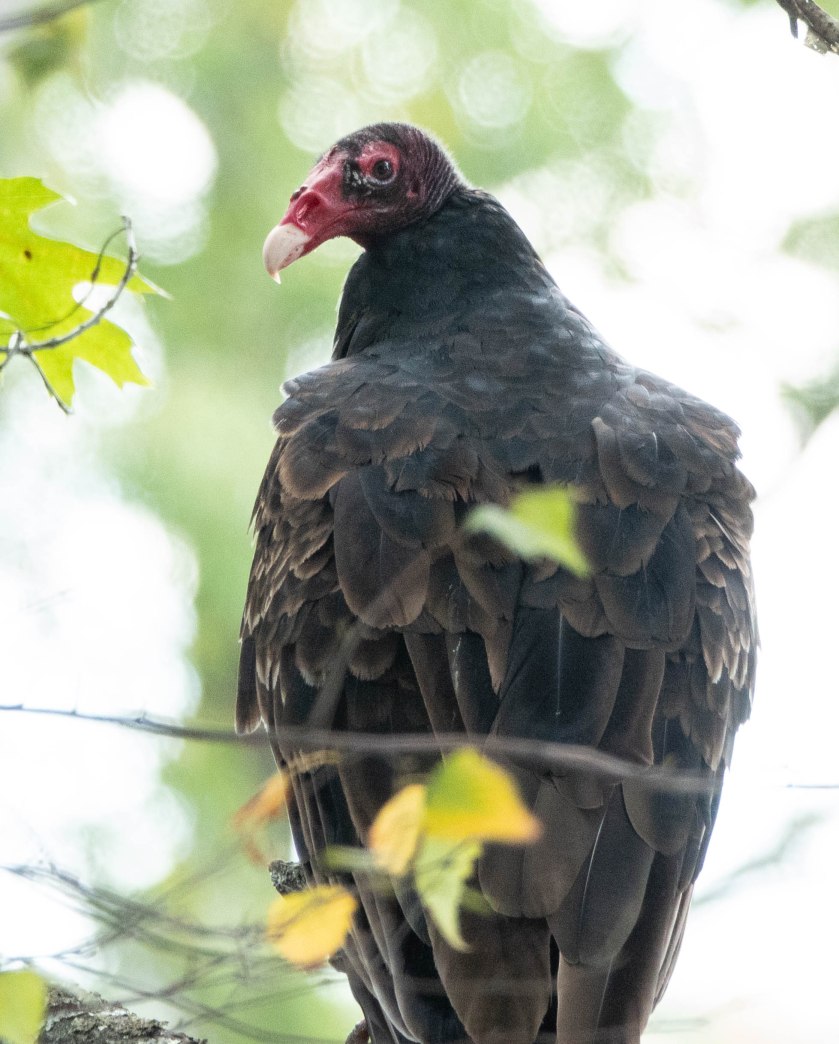
This Eastern Turkey Vulture was feasting on a grey squirrel roadkill, and flew up into a nearby tree when I drove by. I will spare you a photo of the roadkill, but here is the vulture:

Adult turkey vulture

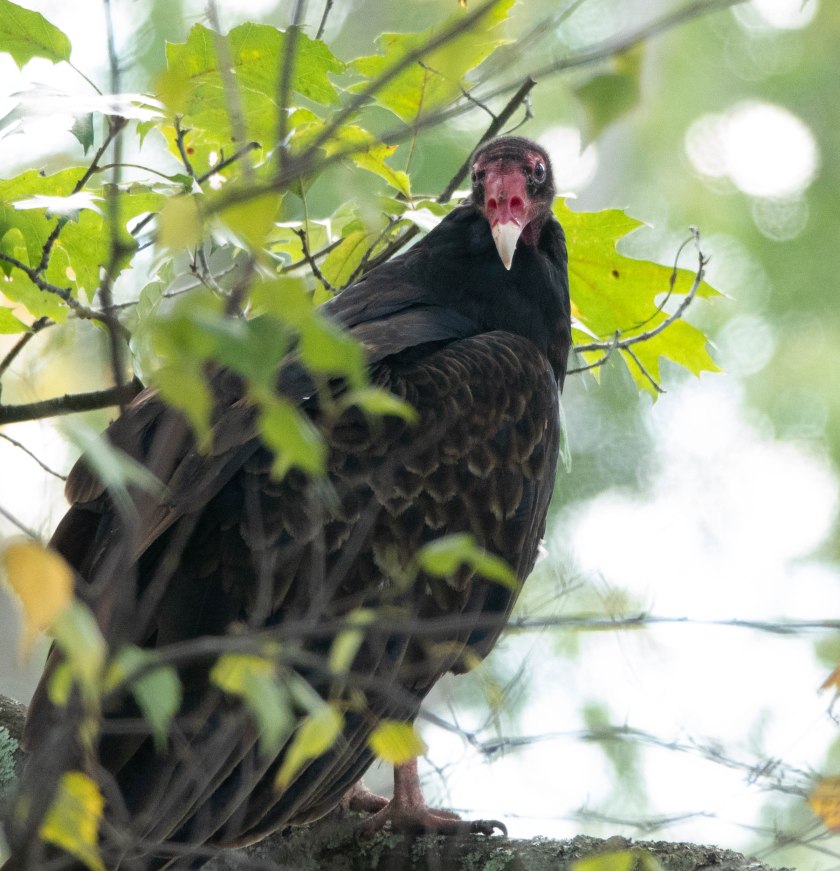
It is fat and round, just like a turkey, and has a wing span of up to six feet.  It appears to have huge connected nostrils, but in fact what you see are the arches of a large bony superstructure that helps the vulture breathe even when it is feeding; the nostrils proper are tucked inside, well protected and out of sight.

Adult turkey vulture

Turkey vultures are unrelated to the vultures of Africa and Asia, and offer a good example of convergent evolution (After all, every region needs a carrion disposal system). In the Americas, they are highly successful, and are found from Southern Canada down to the southern tip of South America.

They are most definitely not songbirds: they lack a syrinx, so they can only hiss or grunt.

The last part of its scientific name, Catharses aura septentrionalis, puzzled me, because it sounded as though it was related to the number seven (as in Septimus). And indeed it is, by a rather circular route (root?). It turns out to be named after the seven stars which make up the Big Dipper, which of course points at the North Star. and so this Latin word came to mean “of the North”,  which is where this particular vulture lives.


Fine feathers maketh…

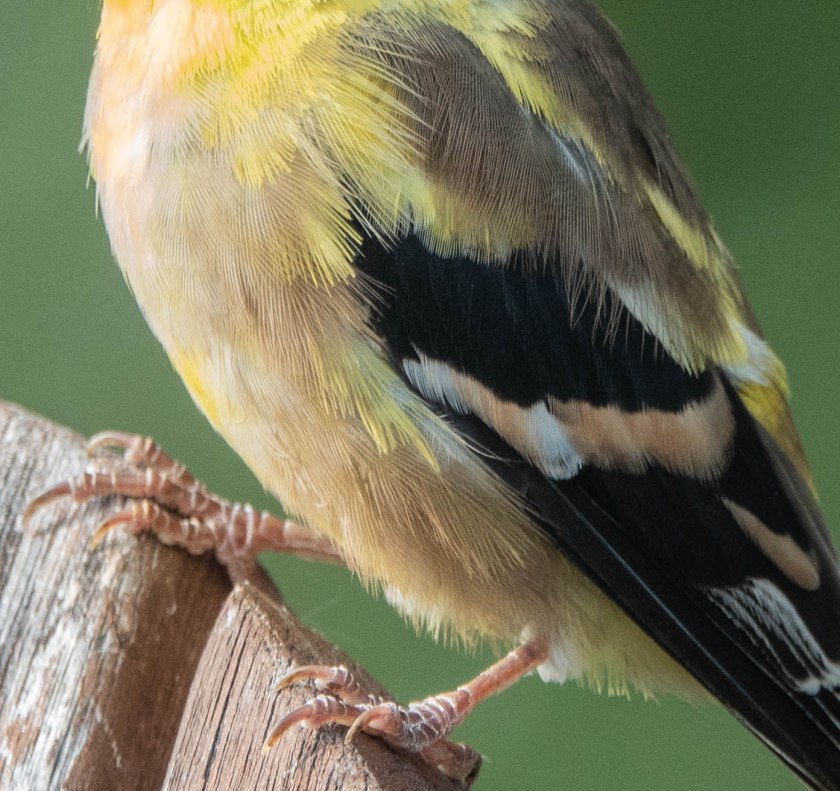
The beauty of a bird astonishes us, and we all admire the lone singular discarded feather, but we don’t always look at the conspiracy of feathers as they compose that beauty.  Look at this juvenile American Goldfinch:

Juvenile goldfinch

Or this:

DSC08274

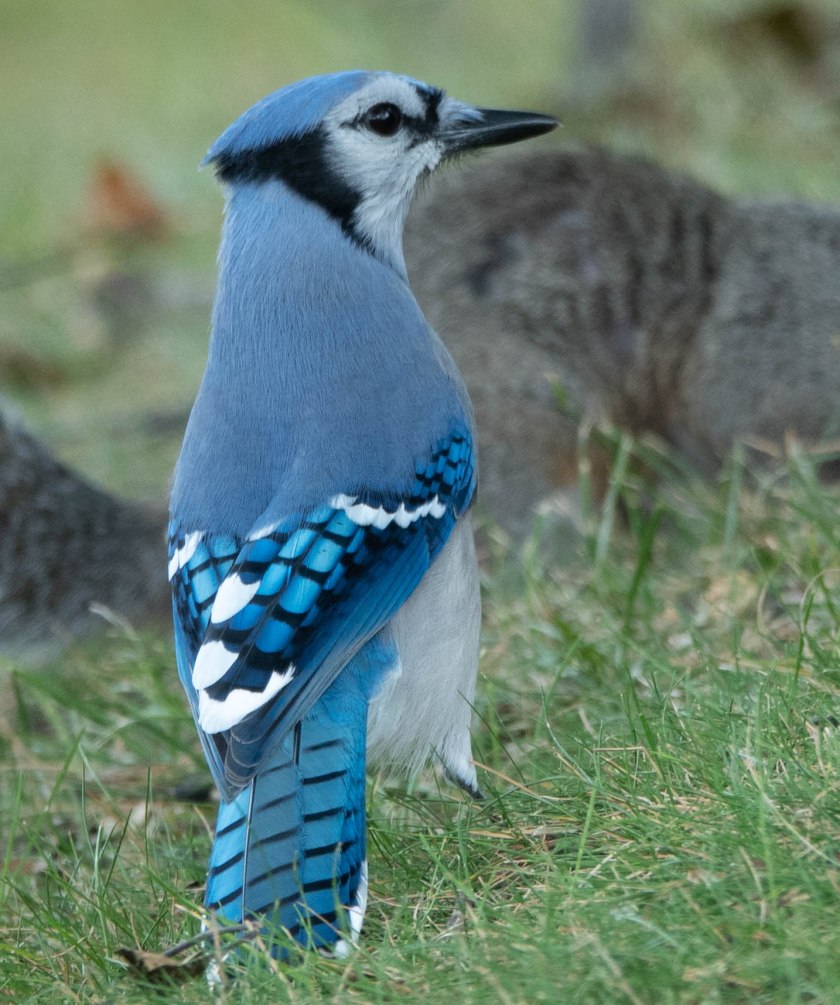
Enjoy this cerulean American Bluejay:

DSC07241

Or the elegant chevron on the nape of the Northern Flicker’s neck:

DSC08856

Admire this bronzed turkey

Wild turkeys

Or, finally, this Yellow-bellied Sapsucker:

dsc08162.jpg

Compare their plumage to our hair: in a fine head of human hair, the front, back and sides are much the same, and each individual hair is more or less the same colour from root to tip (aging aside, and provided you have been keeping au courant at the hairdressers). The human color range goes from jet black to pale straw, with diversions into chestnut. But a bird’s plumage is not at all like that. The color palette knows no limits. On a single bird, the head may be one color, the breast another, and then all is different again from the wings to the tail. As a final flourish, each individual feather can be a whole range of different colors, from base to tip, like this one from a bluejay:

DSC08128

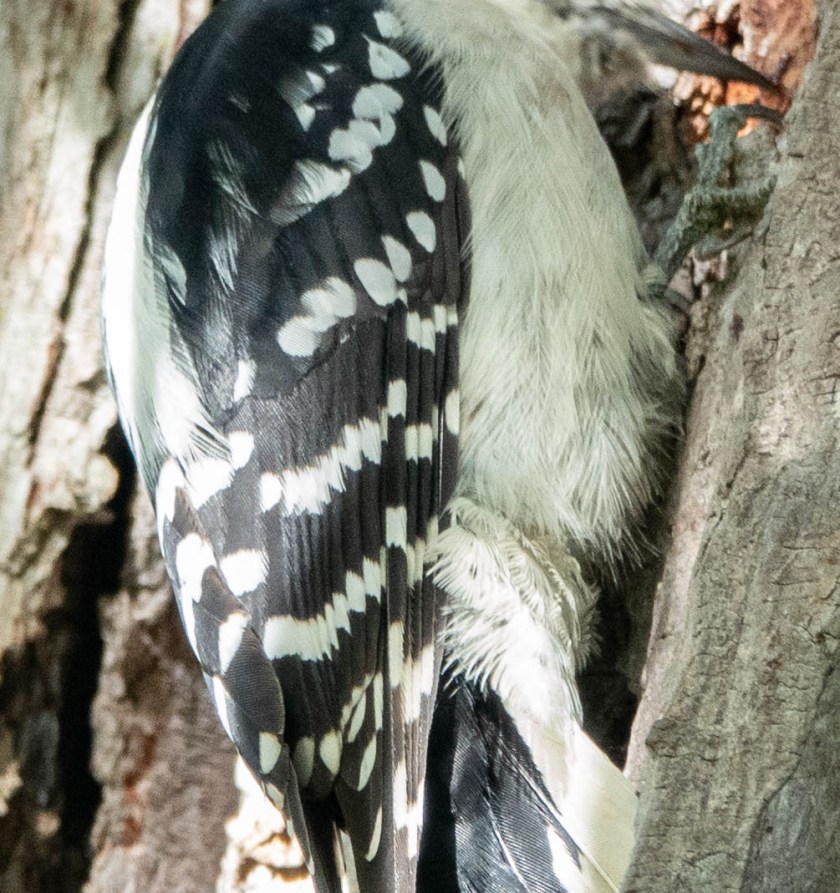
Then they are arranged so that the dots in one feather line up with the one next door to form a stripe: how does the woodpecker’s genome DO that??

DSC08180.jpg

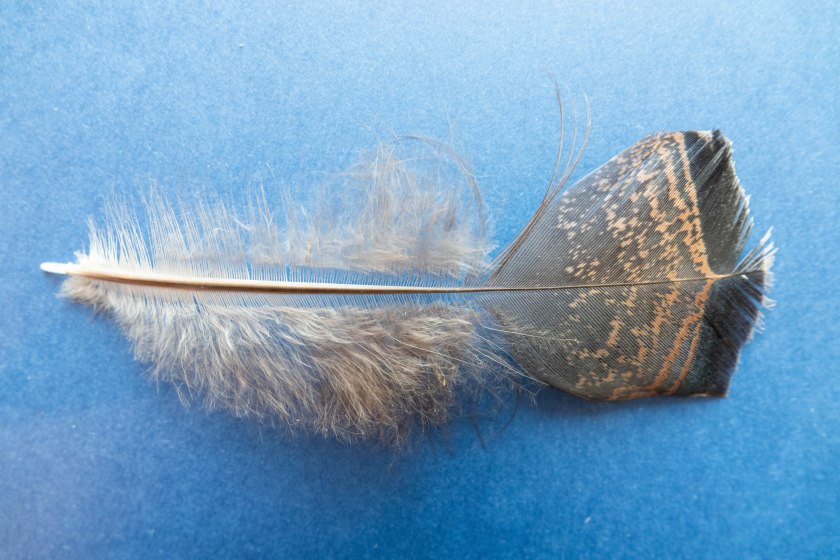
The texture can change too. So on my head, I have tiny feathery bits at my temples, and long smooth hairs elsewhere, but this turkey feather changes texture half way down:

DSC08129

You really couldn’t make it up. I think I need to talk to my colorist about upping her game.


Wriggly things..

I rather like caterpillars, though you may beg to differ.

DSC07228

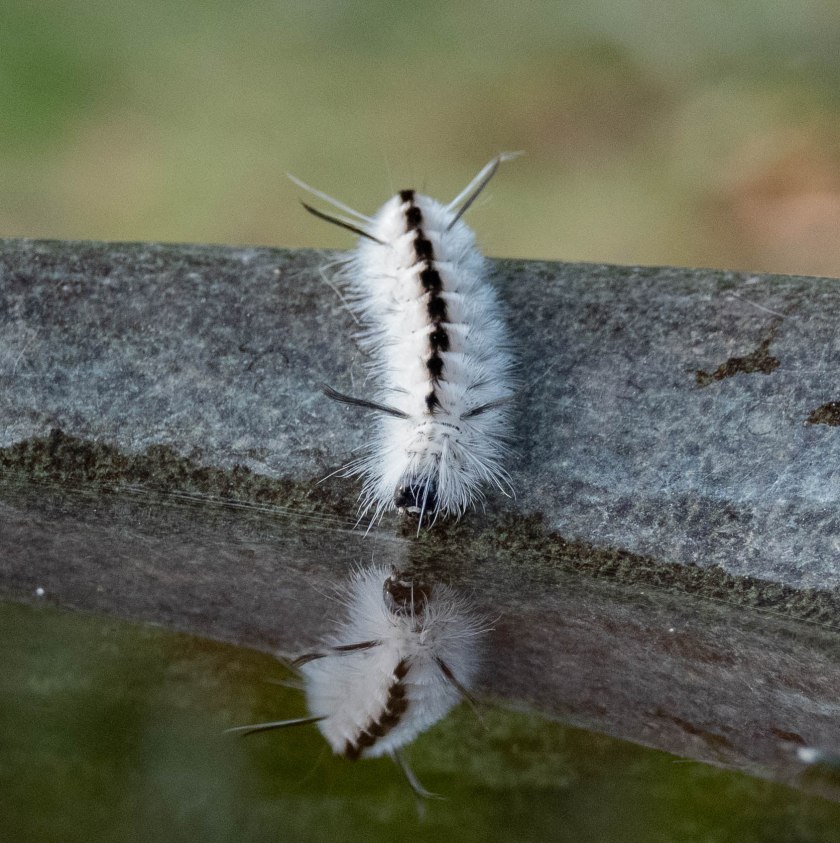
I never knew that caterpillars needed to drink water. This Hickory Tussock Moth caterpillar  seems to have narcissistic tendencies:

DSC07208

Some species are even hairier:

DSC07299

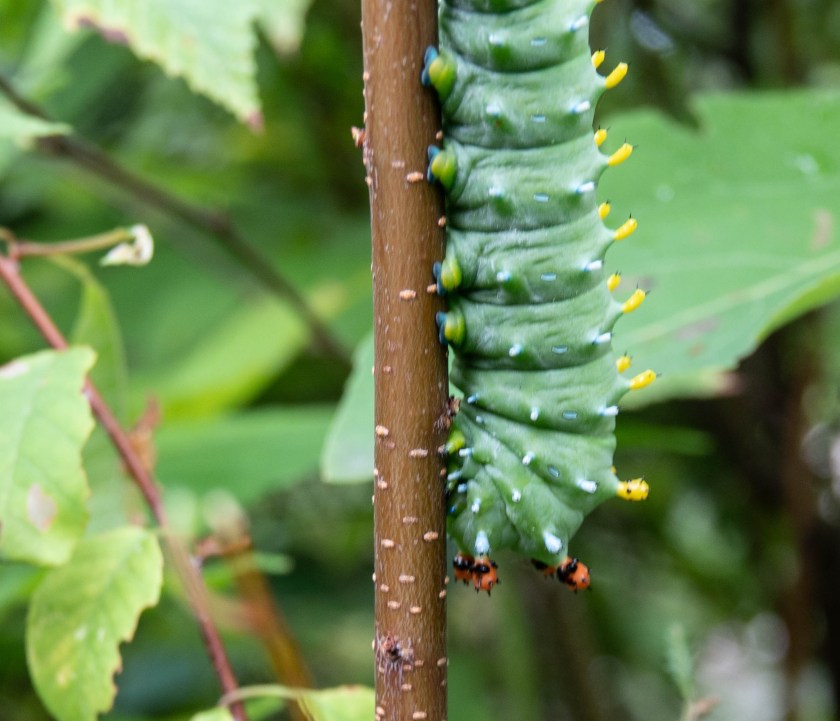
But others are smooth: this is a Cecropia moth caterpillar (4th instar, if you are interested):

DSC03433

And its tiny blue shoes are rather cute:

dsc03473.jpg

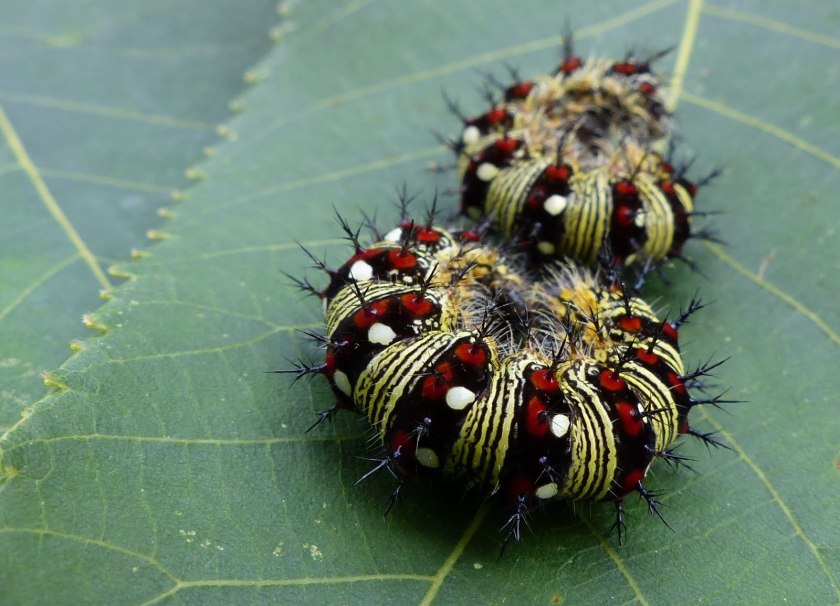
Some curl up when they are scared, like these American Lady caterpillars:

P1160819

I fear that many children today grow up without ever meeting a caterpillar. But I do hope that even so someone has read them Eric Carle’s The Very Hungry Caterpillar.

PS: I wanted to call this “Jacob and Esau”, as in “Behold, Esau my brother is a hairy man, and I am a smooth man” but somehow it didn’t quite work, and I wasn’t sure if people still knew the King James bible. So I relegated it to this postscript.

Broad-winged hawk Part II: The hunt

Two of these hawks have been hunting round my bird feeder and squirrel tree. They swoop on the squirrels, and yesterday one caught either a red squirrel or a chipmunk, or perhaps a vole. I couldn’t see clearly, but it had something in its talons when it took off again from the thicket.

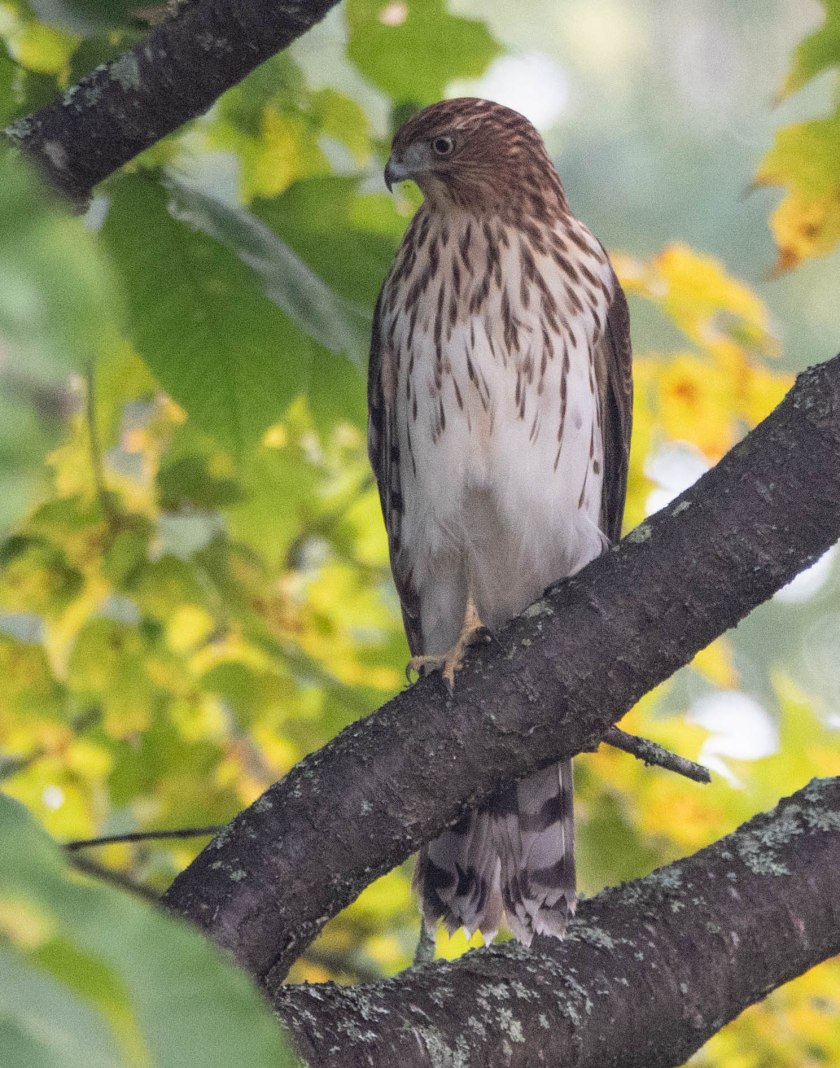
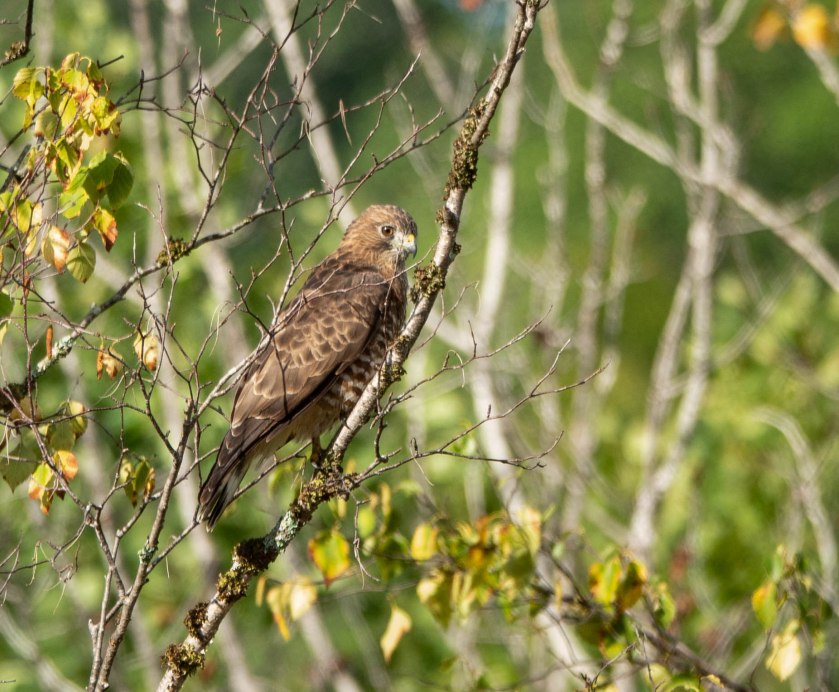
Here is the young predator, waiting and watching:

DSC07693

They are woodland hunters, and this is their typical modus operandi, perching on a low branch concealed in the foliage, preparing to make a short glide down onto their prey.  Here he/she is, caught just after take-off swooping vertically down from the branch for the successful attack.

DSC07694

My camera trap caught glimpses of another attack, this time a squirrel chase:


They eat small mammals , birds and insects. Squirrels are large prey for them, but this one certainly had its eyes on a large meal!

I was somewhat puzzled by the fact that one day there were two of them swooping around, pretty much doing a synchronized aerial ballet thing.  They didn’t seem to be competing , and given that one was a juvenile, I am guessing the other might have been its mother? Or maybe it was a prelude to migration, though I have seen one several times since.

I am lucky to have observed all this because they tend to avoid human dwellings. They only appear when I am alone, never when others are with me.

Broad-winged Hawk Part I: After rain

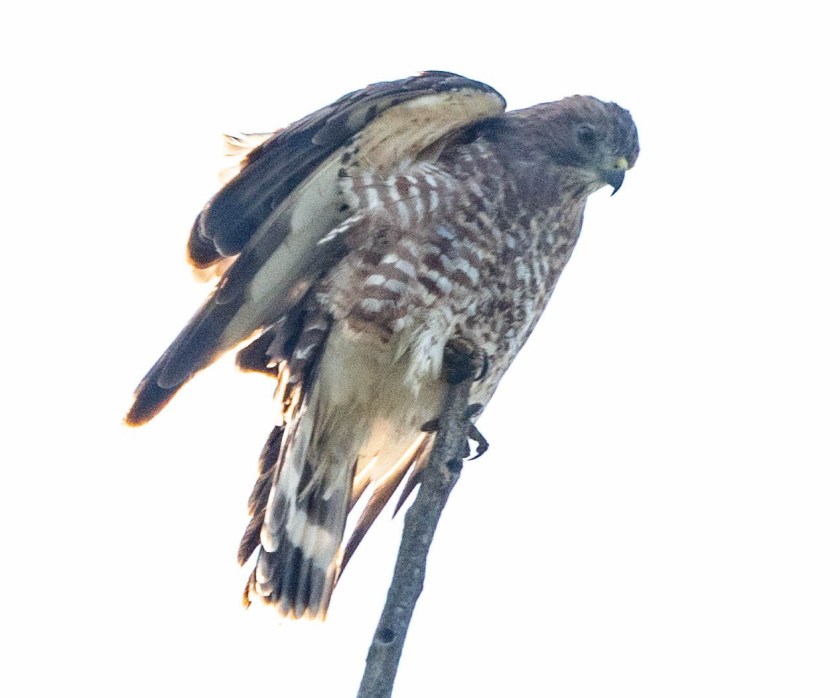
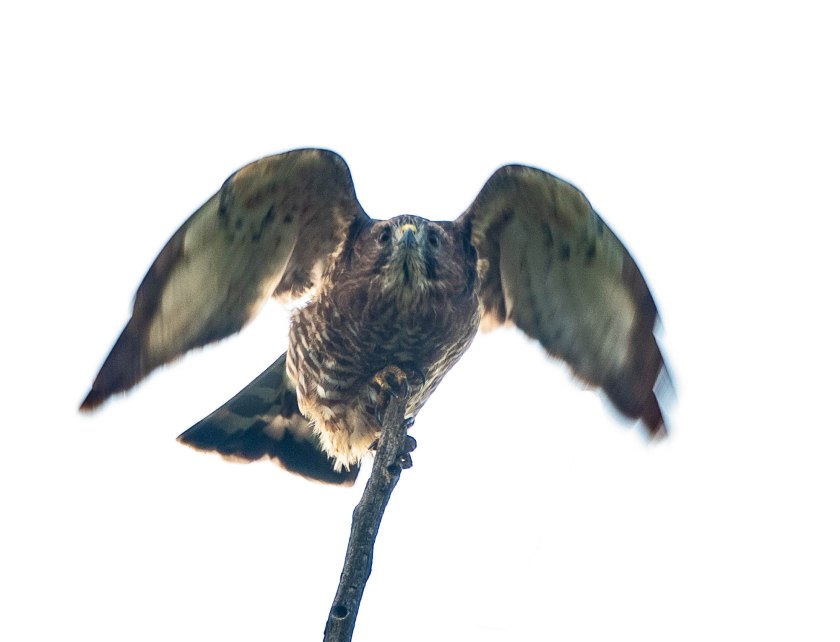
Early one morning after a stormy night I saw this Broad-winged Hawk, Buteo platypterus, drying its wings, and I thought you might like to see the photos.  (The sun was behind the hawk, so they are rather washed out.)

A good preen:


dsc06311.jpg

A little shakeout of the wings:

`broad wimged hawk


And then a stony glare at my obtrusive white truck:

`broad wimged hawkThe final result:

`broad wimged hawk

Next time, the action shots!


PS This is a smallish hawk (maximum body length 17″, wingspan 39″ and weight 20oz) and it has a wide range in the Americas, from Southern Canada down to Brazil.  Some but not all birds migrate, and they often gather for the migration in huge soaring flocks called kettles.


Zombie caterpillars

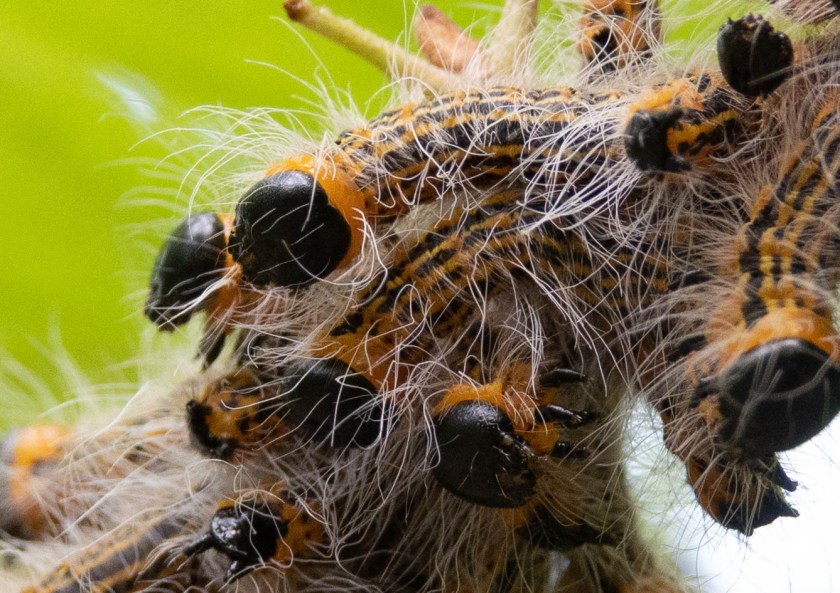
Nature has some bizarre corners. A couple of years ago, I saw these caterpillars, part of a large group steadily demolishing a small shrub.

P1200567

[Warning: from here on in, this blog is just plain wrong!! I now know that these are yellow-necked caterpillars, Datania ministra, the white hairs are normal, and this strange U-shaped posture is their defensive posture. There is no zombie fungus involved!. I’m leaving it up as a warning not to believe everything I say! MY, September 2019]

Then this year I saw this group, all together on a branch a few feet off the ground, each one bent into a U-shape, not eating, and not moving, though they were alive (I poked them gently).

DSC06023

I thought they were the same kind and were about to pupate, but I was wrong, on both counts. I hadn’t noticed the tiny white hairs on some of them, and the next day, they looked like this:

DSC06134

In close up, you can clearly see the “hairs” are growing out of their bodies:

DSC06134-2

This is a fungus which penetrates their bodies, and then absorbs nutrients from their insides, leaving a shell. This next photo is of a different group of caterpillars on the same tree. You can see that the segments  of caterpillar between each pair of legs are getting hollowed out as the fungus does its work:

DSC06377

A thunderstorm destroyed the whole ghoulish tangle, so I will never know what the final stage would have looked like.

By the way, I have failed to identify the fungus or the caterpillar, but the fungus is probably a type of Cordyceps. If anyone knows, let me know.

PS: I did wonder if it was not a fungus but some sort of communal cocoon, but my friendly mushroom expert confirmed the fungal guess. And if it was a cocoon,  it would need to survive a thunderstorm.

Turtle paintings

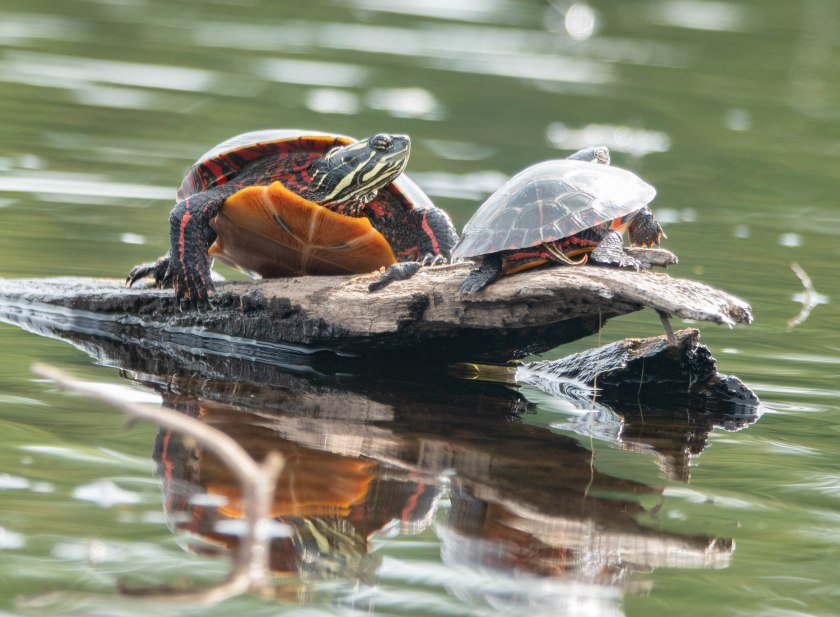
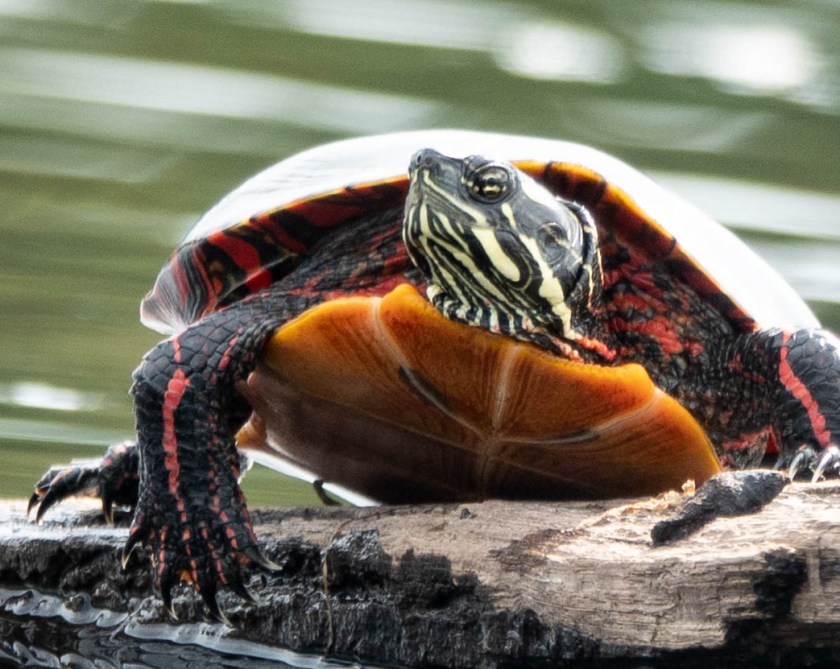
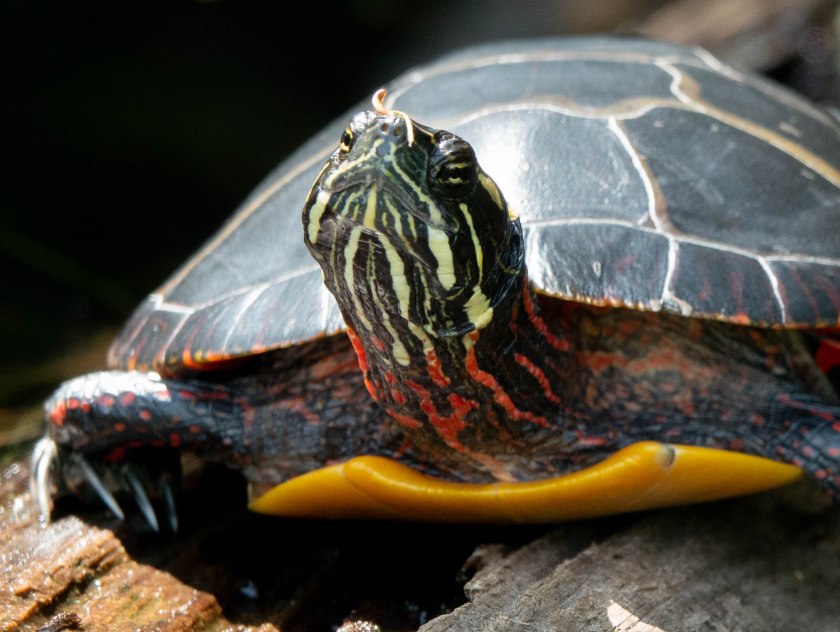
Out kayaking with three friends, on a glorious sunny day, we saw these painted turtles, Chrysemys picta, living up to their names.

DSC06685

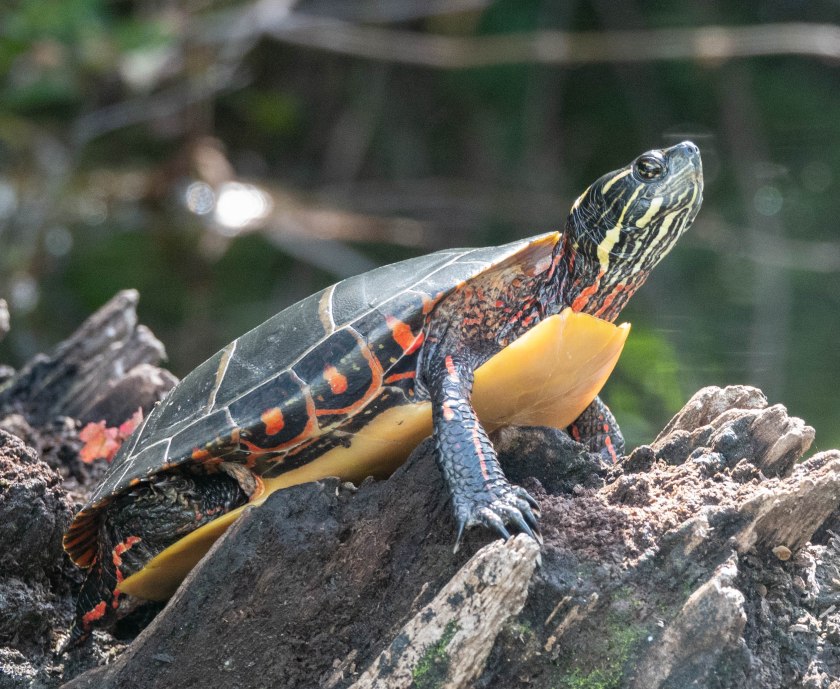
They seem too exotically colored for Maine, but they are widespread, and unmistakeable. The adult females can be up to 10 inches long, though the ones I see are usually 6 or 7 inches.

DSC06676

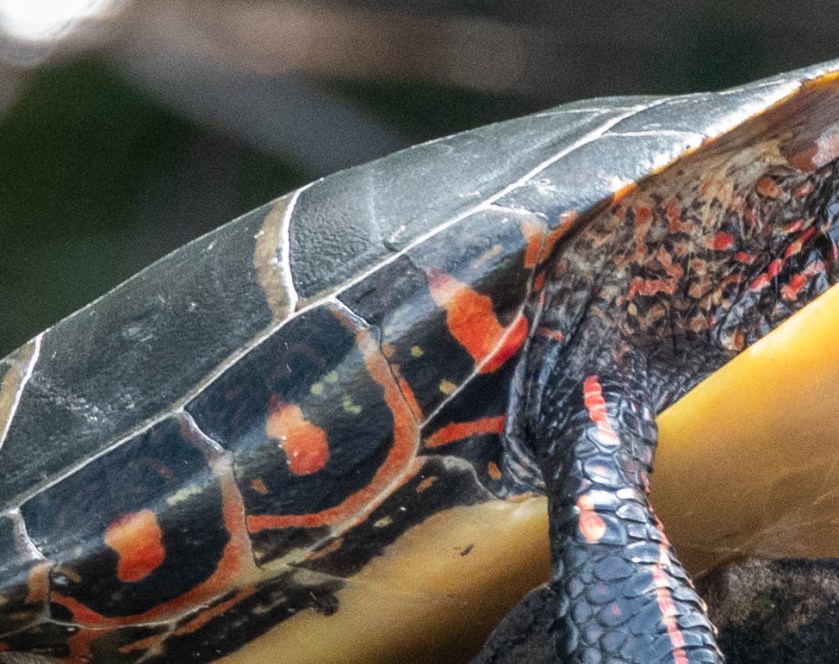
The skin under the edge of the shell is brilliant red and black, and it goes over the edge, as you can see here:

DSC06735

I had never thought about how a turtle’s shell is attached to its body, but Wikipedia says: “The carapace is the dorsal (back), convex part of the shell structure of a turtle, consisting of the animal’s ossified ribs fused with the dermal bone. The spine and expanded ribs are fused .. to dermal plates beneath the skin to form a hard shell. Exterior to the skin the shell is covered by scutes, which are horny plates made of keratin that protect the shell from scrapes and bruises.”

Here is a close-up of where the skin meets the shell, and the transparent keratin plates:

DSC06735


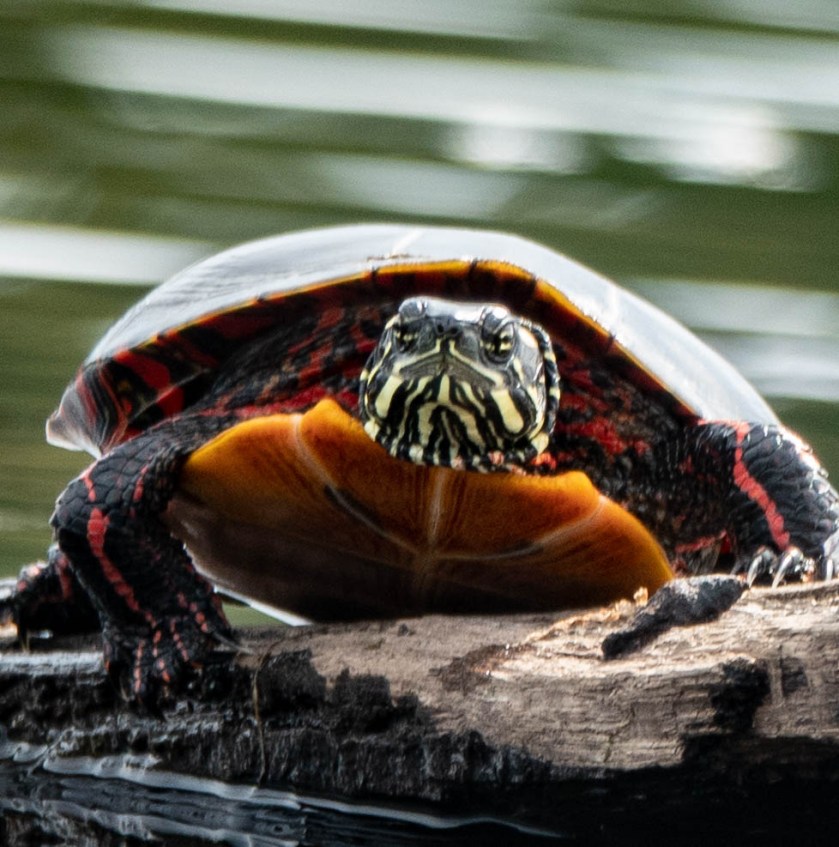
They have a distinctly prehistoric look:

DSC06680

This one had something stuck on its nose, hence the cross-eyed expression:

DSC06715

They eat aquatic vegetation and small insects, crustaceans, and fish. They hibernate in the mud at the bottom of the pond, and can live up to 55 years in the wild.