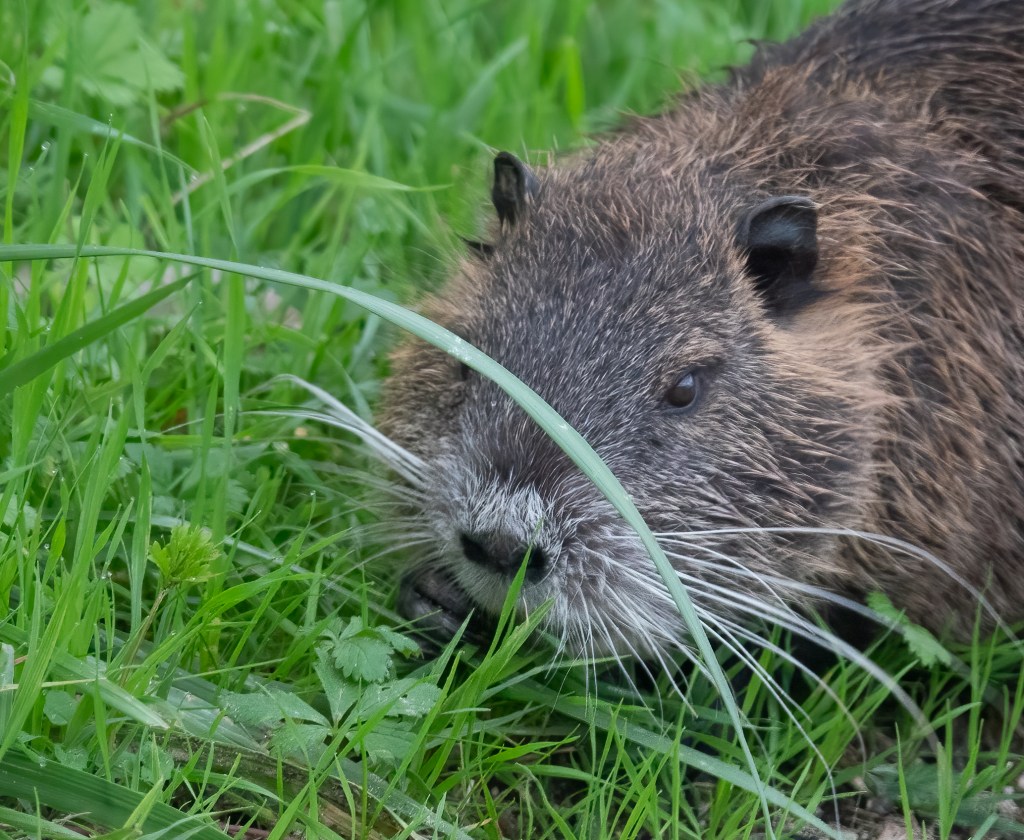
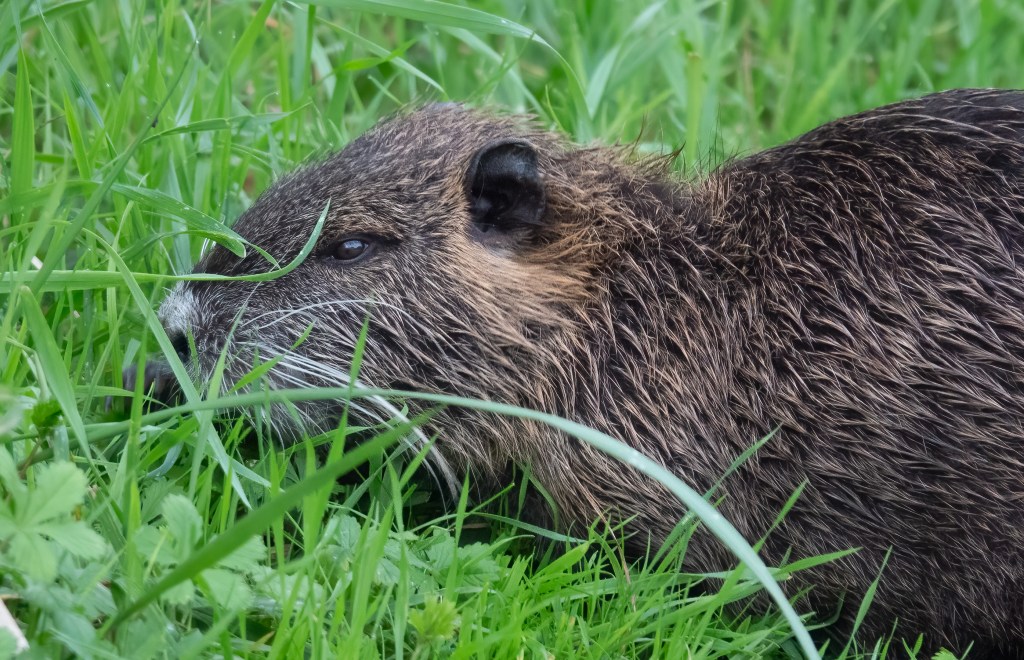
Chiloé: Denizens of The Valdivian Rainforest

Chiloé is a large island off the coast of Chile, near the Lake Region. It has a climate rather like that of the Olympic Peninsula in Washington State: its west coast and uplands get a torrential 120″ inches of rain a year. We walked in the mossy Valdivian temperate rain forests, stayed in lovely lodges in two of the national parks, and went out on rivers, estuaries, and the Pacific ocean.

We had hoped to see a variety of small rare mammals, but of course we didn’t. With one exception: we saw four Southern Pudu, the second smallest deer in the world (smaller than a muntjac, but beaten to bottom spot by the Northern Pudu!). They are only 14-18″ tall, and 14-30lbs. Here is a male:
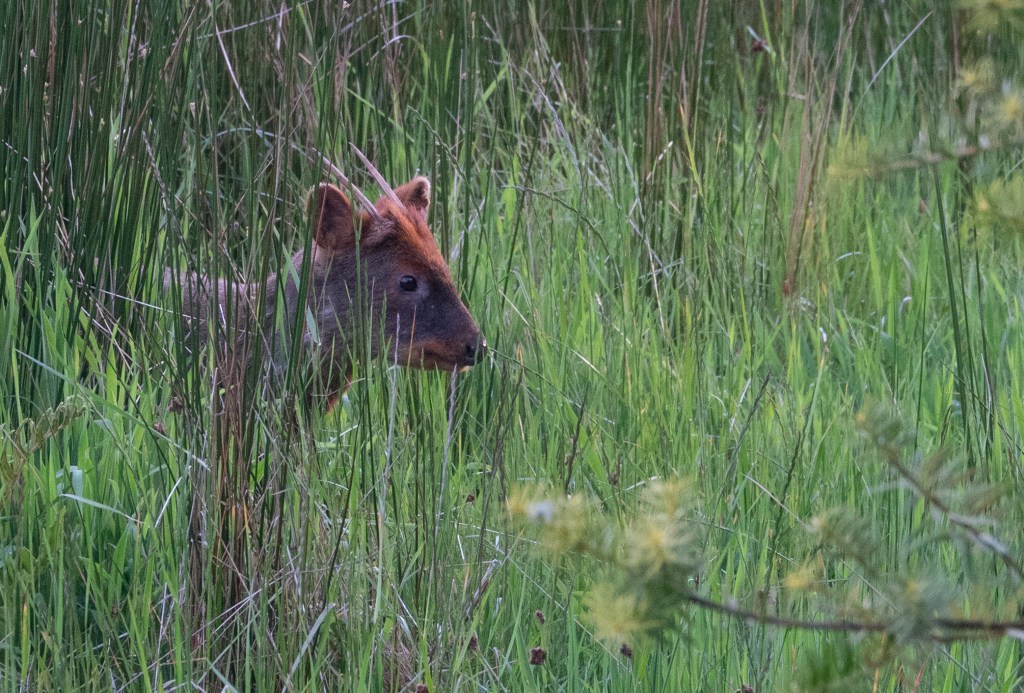
His unforked antlers are no more than 3.5 in long and very delicate.

The first one we saw was a female, and, lucky us, she had a tiny spotted fawn:
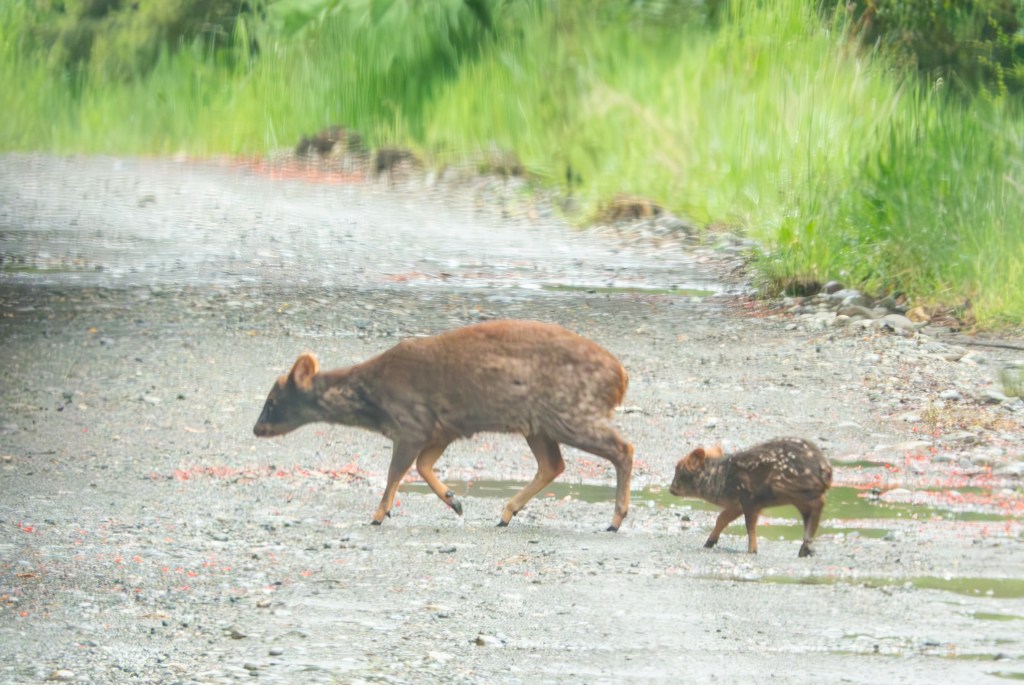
The IUCN considers these deer Near Threatened overall, and the Chiloé population has been isolated from the mainland for over 200,000 years, and is a particularly vulnerable separate gene pool.

All that rain means rivers, and waterfalls,

amidst lush rainforest with giant ferns:

and Gunnera tinctoria, known as “nalca”, everywhere:*
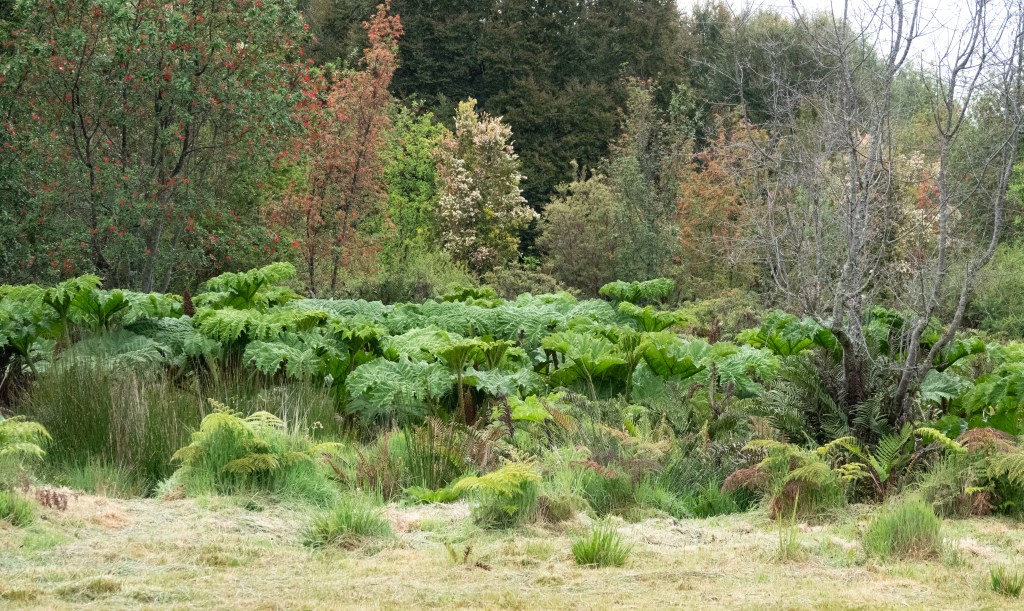
The leaves can be 2.5m across:

And beneath them is a secretive lush world of spiny stalks
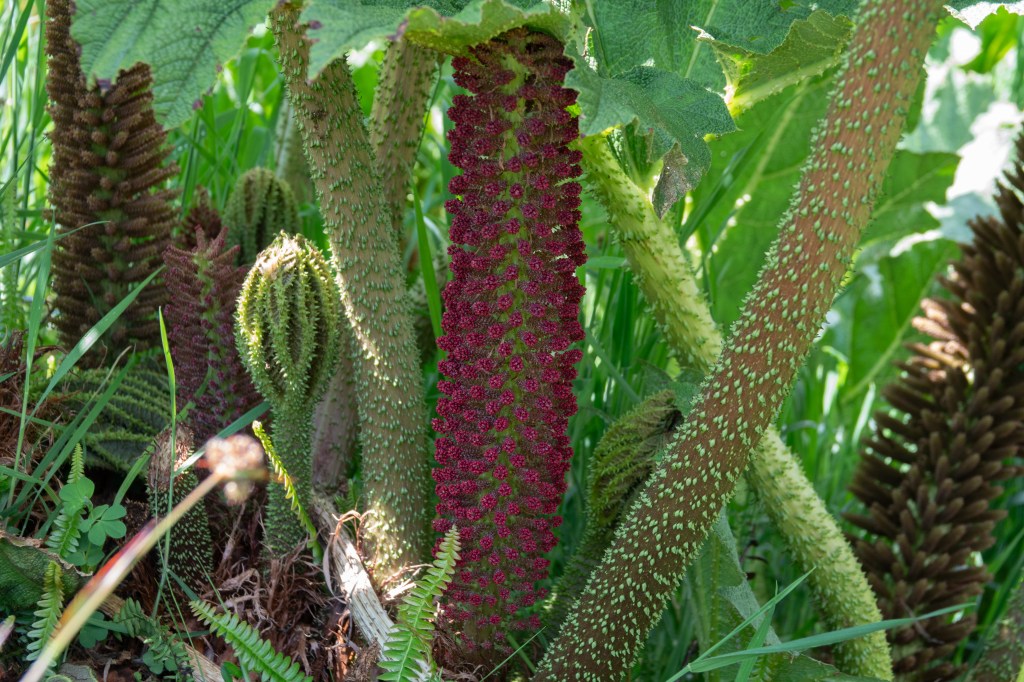
and 1m tall flower spikes.

The stalks are peeled and eaten just like we eat rhubarb.

In November it is early summer down in Chile, and the wildflowers are starting. This is a delicate vine called Luzuriaga polyphylla, endemic to Chile:

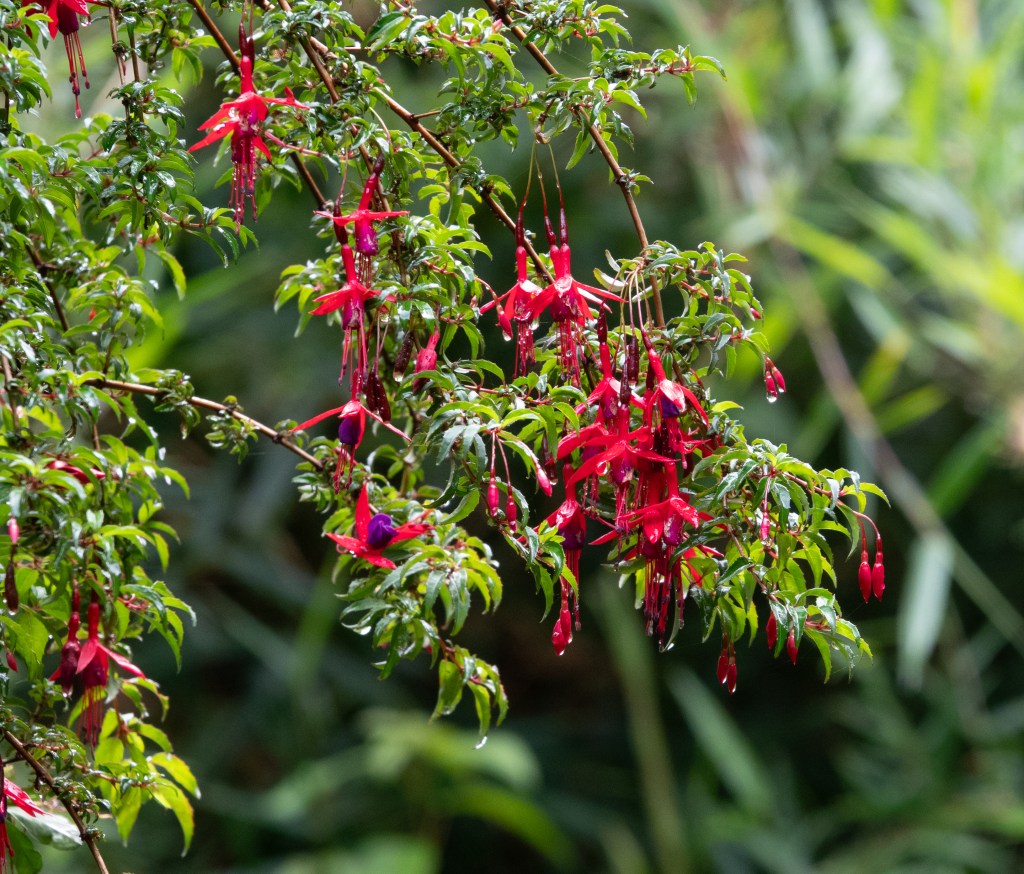
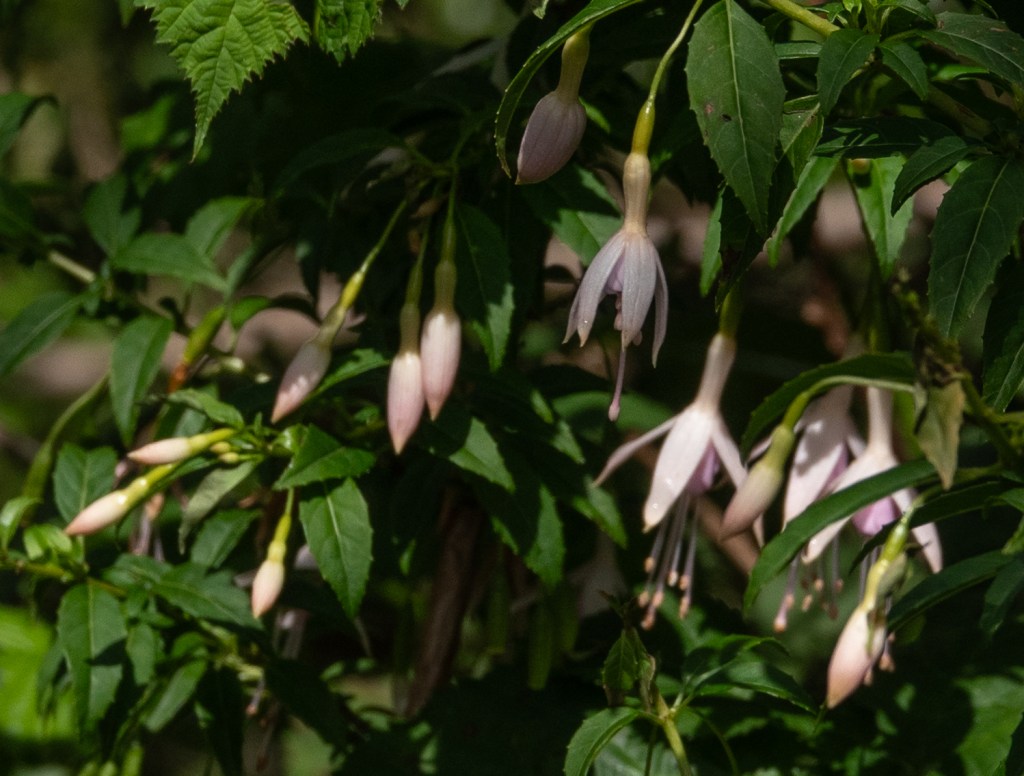
Fuchsias, like many of these plants familiar from our UK or US gardens, come from this part of the world. This is a wild Magellanic Fuchsia:
and so is this:
A ragged looking plant with orange flowers with scarlet centres called Loasa acerifolia:

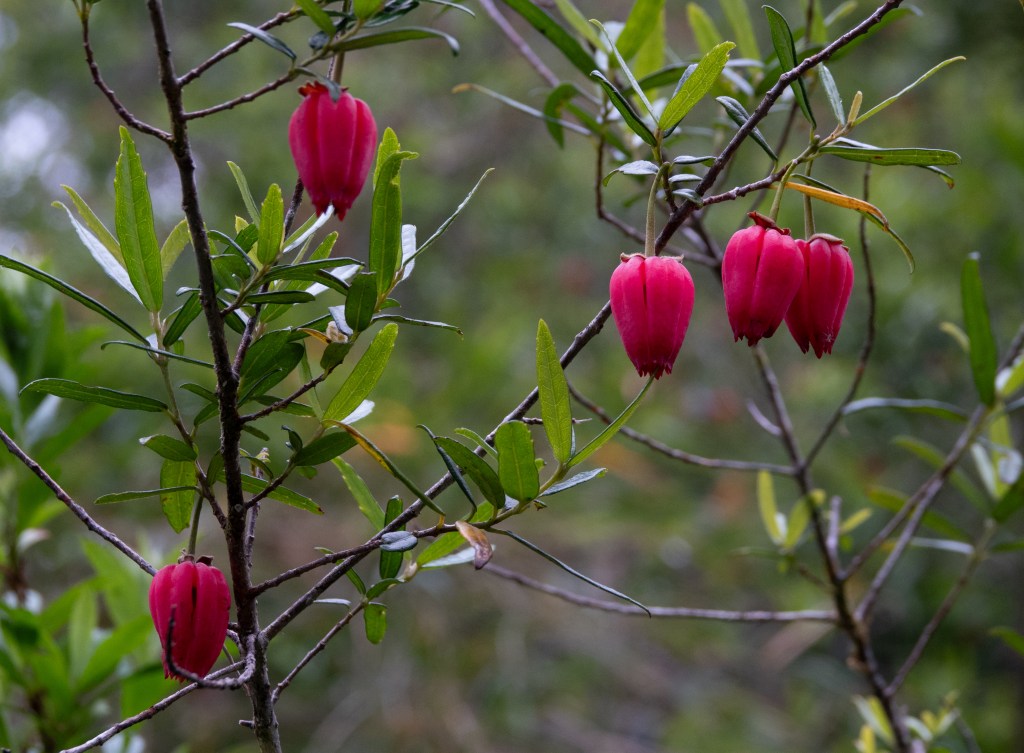
and finally a Chilean Lantern Tree, Crinodendron hookerianum, found only in Chile; it is much loved by hornets, so we beat a hasty retreat:
Everywhere we saw Chilean Firebush, but I’ll let that wait for another day.

PS * Around the time of anti-goverment protests in 2019, a vegetable vendor in Puerto Montt dressed himself in nalca leaves. He went viral, and became a symbol of the protests, known as Nalcaman:

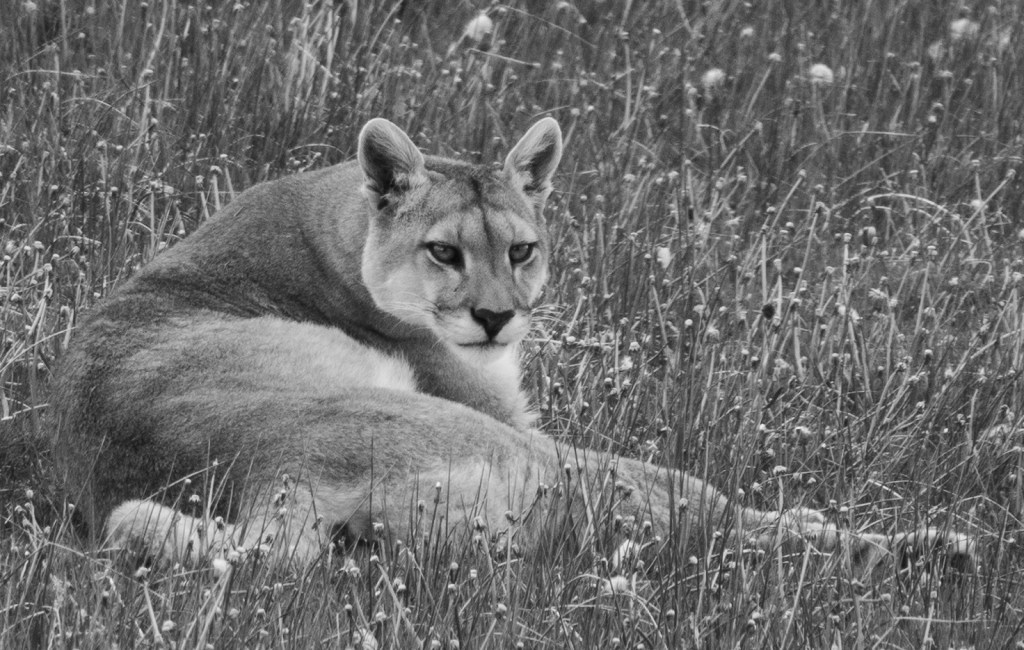
The Tale of Seven Pumas: Number 7

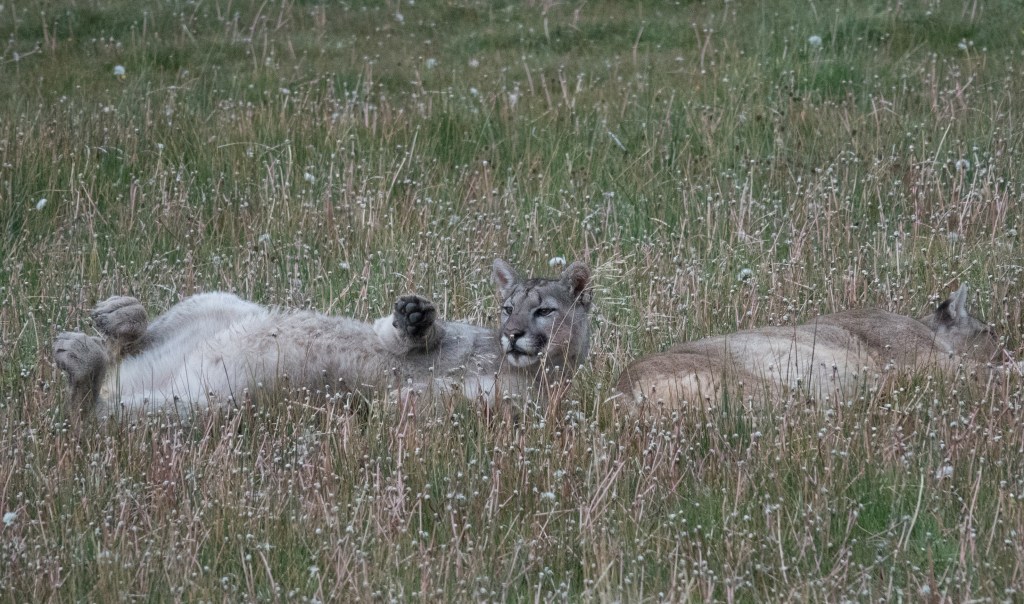
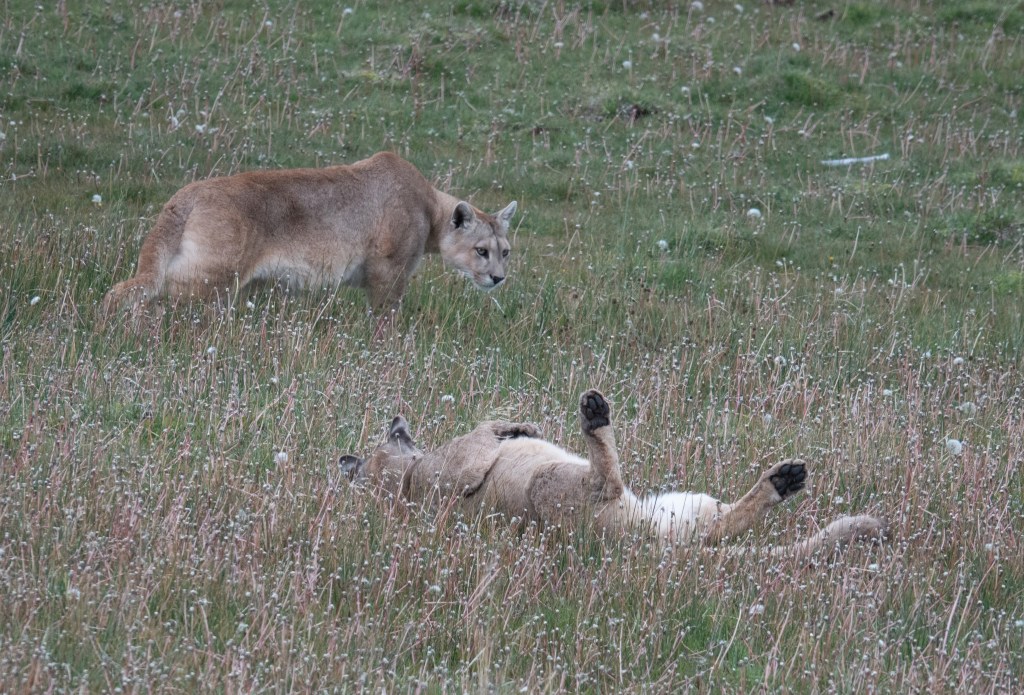
Pumas are solitary animals, by and large, unlike African lions, and we do not think of them as sharing their food with the larger community. It turns out this is not true.

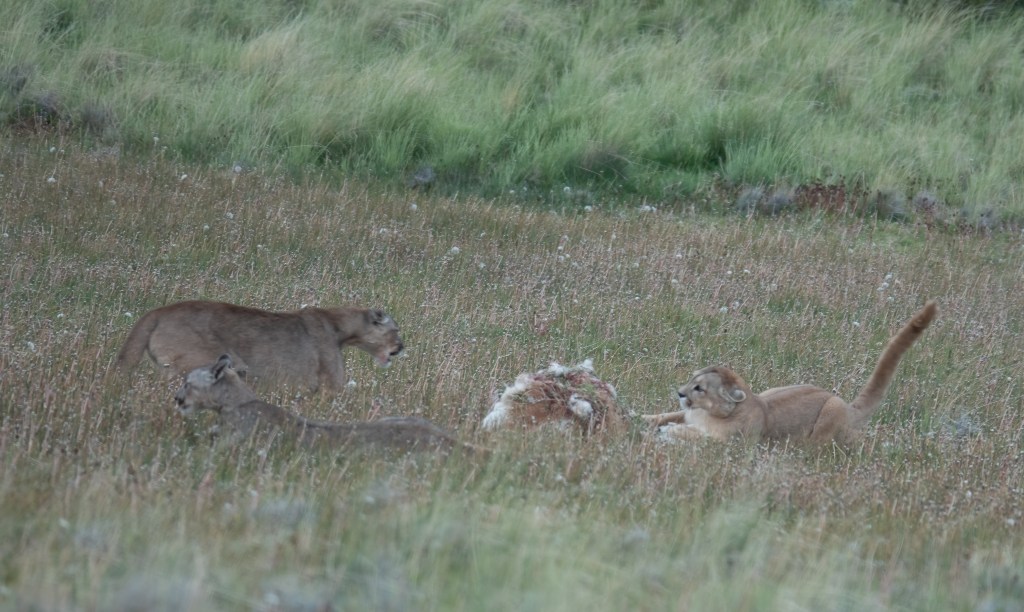
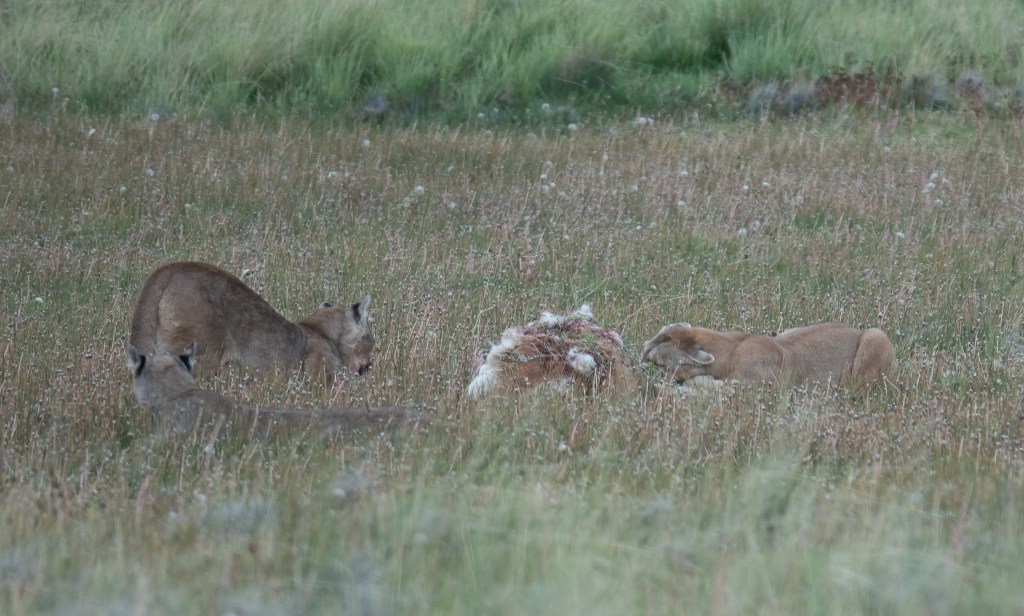
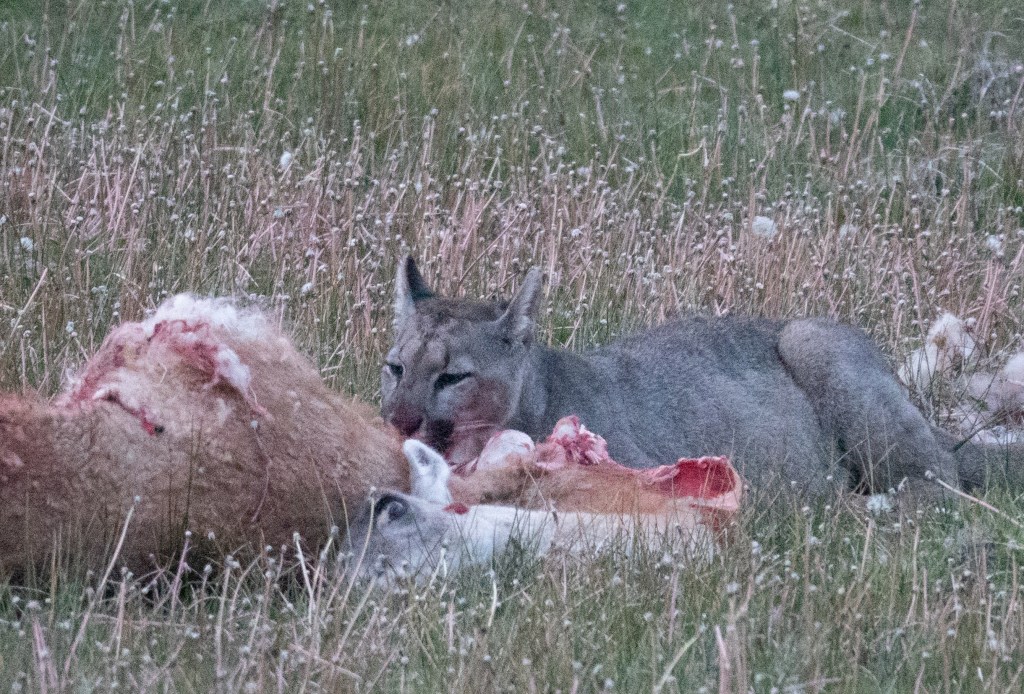
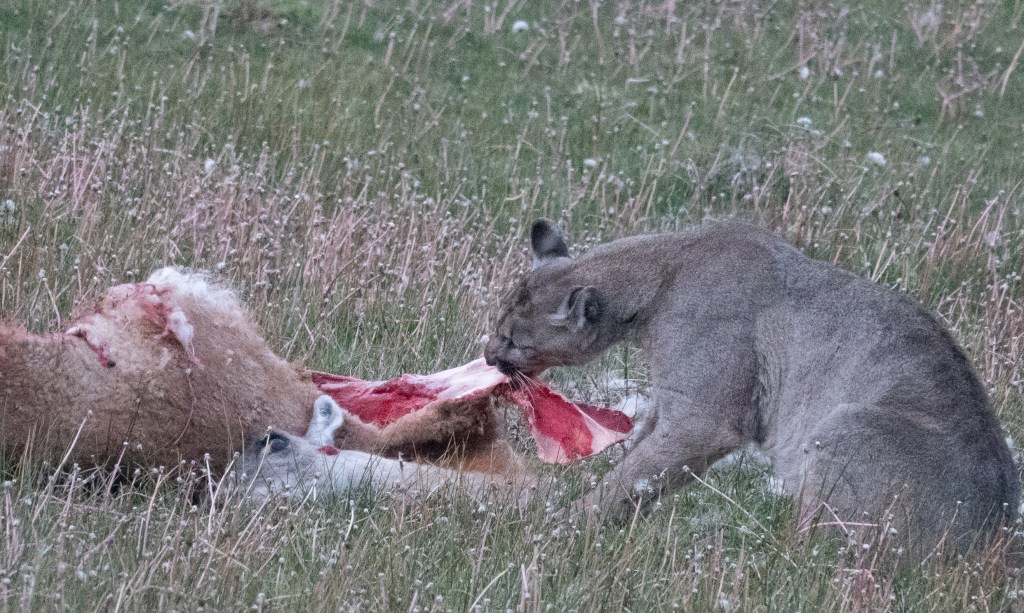
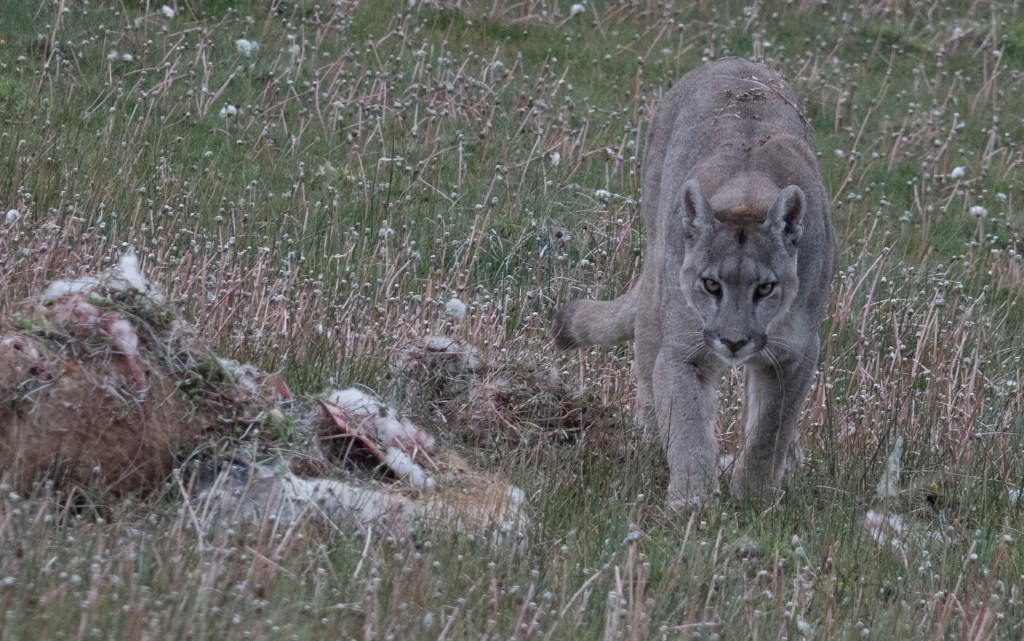
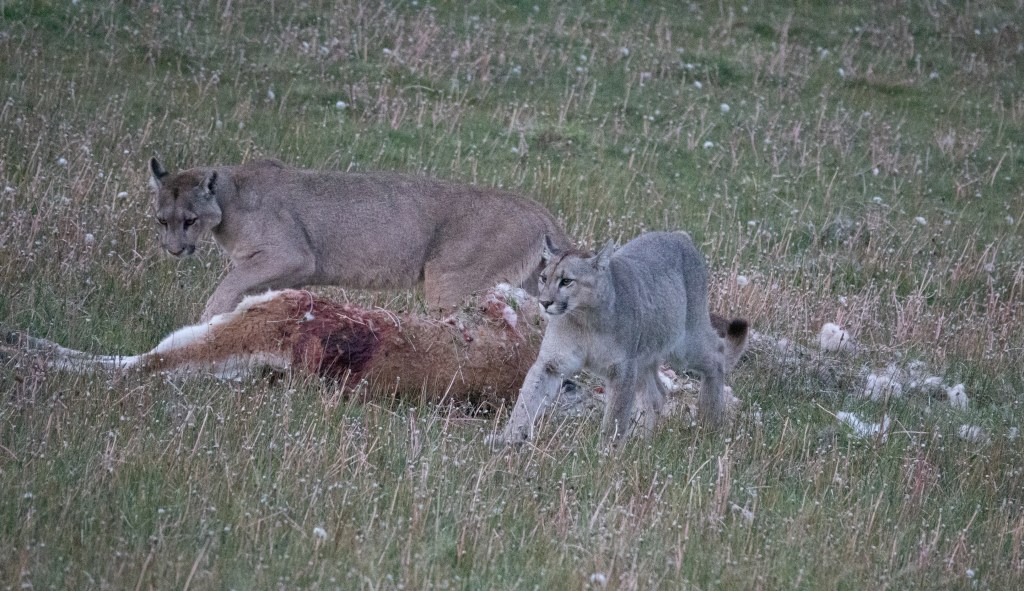
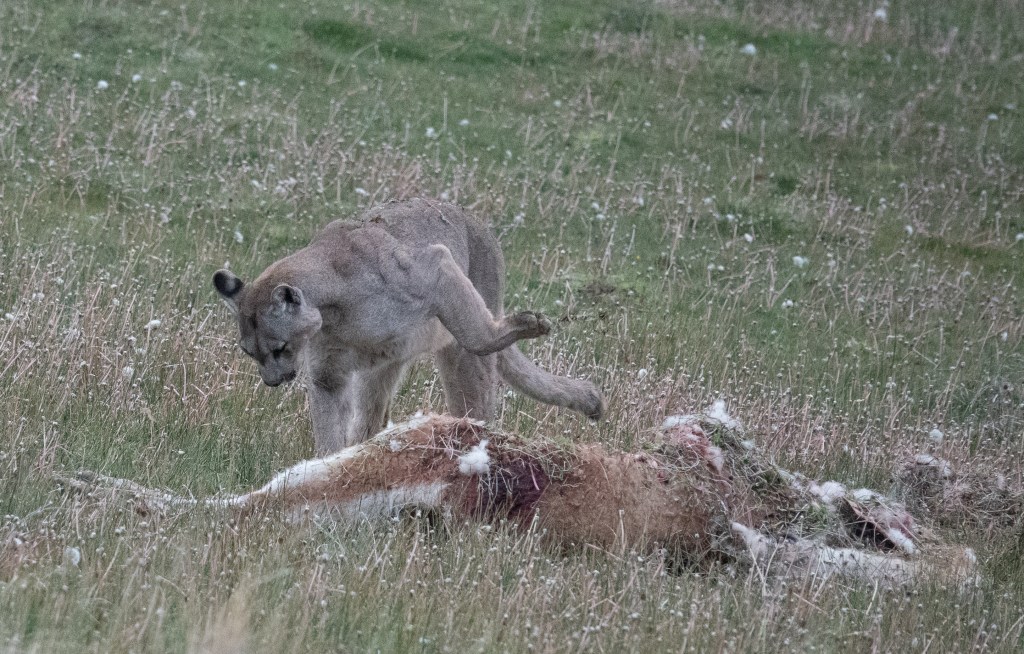
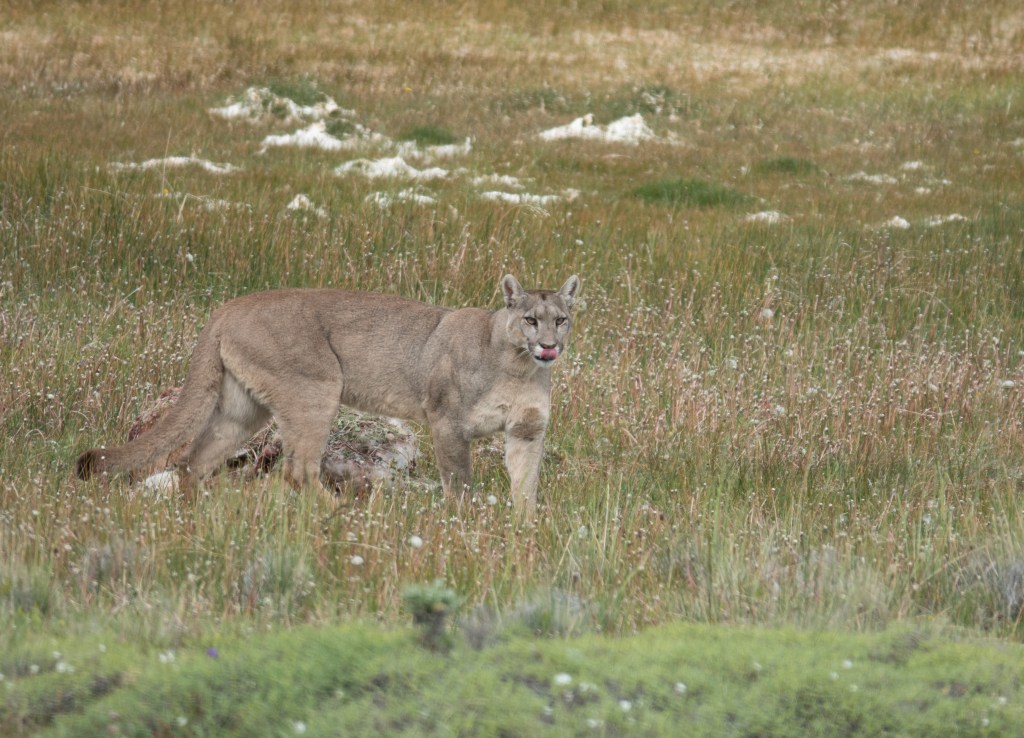
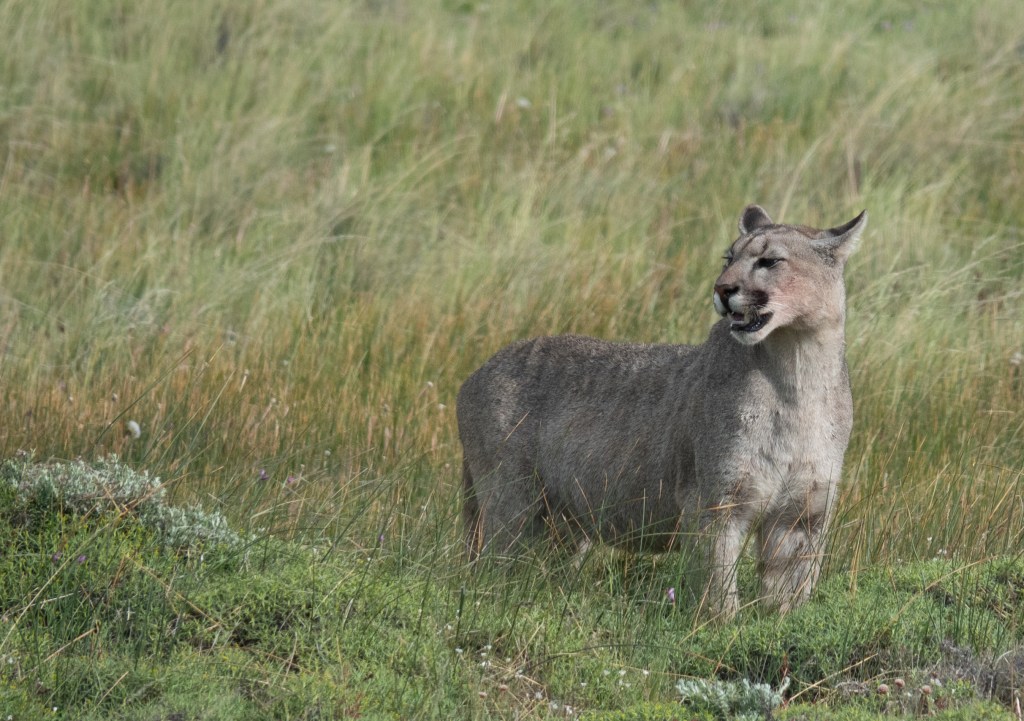
The fourth puma, who we nicknamed Goldie, was hanging around Petaca and her cubs, and she had not eaten. Angelo told us that the female was familiar, living in the same area, and quite possibly a distant relative. He said that the mother would probably let her feed eventually, but not till she and the cubs were done. Since they were all asleep we nipped back to the vehicle for a quick coffee, and while we were there Goldie made her move. These photos are taken from further away and are not great but they tell the story. She circled around to the far side of the kill:

and grabbed a first bite:

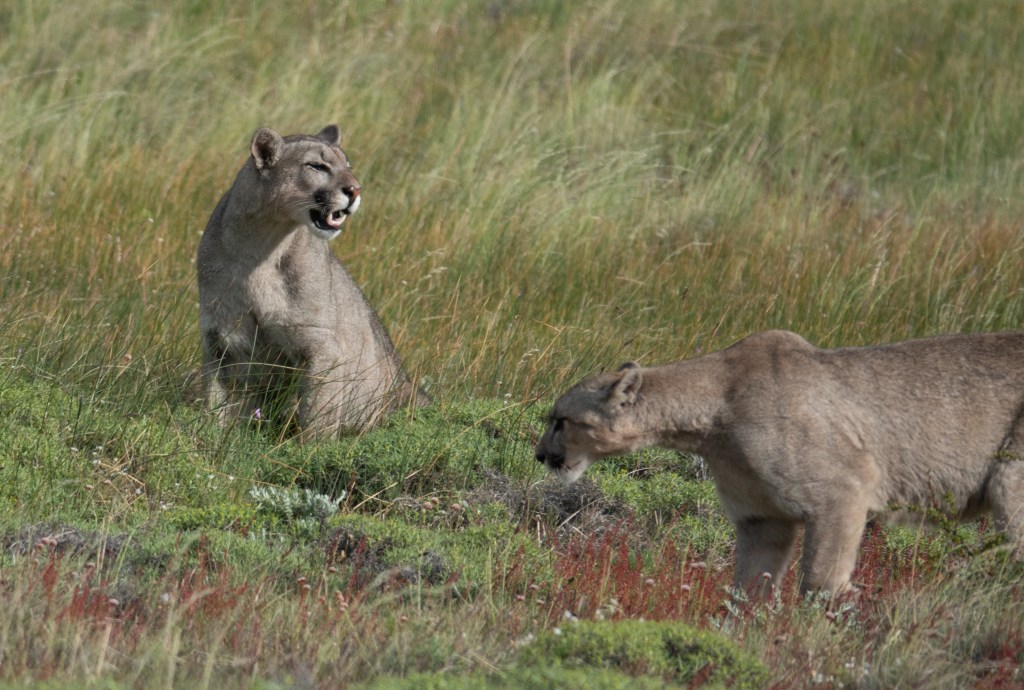
Petaca arrived.

Watch Goldie’s body language in the next few shots:

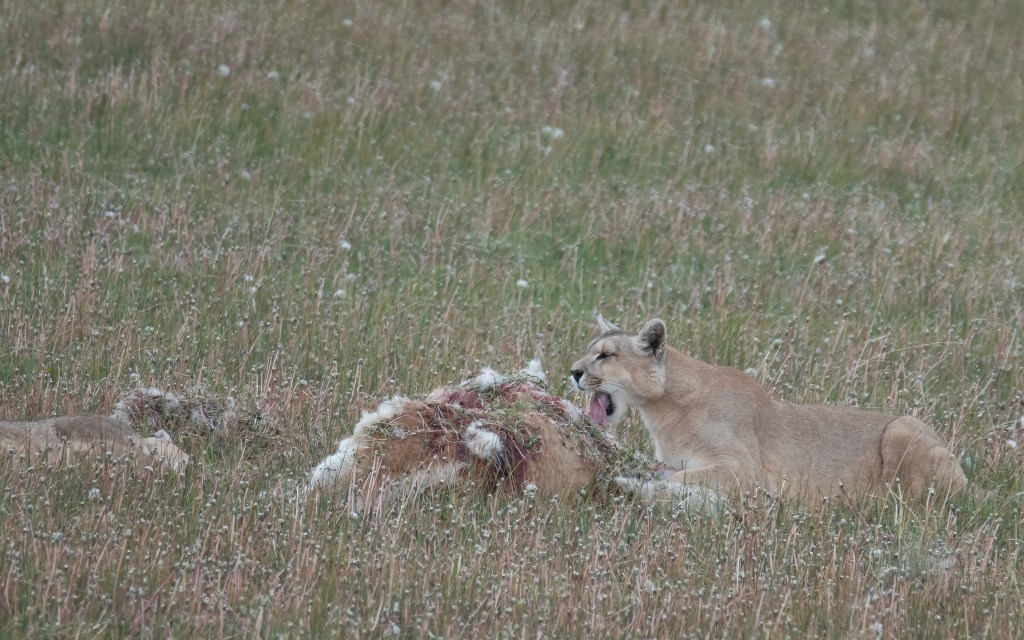
But as Angelo had predicted, once she had made her point Petaca let Goldie eat:

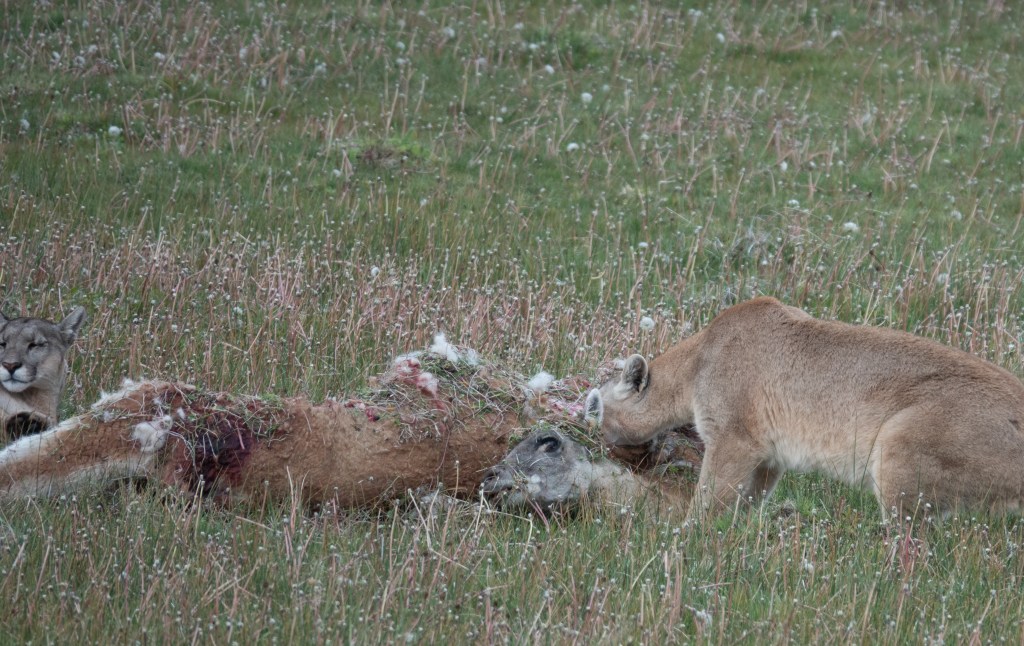
She settled next to the kill so Goldie couldn’t drag it away:

though she shifted it just enough so that you can see the poor guanaco’s head:

Petaca even fell asleep.

Something in the distance attracted their attention:
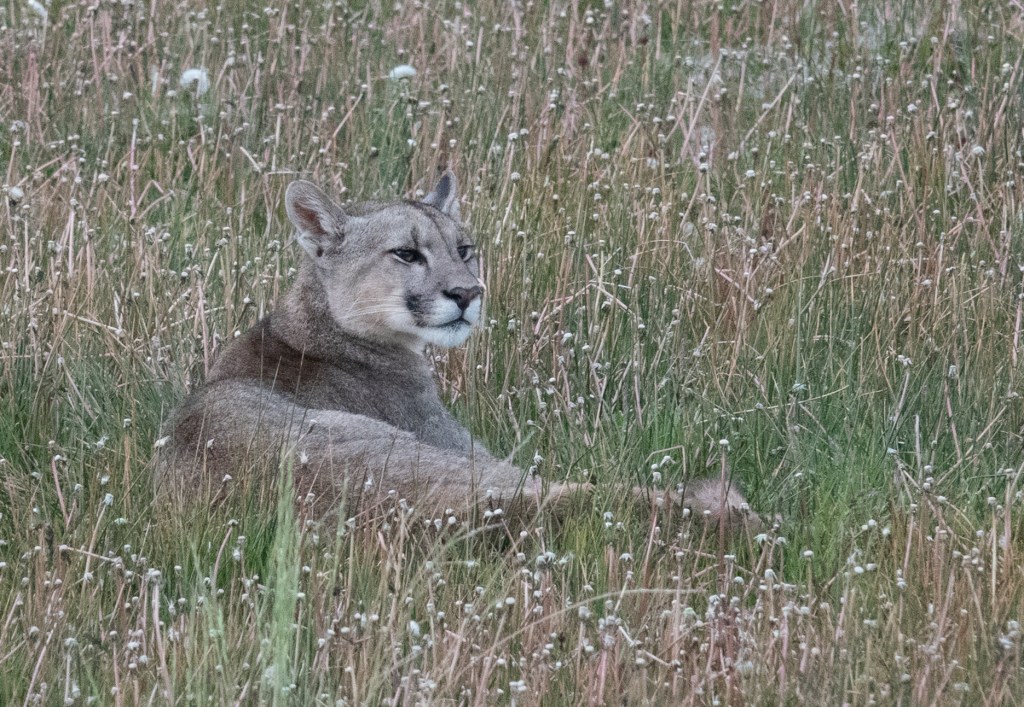
Replete, Goldie moved a little way off, and groomed.

Here’s a video:
Petaca stayed next to the kill, ever vigilant:

Eventually, all the pumas had left the kill. Even Petaca moved away, lurking in the bushes and watching us carefully as we headed for our vehicle:

What a privileged morning. And the last of our pumas.

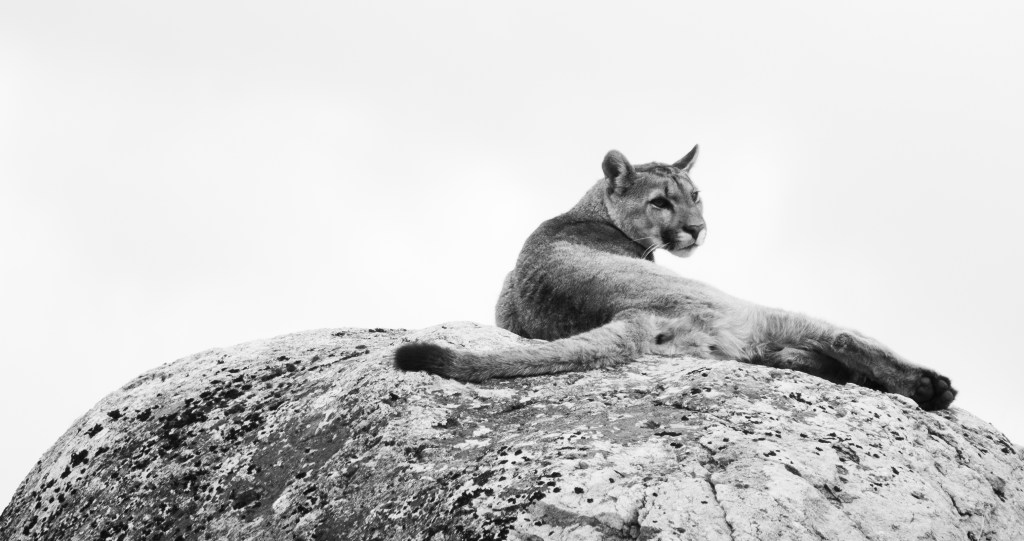
PS Puma coat color varies quite a bit, from the golden color of Blondie, to the gray of Petaca and her cubs, to the tan of Dark. They never have markings, hence the scientific name Puma concolor, meaning ‘uniform color’.

A Tale of Seven Pumas: Numbers 4-6

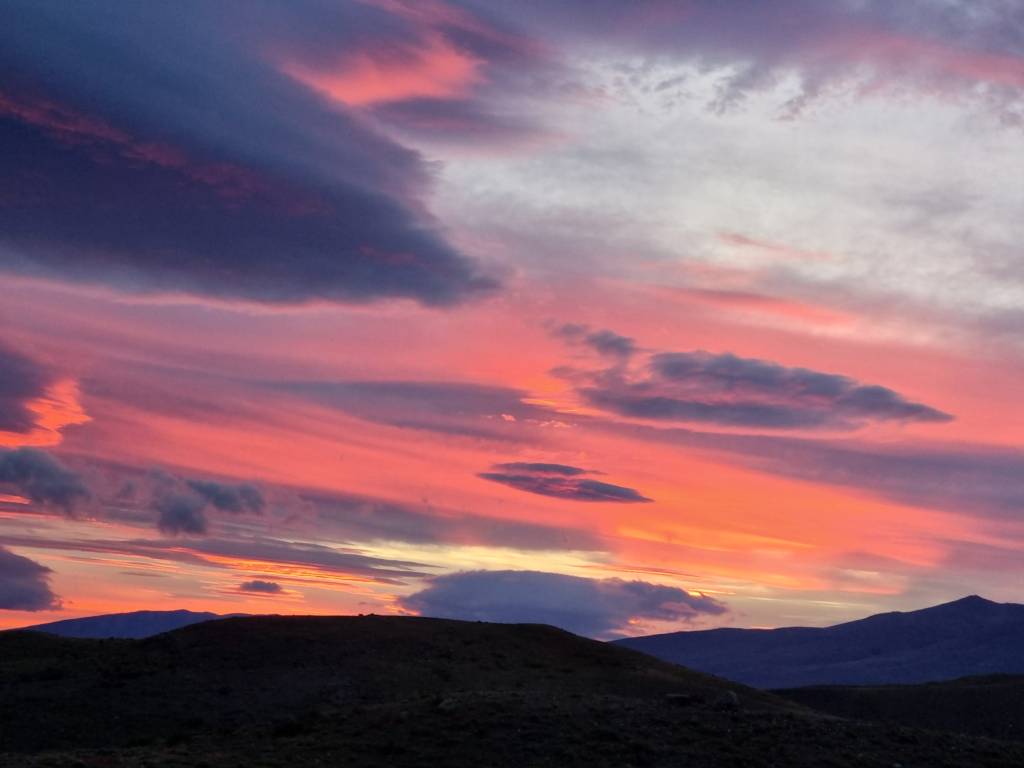
After the previous day, we were slightly dreading another day of howling gales, low temperatures, and not much puma. But at 4am we headed out to Estancia Laguna Amarga again, down the mountain in the dark. The compensation for the early start is a spectacular sunrise, like this one photographed by my friend Kerstin:

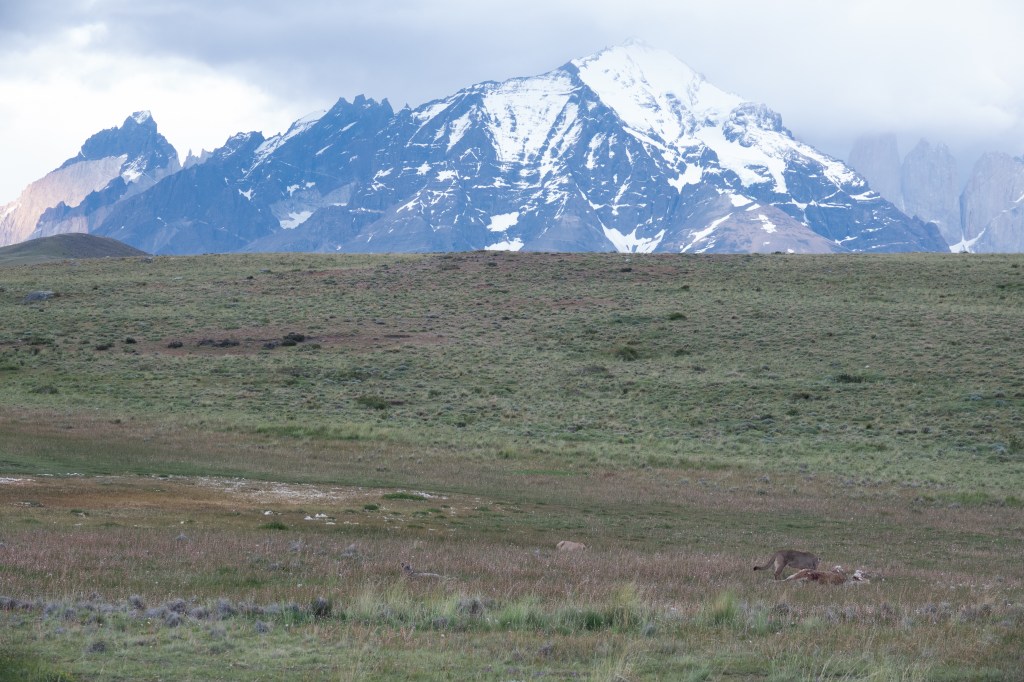
And today, after less than an hour, Angelo our tracker radioed us from quite nearby. With a huge grin, he pointed: there, spread out before us, as if on a stage, were four pumas and one dead guanaco (right foreground). So of course there we stayed, four and a half hours, riveted.

It was a mother, known as Petaca which rudely means “Shorty”, and two 11-month old cubs , one male and one female. (The fourth puma was a young adult female, who will be the subject of my next and final puma post.)

Angelo had seen Petaca the previous evening, looking as though she was hunting, so he had gone searching for her again this morning. She had indeed killed, an adult guanaco, and when we arrived the male cub was still feeding:

but they were clearly sated,

and beginning to nap:

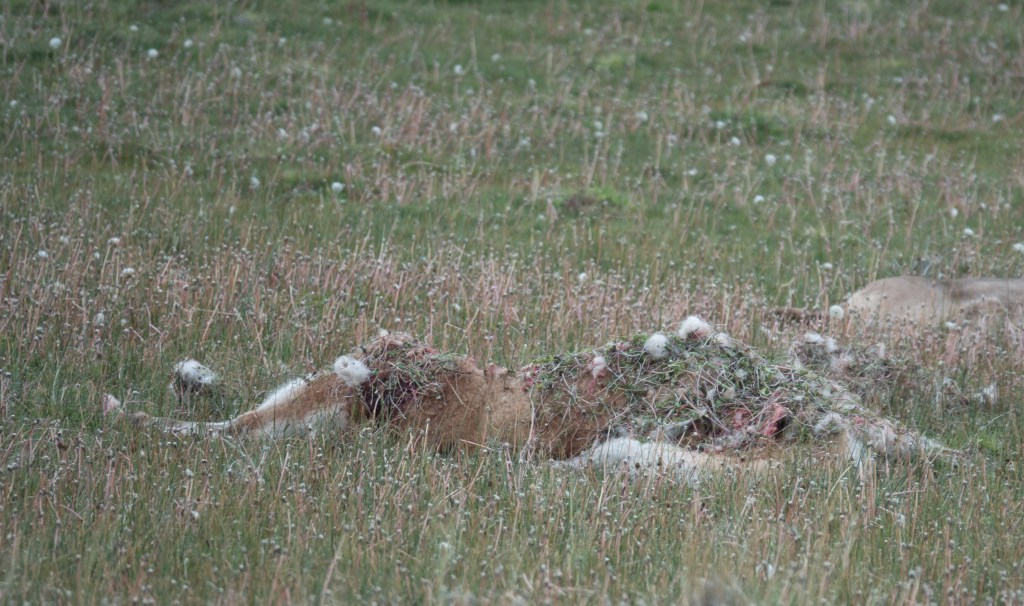
The kill would last them 2-3 days, so long as the condors didn’t find it, so they were scraping up clumps of grass to camouflage it from above:

Here’s a video:

It looked for all the world like a leg of lamb à la Provencale, ready for the oven.

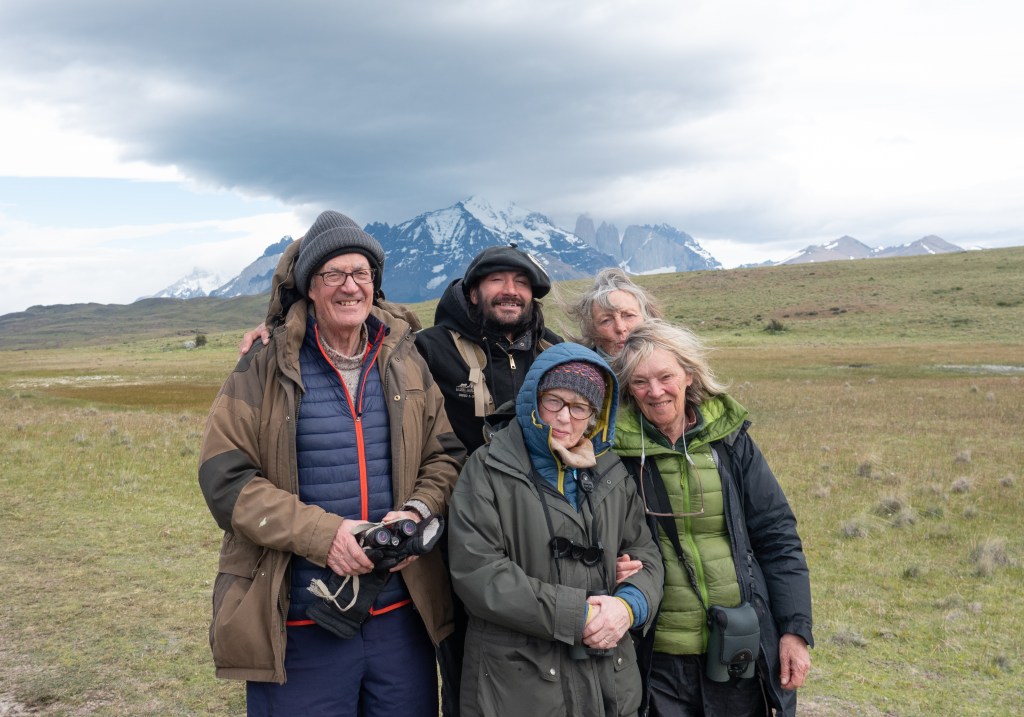
Thankyou, Angelo (the one with the beard!).

I’m ending this post with a small gallery of photos as they move through the landscape finding good spots to rest in for a while. You can I hope see how the wind whips through the grasses, and how their muscles ripple beneath the skin.

At one point the female cub had a good sniff at the ground, then savored it in a classic Flehmen response:

She was then joined by her mother:

The two cubs later walked right past one of my friends (I was behind a bush at the time!), and headed for a good vantage point:

Next time, we meet our final puma.

PS The cubs will stay with their mother till they are 15-24 months old.

PPS The Flehmen response is explained here: https://eyesonthewild.blog/2023/08/15/jaguar-encounters-ii/

The Ancestral Llama

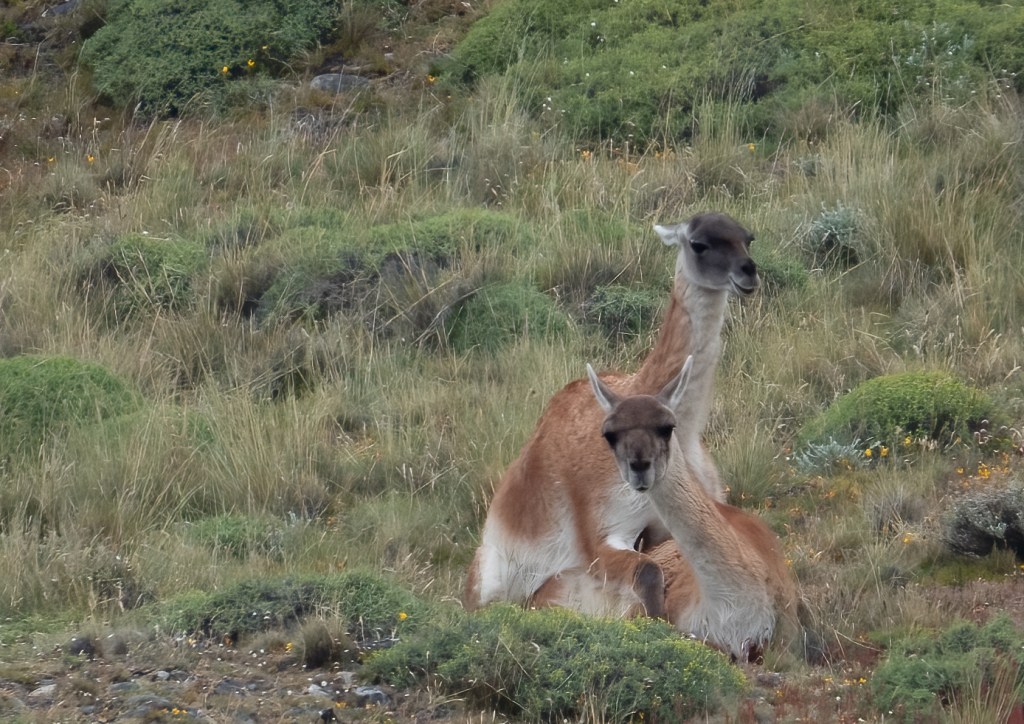
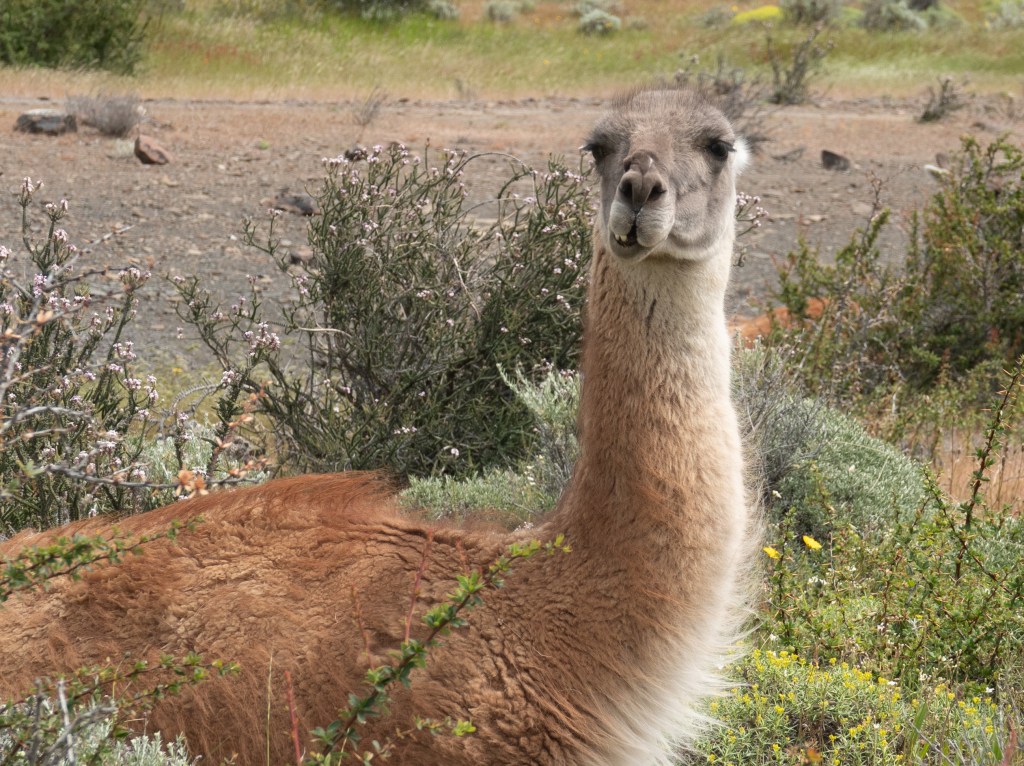
Guanacos are very endearing animals. About 43″ high at the shoulder, and about 60″ to the top of the head, only a tiny bit shorter than me. This one looked me right in the eye:

They are related to vicuñas, in the camelid family. Llamas and alpacas are the domesticated versions of guanacos and vicuñas respectively, so you might say that a guanaco is to a llama what a wolf is to a dog! In Chilean Patagonia, there are an estimated 160,000 guanaco, and they are considered of Least Concern, but before the Europeans came there were probably 20-50 million of them in the larger region. They are a major food for the pumas.

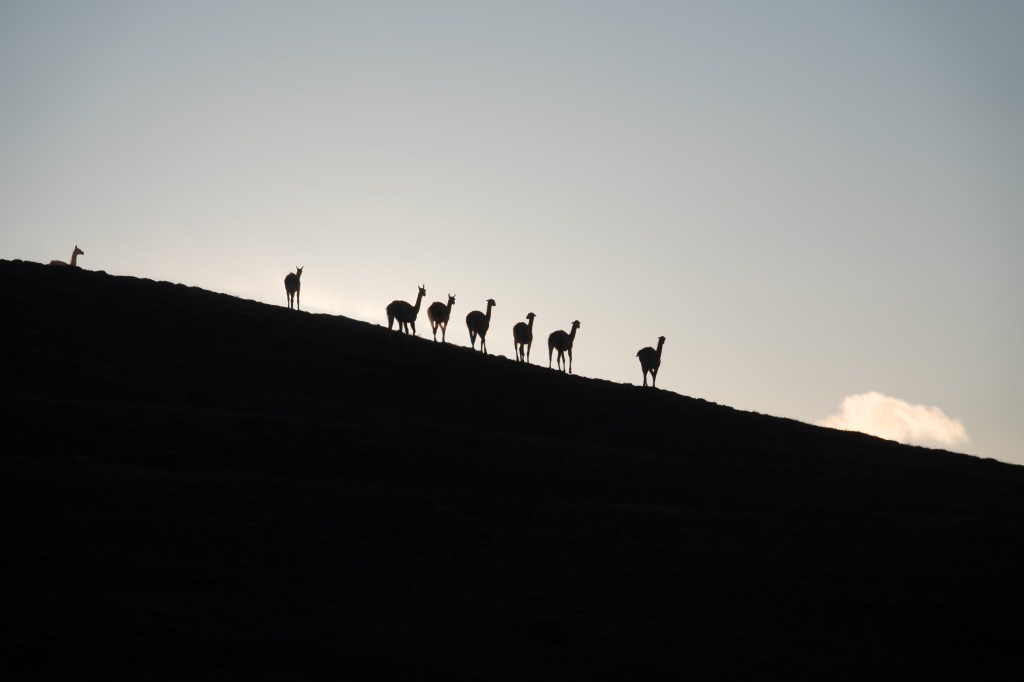
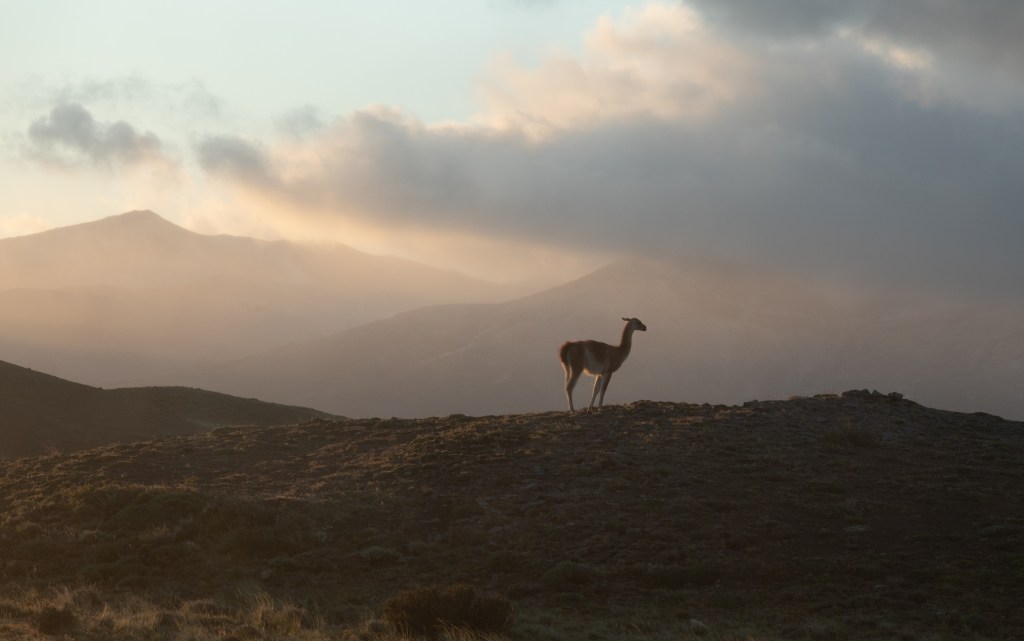
Often the first thing you see is one on the skyline, standing watch:

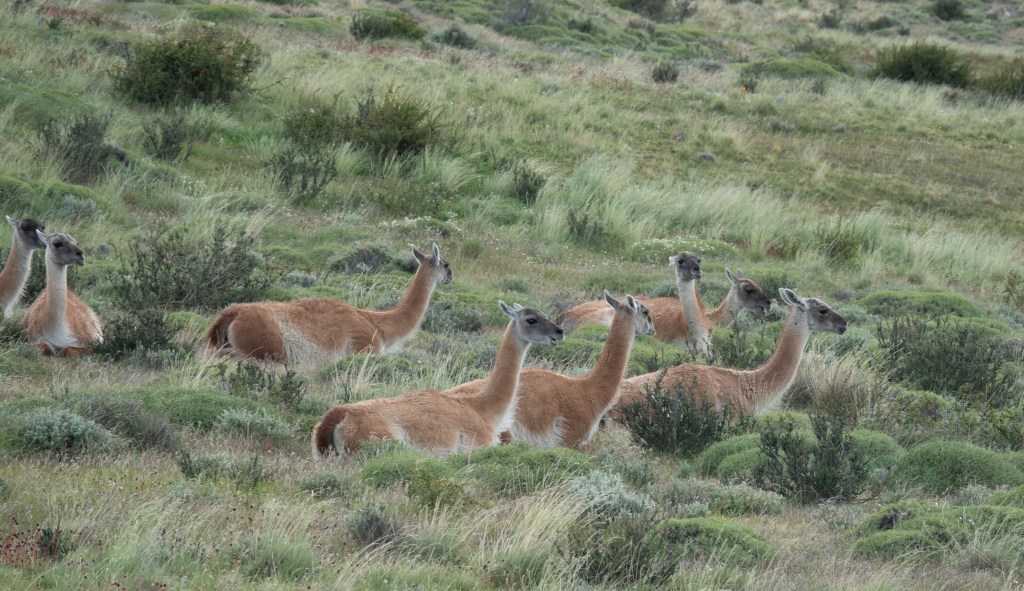
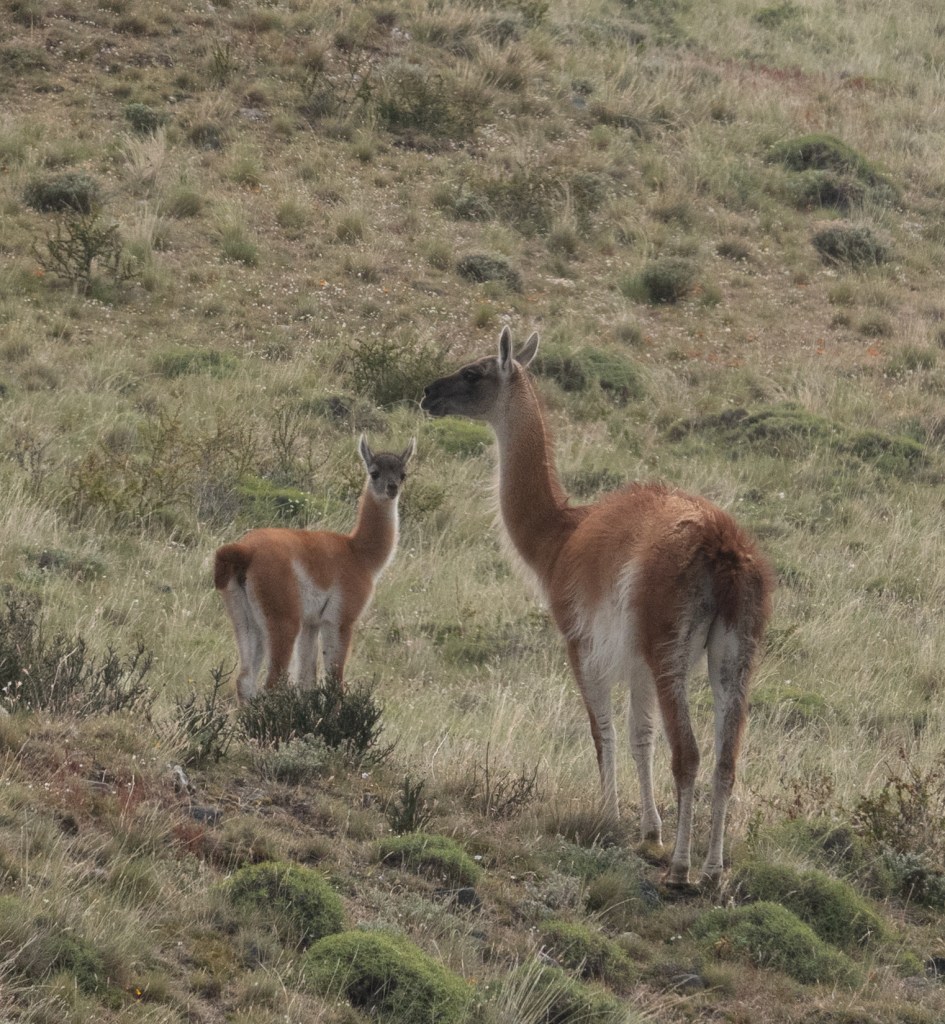
They live in small groups, typically all females and their young, with perhaps one adult male:

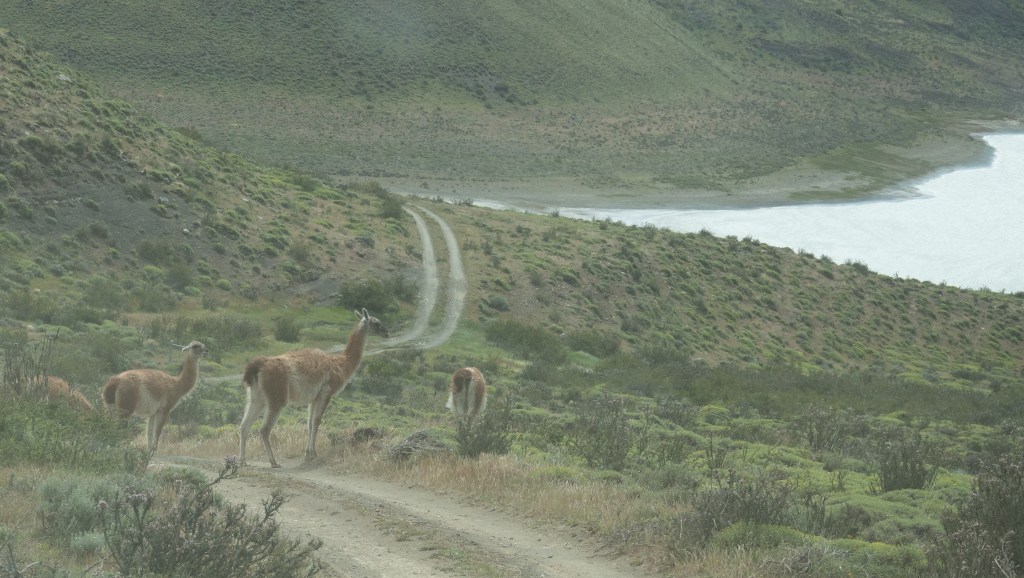
and they were not very bothered by our vehicle:

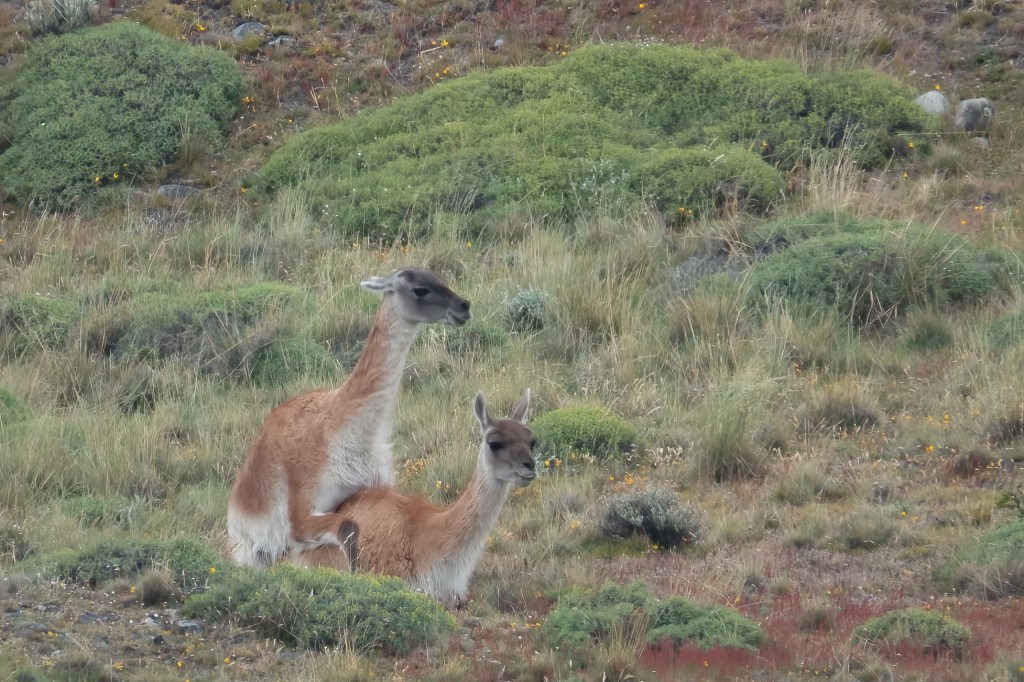
We encountered two adults alone in a secluded valley, quite far away from us, and it took us a minute or two to realize what was going on:

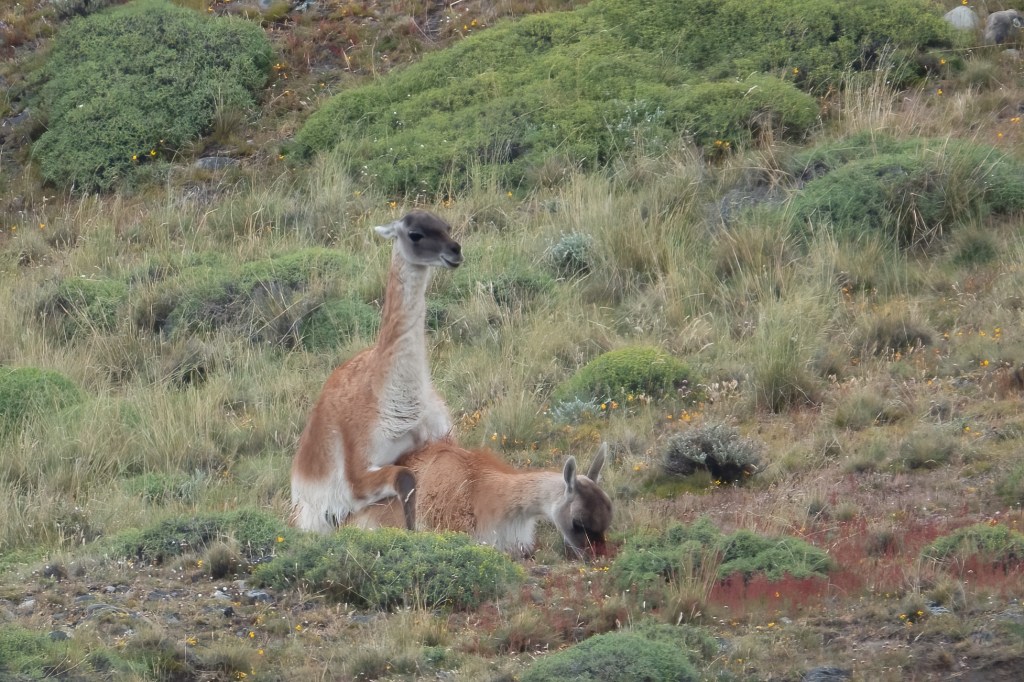
Apparently they can stay in their marital embrace for five hours, and we weren’t sure whether they had just met up, or were ready to part. She seemed resigned, or perhaps bored, and a little hungry:

They noticed us, so we gave them some space for their private date, hopefully uninterrupted by any pumas:

She will give birth just under a year from now. The young ones have a special name, “chulengos”, and we were there during the short season when they are born. Concentrating the births means more of them survive the pumas. The chulengos are irresistible:

Irresistible to humans, but also to pumas. The very first puma we saw had just killed a chulengo, and a puma is entirely capable of killing an adult guanaco too, as you will see in my next puma post.

But guanacos are fast, and if they notice the puma in time they will usually escape. Hence the need to stay on ridges, so that an ambush is difficult:

Their thick coat is an excellent insulator against the driving winds of the region, and it is prized as a luxury fibre, like alpaca and vicuña. Indeed, there are places where wild guanacos are sheared and released back into the wild.

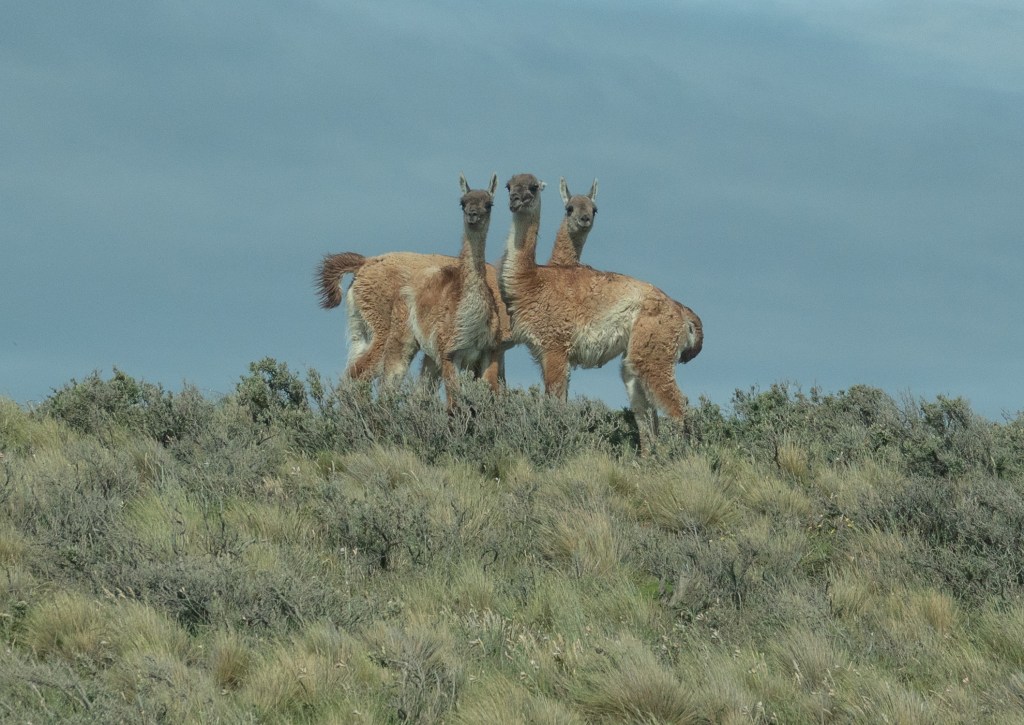
In closing, I rather liked this double-bodied but triple-headed coven, because it reminded me of author Hugh Lofting’s two-headed Push-me-Pull-you llama:

“They were very shy and terribly hard to catch. [Predators…….] get most of their animals by sneaking up behind them while they are not looking. But you could not do this with the pushmi–pullyu — because no matter which way you came towards him, he was always facing you.” [The Story of Doctor Dolittle]

A Tale of Seven Pumas: Number 3

[My second puma post, to see out 2024. Happy 2025, and thankyou for reading my blog.]

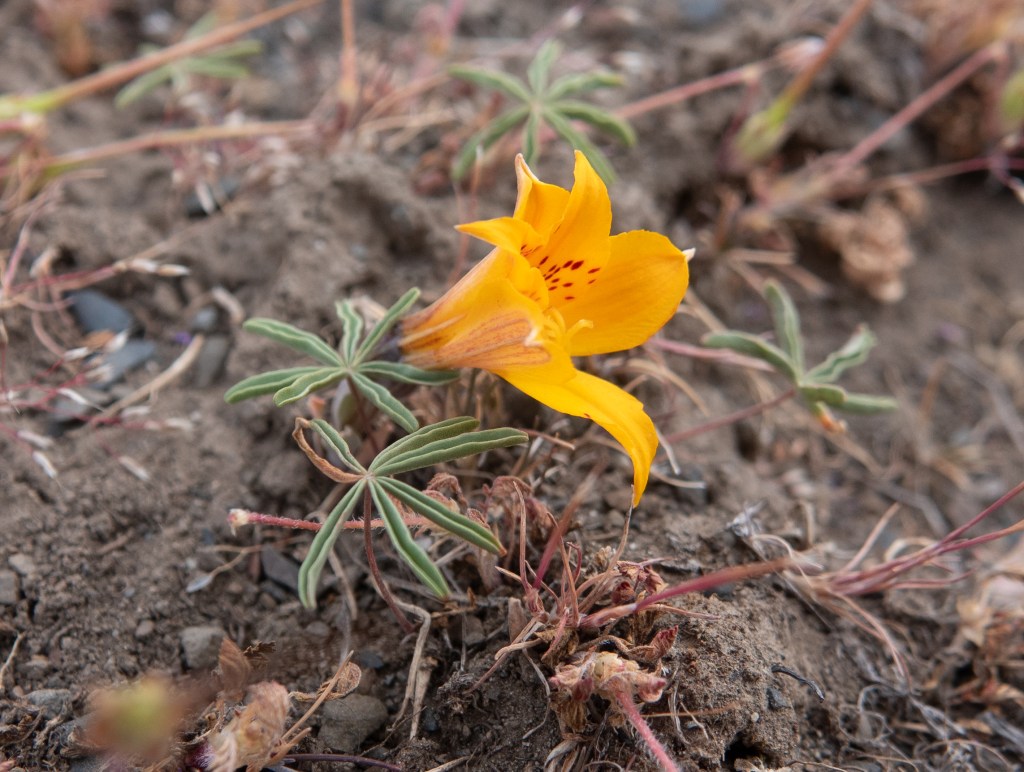
After our stunning sighting of the mother and cub it seemed clear that finding pumas was a doddle. Next day, we set off at 4am for the one-hour drive to Estancia Laguna Amarga to meet our tracker Angelo. We drove around for a couple of hours, seeing nothing much of anything. We stretched our legs, and looked for wildflowers like this lovely Sand Alstroemeria, or Alstroemeria patagonica, aka Mariposa del Campo, growing stalkless right out of the gravel:

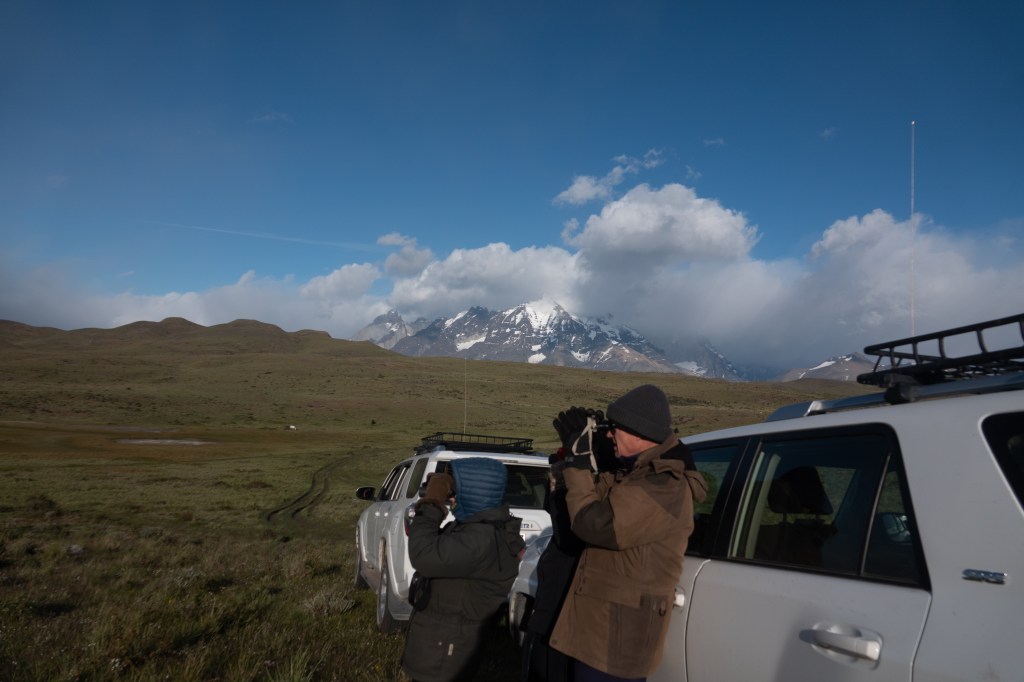
Then a different tracker contacted us on the radio: he had seen something, and he’d meet us there. He pointed at this:

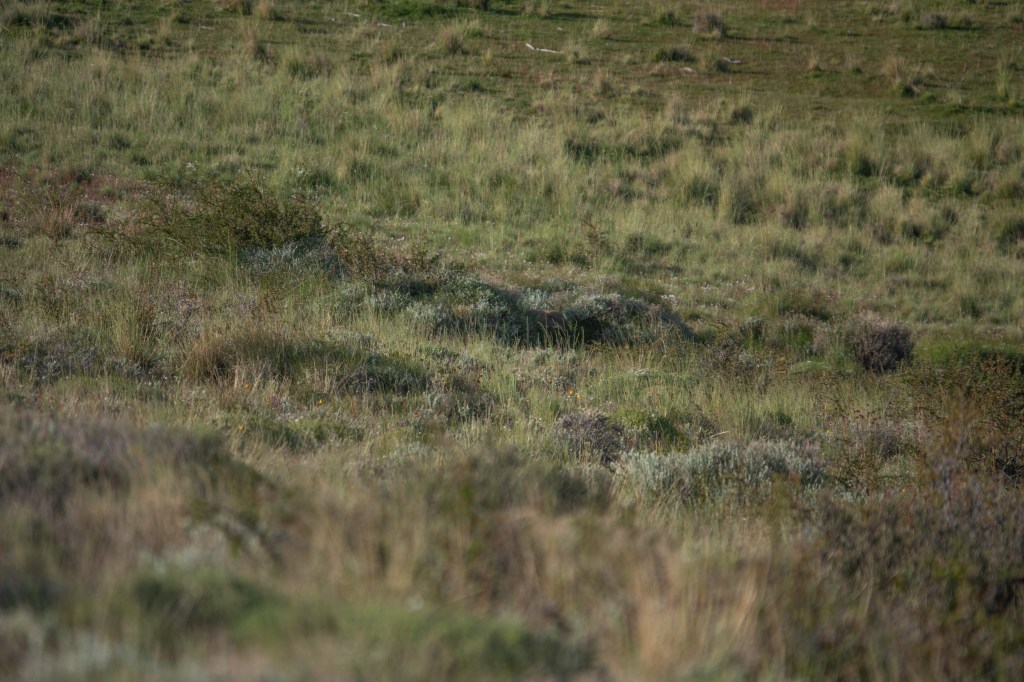
We looked, hard:

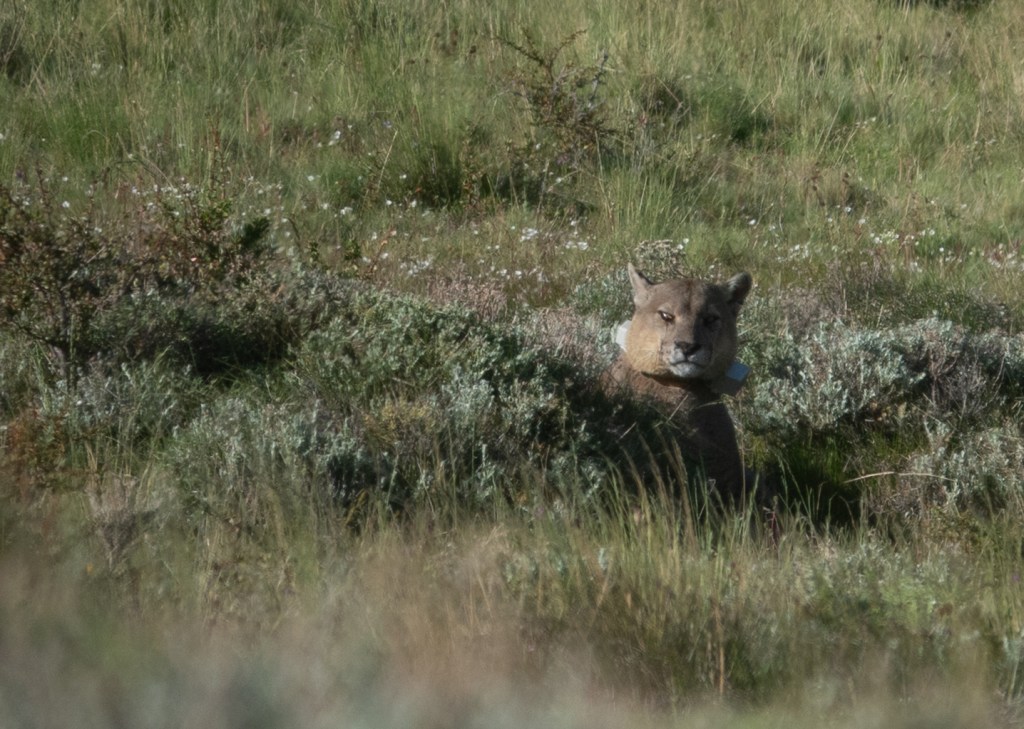
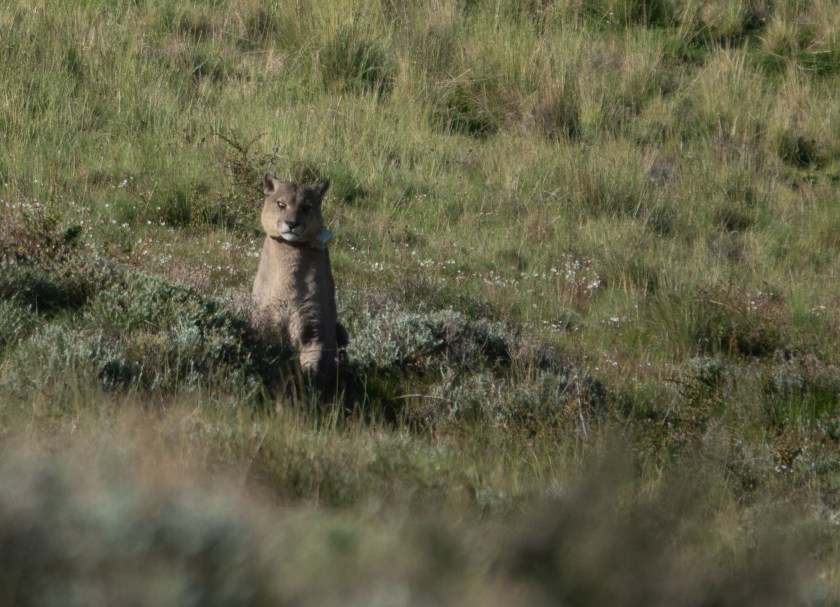
Nothing, or maybe a sliver of brownish back?? But an hour later he raised his head, and we saw that he was real, and wearing a white collar:

His name is Dark, and he was the alpha male for a very large area, where he would father all the cubs. He was collared by the Cerro Guido Conservation Foundation, who are based on a neighboring estancia. Our trackers did not find him via the collar, because they don’t have the tracking equipment; it was just skill, great eyes, and a dollop of luck.

We were told that Dark is shy and does not like people, and indeed after sitting, stretching, and defecating he went back to sleep behind the bush.

In the vicinity there were three horses (circled, top right), and some guanaco. This equine trio are feral, but unlike most horses they do not run at the scent of puma, they just watch carefully from a distance. The puma is circled, bottom left.

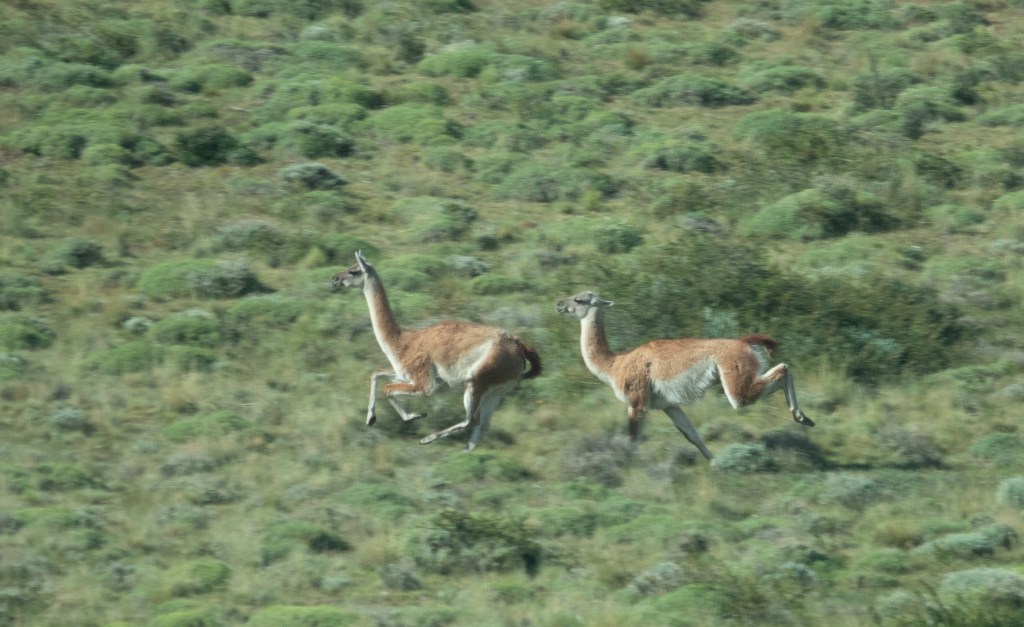
The guanaco, out of shot in the photo above, reacted quite differently. One whiff of Dark, and they were off:

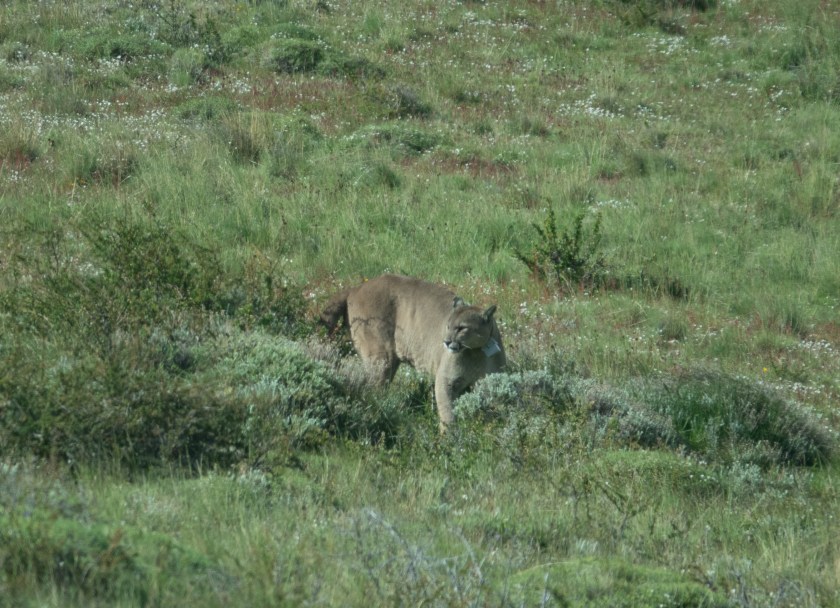
About two and half hours after we arrived, Dark finally showed himself fully,

and immediately walked languidly off up the hill:

with a brief irritated backwards glance:

We tried to follow him, but he was having none of it.

A frustrating morning, and we arrived back exhausted after nearly 10 hours. Clearly seeing pumas is not as easy as it had seemed the day before!


PS The total puma population in the Torres del Paine National Park and its neighboring estancias is estimated at between 50-200 animals, but nobody really knows. This story tells you a little more about the conservation project at Cerro Guido.

Peckish

[The red coiffure seemed suitably festive for today. I do hope you have a wonderful holiday.]

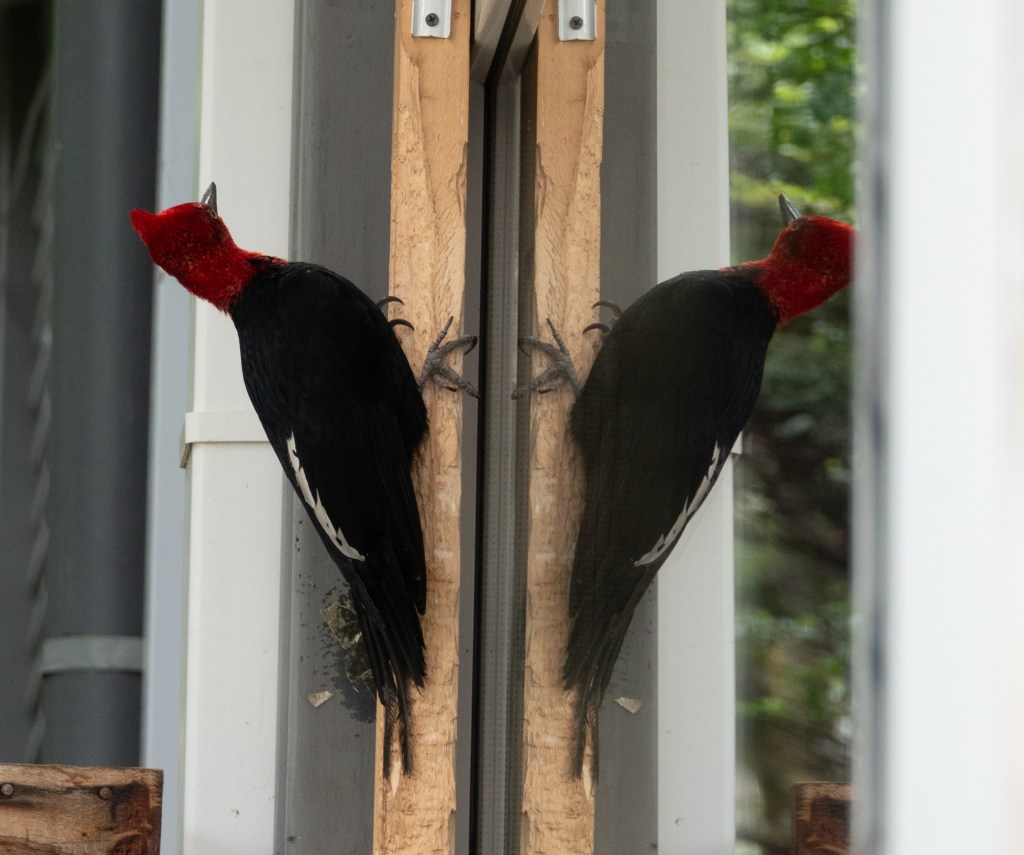
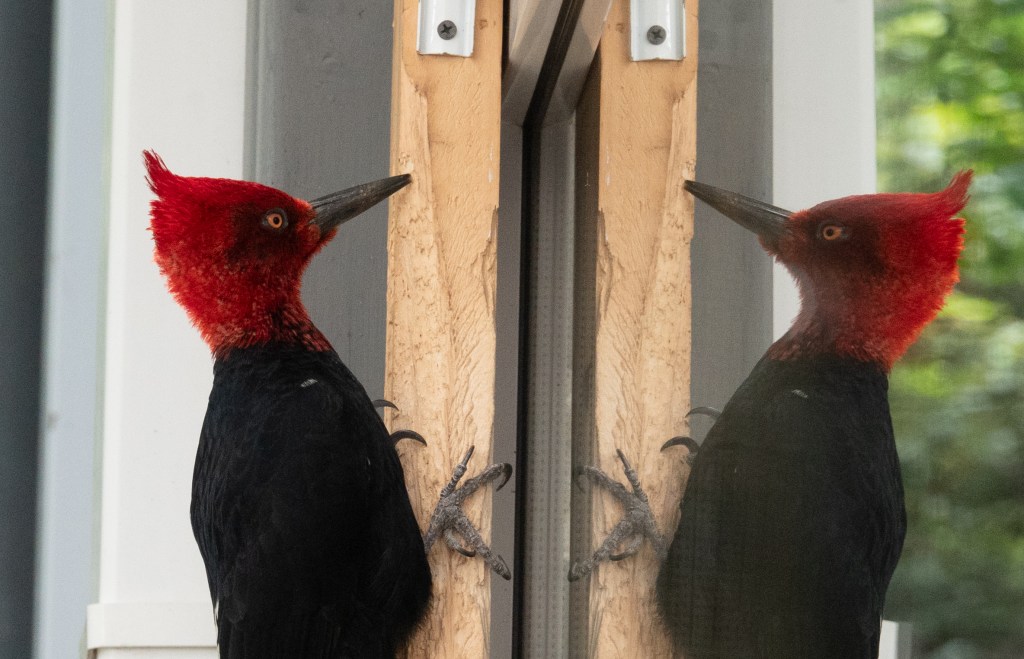
One of the largest woodpeckers in the world lives in Patagonia: the Magellanic Woodpecker, Campephilus magellanicus. This is a handsome male: yes, there’s just one in this photo, though he apparently thinks he’s met a rival, living inside Hotel Lago Grey:

He gives him a sideways look:

Perhaps when he looks back his competition will have thought better of it. No such luck, still there:

So he decides that a war dance is the best strategy :

All this while his mate has been waiting patiently for her Don Quixote to give up tilting at windmills :

And her patience is rewarded. Visions of that glossy curly black quiff draw him back to her side:

They have no close relatives, but the closest may be the extinct ivory-billed woodpecker. The males can weigh up to 360g, a little larger than a Pileated Woodpecker.

Before I leave this post, Patagonia also has the rather drab Chilean Flicker, Colaptes pitius, a species of woodpecker that forages on the ground like its North American counterparts:

It is a male, because it has a dark mustache :

A Tale of Seven Pumas: Numbers 1-2

Our particular interest on this Chile trip was trying to find puma (mountain lion) in Patagonia. The local cattle and sheep estancias are slowly converting to wildlife tourism, and instead of shooting the pumas (which are protected in Chile) they now track them and bring people like us to see them. The animals (some more than others) are getting slowly habituated to vehicles, and don’t act as secretively as they once did, and as they still do in most of the US (where they can be legally hunted).

I’ll tell the tale in four blog posts, chronologically, and perhaps with pauses for other things, so you don’t get too blasé about pumas.

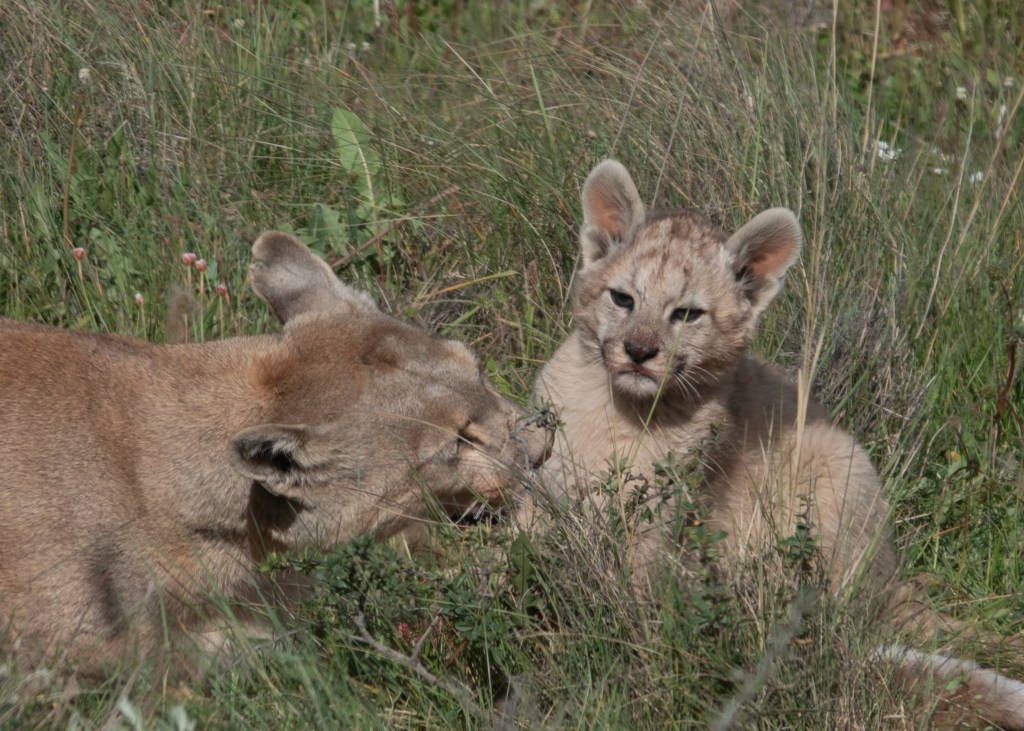
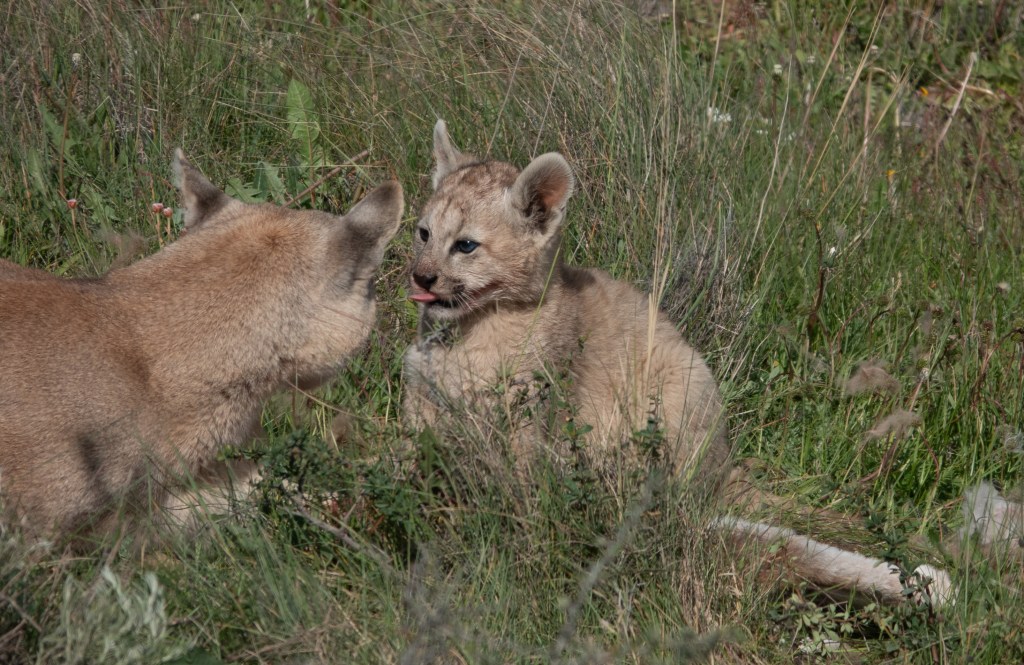
We had been traveling all day from Tierra del Fuego, a 7am start, a 2 hour drive, a ferry across the Straits of Magellan, and another 6 hours on the road. We were almost at our lodge, the Hotel Pehoé on an island in a lake in Torres del Paine National Park. There were a few cars pulled over on the side of the road, so we stopped too. Right by the road a mother puma had killed a baby guanaco for her two cubs, and the mother and one cub were feeding a few feet away, unconcerned. The cub is about two months old.

One cub was nowhere to be seen, but the remaining one was curious and unafraid. In the left foreground you can see the leg of the kill.

The bond between them was almost tangible:

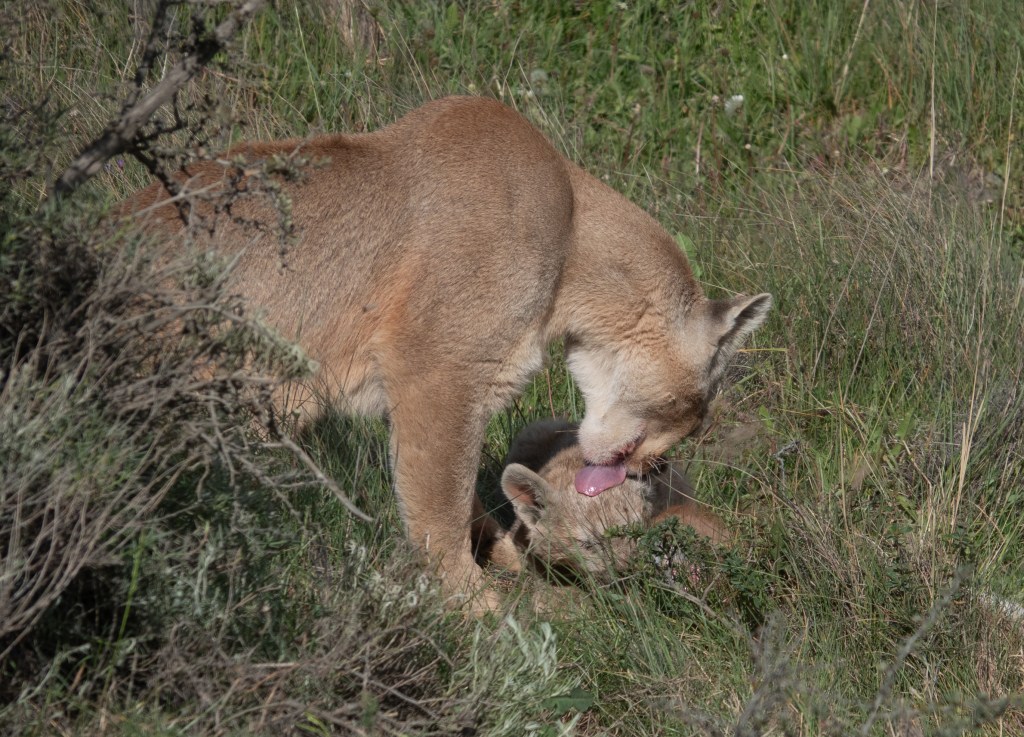
I’m not sure if you can see, but the cub still has blue eyes. The mother groomed her cub thoroughly, from top:

to bottom:

The cub is clearly showing an interest in meat, but it is still nursing as well, which may be what it is trying to do here:

The mother was elegant

and not to be trifled with, keeping a careful eye on her human fans:

After nine minutes they moved slowly off back into the scrub, the cub bounding ahead:

and the mother eventually taking the lead:

And they melted away into the 700 square miles of the park. We were extraordinarily lucky. It is rare to see puma in the national park itself, because the rules require you to stay on the official park road. For the next two days we will be searching outside the park with a tracker.

PS The puma, Puma concolor, has many other names, including mountain lion, and cougar. It is not officially a big cat. There are only five of those, all in the sub-family Pantherinae. Pumas are not in this sub-family, which contains the four cats that can roar – lion, tiger, jaguar and leopard – and their very close non-roaring relative the snow leopard. Instead, they are in the sub-family Felinae, alongside cheetahs, lynx and bobcats.

According to Wikipedia, pumas are the fourth largest cat species worldwide; adults stand up to 90 cm (35 in) tall at the shoulders. Adult males are around 2.4 m (7 ft 10 in) long from nose to tail tip, and females average 2.05 m (6 ft 9 in). Males weigh up to 72 kg (159 lb), and females up to 48 kg (106 lb). The largest recorded cougar, shot in 1901, weighed 105.2 kg (232 lb).

Iriarte et al (1990) show that pumas who live nearer the poles weigh much more than they do closer to the equator. In Patagonia, their mean body weight is 55.6Kg, vs 43.6Kg in Arizona. They’re roughly the size of a cheetah, and much lighter than a lion. But they are perfectly capable, very very rarely, of killing humans

The Chungungo, or Sea Cat

[The next several posts will be from Chile, where we spent a wonderful two weeks in November and December.]

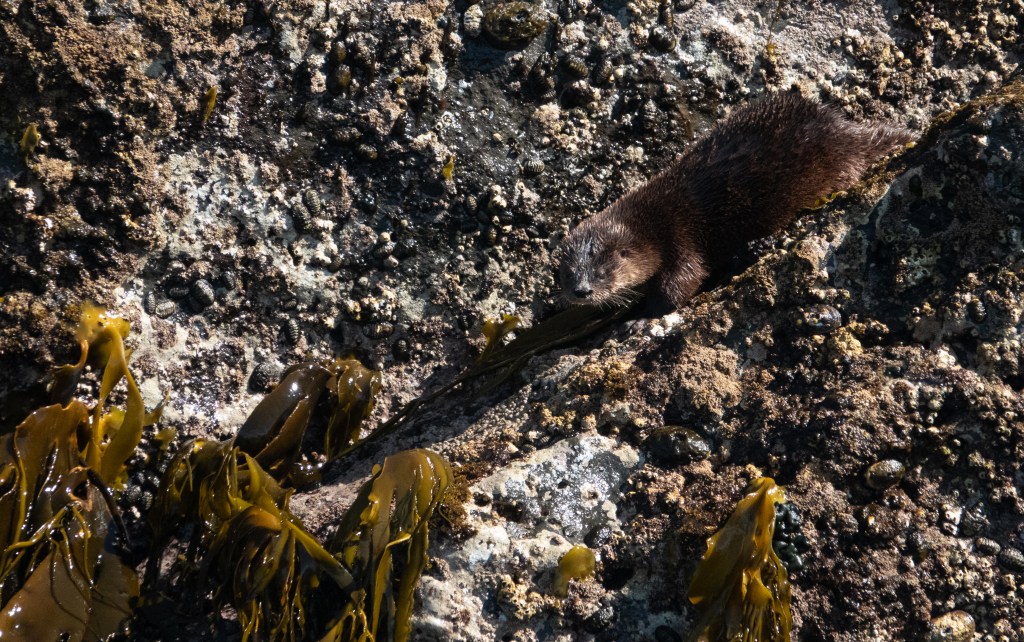
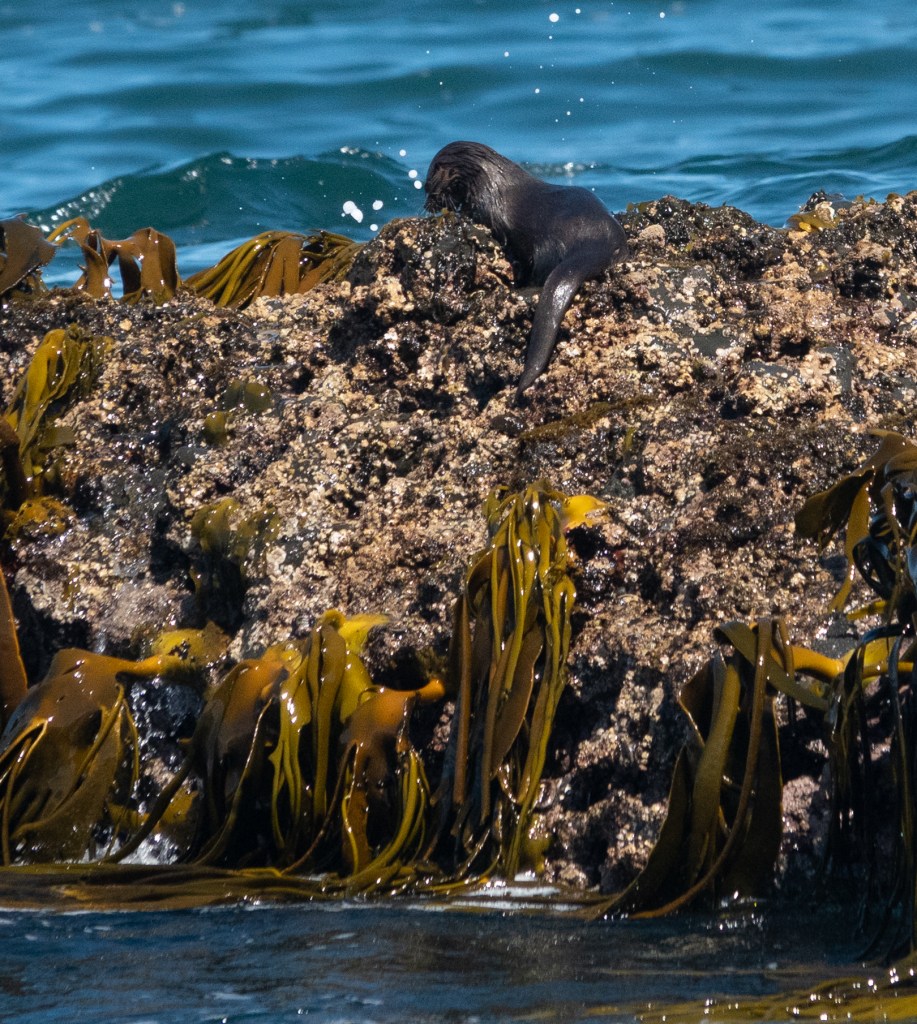
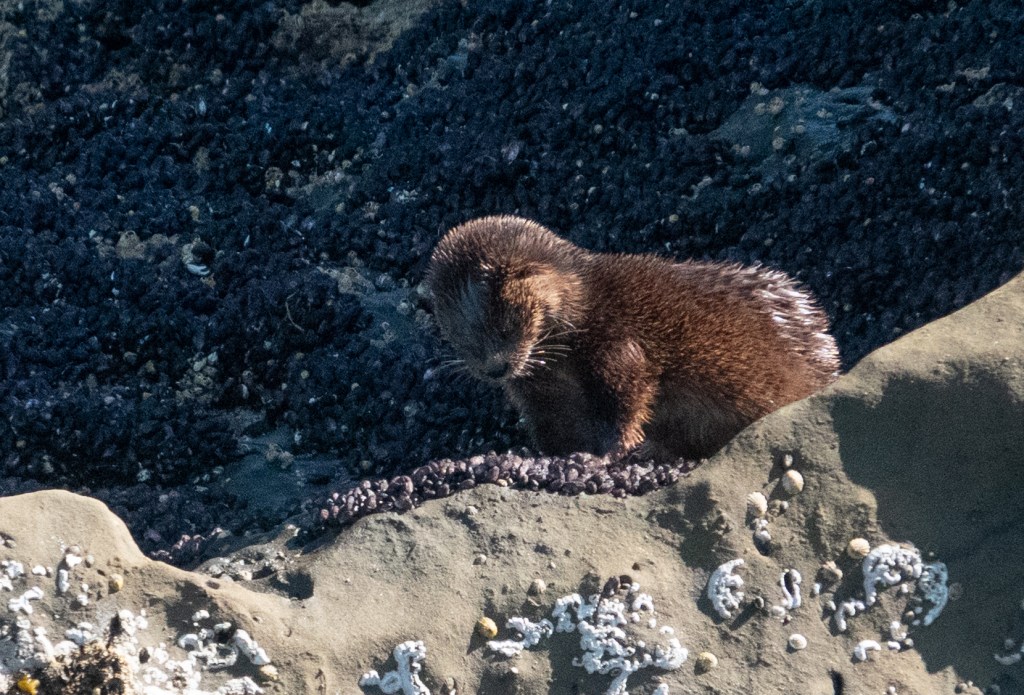
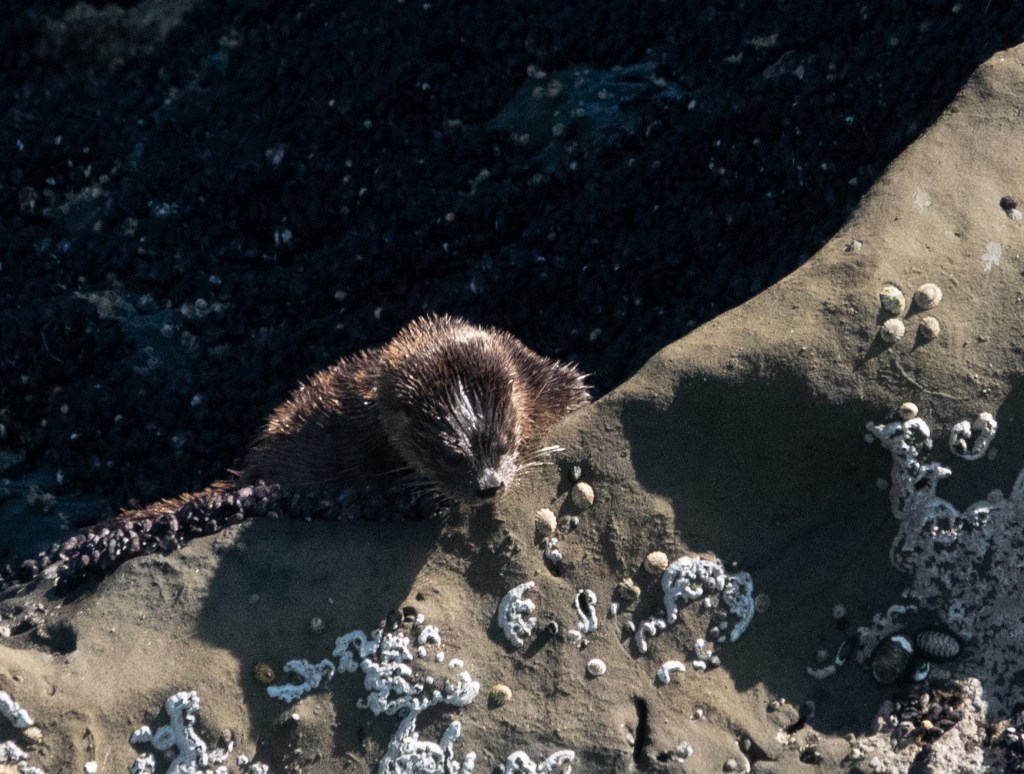
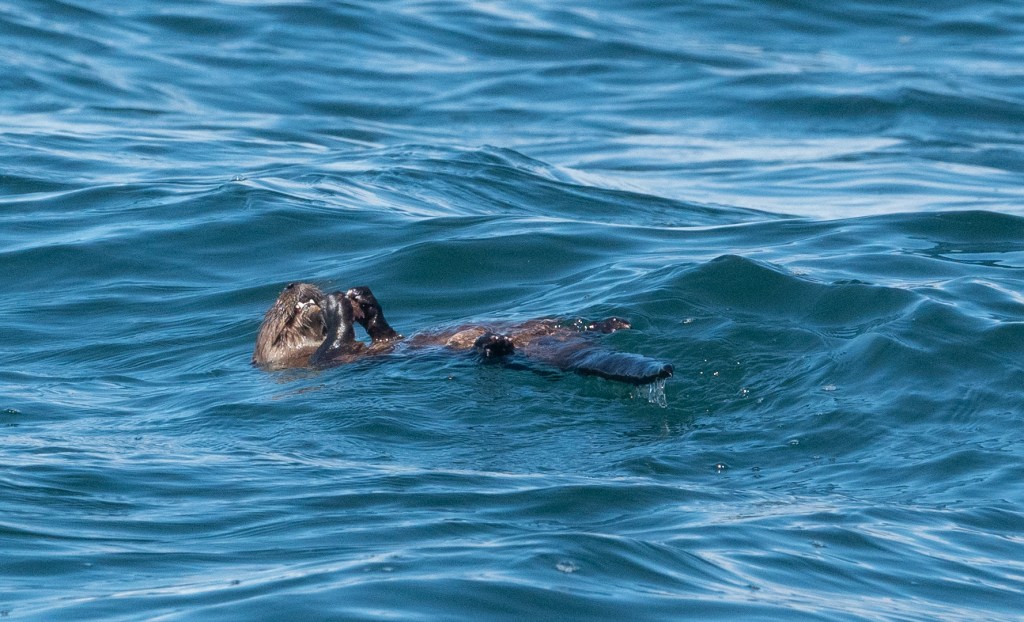
This is a Southern Marine Otter, Lontra felina., also known as a Gato Marino (sea-cat) , or Chungungo.

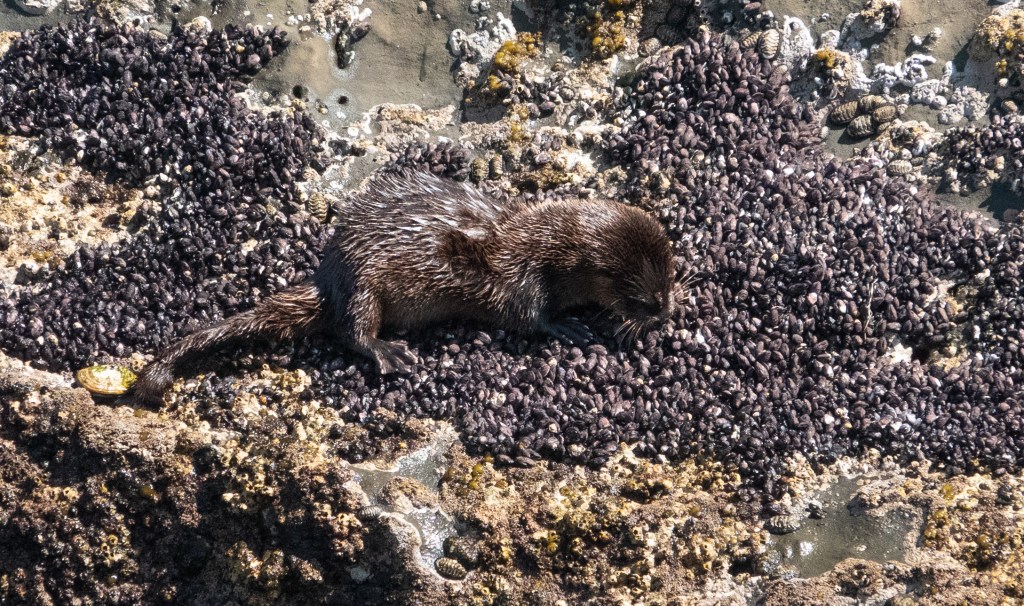
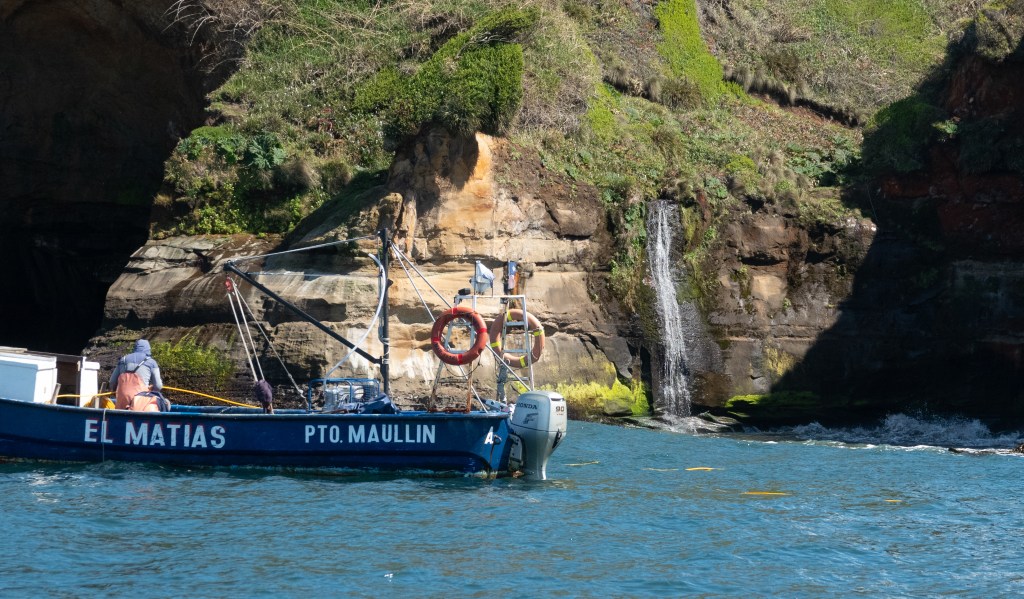
It is the smallest marine mammal, measuring 87 to 115 cm (34 to 45 in) from the nose to the tip of the 13in tail and weighing 3 to 5 kg (6.6 to 11.0 lb). This one is in the Pacific near the mouth of the Maullin River off the coast of Chiloé Island, eating mussels clinging to the rock.

It is found on the Pacific Coast of South America, from Peru to Tierra del Fuego and is the smallest American otter; its closest relative is the North American River Otter., which weighs about three times as much. It is not closely related to the more familiar sea otter of California and the Pacific north west, which can weigh nearly ten times as much.

.

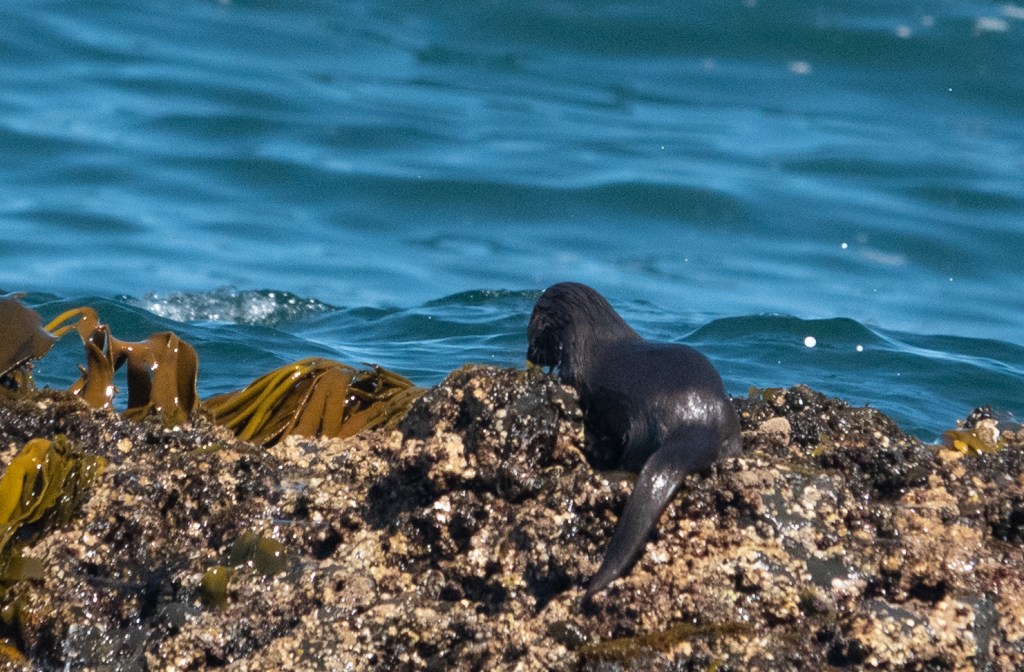
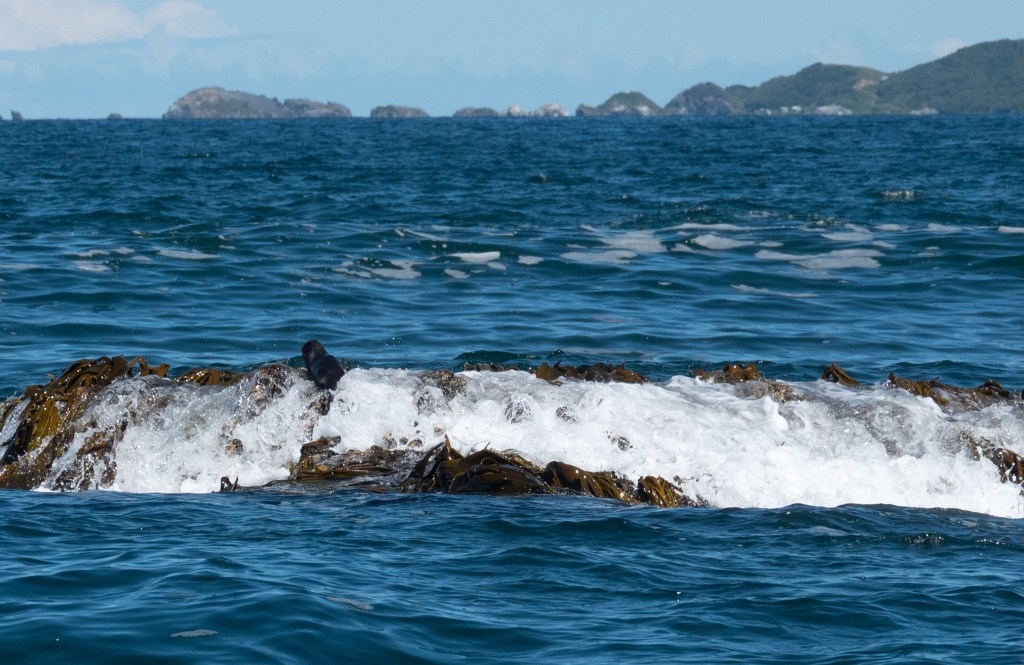
It only lives in salt water, and it likes rough and rocky coasts. Just after this photo was taken it was washed off the rock by a large wave, doing a dramatic mid-air somersault (no photo!).

Their dens are usually in caves, and they apparently spend much of their time on land, unlike the Californian sea otter.

Its coarse fur has 2 cm long guard hairs, covering a dense, insulating undercoat, which is why it was hunted for the fur trade. Now it is very hard to find, and we were lucky to see one after a long hunt.

The marine otter is dark brown with fawn on the throat and belly.

and it has webbed paws, with strong claws that allow it to eat both fish and crustaceans.

Here, it was following a clamming boat; the yellow hose in the photo below is the air supply to the invisible divers below water.

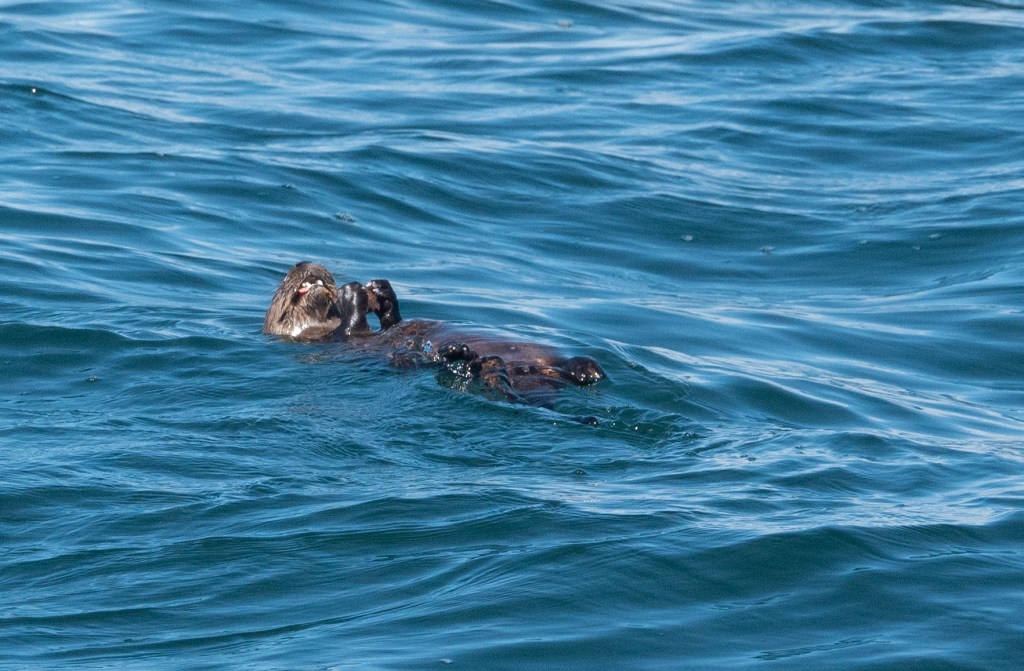
The divers dislodge clams, which the otters love. Like the better known and larger sea otters off California, they feed on their backs:

This charming animal is listed by the IUCN as Endangered . They’re legally protected in both Chile and Peru, but the laws are loosely enforced, and they are sometimes killed by fisherman , or for their fur.

To end with, I found this mini-documentary online that has really wonderful footage of a mother otter and her two cubs, both on land and underwater. The commentary is a little mystical for my taste, but the images are quite lovely.The filmmaker is Ben Goertzen , and it won awards at the Jackson Wild Film Festival in 2019.

At home: “The Gardener of the Patagonian Wetlands” Part II

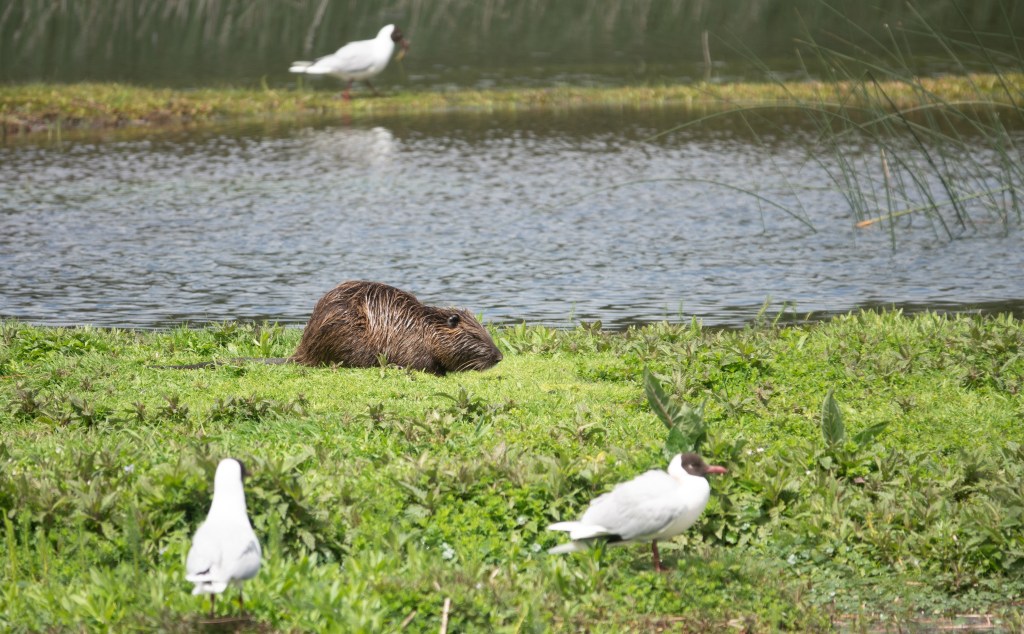
Yesterday morning at 2am I got back from Chile, and I can’t resist an immediate follow-up to yesterday’s coypu blog. Here he is, in his rightful home:

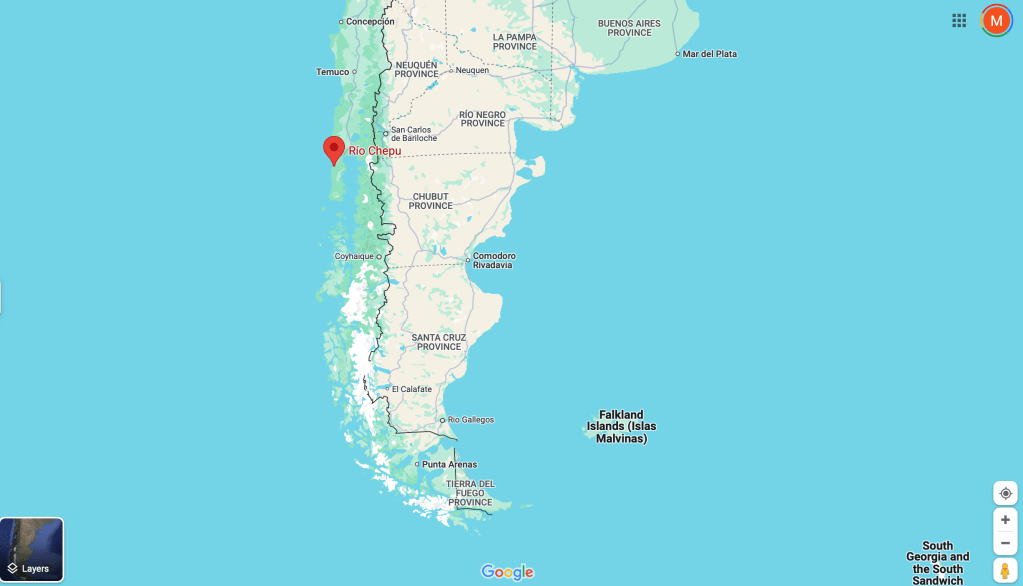
This is near the mouth of the Chepu River, on Chiloé Island in Patagonia in Chile.

I will tell you more about Chiloé in later posts, but for now enjoy “our” coypu, the only one we saw:

It walked along the grassy islet, showing its webbed hindfeet:

and its dexterous front ones:

Then slipped into the water and swam off (the video is slightly slowed down):

Ironically, and sadly, while they are becoming invasive in Europe they are becoming rare in Chile, as a result largely of hunting. Our guide Jonathan was quite excited to see one.

“The gardener of the Patagonian wetlands”, Part I *

I first saw this animal not in Patagonia, but in the hills of Tuscany, on the edge of a hamlet, next to a tiny stream, or more precisely a ditch. There was a narrow path to the ditch through the long grass and we were discussing what had made it.

It was a nutria, or coypu. Native to South America, it was brought to Europe and the US for fur farming, and escaped (or was released when the fur farms closed). Its scientific name is Myocastor coypus, literally “mouse beaver”. Its many names are confusing. Coypu is preferred in South America, where nutria can also mean beaver or otter. In Italy it is sometimes called castorino, little beaver, and in Germany Sumpfbiber, or swamp-beaver. In much of Europe and the US it is considered an invasive species, damaging water banks and crops like rice as it burrows into them.

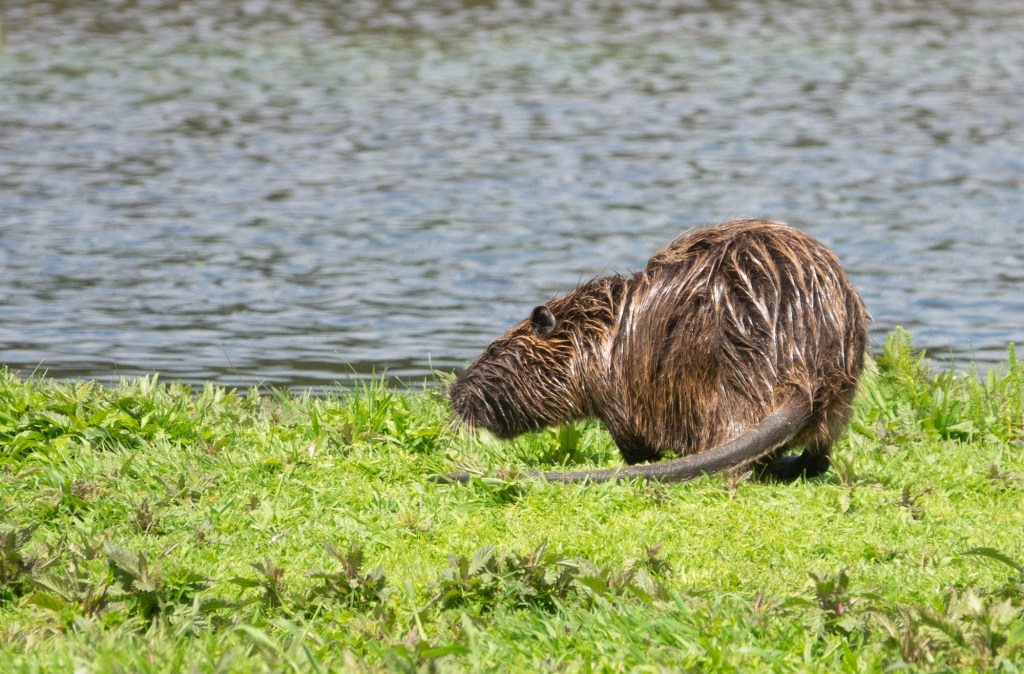
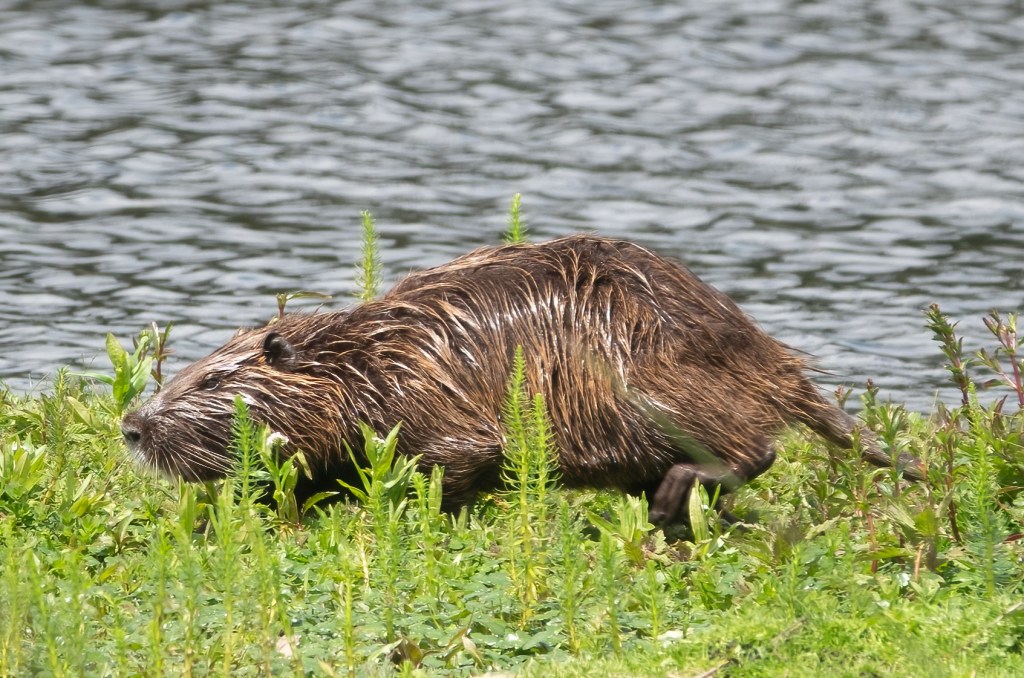
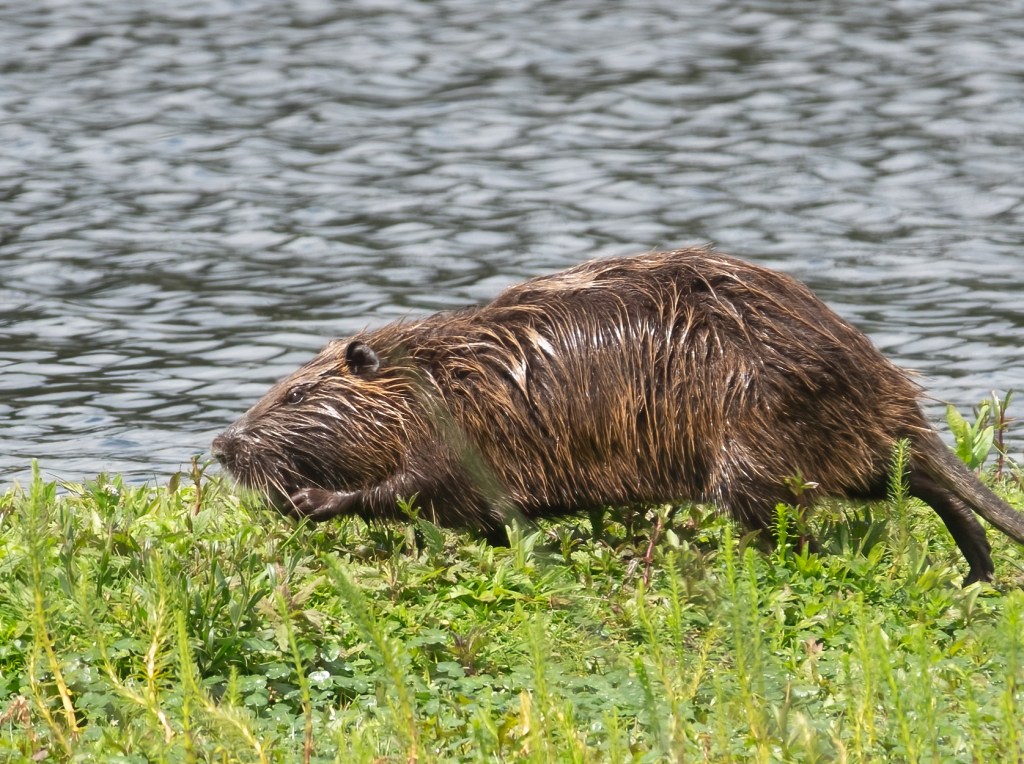
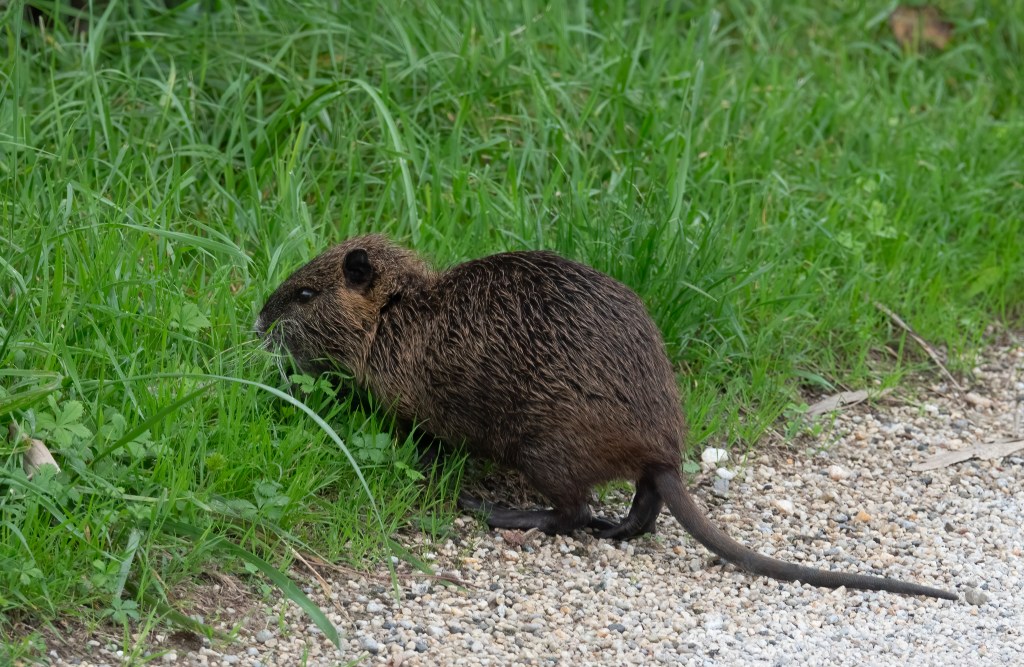
It weighs 10-20lbs:

and has webbed hind feet and a naked tail:

and a white muzzle with long whiskers:

If you rank some other aquatic rodents by size, starting with the smallest, you get muskrat, coypu, beaver, and then capybara. All are vegetarian, but their ranges differ. Coypu and capybara don’t like the cold, which limits their range to balmier latitudes. Nonetheless, once they get loose they can expand their territory amazingly fast. This map showing how they conquered France and beyond is from Schertler et al 2020:

How do they do this?? They live to about three years old in the wild. A litter averages four, but can be as large as thirteen, and they can mate again 2 days after giving birth, so a female can have six or seven litters in her lifetime, potentially adding up to a tally of 91 offspring!.

They were bred for the fur trade because of their remarkable coat. From the outside in, they have 3in long guard hairs, then beneath that a coarse dark brown mid-layer fur, and a thermal undercoat of soft dense grey under fur. This underfur is itself called nutria.

Like beavers, their teeth grow all their lives and are orange. Coypus are mainly nocturnal or crepuscular. They build subterranean burrows and also floating platforms.

I am off to Chile soon, and hope to see them there, where they belong.

PS Coypus get about. They have also surfaced in Japan. This 1996 poem by Ito Shinsuke is transliterated from Japanese; the word nutria has become Japanese nutoria..:

“Shirasagi mo Sugamo mo Koi mo kechirashite/ Sasagase gawa wo Nutoria yuku.”

The English translation:

“Pushing away white herons, ducks, and carp/ The nutria goes his way in the River Sasagase.”

PPS My title is the Argentinian nickname for coypu