The secret egrets

[This post was written but never posted after a trip to Florida in 2019, and recently updated to include Maine.]

Florida has three white egrets, the Snowy Egret, the Great Egret and the Cattle Egret. The Cattle Egret follows behind cattle for the insects stirred up by their passing, and in Florida they have learnt to follow the suburban lawnmowers instead!

This Great Egret flew through the swamp, thoughtfully doing a heron fly-past for my benefit:
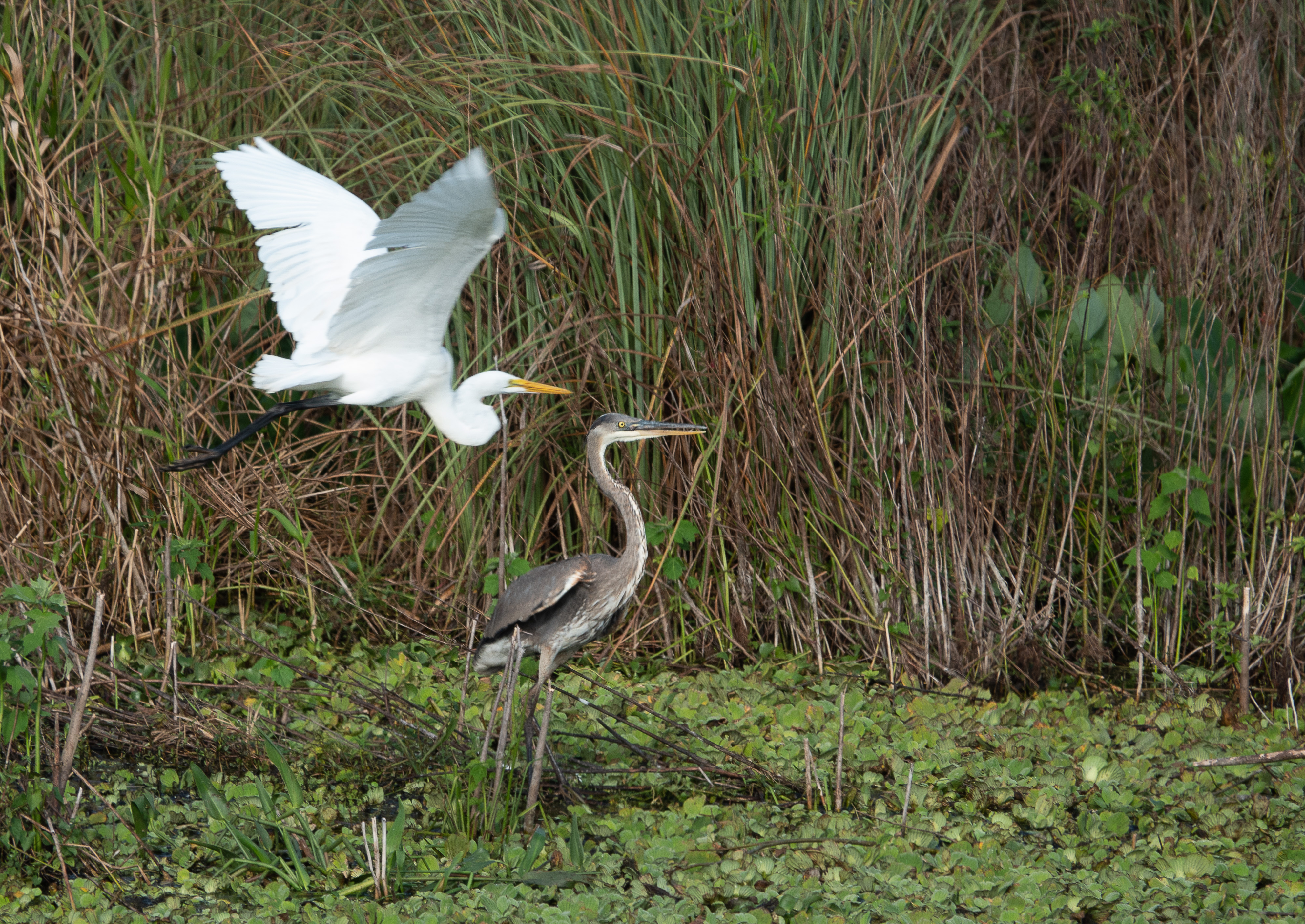
Egret and heron

The smaller Snowy Egret is an exquisite little bird, equally at home in the swamp
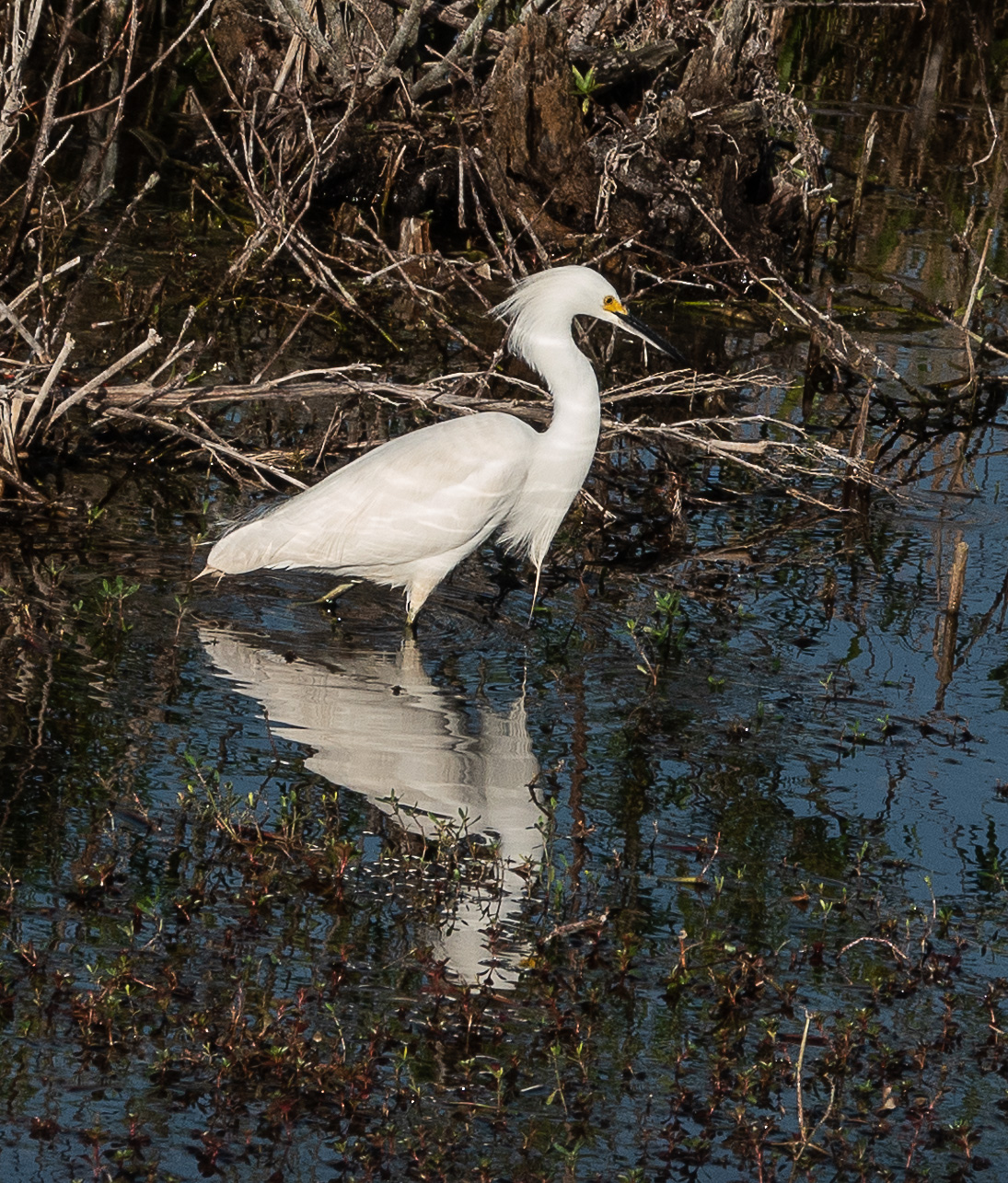
Snowy egret

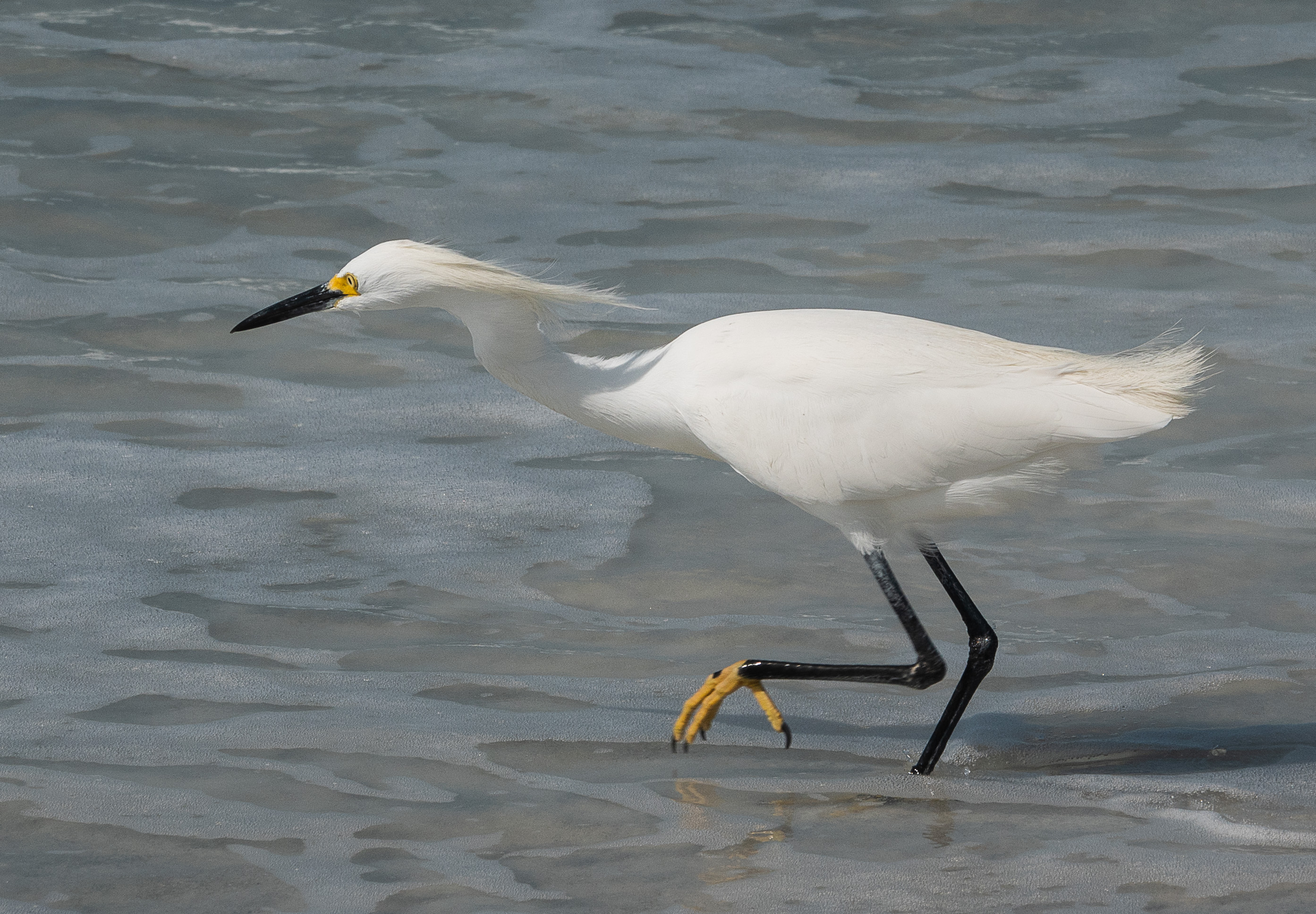
or by the seashore

Snowy egret

This one is actually running after its prey in the surf, instead of just standing still and waiting for its victim to come into range.

Those flowing plumes on the back of the head are the source of the name “egret”, after the French “aigrette”, for an ornament made of feathers.
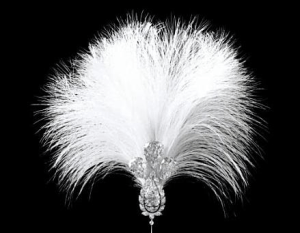

These became so popular in the 19th and early 20th centuries that vast numbers of birds, especially in Florida, were shot to supply the fashion world. Eventually, the trade was brought to a halt in America by a successful campaign spearheaded by women:

https://www.npr.org/sections/npr-history-dept/2015/07/15/422860307/hats-off-to-women-who-saved-the-birds

PS: The Snowy Egret, Egretta thula, might remind you of the Little Egret, Egretta garzetta, of Europe and Africa, but they are different species, and the Great White Egret, Ardea alba egretta, is not even in the same genus, but more closely related to the herons.

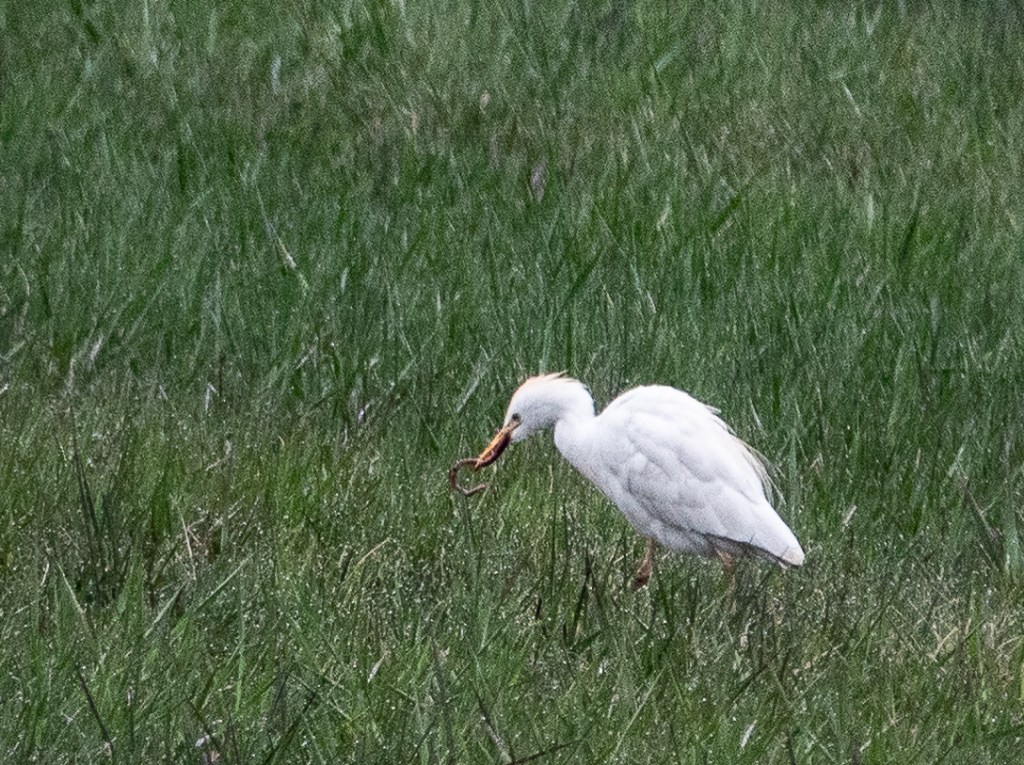
PPS: Even the more pedestrian Cattle Egret, Bubulcus ibis, can be exciting out of context. In April I saw one in a flooded field in Maine, well north and inland of where it was supposed to be. It was in breeding plumage (the reddish areas), and the last breeding egrets seen in Maine were on the coast in 1995. It has never been reported in Oxford County on eBird until this sighting.
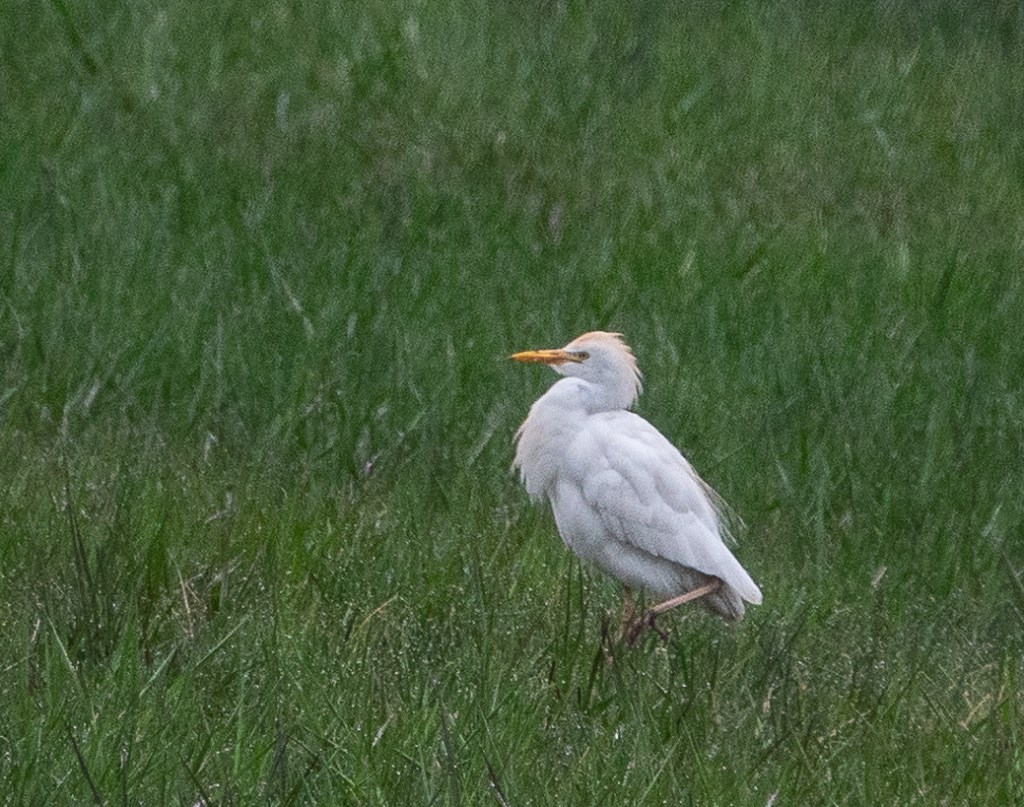
It was hunting in a flooded field, where it caught a small snake or huge worm:
Not to worry, though, their population is secure: even if Maine is a stretch, they famously expanded their range at explosive speed throughout North America during the 20th century, so they are a success story in the world of birds. Their populations reached saturation in many places, and then declined again, but they are classified as of Least Concern.
Cranes: beloved in both Maine and Bhutan

[In 2018 I did a blog that was partly about these cranes, but I had no decent photos. So this is a closer look.]

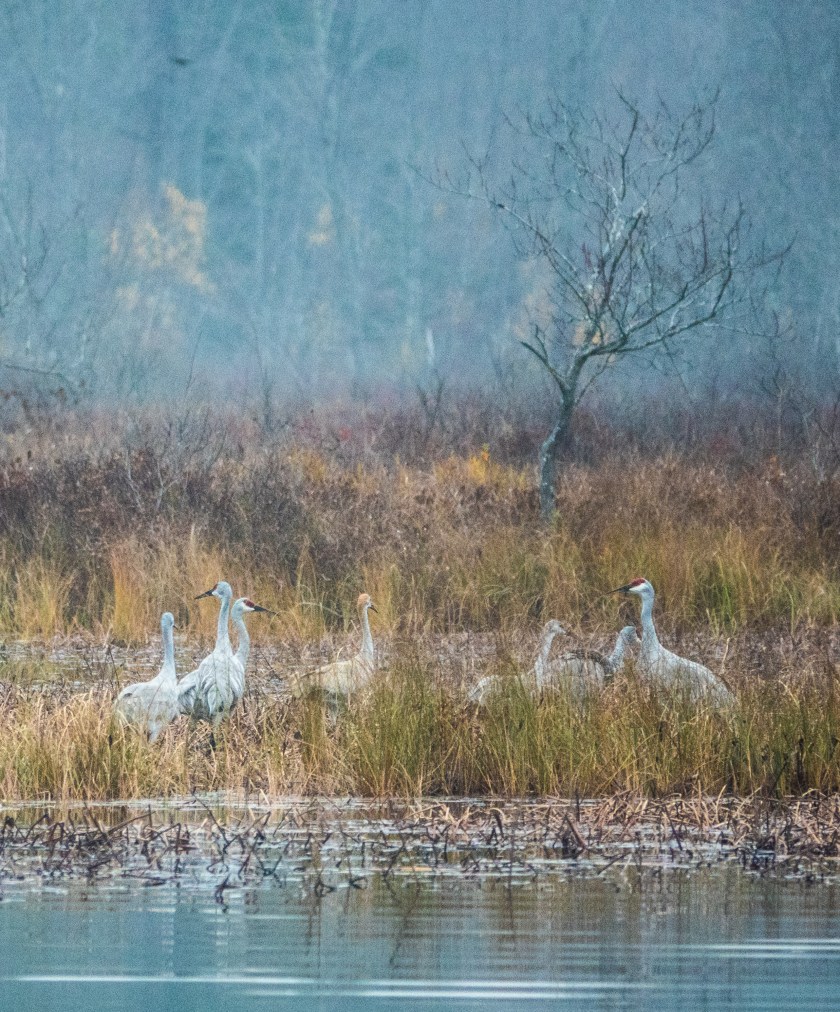
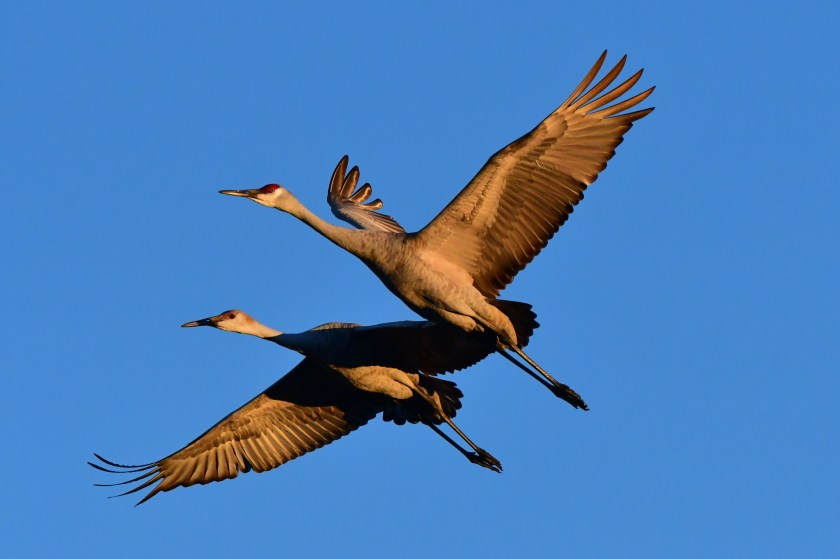
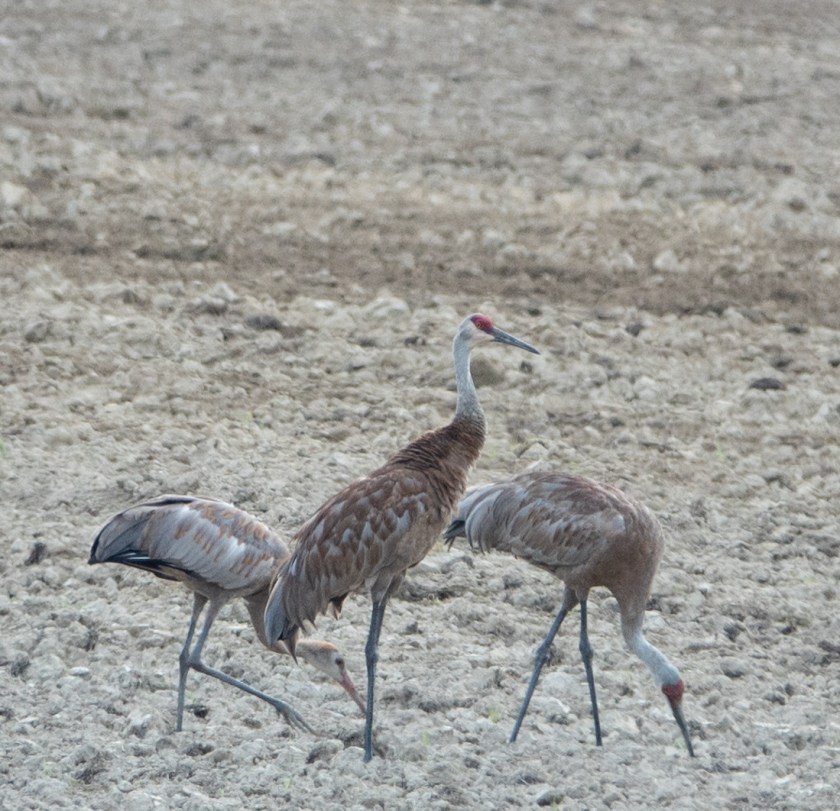
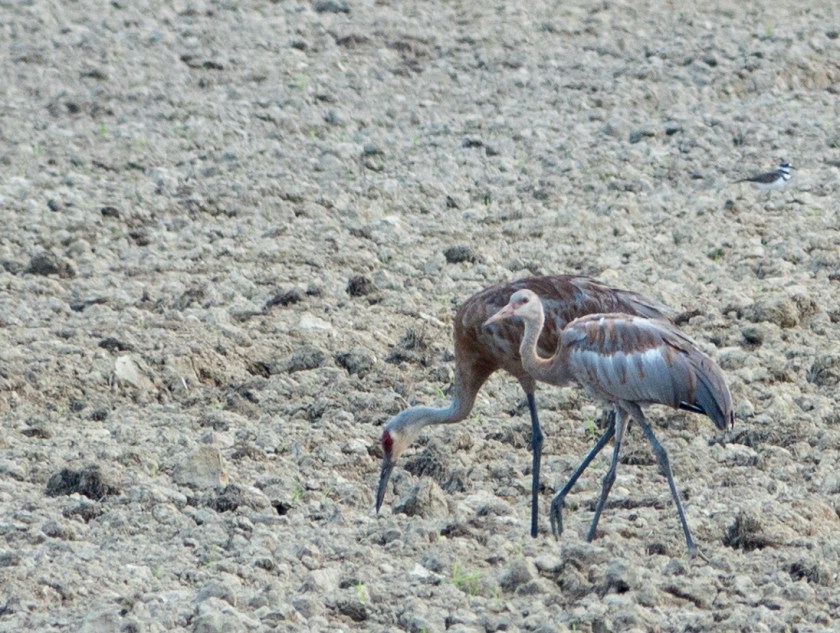
Sandhill cranes, Antigone canadensis, are majestic birds, up to 4ft 6in tall with a wingspan of over 7 feet, that gather in vast flocks in parts of the USA, and sometimes wander calmly around golf courses and subdivisions. But around us in Maine, they are novel and exotic creatures, still skittish near humans, having only established themselves as a breeding flock in the neighborhood fairly recently.

They seem to be attracted by an area of rich flat farmland with fields of turf grass, corn (maize) and occasionally sunflowers, where they forage in the daytime. When I wrote this in early November these fields had recently been harvested, perfect for gleaning.

The young are called colts, maybe because of those long spindly legs? They lack the red foreheads of the adults.

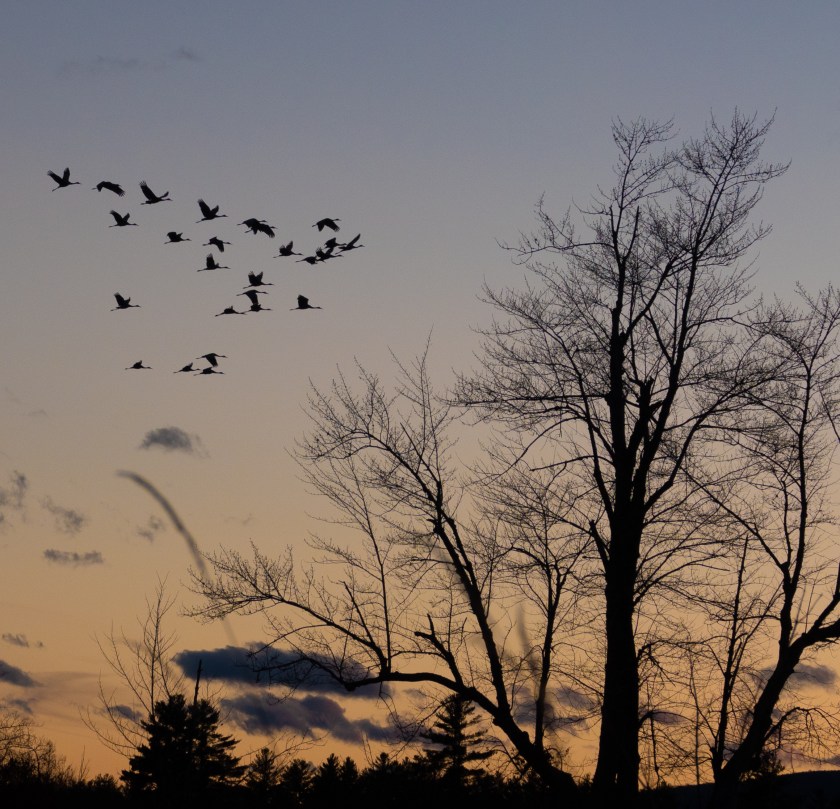
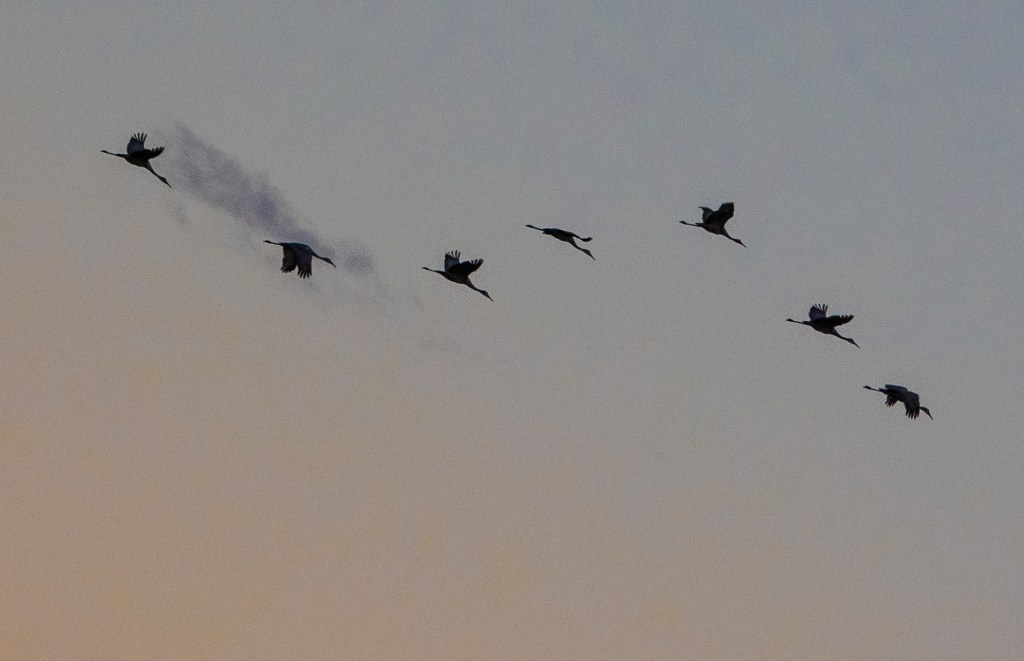
At dusk, they fly a mile or so north to a fen at the edge of the lake where they spend the night. This flock numbered about 30 birds.

They make rather charming sounds, surprisingly like small chickens, as they fly in. I failed to capture this, but you can hear it on this video:

The best view of their evening passegiatta is from the lake, but if they see you they abort their landing and divert to an alternative roosting area.

We tried hiding under camouflage nets, but they still saw us. Last year, though, they landed in the gloaming, and settled in:

My friend Heinrich Wurm, who invites me out on his boat from time to time, took this wonderful photo:

Soon now they leave for New Mexico, where they spend the winter in their tens of thousands in the poetically named Bosque del Apache National Wildlife Refuge.

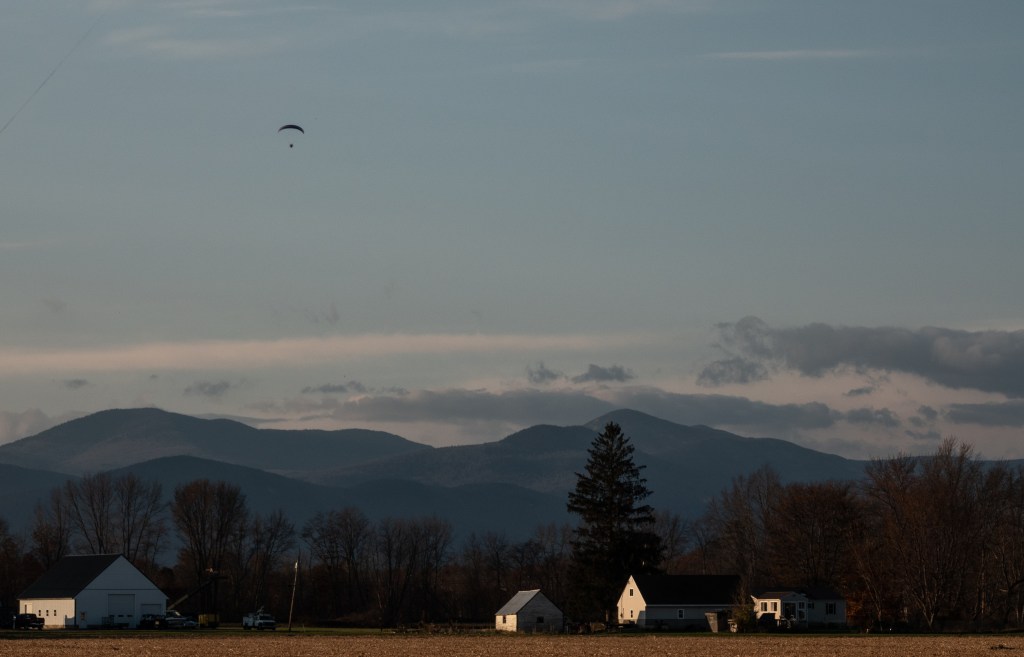
Back at the farm, a lone ultralight aircraft floats above the farmlands, searching in vain for the departed cranes:

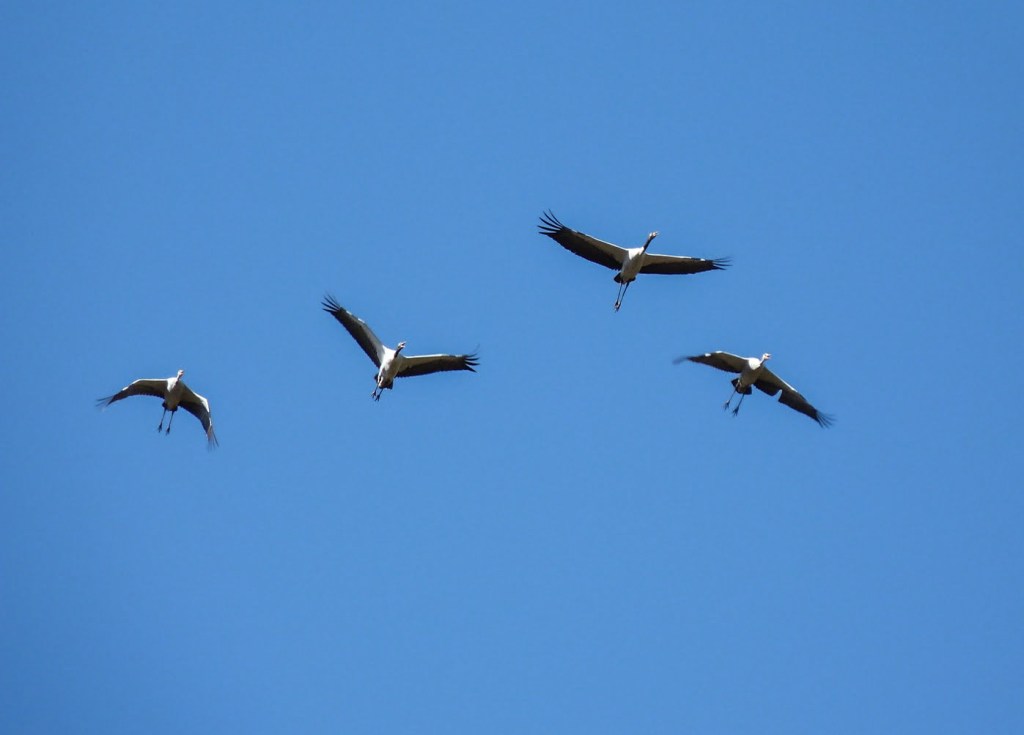
PS It is not only Maine that loves their cranes. The world has 15 species of crane. The Black-necked Crane, Grus nigricollis, winters in the Phobjikha valley in Bhutan, arriving in early November 2010:

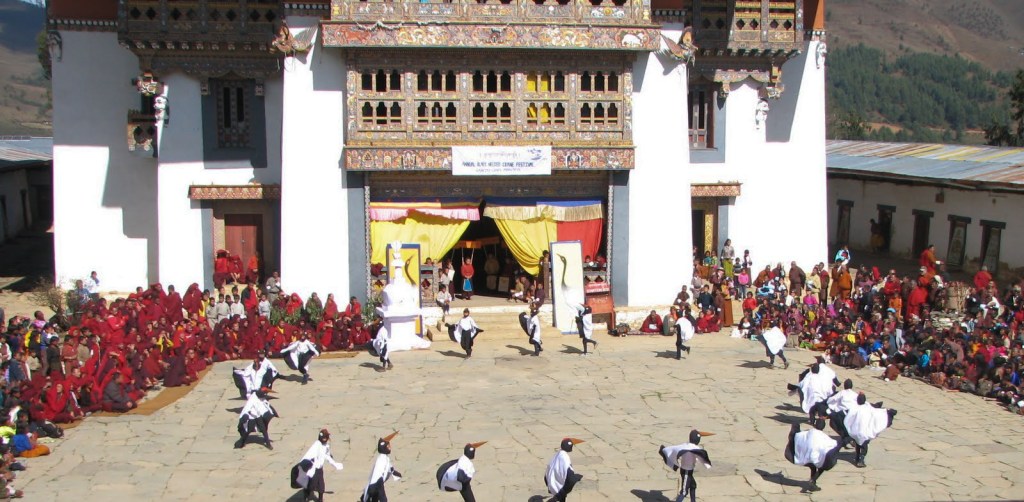
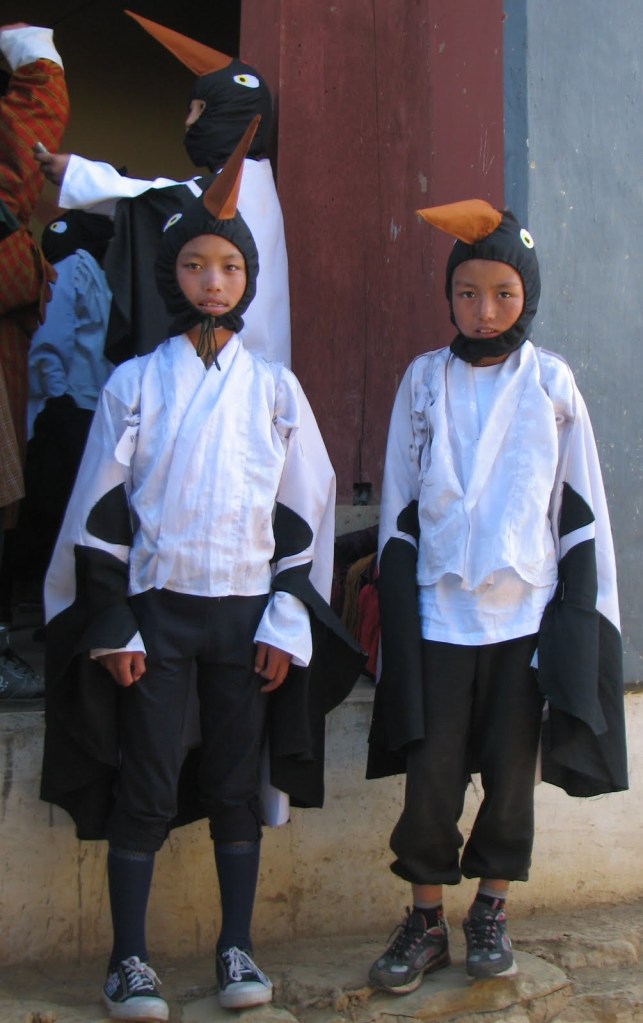
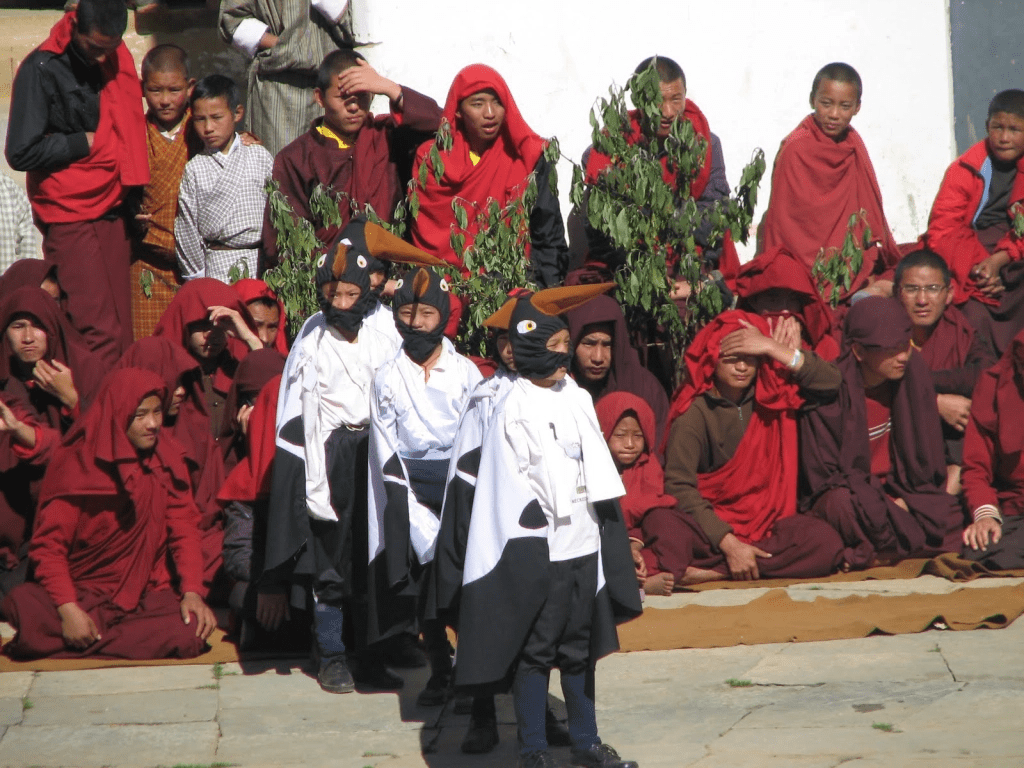
They are sacred to the Bhutanese, so their arrival is celebrated at the Gangtey monastery with the wonderful Crane Festival. These children are doing the Crane Dance:

Here they are in close-up:

watched by the monks (and the whole village).

and nowadays by a goodish number of tourists. The cranes need all the love they can get: there are only around 10,000 left.

Two thousand miles of beavers: 2

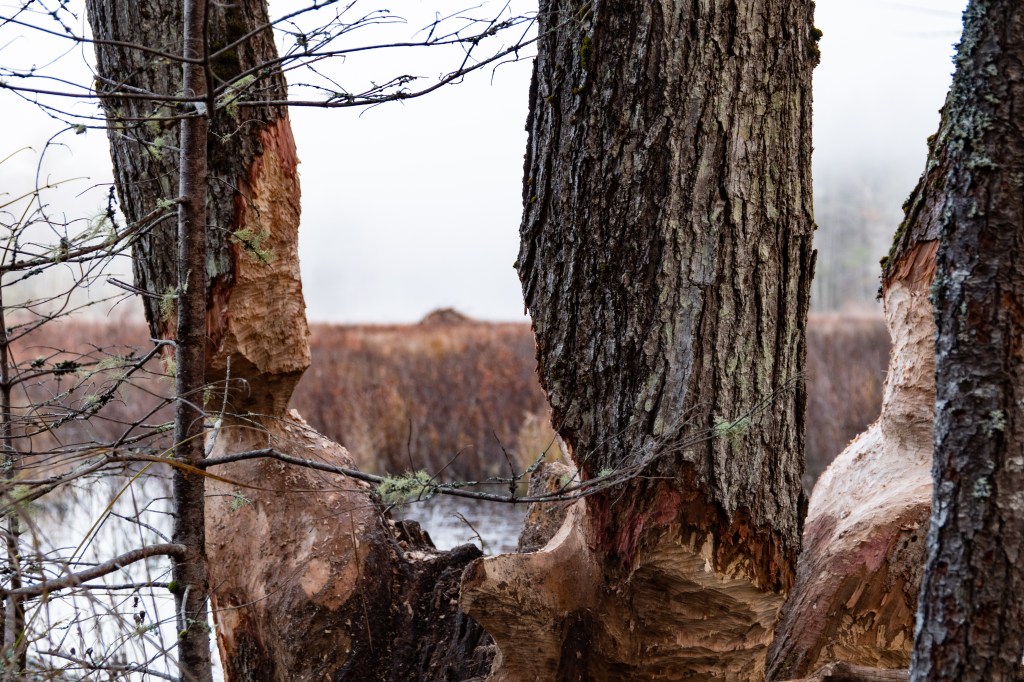
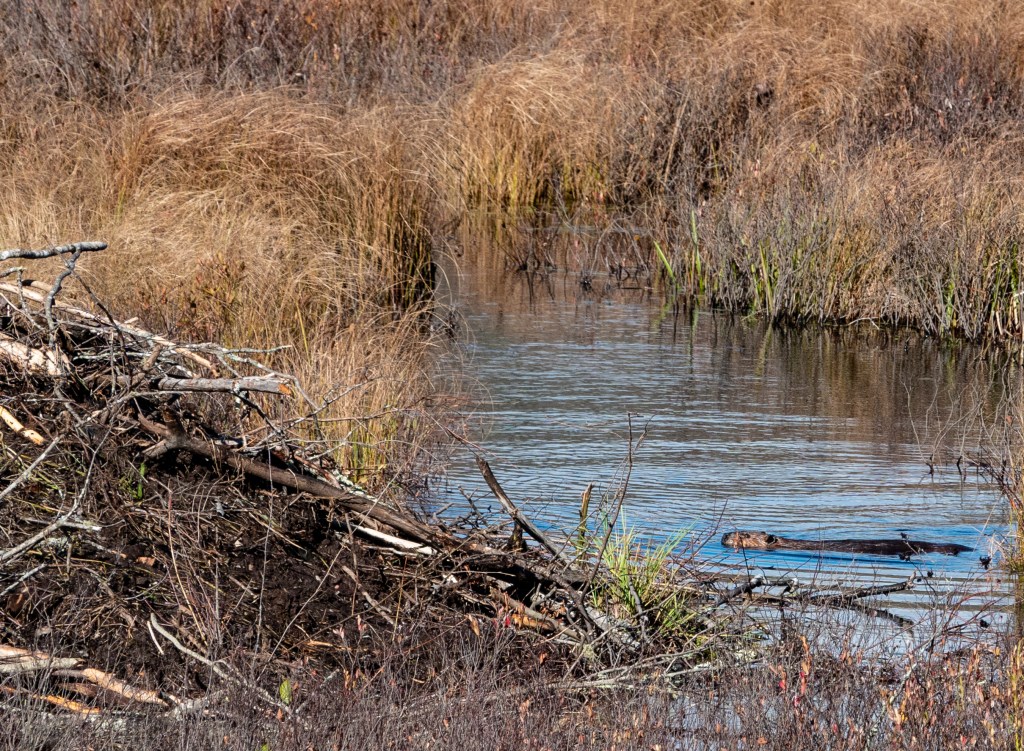
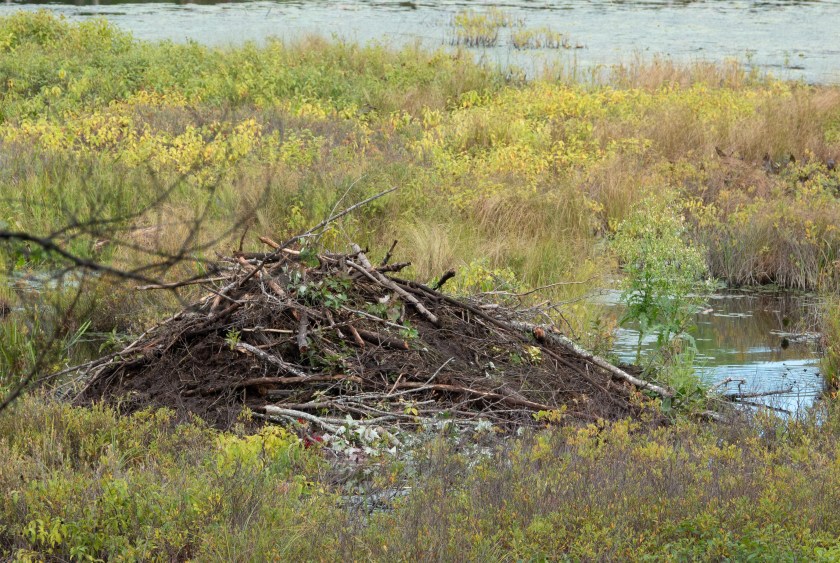
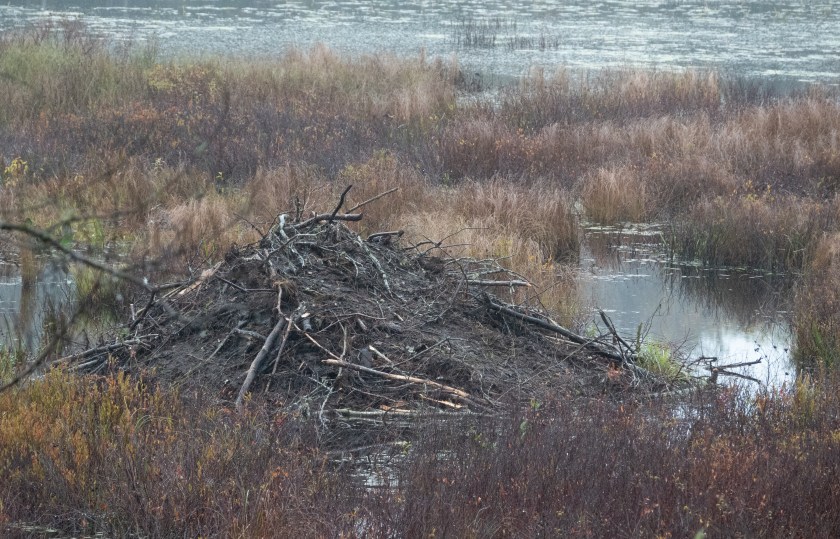
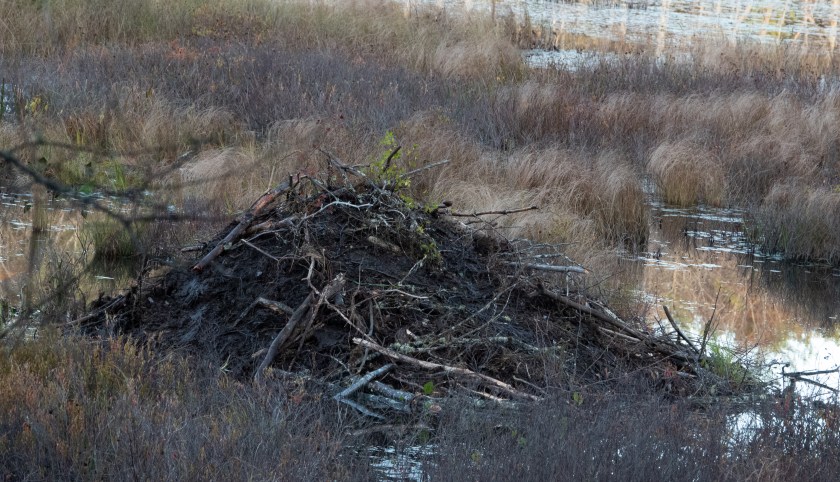
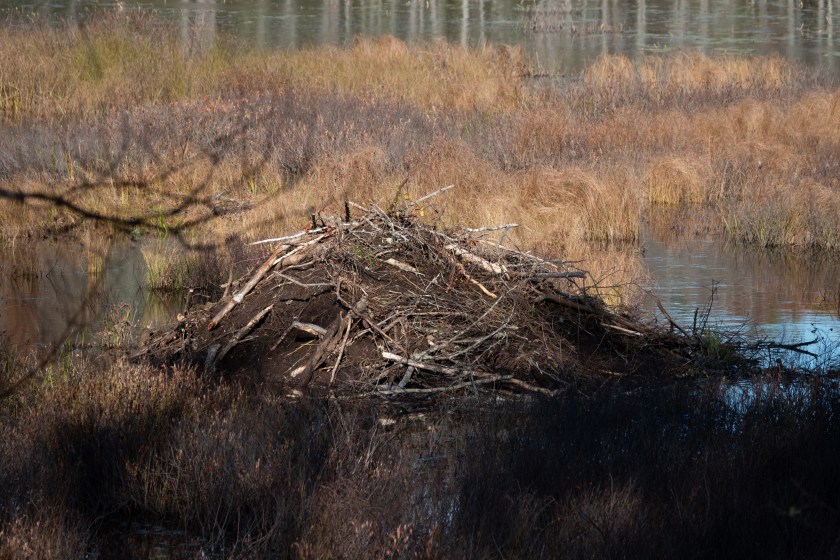
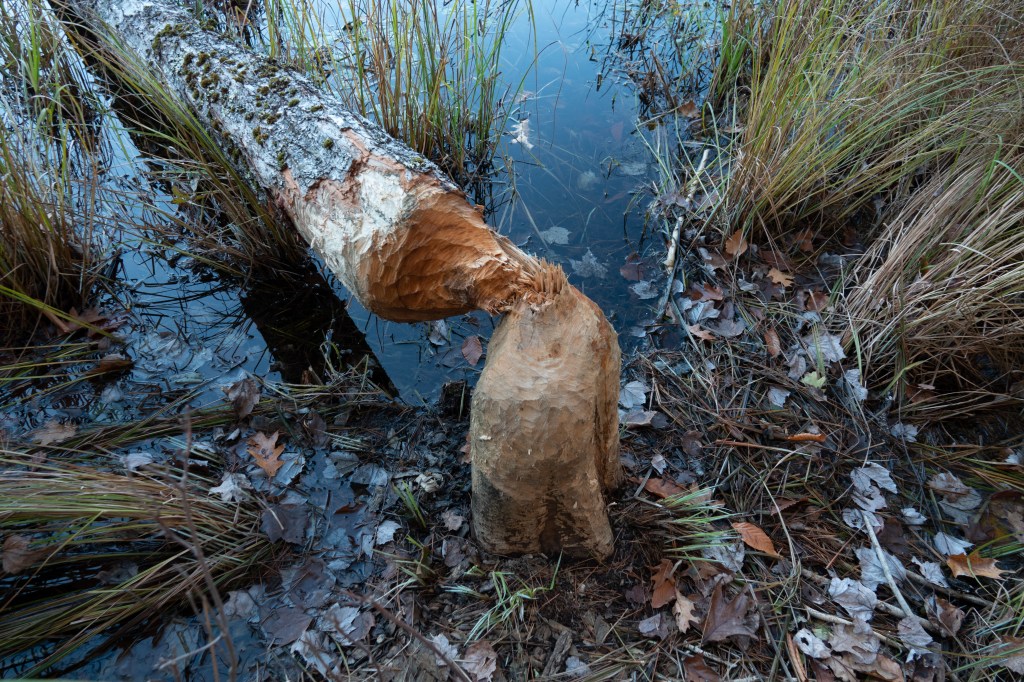
Back at the ranch (well, my pond in Maine, to be more precise), the beaver has been building its lodge. It still seems to be alone, which worries me. But it’s working hard, if somewhat ineffectually. In this case it cut through a clump of three sizable trees, and failed to fell any of them. (The lodge can be seen in the distance).

Back at the lodge..

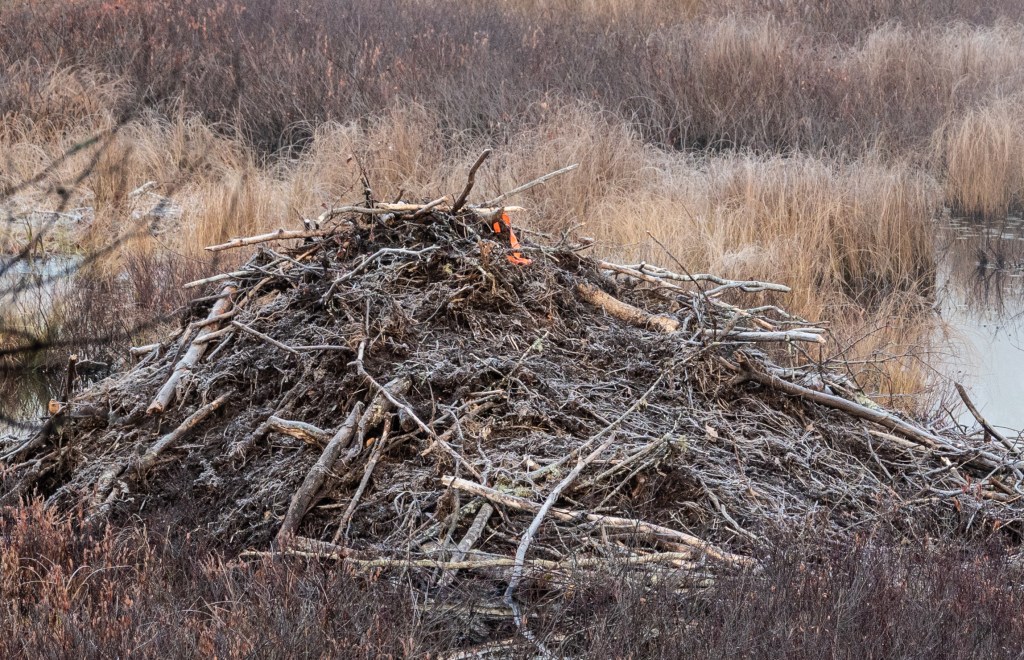
The lodge is built up with layers of fresh mud, and fresh branches. He works entirely at night, I’ve never managed to catch him in the act. But every day there are small changes, more mud, new branches, or both. These photos are taken over a seven week period from September 16th to November 8th:

While the beaver was doing this, Bruce was cutting a new trail further up the pond’s shore, and we had marked the route with pieces of orange tape tied to trees. On November 8th we discovered that the beaver had been at work at the end of the new trail:

And the next day, November 9th, when I photographed the lodge on a frosty morning, there was an orange flag at the top:

I think it had been tied to that tree, and after he cut it down he limbed it and dragged one branch out to his lodge, complete with tape. At least he didn’t swallow it, which could have been disastrous. I have carefully picked up every scrap of remaining tape.

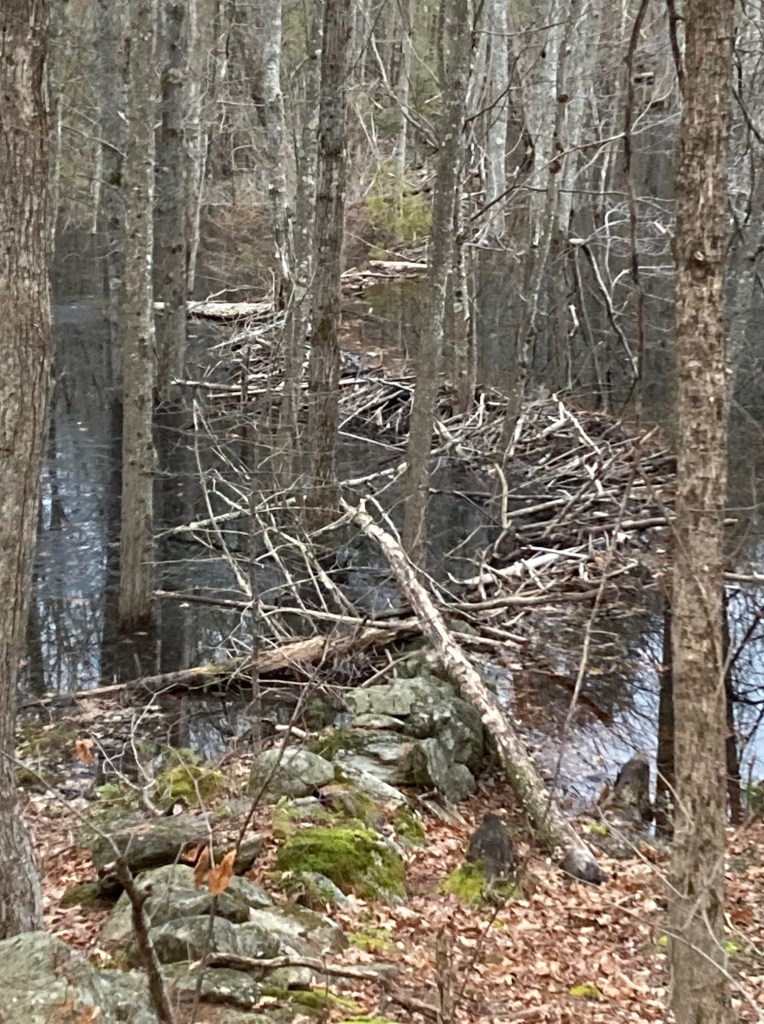
PS Peter Ellison sent me this wonderful photo from southern New Hampshire of an East Coast beaver aspiring to be Andy Goldsworthy, this time by extending an old stone wall into a sinuous dam:

Two thousand miles of beavers: 1

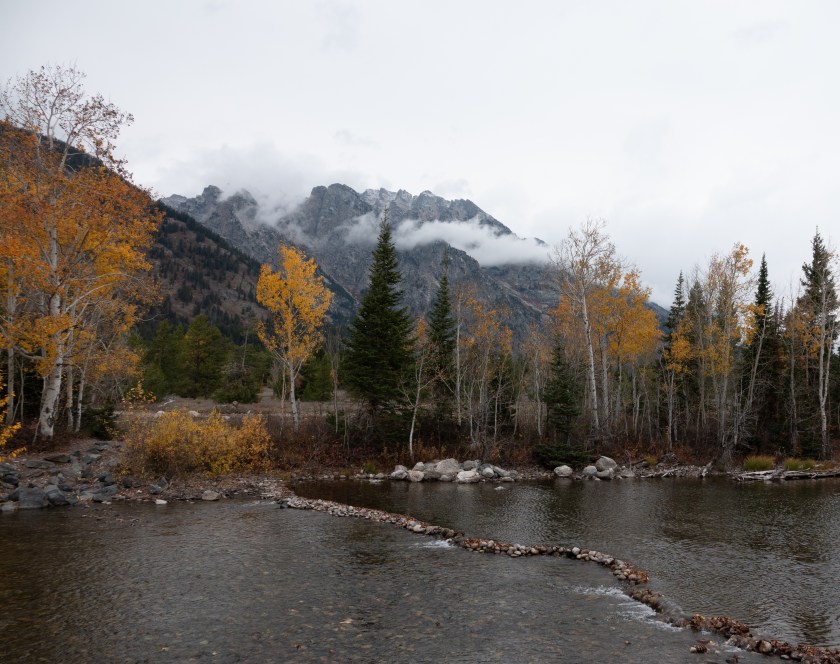
The drive from Lovell, Maine to Jackson, Wyoming is just under 2500 miles, and beaver live in both places. I didn’t actually see any in Wyoming, but we found fascinating evidence of their presence. New to me was a little dam made of pebbles only, just enough to create the sort of terracing effect that makes the stream deep enough to float logs down.

Here it is in closeup. Mark, my guide, says that they may start like this and then build a larger structure on top with logs.

Personally, I would have guessed it was an Andy Goldsworthy sculpture, perhaps secretly constructed at night.

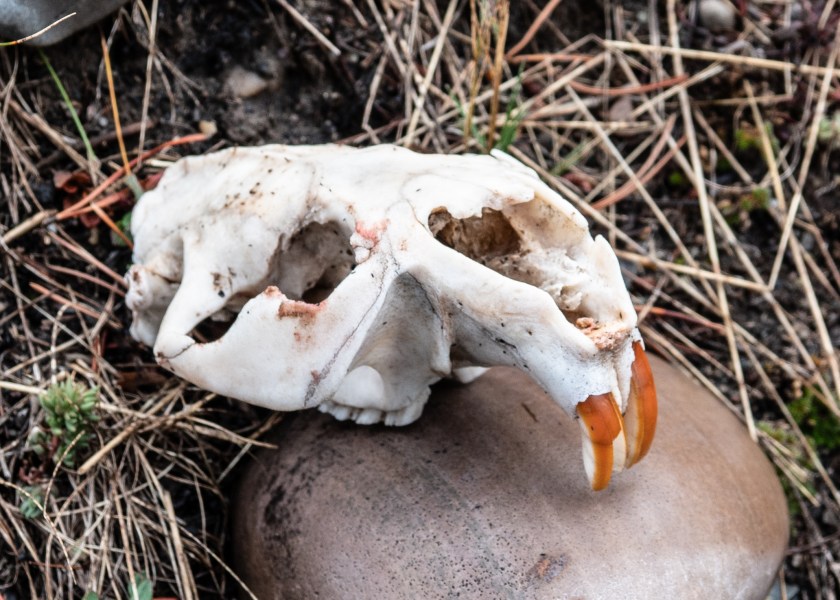
Another day, some distance from water, we found all that was left of a beaver that must have been killed and carried some distance:

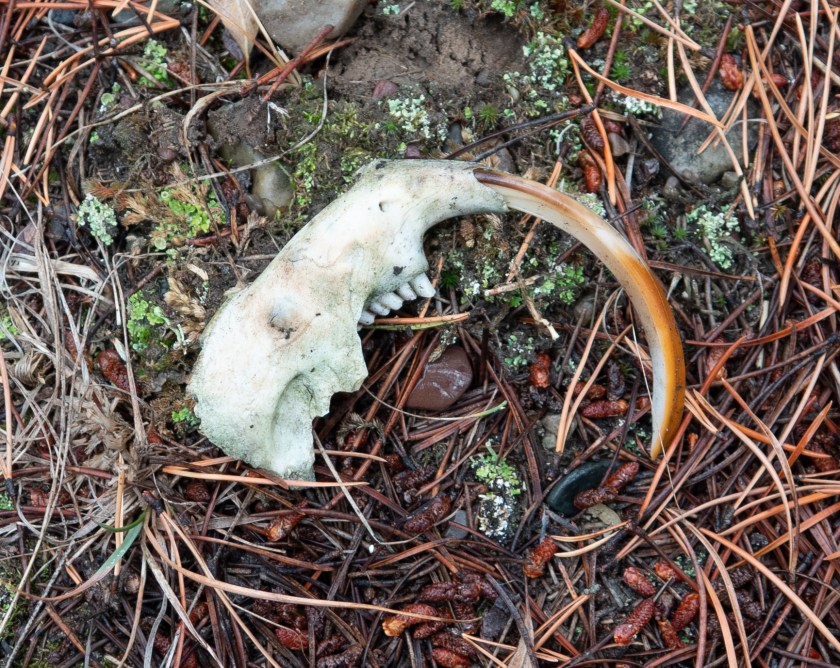
The orange color is iron, which makes the enamel extremely strong. Notice the gap between the huge incisors and the back teeth: a beaver seals its lips behind the incisors, so it can carry branches without getting a mouthful of water. Nearby we found the lower jaw, and we slid the lower incisors out all the way to see how much tooth was there in reserve as the beaver wears away its teeth with all that chewing. The teeth grow throughout its life.

You can also see that the back of the incisors is not orange, and has worn away more quickly than the front, creating a very effective wedge-shaped cutting edge.

One more photo for fun. Close to the beaver skull was the femur (I think) of something BIG, bison or moose:

Next time, back East.

Pronghorns: the goat-antelopes of the American West

Pronghorns tend not to make the headlines. They are not endangered (750,ooo or so still around), not THAT big, not excitingly dangerous, just dapper little antelopes …. except they aren’t.

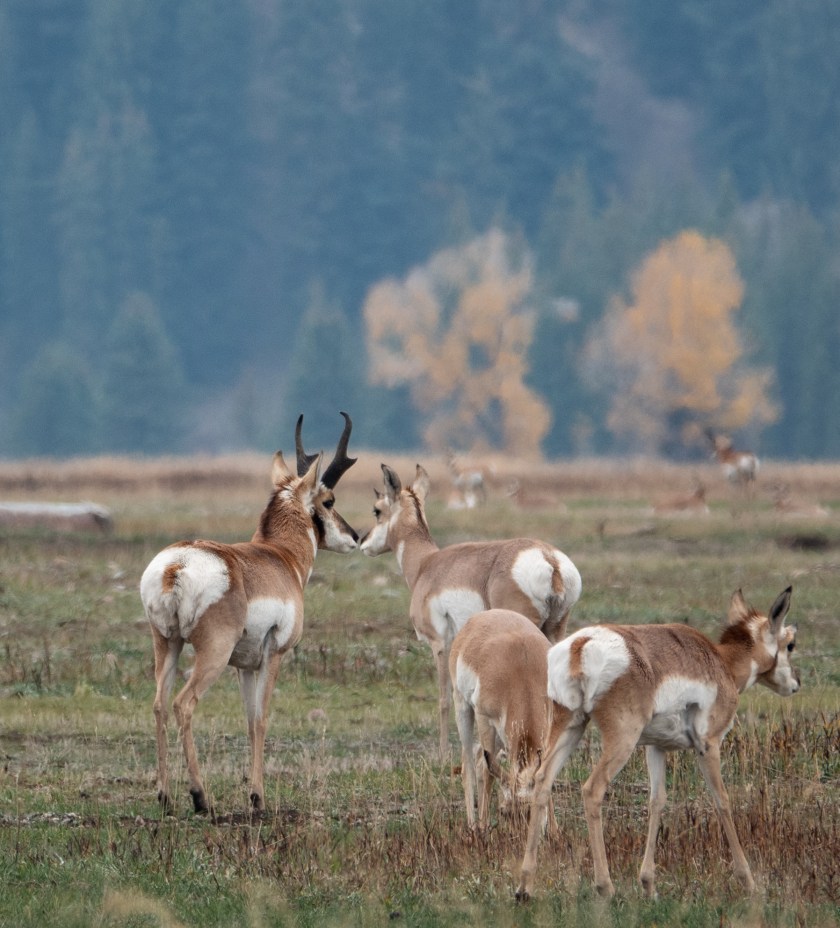
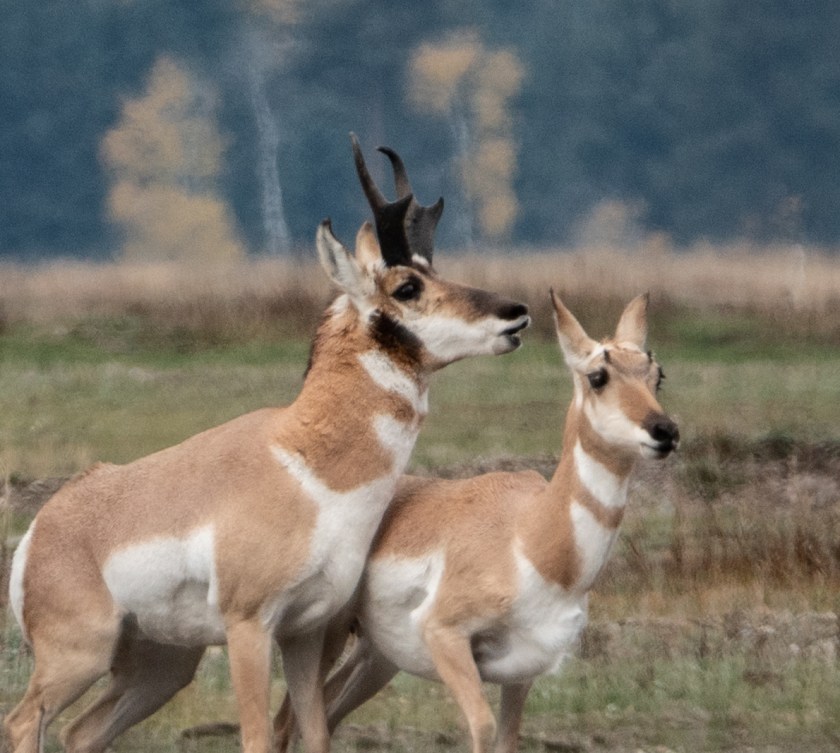
Their scientific name is Antilocapra americana, which means American goat-antelope, but they are neither goat nor antelope, and quite unrelated to any other animal in the world. I watched a male with his harem of females:

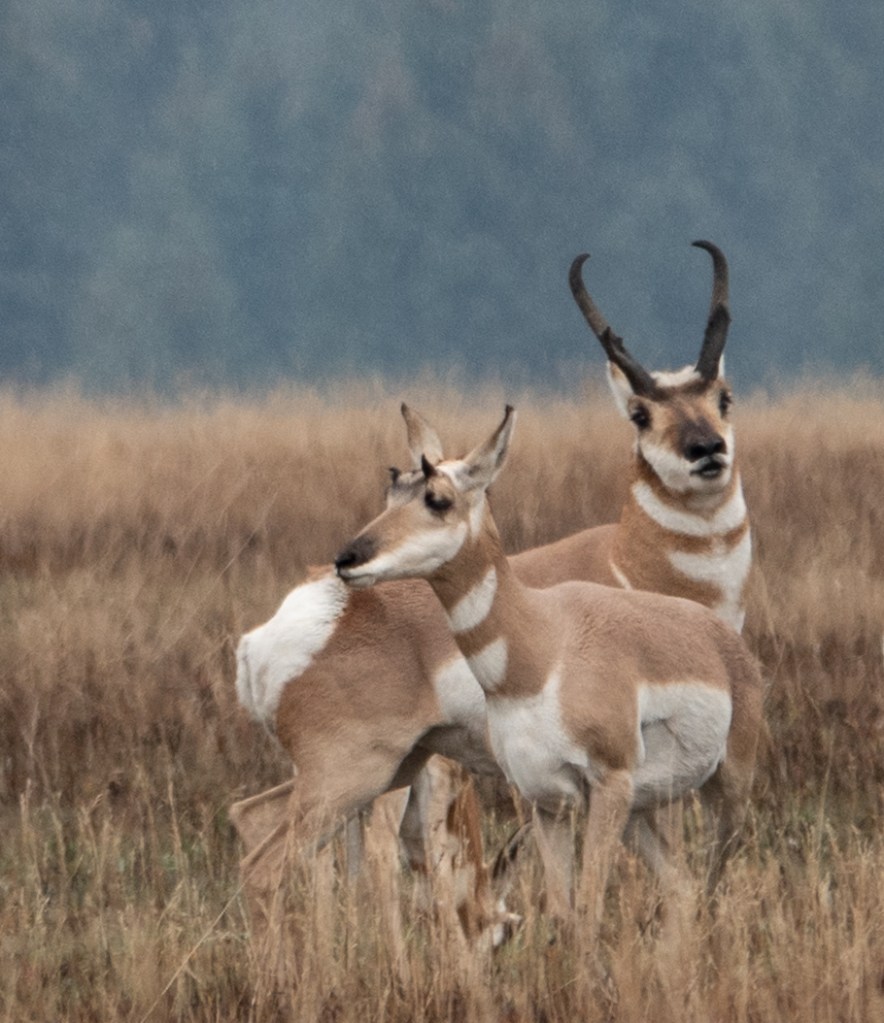
The buck has these sculptural black horns, which turn out to be rather unusual. The San Diego Zoo website says (abbrieviated) “The horns of the pronghorn .. . are a cross between horns and antlers. True antlers are made of bone and shed each year; true horns are made of compressed keratin that grows from a bony core and are never shed. The pronghorn’s are a hybrid: the sheath is made of keratin but the horns shed yearly. True horns have only one point, not the prongs or forks that antlers have. Yet the male pronghorn’s horns can grow to be 10 inches long with a forward-facing prong. Female pronghorn have tiny horns” as you can see here:

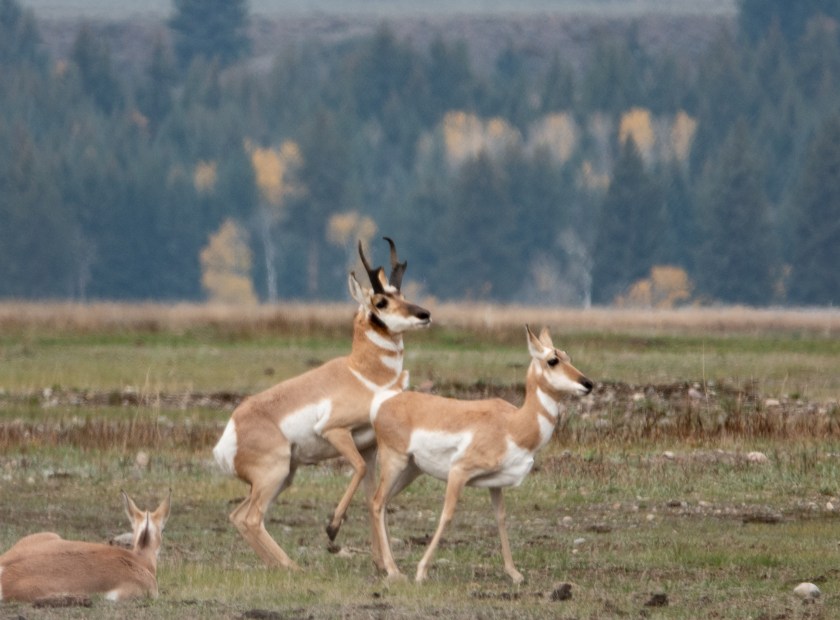
The buck was very interested in his does, and doing the rounds. If one seemed to be receptive, he would scent the air around her, smacking his lips:

If she is receptive, she raises her tail, and he follows her:


still sucking the air:

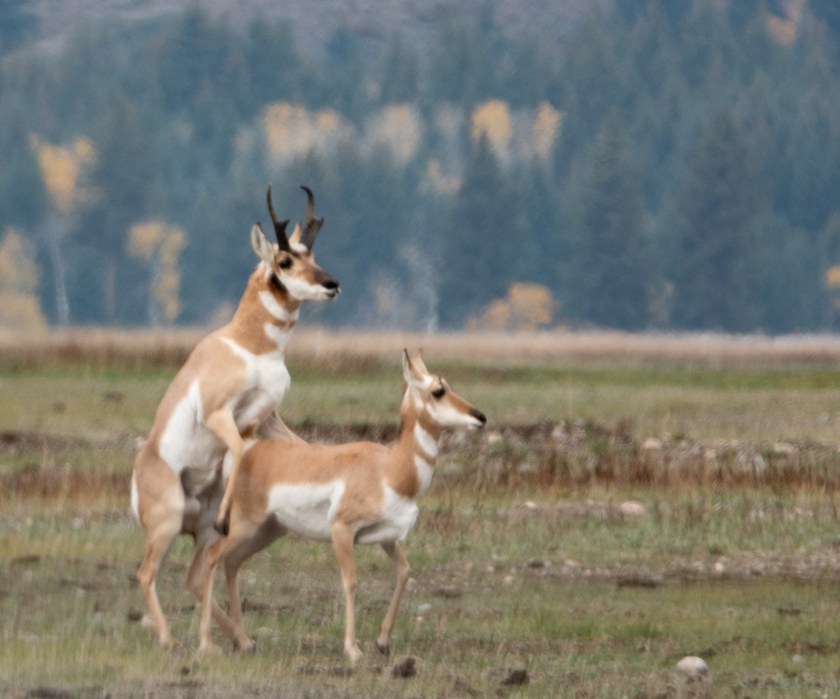
and when she stands still,

he mounts her briefly.

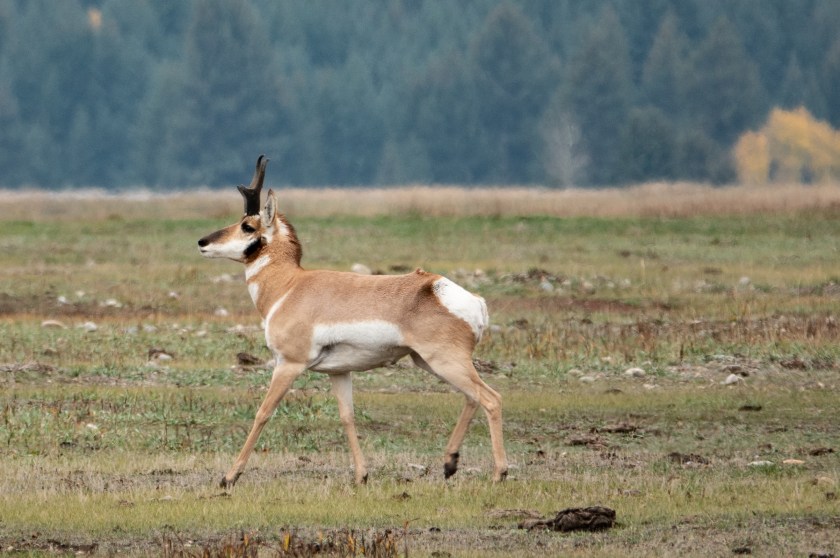
After much sniffing around, and just this one apparently successful mating, he looked first triumphant,

but then exhausted:

Mark took a video on his phone through his scope of another rather desultory attempt:

What I really wanted to see was them running: they can run at 60 mph, and keep it up for longer than a cheetah. They achieve this with specially adapted limbs, extremely large lungs, and the ability to maintain a high rate of blood circulation. Alas for me, they were calmly grazing, with no reason at all to run off.

You’d think there would be a sports car named after the Pronghorn, rather than the Mustang. And guess what, after this idea occurred to me I googled around and discovered I was not the first person to think of this:

https://www.roadandtrack.com/car-culture/a33080682/ram-rebel-trx-pronghorn-name/

PS For more technical details of their ability to run faster than any other New World mammal, read this: https://animaldiversity.org/accounts/Antilocapra_americana/

Landscape 4: Winter Mountains

On our last day in Yellowstone we woke to the first proper snow of the season, and after a few hours they closed the park entrances.

Instead of leaving to the south we had to exit to the north, drive up to Bozeman, Montana, and loop around to the West of the park back to Jackson, which took all day.

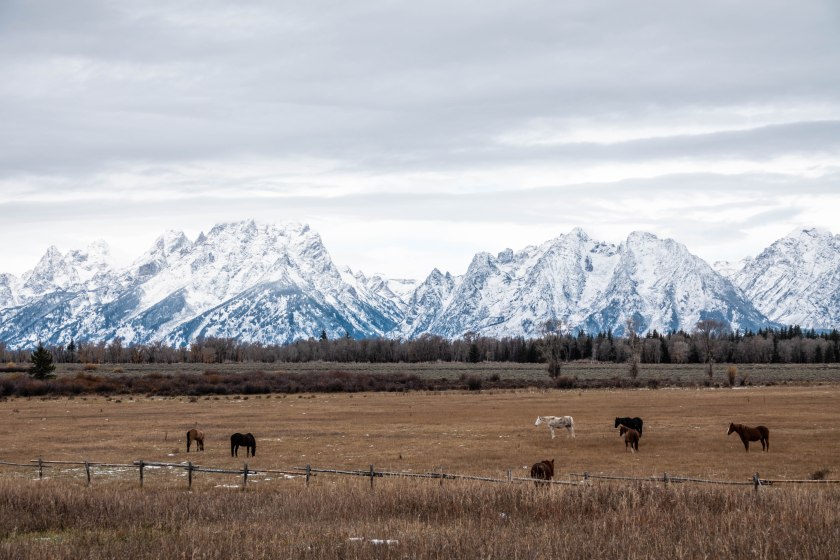
But the morning after the snow the clouds lifted, and there were the Tetons for the first time, as a parting gift before my flight home. The Tetons rise straight out of the valley with no foothills to blur their lower slopes, creating a dramatic and forbidding barrier.

Jackson Valley is at an altitude of 6,800 feet, and the highest peaks in the Tetons are 13,770 feet. This early snow blanketed just the upper slopes of the Jackson Hole Mountain Resort ski area, which gets an average of 500 inches of snow a year.

I stayed with generous friends, so I end with the view from their house. How shall I ever repay them?

Brown black bears

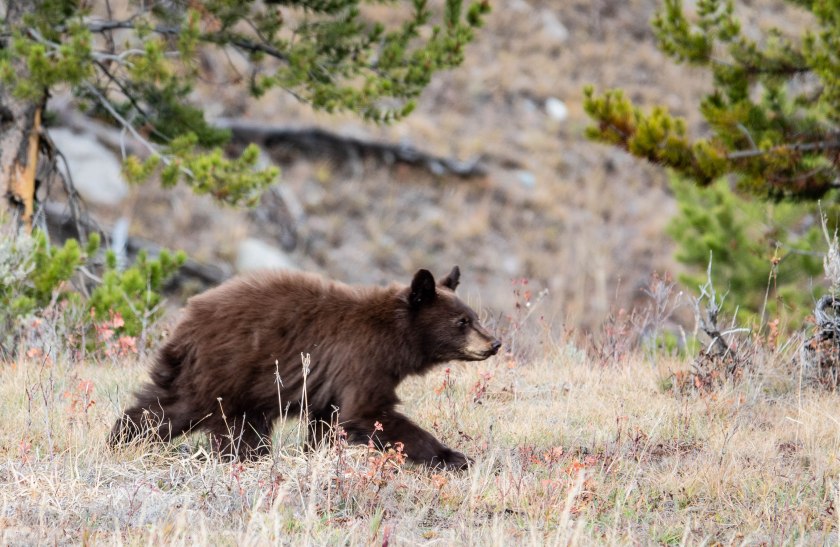
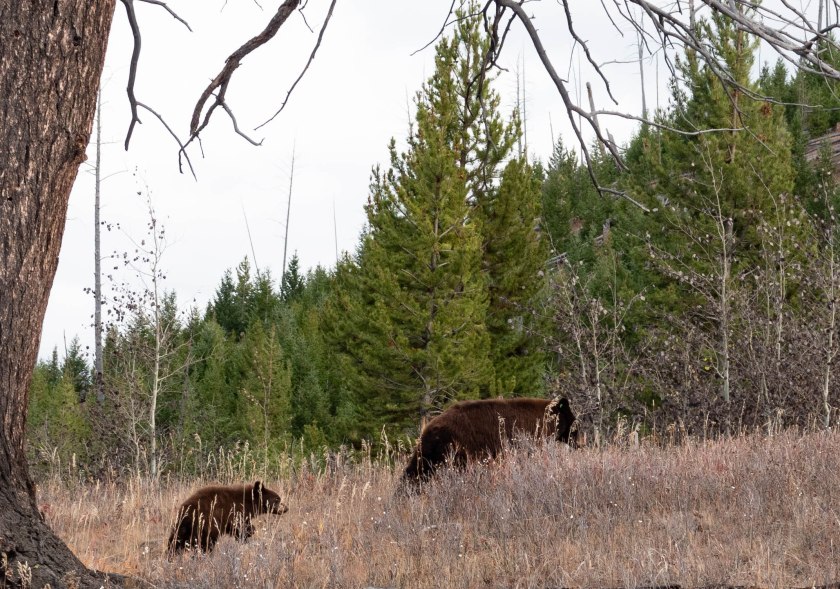
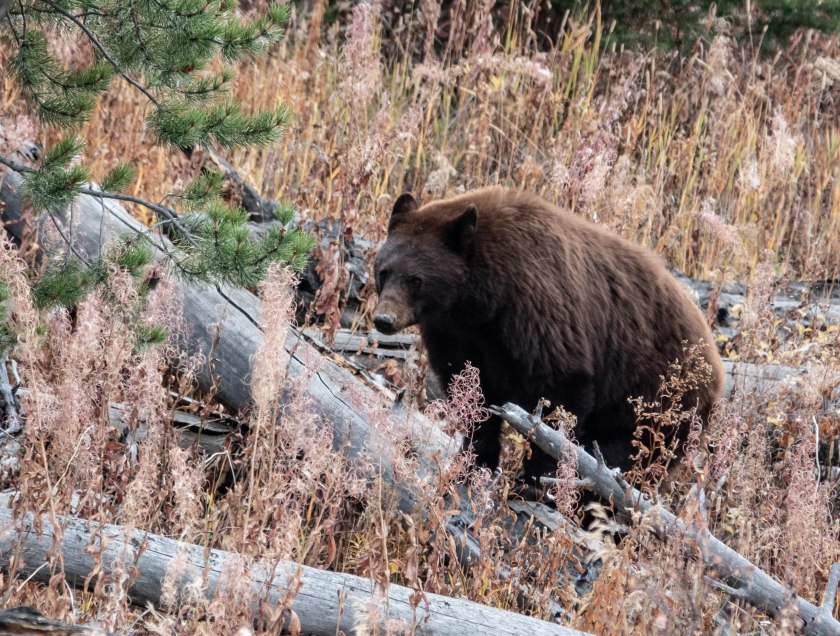
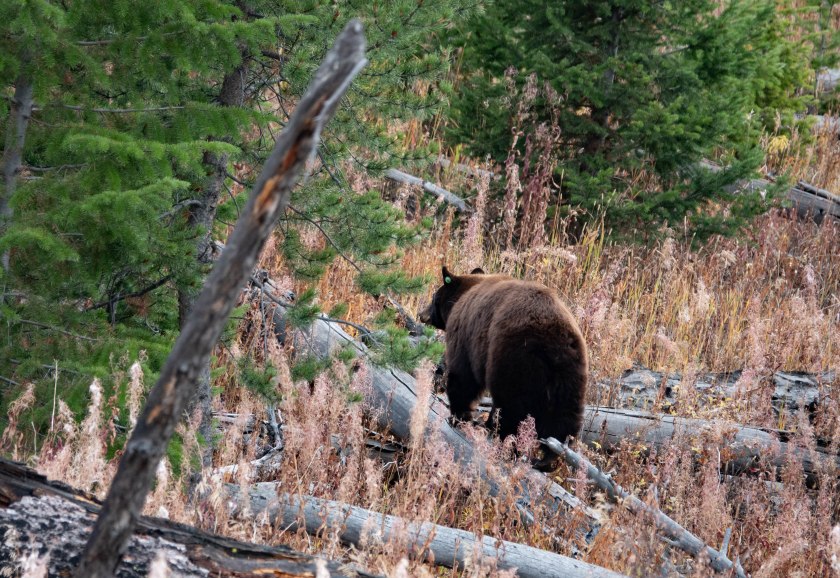
Black Bears, Ursus americanus, are properly black where I live in Maine, but out west they come in many shades. In The Tetons and in Yellowstone I saw black-hued ones in the far distance on two occasions (one of which I personally spotted first through the scope at least a kilometer away, eliciting a high-five from Mark), but my closest encounter was with a walnut-brown mother and two matching cubs.-

They were coming down a steep hillside across a gully from us, and Mark using his scope/cellphone combo got this video:

Then the mother crossed the gully (and the road) to the next hillside

followed by the cubs, in a big hurry,

and they headed off into the woods,

where they hung out for some considerable time, foraging:

The cubs would have been born in the den in mid-January to early February while the mother was still hibernating, so they are now about 8 months old. Two is the usual litter.

She probably weighs 150 pounds; males can be twice that.

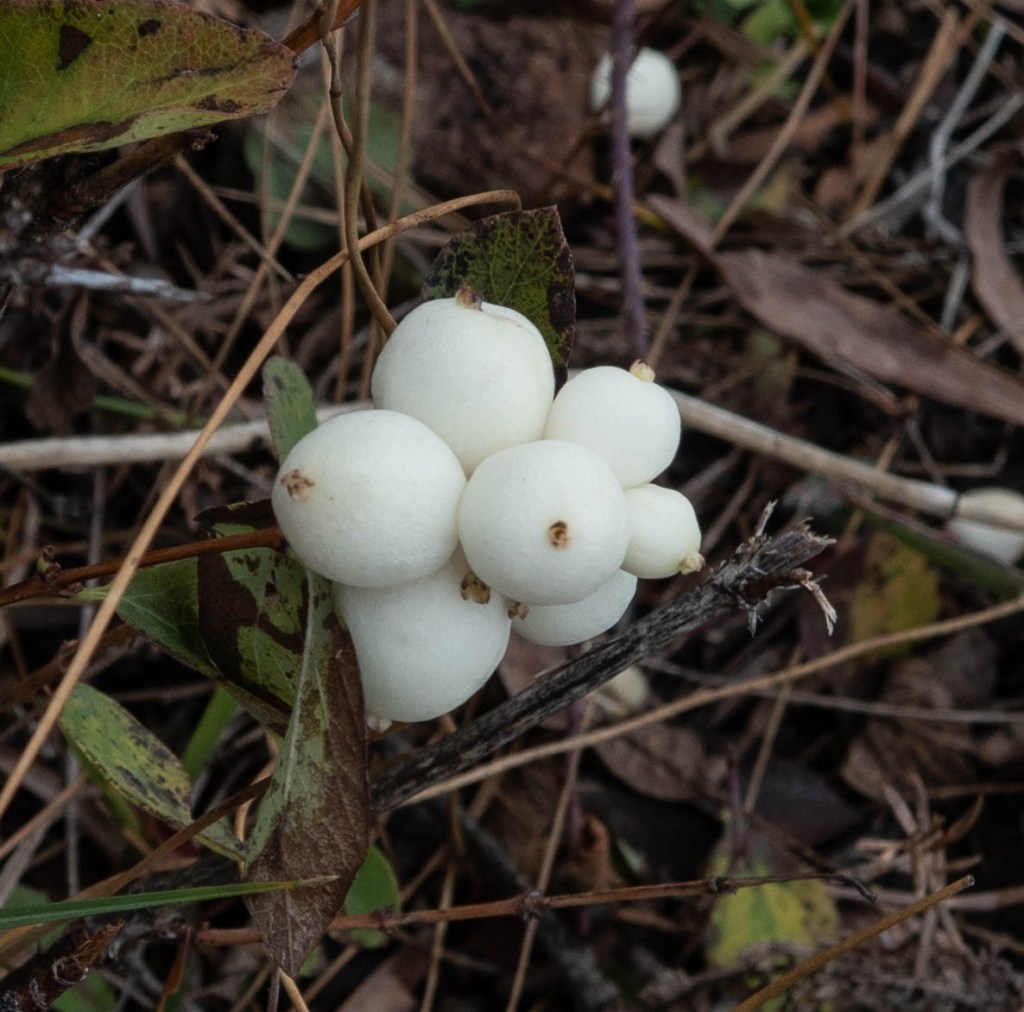
She is now building up her body weight to survive another long winter in hibernation. On this occasion she was eating snowberries:

The cubs will spend one more winter with her before she chases them off in the spring.

PS Yellowstone is vast, 3500 square miles, but it has very few roads, and vehicles must stay on those roads. You can hike, but the animals are thinly spread, so you mostly see them from vehicles. As a result, when a bear comes close enough to the road to be easily visible, bedlam ensues. Cars screech to a halt, people leap out, the rangers arrive to control the crowds. Not my preferred way to see wildlife, though I am one of the tourists in the vehicles adding to the problem. You have to wonder why the animals ever go near the roads, given how much back country they have to roam in, and that feeding the wildlife is strictly forbidden and well policed.

“Oh, lovely, gentle, unobtrusive mule” (deer)*

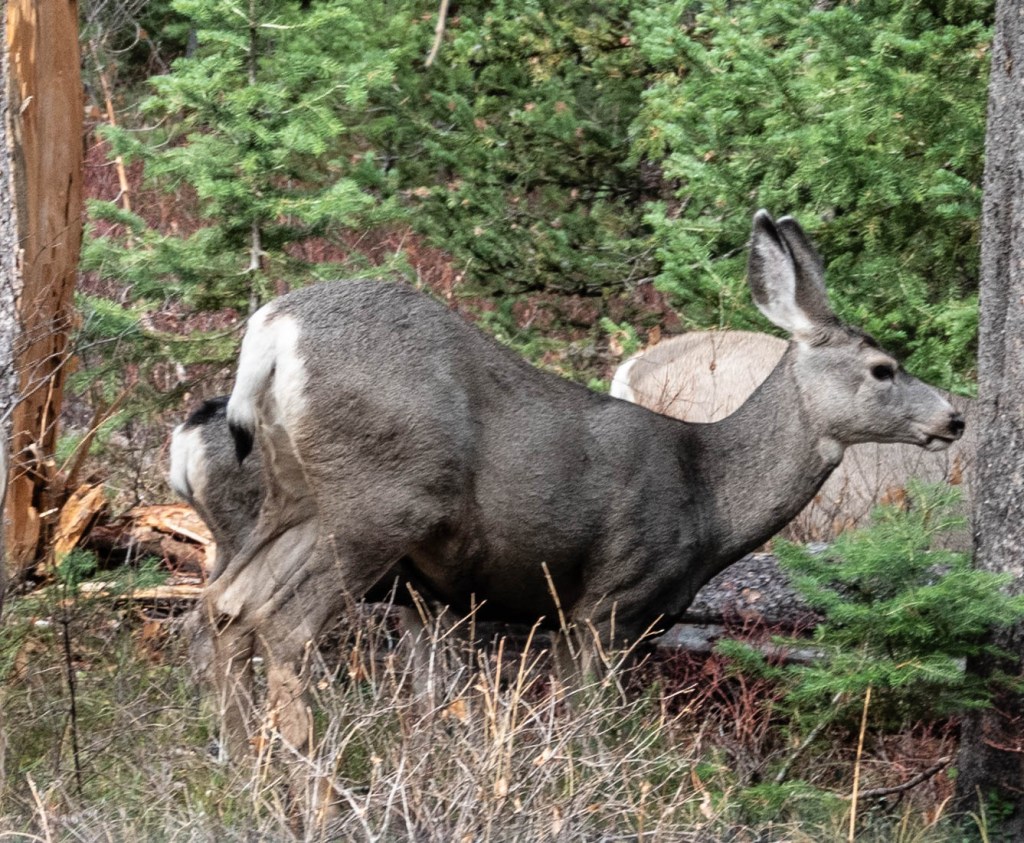
The unassuming mule deer is sometimes called the grey ghost of the forest (a nickname it shares with the unrelated African kudu).

They are a sub-species of black-tailed deer, Odocoileus hemionus, and are limited to areas west of the Missouri River, in contrast to the white-tailed deer, Odocoileus virginianus, found over most of the eastern US, but rare in the West. (though we did see one! ). The mule deer’s tail isn’t actually black, which would make it useless as an alarm mechanism, but it has a black tip:

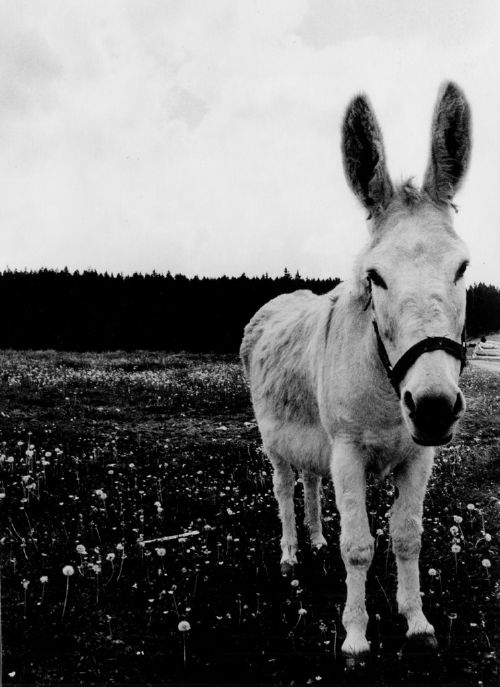
They’re called mule deer because of their large mule-like ears:

Here is an actual mule for comparison!

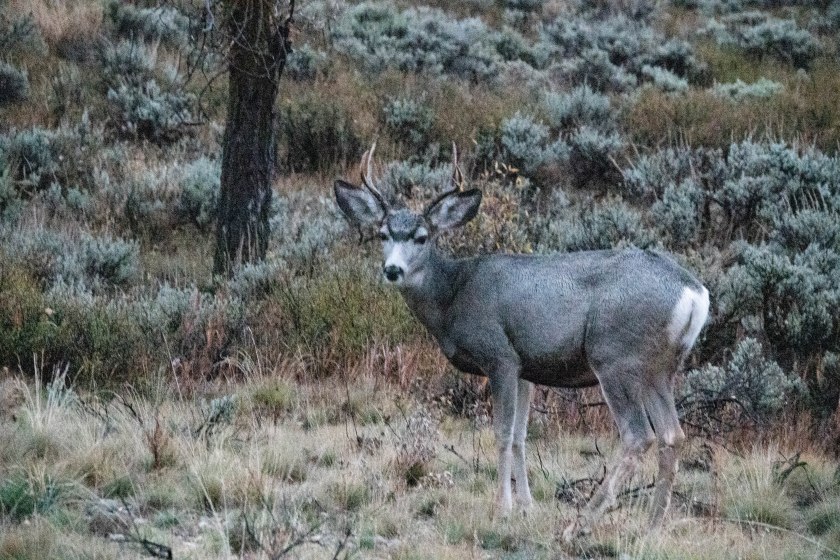
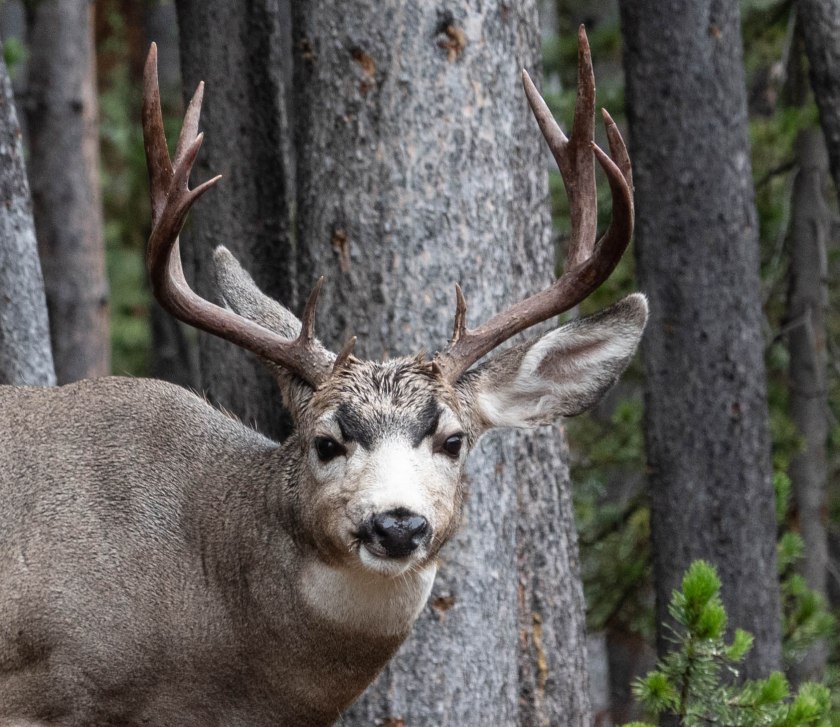
When an adult male materializes out of the forest he is imposing, even at a mere 3 1/2 feet at the shoulder (much smaller than an elk). He can still weigh in at up to 330 lbs.

and he can have pretty large antlers, this one has six points:

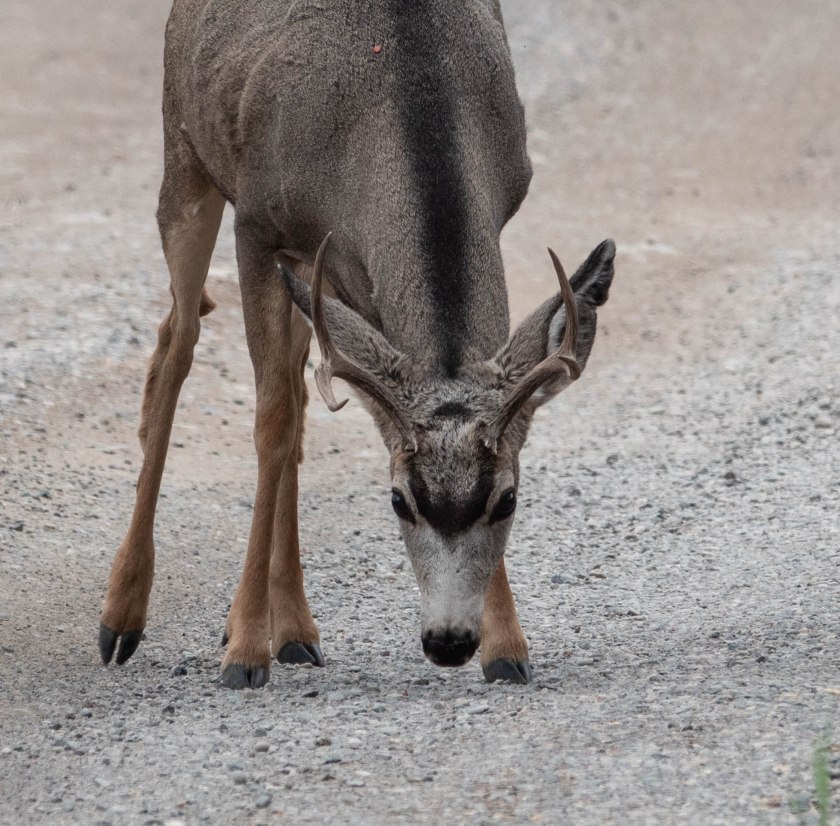
Their facial masks vary widely, and some have black lines down their spine or at the base of their tail. The male above has rather quizzical “eyebrows” that reminded me of Mr. Bean. The young 3-point male below has a chic black V on his forehead and a black spinal stripe:

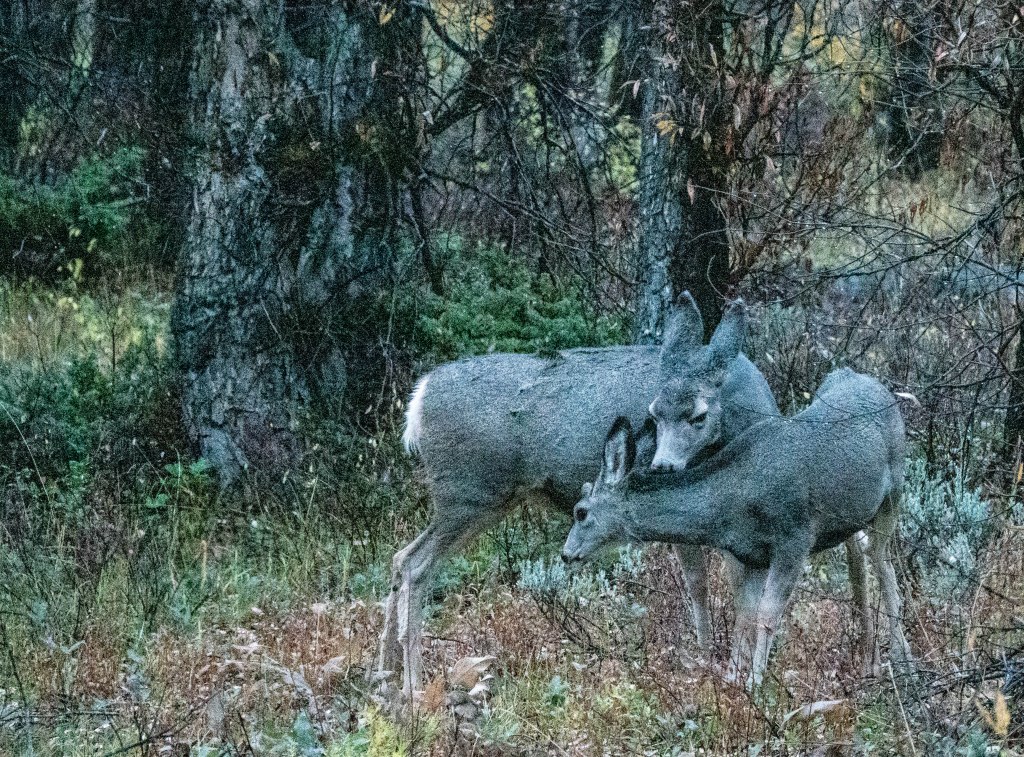
The young are usually born starting in late May and are now 3-4 months old, miniatures of their doting parents:

Sometimes romance seems to have been delayed, and this fawn still has its reddish color and its spots, meaning it can’t be more than 2 1/2 months old.

Winter will be a challenge: this fawn will have to keep up since they can migrate as much as 150 miles south (one travelled 240 miles), the longest land migration of any ungulate in the Lower 48.

*Mules tend not to get a good press, but my title is from a poem written to a pet mule. It is not great poetry, nor is it about a mule deer, but I include it here to demonstrate that even a mule can be loved by someone. The newspaper observes that “it is in blank verse, which seems to be the only literary method for successfully treating the mule.”

LINES THAT FIT A MULE
Wrexham and Denbighshire Advertiser, 1891
By Bill Nye

Oh, lovely, gentle, unobtrusive mule,
Thou standest idly, ‘gainst the azure sky,
And sweetly, sadly singest like a hired man.
Who taught thee thus to warble
In the noontide heat and wrestle with
Thy deep, corroding grief and joyless woe?
Who taught thy simple heart
Its pent-up wildly warring waste
Of wanton woe to carol forth upon the silent air?

I chide thee not, because thy
Song fraught is with grief-embittered
Monotone and joyless minor chords
Of wild, imported melody for thou
Art restless, woe-begirt, and
Compassed round about with gloom,
Thou timid, trusting orphan mule!

Few joys, indeed, are thine,
Thou thrice-bestricken, madly
Mournful, melancholy mule.
And he alone who strews
Thy pathway with his cold remains
Can give the recompense
Of festering and injurious woe.
He who hath sought to steer
Thy limber, yielding tail
Anigh thy crupper band
Hath given thee joy, and he alone.
‘Tis true, he may have shot
Athwart the zodiac, and, looking
O’er the outer walls upon The New Jerusalem,
have uttered vain regrets;
Thou reckest not, O orphan mule,
For it hath given thee joy, and
Bound about thy bursting heart,
And held thy tottering reason
To its throne.

Sing on, O mule, and warble In the twilight grey,
Unchidden by the heartless throng.
Sing of thy parents on thy father’s side,
Yearn for the days now past and gone,
For he who pens these halting,
Limping lines to thee
Doth bid thee yearn and yearn and yearn.

Landscape 3: Evening

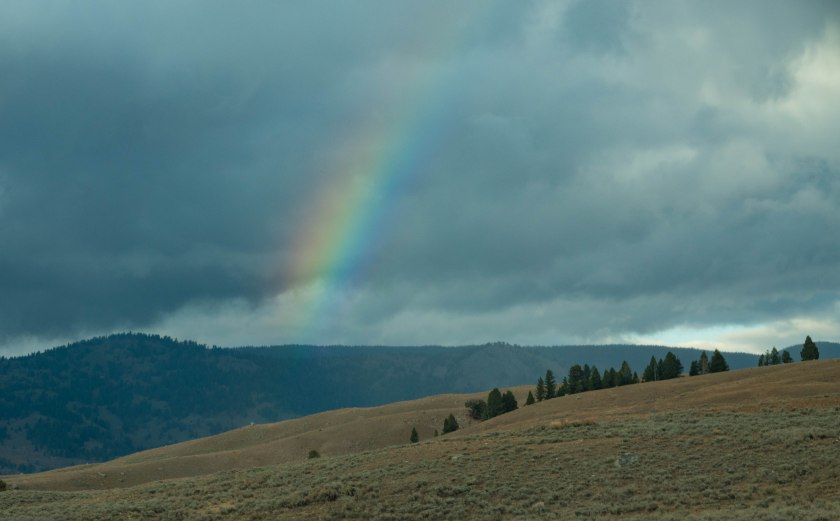
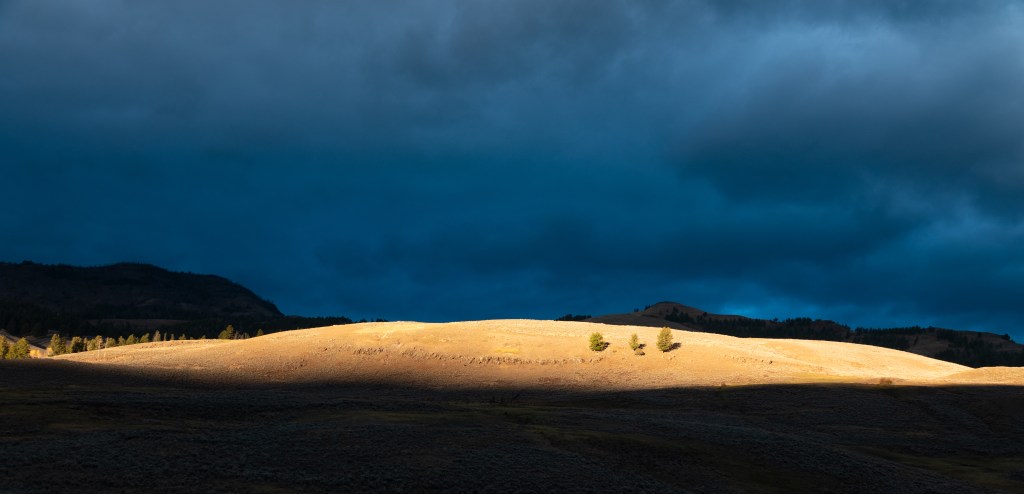
In Yellowstone’s Lamar Valley, as we watched fruitlessly for wolves in the evenings, the sun occasionally leaked through the omnipresent low clouds:

Once it gave us a rainbow:

And once it came in low and sideways, washing the flanks of the hills

We had our backs to those hills, and the light crept up on us almost unawares:

I am glad I turned around, and lifted up mine eyes unto the hills:

What Thomas Chatterton called “the burnish’d mountain-top”, but this one was masquerading as a sand dune.

Partial compensation for the dearth of wolves.

A bull moose in his pomp

I have seen moose in Maine over the years, but always without those iconic antlers: either cows, or bulls after they have dropped their antlers. Hallelujah, in Grand Teton National Park in Wyoming I finally saw bull moose in their full glory.

It wasn’t easy. The biggest one I saw was just turning his back on me to wander nonchalantly back into the deep forest, so I got barely a glimpse and no photo.

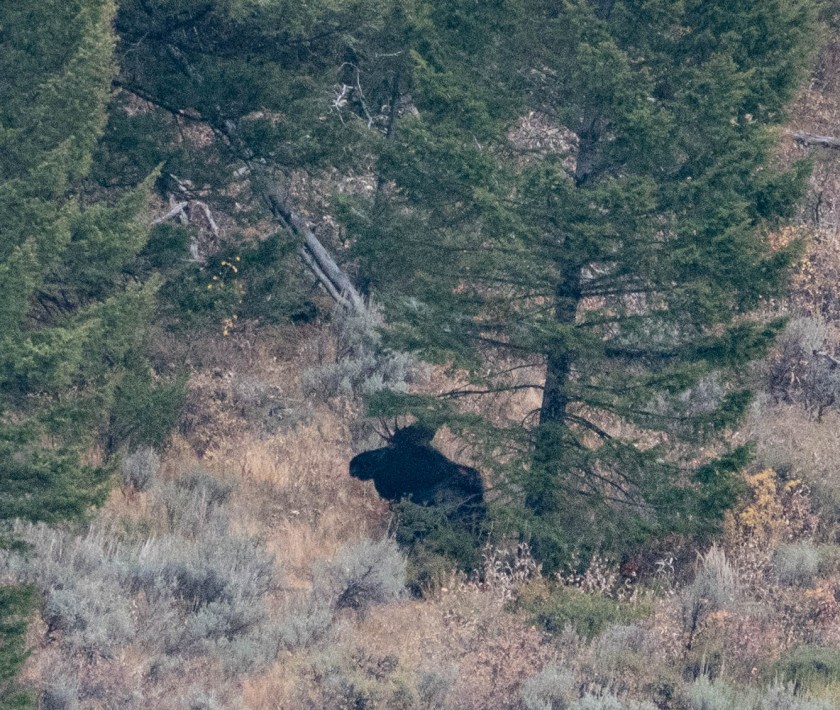
The second one was high on the hillside about 300 metres away: he is the little black dot halfway down and left of centre.

When I zoomed in you could admire his rack and his beard, but not in close-up.

And then he decided to settle down under a tree to chew the cud:

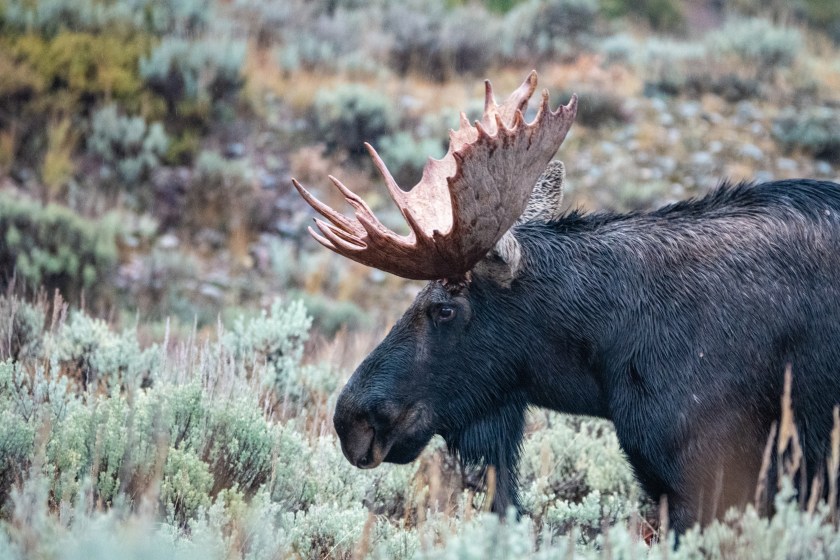
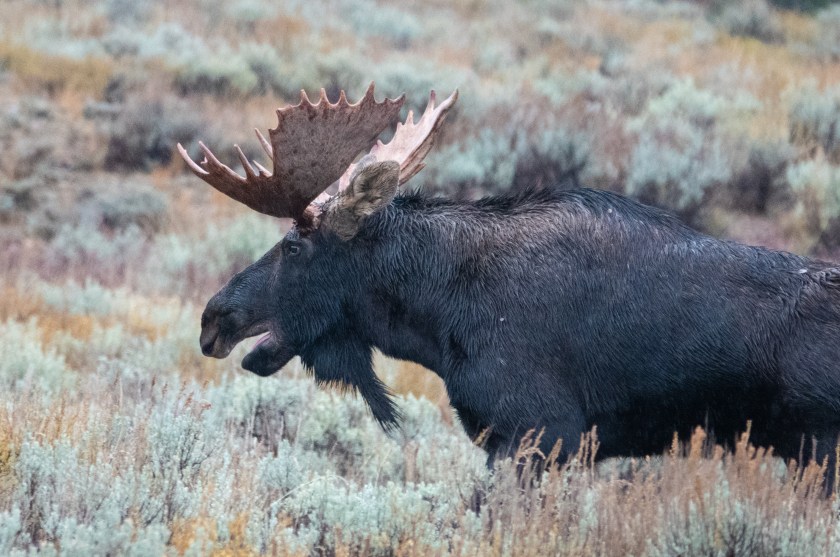
The next day, though, a different male decided to travel across the landscape in full view close by, and here he is:

Their muzzle always reminds me of a carthorse, and I have an urge to hold out my palm with a carrot on it. Probably a bad idea. Anyway, this one is in his prime, between five and ten years old.

It is very hard to age a moose by its antlers, but they don’t get this butterfly (or split-palm) shape until around 5 1/2, and then as they age the antlers dwindle again.

The forward pointing portions are to protect their eyes and faces in dominance displays, though they rarely actually fight. The “beard” is in reality a flap of skin, more properly called a dewlap, or bell, and it is found in both males and females, though it is bigger in males.
No-one really knows what it is for. It may help to spread the animal’s scent during mating season. Bull moose will scrape a depression in the ground, urinate in it, and then lie down in the resulting fragrant slop. A muddy dewlap is a good way of dispersing the enticing pheromones to passing females. In this movie, again taken by Mark with his iPhone/scope combo, you can see how the dewlap flops around:

PS Here is a graphic of the different stages of antlers; the chap in my close-ups carries a fine example of the final stage:

PPS A depressing appendix. Chronic Wasting Disease (CWD) is a prion disease (like mad cow disease) that affects the brains and spinal cords of moose, elk, and deer. First identified in Colorado in 1981, it has now reached the Greater Yellowstone area. It is probably spread through bodily fluids, is slow-growing, and the early symptoms are not obvious. It is always fatal, and is considered a serious threat to the populations of all these animals. We can only hope that they acquire some resistance to this scourge.