I have seen moose in Maine over the years, but always without those iconic antlers: either cows, or bulls after they have dropped their antlers. Hallelujah, in Grand Teton National Park in Wyoming I finally saw bull moose in their full glory.
It wasn’t easy. The biggest one I saw was just turning his back on me to wander nonchalantly back into the deep forest, so I got barely a glimpse and no photo.
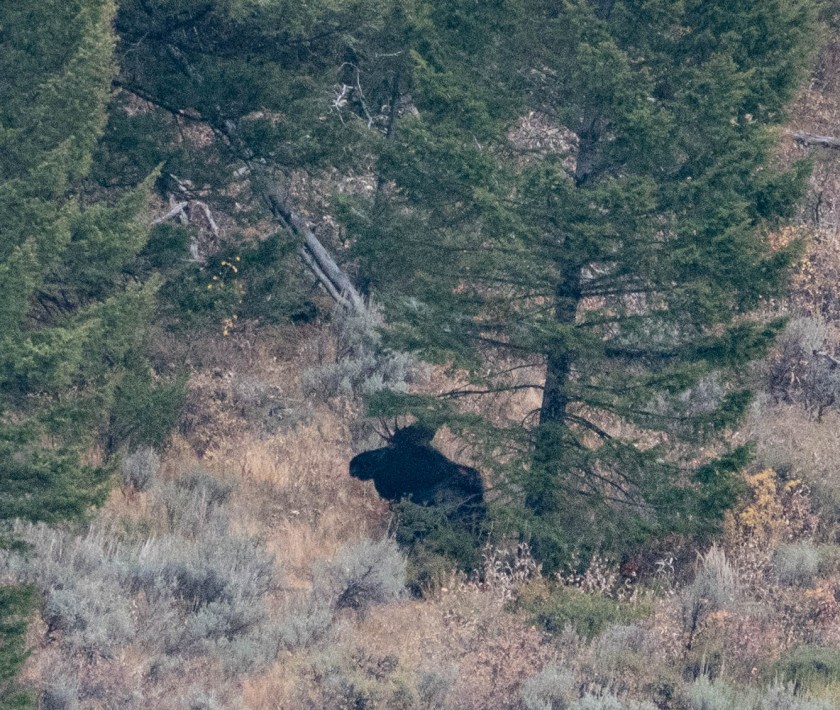
The second one was high on the hillside about 300 metres away: he is the little black dot halfway down and left of centre.
When I zoomed in you could admire his rack and his beard, but not in close-up.
And then he decided to settle down under a tree to chew the cud:
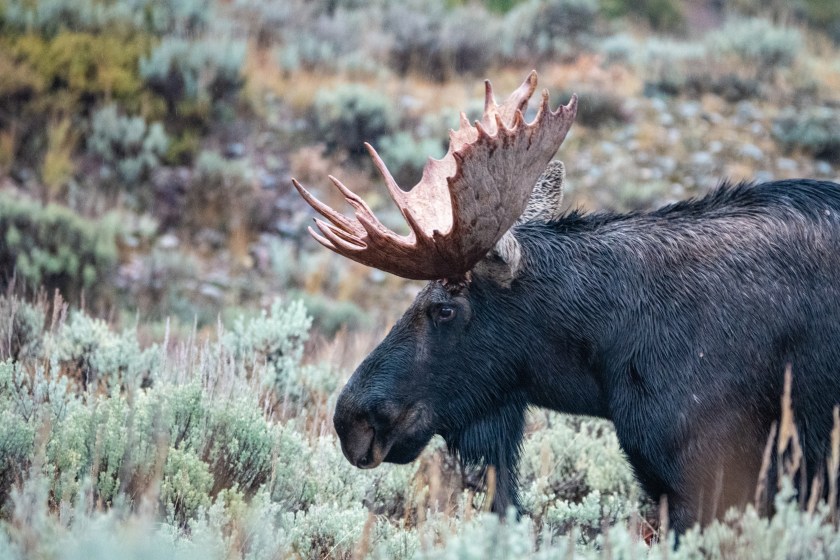
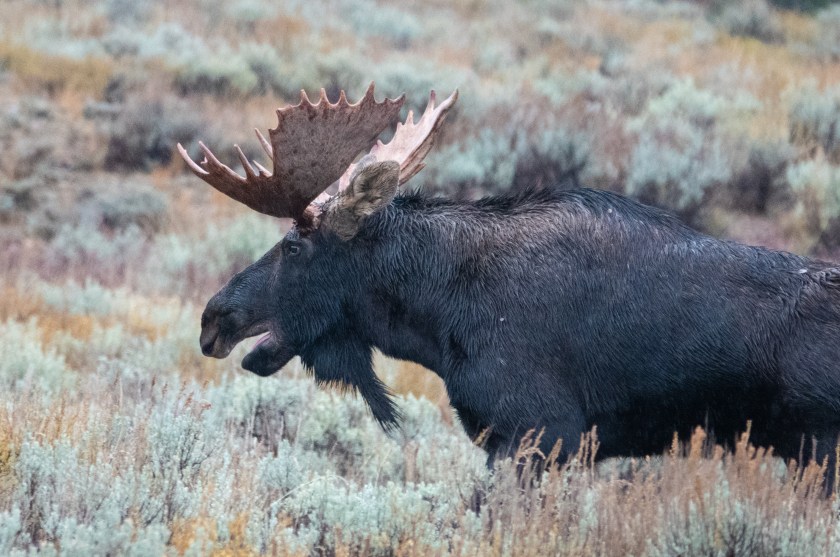
The next day, though, a different male decided to travel across the landscape in full view close by, and here he is:
Their muzzle always reminds me of a carthorse, and I have an urge to hold out my palm with a carrot on it. Probably a bad idea. Anyway, this one is in his prime, between five and ten years old.
It is very hard to age a moose by its antlers, but they don’t get this butterfly (or split-palm) shape until around 5 1/2, and then as they age the antlers dwindle again.
The forward pointing portions are to protect their eyes and faces in dominance displays, though they rarely actually fight. The “beard” is in reality a flap of skin, more properly called a dewlap, or bell, and it is found in both males and females, though it is bigger in males.
No-one really knows what it is for. It may help to spread the animal’s scent during mating season. Bull moose will scrape a depression in the ground, urinate in it, and then lie down in the resulting fragrant slop. A muddy dewlap is a good way of dispersing the enticing pheromones to passing females. In this movie, again taken by Mark with his iPhone/scope combo, you can see how the dewlap flops around:
PS Here is a graphic of the different stages of antlers; the chap in my close-ups carries a fine example of the final stage:
PPS A depressing appendix. Chronic Wasting Disease (CWD) is a prion disease (like mad cow disease) that affects the brains and spinal cords of moose, elk, and deer. First identified in Colorado in 1981, it has now reached the Greater Yellowstone area. It is probably spread through bodily fluids, is slow-growing, and the early symptoms are not obvious. It is always fatal, and is considered a serious threat to the populations of all these animals. We can only hope that they acquire some resistance to this scourge.
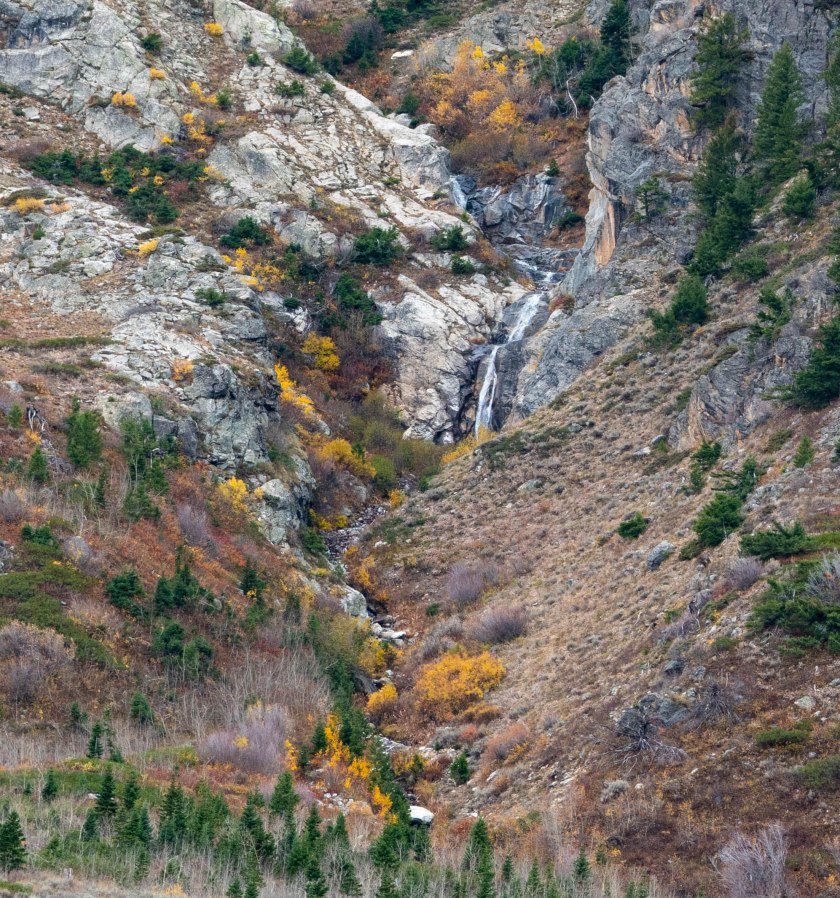
Rivers thread the landscape of Greater Yellowstone, some no more than a trickle:
and some wide and fast:
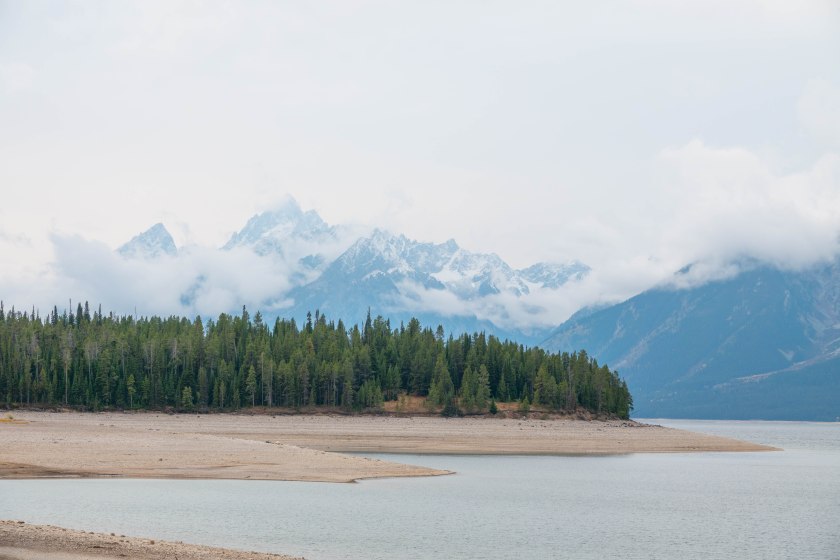
There are lakes, some natural and some the result of dams. One dam was being repaired and the lake was deliberately low:
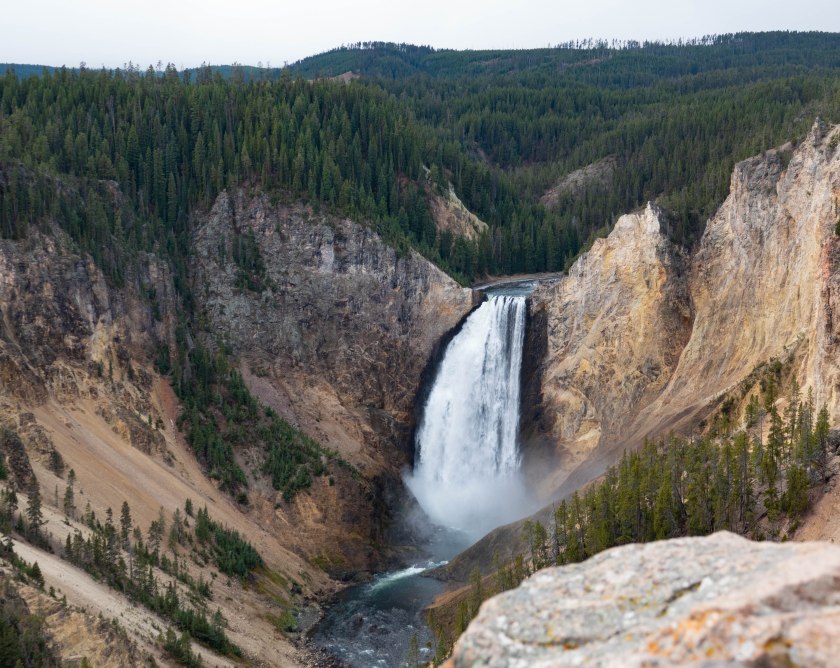
Yellowstone even has its own Grand Canyon, fed by the Yellowstone River as it drops over an impressive waterfall
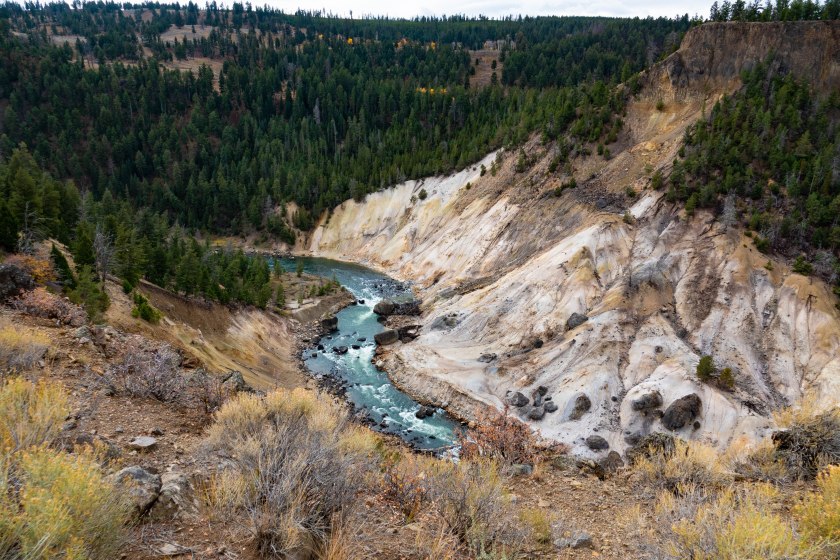
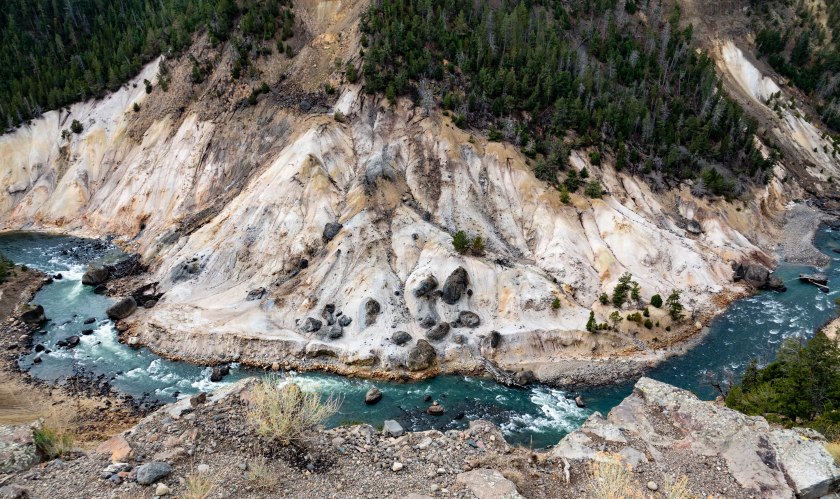
The canyon deepens, and if you hike along the rim the river looks tiny below you :
On other days, if the wind drops and the light is right, you see double:
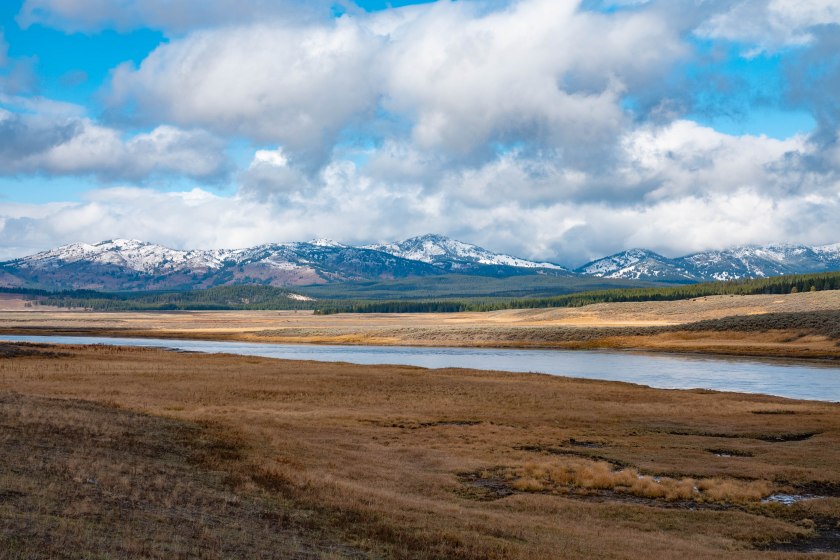
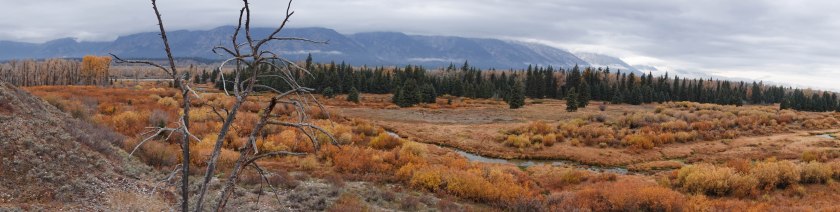
And when you come over the brow of a hill there are wide valleys miles across with streams running through them, and your heart leaps:
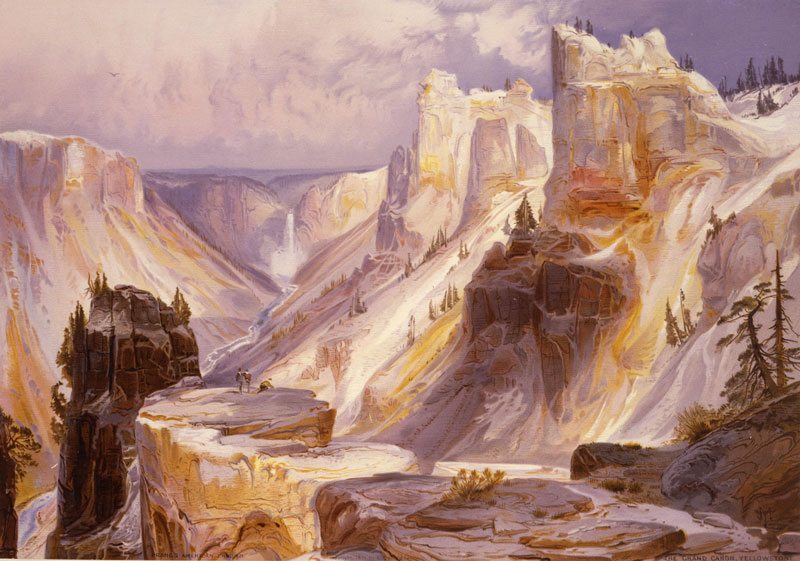
In 1871, on the Hayden survey expedition, the artist Thomas Moran painted watercolors of the Grand Canyon of Yellowstone. These first images of Yellowstone’s astonishing beauty were produced for the masses as chromolithographs,
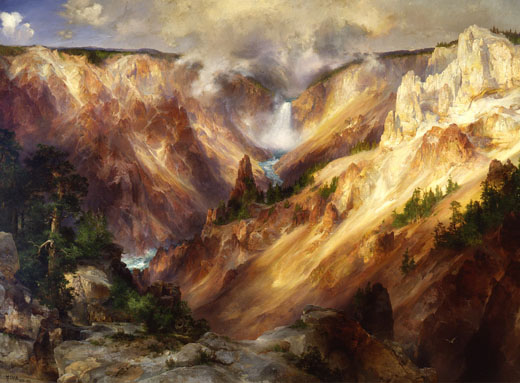
and turned into the awe-inspiring oils we now find so familiar:
His work helped build public support for the establishment of the first national park in the US (and the second in the world), signed into law by President Ulysses Grant in 1872.
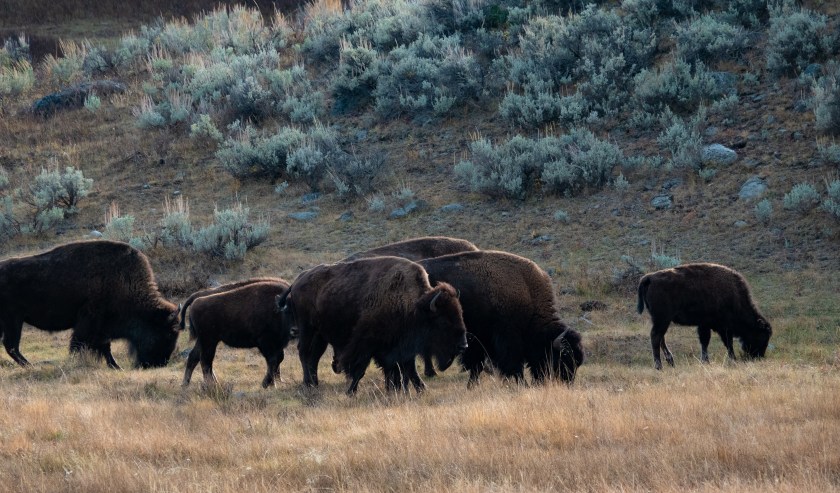
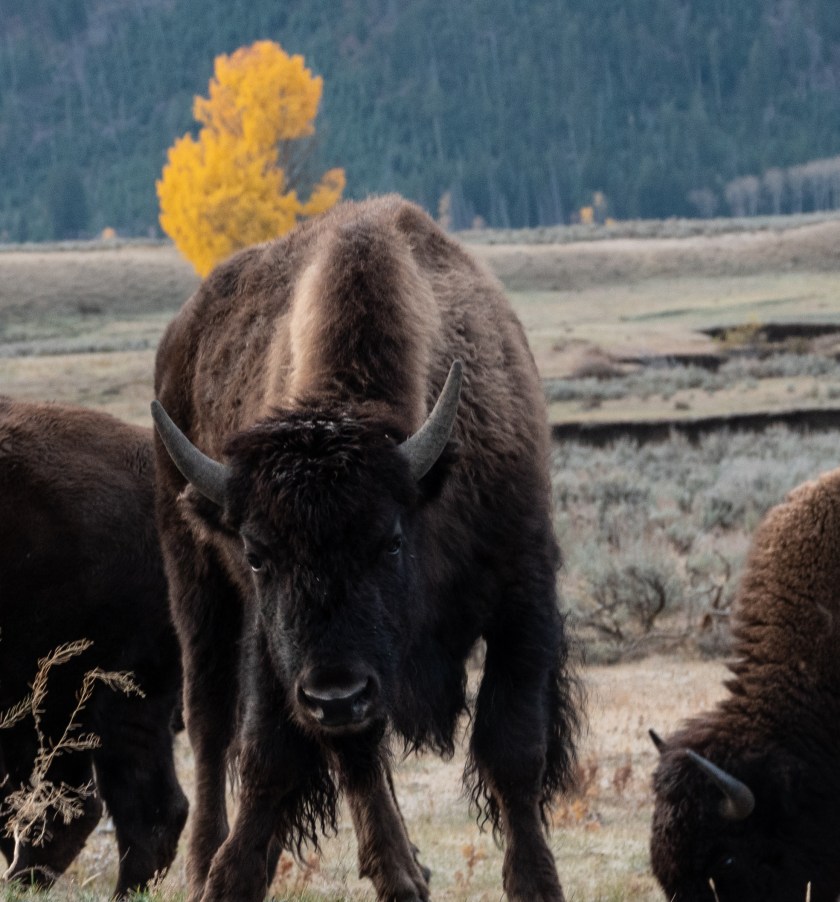
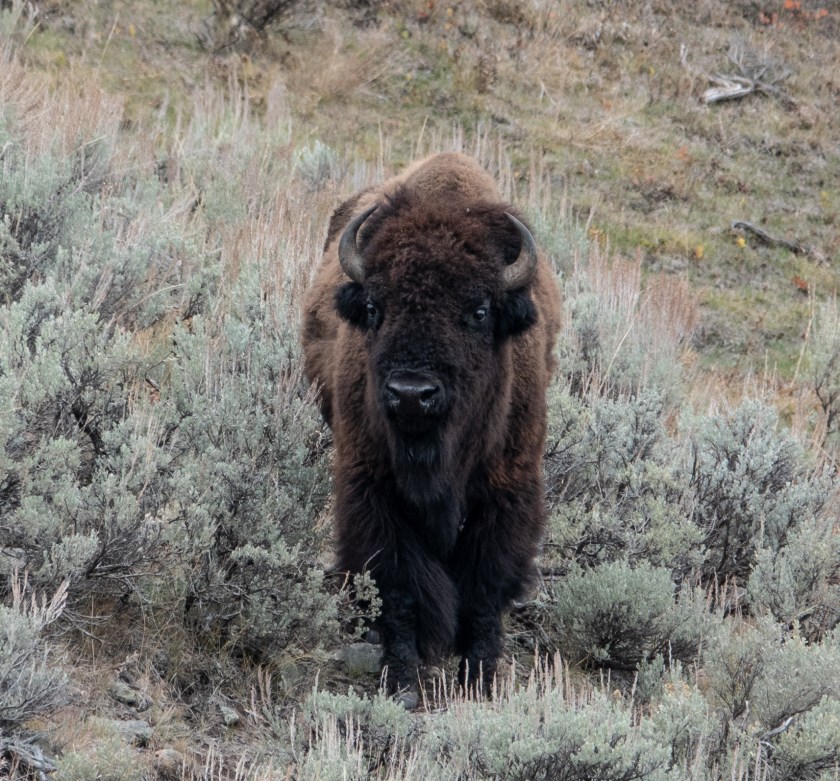
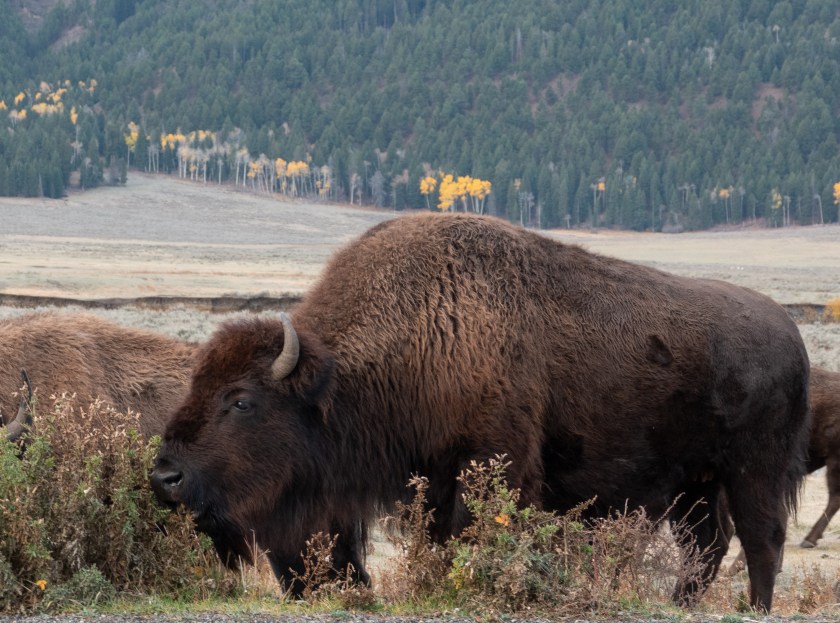
Of all the iconic animals of the American West, surely the Plains Bison is number one.
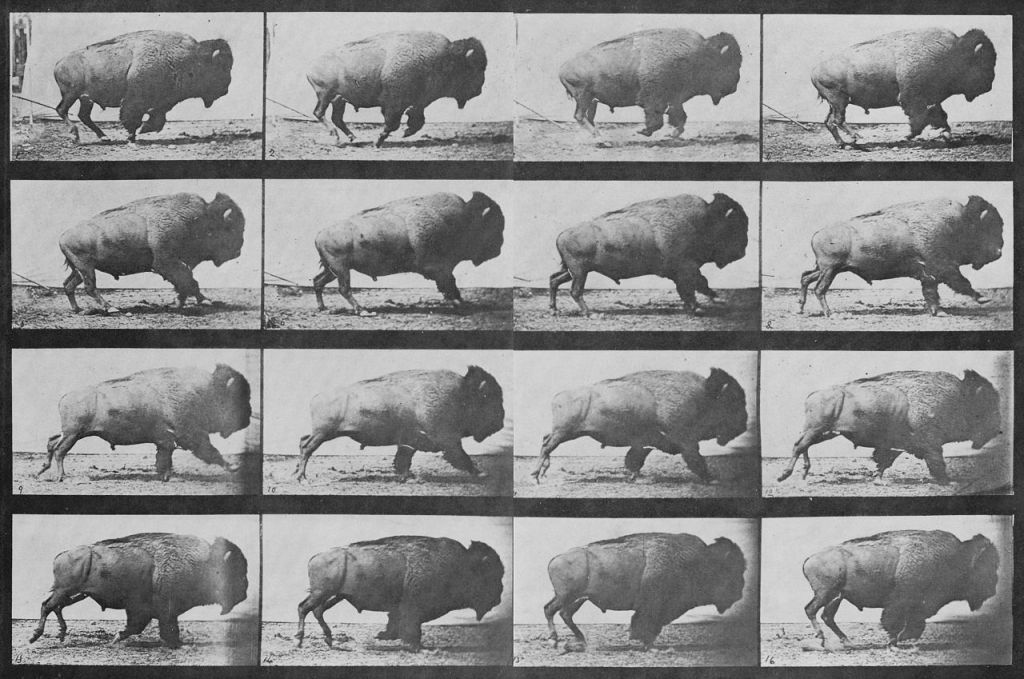
Their story is one of inexcusable near-extinction, followed by a remarkable recovery effort. Before Europeans arrived, they are thought to have numbered around 60 million. By 1905 their numbers were down to less than 1000, including those in captivity. The pioneering photographer Eadweard Muybridge shot this series of stills in 1883,
later composed into a video:
The numbers were brought back up to the current 350,000, initially partly by cross-breeding with cattle, but that practice has long since stopped. The Yellowstone bison are pure bred Bison bison bison with no cattle DNA. (Yes, that is their scientific name!). These numbers are far below what they once were, but their survival as a species is no longer in doubt.
The males have horns whose ends point straight up:
The females have horns that curve elegantly inwards:
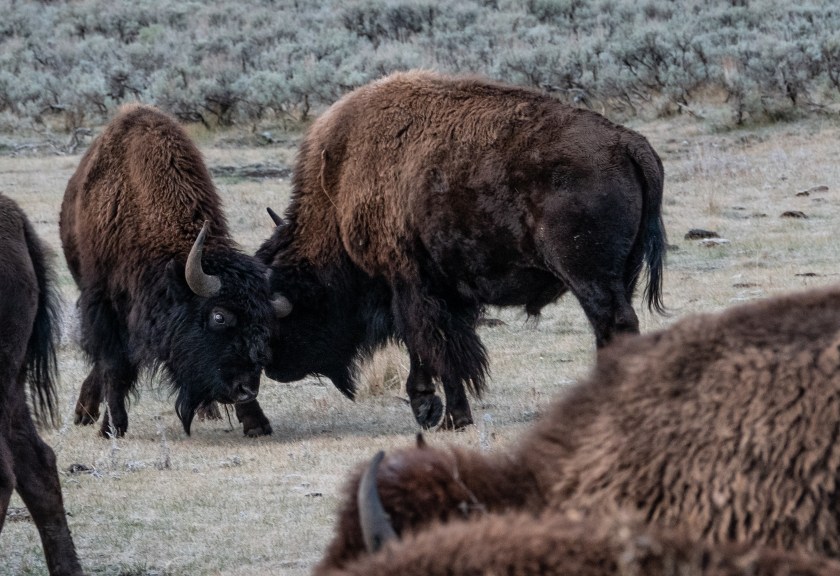
Boys will be boys, as evidenced by these two play-fighting:
But an adult male can weigh 2500 lbs
and do a lot of damage. This adult’s flank has been pierced by a horn, not seriously:
And just look at what they can do to a human being:
They are not all brute force. This one has lovely eyelashes!
And their topknot hair is luxuriantly wiry:*
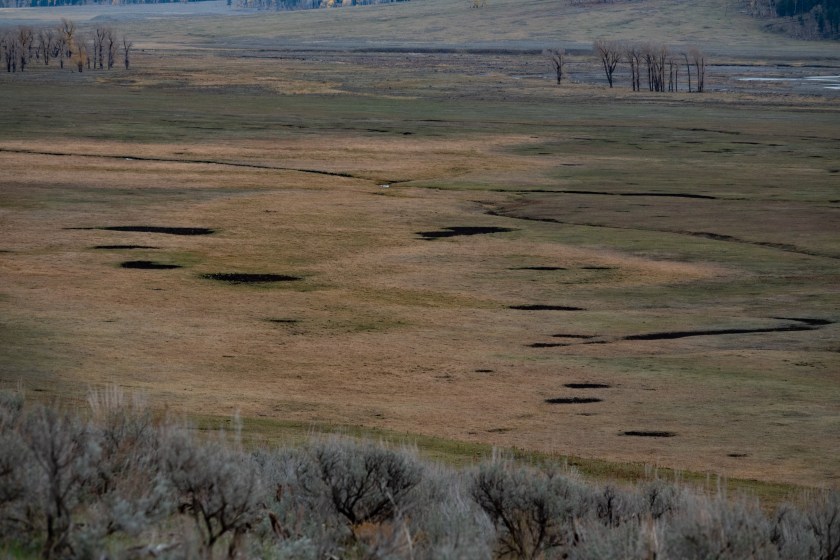
Their thick coat insulates them well, but one of their pleasures is a good wallow in the mud. These dark circles are wallows created by the bison:
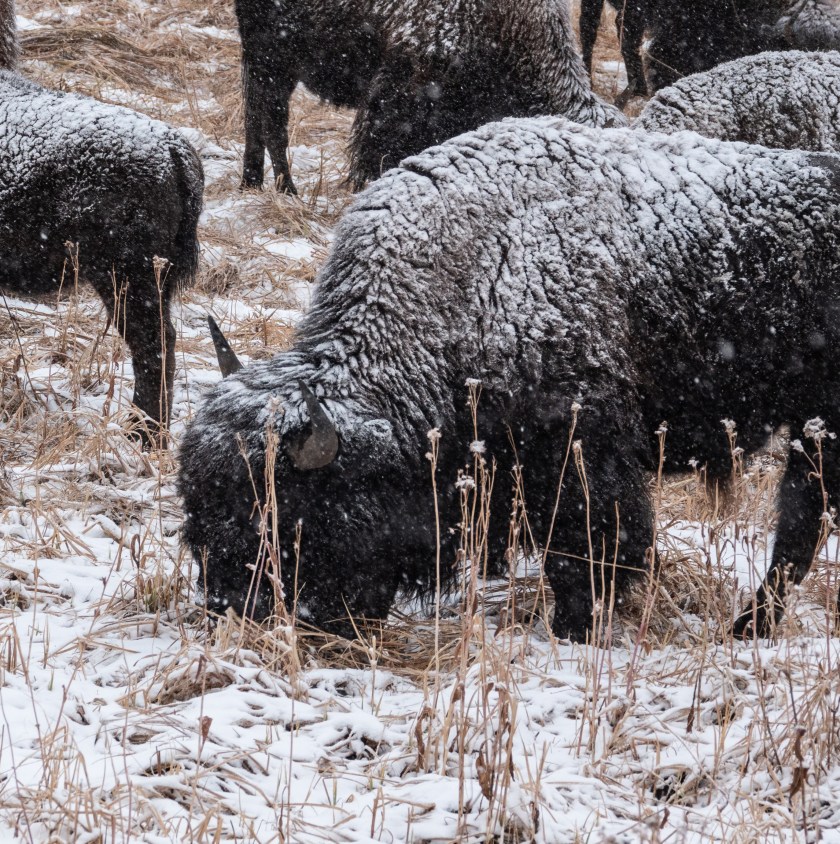
When winter comes, that coat is a pretty good insulator and also fairly waterproof:
The main challenge posed by snow is getting at the food underneath. In Yellowstone, which is at an altitude of over 8000 feet, an average winter brings over 12 feet of snow, with much more at the higher elevations. The bison swing their huge heads from side to side to bulldoze their way through the snow.
PS Bison are often called buffalo, but they are unrelated to the African buffalo or the Asian Water Buffalo, so bison is a better name.
PPS: From The New Yorker, a few days after my return:
*Talking of their hair, this is Hilaire Bellocs’ assessment:
The Bison
The Bison is vain, and (I write it with pain) The Door-mat you see on his head Is not, as some learned professors maintain, The opulent growth of a genius’ brain; But is sewn on with needle and thread.
[In between animal posts, I’m slipping in the occasional post to show you the stunning landscape of the Greater Yellowstone area (which also encompasses the Grand Teton National Park)].
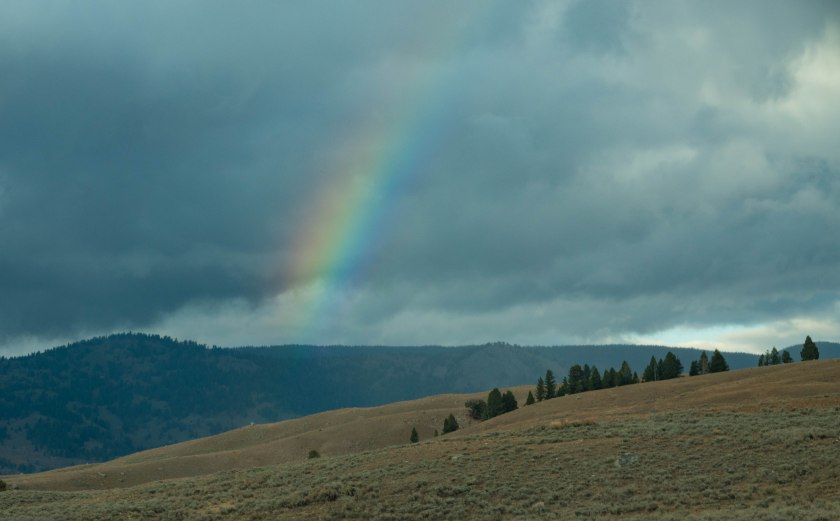
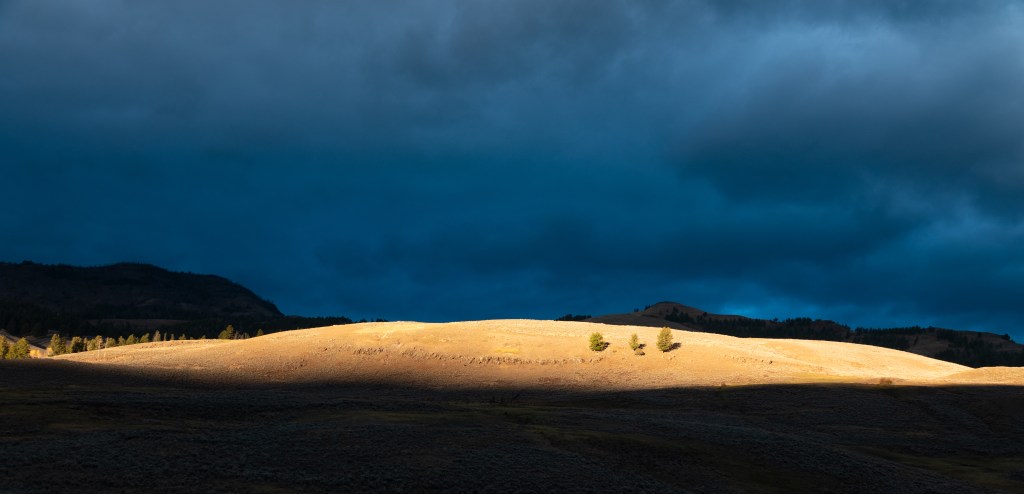
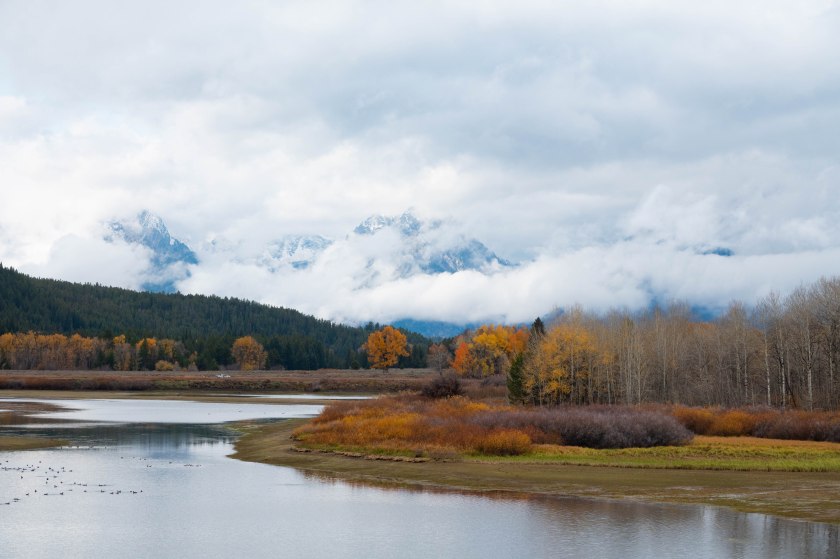
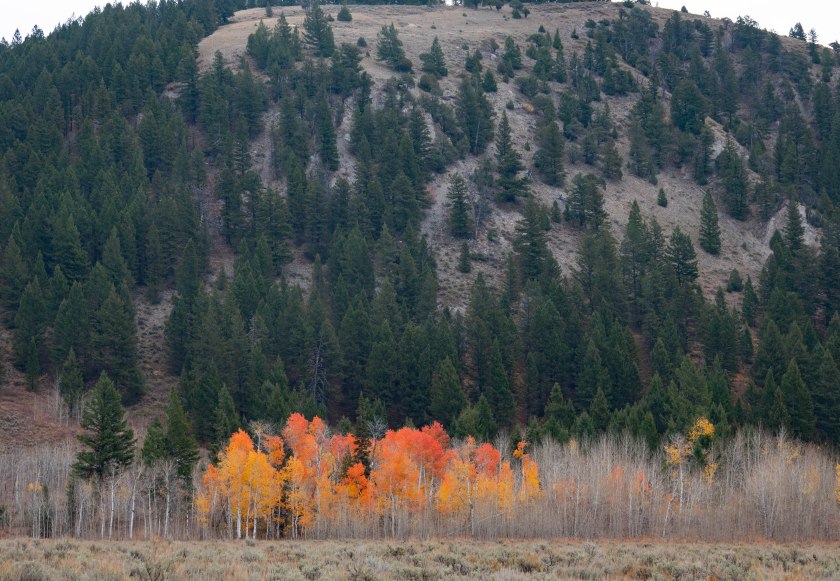
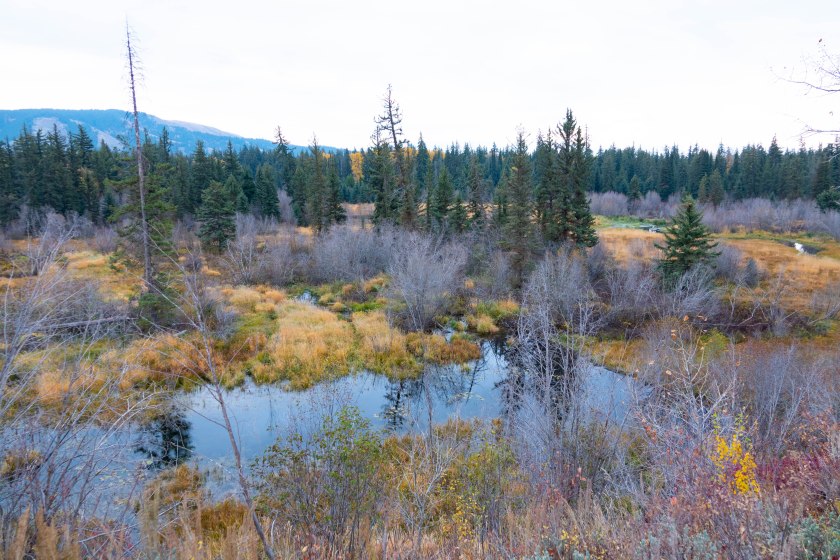
The weather during my trip was mainly cloudy and sullen, with intermittent rain, and one day of snow. The mountains could only be glimpsed, and the dramatic vistas rarely got the kind of lighting they deserved. But its beauty still comes through. The cottonwoods and the aspens turn the most astonishing colors in the fall, and although some were bare by the time I arrived there were enough left to show flashes of brilliance in the otherwise sombre landscape:
Sometimes there were long golden borders between the evergreens and the meadows:
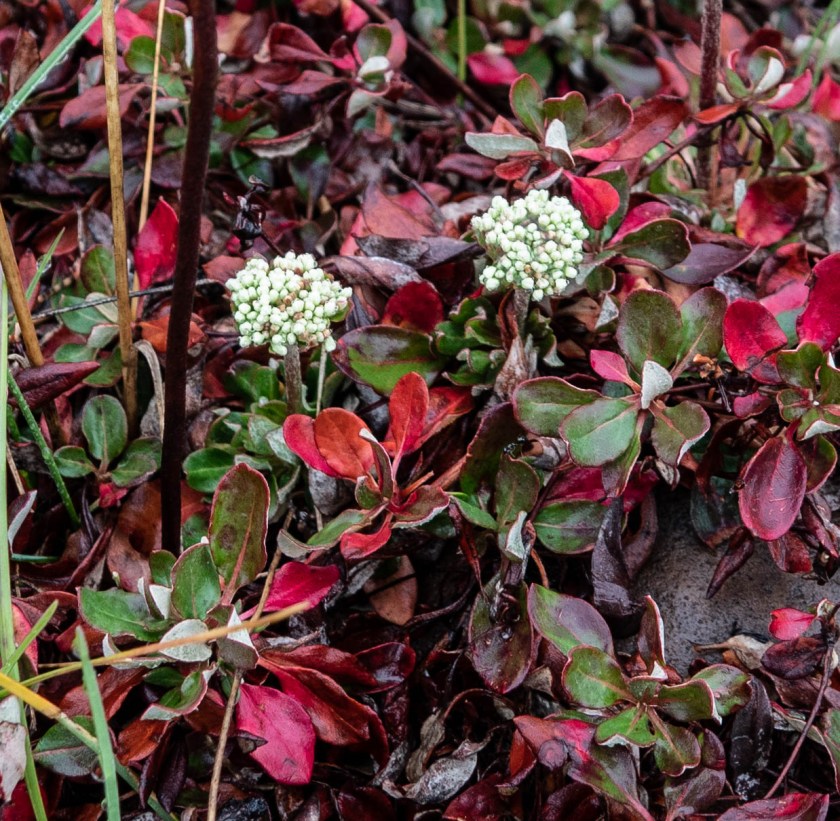
In the moister areas, the low-growing bushy willows were purple and orange in the foreground:
creating a tapestry of autumnal carpets:
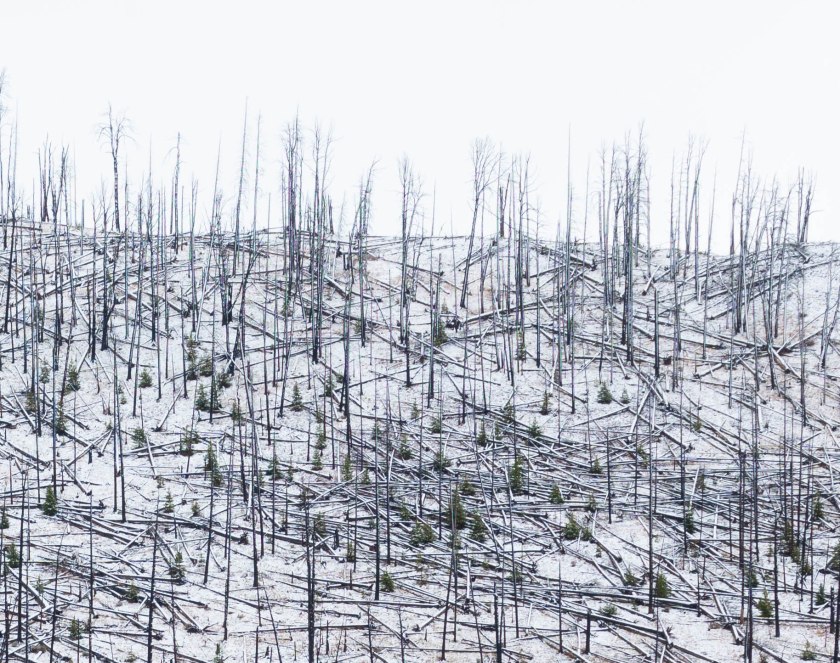
Even where all seemed dead and gone, leaving this bleak aftermath from a catastrophic fire some years ago:
a closer look shows brave new trees returning:
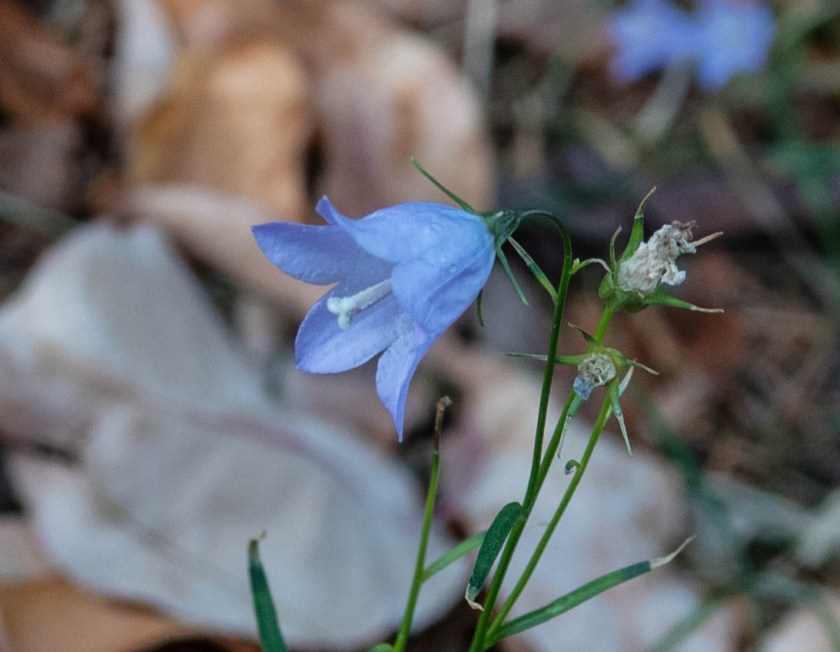
And a few wildflowers hung on, a promise of new life when spring returns.
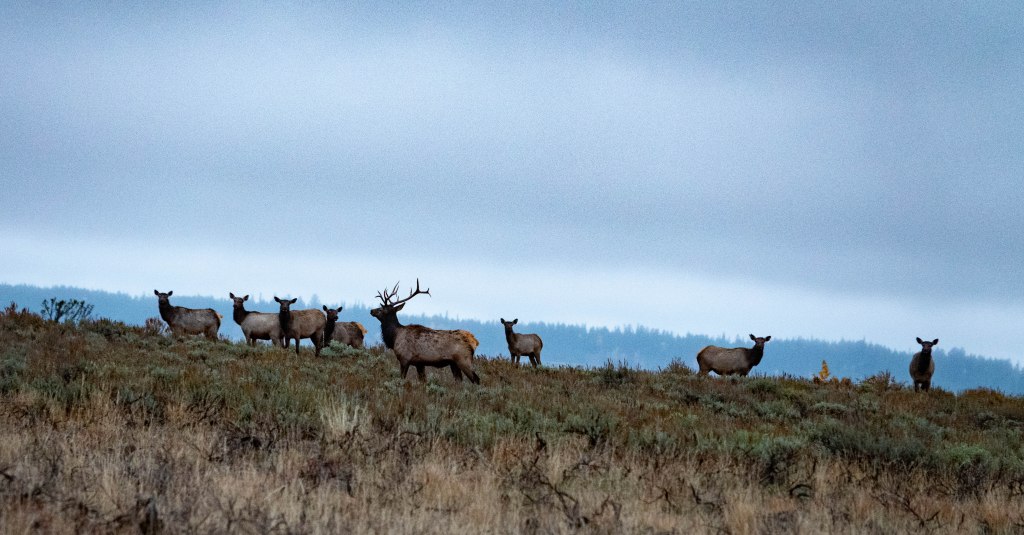
It is mating season, and the bulls that we met last time have harems of from 5-30 females each.
The one in the right foreground below had 26 females!:
The male guards them day and night, because younger ‘periphery bulls’ lurk nearby, hoping to impregnate any female that strays from the group.
The young spikes also have to be watched, just in case they get any ideas. If the seigneur perceives a threat to his sovereignty he stretches his neck out and curves his head back so his antlers touch his spine.
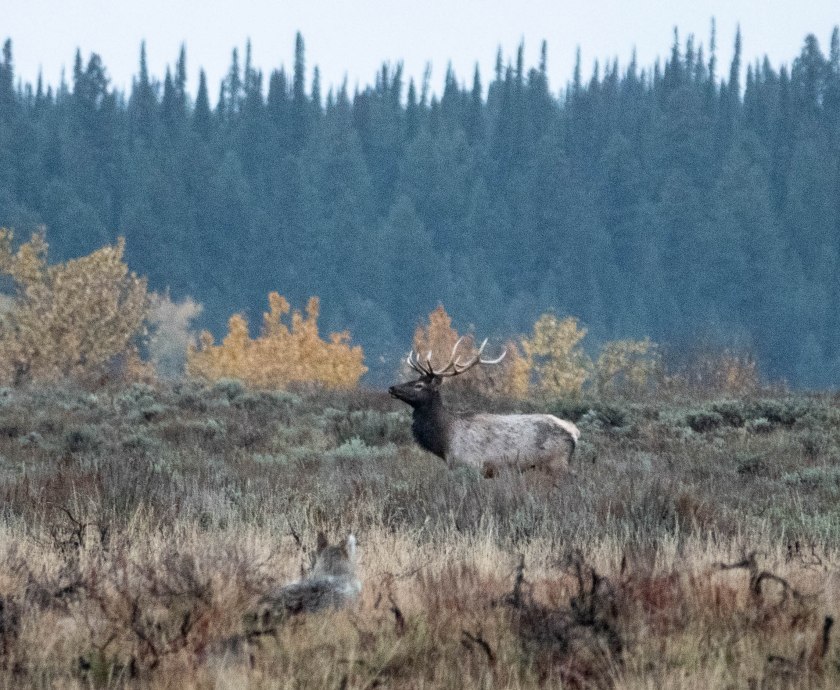
And other threats lurk. This periphery bull wandered away, and when I looked at my distant photos I noticed for the first time that he was not alone:
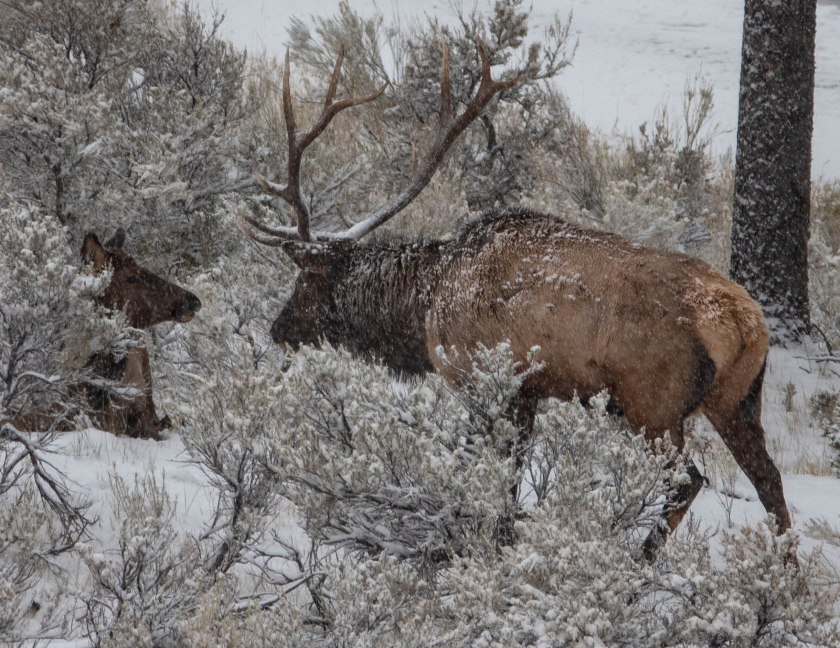
The watcher is certainly a canid, (confirmed by my guide), and probably a wolf, (though it could be a coyote). Since I never did see wolves I am going to claim this as a wolf-sighting! Elk is the preferred food of wolves in the Tetons, and they can tackle both calves, and older or weaker adults.
Bull elk make eerie calls during mating season, known as bugling. Listen here:
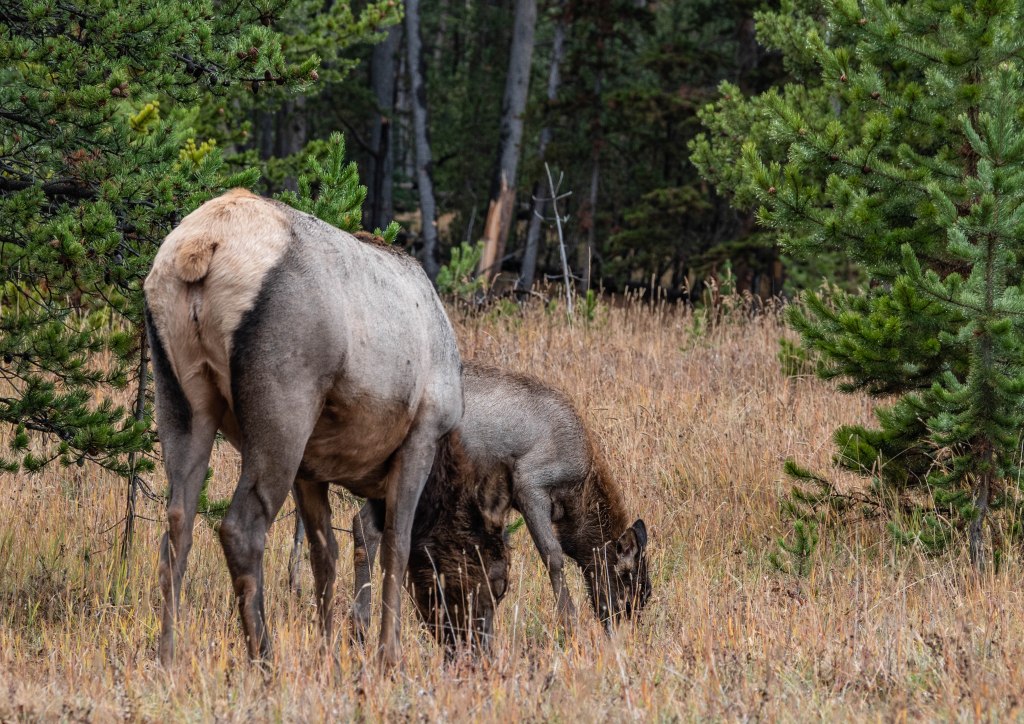
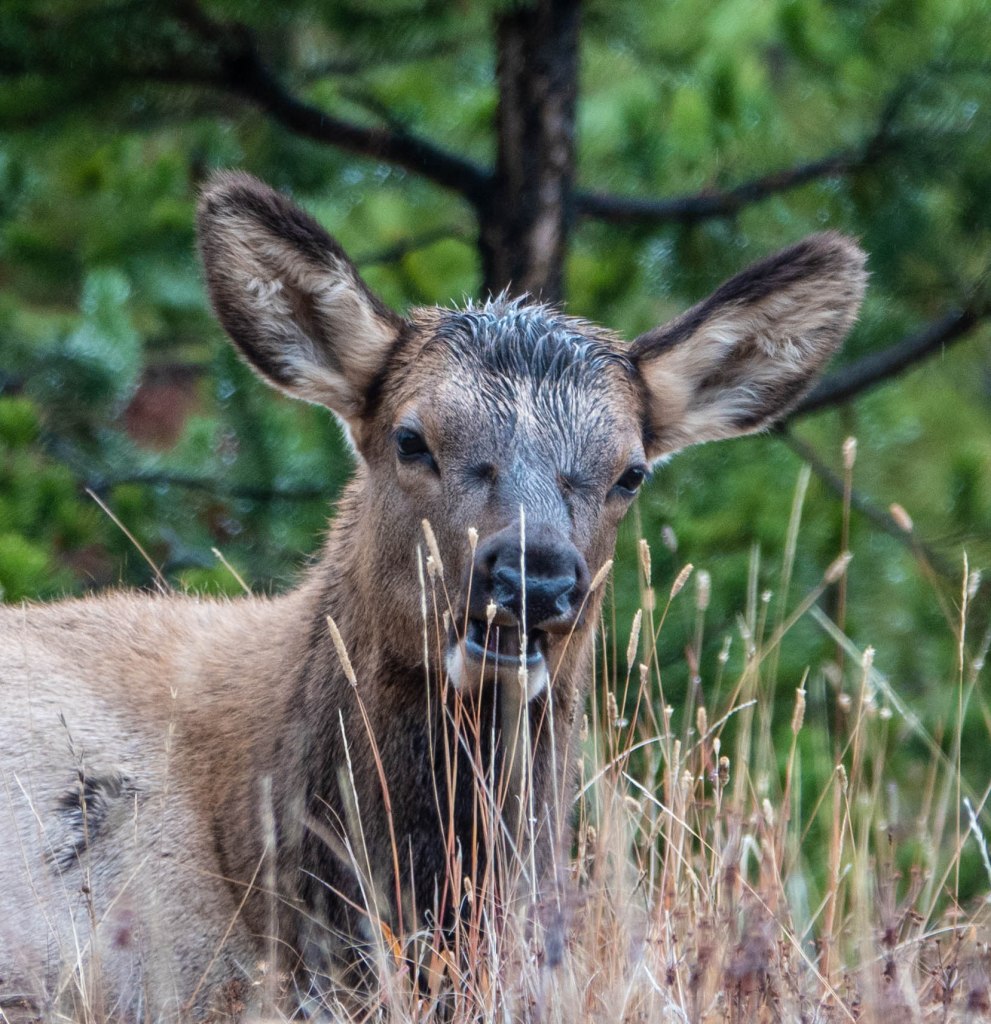
The result of these fall liaisons will be calves in late May to mid-June. This calf is now four months old, browsing with its mother.
When her belly is full, she lies down to digest:
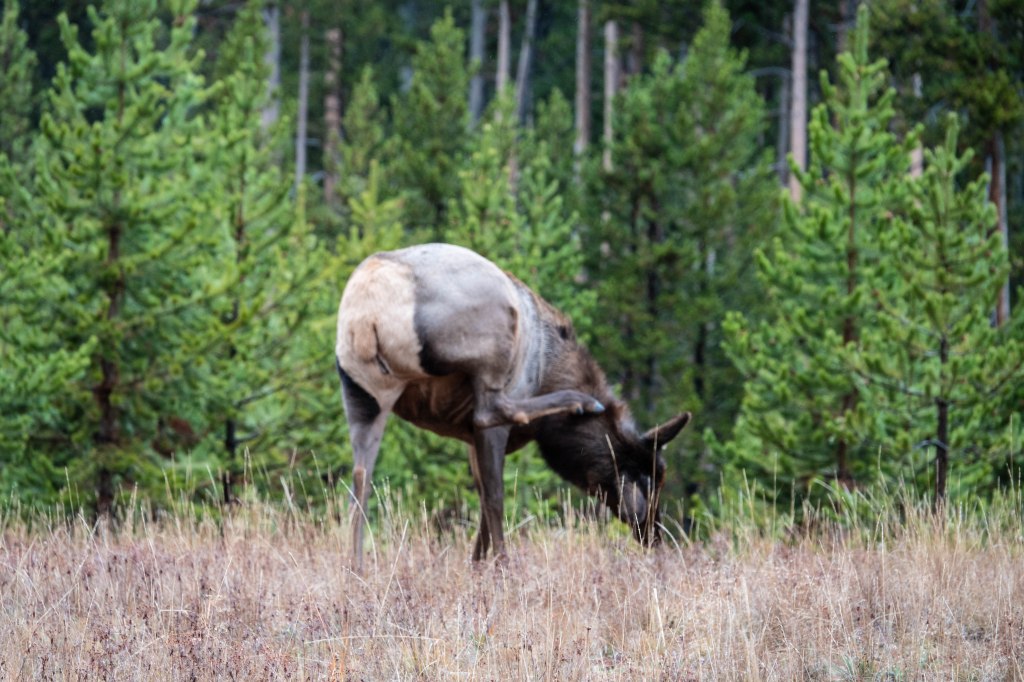
They may look stiff-legged, but those hind legs can be used to scratch behind the ear:
As winter closes in, they drift southwards.
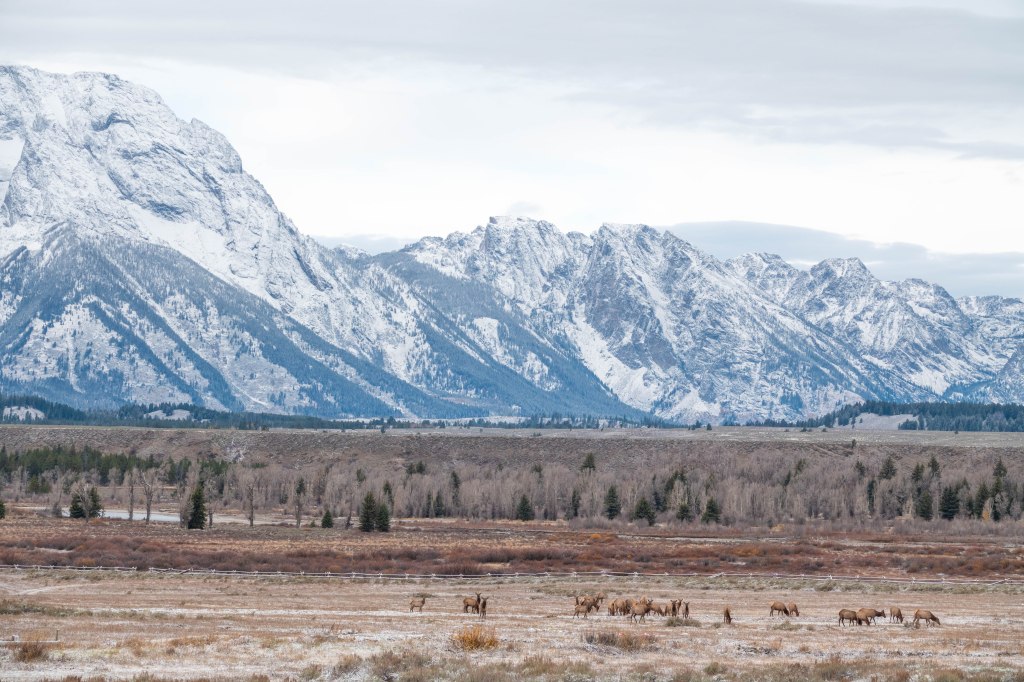
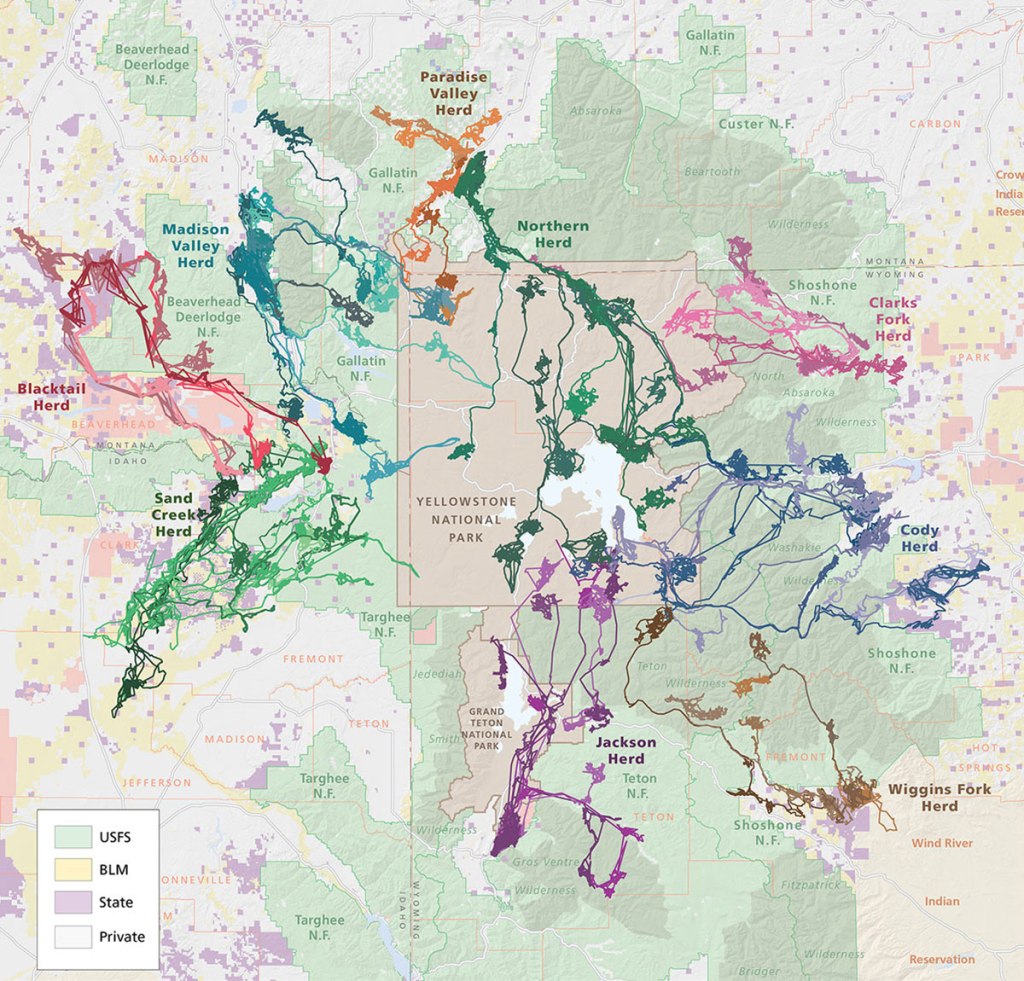
Traditionally, the Jackson herd of about 11,000 animals would have moved from the Grand Tetons to lower elevations further south. Now their way is blocked by the town of Jackson at the southern end of the valley, so to prevent winter starvation the National Elk Refuge was created over 100 years ago, in 1912. Controversially, they are given supplemental food during the winter. The migration routes for the Greater Yellowstone elk herds can be seen below: the largest magenta blob, bottom center, is the Refuge.
I am proud to live in a country that once thought to create a National Elk Refuge. Long may we continue to value such places.
My guide in the Grand Tetons and Yellowstone was the wonderfully well-informed wildlife biologist Mark Byall of EcoTour Adventures. He was a constant source of fascinating information, and never ever boring. Thanks Mark. And Gloria and Rich (you know who you are).
The North American range of the elk is much more limited than it once was, (and Maine has never been their home), so this was my first chance to see elk.
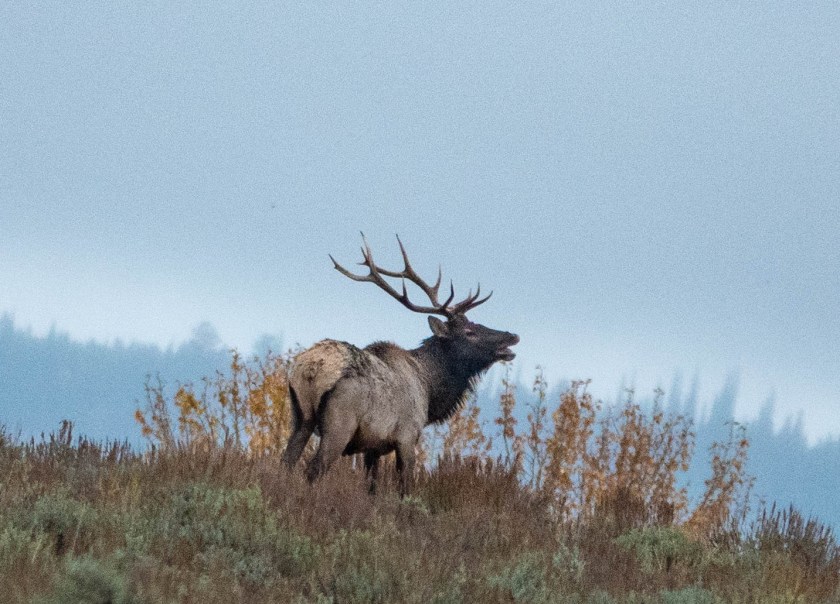
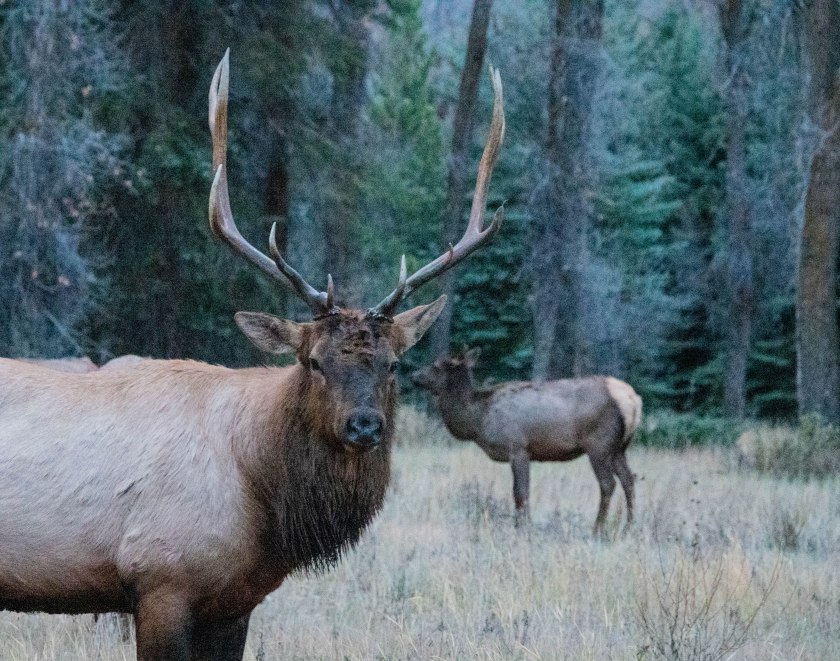
They’re huge! A bull elk, Cervus elaphus nelsoni, can weigh over 1100 lbs and stand up to 5 ft at the shoulder (I am 5ft 3″). The most striking thing about them is of course their antlers. This one has five points on each antler:
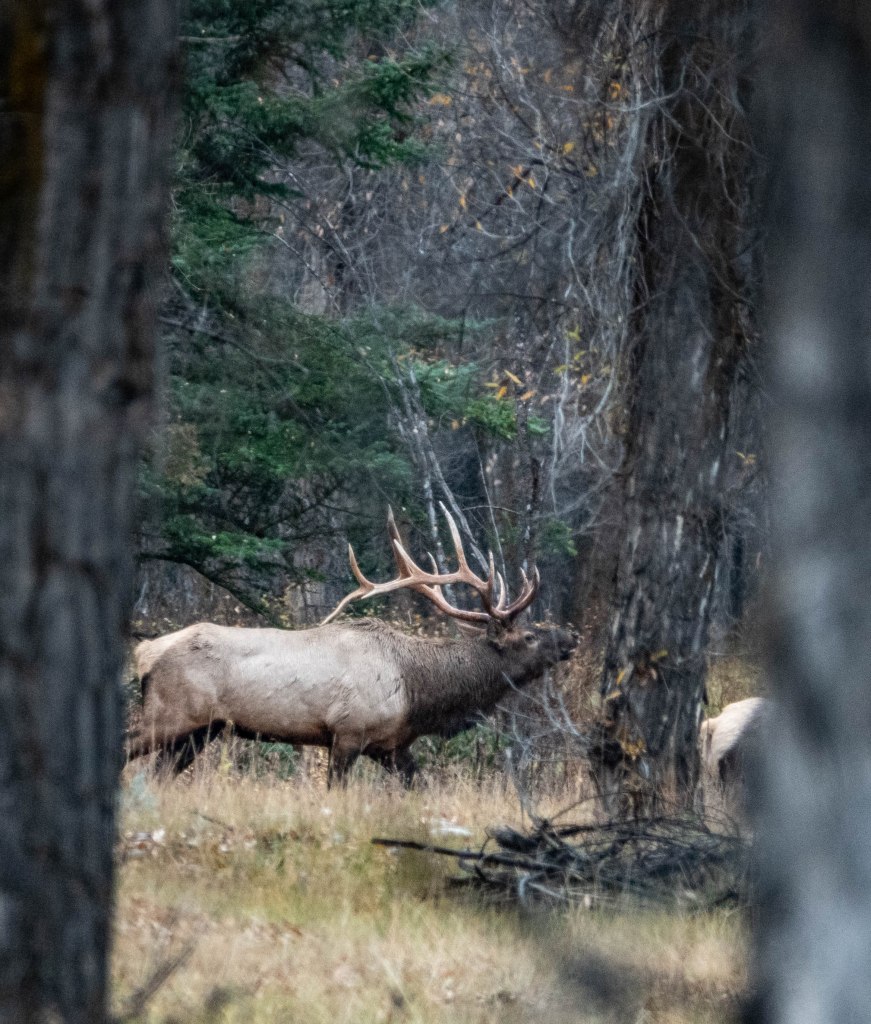
and this one, confronting a potential rival, has six:
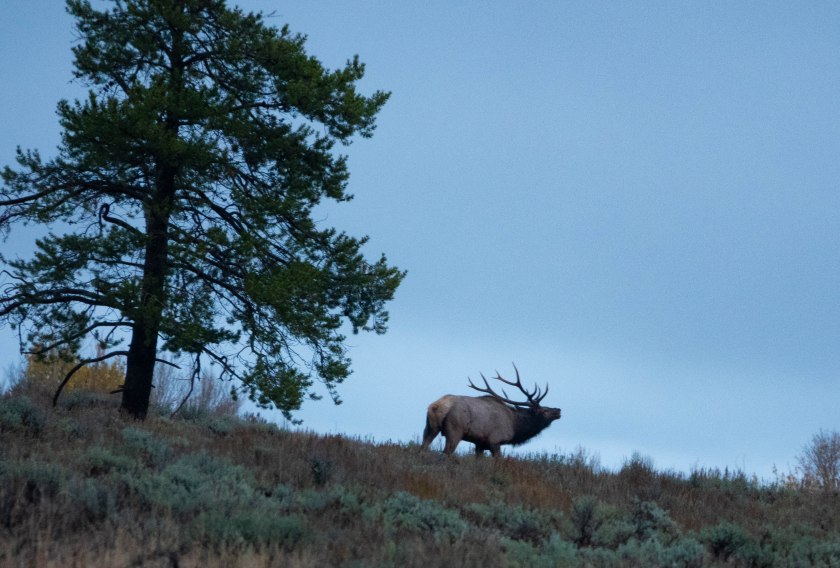
They don’t reach their maximum size for 9 1/2 years or so, and the record-holder had 14 points on each side. But most mature bulls are six-pointers, like my second photo above, and the one in this video, far off on a ridge and taken by Mark Byall through his spotting scope with his iPhone:
We will meet this bull again next time.
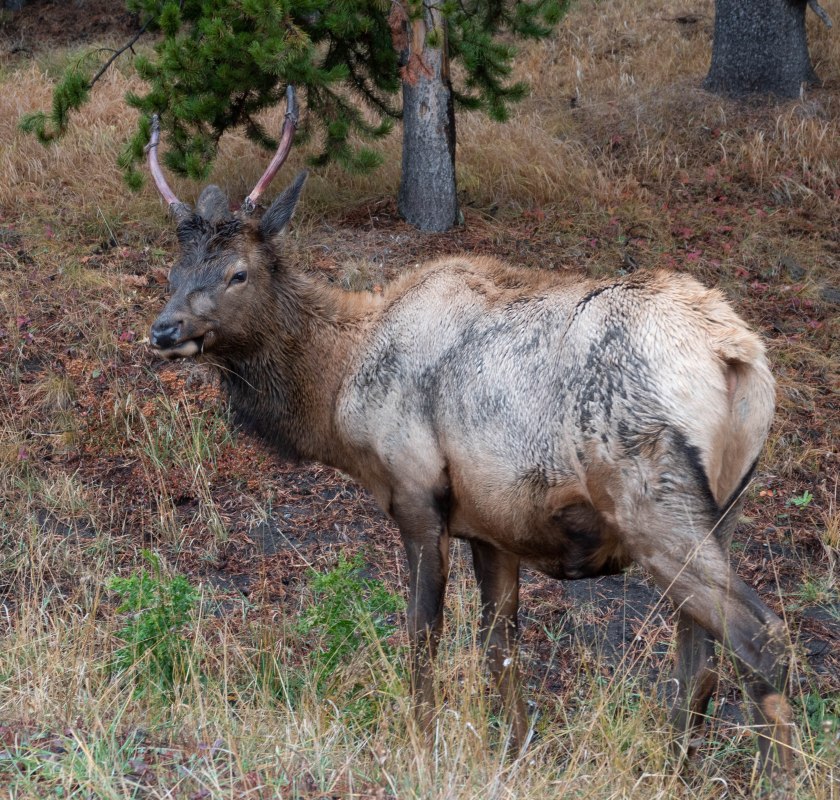
Young bulls are called spikes, for obvious reasons:
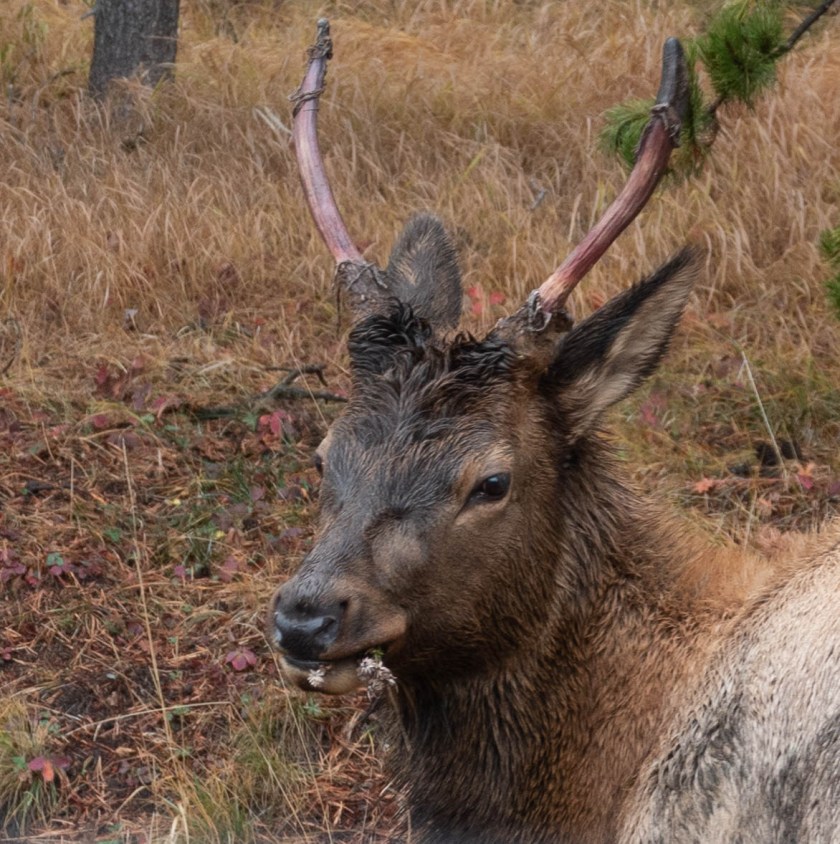
Look closely at his spikes:
They push out of the pedicles, and initially they are covered in a velvety membrane. He still has some attached to the tips of his miniature antlers. The velvet has a blood supply, and helps the antlers grow. Indeed, at this stage they will bleed if they are damaged.
This wonderful time-lapse video shows how antlers grow (it is a white-tailed deer, but the process is the same for elk, moose, or any antlered species):
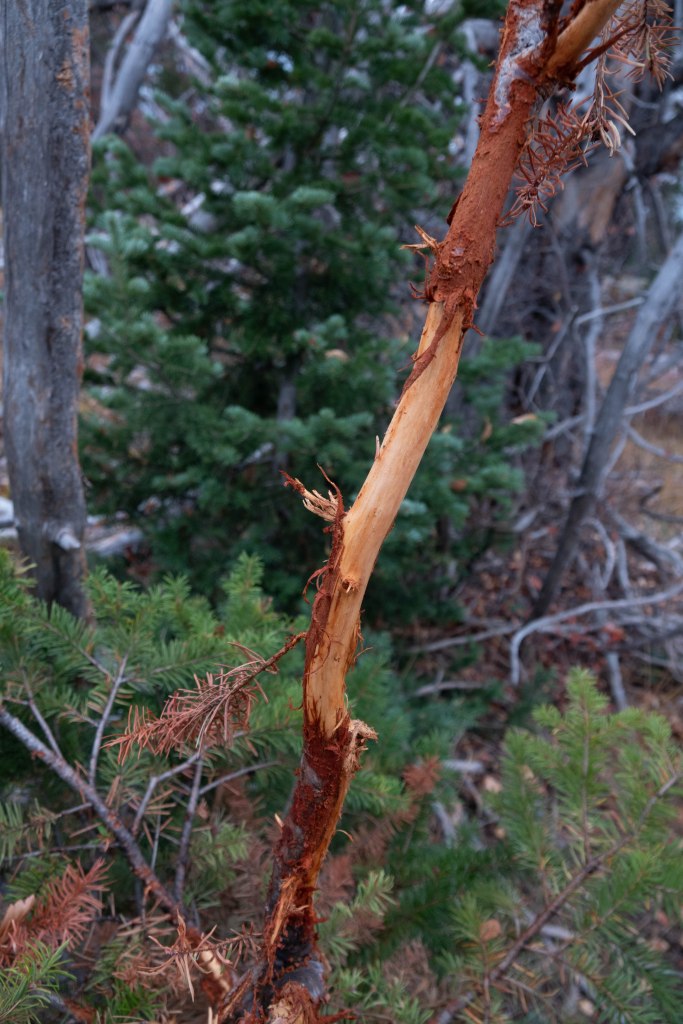
They rub the velvet off on a nearby tree, leaving a scrape behind:
elk scrape
After the mating season is over, they drop their antlers. This video shows an elk just after he has lost his antlers. I suppose it feels like losing a tooth (Is there an antler fairy, I wonder?). He still behaves like the alpha male, and at the end of the video you can see it feels itchy and strange to him.
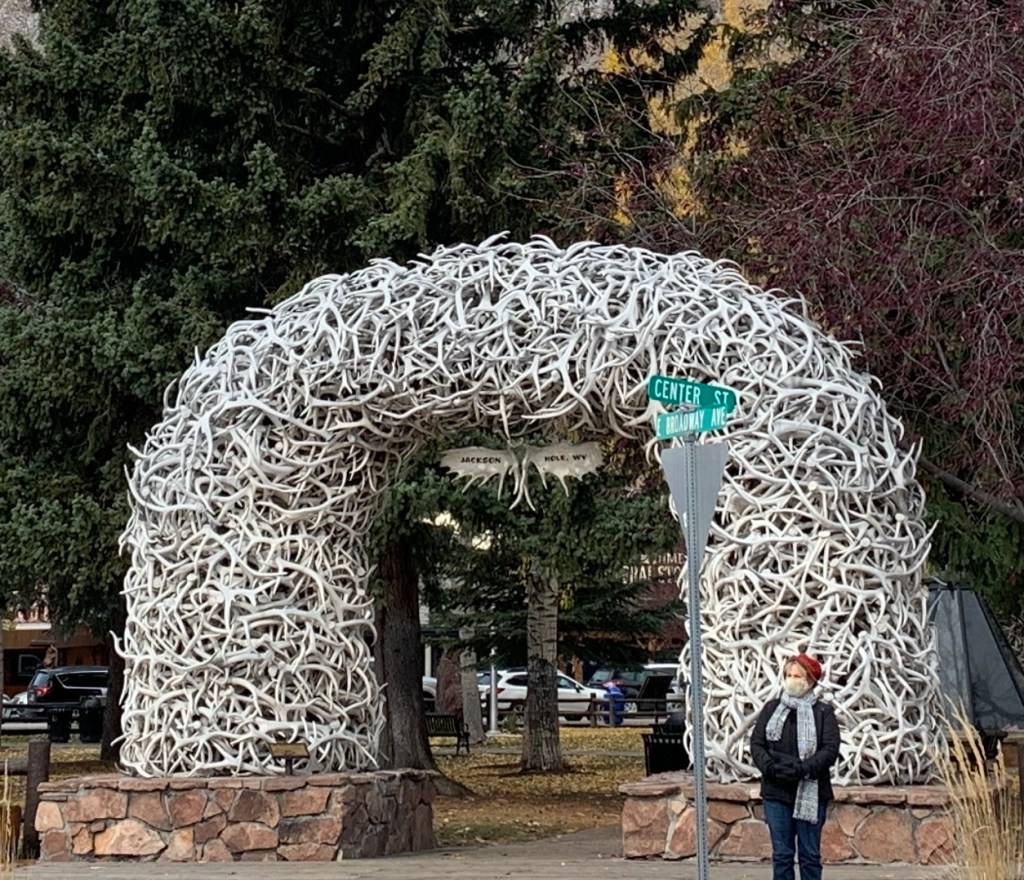
This arch in the town square in Jackson, Wyoming is made entirely of natural elk drops:
In Part 2 I will introduce you to the rest of the family, and an unexpected visitor.
* My title is grammatically justifiable since ‘elk’ can be plural as well as singular! ‘Quelques’ is the plural of the French for ‘some’ and can be pronounced [kelk] or [kelk-uhz]. And you try finding another rhyme for ‘elk’. The only other one is ‘whelk’.
[I’m in Yellowstone, looking for wolves, and on Sunday when I usually send you a post I will be in a Wifi-free zone, so I’ve pulled out a blog I composed earlier this year and stock-piled. If I see wolves, you will of course hear all about it in the fullness of time.]
It was a dreary cold gray day on the last day of May, even the birds had slept in, so I looked more closely at the understory. The alder bushes were garlanded with iridescent alder beetles:
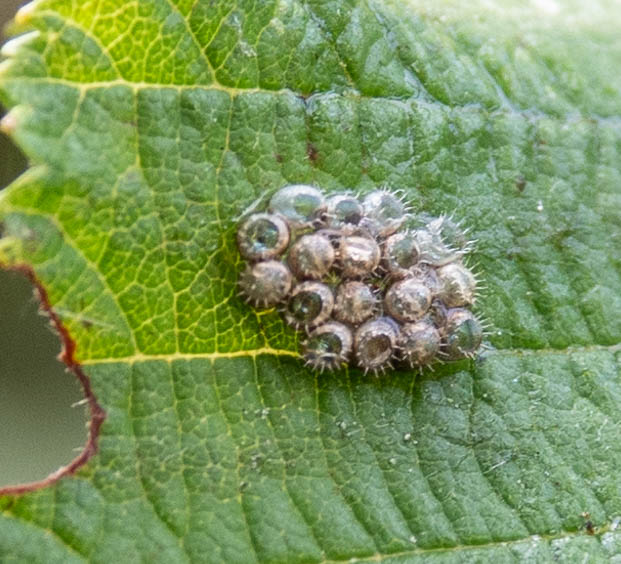
and on a lower leaf, an orderly matrix of tiny cylinders
with a halo of spikes like the crowns on miniature Statues of Liberty:
The spider that is eyeing them is either curious or hungry, but she is not the mother of these eggs. They are the eggs of an assassin bug, and this (a hundred feet away down by the brook) is roughly what they will grow up to be: a Pale Green Assassin Bug, Zelus luridus *, lurking on the flower spike of a False Hellebore.
Their front legs are coated with a sticky substance that helps them trap their prey.
He was lying in wait for an unwary mosquito or blackfly, or even this 3/8″ Band-winged Crane Fly, Epiphragma fasciapenne, sitting on a neighboring leaf:
Its intricate wings are too small to catch the eye in the field, but that’s why I take photos.
I watched the eggs for several weeks, and nothing seemed to change. Here they are three months later. It looks to me as though some have hatched, such as the ones at top right, but is hard to be certain.
*The eggs may be from a different species of assassin bug, I can’t be that precise.
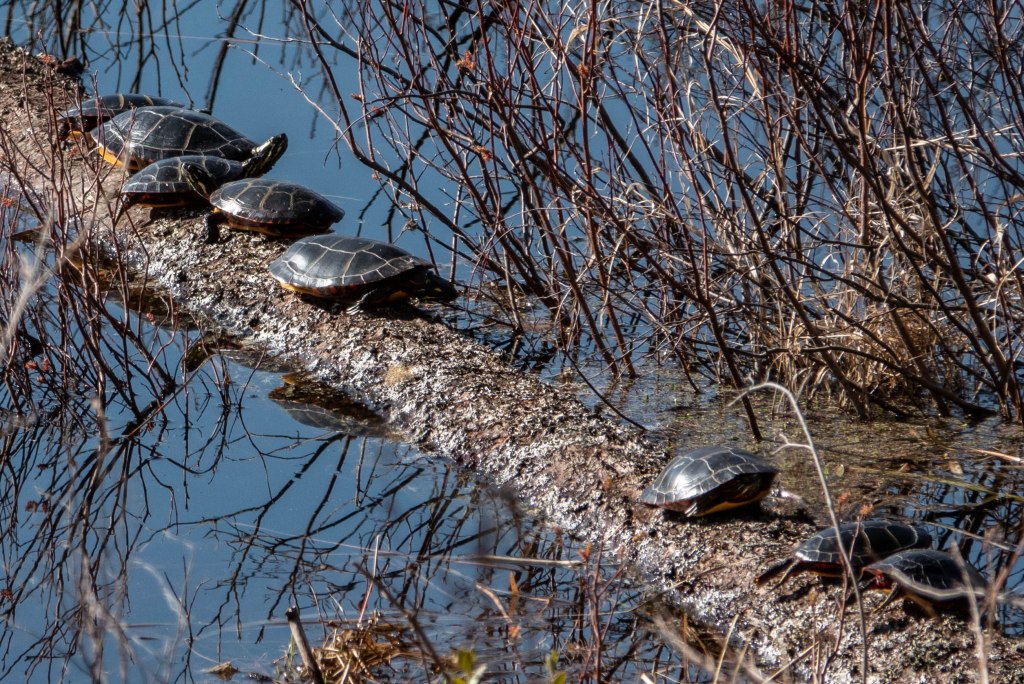
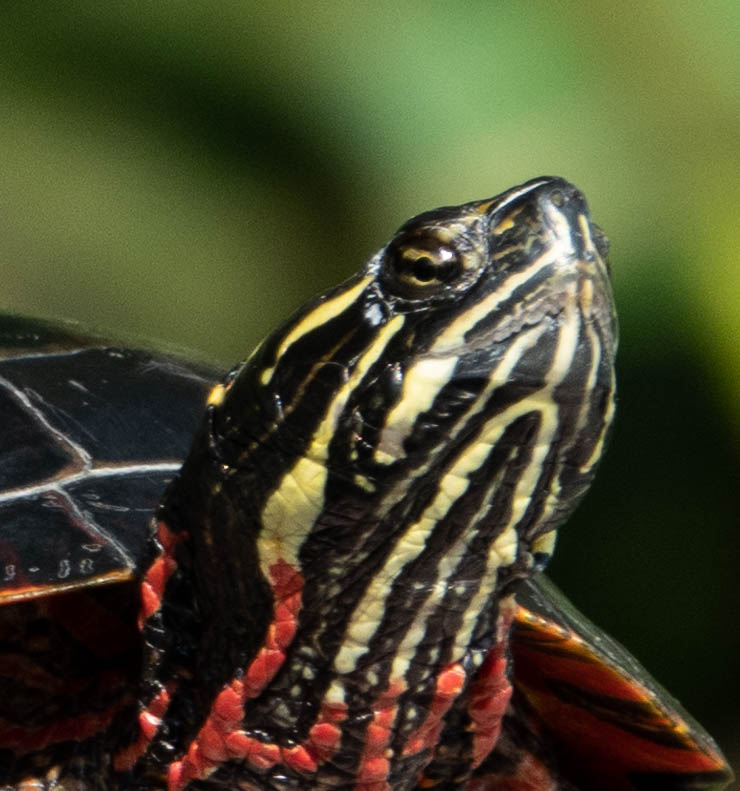
Painted turtles, Chrysemys picta, are perhaps the most-eye-catching creatures on my pond. They’re not rare: this spring there were eight on a log, basking:
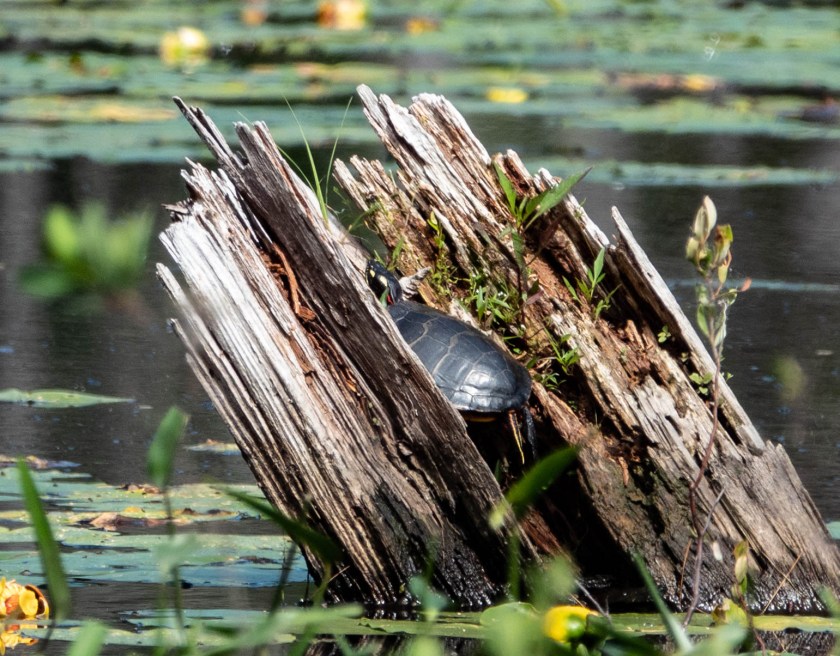
One got wedged in a rotted tree stump. I was all ready to rescue it next day, but it managed to extricate itself.
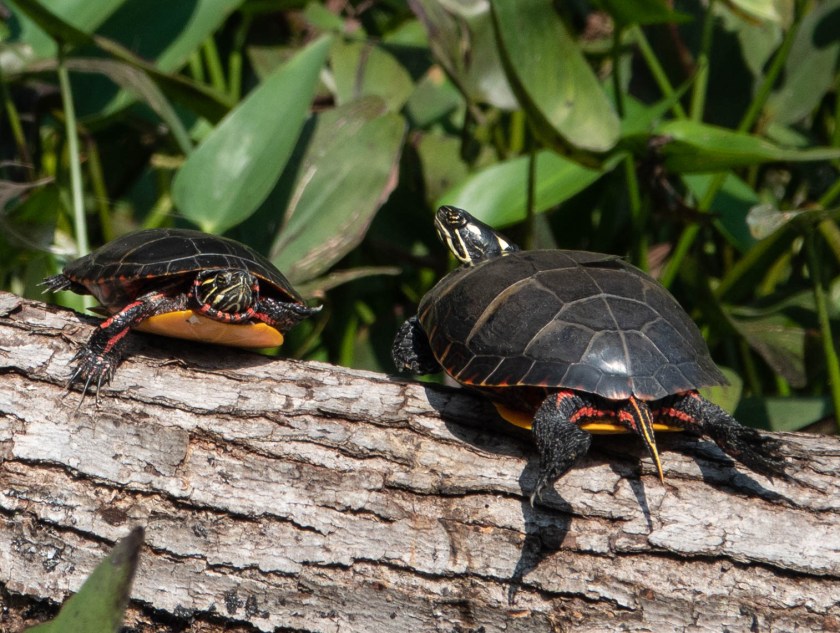
There were three on a fallen tree some weeks later.
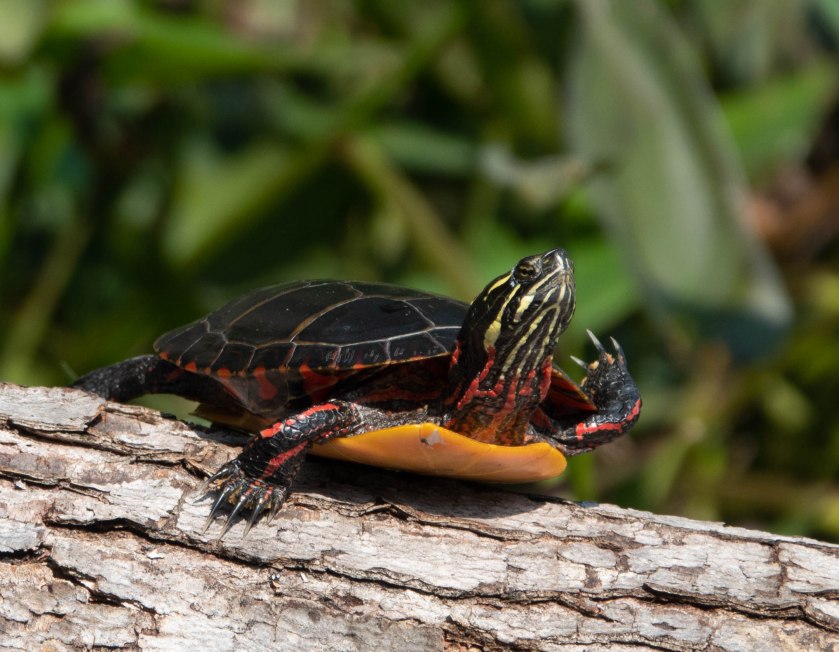
Two dived off when they saw my kayak but the smallest and youngest (and thus the most rash and least intimidated) let me get very close, so I can show you some details.
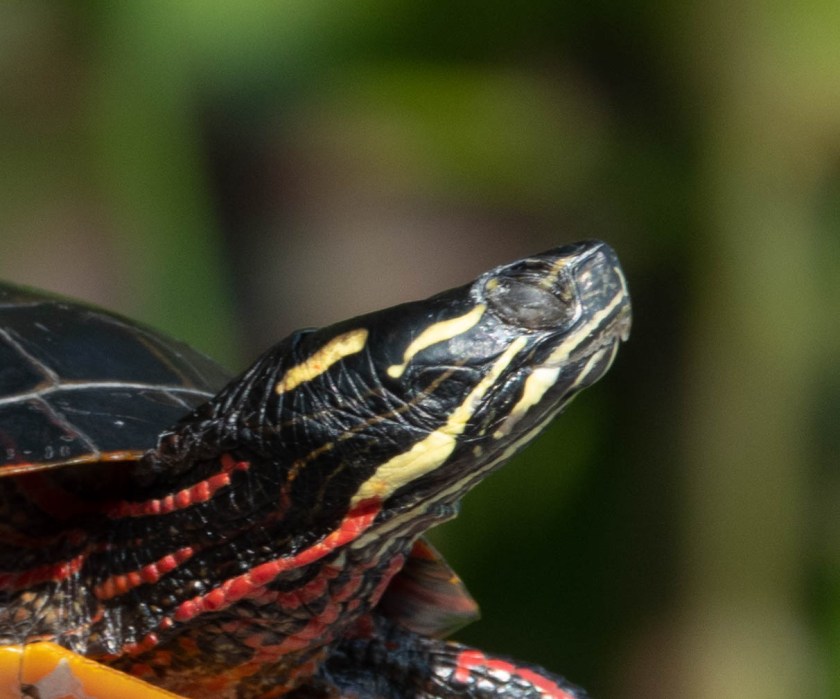
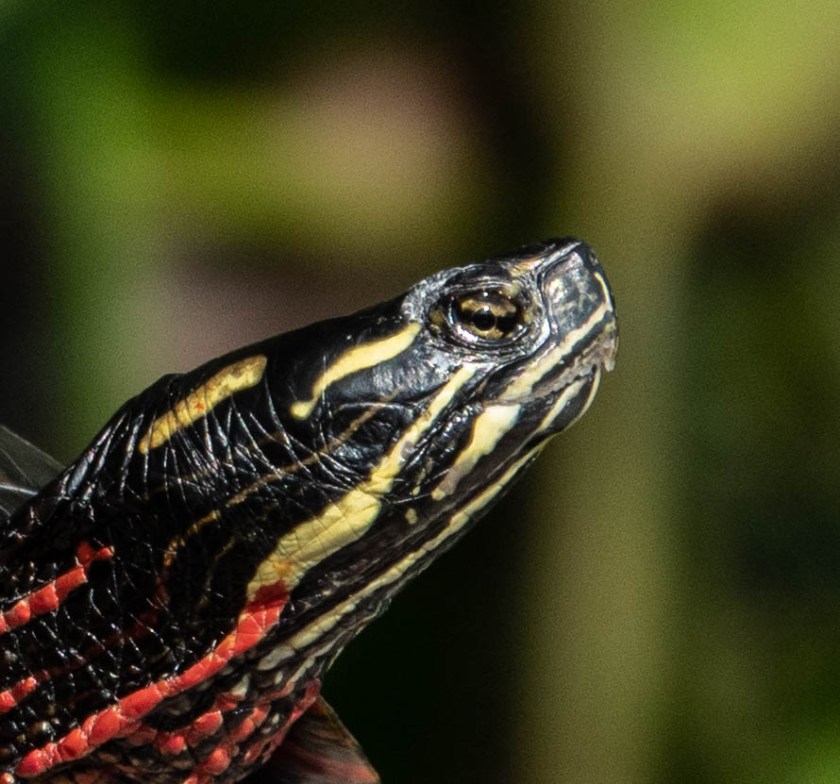
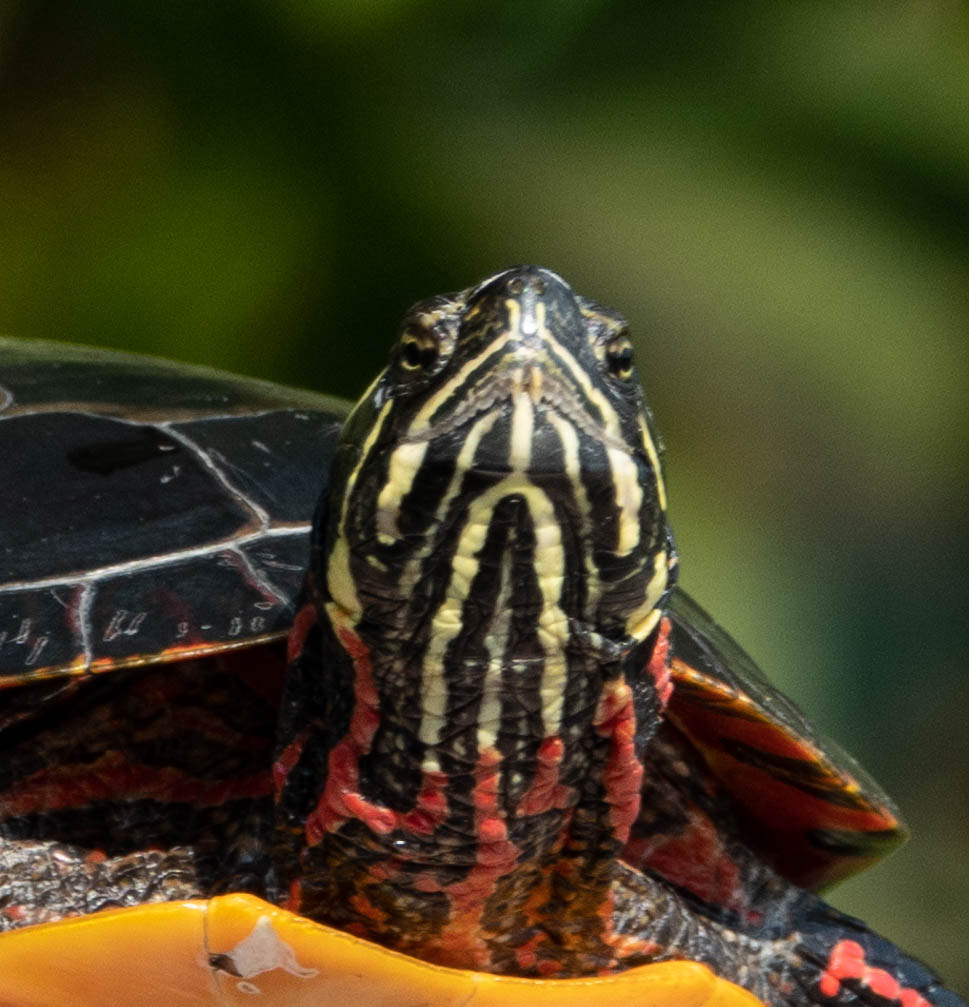
They have beautiful eyes,
with top and bottom eyelids, both closed in the next photo:
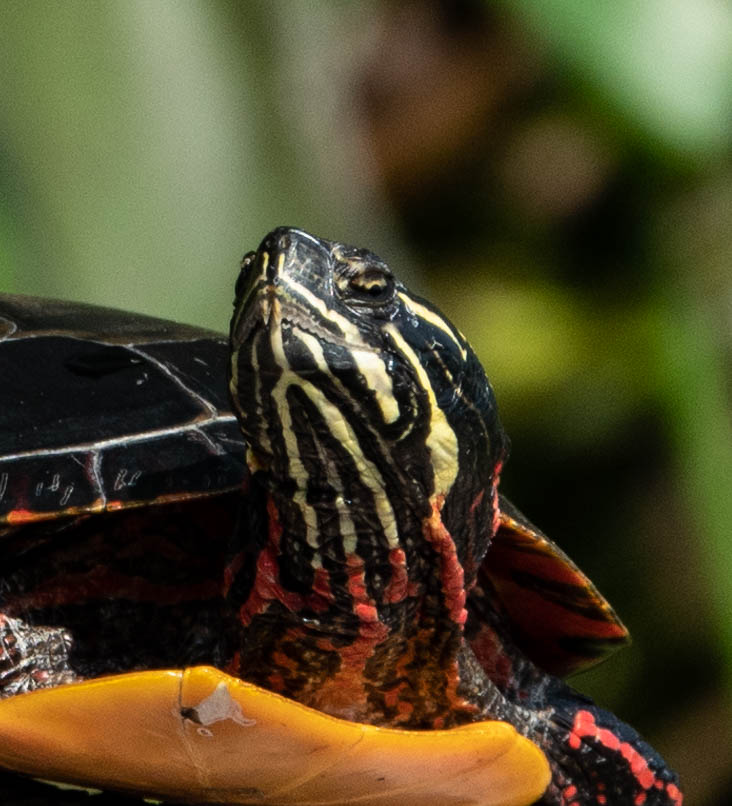
They don’t have teeth, but they do have ‘tomiodonts’ (my word of the week). Look at the center of the upper lip in the next two photos:
There are two bicuspid tooth-like things, with a notch in between.
Despite appearances, these are not teeth. Turtles have horny beaks made of keratin (think fingernails) that they use to grasp and crush food, and many species have a notch in the upper beak, flanked by two or even three tooth like tomiodonts. Their function is rather mysterious. Three explanations have been advanced. First, and most obviously, they may be useful in feeding, especially in immobilizing prey. Second, the fact that they are typically somewhat larger in males supports the idea that they may be used to immobilize the hapless females during mating. And third, they may be hangovers from some much much earlier ancestral species, and were perhaps just “spandrels”, in the sense of Stephen Jay Gould, by-products of some other evolutionarily-favored development.
And a parting wave goodbye!
PS If you’d like to know more, read Moldowan et al 2015. He was bitten by one, and it drew blood, so they are effective tools/weapons.
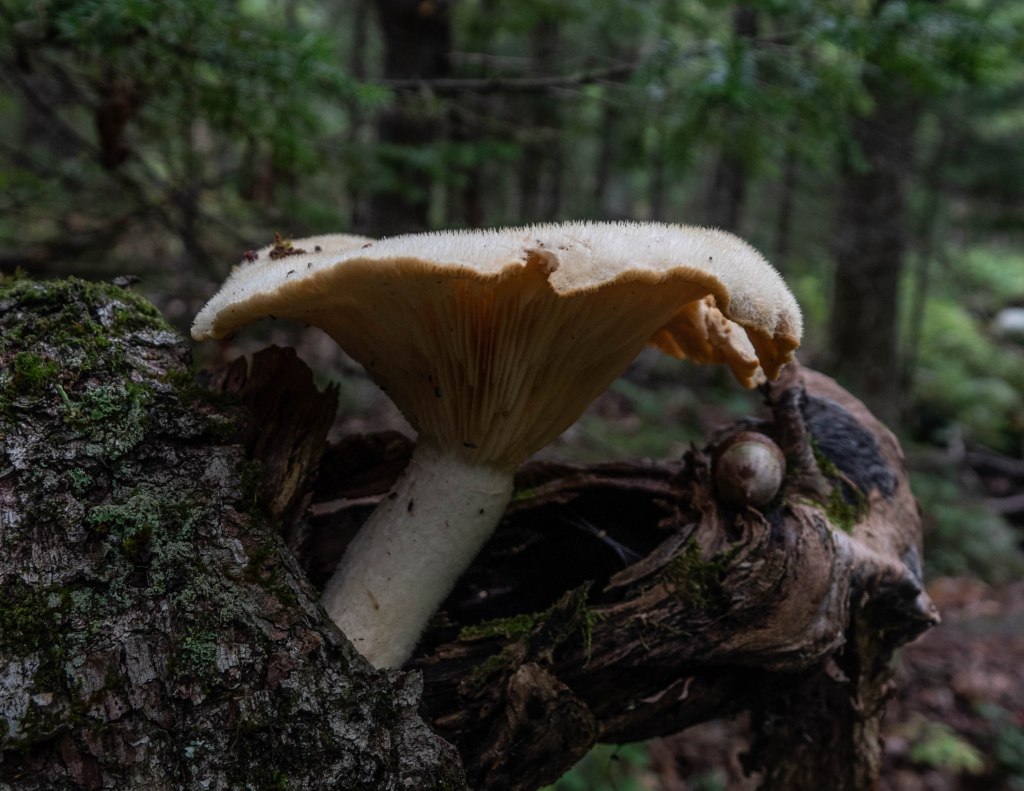
Sometimes I find myself wondering about a phenomenon so ordinary that I had taken it for granted all my life. Mushrooms always orient themselves so that the cap is horizontal, with the spore-producing surface pointing down.
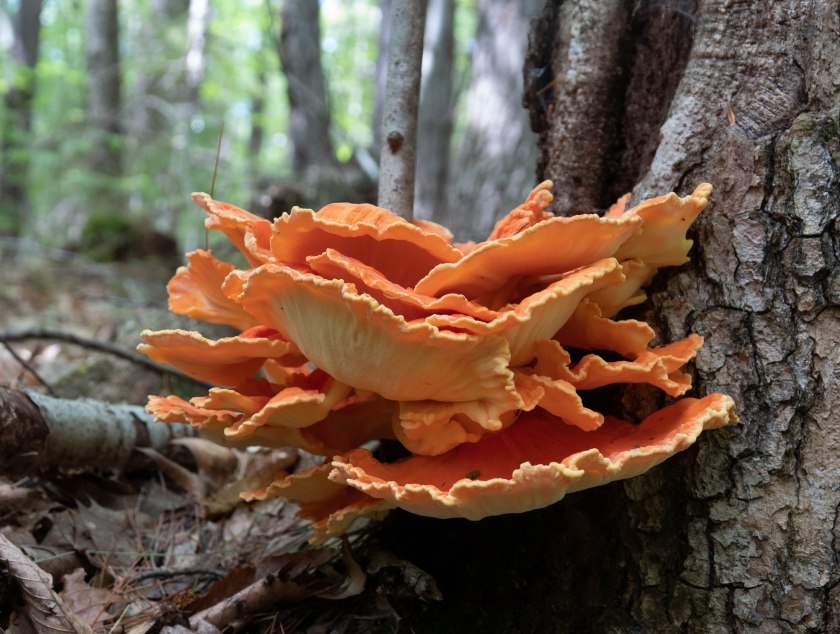
Chicken mushroom
Up to this point, I’m OK. I know that they disperse their spores by simply opening up the gills or tubes to let the spores fall down, and then the wind will catch them. And the upper surface acts to keep the spores dry, essential to their proper dispersal. But here is the question: how does the mushroom know which way is down.
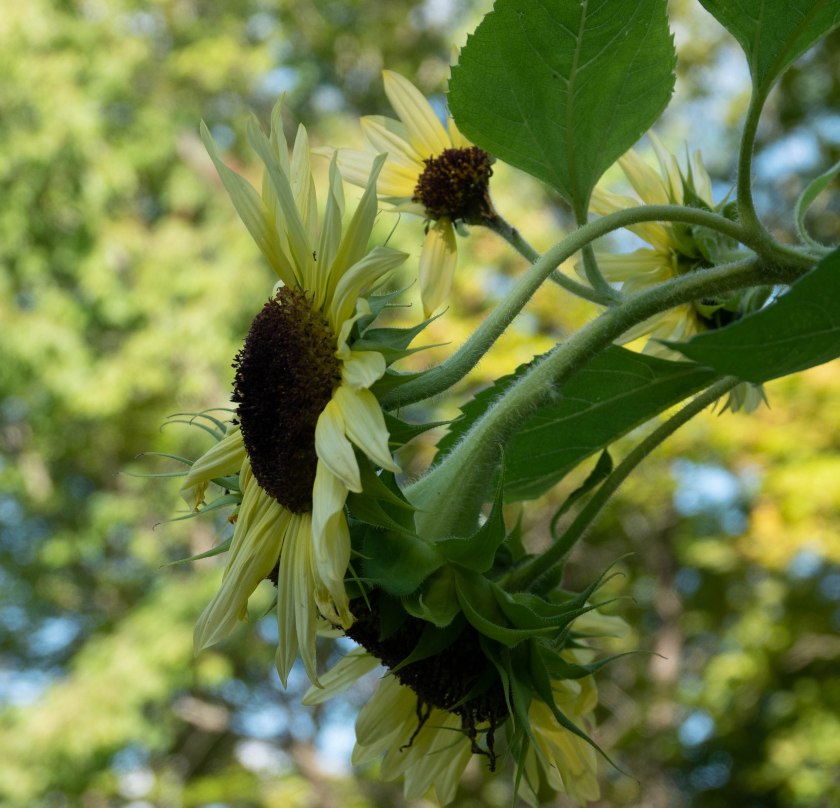
Perhaps it works like in plants. The stalk goes straight up, towards the sun, and the cap just ends up horizontal, at right-angles to the stalk?? But plants have a reason to reach for the sun, they need it to photosynthesize. If they grow in the shade, they may lean sideways towards the sun, and sunflowers turn their entire flower not upwards, but at an angle to face the sun. This one had fallen over in a storm, and contorted itself around back to the sun’s rays.
Mushrooms don’t do this. The cap just faces up and the gills down. And they can grow in very dark places (although some do in fact need light and react to it.)
The urge for the cap to face down is very strong. If the stalk emerges sideways to avoid a rock or a root, it will bend upwards as soon as it can, so that the cap faces down.
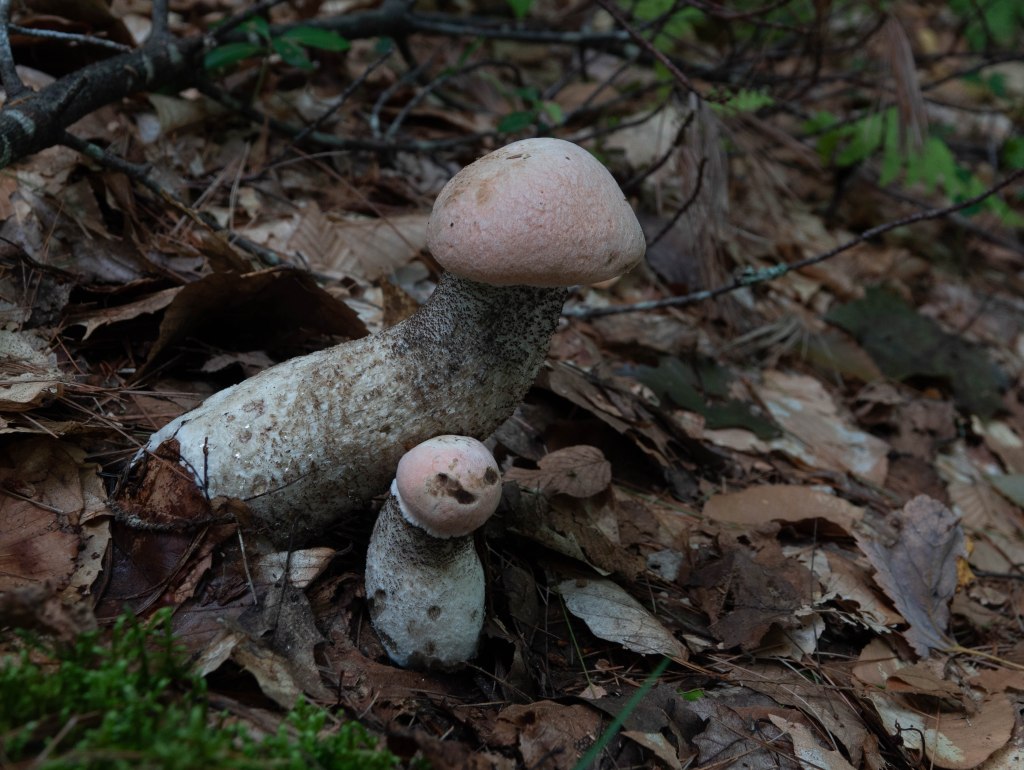
Sometimes the mushroom emerges straight, and then gets knocked over by a passing creature, like a beagle (!).
But the following day it has begun to compensate:
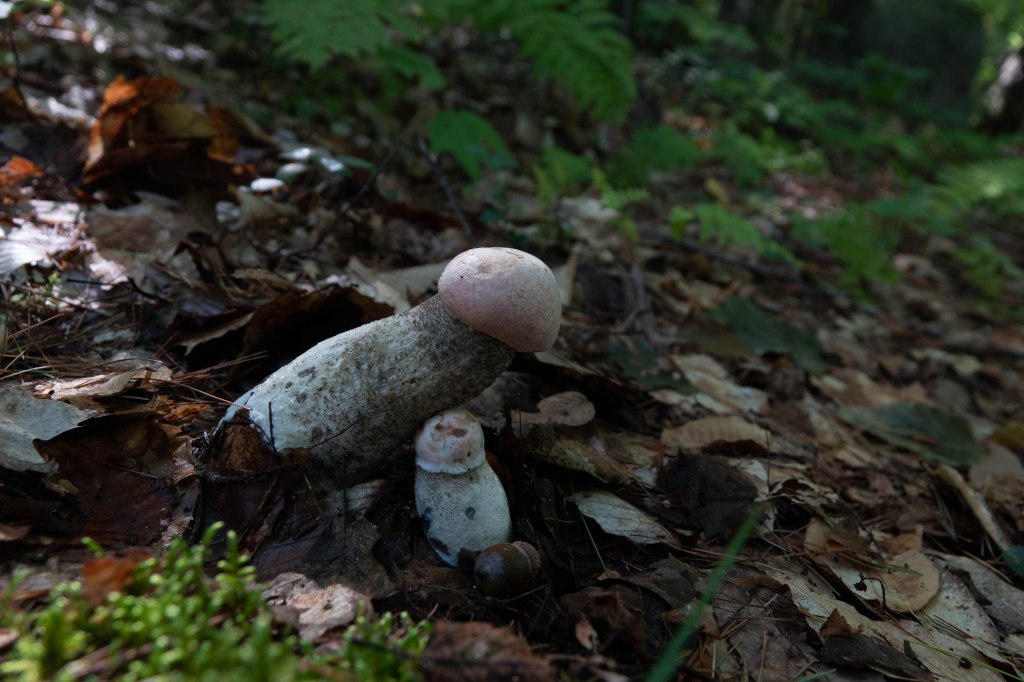
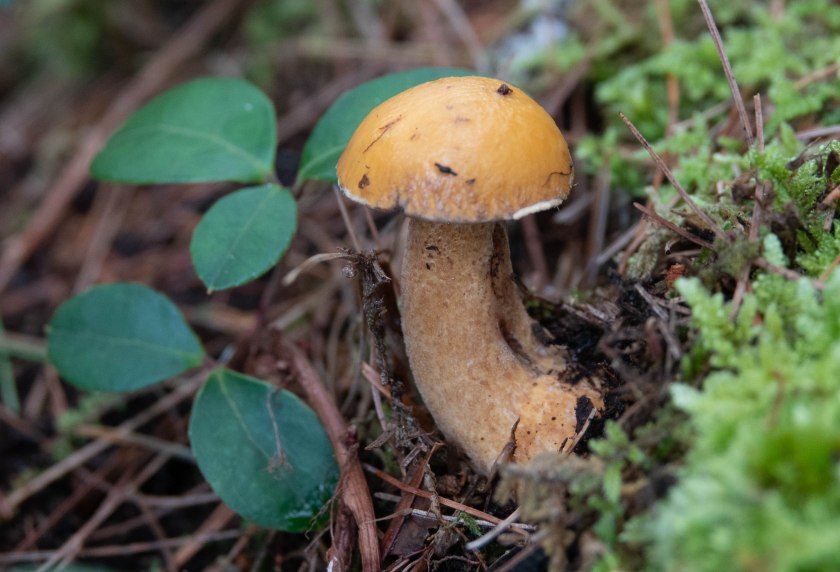
Leccinum sp.
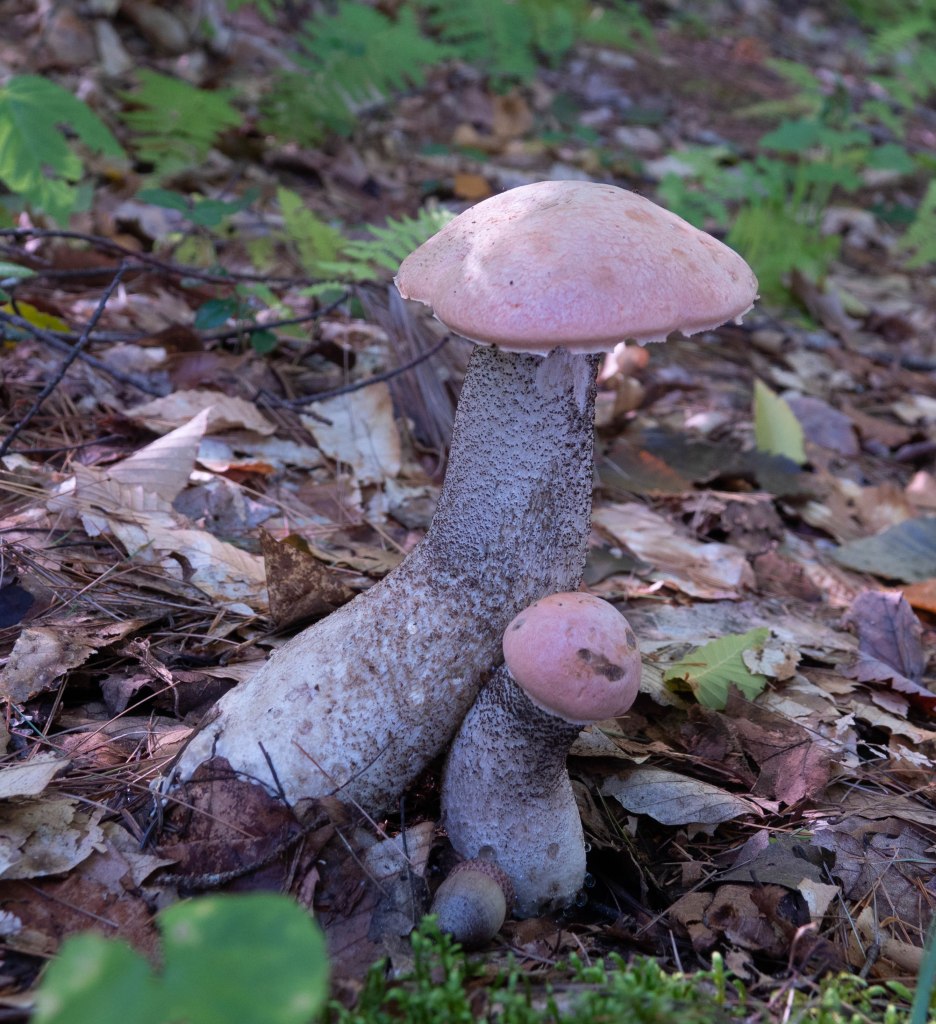
and in one more day it is splendidly resurgent:
This by the way is an 8 inch chunky bolete; there is an acorn at the base of the baby one, for scale.
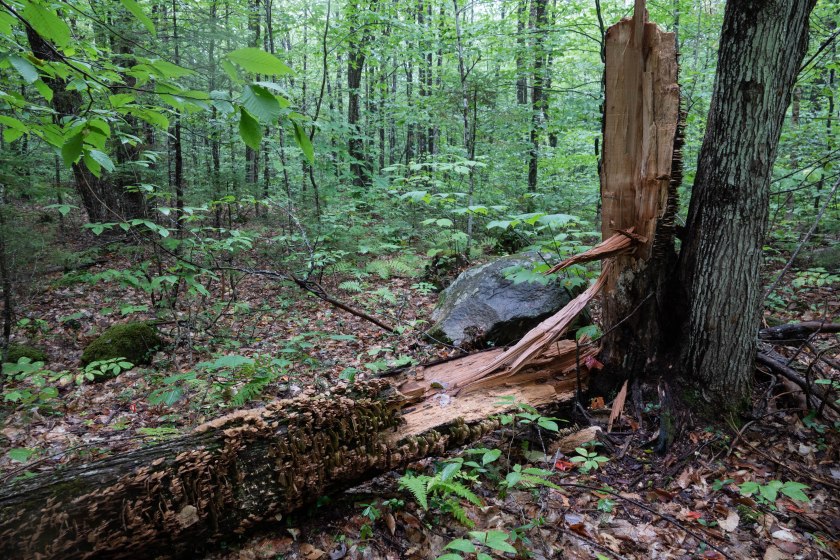
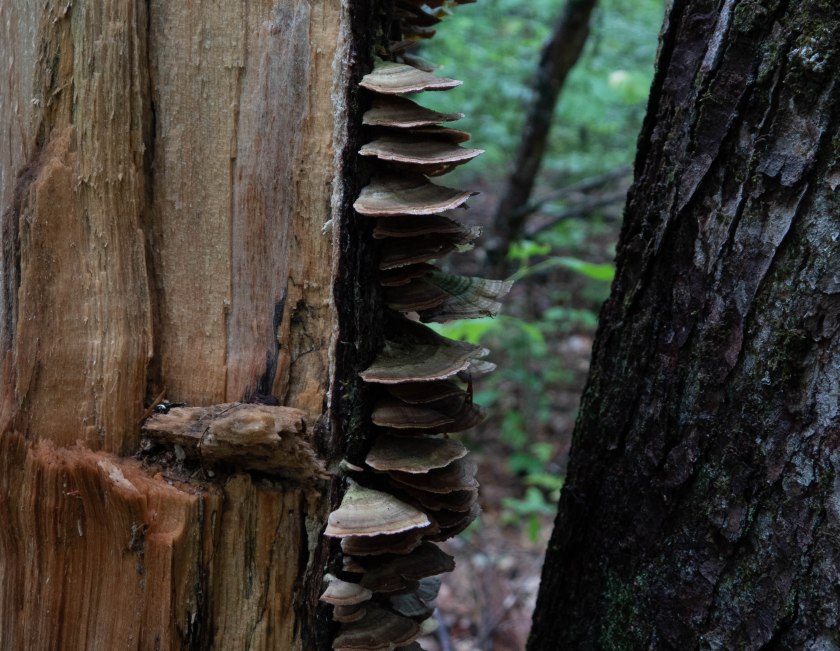
Bracket fungi, with no stalks, grow straight out of the tree at right-angles, like these polypores on the right edge of the still-standing remnant of the trunk below:
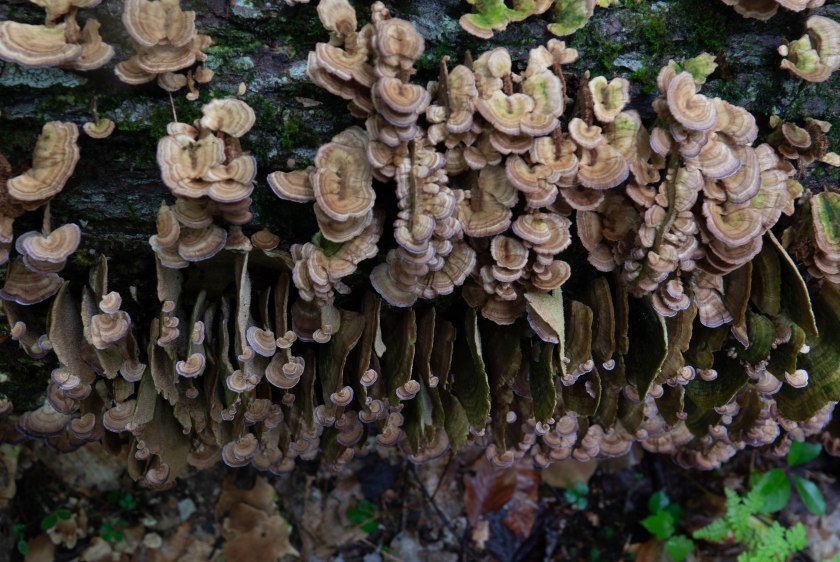
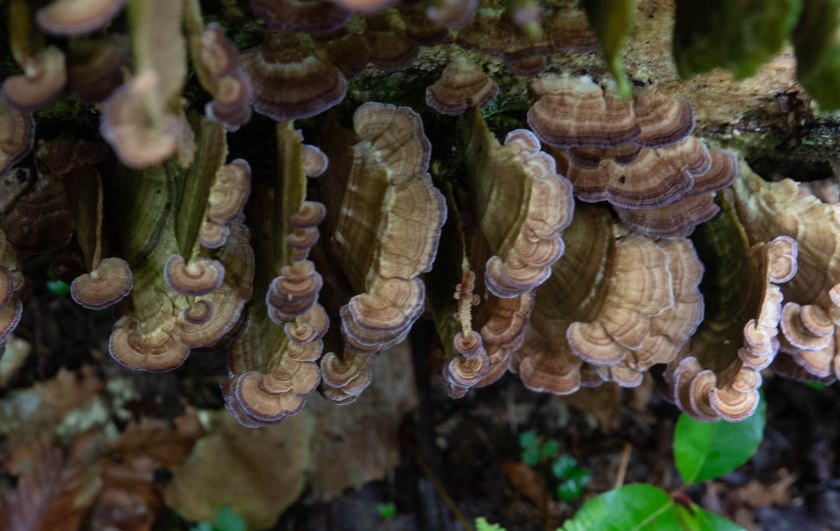
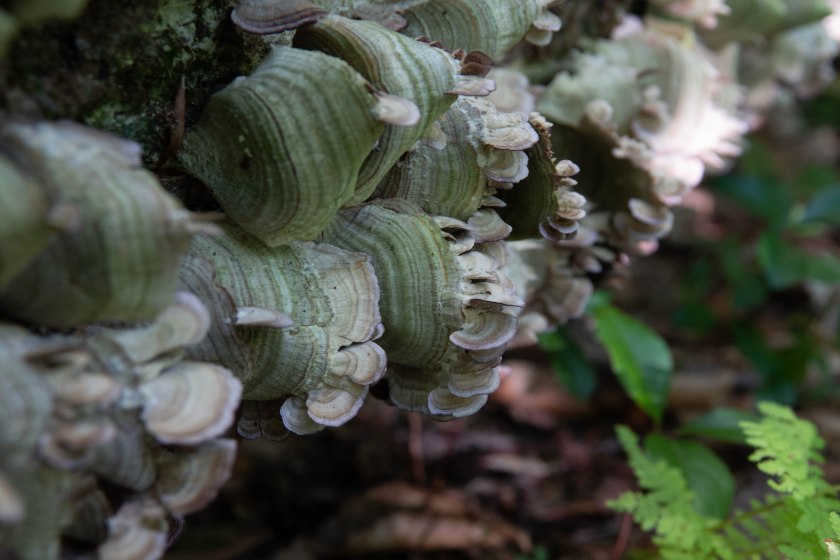
And when the tree falls, the new growth simply rotates itself through 90 degrees so it is facing down again. It’s a little hard to explain in photos, so I’ve given you three attempts below. In each image the old fungi that grew before the fall are vertical now, seen thin edge-0n, and the new ones are horizontal.
So how DO they do it?? Remarkably, it appears that they sense gravity. Just like us. Our ears contain tiny calcium beads called otoliths (‘ear stones’), which float around and brush against tiny hairs and thus remind us of which way is up. If they get loose, our sense of gravity goes wrong and we feel dizzy. It seems that fungal cells may have a similar way of sensing gravity, so they always know which way is down. The nuclei in each cell act a little like otoliths, and the whole fungus responds.
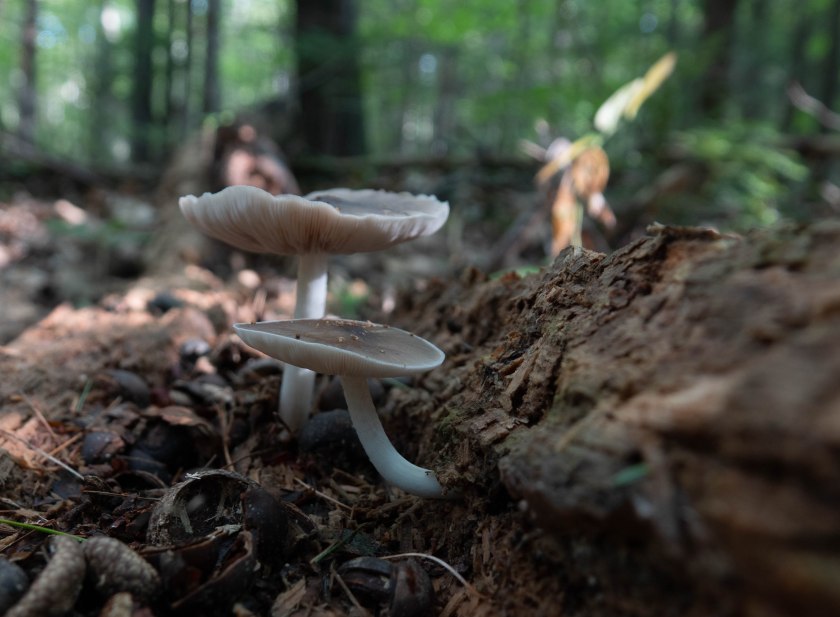
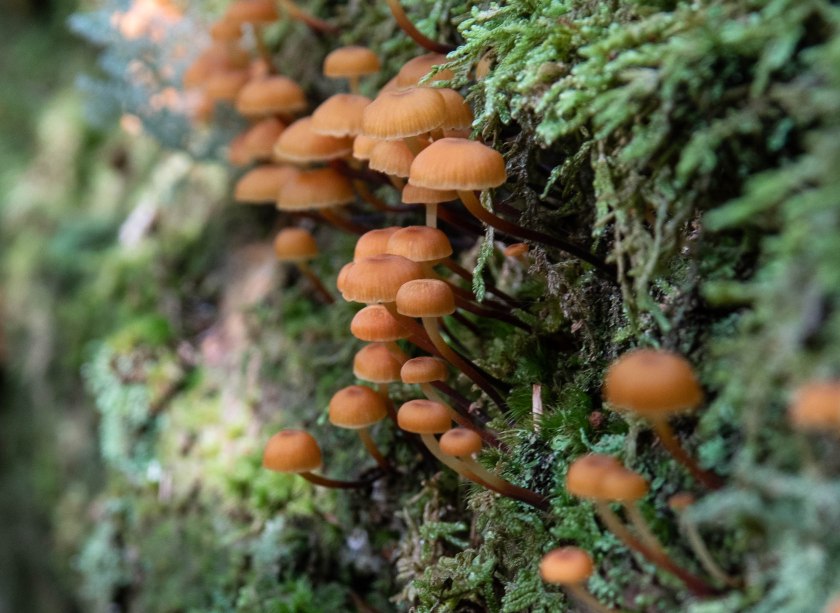
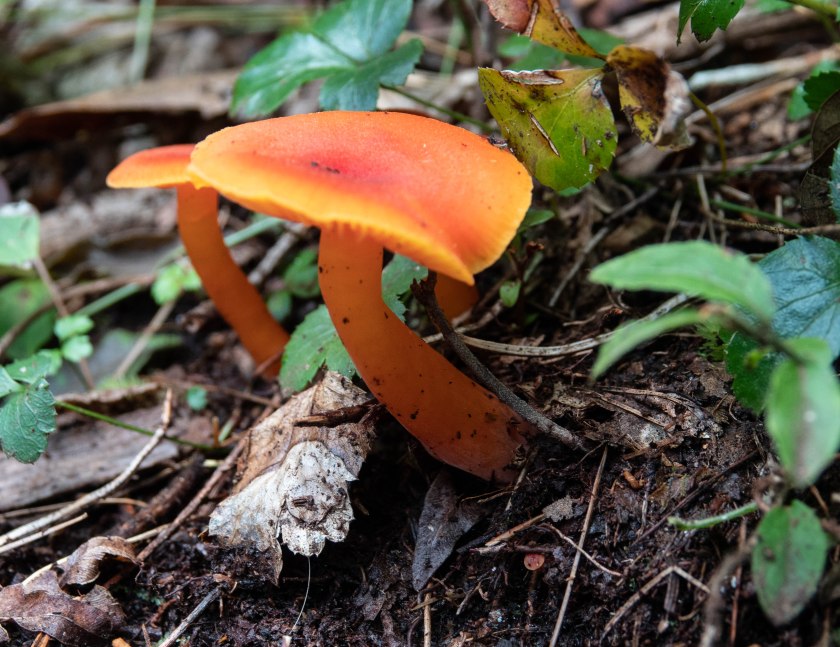
The phenomenon is called gravitropism*, and here are two more successful examples.
If you’d like to know more, here is an excellent article.
*The shelf mushrooms that restart new versions at right angles to the previous ones are technically examples not of gravitropism, but of gravimorphogenesis, since the original doesn’t reorient itself, only the new growth is sensitive to gravity.
PS Rather wonderfully, fungi have been taken into zero gravity in space to see how this affects them. Many of them not surprisingly get too confused to form proper fruiting bodies at all!





















 Eyes on the Wild