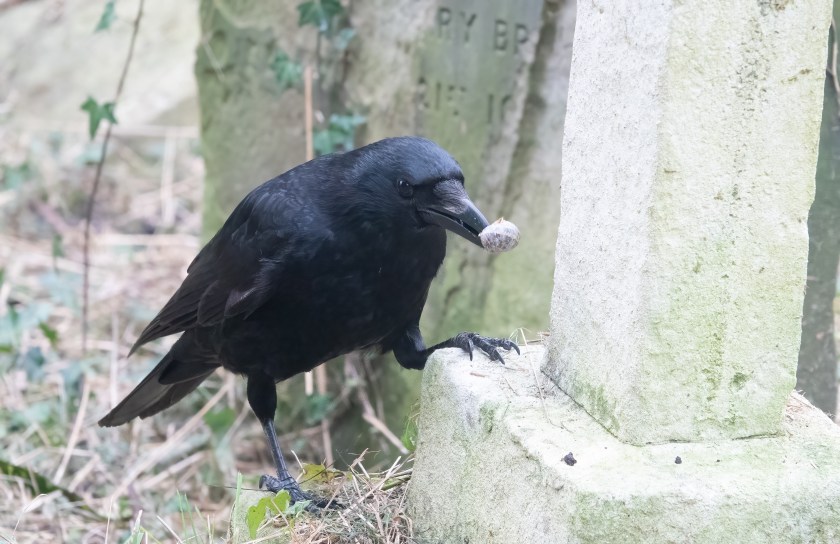
Sometimes very ordinary things catch my attention. The crows in Brompton Cemetery are not rare or exotic, and since they are scavengers we often find them mildly distasteful. But watch closely. This one found a snail:
He placed it on the raised base of a stone cross:
and got to work:
He held it down with his claws:
and stuck one half of his bill inside to reach the meat:
Here’s a short video of his technique:
It’s not easy getting a snail out of its shell, which survived the crow’s onslaught intact but empty:
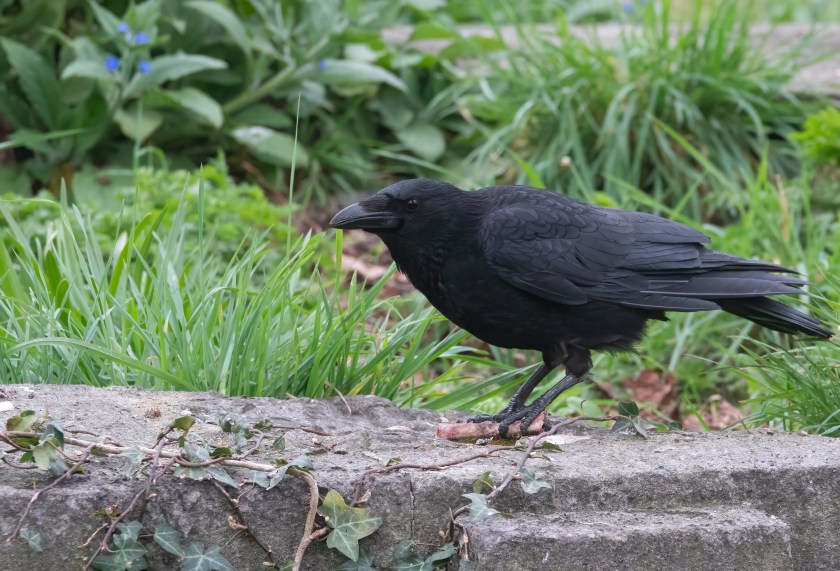
Meanwhile, another crow had stolen a chicken bone from some nearby KFC:
He picked fragments of meat off the outside, and stuck the tip of his upper bill inside to reach the marrow:
Another crow came close, so he carried it further off:
holding it down to foil any attempts at theft:
and eventually taking a flying leap with it in his bill, filmed in this short snippet.:
As you can see, a crow’s beak is a multi-purpose tool. Just for comparison, here is a bird with the shortest beak I know of, a Long-tailed Tit, Aegithalos caudatus, in Norfolk (UK) in March. The entire bird is less than 6″ long, and more than half of that is tail, so the beak is maybe 0.1″:
With that tiny beak it eats only minute insects. A snail’s shell would be impregnable.
So there is delight to be had in paying attention to the small humdrum creatures around us.
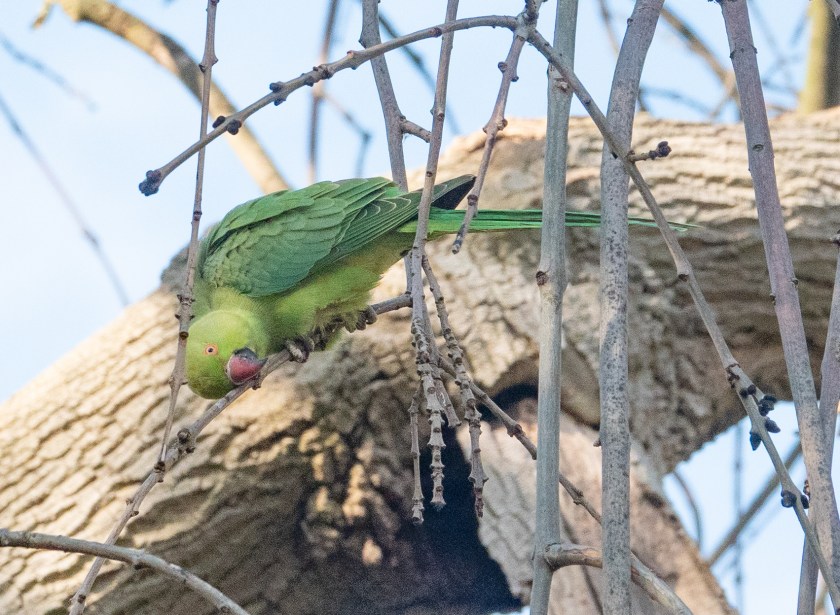
When I’m back in London, I go to various green spaces. One is Brompton Cemetery in Fulham, and this March the birds were nesting. The Ring-necked Parakeets, not native but long-since settled in the UK, had paired off:
and were looking for a suitable nesting hole:
I watched them for some time, as they investigated thoroughly:
but they were not ferrying in either nesting materials, or food.
They hung out in the nearby branches :
preened:
did their nails:
came and went to the hole
and defended it against interlopers:
But I don’t think they ever moved in; I checked out the same tree for several subsequent days and there were no further signs of life.
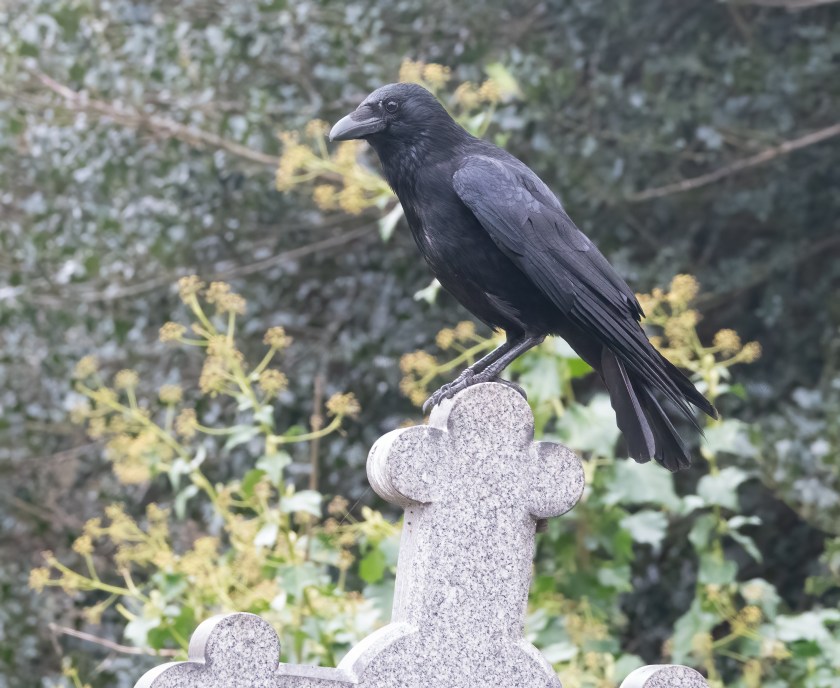
Meanwhile, there were crows everywhere. These are Carrion Crows, Corvus corone, a different species from the American Crow, very similar but a little larger and stockier.
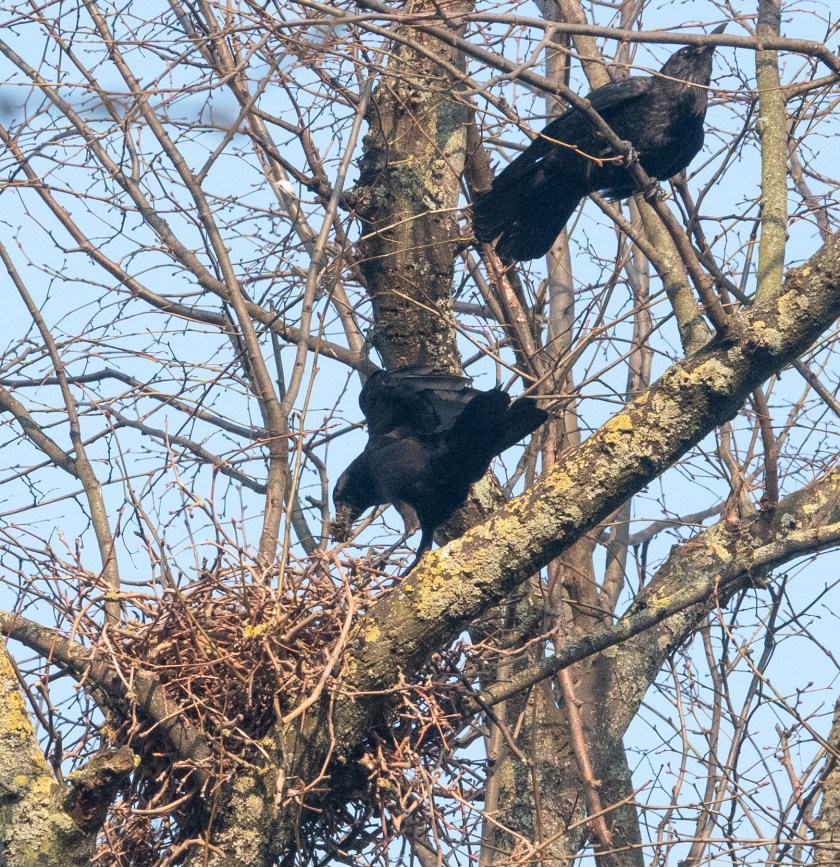
They are monogamous and mate for life. They build twiggy nests in the crowns of tall trees, and the nest building for these two was well advanced. The scaffolding is done, and the interior upholstery is being delivered:
and put into place:
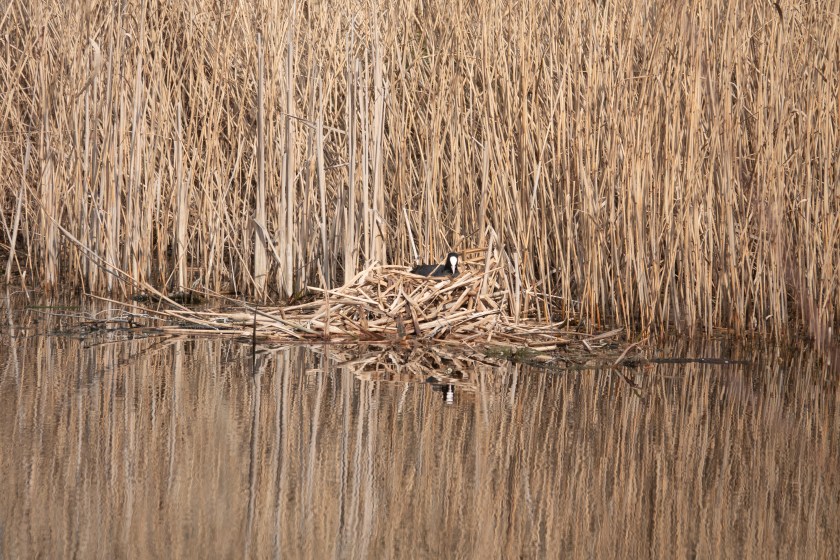
The following day, I went to another favorite place, the London Wetlands Centre, in Barnes. The coots were also in building mode, creating a low mound of reeds. This is the Eurasian Coot, Fulica atra, distinct from the American Coot.
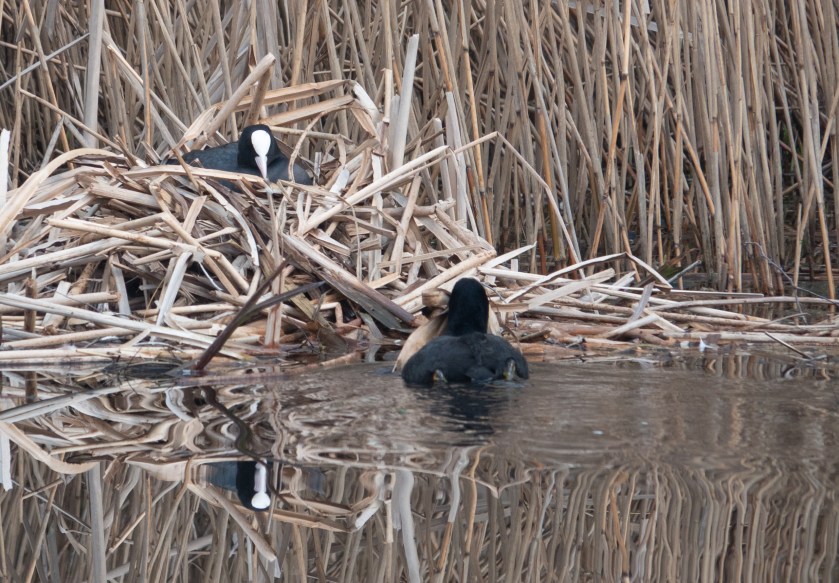
This nest is higher than most: maybe they are expecting flooding? It looked finished to me, and one bird seemed to be sitting on some eggs, turning them occasionally, but its mate was not yet satisfied, and went off on a mission:
It returned with additional reeds:
which it carefully handed over:
Mission complete:
But apparently more were needed, because he went foraging for a second load, so I videoed his return. (Being adaptable birds, they’re happily nesting right under the flight path into Heathrow, but I’ve left the sound track in because between planes you can hear one calling for a delivery.)
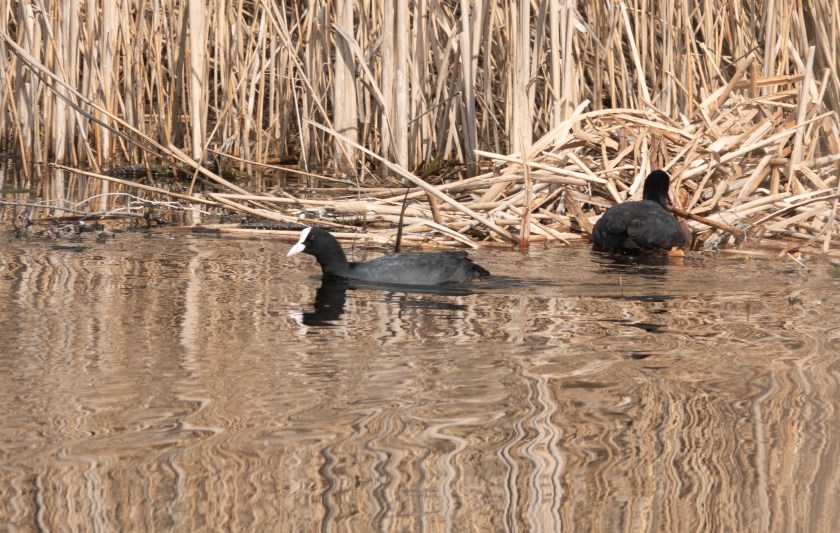
I have carefully referred to neither bird as he/she, because it turns out they share responsibilities for incubating the eggs. I can confirm this because I watched the handover:
‘
And the eggs have a new guardian.
*My title is a line from the poem “Crows in Spring” by the English poet John Clare (1793-1864).
[In March I spent a couple of weeks in England visiting family and friends. I’ll do two or three posts about what I saw there.]
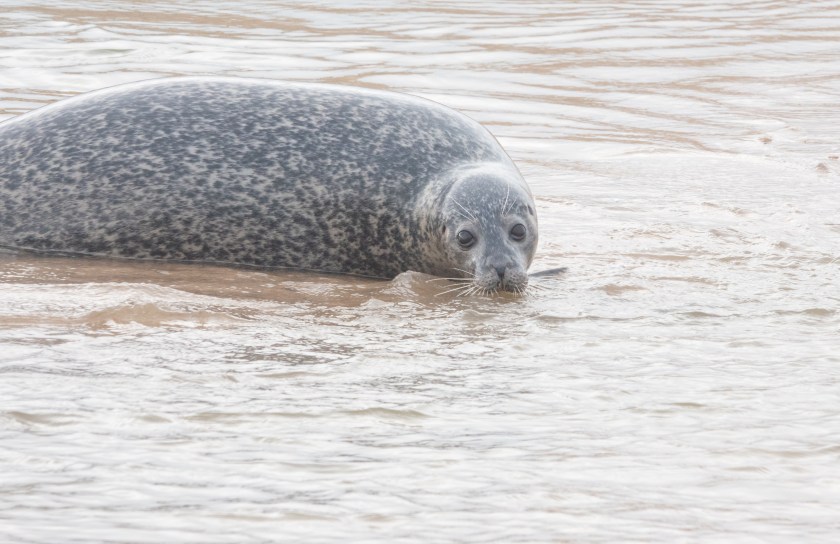
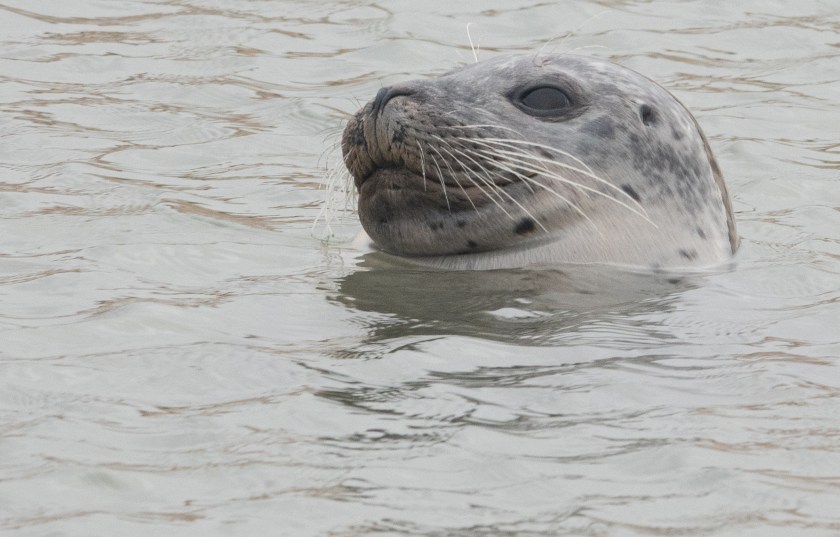
The common seal, aka the harbor seal, Phoca vitulina, lives along the temperate and Arctic coastlines of the Northern Hemisphere, in both Europe and North America. There are several colonies on the east coast of England, including a small one near friends of mine in Norfolk, where we stayed in March. And they are not hard to see up close. You just walk along a broad sandy beach for a mile or so, to where a small river opens into the North Sea, and there they are, asleep on the shore:
or doing nothing much of anything in the shallow water.
Like many sea mammals, they are adapted to underwater life. I went down a rabbit-hole of curiosity about how they sense their world, so this post is heavy on information and rather dull grey photos! What follows is mainly based on an excellent summary in Hanke and Reichmuth 2022.
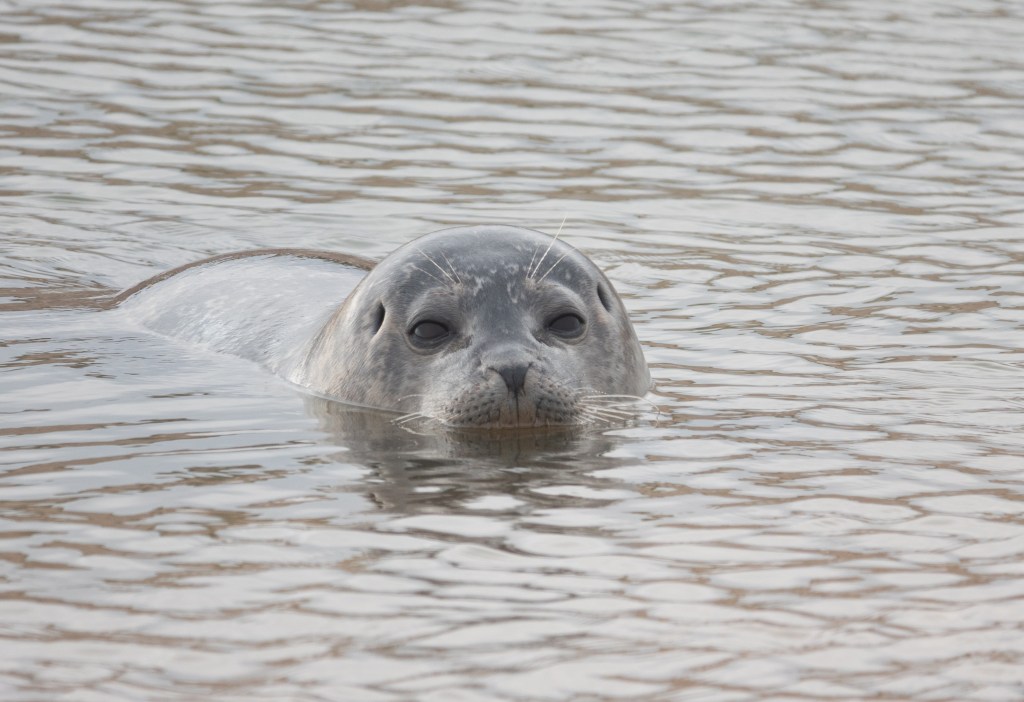
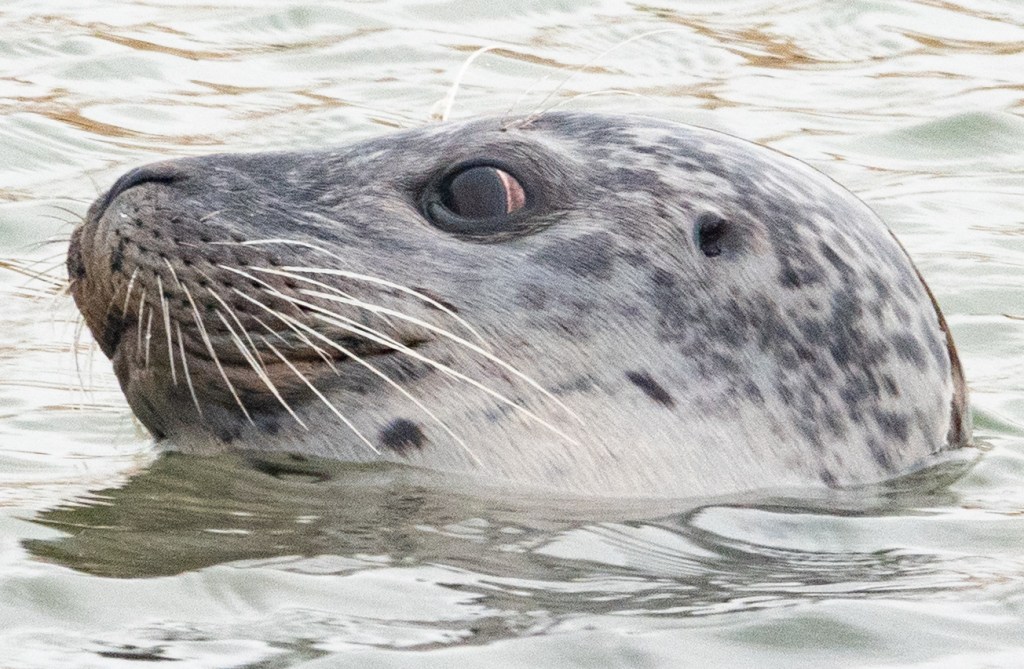
I’ll start with smell, then hearing, vision, and touch. Unlike us, they can close off their nostrils, and also their ears. In this first photo the seal’s nostrils, and also its ears (the little holes behind the eyes) are open:
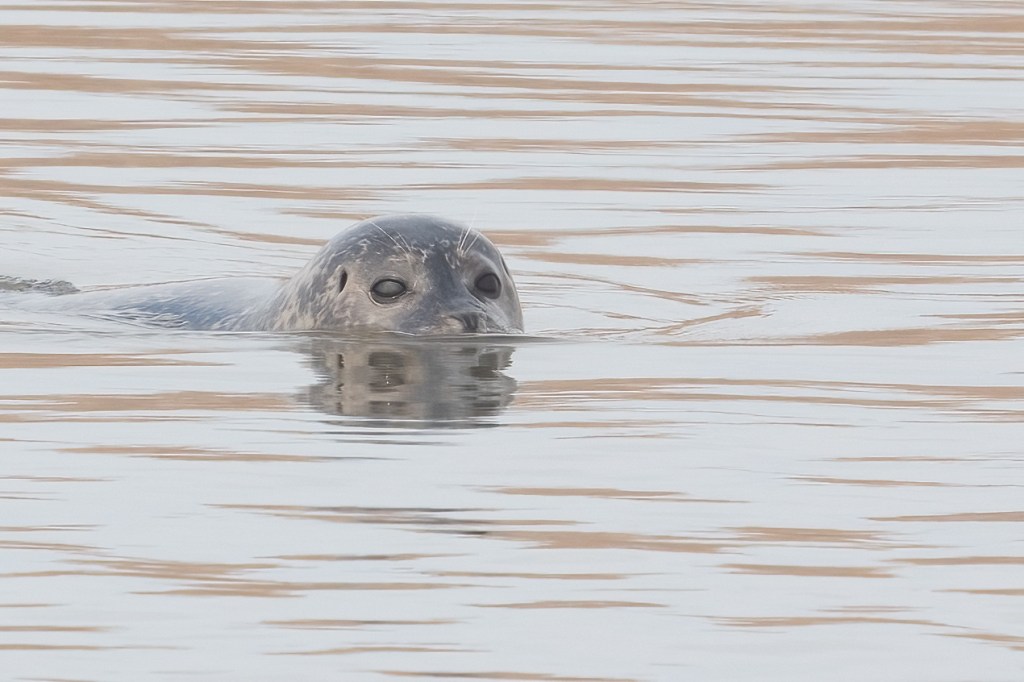
In the second photo, its ears are still open, but its nostrils are closed:
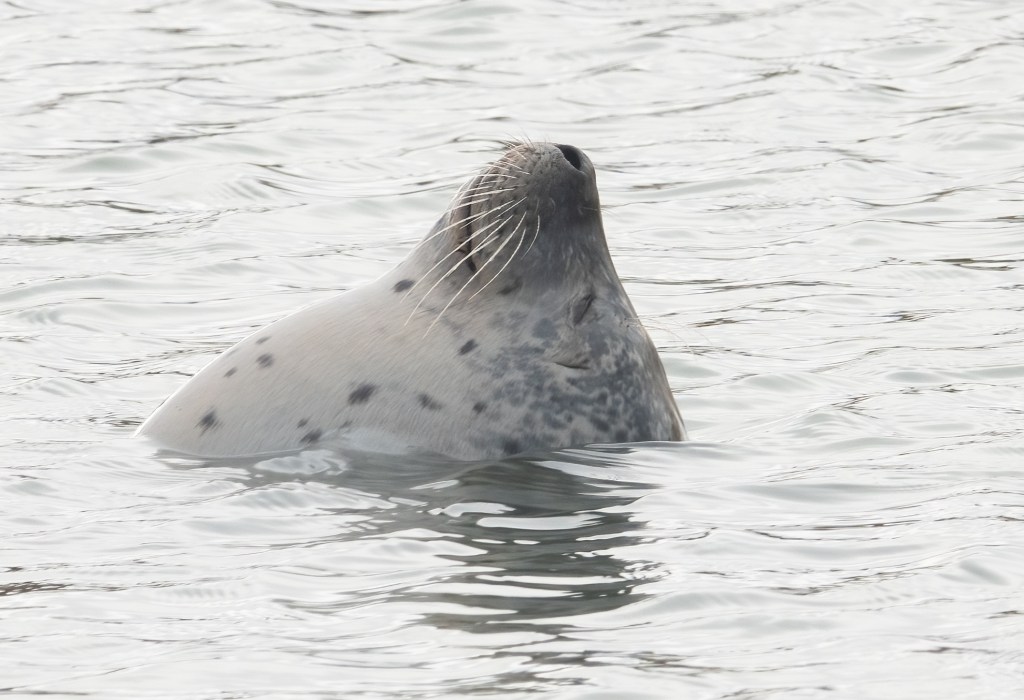
We have to hold our noses when we jump, into the water to get the same effect. Their sense of smell has been little studied, but there is reason to think they use it above water, but presumably not below, given the closed nostrils when they dive.
To show you the closed ears is harder, but in this shot both eyes and ears are closed; the eye slits are roughly vertical, and the ear slits are just below the eyes, roughly horizontal.
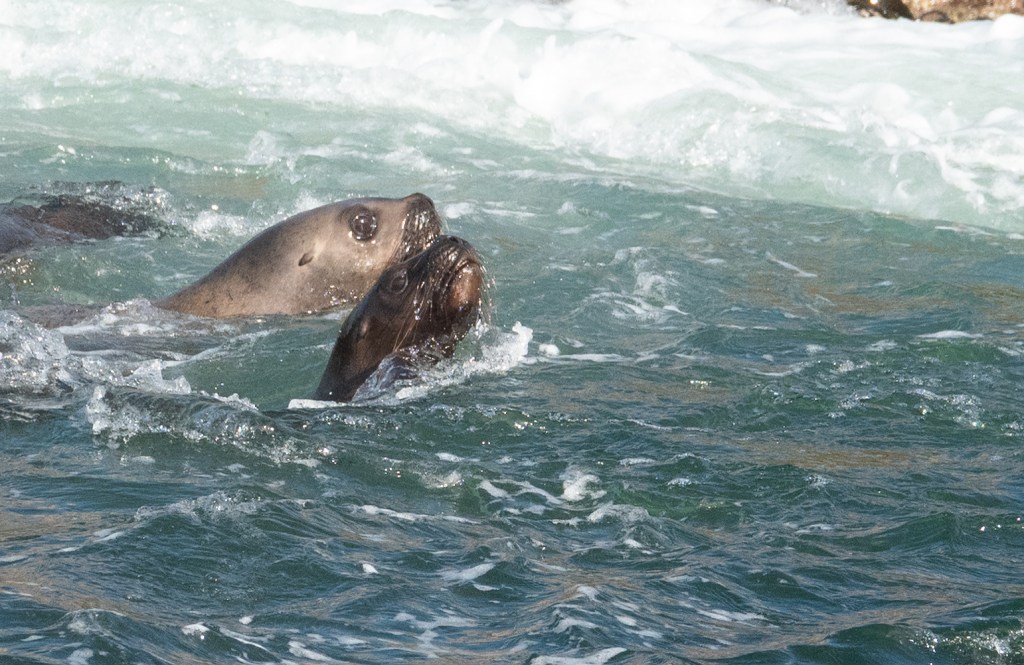
Unlike sealions their ears have no external flap (or pinna), making them more streamlined. Here is a sealion’s ear for comparison, notice the tiny backward facing flap, which can be sealed when diving:
Even though seals close their ears as they dive, their underwater hearing is excellent, better than that of another set of (semi-) aquatic mammals, the sea otters. Presumably this is achieved through their bones and body tissues, straight to the inner ear. Their aerial hearing on the other hand is worse than that of sea otters, and also worse than that of true land carnivores. (Ghoul and Reichmuth 2014)
Their eyes are adapted for seeing clearly both in air and in water. Their cornea has a special flattened front surface, which allows for the same refractive index in air and in water. To boost the light signal in dark conditions, they have a reflective layer behind the retina called the tapetum lucidum that amplifies the light. They must also deal with big light variation, so their pupils can dilate in murky water by a factor of 70 (compared to our human ones, which only change by a factor of four), and shrink in bright light to the size of a pin, and thus invisible in the photo below:
But what my grandchildren would call their “super-power” comes from their whiskers, or vibrissae, up to 100 on their noses and more elsewhere. In addition to exploring the world through touch, these can sense both the dramatic vortex currents caused by a suddenly fleeing fish, and the subtle waves created by a breathing but otherwise motionless flatfish.
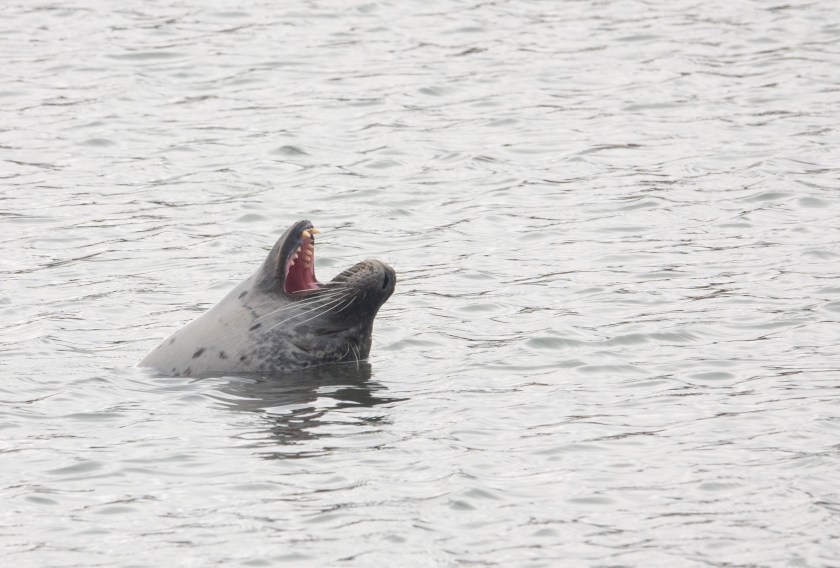
When they yawn, their teeth are impressive , giving them a good grip on a fish, and the ability to crunch it up, bones and all.
One last adaptation. Although their front feet are webbed for swimming, unlike sealions they have protruding claws that can be used to hold fish: (Hocking et al 2018).
They sleep on the sand, but they also sleep in the water, vertically, in a stance called “bottling”, which I found quite charming:
They’re soothing to watch, positively soporific on land or in the shallows. They often lounge around in a sort of banana stance:
This one was disturbed by an approaching smaller seal:
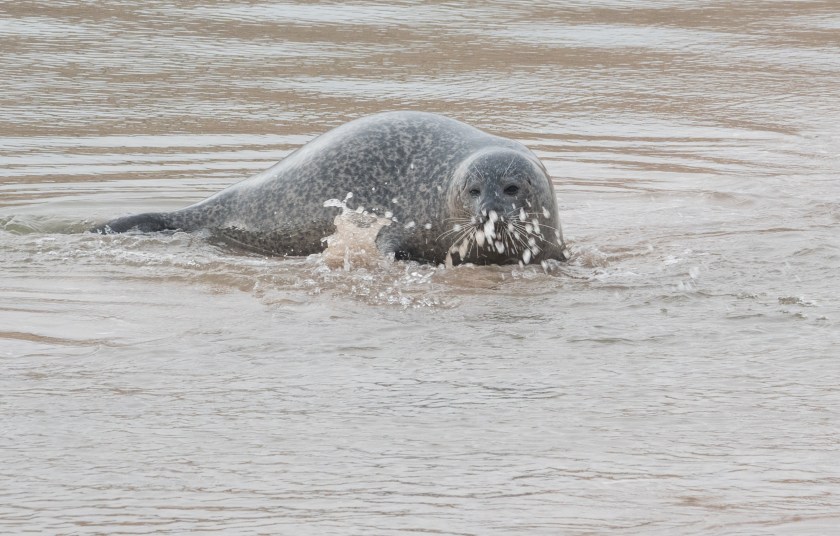
Another one was quietly wallowing, splashing around occasionally in a reaction to other nearby seals, which counts for highly energetic behavior by slumbering seal standards:
But they are also inquisitive, waking up enough to give me the eye:
I have no real story to tell here, just two videos that I can’t resist showing you, both taken on our beaver pond in February. The first shows otters playing again; watch carefully and keep counting heads:
I hope you counted up to four! The most I have ever seen together on our pond. They could be a mother and three cubs from last year (litters range from 1-3), but otter ranges overlap, and there is no way to be certain of their relationship. If they are her cubs, they will be leaving any time now..
The second video shows only one otter, behaving very oddly. I took me a while to realize what was going on:
There is a second otter in the water, visible only in the occasional glimpse, and the one on the ice is throwing itself on top of its sibling (a guess) and having a wonderful time.
To finish, while I was away in England a friend, Pamela Marshall, took a lovely photo of three of the otters that she has generously allowed me to share:
‘
Now, on the last day of March, there is still snow on the ground, but the ice has almost completely melted, and although I saw an otter, it was just a glimpse of a sleek dark brown shape in the dark brown water. To make up, I saw my first pair of Hooded Mergansers. Spring is nigh!
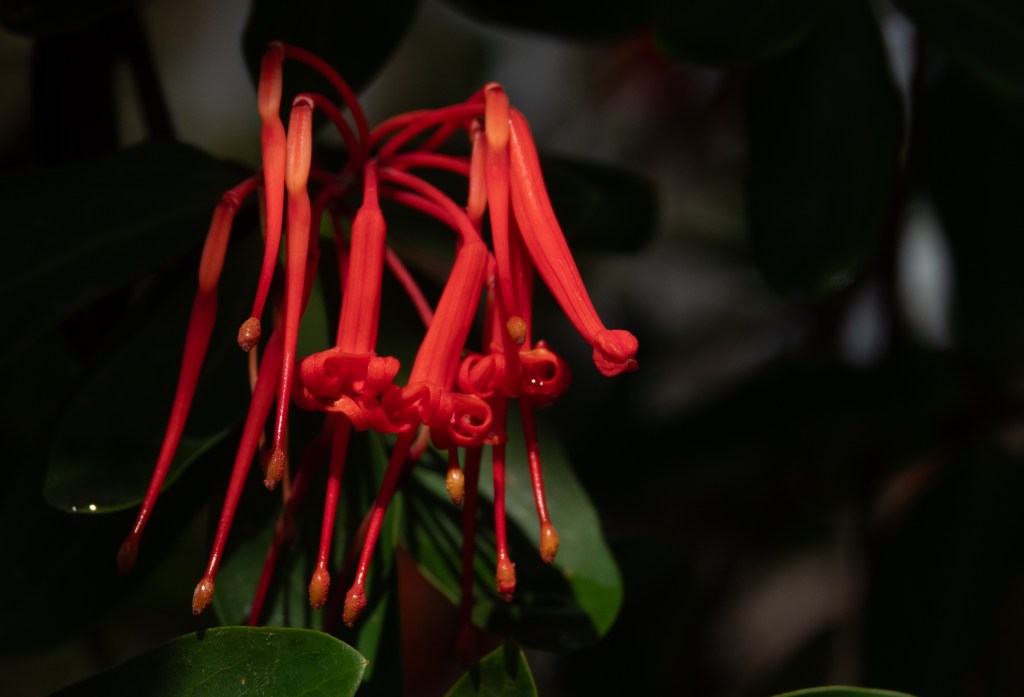
All over Patagonia, from Chiloé in the north to Tierra del Fuego in the south, we saw Chilean Firebush, Embothrium coccineum . A tall shrub or small tree, in spring it is covered in dramatic scarlet blossoms.
They hang in thick clusters:
Each long thin bud (rightmost below) has four petals which split apart and curl back (center), exposing the long style:
The nectar is very sweet, and as it oozes out it attracts insects:
like this tiny sweat bee, which I think is Callistochlora chloris:
Our guide suggested we try the nectar too: and indeed if you suck on a flower the most ethereal mead-like taste fills your mouth:
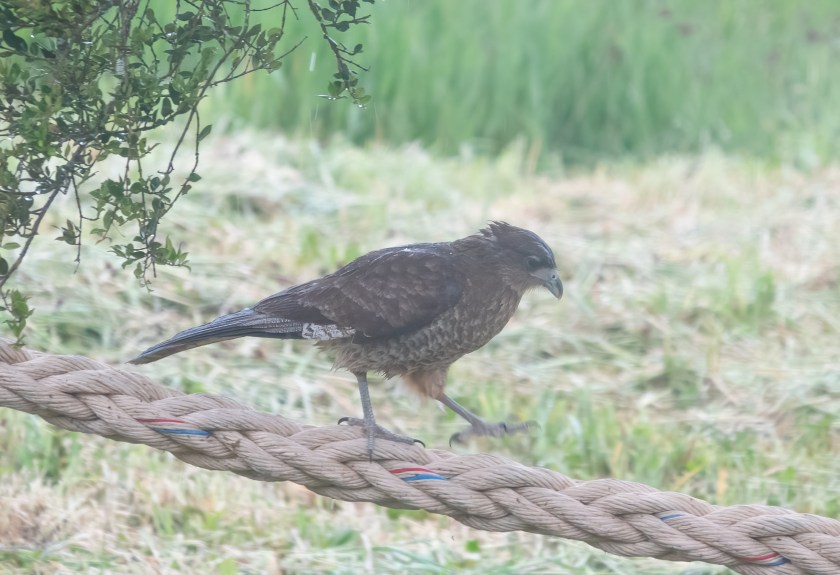
Milvago chimangotemucoensis is the subspecies of the Chimango Caracara found in southern Chile and Argentina. It is a bird of prey, about 17″long with a wingspan of about three feet. They seemed to be everywhere, and the one below is dive-bombing my friend Kerstin.
They hunt small prey like lizards, insects, and mice, and scavenge larger prey. We found one near our Hotel Parque Tepuhueico in Chiloé, having a dustbath :
The purpose is probably to remove parasites, though it has also been suggested that it removes excess lipids deposited on the feathers from the uropygial preening gland. You can see it in action in this video:
It seemed to enjoy that lovely glow you get after a good body scrub:
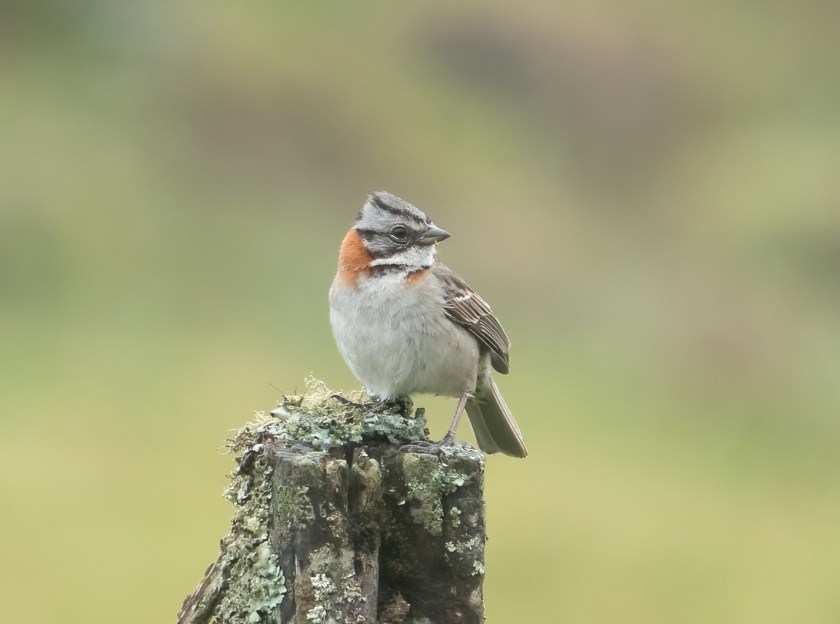
I’ll end with an entirely different bird that somehow never found a place in any other post, the endearing Rufous-collared Sparrow, Zonotrichia capensis:
It sang its tiny heart out on a fencepost:
It is common over much of South America, and tolerant of human presence.
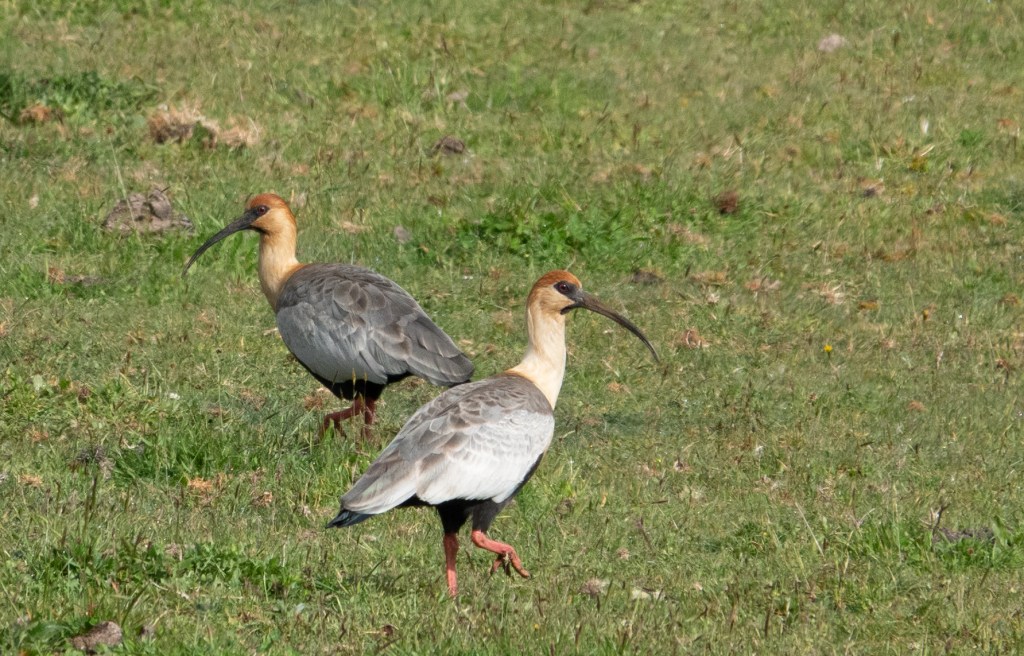
The Black-faced Ibis, Theristicus melanopis, is a handsome bird, which breeds in Southern Chile and Southern Argentina. It is very adaptable, so although open fields are its expected habitat (and outside the breeding seasoning it migrates to the Argentine pampas), it also ventures into quite different territory. Here are a pair poking around in a field for insects, worms, or small vertebrates:
They nest in colonies, often on rocky cliffs:
And in Chiloé they are so laid back that this one settled down on a window ledge. I think it is a juvenile, because of the scalloped wing edges.
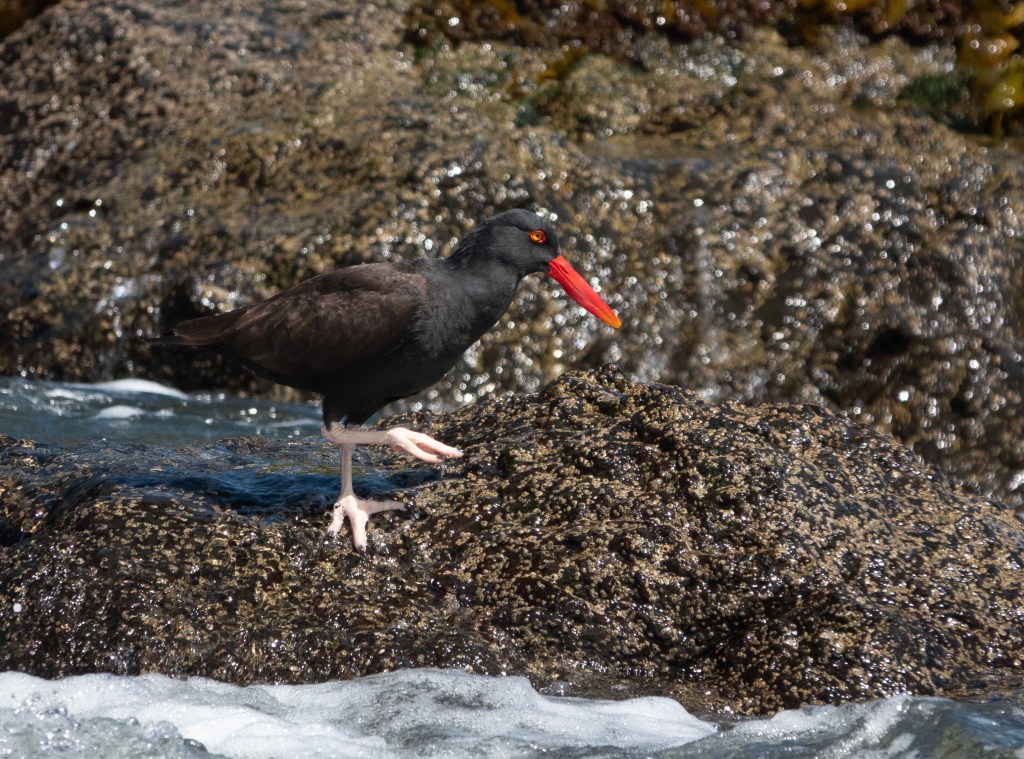
I also liked the Blackish Oystercatcher, Haematopus ater.
It haunts rocky coasts from Peru to Tierra del Fuego, dodging the waves:
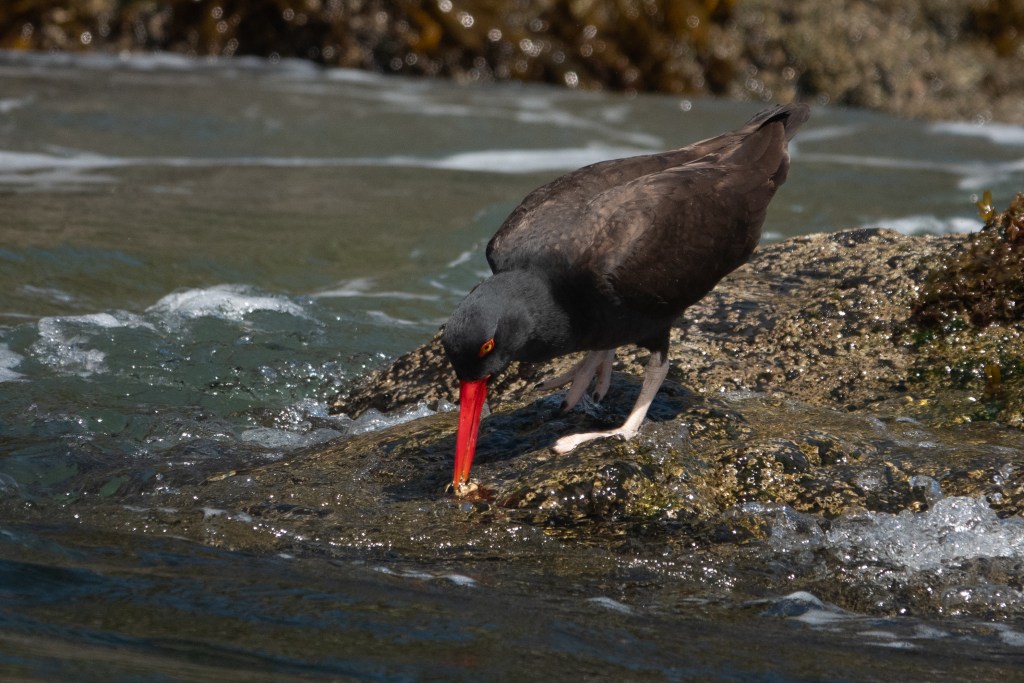
foraging for shellfish:
Apart from that flashy red bill, it has red eyeliner and pale pink feet with black claws, looking as though it had partied all night, with a very Goth pedicure:
After two full-time puma-hunting days, we spent our last complete day in Patagonia just walking in the Torres del Paine National Park, a UNESCO Biosphere Reserve with rich bird and plant life, not just pumas. My goal in this post is to give you a flavor of this stunning place.
We stayed in the Hostería Pehoé, a simple lodge on a tiny island in the middle of Lake Pehoé, reached only by a footbridge.
This was the view from my room.
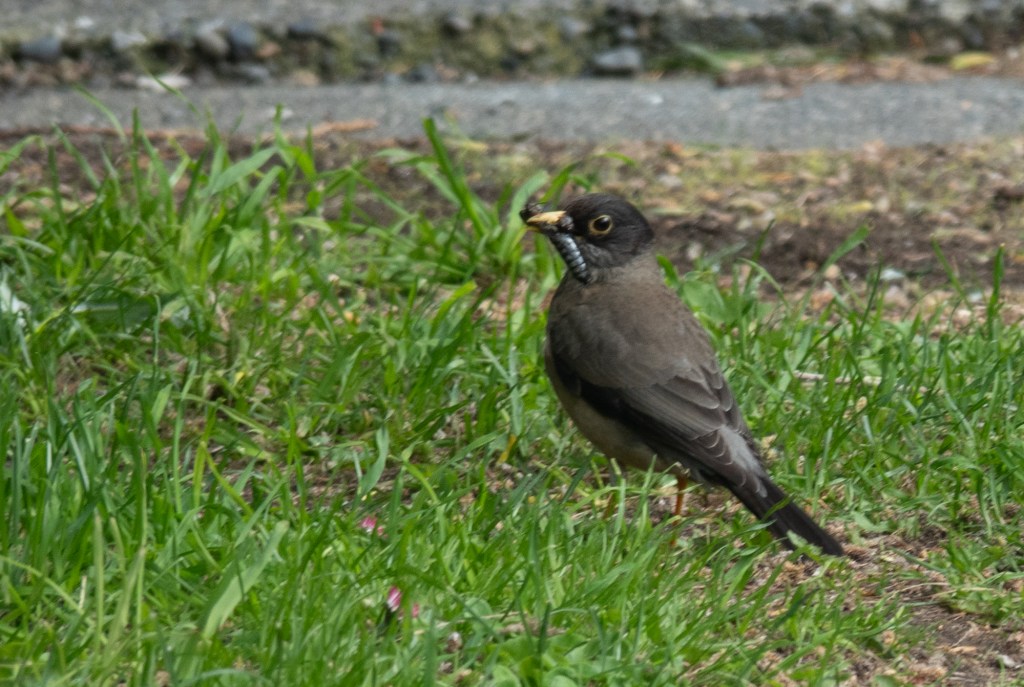
On the island an Austral Thrush had caught lunch:
Palomita, the Dog Orchid, Codonorchis lessonii, punctuated the undergrowth, with two dark eyes on its hood:
and an enticing entrance to the innermost sanctum underneath:
Streaked Maiden lilies, Olsynium biflorum, almost but not quite over..
The island is exposed:
and the perfectly named Darwin’s Slippers, Calceolaria uniflora, sheltered from the strong winds:
,
Rather unusually, this 4″ tall plant is pollinated by a bird, the Least Seedsnipe. It eats the conspicuous white lower lip of the flower, which is high in sugars. As it does so, the stigma and anthers of the flower tap its head and back, and that pollen is then transferred to the next flower it visits.
Moss hung in the small trees:
After breakfast we walked a short and easy trail further south in the Park. We wandered through the scrubby vegetation:
The low trees were a type of beech relative, called Nothofagus antarctica, festooned with Southern South American mistletoe, Misodendrum punctulatum.
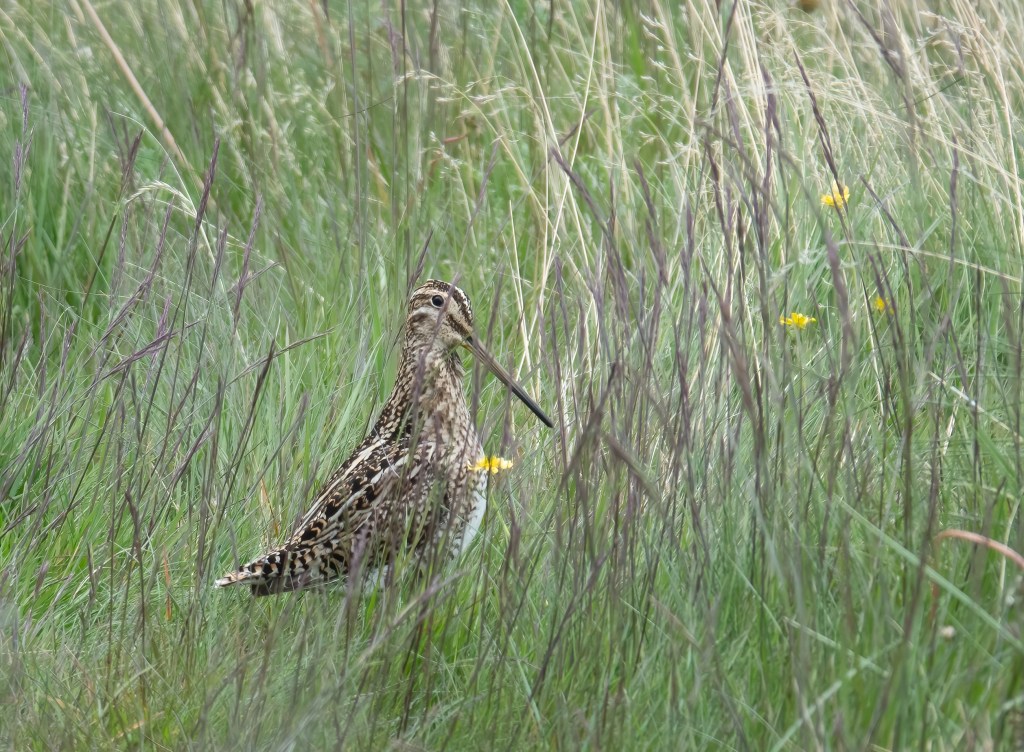
In the long grass a Magellanic Snipe, Gallinago magellanica* , was busily poking around:
We then climbed gently to yet another great view:
All along the way there were orchids:
Torres del Paine has nine species of orchid. The yellow one below is a Yellow Orchid (!), Gavilea littoralis:
The greenish white one is a Porcelain Orchid, Chloraea Magellanica, with a spectacular tongue to entice in the pollinators:
On the way back, we saw the snipe again, posing on a rock:
After a delicious lunch at Hotel Lago Grey we walked to get a proper look at Grey Glacier, dwarfing the quite large boat in the foreground:
It is 3om high at its leading edge. I took these photos 15 years ago, from a boat:
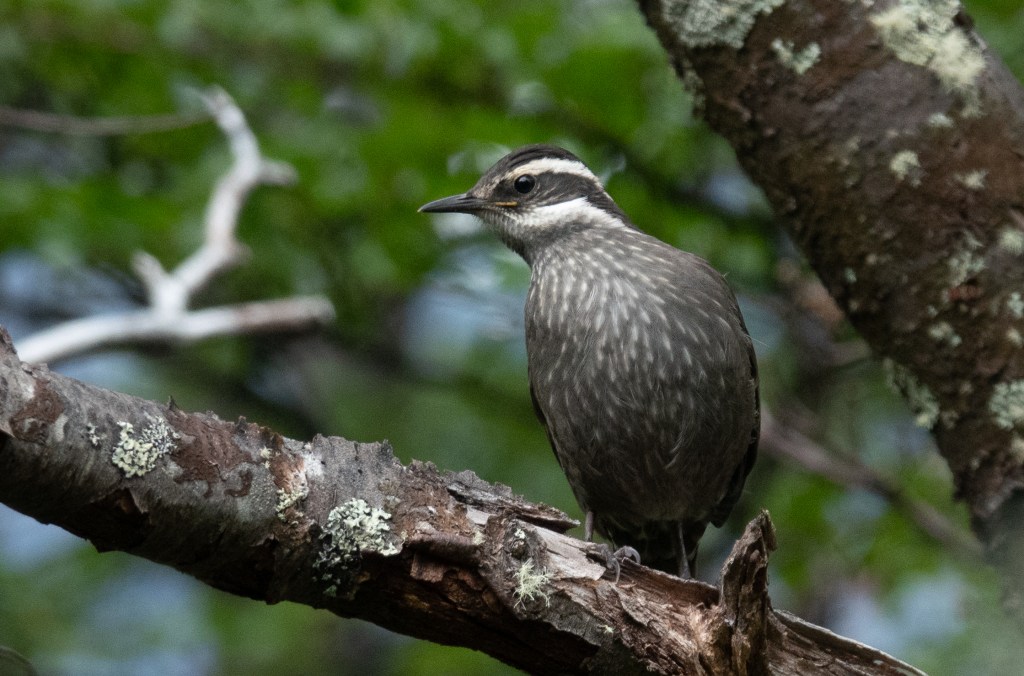
On the way back we were observed by a Dark-bellied Cinclodes:
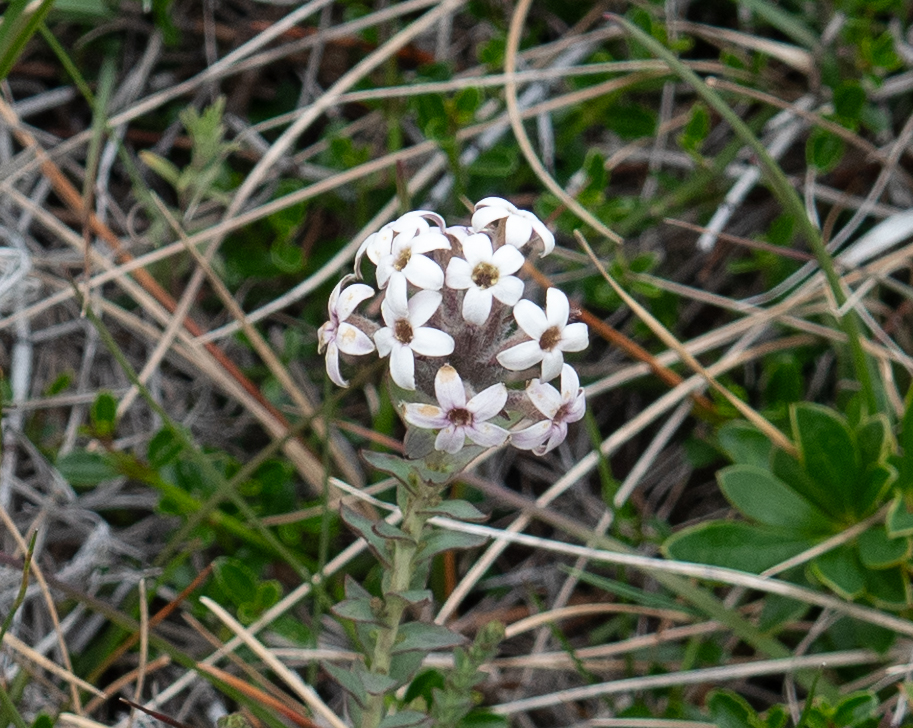
and a few more wildflowers…
Arjona patagonicaCutleaf Anemone
PS * Top tip: if you are searching for the name of an unfamiliar bird down in this part of the world, try choosing an appropriate familiar one from home (thrush, snipe, finch, woodpecker…) and add one of three adjectives: Patagonian, Magellanic, or Austral. Works a treat.
[I have (as you’ve noticed if you read this regularly), been obsessed with my Chile trip, but in January while my Chile blogs were still in full flow, I went to Spain on a different mission, so I thought I’d take a week off from Chile to show you why.]
This post has been planned for a few weeks, but after my previous post it just couldn’t wait any longer ! In case you missed it, I saw my first bobcat on my beaver pond in Maine… read on.
There are four species of lynx in the world. Where I live in Maine, we have bobcats, which are technically lynxes, (Lynx rufus), and the Canadian Lynx (Lynx canadensis), which seems to moving back into some areas of the state. In Europe, there are two other species. The European Lynx (Lynx lynx) is found in northern and eastern Europe and eastwards across northern Asia. But the rarest of all is the Iberian Lynx, Lynx pardinus, found only in Spain and Portugal. I really wanted to see this, and you will understand why when you see their tufted ears and endearing facial ruffs:
In 2002, the Iberian lynx was on the verge of extinction, with only 94 individuals left in two isolated subpopulations in Andalusia. It was considered the most endangered feline in the world, classified as Critically Endangered by the IUCN.
A hugely successful conservation program, focussing on improving habitat, restocking and keeping healthy their main food of rabbits, and a breeding and reintroduction program, means that now there are over 2000 in the wild, and in 2024 they were re-classified by the IUCN as Vulnerable.
These two small areas are still the best chance to see them, so that is where we went. We started in Huelva, in the Doñana National Park. On our first day, we had 180mm (7″) of rain, the most rain in 24 hours in eight years. Needless to say we saw nothing. The next day, most of the roads into the park were flooded, and again we saw nothing.
So on we went to Andújar, further north. First day, no lynx, but a group of lovely male mouflon.
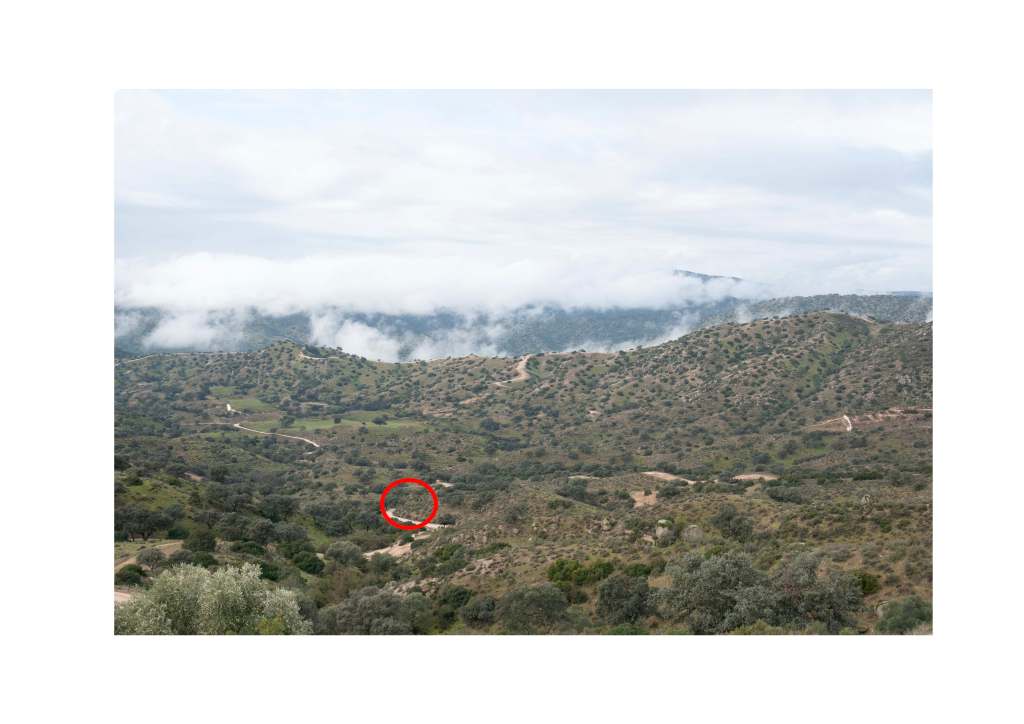
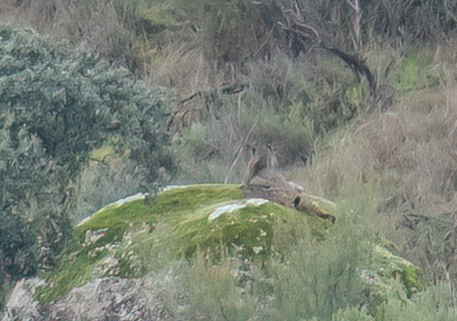
On the second day, we heard that a lynx had been seen, and we roared off in the hope of catching it. Initially, no luck, but then someone spotted it, lying on a rock about 800 meters (nearly 1/2 a mile) away, circled.
The dirt track and surrounding landscape is only open to rangers, so this was the closest we got. There was the lynx, lying on the rock facing away from us, with its head up. Here is my best photo (!); the black spot is the tip of its tail, and the two smaller black spots are the tips of its ears. .
This was our only view in the wild, the fruits of four days of trying.
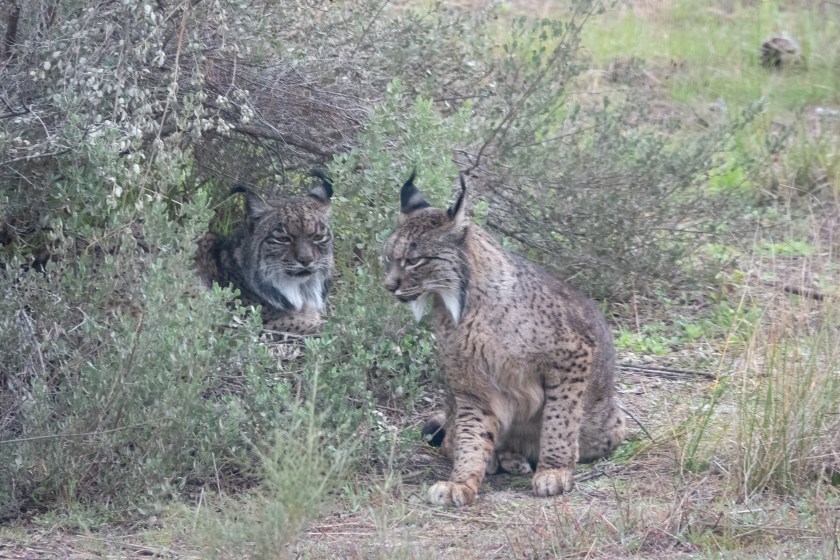
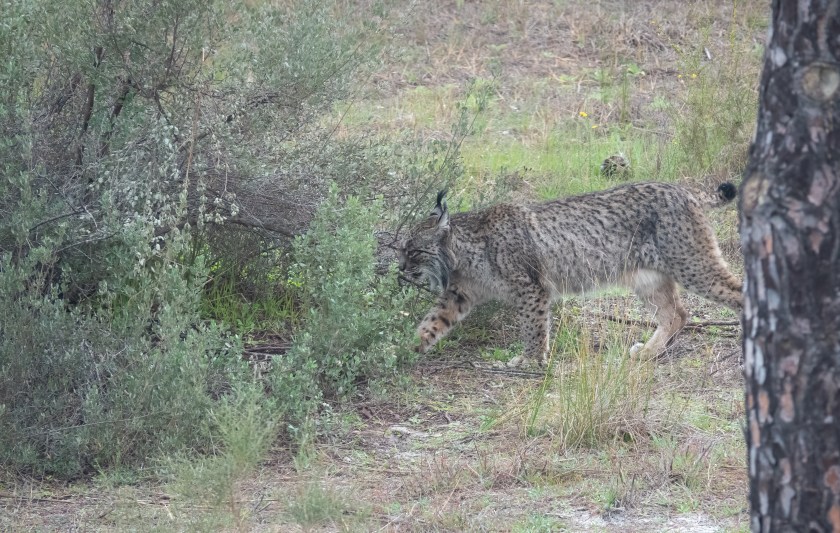
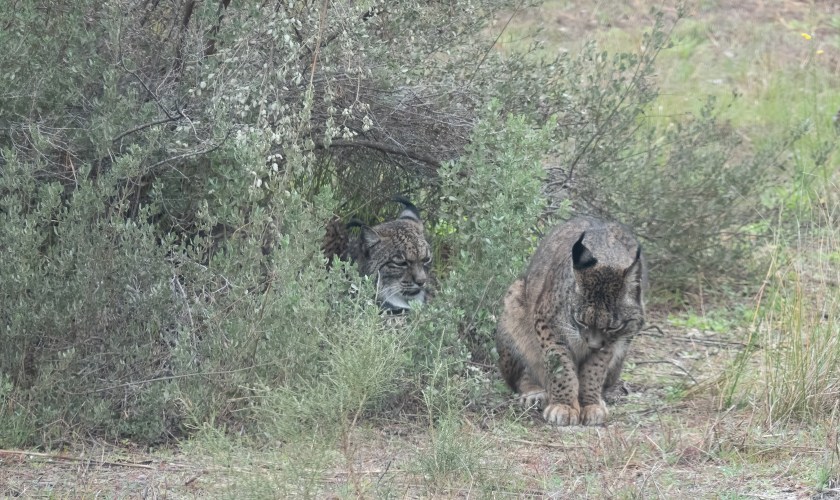
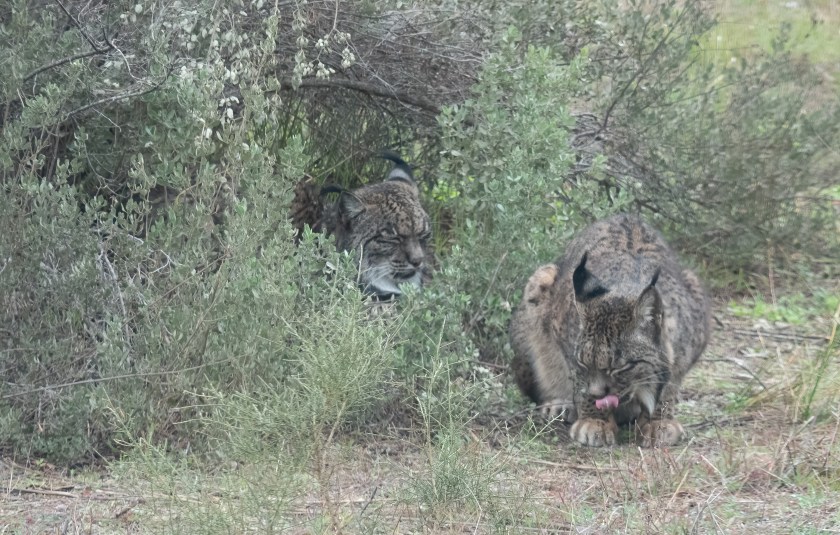
But … so as to keep the suspense up, I omitted to tell you something. In Doñana National Park (our first stop), there is a reproduction centre called El Acebuche that houses a pair of lynx in about 5 acres of wild countryside. Over the years, their offspring have been used to repopulate the area, so successfully that reintroductions are now being sent as far as Portugal. They’re aging, but still there. They hunt rabbits in their enclosed area and may not be seen for days. The centre is not open to the public, but our guide got us in, and we were very lucky. Not only were they hanging about near the viewing area, but they weren’t hiding behind a bush, and they weren’t asleep (though dozy!). These photos were taken through a pane of glass, under lowering skies, but I hope they give you a sense of these glorious animals.
This is Felix, the male.
And this is Dama, the female:
They were deliberately chosen from the two different geographical areas, to mix the gene pools, but they seemed like a fairly contented couple:
Felix had apparently originally had another bride, and when Dama first arrived he was not initially friendly, which could be intimidating judging by these teeth:
Indeed, on one occasion while we were there he snarled at Dama, asserting his dominance:
and you can see how she cringed:
But she too can be fearsome, look at that glare:
They are not huge, the larger males can be up to 32″ long (not counting that stubby tail) and 35lbs in weight. But they can dispatch a rabbit with ease.
I have lived in Maine on and off for 43 years, and never seen a bobcat. I have caught them on camera traps, and seen tracks, but that’s it. Until now.
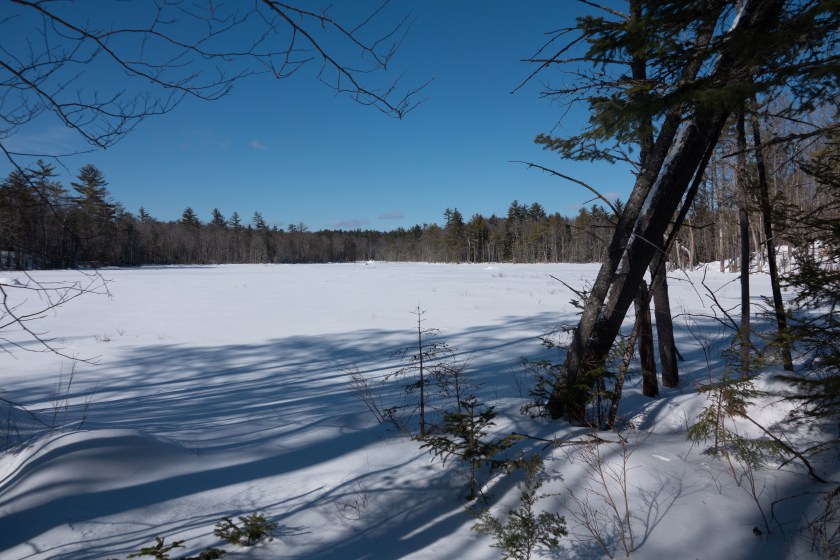
I was out for the second time that day snowshoeing and hoping to see otters. None. I had turned for home, and as always I looked over my shoulder one last time in case they had appeared as I left.
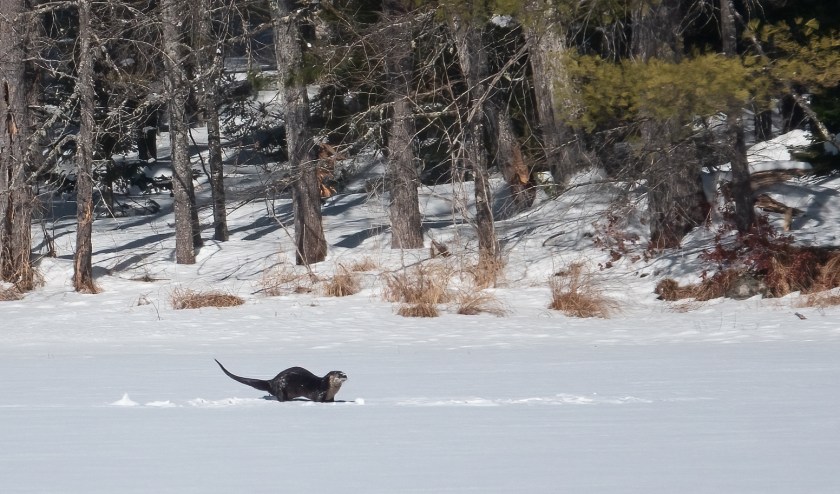
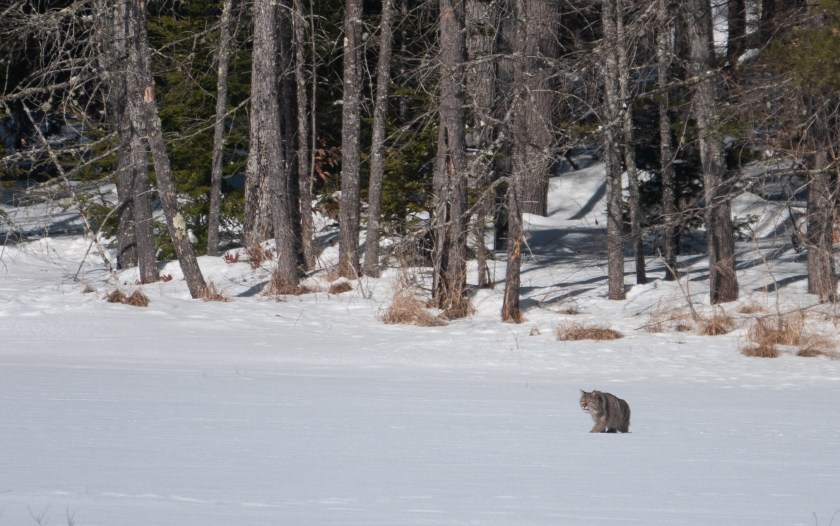
And there one was, on the far side of the pond. So, I headed back out for a closer look:
The otter dived under the ice, but there was another shape on the snow, rounder and fluffier:
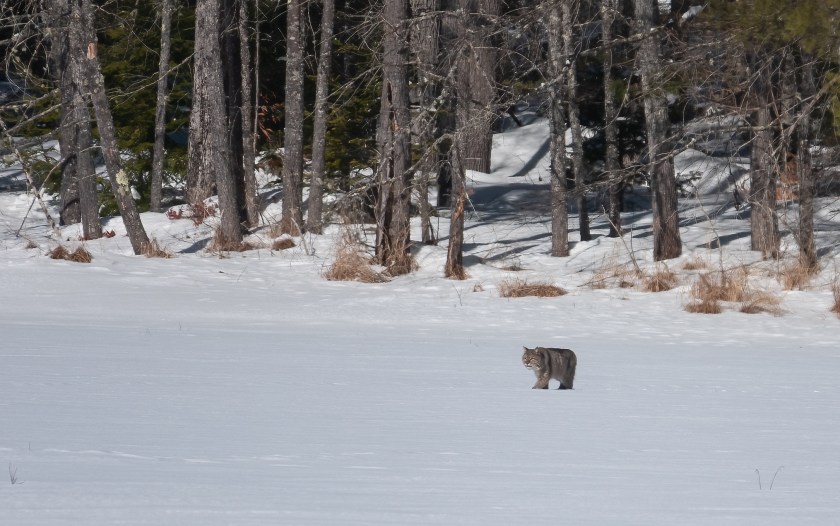
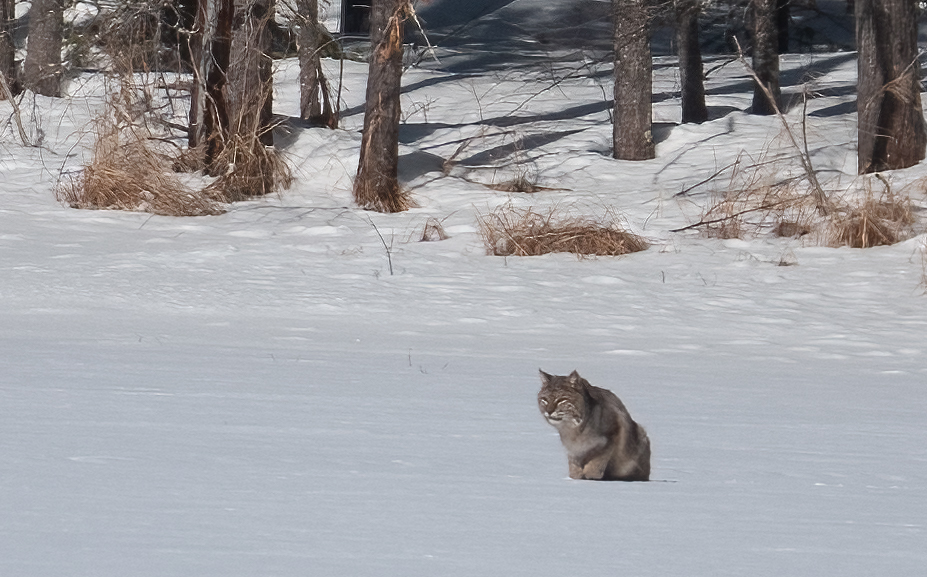
My first ever bobcat, Lynx rufus. I took a few shots from very far away. It was barely moving, carefully placing one silent rear paw in front of the other:
then settling into a crouch:
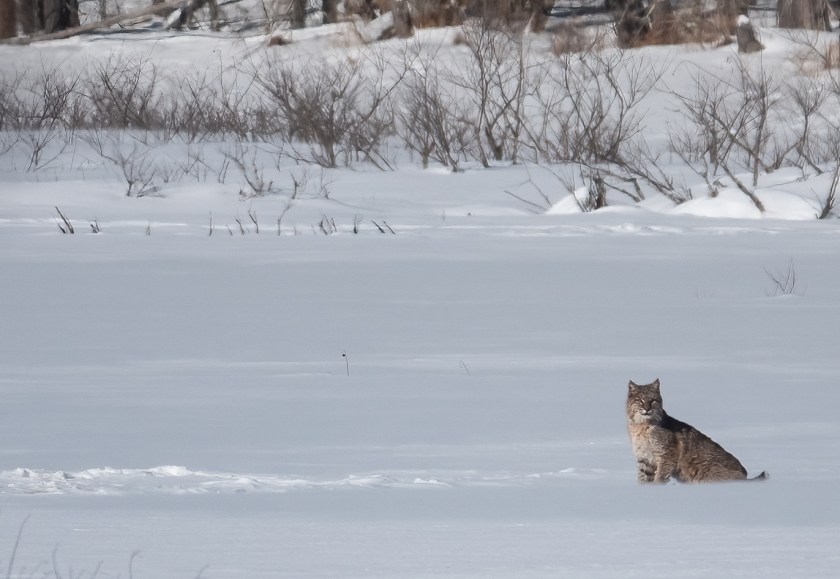
I wasn’t sure, but I wondered if it was preparing to stake out the otter hole. I was a very long way away, so I moved a little closer. From my new angle, I could see that it was now right next to the otter hole (the disturbed snow to its left):
But it smelled me or heard me or saw me,
and took off, just letting me snatch a short video:
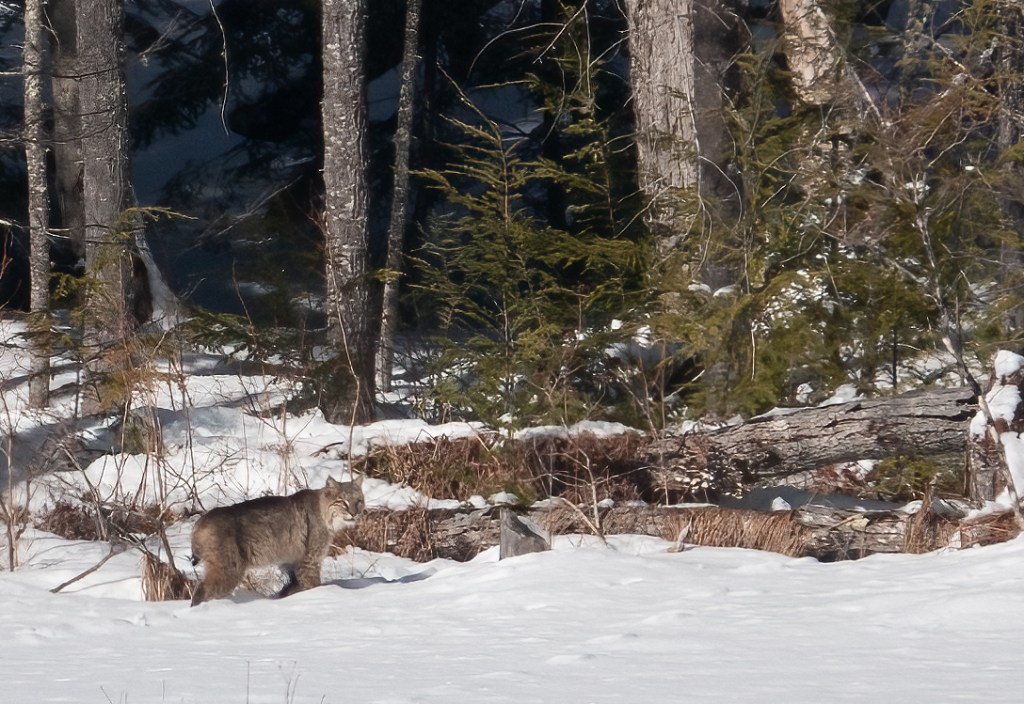
It stopped on the edge of the woods, and looked back reproachfully:
Three minutes of a privileged glimpse into its world.
I have since tried to discover if bobcats hunt otters. There is the occasional reference to otter remains being found in the stomach contents of bobcats, but that’s about it, and these could easily have been either carrion, or very young otters. An adult otter would be a formidable prey, being much the same weight as a bobcat. Look at this video of a bobcat recoiling from an angry otter: https://www.youtube.com/shorts/TJZlFwmdo64
Their main food is snowshoe hares, but they do very occasionally eat fish, so they may have been trying to steal the otter’s catch. See Newbury and Hodges 2018 for more on their diet. Bobcats’ feet don’t cope well with deep snow (unlike Canada Lynx), and we have had plenty of snow this winter, at the northern edge of their range, so my bobcat may be very hungry indeed.
Scott Lindsay, Regional Wildlife Biologist at the Maine Dept. of Inland Fisheries & Wildlife, agrees that it was unlikely to be hunting otters, and he tells me that bobcats are curious, and it was probably just checking things out.
PS Maine has a total bobcat population of around 1500, and a female’s home range is about 23 square kilometers. So it is not surprising that they are hard to see! There’s some useful,information here, including how you tell the difference between a bobcat and a Canadian Lynx.











































 Eyes on the Wild