Swan, Swan Goose, Goose

[As was often the case on this trip, we couldn’t get close enough to the wildlife for me and my camera to get good shots. I’ve made a decision to write about some things anyway, because they are so interesting (I hope), but first I start with pictures that set the scene in Mongolian rural herding culture]

In the Mongolian Altai, down in the plains, there are large lakes, some of them freshwater and some saline. We visited both types. They’re very beautiful (but with a distressing amount of trash around). Most of these photos are of Khar-Us freshwater lake, 1800 Km2, average depth 2.1m. It is a national park.

The wind can be fierce, whipping up dust spouts:

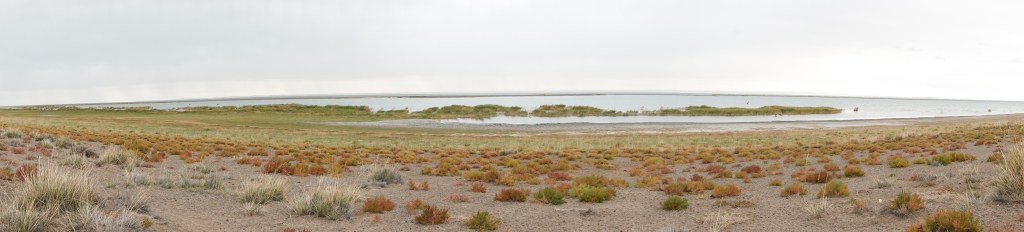
The next photo is Dörgön Lake, a saline lake at 4% salinity, surrounded by samphire plants:
The local herders bring their livestock down to drink,
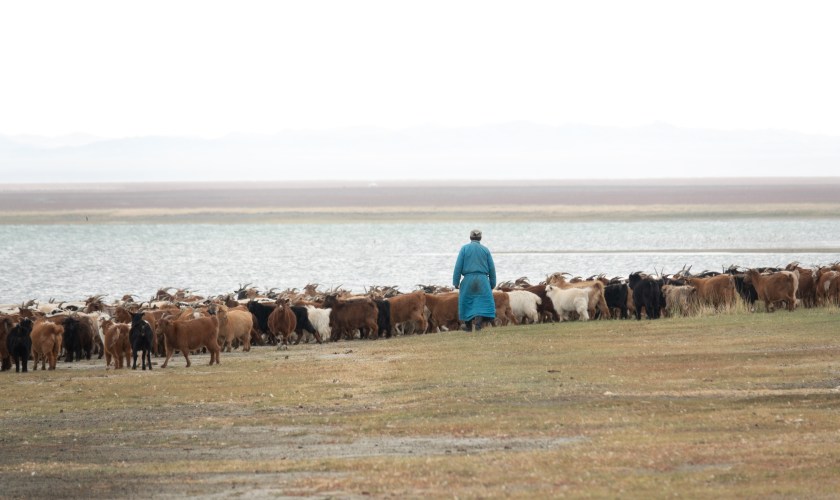
while they prefer to share a cup of tea with our drivers and Jane:

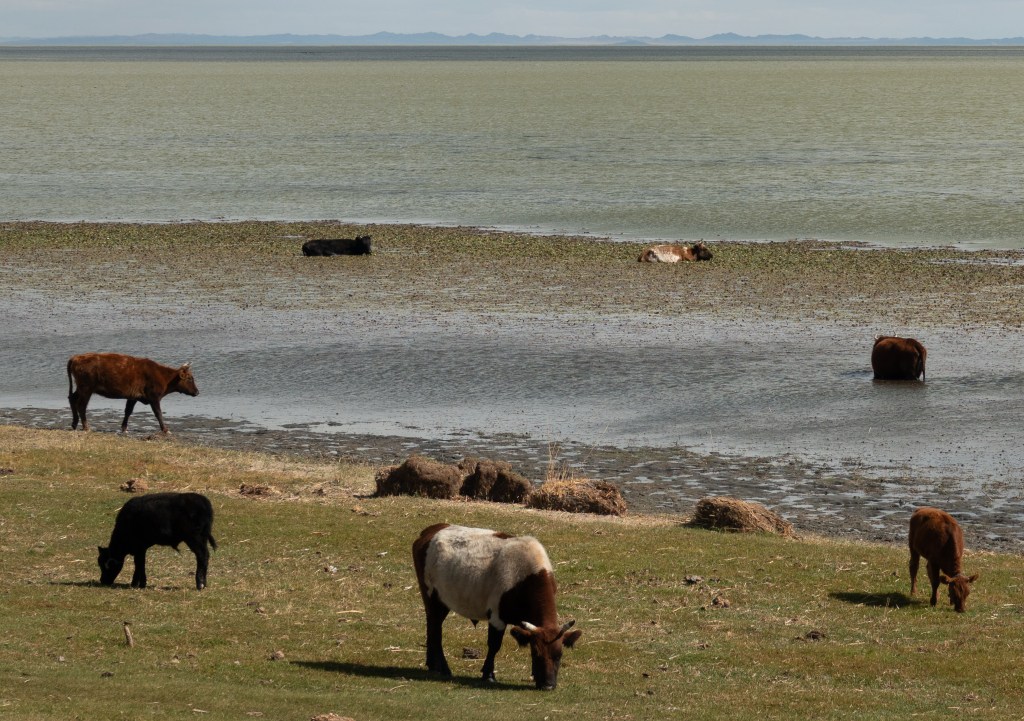
Back at Khar-Us lake, the braver waders browse on water plants:
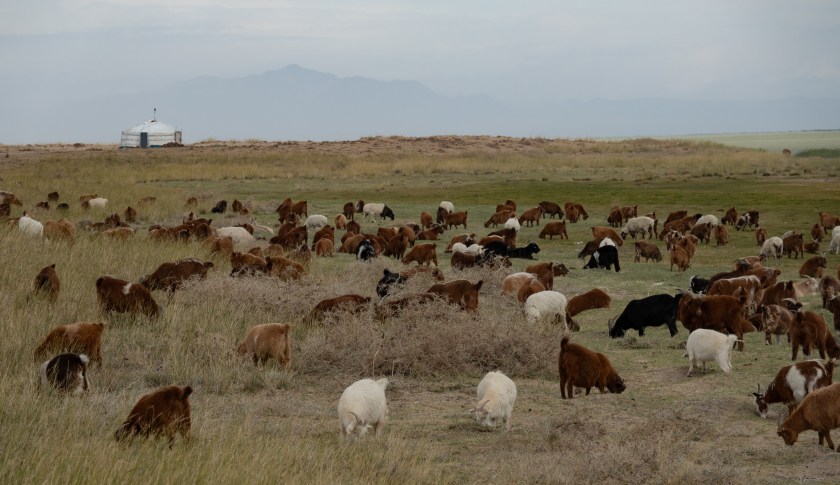
The animals below are a mix of sheep and cashmere goats, now growing their winter coats; your next sweater “on the hoof”:
In the midst of this, there are waterbirds. Whooper Swans, Cygnus cygnus, breed here. They can be seen in the UK, but I have never seen one before. Their total range is from Iceland to Japan, and they only breed in the northern parts of that range. They have lovely yellow bills.

They graze on aquatic plants, in a behavior called, unimaginatively, “upending”!
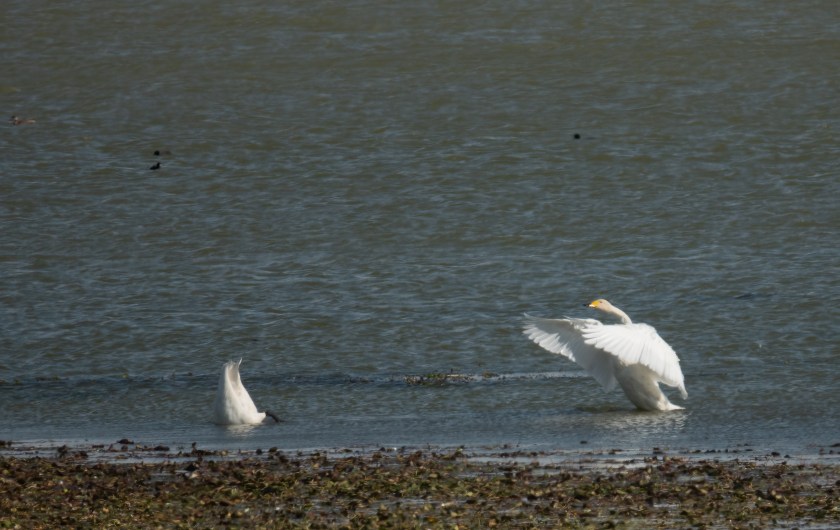
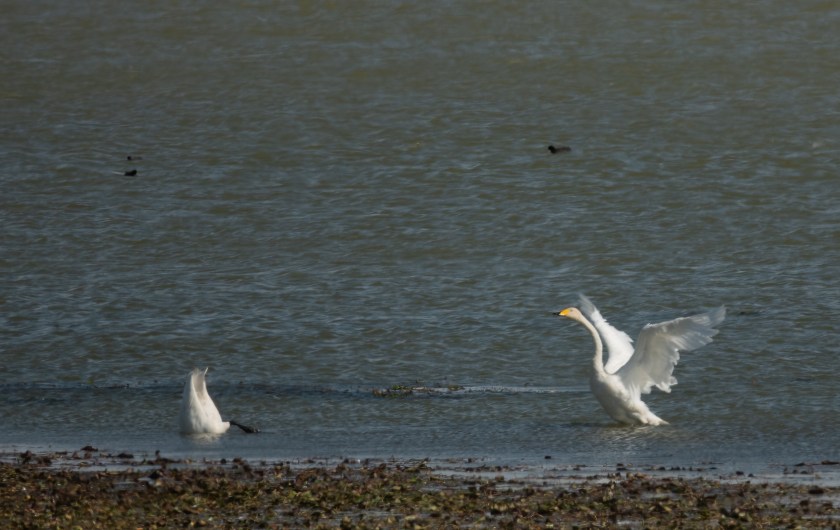
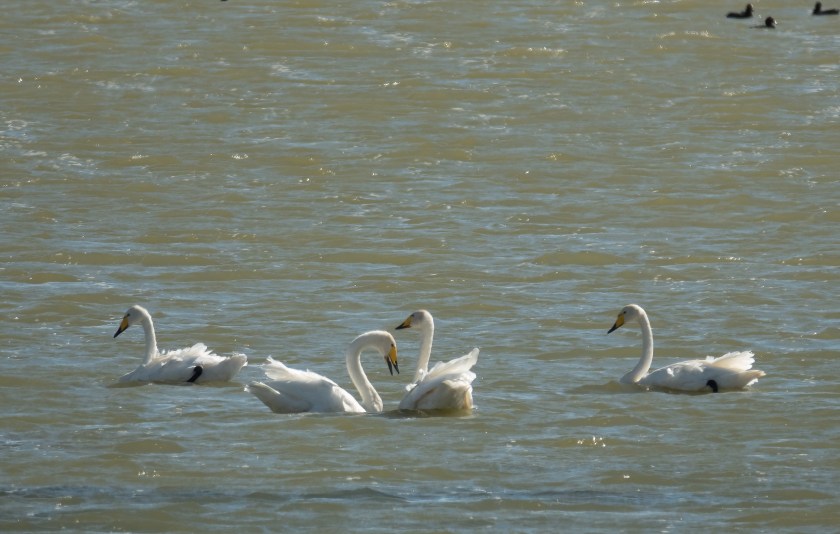
They are thought to pair for life, but they are not well studied on their breeding grounds. This group of around twenty birds:

included two in the midst of a courting ritual.

Here’s a video:

I am happy to say they are not endangered. Soon after we saw them, they probably left for their wintering grounds further south.

Fifteen minutes later Istvan , with a note of excitement in his voice, said “Look, swan geese.” What? Which? Make up your mind. But I hadn’t misheard, there really is a bird called a Swan Goose, Anser cygnoides, which looks like a goose, but with a longer neck and a black (not orange) bill with a white line around it. In the picture below all but the leftmost goose (in both pictures) are Swan Geese. The outsider is a Greylag Goose.
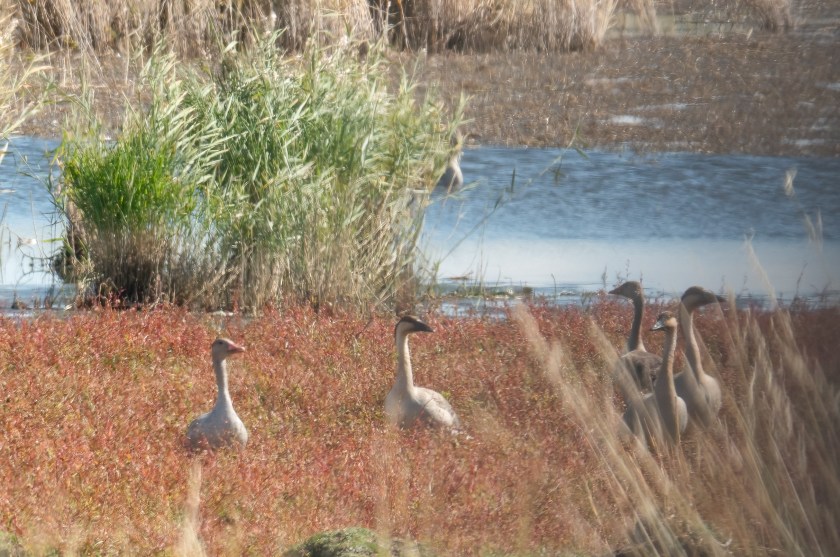
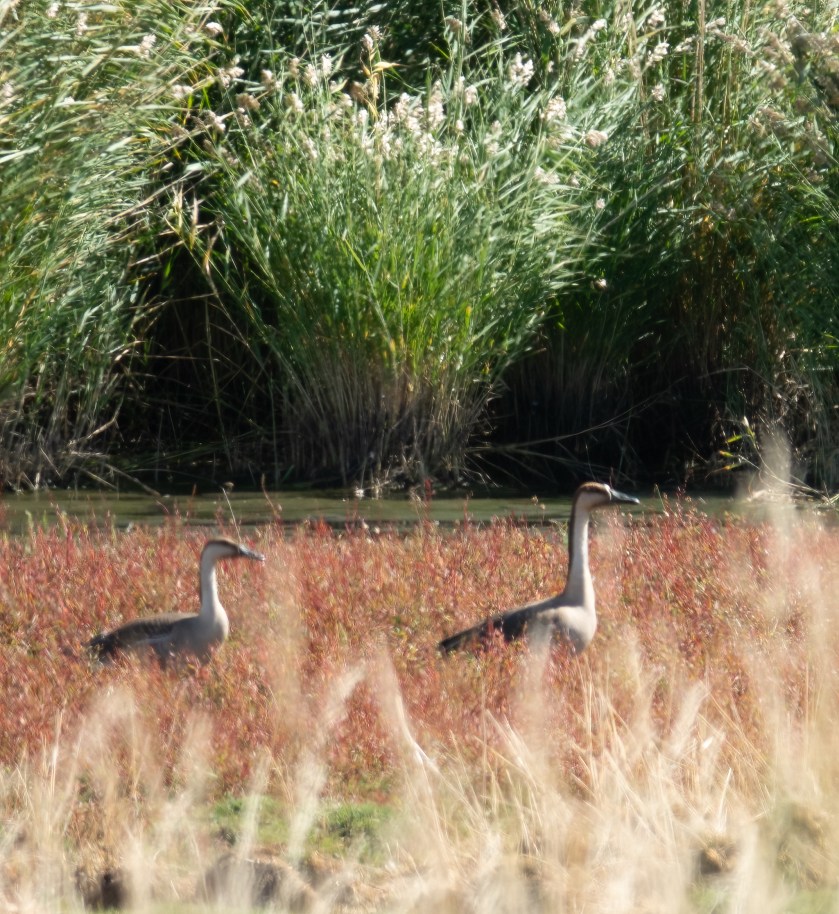
They flew off before I could get better photos:
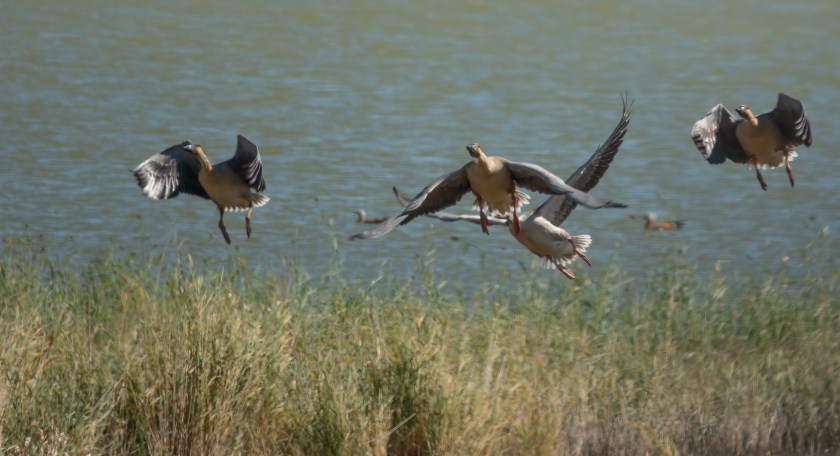
Second from left below could be a Swan Goose/Greylag hybrid.,
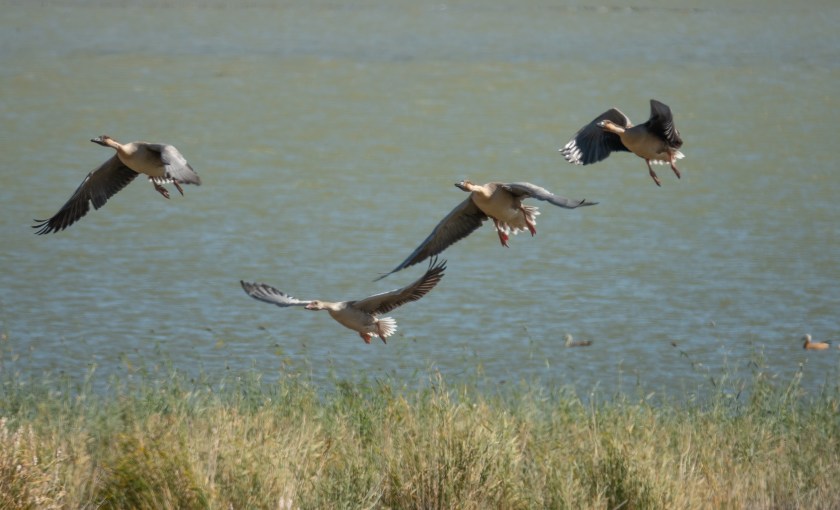
The reason Istvan was so excited is that Swan Geese are classified as Endangered by the IUCN. * Almost all of their breeding grounds are in Mongolia, the yellow areas on the map below:
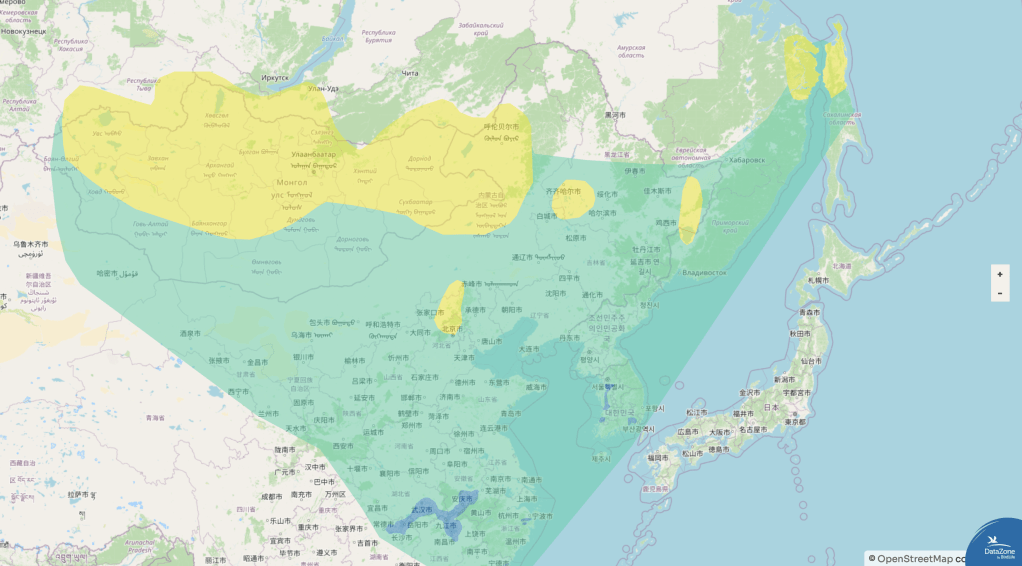
They are protected in Mongolia, but in both their breeding grounds and their wintering grounds (mainly in China) their habitat is very much under threat, and hunting is also a problem. Overgrazing by livestock also plays a role, since the swan geese eat sedges and grasses too.

One final picture: a livestock enclosure on the shores, resourcefully and precisely made of mud brick masonry, dry stone walling, and discarded car parts:

In London or New York this would be considered an art installation.

* The Swan Goose conservation status has changed back and forth over the years, but the most recent listing is Endangered, see Birdlife International for details. The Birds of the World entry is out of date and under revision.
Breakdowns, and bubonic plague

[When we weren’t looking for large mammals in Mongolia, there were smaller creatures to search for, mammals, birds, and insects. And tales to tell.]

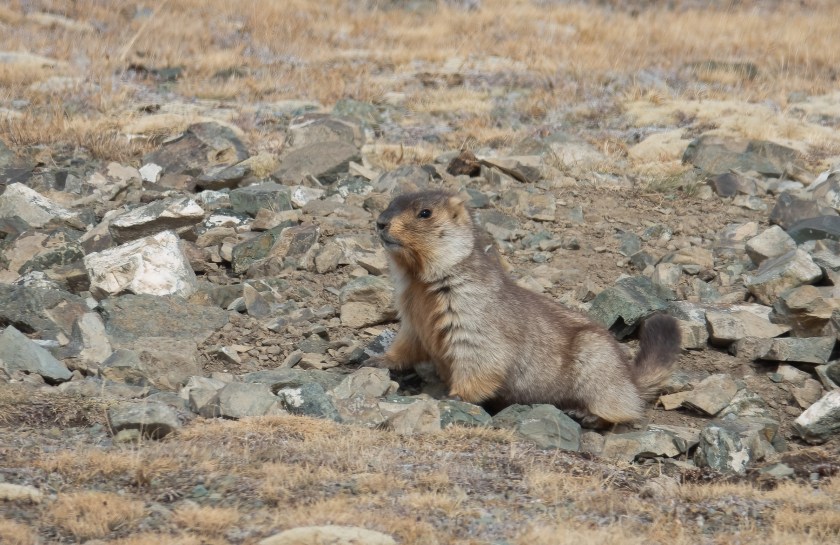
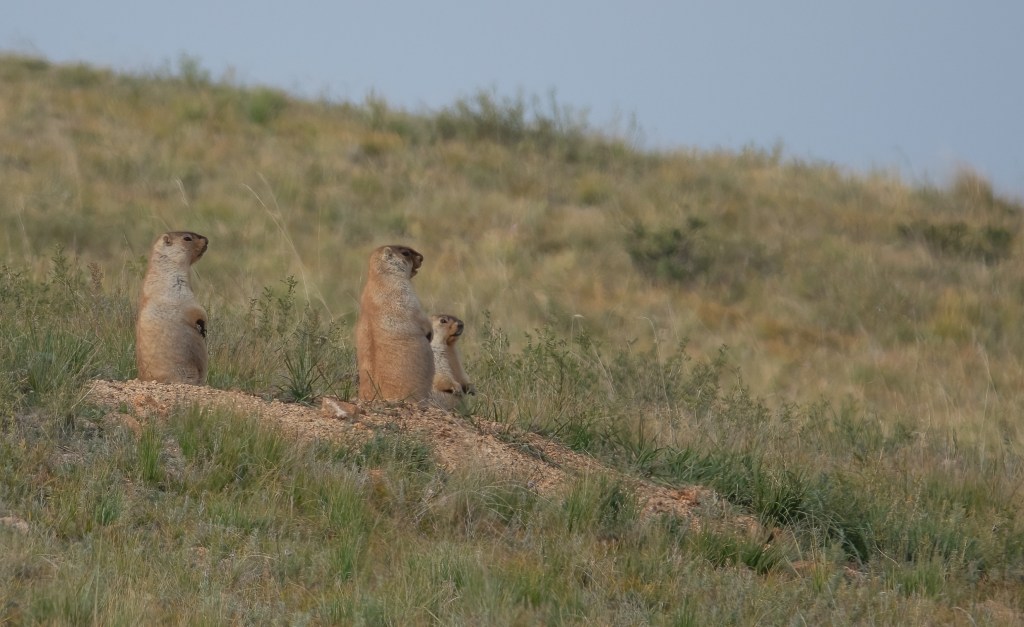
Mammals are scarce, but we did see several foxes, and also Tarbagan Marmots, aka Siberian Marmot, Marmota sibirica, a favorite food of the snow leopard.

Closely related to groundhogs, Marmota monax, they live at much higher elevations and in much larger social groupings of 13-18 animals. They stay close to their burrows, and dive for cover if a threat seems near.

They are considered Endangered by the IUCN , partly due to hunting pressures, and partly because they carry (and catch) bubonic plague. Fleas or ticks can transmit it to humans too, so we did NOT eat marmot or buy marmot fur hats! But despite the plague, Mongolians are fond of their marmots, and build charming statues to them:

I don’t think many Americans would want to build a statue to a groundhog.

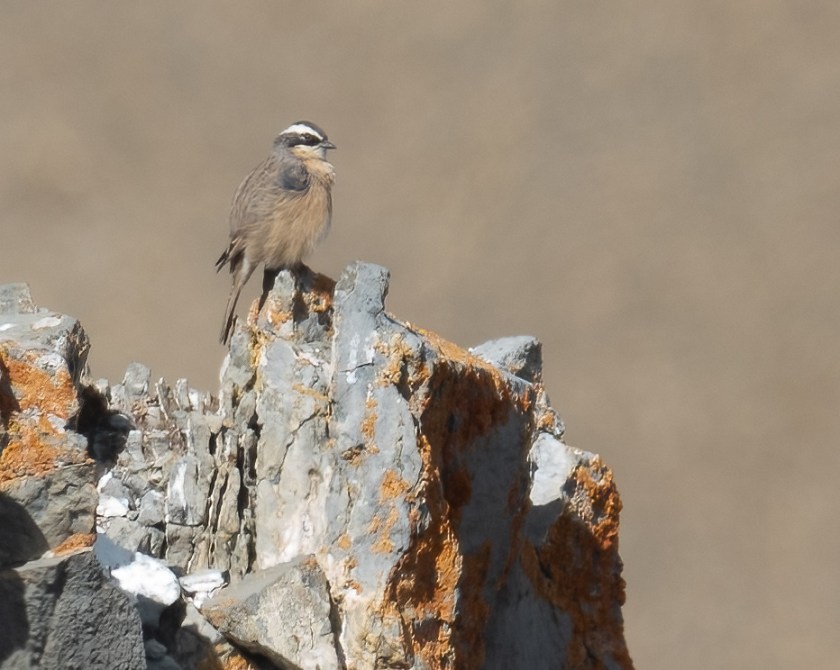
Istvan, our guide, was a skilled and knowledgable birder. When there were no leopards, birds were often a possible substitute. Migratory birds had largely gone, so the birds we saw were brave year-round residents of this harsh land. In the summer months, many of them eat invertebrates, but in the winter their diet is mostly seeds. This is a Brown Accentor:

And this is a Mongolian (or Kozlow’s) Accentor, which Istvan got very excited about. I realize that it is a rather nondescript bird, but apparently it is a birding prize.

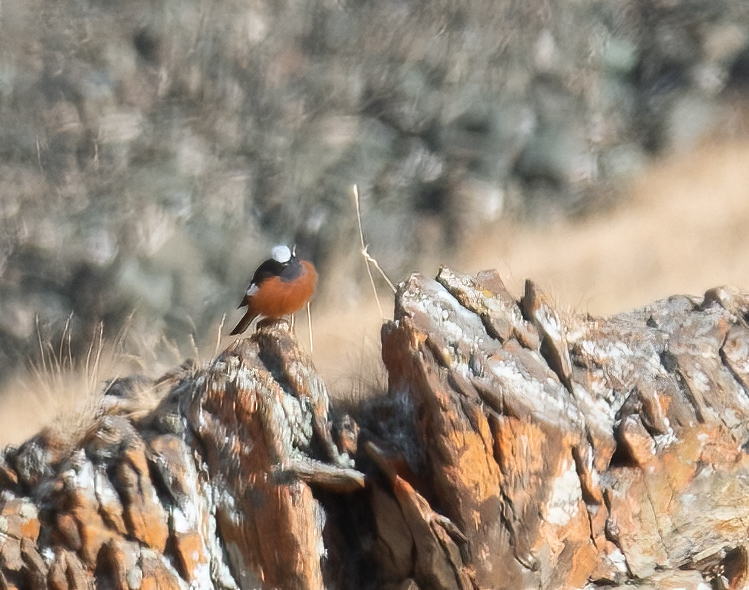
The tiny bird below is a Guldenstaedt’s Redstart. The white area is the top of its head, photographed from above as it looks down!

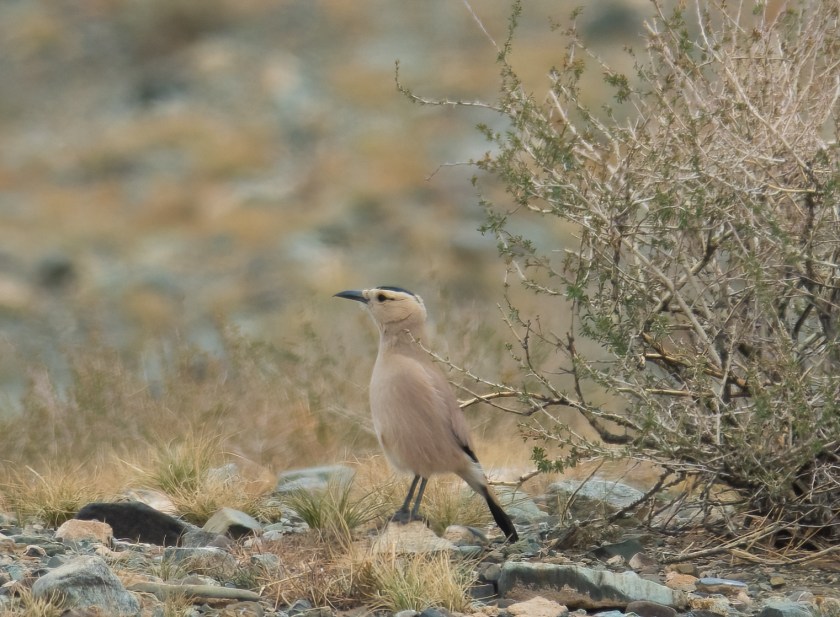
Driving around the foothills, one of our vehicles broke down, so while they fixed it we wandered around for an hour or so, looking for anything really! This is when we saw my favorite bird, the Mongolian Ground Jay, Podoces hendersoni, a very spiffy bird with smart beige and black plumage, and with distinct attitude.

It would be right at home in the world of Bertie Wooster, dressed for luncheon in the country.

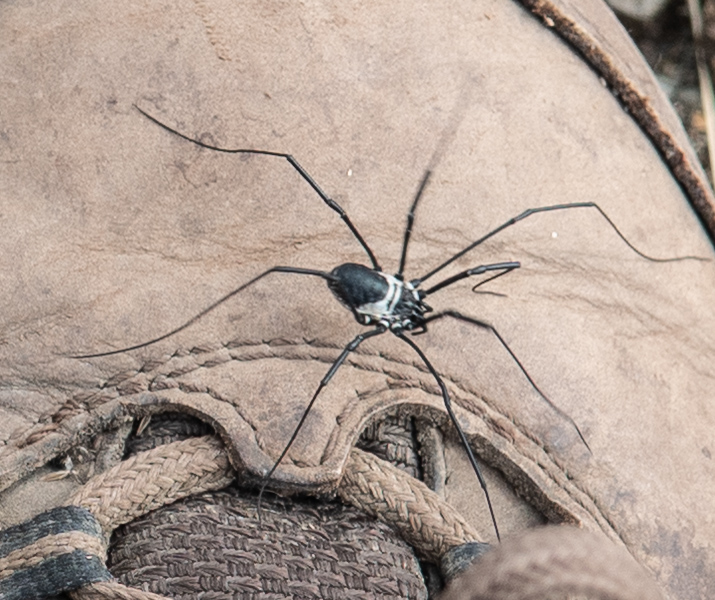
At higher altitudes, there was a rather handsome Daddy Longlegs (Harvestman), that I can’t ID:

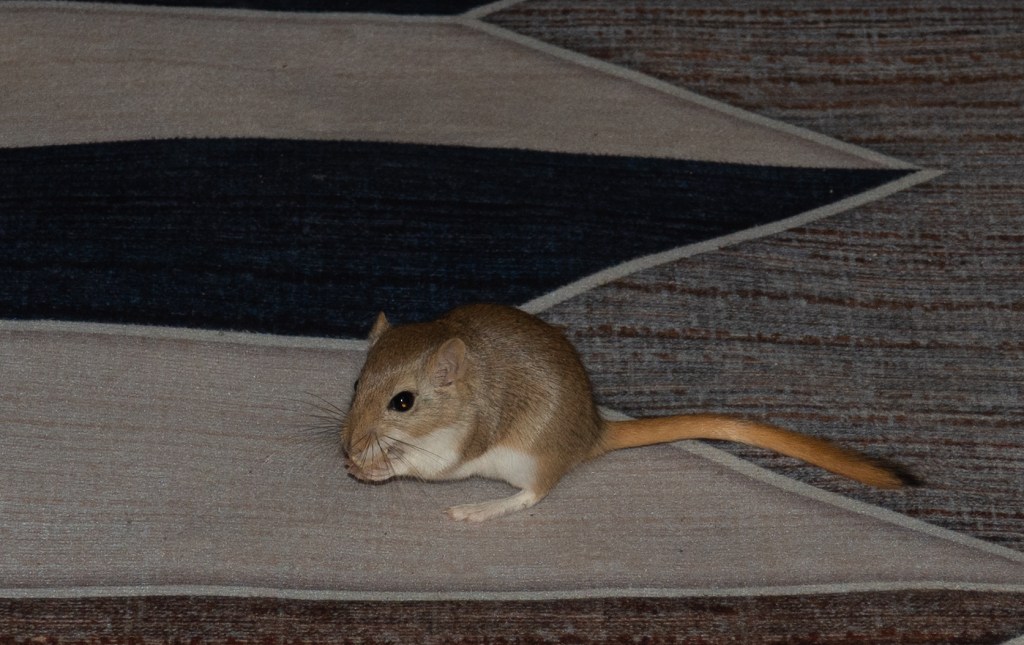
PS Istvan told us that we might hear noises in our gers at night, and not to leave any food around. The culprit would be a Midday Jird. This wonderfully named animal is a little rodent with a long furry tail, that hops on its back legs:

It is actually a gerbil, Meriones meridianus, and since it is largely nocturnal its name seems completely unsuitable!

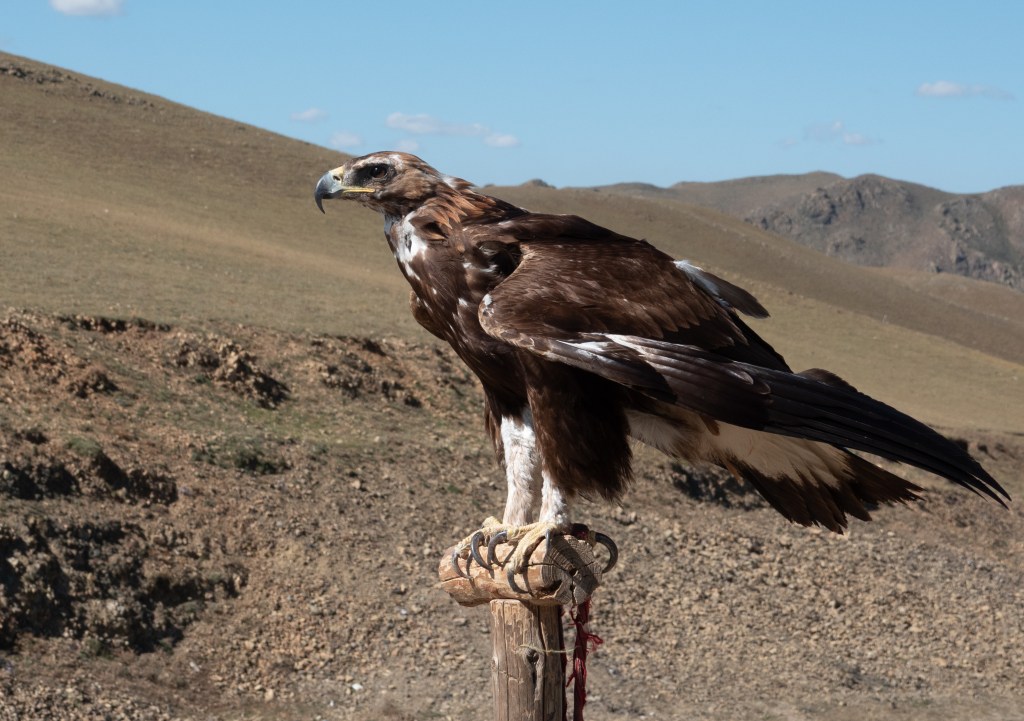
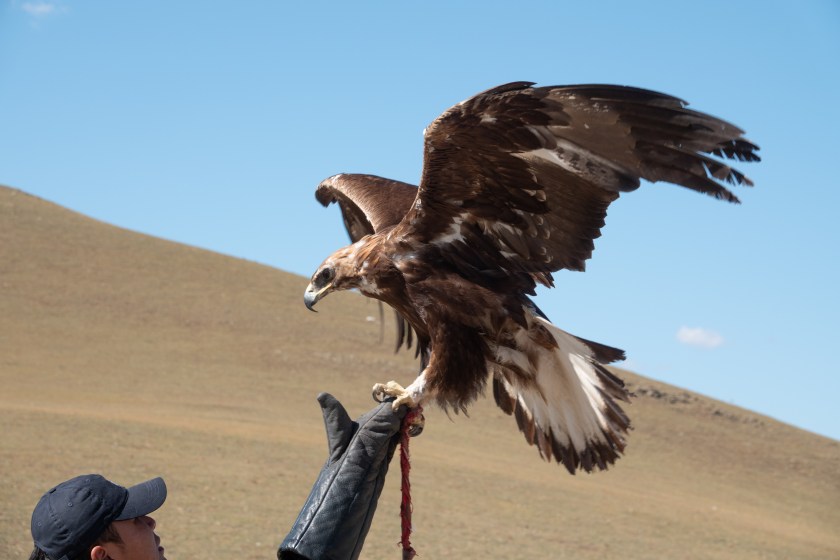
PPS Reverting to birds, we also saw various raptors, soaring on the updrafts, including Golden Eagles, Lammergeiers (aka Bearded Vultures), Cinereous Vultures, and the pheasant-sized endemic Altai Snowcock. But none close enough for worthwhile photos. The pictures below of a magnificent golden eagle were, rather depressingly, taken at a roadside display en route to Ölgii airport next to a souvenir stand.

Two-humps good

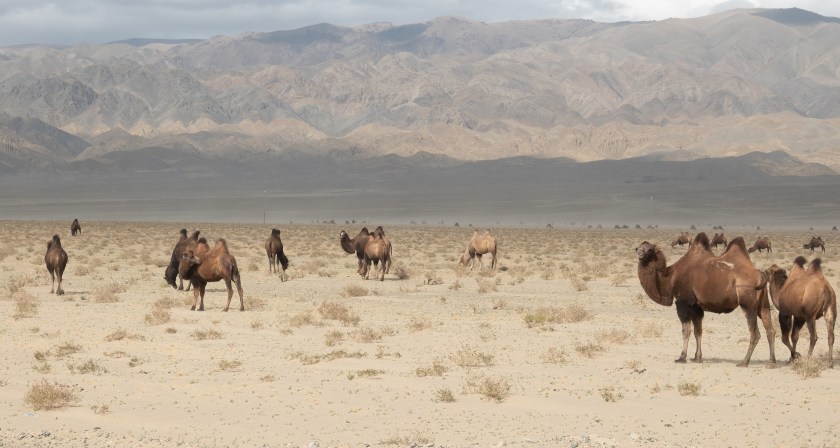
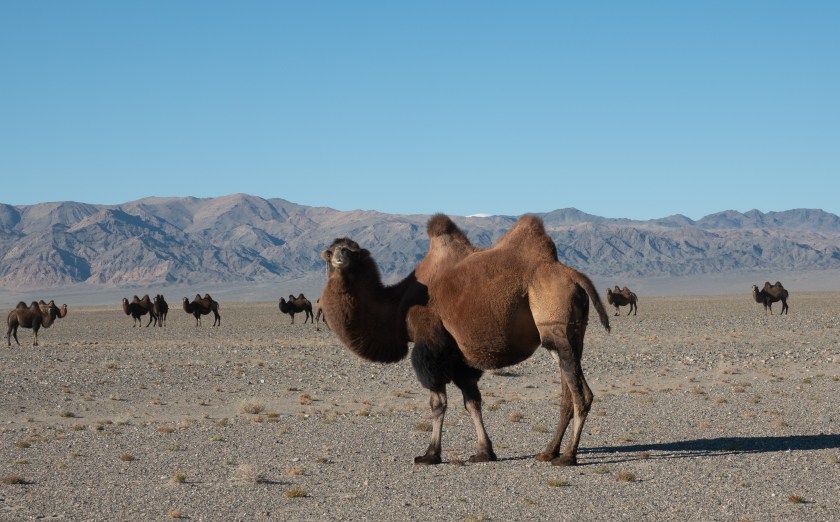
Wild Bactrian camels, Camelus ferus, are found only in very small numbers now, maybe 800 only, in remote parts of the Gobi. We didn’t expect to see them and we didn’t. But we were very taken with the next best thing, domestic Bactrian Camels, Camelus bactrianus. They are not closely related to the wild Bactrian Camel, having diverged maybe 1 million years ago, and they too have two humps.

The humps are fat, not water, and a way to store energy. The Mongolian population totals around 400,000 domestic camels. They roam free across the stony steppes, doing a convincing impersonation of wild animals!

They’re big mammals, the largest in their natural range. Overall height ranging from 230 to 250 cm (7.5 to 8.2 ft), head-and-body length is 225–350 cm (7.38–11.48 ft). Body mass can range from 300 to 1,000 kg (660 to 2,200 lb). They can have a rather ungainly look, as if assembled by committee.

A family may own anything from a handful of camels to several hundred. A castrated male costs about US$400. The herds you see may belong to more than one owner. There are two young ones in the photos below:

When their owners want them, they are rounded up by motor bike: one is approaching in the background.

Our guide pointed out that they ride their motorbikes (and indeed drive their vehicles) pretty much as if they were still on horseback:

My friend Jane made a video:

Their adaptations to the extreme climate in which they so successfully live make them very valuable additions to human societies. They were domesticated around 4000BCE, and used as pack animals on the Silk Road, for riding, but also for milk, meat, hair, and leather. Gers (yurts) may have camelhair in their felt insulation, they may be tied together or packed up with camel skin ropes and bags, and moved from place to place on camels’ backs.

Their adaptations for their harsh home climate include long eyelashes, and nostrils that close, to protect them from sandstorms.

They have tough mouths, and can eat thorny vegetation. If desperate, they will eat skin from carcasses, and even rope, sandals and tents!

They can go without water for months at a time, but when water is available Wikipedia says they may drink up to 57 L (13 imp gal; 15 US gal) in one go. They also routinely eat snow for moisture, unlike most mammals.

A splendid animal:

And their proud owners get together to race them at the annual festival; they ride them pretty hard, but I assume they recover, since they’re too valuable to risk their health:

PS The way to remember that Bactrian camels are the ones with two humps is that Bactrian begins with B, and placed on its side the letter B has two humps!

Survival at high altitude: “..the deserts shall rejoice.”

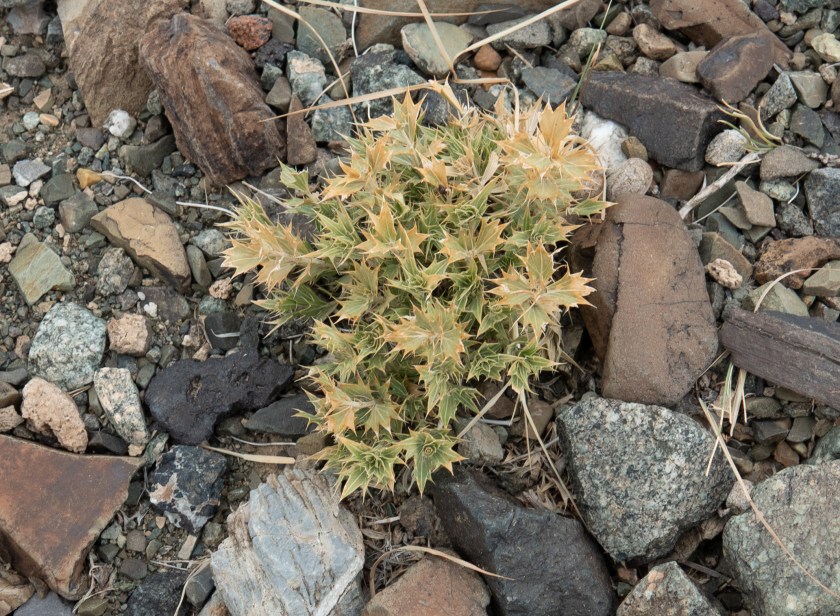
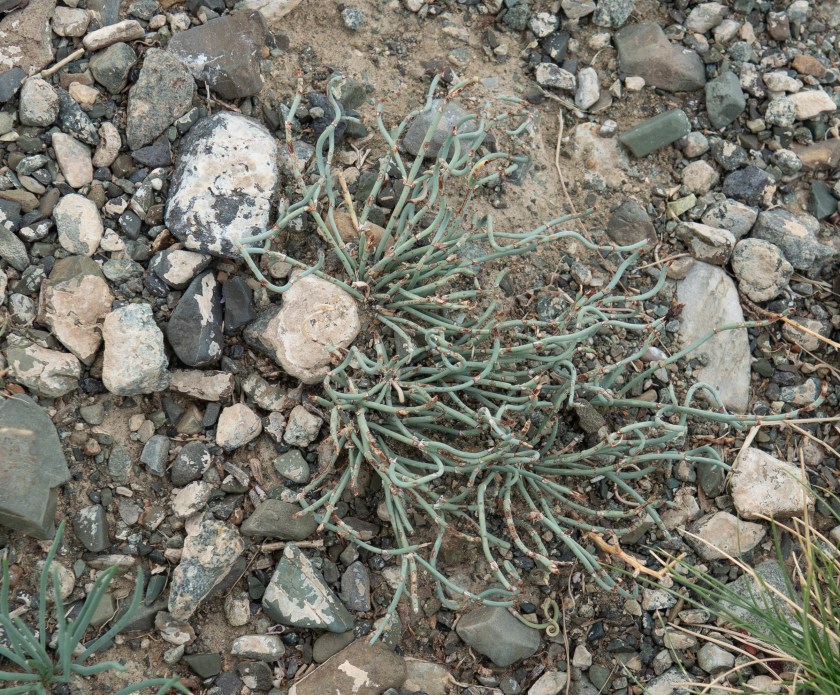
When we were not looking for snow leopards, we explored the lower altitudes of the Altai. As we drove down from our camp towards the valleys, the dry inhospitable stony slopes seemed barren of life, but they actually host a few low growing plants, most of which I’d never seen before. iNaturalist helped me ID them on my return, and all these ID’s were confirmed on iNaturalist by expert Mongolian botanists.

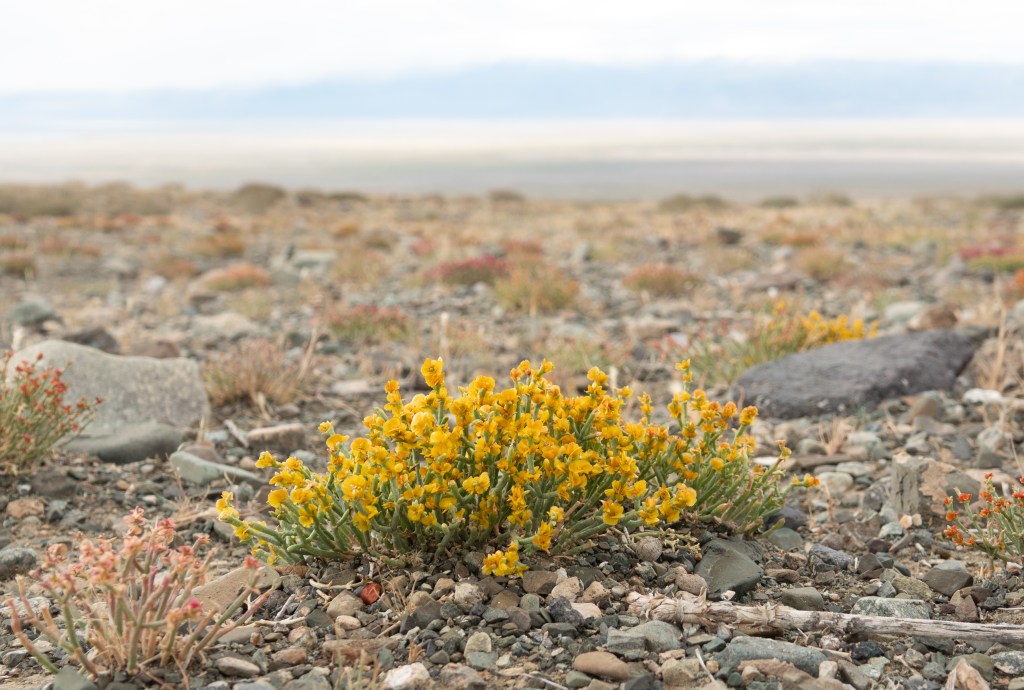
The landscape was Biblical, and many of the plants that survive here are succulents. Annual rainfall is about 6″ (15cm), and winter lows can plummet to -20F, though summers can rise above 80F. In September, not surprisingly, many plants had no remaining vestiges of flowers (but keep reading!):

Lagochilus ilicifolius
Ephedra przewalskii
Nepeta annua

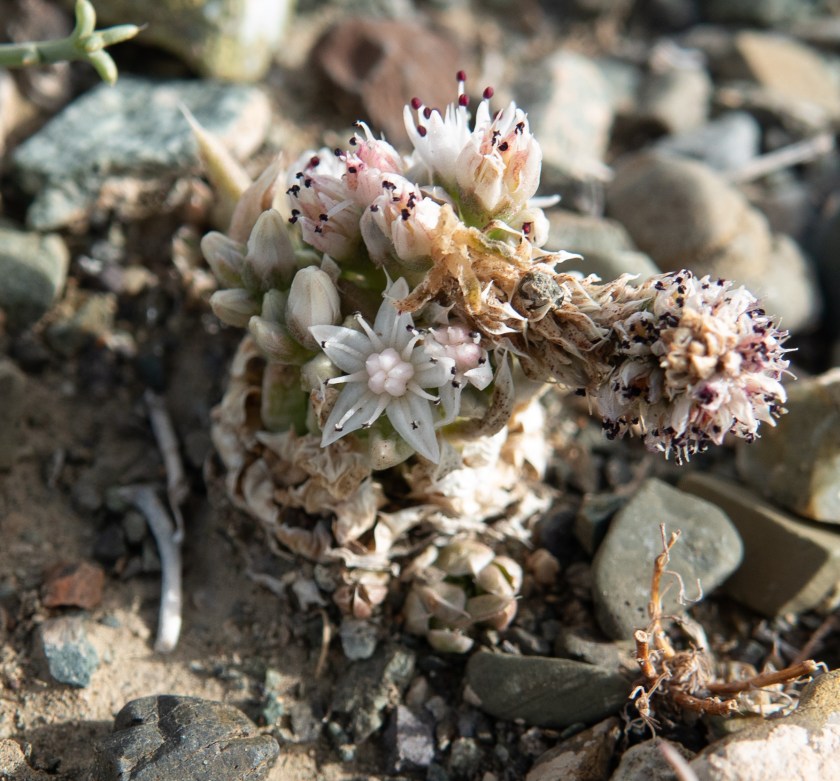
In the spring, the wildflowers must be spectacular, like the deserts in California after spring rains. But even in mid-September a few hardy plants were in flower.

Siberian Catmint

Orystachis thyrsiflora
Orostachys thyrsiflora

Sea Foam Flower
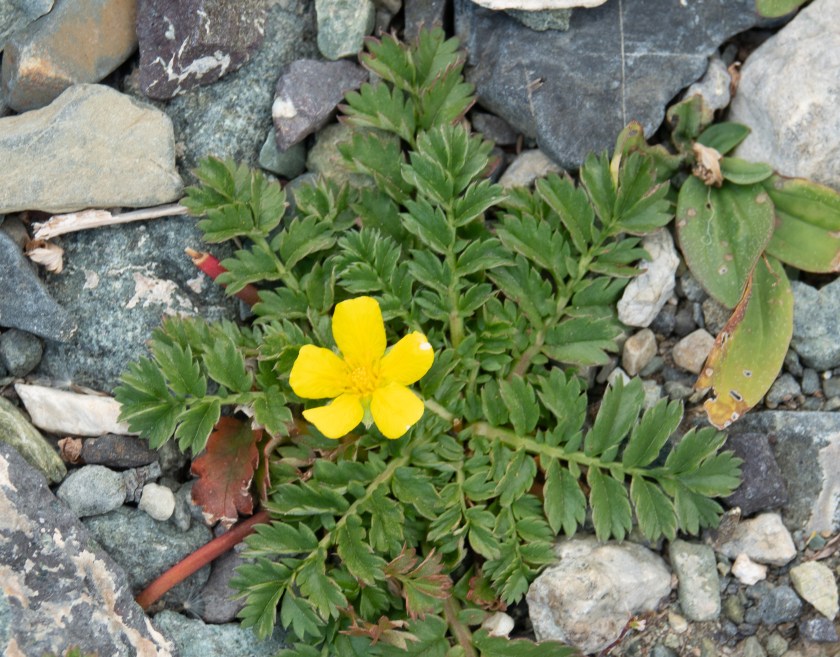
Common Silverweed

Danyang Aster

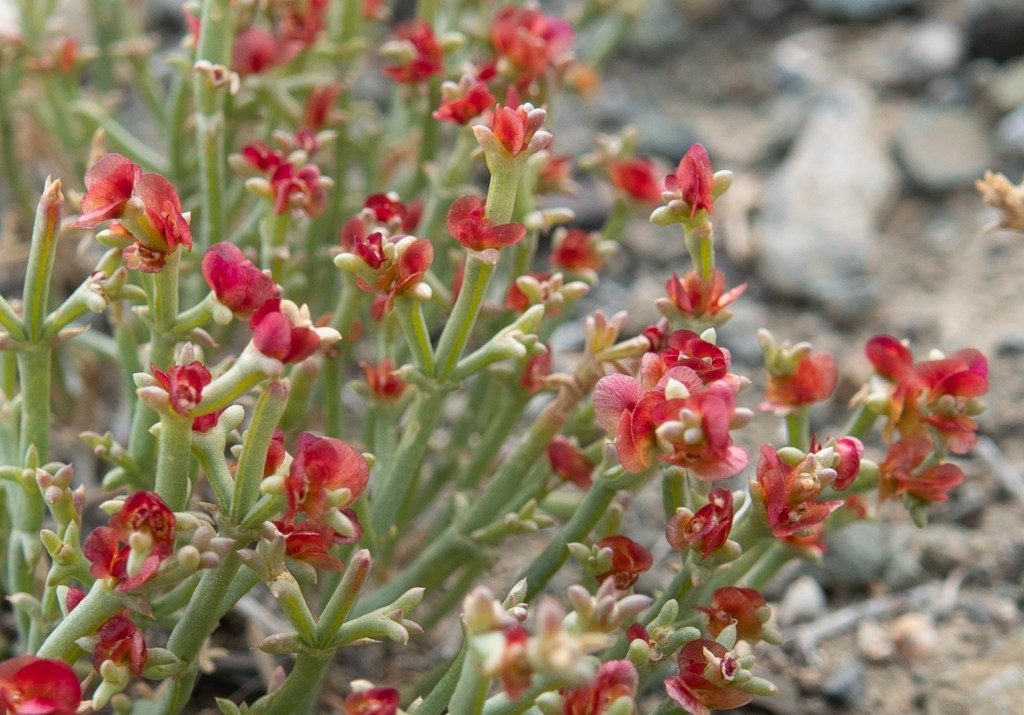
My final plant, and my personal favorite, came in a range of hues from dark crimson to yellow:

Short-leaf Anabasis, Anabasis brevifolia

Life has a way of triumphing over adversity, or as that great poetic work the King James Bible, Isaiah 35: 1-2 says: “The wilderness and the solitary place shall be glad for them; and the desert shall rejoice, and blossom as the rose.”

Another time, I’ll show you some of the birds of these high altitudes.

PS This species of Anabasis is used as forage, but a different species is toxic, and was used as an insecticide in the former Soviet Union.
Saiga and other ungulates

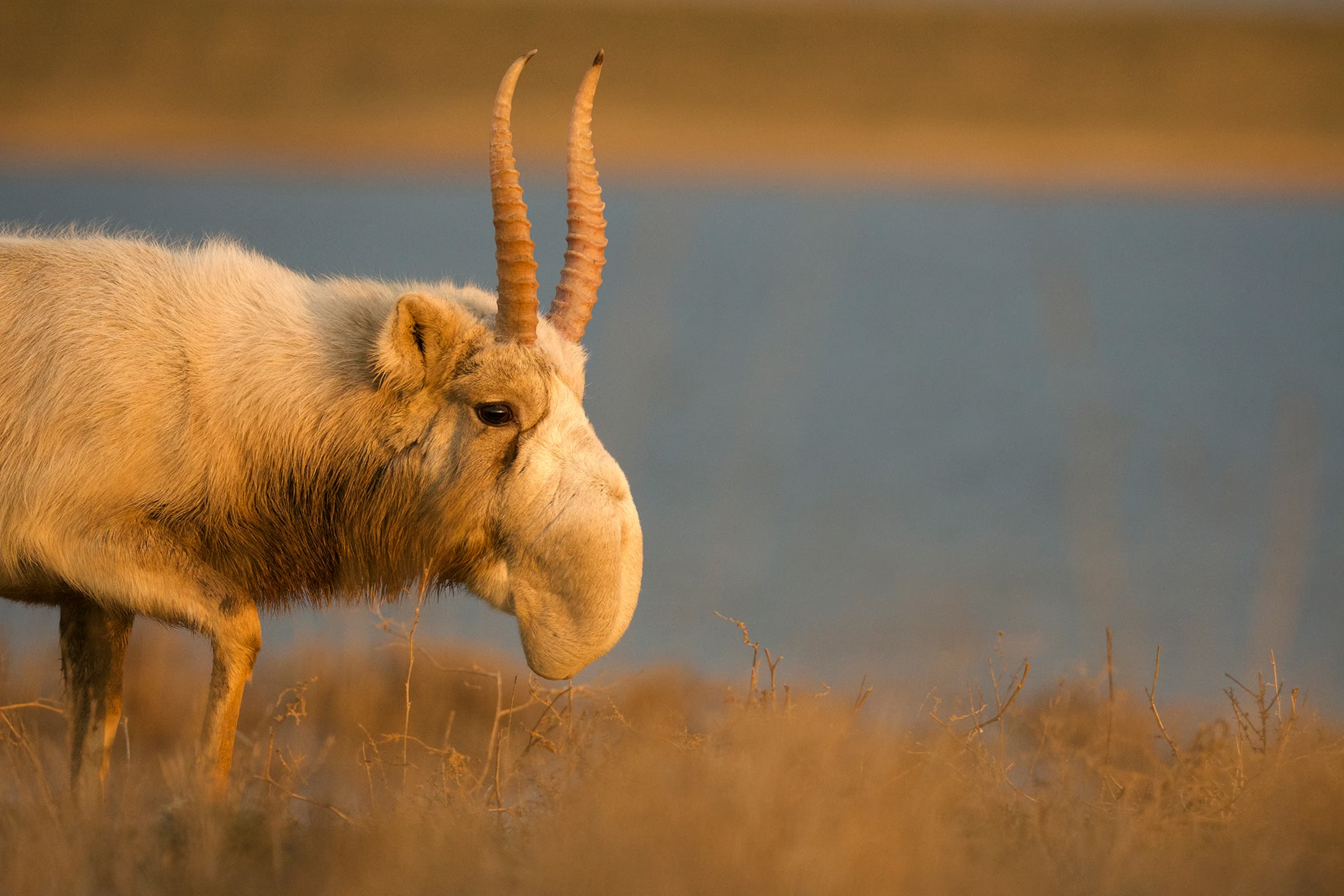
There are several different species of antelope and gazelle in the parts of Mongolia we visited. Of these, the Saiga antelope was top of our list, for three reasons. First, this antelope has grazed the steppes since the last Ice Age, alongside the Woolly Mammoth and the Siberian Tiger. Second, it is a bizarre-looking creature, with the older ones developing an extraordinary proboscis-like nose. Third, it almost disappeared from the steppes of Central Asia in the early 2000’s, being classified as Critically Endangered. It has since recovered remarkably, and is now classified as Near Threatened.

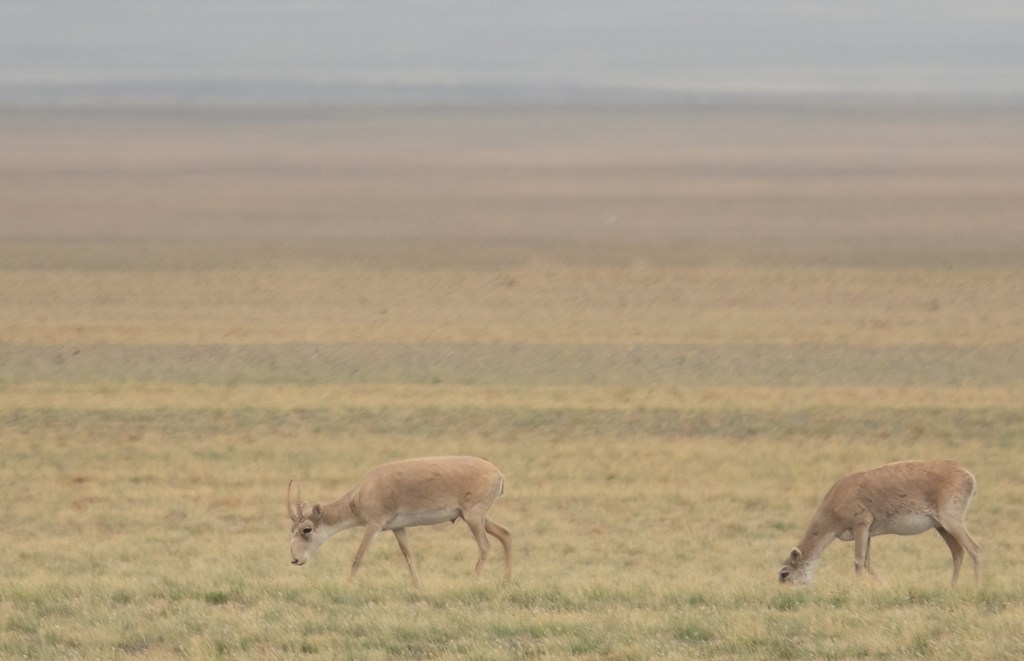
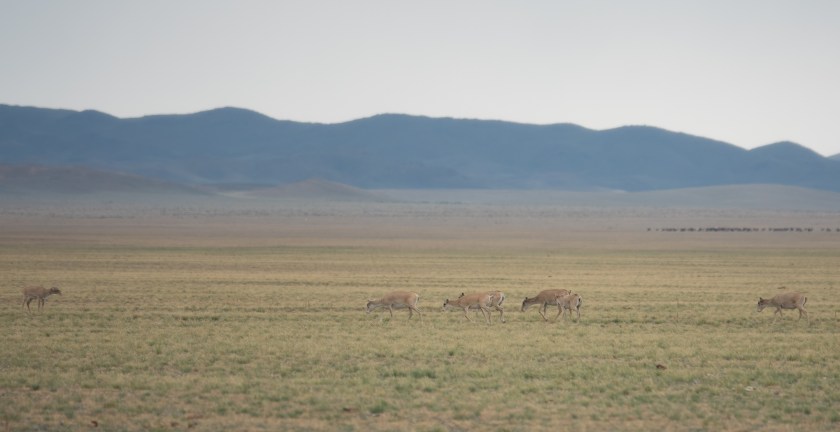
The rugged mountains where the snow leopards live are separated by wide valleys of steppe grasslands. This is Saiga territory. They are skittish, so we never got very close, but we saw a herd of around 30 animals sharing the vast flats with sheep and goats (right in background):

and cattle:

They hold their heads low, even when running:

They have Roman noses and a lugubrious face:

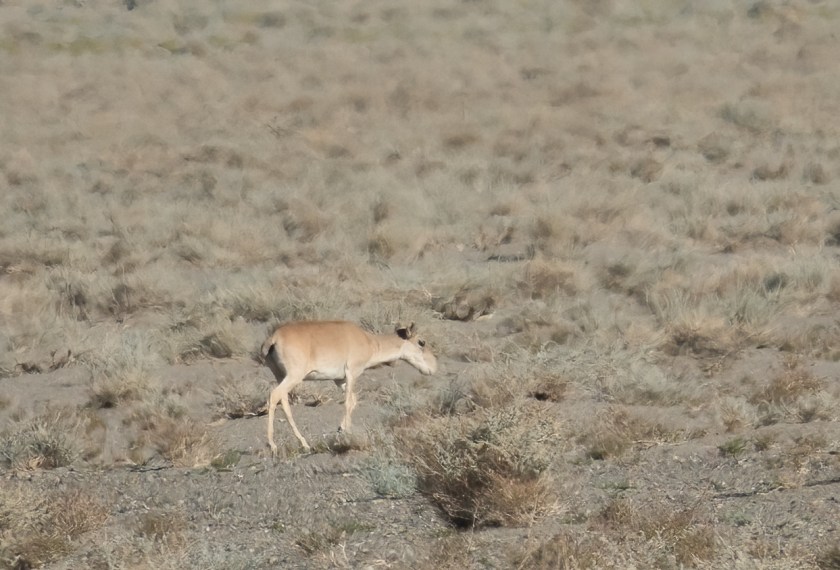
Another day we saw a single doe:

walking all alone and solitary across the plains :

What we didn’t see, sadly, was a mature male with a fully developed proboscis, so here is a photo from National Geographic:

The reasons for the saiga’s precipitous decline were many. After the Soviet Union broke up illegal hunting increased dramatically, driven mainly by demand from China for the horns for traditional medicine. The Pasteurella multocida bacterium caused mass deaths in 2015, and the Peste des Petits Ruminants Virus (PPRV) spread from livestock in 2017 and killed nearly 80%. It gets worse. A 2021 study showed that Foot-and-Mouth Disease has also spread into the saiga herds, with a mortality rate of 34%.

The rebound in population is extremely encouraging, but they are not out of danger yet.

PS We also saw Goitred Gazelle in the Altai, and Mongolian Gazelle in the west of the country, but too far away to photograph usefully. Here are some Mongolian Gazelle, grazing alongside a herd of horses:

They’re not endangered at all, I am delighted to say, despite being hunted for centuries: “a passage in the 13th-century Secret History of the Mongols tells how a young Shigi Qutuqu managed to round up a herd of gazelles in a winter blizzard.” (Wikipedia)

Snow Leopard Quest: the nuts and bolts

[In pale imitation of the BBC’s documentaries which always include a section on “Making Planet Earth”, this post is more about ‘how we saw it’ than about the nature itself, so it may not interest you. Back to proper nature next time.]

To penetrate the mountain fastness where the elusive snow leopard lives takes planning, time, and the skill of a lot of wonderful people.

This is what we went to see, up to 59″long plus 41″ tail, 120lbs of predatory grace (photo from the World Wildlife Fund website):

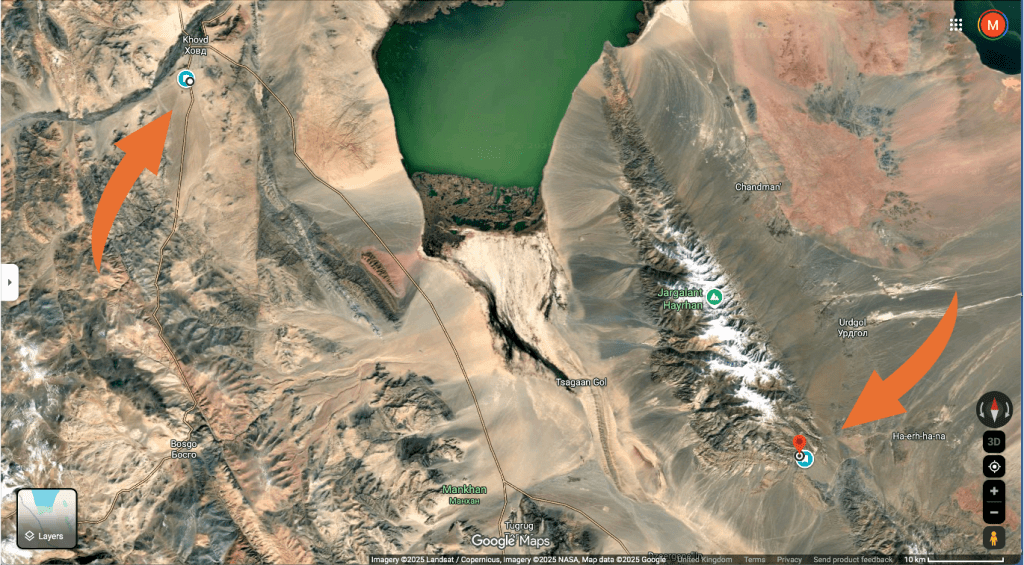
They live in Central Asia and the Himalayas, and we saw them in the Altai area of Mongolia. We flew to Khovd, 2 hours west of the capital Ulaanbaatar

then drove from Khovd, top left, another 2 hours or so to our base camp at 1500m high, bottom right.

The leopards live in the Jargalant mountains, snow-topped on the map.

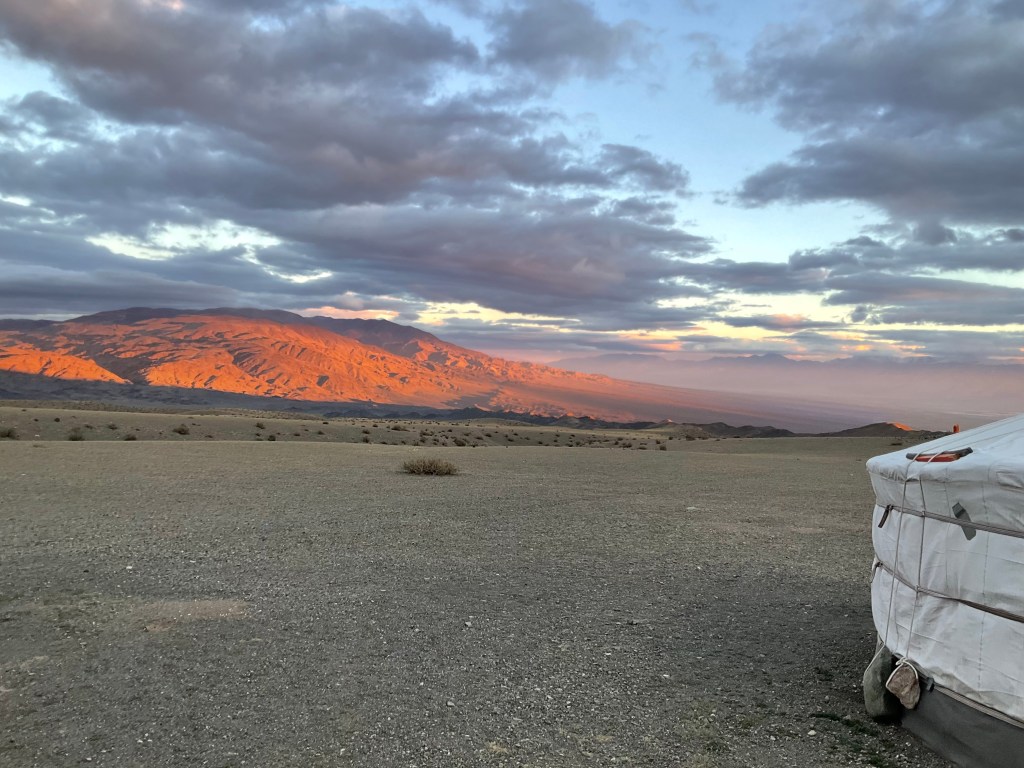
Our base camp had eight gers, each with painted doors, wooden beds and a pot-bellied stove. :

The camp was owned and run by a family. The pater familias was Soronzon, (who we nicknamed Big Daddy):

plus his wife and daughter (our excellent cooks, not just dinner at camp but a hot lunch in the field every day):

And then his two sons, who were a driver and a scout respectively, as well as being of necessity resourceful mechanics:

even if they eventually needed reinforcements:

The scouts live in an isolated ger, scanning for snow leopards; theirs was on top of the mountain, and I’ve lost my photo, but the different one shown by the arrow below shows you how they are dwarfed by this landscape:

The grand-daughter came along one day too:

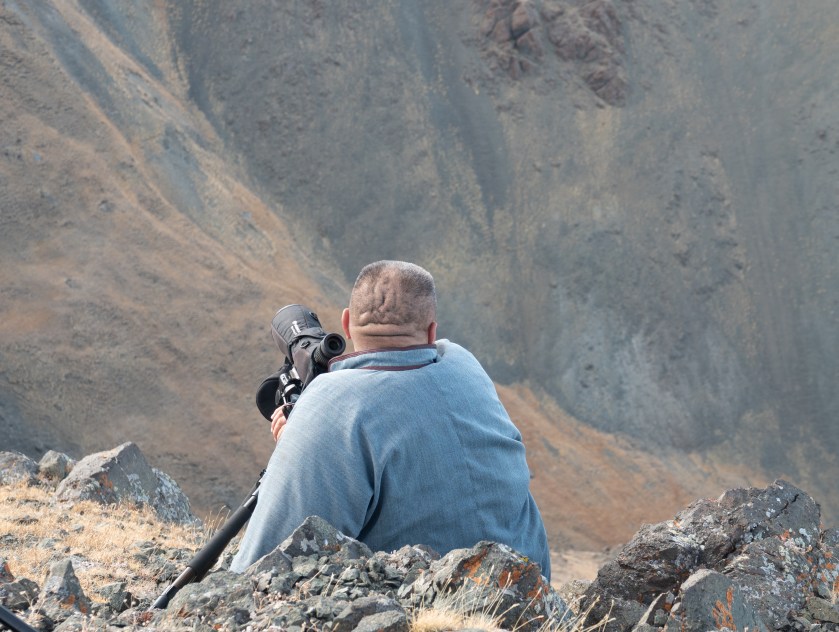
And of course the excellent Istvan, our Hungarian guide, whose photo you saw in the last post, and a translator called Eta, the daughter of herders.

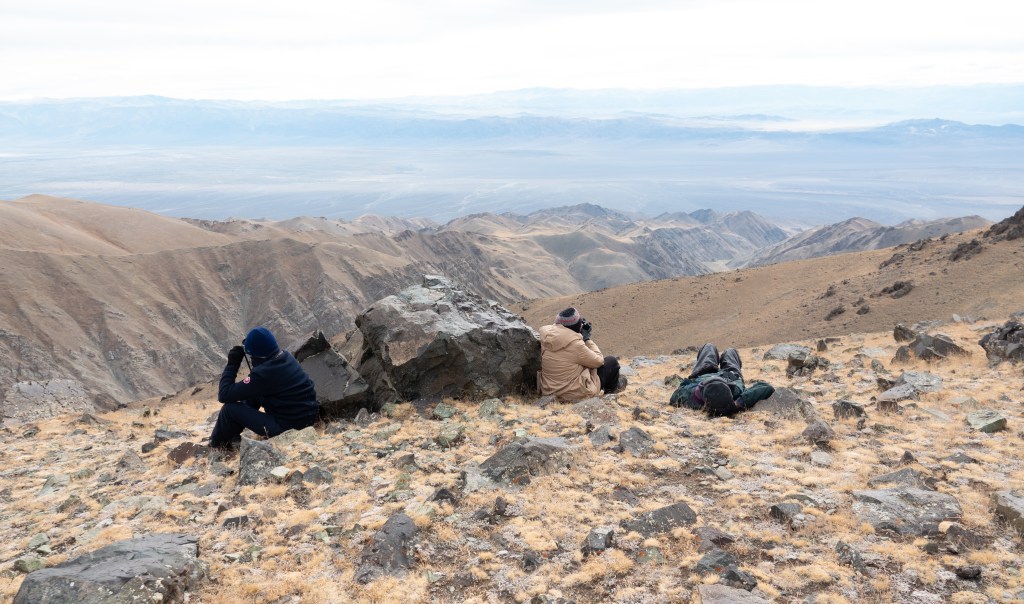
All these photos were taken on our first full day of searching, us sitting on the rocky ground with our binoculars, the guides using their scopes. We were at about 3300m, nearly 11,000 feet (5000 feet higher than Mt Washington, the highest peak east of the Mississippi).

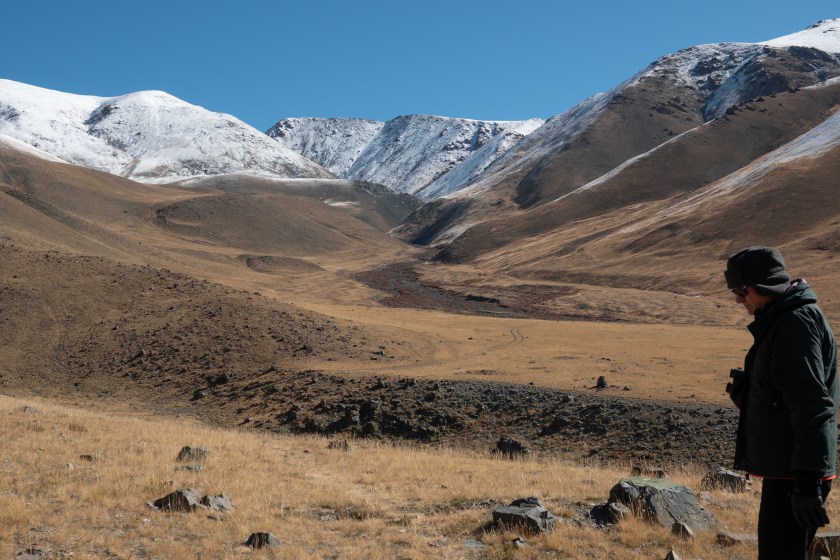
The vistas are wild and open and stark:

But no amount of scanning rustled up a leopard that day.

The next day it rained, and we were also told the leopards had probably descended to lower altitudes, following their prey, so we too stayed low down and looked for other animals.

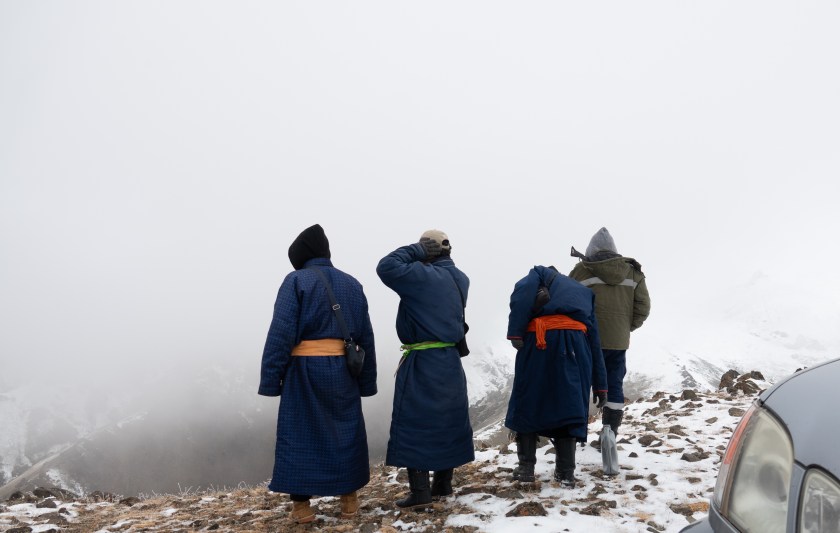
The following day the mountains were covered in cloud, and the rain of the lower altitudes had been snow up there, so we stayed lower during the morning, but after lunch we were told the clouds were starting to lift, so we set off, into a whiteout. The intrepid scouts, who live high in the mountains all summer, emerged from the mist:

and scanned the hillsides whenever there was a break in the clouds.

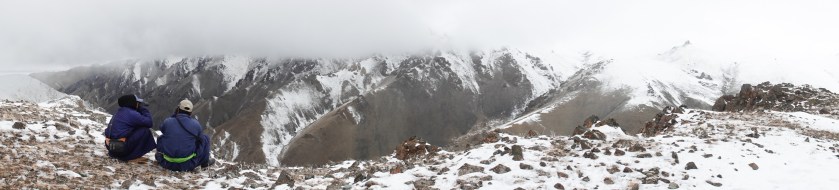
As predicted, the clouds lifted, slowly, and for hours we scanned in the cold, retreating to the vehicles when we couldn’t take it any more.

But Istvan and the scouts stayed there throughout.

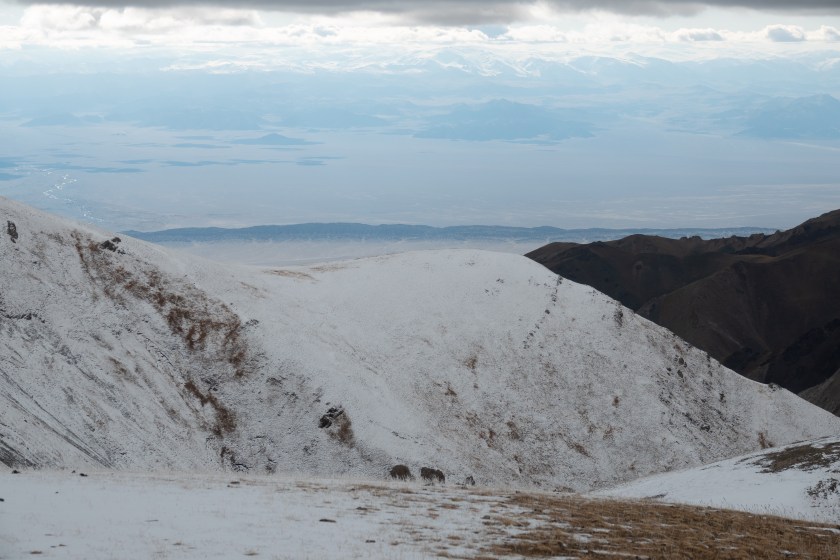
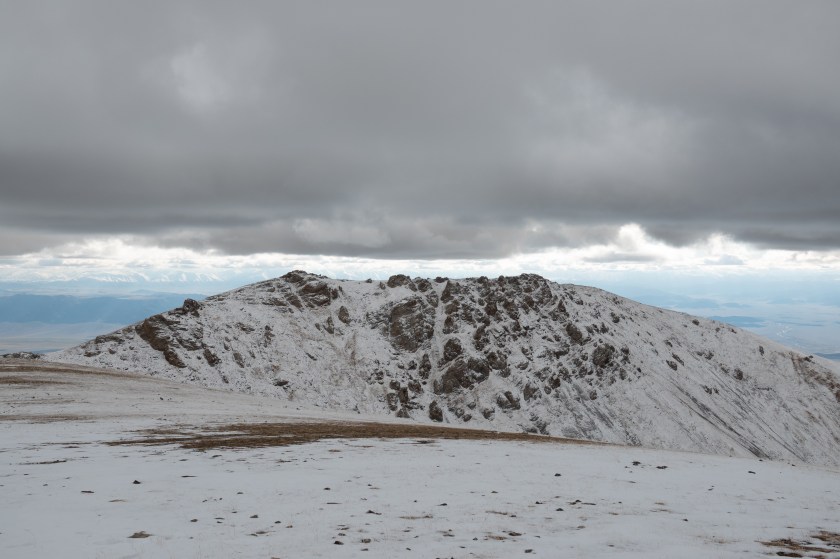
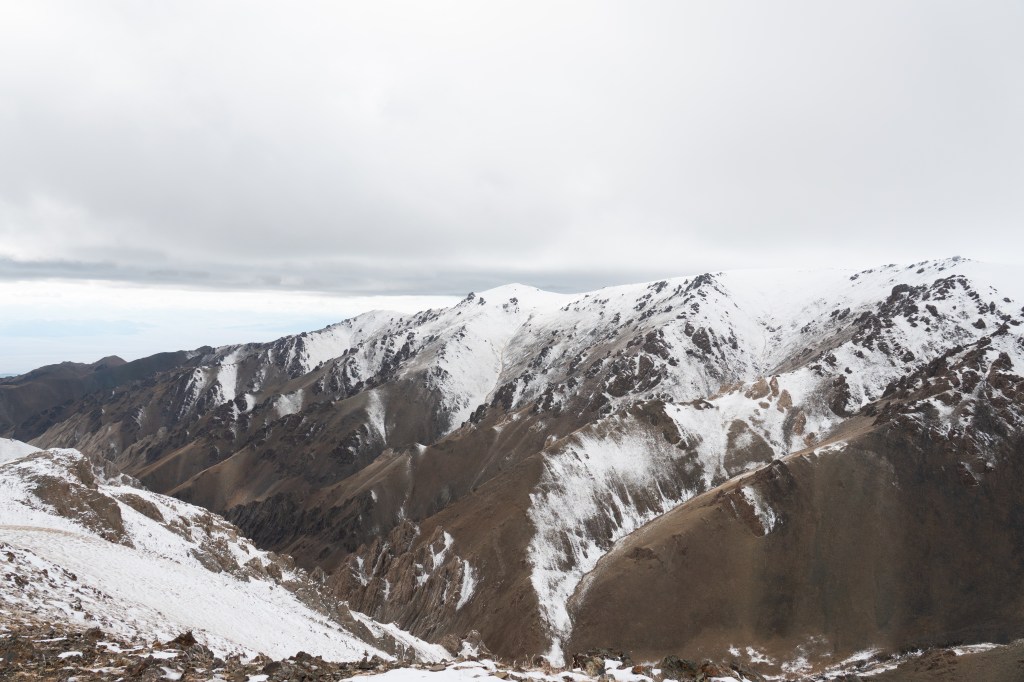
Unsurprisingly we saw nothing, but the views were extraordinary:

The next day was our last day, and the skies cleared. The team decided to search lower down on the other side of the mountain range, and you know what happened next… (from my last post).

A former producer for one of the BBC’s nature shows said that snow leopards were for her “a bit too hard core for the reward”. For me, it was worth it. She also said that it “needs the most expensive cameras on the planet”!  True, and sadly, I didn’t have one.

PS On our last evening in camp, two musicians from the local village of Chandman played for us. One was a throat singer, listen and watch here. The last portion is the Q&A in which he demonstrates his techniques. (Thanks to Stephen and Kerstin for the videos).

Ghost of the Mountains

I have just got back from Mongolia, and this will be the first of several posts. But the biggest hope was to see a Snow Leopard, Panthera uncia, and we did, and so I’m going to start with the day it happened. In later posts if you are interested you can read more about the prior four days of searching, and many other Mongolian delights.

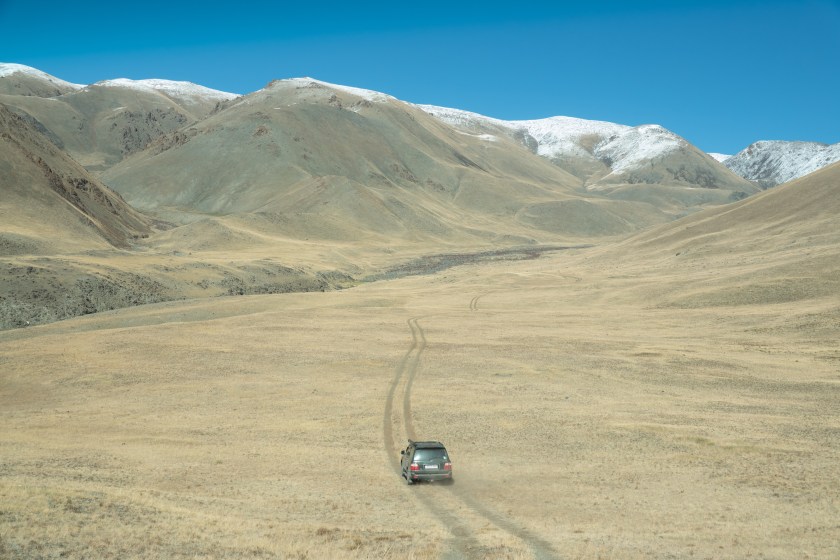
We were in the Altai, in the west of Mongolia. Snow leopards live in these mountains, which rise to nearly 4000m. But it was cold, and our hosts told us the leopard’s prey had moved lower and so had the leopards, and they doubted we would see one. Discouraging. On day four, we went round to a new side of the Jargalant Mt range, and drove up the valley. Here is the ‘road’, and a shot of the glorious scenery:

We paused for a rest, looking out across the distant valley at some tiny dots that were Argali sheep. In front of us was an oboo, a stone cairn surrounded by a stone circle that marks the ancestors and their bonds with nature, lined up precisely with a gap in the hillside.

We drove higher:

and stopped for lunch, at about 2600m. The snowline was around 3300m. The scouts on their dirt bikes arrived to join us.

At the bottom of the valley in the photo below is a tiny dot, in the centre of the photo. That is a dirt bike, so you can absorb the scale of this landscape. .

We settled down,

Istvan our guide scanning the hillsides:

No sign of a leopard, just some distant yaks and an ibex.

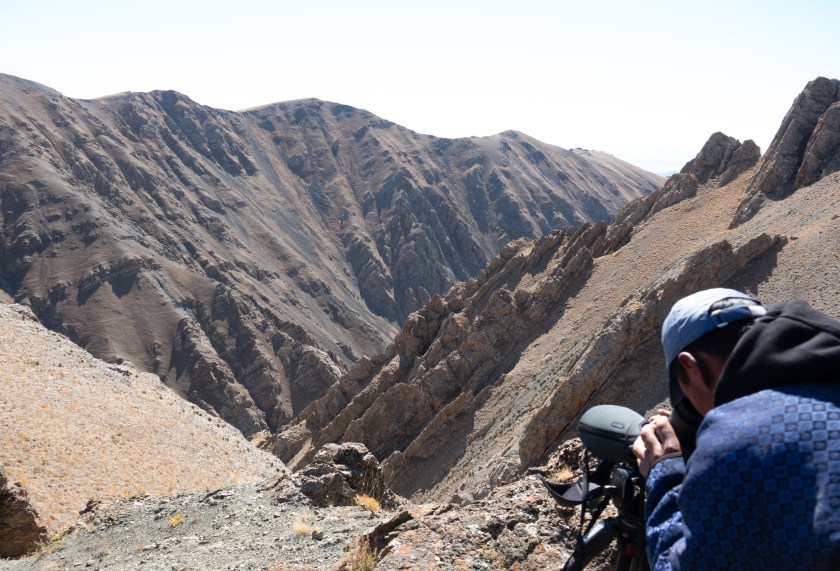
This was our last day in the mountains, and at 1.30pm we started to get into the vehicles, when there was radio crackle, and excited chatter in Mongolian from our guides. Unbelievably the scouts (who had finished lunch and gone back to search) had seen a leopard. We hiked across a steep hillside for about 10 minutes, and looked down into another valley. One scout materialized, and looked through the scope.

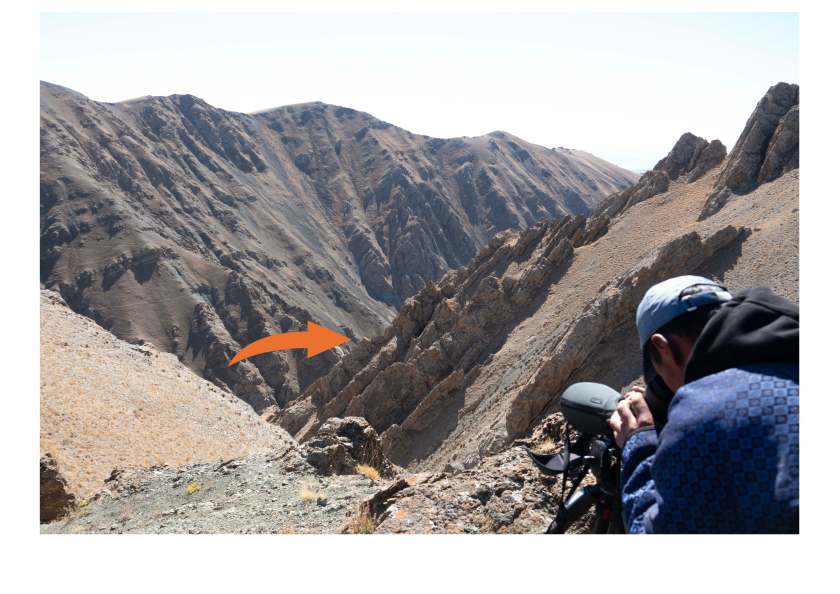
The leopard is here, 800m or 1/2 a mile away across the valley:

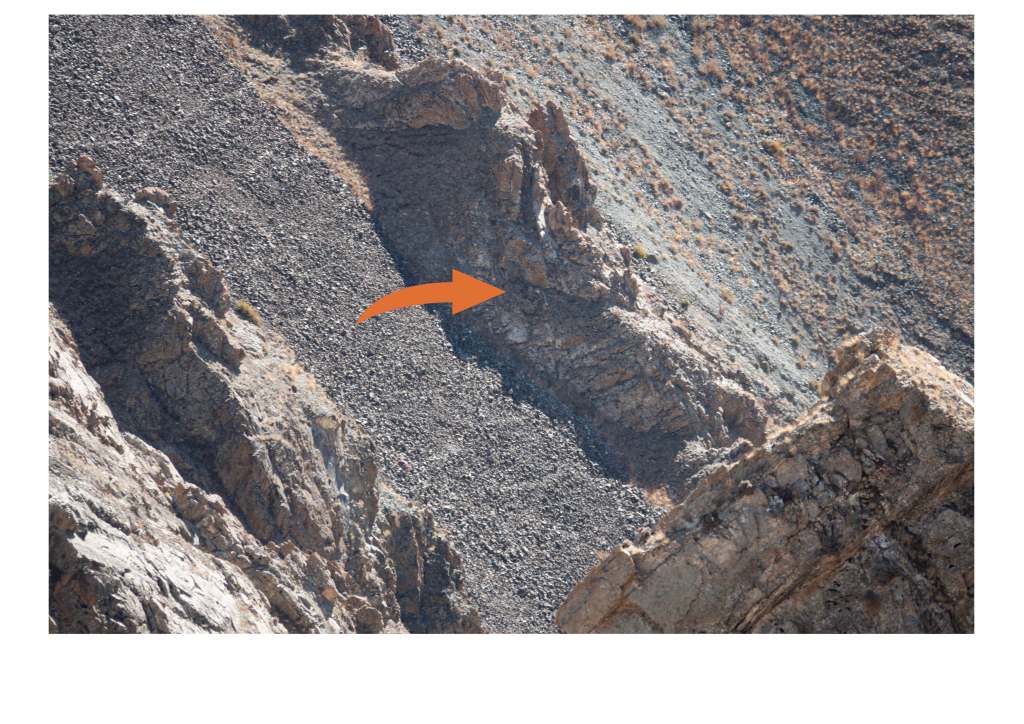
Look closer:

My camera is not up to BBC David Attenborough standards, so my photo is unimpressive, but it is indeed a snow leopard, asleep on a ledge, 1/2 mile away:

Only the tail gives it away. There was a dead ibex nearby, so it had eaten and was now guarding its prey and taking a nap. It may stay with its prey for a week, and kill every 10-15 days. How the scout had seen it was beyond us. He said it had slightly shifted to get more comfortable, and the movement had given it away. What skill, and what eyesight.

Had we left 30 minutes earlier we would never have seen a snow leopard. There is something about knowing that you have brushed up against the world of such a mythical beast that fills your heart with joy. Sometimes the stars align.
PS Mongolia probably has a population of around 1000 snow leopards spread across around 100,000 square kilometers. Each solitary animal can range over around 500Km2.

https://globalsnowleopard.org/paws-preliminary-estimates-of-mongolias-snow-leopard-population-released

There are around 4000-6500 worldwide. The IUCN classifies them as Vulnerable, and no longer as Endangered (which indicates less than 2500 left worldwide), but this is controversial. Much of their isolated habitat is not explored. If you are interested, a very good summary of their behavior and status can be found here: