The Sudden Demise of an American Chestnut

The American Chestnut disappeared in a few short years after the chestnut blight, imported from Asia, killed about 4 billion trees in the early 20th century.

But every now and again one decides to regrow, and lo and behold a few years ago I noticed a very healthy-looking sapling on the edge of my field. By last year it was maybe twenty feet tall, and in full flower:

I have read that very few trees reach the flowering stage before succumbing to the blight, but perhaps I had a winner?
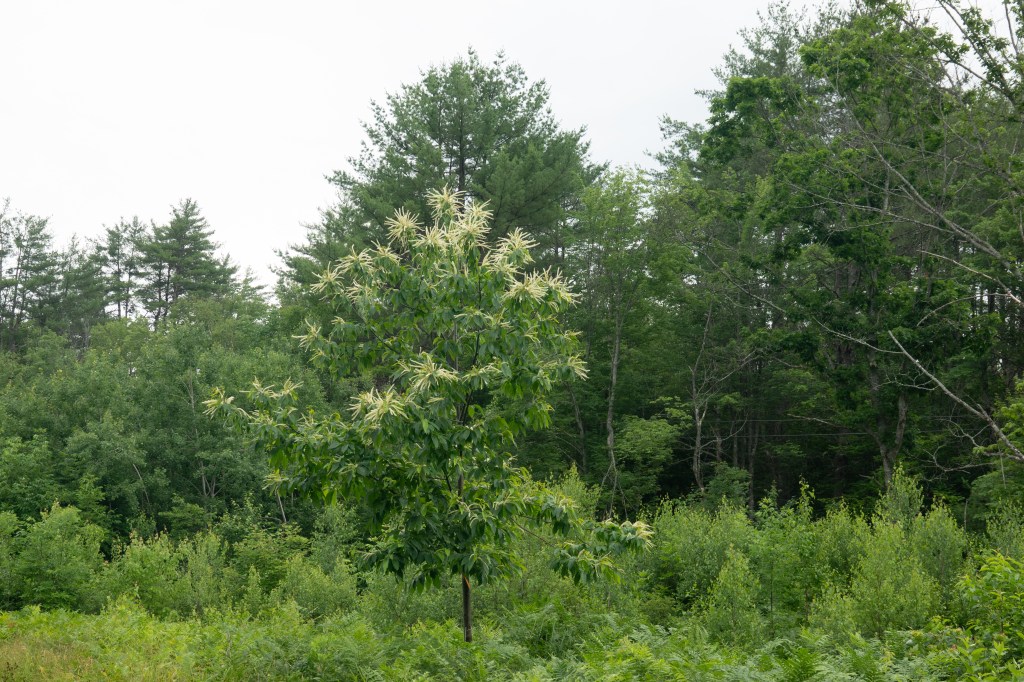
This year, it flowered again. The long creamy fronds are the male flowers, full of pollen that the Common Eastern Bumblebee gorges on. The smaller round prickly ones are the female flowers, which will eventually become the fruit.
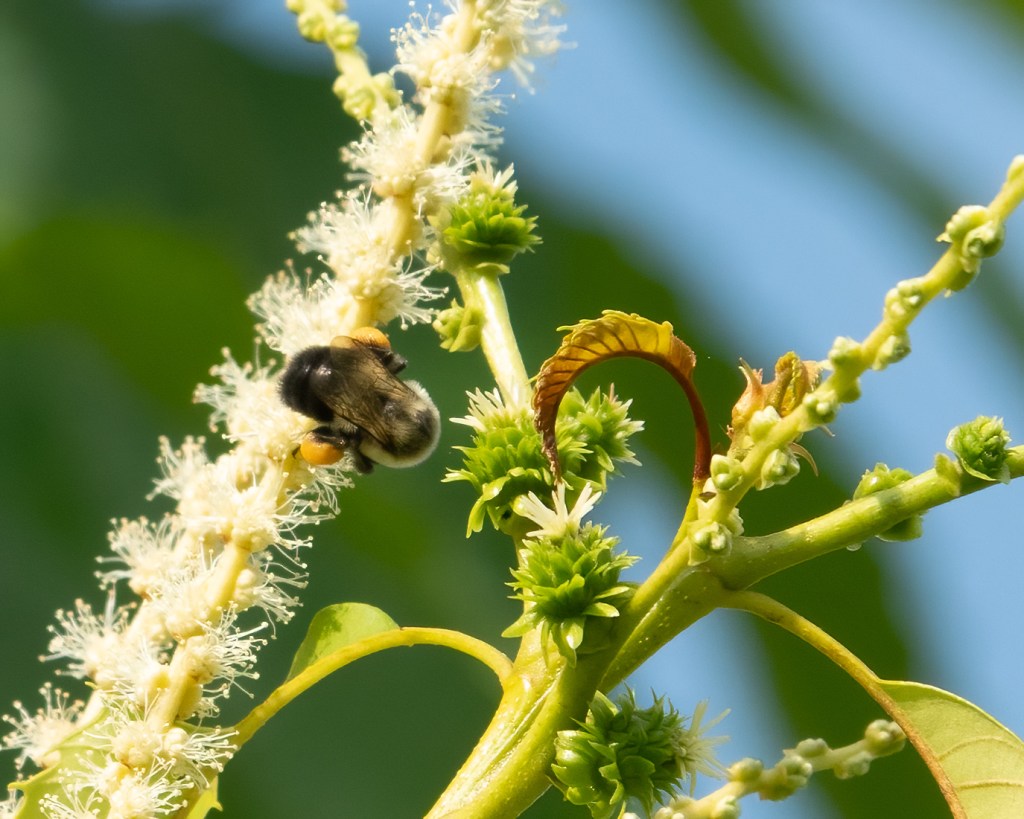
July 6 Round female flowers. Long thin male flowers.

July 6 American Chestnut close-up of female flowers
July 6 Common Eastern Bumblebee gathering pollen from male flowers

These photos were all taken on July 6th.

Five days later, on July 11th, the entire tree drooped:

Two days later, on July 13, it was moribund:

and three days after that, on July 16, it was dead.

The speed with which this fungus kills is horrifying. Ten days from healthy-looking flowers, to death.

The blight is a fungus that enters the tree through a small wound of some kind, creates a canker. Once it girdles the tree, it is doomed:

The trees send up suckers from the roots and the base of the trunk, and all of those below the canker were entirely healthy, but everything above it was brown and dead; the arrow points to the canker, and you can see healthy shoots in the foreground and to the left.

Most of my posts are (I hope) joyous, but this is a dispiriting tale of loss.
A Beetle Magical Mystery Tour

[This post is guaranteed to elicit from any under-10 year old an “Ew, gross!” response.]

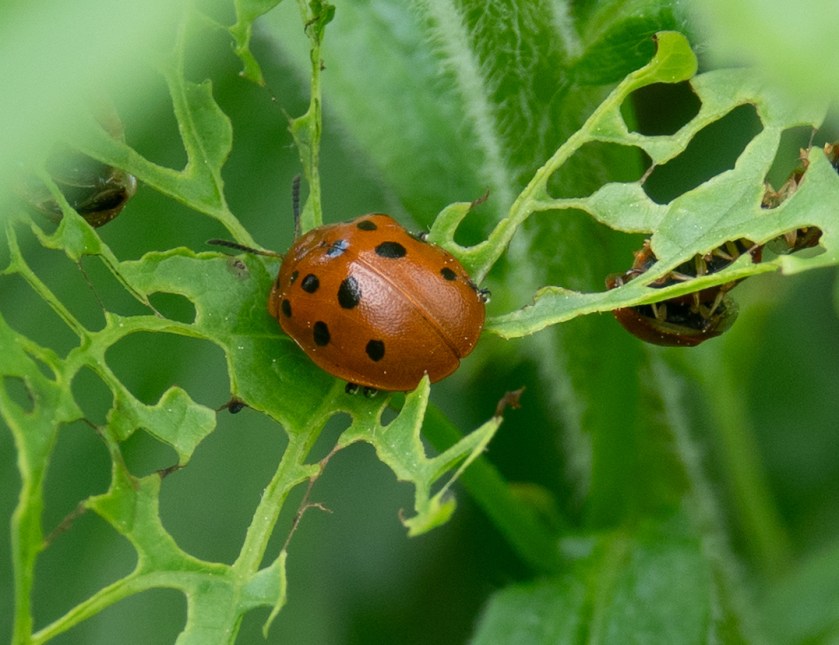
There are at least two different beetles casually called the Milkweed Leaf Beetle. Both are red, and both do indeed eat milkweed leaves, but there the resemblance ends.

The Argus Tortoise Beetle, Chelymorpha cassidea, looks like a ladybug (aka ladybird!) but is a bit bigger at 9 to 12 mm (0.35 to 0.47 in) long compared to 5.5 to 8.5mm for the Harlequin Ladybug.

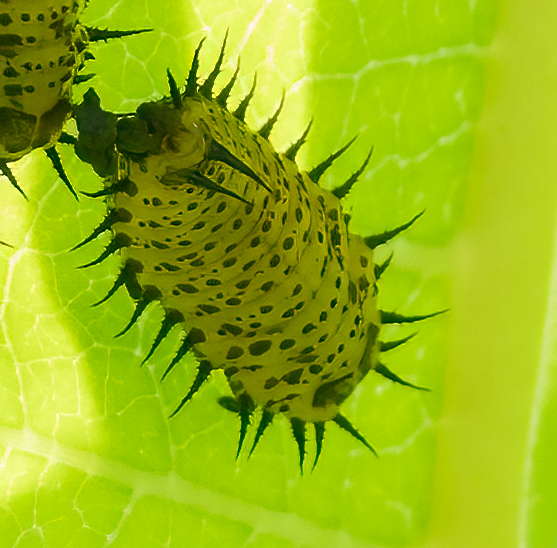
They have the most extraordinary larvae. Here is a trio:

Look at the rightmost one more closely. It has a pair of “horns” at the butt end, called the caudal furca.

Every time it poops, it deposits the output on these horns, building up a substantial lump.

This is called a fecal shield. It curves over the top of the larva like a sort of Roman helmet, and it can be moved or waved around, reminding me of the periscope of the (quite different) Beatles’ Yellow Submarine.

The purpose of this bizarre and rather disgusting construction, seems to be defense against predators (in this case my intrusive camera lens).

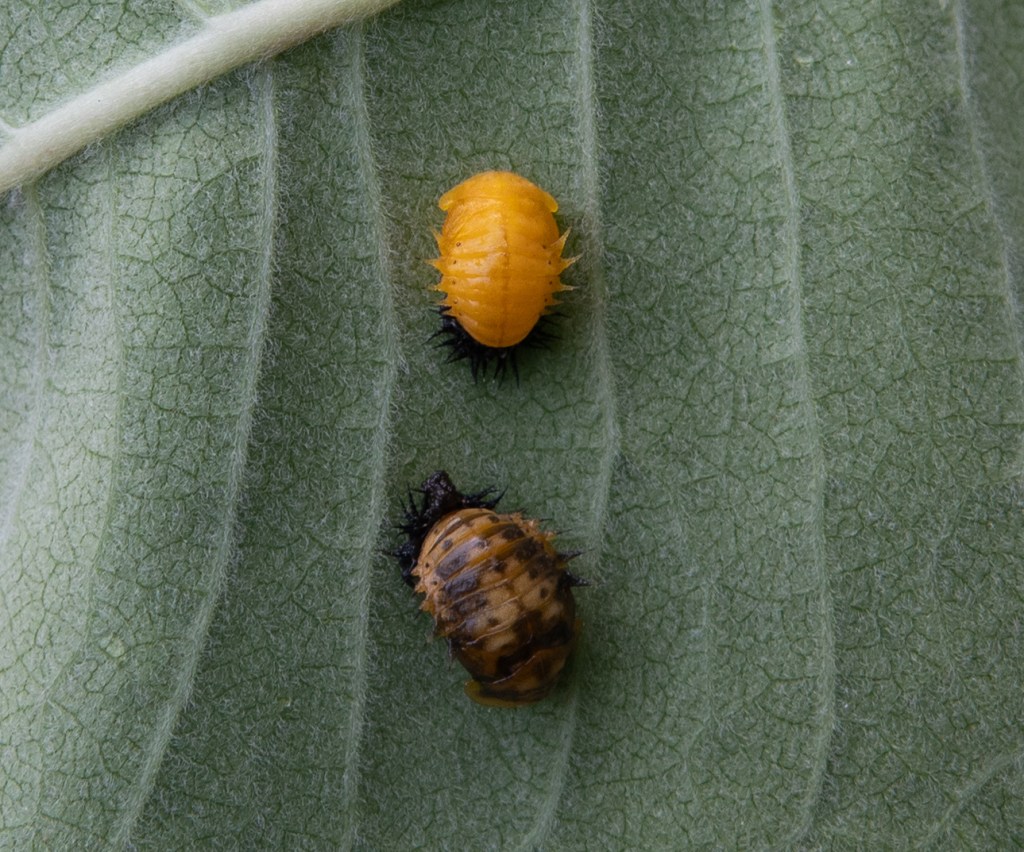
The previous photos were taken at midday on Monday. By 3.04pm on the following day the larva is beginning to form an oval golden pupa, though it is still soft:

At 5.25pm the bottom one has begun to darken, and meanwhile the top one has begun its transformation too:

And by 10.45am the next morning, both have completely changed their color, and hardened into their final pupal forms:

They will drop to the ground, and a new beetle will appear later this summer.

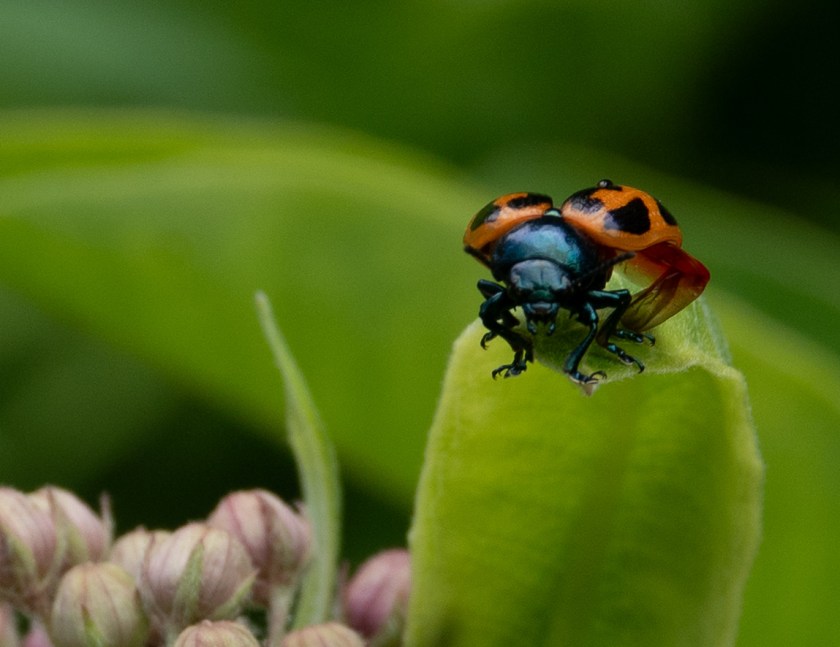
The unrelated Swamp Milkweed Leaf Beetle, Labidomera clivicollis, is also red on the outside:

When it wants to move to a new plant, it goes to a high place:

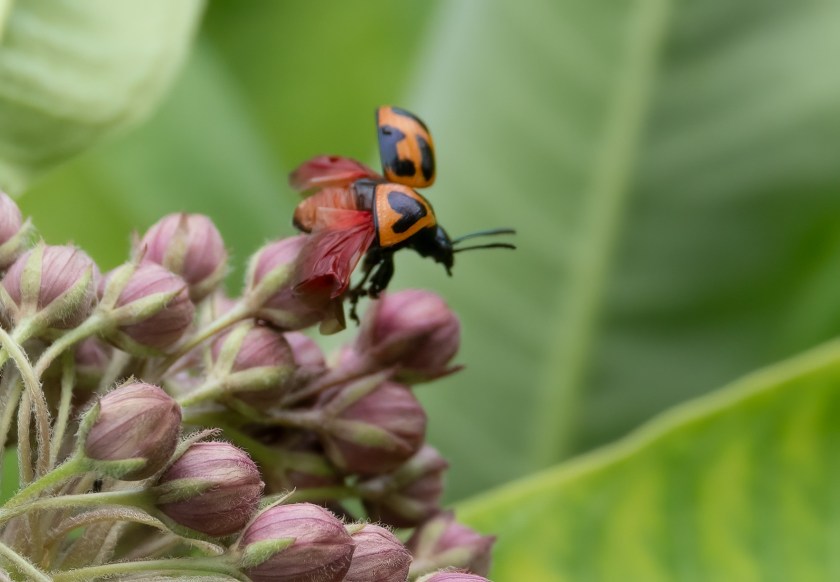
opens those wing cases (elytra):

and unfurls its wings. Lo and behold, they too are red.

An unexpected magical mystery delight.

PS The following one minute video is extremely boring, but shows you that the larvae with their fecal shields are perfectly mobile. For hard-core beetle people only.