Uber Eats is for the Birds

The past few weeks have been prime time for nesting birds and their young. No matter what the adults eat, the diet of a baby bird is pretty much entirely arthropods – insects, moths, caterpillars, spiders, and the like – foods that are high in protein, perfect for growing bones and muscles.

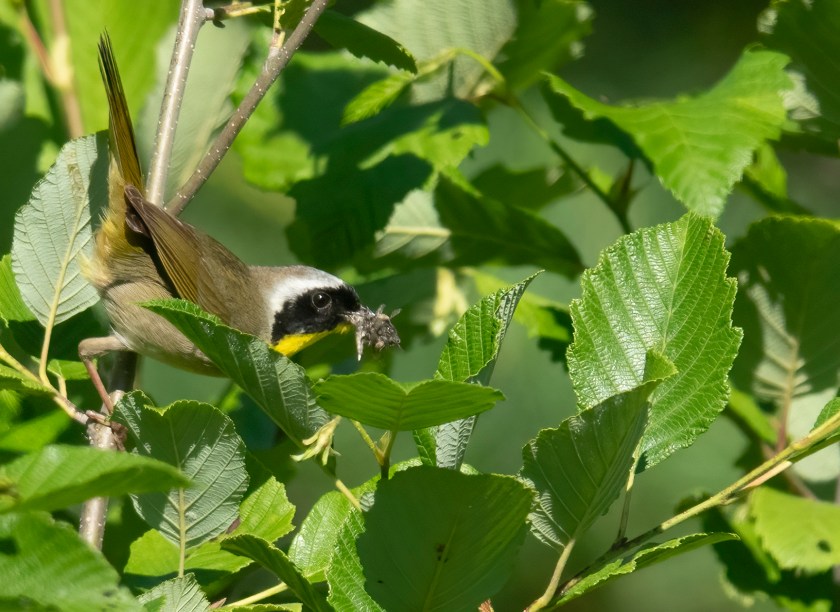
If a bird catches an insect for its own consumption, it usually eats it right away. So if it is carrying the insect around, the odds are high that it is on its way to feed its babies. A Common Yellowthroat male, with an unidentifiable insect:

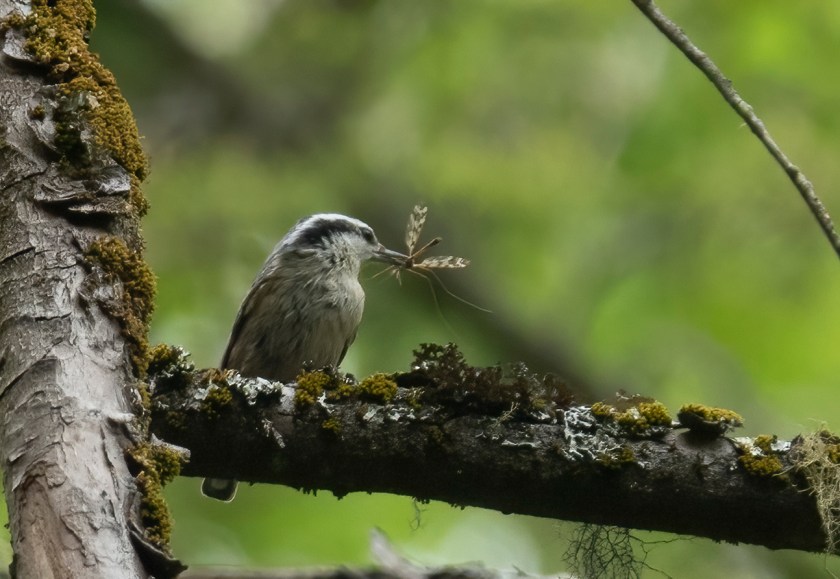
A female Red-breasted Nuthatch, deep in the woods, has caught a Cranefly. (The adults eat conifer seeds in winter, but arboreal arthropods in the breeding season). Only the male actually has a red breast!

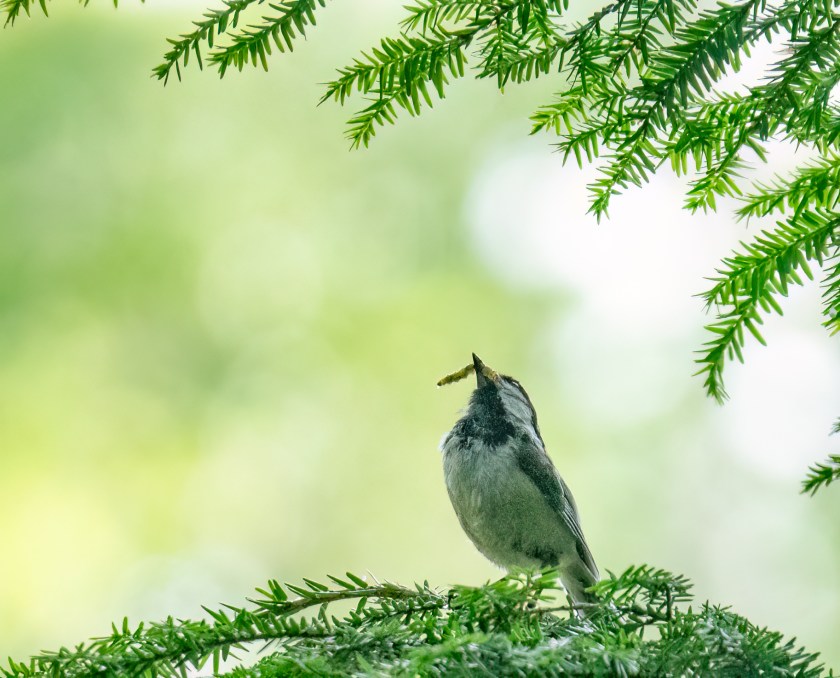
A Chickadee with a juicy caterpillar:

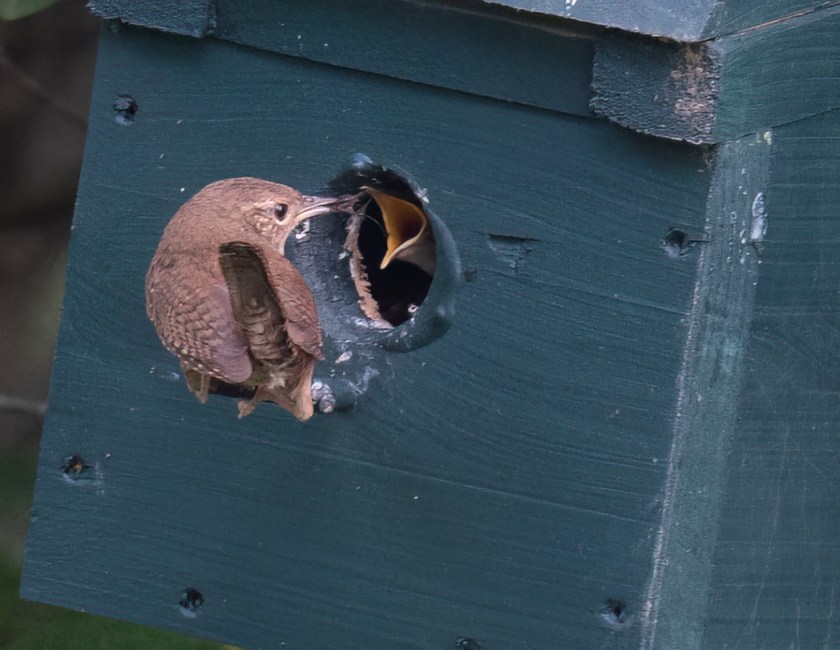
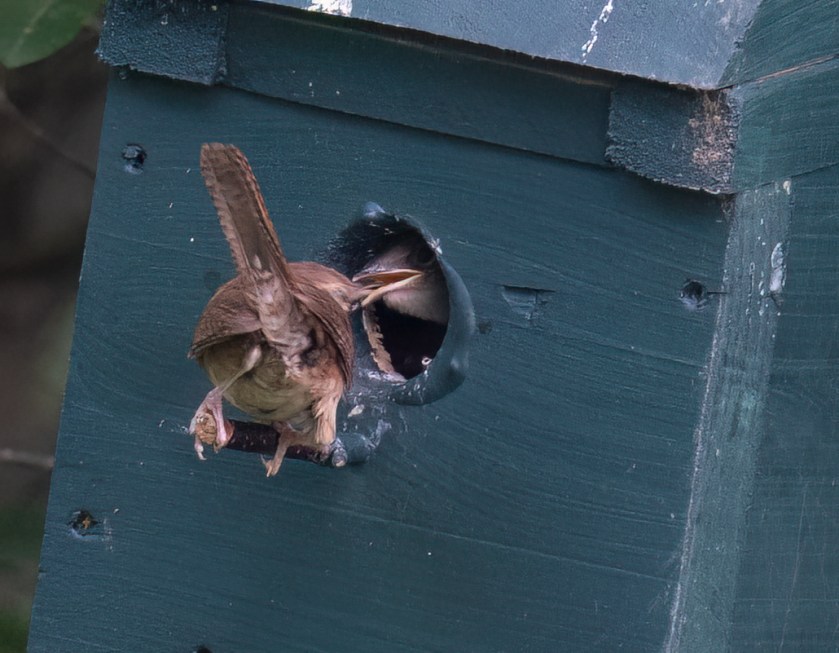
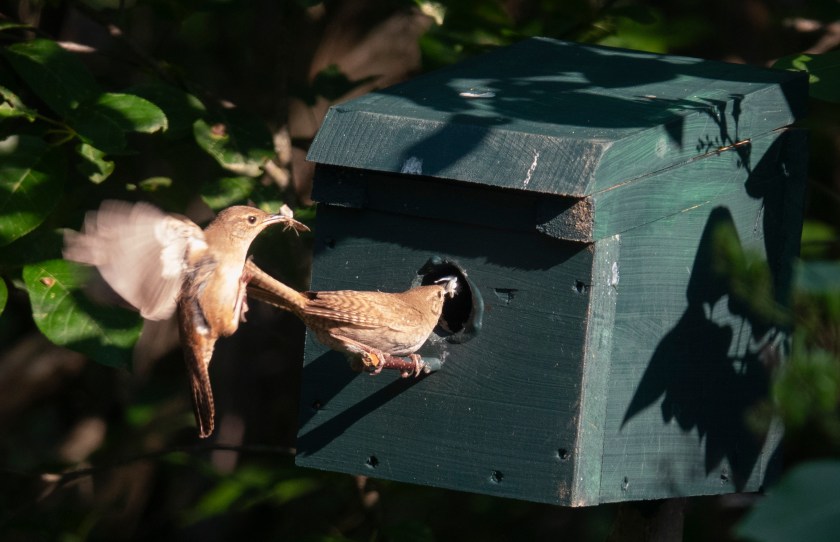
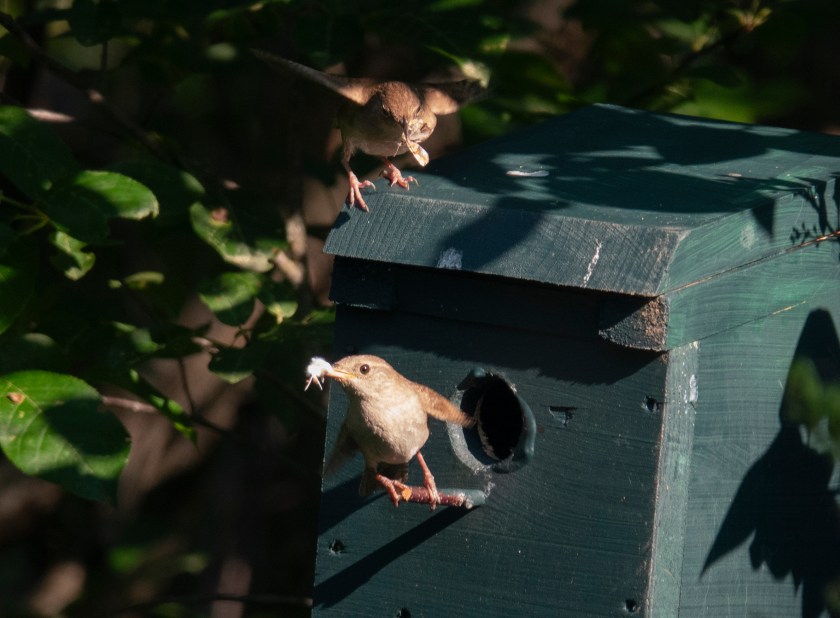
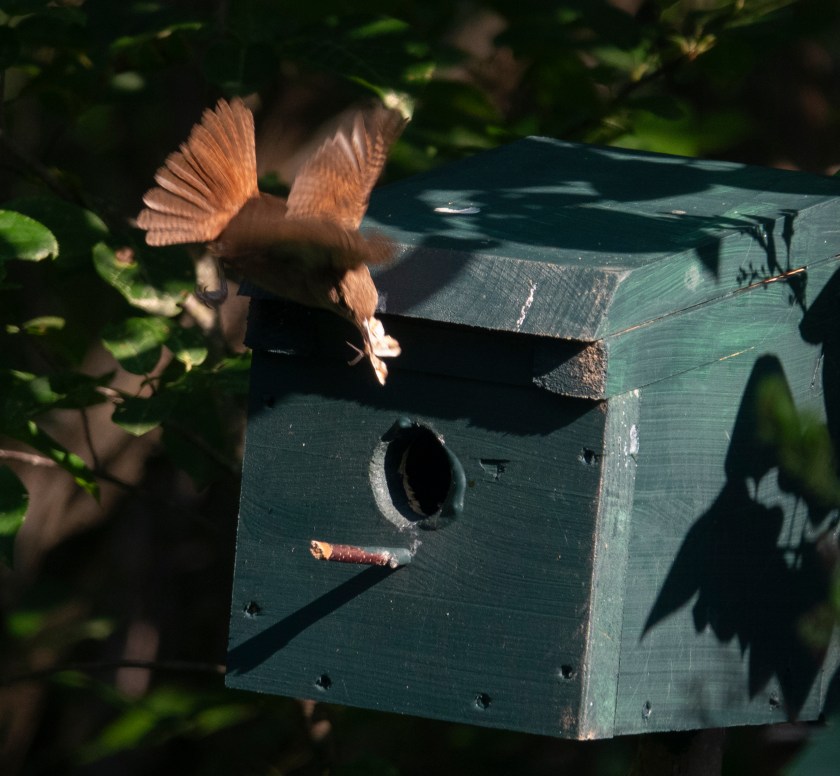
To see birds feeding the babies directly, you have to know where the nest is. The easiest way is to have a nesting box. These two Northern House Wrens came and went all day long with insects for the unseen young in the interior.

As they got bigger, they stuck their heads out in an importunate plea for food:

A sizable insect:

placed right in the baby’s mouth:

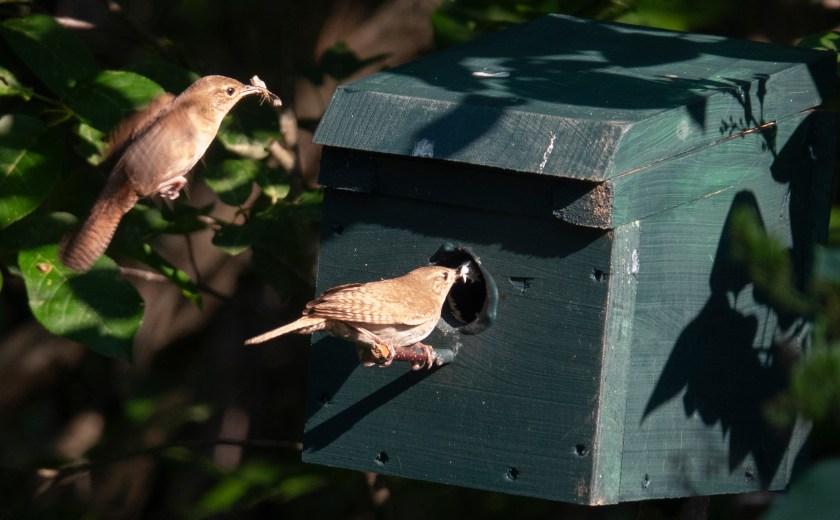
Occasionally, the two parents failed to coordinate, and arrived simultaneously, creating a traffic jam:

A polite dance ensued. ‘You first.’

‘I’ll wait’:

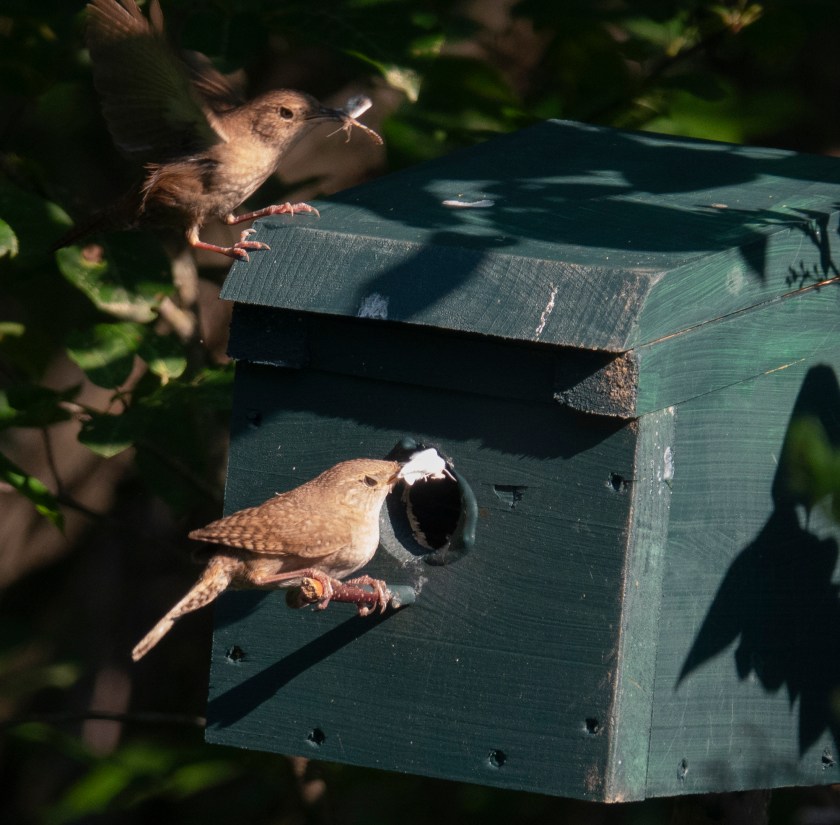
‘No, yours is bigger’:

‘All right, here I come’:

Eventually, the young will fledge, leaving the nest but staying nearby and still dependent on the adults for food.

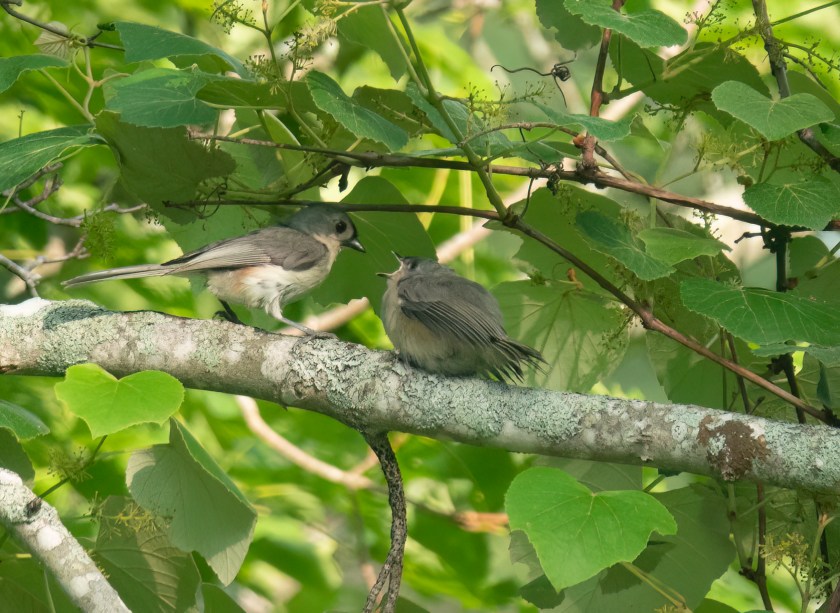
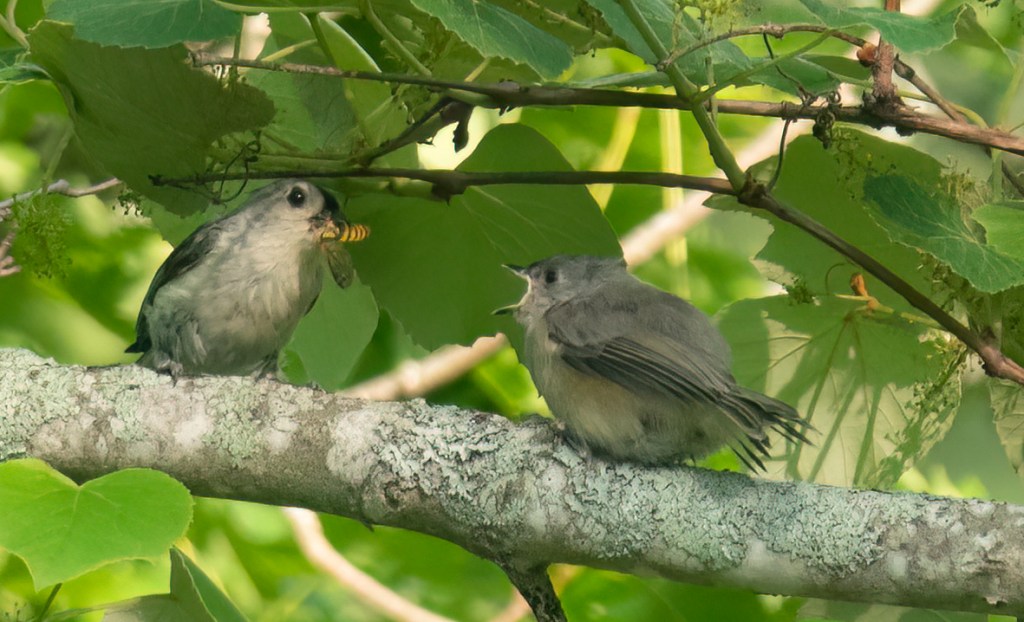
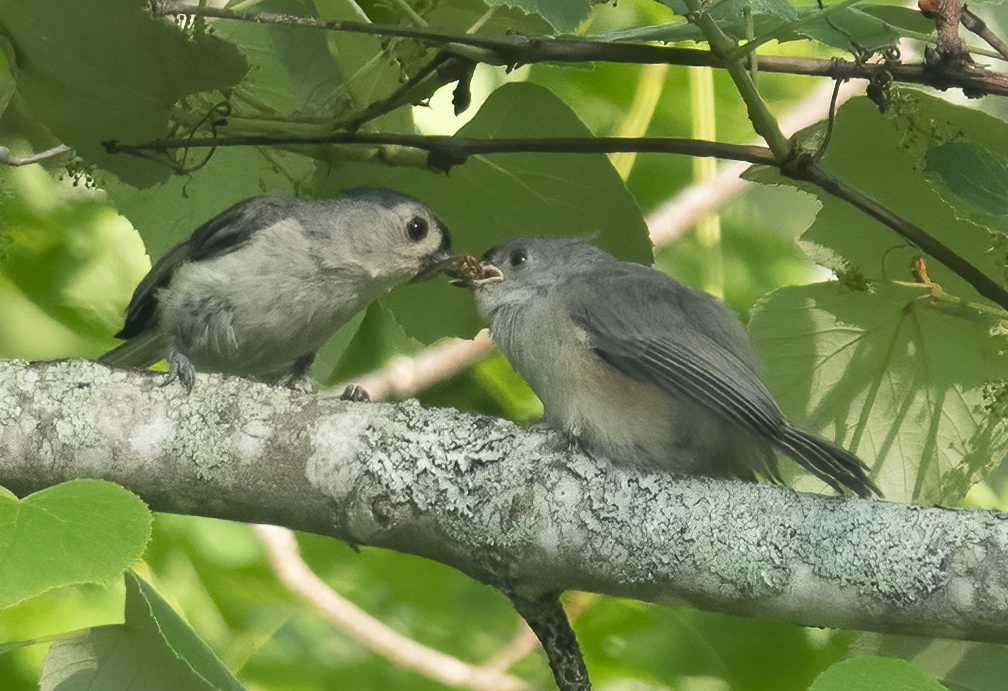
Tufted Titmouse adults eat 2/3 insects, and 1/3 seeds and mast, but they feed their young with insects, including bees. This one is feeding its fledgling, about 30 feet up in the trees.

It has a bee or wasp of some kind:

which the baby struggles to swallow unassisted:

The next generation is well provided for.

A tale of chipmunks and beetles

[Back to Lovell for this post!]

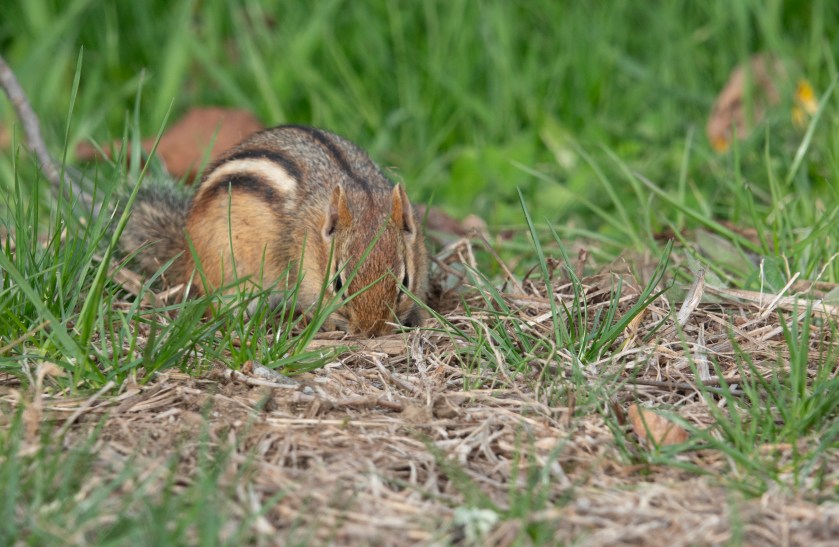
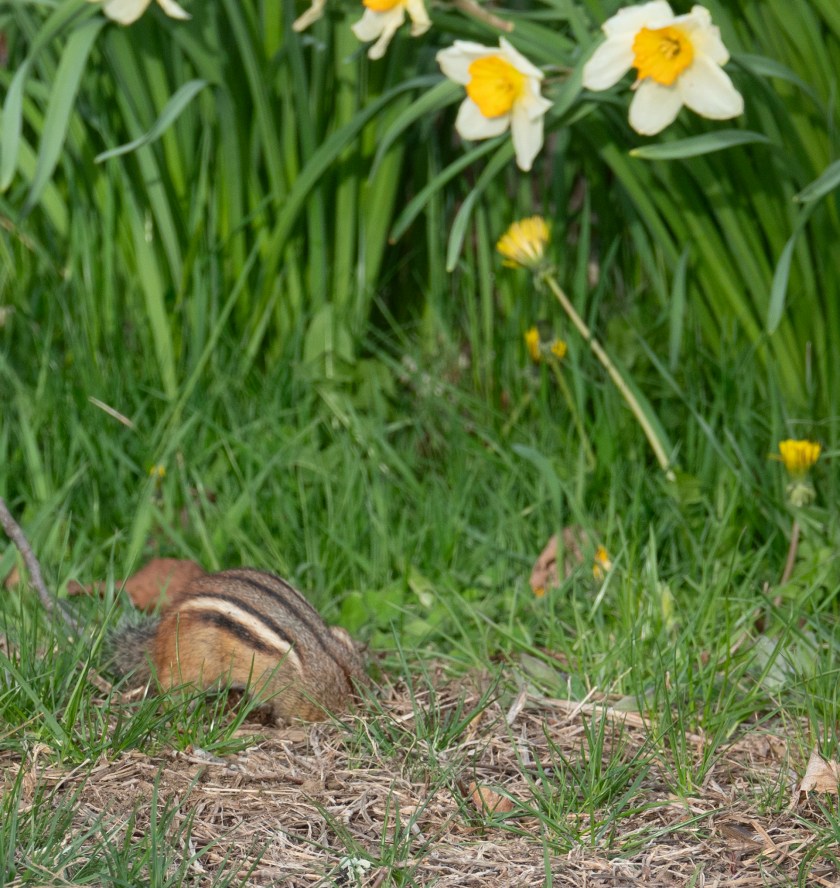
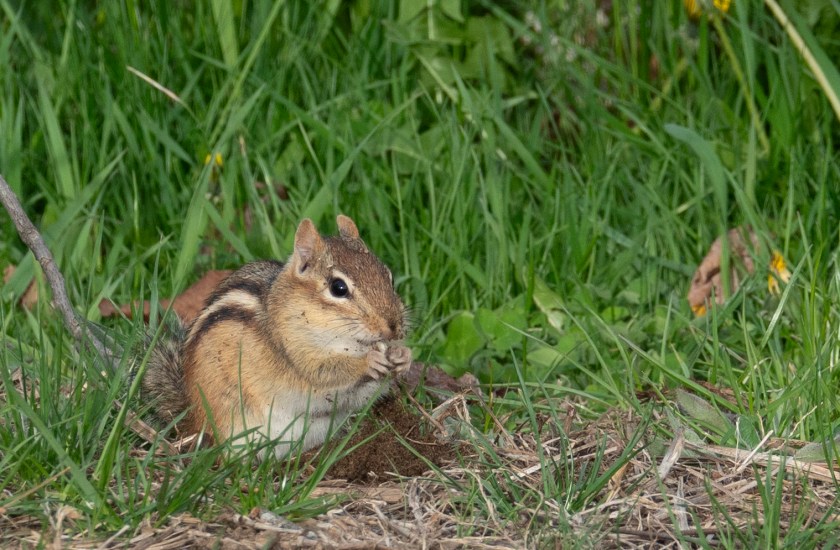
I tend to think of chipmunks as seed eaters, whether from my bird feeder, or straight off the plant. I’ve also posted in the past about them eating my flower buds (grrr..), and adult beetles. The other day (spring here in Maine, after a long hard winter), I saw one sniffing the lawn at the edge of my flower bed:

Then it began to dig, enthusiastically, until its head was underground:

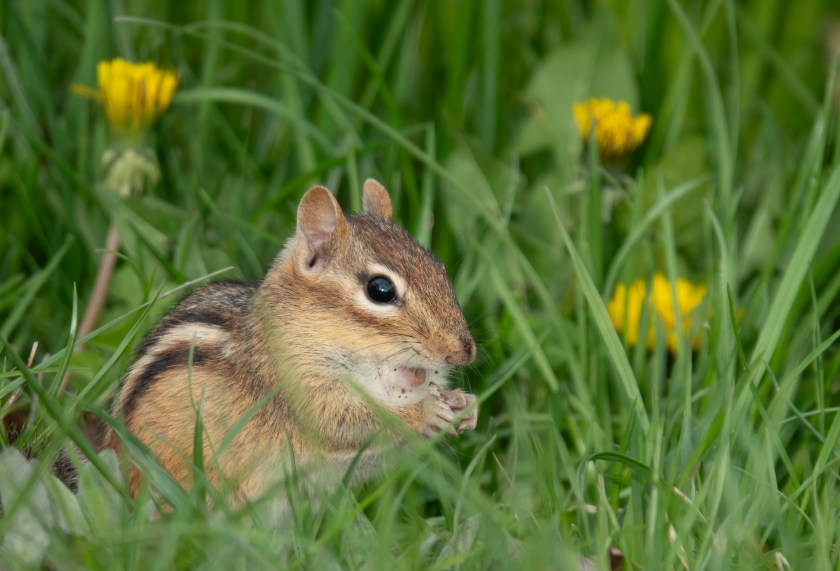
Success. It came up with a grub, which it seemed to find tasty:

The earth on its whiskers, and the hole at its feet, are evidence of the excavation:

In early spring, they’re desperate for protein after a diet of nothing but seeds and nuts all winter. The beetle grubs are beginning to move, and the chipmunks use smell, hearing, and tactile cues via their sensitive noses, to find these grubs. Just so long as it chooses to remove the kind of grub that gardeners dislike, it’s a win-win situation.

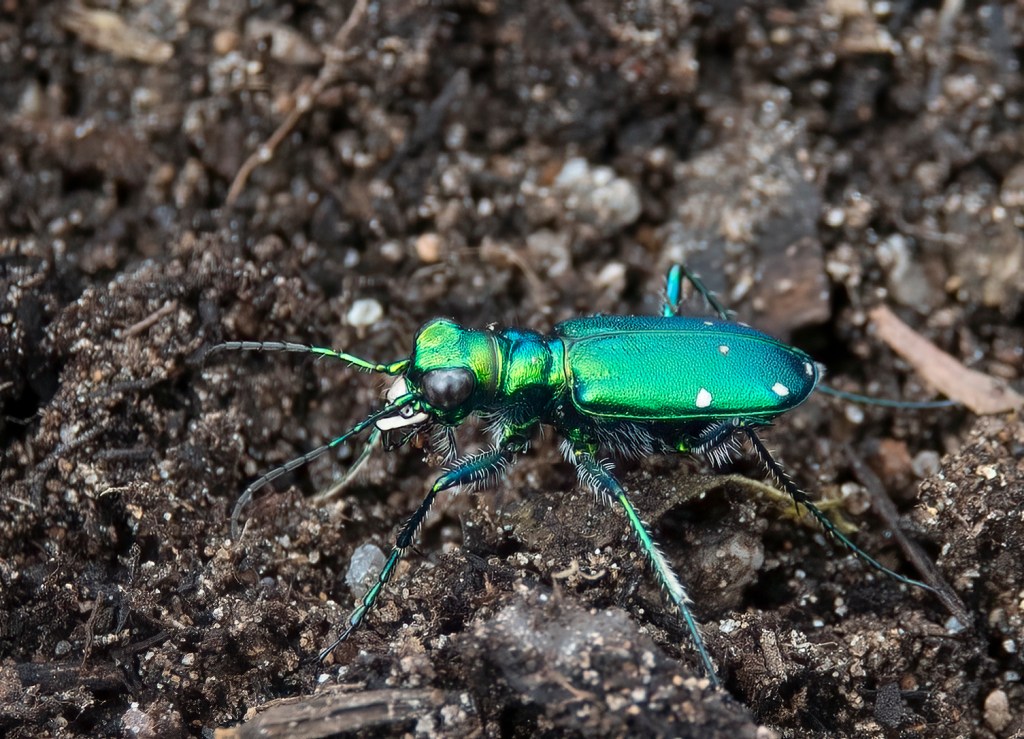
So one poor grub didn’t get the chance to grow into a beetle of some kind, but the same day, getting my vegetable beds ready for planting, I disturbed this emerald Six-spotted Green Tiger Beetle, Cicindela sexguttata:

It has large white mandibles, visible here, and hunts for tinier insects and spiders. You’d think that dazzling coloring would be dysfunctional for a carnivorous predator like this, but apparently not. It is quite common, about 1/2″ long, and is easy to see because it likes sunny patches, but it moves fast and rarely stays still, so it’s hard to photograph.

A Fluffy Lion

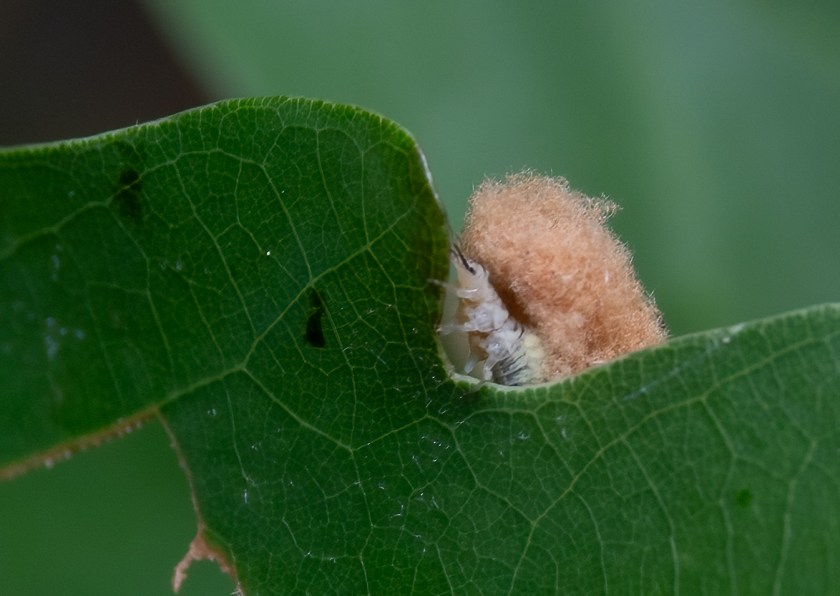
Yesterday morning I saw a small piece of fluff on an oak leaf.

In nature, anomalies catch the eye, so I looked more closely. It moved! So I picked it up. A minute tail and a couple of legs poked out.

The whole thing was about 1/3″long. I tried to turn it over to see the bug underneath, but it righted itself in a microsecond. But when I put it on my thumb it tried to escape, walking steadily along my thumb looking for an off-ramp:

And when I put it back on the leaf, it beat a retreat over the edge of the leaf to safety:

Here is a video:

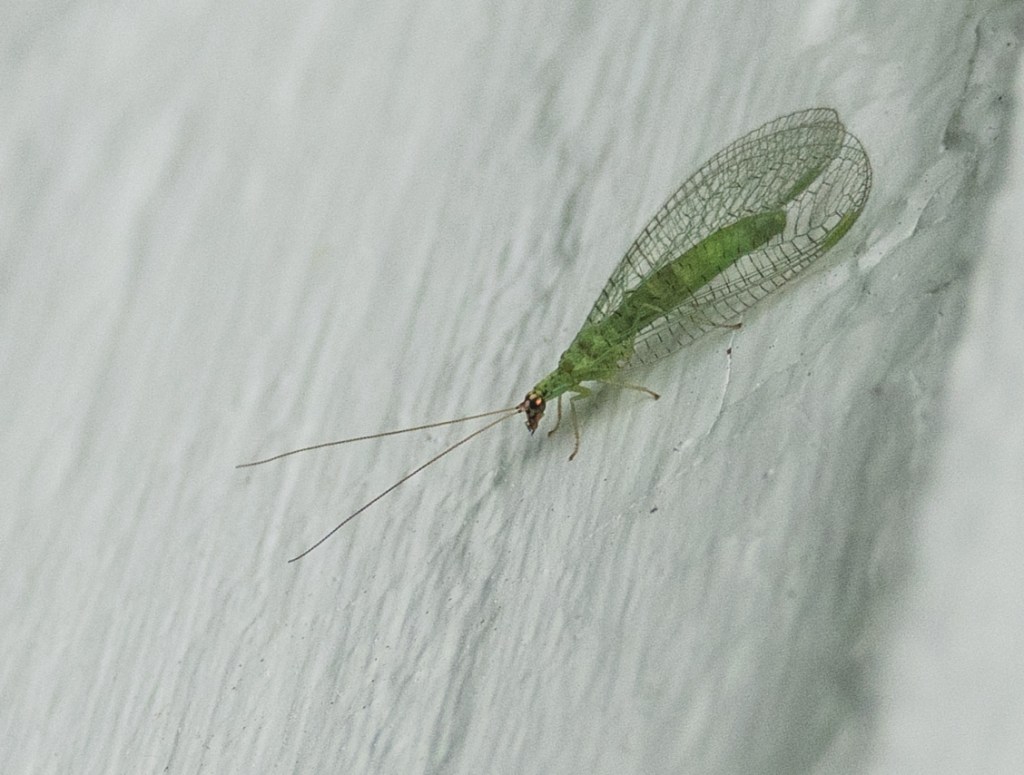
It is the larva of a Stripe-horned Lacewing. Here is a Golden-eyed Lacewing adult, a close relative:

Some species of lacewing larvae, like mine, load detritus on their backs as camouflage to fool birds, and very effective it probably is too, though it didn’t fool me for long.

They feed on aphids, and are sometimes described as alligator-like, both for their body shape and their bite: here is the larva of a Red-tipped Green Lacewing, showing those ferocious jaws:

The Missouri Department of Conservation has a graphic description: “The larvae, sometimes called ‘aphid lions’, are insatiable predators of other insects, especially aphids. A lacewing larva grasps the aphid with its grooved, caliper-shaped jaws, often lifts it up in the air, then drinks the fluids in the aphid’s body. A single lacewing larva can eat an aphid a minute, for hours, and not slow down. ” As a result they are sometimes sold as a natural form of aphid control.

Just shows you can be small but scary, more elegantly put by Shakespeare in Midsummer Night’s Dream “Though she be but little, she is fierce “

A Beetle Magical Mystery Tour

[This post is guaranteed to elicit from any under-10 year old an “Ew, gross!” response.]

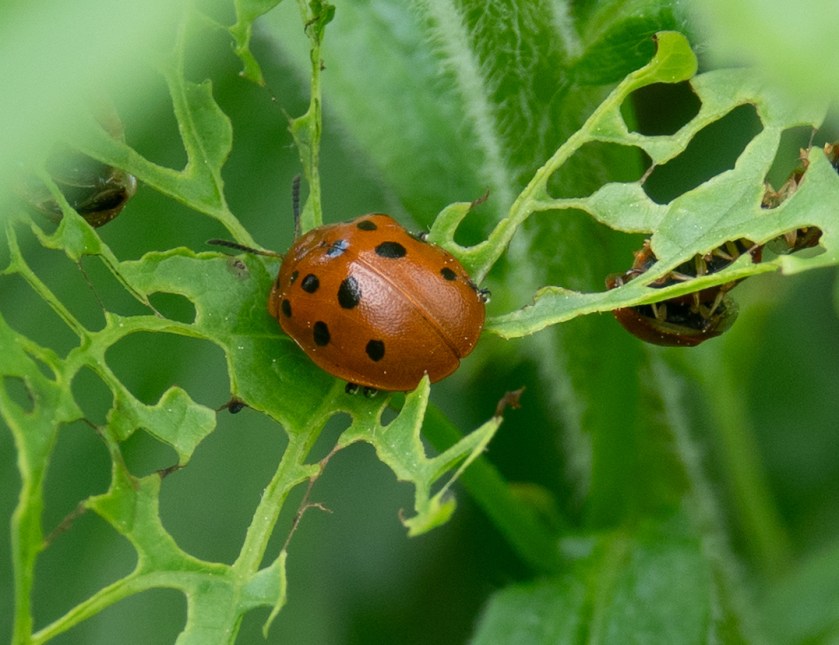
There are at least two different beetles casually called the Milkweed Leaf Beetle. Both are red, and both do indeed eat milkweed leaves, but there the resemblance ends.

The Argus Tortoise Beetle, Chelymorpha cassidea, looks like a ladybug (aka ladybird!) but is a bit bigger at 9 to 12 mm (0.35 to 0.47 in) long compared to 5.5 to 8.5mm for the Harlequin Ladybug.

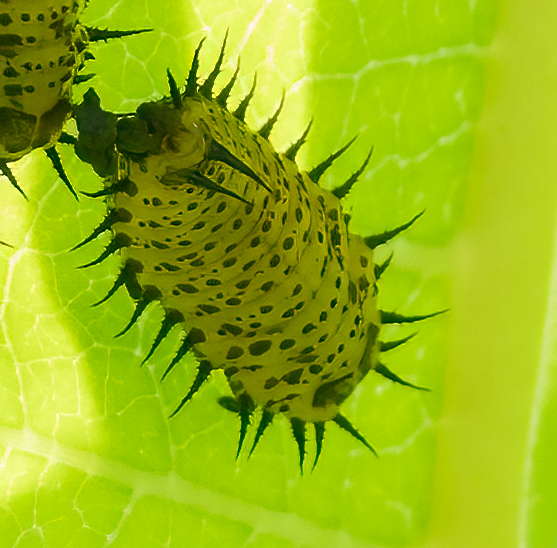
They have the most extraordinary larvae. Here is a trio:

Look at the rightmost one more closely. It has a pair of “horns” at the butt end, called the caudal furca.

Every time it poops, it deposits the output on these horns, building up a substantial lump.

This is called a fecal shield. It curves over the top of the larva like a sort of Roman helmet, and it can be moved or waved around, reminding me of the periscope of the (quite different) Beatles’ Yellow Submarine.

The purpose of this bizarre and rather disgusting construction, seems to be defense against predators (in this case my intrusive camera lens).

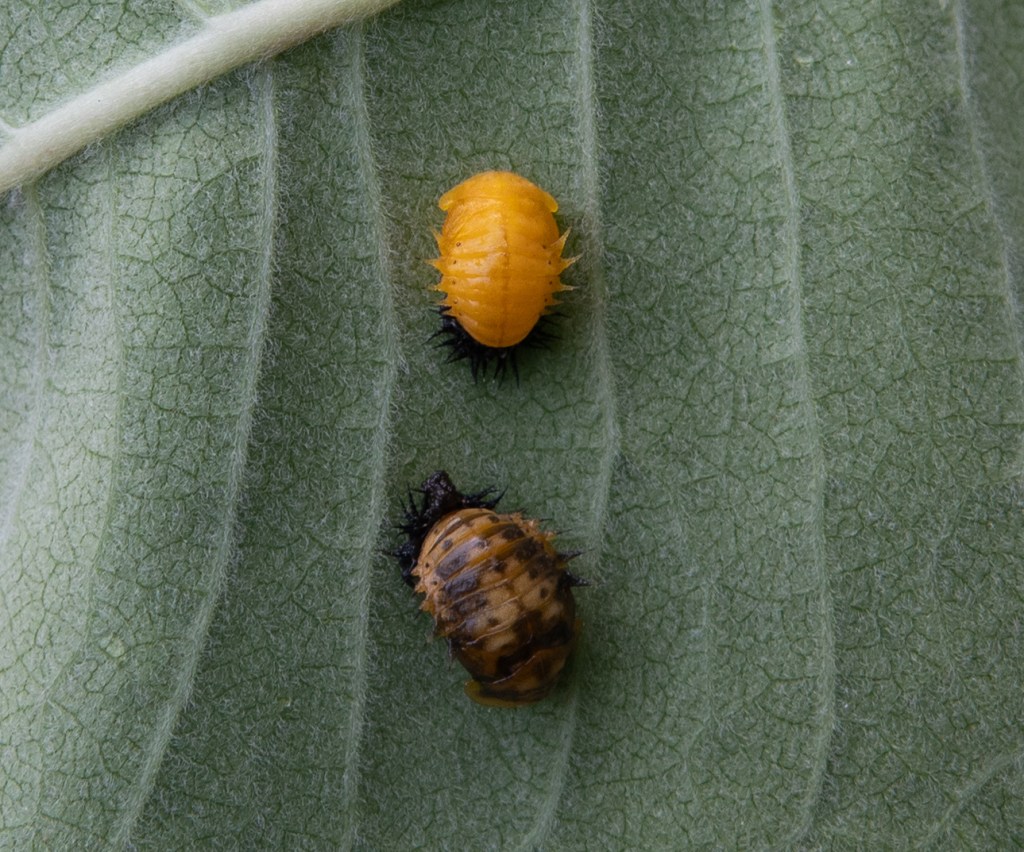
The previous photos were taken at midday on Monday. By 3.04pm on the following day the larva is beginning to form an oval golden pupa, though it is still soft:

At 5.25pm the bottom one has begun to darken, and meanwhile the top one has begun its transformation too:

And by 10.45am the next morning, both have completely changed their color, and hardened into their final pupal forms:

They will drop to the ground, and a new beetle will appear later this summer.

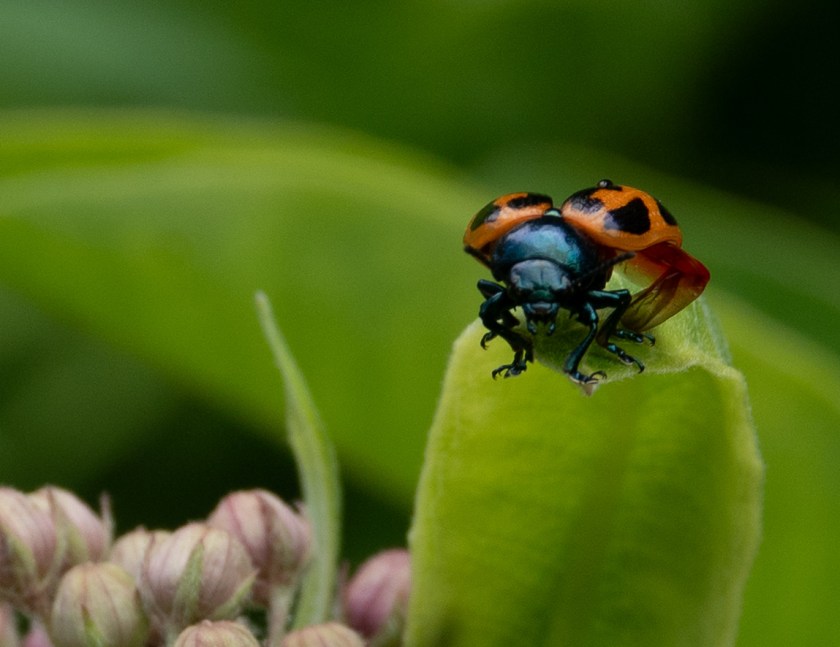
The unrelated Swamp Milkweed Leaf Beetle, Labidomera clivicollis, is also red on the outside:

When it wants to move to a new plant, it goes to a high place:

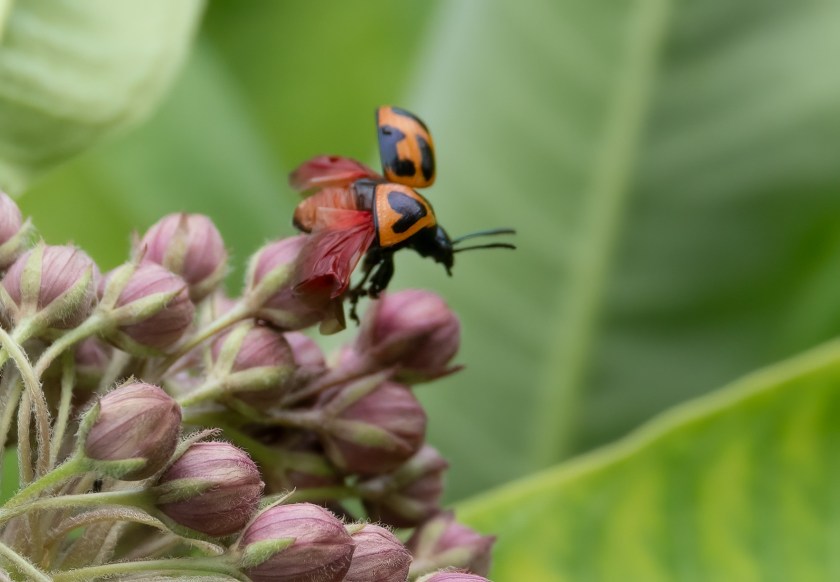
opens those wing cases (elytra):

and unfurls its wings. Lo and behold, they too are red.
An unexpected magical mystery delight.

PS The following one minute video is extremely boring, but shows you that the larvae with their fecal shields are perfectly mobile. For hard-core beetle people only.