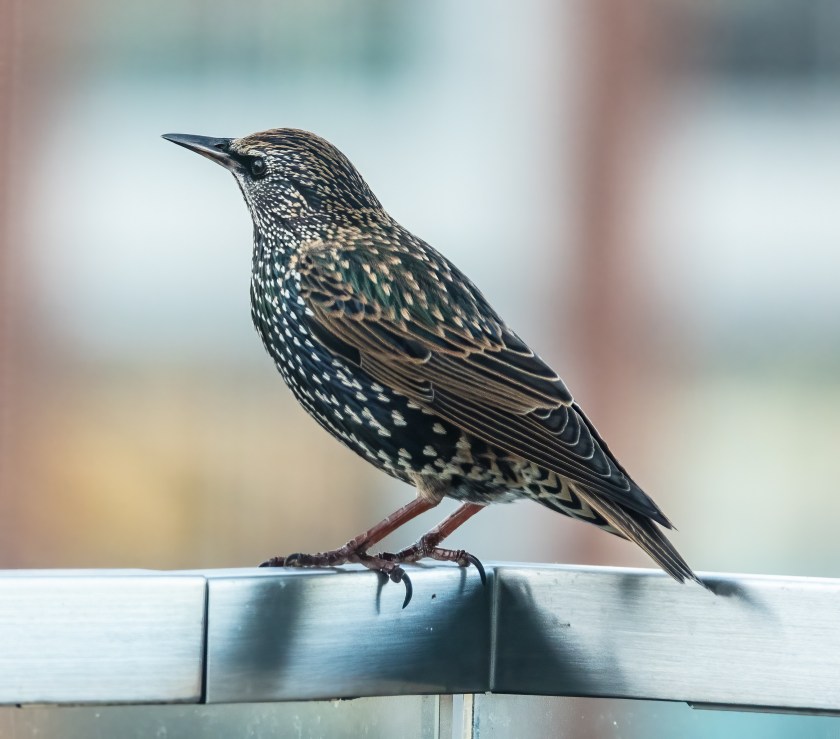
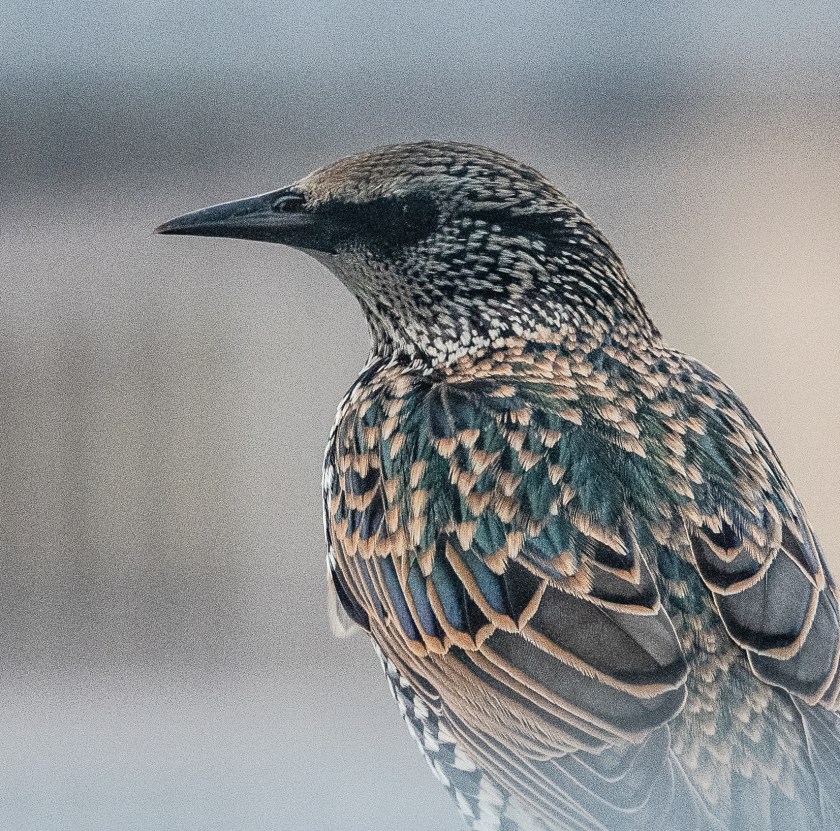
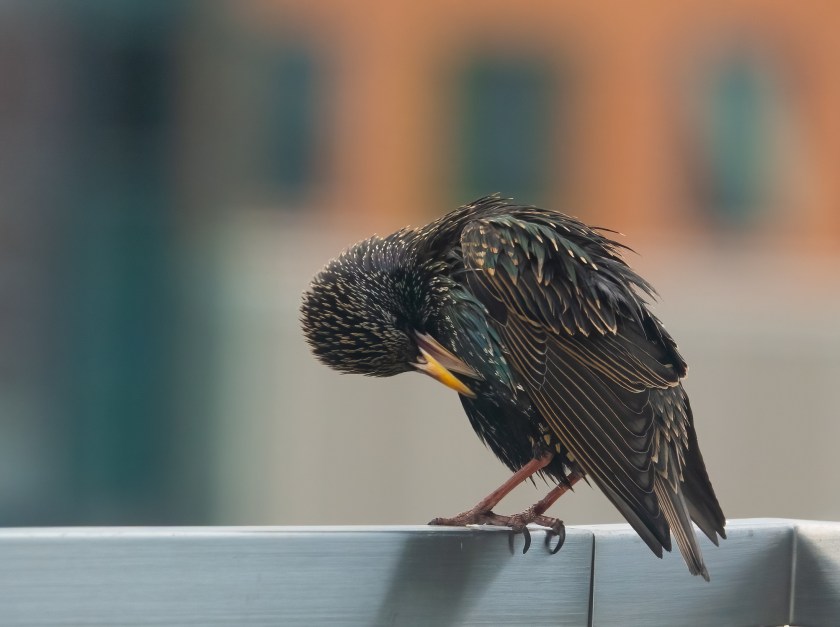
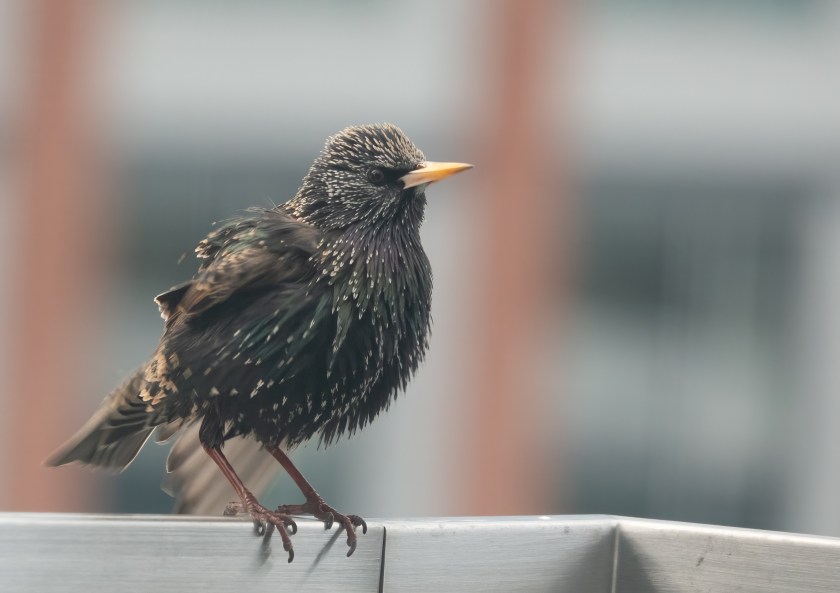
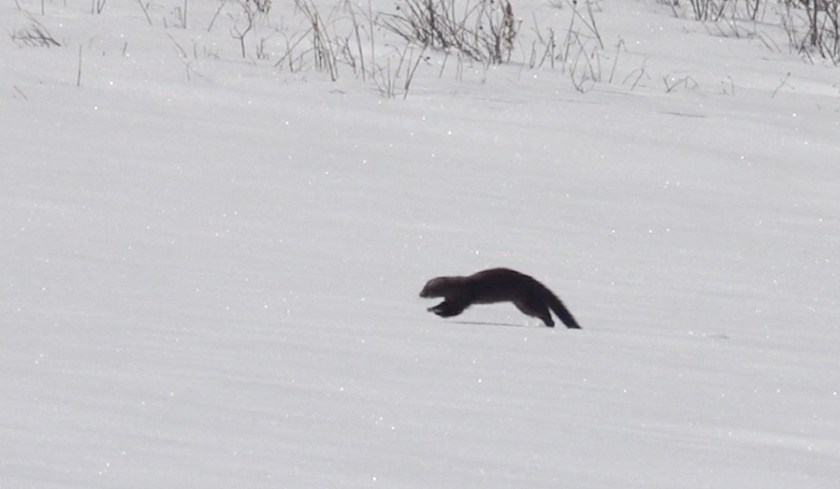
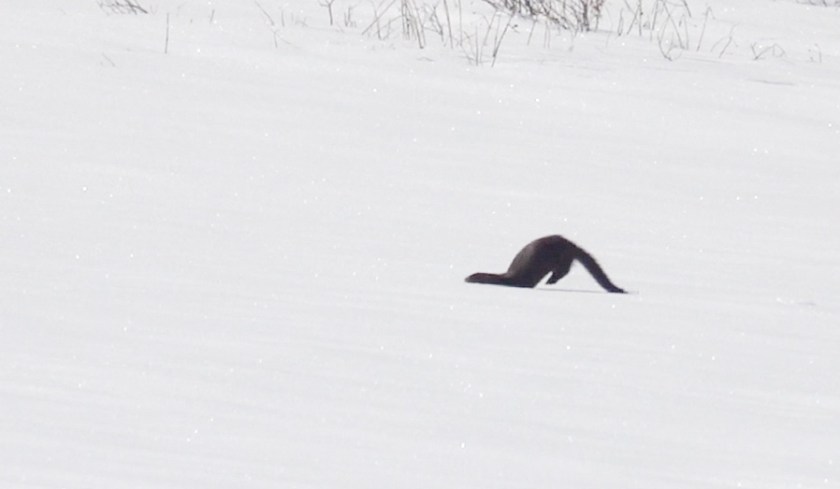
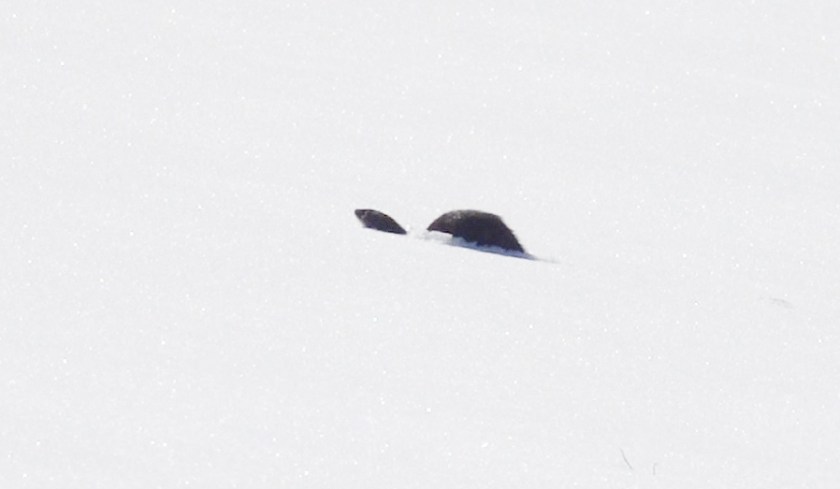
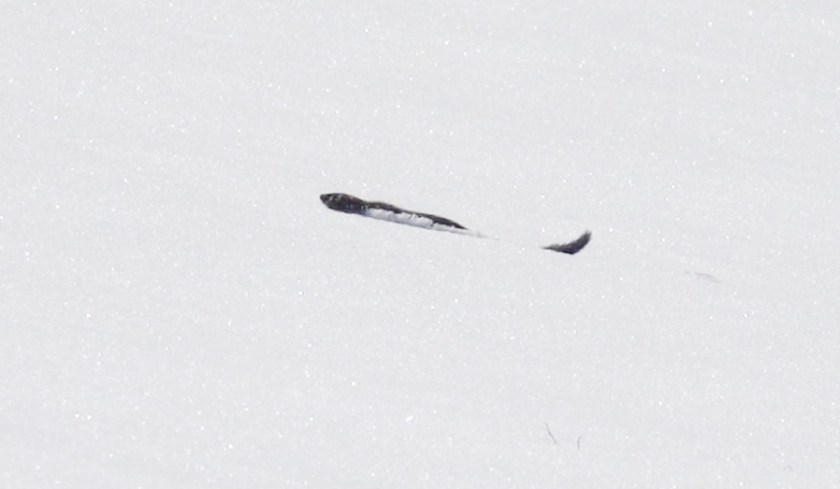
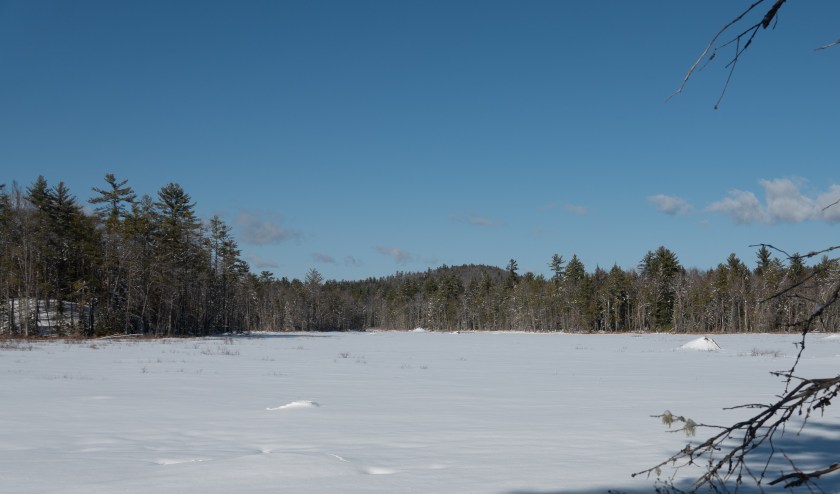
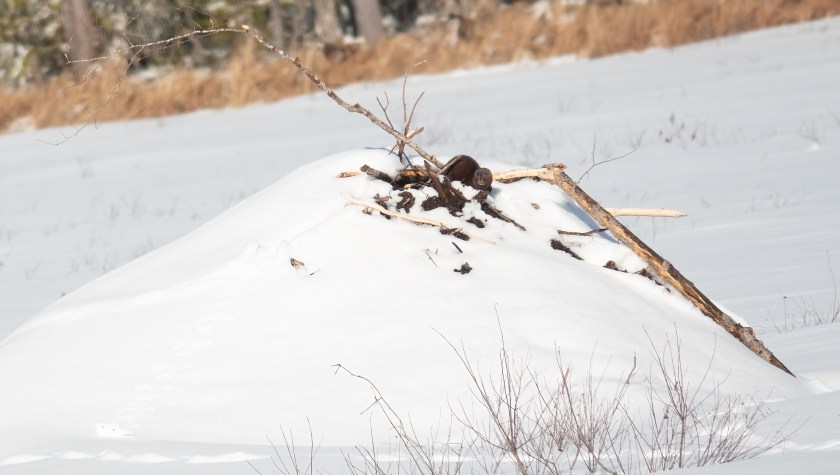
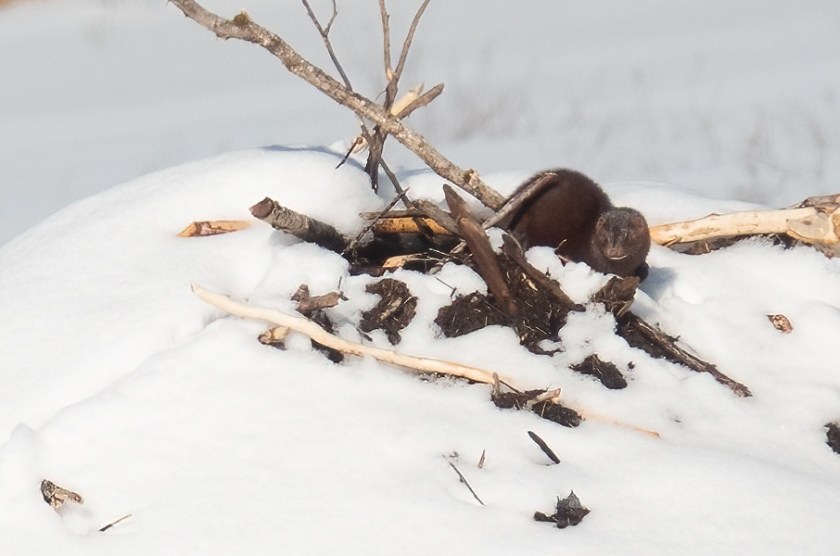
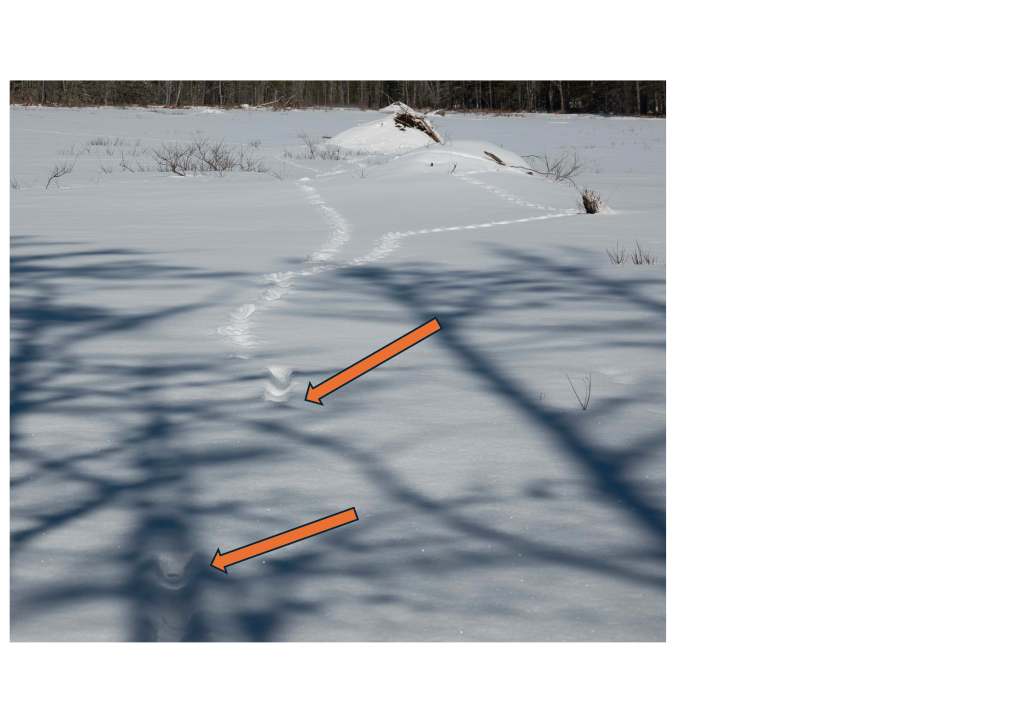
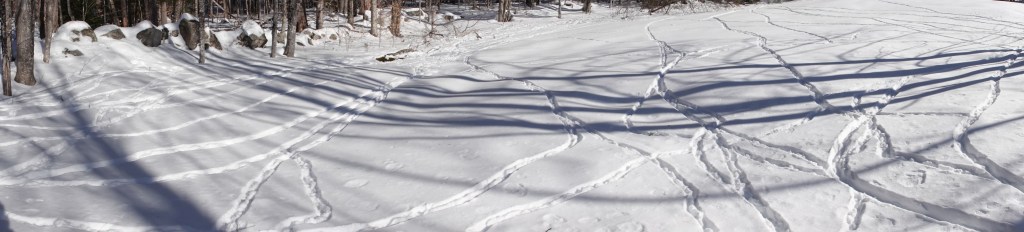
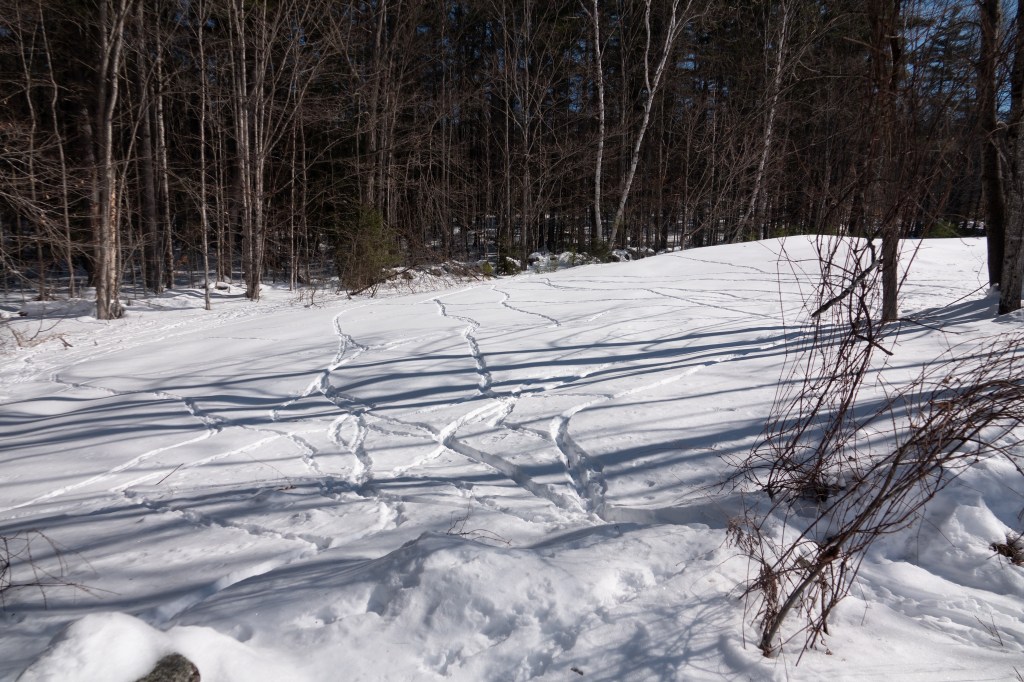
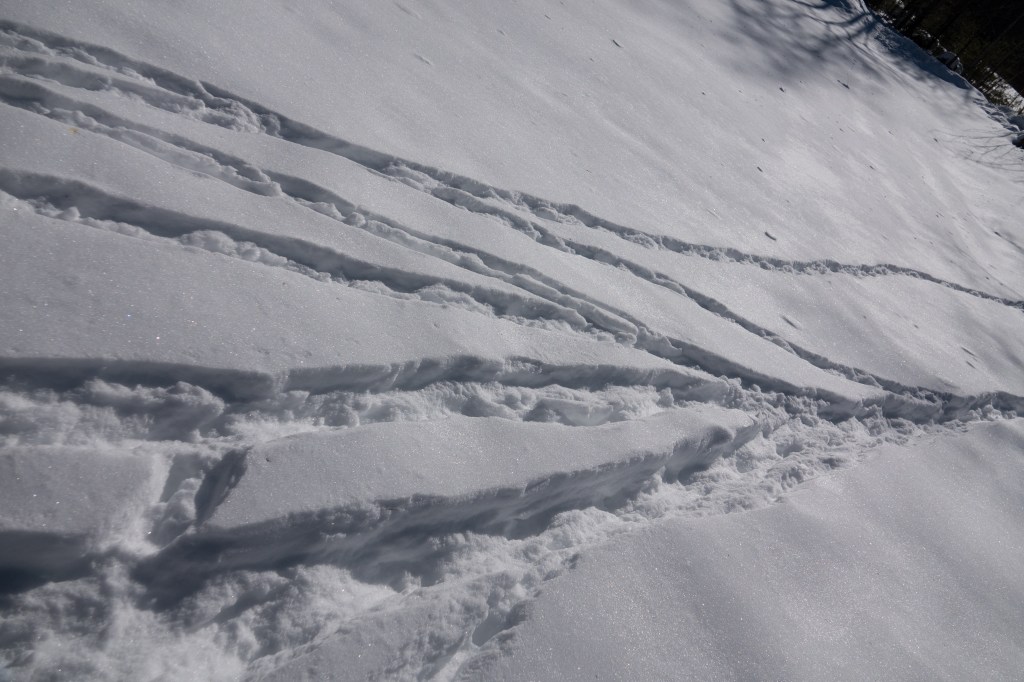
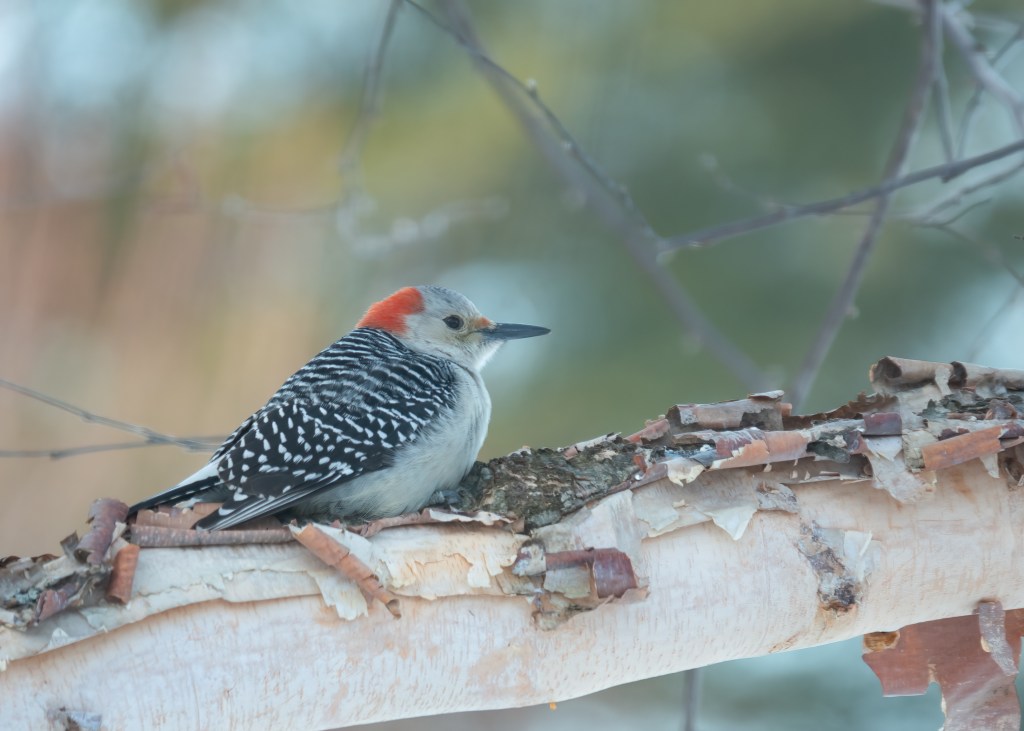
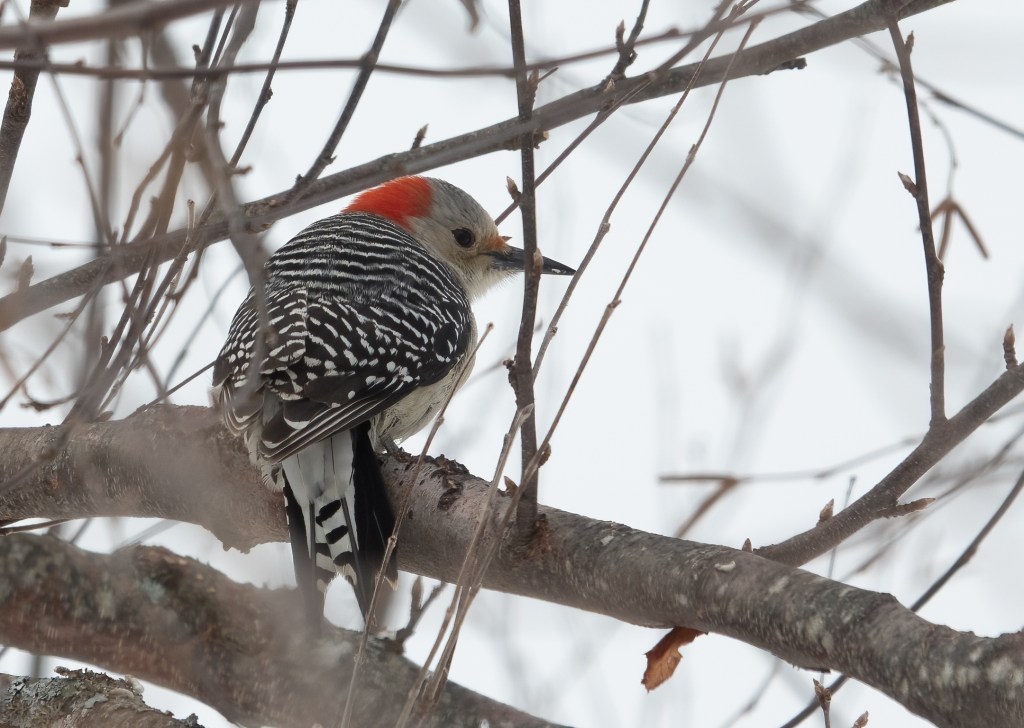
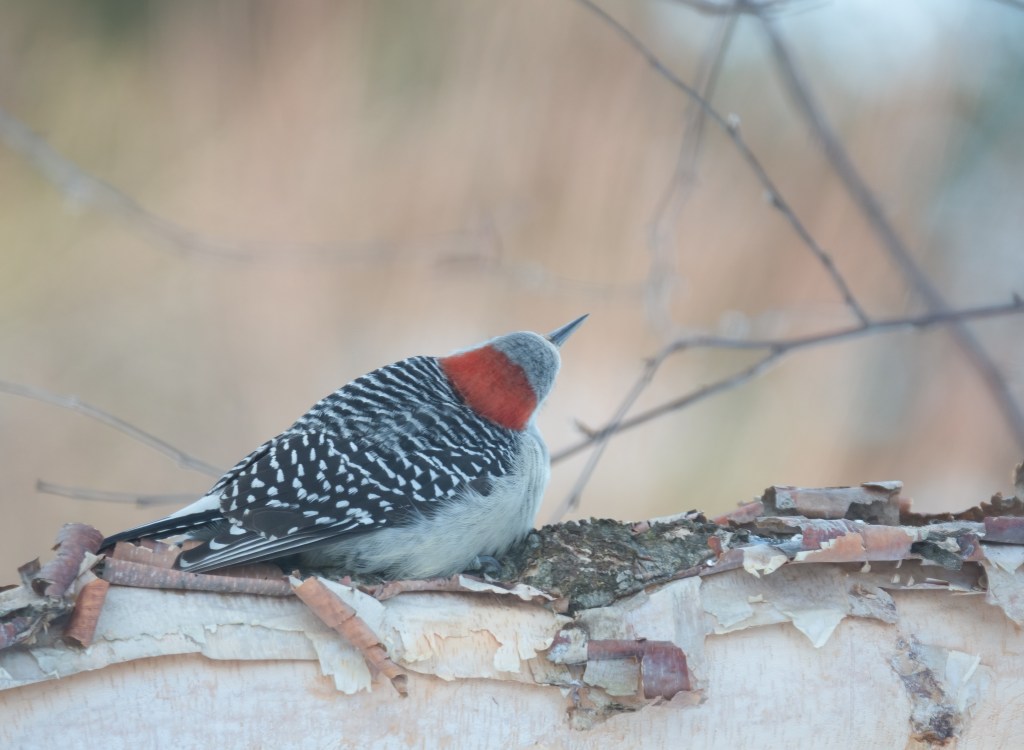
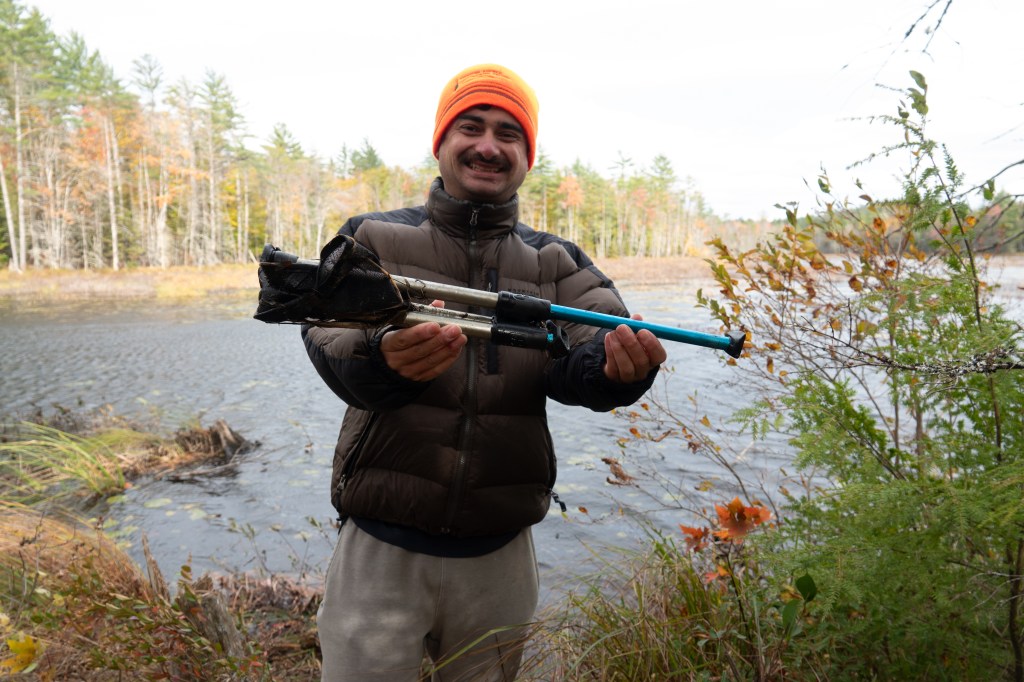
The only possible word is sleek

[Back to Lovell, Maine, for now.]

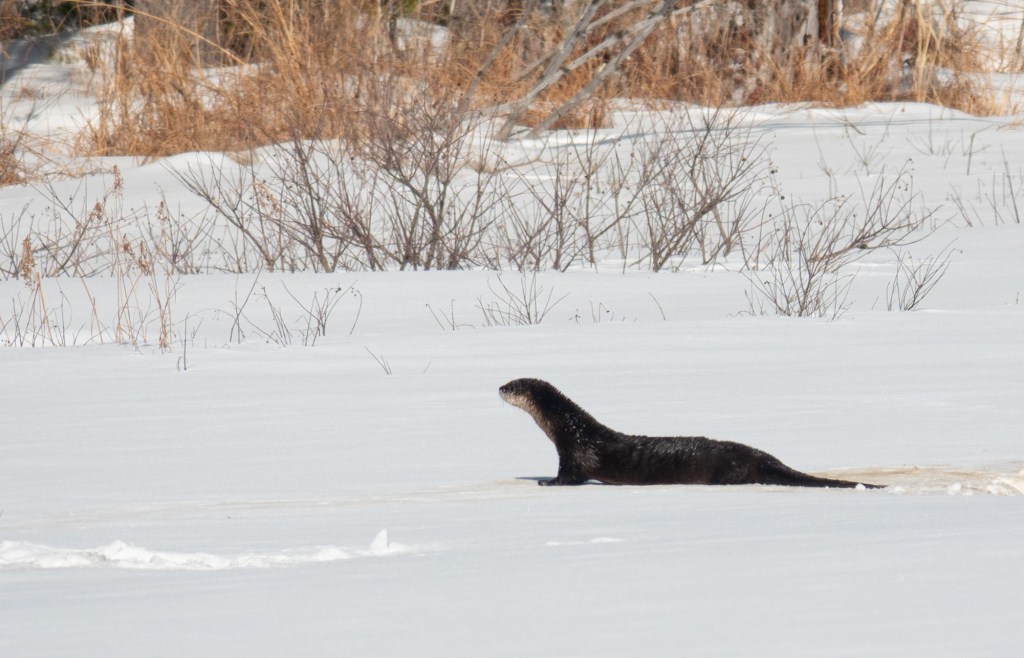
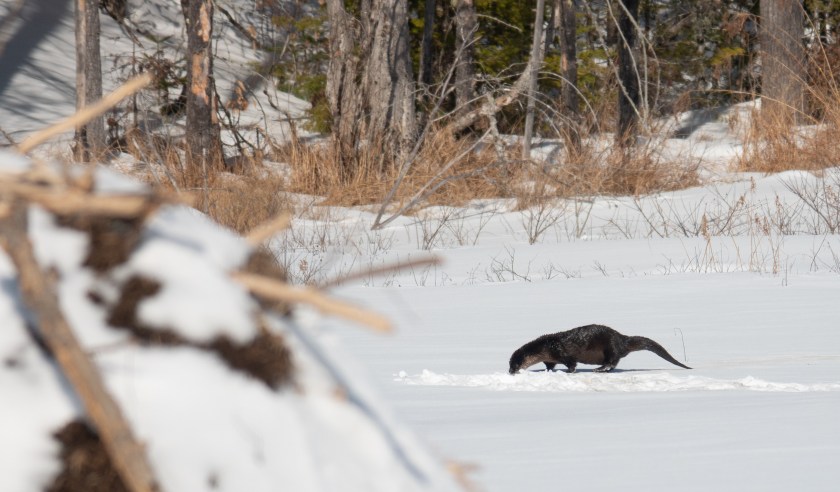
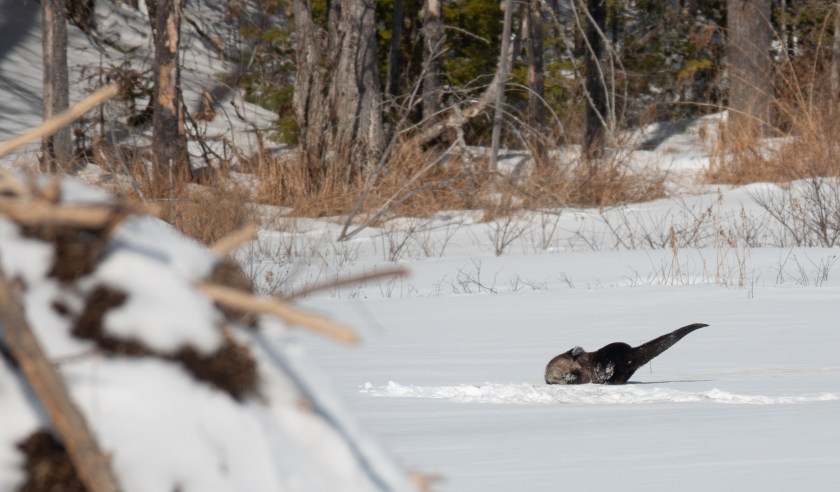
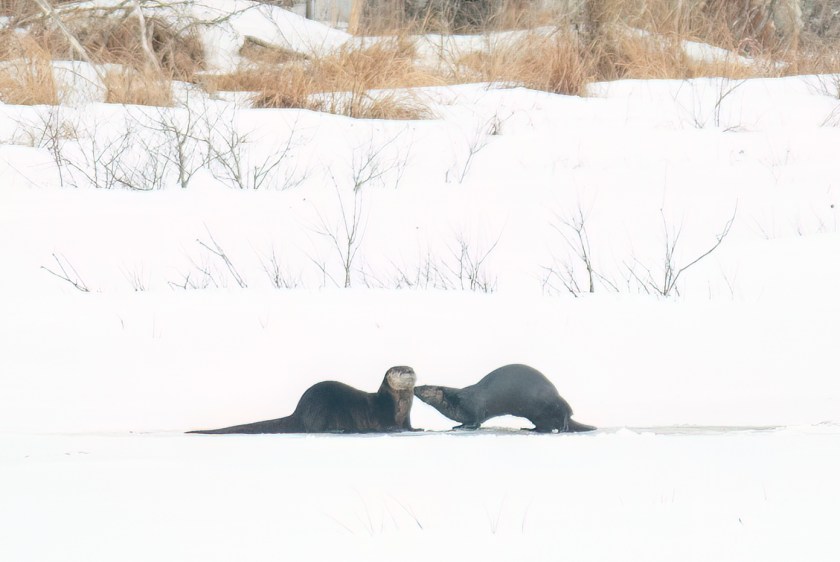
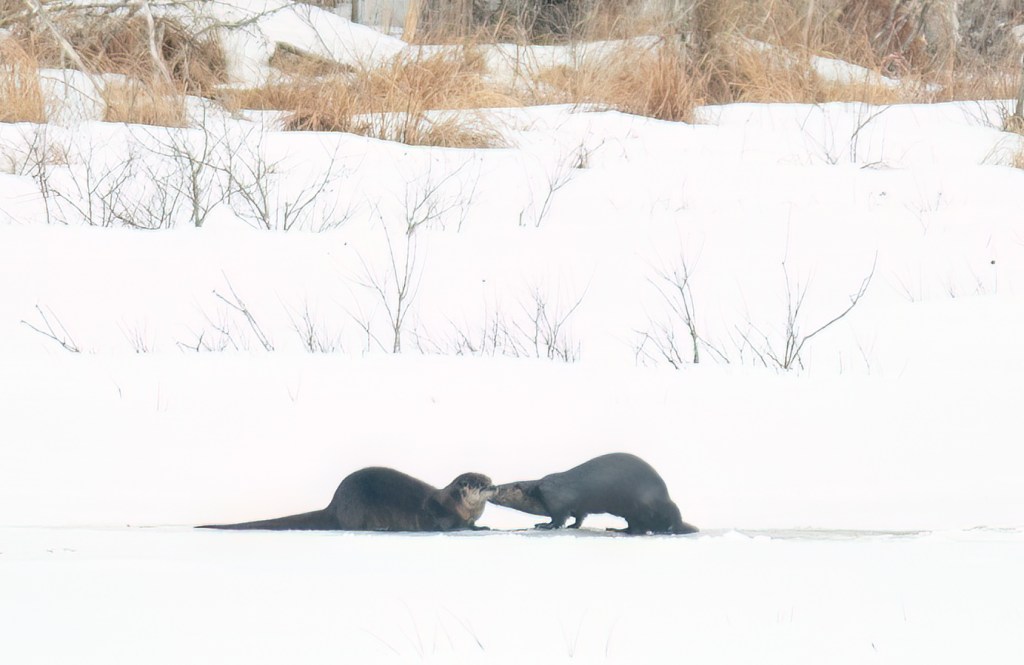
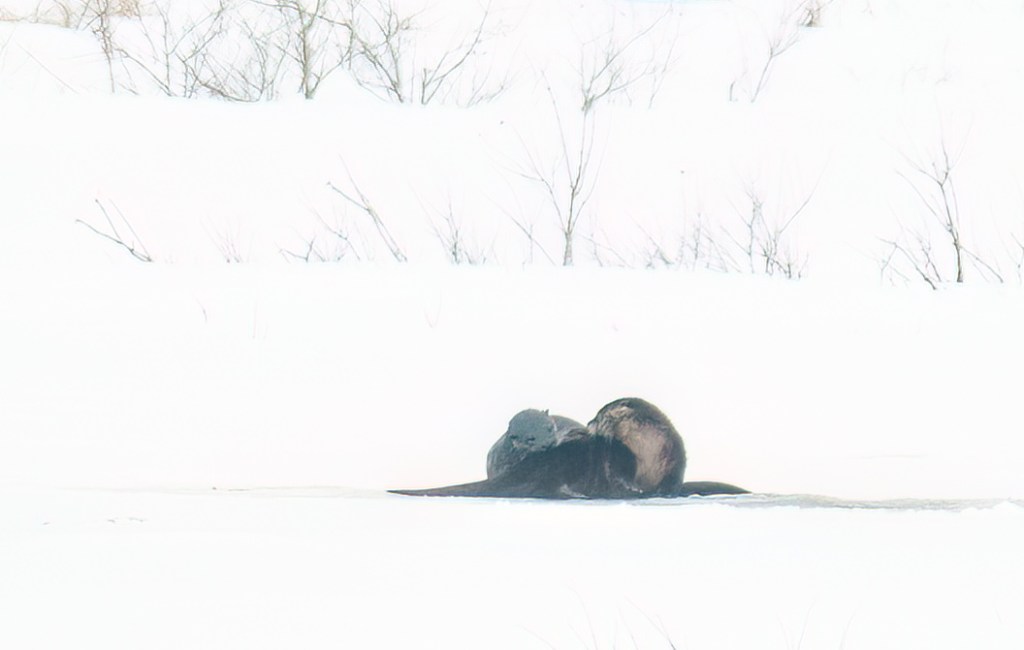
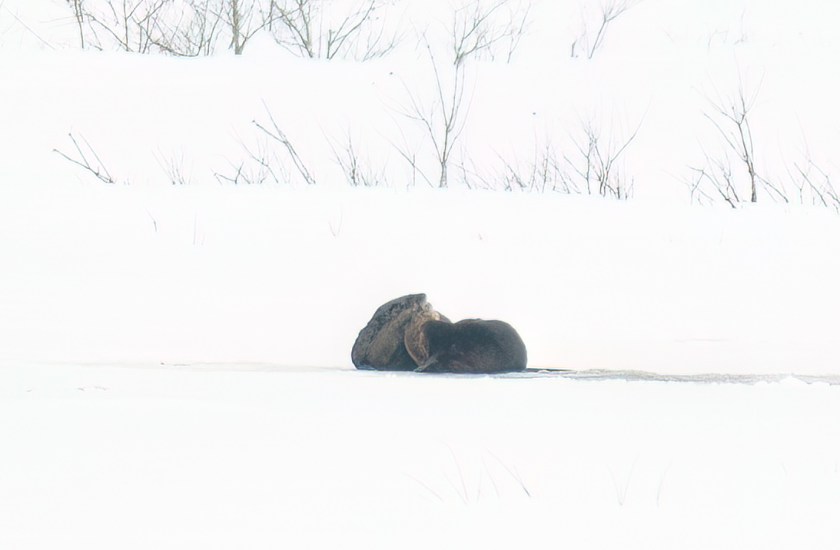
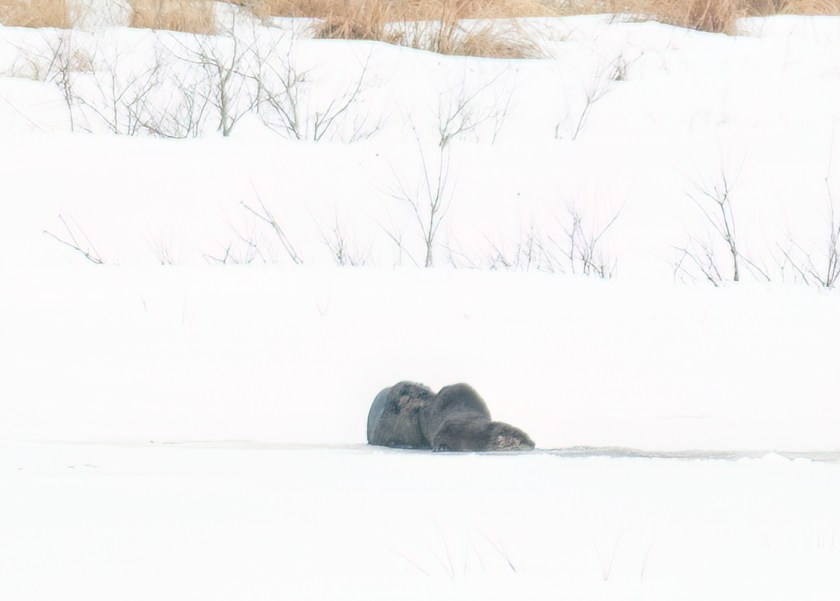
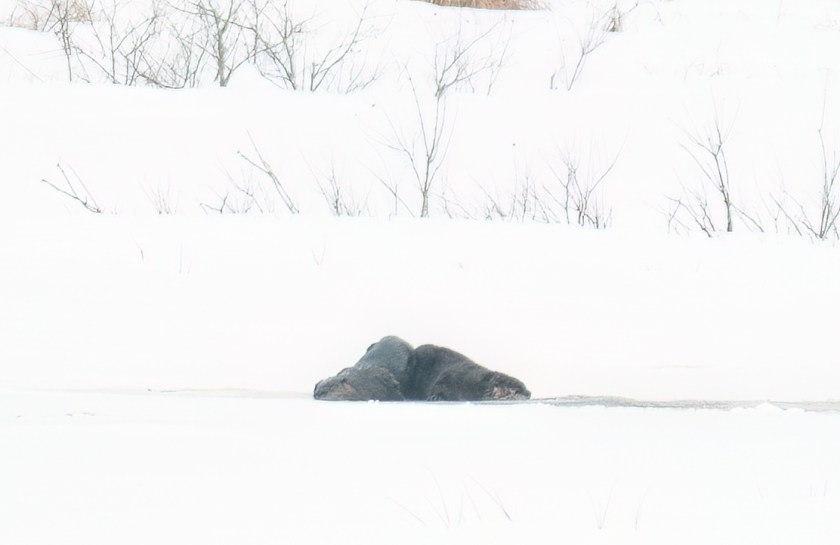
We had had the first proper snowfall of the winter on December 2nd, six inches of lovely fluffy stuff, so on the morning of December 3rd I snowshoed in to our beaver pond. Joy of joys, as I stood on the shoreline two young otters popped out of the ice just a few feet in front of me.

We were all a little startled, but I took a few quick photos:

and after one minute twenty seconds they slid back in:

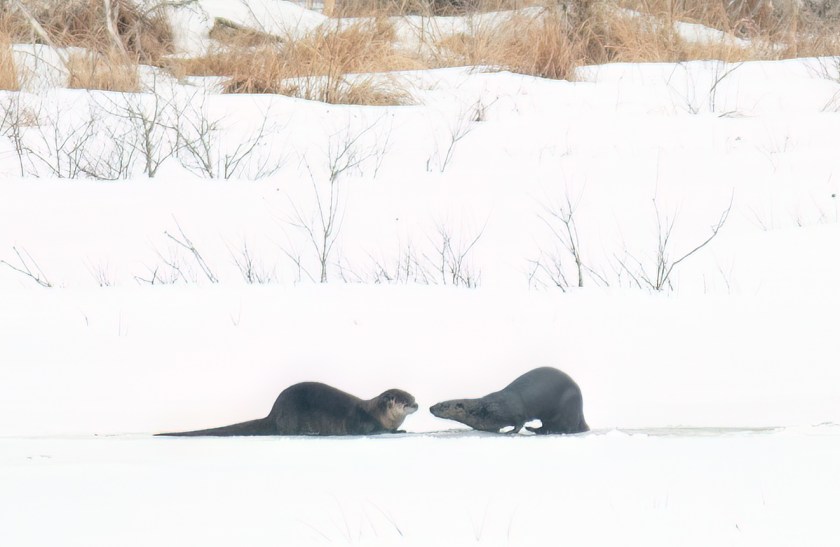
I stayed put, and ten minutes later they returned, this time checking immediately to see if I was still there:

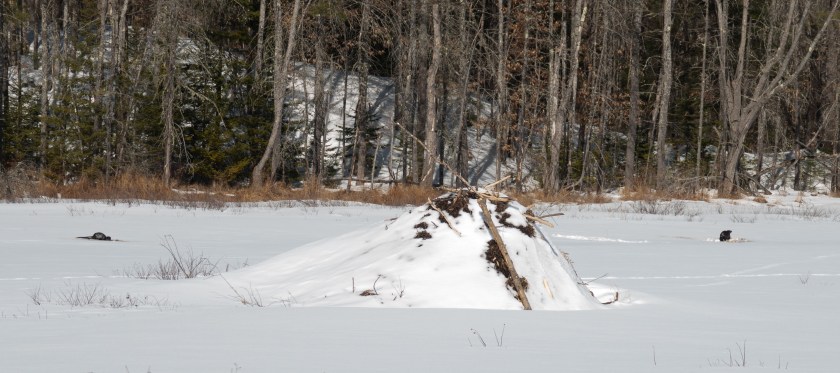
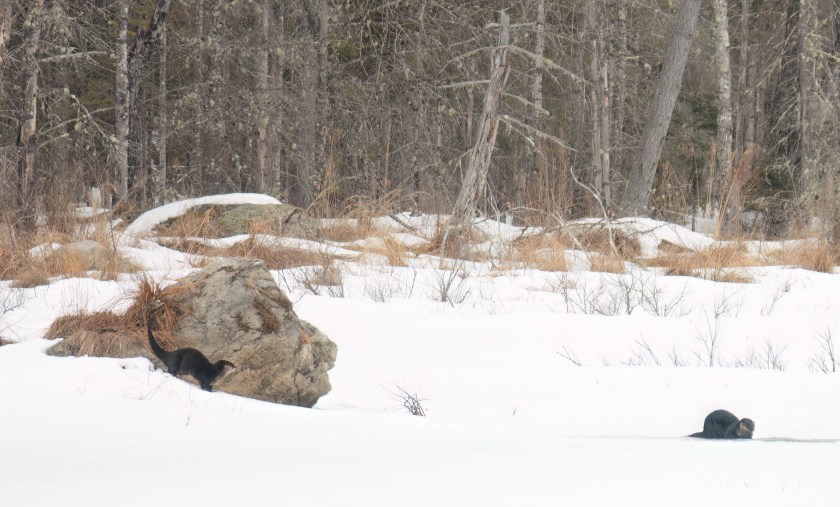
Since I clearly was, they didn’t hang around, only twenty seconds total this time, but then I saw a third one, on the left, further out on the ice near the beaver lodge.

This one was larger, perhaps the mother, and she was fishing successfully, three different fish over the course of fifteen minutes:

Eating one took a while:

Later, another otter joined her, but she didn’t share her fish. Watch the video here:

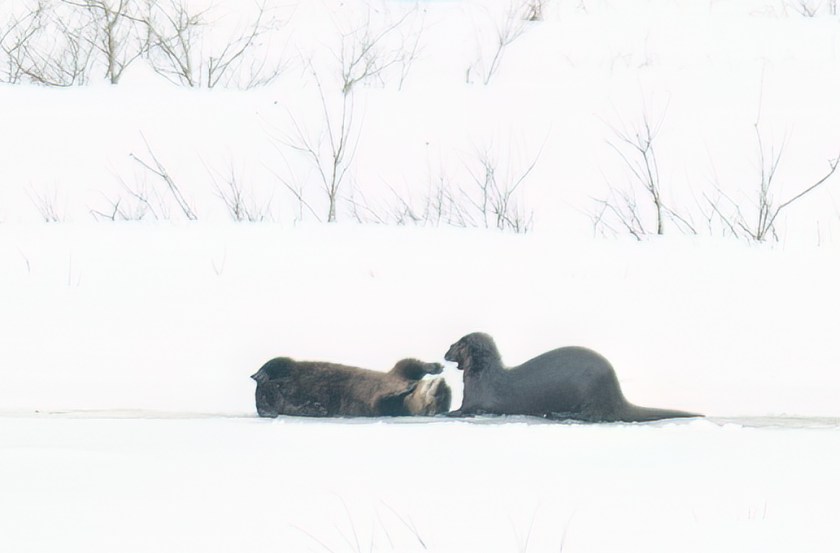
After a bit the youngsters appeared, sunbathing:

Looking for the others:

and sliding on the ice:

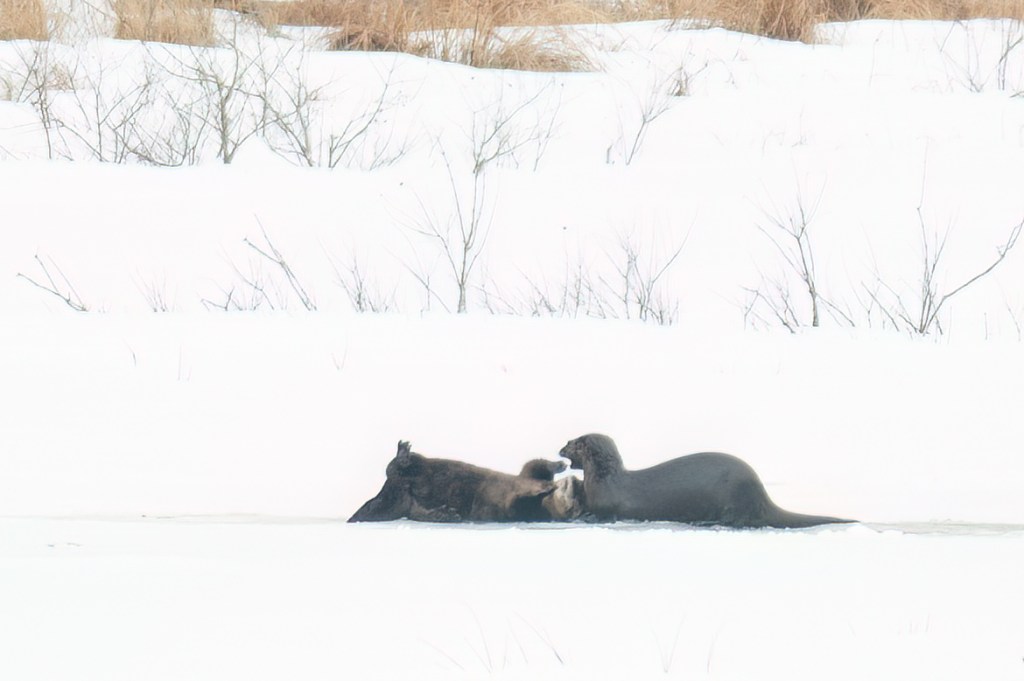
A communal slide, followed by a dip:

A perfect morning, for me and apparently for them too..

Forests in a land without trees

[This is my last post about our Mongolian trip. After this, back to Lovell, Maine.]

Despite what I have shown you so far, there are places in Mongolia with trees. An hour or so north of Ulaanbaatar, there is a real forest, the southern edge of the taiga that stretches north to Siberia. Called Terelj, the parts closest to the capital have become a major tourist destination, and we only reached a tiny wild corner of it just as the hotels were giving way to forest. It was fall, so the colors were lovely:

and we saw a handsome bird called a Northern Nutcracker, Nucifraga caryocatactes:

eating larch cones:

and hiding from us:

These birds are specialized nut-eaters; their tongue has a “lingual nail,” a long keratin growth that helps to lever up and shell seeds.

The only other woodlands we had seen were an odd little fragment near Chamdani in the Altai. Remember the Altai:

and then imagine how startling it was to encounter this: a wetland threaded with rivulets, dotted with small birches, and grazed into grassy moguls.

Small songbirds loved this place:

Rufous-backed Redstart
Hume’s Leaf Warbler, also probably!

But my enduring memories of Mongolia will still be those wide open spaces. I end my series of Mongolian posts with this poem by the famous modern Mongolian poet Dashdorj Natsagdorj, who says it better than I can; it is quite long, so rather than pasting it , here is a link:

https://newprairiepress.org/cgi/viewcontent.cgi?referer=&httpsredir=1&article=1117&context=sfh

PS The poet had a very interesting life: https://en.wikipedia.org/wiki/Dashdorjiin_Natsagdorj

PPS The Nature Conservancy has a huge project helping Mongolia preserve its wild grasslands : read here:

https://www.nature.org/en-us/magazine/magazine-articles/mongolias-conservation-horizon/

Nature at the edge of the modern world

In between the Altai and Hustai NP, we usually had a night before or after in or near Ulaanbaatar, the capital. It is now home to 1/2 of Mongolia’s population, 1.7 million people and growing. It is down in a valley and with a big pollution problem:

But there is still nature nearby.

Our hotel was outside Ulaanbaatar, called the Hotel Mongolica. It was near a river, and farmland, all marred by a serious litter problem. But there were flowers and birds in the grounds that made up for this. Here is an Azure Tit, a really delightful little thing:

A black kite:

and an Azure-winged Magpie:

A few wildflowers:

Siberian Larkspur
Spiny Pennywort, Orostachys spinosa

and farmland behind the hotel:

with a watchful dog:

In Hustai we saw an even finer dog, a Bankhar Dog, much to the excitement of our interpreter. This is the dog that went into battle with Genghis Khan, and Marco Polo brought one back to Venice with him. The best of them, like the one below, have spots above the eyes, giving rise to the name Mongolian Four-Eye Dog. Mongolians believe they are thus able to see into the spirit world. Genetic analysis suggests they are the ancestors of all breeds of livestock guard dogs.

I want one.

PS There is a depressing coda to the story of Bankhar dogs. Wikipedia says:

“As infrastructure and travel made the Bankhar dog’s native regions more accessible, non-native dogs began to intermix with the breed. During the Communist era of Mongolia, Bankhar dogs were let loose or exterminated to forcibly relocate nomadic groups into socialist-style settlements. Their pelts became fashionable for stylish Russian coats, and the largest dogs were killed to feed the growing dog coat industry. By the 1980s, the breed had almost disappeared.”

On the upside, they are now much sought-after, and perhaps the breed will recover. Read more here: https://www.bankhar.org/bankhar-dogs/

Small joys in the vastness: Amur Falcons and Gentians

Mongolia’s Hustai National Park is about 500 sq km in size, mainly hilly grasslands with rocky granite outcrops, on a smaller scale than the Altai, but open and empty nonetheless (though apparently in the summer it can get crowded.) At dawn the wolves howled at the rising sun.

We walked a little, sat on the closely-grazed turf,

and admired the remaining wildflowers, all low to the ground:

Dwarf Porcelain-flowered Gentian
Dwarf Statice
Chamaerhodos altaica
Fetid Dragonhead, Dracocephalum foetidum
Ground Thistle, Cirsium esculentum

We drove out of the park to a nearby river, with Ruddy Shelducks on the bank, and an endless herd of sheep and goats passing in the far distance:

In a tiny stream a Meadow Bunting was washing itself :

Everywhere there were Band-winged Grasshoppers that flew up on brightly colored wings, impossible to photograph in flight, but here is one on the ground:

And a very impressive female Armored Ground Cricket, Deracantha onos:

And all around rock piles arranged by giants (our vehicle is to the right of the further rock pile, for scale):

with domestic horses grazing nearby:

As we left the park, an Amur Falcon watched us from a fencepost:

Wapiti, anyone?

[The other large mammal in Mongolia’s Hustai National Park is the wapiti. It took me some considerable time to understand what we were looking for, because our guide used the names wapiti, moose, elk, and red deer interchangeably. In Eurasia, “elk” is often used for what Americans call moose, but there are no moose in Hustai. We were, it turned out, looking for a close relative of the North American elk, Cervus canadensis, but the subspecies sibiricus. To avoid the confusion with moose, the park rangers call them by the Cree name “wapiti”. “Red deer” was in fact a red herring: it was once thought that red deer, Cervus elaphus, and elk were the same species, but that is now known to be incorrect. C. canadensis has a wider rump patch and paler-hued antlers. ]

So, let’s stick with wapiti! Hustai has around 1300 of them, and they are not endangered. Here is a handsome bull wapiti, resting from his day’s exertions. It is the mating season, so he either has a herd of twenty or more females to keep under control, or he is trying to win a herd away from another male. Either way, an exhausting job.

This is a group of females:

Their lord and master rounds them up:

and moves them higher up the hill to a safer spot:

If he senses another male nearby, he may bellow, or rather “bugle”, an eerie sound. He stretches out his neck, and lowers his larynx to make his voice deeper and thus make himself seem bigger.

There was a larger male somewhere off to the left, but there was also a very young male right next to him, a so-called “spike” male (bottom left), whose antlers have not yet branched; eventually, the dominant male will throw him out of the herd.

The male bugled frequently, but best of all was one morning at dawn when we had gone to look for wolves, and we heard wapiti bugling intermingled with wolves howling. Magical.

The herd moved down towards us to drink from a tiny stream.

The male kept a very close eye on both them and us:

When some of them headed across the stream his displeasure was clear:

and they thought better of it:

After all this effort, his reward is near: the tongue licking the air is scenting an enticing female:

A man’s job is never done.

The Unpronounceable Prehistoric Horse

Our second major destination in Mongolia was Hustai National Park, less than two hours drive from the capital Ulaanbaatar, not nearly as isolated as the Altai, and at a lower elevation.

We had two main goals: Pallas’s Cat, and Przewalski’s Horse. Only the second of these wishes came true, and this post is about those horses, known locally as takhi. Below, from a distance, is a typical social unit: the stallion is at right, with two or three mature mares, and their offspring of up to three years old.

Closer up, these are handsome animals:

They are special because their lineage separated from that of domestic horses at least 38,000 years ago, perhaps as much as 160,000 years ago. They have 33 chromosome pairs compared to 32 for ordinary horses. Other “wild” horses are actually feral domestic horses, but these are truly wild. They were extinct in the wild, and were brought back from about twelve animals in zoos, re-released into their ancestral central Asian homelands. The total population is now thought to be around 2000 animals, of which around 120 live in Hustai National Park.

They are stocky, 12-14 hands high, and strong. They weigh about 300Kg.

The stallion keeps a close eye on his females and foals, making sure they stay together:

The affection between mothers and foals is evident:

Przewalski’s horses have a distinctive appearance.
Their overall coloring is something called pangaré, in which there is pale fur around the eyes, muzzle, and belly. This is thought to be protective, and is found in other wild equines such as the African wild ass. Starting with the head, their profile is convex, not to say Roman:

and their stiff upstanding dark mane has paler hairs at the base, and no forelock:

At the rear, their back has a thin dark dorsal stripe, and the base of the tail (the dock) is longer than in domestic horses, while the tail hairs are shorter:

Finally, their legs have horizontal stripes, or bars, easiest to see on the forest of legs in the front group below:

All of these traits are instances of “primitive markings”, found in other wild equines and more rarely in domestic dun horses.

The painting below is from the Lascaux caves in France, dated to about 20,000 years ago, and looks remarkably like a Przewalski’s horse.
PS There are frequent incursions of herds of domestic horses from outside the unfenced national park. A domestic stallion is not strong enough to mount a Przewalski’s mare, so any foal she has will always be pure-blood Przewalski’s. The reverse is not true, so a foal born to a domestic mare could have been sired by a Przewalski’s stallion. The local herders thus encourage their herds to enter the park, and the rangers shoo them out again, in an ongoing game!
PPS For full details of the challenges of bringing back a diverse population from only 12 ancestors, see here: https://pmc.ncbi.nlm.nih.gov/articles/PMC9686875/

Winter is coming

Taking a break from Mongolia, let’s take a look at what’s going on back in Maine

Winter is approaching, time to fill up on food, and get the house in order. A chipmunk was busily downing something delicious, a beetle, I think:

Now stored in those cheek pouches, to transport to its stash.

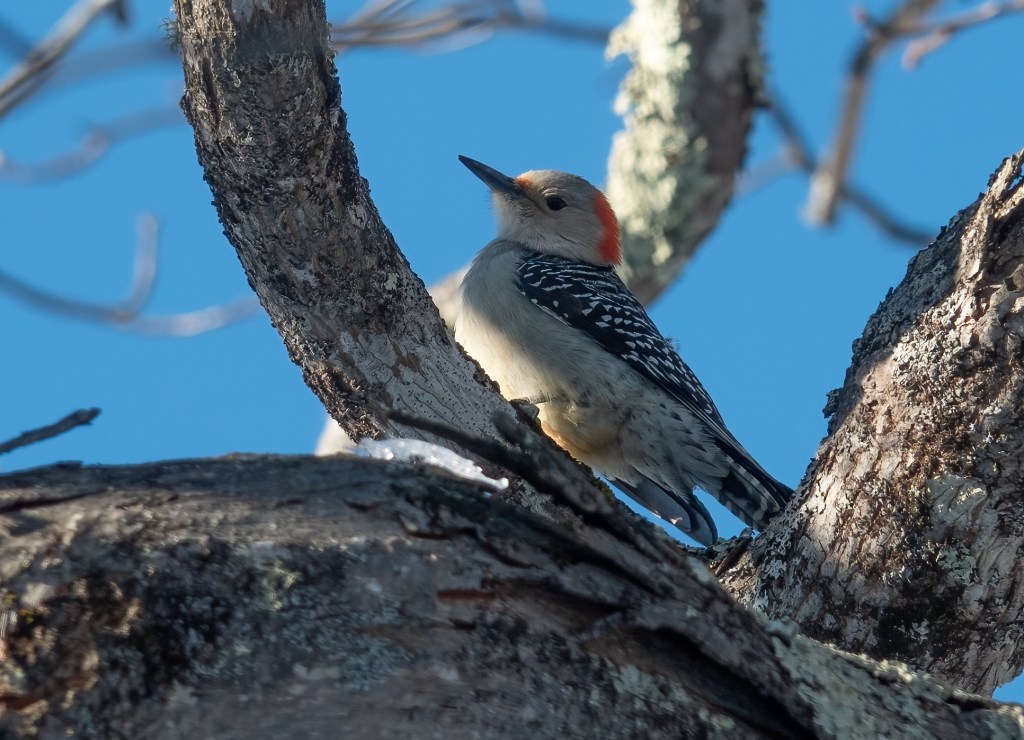
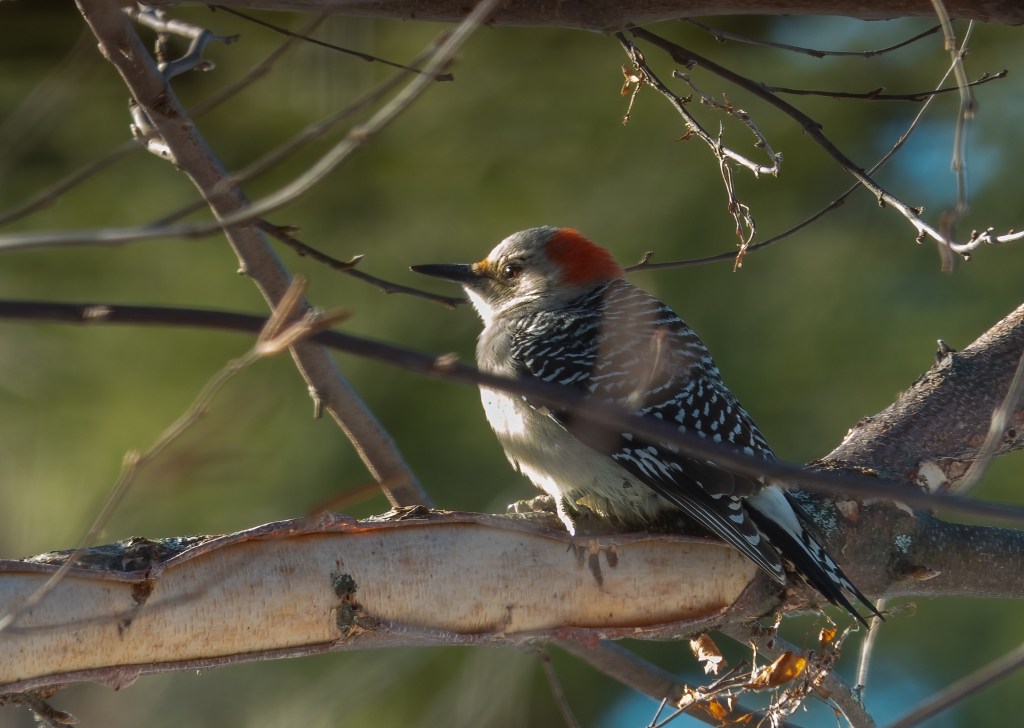
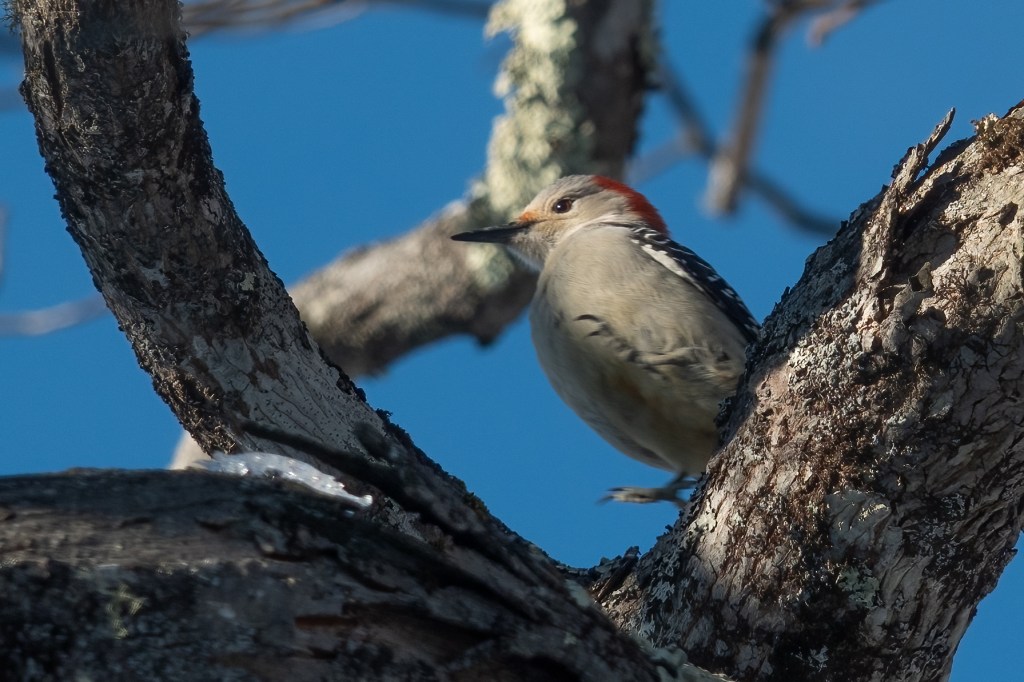
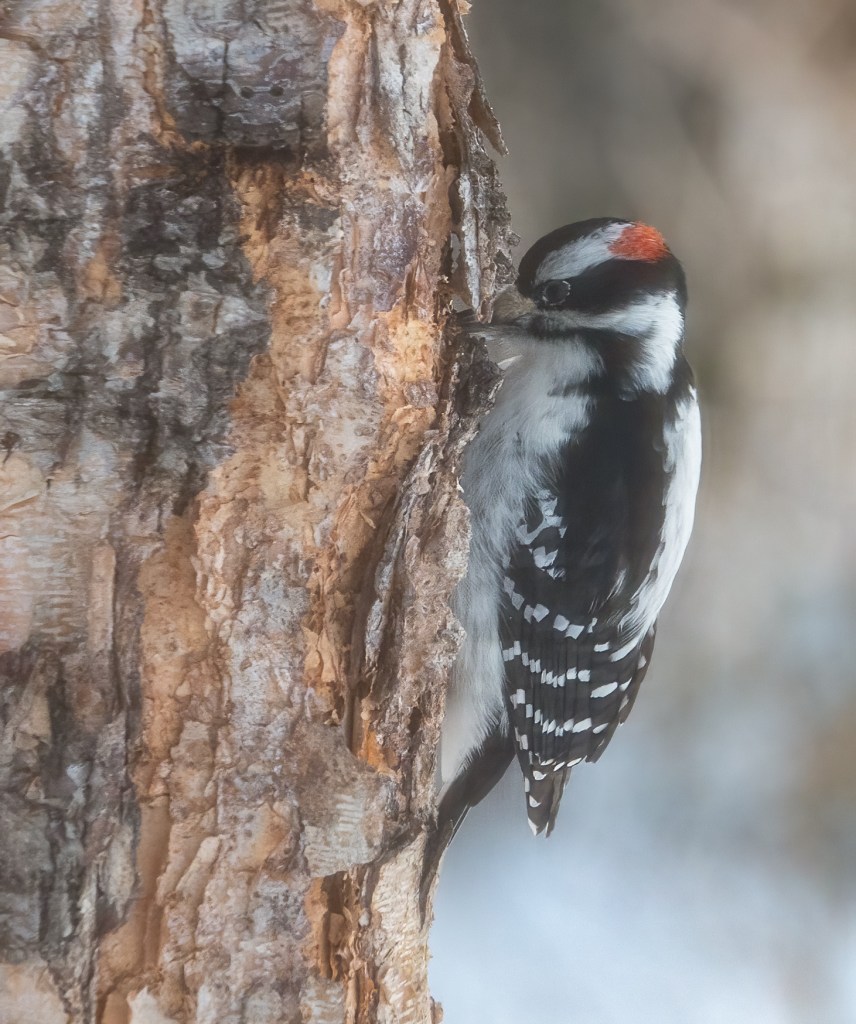
The Downy Woodpecker does not migrate, so it needs a winter roost. Each bird excavates its own; this one is removing hefty chunks of wood. The red head patch indicates that this one is a male:

They like riparian habitat, and this is a dead tree at the edge of the beaver pond. The wood is clearly soft and punky, and he doesn’t pause to eat any grubs, he just throws the wood over his shoulder:

In the video below you can see that the hole is getting so large that he can almost disappear inside:

The flashy cardinal is lazy, gleaning sunflower seeds from underneath the birdfeeder:

The beaver is renovating the lodge:

I went down at first light, 6am, to try and catch him at work. Too late, though he was still swimming around:

but then he saw me, slapped his tail, and dove:

To end, some earth-bound creatures. A late Wood Frog, looking for insects in the leaf mold before heading off to hibernate.

In a lovely coincidence, we saw a relative, a Siberian Wood Frog, in Mongolia, the northernmost frog in the world, living as far as 71 degrees N.

Both survive underwater in winter, with very little oxygen, and can freeze their bodies and then defrost themselves in the spring.

And finally one of those rare late insect sightings, a Black-sided Pygmy Grasshopper:

Later this month the ground will freeze, and all will go quiet till spring. But these inhabitants of my world will still be out there, somewhere.

Swan, Swan Goose, Goose

[As was often the case on this trip, we couldn’t get close enough to the wildlife for me and my camera to get good shots. I’ve made a decision to write about some things anyway, because they are so interesting (I hope), but first I start with pictures that set the scene in Mongolian rural herding culture]

In the Mongolian Altai, down in the plains, there are large lakes, some of them freshwater and some saline. We visited both types. They’re very beautiful (but with a distressing amount of trash around). Most of these photos are of Khar-Us freshwater lake, 1800 Km2, average depth 2.1m. It is a national park.

The wind can be fierce, whipping up dust spouts:

The next photo is Dörgön Lake, a saline lake at 4% salinity, surrounded by samphire plants:

The local herders bring their livestock down to drink,

while they prefer to share a cup of tea with our drivers and Jane:

Back at Khar-Us lake, the braver waders browse on water plants:

The animals below are a mix of sheep and cashmere goats, now growing their winter coats; your next sweater “on the hoof”:

In the midst of this, there are waterbirds. Whooper Swans, Cygnus cygnus, breed here. They can be seen in the UK, but I have never seen one before. Their total range is from Iceland to Japan, and they only breed in the northern parts of that range. They have lovely yellow bills.

They graze on aquatic plants, in a behavior called, unimaginatively, “upending”!

They are thought to pair for life, but they are not well studied on their breeding grounds. This group of around twenty birds:

included two in the midst of a courting ritual.

Here’s a video:

I am happy to say they are not endangered. Soon after we saw them, they probably left for their wintering grounds further south.

Fifteen minutes later Istvan , with a note of excitement in his voice, said “Look, swan geese.” What? Which? Make up your mind. But I hadn’t misheard, there really is a bird called a Swan Goose, Anser cygnoides, which looks like a goose, but with a longer neck and a black (not orange) bill with a white line around it. In the picture below all but the leftmost goose (in both pictures) are Swan Geese. The outsider is a Greylag Goose.

They flew off before I could get better photos:

Second from left below could be a Swan Goose/Greylag hybrid.,

The reason Istvan was so excited is that Swan Geese are classified as Endangered by the IUCN. * Almost all of their breeding grounds are in Mongolia, the yellow areas on the map below:

They are protected in Mongolia, but in both their breeding grounds and their wintering grounds (mainly in China) their habitat is very much under threat, and hunting is also a problem. Overgrazing by livestock also plays a role, since the swan geese eat sedges and grasses too.

One final picture: a livestock enclosure on the shores, resourcefully and precisely made of mud brick masonry, dry stone walling, and discarded car parts:

In London or New York this would be considered an art installation.

* The Swan Goose conservation status has changed back and forth over the years, but the most recent listing is Endangered, see Birdlife International for details. The Birds of the World entry is out of date and under revision.

Breakdowns, and bubonic plague

[When we weren’t looking for large mammals in Mongolia, there were smaller creatures to search for, mammals, birds, and insects. And tales to tell.]

Mammals are scarce, but we did see several foxes, and also Tarbagan Marmots, aka Siberian Marmot, Marmota sibirica, a favorite food of the snow leopard.

Closely related to groundhogs, Marmota monax, they live at much higher elevations and in much larger social groupings of 13-18 animals. They stay close to their burrows, and dive for cover if a threat seems near.

They are considered Endangered by the IUCN , partly due to hunting pressures, and partly because they carry (and catch) bubonic plague. Fleas or ticks can transmit it to humans too, so we did NOT eat marmot or buy marmot fur hats! But despite the plague, Mongolians are fond of their marmots, and build charming statues to them:

I don’t think many Americans would want to build a statue to a groundhog.

Istvan, our guide, was a skilled and knowledgable birder. When there were no leopards, birds were often a possible substitute. Migratory birds had largely gone, so the birds we saw were brave year-round residents of this harsh land. In the summer months, many of them eat invertebrates, but in the winter their diet is mostly seeds. This is a Brown Accentor:

And this is a Mongolian (or Kozlow’s) Accentor, which Istvan got very excited about. I realize that it is a rather nondescript bird, but apparently it is a birding prize.

The tiny bird below is a Guldenstaedt’s Redstart. The white area is the top of its head, photographed from above as it looks down!

Driving around the foothills, one of our vehicles broke down, so while they fixed it we wandered around for an hour or so, looking for anything really! This is when we saw my favorite bird, the Mongolian Ground Jay, Podoces hendersoni, a very spiffy bird with smart beige and black plumage, and with distinct attitude.

It would be right at home in the world of Bertie Wooster, dressed for luncheon in the country.

At higher altitudes, there was a rather handsome Daddy Longlegs (Harvestman), that I can’t ID:

PS Istvan told us that we might hear noises in our gers at night, and not to leave any food around. The culprit would be a Midday Jird. This wonderfully named animal is a little rodent with a long furry tail, that hops on its back legs:

It is actually a gerbil, Meriones meridianus, and since it is largely nocturnal its name seems completely unsuitable!

PPS Reverting to birds, we also saw various raptors, soaring on the updrafts, including Golden Eagles, Lammergeiers (aka Bearded Vultures), Cinereous Vultures, and the pheasant-sized endemic Altai Snowcock. But none close enough for worthwhile photos. The pictures below of a magnificent golden eagle were, rather depressingly, taken at a roadside display en route to Ölgii airport next to a souvenir stand.

Two-humps good

Wild Bactrian camels, Camelus ferus, are found only in very small numbers now, maybe 800 only, in remote parts of the Gobi. We didn’t expect to see them and we didn’t. But we were very taken with the next best thing, domestic Bactrian Camels, Camelus bactrianus. They are not closely related to the wild Bactrian Camel, having diverged maybe 1 million years ago, and they too have two humps.

The humps are fat, not water, and a way to store energy. The Mongolian population totals around 400,000 domestic camels. They roam free across the stony steppes, doing a convincing impersonation of wild animals!

They’re big mammals, the largest in their natural range. Overall height ranging from 230 to 250 cm (7.5 to 8.2 ft), head-and-body length is 225–350 cm (7.38–11.48 ft). Body mass can range from 300 to 1,000 kg (660 to 2,200 lb). They can have a rather ungainly look, as if assembled by committee.

A family may own anything from a handful of camels to several hundred. A castrated male costs about US$400. The herds you see may belong to more than one owner. There are two young ones in the photos below:

When their owners want them, they are rounded up by motor bike: one is approaching in the background.

Our guide pointed out that they ride their motorbikes (and indeed drive their vehicles) pretty much as if they were still on horseback:

My friend Jane made a video:

Their adaptations to the extreme climate in which they so successfully live make them very valuable additions to human societies. They were domesticated around 4000BCE, and used as pack animals on the Silk Road, for riding, but also for milk, meat, hair, and leather. Gers (yurts) may have camelhair in their felt insulation, they may be tied together or packed up with camel skin ropes and bags, and moved from place to place on camels’ backs.

Their adaptations for their harsh home climate include long eyelashes, and nostrils that close, to protect them from sandstorms.

They have tough mouths, and can eat thorny vegetation. If desperate, they will eat skin from carcasses, and even rope, sandals and tents!

They can go without water for months at a time, but when water is available Wikipedia says they may drink up to 57 L (13 imp gal; 15 US gal) in one go. They also routinely eat snow for moisture, unlike most mammals.

A splendid animal:

And their proud owners get together to race them at the annual festival; they ride them pretty hard, but I assume they recover, since they’re too valuable to risk their health:

PS The way to remember that Bactrian camels are the ones with two humps is that Bactrian begins with B, and placed on its side the letter B has two humps!