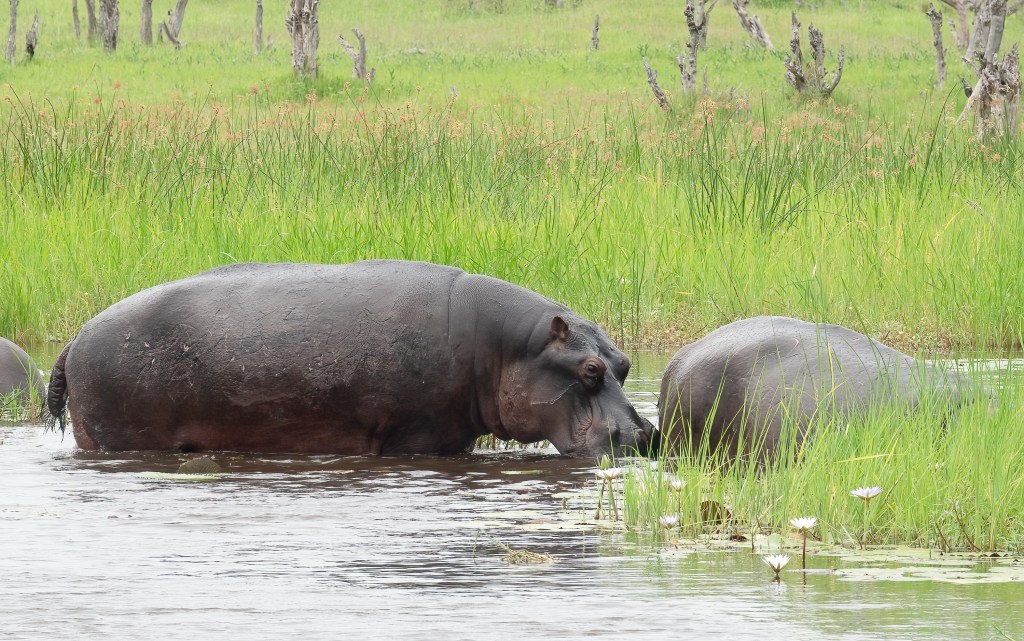
You’ve all seen hippo photos before, I’m sure, but we were lucky to find ourselves on a stretch of the shallow Khwai river where we were at water level, eye-to-eye with the hippos, and also close. They are notoriously the biggest killers in Africa, but apparently the water is their safe place, and they are unlikely to leave the water to attack someone on land. This appeared to be true!
The first we saw had a very very tiny baby, quite possibly a newborn, and too small to cope in the water without help, which may be why they were on land in the daytime:

This 50-100lb baby will grow up into a huge animal, a megaherbivore. Males can weigh up to 7000 lbs, and be 16 feet long. To convey a warning, they yawn, displaying impressive tusks:

The youngsters practice their yawns: this guy has hardly any teeth yet, let alone tusks, but you can get a good look at his fleshy tongue. :

The tusks can be a nuisance, a place for water lilies to get caught:
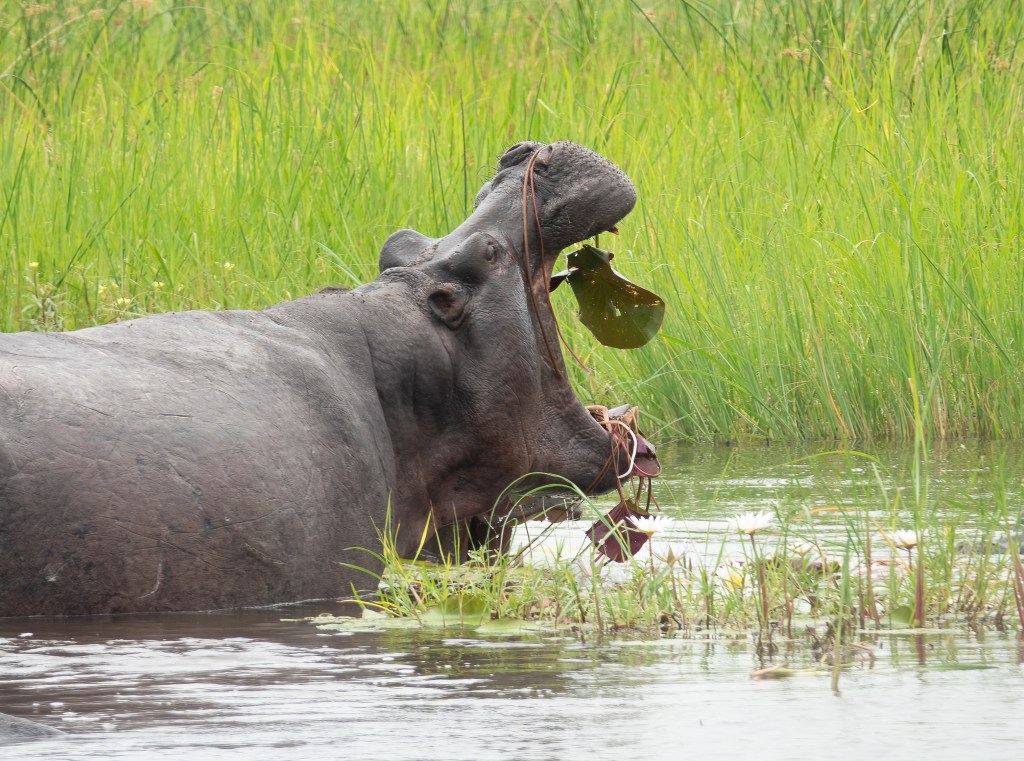
although they are after all herbivores, and he may just be trying to get the food back in his mouth, like any incompetent spaghetti-eater.
They have extremely strange-looking tails:
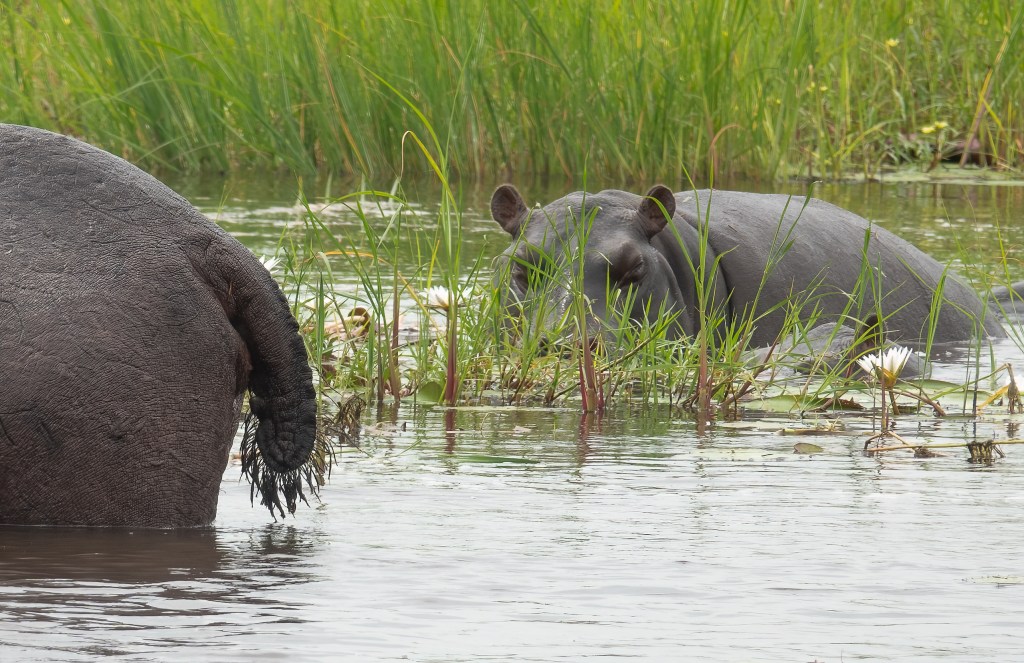
The design has a function, as is usually the case in nature. When hippos defecate, they deliberately spray their dung over as large an area as possible, wagging their tail energetically and using it as a sort of paintbrush. The scent is clearly appealing to other hippos:
including to the kids:

In fact, they eat the adult poop. Baby hippos are born with sterile guts. To populate their guts with essential bacteria, they practice coprophagy. (My spell check corrected “baby hippos” in the previous sentence to “baby hippies”…)
The primary function of the spreading behavior to the hippos is probably territorial, at least when they do it on land, but this unsavory habit is also thought to have positive ecological side-effects. Schoelynck et al 2019 show a fascinating food chain effect. Hippos ingest large amounts of silicon in their grassy diet, and defecate it in their dung. Much of this goes into the river, where it is quickly spread by the hippos, and it has been shown that the presence of hippos drastically increases the silicon levels in the rivers, and thus in the downstream lakes. Silicon is essential to the skeletal structure of diatoms, which in turn provide food for fish, so high silicon levels contribute to the richness of the lake waters and their ecosystems. Read more details here:
https://www.science.org/doi/full/10.1126/sciadv.aav0395
I end not with the Flanders and Swann Hippopotamus Song, but with this video, which is spliced together from footage by me and two of my friends Jane and Annie, who are available to hire as sound engineers. It is 2 minutes 37 seconds of soothing soporific hippo splashing and sighing, climaxing in a fine baritone chorus worthy of a Welsh Male Voice Choir. If you can see it in full screen, so much the better.