Frog Blog 3

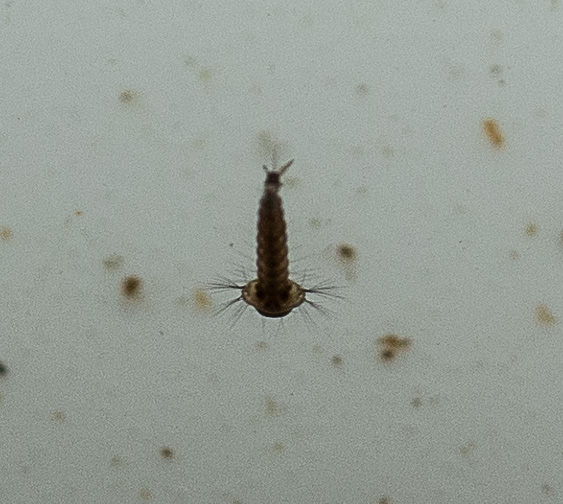
Last time’s Mystery Photo answer: It is a mosquito larva. In two months it will emerge from the pond  and a mosquito will come out and fly away. Or maybe a tadpole will eat it first?

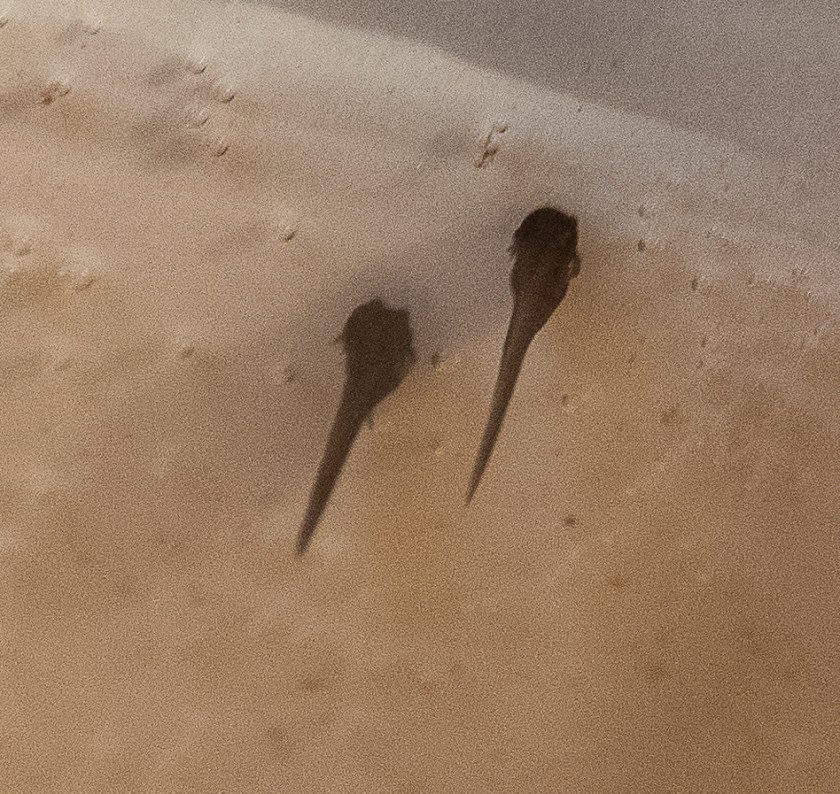
The tadpoles are flourishing: many of them have come out now and are swimming around the bowl.  It makes them very hard to photograph! They like the edges of the bowl:

DSC04008

And close up they now look like this, with a proper body and a tail. They are about 1/4″ long,  and their body is about the size of a grain of rice.
DSC04006

They often lie still, resting, but if the water moves, they swim around:

I put one in little bowl on its own so you could see how it swims. When we swim, we kick our feet up and down, but a tadpole moves its tail very fast from side to side. You might have to watch this very short video more than once to see what it does.

Once I’d taken the video, I put him back with his friends in the big bowl.

Here is a new mystery creature for you, from the pond. It looks like a collection of bits of reed, but in fact it has been collected by the larva of an insect, to protect itself from predators. From the safety of its armor, this one is venturing halfway out to investigate its surroundings:

DSC03813

Do you know what the insect is?? Answer next time!

My next post won’t be till the tadpoles have either grown much bigger, or are changing in interesting ways.  Up till now they haven’t eaten anything, but soon they will be hungry, and I will tell you some time what they like to eat. I’m not sure how long it will take for them to grow, but meanwhile I will go on doing posts for grownups about other things entirely, but all about nature, and maybe you would like some of the photos in those too?
Frog Blog 2

Things are moving fast!! I don’t think these eggs are going to take 20 days to become tadpoles!

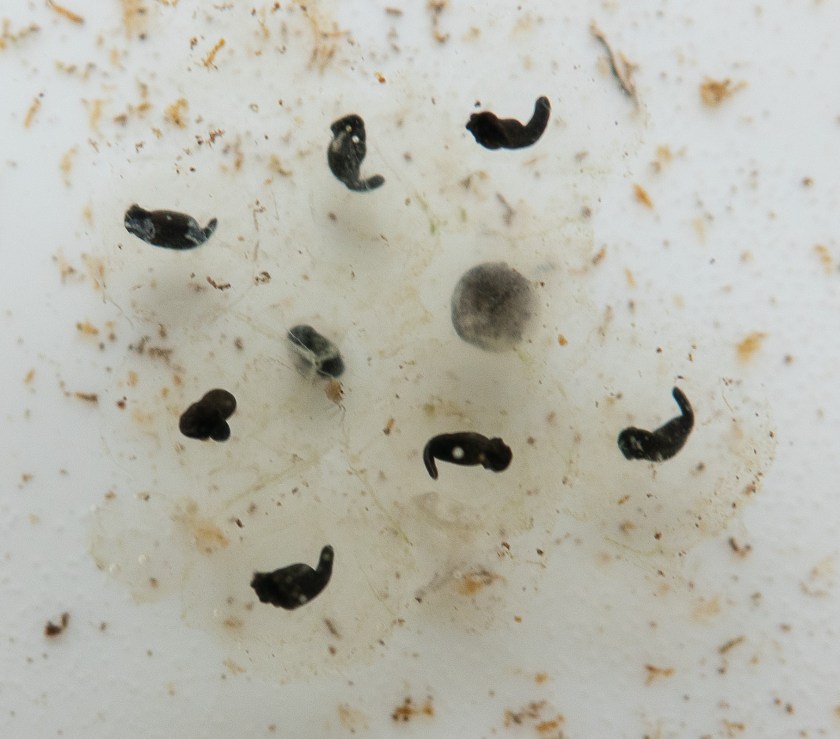
One day after I put the eggs in a bowl, they had already begun to transform. Last time, they looked like black dots, or periods.  But now they look like commas. I put a few eggs in a smaller bowl so I could take a close-up photo more easily:

DSC03661

You can sort of see a tail, and two bumps on each side of the head that will become eyes, or maybe gills. One egg doesn’t seem to be growing at all. There may be something wrong with it, or maybe it is just a little slower than the rest?
The next morning, the tadpoles had started to grow longer tails, and gills! Can you see the little feathery things sticking out on each side: those are called gills.

DSC03688

Tadpoles don’t put their heads above water to take a breath. Just like fish, they breathe water. When the water flows over their little gills, they are able to get oxygen from the water, just like our lungs get it from the air we breathe. Clever, huh?

And the really amazing thing is that they are starting to wriggle inside their jelly capsules. I’m going to try and get a video for next time.

There are other things living in my pond. Do you know what this is?? Try to guess. Clue: it is very, very tiny, smaller even than the frog’s eggs. The answer will be in the next blog.

DSC03586


The bitter end

The start of spring is in fact a very hard time for most wildlife. The winter food sources are almost completely exhausted, and nothing new is yet growing. It snowed again last night, April 9th.

The chickadees have been here all winter, and at this point they will explore any possible food source. This one seems to have found some insects in a knothole in a telegraph pole:

DSC01216

And this one has found something under the lichen on an old apple tree:

DSC01622

These beaver, in a pond with at least two active lodges, were busy some time before the last snowstorm (since there is snow on top of the felled tree), eating the cambium under the bark. They are venturing out now, I have found active scent mounds that they use to mark their territory. Their lodge is visible in the background:

DSC01566

Meanwhile flocks of turkeys are around, the males proudly displaying early in the morning. The three coruncles dangling from their wattles turn bright red with blood when they are excited…

turkey

It now gets light around 6.30am, and I am being woken every morning by noisy turkey dating sessions.

Life goes on.


The Frog Blog

[This is an extra blog, aimed at the younger generation, who badly need things to do right now.. Maybe they will find it fun. It overlaps with my usual blogs, so don’t read both! Please send this on to anyone you know who has small children, the more the merrier.]

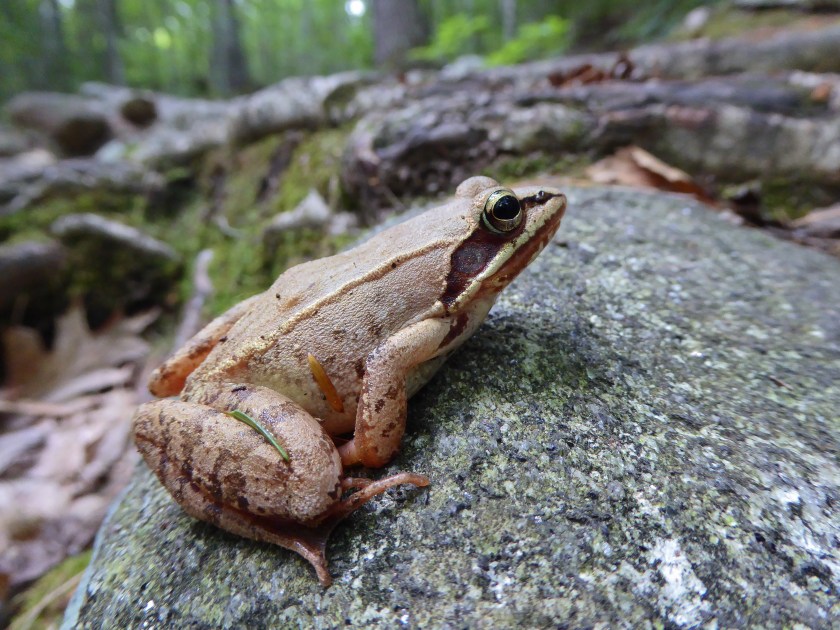
This is a Wood Frog. He is about 2″ long, and she is slightly bigger than he is. You can tell it is a Wood Frog because it has a black mask on its face.

Wood frogs mating

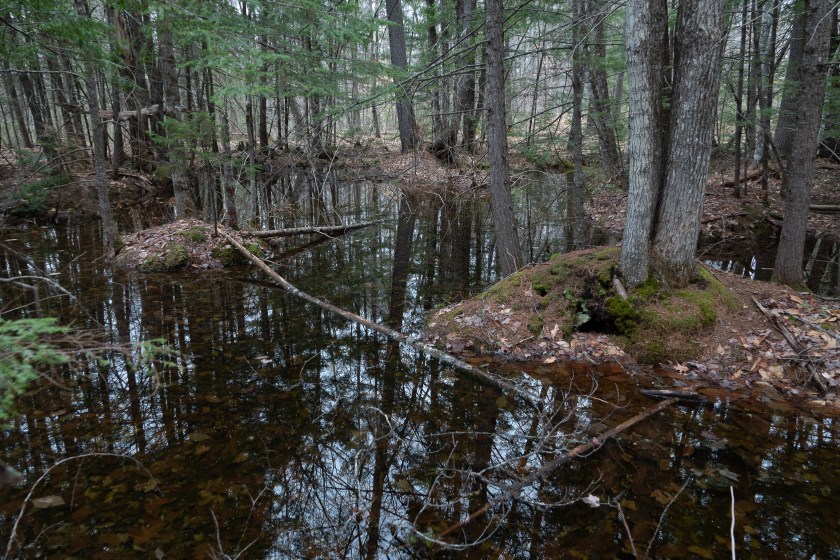
They live in the the woods of Maine, in the northeastern United States, all year, but when spring comes, they rush to the nearest tiny pond.

Vernal pool used by wood frogs

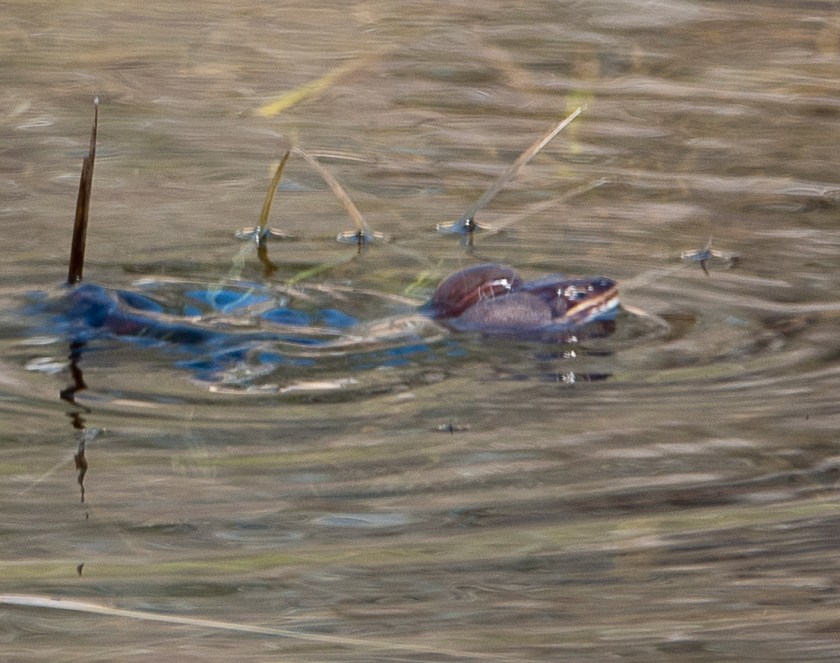
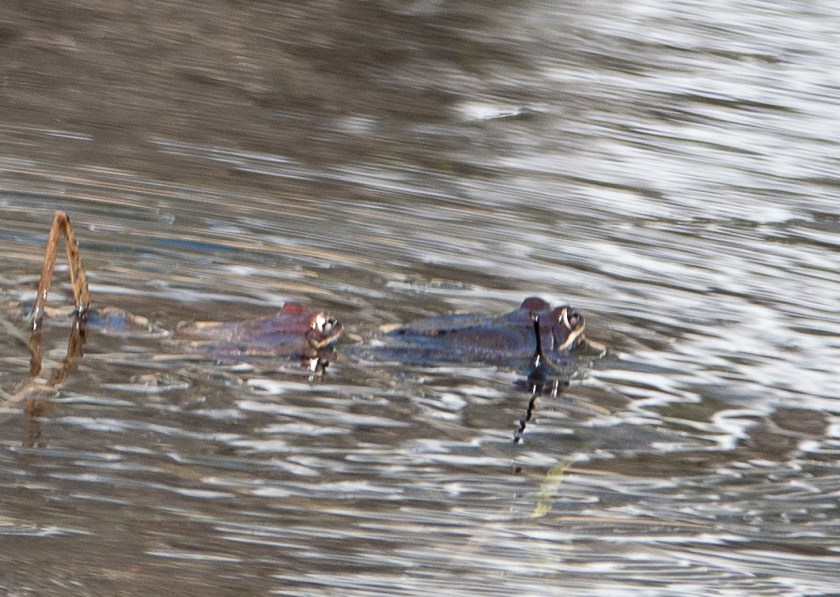
These ponds are so small they have no fish, so the frogs (and their eggs) are safe from being eaten. They swim around, looking for a mate:

DSC03145

DSC03338

And they call out as they swim. What do they say? American frogs say “Ribbit”, right?? But not these frogs. These frogs make a loud noise that sounds exactly like ducks or geese:

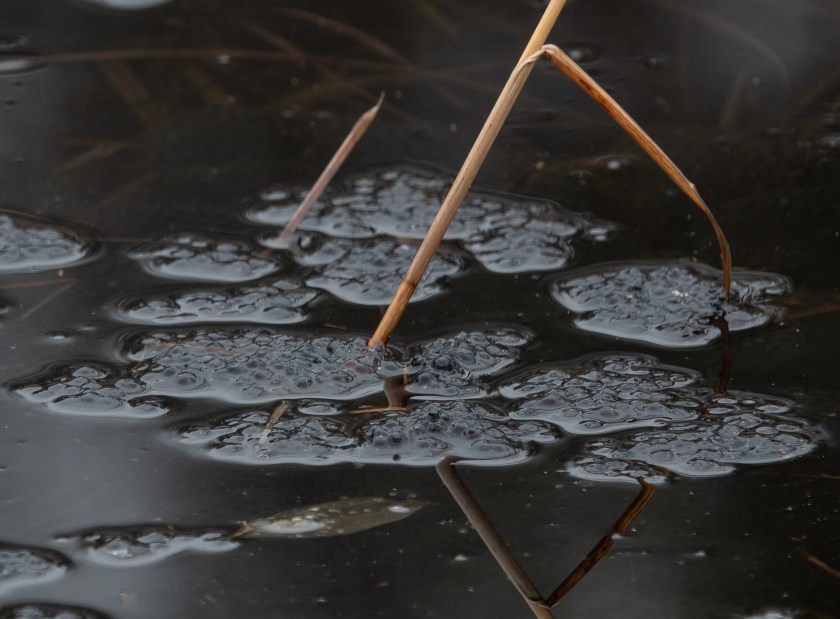
Once they find the love of their life, the female lays eggs, that look like bubbles on top of the water. My pond has thousands and thousands of them right now.

Wood frog eggs

If you collect a few, and get a better look, here they are:


Each egg is a little black dot, surrounded by jelly. There are thousands and thousands of them in my pond right now, so it is OK for a grown-up to collect just a few to show you, so long as I look after them carefully, and put the baby frogs back in the same pond that I found the eggs in. Every day, they will get fresh pond water, and lots of daylight.  Each week, I’ll take some more photos, and let you know how they are doing. If all goes well in about 3 weeks they will hatch as TADPOLES, and then they will gradually turn into FROGS.

I’ll keep you posted, and you can send this blog to all your friends. If you have any questions, you can ask me, and I’ll do my best to answer.


A Dalliance of Wood frogs

[I am a big fan of a blog called Naturally Curious by Mary Holland.  Today she scooped me.  Yesterday, I had prepared this blog on mating wood frogs beside my driveway, and waited till today to send it. I have decided to go ahead anyway, because not all of you read her excellent blog. https://naturallycuriouswithmaryholland.wordpress.com  ]

The shallow pond by our driveway still had ice on it on Friday. Saturday was the first warm and ice-free day, and on Saturday night this was our lullaby:

You might think it was ducks but no, it was wood frogs, who come to the pond to mate in very early spring. Here is a wood frog, Lithobates sylvaticus, in the forest where they live the rest of the year.

Wood frogs mating

They were still at it during the day, and I managed to get some not very good photos; they  are only two inches long, and they are extremely skittish, so you can’t get close, and after they are disturbed they don’t return for 20-30 minutes. Here is a head-on shot:

DSC03145

And a profile. The eyes are surrounded by a big spherical membrane that looks like an old-fashioned goldfish-bowl diving helmet.

DSC03338

The loud quacking sounds are amplified by a pair of air sacs that they inflate when they call, and I managed to get just one shot that shows them inflated:

DSC03155

In this photo, they do remind me rather of silicone breast implants.

And sometimes all that effort pays off; and yes, the males are smaller than the females.

DSC03168

It appears that not all the liaisons are private one-on-one affairs. At one point a small area of the pond was bubbling like a witch’s cauldron. Here is a not very exciting video to give you a sense of what I saw. What lay beneath the surface one must leave to the imagination.

Gray whales III: spy hopping, breaching and more

Much of the time the huge grey shapes cruise along like the submarines in Das Boot, but some behaviors are more interesting.

They do vocalize, and while they are in the calving lagoons they mainly make the so-called ‘knock’ call. Its function is unknown. You can hear this and other calls here:

Gray Whale

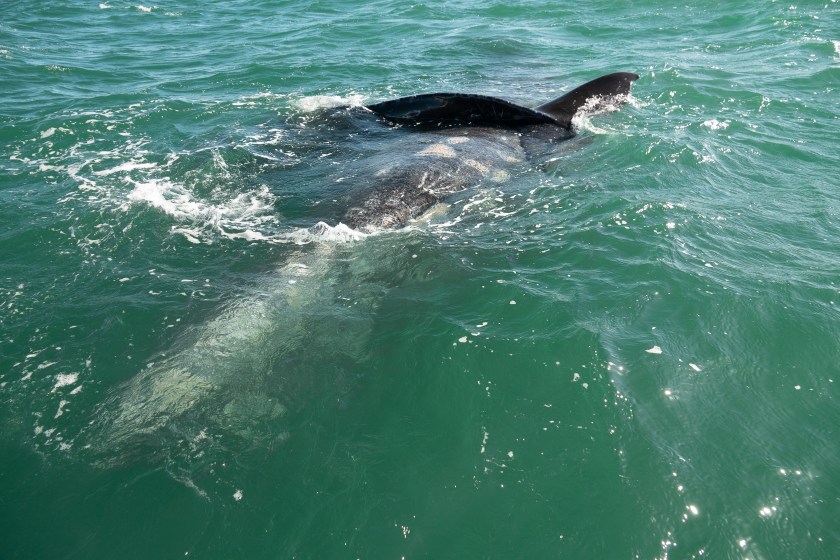
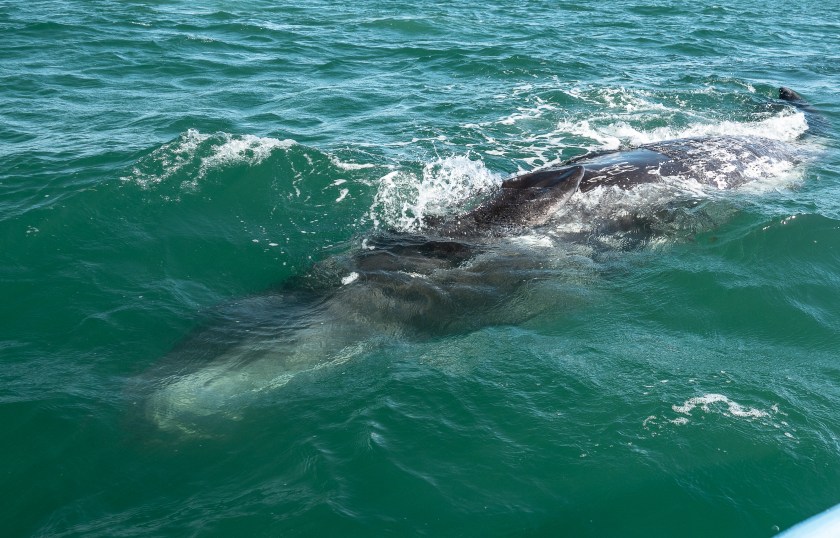
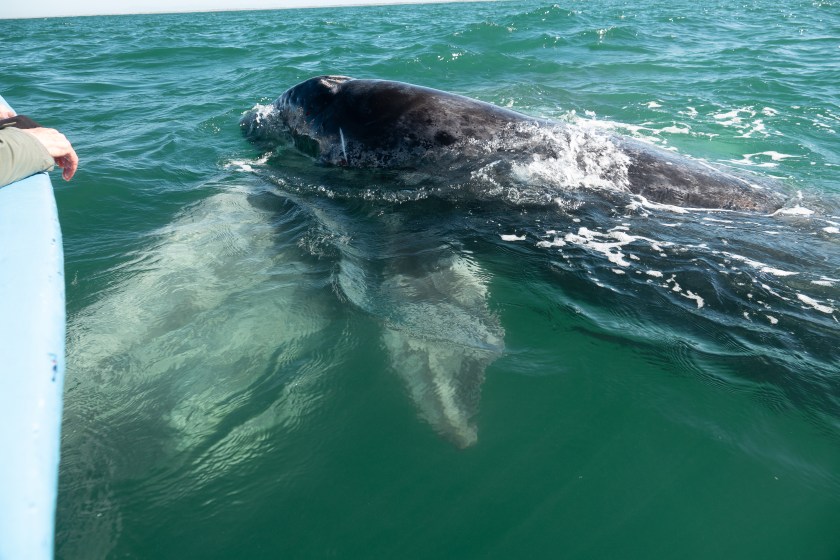
They roughhouse. The mother below pushed her way under her baby, and shoved him out of the way. It wasn’t clear whether she thought he was too close to our boat, or whether she wanted to be the one to get stroked instead, or indeed whether it was deliberate, an accident, or a game. The baby was fine.

DSC00332

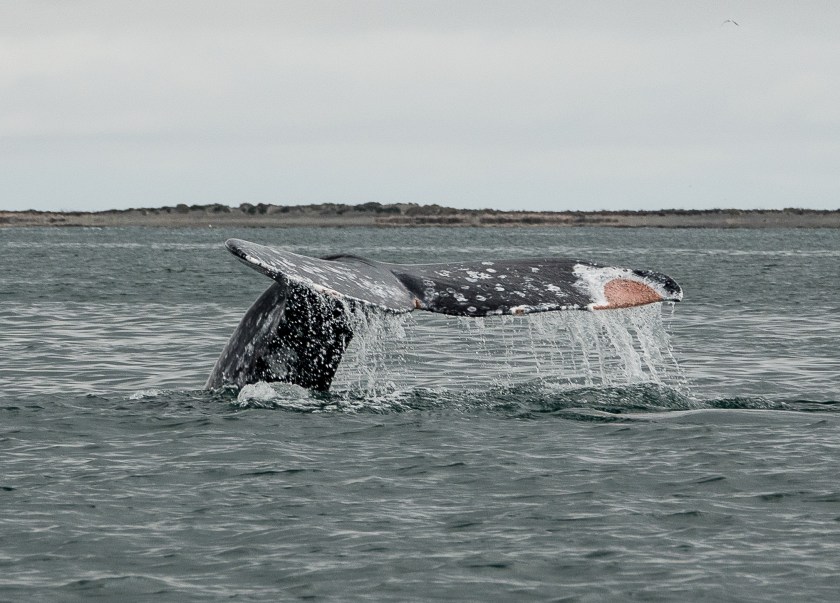
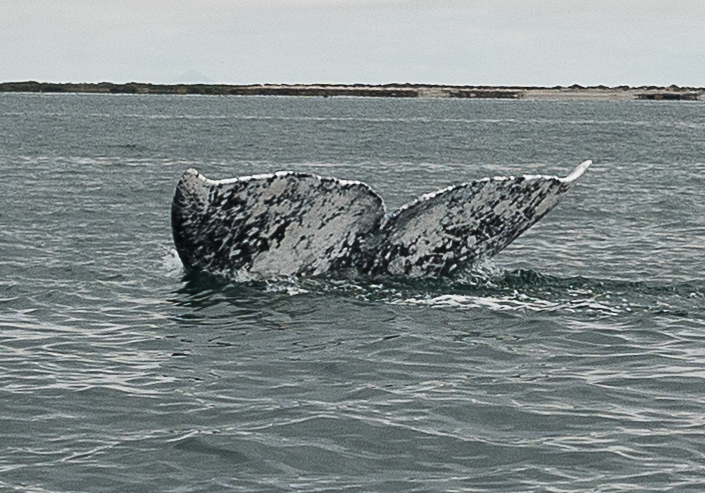
Their behavior can also be more dramatic. Sometimes after a tail fluke, signaling a deep dive…

DSC00931

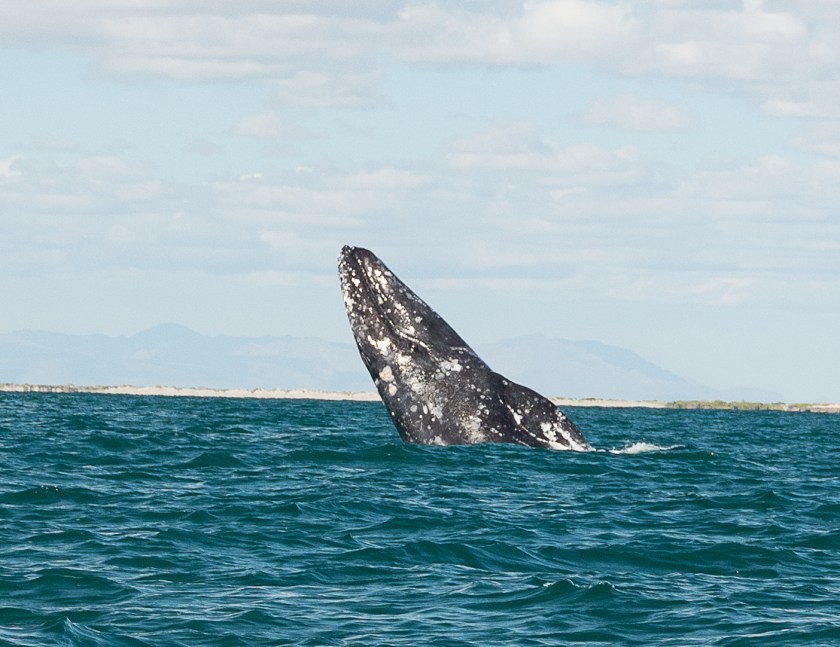
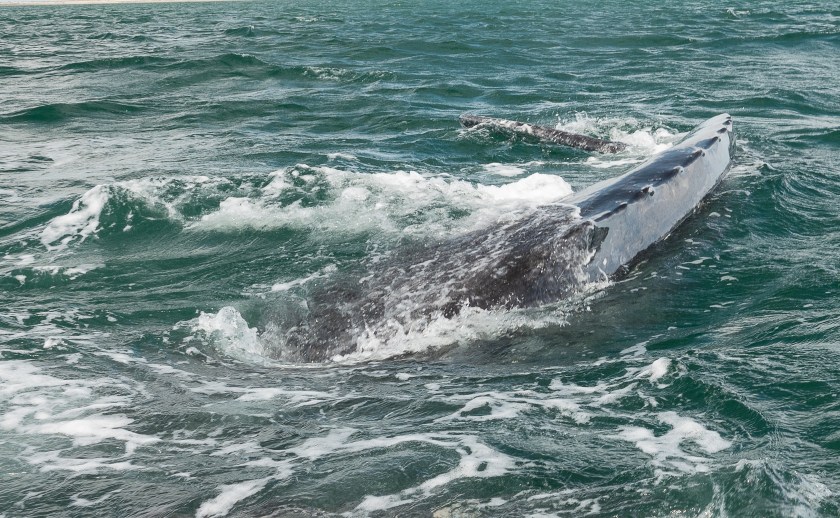
… they reappear in a breach, an explosive sudden leap which lifts at least  40% of their body out of the water. Because it happens without warning, getting a photo is sheer luck, but I did manage one:

DSC01620

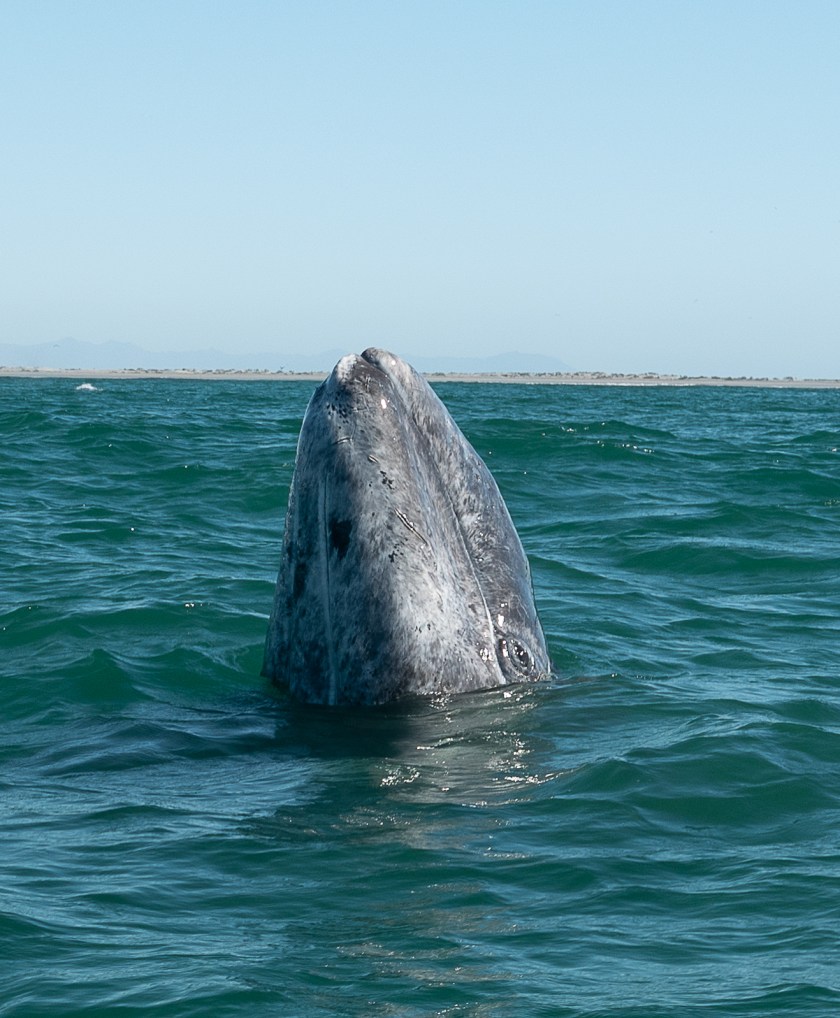
Somewhat easier to photograph are their ‘spyhops’. This is a wonderful name for a maneuver in which they slowly and steadily lift their head vertically out of the water till their eye is at the waterline. They can stay like this for some time, which makes photos easier. You can see the eye in this one:

DSC09981

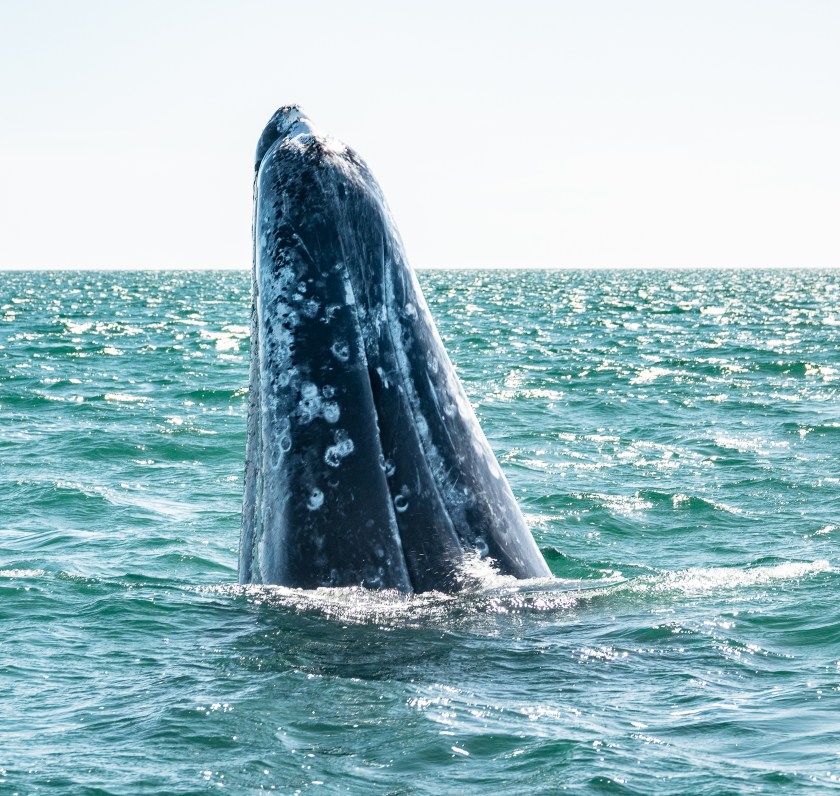
and here you can see the grooves that allow their throats to expand hugely to hold vast volumes of food, mud, and water.

DSC00182

It used to be thought that spyhops were so they could have a good look around, but it appears that their eyes do not always clear the water, and in any case their above-water vision is as bleary as our below-water vision. Their function remains a mystery, and our guides preferred to call them “heads-up” instead.

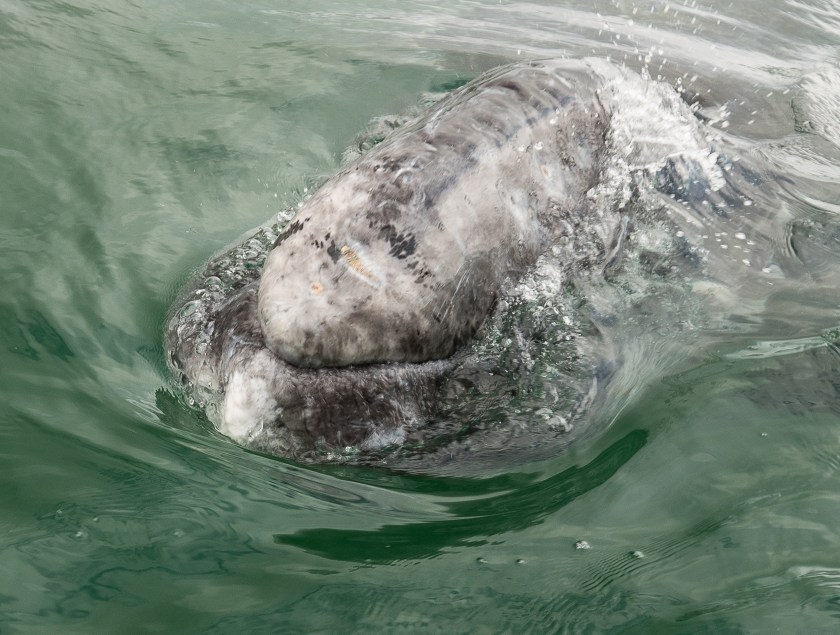
One last close-up:

DSC00982

And off they go:

DSC00662

[I’m going to do one more short post on the history of gray whale whaling and their subsequent revival, for those of you who are interested. If not, skip it and we will return to the spring in Maine after that.]


The crystalline spring

[Another current post from Maine; I’m saving the third gray whale post till next time!]

Spring comes late in Maine. It still snows sometimes, and the hickory buds struggle:

DSC01229

So long as it freezes every night, the ice at the edge of the stream does beautiful things:

DSC01501

In these tough times, small gems are to be cherished, like a single bead of water on a frond of star moss, Tortula ruralis, emerging from the snow:

DSC01374

And when the temperature hovers just below freezing strange things happen, like this hair ice:

DSC01409

The ghostly ephemeral growths are made up of ice filaments that grow from a specific winter-active fungus, Exidiopsis effusa, on dead wood. This was on a dead twig on the ground, and each rosette is about 1/4 inch across.

And the voles or shrews that lived in tunnels under the snow had the roofs of their tunnels melted by the sun, exposing their refuges to the view of passing raptors:

vole or mouse tunnel

A flock of American robins were undeterred by a late snow shower, and descended on the old apple tree, desperate for the remnants of last year’s crop:

DSC01295


The Gray Whale, Head to Tail: II

You never see a whole whale, but you get glimpses, from which you can reconstruct the entire animal.

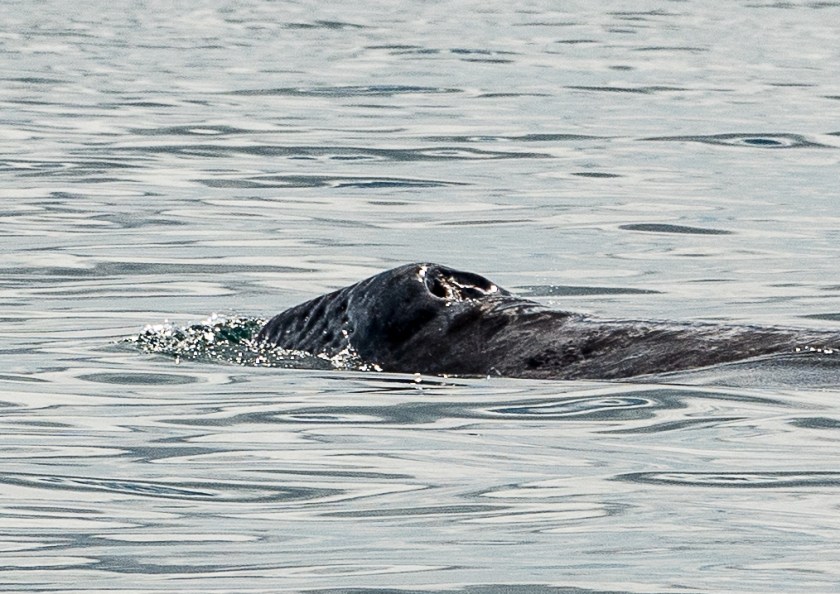
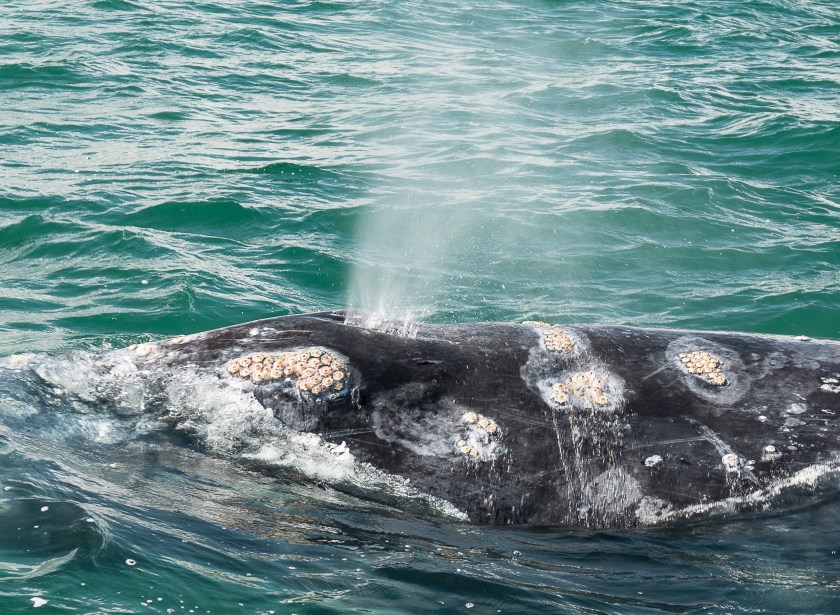
They surface to breathe, and blow. When their blowholes are closed, they look like this: a pair of blowholes, with a depression between them. On this particular whale they are heavily encrusted with barnacles.

DSC00976

And when they are open, they look like this:

DSC01275

When you touch them their skin feels tight and smooth, like an over-inflated heavy-duty rubber beach toy, but they are not quite hairless. About 80 tiny stiff white whiskers (vibrissae) come out of the dimples in their heads, and they are thought to have sensory uses.*

DSC09834

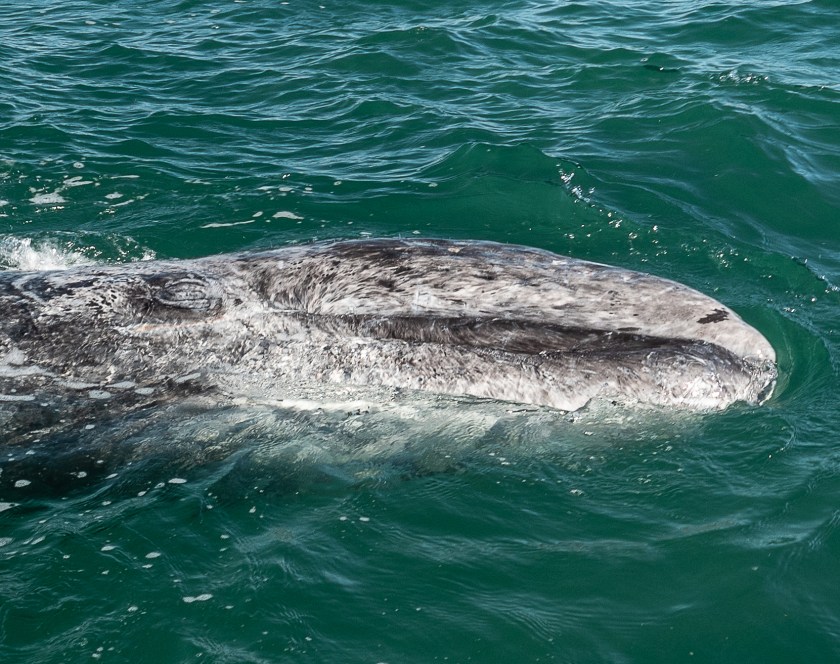
They eat tiny organisms that are found in the mud on the sea floor, using a feeding mechanism unique to gray whales. They swim down, roll onto their right sides, scoop up a big mouthful of gunk and filter out the water and sediment through their baleen plates, leaving small crustaceans called amphipods behind. You can just see the baleen in the photo below, towards the left-hand side of the whale’s slightly open mouth.

DSC09824

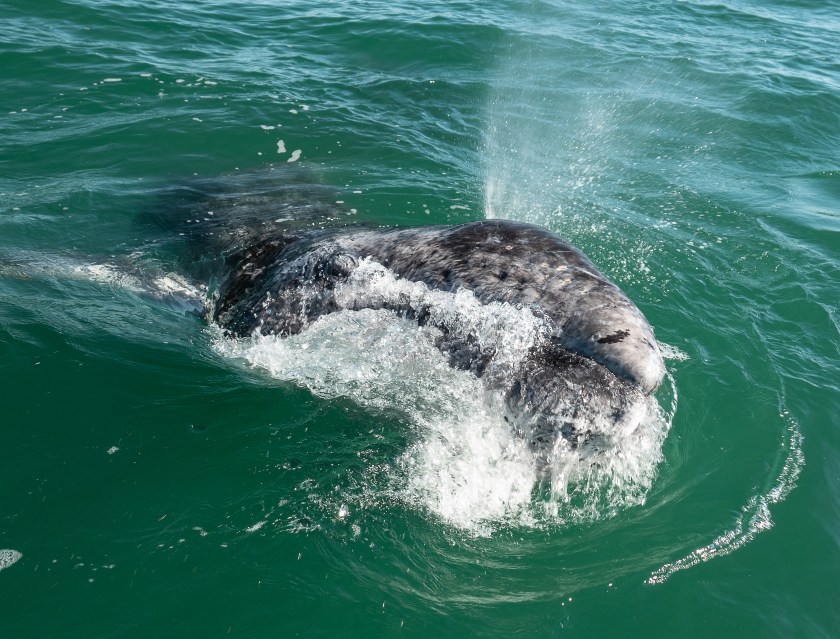
And when one surfaces, look how the water cascades out of its mouth:

DSC00017

Close-up, the adults are covered in barnacles (and tiny orange “whale lice”, small harmless crabs that I failed to photograph).

DSC01339

They swim languidly along, apparently doing not much of anything, but sometimes they swim upside down, like this one, showing its two throat grooves (more of that later):

DSC00243

and roll over onto their sides:

DSC00246

showing the pectoral fin (on top in this photo):

DSC00248

Sometimes, if she decides to turn sharply, you can see the spine and tail, which has no dorsal fin, just a series of 9-13 fleshy knuckles along the backbone:

DSC00753

And of course, the supremely elegant tail:DSC00923

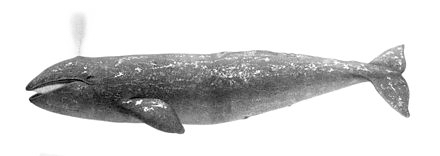
The whole animal looks like this; the drawing was made by Captain Scammon, of whom more later.


440px-Eschrichtius_robustus1


Next time, fluking, breaching and spyhopping!

* A stranded newborn grey whale calf was dissected in San Diego in 2015, and the fascinating results can be read here:

https://www.researchgate.net/publication/273151093_Eye_Nose_Hair_and_Throat_External_Anatomy_of_the_Head_of_a_Neonate_Gray_Whale_Cetacea_Mysticeti_Eschrichtiidae


Spring snow storm

[Whales will return, but this can’t wait.]

This morning we woke up to a new world: I am not a poet, but luckily the 19th century Englishman John Clare said it all in the poem at the end of this post.*


DSC01659

DSC01664

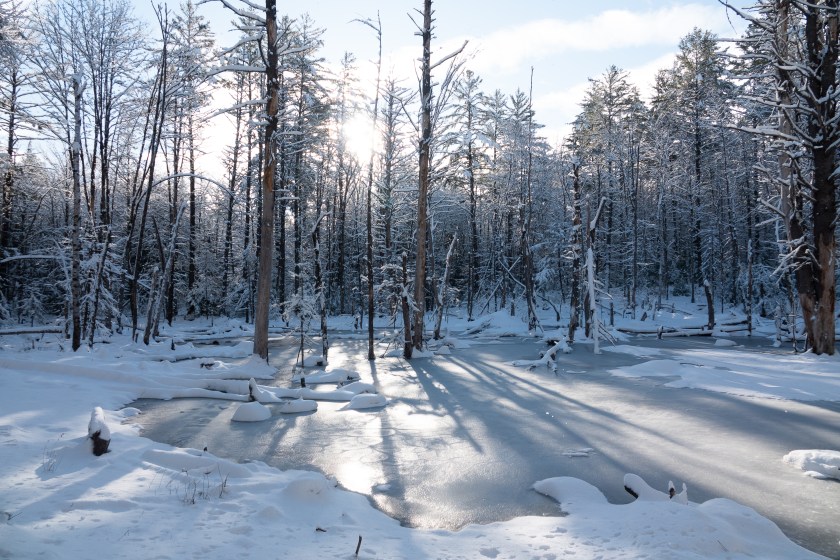
The beaver pond had refrozen just enough to collect shadows as the sun rose:

DSC01756

The cottage is waiting for guests..

DSC01657

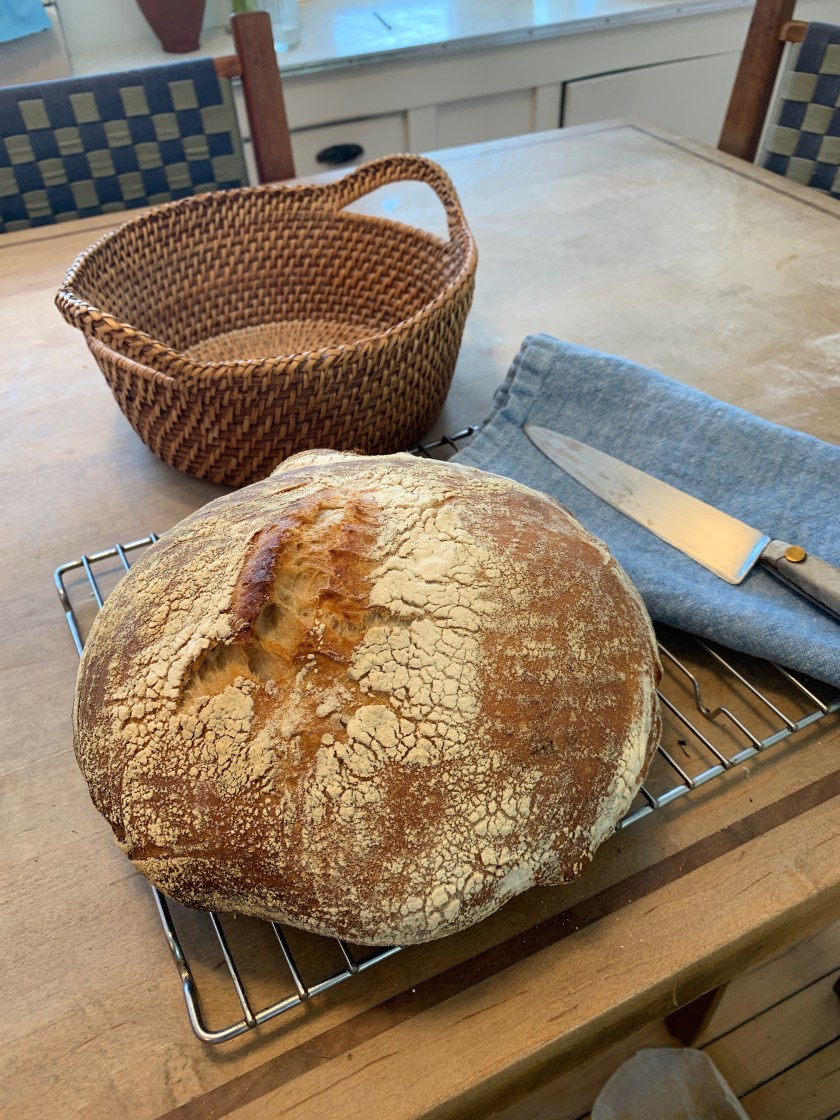
And when I returned, I baked my first ever loaf of sourdough (yeast is hard to get now):

IMG_0428

* The Winter’s Spring, by John Clare 

The winter comes; I walk alone,
I want no bird to sing;
To those who keep their hearts their own
The winter is the spring.
No flowers to please–no bees to hum–
The coming spring’s already come.
I never want the Christmas rose
To come before its time;
The seasons, each as God bestows,
Are simple and sublime.
I love to see the snowstorm hing;
‘Tis but the winter garb of spring.
I never want the grass to bloom:
The snowstorm’s best in white.
I love to see the tempest come
And love its piercing light.
The dazzled eyes that love to cling
O’er snow-white meadows sees the spring.
I love the snow, the crumpling snow
That hangs on everything,
It covers everything below
Like white dove’s brooding wing,
A landscape to the aching sight,
A vast expanse of dazzling light.
It is the foliage of the woods
That winters bring–the dress,
White Easter of the year in bud,
That makes the winter Spring.
The frost and snow his posies bring,
Nature’s white spurts of the spring.

John Clare

Fifteen-foot babies: The Gray Whale I

[This post is the first of several about these remarkable cetaceans. I’ve decided to stretch it out over three or four posts because I figure you are all as bored as I am, or soon will be. I hope in these difficult times when we are all cooped up at home it helps you remember there is a big beautiful world out there that we will one day see again.]

My trip to Mexico was prompted by tall tales of gray whales that come up to small boats to be stroked. Hard to believe, right? And yet it is true. Proof:

DCIM100GOPROG0015988.JPG
Thanks to Said Estrada for the photo, edited by me!

The calf has its rostrum (upper jaw) out of the water, and its barnacle-encrusted blowholes on the right of the photo are closed. Its left eye can just be seen at water-level. And I am stroking a baby whale.

The gray whale, Eschrichtius robustus, is smaller than the blue whale, weighing about 40 tons and measuring about fifty feet, but even so it gives birth to a fifteen foot calf.

The Eastern Pacific population of whales spend their summers in the Northern Pacific feeding, then migrate down the coast of North America to mate and give birth in the quiet lagoons of Baja California. This migration is a round trip of up to 14,000 miles, one of the longest of any mammal. If you go to Baja between January and March, you stand a high chance of seeing them while the calves are building up blubber for their long journey north.

We stayed in Camp Ramon on the shore of San Ignacio Lagoon:

DSC00635

and went out twice a day in 23 foot skiffs called pangas, wading out to them in the wellies thoughtfully provided by our hosts.

DSC00895

The park authorities allow a maximum of 16 boats in the area on the lagoon where whale-watching is allowed, and only 2 boats are permitted near any individual whale. The area is large, many square miles. In practice we never had to share a whale.

Here are a mother and calf swimming side by side:

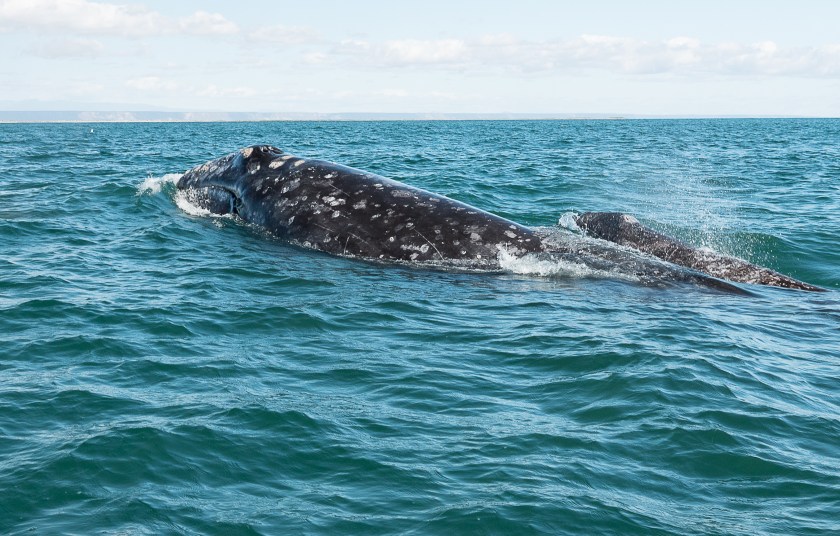
DSC01565

Some whales are skittish round the boats, as you would expect, keeping a certain distance, maybe swimming around the boat or under the boat, but not coming alongside. But for whatever reason some have decided the boats are large friendly blue creatures with tentacles that reach out and pat them, so they bring their calves to the boats and allow them to be greeted by us humans.

DSC09837

When they come close, they are exactly like very very large puppies:

DSC00990

Gray whales were hunted almost to extinction in the 18th and 19th centuries. They were known as “devilfish” because they defended themselves when hunted, often overturning small whaleboats: unreasonable, really. This is what they look like when approaching your small boat at high speed: quite intimidating if you have reason to think they are intent on revenge:

DSC00729

Captain Scammon, a Mainer who discovered one of the the Baja calving lagoons, worked out that if he harpooned the baby the mother would come close to rescue her, and then he could easily harpoon the mother too. It’s quite hard even to think about it nowadays.

The global population has, remarkably,  recovered to close to pre-whaling levels of 20,000. Usually the San Ignacio Lagoon count (in January, when both mating and birthing happen), is around 400. This year, worryingly, it was only 150, and no-one knows why. The hope is that they just went to a different lagoon, but those counts are not yet in.

Next time I’ll talk in more detail about how they look, feed and move.