My Lady’s Slippers

I saw my first one of these orchids about 45 years ago, but still every time I can’t quite believe they really grow in our northern forests:

Pink Lady's Slipper orchids Slipper

They are 6-12ninches tall, and each flower is up to two inches long.  The pouch is a single petal, the labellum, grossly enlarged and modified. In the photo below, a tiny moth stretches out its minuscule proboscis towards the nectary, but it can’t quite reach.

DSC06984

The officially named Pink Lady’s Slipper Orchid, Cypripedium acaule, can sometimes be white instead:
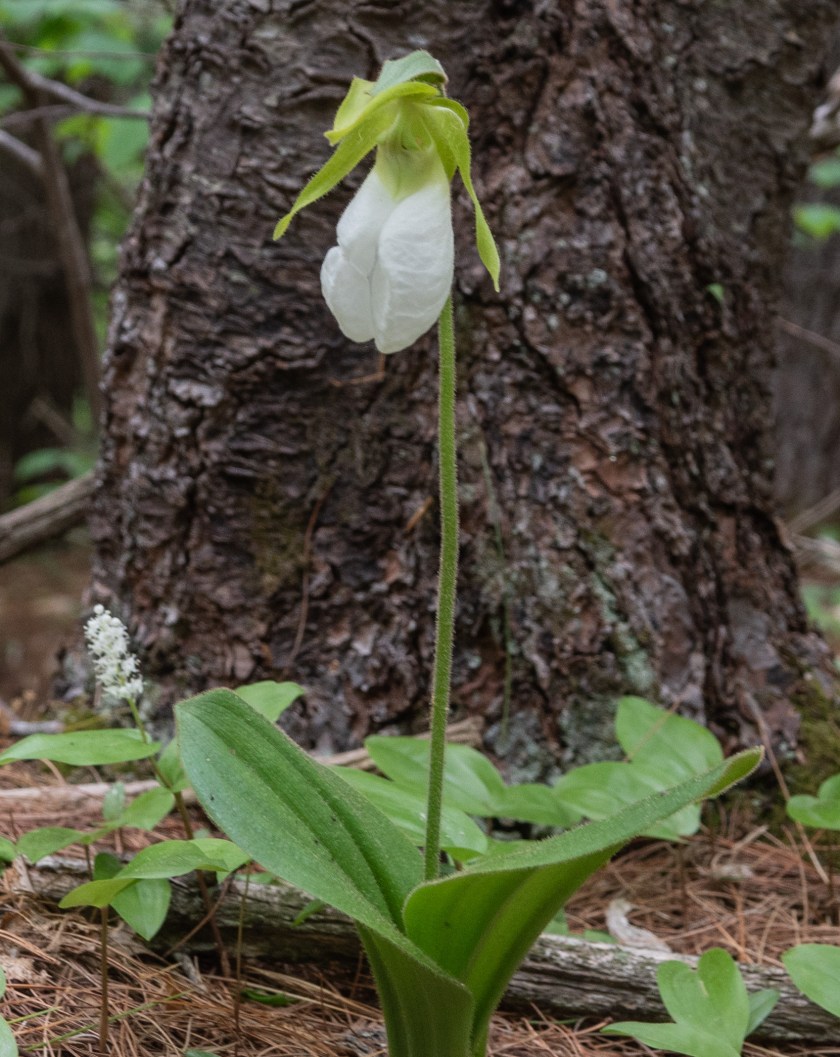
Pink Lady's Slipper orchids Slipper

The root of lady’s slipper was used as a remedy for nervousness, tooth pain, and muscle spasms, and as a sedative.  These sound to me like traditional “women’s complaints”, and I wonder if there is an actual effective compound in the roots, or if it was all because of the lascivious shape of the flower, rather as some cultures believe that long rigid rhino horns ‘cure’ impotence. Does anyone know?

There is also a different yellow species, Cypripedium calceolus, which is even more spectacular:

IMG_0550

The twisted side petals remind me of the payes sidelocks as worn below by Michael Aloni, star of Shtisel:

600e2abd88b8c576322238bd1d1ea12e

These yellow orchids do grow wild here, but I photographed these in the wildflower garden at Halls Pond Gardens in Paris, Maine (yes, really), and I’d like to dedicate this post to the memory of the delightful, modest and hugely knowledgable Mark Brandhorst, creator of the garden, who tragically died unexpectedly this spring. All these orchids are hard to grow, but he had the greenest of fingers.

P.S. Some more detailed information from the US Forest Service website, By Patricia J. Ruta McGhan:

” In order to survive and reproduce, pink lady’s slipper interacts with a fungus in the soil from the Rhizoctonia genus. Generally, orchid seeds do not have food supplies inside them like most other kinds of seeds. Pink lady’s slipper seeds require threads of the fungus to break open the seed and attach them to it. The fungus will pass on food and nutrients to the pink lady’s slipper seed. When the lady’s slipper plant is older and producing most of its own nutrients, the fungus will extract nutrients from the orchid roots. This mutually beneficial relationship between the orchid and the fungus is known as “symbiosis” and is typical of almost all orchid species.

Pink lady’s slipper takes many years to go from seed to mature plants.  Seed-bearing harvest of wild lady’s slipper root is not considered sustainable. Pink lady’s slippers can live to be twenty years old or more.

Pink lady’s slippers also require bees for pollination. Bees are lured into the flower pouch through the front slit, attracted by the flower’s bright color and sweet scent. Once inside, the bees find no reward, and discover that they are trapped, with only one point of escape. Inside the pouch, there are hairs that lead to a pair of exit openings, one beneath each pollen mass. The bee must pass under the stigma, so if it bears any pollen from a visit to another flower, it will be deposited before picking up a fresh load on the way out.”
The fifth and final phoebe installment: Launched

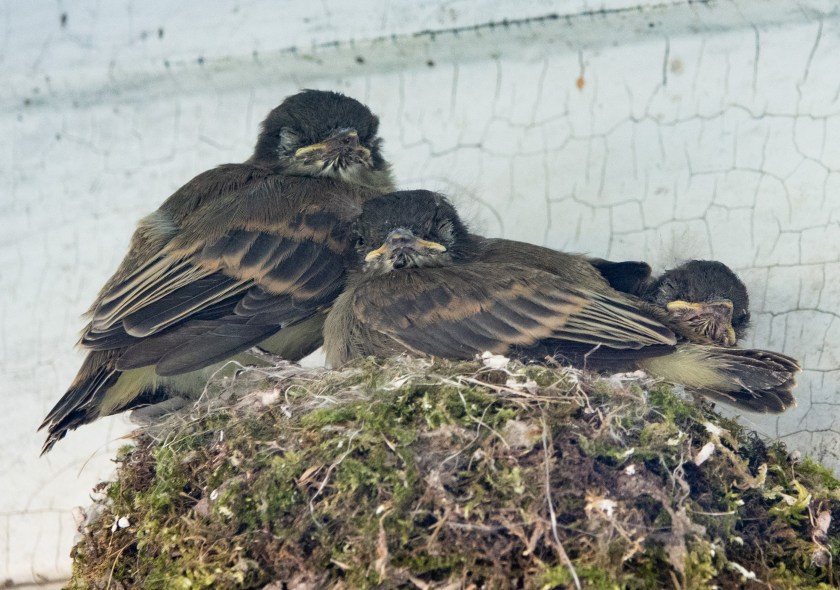
As they got bigger and bigger, it was hard to see how they could fit into the nest.

DSC08346

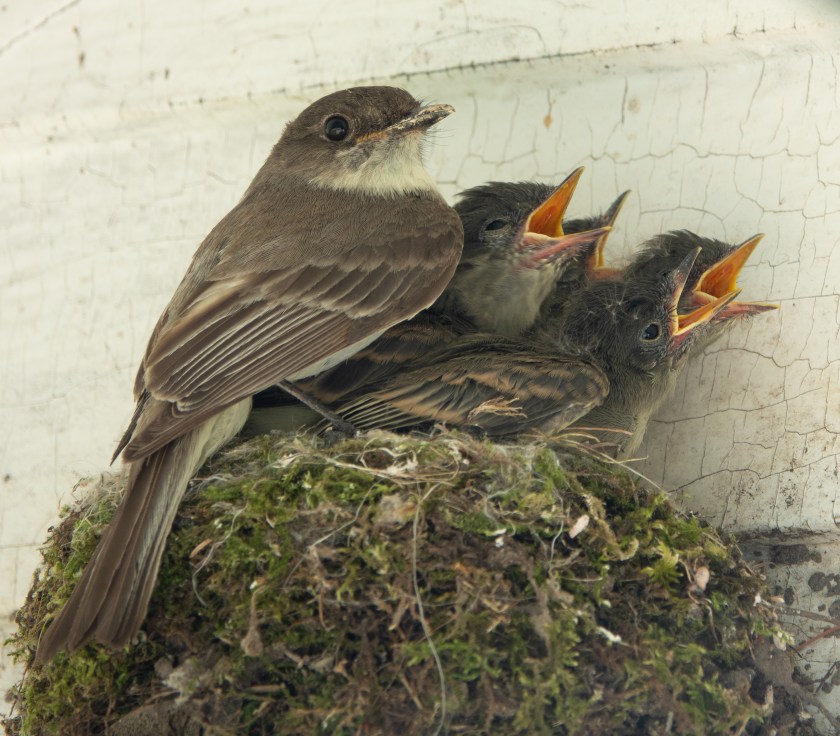
It got very hot, and the exhausted mother joined them for a rest:

phoebe chicks

One evening, two of them were sitting right on the edge of the nest.

phoebe chicks

and the next morning, 14 days after I first photographed them, instead of five there were three,

Phoebe, just fledging or fledged today

Ominously, underneath the nest there was a sizable garter snake, attracted  by the smell of their droppings, and living in hope that one would fall and be easy pickings.

At 11.45am I came back from the post office, hands full, no camera, and as soon as I opened the door three flustered panicked fledglings took off over my head, milled around under the eaves, and then were gone.  The parents immediately appeared, calling frantically, but the nest was empty.

Phoebe, just fledging or fledged today

And then I saw the snake, no bulge in his middle, so they all got off scot-free. An hour or so later, this fledgling was perched in the branches of a nearby weeping willow sapling, none the worse for wear.

Phoebe, just fledging or fledged today

I hear them around, and the conscientious parents should now be feeding the fledglings for a while longer.

I will miss them.

Phoebes 4: seeing inside the nest

[If you are getting tired of my phoebes, there is only one more post to go, and then I will not show you birds for a week or two!].

By now the chicks are getting bigger, and true feathers are starting to come in. It looks as though all five are still there.

Phoebe

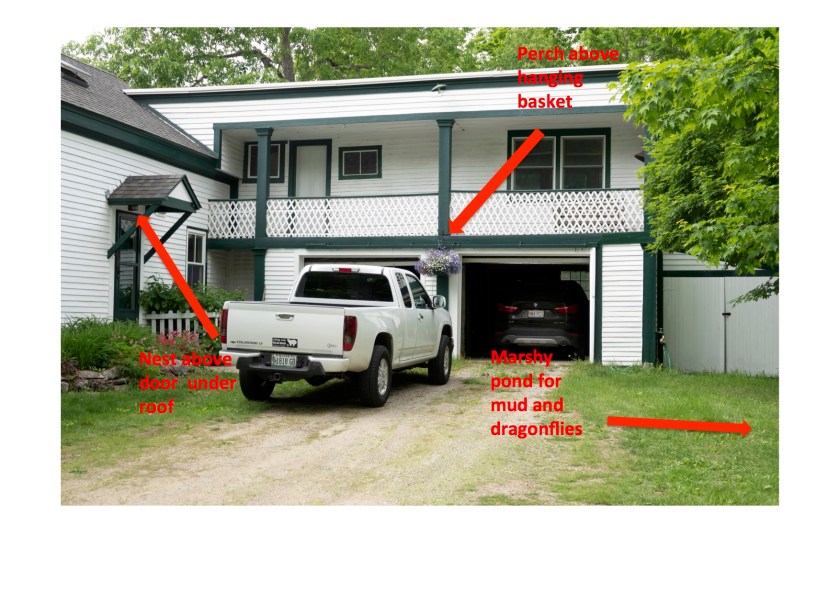
Although the phoebes above the hanging basket tolerate my photography from the kitchen window, and the chicks are unable to escape my lens even if I am nearby, the adults don’t come to the nest if I am out in the open. The nest is under a little roof, so it can’t be seen from a distance, I have to get close. Copying the BBC Wildlife team, who always tell you something about how they got the footage, I thought I’d show you my amateur solution

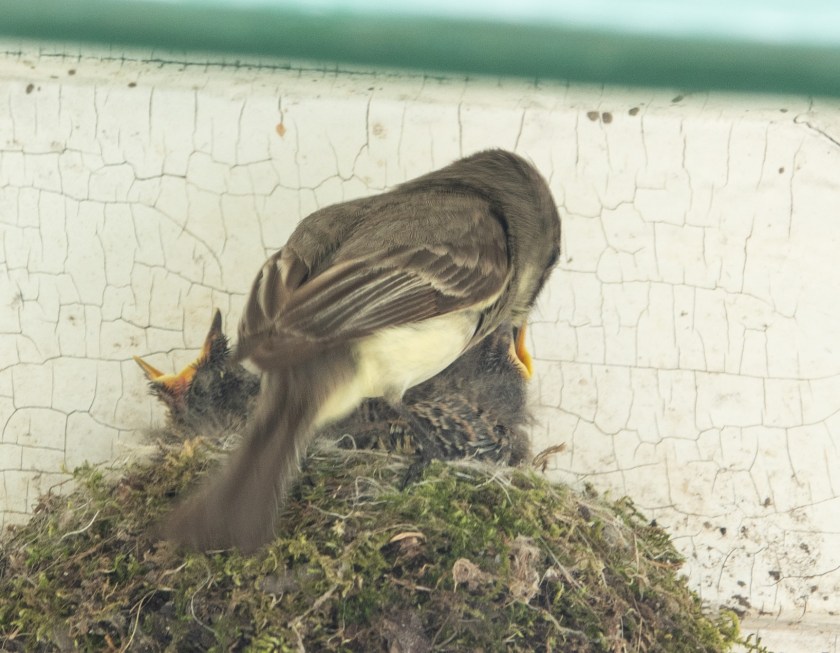
I remembered a birder once telling me that a car made an excellent improvised hide.  So I parked my truck near the nest, rolled down the window, and sat quietly inside. For about ten minutes they were wary, but then they settled, and all the shots that show an adult on the nest were taken by this subterfuge. Here is the setup:

phoebe nest setupShe (or maybe he) brings in a choice morsel, like this grub:
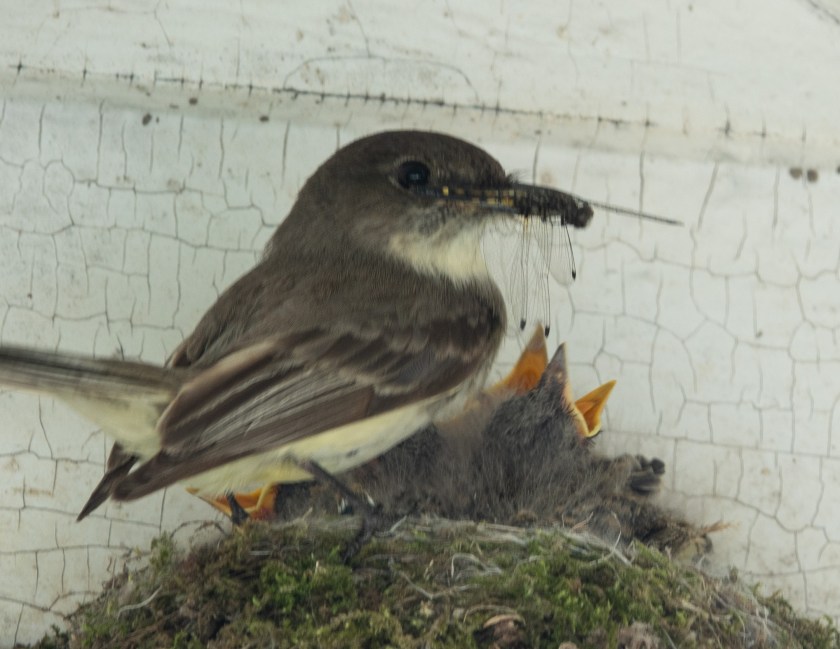
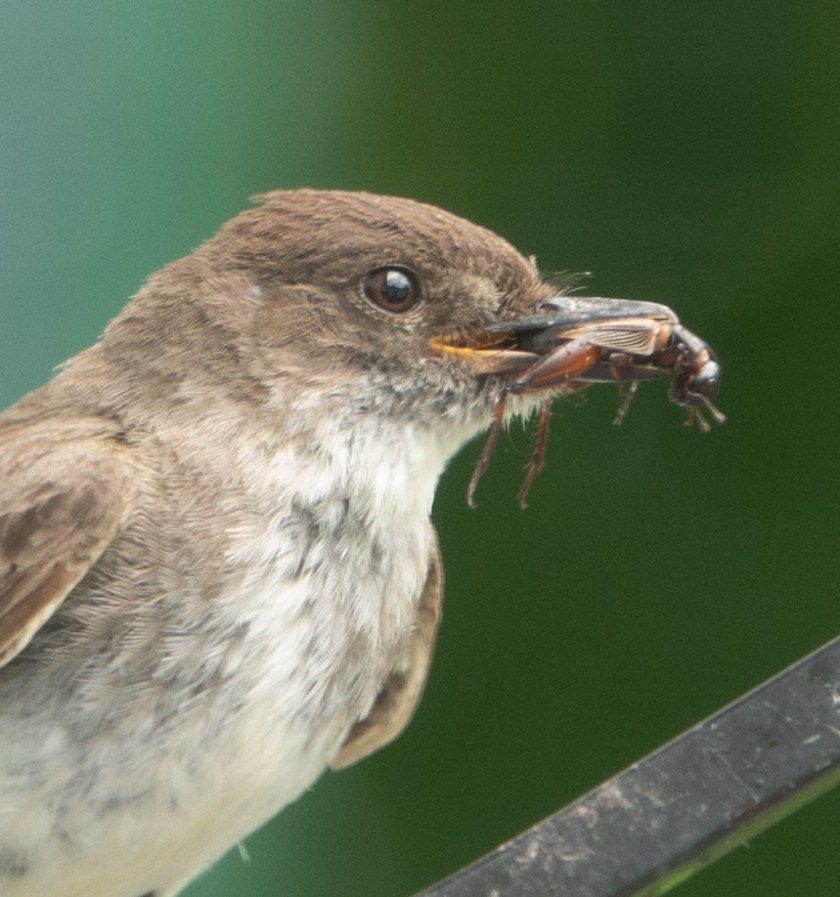
Phoebe

or this dragonfly:

Phoebe with food

And then delivers it to her chick:

Phoebe

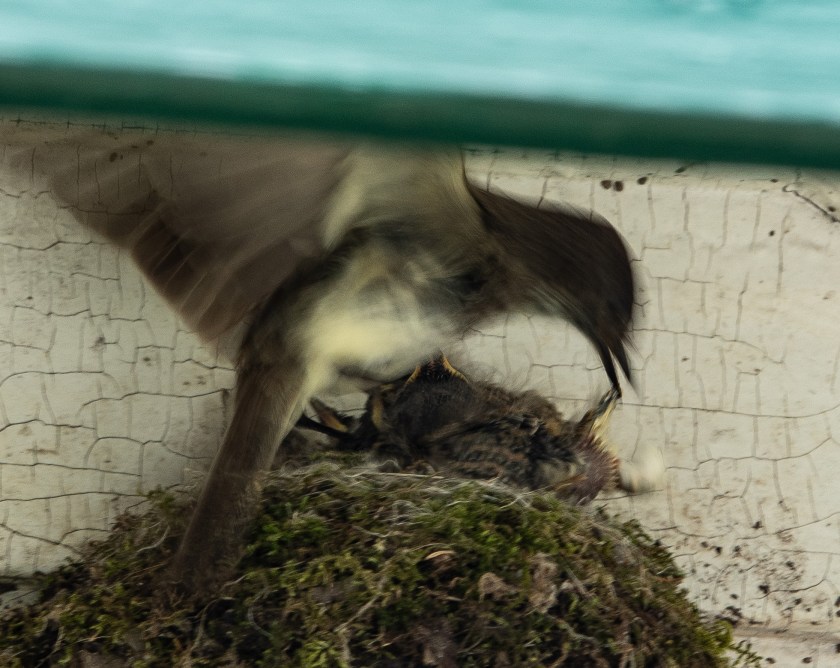
Deliveries are fast, she rarely hangs around. This one was a big moth:

Phoebe with food

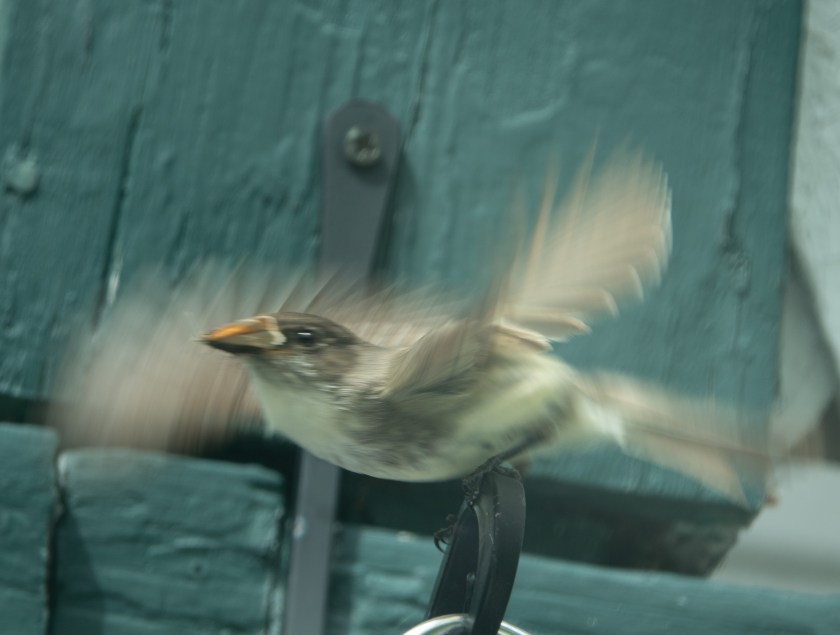
and it is delivered by air (the moth is blown flat against his beak by the speed of takeoff):

Phoebe with food

Deliveroo and Grubhub, you’ve met your match.


Phoebes 3: House cleaning

[This is another one of my scatological posts, feel free to skip it and wait for the next one!]

For the baby phoebes, food deliveries are fast and furious, often at intervals of only a couple of minutes: a small moth at 2.20pm, a large moth at 2.23pm and a huge dragonfly at 2.25pm. There are five mouths to feed.

What goes in must come out. Phoebes are meticulous housekeepers. When the young feel the urge, they raise their bottoms towards the edge of the nest:

Phoebe dealing with fecal sac

The white blob is the fecal sac. It bursts out with some force

Phoebe dealing with fecal sac

to be caught by the mother:

Phoebe dealing with fecal sac

who then flies off to dispose of it elsewhere.

Phoebe dealing with fecal sac

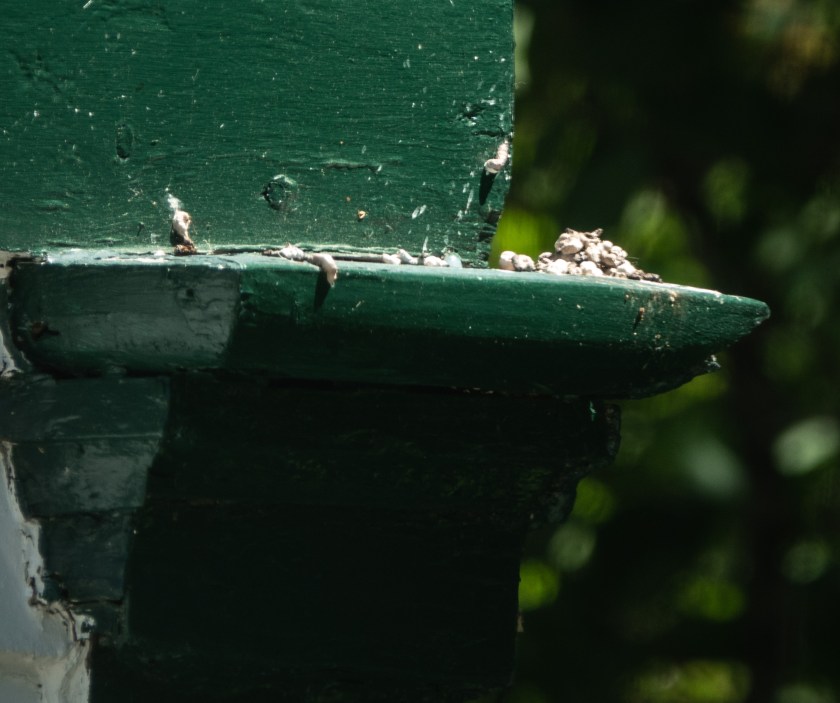
For some reason she made a tidy little heap of them at the top of this corner post:

Phoebe, just fledging or fledged today

As they get close to fledging, they start to just do their own thing over the edge of the nest (and onto our doormat), but until then, the environs are spotless.


Phoebes 2: en famille

Four days later, and the chicks are strong enough to raise their heads above the edge of the nest:Phoebe with young

Both parents are foraging. About 20 feet from the nest, I have a curly bracket for a hanging basket of lobelia. It is close to the kitchen window, convenient for photos. Here they perch, using the bracket as a vantage point from which to swoop on their prey, but also as sort of kitchen pass, from which to send a steady flow of food deliveries to the nearby nest.

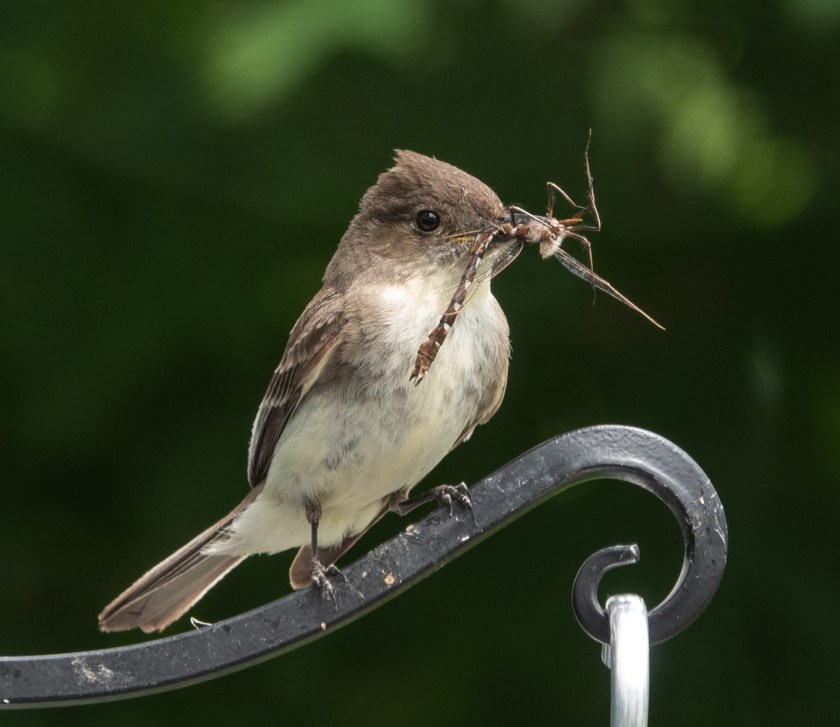
This one is juggling a dragonfly:

Phoebe

This one has got a grip on a butterfly,

phoebes


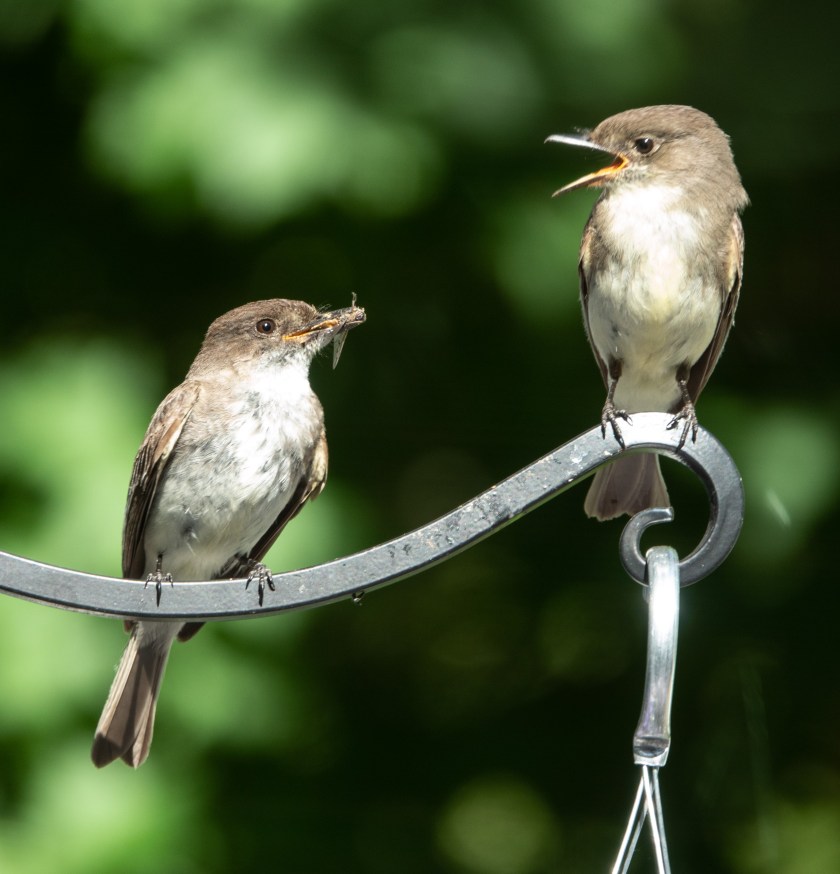
And this one is showing off its catch to its mate, who appears to be saying “Wow!”:

Phoebe

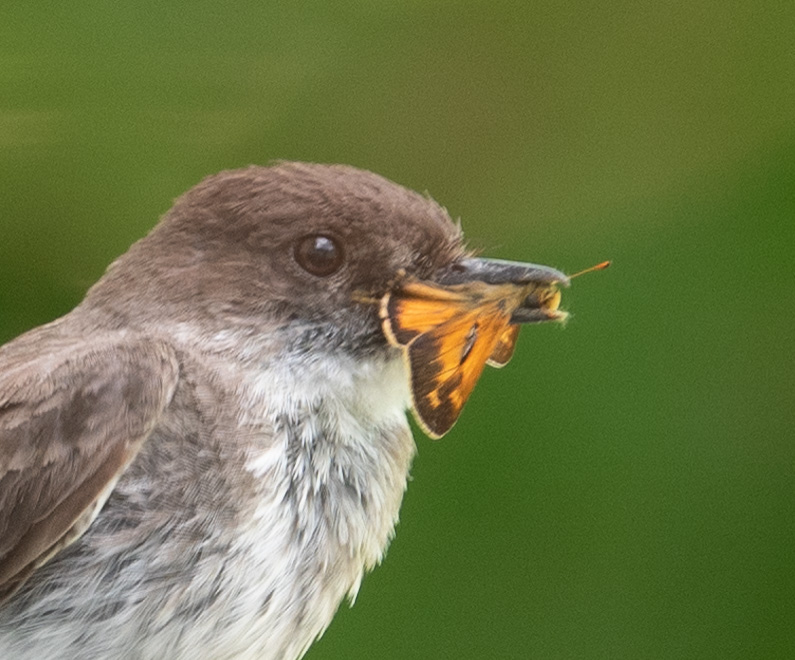
The variety of prey is interesting. A Long-dash Skipper butterfly:

Phoebe

A huge Dragonfly:

DSC08013

A white-faced dragonfly:

phoebe

I think this is a Field Cricket:

phoebe

And a small grasshopper:

DSC08037

If they keep wriggling, they get bashed on the metal bracket till they succumb.

DSC08318

Anyway, these chicks are not going hungry.

Phoebes at home

[This is the first of probably three posts on a family of phoebes who have moved into our household.]

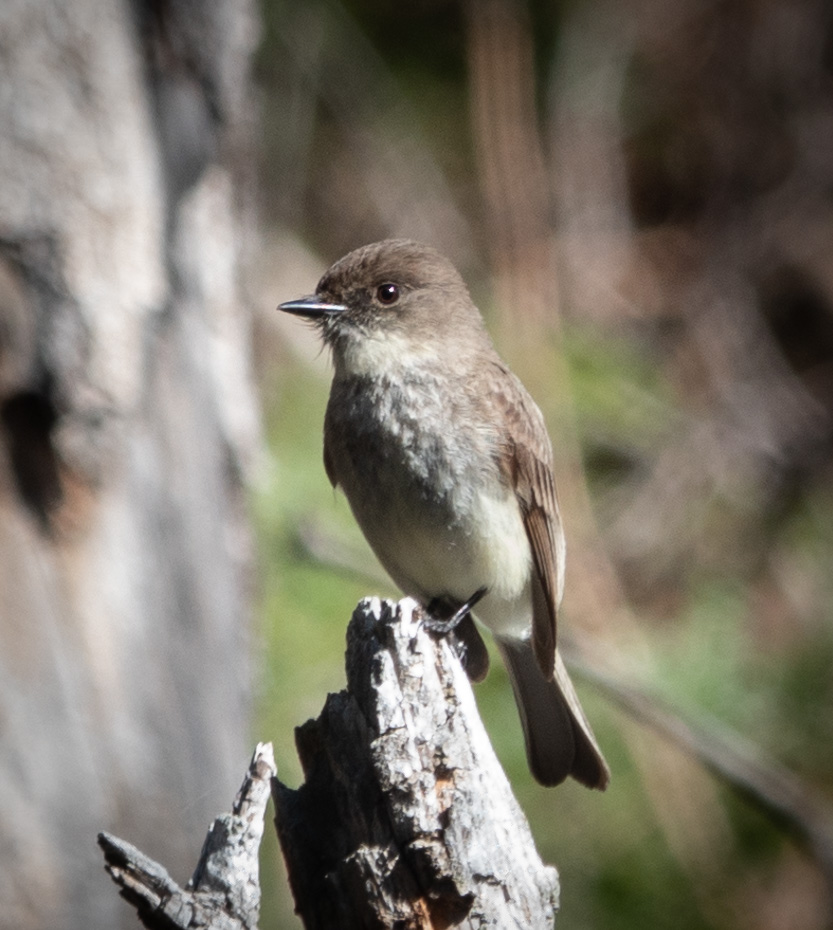
The Eastern Phoebe (Sayornis phoebe) is a flycatcher, in the family Tyrannidae

Phoebe

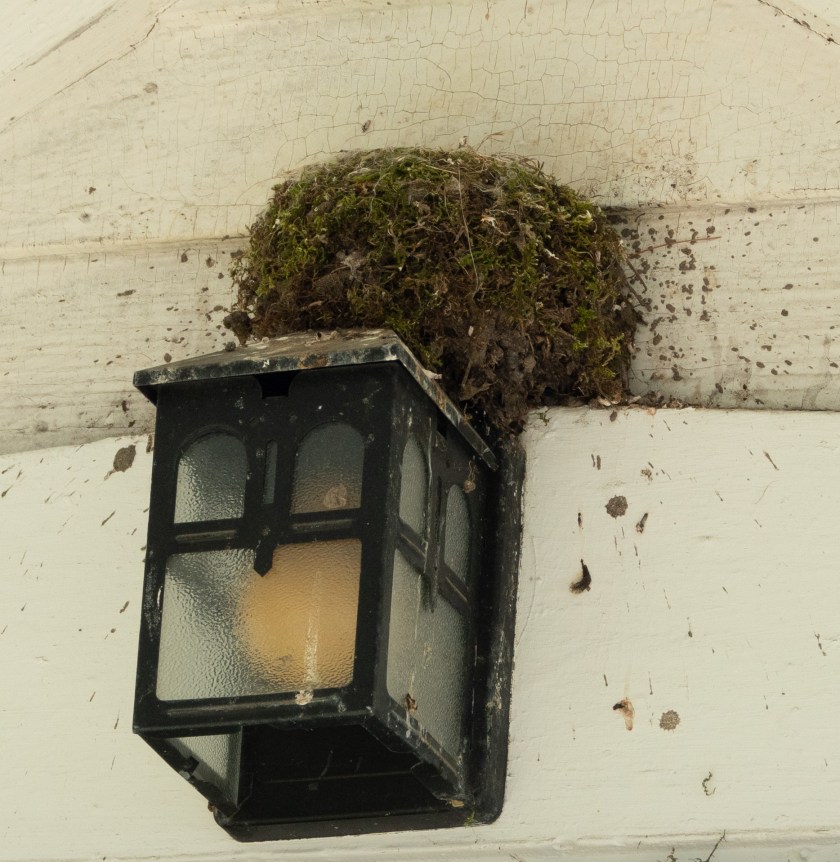
Every year she builds an exquisite nest above our front door.

Phoebe nest

The base is mud, from the small pond by our driveway, which she uses to build a foundation on the top of the light above the door. Then she adds moss, then some sort of soft grass as a lining . Each year she uses the previous year’s nest as a base, and adds to it, building a multi-year skyscraper. Then it topples off, and she starts again. Obviously, the builders are from many generations of mother birds, but somehow the family tradition is kept alive. through the 38 years we have lived here, and who knows how long before that (the house is 210 years old). .

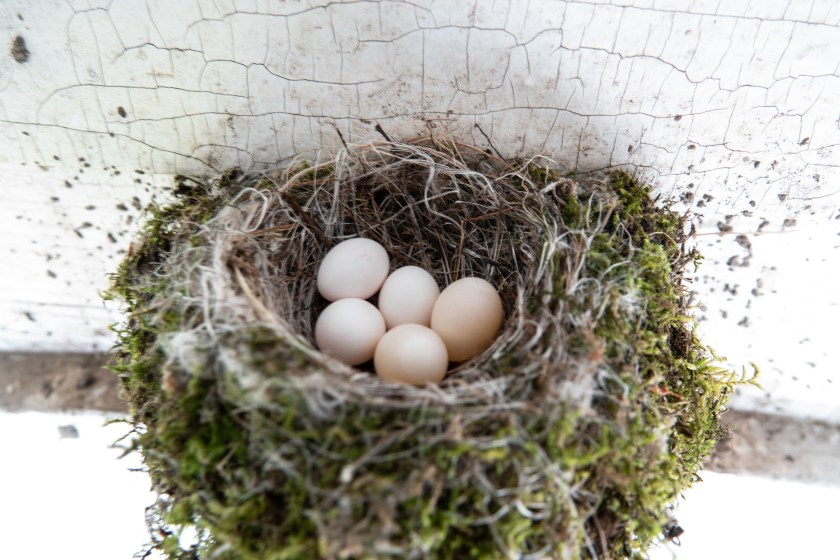
This year, as of May 23,  she has 5 eggs.

Phibere eggs, May 23

Every time we come in and out of the door she flies off, but she always comes back..

On June 5, instead of being snuggled inside the nest she was sitting on the edge:

DSC06948

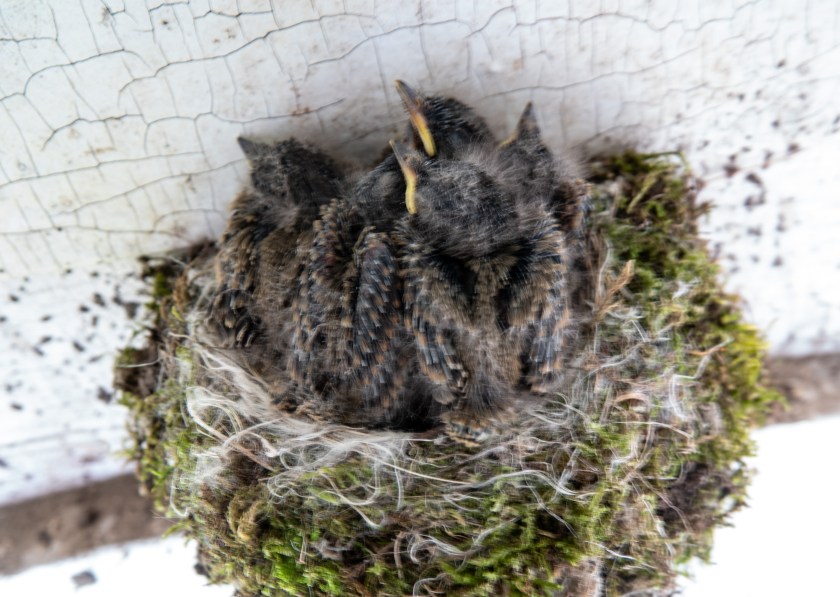
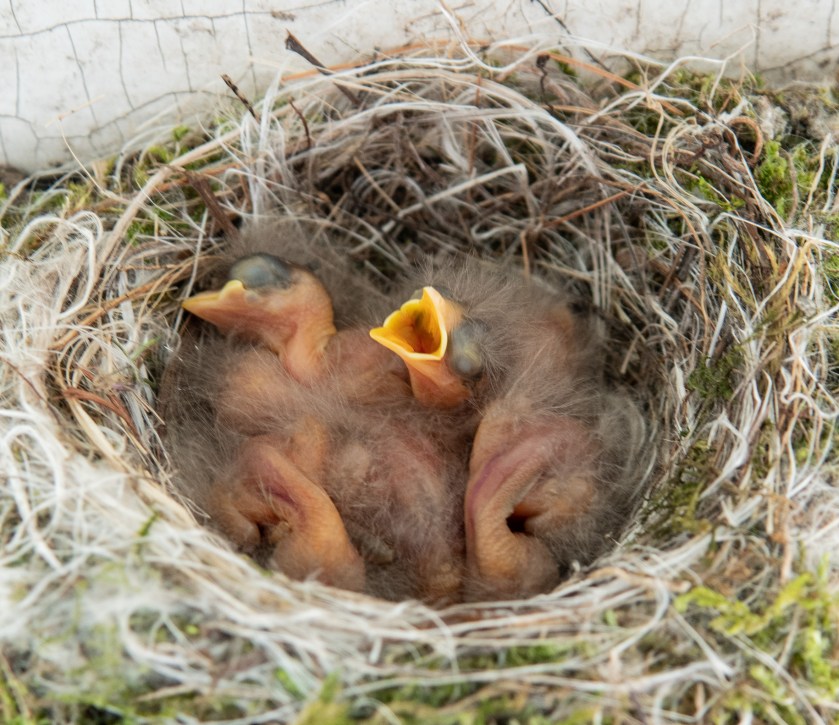
I hoped that meant the eggs had hatched. We got out the ladder and peeked, and sure enough, tiny chicks.

DSC06959

From when I first saw the eggs, this is 13 days, and incubation is given as 16 days in the books. From now, it is supposedly another 16 days till they fledge, so I will watch them carefully and report back. I will check once a week only, so as not to disturb them, though they seem unbothered by our presence, and the mother returned to feed them a few minutes after we put the ladder away.

Watch this space.

PS: I am not sure why this unassuming bird is called Phoebe. Phoebe is the Latinized form of the Greek name Φοίβη (Phoibe), which meant “bright, pure”.  In Greek mythology Phoibe was a Titan associated with the moon and it was also one of the names of her granddaughter, the moon goddess Artemis.

PPS My friend Sue has rightly reminded me that it is of course named after its call: 

Solomon and the Queen

Solomon’s Seal is a very beautiful plant. One species grows wild around here, but the photos are of the ones in my garden, which have been there since before we owned the house, which means at least 40 years, perhaps much longer.

Solomon's Seal and quen bumblebee

It was in full flower two weeks ago, and I noticed that it was heavily populated with bumblebees.

Solomon's Seal and quen bumblebee

After doing a bit of light reading, I realized that these are queen bumblebees, which rather astonishingly winter over here under the ground. When they emerge in the spring  they are peckish, so a sizable plant like this is a great source of nectar and pollen.

But the flowers, each one a tiny bell, are closed, and to the bee has to force them open. Not all bees have the strength for this.

Solomon's Seal and quen bumblebee

What is more, the pollen is deep in the bell, so once the bee has got its head inside the flower, see below, it vibrates its wings at just the right frequency to dislodge the pollen, and down it showers.

Solomon's Seal and quen bumblebee

They stash some in their pollen baskets,

DSC06674

and some sticks to their fuzzy coat and gets carried along to fertilise the next flower they land on.

The queen then builds a nest in the ground, creates tiny waxy cups, fills each one with nectar and pollen, and lays her egg on top. Soon the next generation of worker bees will emerge. Quite a trick.

PS This plant is Polygonatum multiflorum , or  Great Solomon’s Seal.  It grows wild in Europe and Asia, and the Victorians cultivated it and brought it to the USA.

PPS: Buzz pollination is explained rather well here: “Approximately 8 % of flowering plants (∼20,000 species) have poricidal anthers, which release pollen only through small pores .. These anthers release pollen when they are vibrated by bees performing buzz pollination, or sonication … —a behavior in which bees grasp the anthers with their mandibles (usually) and vibrate their bodies by activating their flight muscles while decoupling the wings…. This transfers the vibration to the flowers, and pollen pours out of the anthers onto the bees’ bodies, where it can be groomed and brought to the nest to provision the larvae.” (Excerpted from Switzer and Combes 2016. )


The Secretive Salamander

[Apologies for the poor quality photos, but I thought it was interesting enough to post anyway.]

On our doorstep at 10pm on May 11, in the pitch-dark, was a Spotted Salamander, Ambystoma maculatum. They are quite large, maybe 7 inches long, and this one may have been en route to lay eggs in our small pond.

Spotted Salamander

I brought it inside to photograph, but it didn’t like the light, so I cut the photoshoot short, took it back out, and replaced it on the earth next to where we found it. In the morning it was gone, hopefully heading off for a tryst in my pond…

But then I went to a nearby vernal pool, and found some eggs,

Spotted Salamander EWggs

which I carefully replaced in the pond to create lots of new black and yellow monsters. This was early May; by August they look like this, recognizably a salamander, but still with external gills. That’s what three months of development can do:

P1040345

(The photo above was taken three years ago.)

And early one hot summer morning a couple of years ago a miniature one had found refuge in a cooler full of ice left out after a party:

Spotted salamander, Ambystola maculatum

Their population is stable, and they can live for 10 years. They live under rocks and logs, emerging only at night, returning to the pond in spring to mate and lay their eggs. This secretive life style makes them hard to see. Many years ago we found one in our dark cool basement, where it seemed to have spent the winter. Indeed, the one we saw on our doorstep may have just emerged from the basement, which is built of hand-hewn granite blocks from 1810 when the house was built, and is full of damp crevices through which a salamander could wriggle.

P.S. For a long time I thought salamanders were what Americans called newts. `It turns out however that salamanders are the larger family, which includes newts as a sub-group. Newts are semi-aquatic even as adults, with webbed feet. True salamanders are terrestrial except when mating, and have feet adapted for digging.


Seeing double and eating flowers

Thirty-six hours after I saw “my” bear, as the evening fell, there crossing our meadow were TWO bears.

DSC06537

I think they were a mother and a yearling. My camera battery went flat, so my photos were all fuzzy, but at least I can prove my sighting! The cubs stay with their mothers for up to two years. And at this time of year fresh grass and flowers (especially dandelions) are a crucial part of their diet. “In spring, bears feed on willow catkins, grasses, dandelions, clover, and aspen leaves. Leaves and flowers are preferred when they are highest in protein content (shortly after leaf burst or flowering), before the cell walls build up lignin and cellulose and become more difficult to digest.” from

North American Black Bear

To counter-balance the enormity of a duo of black bears, here is another favorite food flower for a much smaller creature.

The Fringed Polygala is a woodland plant, and has the charming vernacular name Gaywings.

Fringes polygala

This enticing 3/4″ long flower seems to be a favorite of the Eastern Swallowtail butterfly. This one ignored starflowers and mayflowers and Canada dogwood (bunchberries), and flitted from polygala to polygala,

Eastern Swallowtail on Fringes Polygala

inserting its curved tongue with precision into the heart of the tiny flower.

Eastern Swallowtail on Fringes Polygala

and sometimes almost getting its head in too:

Eastern Swallowtail on Fringes Polygala

Seductive things, flowers.

Bearly awake

At 7.15am today I wandered into the kitchen for my first double espresso, glanced out of the window, and saw this:

Bear

Not much to add really.  You are supposed to bring bird feeders in during the summer, for exactly this reason, and mine is coming in now!

But I did get some great photos:

Bear

See how delicately he/she uses his huge paws:

BearBear

I hope I will never get closer to a bear than this.

The following evening, she returned, with last year’s cub. They approached the house, heard or smelled us on our screened porch, and veered off to stroll slowly across the meadow and back into the woods.

Blacl bears, mother and yearling

PS I should add that this is an American Black Bear, Ursus americanus, and an adult male can weigh up to 250Kg. They are shy, and I have only ever seen them before from a car, disappearing into the woods. But when they emerge from hibernation in the spring they are very hungry. Up the road from me, one tried to break into a car that had a sack of birdseed on the back seat. Probably the same bear. I do wonder if they are emboldened by the lack of human activity at the moment because of Covid-19. Reclaiming the wild.

PPS A neighbor, Jo Radner, wrote this marvelous poem after a somewhat similar encounter. I have her permission to share it with you, but for some reason I can’t persuade it to single-space, so it looks longer than it is!

 Morning Blessings 2


Se’u marom eyneychem u’ru mi vara eyleh?

Lift up your eyes and see – who created all this?


Se’u marom eyneychem u’ru. . .


Before I open my eyes I know

the woods are full of life.

Shrill squirrels

sardonic jays

a honking goose flies up the lake

crows are discussing something nearby

and that woodpecker, nature’s jackhammer,

must have bored clear through that tree by now.


It’s when I open my eyes that I see

the quiet ones, the waiting ones –

the little birds,

finches,

nuthatches,

chickadees,

titmice –

and I know it’s time for the new morning ritual:

put out the bird feeder.


It’s a new ritual

because of the bear.


She came late Sunday night

darker than the dark

a massive black shape

even under the deck light

a fluid, moving . . . nothing.

Feeling ridiculous, I stood

barefoot at the screen door.

“Shoo!” “Go away!”

“That’s bird food!”

She forgave my insolence,

strolled over,

raised her huge head

and studied me.

I noticed that her chin was brown,

not black;

her dark eyes glinted under the light;

her teeth (was she smiling?) were white.

I mended my manners.

“Good evening,” I said.

She stood tall,

pivoted with astounding poise,

embraced the bird feeder,

glanced back at me once,

gracefully stepped off the deck

and rode the feeder to the ground

as its iron hanger curved into a new arc.


I have not seen her since.

But each night,

as I bring the tooth-dented feeder indoors,

I scan the dark for her darkness,

and apologize.


. . . mi vara eyleh?