Ducks on honeymoon

I promised to show you some of the waterfowl that stay and breed, including Wood Ducks and mergansers,

The most dramatic are the Wood Ducks. They are very shy, but this pair flew in over my head without noticing me, and settled down.
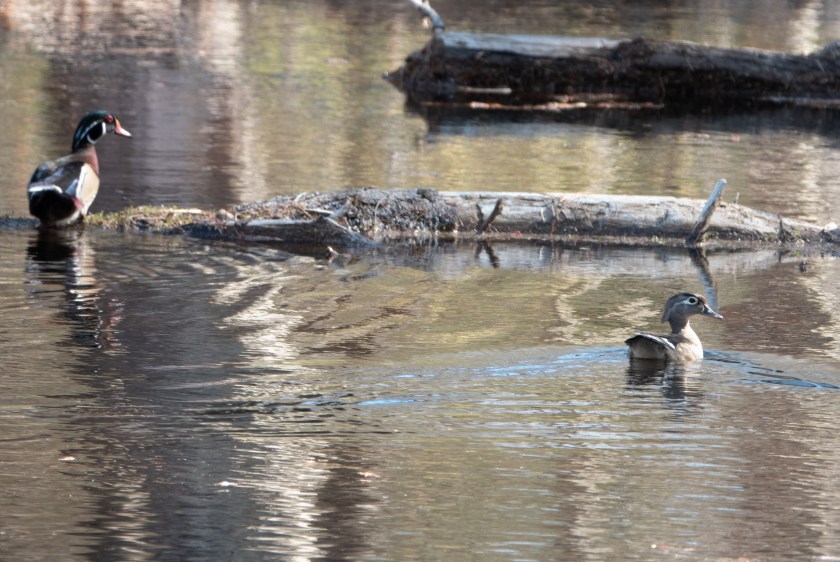
Wood ducks

The males in breeding plumage are extremely handsome, bedecked in an almost military outfit:
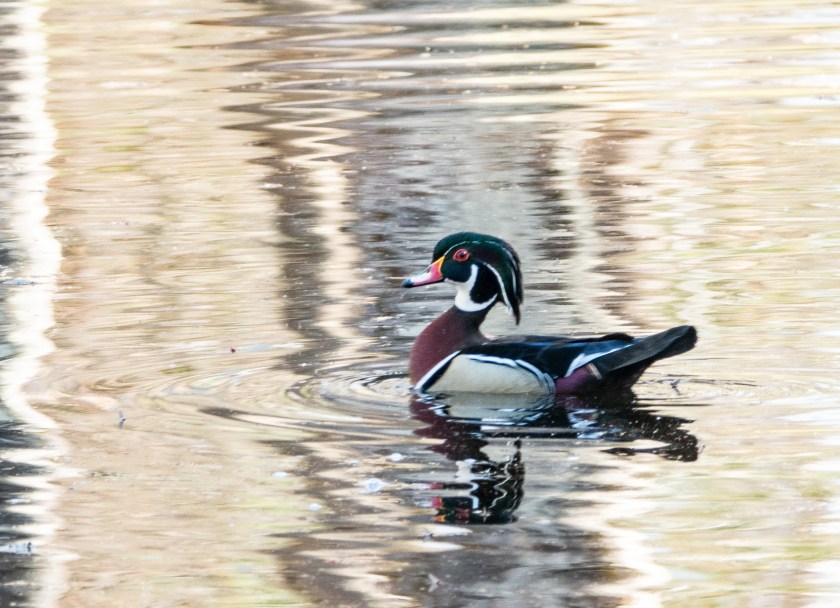
Wood ducks

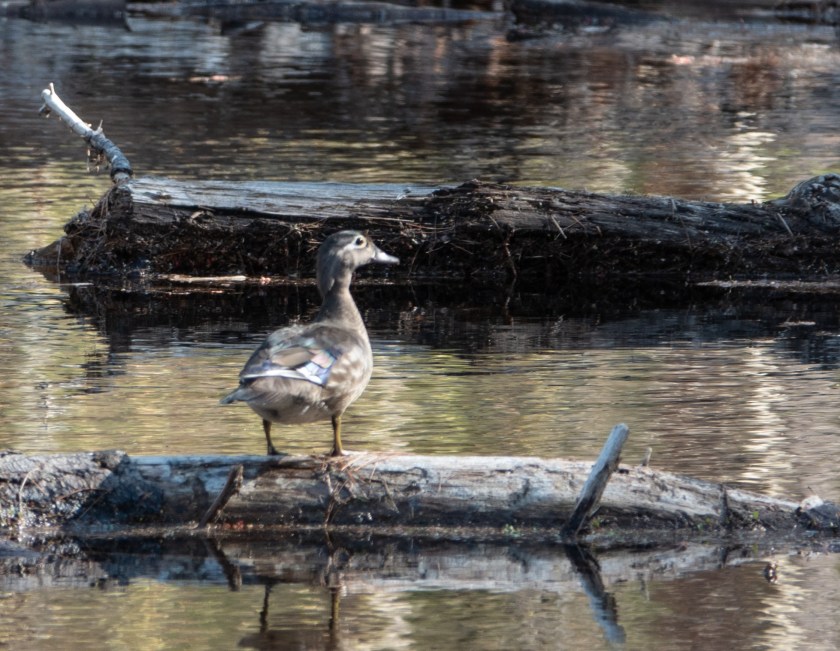
The females are much more discreet:

Wood ducks

I don’t think they are breeding on my pond this year, but last year they did.

We have Canada Geese (yes, you probably hate them but this is their home territory, and I find them rather impressive.) About 8 of them arrived, paired off, then fought for territory,

Canada Goose

As far as I can tell only one pair has stayed put. This pair have chosen an old beaver lodge to raise their young.
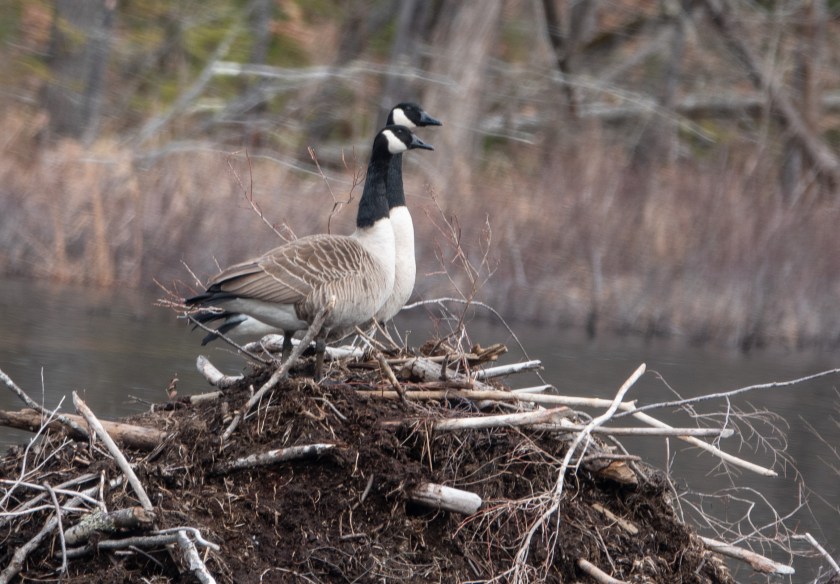
Canada Goose

Feeding on the roots of water plants while they wait for everything to green up again.
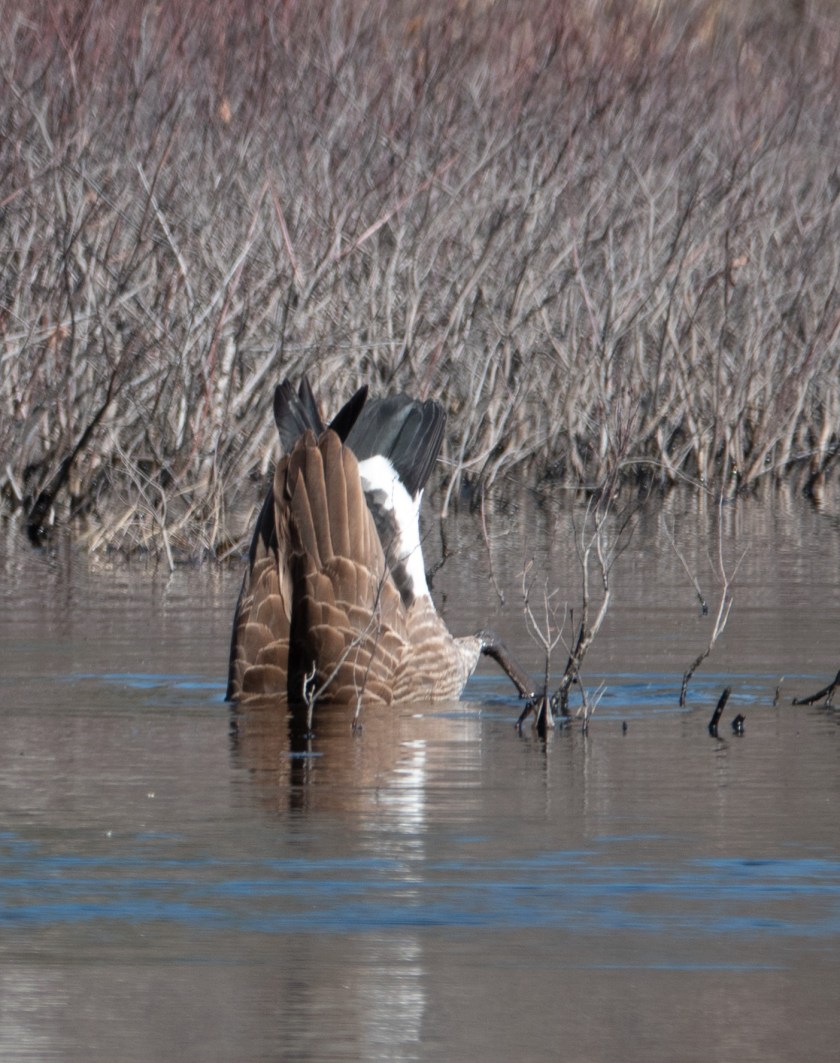
Canada goose

Finally, ten ducklings, now confirmed by Cornell’s eBird moderators as a female Hooded Merganser and her ducklings, with a Black Duck behind them.
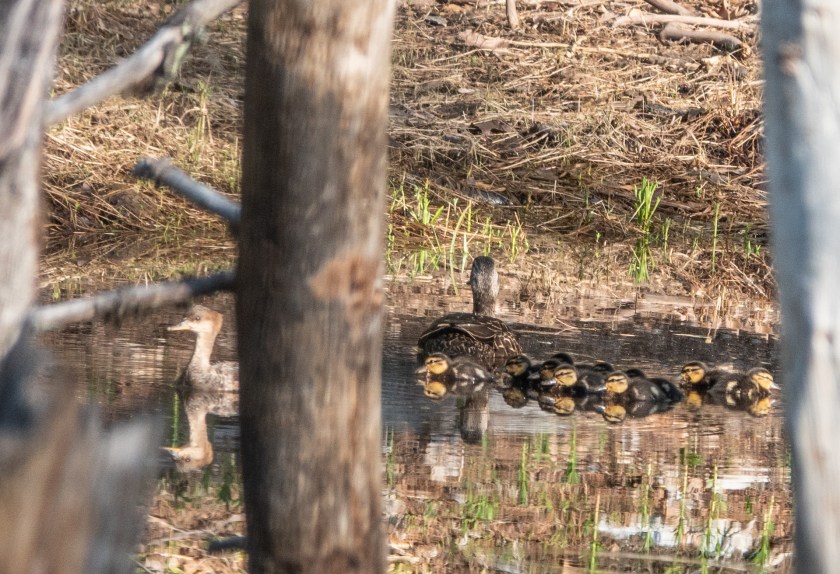
Common mergansers with ducklings

I am actually very worried about them because we have had no rain, and they have chosen an old beaver pond whose dam is no longer being maintained. It is drying out fast, and I don’t know how they will manage. Perhaps she will have to move them, like the  mother in Make Way for Ducklings, a Boston children’s classic by Robert McCloskey.
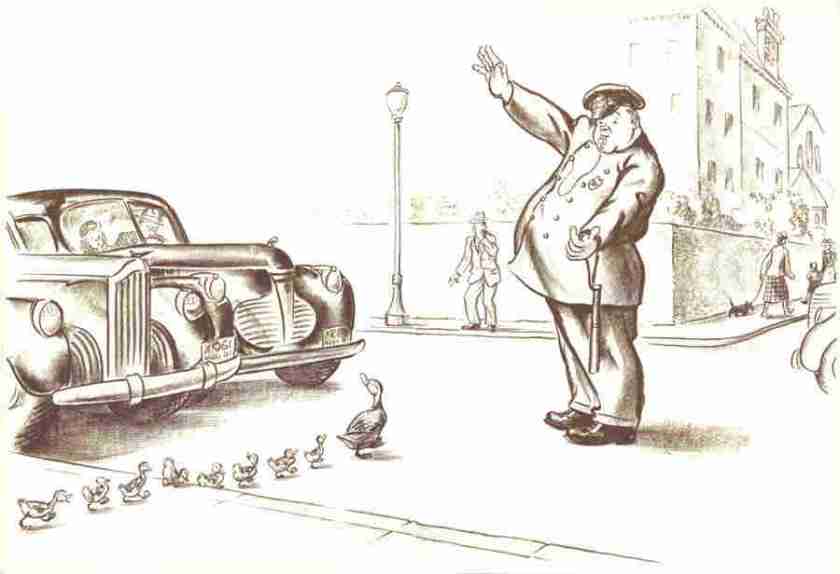
 

ducklingspg46-47_custom-8c2b8fd4e8494177837c3537339224efc25b5969-s1100-c15

PS An earlier version of this post expressed bewilderment at the identity of the ducklings, now thankfully sorted out for me by the Cornell experts!

Frog Blog 11: Dry land!

The very first froglet climbed out of the water and onto a rock this afternoon!

Here he is, the first to make it to frog-hood!

DSC05961

He/she still has a tail, although it is much shorter than it was, as you can see by comparing his tail to the one of the tadpole on the left, who hasn’t developed quite as fast and still has a much longer tail.

DSC05963

But he is ready to go, at the grand old age of 39 days. The cells of his tail will now gently die and be used to build new and different cells, until the tail is all gone. This clever trick is called apoptosis, a very good word to impress your friends with.

If he still seems happy, I will keep him for a few more days as his tail shrinks, take one more photo for you, and then put him back in his original pond.

But if he seems eager to explore a larger world right away, I may let him go right away, and he will be fine. And in that case this will be the last Frog Blog. I hope you have enjoyed them.

“The scattered violets lie..”

The spring comes late here, and the earliest wildflowers are deep in the woods, where the trees are not yet in leaf, and there is still plenty of light. Spring is also short, so these early flowers are often on tiny plants, since the spring growing period doesn’t allow much time for anything to grow tall before it flowers.

I like the violets and pansies, all members of the Viola family. Here are a few for you to enjoy.

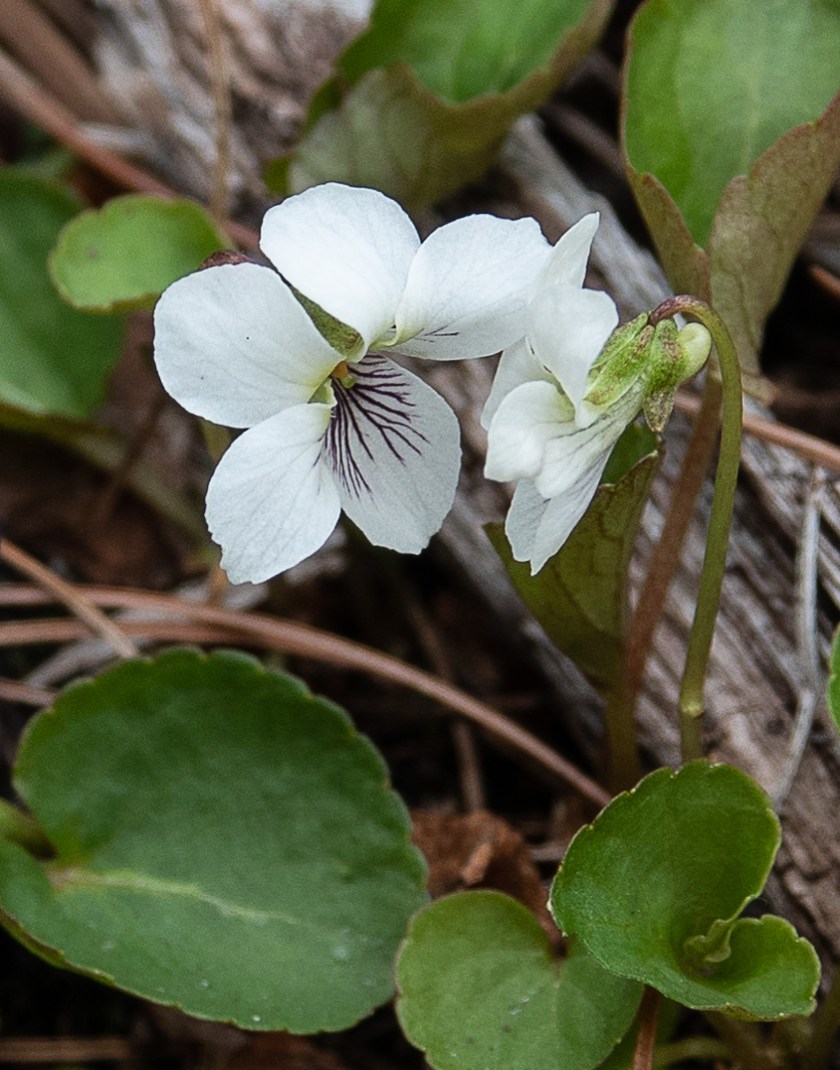
A Northern White Violet, Viola pallens:

DSC00204

A Round-leaved Violet, Viola rotundifolia:

Round-leaved Violet

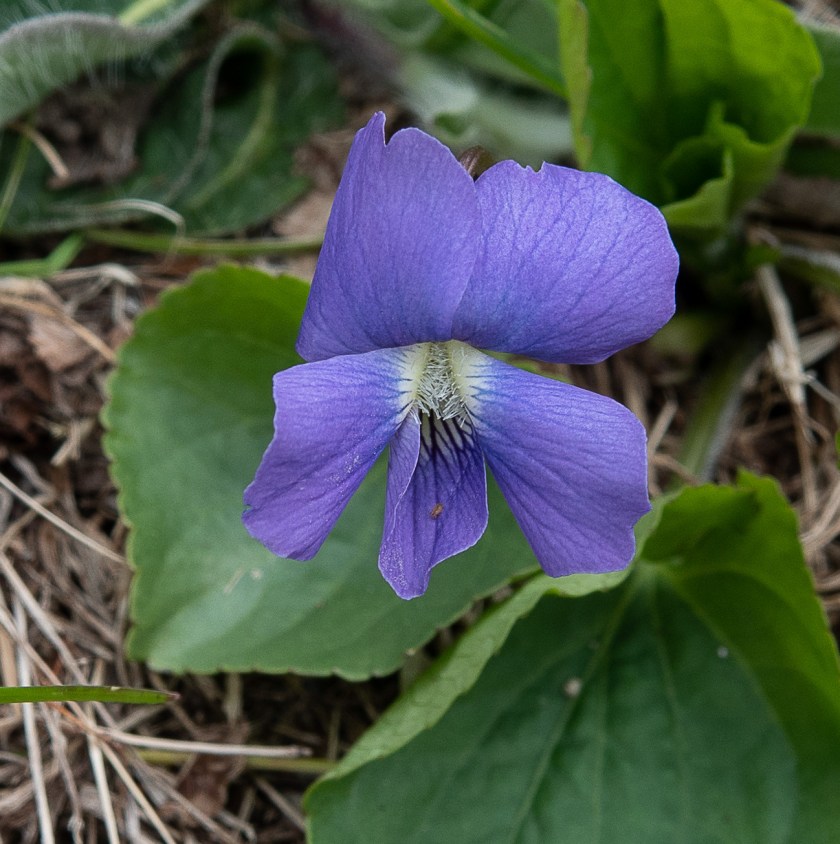
A Common Blue Violet, Viola papilionacea:

Common Blue Violet

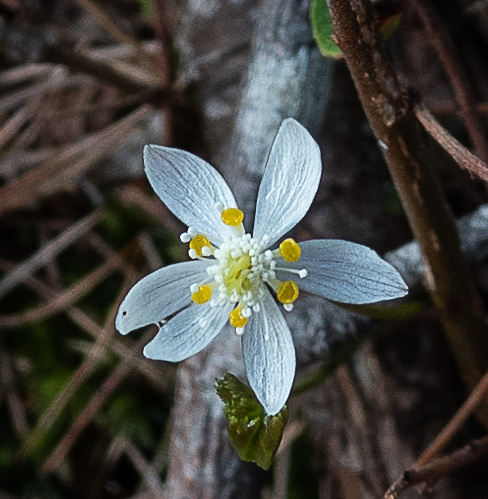
The last one for today is not a viola, but it is very tiny, and very deep in the woods! It is called Goldthread, Coptis groenlandica, and has a single 1/2″ flower, which is exquisite:

Goldthread

The white “petals” are actually sepals, and the real flower is the central portion. The true petals are the golden yellow club shapes, each with a cup-shaped tip that holds nectar.

My title is from the poem March Violet by John Clare. Violets here in Maine are not till late April or early May.

Where last years leaves & weeds decay
March violets are in blow
I’d rake the rubbish all away
& give them room to grow

Near neighbour to the Arum proud
Where dew drops fall & sleep
As purple as a fallen cloud
March violets bloom & creep

Scenting the gales of early morn
They smell before they’re seen
Peeping beneath the old white thorn
That shows its tender green

The lambs will nible by their bloom
& eat them day by day
Till briars forbid his steps to come
& Then he skips away

Mid nettle stalks that wither there
& on the greensward lie
All bleaching in the thin march air
The scattered violets lie

I know the place it is a place
In spring where nettles come
There milk white violets show their face
& blue ones earlier bloom


Frog Blog 10: Fully armed!

The tadpoles are almost frogs… they have got arms as well as legs! Hooray! Look at this splendid fellow, 37 days after hatching:

DSC05877

He is still breathing through gillls, but not for much longer, so I have made sure there is an accessible  rock for them all to climb onto. And soon his tail will begin to shrink. And my work will be done.

Meanwhile, back at the pond, I found a splendid caddisfly who had made a long thin case, from which he emerged looking very fierce with his yellow and black striped head:

Frog

He walked around, hunting for something, dragging his long thin house with him:


I am enjoying all these underwater creatures, who seem so determined and oblivious to us big people on dry ground above them. I don’t think they even know we are there, nor care.


Timberdoodle in road

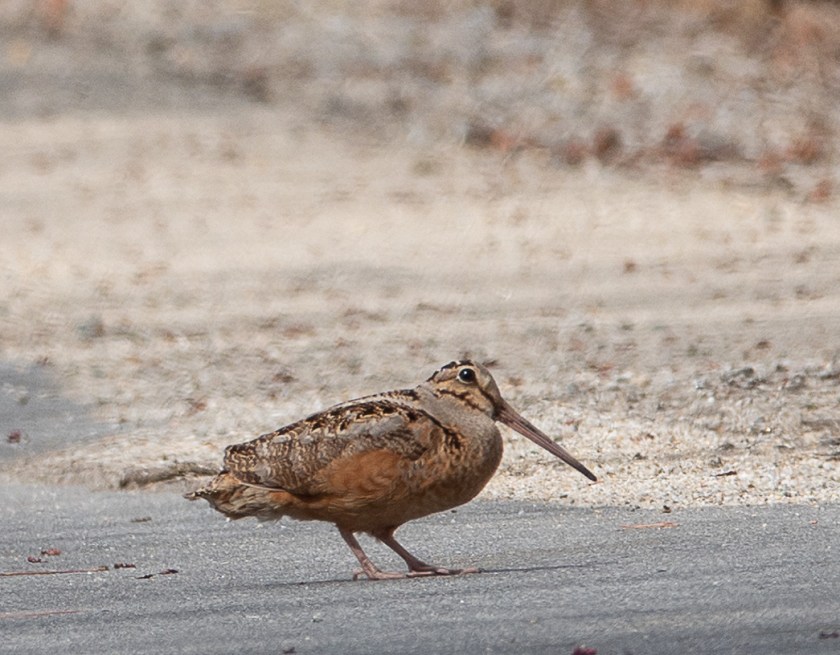
Saturday May 9th started with snow, only an inch but cold and windy, so not at all appealing for a walk. It was Cornell’s Big Bird Day, so I felt I was supposed to go birding, but I wimped out and stayed inside till midday, when it cleared up. Then I drove to a nearby hill for a hike, and on the way back, crossing the road, a woodcock:

American Woodcock, possibly demale guarding nest?

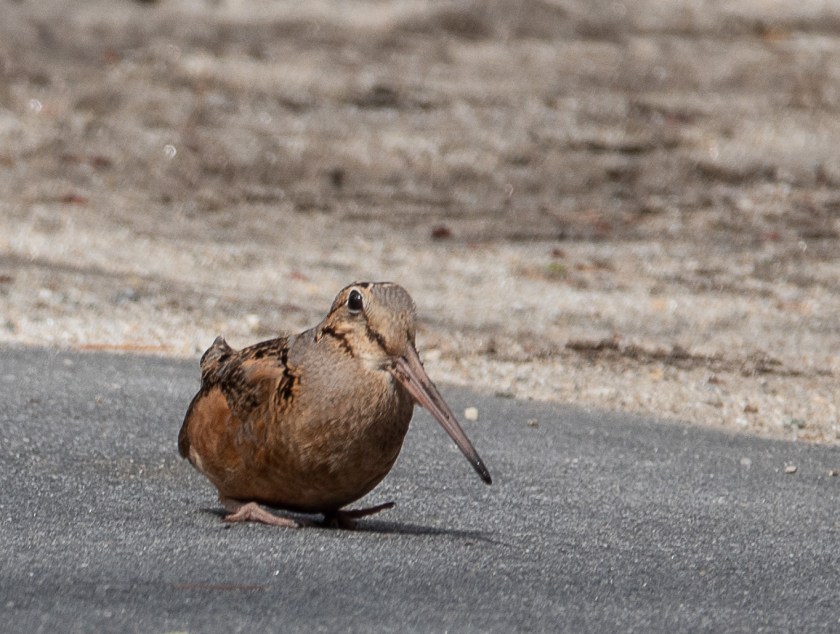
I had never seen an American Woodcock,  Scolopax minor, so I was hugely excited. I stopped (of course), and got out my camera. Instead of scuttling off into the woods it stopped, and slowly hunkered down:

American Woodcock, possibly demale guarding nest?

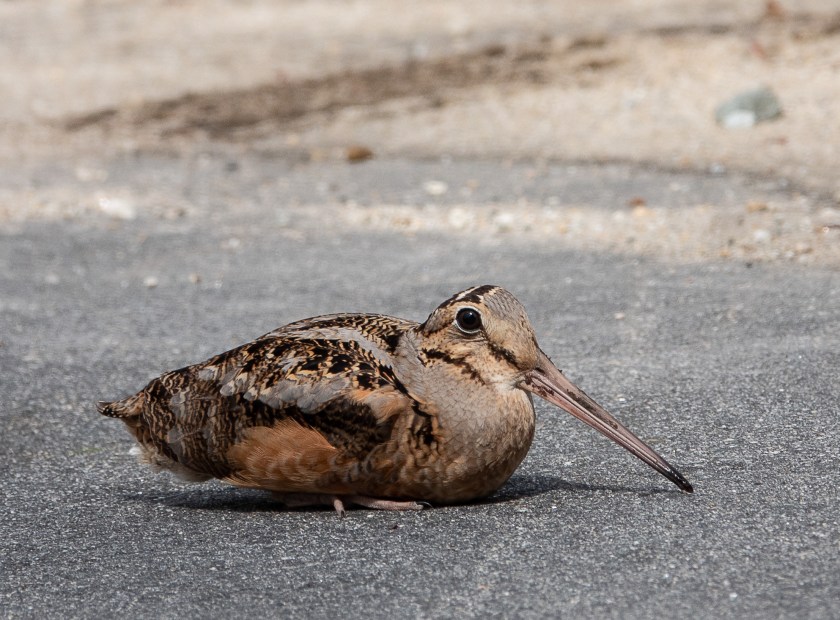
And there it stayed. I crept slowly closer, it didn’t budge, and I got this photo:


American Woodcock, possibly demale guarding nest?

It did not seem to be injured when it was walking, and my guess is she had a nest nearby, and this was her attempt to hide in plain sight, sadly not very effective on tarmac.  I left her in peace, and drove on.

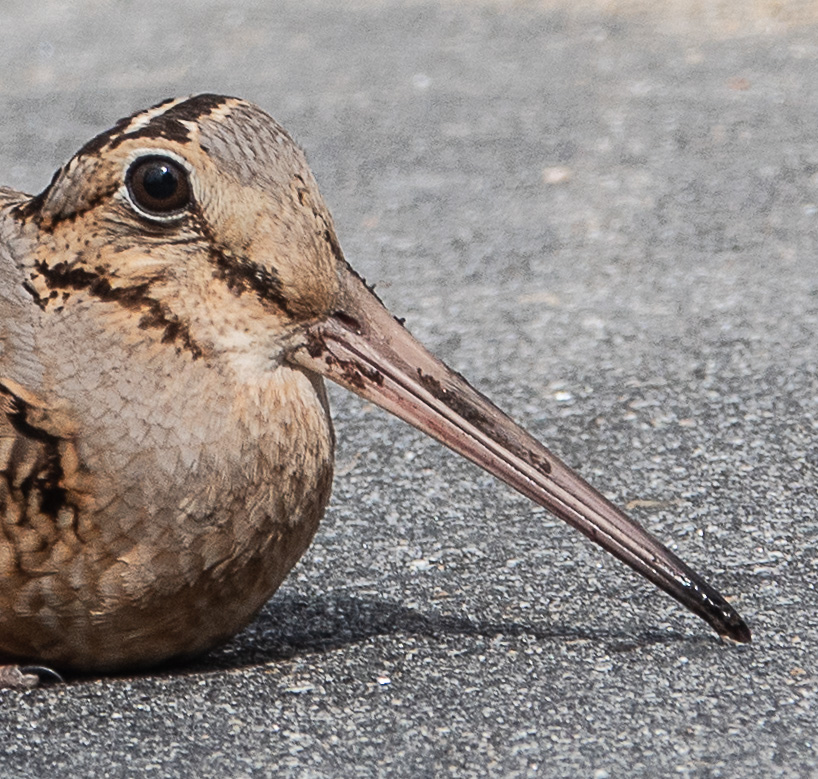
I have since been reading up on woodcocks. They do indeed sometime react to threats near their nests by freezing low on the ground. They have the wonderful local name of Timberdoodles, which is what I will now always call them. Their eyes are on the sides of their heads, so they have 360 degree vision, and the tips of their bills are flexible, to help them dig for earthworms, their main diet. Look closely below:

American Woodcock, possibly demale guarding nest?

The males have a famously flamboyant mating ritual, called “roding”, in which they fly at dusk saying “Peent”. I couldn’t find any good videos of this, let me know if you find one and I’ll add a link.

I am sad to say that their close relative the Eurasian Woodcock is traditionally a British upper-class delicacy. Lord Grantham and his family would have enjoyed roasted woodcocks like these.

https://www.houseofcheviot.com/blog/TRADITIONALROASTWOODCOCK/

Frog Blog 9: Real legs, and walking houses

The tadpoles’ legs look like proper frogs’ legs now, don’t they?

DSC05439

Not only the frogs think spring is coming.  The maple trees are in flower,

DSC04381

and their tiny bright red flowers fall off onto the pond. The photo below has three caddis flies in their home-built houses . They usually use of bits of brown reed, like the top and bottom ones in the photo below, but the one in the middle decided to put on its party clothes, and chose a maple flower instead:

DSC05421

Here is a close up:

DSC05428I think he chose well, don’t you?
And here he is going for a stroll, with his house:

“Beautiful comical things..”

(Another non-frog blog for the adults. My title comes from F. W. Harvey’s poem Ducks, written in 1919 just after World War I. It fits my mood.)

“From troubles of the world
I turn to ducks,
Beautiful comical things..”

In the spring the ducks and geese fly back north.

Some stop in Maine to breed, but some keep going. En route, they rest, so we see species for a short time that we don’t see in the summer or the winter. This bar chart tells me when each species is typically seen where I live, and you can see that some ducks stick around, and some come and go:

https://ebird.org/barchart?r=US-ME-017&yr=all&m=

They will rest on small ponds, like my secluded beaver pond:DSC04759

DSC04847

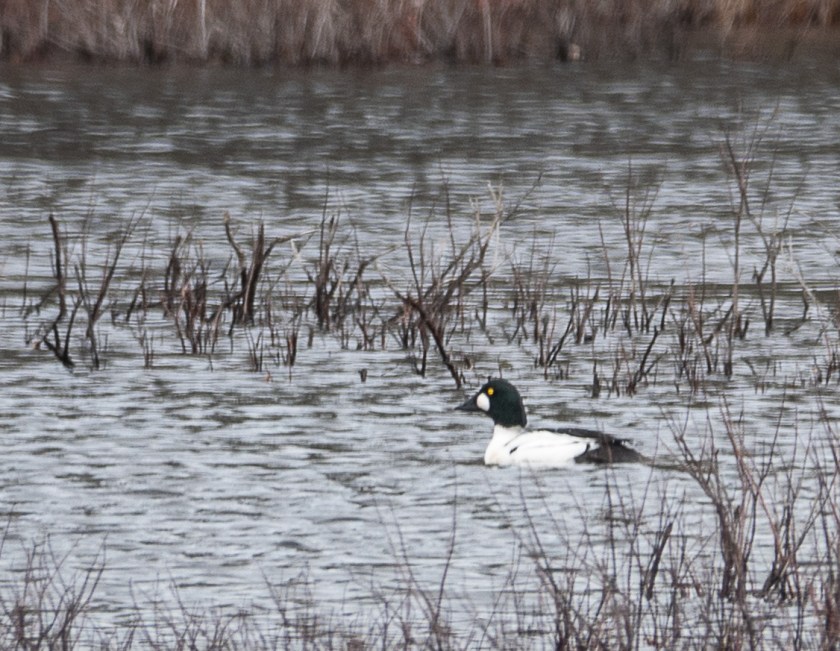
The transients include Common Goldeneye, and Ring-necked Ducks. I am not often here at this time of year, so I have been delighted to see these ducks on my pond. I can’t get close, they are skittish, and the shoreline is marshy so they stay out in open water. Here is a Common Goldeneye

Common Goldeneye

Common Goldeneyes mainly breed in Canada and Alaska, where they nest in tree cavities. They often winter over on the Gulf or Pacific coasts,  along with other Canadians (who are often appropriately referred to as Snowbirds). They eat mainly fish and invertebrates, and a little vegetation.

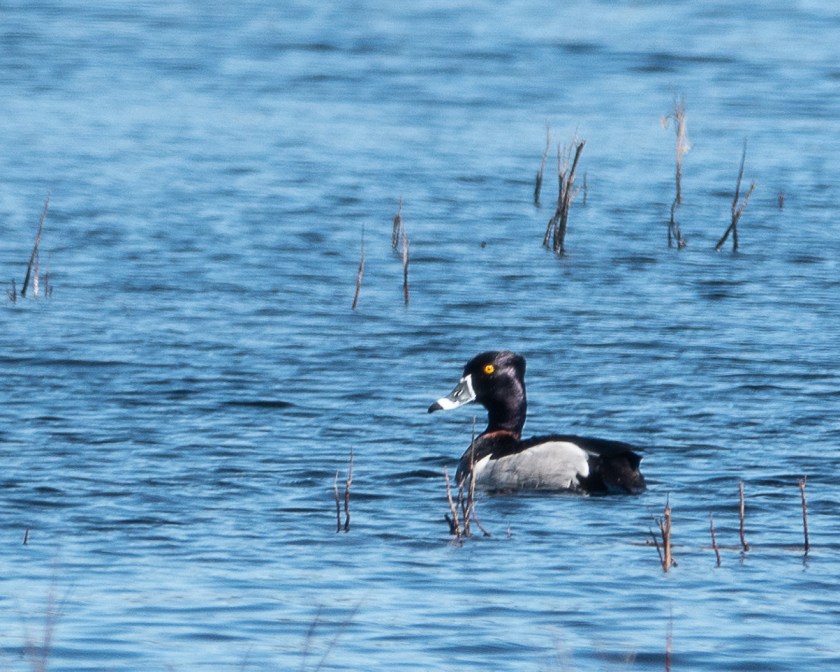
Below are two different male Ring-necked Ducks, which I find charmingly clownish with their striped beaks. They remind me irresistibly of rubber duckies.

images-5

In the first photo you just see the neck-ring:

Ring-necked duckRing-necked duck

They eat submerged vegetation, and invertebrates, and they nest amongst the low marshy bushes and plants. They mainly breed further north, but I still have two pairs of on May 7th, and they do occasionally nest here, so maybe I’ll get lucky and they will stay.

Another time, I’ll show you some of the ones that routinely stay and breed including Common Mergansers, Hooded Mergansers, Wood Ducks, American Black Ducks (and Mallards and Canada Geese).


Frog Blog 8: Legs!!

IT’S GOT LEGS!!!

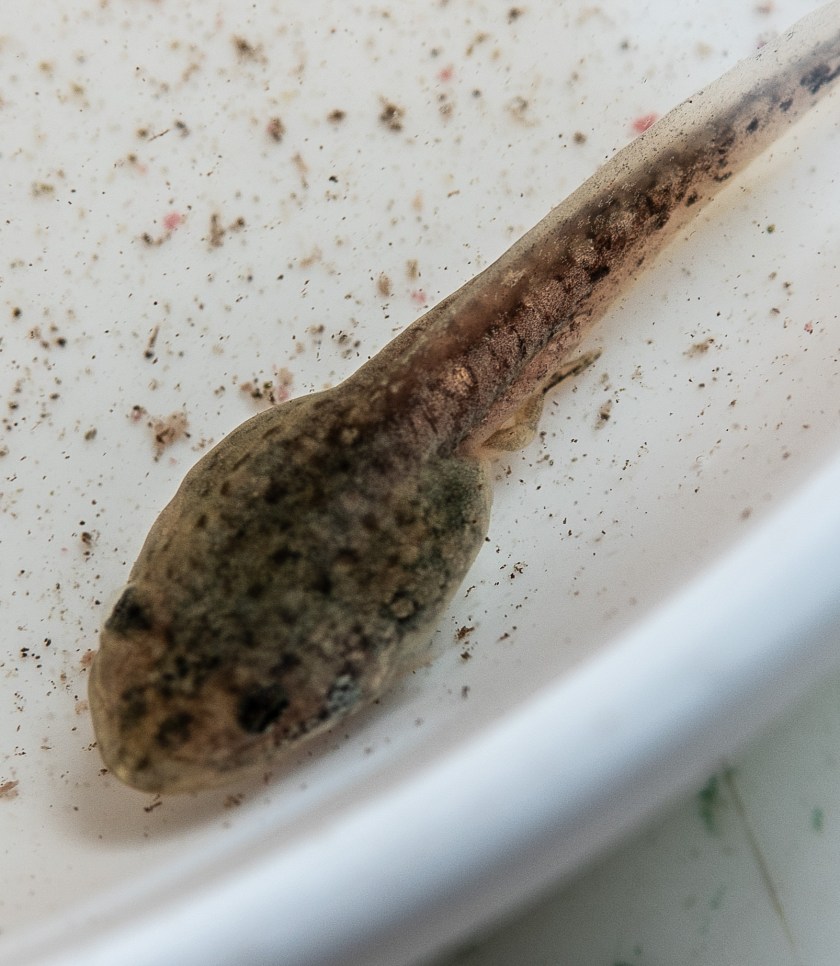
Yesterday I wasn’t sure, but this morning it is official. The tiniest imaginable legs have appeared.  They are really hard to photograph because as they get bigger they swim faster and faster and wriggle more and more, but can you see the tiny leg here?

DSC04989

This is now 27 days after hatching, and I think it now takes about 10 more days for them to turn into frogs, which seems awfully fast to me! I have put lots of them back in the pond, and kept less than ten, so they have plenty of space.

I will put some bigger rocks in their bowl for them to climb onto.

Watch this space.


Frog Blog 7

(Keep reading, even if the tadpoles are not doing much… there’s a cool photo lower down.)

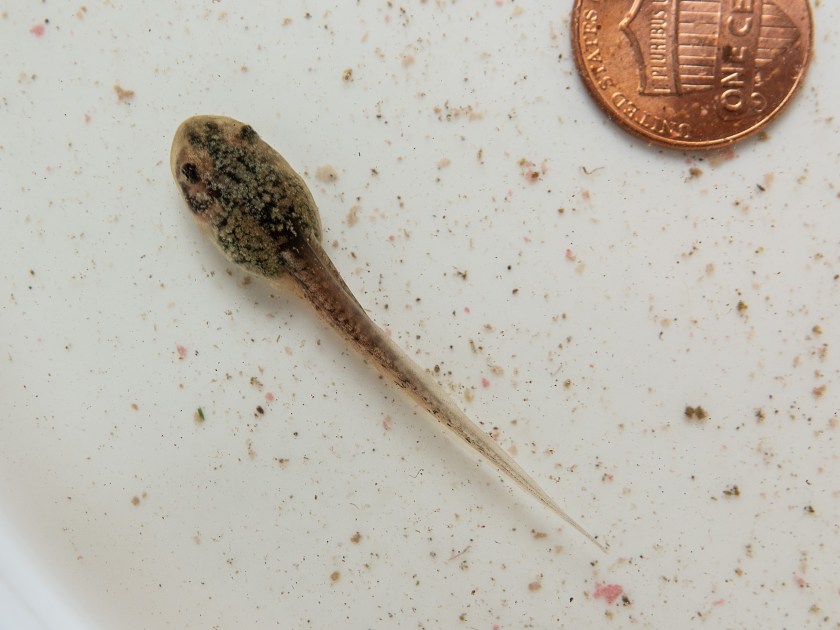
The tadpoles are even bigger now, but STILL no legs!! They hatched 24 days ago, and the legs usually appear between 20-30 days after hatching, so it must be pretty soon. Here’s a photo to show you their size now. (I lost my dime, so this is next to a one cent piece, about the same size!).

DSC00192

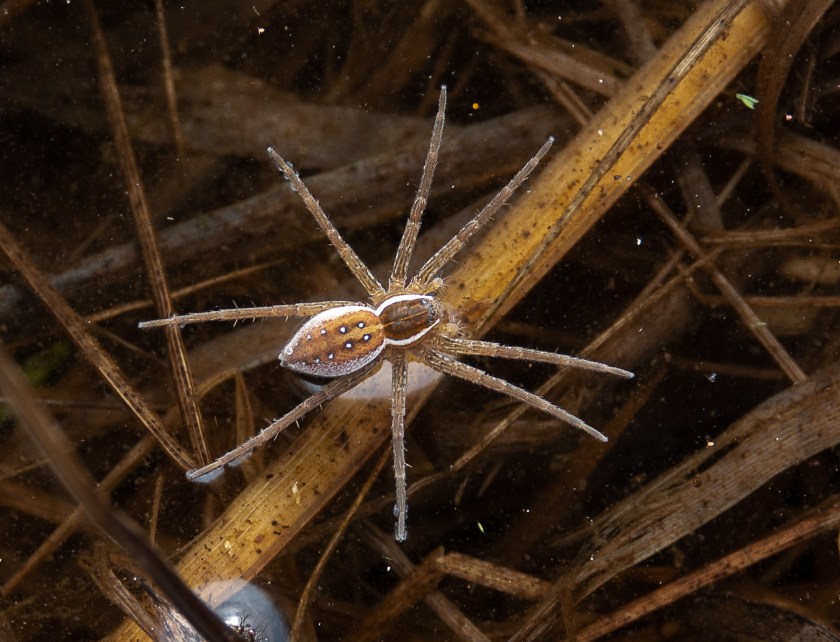
When I was getting water the other day, something big was skipping around on the surface of the water. It was a Fishing Spider, Dolomides triton..

Dolomedes triton, the fishing spider

She was right near the frogs’ eggs, which are now surrounded by millions of tadpoles, so she was obviously hunting them.  She waits for the tiny ripples created by her prey, then she runs across the water and grabs them and injects them with her venom.

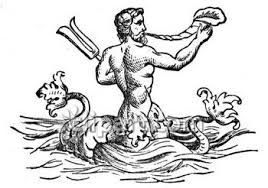
Her Greek name is Triton, the mythological son of Poseidon the god of the sea, who acted as his father’s messenger. Here he is , and I don’t think my spider looks much like him !

triton

Beauty in small things

Lichen are so tiny and so close to the ground that we often ignore them. In close up they are fascinating. They are a fungal host in symbiosis with either algae or cyano-bacteria, which perform photosynthesis , under the protective cover of the fungal host. The component organisms cannot live independently: they need each other to survive.

It is possible to observe roughly how they reproduce, although many of the details are still not well understood. They have a variety of different methods.

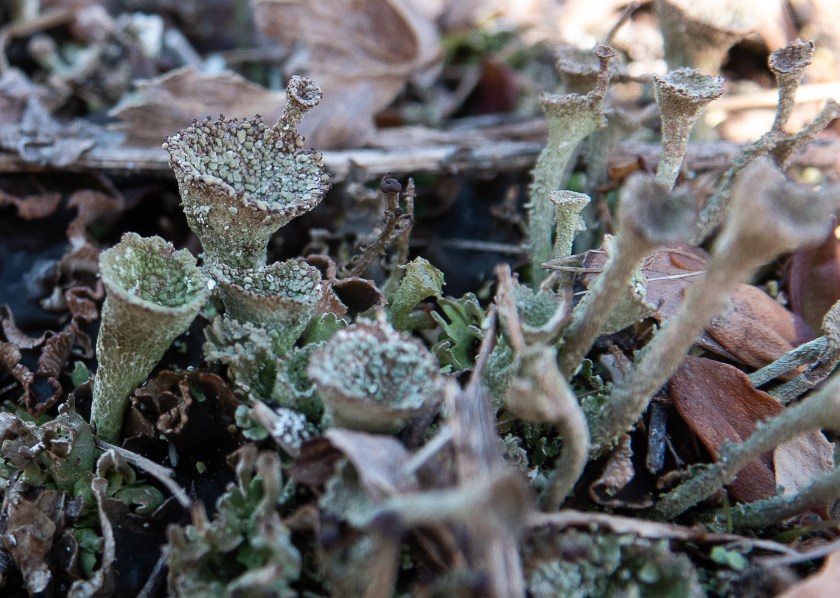
The Trumpet lichen, of the genus Cladonia, extrudes tiny trumpet-shaped stalks called podetia:

Cladonia sp. lichen

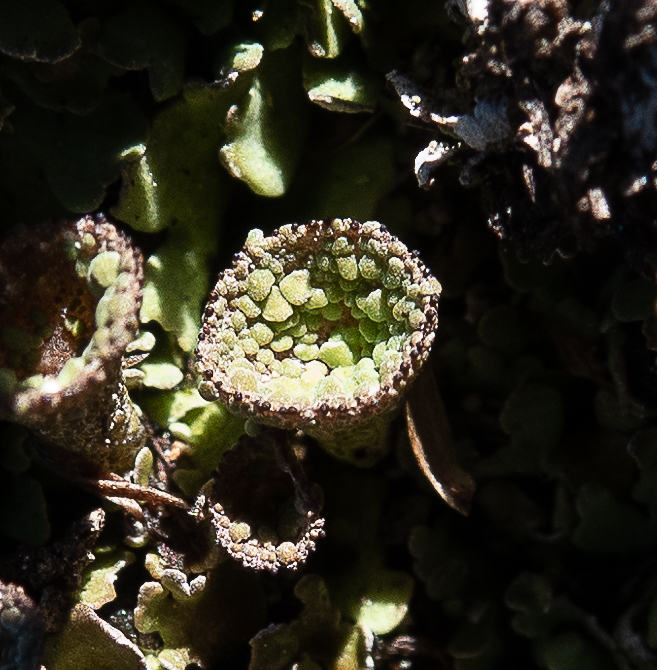
The little pea-like objects inside the podetia are the lichen “spores”. More properly, they are called soredia, and they are granules of algae and fungi ready to disperse and start a new lichen. Here they are in close-up.

Cladonia sp. lichen

Other lichens have different strategies. This is a ruffle lichen, as I usually find them, on a fallen tree branch. .

Ruffle lichen

This one, however, looked different.

Ruffle lichen

In close-up, those brown patches are shiny:

Ruffle lichen

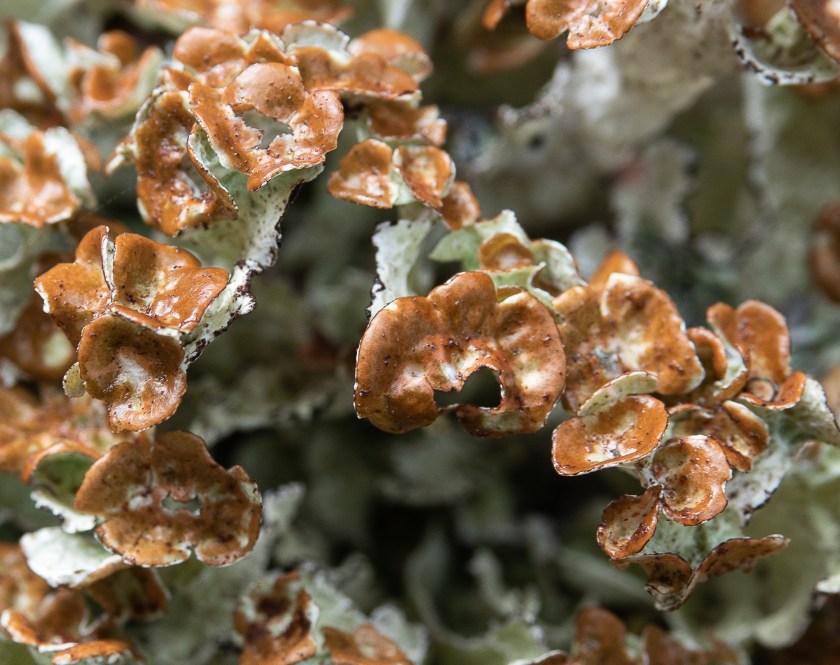
They are, I think, isidia: small growths of the upper cortex with a shiny surface, and they are the fruiting bodies of this type of lichen. They are brown after rain, they turned black the next day when they were dry,  then brown again after another rainy night.

The lichen below is a species of pelt lichen, Peltigera, that grows on rock, and the reddish brown upcurled lobes are the fruiting bodies:

Pelt species, with reddish brown lobes that are fruiting bodies

The moral of this tale is look closely at your lichen, especially after rain, and you might be delighted. This illustration is from a 1908 German book, entitled “Flora im Winterkleide”, or “Flowers in winter dress”, the artist clearly recognizing the beauty to be found in small things.

unnamed-3